

Introduction
Growth hormone (GH) is an endocrine factor with multiple functions that mediates animal growth and metabolic actions. It can promote the growth of animals, being involved in the regulation of animal growth, and has a variety of physical effects, such as gonadal maturation, osmotic pressure regulation and immune regulation. Because GH is a biological macromolecule, it cannot pass through the cell membrane directly. It must bind with a protein encoded by growth hormone receptor (GHR) on the surface of the target cell. GHR is a cytokine/haematopoietic receptor superfamily member that binds GH via its extracellular domain. GH interacts with GHR in a 1:2 GH:GHR stoichiometry with two sites on the GH molecule binding sequentially to the two receptors in the complex. It signals via interaction of the GHR cytoplasmic domain with JAK2 and other signalling molecules. The mature protein of GHR is 620 amino acids in length. The majority of animals' GHR molecules weigh between 100 and 130 kDa. The bovine GHR gene has been mapped on chromosome 23 and consists of ten exons and nine introns.
Parmentier et al. (Reference Parmentier, Portetelle and Gengler1999) reported that GH and GHR genes were important candidate genes in animal growth, carcass traits and lactation traits. Aggrey et al. (Reference Aggrey, Yao and Sabour1999) detected three single-nucleotide polymorphisms (SNPs) within the GHR 5′ untranslated region. Ge et al. (Reference Ge, Davis, Hines and Irvin2000) found four SNPs within the GHR gene exon 10, at positions 76 bp (T/C), 200 bp (G/A), 229 bp (T/C) and 257 bp (A/G). Of these, the two SNPs at positions 200 bp and 257 bp led to amino-acid substitutions, the other two being nonsense mutations. Curi et al. (Reference Curi, Oliveira, Silveira and Lopes2000) found that L/S substitution of the GHR gene regulation region affected the growth of beef cattle, with their body weight increasing significantly. Blott et al. (Reference Blott, Kim and Moisio2003) found nine SNPs of the GHR gene in Holstein cattle, occurring on exon 8 as a T/A substitution. This transition resulted in F279Y amino-acid replacement in the receptor transmembrane domain, which had a significant impact on milk yield and milk composition in the Holsteins. Viitala et al. (Reference Viitala, Szyda and Blott2006) also found this effect of these SNPs in Finnish Ayrshire cattle. Qin et al. (Reference Qin, Xu and Gao2007) have reported that GHR exon 10 variants have a significant association with body size and weight indicators in Nanyang cattle, and Galloway and Limousin cattle. GF Zhao et al. (Reference Zhao, Chen and Lei2007) studied Qinchuan cattle and found a significant link between exon 10 polymorphism and growth traits.
Research, both in China and abroad, has frequently studied the GHR gene, but most of these studies revealed the associations between GHR polymorphic variants and growth traits. Research on associations between polymorphic variants and milk performance traits is very uncommon. Using created restriction sites polymerase chain reaction (CRS-PCR), we created a restriction site at 4962 bp of the GHR gene (the 279th amino acid) to detect the polymorphisms of this SNP and to evaluate the mutations as potential markers of milk performance traits.
Materials and methods
In 351 Holstein cattle, we analysed the genetic structure of the population and associations between polymorphic variants of the GHR gene and milk performance traits. Using the CRS method (CJ Zhao et al., Reference Zhao, Li and Deng2003), we designed a pair of primers according to exon 8 of the bovine GHR gene sequence (GenBank AM161140). In our study we changed the third nucleotide of the 3′ terminal of the forward primer from T into A. Following PCR, the changed nucleotide was able to form the ‘AAT(T/A)’ sequence at this site, allowing recognition by TasI.
Blood (~10 ml) was withdrawn from each animal in order to isolate genomic DNA from leukocytes using the phenol/chloroform method. The genomic DNA was then dissolved in Tris-EDTA buffer (TE) and preserved at −20°C.
PCR was carried out in 25 μl of a mix containing 0.3 μl of each primer (20 mmol/l, forward 5′-ATACTTGGGCTAGCAGTGACATAAT-3′, reverse 5′-CAACAAAGATGTAAATGTAGAGCGA-3′), 0.5 μl dNTP (10 mmol/l each), 1.8 μl MgCl2 (25 mmol/l), 2.5 μl 10×PCR buffer (Sangon), 1 U DNA polymerase (Sangon) and 50 ng of genomic DNA, and H2O was added to make a final mix volume of 25 μl. The PCR reaction was carried out in an Eppendorf Mastercycler 5330 Thermocycler under the following conditions: initial denaturation (94°C for 4 min); 35 cycles of denaturation (94°C for 30 s), annealing (59°C for 30 s) and extension (72°C for 30 s); and final synthesis (72°C for 4 min). The yield and specificity of the PCR products were evaluated after electrophoresis in 1% agarose gel (Promega) with ethidium bromide. The results were observed, analysed and documented using a Fluor-s MultiImager (Bio-Rad).
In order to conduct genotyping of the Holstein populations, restriction fragment length polymorphism (RFLP) analysis was performed. The PCR product (8 μl) was digested with 5 U of TasI restriction endonuclease (Fermentas) and analysed by electrophoresis in 3% agarose gel (Promega) with ethidium bromide. We selected different genotypes of PCR products and sent them to Shanghai Sangon Biological Engineering Technology and Services Co., Ltd. for sequencing. Allele and genotype frequency and their accordance with the Hardy–Weinberg law were assessed using POPGENE 1.31 software (http://www.ualberta.ca/~fyeh). The association between polymorphic variants of the GHR gene and milk performance traits was analysed using the General Linear Model (GLM) procedure (SAS 9.0). The following model was used:

where Y ijkm is the observation of the trait, μ the overall mean, G i the fixed effect of the ith genotypes, YS j the fixed effect of the jth year-season of calving, H k the fixed effect of the cattle farm, P m the fixed effect of the birth parity and e ijkm is random error.
The significance of differences between the means for each group was verified by the Duncan test (at significance levels P<0.05 and P<0.01). The following milk performance traits were analysed: milk yield (kg), fat content (%), protein content (%), the ratio of fat percentage and protein percentage, somatic cell score (SCS). Data on milk performance traits were retrieved from breeding documentation available from the owners of the cows.
Results
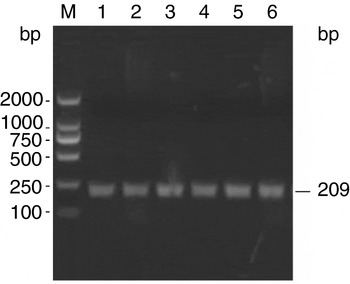
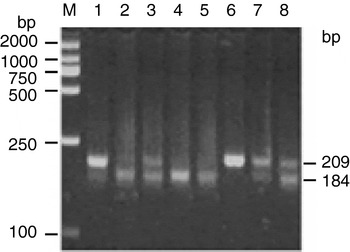
First, we obtained a specific PCR product of a desirable size (209 bp). PCR products were then sent to be sequenced in order to precisely identify the location of mutations. According to the sequence available in Genbank (AM161140), the transition of T into A in position 4962 led to amino-acid substitution and created a restriction site for TasI endonuclease. Digestion of the 209-bp PCR product (Fig. 1) with the enzyme resulted in two restriction fragments of 184 and 25 bp for the TT homozygote, one uncut fragment of 209 bp for the AA homozygote and all three fragments for the TA heterozygote (Fig. 2).
PCR products of GHR. 1–6, PCR products; M, DL 2000 marker.

TasI-RFLP (restriction fragment length polymorphism) patterns of GHR. Lanes: 1 and 6, AA genotype; 2, 4 and 5, TT genotype; 3, 7 and 8, TA genotype; M, DL 2000 marker.

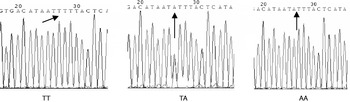
Sequencing revealed one single nucleotide mutation T→A at 4962 bp of the gene in genotype TT when compared with genotype AA, and this mutation resulted in an amino acid change of phenylalanine (TTT)→tyrosine (TAT) (Fig. 3).
Sequence comparison of TT, TA and AA genotypes in the exon 8 of GHR gene.

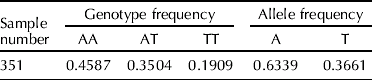
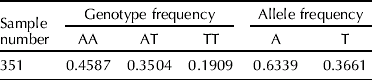
Using polymerase chain reaction restriction fragment length polymorphism (PCR-RFLP), we analysed the genetic structure of Holstein cattle breeds. Allele frequencies were estimated in 351 Holstein cows (0.6339 and 0.3661 for A and T, respectively). The frequencies of genotypes within the breed group were not in accordance with the Hardy–Weinberg proportions (Table 1 and 2).
Genotype and allele frequencies of polymerase chain reaction restriction fragment length polymorphism (PCR-RFLP) products of GHR exon 8
Polymorphism information contents (PIC), heterozygosities (He), effective number of alleles (Ne) and χ 2 value

Significant associations between GHR genotypes and milk performance traits were observed. In Holstein cows, a statistically significant difference in fat content was found. Cows with genotype TT had a higher fat content than cows with genotype AA (P<0.05) (Table 3). No significant differences were found between the other indexes.
Least-square means and standard error for milk production traits of different genotypes of GHR gene

Least-square means with different small letter superscripts within the same column differ significantly (P<0.05)
Discussion
Using the CRS method, by mismatching the 3′ terminal base of the primer, PCR products, after having been digested, were available for identification of genotypes. This technology was convenient to use, it being inexpensive, easy to use and flexible. In this study a restriction site was created in order to obtain the allele frequencies of the GHR gene. The experimental method was simple and efficient. It fully proved that the method was suitable for the analysis of the genetic structure of a single base mutation.
Research indicated that the GHR gene in Chinese Holstein cattle had rich polymorphisms, the frequency of the A allele being higher than that of the T allele, so the A allele is the dominant allele (0.6339/0.3661). However, the study of Viitala et al. (Reference Viitala, Szyda and Blott2006) gave different results (0.11/0.89) in Finnish Ayrshire cattle, the difference between the studies being large. This may be related to geographical differences as well as the bulls being from different sources, and also prompted the observation that in different breeds of cattle, the variation of gene sequences is different. The factors PIC, He and Ne can all be used to measure genetic variation within groups, and its value reflects the level of the degree of individual heterogeneity within homogeneous groups. The higher the value, the larger the genetic variations and the greater the choice potential. We found that GHR gene exon 8 showed moderate polymorphism in Chinese Holstein cows. This indicated that it had large genetic variations. Chinese Holstein cattle of this locus were not in accordance with the Hardy–Weinberg proportions. This indicated that this group has been affected by genetic drift and artificial selection. In our study, combined with sequencing, we revealed that the 4962 T/A substitution resulted in the 279th amino acid change from phenylalanine to tyrosine in the receptor transmembrane region. By using SAS software, we found that Holstein cows with genotype TT had significantly higher fat content than cows with genotype AA (P<0.05). The results were in accordance with the data reported by Blott et al. (Reference Blott, Kim and Moisio2003). This result confirmed the usefulness of the T allele in genetic improvement of milk fat content. The GHR gene also had a significant impact on growth traits. We should therefore study the influence of the different exons of GHR in order to find molecular markers that can improve a variety of economic traits in cows. Because the proportion of cows with the TT genotype in this group was small, we should increase the frequency of this genotype through molecular breeding methods. Cows with AA genotype had higher milk yield and protein content than cows with the other genotypes. However, the differences between them were not significant. This research also needs to expand the number of cows analysed in order to obtain accurate conclusions. Di Stasio et al. (Reference Di Stasio, Destefanis, Brugiapaglia, Albera and Rolando2005) studied the polymorphism of GHR exon 10, 257 bp, and analysed the associations between polymorphic variants and meat yield and meat quality. They revealed that the associations between the 14 external characteristics and four meat natures of Piedmont cows and polymorphic variants were not significant. In this study, the impact of polymorphic variants on the ratio of fat percentage and protein percentage (R) and SCS were not significant. This may be because the milk performance traits were affected by several genes. The effect of the GHR gene alone was very weak, so any research should investigate several genes in order to do a good job in addressing molecular genetic breeding.
Acknowledgements
This work was financially supported by the National High Technology Research and Development Program (‘863’ Program) of China (grant no. 2007AA10Z169), the Breeding Project of Shandong Province (grant no. 2006LZ10-04), the Research and Innovation Fund Project of Shandong Academy of Agricultural Science (grant no. 2006YCX028, 2007YCX019) and the Youth Research Fund Project of Shandong Academy of Agricultural Science (grant no. 2006YQN038).