In 1762 the British captured both Havana, the pearl of the Antilles, and Manila, the Spanish trading entrepôt in Asia. This marked a low point for Spain among European powers and exposed the Spanish Empire's structural weaknesses. For the next forty years, the Spanish crown implemented a series of institutional reforms in colonial Mexico comparable to those begun by Britain in the late seventeenth century. Spanish royal officials increased the centralization of the fiscal administration and undertook a military buildup. They created a regular army while strengthening the militias. Fiscal officials were appointed to collect taxes and most tax farming was eliminated. Between 1760 and 1790 the growth rate of tax revenue in colonial Mexico was among the highest in the world. By the late 1770s the contribution of colonial Mexico to total fiscal receipts in Spanish America was 78 percent (Klein 1998, p. 13).Footnote 1 Colonial Mexicans were contributing 70 percent more taxes per capita than metropolitan Spaniards: the yearly averages were approximately 3.6 and 2.5 pesos per capita by 1790, respectively (Marichal 2007, p. 54).
The success of the colonial reforms in Mexico contrasts with the limited success of parallel fiscal attempts in metropolitan Spain (Pieper 1992, pp. 80–81). It also contrasts with the failure of similar measures undertaken by the British in the thirteen colonies, which led to their struggle for independence after 1775. The Spanish monarchy retained control of colonial Mexico until 1821.
As in Europe on the eve of the formation of the modern state, fiscal capacity in colonial Mexico was fragmented prior to the reforms. The central government had a limited ability to directly collect and enforce taxes. Instead, various entities had fiscal autonomy. Provincial authorities (e.g., cities) and private corporations (e.g., merchant guilds, the church) collected taxes over specific economic activities and regions.Footnote 2 The Crown negotiated bilaterally with the corporate and local elites exchanging fiscal exemptions and other privileges for upfront payments. An increase in fiscal centralization and military buildup implied losses of fiscal and other privileges for these elites. Why did powerful elites allow the emergence of a fiscal-military state in colonial Mexico?
Existing explanations for the growth of fiscal-military states focus on Europe. The conventional accounts emphasize the impact of military conflicts and the supporting role of representative assemblies. Wars unify disparate populations (Huntington 1968; Kiser and Kane 2001) and make the benefits of a well-financed state more salient to many actors (Levi 1988; Besley and Persson 2009, 2011).Footnote 3 Despite the higher benefits from taxation in times of war, commitment problems may impede fiscal cooperation. An unconstrained fiscal-military state has incentives to expropriate elites or renege on its debts. A representative assembly, such as a parliament, limits the extent to which the sovereign can spend and borrow unchecked, increasing thus the sovereign's credibility and fiscal cooperation (North and Weingast 1989; Hoffman and Norberg 1994; Dincecco, Federico, and Vindigni 2011).Footnote 4 The rise of the fiscal-military state in colonial Mexico varies from the conventional European account. The Seven Years' War (1756–1763) indeed played an important role in the Spanish monarchy's successful reforms in colonial Mexico. However, there were no representative assemblies in the Spanish colonies to explain the endurance of the empire for almost another half century.Footnote 5
This article offers an explanation that centers on the collective action problem among fiscally powerful elites created by fiscal fragmentation. When fiscal capacity is fragmented, fiscal payments rely on bilateral, private contracts between each elite and the Crown. Corporate and local elites, as a result, free ride on each other's fiscal contributions to military defense (a public good), contributing less than the socially optimal amount.Footnote 6 Centralization of tax monitoring and enforcement by the central government can serve as a commitment device for elites to overcome free riding. Fiscal centralization, however, entails costs for the central government and the compliance of at least some of the fiscally powerful. Fiscal fragmentation and the military weakness of the Crown in the Americas limited the Crown's ability to impose the reforms, at least in the early stages.Footnote 7
I argue that a military threat provided incentives for the Crown to propose fiscal centralization and for the elites to comply because the benefits to the main corporate elites from military protection were aligned with those of the Crown. In colonial Mexico, the Spanish authority guaranteed the survival of the elite's economic rents and patronage. Also, the public good nature of military protection accentuated the free-riding costs from lack of fiscal cooperation.
I analyze the narrative history and statistical records of colonial finance in eighteenth-century Mexico. The evidence shows that attempts at fiscal institutional reform were successful only after the Seven Years' War. The analysis also shows that fiscal and military reforms were more successful in the regions where the elites were more economically dependent on the Crown. I also discuss failed attempts elsewhere in the Americas that evidence the importance of a common threat between central government and elites.
This study contributes to the literatures on state building in Europe and Latin America by emphasizing two conditions for “war making states.” First, my argument emphasizes the public good nature of military defense. In contrast to an army built for an offensive, it is difficult to exclude groups from the benefits of defensive military buildup; it is easier to earmark the spoils of an offensive war to specific groups. The case of Mexico isolates the effect of defensive goals in the military buildup. While most monarchs in Europe engaged in both defensive and offensive interstate warfare for centuries, the Spanish Crown faced few challenges in colonial territory prior to the Seven Years' War. The case of colonial Mexico thus highlights that war can make states by calling attention to weaknesses that require building elite cooperation.Footnote 8
Second, a focal central authority is a precondition for my argument. Absent a central authority able to propose fiscal centralization and to enforce fiscal collection, an increase in the probability of a threat will not lead to a fiscal-military state. The recent explanations for the lack of state-building in nineteenth-century Mexico corroborate the importance of this precondition. Despite the many regional conflicts and violence during and after the independence wars (1810–1821), the Mexican emerging state did not consolidate until the 1880s. Miguel Centeno (2002, pp. 139–40) argues that “control of the state remained in contention […] the structures or authority required to make use of [the stimulus of war] were not consolidated.”Footnote 9 Indeed, the French invasion of peninsular Spain and abdication of Ferdinand VII in 1808 drastically reduced the legitimacy and credibility of the Spanish Crown, leading the colonial elites to opt for independence. Also, in the process of building the new state, there was no elite faction strong enough to coordinate expectations among the rest.
The following section describes the theoretical argument in more detail. I next provide evidence for fiscal fragmentation and the reliance of the New Spanish corporate elites on the Spanish Crown for economic rents. I then discuss the increase in military vulnerability in New Spain following the Seven Years' War and the increase in fiscal centralization and creation of a regular army despite the initial disagreements on military policy. The final subsection provides additional support from failed attempts elsewhere in the Americas. The article concludes with a discussion of the implications and avenues for future research.
THEORETICAL FRAMEWORK
The theory analyzes a mechanism through which a military crisis can lead to an increase in fiscal centralization. The focus is on the conditions under which corporate elites have incentives to surrender their fiscal privileges to a central government.Footnote 10
A central government, henceforth a ruler, interacts with n corporate elites, indexed by i = 1,…,n. These corporations (cities, guilds, parishes) are composed of agents (majors, heads of guilds, clergymen) that are able to make agreements binding on all their members.Footnote 11
Initially, fiscal capacity is fragmented. That is, the corporations collect taxes and transfer part of the fiscal proceeds to the ruler. The ruler is able to enforce these transfers by means of bilateral contracts with each corporation. A contract specifies an amount of a private good (xi) that the ruler provides to corporation i in exchange for a transfer τi ≥ 0. Only the parties to the contract observe the terms of the contract. Examples of private goods provided by the ruler include state monopolies (exclusive access to trade between specific regions), value added to commodities (minting of silver coins), and the provision of local defense (convoys for merchants, fleets for miners).Footnote 12
If the territory is threatened with an invasion (or unrest), a public good (G)—military defense—is necessary to defeat the invaders (or unruly). An invasion happens with probability θ. To finance military defense, the ruler depends on the corporations' contributions to the public good, g i ≥ 0. These contributions are voluntary because the ruler is unable to enforce them under fragmented fiscal capacity. The contributions, g = (g1,…,gn), result in a level of the public good G = f(g), where f increases with each gi. Also, f(0,g−i) increases with g−1, where f(0,g−i) denotes the level of the public good provided when corporation i contributes zero and all other corporations contribute gi. That is, there are positive externalities on those that do not contribute to building an army.
After the ruler and the corporations observe the probability of invasion (θ), the ruler chooses whether to propose an increase in fiscal centralization. An increase in fiscal centralization entails the corporations surrender to the ruler the power to collect and enforce tax collection. Each corporation accepts or rejects the ruler's proposal. The ruler can implement centralization only if all n corporations accept centralization.Footnote 13 If the ruler does not propose an increase in centralization, or if less than n corporations accept a proposed increase in fiscal centralization, fiscal capacity remains fragmented.
The payoff of each corporation depends on the amounts of private good, xi, and public good, G. Some corporations benefit more from military protection than others. A corporation is vulnerable to a threat to the extent that the corporation depends on the survival of the ruler for future rents. Let αi ≥ 0 parametrize the degree to which corporation benefits from the public good. A higher αi denotes greater dependence on the ruler.Footnote 14 The (expected) payoff of each corporation when fiscal capacity is fragmented is:  , where is ei > 0 corporation i's cost to collect taxes and v and y are the values of the private and public goods. If corporation i rejects the ruler's fragmented policy proposal, the ruler does not provide the private good to the corporation (xi = 0) and the corporation's payoff is:
 .
The (expected) payoff of corporation i when fiscal capacity is centralized is:  where t is corporation i's tax payment. (The ruler sets ti = t for all i when centralizing tax collection.) Because the ruler collects taxes under fiscal centralization, ei = 0 for all i.
The ruler's payoff is the revenue obtained from corporations' payments,  or nt depending on the fiscal regime, minus the cost of providing private and public goods, c(x, G), and the cost of implementing fiscal centralization, F, if applicable.
The analysis provides two main results.Footnote 15 First, because of the positive externalities on G, under fragmented fiscal capacity each corporation free rides on the contributions of others to the public good. Each corporation transfers to the ruler only to the extent that the corporation receives private benefits. This leads to a lower than socially optimal level of public good when fiscal capacity is fragmented.
The second result gives the conditions under which an increase in the probability of a threat leads to fiscal reform. A threat of invasion is more likely to cause an increase in fiscal centralization and military buildup the higher the corporations' stakes on the survival of the ruler for their economic future. If the corporations depend on the ruler for future rents, they benefit more from the provision of the optimal amount of military protection, and thus they are willing to acquiesce to fiscal centralization. A fiscal regime may remain fragmented because the alignment between the benefits to the ruler and the corporate elites from military protection is small (or the ruler's cost of investing in centralization is high).Footnote 16
A centralized fiscal regime allows the colonial corporations to commit to contribute to an increase in the level of military protection. If the benefit from overcoming the cost due to free riding under fiscal fragmentation compensates for the investment in fiscal capacity and for the forgone income to the corporate elites form fiscal privileges, we observe in equilibrium an increase in fiscal centralization. Fiscal revenue collected increases because the ruler internalizes the collective benefit from public good provision. Both the ruler and the corporations are better off by the investment in fiscal centralization.
FISCAL FRAGMENTATION
Colonial fiscal policies originated in Madrid and did not require the approval of either the Cortes in Spain, or other bodies in the colonies (Jáuregui 1999, p. 37; Marichal 2007, pp. 76–77; Elliott 2006, p. 319). The Crown consulted the Council of the Indies—the highest administrative body dealing with Spanish America (created in 1524). The Council, which was located in Madrid with the royal court, advised the Crown and also functioned as a court of last resort. The High Courts (Audiencias) were the closest analog to a legislative body in colonial territory. The High Courts had administrative and judicial functions and maintained oversight over the colonies but did not negotiate fiscal policy with the Crown.Footnote 17
The Crown depended on private transactions and private contracts for the collection of the major taxes in New Spain. Royal officials directly negotiated contracts with the corporate elites and local authorities. The Crown obtained fiscal payments by means of three official forms of private contracts: encabezamientos, arrendamientos, and asientos. Under an encabezamiento, the tribute of a group (matrícula) of tax payers was commissioned to a specific local authority. Arrendamientos functioned basically as tax farming contracts to private individuals or corporations. Through an asiento, the Crown granted private individuals the right to the proceeds of a specific tax in exchange for an upfront payment—basically a loan guaranteed with the private use of fiscal revenues (Dominguez Ortiz 1960; Alvarez-Nogal and Chamley 2011; Conklin 1998). These practices resulted in an effective decentralization of the royal government and of fiscal collection.
Corporate elites and local authorities sent fiscal proceeds to the Cajas Reales (Royal Treasuries) established by the Spanish Crown at the major trading and mining centers. The Mexico City Caja received around 60 percent of total revenues (Jáuregui 1999, p. 34). The Royal Treasuries administered the receipt of fiscal monies while the Tribunal de Cuentas (court of audit) kept fiscal accounts (Sánchez-Bella 1990, pp. 28–29; Jáuregui 1999, pp. 35–37). The fiscal administration, however, was weak. The sale of fiscal administrative posts and seats in the High Courts became widespread during the seventeenth century. This paved the way for a decentralized and creole-controlled administration in the eighteenth century (Elliott 2006, p. 302).Footnote 18
Fiscal fragmentation reduced the monitoring and enforcement costs borne by the central government, and allowed the Crown to obtain payments in advance from the corporate elites. Despite the presence of a treasury administration with a hierarchy of offices and cajas, the Crown had limited ability to obtain fiscal resources without the intermediation of the merchant guild, the church, and the local corregidores and mayors. The Crown needed to negotiate with these elites over increases in tax rates and fiscal administration reforms.Footnote 19
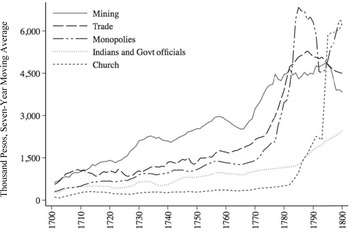
A detailed look at the sources of fiscal revenue shows the network of patronage and privilege that ensured the economic position of the elites and fiscal revenues to the Spanish Crown. During the 1700s most fiscal revenue in New Spain originated from taxes on mining, commerce, the sale of state monopoly products including mercury, and from direct taxes, including the Indian tribute, exactions from public officials, and ecclesiastical tithes (Figure 1).Footnote 20 The five categories in Figure 1 comprised more than 80 percent of fiscal revenue. Totals are in current pesos. Colonial prices were relatively stable because most silver was exported or out of circulation for long periods (Marichal 2006, p. 428).Footnote 21
MAIN SOURCES OF REVENUE, NEW SPAIN

The collection of mining taxes and the sale of state monopoly products involved private transactions between individuals and a royal office. On average, 80 percent of mining proceeds originated from the diezmo minero, a 10 percent tax on silver production. The collection of this tax was tied to the sale of mercury (an essential input for separating the silver from the ore) and the assay process. The Spanish Crown was the sole provider of mercury, through the Mercury Office (Oficina de Azogues).Footnote 22 Mercury was provided in bulk and on credit to refiners, miners, and their merchant backers. After refining, all silver cast into bar had to be presented at the nearest Assay Office (Casa de Fundición); the diezmo minero was paid to obtain the royal seal, which was necessary for the bars to be accepted at the mint. Additionally, a 1 percent fee for assay and the cost of mercury supplied on credit were deducted. By law, all silver bars had to be minted at the Royal Mint (Casa de Moneda) in Mexico City, where seignorage was deducted. Starting in the mid-seventeenth century, the Crown rented the mint to a group of silver bankers (Sánchez-Bella 1990, pp. 229–35; Brading 1971, pp. 130–72; Bakewell 1971, pp. 212–15).
Sales taxes (alcabalas) comprised the majority of fiscal receipts derived from trade. Starting in 1644 the Consulado of Mexico City directly contracted with the Crown to collect the sales tax. The contract specified a duration and the area of the tax district, together with a price to be paid upfront by the Consulado. Prior to 1644, and during an interlude from 1677–1693, the tax was commissioned (encabezado) to the city authorities, who in practice kept subcontracting with the Consulado (Smith 1948). To facilitate the collection of port duties (avería and almojarifazgo), the Crown restricted the arrival of fleets to only two ports (Acapulco and Veracruz), and often privately contracted it to individuals.
The tributo was a head tax on Indian communities, a practice from pre-Columbian times that survived into the colonial period. The Crown initially adapted the pre-Columbian administrative system: caciques and Indian governors collected the tributo (Sánchez-Bella 1990, pp. 207–08). Later, the collection of the tribute was commissioned (encabezado) to corregidores. Because corregidores were in charge of keeping the community funds of the localities, they were able to profit from the funds by using them as private capital (Jáuregui 1999, pp. 40–41).
The church also channeled fiscal revenues to the central administration as a result of a 1501 edict from Pope Alexander VI (Sánchez Santiró 2010, pp. 41–42).Footnote 23 Through its hierarchy of bishoprics and local parishes, the church collected tithes, charged for liturgical services including baptisms and marriages, sold papal bulls (indulgences), and received earnings from chaplaincies, religious foundations, and church property (Fonseca and Urrutia 1845–1853; Marichal 2007, pp. 123–32). The royal coffers received a fraction of parish earning mostly through tithes (diezmos), novenos reales, income from papal bulls (bulas de la santa cruzada), and ecclesiastical vacancies (medias anatas, mesadas, and vacantes).
The corporatist character of fiscal policy embedded the colonial elites in a network of privilege and patronage that relied on the existence of the Crown (Elliott 2006, p. 365; Marichal 2007, pp. 76–77). Silver producers received the concession to exploit the mines in exchange for paying the silver tithe. Also, royal mintage gave silver its value as a means of exchange. The Mexico City Guild, through a Guild Tribunal, had “exclusive jurisdiction over all commercial disputes as well as […] oligopolistic control over […] commercial transaction in the viceroyalty” (Marichal 2007, 77). The restriction to trade only through Veracruz ensured a monopoly for traders in Seville (later Cadiz) and Mexico City. The Indian tribute granted guarantees to communal land and access to a special Indian court. Taxes paid by the church guaranteed the monopoly of the Catholic Church and the autonomy of its institutions. The Mexican corporate elites, thus, benefited from the survival of the Spanish Crown; this was especially the case in Veracruz and Mexico City, where the scale of economic transactions and exchange was more substantial.
Public Good Provision Prior to 1762
The colonial administration provided few social services. Local authorities and corporations provided local public goods. The merchant guilds of Veracruz and Mexico were responsible for the construction and maintenance of the road linking the two cities. Miners contributed funds for the functioning of the Mining College (Colegio de Minería). The church performed multiple functions of social control and invested in education.
Military protection was “hardly more than a token” (McAlister 1953, p. 2). In contrast to Europe, there was no attempt to mobilize the landowning class for military service prior to the mid-seventeenth century. Provincial militias organized at the local level were composed of military units of citizen soldiers who were supposed to undergo periodic training. However, contemporaries and historians have documented that the few troops in the colonies were poorly trained and lacked arms and equipment (McAlister 1953 and 1957; Archer 1981). The urban militias were located in cities and communities, and maintained by the cabildos or by one or more of the local guilds. They were better organized than the provincials but could not be counted upon for defense because they performed local police duties (McAlister 1953, p. 5).
Minimal military protection was located at the ports (Veracruz and Havana) and at the presidios (frontier garrisons). The port of Veracruz, the point of entry and exit for all European trade between the peninsula and New Spain, was the most guarded location in colonial Mexico. Around 1,000 men comprising “a battalion of infantry, a unit of dragoons and a company of artillery” guarded the port and fortress (McAlister 1953, pp. 2–3). According to Viceroy Marqués de Cruillas, this was one-eighth the force necessary to ensure the security of the kingdom. The northern border was protected with a system of 21 presidios extending from the peninsula of California to the borders of French Louisiana. Additional troops were located in Mexico City: a company of infantry and a cavalry company, in total some 320 men. Their primary function was to guard the viceroy and his palace. The regular garrison troops comprised not more than 2,600 men in New Spain prior to the military reorganization (Elliott 2006, p. 295; McAlister 1953, pp. 4–7).
There were therefore few military or police forces that the Crown could rely upon to impose a fiscal-military reform, at least in its early stages. In addition, the discussion on fragmentation makes manifest that the Crown depended on corporate elites and local authorities for fiscal revenue, and so necessitated to negotiate their compliance to change fiscal administration. Fiscal fragmentation also indicates that the corporate elites depended on the Crown, since it was the Crown that guaranteed the network of patronage and privilege underlying their economic rents. The financial fate of the main corporate elites in charge of tax collection was tied to that of the Crown.
FISCAL AND MILITARY REFORMS
According to the theoretical argument, the negotiation and implementation of fiscal centralization and military reform should be more successful in regions that faced a higher probability of a threat and where the interests of the corporate elites were more aligned with those of the Spanish Crown.
External and Internal Threats
For over two centuries, the Spanish Empire in the Americas faced “remarkably few external or internal challenges” (Brading 1973, p. 406). The military defeats suffered by Spain and France in the Seven Years' War and the resulting change in balance of power in Europe and the Americas provide evidence for a significant increase in military vulnerability after 1762 relative to previous levels.
Conflict in North American soil began between France and Britain in 1754. In 1756 France formally declared war on Great Britain. There were battles in India, North America, the Caribbean Isles, the Philippines, coastal Africa, and Europe. By the end of 1760, all French territory in mainland America was in British hands.Footnote 24 An agreement made in August 1761 between the Bourbon kings of Spain and France —the Family Compact—brought Spain into the war. Veracruz was left vulnerable to attack despite the more than three million pesos of extraordinary funds spent by Viceroy Villalba in 1762 to ready the fortifications and mobilize a force of 8,500 men (Archer 1981, p. 315; McAlister 1953, p. 7). In August of 1762 the British Royal Navy captured and occupied Havana and Manila. The Treaty of Paris (10 February 1763) granted victory to Great Britain, who emerged as the dominant European power. Spain recovered Havana and Manila by offering Florida in exchange. Floridablanca (1777–1788) in his Memorial describes the English as scheming to “destroy and disable the great kingdom of New Spain, the most valuable of our Indies” (cited in Stein and Stein 2003, p. 341).
In addition, because of the demographic recovery of the Indian population in the first half of the eighteenth century, internal unrest and insecurity increased in many provinces. There were also disturbances in Guanajuato and other regions as a result of the expulsion of the Jesuits in 1767 (Fisher 1982, p. 219; Brading 1971, pp. 233–34). In 1766 Nuevo León saw populace protests against new taxes and the militia. “Apprehensive creole miners and landowners” (Brading 1971, p. 7) supported the suppression of these revolts. Both creole and peninsular colonial elites shared the Crown's concern for social control (Archer 1977, p. 120).
Spain and Britain fought again militarily in 1779–1783. Spain saw an opportunity to weaken British stronghold in the Americas by supporting the American Revolutionary War. Mexican soldiers participated in battles in Florida and Louisiana, and reinforced the Havana naval squadron (Marichal 2007, p. 45). Spain reconquered Florida and the thirteen colonies gained independence from Britain. These victories for Spain in the Gulf of Mexico, together with the intensification of the French Revolutionary Campaigns (1792–1802) in Europe, shifted priorities to peninsular Spain.
Military Reorganization and Free Riding
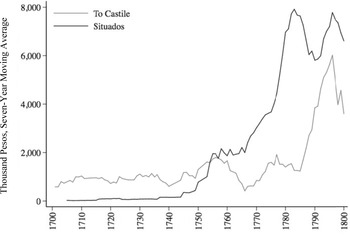
Royal officials directed initial efforts to strengthen the fortifications in the main Atlantic ports: Havana, Veracruz, Campeche, and Cartagena (Elliott 2006, p. 299; Fisher 1982, p. 218). The clear break in transfers in Figure 2 reflects that situado transfers funded the initial increase in military protection after the Seven Years' War. Situados were remittances from one colonial treasury to another to “cover expenses of strategic importance,” typically military and administrative expenses (Marichal and Souto 1994, p. 588).Footnote 25Situado transfers remained small relative to transfers to Castile until 1750, increased during the Seven Years' War, and more than tripled Castile-bound transfers by 1780.
TOTAL TRANSFERS TO CASTILE AND SITUADOS, NEW SPAIN

The events in Cuba made the island a perfect laboratory for the Crown to assess a fiscal-military reform. The conde de Ricla and field marshal O'Reilly arrived to Havana in June 1763 to negotiate with the island's economic elites—planters, ranchers, and merchants—the fiscal measures to fund the cost of defense (Kuethe and Inglis 1985, p. 119; McAlister 1953, p. 8). The Conde de Ricla met with the leading families both individually and collectively. In the negotiations, most Havana's patricians “welcomed the reorganization and rebuilding of the Cuban army and understood the need for revenue and reform to pay the cost” (Kuethe and Inglis 1985, p. 134). It was clear that “the central issue […] was not whether, but how they should arrive at an acceptable means to fund the cost of defense” (Kuethe and Inglis 1985, p. 125). Crown officials also negotiated measures to liberalize trade, shifting economic power from the Merchant Guild in Cadiz to colonial merchants. The reinforced Cuban militia assisted Spain to victories during the American Revolutionary War (Kuethe 1978, pp. 180–81; Kuethe and Inglis 1985, chap. 4).
Following Cuba, the reform was undertaken in mainland New Spain. Juan de Villalba, lieutenant-general and captain-general of Andalusia, arrived in Veracruz in November 1764 at the head of two European regiments (McAlister 1953, p. 16; Kuethe and Inglis 1985, p. 120; Brading 1987, p. 123). Early on, there was disagreement among royal officials regarding the specifics of military policy. Some advocated the use of a regular army, while others defended reliance on provincial militias fortified by a small number of regular troops. Those advocating for a regular army pointed to the lack of expertise of militia units and the dangers of strengthening local military power. Supporters of the militias argued that a regular army was too costly. Initially, military policy centered around militia recruitment trained by regular army cadres sent from the peninsula (Gutiérrez-Santos 1961; Archer 1977 and 1981).
The inefficiencies due to free riding from relying on militia regiments became soon evident. In 1768 the inspector general of infantry, Marqués de la Torre, “dismissed the entire concept of an army based upon militia formations” and denounced the economic elite for the miserly contributions to their own defense (Archer 1981, p. 316). Although the royal treasury transferred fiscal monies to help create provincial regiments, localities financed the militia units and cabildos asserted the right to propose officer candidates.Footnote 26 The peninsular officials sent on commission found they had limited influence. From his visit in the 1770s, the Inspector General Cisneros noted that the cabildos were “negligent and inobservant,” pointing to the example of Querétaro's cabildo, which was unable to send one squadron to help protect Mexico City. The outbreak of war against Britain in 1779 revealed that most provincial units shared Querétaro's weaknesses. The militias also had failed to suppress Indian uprisings at Papantla and Acayucan. The late 1780s saw a shift in emphasis to a centrally financed regular army (Archer 1977, pp. 94–95; 1981, pp. 318–25; Elliott 2006, p. 299).
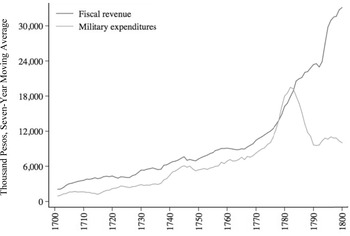
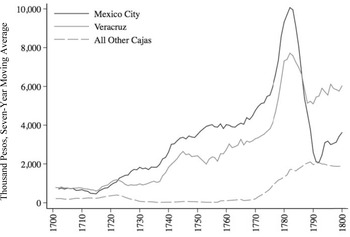
Figure 3 shows an increase in the rate of growth of military expenditures after 1765.Footnote 27 The large increase after the late 1770s reflects the new shift in emphasis and the involvement of Spain against Britain in the American Revolutionary War (1775–1783). Mexico transferred silver, troops, and military provisions to assist the fighting in Florida and the Caribbean (Marichal 2007, pp. 44–46). Also, military expenditures were concentrated in more vulnerable Veracruz and Mexico City (Figure 4). The involvement of Spain in the French Revolutionary Wars (1793–1795), however, diverted priorities and fiscal monies to the peninsula (Archer 1981, pp. 337–38). Figures 2 and 4 suggest a shift in transfers from the Mexico City caja to Castile. Notice, however, that military expenditures in Veracruz and the rest of the cajas remained high.
MILITARY EXPENDITURES AND FISCAL REVENUE, NEW SPAIN

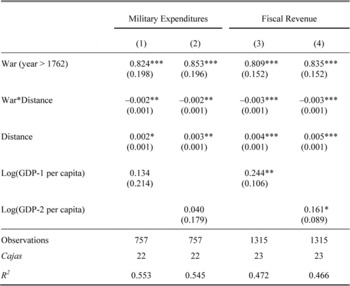
Although the raw data point to an increase in military expenditures after 1762, other factors could be driving the increase in military expenditures. I undertake an econometric analysis to account for economic and population growth, the possibility of serial correlation, and other factors specific to each caja that could have led to increases in military expenditures. Table 1 presents the results for the 1700–1800 period using yearly military expenditures scaled by population.Footnote 28 To test whether the effect of war was greater in regions where the elites were more vulnerable to the threat, I interact War with the “hiker” Distance from each caja to either Mexico City or Veracruz, whichever is closer, as a proxy for vulnerability.Footnote 29 Consistent with the argument, the effect of war on military expenditures per capita falls the farther a caja is from Mexico City or Veracruz (column 1). Average per capita military expenditures in cajas 50 hiker-kilometers away increase 72 percent after the war. The predicted increase for a caja 250 hiker-kilometers away is 30 percent, all else constant. The result is robust to using an alternative measure of economic growth (column 2). The results, however, establish only rough orders of magnitude.Footnote 30
MILITARY EXPENDITURES BY CAJA, NEW SPAIN

EFFECT OF WAR ON MILITARY EXPENDITURES AND FISCAL REVENUES

* Significant at 10 percent.
** Significant at 5 percent.
*** Significant at 1 percent.
Notes:
Dependent variables are per capita and in logs. OLS with panel-corrected standard errors, a common time trend and fixed effects by caja. Distance measures hiker kilometers from each caja to either Mexico City or Veracruz, whichever is closer, as a proxy for vulnerability. Standard errors are in parenthesis.
Sources:
See the Appendix and the text for a description of the variables and data sources.
Despite the difficulties, at the turn of the nineteenth-century colonial Mexico had a regular army and the provincial militias had been rehabilitated and enlarged. Viceroy Banciforte (1794–1798) found an army of 4,747 soldiers, a 50 percent increase from the 2,341 Villalba declared in 1776 (Archer 1981, p. 326; Elliott 2006, p. 300). Lorenzo de Zavala (1918, p. I:XLII) estimates that in 1810 there were 7,083 men in the permanent troops, 3,604 in the frontier troops, and 18,804 in the provincial militias.
Increase in Fiscal Centralization
The transformation of the fiscal colonial structure began with the visita of José de Gálvez in 1765–1771 (Marichal 2007, pp. 55–56; Elliott 2006, p. 304; Kuethe 1991, p. 274). Earlier Bourbon attempts, especially between 1713 and 1729, to end with the sale of office for the high judicial, administrative, and ecclesiastical posts in Spanish America encountered little success (Marichal 2006, p. 429; Sánchez Santiró 2010, pp. 24–25).Footnote 31
Reforms were implemented gradually. Even though the administration of the alcabalas in Mexico City was handed over to treasury officials in 1754, the centralization of all tax districts (suelos alcabalatorios) in New Spain did not start until 1763. In that year, royal officials began administering the aduana (local customs office) at Veracruz. By 1766 forty aduanas had also been centralized and by 1777 the process was finalized in the mayor colonial towns (Smith 1948, p. 23; Sánchez Santiró, Jáuregui, and Ibarra 2001, pp. 143–77).Footnote 32 Salaried excise directors were appointed in 24 towns, and assigned “an accountant, clerks, and guards” to assist them (Brading 1971, p. 52). Eight new cajas were created after 1762 and the Tribunal de Cuentas (court of audit) was revitalized to better monitor fiscal accounts. The average number of revenue categories (ramos) in the fiscal accounts increased from an average of 35 from 1766–1770 to an average of 77 during 1786–1790 (Jáuregui 1999, p. 157).
The tobacco monopoly was established in 1767. The state-owned firm was a multiregional enterprise with productive links in Cuba, Louisiana, and Spain. In its Mexico City factory alone, the monopoly employed over 8,000 workers by 1800 (Marichal 2006, pp. 436–37; Deans-Smith 1992). At the same time, an efficient royal postal service was organized throughout the empire to facilitate communications (Brading 1971, p. 34). The viceregal government attempted to regulate the collection of tithes, expropriated church wealth, and asserted royal authority as being above that of the church (Brading 1987, p. 125). The mediating role of the church declined and the army, both regular forces and militias, grew in size and influence.
A late component of the centralization program was the ordenanzas de intendentes, promulgated in 1786, ordering a reorganization of the structure of colonial administration at the district, provincial, and central levels. Twelve intendancies were setup and an intendant (a permanent, salaried official) assigned at the provincial level, constituting an intermediary level of government between Mexico City and the districts. Five of the twelve intendants were military officers. At the local level, subdelegates substituted the unpaid magistrates for the collection of Indian tribute. The death of Galvéz in 1787 hindered the effective implementation of the ordinances in the sphere of local government (Knight 2002, p. 261; Brading 1971, pp. 64–80).Footnote 33
Figure 3 shows that fiscal revenues began to rise after 1765. Revenues grow at a slow pace initially to then attain a steep increase with the tenure of Gálvez as Minister of the Indies (1776–1787). During his ministry, Gálvez increased centralization efforts and tightened collection procedures. Fiscal revenue increased in all the major tax categories (Figure 1). Alcabalas accounted for 73 percent of the 155 percent increase in trade taxes from 1765 to 1785, while the new tobacco monopoly contributed with 89 percent of the 291 percent increase in monopoly revenue in the same period.Footnote 34 The increase in church-related revenues reflects an increase in novenos reales and the sale of indulgences (Sánchez Santiró 2010, pp. 45–46).Footnote 35 The change in the trend after 1790 (Figure 1) is due to changes in accounting procedures (see the Appendix) and to the mentioned hostilities with France that disrupted trade and shifted priorities to the peninsula.
Although part of the increase in revenue from mining was driven by an increase in silver production, the increase in silver output cannot fully account for the higher fiscal exactions. To promote silver mining, the Crown implemented policies including a reduction in the price of mercury in 1767 and 1776, the extension of tax exemptions, the creation of the Cuerpo de Minería (1776) to promote mining interests and investment, and the approval of a mining code (1783) (Dobado and Marrero 2011, pp. 865–69; Brading 1971, pp. 144–45).Footnote 36 Gálvez, however, also appointed salaried officials to sell gunpowder and manage the Mercury Office, and tightened procedures at the Mint to increase its efficiency. Rafael Dobado and Gustavo Marrero (2011) perform a cointegration analysis for silver production and fiscal revenue, and find that the higher silver output cannot account on its own for the increase in fiscal revenues after 1766.
The higher revenues are also partly due to an increase in economic activity. The Crown decreed comercio libre (free trade) between New Spain and peninsular Spain in 1789, abolishing the convoy system and Cadiz's monopoly on trade. Intracolonial trade, previously banned, was also liberalized. All major ports in peninsular Spain could now trade with the colonies without restriction (Brading 1971, p. 114).Footnote 37 The increase in economic exchange, however, cannot account for all of the growth in fiscal revenues. Juan Carlos Garavaglia and Juan Carlos Grosso (1987) show that fiscal revenue from alcabalas grows at a larger pace than commercial activity in the 1776–1810 period in New Spain.Footnote 38 Nonetheless, the increasing prospects of economic growth as a result of the promotion of the mining industry and trade openness likely facilitated wider elite compliance with the reforms by increasing the gain from military protection.Footnote 39
I perform an econometric analysis for fiscal revenue equivalent to the one for military expenditures for the 1700–1800 period (Table 1). The coefficient on the interaction of War with Distance is statistically significant and consistent with the argument. The effect of war on yearly fiscal revenues scaled by population falls the farther a caja is from Mexico City or Veracruz (column 3). Fiscal revenues per capita increase 67 percent on average after the war for a caja 50 hiker-kilometers away controlling for economic growth, serial correlation, and other factors specific to each caja. For a caja 250 hiker-kilometers away, the increase in average fiscal revenue per capita is 11 percent, all else constant. The result is robust to an alternative measure of economic growth (column 4) and alternative measures of population (Appendix Table 2).
Innovations and increases in public debt provide further evidence of the increased efficiency of the fiscal administration. Prior to the 1780s colonial public debt was minimal relative to ordinary revenues, and was requested mainly from the Merchant Guild and ecclesiasts. In the 1780s a capital market for public debt developed, with the Merchant Guild and the Mining Tribunal as intermediaries. Creditors diversified and financial officials offered new types of guarantees. Confidence increased with the increased ability of the colonial administration to obtain fiscal revenue (Marichal 2007, chap. 3).Footnote 40
In sum, the reforms provide evidence for the emergence of a fiscal-military state in colonial Mexico. Some of the old practices, however, remained in place. In the last decade of the century, for instance, the Crown granted titles and important posts in the military in exchange for contributions to the army (Archer 1981, pp. 329–32). Regina Grafe and Alejandra Irigoin (2006) have coined the term “bargained absolutism” for the second half of the eighteenth century, emphasizing the still active role played by corporate elites in government.Footnote 41 Even if the resulting centralization was not absolute, the argument still stands that the role of the central government in fiscal collection and enforcement increased to unprecedented levels, and that such increase was more pronounced in the regions where the corporate elites were more dependent on the Crown for economic rents and privilege.
Robustness
Evidence for the rest of Spanish America provides further support for the argument. Although overall fiscal revenues increased, the implementation of the fiscal-military reforms was not homogeneous and led to resistance in some regions (Paquette 2005, p. 111; Fisher 1982).Footnote 42 The elites' benefits from military protection and from the survival of the Spanish Crown varied across viceroyalties.
In the viceroyalty of New Granada, the fiscal-military reorganization concentrated in the peripheral cities and in those experiencing internal unrest. The creole elite were more aware of their vulnerability to external invasion in Panamá, Cartagena, and Guayaquil. Also, internal upheaval in the presidency of Quito provided the conditions for compliance from the local elite. As a result, Panamá, Cartagena, and Quito together possessed an army double the size of that of the viceroyalty of Peru. In the interior provinces, however, the elites viewed a military reform with suspicion. In fact, in the late 1780s colonial elites allied with popular sectors and marched to the capital to protest the increase in fiscal pressure. They received fiscal concessions (Kuethe 1978; Fisher, Kuethe, and McFarlane 1990).
In the viceroyalty of Peru, the implementation of the fiscal and military reforms was relatively more successful in Lima, the coastal economic center. Farther from this coastal city, the reform was less thorough and opposition stronger. Rebellions headed by Indian nobles erupted in southern and upper Peru to protest against the increased burden of taxation in Indian towns and the disruption of local trade. The rebellions led to the reliance on a regular force and to partial disbandment of the militias in the interior (O'Phelan-Godoy 1985; Fisher, Kuethe, and McFarlane 1990). Even if fragmentary, this evidence for Spanish America suggests that a systematic analysis of revolts by regional threat risk and alignment between the corporate elites' and Crown's interests is a promising area for future research.
In addition, earlier, in 1626, the Count-Duke of Olivares attempted a fiscal reform in the colonies—the Union of Arms—with the goal of sharing the burdens of defense among the different kingdoms in the Spanish peninsula and with the American colonies. Although the Union of Arms had partial successes in the peninsula, then at war with France, the colonial elites resisted the fiscal reforms. Only temporary increases to trade taxes took effect.Footnote 43
Finally, the failure of the British to implement fiscal centralization in the thirteen colonies also provides support for the argument. From the colonists' point of view, British success in the Seven Years' War in fact eliminated the long-standing threat from France. The attempt at reform led to conflicts, escalating into the American Revolutionary War. Spain, rather than venture invasion, aided the rebelling colonists, as was mentioned above.
In sum, these failed attempts and uneven reform implementation also attest to the importance of a common threat between Crown and elites to foster fiscal cooperation. Reform success can in large part be explained by the local and corporate elites' perception of military vulnerability in different regions.
CONCLUSION
During the late eighteenth century, the Spanish Crown acquired new roles and unprecedented control over fiscal resources in colonial Mexico. This apparent increasing absolutism had to be negotiated with the local and corporate elites. The initial fragmentation of fiscal collection and military weakness of the Crown in colonial territory limited the Crown's ability to impose the fiscal-military reform. The fiscally powerful elites could refuse centralization; indeed they had rebuffed the Crown's previous attempts to obtain greater control over fiscal monies. Elites complied with an increase in fiscal centralization and military buildup after 1763 because their status and economic privileges depended on the survival of the Spanish Crown. Centralization served the different corporate elites to overcome free riding and increase fiscal contributions.
The case of Mexico documents that institutions of representation need not accompany successful fiscal centralization. Scholars argue that Parliament played a decisive role in the negotiation of the fiscal reforms implemented in England during the late seventeenth century. This study points to a complementary condition—present in the English case but less emphasized in the literature—that likely also facilitated centralization earlier in England than in other European regions. The English lacked a standing army and were not involved in major international conflict between the late fifteenth and seventeenth centuries. The Civil War focused the attention of England's elites on the need to secure the state against domestic rivalries and pursue its interests overseas (O'Brien 2011, p. 426). The goals of the military buildup in England had a large public-good, defensive component, as in the case of Mexico.
The analysis of the historical evidence provides support for the main implications of the theoretical argument. Two important avenues for future research, however, remain. It would be desirable to complement this analysis with a thorough historical study of the politics, negotiation, and resistance behind the fiscal-military changes across regions, corporate elite, and economic activities. Second, tax funds are the backbone of a state's borrowing capacity. Indeed, the Crown was able to mobilize large amounts from corporate elites and private individuals after the 1780s. An analysis of public debt innovations and negotiations in light of the argument put forth here remains an area for future research.
Although focusing on the case of colonial Mexico, this article offers a specific mechanism that may tell us something about the evolution of the role of the state at other times and places. Crises, military or not, that call attention to weaknesses that require building collective cooperation among corporate elites may also lead to an increasingly centralized state with a larger role in public good provision. The existence of a focal central authority is a key factor, as is the alignment between the main corporate elites' and central authority's benefits from public good provision. Centralization serves as an institutional device for elites to commit to collective cooperation.
Appendix
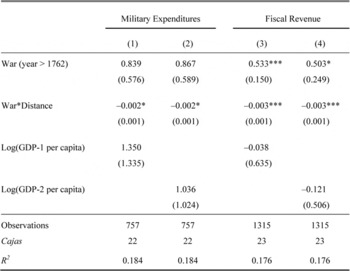
ROBUSTNESS: EFFECT OF WAR ON MILITARY EXPENDITURES AND FISCAL REVENUES

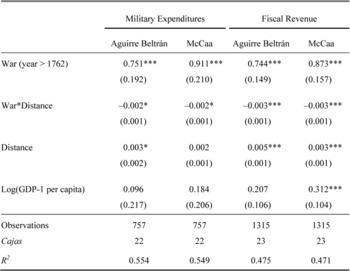
EFFECT OF WAR ON MILITARY EXPENDITURES AND FISCAL REVENUES FOR ALTERNATIVE MEASURES OF POPULATION GROWTH

Fiscal Data
The fiscal data come from the published accounts by John Tepaske and Herbert S. Klein (1988), which are available in print and online at Richard Garner's website: www.insidemydesk.com/hdd.html.
I concentrate on the period between 1701 and 1800 for the 23 Mexican cajas.Footnote 44 This allows me to compare the data under the same Royal House (the Bourbons). There are 1,361 yearly observations by caja.Footnote 45 Fiscal data for each caja is further subdivided in ramos. I aggregated the ramos in different categories according to who collected the corresponding tax. For this, I relied in part on the categorizations by Klein (1998), Luis Jáuregui (1999) and Pedro Pérez Herrero (1991). The categories are described below. Total income excludes income carried over from previous years (partidas contables, alcances de cuentas, debido de cobrar, sobras y residuos, and Real Hacienda en Común), debt and loans (préstamos, fiadores, donativos, contribuciones y socorros para su majestad), deposits (depósitos y fianzas, bienes), and accounts with other cajas (cuenta con, venido de, remitidos, and situados).
Following other scholars that have used the colonial fiscal series, I opted for keeping the figures in current pesos. The existing price indices focus on specific markets (mostly agricultural) and do not agree with each other. Further, there is no evidence for long-term inflation in the colonies. Prices were relatively stable because most silver was exported or out of circulation for long periods (see Appendix 2 in Klein 1998, p. 118; Marichal 2006, p. 428).
Scholars have highlighted that there are accounting problems with the data after 1787 because of the introduction of the intendancy system and the implementation of a new accounting procedure, the Sistema de partida doble (Pérez Herrero 1991, pp. 219–24). Furthermore, the geopolitical situation in Europe changed drastically after 1790 because of the French Convention (1793–1795). New ramos were created after 1790 involving extraordinary revenues, on which the Spanish Crown increasingly relied. The averages after 1790 are therefore not altogether comparable with the earlier data.
The fiscal revenue and expenditures categories are as follows:
Mining: Taxes on silver and gold (diezmos and quintos), and jewelry, pearls, and specie. Also, income from minting (amonedación, senoreage, ensaye, reensaye, Casa de moneda), smelting (fundición y afinación), and fletes.
Trade: Aduana, avería, fletes, alcabalas, almojarifazgos, other trade taxes related to the Armada de Barlovento, and liquor, wine, aguardiente, and pulque.
Public Monopolies: All revenue related to mercury and tobacco. Also, papel sellado, naipes, salt, nieve, gallos, and alumbres. Multas, composiciones, indultos and licencias were also included here accounting for the Crown's “monopoly” on the provision of justice.
Indians: Tributos reales, cajas de comunidad, encomiendas, and medio real del hospital.
Government Officials: Income from the sale of office, vacantes, media anata, and mesada.
Church: Ecclesiastical tithe, novenos reales, bulas de Santa Cruzada, bienes mostrencos, church-related media anata and mesada, and Temporalidades.
Other: Fletes not related to mining or trade, sueldos, emolumentos, mercedes, fábricas, factorías y aprovechamientos, temporary income (juros, mercedes y juros, Banco Nacional de San Carlos, consolidación de vales reales), montepíos, and extraordinarios.
Military Expenditures: Includes presidios and guardacostas, situados and socorros, militia expenditures, all expenditures related to Barlovento, and remittances to Havana and to Veracruz.
Economic and Population Growth
There are few counts of the total population in colonial Mexico, and most estimations concentrate on the very early or late colony. I constructed the population series for the regression analysis by interpolating estimates for the available years, assuming linear growth. Most scholars agree that the nadir for the Indian population occurred in the mid-seventeenth century and estimate a total population around 1.5 million (Garner and Stefanou 1993, p. 15).Footnote 46 The Villaseñor census in 1742 reported a range of 2.5–3 million. However, the census did not include all of New Spain. The most reliable count is from the Revillagigedo census in 1790–1793, revealing about 4.5 million persons. Humboldt and other scholars have argued, however, that the count missed large expanses of territory and has errors. I use the following mid-range population data, in millions: 1.7 in 1643, 3.6 in 1742, 4.7 in 1790, 5.2 in 1793, and 5.8 in 1803.Footnote 47 For the robustness results in Appendix Table 2, I use McCaa's estimates: 2.2 for 1595, 4.8 for 1790 and 5.1 for 1800; and Aguirre Beltrán's: 1.7 for 1646, 2.5 for 1742, 3.8 for 1793, and 6.1 for 1810 (McCaa 2000, pp. 253–57, 279; Aguirre Beltrán 1972, p. 234).
The GDP estimate is constructed from alcabala and mining fiscal receipts, and therefore correlated to fiscal trends. The estimation assumes that the value of commerce accounted for by alcabalas changed from 50 percent in 1577 to 80 percent by 1810, and that 70–80 percent of GDP was agriculture (GDP-1). The regression results are robust to using an alternative measure of economic growth that assumes instead a change in alcabalas from 20 percent of the total value of commerce in 1577 to 80 percent by 1810 (GDP-2). More details and both measures are available at www.insidemydesk.com/ladata/estmexgdpex.xls. See Garner and Stefanou (1993) for a thorough analysis of production in eighteenth-century Mexico.