INTRODUCTION
Currently it is estimated that about 20.5 million Americans have cataract in either eye, with this figure expected to increase dramatically as the population ages (Congdon et al., 2004). The prevalence of cataract among adults aged 55 and older is approximately 30% (AIHW, 2005), and consequently many older adults undergoing neuropsychological assessment are likely to have cataract. Despite this, there is a lack of information on whether cataract affects neuropsychological test performance.
There is now substantial evidence that declines in visual and cognitive function co-occur with aging (Anstey et al., 2002, 2003; Anstey & Smith, 1999; Christensen et al., 2001; Drobny et al., 2005; Lindenberger & Baltes, 1994; Lindenberger et al., 2001; Salthouse et al., 1996; Schneider & Pichora-Fuller, 2000; van Boxtel et al., 2001). This has led to speculation about the causal relationship between visual and cognitive aging, with several theories being canvassed.
A common neurological cause (e.g., degeneration of neuronal structures) for visual and cognitive aging has been proposed (Lindenberger & Baltes, 1994) based on cross-sectional studies showing that cognitive and sensory variables share most of their age-related variance. However, methodological articles have argued that cross-sectional studies are limited in their capacity to allow for inferences about individual-level correlated rates of change, and may inflate observed associations among age-related variables (Hofer & Sliwinski, 2001; Lindenberger & Potter, 1998). Longitudinal research, while revealing joint associations between visual and memory decline, has suggested that only a small proportion of the decline is due to a common factor (Anstey et al., 2003). Another hypothesis linking sensory and cognitive function is that sensory deprivation leads to loss of neuronal connections and loss of cognitive ability. This hypothesis has received little empirical evaluation in the context of sensory-cognitive connections, but is analogous to the “use it or lose it” hypothesis with respect to mental and physical activity and aging (Hultsch et al., 1999). The basic idea is that maintenance of capacity (physical or cognitive) is related to practice or activation of neurons or muscles, and that lack of activation may lead to loss of capacity. The converse of this is that activation or training will increase capacity. Therefore, if a sensory intervention increases activation of neuronal circuitry, it may also increase neuronal capacity. Studies of mental activity have shown specific improvement in cognitive function associated with the abilities that were subject to training, but no transfer of improvement to domains that did not receive training (Ball et al., 2002). It is difficult to make predictions about whether sensory stimulation in individuals with correctable sensory deficits would lead to specific or general changes in brain activation, although functional magnetic resonance imaging (fMRI) studies would allow for investigation of this.
Another theoretical perspective is that perceptual deficits influence encoding of cognitive test materials or that compensation for visual deficits requires cognitive resources and this reduces resources available for cognitive processing (Anstey et al., 2002; Drobny et al., 2005; Lindenberger & Baltes, 1994). Finally, it has been proposed that visual and cognitive abilities are both biomarkers of aging, and by definition, will age in parallel, thus giving the impression in cross-sectional studies of being causally interrelated (Anstey et al., 2005).
Two longitudinal studies have reported data on vision, hearing, and cognitive performance at multiple time-points in normally aging samples. Latent growth curve analysis of data drawn from the Australian Longitudinal Study of Aging showed that while visual and cognitive aging occurred in parallel, only a small amount of variance in decline was shared over eight years (Anstey et al., 2003). Earlier results from a two-year follow-up of the same study showed that marked decline in vision over a short period was associated with accelerated memory decline (Anstey et al., 2001), suggesting that a pathological process may underlie some of the shared variance in visual and memory aging. Recent results from the Maastricht Longitudinal Aging study, using regression analyses of change scores, confirmed those of the Australian Longitudinal Study of Aging in showing that decline in visual acuity predicted subsequent cognitive decline (Valentijn et al., 2005).
In complementary experimental studies, visual deficit was simulated by requiring subjects to wear prescription glasses. One study (Dickinson & Rabbitt, 1991) found that participants aged 18 to 35 wearing distorted glasses had poorer free recall. They also found that participants with distorted vision read more slowly than subjects without artificially distorted vision. It is possible that this may have been why these subjects also recalled less information. Lindenberger et al. (2001) also simulated deficits in auditory and visual acuity in a sample of 218 volunteers aged 30 to 50. They found that reduced auditory acuity also reduced performance on a reading-span measure of working memory, but they did not find any other effects. They argue from these results that the relationship between sensory function and cognition is due to central factors, namely, the functional integrity of the aging brain.
Alterations to visual stimuli used in cognitive testing have also shown effects on cognitive performance. For example, Ferraro et al. (2002a) found that degradation of the pictures in the Boston Naming Test resulted in poorer performance among undergraduate students, and Anstey et al. (2006) found that older adults had longer latencies when responding to low contrast conditions in tests of processing speed, perceptual matching, and associative memory compared with high contrast conditions. However, Ferraro and colleagues did not find that orientation of the Rey complex figure affected performance on this neuropsychological test among undergraduate students (Ferraro et al., 2002b).
There are limitations with both longitudinal and simulation studies in investigating the relationship between eye disease, vision, and neuropsychological test performance. Visual and cognitive aging occur in the context of many other age-related changes in health and physical function that affect performance on the tests. Attrition in longitudinal studies and selection bias in cross-sectional studies (Anstey & Luszcz, 2002; Lindenberger et al., 2002) also influence results. Over time, potential bias from differential attrition may have an impact on estimates of health, physical, and cognitive functions, leading to biased correlations among variables. Simulation studies may not accurately imitate the visual deficits seen in aging and the individual characteristics of participants in whom visual deficits occur. Furthermore, simulations are in place only for the duration of the experiment, so that no long-term effects of sensory deprivation can be estimated.
It is impossible to intervene in the aging process of interest in order to directly test hypotheses about causal directions and influences of one aging process in relation to another. We therefore used an intervention that occurs clinically to improve visual function, namely cataract removal, to evaluate the extent to which cataract may affect neuropsychological test performance. We aimed to test the hypothesis that visual aging affects neuropsychological test performance through the effect of cataract on perception and encoding of visual information. If this were the case, then we would expect that improvement in visual function post cataract surgery would lead to improvement in neuropsychological test performance. We hypothesized that improvement in cognitive test performance post cataract surgery could be achieved through at least two means: (1) improved visibility of test material due to improved visual acuity, which would allow for faster processing of information, or (2) through the increase in neural stimulation of sudden visual improvement after cataract surgery. We conducted a clinical trial of the cognitive benefits of cataract surgery, using a waiting-list control group. Tests were presented in both auditory and visual modalities, and we expected that if hypothesis (1) was correct, then improvement would be seen on visually presented tests, but not aurally presented tests. On the other hand, if hypothesis (2) were correct, we would expect to see improvement on all tests. If neither hypothesis was correct, then we would not find any improvement in cognitive performance associated with cataract surgery. This could be because central factors affect both vision and cognition, but are not affected by cataract surgery. Although hypothesis (2) is plausible, we considered hypothesis (1) first to be the more likely, and hence expected to find improvement on cognitive tests presented visually, but not cognitive tests presented aurally.
The main part of the study used neuropsychological tests that are commonly used with older adults. In case the effect of cataract surgery on cognition could only be detected under specific stimulus conditions (such as low contrast or for different sized stimuli), we also incorporated some experimental tasks and size manipulations into our design. The visual memory task was presented in its usual size and in an enlarged size to determine whether stimulus size moderated the effect of cataract on visual memory performance. If this were the case, improvement would be seen in performance on the usual sized stimuli in the intervention group. Computer-based tasks of perceptual matching, associative memory and reaction time were also administered under conditions of varying contrast, stimulus size and presentation time (Anstey et al., 2006).
METHODS
Participant Selection and Procedure
Potential research participants with bilateral cataract aged 55 and older were identified from surgical waiting lists of eye clinics of three large public teaching hospitals in Sydney, Australia and were sent information on the study and an invitation to participate. Patients were referred to the cataract waiting list when ophthalmologists considered that the visual disability caused by their cataract was severe enough to justify surgery. Those interested in the study returned a reply paid envelope to the investigators and were then screened for inclusion in the study by telephone. Exclusion criteria at this point included self-reported eye disease other than cataract, neurological disorder, and non-English speaking background. Participants passing the screening stage were randomized to either an intervention or control arm. Randomization was conducted by drawing lots. Individuals in the control arm were assessed on two occasions at a three-month interval before surgery, whereas those in the intervention group were assessed 1–2 weeks before surgery and then reassessed three months postsurgery. Assessments were conducted in patients' homes and included measures of visual acuity, neuropsychological tests, and experimental computer-based cognitive tests. Patients also completed a battery of self-report surveys that included: demographic information, health status, health care and medication use, number of comorbid conditions, psychosocial functioning, and, vision-related disability. The clinical assessment was identical on each measurement occasion. A second level of screening based on visual acuity scores occurred after the first assessment in which the first standardized visual acuity measure was taken. Volunteers whose visual acuity was better than 20/40 were excluded at this stage. This cut-off was chosen because it is considered to indicate a level of visual acuity that affects the capacity to see cognitive tests in traditional cognitive aging experiments (Schneider & Pichora-Fuller, 2000), and is associated with moderate cataract severity. A more conservative cut-off would have excluded too many potential participants. Finally, a third level of screening occurred at postsurgical follow-up for both the waiting list and control groups. Here an ophthalmologist confirmed the absence of other eye disease, improvement in visual acuity was reassessed, and surgical complications recorded. This information was then used to determine the final sample that met the inclusion criteria for statistical analysis. Only one participant was excluded on the basis of this final assessment. Ethical approval for the study was obtained from the University of New South Wales and all participating hospitals.
Research Participants
One hundred and ten participants passed the telephone screening (46 men, 64 women). Of these, 53 were excluded at the first in-home assessment because visual acuity was better than 20/40 and one individual was excluded who did not have cataract. Fifty-six individuals were randomized to the intervention and control groups (28 per group). Of those in the intervention group, 26 participated in the follow-up and one was excluded after the final post-surgical assessment due to surgical complications, leaving 25 in this group. Of those in the control group, one withdrew due to lack of interest, two were too ill to complete the follow-up, and another five participants did not complete follow-up for other reasons, leaving 20 in this group.
Neuropsychological Tests Presented Visually
Visually presented tests such as visual memory and face recognition were selected because they were hypothesized to be most sensitive to the effects of visual impairment. Visual memory was assessed with two parallel versions of the stimuli from the Benton Visual Retention Test (BVRT). In the first version, odd-numbered stimuli were presented in usual size and even-numbered stimuli were presented twice the usual size. In the second version, even-numbered stimuli were presented in usual size, and odd-numbered stimuli were presented at twice the usual size. Following the presentation of each card for 10 seconds, participants were asked to draw the design from memory to the best of their ability. The number-correct scoring was used (Benton-Sivan, 1992). The order of administration of the two tests was counterbalanced across participants. Administration of the usual and large versions allowed for examination of whether stimulus size and visibility of the stimulus influences performance pre- and post-cataract surgery. Missing scores for BVRT (n = 2) were replaced using the best subsets regression method available from STATA (version 8).
Nonverbal reasoning was assessed using Sets B and C of Raven's Progressive Matrices (Raven, 1940), which are also known as measures of fluid intelligence (Horn, 1982). For each item, the participant was shown a test figure with a part missing and must select which of 6 possible response figures belongs with the test figure. This untimed test included 3 practice items and 24 test items and the score was the total number correct. Internal consistency was high.
Face Recognition was assessed with the Warrington Face Recognition Test, which requires recognition of halftone images of 50 male faces (Warrington, 1984). Immediately after presentation, the faces were presented one at a time, each one accompanied by a new foil. A forced-choice procedure (untimed) required the participant to choose the one face that had been presented previously. The score was the number of correct choices.
Neuropsychological Tests Presented Aurally
Verbal memory and reasoning tests were chosen to allow for a comparison in the effect of cataract surgery on tests presented visually and nonvisually. Verbal memory was assessed using the first trial of the Rey Auditory Verbal Learning Test (RAVLT). The subjects read a list of 15 common nouns and their score was how many they could recall in any order.
The Similarities subtest of the Wechsler Adult Intelligence Scale–Revised (WAIS-R, Wechsler, 1981) provided a measure of verbal reasoning. Responses to individual items were each given a score of 0, 1, or 2, and these were summed to form a total score.
Verbal working memory was measured with a digit-span backwards test requiring participants to recall a series of digits in the reverse order to that in which they were presented (Wechsler, 1981). The participant had to repeat the numbers in the reverse order. There were 2 trials of a series ranging from 2 to 9 digits. The test was discontinued when the participant failed 2 items at the same level. The score was the total number of correct trials.
Experimental Cognitive Tests Presented Visually
A four-choice visual reaction time test (CRT) involved a computer display of 4 horizontal dashes. The stimulus was a capital E in 18, 36, 52, or 70-point bold Tahoma Font that appeared above one of the four dashes. When the E appeared on the screen, the subject responded by pressing one of the 4 response keys on the keyboard. The stimulus-response arrangement was compatible, with the 4 stimulus positions from left to right corresponding to responses with the left-hand middle, left-hand index, right-hand index, and right-hand middle fingers. Sixteen practice trials and 160 test trials were given.
A computer-administered perceptual matching (PM) test adapted from Salthouse (1994) assessed the speed at which patients could visually process basic information by determining whether or not 2 digits were the same (Anstey et al., 2006). For each trial, a pair of probe items (digits) was presented in the center of the screen. The participants' task was to decide whether the digits were the same, that is, whether they were a matching pair. Participants were instructed to press a green button on the response box if the digits matched, or to press the red button if the digits were not matching. Five practice trials with feedback were presented under high contrast (normal) conditions and 72 experimental trials were presented. This task was operationalized using a fully factorial design with 3 factors: match versus no match (half of the pairs comprised matching digits and half were discordant digits), contrast (high vs. medium contrast condition), and size (usual size vs. large). The medium contrast condition had a hue of 160, saturation of 5, and luminance of 152, and the high contrast condition had a hue of 170, saturation of 0, and luminance of 0. The no-match pairs were included to ensure that participants made a decision about the accuracy of each pair and results were pooled for the match and no-match conditions. There were 16 trials in each of 4 conditions (high contrast usual size, high contrast large size, medium contrast usual size, and medium contrast large size).
Associative memory (AM) also adapted from Salthouse (1994) was assessed with an experimental task involving the presentation of a symbol-digit pair (comprising a letter between A and F and a digit between 1 and 6) for either 850 or 1250 ms. When each test pair was presented, participants were asked to indicate whether the two items (symbol and digit) had been paired together the last time either item had been presented. The lag between the relevant study and test pair (i.e., number of intervening trials) was either 0 or 1, and was randomly determined. Participants were instructed to press the green button on the response box if they considered the items had been paired previously or the red button to indicate that the items had not been paired the last time one of them was presented. The task was operationalized by a fully factorial, three-measure design: match versus no match; size (usual vs. large), and presentation duration (850 or 1250 ms). After 5 practice trials with feedback, 80 test trials were administered. Half of the trials comprised the nonmatching test pairs, necessary for the experimental manipulation, but these were pooled with the matched trials in the analyses. Reaction times (RTs) were the dependent variable for all experimental cognitive tests.
Data Analysis
For neuropsychological outcome variables a series of 2 × 2 mixed analyses of covariance (ANCOVAs) were conducted with group (control vs. intervention) as the between-subjects factor, time as within-subjects factor (baseline and follow-up), and with age and baseline visual acuity as covariates. A 2 (group) × 2 (time) mixed multivariate analysis of covariance (MANCOVA), was conducted on scores for BVRT usual size and BVRT large size, also with age and baseline visual acuity as covariates. The specific effect of interest in this analysis was the time × group interaction term. A significant time × group interaction would indicate that the degree of change in scores from baseline to follow-up for the dependant measures was different for the two groups (i.e., control vs. intervention).
For the experimental cognitive tasks, 3 separate 2 × 2 mixed MANCOVAs were conducted with group (control vs. intervention) as the between-subjects factor, time (baseline and follow-up) as the within-subjects factor, and with age and baseline visual acuity as covariates for CRT, PM, and AM. These MANCOVAs were conducted on 4 dependent variables associated with CRT (i.e., RTs for size1, size 2, size 3, size 4), PM (i.e., RTs for high contrast usual size, high contrast large size, low contrast usual size, low contrast large size), and AM (i.e., RTs for long exposure usual size, long exposure large size, short exposure usual size, short exposure large size), respectively. The specific effect of interest in these analyses was the time × group interaction term, which if significant would indicate that the degree of change in RT from baseline to follow-up for the dependent measures was different for the 2 groups (i.e., control vs. intervention). Visual acuity was included as a covariate as a proxy for cataract severity, and age was included to control for the effect of age on cognitive test performance.
For the computer tasks, extreme outlying trials (the top and bottom 2 percent of trials across participants) were excluded. For each respondent, trials with latencies more than 3 standard deviations from the mean in each condition were also excluded. All analyses were conducted using SPSS 12.0.1. For all analyses, an alpha level of p < .05 was used.
RESULTS
Description of the Sample
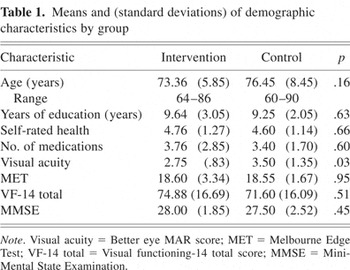
Table 1 shows the demographic status and visual function of the intervention and control groups. The average level of education was relatively low (approximately 9 years). There were no significant differences between the control and the intervention group for age, years of education, self-rated health, number of medications, visual contrast sensitivity, self-reported visual function, or performance on the MMSE. There was a significant difference in visual acuity [t (43) = −2.3, p = .03], with the control group having slightly poorer visual acuity than the intervention group.
Means and (standard deviations) of demographic characteristics by group

Comparison of Groups on Neuropsychological Measures
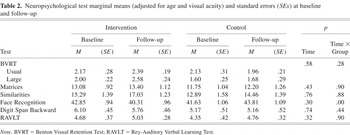
Table 2 displays the estimated marginal means and the associated standard errors of both groups on the neuropsychological measures at baseline and follow-up. There were no significant baseline differences between the control and intervention groups for any of the neuropsychological measures (all p > .05). There was a significant time × group interaction for face recognition [F(1,41) = 10.42, p < .001, partial η2 = .20]. Inspection of the estimated marginal means for face recognition revealed a decline in the performance of the intervention group from baseline to follow-up. On the other hand, the control group's performance improved from baseline to follow-up. There were no significant time × group interactions for any of the other neuropsychological measures indicating that the intervention did not have an effect. There were no significant age × time interactions, indicating that the age-range of the samples did not influence results.
Neuropsychological test marginal means (adjusted for age and visual acuity) and standard errors (SEs) at baseline and follow-up

Comparison of Groups on Experimental Tasks
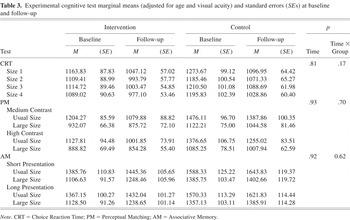
Table 3 displays the estimated marginal means and associated standard errors of RTs for the experimental tasks. No significant differences were found between the two groups at baseline for all of the experimental tasks (all p > .05). There were no significant time × group interactions for any of the experimental tasks and no significant age × time interactions, showing that neither age nor intervention had an effect on performance on the experimental tasks.
Experimental cognitive test marginal means (adjusted for age and visual acuity) and standard errors (SEs) at baseline and follow-up

DISCUSSION
We report results from the first clinical trial of cataract surgery to improve cognitive test performance, in otherwise healthy adults. By selecting patients with no significant ocular comorbidities, the study assessed the effect of cataract as a cause of vision impairment, and the potential impact of cataract removal on cognition. A distinction between various causes of vision impairment is worth highlighting. Signs of age-related macular degeneration (AMD) were not present in patients included in the study. When age-related maculopathy coexists with cataract and with declining cognitive function, AMD and cognitive decline might be related by similar causal mechanisms, giving rise to situations where vision decline (from AMD) appears related to poor cognition. In this study, AMD cases were excluded through clinical ophthalmological assessment.
We expected the effect of cataract surgery to benefit tests presented visually, including visual memory, face recognition, and possibly matrix reasoning. Effects on memory tests would be expected if better vision resulting from cataract surgery assists in encoding visual stimuli under timed conditions. Our clinical trial of cataract surgery to improve neuropsychological test performance provided no support for this hypothesis, and a significant effect of face recognition was in the opposite direction to that expected. Although we have found that contrast sensitivity was associated with scores on PM and AM in previous work (Anstey et al., 2006), we did not find any benefit of cataract surgery on performance on these tests in the present study. The small sample size of the study reduced the power to detect significant effects, and so it is possible that effects would be found in studies with larger samples. Our study had power of .58 to detect a large group × time effect (0.7), power of .39 to detect a medium group × time effect size (0.5), and power of .15 to detect a small group × time effect (0.3). Although there were no significant main-effects for time, there did appear to be an improvement in means in some instances, for both groups, so that it is possible that practice effects overpowered a small improvement due to surgery.
A previous study showing improvement of cognitive function after cataract surgery reported the finding in only 20 patients with mild cognitive impairment, but not in controls without cognitive impairment (Tamura et al., 2004). It is therefore possible that cognitive benefits of cataract surgery may occur in clinical groups with other neurological disorders. Such groups may benefit more from increased cognitive support, whereas nonimpaired controls may be performing near ceiling and might not find additional support to yield much additional benefit to performance (Bäckman & Forsell, 1994). Longitudinal results from the Australian Longitudinal Study of Aging have shown that there is a group of older adults who show both rapid decline in memory and vision (Anstey et al., 2001). It is possible that this group includes individuals with mild cognitive impairment and that interventions may have different effects within this group.
Our results have both theoretical and clinical implications. They do not support a view that age-related cataract strongly affects cognitive test performance at the level of the end organ. They imply that shared variance between visual and cognitive function shown in previous studies may be due to shared common neurological factors. For example, the nigrostriatal dopamine system is implicated in cognitive aging (Erixon-Lindroth et al., 2005) and dopamine receptors are found throughout the retina, where they have been associated with visual deficits in Parkinsons' disease (Li et al., 2001; Witkovsky, 2004). Neuropathology such as senile plaques and tangles may disrupt the visual association areas in addition to causing cognitive deficits (von Gunten et al., 2004). However, our results suggest that visual processing of information is maintained despite eye disease in older adults. Clinically, these results show that while cataract surgery improves vision and quality of life, (Elliott et al., 2000; Harwood et al., 2005; Lundstrom et al., 2001) it provides minimal benefits for cognitive or neuropsychological function in cognitively normal adults.
Strengths of this study include rigorous exclusion criteria, representative levels of education (rather than the high levels of education often observed in volunteer samples), randomization to condition, and a wide range of outcome measures. The study was limited by a small sample size and the relatively short follow-up period of 3 months. Given the novelty of this research, it is not known what the optimal time period is for observing any potential cognitive benefits of cataract surgery. Longer-term follow-up may allow greater time for the benefits to accumulate, but would also introduce greater individual differences that may influence cognition, due to effects of aging and disease. The slightly greater attrition from the control group may have resulted in higher functioning or more motivated participants being retained in this group compared with the intervention group, which would have reduced the likelihood of observing a significant effect.
Future research is warranted to investigate whether other types of neuropsychological test performance are affected by cataract, whether patients with cognitive impairment show cognitive benefits, or whether other behavioral indicators, such as intraindividual variability, are sensitive to visual change in late life. Functional magnetic resonance imaging studies would be invaluable for identifying activation patterns associated with cognitive processing both pre- and postcataract removal.
The results of this study are important in determining the extent to which interventions in visual function may improve cognitive function, and for indicating medical conditions in which neuropsychological assessments are valid. The results suggest that neuropsychological assessments of older adults are not adversely affected by the presence of cataract that is severe enough to justify surgery. Larger studies are required to confirm this result. This is important given the high prevalence of cataract in the population.
ACKNOWLEDGMENTS
This study was funded by NHMRC (Grant No. 113876). Dr. Anstey is funded by a National Health and Medical Research Council of Australia Fellowship (number 179839). We thank Peter Butterworth, Janine Walker, Agus Salim, Juliette Drobny, the eye clinics at the Prince of Wales Hospital, St. George Hospital, and Westmead Hospital, and the participants for their assistance. There are no conflicts of interest.