Introduction
Occurrences causing damage, ecological disruption, loss of human life, or deterioration of health and health services on a scale sufficient to warrant an extraordinary response from outside the affected community or area constitute disasters.1 Disasters could be naturally occurring or man-made. Recently, there has been an upsurge in the world’s experience of disaster: bombings, mass shootings, plane crashes, and other acts of terrorism. Earthquakes, landslides, hurricanes, typhoons, severe flooding, volcanic eruptions, and other natural disasters are not on the decrease. Others like motor vehicle accidents and collapse of public buildings, irrespective of the causes, appear to be on the increase too.
The major challenges following a disaster are the large number of human involvement and the need for identification. Charred, burnt, crushed, fragmented, and co-mingled human parts make identification of those involved a big task, and this may precipitate serious legal, political, organizational, psychosocial, documentation, and communication problems.Reference Wadhawan, Khan, Solanki and Palekar2 Oral and dental tissue evaluation remains one of the most reliable means of identification of victims involved in disasters.Reference Gustafson3–Reference Acharya5
The earliest records of use of dental data for identification were in 1881, involving 449 casualties, when the ring theater in Vienna, Austria was destroyed during a live performance; 284 among the dead were identified by a medical practitioner using dental data in his investigation. The second incidence was in May 1897: a charity bazaar fire had resulted in 126 deaths in Paris, France. There remained 30 unidentified bodies who were eventually identified through dental data thanks to meticulous dental record keeping of all amalgam fillings, gold repairs, crowns, and missing teeth.Reference Acharya5
Away from the dead victims, the displaced, injured, and hospitalized need assistance and care. Preparedness is the watchword. Disaster preparedness means that appropriate systems, procedures, and resources are in place to provide prompt and efficient assistance to victims, thus facilitating relief measures and rehabilitation.Reference Wadhawan, Khan, Solanki and Palekar2, Reference Stewart and Cordell6
The role of dentists in disaster management is vast and includes: triage;Reference Janssen and Lampiris7 dental identification – presence or absence of teeth, shape size, and bone characteristics are reference points;Reference Kolude, Adeyemi, Taiwo, Sigbeku and Eze4, Reference Fielding8, Reference Mosca9 age determination;Reference Kolude, Adeyemi, Taiwo, Sigbeku and Eze4, Reference Kondo and Townsend10 surveillance;Reference Katz, Nekorchuk, Holck, Hendrickson, Imrie and Effler11, Reference Bhoopathi, Mashabi, Scott and Mascarenhas12 immunization and medications;Reference Naiman, Psrk, Boylan, Morse and Glotzer13, Reference Poster14 referral of patients;Reference Chmar, Ranney, Guay, Hade and Valachovic15 diagnosis and monitoring;Reference Flores, Mills and Shackelford16 infection control;Reference Coule and Horner17 quarantine;Reference Pretty and Sweet18 and definitive treatment, including treatment of orofacial injuries, provision and assistance with anesthesia, starting intravenous lines, suturing, and additional appropriate surgeries, among others.Reference Giddon19
To effectively fulfil these roles, appropriate basal knowledge, preparedness (physical and psychological), training, and re-training are essential as in all other cases of emergencies. This study’s objective was to evaluate the level of preparedness of Nigerian dentists to efficiently participate in disaster prevention and management, as well as the perceived need for further education, updates, and training.
Materials and Methods
Ethical Consideration
The protocol for this study was reviewed and approval granted by University of Benin teaching hospital, Benin-City, Nigeria Ethics and Research Committee. Informed consent was obtained from the participants.
Study Setting/Design
This cross-sectional, questionnaire-based study was conducted in Edo State (Nigeria) among selected Nigerian dentists that attended the Annual Scientific Conference of School of Dentistry, University of Benin between 2016 and 2017.
Sample Size/Sampling
Convenient sampling technique was employed to select 185 participants, which is the minimum sample size calculated using the CochranReference Cochran20 statistical formula, with 86.0% prevalence of health workers that reported availability to work during disaster.Reference Johnson-Campbell, La Grenade, Holder-Nevins and McCaw-Binns21
Selection Criteria
All registered dentists still in active practice and willing to participate in the study were included in the study, while those that declined consent to participate were excluded.
Data Collection Tool
The data collection tool was a 54-item, modified Chhabra, et alReference Chhabra, Rajesh, Chhabra, Binnal, Sharma and Pachori22 disaster management questionnaire. This self-administered questionnaire was hand delivered. The questionnaire elicited information on demographic characteristics, disaster management knowledge, attitude, preparedness, and willingness to assist in event of disaster. A total of 30 questions assessed disaster management knowledge with each correct answer scored as one and incorrect answer scored as zero. The higher the score, the better the disaster management knowledge. Disaster management attitude was assessed using eight questions with the five-point Likert scale answers scored as “Definitely Yes” (5), “Yes” (4), “Neutral” (3), “No” (2), and “Definitely No” (1). The higher the score, the better the disaster management attitude. Behavior was also assessed with eight questions and the five responses were in terms of frequency, which were graded as “<one month” (5), “one to six months” (4), “six to 12 months” (3), “>one year” (2), and “never” (1). The higher the score, the better the disaster management behavior. Disaster management preparedness was assessed using three questions with the five-point Likert scale answers scored as “Definitely Yes” (5), “Yes” (4), “Neutral” (3), “No” (2), and “Definitely No” (1). The higher the score, the better the disaster management preparedness.
Willingness was assessed with a single question: “In case of any disaster occurring, are you willing to provide assistance?” The responses were either yes or no. The other two questions in the questionnaire, which also had the responses as either yes or no, were on previous disaster management training and standard operating procedure for responding to natural disasters in Nigeria.
Data Analysis
The data were subjected to Chi square test to find any association between demographic variables (age and gender) and willingness with knowledge, attitude, behavior, and preparedness regarding disaster management. Pearson’s correlation was employed to explore any association between disaster management knowledge, attitude, behavior, willingness to render assistance in the case of disaster, and preparedness among the participants using IBM SPSS version 21.0 (IBM; Armonk, New York USA) and the relevant findings were presented as tables. Statistical significance was set at P less than .05.
Results
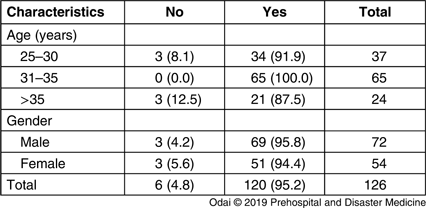
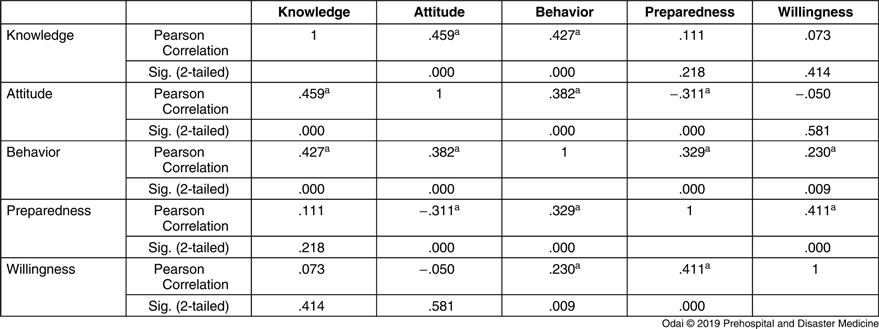
A total of 126 dentist participated in the study, giving a 68.1% retrieval rate. Males constituted 57.1% while females made up 42.9%. Participants aged 25 to 30 years old made up 29.4%, 31–35 years old was 51.6%, and greater than 35 years old were the remaining 19.0%. The willingness to render assistance in the case of disaster among the participants was 95.2%. Age was significantly associated with willingness to render assistance in the case of disaster among the participants. More than three-quarters (81.0%) reported that they had not received any disaster management training and 92.9% reported that they were not familiar with any government paper on response to disaster (Table 1). The mean disaster management knowledge and attitude scores were 16.95 (SD = 0.40) and 34.62 (SD= 0.56), respectively. Males had significantly higher knowledge than females (P = .001). The participants older than 35 years had significantly better attitude than the other age groups (P = .001). Males had significantly better attitude than the females (P = .005). The mean disaster management behavior score was 16.36 (SD = 0.60) while the mean disaster management preparedness score was 8.12 (SD = 0.25). Males reported significantly better preparedness than females (P = .000). Participants that reported willingness to render assistance in event of disaster had significantly better behavior (P = .005) and preparedness (P = .001) scores than their counterparts (Table 2). The disaster management knowledge had positive significant correlation with attitude and behavior. The disaster management attitude had positive significant correlation with behavior and negative significant correlation with preparedness. Disaster management behavior had positive significant correlation with preparedness and willingness to render assistance. Willingness to render assistance had positive significant correlation with preparedness (Table 3).
Willingness to Render Assistance in the Case of Disaster among the Participants

Relationship between Disaster Management Knowledge, Attitude, Behavior, Willingness to Render Assistance in the Case of Disaster, and Preparedness among the Participants

Correlation between Disaster Management Knowledge, Attitude, Behavior, Willingness to Render Assistance in the Case of Disaster and Preparedness among the Participants

a Correlation is significant at the 0.01 level (2-tailed).
Discussion
The roles of dental surgeons in disaster management are well-established in the literature.Reference Wadhawan, Khan, Solanki and Palekar2, Reference Kolude, Adeyemi, Taiwo, Sigbeku and Eze4, Reference Acharya5, Reference Janssen and Lampiris7 Dentists are subjected to medical and surgical training, and are trained for handling medical emergencies in dental clinics and hospitals, such as performing minor surgery, dispensing of drugs, giving injections, and administration of anesthesia, during their pre-doctoral education that makes them useful in disaster management situations. However, these health workers remain an untapped and often overlooked resource in disaster management in many countries of the world.Reference Chhabra, Rajesh, Chhabra, Binnal, Sharma and Pachori22 The American Dental Association (Chicago, Illinois USA) suggests that dental professionals utilizing their strong scientific and technical skills should assist in disaster management. This study appears to be the first to explore disaster management knowledge, attitude, behavior, willingness, and preparedness among dental surgeons in Nigeria. This is against the backdrop of increasing man-made disasters in the form of terrorism and conflicts in Nigeria. Findings of this study indicated that the knowledge and behavior scores of respondents were considerably low when compared with attitude scores. Lack of formal training programs about disaster management among qualified dentists and those in training in Nigeria may have led to low knowledge scores among the participants. This was confirmed by more than three-quarters (81.0%) reporting of non-receipt of any disaster management training. Emphasis on improving knowledge is sustained by the fact that disaster management knowledge had positive significant correlation with attitude and behavior in this study. Males had significantly higher knowledge than females, which may tally with males’ higher involvement in many environmental activities outside clinical duties, thus possibly leading the higher disaster management knowledge. The mean attitude score was high in this study, which may not be unconnected with that positive attitude is needed for health and survival among dentists in Nigerian as the country is bedeviled with political, socioeconomic, health, and poverty issues. The participants older than 35 years and males had significantly better attitude than their counterparts, which may be linked to the fact that they had higher disaster management knowledge. The positive significant correlation between disaster management attitude and behavior imply that positive attitude engenders favorable behavior. However, the negative significant correlation with preparedness makes it obvious that positive attitude alone is unable to propel high preparedness in the absence of other favorable parameters. The mean disaster management behavior score was 16.36 (SD = 0.60). Disaster management behavior had positive significant correlation with preparedness and willingness to render assistance. The mean disaster management preparedness score was 8.12 (SD = 0.25). Males reported significantly better preparedness than females (P = .000). The training geared towards improving knowledge of dental surgeon may be necessary to facilitate positive attitudinal and favorable behavioral disposition.
In this study, the majority (95.2%) of the participants expressed willingness to provide assistance in case of any occurring disaster. This was lower than (98.8%) reported among interns in Manipal College of Dental Sciences, Mangalore (India),Reference Rajesh, Pai, Shenoy and Priya23 but higher than (92.0%) reported among the New England dentists attending the 2005 Yankee Dental Conference in Boston, Massachusetts (USA);Reference Scott, Bansal and Mascarenhas24 (94.7%) among Oregon dentist;Reference Katz, Nekorchuk, Holck, Hendrickson, Imrie and Effler25 (85.0%) among Indian General Dental Practitioners;Reference Chhabra, Rajesh, Chhabra, Binnal, Sharma and Pachori22 among (73.8%) dentists in Hawaii (USA) that expressed willingness to provide assistance to the state in the event of a bioterrorist attack;Reference Katz, Nekorchuk, Holck, Hendrickson, Imrie and Effler25 and among (70.0%) all licensed physicians and nurses residing in Hawaii that expressed willingness to assist the state in the event of a bioterrorist attack.Reference Katz, Nekorchuk, Holck, Hendrickson, Imrie and Effler26 However, the willingness may be limited by non-exposure to training, so government officials and managers of disaster/emergency response agencies should consider incorporating dental professionals into their disaster management plans. Age was significantly associated with willingness to render assistance in the case of disaster among the participants. The 31-35-year-olds reported the highest level of willingness, which could be explained by the high-level practice exposure, experience, and vigor around this age among dentists in Nigeria. This is in tandem with Chhabra, et alReference Chhabra, Rajesh, Chhabra, Binnal, Sharma and Pachori22 report of significant association between willingness to participate in disaster management and age among Indian general dental practitioners. The willingness to render assistance was positively correlated with behavior and preparedness. There is therefore possibility that increasing exposure and opportunity will prompt dental surgeon into providing assistance in disasters because of their favorable behavior and high-level of preparedness in relation to disaster management. Although not statistically significant, the higher mean knowledge score in those willing to render assistance justifies the need for training to increase knowledge, and invariably willingness, which will consequently exert positive effects on disaster management behavior and preparedness.
Limitations
The cross-sectional study’s design inherent some limitations, and the foremost is generalizability; moreover, the study was done with a convenience sampling which further limits the generalizability. Moderate response rate in the present study may affect the overall quality of the data and thereby affecting the conclusions. Social desirability or positive bias, and/or deviation or negative bias, are associated with questionnaire-based studies. The shortcomings of Likert scales are end-aversion bias, positive skew, and the halo effect.
Conclusion
Data from this study revealed high-level of willingness to render assistance in disaster, high disaster management attitude but with low disaster management knowledge, behavior, and preparedness. The significant correlation between knowledge, attitude, behavior, and preparedness implies that training will offer immense benefit.