Chronic post-operative pain is generally accepted as a potential consequence of almost any operation.Reference Kehlet, Jensen and Woolf 1 , Reference Macrae 2 Prevalence rates vary substantially, depending on the type of surgery; for example, between 50 and 85% of amputees experience phantom pain after amputation, up to 30% develop chronic pain after breast cancer surgery, between 20 and 60% report chronic pain after thoracotomy because of lung cancer, and about 10% develop chronic pain after inguinal hernia repair.Reference Nikolajsen and Jensen 3 – Reference Aasvang and Kehlet 6 The causes of chronic pain after surgery are not fully known, but several risk factors have been identified, including female gender, psychosocial and genetic factors, and pre- and post-operative pain.Reference Kehlet, Jensen and Woolf 1 , Reference Macrae 2 Nerve injury during surgery is also an important risk factor, as many patients with chronic post-operative pain present with hyperalgesia and allodynia in the painful area, which are characteristic symptoms of neuropathic pain.Reference Jensen and Baron 7 , Reference Steegers, Snik, Verhagen, van der Drift and Wilder-Smith 8
Studies on amputation, thoracotomy and inguinal hernia repair have suggested that young age at the time of surgery may be associated with a lower risk of developing chronic pain.Reference Wilkins, McGrath, Finley and Katz 9 – Reference Kristensen, Ahlburg, Lauridsen, Jensen and Nikolajsen 11 For example, a questionnaire-based study including adults who underwent thoracotomy in childhood because of coarctation of the aorta showed that only three out of 88 (3.4%) had pain 30 years after surgery.Reference Kristensen, Pedersen, Hjortdal, Jensen and Nikolajsen 10 Another questionnaire-based study of 98 children who had undergone inguinal hernia repair 3 years earlier showed a prevalence of chronic pain of 5.1%.Reference Kristensen, Ahlburg, Lauridsen, Jensen and Nikolajsen 11 The mechanisms behind this apparent lower risk of developing chronic pain in young patients are not fully known, but may be related to both physiological and psychological factors.
Sternotomy is a relatively common surgical procedure in children, and it is carried out for both minor – closure of atrial and ventricular septum defects – and major – correction of Tetralogy of Fallot, arterial switch operations and other – surgeries on the heart. In adults, sternotomy is followed by chronic pain in 20 to 50% of patients.Reference Bruce, Drury, Poobalan, Jeffrey, Smith and Chambers 12 – Reference van Gulik, Janssen and Ahlers 16 In the most recent of these studies, 136 adult patients were followed up prospectively and the prevalence of chronic pain was 35% 1 year after sternotomy. Only few patients had pain constantly, but pain affected sleep in 36% of the pain patients, and 14% had stopped working because of the pain.Reference van Gulik, Janssen and Ahlers 16
Less is known about chronic pain after cardiac surgery via sternotomy in children. To the best of our knowledge, a long-term follow-up with focus on the prevalence and character of pain has not yet been performed. We therefore decided to carry out the present study. The aim was twofold: to determine the prevalence of chronic pain after sternotomy in childhood and to assess any neuropathic pain component by performing quantitative sensory testing.
Materials and methods
Patients
Children were recruited from the Department of Cardiothoracic and Vascular Surgery, Aarhus University Hospital, Aarhus, Denmark. Inclusion criteria were cardiac surgery via median sternotomy 10–60 months earlier – from January, 2007 to March, 2011; identification through search on the relevant diagnostic codes; International Classification of Diseases – age between 0 and 12 years at the time of surgery, and present age of at least 4 years. The lower limit of 4 years was chosen as children must be at least 4 years old in order to be able to use a Faces Pain Scale.Reference Hicks, von Baeyer, Spafford, van Korlaar and Goodenough 17 Exclusion criteria were cognitive impairment or other severe systemic disease. A postal questionnaire on pain was sent to all eligible children and their parents in January, 2012. A reminder was sent in case of no reply.
Another group of 13 children aged between 4 and 12 years were prospectively examined with quantitative sensory testing ∼3 months after sternotomy. This was done in order to assess whether there was any neuropathic pain component. The first child was examined in October, 2010 and the last child in May, 2012.
Relevant medical and surgical data of the children were derived from their medical records. None of the children received local anaesthetics for wound infiltration during surgery or for infusion post-operatively. In most cases, the sternum was closed with vicryl suture. Only 14 children had, because of older age and higher weight at the time of surgery, their sternum closed by wire. The study was approved by the Regional Research Ethics Committee of Central Jutland (ID: M-20100148) and registered according to the Danish Law of Data Protection (ID: 2010-41-5177).
Assessment of pain
The pain questionnaire included questions about pain after sternotomy, defined as any pain that developed or persisted after surgery and was located in the sternum.
First, the children were asked to recall the intensity – worst pain during the first post-operative week – and duration (1 week; 2 weeks; 3–4 weeks; <2 months; pain still present; do not remember) of their pain after surgery. Second, they were asked to describe any present pain in the sternal area and the average pain intensity during the most recent week using the revised Bieri Faces Pain Scale. Each of the six faces corresponds to a number on a numeric rating scale (0–10): The first face corresponds to a pain intensity of 0 on the numeric rating scale, the second face corresponds to 2 on the numeric rating scale, and the sixth face corresponds to 10 on the numeric rating scale.Reference Hicks, von Baeyer, Spafford, van Korlaar and Goodenough 17 Third, they were asked whether anything provoked the pain – touch, pressure, physical activity, others. Finally, they were asked to describe the character of their pain by using the following sensory descriptors derived from the Danish version of the McGill Pain Questionnaire: burning, pricking, scalding, pressing, freezing, numbing, itchy, shooting or others.Reference Drewes, Helweg-Larsen and Petersen 18 Children with persistent pain were also asked about their consumption of analgesic medications.
Young children may find it difficult to answer questions about past pain and in distinguishing between different word descriptors. Therefore, their parents/guardians were encouraged to support the children in completing the questionnaire.
Quantitative sensory testing
Quantitative sensory testing was carried out in 13 children, who were included consecutively during the study period, at the scheduled outpatient visit ∼3 months after surgery. The children and their parents were carefully introduced to the examination, and the tests were demonstrated on either a parent or a teddy bear. Quantitative sensory testing included determination of pinprick hyperalgesia (von Frey filament No. 5.88, Stoelting, Illinois, United States of America) and brush allodynia (SENSELabTM Brush-05, Somedic AB, Hörby, Sweden) and cold (thermal roller at 20°C). Pressure pain threshold was measured by applying a pressure algometer 1 cm outside the surgical scar (Somedic AB, application rate of 20 kPa/s). The child was instructed to say stop as soon as the applied pressure evoked pain. The children also completed the pain questionnaire that was used for the postal survey. As no reference values exist for pressure pain thresholds obtained at the sternum in children, the pressure pain threshold was determined in 10 healthy age-matched children recruited outside the hospital in a local residence area for comparison. The same examiner (A.D.K.) carried out all sensory testing.
Statistical analysis
Data were entered into an Access database and analysed using the software package Sigma Plot, version 11. Descriptive statistics were used. Dichotomous data were analysed using the χ2-test. A p value <0.05 was considered statistically significant. The results are presented as median with ranges.
Results
Pain questionnaire
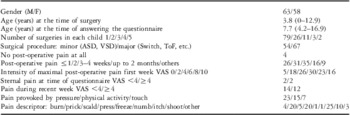
A total of 195 children fulfilled the inclusion criteria, but 24 were excluded mainly because of Down syndrome (n = 6), DiGeorge syndrome (n = 5) or other chromosomal abnormalities (Fig 1). Thus, pain questionnaires were sent to 171 children. In all, 121 children, including 63 boys and 58 girls, returned the questionnaire (response rate 71%). Their age at the time of answering the questionnaire was 7.7 (4.2–16.9) years and their age at the time of surgery was 3.8 (0–12.9) years; thus, the follow-up time was 4 (0.8–5.1) years. In all, 54 children (45%) had undergone closure of atrial and ventricular septum defects and the remaining had undergone correction of Tetralogy of Fallot, arterial switch, Ross operations and others. A total of 42 children had undergone cardiac surgery more than once.
Flowchart of pain questionnaire patients.

Non-responders
The 50 children who did not answer the questionnaire were not significantly different in terms of distribution of diagnoses, sex or frequency of re-operations, but non-responders were younger (1.4 (0.1–11.9) years, p < 0.001) at the time of surgery.
Frequency of pain
Patient characteristics and results from the pain questionnaires can be seen in Table 1. Pain after sternotomy disappeared within 3–4 weeks in most of the children and only four children (3%) reported of present pain in the sternum (intensity 2, 2, 4, 4, respectively). The latter child occasionally took paracetamol for the pain. However, when asked about average pain intensity during the most recent week, only 79% were pain free. A total of 26 children (21%) reported some pain; in 12 (46%) of the 26 children, the intensity was ≥4 on the revised Bieri Faces Pain Scale.
Patient characteristics, recalled pain and pain characteristics 10–60 months after cardiac surgery via sternotomy (n = 121).

ASD = atrial septal defect; Switch = arterial switch of great arteries in transposition of the great arteries; ToF = Tetralogy of Fallot; VAS = visual analogue scale; VSD = ventricular septal defect
Results are presented as median with ranges
Another 24 children (20%) who had no pain at present or during the most recent week experienced pain occasionally, most often provoked by physical activity (n = 15), pressure to the scar (n = 23) or touching of the scar area (n = 7). An additional 13 children reported no pain, but used the pain descriptors to describe unpleasant sensations located to the sternum. Thus, a total of 63 out of 121 (52%) children had either present pain (n = 4), present pain and/or pain within the most recent week (n = 26), occasionally provoked pain (n = 24), or no pain but unpleasant sensations located in the sternum (n = 13). None of the children had requested removal of the sternal wire because of pain.
Characteristics of pain
Itching (n = 25), pricking (n = 20), pressing (n = 20) and shooting (n = 10) were the descriptors most often used to describe the pain and sensations located in the sternum.
Risk factors
The risk of persistent pain was not significantly lower in the children who had undergone surgery because of atrial and ventricular septum defects than in those who had undergone major cardiac surgery (15 versus 27%, p = 0.17). In all, 12 children with present pain and/or pain within the most recent week had had more than one sternotomy. Their risk of developing chronic pain was not significantly higher compared with that of the children with only one sternotomy (29 versus 17%, p = 0.25). There was no difference in age at the time of surgery between the 26 children who stated present and/or recent pain and the 95 who did not (4.1 versus 3.8 years, p = 0.75). In addition, there was no difference in the prevalence of chronic pain between boys and girls (p = 0.99).
Quantitative sensory testing
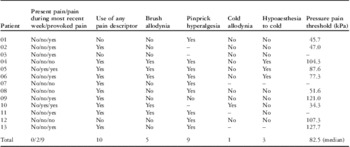
In all, 13 children, including four boys and nine girls aged 7.5 (5–14.1) years at the time of surgery, underwent quantitative sensory testing. There were two children who had undergone closure of atrial and ventricular septum defects and six children who had undergone two or more cardiac surgeries. None of the participants had pain at the time of the examination. However, two children had experienced pain during the most recent week with intensities of 2 and 4 on the revised Bieri Faces Pain Scale. Another seven children reported that sternal pain could be provoked by physical activity, pressure or touch to the scar area. In addition, three children used pain descriptors, although they did not state present or provoked pain. Itching and pressing were the most frequent pain descriptors used by nine and three children, respectively. Thus, only one child did not report any pain or discomfort in the scar area.
Quantitative sensory testing revealed sensory abnormalities in 10 out of 13 children. Details about pain and quantitative sensory testing can be found in Table 2. The pressure pain threshold was 82.5 (34.3–127.7) kPa in the operated children. In the 10 healthy children (7.7 (5.3–12.2) years), the pressure pain threshold was 126.3 (100.1–210.7) kPa (p = 0.006).
Results from quantitative sensory testing in 13 children 3 months after cardiac surgery via sternotomy.

–, did not want to participate.
Discussion
The present study is the first to examine the prevalence of chronic pain after cardiac surgery via sternotomy in children. The main finding was the demonstration of present or recent pain in 26 out of 121 children (21%). In 12 children (10%), the pain was ≥4 on the numeric rating scale, but only four patients (3%) had pain at the time of answering the questionnaire. Only one child used medication for the pain. In another 24 children (20%) without spontaneous pain, pain could be provoked by physical activity; thus, a considerable number of children have some pain problems after sternotomy.
The follow-up period in the present study was longer (4 years) than in most of the studies on chronic pain after sternotomy in adults. The prevalence of chronic pain after sternotomy in studies with 1-year follow-up (17–35%)Reference Lahtinen, Kokki and Hynynen 14 – Reference van Gulik, Janssen and Ahlers 16 is, however, similar to that of studies with 2–3 years’ follow-up (12–56%);Reference Bruce, Drury, Poobalan, Jeffrey, Smith and Chambers 12 , Reference Eisenberg, Pultorak, Pud and Bar-El 13 therefore, it can be argued that the low prevalence in children cannot simply be explained by a dissipation of pain over time.
The pain descriptors most often used by the children – itching, pricking, pressing and shooting – suggest that chronic pain after sternotomy may have a neuropathic component. In adult patients undergoing thoracotomy, a neuropathic component was found in about half of the patients.Reference Steegers, Snik, Verhagen, van der Drift and Wilder-Smith 8 The sternum receives its innervation from the ventral primary rami of the spinal nerves T1–T11 and its lateral and anterior cutaneous branches, and cardiac surgery via sternotomy is likely to affect the nerves bilaterally. In fact, nerve injury during surgery has been shown to be an important risk factor for the development of chronic pain after surgery.Reference Kehlet, Jensen and Woolf 1 Other mechanisms are likely to be involved. For example, it is possible that visceral stimulation during surgery can sensitise the central nervous system, thus facilitating the development of somatic chronic pain via viscero-somatic convergent mechanisms.Reference Stawowy, Funch-Jensen, Arendt-Nielsen and Drewes 19
Out of the 13 children who underwent quantitative sensory testing, 10 had sensory abnormalities in the scar area, including brush and cold allodynia, pinprick hyperalgesia and lowered pressure pain thresholds. However, there was no consistent association between the pain and the results from the quantitative sensory testing. It is likely that abnormal hypo- and hyperphenomena are common after sternotomy, but the specificity for chronic pain may be low.
Gender may affect the risk of chronic pain, including pain after surgery. Several studies on various chronic pain conditions have shown that girls report more severe pain, and more frequently than boys.Reference Perquin, Hazebroek-Kampschreur and Hunfeld 20 , Reference Keogh and Eccleston 21 In the present study, however, there was no gender difference.
In a recent study on chronic pain after thoracotomy in childhood or adolescence, very young age at the time of surgery was associated with a shorter duration of post-operative pain. The prevalence of long-lasting (>3 months) post-operative pain was 3.2% in the youngest group (0–6 years at the time of surgery), 19.4% in children aged 7–12 years at the time of surgery, and 28.5% among those aged 13–25 years at the time of surgery.Reference Kristensen, Pedersen, Hjortdal, Jensen and Nikolajsen 10
In adults, re-sternotomy is a risk factor for the development of chronic pain after sternotomy.Reference van Gulik, Janssen and Ahlers 16 In this study, the children had to be at least 4 years of age in order to answer the questionnaire. Almost half of children with congenital cardiac abnormalities are operated in early infancy. Heart surgeries are only carried out in children above the age of 4 years in selected cases. Therefore, there is a large percentage of second- and third-time operations in the present study. There was a trend, although not significant, towards a higher prevalence of pain in children who had undergone more than one sternotomy. Similarly, the prevalence of chronic pain was similar in children with minor and major cardiac surgeries.
The lower prevalence of chronic pain after surgery in childhood may have several explanations. An immature peripheral and central nervous system combined with an enhanced neuronal plastic capacity in the child's brain may contribute to a lower risk of developing chronic pain.Reference Florence, Jain, Pospichal, Beck, Sly and Kaas 22 Bones, tendons and ligaments are more indulgent and flexible in children, and therefore sternotomy may be less harmful in children than in adults. Psychological aspects may also play an important role. Psychological aspects such as fear of surgery have been found to be associated with more acute pain in adults,Reference Peters, Sommer and de Rijke 23 but children may not worry about surgery to the same extent as adults.
Some limitations of the present study should be considered. First of all, the median age was 7.7 years at the time of answering the questionnaire, and the cognitive ability to understand the meaning of the questions and the purpose of the study may vary in this age group. Second, information about the duration of pain after surgery may be susceptible to recall bias, especially in children having undergone more than one cardiac surgical procedure. It has been shown, however, that even young children can recall previously experienced pain for months and years.Reference von Baeyer, Marche, Rocha and Salmon 24 Third, children with possible cognitive dysfunction – for example, Down and DiGeorge syndromes – were not asked to participate in the study. It could be argued that exclusion of these children was not necessary as parental support could have been obtained in these cases. Finally, information about unpleasant sensations in the scar area was based on self-reports in most of the children. Quantitative sensory testing is necessary in order to obtain more reliable data on sensory abnormalities.
In conclusion, this study suggests that the prevalence of chronic pain after sternotomy is lower if surgery is performed in childhood. Thus, our results are in accordance with other studies showing that surgery in childhood is associated with a lower risk of developing chronic pain. In all, 21% of the children, however, reported some pain located in the scar area, implying that chronic pain after cardiac surgery via sternotomy in children is a problem that should not be neglected. The pain is likely to have a neuropathic component. Prospective studies, including quantitative sensory testing and with a long-term follow-up, are needed to increase our knowledge about the prevalence of chronic pain after surgery in children.
Acknowledgements
None.
Financial Support
This research received support from the Health Research Fund of Central Denmark Region.
Conflicts of Interest
None.
Ethical Standards
The authors assert that all procedures contributing to this work comply with the ethical standards of the relevant national guidelines on human experimentation and with the Helsinki Declaration of 1975, as revised in 2008, and has been approved by the institutional committees – approval obtained from the Regional Research Ethics Committee of Central Jutland.