





Introduction
The Kaqchikel people are an indigenous Maya community primarily residing in the highlands of southern Guatemala. Since the establishment of the Superintendency of Guatemala by Spain in 1544, this region has been greatly impacted by various aspects of Spanish culture and language at a societal level. Nowadays, surrounded by a Spanish sociocultural environment, Kaqchikel children, despite growing up speaking Kaqchikel at home, primarily receive education in Spanish, the societal majority language. Consequently, broadly speaking, Spanish has become their primary functional language, while Kaqchikel takes on the role of their heritage language. Similarly, in the current study we consider our participants to be heritage bilinguals living in a Spanish-dominant environment. The present study investigated the influence of Spanish on lexical production and sentence processing within the Kaqchikel community. Situated within the framework of heritage language bilingualism (e.g., Bayram et al., Reference Bayram, Rothman, Di Pisa and Slabakova2021; Ducar, Reference Ducar2008; Li & Matthews, Reference Li and Matthews2022; Pascual y Cabo and Rothman, Reference Pascual y Cabo and Rothman2012; Polinsky, Reference Polinsky2011, Reference Polinsky2018; Polinsky & Scontras, Reference Polinsky and Scontras2019, Reference Polinsky and Scontras2020; Rothman, Reference Rothman2009; Scontras et al., Reference Scontras, Fuchs and Polinsky2015; and specifically related to the “revitalization” of the Mayan languages, Berkley, Reference Berkley1998, Reference Berkley2001; Guerrettaz, Reference Guerrettaz2020), this research seeks to explore whether and how the societal dominanceFootnote 1 of the Spanish language has impacted specific aspects of the Kaqchikel heritage language.
Kaqchikel as a heritage language
The issue of heritage languages in the literature often centers around immigrants in North America, due to families arriving from regions such as Asia, Africa, and Central/South America and passing their native languages down through generations. For example, a 2018 survey noted that 67.3 million people in the United States spoke a foreign language at home (Zeigler & Camarota, Reference Zeigler and Camarota2019). Considering that about 60% of the global population is bilingual or multilingual, with rates exceeding 90% in some regions (e.g., Grosjean, Reference Grosjean2019), it seems unlikely that learning multiple languages hinders cognitive or linguistic development. Research indicates that, when socioeconomic and educational factors are taken into account, bilingual and multilingual children generally show developmental outcomes comparable to those of monolinguals, although findings vary across domains and tasks (Antoniou, Reference Antoniou2019; Bialystok, Reference Bialystok2009; Bialystok & Craik, Reference Bialystok and Craik2022; Kroll & Bialystok, Reference Kroll and Bialystok2013). However, as Spanish-speaking populations grow, Spanish in North America has become both a challenge to English dominance and a proliferating heritage language with specialized programs in the U.S.
However, the situation for languages from the Maya linguistic group, such as Kaqchikel, is markedly different. Unlike typical heritage languages introduced by immigrants, Kaqchikel became a heritage language in its own native region due to Spanish conquest and influence, which extended Spanish cultural and linguistic presence throughout the country. This represents a reversal of the process by which heritage languages often emerge through immigration, and its effects have persisted into the modern era (e.g., after independence from Spain and the Guatemalan Civil War). Yet, despite the recent formal recognition of Guatemala’s Mayan languages and cultures in official administration, Spanish remains pervasive in everyday life, especially in schooling, media, and government. It has been widely documented that Spanish-medium instruction and uneven implementation of bilingual/intercultural education sustained post-war Spanishization and inhibited intergenerational transmission in Maya communities (Garzón et al., Reference Garzón, Brown and Richards1998; Holmquist & Muzika Kahn, Reference Holmquist and Muzika Kahn2017; Milian & Walker, Reference Milian and Walker2019; Poppema, Reference Poppema2009). Consequently, while multilingualism is being officially promoted, in practice, Spanish maintains its strong social dominance.Footnote 2
Kaqchikel is the leading language among the twenty-two Mayan languages spoken in Guatemala, with an estimated one million ethnic Kaqchikel but fewer than 450,000 speakers (Lewis, Reference Lewis2009). Originating from the Maya civilization, Kaqchikel has a rich history, particularly in the highlands of southern Guatemala. However, its trajectory shifted significantly with Spanish colonization in the 16th century, which introduced dominant Spanish religious, cultural, social, and linguistic influences. These changes led to the assimilation of Spanish elements into Kaqchikel life, shifting Kaqchikel into the role of a heritage language and establishing Spanish as the leading language in the region.
Kaqchikel communities in Guatemala are relatively dispersed, resembling isolated islands, which contributes to the fragmentation of the Kaqchikel language. The need for standardization has become increasingly apparent in recent years due to variations in pronunciation and expressions across different communities. Despite the challenges faced during Spanish rule, particularly by the Maya people, the arrival of the Spaniards, notably missionaries, did play a crucial role in documenting Mayan languages, including standardization efforts for Kaqchikel. The written records left behind are invaluable resources for contemporary linguists and significantly contributed to standardizing Mayan languages. Formal standardization initiatives for Mayan languages began more recently, marked by the establishment of the Guatemalan Maya Language Academy in 1986 and the collaborative efforts of linguists in the Francisco Marroquin Language Project from 1987 to 2008 (García Matzar et al., Reference García Matzar, Omori, Yasugi and Koizumi2012). This project aimed to create a comprehensive outline of the Kaqchikel language, focusing on standardizing various linguistic elements such as pronunciations, lexical items, and grammatical inflections. The process of Kaqchikel standardization achieved a phonetic description, uniformity in vocabulary spelling, and consistency in grammatical structures.
While Kaqchikel children are now attending school, there was a historical tendency to physically punish students for using Mayan languages (Berkley, Reference Berkley1998, Reference Berkley2001; Guerrettaz, Reference Guerrettaz2020), hindering the progress of Kaqchikel language education. Recent initiatives in education for the Kaqchikel heritage language have emerged, rooted in these standardization efforts. Their focus is on revitalizing and promoting the Kaqchikel language within educational contexts to ensure its continued vitality and transmission to future generations (England, Reference England2003). Yet, despite these efforts, even nowadays almost all education in Guatemala takes place in Spanish.
Linguistic characteristics of Kaqchikel sentences
Most languages typically place a subject before an object in their sentence structure. According to Dryer (Reference Dryer, Dryer and Haspelmath2013), the predominant word order across the world’s languages follows the subject-object (SO) sequence, with 48% using subject-object-verb (SOV), 41% using subject-verb-object (SVO), and 8% using verb-subject-object (VSO). This prevalence of the SO order, accounting for 97% of languages, suggests its near-universal preference. This structure indicates that subjects typically precede objects as agents when causing changes in patients. Moreover, an agent’s action often alters the state of the patient. Neurological studies examining the flexible word order in languages like German (e.g., Bornkessel-Schlesewsky & Schlesewsky, Reference Bornkessel-Schlesewsky and Schlesewsky2009; Bornkessel et al., Reference Bornkessel, Schlesewsky and Friederici2002; Fiebach et al., Reference Fiebach, Schlesewsky and Friederici2001), Japanese (Tanaka et al., Reference Tanaka, Branigan, McLean and Pickering2011), Basque-Euskara (Erdocia et al., Reference Erdocia, Laka, Mestres-Missé and Rodriguez-Fornells2009), and Turkish (Demiral et al., Reference Demiral, Schlesewsky and Bornkessel-Schlesewsky2008) have shown that sentences using an object-subject (OS) order are more challenging to process than those with a subject-initial structure. This supports the notion that the SO order reflects the most natural and efficient way to organize and interrelate core conceptual elements in a sentence.
In addition to a general SO order preference, additional patterns have been documented in other languages with flexible VSO/SVO word orders. For instance, Arabic, canonically VSO, has been documented to show variations in word order preferences. Specifically, Palestinian-Arabic-speaking children first acquire and prefer the canonical Arabic VSO structure but ultimately shift to colloquially preferred SVO variant. In other studies (AlQahtani, Reference AlQahtani2016), it was revealed that while Arabic speakers prefer the canonical word VSO order, when heritage speakers were influenced by L2 languages with SVO canonical word orders, SVO preferences became more prevalent. Accordingly, a general SV over VS might also be prevalent.
According to the Interface Hypothesis, proposed by Sorace (e.g., Sorace, Reference Sorace2011), heritage speakers such as those in the Kaqchikel community might face difficulties at external linguistic interfaces. The hypothesis points where syntactic processing must be integrated with discourse-level or pragmatic information. This theoretical perspective is particularly relevant for understanding how bilingual Kaqchikel-Spanish speakers handle the complexities of word order variations. This is because Kaqchikel stands out as one of the select few languages that utilizes VOS as its canonical word order, where neither the subject nor the object is topicalized or focused in its default structure (e.g., Aissen, Reference Aissen1992; Ajsivinac Sian et al., Reference Ajsivinac Sian, García Matzar, Cutzal and Alonzo Guaján2004; Coon, Reference Coon2010; England, Reference England1991; García Matzar & Rodríguez Guaján, Reference García Matzar and Rodríguez Guaján1997; Otaki, Reference Otaki2023; Rodríguez Guaján, Reference Rodríguez Guaján1994; Yasunaga et al., Reference Yasunaga, Yano, Yasugi and Koizumi2015). In fact, the canonical VOS order only constitutes a mere 2% among world languages. Yet, Kaqchikel also permits multiple surface orders. SVO, OVS, and VSO orders are all attested and are typically derived by information-structural operations such as scrambling and topicalization (Ohta et al., Reference Ohta, Fukui, Koizumi, Tamaoka and Sakai2017). Similar to the situation with colloquial Arabic, descriptive grammars of Kaqchikel document SVO as a common alternative order in discourse (García Matzar & Rodríguez Guaján, Reference García Matzar and Rodríguez Guaján1997). This matters for bilinguals because Spanish is canonically SVO, the structural overlap between Spanish SVO and the SVO option in Kaqchikel provides a natural pathway for cross-linguistic influence, biasing acceptability toward SVO in Kaqchikel even though VOS is the neutral baseline (see Bosch & Unsworth, Reference Bosch and Unsworth2021).
Kaqchikel is known as an ergative language (Dixon, Reference Dixon1979, Reference Dixon1994). Subjects and objects are not case-marked in Kaqchikel, but the predicate specifies the subject/object, persons of first, second, or third, and numbers of singular or plural. An example of a VOS-ordered sentence (1), taken from Koizumi et al. (Reference Koizumi, Yasugi, Tamaoka, Kiyama, Kim, Sian and Mátzar2014, p. 1211), demonstrates the predicate X-φ-u-chöy [CP-ABS.3sg-ERG.3sg-cut], denoting CP [completive], ABS [absolutive], 3sg [third person singular], ERG [ergative] 3sg [third person singular], and finally chöy meaning “cut.” In this predicate, x- refers to the aspect (completive) marker, φ (a null morpheme) refers to the object agreement marker, -u refers to the subject agreement marker, and the verb chöy (“cut”). Two nouns or noun phrases follow the predicate: the object, ri chäj “the pine tree,” and the subject, ri ajanel “carpenter,” where ri refers to the determiner “the.”
(1)
VOS order
X-φ-u-chöy
ri
chäj
ri
ajanel.
CP-ABS.3sg-ERG.3sg-cut
DET
pine.tree
DET
carpenter.
“The carpenter cut the pine tree.”
As depicted in an SVO-ordered sentence (2) taken from Koizumi et al. (Reference Koizumi, Yasugi, Tamaoka, Kiyama, Kim, Sian and Mátzar2014, p. 1212), positioning the subject before the predicate or verb often implies interpreting the subject as a topic. In this context, the SVO order carries a pragmatic emphasis. The placement of a topic is pragmatically motivated and syntactically results in one of three word orders (Aissen, Reference Aissen1992; Coon, Reference Coon2010; England, Reference England1991): SVO, OVS, or VSO, while the VOS order is considered pragmatically neutral. According to England (Reference England1991), the word orders of SVO, OVS, and VSO are derived from VOS through reordering rules. Besides reordering, the overall meaning of the sentences remains essentially unchanged compared to the VOS-ordered sentence (1). While the VOS-ordered sentence (1) is assumed to be base-generated, the SVO-ordered sentence (2) is derived from the involvement of an additional movement of the subject.
(2)
SVO order.
Ri
ajanel
X-φ-u-chöy
ri
chäj.
DET
carpenter
CP-ABS.3sg-ERG.3sg-cut
DET
pine.tree.
“The carpenter cut the pine tree.”
Kaqchikel utilizes the term achike as a single interrogative word, serving as who in subject wh-questions and whom in object wh-questions. In Kaqchikel syntax, the mandatory wh-movement dictates the initial positioning of achike in both subject and object wh-questions. A notable feature is the presence of syntactic ergativity in Kaqchikel subject wh-questions (Erlewine, Reference Erlewine2016; Henderson & Coon, Reference Henderson and Coon2018). In sentence (3) taken from Otaki (Reference Otaki2023, p. 19), the predicate undergoes intransitivization within the structure. This sentence illustrates that the predicate solely consists of an absolutive agreement marker φ, followed by the obligatory agent focus marker (AF) -o at its conclusion. The agent focus marker is essential in subject wh-questions. Additionally, the noun la ti xtän, where la acts as a determiner and ti represents the diminutive, conveys a term of endearment meaning “a little,” following the predicate.
(3)
Subject wh-question
Achike
x-φ-nim-o
la
ti
xtän?
who
CP-ABS.3sg-push-AF
DET
DIM
girl?
“Who pushed the girl?”
In object wh-questions, exemplified by sentence (4) from Otaki (Reference Otaki2023, p. 19), the predicate x-φ-u-nim retains the original structure of a transitive sentence. It contains x- as the aspect marker (completive), φ as the object agreement marker, -u as the subject agreement marker, and the verb nim, signifying “push.” Notably, there is an absence of the agent focus marker -o in this construction. Similarly, the phrase la ti xtän, translating to “a little girl,” follows the predicate.
(4)
Object wh-question
Achike
x-φ-u-nim
la
ti
xtän?
who
CP-ABS.3sg-ERG.3sg-push
DET
DIM
girl
“Who did the girl push?”
Consequently, the null morpheme φ marks absolutive in intransitives, but in transitives φ functions as object agreement in the presence of a distinct ergative marker (e.g., -u). The disambiguation is morphosyntactic rather than phonological (Coon, Reference Coon2010; Henderson & Coon, Reference Henderson and Coon2018).
Based on a sentence plausibility judgment task conducted on adult bilingual speakers in Kaqchikel, Koizumi et al. (Reference Koizumi, Yasugi, Tamaoka, Kiyama, Kim, Sian and Mátzar2014) observed faster processing of VOS-ordered sentences, such as sentence (1), in contrast to their VSO and SVO counterparts. This affirmed the fundamental word order in Kaqchikel, as prescribed by syntax, to be VOS. Neurocorrelational investigations of Kaqchikel by Koizumi and Kim (Reference Koizumi and Kim2016) and Yano et al. (Reference Yano, Yasunaga, Koizumi and Harris2017) further confirmed that sentences in Kaqchikel are more efficiently processed when using the VOS order, in contrast to the SVO order demonstrated in sentence (2). These findings suggest that the preference for the SO order in sentence comprehension, noted in prior studies, is not universally applicable. Instead, the complexities of sentence comprehension are significantly shaped by the distinctive syntactic structures inherent in individual languages.
The syntactic structure of Kaqchikel distinctly deviates from Spanish which predominantly uses SVO order. While Spanish allows frequent null subjects and pragmatic word-order flexibility (SVO/VSO/OVS), SVO is, nevertheless, the canonical order in neutral contexts (Ocampo, Reference Ocampo, Downing and Noonan1995; Zubizarreta, Reference Zubizarreta1998). Over an extensive period of Spanish dominance, Kaqchikel might have inevitably assimilated some influences from the Spanish language. Various linguistic descriptions (e.g., Aissen, Reference Aissen1992; Coon, Reference Coon2010; England, Reference England1991; García Matzar & Rodríguez Guaján, Reference García Matzar and Rodríguez Guaján1997; Otaki, Reference Otaki2023; Yasunaga et al., Reference Yasunaga, Yano, Yasugi and Koizumi2015) and behavioral/neurocorrelational studies (Koizumi & Kim, Reference Koizumi and Kim2016; Koizumi et al., Reference Koizumi, Yasugi, Tamaoka, Kiyama, Kim, Sian and Mátzar2014; Yano et al., Reference Yano, Yasunaga, Koizumi and Harris2017) have led to several hypotheses.
If the VOS order remains fundamental in Kaqchikel sentence processing despite the enduring influence of Spanish, it would imply that sentences structured in VOS are processed more accurately and rapidly than those in the SVO order in Kaqchikel. This would mirror studies in Arabic which have shown that it can be possible for heritage speakers to maintain canonical order preferences, given limited exposure to the L2. However, the hypothesis suggests that if the basic word order acquired during childhood in Kaqchikel influences later-acquired Spanish, sentences in the VOS order would be processed more swiftly than those in the SVO order in both languages. This would be similar to L1–L2 cross-linguistic influences found in other language pairs such as Dutch-English bilinguals (Bosch & Unsworth, Reference Bosch and Unsworth2021). However, if Spanish, acquired later and eventually becoming the primary functional language, significantly influences Kaqchikel, then the SVO basic word order of Spanish would likely impact Kaqchikel, and sentences in the SVO order would be processed more quickly and accurately than those in the VOS order.
Likewise, in Kaqchikel subject wh-questions and object wh-questions, with VOS considered the basic order, the hypothesis suggests that interrogative sentences following the O1Vt 1S-ordered object wh-questions might undergo quicker processing and potentially achieve higher accuracy than subject wh-questions structured in the S1VOt 1 order. This assumption arises from the greater distance the subject needs to move from its original position in the VOS canonical order to the sentence-initial position, compared to the object’s movement from its original position. Conversely, in Spanish, who is expressed as quién, while whom translates to a quién. Similarly, two word-ordered interrogative sentences, SVO and OVS, have been formulated in Spanish with the former being preferred among Spanish dialects (e.g., Brown & Rivas, Reference Brown and Rivas2011).
Word order in Spanish is relatively flexible, allowing for emphasis or stylistic variation. A typical transitive sentence in Spanish usually follows the SVO order, which is considered the canonical order. However, the subject-and-verb reversal order of VSO is also possible. Zubizarreta (Reference Zubizarreta1998) suggests that both SVO and VSO structures are compatible with a neutral focus although the use of the VSO order has decreased over time. In addition, although much less common, both OVS and VOS orders are also possible in Spanish. This flexibility in Spanish leads to ongoing debate among linguists about the canonicity of word order in Spanish. Nevertheless, the SVO order is widely accepted as the basic word order in Spanish due to its prevalence.
Given the prevalence of the SVO structure in Spanish, it is anticipated that sentences structured in the SVO order may undergo faster processing and potentially yield higher accuracy compared to sentences using the VOS order. Similarly, subject wh-questions may undergo faster processing and yield higher accuracy compared to object wh-questions structured in the OVS order. The influence of Spanish’s SVO structure on word order in Kaqchikel could be significant, as it is expected that the ubiquity of SVO in Spanish may impact the word order patterns in Kaqchikel. Therefore, a comprehensive investigation is necessary to understand the influence of Spanish on sentence processing in Kaqchikel, and vice versa.
Current study
General methods
Participants and sample-size rationale
The study comprised three experiments examining lexical production and sentence processing in Kaqchikel-Spanish bilinguals from Kaqchikel-speaking communities around Antigua, Guatemala. Across all experiments, participants were adult native speakers of Kaqchikel who grew up using Kaqchikel in daily life and received formal schooling in Spanish. In line with the aims of the study, we treat the sample as heritage bilinguals living in a Spanish-dominant environment, while avoiding stronger claims about individual language dominance because participant-specific dominance measures were not collected for all experiments. All participants provided informed consent and received monetary compensation. For all experiments, ethical approval was obtained by the ethical committee of the Graduate School of Arts and Letters, Tohoku University, Japan.
Experiment 1 included 63 participants (24 females, 39 males; mean age = 32.2 years, SD = 9.8). Experiments 2 and 3 included 80 participants (46 females, 34 males; mean age = 32.3 years, SD = 9.8), of whom 61 had also participated in Experiment 1. Because the study was conducted in a field setting with a difficult-to-access bilingual population, sample size was determined primarily by feasible recruitment rather than by a priori power analysis. This feasibility-based approach is broadly consistent with prior psycholinguistic studies using sentence-level plausibility or acceptability decision tasks, including Kaqchikel auditory sentence plausibility studies with 61 recruited participants and 108 target sentences (22 included in the final analysis; Koizumi et al., Reference Koizumi, Yasugi, Tamaoka, Kiyama, Kim, Sian and Mátzar2014) and 53 recruited participants and 160 target sentences (24 included in the final analysis; Kiyama et al., Reference Kiyama, Tamaoka, Kim and Koizumi2013), as well as a self-paced listening study with end-of-sentence plausibility judgments using 36 participants and 260 sentences (Waters et al., Reference Waters, Caplan and Yampolsky2003).
As a contextual benchmark, we derived approximate minimum-N estimates from the observed effect magnitudes in the present data. Under conventional assumptions, these estimates suggested that samples of roughly 16, 113, 268, and 52 participants would be required to detect effects of similar size in Experiments 1, 2a, 2b, and 3b, respectively. In Experiment 3a, however, the observed effects were near zero, resulting in unrealistic minimum-N values. We therefore interpret the Experiment 3a results as reflecting the absence of a robust effect in the present paradigm rather than merely a lack of sample size. These estimates are provided only as approximate contextual benchmarks and do not replace a full simulation-based power analysis for mixed-effects models, especially in designs with crossed random factors such as participants and items (Brysbaert & Stevens, Reference Brysbaert and Stevens2018; Lakens, Reference Lakens2022; Westfall et al., Reference Westfall, Kenny and Judd2014).
Because the study was conducted as a field investigation in Kaqchikel-speaking communities in Guatemala, participant recruitment was constrained by the practical realities of fieldwork, including local access, scheduling, and willingness to participate. As a result, the final sample for each experiment reflected the number of eligible participants who could be recruited during the data-collection period, rather than a preregistered a priori power target.
General procedure
The three experiments were designed to provide complementary evidence about lexical production and sentence processing in Kaqchikel and Spanish. Experiment 1 employed a word production task, whereas Experiments 2 and 3 employed auditory sentence correctness decision tasks.
In Experiment 1, the experimental paradigm was explained by a native Kaqchikel speaker to the participants. Participants were prompted to articulate as many words as possible containing one of these five Kaqchikel or Spanish consonants within one minute. With five consonants in each language, the total duration for this task was 10 minutes. The participants’ word productions were recorded, and academically trained native Kaqchikel and Spanish speakers transcribed all the produced words. Subsequently, the number of words generated for each consonant in both Kaqchikel and Spanish was calculated. To control for potential order effects, the sequence of language presentation was counterbalanced during both Kaqchikel and Spanish word production tasks.
Experiments 2 and 3 were structured using E-Prime 2.0 and included two sub experiments each. Experiments 2a and 2b both utilized a sentence correctness decision task (i.e., an acceptability judgment task). Instructions were displayed on the screen and further clarified verbally by a bilingual Kaqchikel/Spanish speaker. Each trial commenced with a fixation point (*) displayed at the center of the computer screen for 500 ms. This was followed by the auditory presentation of a target sentence through speakers connected to the computer. Participants were required to determine whether the sentence, presented in either Kaqchikel or Spanish (with each language tested in separate experiments), was semantically and grammatically correct. Decisions were registered by pressing the YES key for correct sentences and the NO key for incorrect ones. After recording each response, the subsequent trial began following a brief 200 ms pause.
Participants were verbally instructed to respond quickly and accurately to the sentence correctness decision task. All stimulus sentences were presented in random order to each participant. Before the experiment began, participants were given 10 practice sentences to help them become acquainted with the task. The experiments were conducted individually in a quiet room, face-to-face with a native bilingual Kaqchikel/Spanish experimenter. Experiment 2a (Kaqchikel) and Experiment 2b (Spanish) were conducted separately in their respective languages, with the order of languages counterbalanced across participants to ensure unbiased results. Reaction time and accuracy data were captured using E-Prime software. Reaction times were specifically measured from the onset of the auditory sentence to the moment participants pressed the YES or NO key, ensuring precise timing data for analysis. The same procedure was followed for Experiments 3a and 3b.
Experiment-specific materials
Experiment 1 used an initial-consonant word production task in Kaqchikel and Spanish. Experiment 2 used auditorily presented active transitive sentences contrasting SVO and VOS word orders in the two languages. Experiment 3 used auditorily presented interrogative sentences contrasting subject and object question structures in Kaqchikel and Spanish. Detailed materials for each experiment are reported in the corresponding experiment-specific subsections.
Because the stimulus development process involved mediation across languages, some risk of Spanish-oriented bias in item construction cannot be fully excluded. Lexical concepts were initially discussed in English, then communicated in Spanish through a Spanish-speaking informant, and finally adapted into Kaqchikel with the assistance of native Kaqchikel speakers, who were instructed to produce the most natural formulations possible. Although care was taken to avoid cognates and loanwords and to maximize naturalness in Kaqchikel, the multi-step design process may nevertheless have introduced subtle formal or register-related biases into some items.
Statistical analysis
All analyses were conducted in R. Because the study involved repeated observations from both participants and items, mixed-effects models were used throughout.
For Experiment 1, the word production data were analyzed using a linear mixed-effects (LME) model (Baayen et al., Reference Baayen, Davidson and Bates2008) with the lme4 package in R (Bates et al., Reference Bates, Maechler, Bolker and Walker2016). Satterthwaite’s approximations (Satterthwaite, Reference Satterthwaite1946) were employed via the lmerTest package to generate p values (Kuznetsova et al., Reference Kuznetsova, Brockhoff and Christensen2017). To address potential variance issues in the frequency data, the transformation recommended by Yamamura (Reference Yamamura1999) was applied by adding 0.5 to the data before taking the natural logarithm, that is, log(x + 0.5). Language (Kaqchikel vs. Spanish) was treated as a fixed factor, while participants and stimuli were treated as random factors. Results from multiple models were compared according to the Akaike Information Criterion (AIC), and the final reported model treated both random factors as random intercepts.
For Experiments 2 and 3, the Kaqchikel and Spanish data were analyzed separately because the auditory stimuli differed in duration across the two languages, even though durations were controlled within language and condition. Accuracy and reaction time data from the sentence correctness decision tasks were analyzed separately using mixed-effects models with the lme4 package in R. In each analysis, the critical fixed factor was sentence type or word order, depending on the experiment, and participants and stimulus sentences were treated as random factors. Accuracy was analyzed using generalized linear mixed-effects models (glmer). Reaction times were analyzed using linear mixed-effects models (lmer) with restricted maximum likelihood estimation (Harville, Reference Harville1977). For reaction time analyses, only correctly judged items were included, observations faster than 500 ms or slower than 5,000 ms were excluded, and reaction times were transformed into natural logarithms prior to analysis. Satterthwaite’s approximations were used via the lmerTest package to generate p values for the linear mixed-effects models. Results from multiple models were compared using the Akaike Information Criterion (AIC), and the final reported models treated both participants and items as random intercepts for each analysis.
Effect magnitude and model-summary indices
To supplement null-hypothesis significance testing, we report complementary indices of effect magnitude and model fit, reported in Table 1. Standardized model-based effect indices were obtained using the effectsize package (Ben-Shachar et al., Reference Ben-Shachar, Lüdecke and Makowski2020). Model-based estimated marginal means and pairwise contrasts were obtained using emmeans (Lenth, Reference Lenth2023). Model-level fit was summarized using Nakagawa’s
 ${R^2}$
as implemented in the performance package (Lüdecke et al., Reference Lüdecke, Ben-Shachar, Patil, Waggoner and Makowski2021), following Nakagawa et al. (Reference Nakagawa, Johnson and Schielzeth2017). These measures are intended as complementary summaries rather than interchangeable quantities. In particular, the indices reported from performance reflect model-level explanatory fit rather than contrast-level effect size in the narrow sense. Given that effect-size reporting for mixed-effects models remains less standardized than in simpler fixed-effects designs, these summaries should be interpreted with appropriate caution.
Standardized effect indices, estimated contrasts, and model fit across experiments
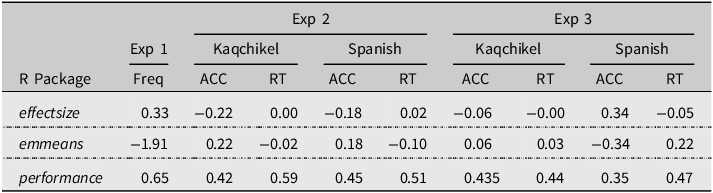
Table 1. Long description
The table presents data on standardized effect indices, estimated contrasts, and model fit across three experiments. It has three main columns for each experiment and rows for different R packages: effectsize, emmeans, and performance. Each experiment column is further divided into sub-columns for Kaqchikel and Spanish languages, with measures for Freq, ACC, and RT. Row 1: effectsize, Exp 1: Freq 0.33, ACC -0.22, RT 0.00, Exp 2: Kaqchikel ACC -0.18, RT 0.02, Spanish ACC -0.06, RT -0.00, Exp 3: Kaqchikel ACC 0.34, RT -0.05, Spanish ACC 0.44, RT 0.35. Row 2: emmeans, Exp 1: Freq -1.91, ACC 0.22, RT -0.02, Exp 2: Kaqchikel ACC 0.18, RT -0.10, Spanish ACC 0.06, RT 0.03, Exp 3: Kaqchikel ACC -0.34, RT 0.22, Spanish ACC 0.35, RT 0.47. Row 3: performance, Exp 1: Freq 0.65, ACC 0.42, RT 0.59, Exp 2: Kaqchikel ACC 0.45, RT 0.51, Spanish ACC 0.435, RT 0.44, Exp 3: Kaqchikel ACC 0.35, RT 0.47, Spanish ACC 0.47, RT 0.47.
Note: Values in the effectsize row reflect standardized model-based effect indices derived from the fitted models. Values in the emmeans row reflect model-based pairwise contrasts estimated from the marginal means; for linear mixed models, these may be expressed as standardized contrasts, but for generalized linear mixed models, they should not be interpreted as Cohen’s
 $d$
, since standardized mean-difference effect sizes are not generally defined for models without an additive residual error term. Values in the performance row report Nakagawa’s conditional
 ${R^2}$
for each model.
Experiment 1: Analysis of Kaqchikel and Spanish word production
As it has been assumed above that Kaqchikel speakers in Guatemala are influenced by the societally dominant Spanish, Experiment 1 sought to investigate how the dominant Spanish sociocultural context impacts the formation of vocabularies in each language. The primary objective of Experiment 1 was to conduct a comparative analysis of lexical richness between the Kaqchikel and Spanish languages by examining word production in both linguistic contexts. From this, incidental evidence will be provided demonstrating an overall Spanish dominance among bilingual Kaqchikel and Spanish speakers.
Method
Participants
As described in the General Method section, sixty-three native speakers of Kaqchikel were recruited for this study (N = 63).
Materials
Nasukawa et al. (Reference Nasukawa, Yasugi, Koizumi and Kenstowicz2013) proposed that Kaqchikel encodes words phonologically from right to left, unlike the common left-to-right orientation in other languages, suggesting an organizational focus on final phonemes. Contrastingly, Tamaoka et al. (Reference Tamaoka, Hayakawa, Mansbridge, Bulaeva, Xiong, Koizumi and Nasukawa2015) found that both Kaqchikel and Spanish speakers showed a left-to-right processing pattern during a phoneme monitoring task, challenging this hypothesis. Given that no such processing differences were experimentally confirmed, Experiment 1 aimed to measure the distinction between the two languages in terms of word production based on the initial consonant for comparison among Kaqchikel heritage speakers.
In selecting initial consonants for both languages, we utilized different approaches due to the absence of a frequency index in Kaqchikel. For Kaqchikel, we sought guidance from native Kaqchikel-speaking linguists at the Francisco Marroquin Institute (in Antigua), who provided insight into frequently used initial consonants. Based on their suggestions, we selected five consonants: [ch], [k’], [m], [p], and [q’]. For Spanish, we referred to a Spanish dictionary and selected five consonants with a high frequency of words listed: [d], [l], [n], [r], and [s]. Naturally, the frequencies of words initiated from certain consonants might differ a priori between the languages. Yet, as there is no reliable Kaqchikel source to evaluate this unambiguously, we had to rely on native Kaqchikel language speakers’ guidance. They indicated that for Kaqchikel, a large body of words should be possible to construct from the abovementioned consonants.
Procedure
As described in the General Method section, participants produced as many words as possible beginning with each target consonant within one minute, and the resulting productions were recorded, transcribed, and counted separately for Kaqchikel and Spanish, with language order counterbalanced across participants.
Results
Refer to the General Methods section above for a detailed report on the LME analysis.
A total of 1,861 words in Kaqchikel and 4,258 words in Spanish produced by 63 participants were analyzed. Table 2 shows the numbers of word productions for each consonant.
Number of produced words in each sound (Experiment 1)
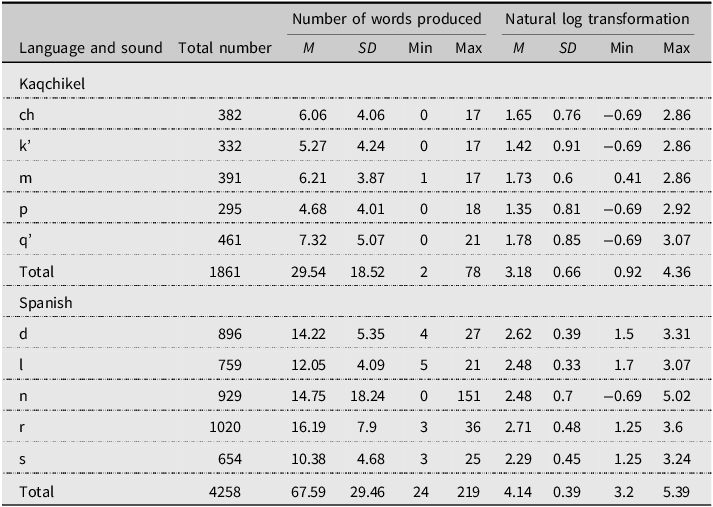
Table 2. Long description
The table compares the number of words produced in Kaqchikel and Spanish for different sounds. It has 14 rows and 10 columns. The columns are labeled Language and sound, Total number, Number of words produced (M, SD, Min, Max), and Natural log transformation (M, SD, Min, Max). The rows are grouped under Kaqchikel and Spanish, with specific sounds listed under each language. For Kaqchikel, the sounds are ch, k’, m, p, q’, and Total. For Spanish, the sounds are d, l, n, r, s, and Total. Each row lists the total number of words produced, the mean, standard deviation, minimum, and maximum number of words produced, and the natural log transformation values for mean, standard deviation, minimum, and maximum.
Note: Participants = 63. M = mean. SD = standard deviation.
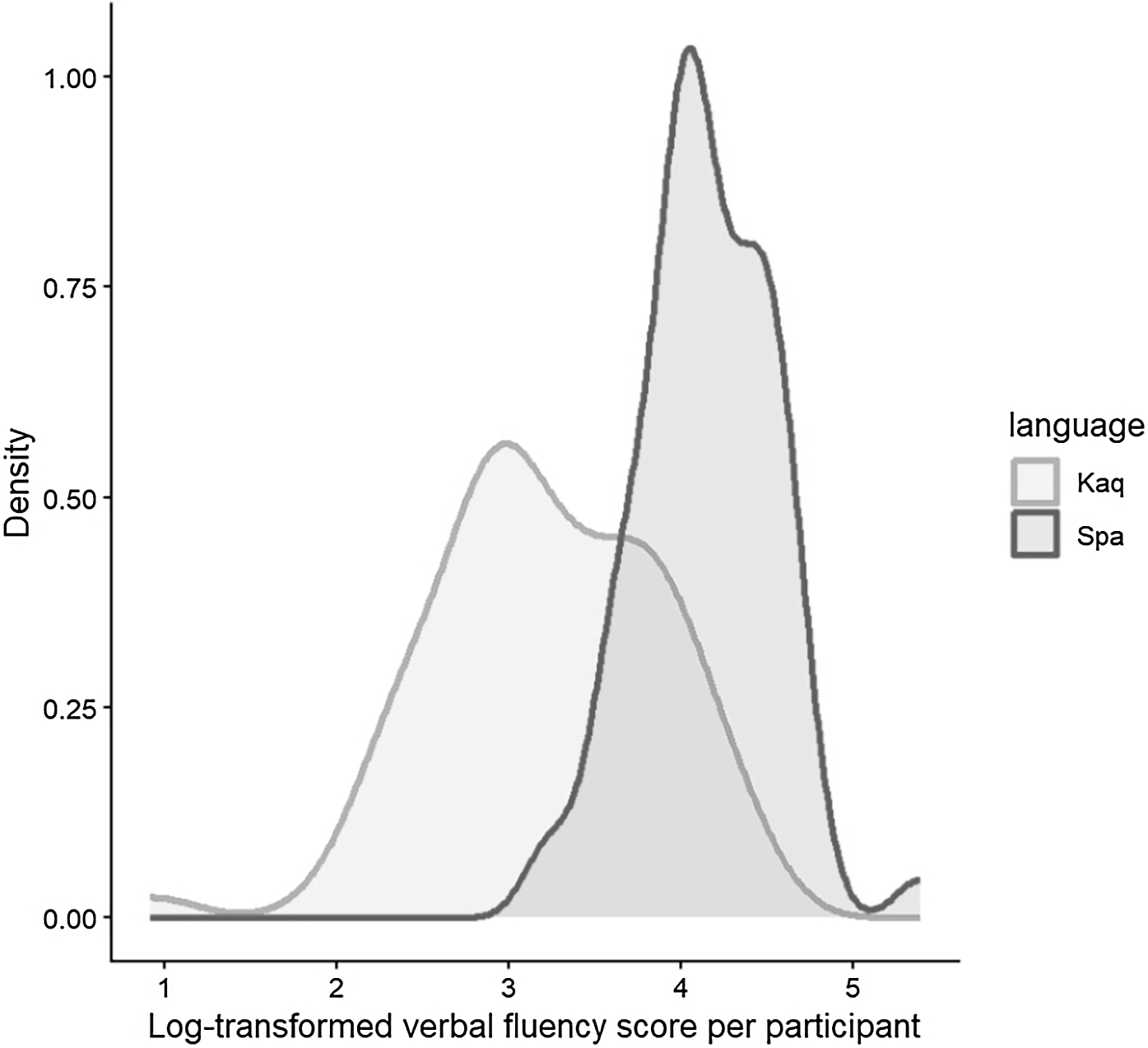
In this LME analysis, language (Kaqchikel and Spanish) was treated as a fixed factor, while participants and stimuli (10 consonants comprising 5 Kaqchikel and 5 Spanish consonants) were designated as random factors. The results are reported in Table 3. Referenced Spanish in the fixed factor of language, the mean per participant (i.e., the average number of words a participant could generate in total; so counting all consonants in that language) in Spanish words (M = 67.59, SD = 29.46) significantly differed from Kaqchikel words (M = 29.54, SD = 18.52) [t(8) = −8.317, p < 0.001]. To further characterize participant-level variation, selected verbal fluency totals are reported in Table 4, and an optional paired plot illustrating participant-level Kaqchikel and Spanish totals was generated in R using ggplot2 (Wickham, Reference Wickham2016), shown in Figure 1.
LME analysis for numbers of words produced (Experiment 1)

Table 4. Long description
A table with four rows and three columns comparing participants’ scores in Kaqchikel and Spanish languages. The columns are labeled Language focus, Participant type, Score in target language, and Score in other language. The row labels are Kaqchikel Minimum, Kaqchikel Median, Kaqchikel Maximum, Spanish Minimum, Spanish Median, and Spanish Maximum. Row 1: Kaqchikel, Minimum, 2, 26 (Spanish). Row 2: Kaqchikel, Median, 24, 56 (Spanish). Row 3: Kaqchikel, Maximum, 78, 98 (Spanish). Row 4: Spanish, Minimum, 24, 10 (Kaqchikel). Row 5: Spanish, Median, 61, 27 (Kaqchikel). Row 6: Spanish, Maximum, 219, 49 (Kaqchikel).
Note: Participants = 63. Sound = 10. Observations = 630. SE = standard errors. lmer(log(prodfreq+0.5) ∼ language + (1|participant) + (1|item), data). * = p < .05 ** = p < .01 *** = p < .001.
Min, median, max participants’ scores for each language
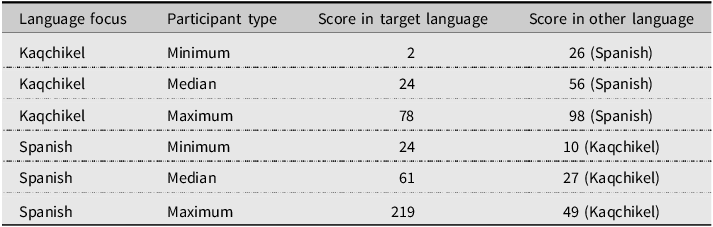
Table 3. Long description
A table with four columns and three rows, including a header row. The columns are labeled Variables, Estimate, SE, df, t Value, Pr(>|t|), and p. The first row under the header is for the intercept, with values 2.513, 0.097, 18, 25.967, <0.001, and ***. The second row is for Language: Kaqchikel, with values -0.925, 0.111, 8, -8.317, <0.001, and ***. The table presents the results of a linear mixed-effects analysis, showing the estimates, standard errors, degrees of freedom, t-values, and p-values for the intercept and the language factor Kaqchikel.
Note: Participant totals are sums across the five sounds within each language. Median refers to the participant whose total corresponded to the median value within that language.
Log-transformed verbal fluency scores (density plot) for Kaqchikel and Spanish.
Discussion
Experiment 1 found that among our participants, significantly more words were produced in Spanish than in Kaqchikel during a word production task. This disparity in word production hints of the influence of linguistic environment and exposure on vocabulary diversity. Their Spanish language abilities demonstrated a notably broader vocabulary, reflecting a wider range of sociocultural concepts influenced by external factors. Conversely, perhaps the limited usage of Kaqchikel within a small community might have constrained its vocabulary diversity. Their constant exposure to Spanish, prevalent in the sociocultural context, might have significantly shaped the language proficiency of Kaqchikel speakers. The observed Spanish advantage likely reflects formal literacy, which is known for enhancing Spanish lexical development in heritage communities where bilingual children may not be literate in Kaqchikel (e.g., Balcazar, Reference Balcazar, Leonard and Gardner2009). This finding also matches with claims in the heritage literature that heritage language speakers, although they know numerous words in their heritage language, do typically have significant gaps in their vocabulary (Montrul, Reference Montrul2010). Additionally, they might find it difficult to retrieve infrequent words, and the words they know well are often those learned in their childhood (e.g., typical household objects; cf. Montrul, Reference Montrul2010, p. 6). A broader implication of limited heritage language vocabulary has been argued that smaller vocabularies in heritage languages can lead to additional issues such as morphological overregularization in their heritage language (Montrul & Mason, Reference Montrul and Mason2020). Generally, the evidence from Experiment 1 suggests an overall Spanish lexical dominance among our participants.
To assess whether individual differences in verbal fluency might have contributed to the sentence-processing results, we conducted supplementary analyses for Experiments 2 and 3 using each participant’s natural log-transformed verbal fluency score, centered and scaled, as an independent predictor. These analyses were restricted to the 61 participants who completed all three experiments. No significant main effects of verbal fluency were observed for any dependent measure, nor were any significant interactions found. We therefore do not report these analyses in detail. Importantly, the verbal fluency data also showed little evidence of participant-level reversal in relative language strength: only one participant produced more Kaqchikel than Spanish words, and this case was nearly balanced, with relatively high fluency in both languages. Accordingly, the Experiment 1 results are more appropriately interpreted as reflecting a group-level tendency toward Spanish dominance rather than meaningful participant-level variation likely to explain the outcomes of Experiments 2 and 3. Such a group-level asymmetry may, in turn, have contributed to the observed word-order preferences.
Experiments 2a for Kaqchikel and 2b for Spanish: VOS-/SVO-Ordered Sentence Processing
The canonical order in Kaqchikel is known to be VOS, while Spanish predominantly uses the SVO order. Considering the fundamental differences in the basic word orders of these two languages, Experiment 2a for Kaqchikel and Experiment 2b for Spanish were designed to examine the interplay between the dominant Spanish language and the heritage Kaqchikel language, specifically focusing on their respective word orders. Experiment 2a conducted a sentence correctness decision task for Kaqchikel active transitive sentences in both VOS and SVO orders. Similarly, Experiment 2b conducted the sentence correctness decision task for Spanish transitive sentences in SVO and VOS orders, directly corresponding to the Kaqchikel sentences. These experiments aimed to explore the potential reciprocal influences on sentence processing between Kaqchikel and Spanish, particularly in relation to their syntactic structures.
Method
Participants
As described in the General Method section, eighty native speakers of Kaqchikel were recruited for this study (N = 80).
Materials
To create suitable stimulus sentences in both Kaqchikel and Spanish, we initially selected words from the top 3,000 high-frequency words listed in El Corpus del Español (https://www.corpusdelespanol.org/x.asp). We carefully avoided cognates and loanwords between Spanish and Kaqchikel to maintain linguistic integrity. These words were then used to construct sentences that could be effectively adapted into Kaqchikel, ensuring that the stimulus sentences were linguistically appropriate and comparable across both languages. For example, we constructed simple Spanish SVO-ordered active transitive sentences such as El presidente llamó al señor (“The president called the man”). We then created a VOS-ordered sentence from the SVO structure, resulting in Llamó al señor el presidente. Similarly, the SVO-ordered Kaqchikel sentences were constructed, such as Ri champomanel xroyoj jun tat (“The president called the man”). Based on this pattern, the corresponding VOS sentences were formed: Xroyoj jun tat ri champomanel. In constructing these sentences, both subject and object nouns were consistently kept in the singular third person to eliminate any ambiguity between singular and plural forms.
Additionally, in Kaqchikel, nouns that take the definite article ri can function as both subject and object. When a verb is followed by two nouns in the VOS order, this arrangement can create ambiguity regarding which noun is the subject and which is the object. To address this ambiguity, we used the indefinite article jun for the object noun and the definite article ri for the subject noun. Using this method, we constructed 32 pairs of semantically and grammatically correct sentences in both SVO and VOS orders in each language, resulting in a total of 64 sentences (32 SVO and 32 VOS). The 64 correct sentences in both Kaqchikel and Spanish were then divided into two lists, each containing 16 SVO and 16 VOS sentences. These lists were distributed among two participant groups using a counterbalanced design to ensure variability and minimize bias in response patterns.
In Experiments 2a and 2b, reaction times were measured from the onset of the auditory sentence until participants indicated whether a sentence was correct or incorrect by pressing a YES or NO key. Therefore, the recorded durations of the phonetically presented sentences were included in the reaction times. To ensure consistency, sound duration times were controlled to be equal within each language for both SVO and VOS word orders. For Experiment 2a, the 64 Kaqchikel sentences were precisely matched, with a mean duration of 2,553 ms (SD = 414 ms) for both the 32 SVO and 32 VOS sentences. Similarly, in Experiment 2b, the 64 Spanish sentences demonstrated only minimal differences in duration, with the 32 SVO sentences lasting 2,752 ms (SD = 360 ms) and the 32 VOS sentences lasting 2,751 ms (SD = 360 ms).
Additionally, 32 incorrect semantically infelicitous and/or ungrammatical sentences were created for each language, consisting of 16 SVO-ordered and 16 VOS-ordered sentences in both Kaqchikel and Spanish. For example, an SVO-ordered sentence in Kaqchikel might be Ri parapox xutïj jun nimajuku’, translating to “The butterfly ate a ship,” or Ri kumätz xulöq’ jun ch’umil, meaning “The snake bought a star.” Similarly, the equivalent Spanish sentences were La mariposa comió a un barco and El tiburón robó a un avión. Since these incorrect sentences were not included in further analysis, they were compiled into a single set without counterbalancing. Each participant saw each list in a counterbalanced way.
These 64 correct and 32 incorrect sentences in both Kaqchikel and Spanish were audibly recorded by a male native speaker, who is fluently bilingual in both languages. The sentence-processing experiments for Kaqchikel (Experiment 2a) and Spanish (Experiment 2b) were conducted and analyzed independently, with the sequence of conducting counterbalanced to ensure unbiased results. All semantically and grammatically correct sentences in both Kaqchikel and Spanish are detailed in Supplementary Material–Appendix A. Please note that Appendix A contains only semantically and grammatically correct sentences, excluding any that are semantically incorrect, infelicitous, or ungrammatical.
Procedure
The procedure for Experiment 2 followed the general sentence correctness decision task described in the General Method section. Participants heard auditorily presented sentences in either Kaqchikel or Spanish and judged whether each sentence was semantically and grammatically correct by pressing the YES or NO key. The Kaqchikel and Spanish versions were administered separately, with the order of languages counterbalanced across participants, and reaction times were measured from sentence onset to the participant’s response.
Results
The experiments involving Kaqchikel and Spanish were conducted separately. This was due to the different durations of the sound stimuli in each language, which necessitated separate analyses. Refer to the General Methods section above for a detailed report on the LME analyses in Experiment 2.
Results of LME model analysis for accuracy in experiment 2a for Kaqchikel
A total of 5,120 responses (80 participants × 32 correct sentences × 2 word orders) were analyzed. Table 5 displays the means and standard deviations for accuracies in processing SVO- and VOS-ordered Kaqchikel sentences. The outcomes of the LME models are presented in Table 6. Notably, the results indicated significantly higher accuracy in judging sentences with an SVO order compared to a VOS order (z = −2.790, p < 0.01).
Accuracies of SVO- and VOS-ordered sentence processing in Experiment 2a for Kaqchikel

Table 5. Long description
A table comparing the means and standard deviations for accuracies in processing SVO- and VOS-ordered Kaqchikel sentences. The table has two rows and four columns. The columns are labeled Language, Word order, M, and SD. The row labels are Kaqchikel with sub-labels SVO and VOS. Row 1: Kaqchikel, SVO, 81.45 percent, 38.88 percent. Row 2: Kaqchikel, VOS, 78.79 percent, 40.88 percent.
Note: Participants = 80. Item = 32, Observations = 5,120. M = mean. SD = standard deviation.
LME analysis for accuracy in experiment 2a for Kaqchikel

Table 6. Long description
A table with two rows and five columns presenting the results of a linear mixed-effects model analysis for accuracy in experiment 2a for Kaqchikel. The columns are labeled Variables, Estimate, SE, z-Value, Pr(>|z|), and p. The first row represents the intercept with values 2.092, 0.261, 8.022, <0.001, and *** respectively. The second row represents Word Order: VOS with values -0.224, 0.080, -2.790, <0.01, and ** respectively.
Note: Participants = 80. Item = 32. Observations = 5,120. SE = standard errors. glmer(acc ∼ word order + (1|participant) + (1|item), data, family = binomial). * = p < .05 ** = p < .01 *** = p < .001.
Results of LME model analysis for reaction time in experiment 2a for Kaqchikel
No reaction times were recorded faster than 500 ms or slower than 5,000 ms. Since only items judged correctly were included in the data analysis, a total of 4,102 responses were analyzed. Table 7 presents the means and standard deviations for the reaction times of SVO- and VOS-ordered Kaqchikel sentence processing. The outcomes of the models are presented in Table 8. The fixed factor of word order was not significant [t(3,991) = 0.690, p = 0.490, ns], indicating no significant difference in reaction times between the SVO and VOS orders.
Reaction times of SVO- and VOS-ordered sentence processing in experiment 2a for Kaqchikel

Table 7. Long description
A table with two rows and four columns. The columns are labeled Language, Word order, M, and SD. The row labels are Kaqchikel. Row 1: Language, Kaqchikel; Word order, SVO; M, 3,100; SD, 618. Row 2: Language, Kaqchikel; Word order, VOS; M, 3,097; SD, 629.
Note: Participants = 80. Item = 32, Observations = 4,102. M = mean. SD = standard deviation.
LME analysis for reaction times in experiment 2a for Kaqchikel

Table 8. Long description
A table with four rows and six columns presenting the results of a linear mixed-effects analysis for reaction times. The columns are labeled Variables, Estimate, SE, df, t Value, and Pr(>|t|). The rows are labeled (Intercept) and Word order: VOS. The values in the table are as follows: Row 1: (Intercept), 8.032, 0.025, 42.110, 319.260, <0.001. Row 2: Word order: VOS, 0.003, 0.004, 3.991, 0.690, 0.490.
Note: Participants = 80. Item = 32. Observations = 4,102. SE = standard errors. lmer(log(rt) ∼ word order + (1|participant) + (1|item), data). * = p < .05 ** = p < .01 *** = p < .001.
Results of LME Model Analyses for Accuracy in Experiment 2b for Spanish
A total of 5,120 responses (80 participants × 32 correct sentences × 2 word orders) were analyzed. Table 9 displays the means and standard deviations for the accuracies of SVO- and VOS-ordered Spanish sentence processing. The outcomes of the models are presented in Table 10. The analysis revealed no significant difference in accuracy between SVO and VOS orders [z = −1.807, p = 0.071, ns].
Accuracies of SVO- and VOS-ordered sentence processing in experiment 2b for Spanish

Table 9. Long description
A table with two rows and four columns comparing the means and standard deviations for the accuracies of SVO- and VOS-ordered Spanish sentence processing. The columns are labeled Language, Word order, M, and SD. The row labels are Spanish for both word orders. Row 1: Language, Spanish; Word order, SVO; M, 89.92 percent; SD, 30.97 percent. Row 2: Language, Spanish; Word order, VOS; M, 88.59 percent; SD, 31.79 percent.
Note: Participants = 80. Item = 32, Observations = 5,120. M = mean. SD = standard deviation.
LME analysis for accuracy in experiment 2b for Spanish

Table 10. Long description
A table with two rows and five columns presenting the results of a linear mixed-effects analysis for accuracy in experiment 2b for Spanish. The columns are labeled Variables, Estimate, S E, z-Value, Pr(>|z|), and p. The first row represents the Intercept with values 3.075, 0.251, 12.238, <0.001, and *** respectively. The second row represents Word order: VOS with values -0.182, 0.101, -1.807, 0.071, and ns respectively.
Note: Participants = 80. Item = 32. Observations = 5,120. SE = standard errors. glmer(acc ∼ word order + (1|participant) + (1|item), data, family = binomial). * = p < .05 ** = p < .01 *** = p < .001.
Results of LME model analyses for reaction time in experiment 2b for Spanish
No items were processed faster than 500 ms or slower than 5,000 ms. As only items judged correctly were included in the data analysis, a total of 4,570 responses were analyzed. Table 11 presents the means and standard deviations for the reaction times of SVO- and VOS-ordered Spanish sentence processing. The outcomes of the models are presented in Table 12. The fixed factor of word order was significant [t(4,458) = 3.464, p < 0.001], indicating that sentences with SVO order were processed significantly faster than those with VOS order.
Reaction times of SVO- and VOS-ordered sentence processing in experiment 2b for Spanish

Table 11. Long description
A table with two rows and four columns. The columns are labeled Language, Word order, M, and SD. The row labels are Spanish. Row 1: Language, Spanish; Word order, SVO; M, 3,264; SD, 515. Row 2: Language, Spanish; Word order, VOS; M, 3,295; SD, 520.
Note: Participants = 80. Item = 32. Observations = 4,570. M = mean. SD = standard deviation.
LME analysis for reaction times in experiment 2b for Spanish

Table 12. Long description
A table with three columns and two rows. The columns are labeled Variables, Estimate, SE, df, t Value, Pr(>|t|), and p. The first row under Variables is (Intercept) with values 8.086, 0.016, 67.280, 500.477, <0.001, and ***. The second row under Variables is Word order: VOS with values 0.011, 0.003, 4.458, 3.464, <0.001, and ***.
Note: Participants = 80. Observations = 4,570. SE = standard errors. lmer(log(rt) ∼ word order + (1|participant) + (1|item), data). * = p < .05 ** = p < .01 *** = p < .001.
Discussion
Experiments 2a and 2b were conducted to explore the relationship between word order and sentence processing in Kaqchikel and Spanish. In Experiment 2a (Kaqchikel), the accuracy findings revealed that sentences in the SVO order were processed with slightly higher accuracy than those in the VOS order, suggesting a deviation from what is traditionally considered the canonical VOS order in Kaqchikel. However, the reaction times between the two word orders did not show any significant differences, indicating that the processing speed for both orders remains comparable. In Experiment 2b (Spanish), unlike in Kaqchikel, no significant differences in accuracy were observed between the SVO and VOS orders. However, reaction times were faster for sentences in the SVO order compared to the VOS order. This finding aligns with the established understanding that SVO is the canonical word order in Spanish, suggesting that it is processed more efficiently. The word order effect on accuracy showed a measurable impact in Kaqchikel (−2.66% effect for VOS) but was negligible in Spanish (−1.33% effect for VOS). Regarding reaction times, Spanish displayed a noticeable delay for VOS (+31 ms effect), while in Kaqchikel, the times were almost identical across orders (−3 ms effect for VOS). These findings suggest that although VOS is traditionally the canonical order in Kaqchikel, SVO-ordered transitive sentences were processed with greater accuracy, despite similar processing times. For Spanish, while accuracy between SVO and VOS was consistent, the canonical SVO order was processed more quickly than VOS. This differential impact highlights the strong influence of Spanish, the dominant language, on the heritage language Kaqchikel, particularly in terms of language processing dynamics.
Experiments 3a and 3b: Kaqchikel and Spanish interrogative sentence processing
Experiment 3 investigates the processing of interrogative sentences in both Kaqchikel and Spanish, focusing on the fundamental differences in their basic word orders. Experiments 3a (Kaqchikel) and 3b (Spanish) were designed to explore the interplay between the dominant Spanish language and the heritage Kaqchikel language, particularly regarding their respective word orders. In Kaqchikel, the single word achike serves both as the subject wh-question (“who”) and the object wh-question (“whom”), leading to two distinct word orders for interrogative sentences: SquestVO (subject wh-question) and OquestVS (object wh-question). Considering Kaqchikel’s canonical VOS order, we hypothesize that OquestVS sentences, where the object moves from its original position to the front before the verb, will be processed faster and more accurately than SquestVO sentences due to the longer movement required for SquestVO. In Spanish, “who” is translated as quién, and “whom” as a quién. Spanish interrogative sentences can also adopt two word orders: SquestVO (subject wh-question) and OquestVS (object wh-question). Given that SVO is the basic word order in Spanish, SquestVO sentences are expected to be processed more quickly and accurately than OquestVS sentences. Experiments 3a and 3b aim to compare the effects of word order through a sentence correctness decision task for auditorily presented interrogative sentences in each language.
Method
Participants
Identical to Experiment 2.
Stimulus sentences
Following the methodology of Experiment 2, we selected words from the top 3,000 high-frequency entries in El Corpus del Español (2002). Efforts were made to avoid cognates and loanwords between Spanish and Kaqchikel to ensure the linguistic integrity of the sentences. These words were then used to construct sentences adaptable to Kaqchikel, maintaining linguistic appropriateness and comparability between the two languages. For Spanish, we developed two types of interrogative sentences. An example of a “who (quién)” question in SquestVO form is ¿Quién ayudó al director? meaning “Who helped the director?,” while a “whom (a quién)” question in OquestVS form is ¿A quién ayudó el director? translating to “Whom did the director help?.” In Kaqchikel, the word achike serves both “who” and “whom.” Corresponding Kaqchikel questions were formulated based on the Spanish structure. For instance, a “who” question in SquestVO form is Achike xto’o ri cholonel? meaning “Who helped the director?,” and a “whom” question in OquestVS form is Achike xuto’ ri cholonel? meaning “Whom did the director help?.” As in Experiment 2, subject and object nouns were standardized to singular third person in Experiment 3. The definite article ri was consistently used for the object noun in a “who” question and the subject noun in a “whom” question to ensure consistency across interrogative sentences. This process produced 32 pairs of SquestVO and OquestVS semantically and grammatically correct interrogative sentences (64 sentences total) in both Spanish and Kaqchikel.
As in Experiment 2, reaction times in Experiment 3 were measured from the onset of the auditory presentation of the sentence to the moment participants decided on its correctness by pressing a YES or NO key. Consequently, the recorded durations of the phonetically presented sentences were included in the reaction time measurements. The duration times were standardized within each language: for Kaqchikel, 64 sentences had a mean duration of 1,846 ms for both 32 SquestVO and 32 OquestVS sentences, with standard deviations of 192 and 191 ms, respectively. For Spanish, 64 sentences maintained a consistent mean of 1,768 ms (SD = 189 ms) for both 32 SquestVO and 32 OquestVS sentences. Although the recorded durations were adjusted to be exactly the same for the two word orders, SquestVO and OquestVS, the differences between the two languages were not equalized. Therefore, the experiments were conducted separately: Experiment 3a for Kaqchikel and Experiment 3b for Spanish.
Additionally, 32 incorrect semantically infelicitous and/or ungrammatical sentences were created, comprising 16 SquestVO and 16 OquestVS sentences for each language. For instance, an SquestVO sentence in Kaqchikel could be Achike xpixab’an ri chun? meaning “Who advised the lime?” and Achike xxupun ri ik’? meaning “Who blew on the moon?” Corresponding Spanish sentences included ¿Quién aconsejó la cal? and ¿Quién sopló a la luna? As these incorrect sentences were not included in further analysis, they were compiled into a single set without counterbalancing. Thus, each participant received one of two sets of 32 correct sentences and one set of 32 incorrect sentences for the task, ensuring that no participant received the same sentence in different word orders.
As with Experiment 2, these 64 correct and 32 incorrect interrogative sentences in both Spanish and Kaqchikel were audibly recorded by a male bilingual speaker, fluent in both Kaqchikel and Spanish, for Experiment 3. The experiments were conducted separately for each language, Experiment 3a for Kaqchikel and Experiment 3b for Spanish. Each experiment comprised 32 correct and 32 incorrect sentences, totaling 64 sentences. The order of conducting Experiment 3a for Kaqchikel and Experiment 3b for Spanish was counterbalanced to ensure unbiased results. All semantically and grammatically correct sentences used in the experiments are detailed in Supplementary Material–Appendix B. Please note that Appendix B exclusively contains semantically and grammatically correct sentences, and does not include any that are semantically incorrect, infelicitous, or ungrammatical.
Procedure
Identical to Experiment 2.
Results
Methods for the analyses and separation of results by language are identical to Experiment 2. Refer to the General Methods section for a detailed description of the LME analyses.
Results of LME model analyses for accuracy in experiment 3a for Kaqchikel
A total of 5,120 responses (80 participants × 32 correct sentences × 2 interrogative word orders) were analyzed. Table 13 presents the means and standard deviations for the accuracy of SquestVO and OquestVS interrogative sentence processing in Kaqchikel. The outcomes of the LME models are shown in Table 14. The results indicated no significant difference in accuracy between SquestVO (M = 73.98%) and OquestVS (M = 74.92%) in Kaqchikel [z = 0.882, p = 0.378, ns], suggesting no effect of word order on accuracy.
Accuracies of SquestVO- and OquestVS-ordered interrogative processing in experiment 3a for Kaqchikel

Table 13. Long description
A table comparing the accuracies of SquestVO and OquestVS word orders in Kaqchikel. The table has two rows and four columns. The columns are labeled Language, Word order, M, and SD. The row labels are Kaqchikel with SquestVO and OquestVS word orders. For SquestVO, the mean accuracy (M) is 73.98 percent and the standard deviation (SD) is 43.88 percent. For OquestVS, the mean accuracy (M) is 74.92 percent and the standard deviation (SD) is 43.35 percent.
Note: Participants = 80. Item = 32. Observations = 5,120. M = mean. SD = standard deviation.
LME analysis for accuracy in experiment 3a for Kaqchikel

Table 14. Long description
A table with two rows and five columns. The columns are labeled Variables, Estimate, SE, z-Value, Pr(>|z|), and p. The first row under Variables is (Intercept) with values 1.388, 0.212, 6.538, <0.001, and *** respectively. The second row under Variables is Word order: OquestVS with values 0.064, 0.072, 0.882, 0.378, and ns respectively.
Note: Participants = 80. Item = 32. Observations = 5,120. SE = standard errors. glmer(acc ∼ word order + (1|participant) + (1|item), data, family = binomial). * = p < .05 ** = p < .01 *** = p < .001.
Results of LME model analyses for reaction time in experiment 3a for Kaqchikel
No items were processed faster than 500 ms or slower than 5,000 ms. After considering only correctly judged items for data analysis, a total of 3,812 responses were included. Table 15 presents the means and standard deviations for reaction times in Kaqchikel SquestVO and OquestVS interrogative sentence processing. The outcomes of the models are listed in Table 16. The results showed no significant difference in reaction times between SquestVO (M = 2,707 ms) and OquestVS (M = 2,723 ms) in Kaqchikel [t = 0.817, p = 0.414, ns], indicating no effect of word order on processing speed.
Reaction times of SquestVO- and OquestVS-ordered interrogative processing in Experiment 3a for Kaqchikel

Table 15. Long description
A table with two rows and four columns. The columns are labeled Language, Word order, M, and SD. The row labels are Kaqchikel with two word orders: SquestVO and OquestVS. For SquestVO, the mean reaction time M is 2,707 milliseconds with a standard deviation SD of 626. For OquestVS, the mean reaction time M is 2,723 milliseconds with a standard deviation SD of 631.
Note: Participants = 80. Item = 32. Observations = 3,812. M = mean, SD = standard deviation.
LME analysis for reaction times in experiment 3a for Kaqchikel

Table 16. Long description
The table presents the means and standard deviations for reaction times in Kaqchikel SquestVO and OquestVS interrogative sentence processing. It has two rows and six columns. The columns are labeled as Variables, Estimate, SE, df, t Value, Pr(>|t|), and p. The first row under Variables is (Intercept) with values 7.896, 0.020, 92.727, 403.936, <0.001, and ***. The second row under Variables is Word order: OquestVS with values 0.004, 0.005, 3.703, 0.817, 0.414, and ns.
Note: Participants = 80. Item = 32. Observations = 3,812. SE = standard errors. ns = not significant lmer(log(rt) ∼ word order + (1|participant) + (1|item), data). * = p < .05 ** = p < .01 *** = p < .001.
Results of LME model analyses for accuracy in experiment 3b for Spanish
A total of 5,120 responses (80 participants × 32 correct sentences × 2 interrogative word orders) were analyzed. Table 17 presents the means and standard deviations for the accuracy of SquestVO and OquestVS interrogative sentence processing in Spanish. The outcomes of the models are shown in Table 18. The results indicated that SquestVO-ordered interrogative sentences (M = 85.63%) were processed more accurately than OquestVS-ordered sentences (M = 81.95%) in Spanish [z = −4.033, p < 0.001], showing that the basic SquestVO order is processed more accurately than OquestVS.
Accuracies of SquestVO- and OquestVS-ordered interrogative processing in experiment 3b for Spanish

Table 17. Long description
A table with two rows and four columns. The columns are labeled Language, Word order, M, and SD. The row labels are Spanish with two word orders: SquestVO and OquestVS. For SquestVO, the mean accuracy (M) is 85.63 percent with a standard deviation (SD) of 35.09 percent. For OquestVS, the mean accuracy (M) is 81.95 percent with a standard deviation (SD) of 38.47 percent.
Note: Participants = 80. Item = 32. Observations = 5,120. M = mean, SD = standard deviation.
LME analysis for accuracy in experiment 3b for Spanish

Table 18. Long description
A table with three columns and two rows. The columns are labeled Variables, Estimate, S E, z-value, Pr(>|z|), and p. The first row under Variables is (Intercept) with values 2.324, 0.204, 11.372, <0.001, and ***. The second row under Variables is OquestVS with values -0.338, 0.084, -4.033, <0.001, and ***.
Note: Participants = 80. Item = 32. Observations = 5,120. SE = standard errors. glmer(acc ∼ word order + (1|participant) + (1|item), data, family = binomial). * = p < .05 ** = p < .01 *** = p < .001.
Results of LME model analyses for reaction time in experiment 3b for Spanish
No items were processed faster than 500 ms or slower than 5,000 ms. After considering only correctly judged items for data analysis, a total of 4,290 responses were included. Table 19 presents the means and standard deviations for the reaction times of Spanish SquestVO and OquestVS interrogative sentence processing. The outcomes of the models are presented in Table 20. The results indicated that SquestVO-ordered interrogative sentences (M = 2,638 ms) were processed more quickly than those with OquestVS order (M = 2,726 ms) [t = 7.249, p < 0.001], showing that sentences in the basic SquestVO order in Spanish are processed more rapidly than their OquestVS counterparts.
Reaction times of SquestVO- and OquestVS-ordered interrogative processing in Experiment 3b for Spanish

Table 19. Long description
A table with two rows and three columns. The columns are labeled Language, Word order, M, and SD. The row labels are Spanish with two word orders: SquestVO and OquestVS. For SquestVO, the mean reaction time M is 2,638 ms and the standard deviation SD is 611. For OquestVS, the mean reaction time M is 2,726 ms and the standard deviation SD is 615.
Note: Participants = 80. Item = 32. Observations = 4,290. M = mean. SD = standard deviation.
LME analysis for reaction times in experiment 3b for Spanish

Table 20. Long description
A table with six columns and two rows. The columns are labeled Variables, Estimate, SE, df, t Value, Pr(>|t|), and p. The first row under Variables lists (Intercept) with corresponding values: 7.864, 0.019, 105, 407.008, <0.001, and ***. The second row under Variables lists OquestVS with corresponding values: 0.035, 0.005, 4,180, 7.249, <0.001, and ***.
Note: Participants = 80. Item = 32. Observations = 4,290. SE = standard errors. lmer(log(rt) ∼ word order + (1|participant) + (1|item), data). * = p < .05 ** = p < .01 *** = p < .001.
Discussion
Experiments 3a and 3b investigated the processing of who and whom questions in Kaqchikel and Spanish, aiming to understand how different word orders influenced the processing of these interrogatives. The results of Experiment 3a showed no significant difference in either accuracy or processing speed between SquestVO and OquestVS orders in Kaqchikel. In contrast, Experiment 3b for Spanish revealed that interrogative sentences with the SquestVO order were processed more accurately and more quickly than those in the OquestVS order. These findings may be attributed to the inherent SVO structure in Spanish. The participants in this study, though raised speaking Kaqchikel, may have been strongly influenced by Spanish due to their formal schooling and the dominant language environment. This influence likely contributed to the absence of a word order effect in Kaqchikel, while producing a strong preference for SquestVO in Spanish. In Spanish, participants appear to leverage the typical subject-verb-object SquestVO structure, while in Kaqchikel, no clear word order effect was observed.
General discussion
Bilingualism in heritage languages is a significant topic, especially among new immigrant families in North America (e.g., Bayram et al., Reference Bayram, Rothman, Di Pisa and Slabakova2021; Ducar, Reference Ducar2008; Li & Matthews, Reference Li and Matthews2022; Pascual y Cabo & Rothman, Reference Pascual y Cabo and Rothman2012; Polinsky, Reference Polinsky2011, Reference Polinsky2018; Polinsky & Scontras, Reference Polinsky and Scontras2019, Reference Polinsky and Scontras2020; Rothman, Reference Rothman2009; Scontras et al., Reference Scontras, Fuchs and Polinsky2015). The situation for Mayan languages like Kaqchikel in Latin America, however, follows a unique historical path dated back to the 16th century, differing from more contemporary language shifts (Berkley, Reference Berkley1998, Reference Berkley2001; Guerrettaz, Reference Guerrettaz2020). Kaqchikel communities have seen a historical change with children being educated in Spanish, effectively making it their primary language. This shift has positioned Kaqchikel as a heritage language, in a society where Spanish is most prevalent in official and societal contexts.
In Experiment 1, a significant disparity in the number of words produced was found; specifically, Kaqchikel speakers generated a larger number of Spanish words compared to Kaqchikel. Despite having continuously spoken Kaqchikel since their early years, the prevalence of Spanish in diverse contexts in Guatemala clearly impacted their lexical knowledge. This outcome demonstrates a reversal of language dominance (Cook, Reference Cook2003; Pavlenko & Jarvis, Reference Pavlenko and Jarvis2002; Seliger, Reference Seliger, Ritchie and Bhatia1996), shifting from the initially acquired Kaqchikel to Spanish.
This difference in word production might be influenced by key factors such as the linguistic environment and the extent of exposure by Kaqchikel participants. The extensive and varied lexicon of Spanish likely has thrived through its extensive usage in daily Guatemalan life, while the more limited usage of Kaqchikel within the community might have influenced its vocabulary growth. In all, prolonged and early exposure to Spanish likely has contributed significantly to the differences observed in this experiment between Kaqchikel and Spanish among native Kaqchikel participants.
The results of Experiment 2a indicated that sentences structured in the SVO order were processed with slightly higher accuracy compared to those in the VOS order in Kaqchikel. Additionally, in Experiment 2b for Spanish, SVO sentences were processed significantly faster than their VOS counterparts. These findings suggest a stronger adherence to the basic SVO order in Spanish, while word order appeared to have no notable influence on processing in Kaqchikel. These results align with a study by Yoza et al. (Reference Yoza, Erdocia, Laka and Laka2019), which compared monolingual Peninsular Spanish speakers with speakers of Andean Spanish. In Andean Spanish, there is a higher occurrence of preverbal objects, and the authors proposed that the OV nature of indigenous contact languages (e.g., Quechua) may modulate Andean Spanish, making it less strictly SVO. However, their experiment found that the canonical SVO order still facilitated faster and more accurate sentence processing, even in Andean Spanish, similar to the findings reported here.
A sentence with the basic (canonical) order typically functions more efficiently in sentence structure, resulting in faster processing speeds compared to those with alternative orders. This characteristic is evident in various psycholinguistic studies, particularly those focusing on sentence processing in Japanese (e.g., Koizumi & Tamaoka, Reference Koizumi and Tamaoka2004; Mazuka et al., Reference Mazuka, Itoh, Kondo and Nakayama2002; Miyamoto & Takahashi, Reference Miyamoto and Takahashi2004; Tamaoka & Mansbridge, Reference Tamaoka and Mansbridge2019; Tamaoka et al., Reference Tamaoka, Sakai, Kawahara, Miyaoka, Lim and Koizumi2005; Tamaoka et al., Reference Tamaoka, Asano, Miyaoka and Yokosawa2014; Ueno & Kluender, Reference Ueno and Kluender2003). In the case of Kaqchikel, Koizumi et al. (Reference Koizumi, Yasugi, Tamaoka, Kiyama, Kim, Sian and Mátzar2014) state that the VOS order serves as the basic order, with the SVO order understood as a result of subject (S) movement to the initial position of the sentence (S1VOt 1). The “gap-filling parsing” sentence-processing model (Frazier, Reference Frazier1987; Frazier & Clifton, Reference Frazier and Clifton1989; Frazier & Flores D’Arcais, Reference Frazier and Flores D’Arcais1989; Ness & Meltzer-Asscher, Reference Ness and Meltzer-Asscher2017; Sekerina, Reference Sekerina and Karimi2003; Stowe, Reference Stowe1986) provides a possible explanation. Native Kaqchikel speakers would recognize that an initial noun could be moved from the frontal position in the VOS base-ordered sentence. Because the noun is animate, they may expect it to be the agent subject (S) before encountering the predicate. Upon encountering the subsequent predicate, they recognize the sentence as transitive. Subsequently, upon encountering the object (O), they assume that the subject noun placed in the frontal position must come after the object, in accordance with the VOS base structure. Experiments 2a and 2b revealed a significant difference between SVO and VOS, for Spanish only in which SVO is canonical. Reaction times for SVO/VOS were virtually identical in Kaqchikel, indicating that the processing mechanism of the gap-filling parsing is likely not supported for Kaqchikel.
We must note that SVO is indeed an acceptable word order in Kaqchikel. It has been described as carrying a pragmatic, topicalizing effect, as illustrated in Example 2 of the introduction (e.g., “the CARPENTER (and no one else) cut the pine tree”; García Matzar & Rodríguez Guaján, Reference García Matzar and Rodríguez Guaján1997). England (Reference England1991, p. 472), however, characterizes Kaqchikel as the most inconsistent of all Mayan languages with respect to how SVO order is interpreted. By contrast, Maxwell and Little (Reference Maxwell and Little2006, p. 84) argue that SVO has become the most frequent (and basic) order in recent decades, while noting that VOS was dominant prior to 1986. England (Reference England1991, p. 483) provides seemingly contradictory views: she cites Rodríguez Guaján (Reference Rodríguez Guaján1989) to show that SVO was already present in the sixteenth century, too early to be attributed to Spanish influence, yet she also acknowledges, on the same page, that “Spanish influence since the sixteenth century, and especially today, may also be a strong factor in changes and is certainly thought to be so by speakers of some Mayan languages” (cf. Rodríguez Guaján, Reference Rodríguez Guaján1990). This latter view aligns with later work by Rodríguez Guaján (Reference Rodríguez Guaján1994, p. 201), who notes: “At present, there is a tendency to believe that sentences with SVO order have the basic order because it is the most common, but this is not true. With Castilianization, our mental structures are influenced by SVO. This problem occurs mostly among Kaqchikel speakers Castilianized in school” and concludes that “the basic order of Kaqchikel is not SVO but rather VOS.”
Taken together, these accounts reveal considerable disagreement among linguists about the precise role and interpretation of SVO in Kaqchikel. Still, given that SVO is a structure shared by both Kaqchikel and Spanish, it is perhaps unsurprising that SVO seems to be attested in both languages (a point raised by an anonymous reviewer). Future research using a monolingual baseline group will be important in clarifying whether a potential preference for SVO reflects genuine cross-linguistic influence from Spanish or whether it is an inherent feature of Kaqchikel itself.
Experiment 3a showed that the lack of differences in both accuracy and reaction times between SquestVO and OquestVS suggests that the anticipated distinctions between these two interrogative structures did not occur as predicted. Specifically, this indicates that the VOS canonical order in Kaqchikel may not serve as the base structure in sentence processing for gap-filling parsing (Frazier, Reference Frazier1987; Frazier & Clifton, Reference Frazier and Clifton1989; Frazier & Flores D’Arcais, Reference Frazier and Flores D’Arcais1989; Stowe, Reference Stowe1986). These findings suggest that while Kaqchikel remains a stable heritage language with nearly a half million speakers in Guatemala and more immigrants in the US, Spanish asserts its dominance in interrogative sentence processing. This highlights the significant influence of Spanish, the dominant language, on the processing of interrogative structures, even among heritage bilingual speakers of Kaqchikel.
In contrast, Experiment 3b for Spanish revealed that interrogative sentences with the SquestVO order were processed more accurately and more quickly than those in the OquestVS order. This study’s findings can be related to other research, particularly highlighting the complexities of syntactic processing in heritage languages. For example, Cuza (Reference Cuza2013) identifies cross-linguistic influence in the use of subject-verb inversion in Spanish heritage speakers, and showed that their participants have more difficulty with subject–verb inversion in embedded wh-questions (in which English and Spanish differ the most) such as Me pregunto qué compró Juan (I wonder what John bought) as compared to matrix questions, such as ¿Qué compró Juan? (What did John buy?). This is related to our observation in Experiment 2 that Spanish canonical order elicited more accurate decisions even in Kaqchikel (admittedly, the differences were quite small). This suggests that the type of syntactic structure in the societal language can significantly influence bilingual speakers’ language processing in the heritage language. Additionally, the work by Love and Swinney (Reference Love, Swinney and Hillert1998) on the role of canonical word order in structural processing, particularly in long-distance dependencies, matches with our results as we found indications that indeed the canonical order might be important (especially Experiment 3b).
Similarly, Sorace’s (Reference Sorace2011) influential Interface Hypothesis, briefly mentioned in the introduction, proposes that structures involving interfaces between syntax and other external cognitive domains, such as discourse, present challenges for bilingual speakers (but see Schmid, Reference Schmid2022). This hypothesis aligns with our Experiment 2 in that Kaqchikel speakers, influenced by their dominant Spanish language, show no clear advantage for VOS order, a pattern which might indicate interface such vulnerability. Specifically, while Experiment 2 produced out-of-the-blue sentences, with no prior experimental discourse, the wider usages of Kaqchikel and Spanish in colloquial speech might have played a larger role in their processing judgments within the experiment. In all, more research especially tuned to difficulties at the interface for Kaqchikel-Spanish bilinguals is necessary to investigate the extent of Spanish influence on the Kaqchikel heritage language.
A limitation of the current study is that the initial survey design did not include collection of comprehensive background linguistic data from participants, specifically regarding the age of onset of bilingualism, mean age of onset for Spanish, and the primary languages spoken by their parents. As such, the potential impact of these factors on heritage language acquisition, which are recognized as significant in the literature, could not be explored here which might limit the scope of our findings to some extent.
Lastly, a further limitation concerns task sensitivity. The sentence correctness decision tasks used in Experiments 2 and 3 were selected because they were portable, feasible for field-based testing in Kaqchikel-speaking communities, and allowed direct cross-language comparison using auditorily presented materials. At the same time, these tasks provide a relatively coarse measure of word-order processing and are less fine-grained than online methods specifically designed to track the time course of syntactic interpretation, such as the cross-modal priming paradigm developed by Swinney (Reference Swinney1979). Future work using more sensitive real-time measures of this kind would help clarify the time course of word-order processing and the extent of Spanish influence on Kaqchikel sentence comprehension.
Educational implications
Despite the Spanish dominance since the 16th century, the remarkable persistence of the Kaqchikel language sets it apart from many other heritage languages. This resilience is particularly noteworthy when, for example, considering the trend among Chinese immigrants to the United States, who often lose proficiency in their heritage language after three generations (Li, Reference Li1994; Li and Matthews, Reference Li and Matthews2022). The retention of Kaqchikel suggests successful language teaching efforts in the community, yet the constraints of a small community likely influence the language’s growth potential. To ensure the continued vitality of Kaqchikel, there is a need for comprehensive measures. For example, expanding the Kaqchikel vocabulary through the development of a comprehensive dictionary and actively promoting its usage within the community seems to be a crucial step in preserving and strengthening the language. Leveraging the educational potential within the community to nurture Kaqchikel language skills among the new generation of children is of vital importance. The emphasis on the “revitalization” of Kaqchikel in educational settings and daily interactions within the community can significantly contribute to enhancing proficiency and preserving this invaluable linguistic heritage (Berkley, Reference Berkley1998, Reference Berkley2001; Guerrettaz, Reference Guerrettaz2020). This dedication to language preservation will sustain the rich cultural heritage embedded within the Kaqchikel language, encouraging a stronger sense of identity and pride within the community.
Supplementary material
The supplementary material for this article can be found at https://doi.org/10.1017/S0142716426100769
Replication package
The data related to this manuscript are available at the following OSF repository: https://osf.io/m7ztj/overview.
Acknowledgements
We appreciate the kind support from our Kaqchikel participants who took part in the experiments.
Competing interests
No authors declare any conflict of interest with this work.
Funding statement
This study was supported by a Grant-in-Aid from the Japan Society for the Promotion of Science (#19H05589, PI: Masatoshi Koizumi at Tohoku University, Japan) and a Grant-in-Aid for Japan Society for the Promotion of Science (#23K00628; PI: Emeritus Professor Katsuo Tamaoka at Graduate School of Humanities, Nagoya University, Nagoya, Japan).
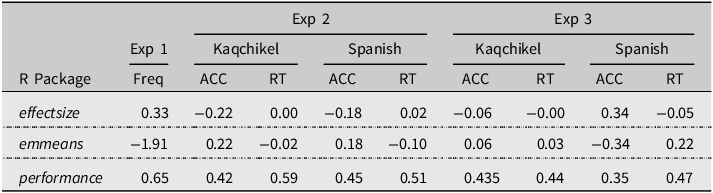
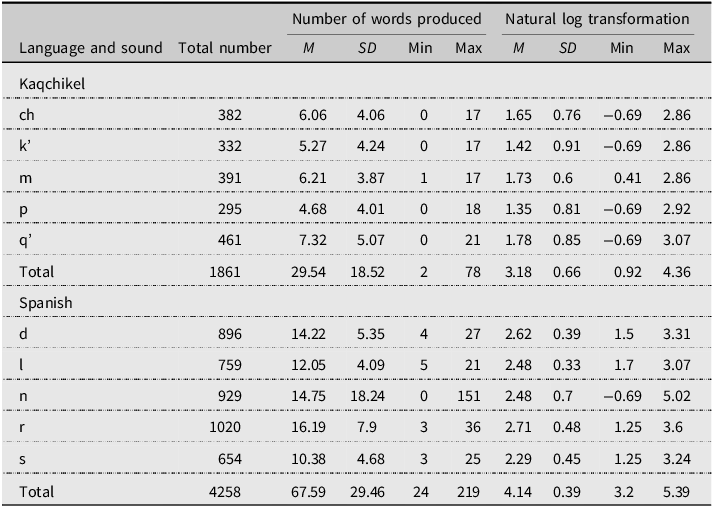

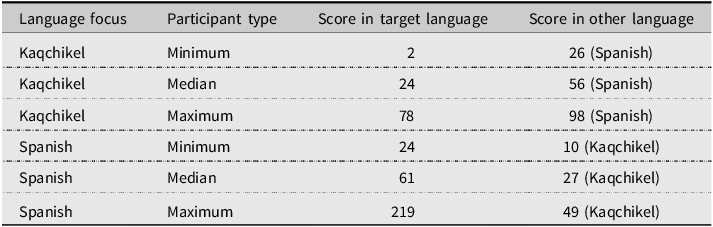
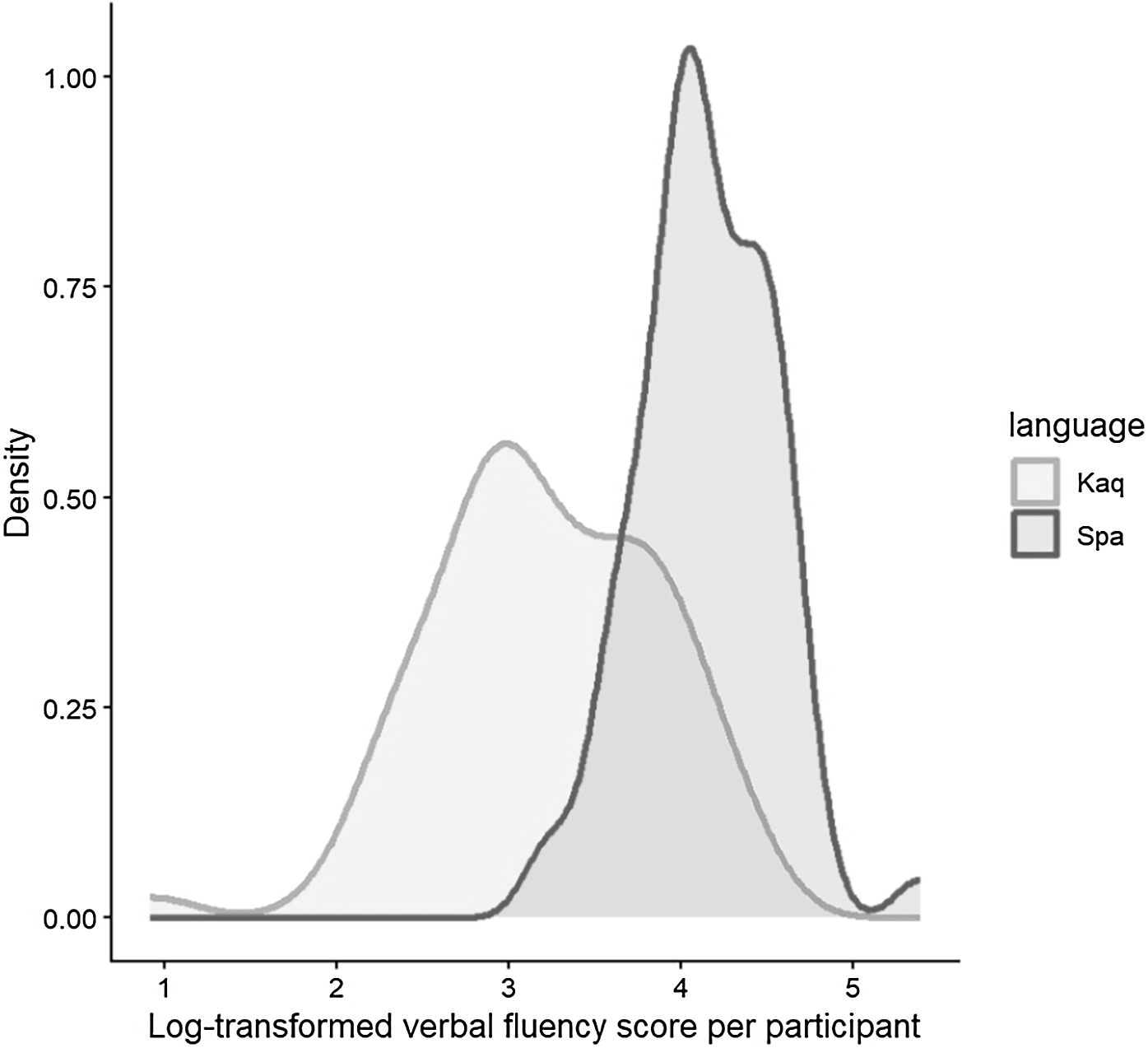


















 Open access

