1. Introduction
What explains South Korean public opposition to refugees and does the public differentiate among groups? A sizable literature addresses perceptions of North Korean arrivals, especially as their numbers rapidly expanded since the mid-1990s. Little attention until recently has been given to views of other refugee groups, in large part due to South Korea not being a major destination point for non-ethnic Korean refugees. However, due to broader refugee crises and hostility among many other developed countries to taking in additional refugees, an increasing number of refugees from outside of Asia have arrived in South Korea. More recently, the government has experienced its first major challenge in addressing non-Korean refugees as around 500 Yemeni civilians arrived on Jeju Island from 2016 to 2018 in search of asylum.
South Korea is an important context to analyze perceptions of refugees and can provide insight into the challenges of public acceptance of refugees elsewhere. South Korea, despite an increase in the number of immigrants in the last three decades, remains comparatively ethnically and culturally homogeneous among developed countries, with immigration a threat to this homogeneity (Chang, Reference Chang2019). Conventional wisdom would assume greater public acceptance of refugees that share ethnic and cultural characteristics of the host country and in the case of South Korea this should result in a public welcoming North Koreans. The arrival of non-Korean refugees provides an opportunity to compare public sentiment toward this group and North Koreans to identify whether to what extent the public disaggregates refugees. Considering that many host countries have received refugees from various destinations and that more homogeneous states are often assumed to be less acceptant of refugees in general, identifying the extent that the public differentiates groups is important for crafting public policy that encourages integration.
In 1992, South Korea signed the Convention on the Status of Refugees, which outlines the rights of asylum seekers and expectations from the signatory countries, but has only had an acceptance rate of 1.5% (Jun, Reference Jun2019; also see Kwon, Reference Kwon2014). South Korea only began accepting asylum seekers in 1994, with 294 of the 4,516 applicants approved as of 30 May 2012 (Torneo, Reference Torneo2016). In 2017, the Ministry of Justice reviewed 6,015 asylum seekers' claims and accepted only 91 refugees (HRW, 2019). In 2018, only 144 people out of 3,789 or 3.7% of asylum seekers were granted refugee status (Yonhap, 2019). Additionally, in the same year two out of over 480 Yemeni were granted refugee status (Choe, Reference Choe2018). In contrast, Germany, the primary European destination for asylum seekers has received 442,000 asylum applications in 2015 alone (Pew, 2016).
By far, North Korean arrivals represent the largest and the most welcomed refugee group. According to the Ministry of Unification (2020), 1,047 North Koreans were admitted in 2019. Comparing North Korean arrivals to other refugee groups admittedly presents several challenges. This includes whether even to call this group refugees, as South Korean law in principle treats North Koreans as moving within the constitutionally defined territory of the Republic of Korea (e.g., Ha et al., Reference Ha, Cho and Kang2016). In contrast to other groups, once processed by the National Intelligence Service (NIS) and provided 3 months of rehabilitation in a government center (hanawon), North Korean arrivals automatically become citizens. Historically, the South Korean government has been welcoming to North Korean arrivals, including numerous policies aimed at easing their assimilation. Although the North Korean arrivals still face challenges of integration, their Korean identity grants them status that remains almost unattainable for other asylum seeking groups. Moreover, discriminatory treatment of non-Koreans remains prevalent, oftentimes based purely on appearance or stereotypes (Ghazarian, Reference Ghazarian2018). However, the broader economic and cultural challenges North Koreans face once in South Korea, as well as public concerns and stereotypes about arrivals, show similarities to other groups.
Immigrants comprise only about 4% of South Korea's population, in large part due to restrictive immigration policies (e.g., Chang, Reference Chang2019), but increases in migrant workers and international marriages put pressure to acknowledge South Korea's growing multiracial and multiethnic society (e.g., Yoon et al., Reference Yoon, Song and Bae2008). Previous research suggests that the general hostility toward many of the non-Korean arrivals connects to South Korea's ethnic homogeneity and a historical focus on ethnic nationalism. Such factors may lead to beliefs that immigrants threaten society and cannot assimilate, factors that should prioritize North Korean arrivals (e.g., Yoon et al., Reference Yoon, Song and Bae2008; Watson, Reference Watson2010; Lee, Reference Lee2012; Ghazarian, Reference Ghazarian2018). Others suggest that the opposition to Yemeni refugees falls more on views of their religion, Islam, than necessarily their ethnicity. Yet, few analyses directly attempt to address perceptions of different refugee groups.
South Korea's rapid economic development in part can be attributed to a focus on higher education, which left lower paying jobs without workers (Hundt, Reference Hundt2016). An aging population and a low birth rate suggest that South Korea's economic survival requires an immigrant workforce (Watson, Reference Watson2010), especially in so-called 3-D industries (dirty, demeaning, and dangerous) where many South Koreans are reluctant to work (Yoon et al., Reference Yoon, Song and Bae2008). These immigration needs combined with greater pressures and expectations to accept refugees challenge the conception of the nation on ethnic terms. Moreover, when governments make decisions on migration policy, they do so based on who the migrant group is and how the public may perceive them (Ha et al., Reference Ha, Cho and Kang2016; Allen et al., Reference Allen, Anderson, Van Hear, Sumption, Düvell, Hough, Rose, Humphris and Walker2017). Limited cross-national research suggests that the public is more likely to be supportive of ‘refugees’ rather than ‘immigrants’ (e.g., Rasmussen and Poushter, Reference Rasmussen and Poushter2019), yet little of this research focuses on homogeneous states like South Korea, where the public may differentiate across types of arrivals, even if their plight is generally acknowledged. For example, shared ethnicity and favorable state policies would be expected to influence public support favorably toward North Korean refugees, while support for non-Korean refugees would remain low.
Our contribution to this issue is an original web survey with an embedded experimental design in order to test acceptance for three groups: North Korean arrivals, non-ethnic Korean refugees, and Muslim refugees. This allows us to see if the public prefers co-ethnic refugees and differentiates among types of refugees more broadly. We first present a literature review on perceptions of immigrants and refugees, connecting this to the South Korean environment and our hypotheses. This is followed by an explanation of our research design and original survey. Finding clear differences in acceptance across the three groups studied, with particular opposition to Muslim refugees, we further unpack public views of Islam as incompatible with Korean society. The conclusion suggests future avenues of research on public perceptions of new arrivals.
2. Arrivals to South Korea and public perceptions
Arrivals to South Korea, whether as refugees or immigrants more broadly, can be divided into a few broad categories: North Koreans, other ethnic Koreans, and non-ethnic Koreans. South Korea has accepted around 33,752 North Korean refugees (or talbukja) since 1998 (Ministry of Unification, 2020). Additionally, foreign-born ethnic Koreans immigrate mostly from China, the USA, Russia, Canada, Uzbekistan, and Kazakhstan (Korea Immigration service, 2019), whereas most non-ethnic Korean immigrants in recent years have come from China, Vietnam, and Thailand and account for 61.7% of non-Korean entries in 2018 (Statistics Korea, 2019; Korea Immigration Service, 2019). Non-Korean Muslim immigrants account for around 0.3% of the population, and emigrate from Pakistan, Myanmar, Bangladesh, and Yemen.
Initially, North Korean defectors enjoyed greater support by the South Korean government as they were highly educated, belonged to a higher social class and remained useful in propaganda during the Cold War. More recent arrivals, however, typically come from lower social statuses and with little educational background, needing educational programs and training in order to assimilate into South Korean society. Due to the economic strain brought by such defectors, South Korean public support has declined as many call for the government to prioritize domestic issues.
Nevertheless, a history of nationalist appeals regarding reunification would also prioritize acceptance of North Korean arrivals compared to other non-ethnic Koreans. Japanese colonization, followed by Cold War dynamics and nationalism under military rule produced an exclusive form of nationalism and identity (Yoon et al., Reference Yoon, Song and Bae2008), one emphasized more than a secularized republican nationalism (Watson, Reference Watson2010). For many, national identity continues to be defined on ethnic terms, with discriminatory treatment of non-Koreans prevalent (Ghazarian, Reference Ghazarian2018). Furthermore, unification as a policy imperative continues to emphasize the Korean people as a single ethnic family from time immemorial (Son, Reference Son2016), with majorities still supportive of reunification at least in the abstract (e.g., Macris, Reference Macris2012; Cha Reference Cha2014; Kim et al., Reference Kim, Friedhoff, Kang and Lee2015).
However, recent research challenges this strength of shared ethnic identity, with Ha and Jang (Reference Ha and Jang2016) finding South Koreans identifying strongly with ethnic identity were not as supportive of North Korean arrivals. Additionally, the literature implies that most South Koreans emphasize civic over ethnic identity (Ha et al., Reference Ha, Cho and Kang2016; Ha and Jang, Reference Ha and Jang2016). As an increasing number of South Koreans find civic factors such as the ability to speak Korean or having respect for Korean political institutions and laws as more important than ethnic factors as qualifications of Korean national identity (Yoon et al., Reference Yoon, Song and Bae2008), the support for assimilating North Korean refugees could likely decline. Such erosion of broad ethnic identity appeals may be due to several factors, from generational shifts as fewer South Koreans have direct connections to North Korea or remember the war and its immediate aftermath, to changing conceptions of the nation as a result of South Korea's democratization. Moreover, national curriculum changes in 2007 removed the emphasis on danil-minjok (single-blooded ethnicity) from history textbooks (Ghazarian, Reference Ghazarian2018), again suggesting a weakening of ethnic nationalism.
Although South Koreans may prefer to accept North Koreans, little research addresses public perceptions of other refugee groups or comparing these perceptions to those of co-ethnics. For example, Chang (Reference Chang2019) finds ethnic nationalism and xenophobia consistently influencing anti-immigration attitudes regardless of the group. Although there is a notable demand for foreign labor, the South Korean government traditionally has not provided reforms and immigration policies that help such groups achieve social integration. For instance, Indonesian workers have higher employment rates than North Korean defectors or Korean Chinese, but the South Korean government does not incentivize them to settle in the country (Ha et al., Reference Ha, Cho and Kang2016). Therefore, many Indonesians tend to concentrate in groups near industrial towns (Ha et al., Reference Ha, Cho and Kang2016). One specific example of this is the ‘Muslim Street’ in Seoul where roughly 100,000 Muslims live and attend one of the mosques in the heart of Itaewon (Diaconu and Tacet, Reference Diaconu and Tacet2017). Chang (Reference Chang2019) finds that the need for low-skilled labor and the gender imbalance in rural areas drives the increase in the number of migrants. This gender imbalance in particular has created a market for the immigration of foreign brides from China and Southeast Asia to South Korea (Kim, Reference Kim2016), with efforts toward social integration via centers that teach these women about Korean history, values, language, and laws (Iglauer, Reference Iglauer2015). However, such integration efforts for other immigrant communities remain limited, leading to socially isolated immigrant enclaves.
Some have cited economic concerns as reasons for anti-immigration sentiment, especially with regard to migrant workers. Research has found that people are more likely to oppose immigrants with a similar skill set as them and that low-skilled workers are prone to opposing immigration (Scheve and Slaughter, Reference Scheve and Slaughter2001; Mayda, Reference Mayda2006). Work on refugees in Europe found Europeans were more acceptant of refugees with the most potential in terms of economic contributions (Bansak et al., Reference Bansak, Hainmueller and Hangartner2016). With economic migrants being the majority of foreign immigrants to South Korea, public perceptions of immigrants as economic burdens are prevalent. However, additional research finds that public reactions to costs of immigration is dependent on the group of immigrants and points to something more deep-rooted (Brader et al., Reference Brader, Valentino and Suhay2008). In this way, perceptions of the costs of immigrants might not be the biggest explainer of public support, but instead racial or ethnic bias. For example, North Korean arrivals are given access to multiple programs and monetary help in order to transition to life in South Korea. Even though such treatment of North Koreans brings up an economic concern, the backlash among the public is not nearly as strong as with the other refugee groups. This would suggest that other factors heighten or dampen the economic concerns of accepting immigrants and refugees.
Additionally, ethnic or racial group cues may carry implications for how citizens perceive the severity of harm from immigration. This should be particularly evident in South Korea, due to long-held views of the nation built upon a shared bloodline and culture (Ha et al., Reference Ha, Cho and Kang2016). For instance, migrants without proficiency in the local language might suggest cultural tensions whereas the ones from poor countries might suggest economic strain (e.g., Brader et al., Reference Brader, Valentino and Suhay2008).
Regarding North Koreans, many South Koreans may feel a similar tension between cultural and economic challenges, whereas the historical emphasis on shared bloodline overrides the economic concern and consequently creates greater support for the North Korean refugees in comparison with other groups. However, non-ethnic Korean arrivals, especially from poor countries, likely are seen as both a cultural and economic concern.
Previous research finds that people are more likely to hold positive views of immigrants they believe to be similar to them (e.g., Brader et al., Reference Brader, Valentino and Suhay2008). For ethnically homogeneous countries, such concerns may be stronger, with Japanese public opinion showing immigrants viewed as connected to terrorism to crime (Stokes and Devlin, Reference Stokes and Devlin2018). For many Koreans, this may translate to preference toward immigrants of the same or similar ethnic background as them. Yet, little research addresses other ethnic groups in comparison. For instance, Indonesians living in South Korea are one of the few groups that have been compared to non-Korean and ethnic Chinese. Ha et al. (Reference Ha, Cho and Kang2016) find that South Koreans generally favor North Korean defectors over Korean Chinese or Indonesians. Additionally, they find that after controlling the levels of threat, South Koreans clearly prefer Korean Chinese to Indonesian immigrants (Ha et al., Reference Ha, Cho and Kang2016).
North Koreans may be treated as a special case of refugees, while it is unclear whether the South Korean public differentiates between types of non-Korean refugees. In 2018, following the arrival of over 500 Yemeni refugees on Jeju Island, the South Korean government faced a severe public backlash, counter to the spirit of the UN Convention Relating to the Status of Refugees. Their arrival triggered strong opposition from the South Korean public, with a petition that gathered more than 700,000 signatures demanding the government not to accept these refugees (Jun, Reference Jun2019). The received backlash seemingly is shaped by concerns that go well beyond the economic security and national safety. Additionally, the number of Yemeni arrivals pales in comparison with asylum requests faced by other democratic countries that are signatories to the Convention. Such strong public reaction for a small number of refugees who would likely have minimal economic or security impact could further suggest the underlying Islamophobic attitudes.
The backlash to Yemenis was likely influenced by their religion. South Korea's Muslim population has grown considerably since 2001, now to approximately 150,000, with nearly a third being ethnically Korean. For example, the protests following Yemeni arrivals included signs with sayings such as ‘Islamic culture does not respect the human rights of women’ or ‘there are terrorists hiding among the refugees’, clearly highlighting the Islamophobic attitudes (Jun, Reference Jun2019). The public backlash in South Korea is consistent with the anti-Muslim sentiment against refugees elsewhere. Moreover, in their European experiment, Bansak et al. (Reference Bansak, Hainmueller and Hangartner2016) found that voters across different European countries consistently show anti-Muslim sentiment while also showing notable preference for Christian over Muslim asylum seekers. Media representations also influence the public perception of immigrants and refugees as well as immigration policies (Smets and Bozdag, Reference Smets and Bozdağ2018). Therefore, countries with politicians that embrace xenophobic rhetoric and acts toward refugees and other migrants do not exist in a vacuum, as their words are actions that can resonate in other countries (Miller, Reference Miller2018). Therefore, many protesters against Yemeni arrivals emphasized the turmoil that Muslim refugees have caused in Europe and the strong opposition to allow similar scenario in South Korea. More specifically, views of Muslims and Muslim immigrants have been influenced by media depictions of them as terrorists and South Koreans are not exempt from this influence (Rane and Abdalla, Reference Rane and Abdalla2008). For example, previous survey research has found that South Koreans were less accepting of Yemeni refugees if it was mentioned that a majority were Muslim (Rich and Bison, Reference Rich and Bison2018).
Although South Koreans may be less interested in social integration of North Korean arrivals in recent years and generally inhospitable to non-Korean refugees, we should still see variation in perceptions among the public. The broader literature suggests men and women view immigration differently (e.g., Aalberg et al., Reference Aalberg, Iyengar and Messing2012; Francois and Magni-Berton, Reference François and Magni-Berton2013; Valentova and Alieva, Reference Valentova and Alieva2014). Limited evidence suggests South Korean women are less supportive of immigration overall, but even if this distinction is declining (e.g., Hundt, Reference Hundt2016), a similar divergence would be expected in perceptions of refugees. Previous research has found that views of immigrants have improved concurrently with the increase in numbers and that younger, more educated Koreans are more likely to hold positive views of immigrants (Hundt, Reference Hundt2016). This may be due to generational differences in beliefs reflecting ethnic nationalism (Kim et al., Reference Kim, Friedhoff, Kang and Lee2015). South Korean women were also particularly distrustful of Yemeni refugees, most of whom were male Muslims (e.g., Park, Reference Park2018; Kwon, Reference Kwon2019), with claims such as that Islam is against women's rights and the refugees could be harboring terrorists (Jun, Reference Jun2019).
We argue that several factors likely contribute to women exhibiting lower support for refugees. Some may view refugees as economic competition, if not explicitly for jobs then for social programs. Others, assuming that most refugees are male, may be particularly concerned about their personal security when considering refugee admittance. Patriarchal views and the expectation of males to be breadwinners rather than rely on social welfare programs may also shade perceptions. Although disaggregating and directly measuring such influences remains difficult, the result should still be a gender deviation on perceptions of refugees. If women are more insensitive to refugees, we may also accept variation in support based on the types of refugees, with the economic and security concerns more socially acceptable to acknowledge when the focus is not on ethnic brethren.
Based on the literature we propose the following hypotheses:
H1: South Koreans will be less welcoming of non-ethnic Korean refugees compared to North Korean arrivals.
H2: South Koreans will be less welcoming of Muslim refugees compared to the North Korean arrivals.
H3: Women will be less welcoming of refugees than men.
H3a: Women will be less welcoming of non-ethnic Korean refugees than men.
H3b: Women will be less welcoming of Muslim refugees than men.
3. Research design
To see how South Korean public support for refugees is influenced by the refugees' ethnicity and religion, we surveyed 1,111 South Koreans from 2–12 March 2020 via a web survey, implemented by Macromill Embrain, using quota sampling by age, gender, and region based on census data. After a series of demographic and attitudinal questions, respondents were randomly assigned to receive of the following three questions to evaluate on a five-point Likert scale (strongly disagree to strongly agree)Footnote 1:
-
Version 1. South Korea should be more welcoming of North Korean arrivals.
-
Version 2. South Korea should be more welcoming of non-Korean refugees.
-
Version 3. South Korea should be more welcoming of Muslim refugees.
We chose this wording for several reasons. The term arrivals is more consistent with what the South Korean government calls North Koreans, and avoids confusion or political connotations for the group while still broadly comparable to refugees. Version 1 also captures the most known group of refugees. The difference between 1 and 3 allows us to estimate the impact of being Muslim, under the assumption that North Koreans are unlikely to be Muslim.
Separating out the types of refugees in Versions 2 and 3 allows us to identify explicitly the extent of any bias against Muslim refugees rather than just against non-Koreans more broadly. Although some respondents, when receiving the non-ethnic Korean refugees’ version may think of recent Yemeni arrivals, there have been several non-Yemeni arrivals as well. Similarly, recent unskilled immigration has not been limited to Muslim-majority countries. Focusing on welcoming also avoids issues of specific social service policies that may trigger opposition separate from ethnic or religious dimensions. The wording also does not refer to the number of potential arrivals that could also trigger opposition (see Treumann and Rich, Reference Treumann and Rich2017).
As a secondary analysis, we also tested an additional experimental randomization in the same survey, focusing on Islam. This is to identify whether how Muslims in South Korea are presented influence views on Islam's compatibility with Korean values and whether acknowledging that some ethnic Koreans are Muslim influences those views. Respondents received one of the following three prompts and asked to answer either yes or noFootnote 2:
-
Version 1: Approximately 200,000 people (or 0.2% of the population) living in South Korea are Muslim. Do you see Islam as compatible with South Korean values?
-
Version 2: Approximately 200,000 people (or 0.2% of the population) living in South Korea are Muslim, many of whom are ethnic Korean. Do you see Islam as compatible with South Korean values?Footnote 3
-
Version 3: Approximately 200,000 people (or 0.2% of the population) living in South Korea are Muslim, many of whom are foreigners. Do you see Islam as compatible with South Korean values?
4. Empirical analysis
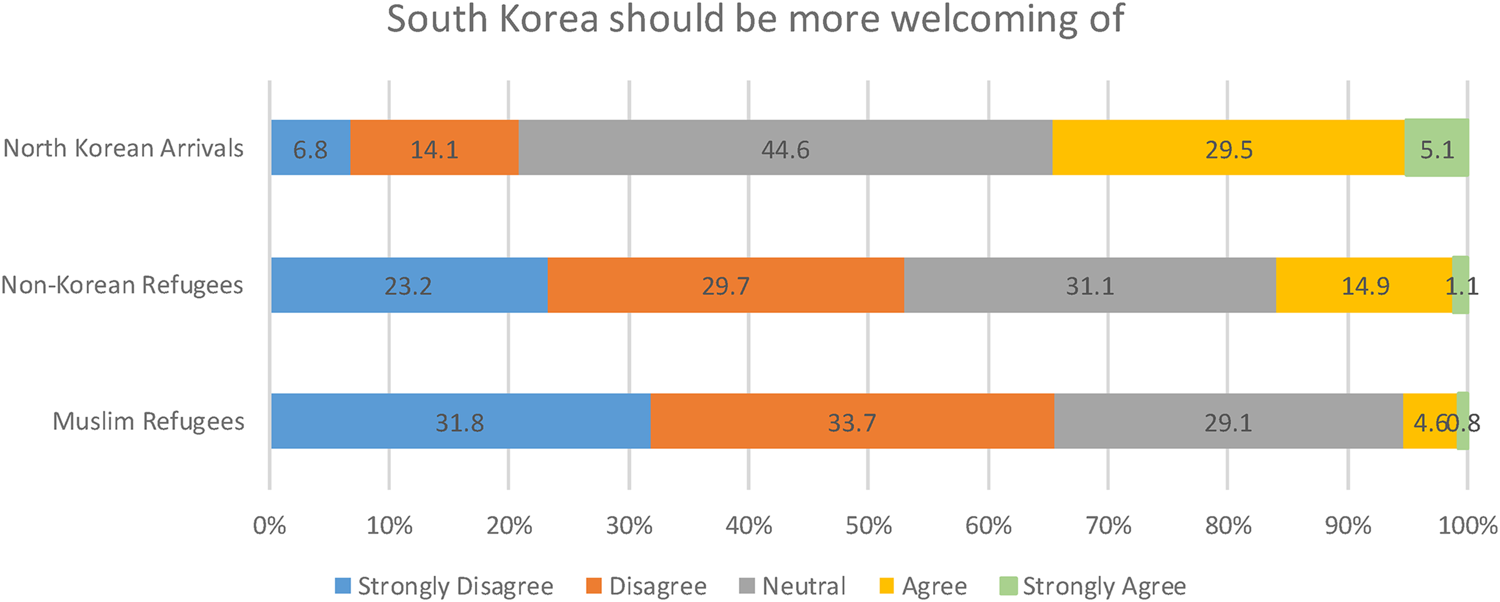
Figure 1 presents the Likert scale responses to the three versions of the original experimental version. Starting with North Koreans, we see the plurality of respondents were neutral (44.6%), with 34.6% agreeing that South Korea should be more welcoming. In contrast, majorities opposed welcoming other groups, with opposition 12.6% higher among those receiving the Muslim refugee version compared to the non-Korean refugee version. Therefore, it is clear that that mentioning the ‘difference’ in ethnicity and religion of the refugee groups affects public support, in the drop in support between the latter two versions, consistent with H1 and H2. Although non-Korean refugees might be assumed Muslim based on recent arrivals, the intentional phrasing of ‘Muslim refugees’ appears to explicitly prime negative perceptions from the South Korean population.
Public perceptions of welcoming arrivals.

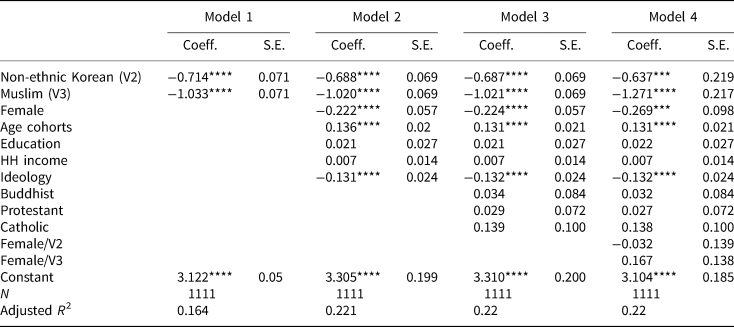
To identify whether these results endured after consideration of other factors, we conducted four ordinary least squares (OLS) modelsFootnote 4 using the welcoming question as the dependent variable and Versions 2 (non-ethnic Korean) and 3 (Muslim) as the main independent variables, leaving Version 1 as the baseline. The first includes not additional controls, whereas model 2 includes age cohort (a five-point measure), gender (female), education (a five-point scale), income (eight-point scale), and political ideology (a seven-point scale from very liberal to very conservative). Model 3 adds controls for the three largest religious affiliations in South Korea: Protestants, Catholics, and Buddhists. As past studies find that evangelical Protestants globally were more likely than Catholics to say Islam is violent (Pew, 2010), with Protestant aversion to Muslims increasing with increased contact (Jung, Reference Jung2011). Finally, model 4 adds interaction terms for female respondents and Versions 2 and 3 of the prompt.
Table 1 presents the results. Starting with the basic model (model 1), we find that those who received the non-ethnic Korean version corresponded with a more than two-thirds of a point lower approval of welcoming refugees compared to the North Korean baseline, with those receiving the Muslim version corresponding with over a point decline, both variables significant at 0.001. These patterns endure with demographic controls. As seen in the broader literature, women were less welcoming (significant at 0.001), consistent with H3, as were more conservative respondents. However, age surprisingly positively corresponded with welcoming. Moreover, we see no statistical difference in perceptions across religions groups. Moreover, we found no statistical significant relationship on the interaction terms, contrasting with H3a and H3b. In other words, although women were less welcoming of refugees in general, our findings suggest that women do not systematically differentiate types of refugees or appear to have distinct motivations for viewing non-ethnic Korean vs Muslim refugees differently.
OLS regressions on welcoming refugees

****P < 0.001, ***P < 0.01, **P < 0.05, *P < 0.10.
Additional tests produced largely consistent findings with the original models. First, considering that recent Muslim refugees were concentrated on Jeju Island, we tested both a dummy variable for respondents from Jeju and for surrounding areas in South Korea's southwest provinces. None of these inclusions reached significance nor changed the core findings of the original models. Relatedly, we tested dummy variables for other regions to identify whether particular areas (e.g., Seoul) were driving the results, but found no significant relations. The lack of regional variation suggests that areas where refugees or immigrants in general have relocated appear to have little impact on perceptions of welcoming refugees. Finally, we included various views on unificationFootnote 5 produced largely similar results.
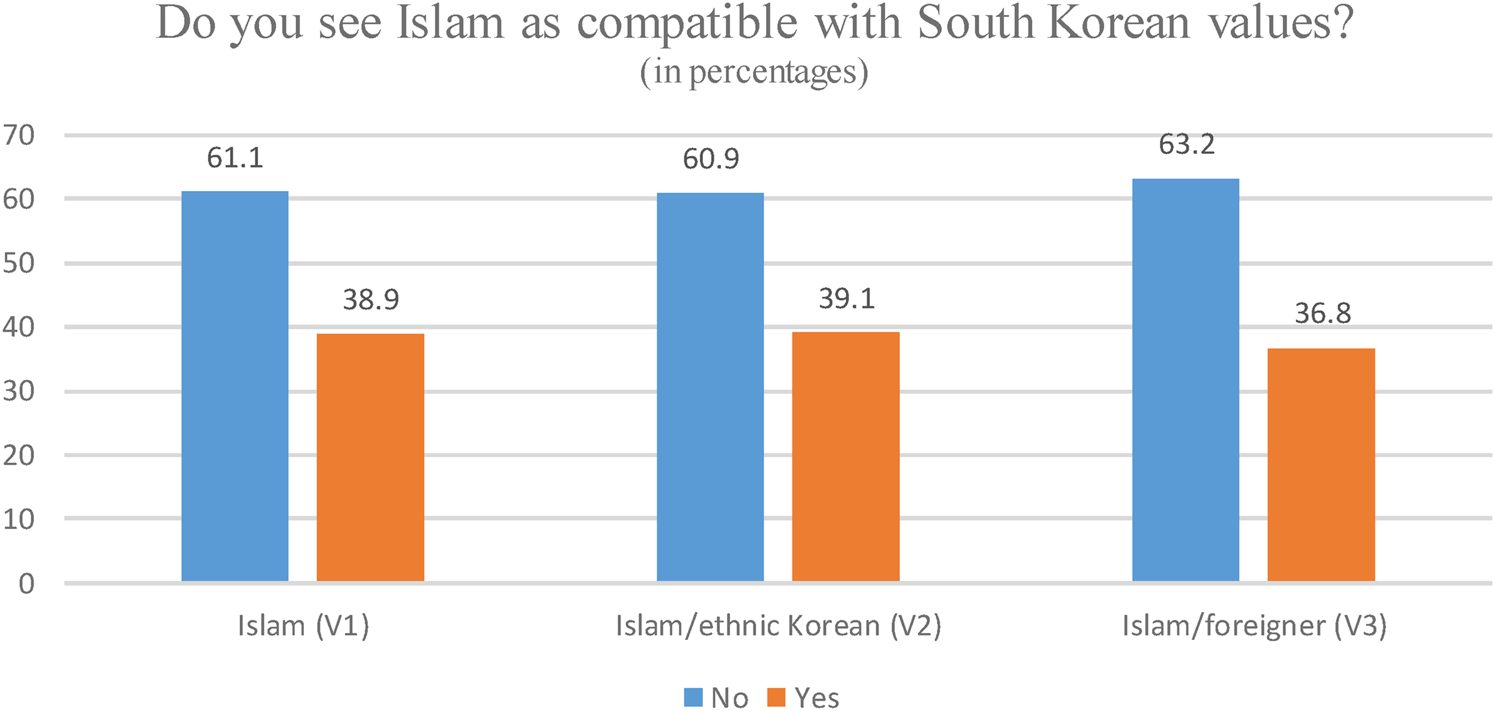
The results suggest a greater hostility toward welcoming Muslim refugees than other groups. Due to this drop for the third version, we then wanted specifically to test South Korean perceptions of Islam. We also asked whether Koreans viewed Islam as incompatible with Korean values. Here too we randomized respondents to receive one of the three Islam versions to see if views shifted depending on how the Muslim community was presented.Footnote 6 However, we see little variation across groups, with over 60% of respondents viewing Islam as incompatible, even when ethnic Korean Muslims were mentioned in the prompt (see Fig. 2).
Perceptions of Islam as compatible with South Korean values.

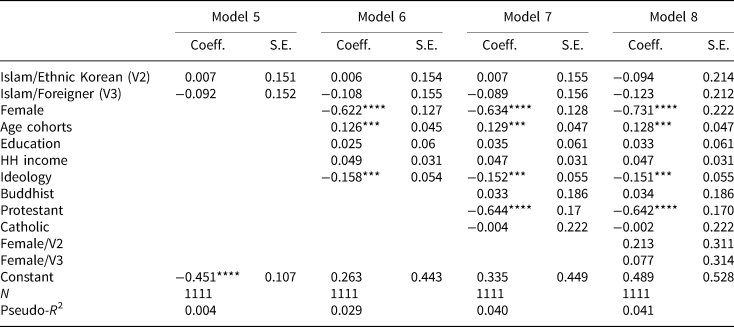
Logit models (see Table 2) using Versions 2 and 3 as the main independent variables with the same demographic control variables in models 2–4 in the previous models finds no statistical difference in the experimental versions, whereas again, gender and ideology negatively corresponded and age positively corresponding with agreement. In addition, of the religious dummy variables, only the Protestant variable reaches significance, negatively corresponding with viewing Islam as compatible (significant at 0.001).Footnote 7
Logit regressions on Islam's compatibility with South Korean values

****P < 0.001, ***P < 0.01, **P < 0.05, *P < 0.10.
Several insights emerge from the findings. First, support for welcoming North Koreans appears lower than one might have expected, with a plurality of respondents indifferent, especially as eventual unification remains popular. This suggests that ethnic appeals, although socially acceptable and perhaps encouraged,Footnote 8 alone are not enough to encourage broader acceptance of North Korean arrivals. Second, as expected, the South Korean public was more supportive of North Koreans than other refugees, consistent with H1 and H2. That the public was less welcoming of Muslim refugees not only suggests the strength of Islamophobia, but also adds additional evidence that the public response to Yemeni arrivals was not simply due to their ethnic differences. We also find a clear divergence between female and male respondents, consistent with H3, but we fail to find a statistically significant interaction between gender and receiving one of the prompts regarding non-ethnic Korean or Muslim refugees (H3a and H3b). Finally, that South Koreans view Islam as incompatible with Korean values regardless of how it was framed further suggests a baseline Islamophobia that undermines refugee efforts. Yet, of religious identifications, only Protestants appear disproportionately to oppose welcoming Muslim refugees. In other words, we still see subtle differences based on the religion of the respondent.
5. Conclusion
As South Korea faces greater pressure to accept immigrants in general and refugees in particular, it is important to understand how the public views these issues as a means to correct misconceptions and to address challenges to integration. At the end of 2019, an unprecedented 79.5 million of people were displaced, meaning that forced displacement now affects 1% of humanity (UNHCR, n.d.). Global migration trends further imply that South Korea will be facing greater numbers of asylum seekers in the near future. Moreover, the South Korean government will be challenged with creating migration policies that will honor international commitments while also appeasing domestic voters. Our findings suggest that, despite agreeing in principle to accepting refugees, the South Korean government struggles to win over the public. This is despite a decline in views of the nation purely on ethnic lines and abstract support for North Korean arrivals, suggesting a continuing undercurrent of ethnic nationalism.
Although only focusing on the Korean context in this analysis, the findings should shed light on public opinion of refugees elsewhere. First, the findings suggest a preference for immigrants that share ethnic or cultural characteristics, which may be particularly important in largely homogeneous states. However, even in the South Korea case, we see a plurality indifferent to welcoming co-ethnic arrivals, suggesting that attempts to relocate refugees to countries with similar populations on ethnic or cultural lines may not overcome public concerns. Moreover, this study more explicitly identifies the extent of Islamophobia separate from general anti-refugee sentiment. Such disaggregation may be particularly important in understanding anti-refugee sentiment in largely homogeneous states.
Although this study only focused on refugee groups, future research could extend this to perceptions of immigration more broadly. For example, existing research suggests that the South Korean public differentiate between North Korean arrivals and ethnic Koreans raised in China, with both still preferable to non-ethnic Korean immigration (e.g., Seol and Skrentny, Reference Seol and Skrentny2009; SCMP Editorial, 2019). Nor can our research address other ethnic Korean immigration, for example from Central Asia, which the South Korean government has not been as welcoming compared to North Korean arrivals. Our research also cannot disentangle public acceptance of immigration in general vs refugees specifically.
Finally, although our findings on the demographic factors influencing perceptions are comparable to previous research, additional demographic and attitudinal factors deserve attention. Our survey, as with many others, does not allow for a disaggregation of Protestants into mainline and charismatic groups, the latter which has been more conservative and politically active. Similarly, perceptions of refugees are likely shaped in part by personal economic insecurity that household income alone cannot capture. Future research may wish to capture types of occupations or at the very least perceptions of one's economic conditions. Similarly, attitudes about societal trust as well as psychological traits may shed additional light on perceptions of refugee groups.
Appendix A: Summary statistics of independent variables and first randomization

Appendix B: Ordered logit regressions on welcoming refugees

Appendix C: Summary statistics of independent variables and second randomization