Introduction
Major depressive disorder (MDD) in adolescence is common and results in significant occupational and psychosocial impairment, including risk for suicide (Kovacs et al. Reference Kennett, Wood, Bright, Trail, Riley, Holland, Avenell, Stean, Upton, Bromidge, Forbes, Brown, Middlemiss and Blackburn1993; Weissman et al. Reference Uher, Farmer, Henigsberg, Rietschel, Mors, Maier, Kozel, Hauser, Souery, Placentino, Strohmaier, Perroud, Zobel, Rajewska-Rager, Dernovsek, Larsen, Kalember, Giovannini, Barreto, McGuffin and Aitchison1999). The lifetime prevalence of MDD in this age period has been estimated to range from 15 to 20%, which is comparable with the lifetime rate of adult MDD (Birmaher et al. Reference Birmaher, Ryan, Williamson, Brent, Kaufman, Dahl, Perel and Nelson1996). Clinically, the presentation of depression in young people is largely similar to the symptoms seen in adulthood, although depressed youth may exhibit increased irritability rather than (or in addition to) the typical sadness associated with adult depression. Therefore, irritability is included as a cardinal symptom in the diagnosis of MDD among children and adolescents but not adults (American Psychiatric Association, 2013).
The use of antidepressant medication in adolescents and young people has been controversial because many medications that are effective in older adults appear to have a less favourable risk:benefit ratio in young people (Whittington et al. Reference van Beek and Dubas2004). Particular concern has been expressed about the risk of antidepressant-induced adverse behavioural reactions, such as anxiety/agitation, hostility and suicidal behaviour (Jureidini et al. Reference Joormann, Talbot and Gotlib2004). Indeed, it appears from controlled trials that young people taking selective serotonin reuptake inhibitors (SSRIs) exhibit more suicidal behaviour than those taking placebo (Martinez et al. Reference Lu, Zhang, Lakoma, Madden, Rusinak, Penfold, Simon, Ahmedani, Clarke, Hunkeler, Waitzfelder, Owen-Smith, Raebel, Rossom, Coleman, Copeland and Soumerai2005; Hammad et al. Reference Grillon, Levenson and Pine2006). However, the incidence of fatal suicide is not increased and, in fact, lowered rates of SSRI prescribing to adolescents following regulatory warnings in the USA and Europe were associated with an increased number of attempted and completed suicides at a population level (Gibbons et al. Reference Gibbons, Brown, Hur, Marcus, Bhaumik, Erkens, Herings and Mann2007; Lu et al. Reference Lang, Bradley and Cuthbert2014).
Unlike many other antidepressants, the SSRI fluoxetine is thought to have a favourable risk:benefit ratio in children and adolescents with moderate to severe depression (Whittington et al. Reference van Beek and Dubas2004) and is the only SSRI currently approved in the UK (National Institute for Health and Clinical Excellence, 2005). In the USA, fluoxetine was the only antidepressant approved for use in youth until 2009, when escitalopram also gained US Food and Drug Administration (FDA) clearance (National Institute for Health and Clinical Excellence, 2005). Why fluoxetine might have a more favourable benefit:risk profile than other antidepressants in this age is unclear, although it has been suggested that its long half-life could be advantageous in less compliant patients (Smith, Reference Safer2009).
The neuropsychological effects of fluoxetine have been little investigated in humans. Our group has studied single doses of a wide range of antidepressants in adult healthy volunteers. For instance, a single dose of both the selective noradrenergic reuptake inhibitor (NRI) reboxetine and the serotonin–norepinephrine reuptake inhibitor (SNRI) duloxetine has been shown to increase the recognition of happy facial expressions (Harmer et al. Reference Harmer, Cowen and Goodwin2003b , Reference Harmer, Bhagwagar, Perrett, Völlm, Cowen and Goodwin2008). In contrast, acute administration of the SSRI citalopram increases not only the processing of positive information (as reflected in an enhanced recognition of happy faces and attentional vigilance to positive words) but also threat processes (increased recognition of fearful faces and startle responses) (Harmer et al. Reference Harmer, Bhagwagar, Perrett, Völlm, Cowen and Goodwin2003a ; Browning et al. Reference Browning, Reid, Cowen, Goodwin and Harmer2007). We have suggested that the production of positive emotional bias underlies the antidepressant action of drugs effective in treating depression, whilst increased threat processing may be responsible for the worsening of anxiety seen in some patients at the initiation of SSRI treatment (Kent et al. Reference Jureidini, Doecke, Mansfield, Haby, Menkes and Tonkin1998). Following repeated treatment with SSRIs, the acute effects on threat processing are reversed and an anxiolytic profile becomes apparent (Burghardt et al. Reference Burghardt, Sullivan, McEwen, Gorman and LeDoux2004).
Given the critical need to better understand the mechanisms underlying antidepressant action in young people, the present study investigated the acute neuropsychological effects of fluoxetine in tasks known to be sensitive to both positive and negative/adverse effects of antidepressants on emotional processing (see Harmer et al. Reference Hammad, Laughren and Racoosin2011). More specifically, we used a facial expression recognition task (FERT) to examine the perception and interpretation of key facial expressions. The attentional dot-probe paradigm and the Rapid Serial Visual Presentation (RSVP) were used to measure biases of attention towards negative/threatening and positive stimuli. Finally, an emotion-potentiated startle task (EPST) measured the affective modulation of the startle reflex (taken as an index of fear). By using these paradigms, our primary aim was to investigate whether fluoxetine, like the SSRI citalopram, produced evidence of acute increases in threat processing in a sample of young adult volunteers who, because of their age, may be more susceptible to the adverse effects of antidepressants. A secondary aim was to test if fluoxetine had any effects on additional affective information, including happy, sad and anger cues.
Method
Participants
A total of 35 healthy volunteers aged between 18 and 21 years were recruited using posters and web advertisements. Given National Institute for Health and Clinical Excellence (NICE) and FDA concerns that antidepressants may increase the risk of suicidal ideation and behaviour in young people up to 25 years old, we chose the 18–21 years age range as it falls between the late adolescence and young adulthood period, and avoids the ethical constraints of administering drugs to healthy adolescents aged below 18 years.
All participants were given a standard medical screening and administered the Structured Clinical Interview for DSM-IV Axis I Disorders (First et al. Reference First, Spitzer, Gibbon and Williams1997) to determine suitability for participation in the study. Exclusion criteria included: current medical problems; personal history of psychiatric illness, including alcohol/substance abuse; first-degree family history of bipolar disorder; smoking frequency greater than five cigarettes per day; pregnancy or breast-feeding; usage of recreational drugs within the last 3 months; and current use of psychotropic medication. To avoid retest effects, participants who had taken part in studies involving the same tasks were also excluded.
Ethical approval for this study was obtained from the Berkshire Research Ethics Committee (10/H0505/2). All participants gave written and verbal consent prior to their participation in this study, and were reimbursed with £80 for their time.
Experimental design
Participants arrived at the laboratory in the morning and were randomized to receive either 20 mg of fluoxetine or a matched placebo, in a double-blind procedure. This resulted in 17 participants in the fluoxetine group and 18 in the placebo group. Following drug/placebo administration, participants sat in a quiet room until the testing session began. During this time, participants were free to read, work and/or use their laptops, and were also carefully monitored for potential side effects. In order to guarantee that fluoxetine had reached its peak level, which has been shown to be after 6–8 h (Rossi et al. Reference Pringle, Browning, Cowen and Harmer2004), the behavioural testing session started 6 h after drug/placebo administration.
Participants were asked to refrain from alcohol on the night before and to limit caffeine consumption to one cup on the testing morning. Participants were not allowed to smoke or drink any additional caffeine for the duration of the study. For lunch, participants were offered a selection of light meals. The premenstrual week was also avoided for testing.
Measures
This study included a series of questionnaires aimed at investigating changes in subjective mood, as well as behavioural paradigms which have previously shown to be sensitive to detect biases in emotional processing after acute administration of several antidepressants, therefore serving as sensitive markers of the early mechanisms potentially underlying the clinical effects of these agents (Pringle et al. Reference Pälvimäki, Kuoppamäki, Syvälahti and Hietala2011).
Subjective ratings
At the screening visit, participants completed the trait version of the State-Trait Anxiety Inventory (STAI-T; Spielberger et al. Reference Schepman, Taylor, Collishaw and Fombonne1970) and the Eysenck Personality Questionnaire (EPQ; Eysenck & Eysenck, Reference Ekman and Friesen1975). The National Adult Reading Test (NART; Nelson & Wilson, Reference Murphy, Downham, Cowen and Harmer1991) was also administered in order to obtain an estimate measure of verbal intelligence quotient (IQ). On the testing day, participants were asked to complete the following questionnaires: the Beck Depression Inventory (BDI; Beck et al. Reference Beck, Ward, Mendelson, Mock and Erbaugh1961) and the state version of the STAI (STAI-S; Spielberger et al. Reference Schepman, Taylor, Collishaw and Fombonne1970) in order to assess mood and anxiety symptoms; Visual Analogue Scales (VAS) to assess alertness, contentedness and calmness symptoms (Bond & Lader, Reference Bond and Lader1974); the Positive and Negative Affective Schedule (PANAS; Crawford & Henry, Reference Coltheart2004); the Jitteriness Rating Questionnaire (JRQ; Sinclair et al. Reference Sinclair, Christmas, Hood, Potokar, Robertson, Isaac, Srivastava, Nutt and Davies2009) to measure sensitively symptoms of anxiety and agitation; and, finally, an adapted version of the Antidepressant Side-Effect Checklist (ASEC; Uher et al. Reference Stringaris and Goodman2009). The STAI-S, VAS, PANAS, JRQ, VAS and ASEC were administered twice, before the drug/placebo administration and at the end of the testing session.
FERT
This paradigm measures the ability to identify and distinguish different facial expressions, being considered a probe of interpretation bias. Facial stimuli include different intensities of positive and negative facial expressions, therefore allowing the assessment of subtle facial discrimination in the face of complex and ambiguous emotions (Harmer et al. Reference Hammad, Laughren and Racoosin2011). More specifically, the task stimuli included six basic emotions taken from the Ekman & Friesen (Reference Dougherty, Smith, Bufferd, Stringaris, Leibenluft, Carlson and Klein1976) Pictures of Affect Series: happiness, sadness, fear, anger, surprise and disgust. These facial expressions were morphed between each prototype and neutral, using techniques described by Young et al. (Reference van Beek, van Dolderen and Demon Dubas1997). Briefly, this procedure involves taking a variable percentage of the shape and texture differences between neutral (0%) and each emotional standard (100%) in 10% steps, leading to a range of emotional intensities. Four examples of each emotion at each intensity were given (total of 10 individuals). Each face was also given in a neutral expression, giving a total of 250 stimuli presentations. Facial stimuli were presented in a random order for 500 ms, being immediately replaced by a blank screen. Participants were asked to make their response as accurately and as quickly as possible by pressing a labelled key on a response box. The outcome measures in this task include: (1) percentage of correct responses (i.e. the number of faces correctly identified as containing any intensity of a particular emotion); (2) percentage of misclassifications (false hits); and (3) reaction times (RTs) (to emotions correctly identified).
EPST (electromyography; EMG)
The EPST measures the eye-blink reaction to different emotional and neutral stimuli using EMG recordings. The eye-blink response is considered the first and fastest element of the startle response (Lang et al. Reference Kučera and Francis1990), being an indicator of the fear reaction in both humans and animals. This version of the paradigm included pictures from the International Affective Picture System, designed to elicit positive, negative or neutral emotions (Lang et al. Reference Kurt, Arik and Celik2005). These stimuli had been rated and selected such that the negative and positive pictures were similar in terms of arousal but opposite in valence, whereas the neutral pictures were low on arousal and average on valence. Stimuli were presented for 13 s (inter-trial interval of between 11 and 15 s, mean 13 s) on a 43 cm cathode ray tube (CRT) computer screen approximately 1 m away from the participant. The eye-blink component of the startle response was recorded from the orbicularis oculi using EMG (EMG-startle response system; San Diego Instruments, USA). Acoustic probes were 50 ms, 95 dB bursts of white noise with a nearly instantaneous rise time and were delivered binaurally through headphones (delivered at 1.5, 4.5 or 7.5 s following picture onset). Within each block of 21 pictures, probes were delivered on five of each trial type (neutral, positive or negative). To limit expectation of the noise, two trials per valence did not contain any startle probes and three probes per block were given within the inter-trial interval. To habituate participants to the startle probes and to orient them to the procedure, participants viewed an introductory set of nine neutral pictures and received nine startle probes (two of these within the inter-trial interval). We then calculated eye-blink reflex magnitudes and z-transformed those to normalize data and reduce inter-subject variability. A more detailed description is given elsewhere (Browning et al. Reference Browning, Reid, Cowen, Goodwin and Harmer2007).
Attentional dot-probe task
This paradigm assesses attention to positive versus negative stimuli using an RT measure. Two faces with different facial expressions are presented vertically on the computer screen and replaced by a cue (two dots) to which the volunteer has to respond. The rationale behind this task is that if participants have allocated their attention to the negative stimulus and the dot appears in the same place, they should be relatively faster to respond than if the dots appear in the opposite location. Pairs of photographs of 20 individuals displaying different emotions were taken from the Japanese and Caucasian Facial Expressions of Emotion and Neutral Faces (JACFEE/JACNeuF) sets of facial expressions (Matsumoto & Ekman, Reference Martin, Ballard and Higgins1988). There were three types of face pairs: (1) two neutral expressions (neutral–neutral); (2) a fearful face and a neutral face (fearful–neutral); and (3) a happy face and a neutral face (happy–neutral). Each pair comprised facial expressions from the same individual. On each trial, one of the faces occupied the top half of the screen and the other the half bottom, with a central fixation cue appearing in the middle. The emotional faces (i.e. fearful and happy faces) appeared in both locations with equal frequency. In addition, there were two types of conditions: subliminal and supraliminal, in which the faces were presented for 100 ms or 1000 ms respectively. Participants were asked to report the orientation of the dots as quickly and as accurately as possible by pressing the corresponding labelled key on a keyboard. Consistent with Murphy et al. (Reference Martinez, Rietbrock, Wise, Ashby, Chick, Moseley, Evans and Gunnell2008), attentional vigilance scores were calculated for each participant by subtracting the mean RT from trials when probes appeared in the same position as the emotional face (congruent trials) from trials when probes appeared in the opposite position to the emotional word (incongruent trials). Therefore, positive scores suggest an attentional vigilance towards the emotional stimuli, whilst negative scores indicate attentional bias away from the emotional stimuli. Zero scores suggest no bias towards the emotional face.
RSVP
This paradigm measures the processing of different word valences under conditions of restricted attentional resources (‘attentional blink effect’). Participants were asked to attend to a series of rapidly presented words and to focus on two word targets (T1 and T2), while the time between these two targets was varied. We used a modification of the RSVP paradigm reported previously (Raymond et al. Reference Perlis, Fava, Trivedi, Alpert, Luther, Wisniewski and Rush1992; Anderson & Phelps, Reference Anderson and Phelps2001) where each trial consisted of 15 words [two targets (bright green) and 13 distractors (black)], each presented for 100 ms and immediately followed by the subsequent stimulus. Participants were required to type the target words using the keyboard. The targets consisted of T1 and T2 words and were presented in bright green, as opposed to the black colour of the distractors. T1 stimuli were 56 neutral words averaging 4.38 letters in length. Distractor items were 79 neutral words of much longer length (average = 11.66 letters), in order to appropriately mask all target stimuli and also to maintain distinctiveness between the target and distractor stimuli. Six trial lags were introduced from lag 2 [one distractor between the two targets (T1–T2), stimulus onset asynchrony (SOA) = 200 ms] to lag 7 [six distractors presented between the two targets (T1–T2), SOA = 700 ms]. We used neutral (e.g. arm, iron, owl), positive (e.g. gift, honour, cheer) and negative (e.g. abuse, rage, betray) words as T2 stimuli, selected from the Affective Norms for English Words (ANEW) database (Bradley & Lang, Reference Bradley and Lang1999). The T2 stimuli were matched for average word length, written word frequency and familiarity (Kučera & Francis, Reference Kovacs, Goldston and Gatsonis1967; Coltheart, Reference Coccaro and Kavoussi1981). Positive and negative words were also matched for arousal ratings. The outcome measure in this task was the percentage of T2 words correctly identified when preceded by a correct identification of the T1 word.
Statistical treatment
Data were analysed by using IBM SPSS 22 software (USA). Baseline characteristics [age, body mass index (BMI), IQ, EPQ, STAI, jitteriness, VAS, PANAS and BDI], excluding gender, were analysed by using independent t tests. Gender was analysed using a χ 2 test. The self-report scales used to assess the effects of fluoxetine (i.e. STAI-S, PANAS, ASEC and JRQ) were analysed using a mixed-design (split-plot) analysis of variance (ANOVA), with time (pre- and post-drug/placebo administration) and group (fluoxetine v. placebo) as within- and between-subjects factors, respectively.
The experimental tasks were analysed by using a mixed-design (split-plot) analysis of covariance (ANCOVA) with group (fluoxetine v. placebo) as the between-subject factor and average STAI-S as a covariate. To explore the effects of gender on the FERT and startle response, the same analysis was repeated with gender as the between-subject factor. Within-subject factors were emotion/valence (FERT, attentional dot-probe, RSVP and startle response), stimulus presentation (attentional dot-probe) and lag type (RSVP). Significant interactions in the ANCOVA were further explored using follow-up pairwise comparisons or separate repeated-measures ANOVAs. When sphericity was violated, Greenhouse Geisser corrections were reported, but uncorrected degrees of freedom are reported for clarity. Due to skewness in distribution, the RTs for the FERT were submitted to a log-transformation that proved successful in ensuring normality. A p value lower than 0.05 was used to denote statistical significance. Marginal differences with a p value lower than 0.10 are also reported. Partial eta squared (η p 2) and Cohen's d are reported as measures of effect size for ANOVAs and independent t tests, respectively.
Results
Baseline characteristics
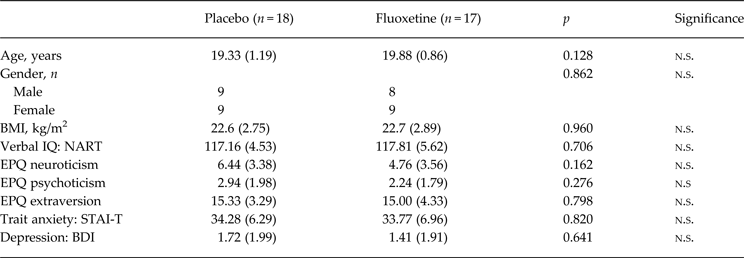
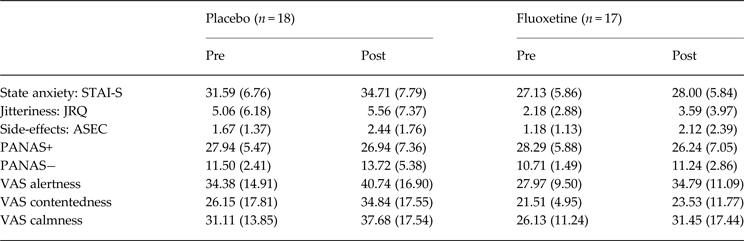
There were no significant differences between the groups in terms of age, gender distribution, BMI, IQ (as measured using the NART), EPQ scales, trait anxiety (STAI-T) and depression (BDI-I) symptoms (all p's > 0.17; see Table 1). Participants were also matched for contentedness, alertness and calmness (VAS) and for positive and negative affect (PANAS) at baseline (all p's > 0.25). However, there were marginal differences in STAI-S (t 31 = 2.021, p = 0.052, d = 0.706) and jitteriness symptoms (t 33 = 1.749, p = 0.090, d = 0.597). The placebo group revealed higher scores in both these scales (see Table 2).
Baseline characteristics

Data are given as mean (standard deviation) unless otherwise indicated.
n.s., Non-significant; BMI, body mass index; IQ, intelligence quotient; NART, National Adult Reading Test; EPQ, Eysenck Personality Questionnaire; STAI-T, Spielberg State Trait Anxiety Inventory – Trait; BDI, Beck Depression Inventory.
Subjective state changes

Data are given as mean (standard deviation).
STAI-S, Spielberg State Trait Anxiety Inventory – State; JRQ, Jitteriness Rating Questionnaire; ASEC, Antidepressant Side-Effect Checklist; PANAS+, positive items from the Positive and Negative Affective Schedule; PANAS−, negative items from the Positive and Negative Affective Schedule; VAS, Visual Analogue Scales.
Subjective changes
There was no main effect of group or interaction with group when assessing jitteriness (JRQ), side effects (ASEC) or affect (PANAS) (all p's > 0.25). However, the placebo group showed increased state anxiety (STAI-S) across time points, i.e. even at baseline (main effect of group: F 1,31 = 6.970, p = 0.013, η p 2 = 0.184). This measure was therefore controlled for in subsequent analyses.
When considering contentedness VAS ratings, there was a trend for a main effect of group (F 1,29 = 2.901, p = 0.099, η p 2 = 0.091) and for an interaction between group and time (F 1,29 = 3.678, p = 0.065, η p 2 = 0.113). Participants on placebo showed overall increased scores in this scale. The interaction with time was driven by group differences at time-point 2, with the placebo group again revealing higher scores (F 1,29 = 4.493, p = 0.043, η p 2 = 0.134). Fluoxetine did not modulate the ratings from the calmness VAS (emotion x group: F 1,29 = 0.038, p = 0.847, η p 2 = 0.001) or alertness (emotion x group: F 1,29 = 0.015, p = 0.904, η p 2 = 0.001).
A summary of the scores obtained in these measures is provided in Table 2.
FERT
There was a significant interaction between emotion and group when considering accuracy levels (F 6,192 = 2.358, p = 0.032, η p 2 = 0.069). Follow-up pairwise comparisons revealed that participants receiving fluoxetine were less accurate at identifying anger [F 1,32 = 5.011, p = 0.032, η p 2 = 0.135; placebo: 51.21%, 95% confidence interval (CI) 45.46–56.96%; fluoxetine: 41.81%, 95% CI 35.88–47.74%] and sadness (F 1,32 = 5.022, p = 0.032, η p 2 = 0.136; placebo: 58.13%, 95% CI 51.68–64.59%; fluoxetine: 47.56%, 95% CI 40.91–54.22%). They also showed a trend to be more accurate at identifying happiness (F 1,32 = 3.282, p = 0.079, η p 2 = 0.093; placebo: 62.54%, 95% CI 58.16–66.92%; fluoxetine: 68.34%, 95% CI 63.82–72.86%). No significant differences were seen in the remaining expressions (all p's > 0.20) (see Fig. 1a ).
(a) Accuracy of facial expression recognition in the fluoxetine and placebo groups. Values represent percentage of correct responses summed over the different intensity levels for that emotion. (b) Average reaction times of facial expression recognition. Only correct responses were considered in the averaging of reaction times. Values are adjusted means, with standard errors represented by vertical bars. * p < 0.05, + p < 0.10. neut, Neutral; ang, angry; disg, disgust; hap, happy; surp, surprised.

When analysing the RT taken to detect the facial expressions, a trend for an interaction effect between facial expression and group was seen (F 6,192 = 2.053, p = 0.061, η p 2 = 0.060). Consistent with the decreased accuracy to detect anger, participants receiving fluoxetine showed a trend to be slower to detect this emotion (F 1,32 = 3.169, p = 0.085, η p 2 = 0.090; placebo: 1761.78 ms, 95% CI 1560.11–1963.45 ms; fluoxetine: 2060.14 ms, 95% CI 1852.20–2268.09 ms). The other comparisons revealed a p value greater than 0.28 (see Fig. 1b ).
Finally, when considering the number of misclassifications, there was no interaction between emotion and group (F 6,192 = 1.148, p = 0.334, η p 2 = 0.035) or main effect of group (F 1,32<1, p > 0.9, η p 2 = 1.000).
Repeating this analysis with gender as an additional between-groups factor showed that this variable did not influence the effects of fluoxetine on any the measures (as revealed by a lack of emotion x group x gender interaction for accuracy: F 6,180 = 0.644, p = 0.695, η p 2 = 0.021; misclassifications: F 6,180 = 0.341, p = 0.798, η p 2 = 0.011; and RTs: F 6,180 = 1.801, p = 0.101, η p 2 = 0.057).
Emotion-potentiated startle
Data from one participant were removed in the fluoxetine group due to excessive noise in the EMG trace. The analysis was therefore performed with 34 participants in total. A split-plot ANCOVA (with average STAI-S again as a covariate) revealed a significant interaction between valence and group treatment (F 2,62 = 5.139, p = 0.009, η p 2 = 0.142). There was no main effect of group (F 1,31 = 0.370, p = 0.547, η p 2 = 0.012).
In order to explore the interaction between group and valence further, separate repeated-measures ANOVAs were conducted for the two groups. This analysis revealed an effect of picture valence in the placebo group (F 2,32 = 3.612, p = 0.039, η p 2 = 0.184), but not in the fluoxetine group (F 2,28 = 2.500, p = 0.100, η p 2 = 0.152). The participants on placebo showed the normal emotion-potentiated startle effect, with the z-transformed scores for the unpleasant pictures (0.211, 95% CI 0.081–0.341) being significantly higher than those for neutral (−0.177, 95% CI −0.303 to −0.051; p = 0.002) and pleasant (−0.067, 95% CI −0.166 to 0.032; p = 0.008) pictures. However, this emotion potentiation of the startle response was abolished in the fluoxetine group (all p's > 0.21; see Fig. 2a ).
Effect of fluoxetine versus placebo on emotion-potentiated startle responses. Values are average z-transformed (a) or raw amplitude (b) eye-blink responses to the acoustic probes in the context of neutral, pleasant and unpleasant pictures. Values are adjusted means, with standard errors represented by vertical bars. ** p < 0.01.

Repeating this analysis with gender as an additional between-groups factor showed that this variable did not influence the effects of fluoxetine on the z-transformed scores (as revealed by a lack of valence x group x gender interaction: F 2,58 = 0.163, p = 0.850, η p 2 = 0.006).
When considering raw scores, there was a trend for a significant interaction between emotion and group (F 2,62 = 3.376, p = 0.066, η p 2 = 0.098) but no main effect of group (F 1,31 = 0.416, p = 0.524, η p 2 = 0.013), reflecting the same pattern seen in the z-transformed scores (see Fig. 2b ).
Attentional dot-probe task
There were no significant differences in accuracy rates between the two groups (placebo mean: 93.9%, fluoxetine: 93.8%; t 33 = 0.160, p = 0.874, d = 0.053). Incorrect trials were therefore not included in the RT analysis. In order to minimize the influence of outliers, trials with response times that were above 1200 ms and below 200 ms, as well as those that were 3 standard deviations above or below the mean RT (computed after the first cropping), were excluded (Browning et al. Reference Browning, Holmes, Charles, Cowen and Harmer2012).
A 2 × 2 × 2 split-plot ANCOVA was computed, with valence (happy v. fearful) and stimulus presentation (short v. long) as within-subject variables, group (placebo v. fluoxetine) as a between-subjects factor and average STAI as a covariate. This analysis failed to reveal a significant interaction between valence and group (F 1,33 = 2.718, p = 0.109, η p 2 = 0.078) or a main effect of group (F 1,33 = 0.034, p = 0.855, η p 2 = 0.001).
RSVP
The analysis for this task was performed with 33 participants (16 in the fluoxetine group and 17 in the placebo) due to technical problems in data acquisition for two subjects. Consistent with previous studies using this task (Anderson & Phelps, Reference Anderson and Phelps2001; De Martino et al. Reference Davis, Falls, Campeau and Kim2008), data were segregated into early (lags 2–3, 260–390 ms) and late lag (lags 6–7, 780–910 ms). We performed a 3 × 2 × 2 drug split-plot ANCOVA: T2 stimulus valence (positive, negative, neutral) × lag (early v. late) × group (fluoxetine v. placebo).
The analysis revealed a trend for a main effect of lag (F 1,30 = 3.105, p = 0.088, η p 2 = 0.094). Follow-up pairwise comparisons revealed a higher number of correct responses in late versus early lags (87.60% v. 75.13%). There was no main effect of group, valence or any significant interactions with lag and valence (all p's > 0.20).
Discussion
This study investigated the influence of acute fluoxetine administration on a battery of tasks previously shown to be sensitive to both the positive and negative effects of SSRIs on emotional processing (Harmer et al. Reference Hammad, Laughren and Racoosin2011). Our primary aim was to test whether fluoxetine would increase threat processing in this sample of young adult volunteers. A secondary goal was to test if fluoxetine modulated the processing of additional emotional cues, including sadness, happiness and anger. Contrary to our prediction, fluoxetine did not show an anxiogenic profile. Rather, the emotion-potentiated startle effect, a measure of fear processing, was abolished in the fluoxetine group when compared with placebo. Beyond this effect, fluoxetine reduced the recognition of angry and sad faces and led to a marginal increase in the accuracy to recognize happy faces. This decrease in negative versus positive processing occurred in the absence of any overall improvement in mood or anxiety, which suggests an immediate, direct effect of fluoxetine on emotional processing. Indeed, there was a small effect for those receiving fluoxetine to report lower levels of contentedness compared with placebo treatment. Even though this effect was small and restricted to one measure, it also highlights the dissociation between subjective ratings and early effects of antidepressants on emotional processing.
Lack of acute anxiogenic effects of fluoxetine
Contrary to our initial prediction, fluoxetine did not reveal anxiogenic-like effects in this sample of young adult volunteers, showing instead a profile more consistent with anxiolysis. Indeed, fluoxetine (relative to placebo) abolished the typical increase in the magnitude of startle responses during the presentation of unpleasant pictures. The startle paradigm is a well-established measure of fear and anxiety, and highly sensitive to the clinical effects of anxiolytic drugs (see Davis et al. Reference Dalili, Penton-Voak, Harmer and Munafò1993). An abolition or reduction of fear-potentiated responses has been found previously with acute administration of the anti-anxiety drug diazepam (Patrick et al. Reference Patrick, Berthot and Moore1996; Murphy et al. Reference Martinez, Rietbrock, Wise, Ashby, Chick, Moseley, Evans and Gunnell2008). Likewise, preclinical models using shock-induced vocalizations and conditioned freezing have reported anxiolytic effects after acute administration of fluoxetine (Schreiber et al. Reference Rossi, Barraco and Donda1998; Nakamura & Kurasawa, Reference Matsumoto and Ekman2001), but see Kurt et al. (Reference Kronenberg, Apter, Brent, Schirman, Melhem, Pick, Gothelf, Carmel, Frisch and Weizman2000). However, it should be noted that there was no reduction in the recognition of fearful faces in the current study, which suggests that fluoxetine is not having a broad anxiolytic-like effect at this early stage.
The abolition of fear-potentiated responses by fluoxetine (v. placebo) is in contrast with previous studies showing that a single dose of the SSRI citalopram increases the processing of threat-related stimuli, as reflected by an increased recognition of fearful facial expressions (Harmer et al. Reference Harmer, Bhagwagar, Perrett, Völlm, Cowen and Goodwin2003a ; Browning et al. Reference Browning, Reid, Cowen, Goodwin and Harmer2007) and higher emotional reactivity in the startle paradigm (Browning et al. Reference Browning, Reid, Cowen, Goodwin and Harmer2007; Grillon et al. Reference Grillon, Levenson and Pine2007). Such findings are thought to reflect the mechanisms responsible for the anxiogenic reactions seen with some patients at early stages of SSRI treatment (Kent et al. Reference Jureidini, Doecke, Mansfield, Haby, Menkes and Tonkin1998). It is notable that fluoxetine failed to show the anxiogenic profile seen previously with citalopram, a difference that may be explained by the specific pharmacodynamic properties of fluoxetine, or by the characteristics of this population itself, given that previous studies using single doses of citalopram included participants who were, on average, slightly older (average of 24 years in the Browning et al. Reference Browning, Reid, Cowen, Goodwin and Harmer2007 study; average age of 37–40 years in the Harmer et al. Reference Gur, Erwin, Gur, Zwil, Heimberg and Kraemer2003a study).
Despite belonging to the same class, citalopram and fluoxetine have a number of pharmacological differences that could underlie their contrasting acute effects on threat processing. For example, fluoxetine shows an affinity for the serotonin 2C (5-HT2C) receptor that is close to its affinity for the 5-HT transporter (Hoffman et al. Reference Harmer, Heinzen, O'Sullivan, Ayres and Cowen1991) and about five-fold greater than that of citalopram (Pälvimäki et al. Reference Pälvimäki, Kuoppamäki, Syvälahti and Hietala1999). Together with evidence that fluoxetine acts functionally as a 5-HT2C receptor antagonist, these findings have led to the proposal that some of its effects may be mediated via blockade of 5-HT2C receptors, in addition to the well-characterized inhibition of the serotonin transporter (Ni & Miledi, Reference Nakamura and Kurasawa1997).
Notably, the abolition of potentiated fear responses reported in the present study is consistent with a 5-HT2C antagonism mechanism. Drugs that act as antagonists at this receptor have been shown to decrease anxiety-related responses in pre-clinical and human studies (e.g. Kennett et al. Reference Judd, Schettler, Coryell, Akiskal and Fiedorowicz1997; Martin et al. Reference Leibenluft, Cohen, Gorrindo, Brook and Pine2002; Arnone et al. Reference Arnone, Horder, Cowen and Harmer2009). An example is the 5-HT2C antagonist mirtazapine, which decreases the processing of threat-related information as well as startle responses in healthy volunteers (Arnone et al. Reference Arnone, Horder, Cowen and Harmer2009).
The current study did not detect any robust effect of fluoxetine on the tasks used to measure attentional vigilance towards positive and threatening information (i.e. attentional dot-probe and RSVP). Attentional bias towards threat is a key feature of anxiety and can be modulated by drug and psychological treatments that have clinical effects in these disorders (Murphy et al. Reference Martinez, Rietbrock, Wise, Ashby, Chick, Moseley, Evans and Gunnell2008; Reinecke et al. Reference Perlis, Mischoulon, Smoller, Wan, Lamon-Fava, Lin, Rosenbaum and Fava2013). This absence of effect therefore provides further evidence that acute fluoxetine does not induce an anxiogenic-like profile in young healthy people, although this interpretation is limited due to the absence of a basic fear vigilance effect in the placebo group, specifically in the attentional dot-probe task. Given our findings from the FERT, future research may wish to include anger cues in these measures, to assess the likely contribution of attention versus perceptual changes in anger processing following fluoxetine administration.
Finally, it should be noted that the current findings do not exclude the possibility that fluoxetine and other SSRIs may increase the processing of anxiety-related stimuli in vulnerable patients. A subset of both adult and young depressed patients experience adverse effects upon initiation of antidepressant treatment (Jick et al. Reference Jick, Kaye and Jick2004; Jureidini et al. Reference Joormann, Talbot and Gotlib2004), which corroborates the need to explore the mechanisms and risk factors underlying these effects. Relevant to this is evidence suggesting that adverse reactions to SSRIs are influenced by variables such as drug metabolism (Brøsen, Reference Brøsen2004) and genotypic differences (Perlis et al. Reference Ni and Miledi2003; Kronenberg et al. Reference Kent, Coplan and Gorman2007). There is consequently a need to identify both genetic and psychological markers that can reliably predict which patients are most susceptible to encounter adverse side effects after the initiation of antidepressant treatment.
Early effects of fluoxetine on anger processing
A prominent finding of the current study is the effect of fluoxetine on anger processing. Fluoxetine was shown to decrease the accuracy to correctly identify angry faces and there was also a trend for a slower recognition of this emotion. This highlights an important mechanism through which fluoxetine may act to alleviate symptoms in adolescent MDD. Indeed, anger is a hallmark feature of irritability, which is one of the core symptoms of childhood and adolescent depression (American Psychiatric Association, 2013). There is also evidence suggesting that depressive symptoms in adolescence are associated with an increased processing of anger (van Beek et al. Reference Stringaris, Zavos, Leibenluft, Maughan and Eley2006) and sadness (Schepman et al. Reference Reinecke, Waldenmaier, Cooper and Harmer2012), as well as a decreased perception of happy faces (Beek & Dubas, Reference Stringaris, Maughan, Copeland, Costello and Angold2008). This is consistent with clinical evidence showing that sadness and irritability are two prominent symptoms of juvenile MDD.
The importance of anger/irritability in depression has been a focus of increasing interest (Safer, Reference Raymond, Shapiro and Arnell2009; Fava et al. Reference Eysenck and Eysenck2010; Judd et al. Reference Hoffman, Mezey and Brownstein2013). Recent clinical studies suggest that irritability is common among depressed adults (Fava et al. Reference Eysenck and Eysenck2010; Judd et al. Reference Hoffman, Mezey and Brownstein2013), indicative of earlier onset and increased disease severity (Verhoeven et al. Reference Strober, Green and Carlson2011; Judd et al. Reference Hoffman, Mezey and Brownstein2013), as well as a potential marker for a diagnostic subtyping symptom (Perlis et al. Reference Nelson and Wilson2009). In adolescence, irritability is a cardinal symptom for establishing an MDD diagnosis and seems to affect one-third of depressed youth in community samples (Stringaris et al. Reference Spielberger, Gorsuch and Edward2013) and up to 30–85% in clinically depressed populations (Strober et al. Reference Stringaris, Cohen, Pine and Leibenluft1981; Ryan et al. Reference Ryan, Puig-Antich, Ambrosini, Rabinovich, Robinson, Nelson, Iyengar and Twomey1987). There is growing evidence for the implications of irritability as a developmental symptom relevant for both the aetiology and the clinical presentation of depression. Stringaris et al. (Reference Spielberger, Gorsuch and Edward2013) recently reported that irritability, when manifested during adolescent MDD, is more frequent in males, and is also associated with an increased risk for co-morbid disruptive symptoms and sleep disturbances. Additional studies highlight the behavioural impairment associated with irritability in adolescence and the potential aetiological role of this symptom in the development of depressive states, especially in light of evidence suggesting that irritability predicts depression in early and late adulthood (Leibenluft et al. Reference Lang, Bradley and Cuthbert2006; Stringaris et al. Reference Sinclair, Christmas, Hood, Potokar, Robertson, Isaac, Srivastava, Nutt and Davies2009; Stringaris & Goodman, Reference Smith2009; Dougherty et al. Reference De Martino, Strange and Dolan2013), and also shares common genetic underpinnings with this disorder (Stringaris et al. Reference Steinberg, Cardoso, Martinez, Rubinow and Schmidt2012).
The influence of fluoxetine on anger processing is also of interest in view of the effects of serotonin on anger and aggressive behaviours more broadly. Fluoxetine increases 5-HT levels through inhibition of the serotonin transporters and has important effects in alleviating anger symptoms across different populations, including depressed patients with anger attacks (e.g. Fava et al. Reference Eysenck and Eysenck2010), patients with intermittent explosive disorder (Coccaro & Kavoussi, Reference Coccaro and Kavoussi1997) and females with pre-menstrual disorder suffering from irritability (Steinberg et al. Reference Schreiber, Melon and De Vry2012). In line with this, experimental manipulations that reduce serotonin levels via acute tryptophan depletion have the opposite effect of increasing aggression-related responses, particularly in individuals high in irritability (e.g. Cleare & Bond, Reference Cleare and Bond1995; Bjork et al. Reference Bjork, Dougherty, Moeller and Swann2000; Bond et al. Reference Bond, Wingrove and Critchlow2001; for a review, see Young, Reference Verhoeven, Booij, Van der Wee, Penninx and Van der Does2013). The current finding that fluoxetine reduces perception of anger, even after a single dose, is therefore consistent with these actions and supports the use of this emotional processing model to characterize and explore mechanisms relevant to antidepressant drug action.
Fluoxetine reduces perception of sad facial expressions
Fluoxetine was found to decrease the processing of sad facial expressions. This effect is again opposite to that seen in MDD in adult and young people, where patients are more likely to identify ambiguous facial expressions as sad (Gur et al. Reference Gibbons, Brown, Hur, Marcus, Bhaumik, Erkens, Herings and Mann1992; Schepman et al. Reference Reinecke, Waldenmaier, Cooper and Harmer2012). In a recent meta-analysis of Dalili et al. (Reference Crawford and Henry2014), the recognition of sadness (but not of other emotions) was found to be preserved in depressed patients, which is consistent with contemporary models of depression emphasizing the role of negative cognitive bias in the aetiology and maintenance of depressive states (Beck, Reference Beck1976). There is also emerging evidence suggesting that MDD in childhood and adolescence is characterized by a pattern of negative thoughts that influences different levels of cognitive processing. Youth with subclinical/clinical depression, or those at increased risk for developing MDD, have been suggested to recall more negative material (relative to positive) in memory tasks (Bishop et al. Reference Bishop, Dalgleish and Yule2004), and to attend more to negative cues (Joormann et al. Reference Harmer, Hill, Taylor, Cowen and Goodwin2007), therefore corroborating the premises of cognitive models of depression, first developed and validated with adults (Beck, Reference Beck1976). Taken together, this suggests an important mechanism by which fluoxetine may act to reverse negative biases that characterize depression in young people. The extent to which this effect of fluoxetine may generalize to other age groups remains to be determined.
It is also interesting to note that the reduction of sadness recognition by fluoxetine is consistent with a 5-HT2C antagonism, given that 7-day treatment with the 5-HT2C antagonist agomelatine was shown to impair the processing of sad facial expressions in the same facial recognition paradigm used here (Harmer et al. Reference Hammad, Laughren and Racoosin2011). The similarities between the effects of fluoxetine and agomelatine on sadness may therefore result from a shared 5-HT2C antagonistic property that is not found with other SSRIs such as citalopram, as discussed earlier. Future studies are needed in order to clearly assess this hypothesis.
Limitations
This study has a number of limitations that should be considered when interpreting the results. In order to clearly characterize the unique mechanisms of fluoxetine, it would have been useful to dissociate the effects of this drug from other SSRIs, such as citalopram, on emotion processing. Forthcoming studies should directly compare the effects of these drugs within the same experiment.
This study had a double-blind design, which was maintained throughout the study, as neither the participants nor the experimenter were disclosed the information on the randomization assignment. The absence of overall differences in subjective state (including side effects) also suggests that participants did not detect overall subjective changes in mood or anxiety, which is in line with previous published studies involving single doses of antidepressants (e.g. Browning et al. Reference Browning, Reid, Cowen, Goodwin and Harmer2007; Arnone et al. Reference Arnone, Horder, Cowen and Harmer2009). However, a limitation of the current study was that a manipulation check was not carried out, i.e. by asking participants to guess which experimental group they were assigned to.
Conclusion
Our findings suggest that a single dose of fluoxetine has direct effects on the way emotional information is processed in young healthy people including the processing of angry and sad facial expressions. Given the key role of anger in the clinical presentation of adolescent depression, the reduction in anger perception following fluoxetine highlights a potential mechanism through which this treatment may exert its clinical action.
Fluoxetine also abolished fear-potentiated responses in comparison with placebo, which was contrary to our initial hypothesis. The mechanism of action of fluoxetine in this respect show potentially important differences from other antidepressants such a citalopram, which is pertinent in face of evidence that fluoxetine has a more favourable benefit:risk profile in comparison with this and other antidepressants in young people with depression (Whittington et al. Reference van Beek and Dubas2004). Future research should clarify the mechanisms underlying the apparent higher efficacy and tolerability of fluoxetine in depressed adolescents in comparison with other drugs.
Acknowledgements
Funding support for this study was provided by the Medical Research Council, UK (grant code: G0801432). L.P.C. was supported by the Foundation for Science and Technology, Portugal (doctoral grant code: SFRH/BD/64894/2009). S.E.M. is supported by the National Institute for Health Research (NIHR) Oxford Biomedical Research Centre based at Oxford University Hospitals Trust, Oxford University. We are extremely grateful to the participants of our study. We would also like to thank Dr Sarah McTavish, Dr Martina Di Simplicio and Dr Beata Godlewska for help with the medical screenings.
Declaration of Interest
L.P.C. served as a consultant to P1vital, a contract research organization that runs industry-sponsored experimental medicine studies in academic departments. S.E.M. has also served as a consultant to P1vital and has participated in paid speaking engagements for Eli Lilly and Co., UK. M.B. is employed part time by P1vital. P.J.C. has been a paid member of advisory boards of Eli Lilly, Lundbeck and Servier, and has received remuneration for scientific advice given to legal representatives of GlaxoSmithKline. C.J.H. serves on the advisory board of P1vital, and receives consultancy fees from and has shares in the company; and is also a director of Oxford Psychologists. C.J.H. has also received consultancy fees from Lundbeck.