Introduction
According to Ferri et al. (Reference Ferri, Prince and Brayne2005), it is estimated that there are 4.6 million new cases of dementia every year in the world (a new case every 7 s) and that the number of people affected will double every 20 years, reaching 81.1 million in 2040. The prevalence of dementia in people over 65 in developed countries is between 6% and 9%, while in Latin American countries, the prevalence ranges from 4% to 8% (Molero et al., Reference Molero, Pino-Ramírez and Maestre2007; Custodio et al., Reference Custodio, García and Montesinos2008). Latin American countries are not exempt from this epidemiological problem (Manrique Espinoza et al., Reference Manrique Espinoza, Salinas Rodríguez and Moreno Tamayo2013).
In elderly patients with dementia, pain is a frequent problem (Domenichiello and Ramsden, Reference Domenichiello and Ramsden2019), which produces alterations at the cardiovascular, muscular, skeletal, urological, metabolic, gastrointestinal, hepatic, endocrine, and central nervous system levels. Although described some years ago (Franco and De Lucas, Reference Franco and De Lucas2001; Helme and Gibson, Reference Helme and Gibson2001; Jakobsson et al., Reference Jakobsson, Klevsgård and Westergren2003), research in this field in the Ibero-American region seems not to have made sufficient progress.
Pain perception is usually reported by most people who have both the physical and mental ability to communicate it; however, people who are disabled, due to whatever cause, may not be able to report their pain experience. In this regard, some authors (De Souza Rolim et al., Reference De Souza Rolim, Campos Fabri and Nitrini2014a) report that the inability of persons with advanced dementia to communicate and express themselves makes it difficult to correctly assess pain. Consequently, if there is no adequate treatment of pain, suffering that can be avoided for elderly people with dementia is generated (De Souza Rolim et al., Reference De Souza Rolim, Campos Fabri and Nitrini2014b; Papiol Espinosa and Abades Porcel, Reference Papiol Espinosa and Abades Porcel2015).
Dementia is a chronic degenerative syndrome that produces a high degree of disability characterized by a severe cognitive deficit, loss of language, and the ability to perform activities of daily living (Herr et al., Reference Herr, Bjoro and Decker2006). With the progression of dementia, an increase in comorbidities is observed, and in more advanced stages dementia itself is the main cause of pain. Based on advances in research, anatomical changes in different types of dementias could be verified to determine the degree of injury in areas of processing or transmission of pain (Kumar and Elavarasi, Reference Kumar and Elavarasi2016).
Some authors (Scherder et al., Reference Scherder, Sergeant and Swaab2003) have observed alterations in heart rate responses before, during and after venous puncture in elderly patients with altered cognitive abilities and in patients with dementia, which indicates the presence of alterations of emotional responses, as well as the evaluation of pain thresholds. They revealed no significant differences in patients with dementia as compared to normal subjects, suggesting that the sensory-discriminative component of pain is preserved in dementia.
Several instruments (scales) have been described for the evaluation of pain in people with dementia (Zwakhalen et al., Reference Zwakhalen, Hamers and Abu-Saad2006), which nurses apply in clinical settings or in the home. However, the applicability of these scales (originally published in English) is not clear in Latin America, where Spanish and Portuguese are mainly spoken. With this basis, the objective of this study was to identify and analyze the different instruments used for the evaluation of pain in elderly people diagnosed with dementia in the Latin American region.
Methods
A bibliometric investigation was carried out adhering to the PRISMA guidelines for conducting systematic reviews. The question in this review was:
What instruments are currently used for pain assessment in elderly people diagnosed with dementia?
To identify the evidence, the PICOS structure was followed according to the following points:
• Patients: Alzheimer's, vascular dementia, dementia with Lewy bodies.
• Intervention: pain assessment.
• Comparison: patients without Alzheimer's diagnosis, vascular dementia, dementia with Lewy bodies.
• Outcomes: instruments for assessing pain in non-communicative patients, measures of validity and reliability.
• Studies (type of): quantitative studies, clinical trials, cases and controls, cohorts, cross-sectional studies.
The search was carried out in the PubMed, BIREME, and Scielo databases (the last two are the most important for the Latin American area). The references of the selected articles were also reviewed for an integral reading to include additional studies not indexed in these databases. The search strategies included the following keywords: pain, acute pain, chronic pain, palliative care, nursing assessment, pain measurement, dementia, Alzheimer's disease, vascular dementia, Lewy body disease, cognitive dysfunction, and frail elderly.
Studies that met the following criteria were included: (I) Quantitative studies, clinical trials, cases and controls, cohorts, cross-sectional studies; (II) Studies that included patients with Alzheimer's, vascular dementia, or dementia with Lewy bodies; (III) Published between 2012 and 2018; (IV) Published in English, Spanish, or Portuguese; and (V) Studies conducted in Latin American countries (Latin America, Spain, and Portugal). The exclusion criteria were (I) Non-availability of the full text and (II) Sample size smaller than 20 patients.
All references were managed with Mendeley® software. The selection of the articles began with the removal of duplicate articles, and proceeded with the reading of the title and abstract, carried out independently by reviewers 1 and 2. The final decision in cases of disagreement was based on the criteria of a third reviewer. In the second phase, the same reviewers read the full text of the studies to define which would be included for the extraction and synthesis of data. The data were stored in Microsoft Office Excel spreadsheets and organized in an instrument constructed by the authors considering: characteristics of the study (author, year, and country), characteristics of the patients (diagnosis, ages, diagnostic instruments, and statistical analysis), and characteristics of the results (measures of reliability and validity).
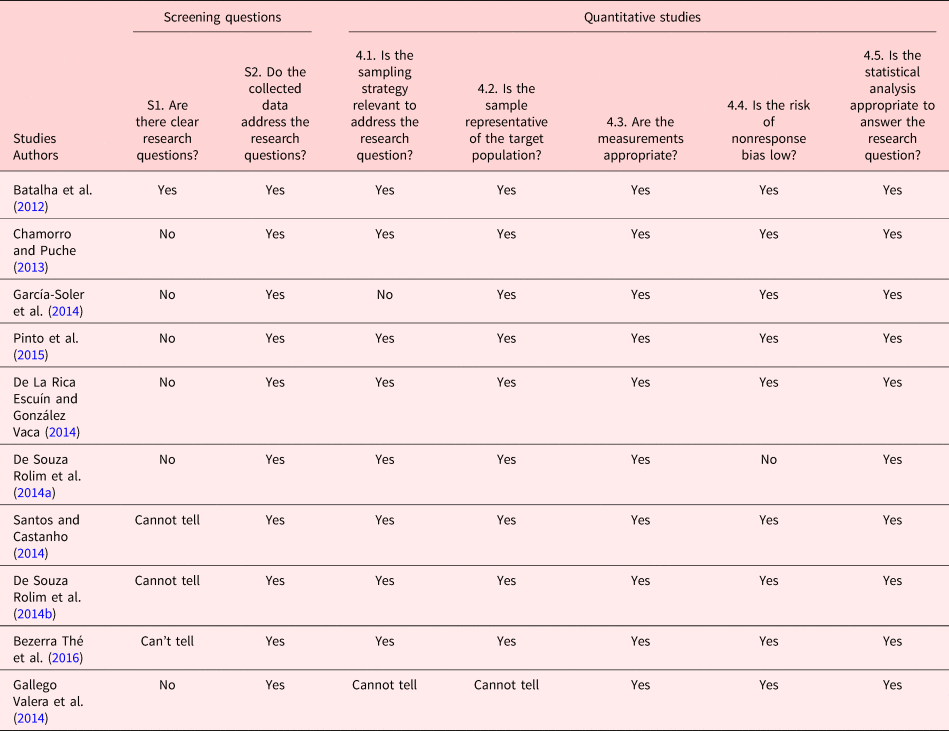
The methodological quality of the studies was evaluated using the Mixed Methods Appraisal Tool (MMAT) version 2018 (Rostad et al., Reference Rostad, Utne and Grov2017; Hong et al., Reference Hong, Pluye and Fàbregues2018; Tsai et al., Reference Tsai, Jeong and Hunter2018). All of the studies included were independently assessed by reviewers 1 and 2 (Table 1), based on the following criteria: (I) Is the sampling strategy relevant to address the research question? (II) Is the sample representative of the target population? (III) Are the measurements appropriate? (IV) Is the risk of nonresponse bias low? (V) Is the statistical analysis appropriate to answer the research question?
Analysis of the quality of studies included in the systematic review using MMAT version 2018

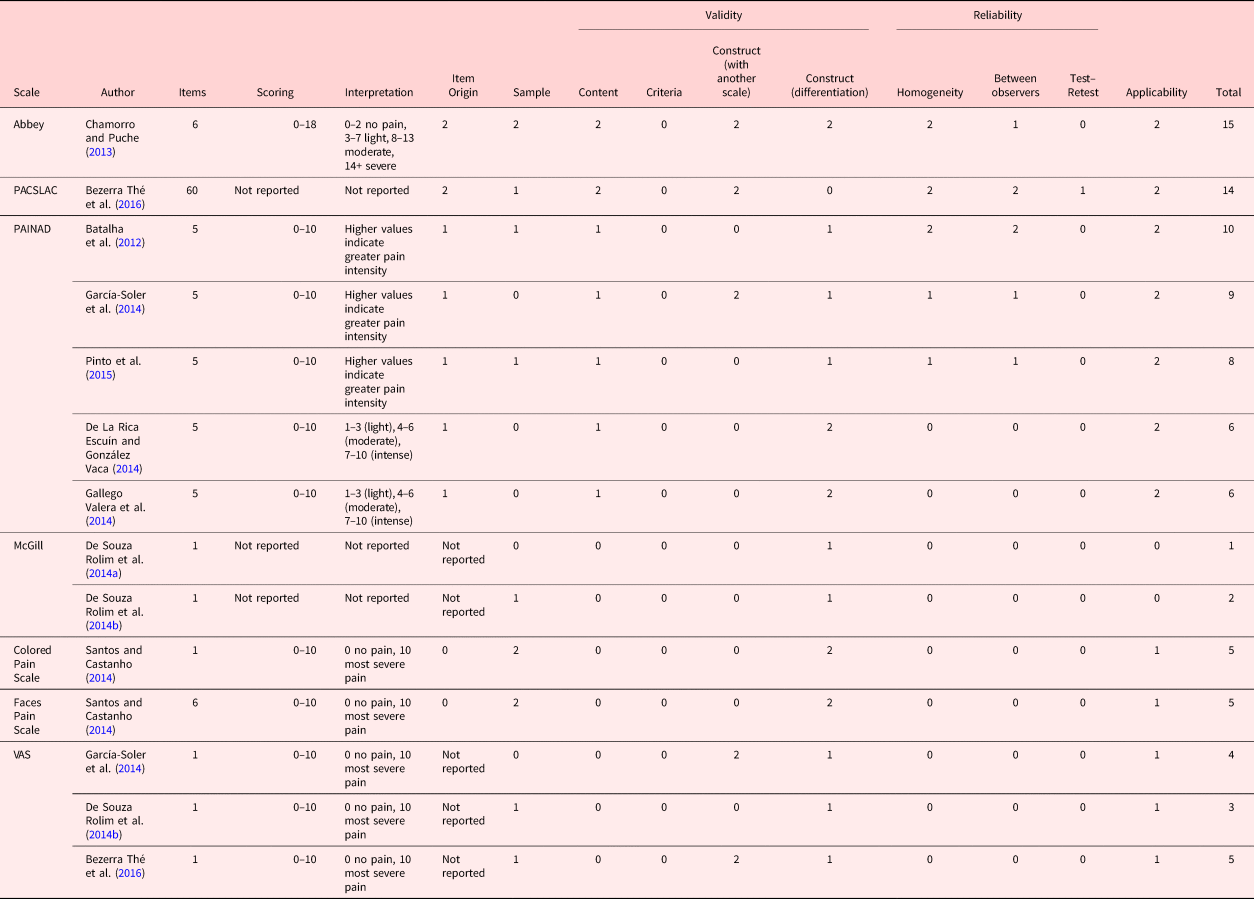
Quality, in terms of reliability and validity of the instruments located in the articles, was evaluated with the tool developed by Zwakhalen et al. (Reference Zwakhalen, Hamers and Abu-Saad2006), which evaluates 10 criteria in each pain measurement instrument: (1) origin of the items; (2) number of participants; (3) content validity (the items cover all pain dimensions); (4) validity of criteria (uses a gold standard); (5) validity of construct I (in relation to another pain scale); (6) validity of construct II (difference between pain/no pain); (7) homogeneity (alpha Cronbach); (8) reliability between observers (correlation between observers); (9) test–retest reliability (test–retest correlation); and (10) applicability (practical, easy to apply). The total score can range from 0 to 20 points for each instrument used in each study.
The review protocol was registered on the PROSPERO platform (CRD42019133892).
Results
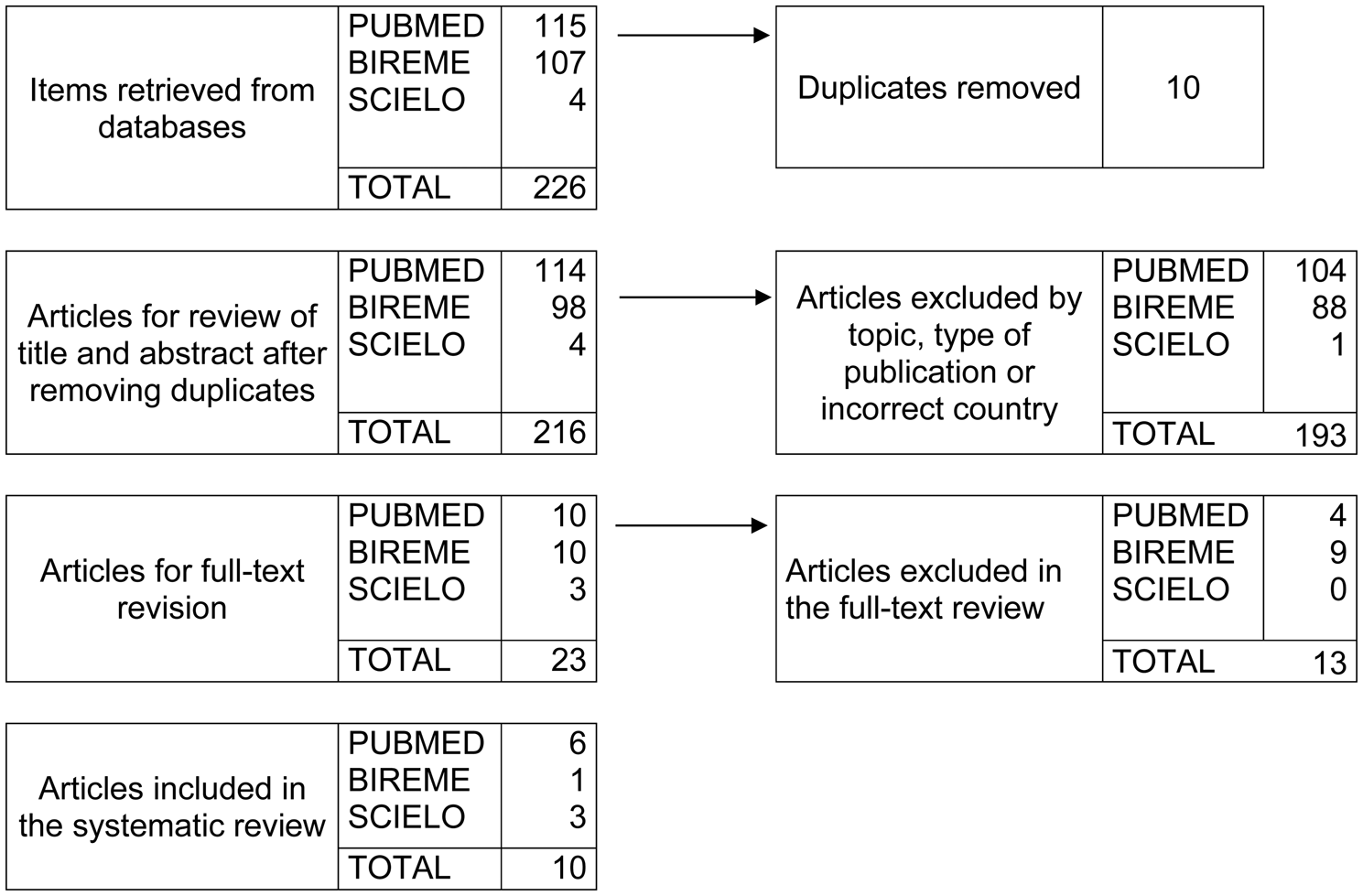
A total of 226 studies were retrieved from the databases. After the removal of 10 duplicates, 216 articles were read in the title and abstract, eliminating 193, resulting in 23 articles for full-text reading. Ten articles were finally included in the data extraction and synthesis of results (Figure 1).
PRISMA flowchart of the inclusion process in the systematic review.

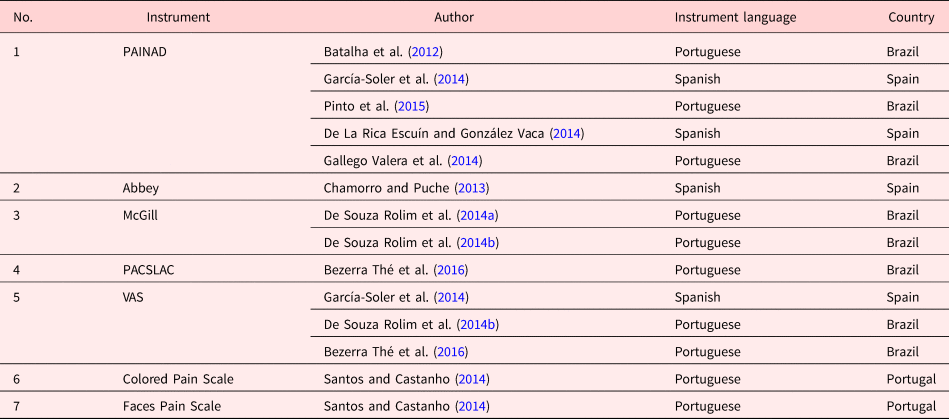
In those 10 studies, four scales for pain measurement were identified: PAINAD, Abbey, McGill, and PACSLAC. Three other similar scales were used as a silver standard: Faces Pain Scale, VAS, and Colored Pain Scale. The languages used in the scales were Spanish (from Spain) and Portuguese (from Brazil and Portugal) (Table 2).
Pain measurement instruments identified in the reviewed studies

Among the characteristics of the studies included in the systematic review, the scale most utilized was PAINAD, which was included in five studies in its Spanish (Spain) and Portuguese (Brazil) versions (Batalha et al., Reference Batalha, Duarte and do Rosário2012; De La Rica Escuín and González Vaca, Reference De La Rica Escuín and González Vaca2014; Gallego Valera et al., Reference Gallego Valera, Carezzato and Carvalho Vale2014; García-Soler et al., Reference García-Soler, Sánchez-Iglesias and Buiza2014; Pinto et al., Reference Pinto, Minson and Lopes2015). The Abbey scale was only used in Spain (Chamorro and Puche, Reference Chamorro and Puche2013), while the PACSLAC and McGill scales were used only in Brazil (De Souza Rolim et al., Reference De Souza Rolim, Campos Fabri and Nitrini2014a, Reference De Souza Rolim, Campos Fabri and Nitrini2014b; Bezerra Thé et al., Reference Bezerra Thé, Gazoni and Cherpak2016). Some validation studies used an analogous scale, fulfilling the function of the silver standard for pain assessment; as there is no gold standard for pain diagnosis in persons who lack the ability to communicate their pain, such as in cases of dementia (De Souza Rolim et al., Reference De Souza Rolim, Campos Fabri and Nitrini2014b; García-Soler et al., Reference García-Soler, Sánchez-Iglesias and Buiza2014; Santos and Castanho, Reference Santos and Castanho2014; Bezerra Thé et al., Reference Bezerra Thé, Gazoni and Cherpak2016).
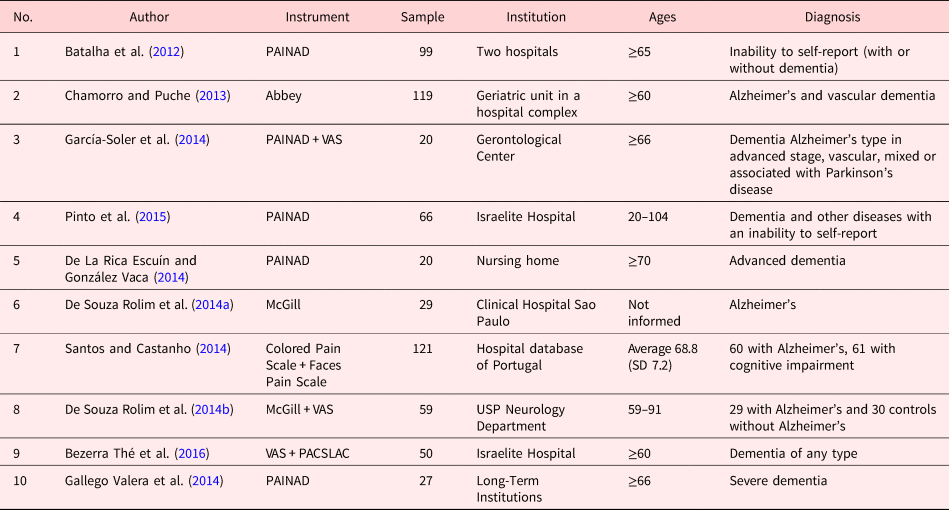
The studies that presented the most important samples were Chamorro and Puche (Reference Chamorro and Puche2013), with a sample of 119 patients older than 60 years of age with a diagnosis of Alzheimer's and vascular dementia in a hospital geriatric unit, and Santos and Castanho (Reference Santos and Castanho2014) with a sample of 121 patients from Portugal diagnosed with Alzheimer's disease and cognitive impairment with a mean age of 68 years (Table 3).
Main characteristics of the studies included in the systematic review

Regarding reliability and validity indicators analyzed in each of the scales used by the 10 studies, it was identified that in Spanish, the Abbey scale shows the best validity and reliability coefficients, given that the study sample was large (n = 119); in Portuguese, the PACSLAC scale shows the best reliability and validity coefficients, although the sample was small (n = 50). The Abbey and PACSLAC scales obtained the best scores, as both are multidimensional and have been developed specifically for patients with dementia who are unable to communicate (Table 4).
Characteristics of the scales used for pain measurement identified in the included studies

The PAINAD scale, although widely used, did not demonstrate adequate reliability and validity coefficients, in part because of the small sample numbers in the studies, and because it was not initially constructed for patients with the diagnoses of interest in the present study but was an adaptation of a previously existing scale (Batalha et al., Reference Batalha, Duarte and do Rosário2012; Table 4).
Discussion
The perception of pain is highly subjective; consequently, the assessment of pain by nurses becomes very complex in people with dementia. Some authors have identified barriers to pain management in people with dementia including lack of recognition of pain, lack of education or training, diagnostic failures, and lack of pain assessment tools, as well as mentioning the lack of evidence of these tools for pain assessment (Zwakhalen et al., Reference Zwakhalen, Hamers and Abu-Saad2006; McAuliffe et al., Reference McAuliffe, Nay and O'Donnell2009). On the other hand, among the strategies that have been mentioned to overcome these barriers are knowing the person, education, or training and using the most appropriate tools for pain assessment and management (Franco and De Lucas, Reference Franco and De Lucas2001; Herr et al., Reference Herr, Bjoro and Decker2006; McAuliffe et al., Reference McAuliffe, Nay and O'Donnell2009).
Following the review of the Latin American literature, reliability and validity coefficients of pain measurement scales were reviewed for patients meeting the criteria in this region. The most used scales were PAINAD, Abbey, McGill, and PACSLAC. As there was no gold standard for pain assessment, some studies chose to include analogous scales such as the Faces Pain Scale, VAS, and the Colored Pain Scale as a silver standard.
In practical terms, with the Abbey and PACSLAC scales that have been validated in this region, the nurse can perform a multidimensional assessment of pain in an average of 15 min, and training in the use of these scales requires only a few hours, and it has been suggested that family caregivers may also apply these scales to their relatives with dementia (Franco and De Lucas, Reference Franco and De Lucas2001; Herr et al., Reference Herr, Bjoro and Decker2006; McAuliffe et al., Reference McAuliffe, Nay and O'Donnell2009; Chamorro and Puche, Reference Chamorro and Puche2013; Montoro-Lorite and Canalias-Reverter, Reference Montoro-Lorite and Canalias-Reverter2015; Papiol Espinosa and Abades Porcel, Reference Papiol Espinosa and Abades Porcel2015; Bezerra Thé et al., Reference Bezerra Thé, Gazoni and Cherpak2016; Tsai et al., Reference Tsai, Jeong and Hunter2018).
In spite of this, the reliability and validity coefficients that these scales have exhibited in the analysis is not entirely convincing, as other authors have reported (Zwakhalen et al., Reference Zwakhalen, Hamers and Abu-Saad2006); the Abbey achieved 15 points out of a possible 20, and the PACSLAC achieved 14 out of 20 points. This implies that they cover 75% of the expectations in the analyzed coefficients, and consequently the overall quality of both scales could be substantially improved in future studies with larger samples and with complete validation studies that include test–retests.
Although the analogous scales in the reviewed studies were used only as a silver standard, it is not recommended at the international level that they be used for pain assessment in people with dementia if there are multidimensional scales, especially if family members are evaluating the pain of persons with dementia (Zwakhalen et al., Reference Zwakhalen, Hamers and Abu-Saad2006; Tsai et al., Reference Tsai, Jeong and Hunter2018).
Implications for nursing practice and research
The findings of this review have important implications for nurses in Latin America. Scientific production in this area of knowledge is in full growth in other regions of the world (Zwakhalen et al., Reference Zwakhalen, Hamers and Abu-Saad2006; McAuliffe et al., Reference McAuliffe, Nay and O'Donnell2009; Kim et al., Reference Kim, Park and Moon2017; Tsai et al., Reference Tsai, Jeong and Hunter2018); however, in Latin America, it is necessary to increase the available evidence regarding pain assessment scales that are culturally sensitive.
The authors of the articles analyzed in this review have not described in depth about the cultural sensitivity of each instrument used in Latin America; nor does the scale developed by Zwakhalen have a dimension referred to the “cultural appropriateness” of pain assessment scales (Zwakhalen et al., Reference Zwakhalen, Hamers and Abu-Saad2006).
We consider that the cultural dimension in pain assessment is important because the symptoms referred by patients also reflect their cultural background. In some countries, it is considered that suffering pain in silence is a highly valued response, so some people consider it very acceptable not to express their pain (Jin, Reference Jin2017). For example, it has been described that in Mexico (Nance et al., Reference Nance, May and Padilla2015), there are very particular ways of experiencing pain as something natural: “Pain is part of life. We always have had pain. Sometimes the doctors can help, sometimes not”, “We come into the world in pain and we leave it in pain”. This cultural dimension is a bit different in patients who do not have the ability to communicate pain since in those cases the people who assess the pain of the patients are nurses. Nurses, like patients, have learned about pain in childhood, as part of their socialization process. They have learned in society the ways of expressing their pain in “normal and right” ways (Narayan, Reference Narayan2010). As well as patients, health professionals, as social beings, also have their own cultural and ethnic background, which can lead to interpreting behaviors in the face of pain in a very particular way.
Finally, some authors affirm that in the multidimensional scales, such as Abbey and PACSLAC when administered by the nurse or by the relatives of the patients, cultural aspects should focus on the evaluator as much as on the patient himself (Narayan, Reference Narayan2010).
This increase in the available evidence should lead to an improved implementation of pain assessment and management for persons with dementia in clinical settings and in the home. Nurses have an important responsibility both in research and in practice; they should only apply scales that demonstrate reliability and validity in their own language. It is recommended that to measure and alleviate pain more accurately for patients with dementia in Spanish-speaking contexts, it is necessary to generate more evidence. Studies with samples of over 100 patients are needed with complete measurements of reliability, validity, and test–retest.
Conclusions
It can be concluded that four scales validated in Spanish or Portuguese were identified in two countries (Spain and Brazil). In Spanish, the Abbey scale shows the best reliability and validity coefficients, with a significant sample; in Portuguese, the PACSLAC scale shows the best reliability and validity coefficients, although with a small sample. Abbey and PACSLAC are multidimensional scales that have been developed specifically for patients with dementia.
Author contribution
All authors (S.M.C. and R.A.A.Z.) developed the research project, performed data collection, analyzed and interpreted the results, and wrote the article. All authors reviewed and approved the final version.
Acknowledgments
The authors are grateful to the University of the Sierra Sur, for the support received to carry out this research.
Authorship declaration
All of the authors have contributed to this study in terms of its design, participated in the data collection, analysis and interpretation of the results, and are responsible for the content and writing of the paper.
Authorship statement
All authors meet the criteria according to the latest guidelines of the International Committee of Medical Journal Editors and agree with this manuscript.
Funding
The authors declare that no funding was involved in this research.
Conflict of interest
The authors declare that there are no conflicts of interest. The authors alone are responsible for the content and writing of the paper.