INTRODUCTION
Mangrove forests not only provide valuable ecosystem services to humans by protecting coastlines from wave action and storms, sequestering carbon and nutrient runoff and preventing erosion, they also supply habitat for reptiles, terrestrial invertebrates and marine organisms (Scoffin, Reference Scoffin1970; Granek & Ruttenberg, Reference Granek and Ruttenberg2007; Nagelkerken et al., Reference Nagelkerken, Blaber, Bouillon, Green, Haywood, Kirton, Meynecke, Pawlik, Penrose, Sasekumar and Somerfield2008a; Miah et al., Reference Miah, Shin, Koike, Mia, Shin and Koike2011). Mangroves can be found fringing open coastlines, lining estuarine creeks and rivers and bordering semi-isolated (from the open ocean by barrier beaches) bays or lagoons (e.g. Nagelkerken et al., Reference Nagelkerken, Dorenbosch, Verberk, de la Moriniere and van der Velde2000a; Layman & Silliman, Reference Layman and Silliman2002; Gratwicke et al., Reference Gratwicke, Petrovic and Speight2006; Dorenbosch et al., Reference Dorenbosch, Verberk, Nagelkerken and van der Veldel2007). In each seascape, mangrove habitat may have varying degrees of connectivity to shallow habitats such as seagrass, sand, mud, coral reef patches and algal beds.
Semi-isolated mangroves are often overlooked in reef-associated literature. However, many regions in the Indo-Pacific and Caribbean house semi-isolated mangroves (e.g. Tongnunui et al., Reference Tongnunui, Ikejima, Yamane, Horinouchi, Medej, Sano, Kurokura and Taniuchi2002; Pittman, Reference Pittman, Caldow, Hile and Monaco2007). In isolated locations, high concentrations of suspended sediment can inhibit seagrass and coral establishment (Rogers, Reference Rogers1990; Hall et al., Reference Hall, Durako, Fourqurean and Zieman1999). In these cases, mud and macro-algae often dominate the bottom substrates of habitats adjacent to mangrove forests (Copeland, Reference Copeland1965; Shepherd et al., Reference Shepherd, Watson, Womersley and Carey2009). Therefore, open mangrove fringing coastlines and semi-isolated mangroves may differ greatly with regards to type of adjacent habitat, which has been shown to affect abundances and species present in fish assemblages (Dorenbosch et al., Reference Dorenbosch, Verberk, Nagelkerken and van der Veldel2007; Pittman, Reference Pittman, Caldow, Hile and Monaco2007; Jaxion-Harm et al., Reference Jaxion-Harm, Saunders and Speight2012).
While many species of macro-invertebrates and fish remain in mangroves throughout their lives (habitat specialists), others utilize multiple habitats during their lifespan (e.g. ontogenetic shifters) (as defined by Adams et al., Reference Adams, Dahlgren, Kellison, Kendall, Layman, Ley, Nagelkerken and Serafy2006; Jaxion-Harm et al., Reference Jaxion-Harm, Saunders and Speight2012). Different habitats may offer organisms different levels of refugia and food (Dorenbosch et al., Reference Dorenbosch, Grol, de Groene, van der Velde and Nagelkerken2009). Commercially important macro-crustacea, such as Panulirus argus (spiny lobster) in Belize, occupy mangroves as juveniles and coral reefs as adults (Acosta et al., Reference Acosta and Butler1997). Likewise, many fish species use mangroves as a nursery ground (defined by Beck et al. (Reference Beck, Heck, Able, Childers, Eggleston, Gillanders, Halpern, Hays, Hoshino, Minello, Orth, Sheridan and Weinstein2001) as a habitat that contributes greater than average abundances to adult populations per unit area) before undergoing ontogenetic migration to coral reefs (Gratwicke et al., Reference Gratwicke, Petrovic and Speight2006; Verweij et al., Reference Verweij, Nagelkerken, Hol, van den Beld and van der Velde2007). Undoubtedly, there are many benefits to spending at least part of a lifecycle in mangroves, including abundance of food (Laegdsgaard & Johnson, Reference Laegdsgaard and Johnson2001), retention of larvae (Paris & Cowen, Reference Paris and Cowen2004), and a combination of increased habitat complexity (Beukers & Jones, Reference Beukers and Jones1998), increased shade and turbidity (Helfman, Reference Helfman1981; Cocheret et al., Reference Cocheret de la Moriniere, Nagelkerken, van der Meij and van der Velde2004) and reduced predation pressure (Laegdsgaard & Johnson, Reference Laegdsgaard and Johnson2001).
Most studies deeming mangroves as important for both nursery and habitat specialist species have performed their research in mangroves in riverine systems or connected to seagrass and/or coral reefs (e.g. Nagelkeren et al., 2000a; Mumby et al., Reference Mumby, Alasdair, Edwards, Arias-Gonzallez, Lindeman, Blackwell, Gall, Gorczynska, Harborne, Pescod, Renken, Wabnitz and Llewellyn2004; Jones et al., Reference Jones, Walter, Brooks and Serafy2010). Furthermore, very few studies survey both fish and invertebrates (macro and micro, e.g. Robertson & Blaber, Reference Robertson, Blaber, Robertson and Alongi1992; Dorenbosch et al., Reference Dorenbosch, Verberk, Nagelkerken and van der Veldel2007) in mangrove habitat, despite the latter playing an important dietary role for fish (Layman & Silliman, Reference Layman and Silliman2002; Cocheret et al., Reference Cocheret de la Moriniere, Pollux, Nagelkerken, Hemminga, Huiskes and van der Velde2003). Little is known about how associations and connectivity of habitats commonly found in semi-isolated lagoons affect the faunal communities within. Assessing habitat and resource requirements is the first step in protecting species such as commercially important fish and crustaceans. Therefore, the aim of the current study is to survey fish, crustacean, and zooplankton distribution in mangroves and adjacent habitats within a semi-isolated lagoon to determine how abundant they are throughout the lagoon, and how important specific habitats are to the multiple trophic levels.
MATERIALS AND METHODS
Site description
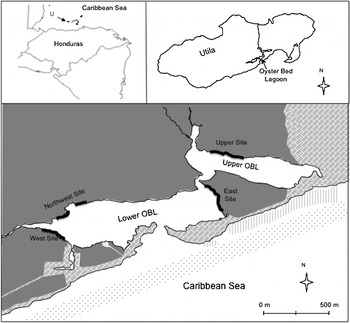
The current study was conducted in Oyster Bed Lagoon, Utila, which is one of the Bay Islands located 29 km off the coast of Honduras (Figure 1). Utila has very little tidal exchange (approximately ±20 cm) and no freshwater influence during the dry season (end of March to mid-August) (Gutshe et al., Reference Gutsche2005). Utila's hydrological and environmental factors make the island representative of most Caribbean islands (e.g. Nagelkerken et al., Reference Nagelkerken, Dorenbosch, Verberk, de la Moriniere and van der Velde2000a; Aguilar-Perera & Appeldoorn, Reference Aguilar-Perera and Appeldoorn2008). Oyster Bed Lagoon houses mangrove forests comprised solely of the red mangrove Rhizophora mangle, surrounding shallow bodies of water (with high suspended sediment levels, 4.3 mg/l in the dry season) that are semi-separated from the open sea. Oyster Bed Lagoon consists of two large bodies of water separated by a small (110 m long) canal (Figure 1). For the purpose of the study, the bodies of the water were named as Lower and Upper lagoon. The opening of the lagoon measures 75 m across and allows for exchange of water with the sea. The lagoon is shallow, with an average depth of 1.5 m and maximum depth of 3 m. The bottom of the lagoon is predominately mud or foliose macro-algae covered mud. The nearest seagrass and coral reef habitats are located on the sea-ward side of the lagoon's mouth, nearly 1 km away from surveyed sites. Small portions of the lower and upper lagoons have undergone mangrove loss from land reclamation (see Figure 1, personal observation). Two man-made canals have been cut and dredged to a water depth of 2–3 m on the west and north-west side of the lower lagoon.
Map of Oyster Bed Lagoon (OBL) (N16°06′25′W86°54′75′), Utila, Honduras, Central America. Sites are depicted with black shading.
 mangroves,
 cleared mangroves,
 seagrass,
 coral.

A criterion for selection of sampling sites in Oyster Bed Lagoon was depth; 0.5 m was the minimum depth necessary to perform snorkel underwater visual censuses (UVC) and to deploy minnow traps. Depth measurements were taken every 5 m along the shoreline of the lagoon. Roughly 30% of the lagoon that met this requirement was divided into four sites separated by at least 150 m. Between 21 June and 11 August (within the dry season), 2008, UVC fish surveys were conducted at each of the four sites (West, North-west, Upper, and East) within six marked 2 × 30 m transects located at 0 and 5 m from prop roots. Between 3 July and 30 July of 2009 UVC surveys, fish/macro-invertebrate traps and plankton tows were deployed at three sites (West, North-west, and Upper; Figure 1) within four marked 2 × 20 m belt transects at 0, 5 and 15 m away from the prop roots. These transects differed in depth (the bottom gently sloped down from 50 cm adjacent to mangroves to a depth of 80 cm at 5 m and 100 cm at 15 m), but varied little in salinity (~37.5 ppm) or temperature (~32°C). Habitat characteristics in mangroves such as prop root density and percentage algal cover can be found in Jaxion-Harm et al. (Reference Jaxion-Harm, Saunders and Speight2012) and Jaxion-Harm & Speight (Reference Jaxion-Harm and Speight2012).
Zooplankton survey
A plankton tow net, length 1.21 m × 0.54 m diameter, was constructed with 150 μm mesh size. Within each transect (three per 0, 5 15 m), the net was towed between 10:00 and 11:00 for 10 m at a depth of approximately 3 cm from the side of a two-person kayak, resulting in 2.289 m3 of water sampled. Each sample was preserved with 70% alcohol for subsequent taxonomic identification and abundance measurements.
Macro-crustacea survey
Based on pilot studies, minnow traps (Cabellas's collapsible minnow traps; dimensions (H) 30 cm × (W) 30 cm × (L) 60 m with 6.5 cm openings on both ends) were an effective method for catching small crustaceans. Macro-crustacea are usually defined as ‘able to be seen by the naked eye’, and are often collected with mesh sizes of 0.5 or 1 mm (Vitaliano et al., 2006); however, the mesh size of the minnow traps was 1.6 mm, therefore macro-crustacea in this study are defined as larger than 1.6 mm. Five minnow traps were placed in each transect at each distance (0, 5 and 15 m from prop roots) for a total of 20 traps per distance and 60 per site. Each minnow trap was baited with five pieces (approximately 2–3 g) of tuna-flavoured cat food before being deployed along the transect. Traps were checked every 24 hours between 14:00 and 16:00 for five days. All animals caught were identified, sized (prawn = tip of rostrum to tip of uropod; crabs = width of carapace) and released, before replenishing bait and redeploying.
Fish underwater visual census
Underwater visual census snorkel surveys were performed in each transect between 9:00 and 11:00 (see method details in Jaxion-Harm & Speight, Reference Jaxion-Harm and Speight2012). All fish within primary prop roots and under overhanging roots were identified to the species level, and fork lengths were visually estimated to the nearest 5 cm. The snorkeller repeated the belt transect surveys at appropriate distances (5 or 15 m) from the prop roots. Fish were categorized into life stages according to Jaxion-Harm et al. (Reference Jaxion-Harm, Saunders and Speight2012).
Statistical analyses
Abundances of macro-crustacea (and fish) per transect were calculated by aggregating individuals from the five traps in each transect (per distance, N = 4) and summing catches from the five days. Due to low abundances of small prawn/shrimp genera, all species outside of the larger-sized Penaeus genus were classified as ‘other shrimp’.
Generalized linear models (R statistical software version 2.10.1) were used to compare pooled macro-crustacea catches (individual genera), abundances of individual dominant zooplankton taxa, densities of individual dominant fish species, mean fish density (all species totalled per 100 m2), and fish species richness (number of species in a given area) amongst transects located 0, 5 and 15 m from mangroves. In all models, transects at the distances from prop roots (2008: N = 6 for fish surveys; 2009: N = 4 for macro-invertebrate and fish surveys and N = 3 for zooplankton surveys) were nested within the three categorical, random (not fixed) sites (m) (fish surveys 2008: m = 4; all surveys 2009: m = 3). Poisson error structures were used for count data, and fit of model was tested based on Akaike's information criterion (AIC) (Crawley, Reference Crawley2007). The most complex model with interactions between site and distance was tested, then simplified with deletions and amalgamating explanatory variables with similar parameter values, resulting in the minimum adequate model.
To determine if community structure differed amongst distance from prop roots, square-root transformed fish assemblage data were used with Bray–Curtis dissimilarities (sum of absolute differences divided by the total abundance) in an Analysis of similarity test (ANOSIM; Community Analysis Package (CAP), copyright PISCES 2008). An assemblage is defined as a ‘phylogenetically related group within a community (collection of species in same place at the same time)’ (Fauth et al., Reference Fauth, Bernardo, Camara, Resetarits, VanBuskirk and McCollum1996). Assemblage structure comparisons were displayed in a multidimensional scaling (MDS) plot with transects bearing similar communities clustering together. Goodness of fit in two dimensions was measured by stress tests (zero represents a perfect fit); acceptable levels are less than 0.2 (Clarke, Reference Clarke1993).
RESULTS
Zooplankton surveys
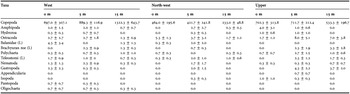
The plankton tow net caught a total of 18,257 organisms from 27 tows. Out of 14 main taxa (Table 1), four taxa accounted for approximately 99% of the mean zooplankton abundance: copepoda (98%), ostracoda (0.6%), amphipoda (0.2%) and gastropoda (0.2%). Copepods numerically dominated the catch; however, they displayed extremely high variation within site and distance, ranging from 134 to 2597 individuals per tow. There were no significant differences in total crustaceans or copepods (or any of the other taxa caught) amongst samples collected at the varying distances from prop roots. However, abundances of total crustaceans and copepods were significantly greater at the west site than at the north-west site (N = 3, P < 0.01).
Taxa caught in plankton net towed at three distances (0, 5, 15 m) from mangrove prop roots in three sites. Values presented as mean abundance ± standard error.

L, larval life stage.
Macro-invertebrate survey
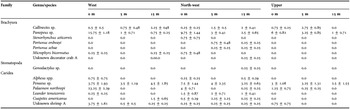
Minnow traps were nine times more effective at catching macro-crustacea than at catching fish, with a mean catch rate of 1.77 ± 0.25 crustacea/trap. Traps caught six genera of crabs and six genera of prawns/shrimps (Table 2). The majority of the crabs were Callinectes spp. (blue crabs, 19%) and Panopeus spp. (mud crabs, 74%), while Penaeus spp. (pink prawns, 45%) and Palaemon northropi (grass prawns, 42%; Rankin, 1898) were the most abundantly caught prawns/shrimp.
List of the macro-crustacea caught in minnow traps deployed at three distances (0, 5, 15 m) from mangrove prop roots with corresponding densities (± standard error) per 100 m2.

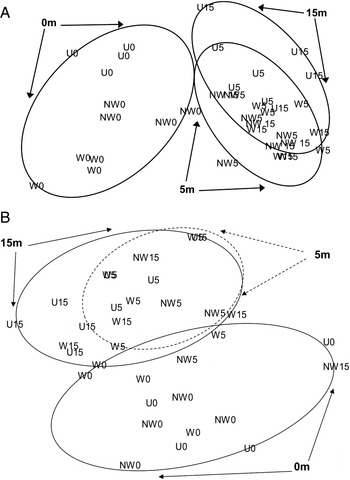
Assemblages of macro-crustacea caught in minnow traps at 0 m were grouped together in the multivariate plot, and determined to be significantly different from those at 5 m and 15 m (ANOSIM, both P < 0.001, R = 0.78, Figure 2A). Conversely, macro-invertebrate assemblages 5 m away from mangroves appear to overlap with assemblages in transects 15 m away. ANOSIM tests reveal that these macro-invertebrate assemblages are not significantly different from each other (P = 0.707).
Difference in (A) macro-crustacea and (B) fish assemblages located at 0 m, 5 m and 15 m from seaward edge of mangrove forests in Oyster Bed Lagoon, Utila. Assemblages are expressed in a multidimensional scaling ordination plot (Bray–Curtis dissimilarity coefficient) and each point represents the assemblage in one transect. Data point labels: U: Upper site; W: West site; NW: North-west site; 0: zero metres; 5: five metres; 15: fifteen metres from prop roots. Stress = 0.14.

Comparisons amongst macro-invertebrate catch abundances show significantly more Panopeus spp. and small prawns/shrimp (<2 cm) at 0 m (N = 4, P < 0.001), and no difference in abundances between traps 5 m and 15 m away from mangroves. Penaeus prawn and Callinectes crab spp. abundances were not significantly different amongst 0, 5 and 15 m.
Fish surveys
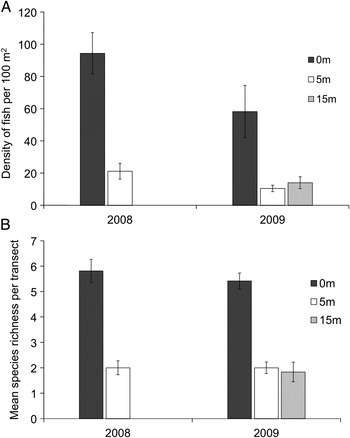
In 2008, visual surveys showed that the density of fish located in 0 m transects was more than three times the total density of fish located in transects 5 m away from the prop roots (N = 6, P = 0.04, Figure 3A). In 2009, surveys of additional transects at 15 m revealed there was no linear decrease in fish densities with distance from prop roots, and fish densities in 5 m and 15 m were not significantly different. In addition, species richness in 0 m transects was significantly higher than in 5 m and 15 m transects (2008: N = 6, P < 0.001 and 2009: N = 4, P < 0.001, Figure 3B). When multiple species in the community are grouped together, fish assemblages were significantly different between assemblages at 0, 5 and 15 m (all P < 0.001, R = 0.376). However, on a multivariate scale plot, fish assemblages in 5 m plots do not appear to cluster separately from assemblages in 15 m plots (Figure 2B).
Variation in numbers and diversity of fish with distances from the seaward edge of mangrove forests in Oyster Bay Lagoon: (A) density of fish per 100 m2; (B) number of species per transect (2008: 60 m2; 2009: 40 m2). Values presented as mean ± standard error, N = 4 in 2008 and 3 in 2009.

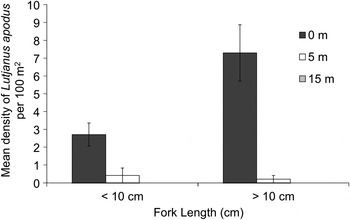
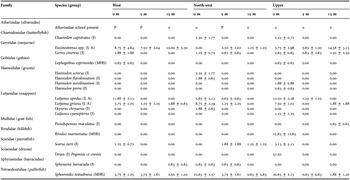
Nineteen species of fish were found in the 36 transects visually surveyed in 2009 (Table 3). Juvenile ontogenetic shifters constituted 77% of fish surveyed, while mangrove habitat specialists comprised the remaining percentage. Juvenile snappers, primarily Lutjanus apodus (13%, schoolmaster snapper; Walbaum, 1792) and L. griseus (11%, grey snapper; Linnaeus, 1758) dominated UVC surveys (Table 3). Results from the UVC reveal that there were significantly more small (<10 cm) and large (>10 cm) juvenile L. apodus at 0 m (N = 4, P = 0.01, P < 0.001, respectively) than in transects 5 m and 15 m away, but no difference in densities between 5 m and 15 m (Figure 4). All fish species, with the exception of lutjanids, gerreids and Sphoeroides testudineus in the surveys were less than 10 cm (total length). Lengths of Sphoeroides testudineus were not measured, as all fish were of similar length (estimated 8–12 cm). Results from UVC surveys revealed Sphoeroides testudineus (checkered pufferfish; Linnaeus, 1758) densities exhibit the same pattern in the Upper and North-west sites, with more fish located in 0 m transects compared to 5 m and 15 m transects (N = 4, P = 0.01; Table 3). In addition, both gobies and grunts were only found in 0 m transects at all sites (Table 3). In contrast, there was no difference in gerreid abundance (<10 cm and >10 cm) between 0, 5 and 15 m.
Variation in numbers of small (<10 cm) and large (<10 cm) lutjanids with distances from the seaward edge of mangrove forests in Oyster Bay Lagoon. Densities per 100 m2 presented as mean ± standard error.

List of the fish visually surveyed at three distances (0, 5, 15 m) from mangrove prop roots with corresponding densities (± standard error) per 100 m2, life-stage, and residency in mangroves.

J, juvenile (ontogenetic shifters); A, adult (ontogenetic shifters); MHS, mangrove habitat specialist; P, present.
Minnow traps (24 hour catches) caught a total of 235 fish consisting of nine species. Pooled catches revealed no significant differences in total fish catch amongst distances (mean fish catch per five traps over five days = 6.45 ± 3.06).
DISCUSSION
Zooplankton distribution
The present study was the first to measure zooplankton abundance in Honduran mangroves. As found by the current study, copepods in Caribbean sites such as those in mangroves in Puerto Rico (Rios-Jara et al., Reference Rios-Jara1998) and a coral reef lagoon in Mexico (Álvarez-Cadena et al., Reference Álvarez-Cadena, Ordonez-Lopez, Almaral-Mendivil and Uicab-Sabido2009) constituted over 90% of total zooplankton catches and displayed high degrees of density variation. Along with copepods, balanids and brachyurans were also abundant in these Caribbean studies (including the current study), while organisms from other groups were scarce. Zooplankton provide the trophic link between primary productivity and higher trophic guilds, and most carnivorous fish consume zooplankton during at least one stage (usually early juvenile) of their life history (Alheit & Scheibel, Reference Alheit and Scheibel1982; Cocheret et al., 2003). In this study, copepod distribution was not linked to distance to mangrove forests. Distribution of zooplankton is often linked to hydrology, chlorophyll-a, salinity and sediment load (Jouffre et al., Reference Jouffre, Lamhoai, Millet and Amanieu1991; Robertson & Blaber, Reference Robertson, Blaber, Robertson and Alongi1992; Krumme & Liang, Reference Krumme and Liang2004; Costa et al., Reference Costa, Leite and Pereira2009). In Oyster Bed Lagoon, current speed and direction is highly variable, which may explain the absence of a pattern in zooplankton assemblages at a distance to mangrove level (Cowie, unpublished data). In addition, the current study did not find a significant difference in salinity amongst site locations. It is suggested that future studies measure chlorophyll concentrations and sediment load at both the site and distance to mangrove level, as this may explain the significant difference in copepod abundances between the North-west and West sites.
Macro-invertebrate distribution
Knowledge of macro-invertebrate distribution from Caribbean mangroves is limited (e.g. Browder et al., Reference Browder, Dragovich, Tashiro, Coleman-Duffie, Foltz and Zweifel1986; Sheridan, Reference Sheridan1992). Numerically dominant decapods in this study, Panopeus and Callinectes crabs and Penaeus and Paelomon prawns corresponded with results from two other mangrove studies previously performed in Florida (Browder et al., 1986; Sheridan, Reference Sheridan1992). Callinectes crabs were found in both Floridian studies, but Panopeus crabs were only found in Browder's study. The second most abundant prawn species in the current study was Paelomon northropi, belonging to the family Paelomonidae, which was the most abundant decapod family in both Floridian studies.
In the present study, macro-invertebrate distribution indicates that different genera vary in their use of mangrove prop roots versus adjacent algae beds. However, reasons behind varying distribution are unknown and require further investigation.
Fish distribution
In the current study, daytime UVC surveys showed fish species richness and densities were greater in Oyster Bed Lagoon's prop roots than in adjacent algal beds. In Spanish Water Bay, Curaçao, and Antilles, Nagelkerken et al. (Reference Nagelkerken, Dorenbosch, Verberk, de la Moriniere and van der Velde2000a) found twice the number of species and two hundred times higher densities of fish in mangroves compared to algal beds.
During the day, fish may use mangroves for both food and refuge. In Curaçao, Dorenbosch et al. (Reference Dorenbosch, Grol, de Groene, van der Velde and Nagelkerken2009) found that grunts (Haemulidae) tethered to mangrove prop roots away from coral reefs had significantly higher rates of survival. Furthermore, with higher abundances of potential macro-invertebrate prey located in prop roots, it is likely that fish in the current study did not have to sacrifice growth for protection during daytime hours. However, diet analysis is needed in future studies to verify that macro-invertebrates present are the same species consumed by fish. Unlike open mangrove systems with adjacent seagrass beds, daytime densities of fish were low in adjacent algal beds compared to densities of fish in seagrass found in previous studies (Dorenbosch et al., Reference Dorenbosch, Verberk, Nagelkerken and van der Veldel2007; Jaxion-Harm et al., Reference Jaxion-Harm, Saunders and Speight2012). In Spanish Water Bay, Curaçao, which contains mangroves, seagrass and algae, fewer species of fish were found in algal beds (Nagelkerken et al., Reference Nagelkerken, Dorenbosch, Verberk, de la Moriniere and van der Velde2000a). Fish, particularly small juveniles, may prefer seagrass due to an abundance of small refuge gaps between blades (Gratwicke et al., Reference Gratwicke and Speight2005). Reduced numbers of fish in algal beds in the current study may be due to dense thickets providing few refuge gaps. Future studies are needed to test predation of juvenile fish in mangroves versus mud/algae.
Fish distributions based on minnow trap catches in Oyster Bed Lagoon, which were deployed for 24 hours (i.e. encompassing both day and night), differ from daytime UVC results. Abundances of fish caught in the minnow traps were not significantly different amongst the three distances from prop roots, suggesting fish may leave the mangroves at night. In previous studies, fish have been found to migrate from mangroves to connected seagrass beds at night (Nagelkerken et al., Reference Nagelkerken, Dorenbosch, de la Moriniere, Verberk and van der Velde2000b, Reference Nagelkerken, Bothwell, Nemeth, Pitt and van der Velde2008b; Luo et al., Reference Luo, Serafy, Sponaugle, Teare and Kieckbusch2009), and catches from our minnow traps suggest fish also migrate to neighbouring algal beds. At night, fish may use the protection of darkness to leave the protection of prop roots. Piscivores mostly use visual cues to find their prey; therefore, predation risk is likely to be lower during the night (McMahon & Holanov, Reference McMahon and Holanov1995). Although the majority of macro-crustacea in the current study were found under the prop roots, potential fish prey (see Layman & Silliman, Reference Layman and Silliman2002), paeneid prawns and small Callinectes crabs, were plentiful in both prop roots and algal beds.
In conclusion, fish and macro-invertebrate assemblages were significantly different between prop roots and adjacent (both 5 m and 15 m away from prop roots) algal beds. However, zooplankton did not follow any distinct distribution patterns. Lutjanids dominated fish surveys, and Panopeus crabs dominated minnow trap catches. Many Caribbean studies have found positive correlations between mangroves and adult reef populations of fish species such as Lutjanus apodus (schoolmaster snapper), Gerres cinereus (Yellow fin mojarra; Walbaum 1792), and Sphyraena barracuda (great barracuda; Edwards, 1771) (Mumby et al., Reference Mumby, Alasdair, Edwards, Arias-Gonzallez, Lindeman, Blackwell, Gall, Gorczynska, Harborne, Pescod, Renken, Wabnitz and Llewellyn2004; Dorenbosch et al., Reference Dorenbosch, Verberk, Nagelkerken and van der Veldel2007; Harm et al., Reference Harm, Kearns and Speight2008). Since these species depend on mangrove habitat during their juvenile life stage, and mangroves in this study are connected to adjacent mud and algae, it is important to study how these fish use this habitat continuum in order to provide necessary data for conservation management of semi-isolated mangrove lagoons. Observations from the current study imply that these fish use both mangrove prop roots and adjacent algal beds, but have a higher dependence on prop roots during daytime hours. However, future diet studies and nocturnal surveys are needed in order to make direct correlations between distribution of macro-invert prey and their predators—carnivorous fish.
ACKNOWLEDGEMENTS
The authors thank R. Wright, B. Thorne, P. Henderson, C. Hambler, J. MacDonald and S. Cragg for their assistance with study design, aid with statistics and help in the field. This work was funded by St Catherine's College, Oxford and Operation Wallacea.