In recent decades in the United States of America, obesity rates have doubled, and morbid obesity rates have quadrupled.Reference Flegal, Carroll, Ogden and Johnson 1 , Reference Sturm 2 Approximately 78 million adults above age 20 and 12.5 million children and adolescents in the United States of America are obese.Reference Flegal, Carroll, Kit and Ogden 3 Data from the National Health and Nutrition Examination Surveys show that among adults aged 20–74 years, the prevalence of obesity increased from 15% in the 1976–1980 survey to 33% in the 2003–2004 survey.Reference Yaemsiri, Slining and Agarwal 4
Previous studies have assessed hypoxia in newborn animal models at the molecular level and have shown impaired growth.Reference Cheek, Graystone and Rowe 5 Normoxia after surgical repair has not been studied as it relates to long-term growth. The sharp increase in overweight and obesity in the United States of America corresponds to associated risks for all-cause mortality, cancer, non-alcoholic fatty liver disease, hypertension, type 2 diabetes, and metabolic syndrome.Reference Cohen 6 – Reference Pemberton, McCrindle and Barkin 8 Only sporadic data outline the rise of obesity in patients with CHD. Constituting about 1% of the population, the rapidly growing CHD cohort increasingly is made up of adults.Reference Marelli, Ionescu-Ittu, Mackie, Guo, Dendukuri and Kaouache 9 Within this group, tetralogy of Fallot represents 4–9% of all CHD, requires lifelong care, and is the most common cyanotic CHD in both children and adults, making it an ideal population to evaluate over time.Reference Hoffman and Kaplan 10
With palliative procedures available, the tetralogy of Fallot cohort typically has normal saturation, and by adulthood their weight is similar to the general population. No study to date has studied this weight change over time. In this cross-sectional study of tetralogy of Fallot patients at a single centre, we studied the relationship of body mass index versus age and time postoperatively for patients of all ages followed-up at a single centre.
Materials and methods
Data were collected by retrospective review of echocardiographic data at a single centre from 1 January, 2012 to 31 December, 2014. There were 137 patients identified with surgically repaired tetralogy of Fallot. Basic demographic information including age, gender, height, weight, and body mass index was collected from these patients at their most recent evaluation if multiple encounters were noted. Surgical repair date and time in years since complete repair were recorded for the tetralogy of Fallot patients. In instances where multiple cardiac surgeries were performed, the definitive tetralogy of Fallot repair was determined to be the index surgery. Procedures involving a Blalock–Taussig shunt, right ventricle–pulmonary artery conduit, or other valvular interventions were not analysed. Patients were not excluded on the basis of concomitant genetic syndromes or chromosomal abnormalities.
Age-matched controls were generated by 1:1 age matching – to the year for those ⩾6 years of age and to the month for those <6 years of age – who had a structurally normal heart identified on an echocardiogram performed during 1 January, 2012–31 December, 2014 at the same centre. Adults are defined as being ⩾18 years of age. Matched demographic information was obtained for the controls. The only exclusion criterion for the control group was patients with incomplete demographic data.
Body mass index was calculated as follows: weight (kg)/(height (m))2. Normal was defined as body mass index of 18.5–24.9 kg/m2. Overweight was defined as body mass index of 25–29.9 kg/m2. Obese was defined as body mass index of ⩾30 kg/m2. All reported body mass indices are in kg/m2.
All patients underwent an echocardiographic evaluation using IE33 (Philips Inc., Andover, Massachusetts, United States of America). Standardised comprehensive protocols were utilised for all patients. Among patients who had cardiac MRI performed, studies were performed in an Ingenia clinical 1.5-T MR scanner (Philips Healthcare, Best, The Netherlands). When multiple imaging studies were performed within the study window, the most recent study was analysed.
The present study was approved by the Montefiore Medical Center institutional review board.
Data analysis was performed using SAS version 9.4. Continuous variables are reported as mean±SD. All p values were calculated using a Student’s two-tailed t-test with α=0.05 used as level of significance.
Results
The mean body mass index of the 137-patient tetralogy of Fallot cohort was 21.4 kg/m2 (range from 11.6 to 54.4 kg/m2) and for the control cohort it was 22.9 kg/m2 (range from 11.3 to 47.8 kg/m2) (p=0.079). Normal body mass index was noted in 36 tetralogy of Fallot patients (26%) and in 24 (45%) adult patients. Overweight was identified in 26 tetralogy of Fallot patients (19%) and in 18 (34%) adult patients. Obesity was present in 26 tetralogy of Fallot patients (19%) and in 11 (21%) adult patients.
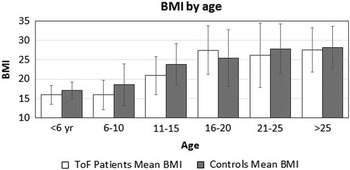
Age was analysed as it relates to body mass index between the tetralogy of Fallot cohort and the control group. In the first 5 years of age, the tetralogy of Fallot cohort had a significantly lower body mass index compared with the control group (p=0.042) (Fig 1). No other statistically significant differences were noted, and only in the 15–20-year-old subgroup body mass index in the tetralogy of Fallot cohort was higher than age-matched controls.
Body mass index (BMI) means (+/−SD) among tetralogy of Fallot (ToF) and control patients by age.

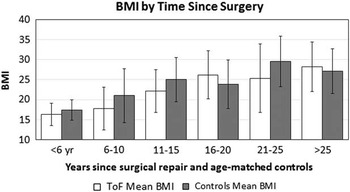
Time since surgical repair was also analysed as it relates to body mass index. In the first 5 years postoperatively, the tetralogy of Fallot group has statistically significantly lower body mass index (p=0.028) (Fig 2). No other statistically significant differences were noted between cohorts.
Body mass index (BMI) means (+/−SD) among tetralogy of Fallot (ToF) and control patients by postoperative years.

Data were censored with regard to other cardiovascular anatomies affecting body mass index. After excluding the 17 patients within the tetralogy of Fallot cohort who also had pulmonary atresia, it is observed that the mean body mass index for those aged ⩽6 years was not statistically significantly different when compared with controls (16.1 versus 17.1; p=0.11). No statistically significant differences in body mass index were noted in the first 15 years. The 16–20-year-old tetralogy of Fallot cohort without pulmonary atresia, however, had statistically significantly higher body mass index when compared with age-matched controls (28.1 versus 23.5; p=0.04). In patients ⩾20 years of age, the tetralogy of Fallot with pulmonary atresia cohort had lower body mass index, but this was not statistically significant (26.5 versus 27.9; p=0.34).
Among adult tetralogy of Fallot patients, no trends were observed in body mass index based on decade of life, with a mean body mass index of 26.5 kg/m2. For the 27 patients aged 21–30 years, the mean body mass index was 25.5 with an SD of 8.1. For the 19 patients aged >30 years, the mean body mass index was 26.8 with an SD of 4.1.
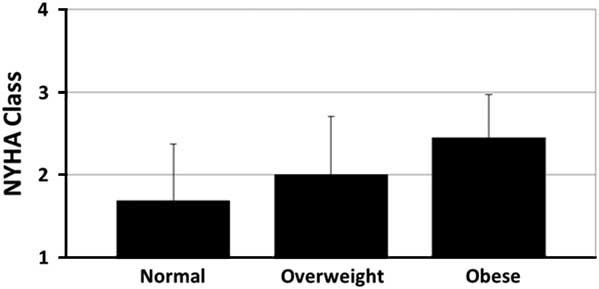
Adult tetralogy of Fallot patients have a trend towards higher NYHA functional classification as body mass index increases (normal 1.7, overweight 2.0, obese 2.4) (Fig 3). There is a statistically significant difference in the average NYHA classification between patients with normal and obese body mass indices (p=0.03).
NYHA class among adult tetralogy of Fallot patients by body mass index category.

Adult tetralogy of Fallot patients did not have a significantly different left ventricular ejection fraction based on body mass index. Comparisons of left ventricular ejection fraction were made between each subgroup based on body mass index, and the comparison of normal versus obese patients as determined by echocardiography (p=0.55) or cardiac MRI (p=0.26) did not show statistical significance.
Discussion
Children, particularly adolescents, who are obese have a high probability of becoming adults who are obese.Reference Llewellyn, Simmonds, Owen and Woolacott 11 The prevalence of obesity is increasing rapidly in numerous industrialised nations worldwide, and the bimodal distribution of obesity portends a large-scale obesity epidemic in the next few decades. Adolescent obesity poses a serious risk for severe obesity during early adulthood, which calls for a stronger emphasis on weight reduction during early adolescence, specifically targeting groups at greater risk. Tetralogy of Fallot is not exempt from the obesity trends seen in the general population, and previous reports have shown a similar pattern with >12.3% obesity and >18.5% overweight but without temporal data.Reference Fogel, Pawlowski and Keller 12 Our data imply that traditional cardiovascular risk factors should be monitored starting at least by adolescence in the CHD population.
The patients included in this study were mostly from an urban centre where demographic studies demonstrate lower socio-economic and health status. Thus, it is not surprising we found that among adults 21% were obese and 34% were overweight. The significant difference in body mass index between patients with tetralogy of Fallot and normal cohorts is expected within the first 5 years, as it is anecdotally known that tetralogy of Fallot patients do not grow well even in the first few months following definitive surgical repair. Weight increases are seen later and are starkly different from the first years of life. By 16–20 years of age, tetralogy of Fallot patients are heavier than their peers without CHD, but the reason for this remains unclear. Independent of the reason, the time course of overweight and obesity provides evidence for the need to start counselling adolescent tetralogy of Fallot patients about the dangers of obesity, much as should be done in the general population. Among adolescent and adult CHD patients, psychiatric disorders including depression are noted to be prevalent;Reference Horner, Liberthson and Jellinek 13 – Reference Freitas, Castro and Sarmento 17 however, a recent international study has shown good quality of life, suggesting that perhaps it is not a significant contributor to obesity in this population.Reference Apers, Kovacs and Luyckx 18
We are the first to report data regarding increased body mass index being associated with increased NYHA functional classification status in adult tetralogy of Fallot patients. Given that obesity and increased NYHA functional classification are known risk factors for increased all-cause mortality, these data suggest that monitoring the body mass index is important. Although previous studies in non-CHD patients have shown a survival advantage in certain subpopulations among those with higher body mass index, future studies in the CHD population are warranted to see whether this relationship exists.Reference Parissis, Farmakis and Kadoglou 19
We are first to report that no differences exist in left ventricular ejection fraction as calculated by echocardiography and cardiac MRI in adult tetralogy of Fallot patients as segregated by body mass index. These data suggest that obesity, a known morality risk factor, is not associated with decreased left ventricular ejection fraction, which has been documented in multiple other studies among various subgroups.Reference Clark, Fonarow and Horwich 20 Although mortality data are not within the scope of this study, future investigations associating body mass index, ventricular ejection fraction, and mortality might be worth pursuing.
Limitations
Limitations of this study include the small sample size in total and within subgroups for both tetralogy of Fallot and control groups. Data regarding non-cardiovascular conditions that affect weight might confound results. Other cardiovascular anatomies might be pertinent affecting growth or repeated intervention. Known medical conditions affecting body mass index were not censored in the analysis with two patients genetically confirmed as trisomy 21 and another patient with DiGeorge syndrome. In addition, this was not a longitudinal study and included patients who underwent different techniques during multiple interventional and surgical eras. The cross-sectional study design includes prevalence–incidence bias, and therefore inability to make causal inferences. These data come from a single centre, which serves a predominantly lower socio-economic status population of variable medical compliance and resources; therefore, the results may not reflect the general population within and outside of the United States of America.
Conclusion
Obesity is a major risk factor for cardiovascular disease and is a rising epidemic in the United States of America. The prevalence of obesity in long-term survivors with tetralogy of Fallot is increasing and possibly in survivors with other CHD lesions as well, but little chronologic data exist. Tetralogy of Fallot patients initially had lower body mass index, but this difference did not persist. As adults, increased body mass index was associated with higher NYHA functional classification but not with worsened left ventricular ejection fraction. Further research on obesity in patients with CHD is needed to investigate its long-term effects.
Acknowledgements
None.
Financial Support
This research received no specific grant from any funding agency or from commercial or not-for-profit sectors.
Conflicts of Interest
None.