


Introduction
Clinical supervision refers to ‘the formal provision, by approved supervisors, of relationship-based education and training that is work-focused and manages, supports, develops, and evaluates the work of colleague/s’ (Milne, Reference Milne2008, p. 15). Research indicates that supervision is vital to the provision of effective therapeutic interventions, improving client outcomes, enhancing continued learning, and promoting safe, client-centred care (Milne et al., Reference Milne, Reiser, Cliffe, Breese, Boon, Raine and Scarratt2011). It follows, then, that clinical supervision represents a core component in the implementation of evidence-based psychological therapies, including cognitive behavioural therapy (CBT) (APA, 2015; Roth and Pilling, Reference Roth and Pilling2008).
Mirroring the growing dissemination and utilisation of CBT in healthcare systems, increased attention has been paid to which methods are most effective in facilitating therapist training and development (Rakovshik and McManus, Reference Rakovshik and McManus2013; Shafran et al., Reference Shafran, Clark, Fairburn, Arntz, Barlow, Ehlers and Wilson2009). A variety of educational and cognitive behavioural models have been posited, incorporating cognitive tasks (e.g. case conceptualisation and treatment planning), behavioural tasks (technical skills acquisition and rehearsal), and emotional tasks (affective processing and self-reflection) (Bennett-Levy, Reference Bennett-Levy2006, Liese and Beck, Reference Liese, Beck and Watkins1997; Milne, Reference Milne2009; Milne and Reiser, Reference Milne and Reiser2017; Padesky, Reference Padesky and Salkovskis1996; Safran and Muran, Reference Safran and Muran2001). While space does not permit a comparison of these frameworks, action-based and experiential supervisory methods such as role-play and (to a lesser degree) ‘chairwork’ have been consistently favoured in the training and supervision of cognitive therapists (Milne, Reference Milne2009; Pugh, Reference Pugh2019a).
Action-based supervision
Consensus indicates that CBT supervision should be at least partly experiential and ‘action-packed’ (Bennett-Levy, Reference Bennett-Levy2006; Kaslow et al., Reference Kaslow, Borden, Collins, Forrest, Illfelder-Kaye, Nelson and Rallo2004; Milne, Reference Milne2009; Milne and Reiser, Reference Milne and Reiser2017; Padesky, Reference Padesky and Salkovskis1996; Ronen and Rosenbaum, Reference Ronen and Rosenbaum1998; Roth and Pilling, Reference Roth and Pilling2007a). Action-based supervisory methods represent a collective of enactive procedures that involve simulated interactions with other individuals (e.g. clients or colleagues), parts of the self, or both. These methods very much ‘stand on the shoulders of giants’ and are informed by the seminal works of Jacob L. Moreno (Reference Moreno1987), George Kelly (Reference Kelly1955) and Fritz Perls (Reference Perls1975). Role-play is the procedure most familiar to cognitive therapists, involving the within-session enactment of past, present and future interactions which approximate real-life experiences. CBT supervision employs role-play for various purposes including: demonstrating the implementation of interventions (‘modelling’); practising the application of techniques (‘rehearsal’); exploring novel therapeutic strategies (‘experimentation’); revisiting key interactions in therapy (‘re-enactment’); and facilitating changes in perspective (e.g. ‘role reversal’ with other individuals).
In contrast to the pragmatic focus of role-playing, chairwork is a more creative and exploratory action-based method. Accordingly, these techniques are well suited to self-reflection and the resolution of evocative issues such as negative ‘countertransference’ and problematic therapist beliefs (Jenkyns, Reference Jenkyns, Jones and Dokter2008; Pugh, Reference Pugh2019a). Chairwork has been categorised in different ways. ‘Empty-chairwork’ involves the supervisee engaging in an imaginal dialogue with an ‘other’ (in most cases, the client) who is held, symbolically, in an empty chair. ‘Multi-chair’ techniques, on the other hand, involve the supervisee speaking from several chairs representing different perspectives or parts of the self. Chairwork and role-play overlap considerably and are often blended to produce dramatisations that are evocative and memorable (Milne and Reiser, Reference Milne and Reiser2017; Pugh, Reference Pugh2017).
Finally, behavioural experiments (Bennett-Levy et al., Reference Bennett-Levy, Westbrook, Fennell, Cooper, Rouf and Hackmann2004) are an effective medium for evaluating and implementing factors that impact upon clinical practice. These include supervisees’ cognitive appraisals (e.g. about the self, the client or CBT) or specific behaviours (e.g. how technical skills are implemented). Whilst this paper focuses on role-play and chairwork (as these are likely to be least familiar to CBT supervisors), examples of how behavioural experiments are incorporated into CBT supervision are presented in Table 1.
Example therapist beliefs and behavioural experiments

Theoretical basis for action-based supervision
‘Experiential learning’ (i.e. learning through experience) represents the foundation of evidence-based CBT supervision; indeed, clinical supervision represents a fundamentally experiential approach to professional learning (Milne, Reference Milne2018; Milne and Reiser, Reference Milne and Reiser2017). Kolb’s (Reference Kolb1984) model of experiential learning suggests that professional development requires a number of active components including experiencing (engaging in an activity), reflection (thinking about what happened), meaning-making or conceptualisation (creating a model on the basis of experience) and experimentation (testing one’s theory through continued activity). Supervisors must, therefore, ensure that each mode of experiential learning is regularly incorporated into supervision. This includes the use of action-based procedures for enhancing professional development (Edmunds et al., Reference Edmunds, Kendall, Ringle, Read, Brodman, Pimentel and Beidas2013; Milne and Reiser, Reference Milne and Reiser2017).
Building on the work of Kolb (Reference Kolb1984), therapy-specific models of learning have proposed that effective psychotherapeutic practice relies upon a complex integration of declarative knowledge (factual information) and procedural knowledge (technical competency) (Bennett-Levy, Reference Bennett-Levy2006; Safran and Muran, Reference Safran and Muran2001). To facilitate such integration, effective learning environments should mirror the contexts in which knowledge is to be applied. In other words, understanding cognitive behavioural principles is maximised through a mixture of both discussion and performances involving simulated therapeutic interactions. This is particularly relevant to novice therapists, for whom action-based methods provide a bridge between declarative knowledge (‘This is what I need to do’) and the development of procedural knowledge (‘This is how I do it’) (Bennett-Levy, Reference Bennett-Levy2006). Indeed, research suggests that matching learning environments and ‘real-world’ clinical contexts increases the likelihood that new knowledge and skills will be implemented outside of supervision (Cross et al., Reference Cross, Seaburn, Gibbs, Schmeelk-Cone, White and Caine2011).
Lastly, information processing theory (IPT) has elucidated the process of learning through supervision (Tangden and Borders, Reference Tangden and Borders2017). IPT suggests that information is acquired, processed, stored and retrieved through several stages involving sensory memory, short-term (working) memory and long-term memory (Schunk, Reference Schunk2016). We suggest that action-based methods are effective in engaging each of these systems. Beginning with sensory memory, information must be attended to before it is passed to working memory for further processing. At this stage of learning, information that is presented in a novel, evocative and kinaesthetic manner tends to be most salient (Tangden and Borders, Reference Tangden and Borders2017). Next, information is actively processed in working memory. Rehearsing information through enactment and imaginal implementation represents one of the most important strategies for encouraging such processing. Finally, information is transferred to long-term memory for storage through a process of encoding (the imprinting of information) and elaboration (linking new knowledge to past knowledge) (Schunk, Reference Schunk2016). New mental representations that are vivid, personally meaningful and multisensory are believed to possess a ‘retrieval advantage’ from long-term memory (Brewin, Reference Brewin2006). Seen within this framework, action-based approaches to supervision appear to be advantageous in terms of the acquisition, processing and recall of learning.
Practical basis for action-based supervision
Pragmatic grounds for advocating action-based supervision also exist. In terms of evaluation, standardised rating systems and reviewing video/audio recordings therapy represent the ‘gold standard’ methods for assessing clinical skill in CBT (Lewis et al., Reference Lewis, Scott and Hendricks2014; Roth and Pilling, Reference Roth and Pilling2008), but are often expensive and time-consuming. Role-play is a cost-effective and feasible alternative, providing a ‘middle ground’ between onerous direct observations and imprecise indirect methods such as self-report and case discussion (Beidas et al., Reference Beidas, Cross and Dorsey2014; Lewis et al., Reference Lewis, Scott and Hendricks2014). Action-based procedures also have the advantage of flexibility and spontaneity, enabling supervisors to provide rapid assessments of learning and timely feedback on performance.
Regarding clinical development, action-based methods allow supervisees to safely work in simulated situations that are novel, challenging or time-consuming to describe, as well enabling direct observations of supervisors’ practice. In addition, enactive procedures tend to generate more affect than discussion alone. This has a trifold benefit. Firstly, supervisees are able to practise managing the higher levels of emotion that accompany real clinical encounters (Cross et al., Reference Cross, Seaburn, Gibbs, Schmeelk-Cone, White and Caine2011). Secondly, research suggests that evocative procedures enhance the elaboration and retention of new skills (Milne and Reiser, Reference Milne and Reiser2017; Ronen and Rosenbaum, Reference Ronen and Rosenbaum1998; Smeets et al., Reference Smeets, Wolf, Giesbrecht, Sijstermans, Telgen and Joels2009). Thirdly, emotion arousal supports the modification of thoughts and beliefs that may impact on supervisees’ practice (see section on the supervisee’s ‘self’ system below) (Samoilov and Goldfried, Reference Samoilov and Goldfried2000).
Evidence for action-based supervision
Research has underscored the value of experiential approaches to learning and development. For example, several studies indicate that action-based methods maximise therapists’ skill acquisition, improve the retention of learning, reduce treatment infidelity and enhance clinical outcomes (Bellg et al., Reference Bellg, Borrelli, Resnick, Hecht, Minicucci and Ory2004; Cross et al., Reference Cross, Seaburn, Gibbs, Schmeelk-Cone, White and Caine2011; Edmunds et al., Reference Edmunds, Kendall, Ringle, Read, Brodman, Pimentel and Beidas2013; Lambert and Arnold, Reference Lambert and Arnold1987; Lewis et al., Reference Lewis, Scott and Hendricks2014; Matthieu et al., Reference Matthieu, Cross, Batres, Flora and Knox2008). Experiential methods also appear to be more effective than passive supervisory strategies such as case discussion. For instance, Bearman and colleagues (Reference Bearman, Schneiderman and Zoloth2017) reported that novice CBT therapists allocated to ‘active’ supervision (incorporating role-play and modelling) demonstrated greater competence than individuals attending ‘supervision-as-usual’. These results build on previous findings indicating that supervision that incorporated action-based methods predicted greater utilisation of cognitive behavioural methods than discussion alone (Bearman et al., Reference Bearman, Weisz, Chorpita, Hoagwood, Ward and Ugueto2013). Meta-analytic reviews have reached similar conclusions, demonstrating that behavioural modelling and rehearsal result in significant improvements in trainees’ declarative and procedural knowledge, with the latter remaining particularly resistant to decay (Taylor et al., Reference Taylor, Russ-Eft and Chan2005). These outcomes also translate into action, with another meta-analytic study identifying action-based learning (e.g. coaching, rehearsal and feedback) as one of the most effective methods for ensuring that training affects clinical practice (Beidas and Kendall, Reference Beidas and Kendall2010).
Overall, research supports the assertion that effective supervision should incorporate active-experiential procedures. It comes as no surprise, then, that action-based methods represent a common ingredient in effective therapy training programmes (Milne et al., Reference Milne, Reiser, Cliffe, Breese, Boon, Raine and Scarratt2011; Rakovshik and McManus, Reference Rakovshik and McManus2013; Roth et al., Reference Roth, Pilling and Turner2010). Moreover, action-based methods of learning are valued by therapists in training (Baum and Gray, Reference Baum and Gray1992; Johnston and Milne, Reference Johnston and Milne2012; Rakovshik and McManus, Reference Rakovshik and McManus2013) and preferred over and above lecturing, discussion and reading (Bennett-Levy et al., Reference Bennett-Levy, McManus, Westling and Fennell2009a). These findings beg the question: are supervisors utilising action-based methods, and if not, why not?
Supervisory drift
In the same way that ‘therapist drift’ describes clinicians’ divergence from evidence-based practice (Waller, Reference Waller2009), we use the term ‘supervisory drift’ to refer to instances in which core components of supervision (e.g. outcomes monitoring, direct observation, mutual feedback) are omitted, avoided or deprioritised, resulting in a gap between supervisory theory and practice. Despite promotion in leading supervisory texts, several reviews indicate that action-based procedures are absent in many supervisory encounters: modelling, role-play and skill rehearsal are used relatively infrequently in CBT supervision, and much less often than talk-based procedures such as instruction and discussion (Milne, Reference Milne2008; Townend et al., Reference Townend, Iannetta and Freeston2002). Fortunately, the use of active methods does appear to be increasing (Reiser and Milne, Reference Reiser and Milne2016), although these strategies continue to fall outside of the ‘top ten’ interventions utilised by expert supervisors.
Why do supervisors tend to neglect action-based methods? Informed by the therapist drift literature (Meehl, Reference Meehl1986; Waller, Reference Waller2009; Waller and Turner, Reference Waller and Turner2016), we speculate that several conscious and non-conscious factors contribute to their omission. These include: supervisor knowledge (e.g. non-use supervision manuals); clinical experience (e.g. limited training in role-play and chairwork); attitudes (negative beliefs regarding experiential techniques or performance); emotions (shame-proneness or anxiety around enactments); social factors (motivation to protect the supervisory alliance); and contextual factors (restricted time for facilitating experiential procedures). Preliminary research supports some of these hypotheses. For example, many clinicians dislike role-plays despite their benefits (Fertleman et al., Reference Fertleman, Gibbs and Eisen2005), and many supervisors doubt their ability to utilise experiential procedures effectively (Owen-Pugh and Symons, Reference Owen-Pugh and Symons2013). Consequently, supervisees may be at risk of receiving supervision which is at best banal and at worst less effective than it could be. This not only does a disservice to the supervisee, but also the individuals that they work with.
Clearly, a range of human factors conspire to make action-based supervisory methods challenging to implement. Unfortunately, ‘being nice’ – either to ourselves as supervisors or those that we train – carries the very real risk of stifling supervisees’ clinical and professional development. Indeed, research demonstrates that while the more popular, discursive methods of supervision contribute to effective practice, they often fail to influence therapists’ subsequent behaviour or therapeutic competence (Beidas and Kendall, Reference Beidas and Kendall2010; Herschell et al., Reference Herschell, Kolko, Baumann and Davis2010; Jensen-Doss et al., Reference Jensen-Doss, Cusask and de Arellano2008; Rakovshik and McManus, Reference Rakovshik and McManus2010). Given that supervisees’ self-reported practice does not always match actual behaviour, passive supervisory methods also risk the provision of inappropriate instruction, misguided self-reflection and inaccurate appraisals of supervisee competence (Beidas and Kendall, Reference Beidas and Kendall2010; Ronen and Rosenbaum, Reference Ronen and Rosenbaum1998). This provides some explanation as to why supervisors often over-rate the abilities of their supervisees (Dennhag et al., Reference Dennhag, Gibbons, Barber, Gallop and Crits-Christoph2012). Consequently, novice therapists may believe they are implementing interventions with fidelity and skill when they are not, resulting in supevisees’ drift mirroring that of their supervisors (Bellg et al., Reference Bellg, Borrelli, Resnick, Hecht, Minicucci and Ory2004; Townend et al., Reference Townend, Iannetta and Freeston2002).
To summarise, consensus indicates that CBT supervision should be both a ‘doing’ process and a ‘talking’ process. Unfortunately, supervisors are at risk of ‘drifting away’ from the use of active supervisory methods. This drift comes with considerable costs, potentially reducing supervisee’s opportunities for technical, professional and personal development. To both inform and encourage more systematic use of action-based methods in CBT supervision, we now present a framework for applying these experiential methods and describe a variety of procedures, focusing mainly on the application of role-play and chairwork.
Applications of action-based methods
The declarative-procedural-reflective model
The declarative-procedural-reflective model (DPR; Bennett-Levy, Reference Bennett-Levy2006) provides a useful theoretic framework for conceptualising therapist development. According to DPR, skill acquisition and professional development is guided by three interacting informative-processing subsystems: a declarative system composed of forms of knowledge (conceptual understandings), a procedural system that guides therapeutic practice (professional competencies), and a reflective system that enables clinicians to elaborate their conceptual and procedural competencies on an ongoing basis (‘continued learning’). The model also incorporates a taxonomy of core therapeutic skills associated with effective practice, including perceptual, interpersonal and communicative abilities.
Procedural system
The procedural system is informed by both declarative knowledge and pre-existing interpersonal competencies, and represents the storehouse of therapists’ skills and abilities. Procedural skills have been differentiated into specific subcomponents including discrete technical skills (e.g. competent implementation of interventions), interpersonal perception skills (e.g. accurate empathy), and interpersonal relational skills that support the therapeutic alliance (e.g. attending to non-verbal communication) (Bennett-Levy, Reference Bennett-Levy2006). Role-play has been identified as the medium for procedural skills development par excellence (Bennett-Levy et al., Reference Bennett-Levy, McManus, Westling and Fennell2009a; Milne, Reference Milne2009; Milne and Reiser, Reference Milne and Reiser2017). However, skills rehearsal represents just the start of action-based methods – not their limit.
Technical competence
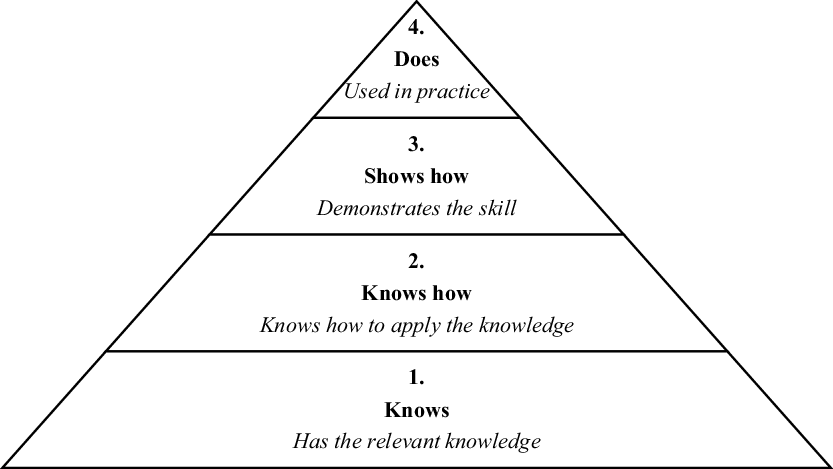
Miller (Reference Miller1990) has described a hierarchical framework for building and evaluating technical competence (Fig. 1). At the base of this hierarchy is ‘knows’ (supervisees’ conceptual knowledge), followed by ‘knows how’ (application of conceptual knowledge), then ‘shows how’ (e.g. technical performance), and lastly ‘does’ (e.g. clinical practice). It is at the level of ‘showing how’ that action-based supervisory methods are most readily applicable (Corrie and Lane, Reference Corrie and Lane2015).
Miller’s (Reference Miller1990) clinical skills hierarchy.

Supervisors assess technical competence by inviting supervisees to demonstrate, through role-play, how they would go about implementing routine interventions (supervisor: ‘Show me how you would explain the cognitive behavioural model to a client – I’ll play the client and you play the therapist’). Not only does this identify areas for skills development, but revisiting role-plays throughout supervision provides a measure of improvement in therapists’ technical competence over time (Beidas and Kendall, Reference Beidas and Kendall2010; Newman and Kaplan, Reference Newman and Kaplan2016; Padesky, Reference Padesky and Salkovskis1996).
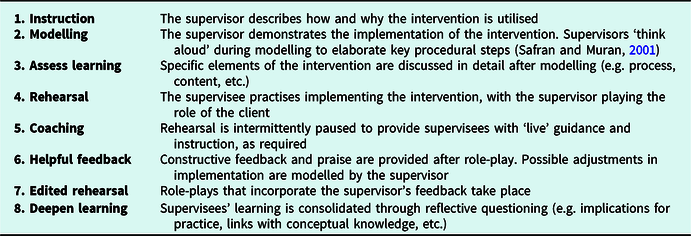
Which experiential methods support therapists to enhance their technical ability? Behavioural skills training is a well-researched learning framework that has been applied to the development of clinical skills (Table 2) (Pugh, Reference Pugh2019a). In summary, technical skills training (TST) involves several stages of experiential learning including supervisor modelling, discussion, supervisee rehearsals, coaching, corrective feedback and fine-tuning. Consistent with the collaborative ethos of CBT, TST is most effective when supervisees bring their own clinical scenarios to role-play (Taylor et al., Reference Taylor, Russ-Eft and Chan2005).
Technical skills training framework (‘I-MARCHED’) (Pugh, Reference Pugh2019a)

Technical competence alone does not guarantee therapeutic efficacy or consistency, however. For this reason, technical role-plays are used across supervisory meetings to ensure that interventions continue to be implemented proficiently and with fidelity (Pugh, Reference Pugh2019a). Repeated role-plays also retain and maintain technical skills. Given that some CBT interventions are used relatively infrequently in routine practice (e.g. attention retraining), they are at risk of decay. Furthermore, therapists working in specialist settings have limited opportunities to practise other model-specific competencies (e.g. Roth and Pilling, Reference Roth and Pilling2007a). Action methods such as role-play enable therapists to practise technical skills that might otherwise be neglected.
Perceptual competence
Interpersonal perceptual skills guide therapists’ attunement to clients’ moment-by-moment ‘process-in-state’ (Bennett-Levy and Thwaites, Reference Bennett-Levy, Thwaites, Gilbert and Leahy2007; Greenberg and Goldman, Reference Greenberg and Goldman1988). Research suggests that training programmes for enhancing perceptual competence (e.g. empathy training) are most effective when they incorporate active methods such as modelling, rehearsal and role-play (Teding van Berkhout and Malouff, Reference Teding van Berkhout and Malouff2016).
Empathic attunement enables therapists to understand the nature and experience of clients’ distress. Role reversal is an evidence-based psychodramatic method that has been described as the optimal method for building empathy (Kipper and Ritchie, Reference Kipper and Ritchie2003; Yaniv, Reference Yaniv2012). In the context of CBT supervision, role reversal involves the supervisee switching seats and ‘becoming’ the client. In doing so, the perspective of the other is fully experienced, generating empathic insights at both cognitive and affective levels. Supervisors facilitate role-reversal in two ways. First, the supervisee might be asked to adopt the client’s role during the re-enactment of therapeutic encounters (supervisor: ‘Let’s recreate what happened in your last session. You play your client and I will play you, repeating your behaviour as accurately as I can’). This method has the advantage of not only encouraging attunement, but also allowing supervisees to witness their behaviours from an external perspective. Alternatively, supervisees are asked to embody the client during imaginal interviews with the supervisor (supervisor: ‘Change chairs and speak as your client. [Supervisee switches seats]. Tell me about yourself. What brought you to therapy? What was your life like before then? How are you finding treatment? What is it like working with this therapist?’).
An equally important perceptual skill, mindfulness refers to the ability to attend to the clients’ and one’s own experience concurrently, establishing a ‘double consciousness’ of the therapeutic process (Bennett-Levy and Thwaites, Reference Bennett-Levy, Thwaites, Gilbert and Leahy2007; Katzow and Safran, Reference Katzow, Safran, Gilbert and Leahy2007). Awareness-orientated role-plays (Safran et al., Reference Safran, Muran, Stevens, Rothman, Falender and Shafranske2007) provide an opportunity to practise mindful awareness of therapy interactions. This procedure involves the re-enactment of key client–therapist events, with the supervisee playing both roles. Role-play is paused intermittently to allow supervisees to focus their attention inwards to clarify their own, and the client’s, unfolding cognitive-affective experience. In doing so, supervisees move from a position of ‘reflection-on-action’ (mindful attending after interactions with the client) and towards ‘reflection-in-action’ (mindful awareness during interactions) (Schön, Reference Schön1991).
Relational competence
While perceptual competencies constitute therapists’ receptive skills (e.g. attending to a client’s communicative ‘inputs’), relational competences represent therapists’ ‘outputs’ (e.g. communications back to the client). Empathic communication is a core relational skill that enables therapists to convey their understanding of the client’s cognitive, emotional and interpersonal experience (Beck et al., Reference Beck, Rush, Shaw and Emery1979; Safran and Segal, 1990). Accurately communicating empathy in CBT is a complex skill that incorporates attunement (e.g. attending to the client’s experience), conceptual knowledge (e.g. linking these understandings to the case conceptualisation) and technical skills (e.g. summarising information) (Thwaites and Bennett-Levy, Reference Thwaites and Bennett-Levy2007). Role reversal (adopting the client’s point of view during re-enactments), followed immediately by role-play (switching roles and conveying new insights back to the ‘client’) allows therapists to practise empathic communication. Role-plays initially focus on ‘simple’ empathic communications (e.g. word-for-word reflections) before practising more complex responses (e.g. depth reflections and explorations of clients’, ‘felt senses’) (Gendlin, Reference Gendlin2003; Truax and Carkhuff, Reference Truax and Carkhuff2017).
Difficult conversations are unavoidable in CBT (e.g. late attendance, between-session task non-compliance), as are sensitive topics of discussion (e.g. assessing substance use and sexual practices). Supervisor modelling followed by rehearsal builds supervisees’ confidence raising these issues with clients (see Table 2). Alternatively, contrasted role-plays (McNeilage and Adams, Reference McNeilage and Adams1979) allow supervisees to discover more idiosyncratic ways of navigating challenging discussions. This procedure involves the supervisee enacting the ‘extremes’ of communication in order to identify an effective ‘middle ground’. For example, a supervisee who feels uncomfortable discussing a client’s sexual difficulties might be asked to address this issue in three ways during role-play: first, a conversation about sex is initiated with a client (represented by an empty chair) in the most blunt and crass manner possible (chair 1), followed by a cautious manner (chair 2), before rehearsing a balanced approach combining empathy with sensitive matter-of-fact discussion (chair 3).
Repairing alliance ruptures (discord between client and therapist) requires considerable relational skills (Safran and Muran, Reference Safran and Muran2000) and has been associated with better therapy outcomes in CBT (e.g. Strauss et al., Reference Strauss, Hayes, Johnson, Newman, Brown, Barber and Beck2006). Bennett-Levy and Thwaites (Reference Bennett-Levy, Thwaites, Gilbert and Leahy2007) have described a staged model for exploring and resolving ruptures through role-play. First, the problematic interaction is recreated, with the supervisor enacting the therapist/supervisee and the supervisee enacting the client (‘awareness raising’) (supervisor: ‘Show me how this conflict unfolded. You play the client and I’ll play you’). Second, reflective questioning is used to clarify the supervisee’s cognitive-affective response after re-enactment (‘experiential processing’) (supervisor: ‘Let’s pause this role-play. Having experienced this conflict once again, what are your thoughts and feelings about the interaction now?’). Based upon these experiential insights, an interpersonal formulation of rupture is developed in stage 3 (‘reflective processing’) (supervisor: ‘Let’s stand. [Supervisor and supervisee stand up]. Looking at this interaction from a distance [gestures to the two chairs], what do you see unfolding between these individuals? What’s this conflict about?’). In the final stage, role-plays are used to rehearse productive responses in the event that similar ruptures occur again (‘procedural skills rehearsal’).
Quite understandably, novice therapists sometimes struggle to formulate effective responses when ruptures occur. In other cases, multiple routes to resolution present themselves. ‘Multi-modelling’ involves the supervisor demonstrating different approaches to repairing ruptures in different chairs. For example, in response to a client becoming withdrawn during a discussion (enacted by the supervisee in chair 1), the supervisor might demonstrate a variety of metacommunications (Muran et al., Reference Muran, Safran, Eubanks-Carter, Muran and Barber2010) including state observations (supervisor [chair 2]: ‘You seem distant right now’), interpersonal observations (supervisor [chair 3]: ‘I sense we are less connected’) or self-disclosure (supervisor [chair 4]: ‘I’m aware of feeling detached from you’). By experiencing these responses from the client’s perspective, supervisees are also able to evaluate their relative accuracy, utility and likely impact. Multi-modelling also provides opportunities for supervisors to model imperfection – supervisees are often reassured to see senior colleagues struggle with the clinical interactions they encounter (Safran et al., Reference Safran, Muran, Stevens, Rothman, Falender and Shafranske2007).
Reflective system
Reflective practice is emphasised in CBT supervision (Haarhoff and Thwaites, Reference Haarhoff and Thwaites2016). From an information-processing perspective, the reflective system has been described as a content-free, representational system that is activated by therapeutic ‘problems’ or when clinicians’ expectations do not match reality. Through a combination of focused attention, mental representations of the issue in question and sophisticated cognitive operations, the reflective system is capable of generating novel solutions to therapeutic issues, which are then conveyed to the declarative and procedural systems (Bennett-Levy and Thwaites, Reference Bennett-Levy, Thwaites, Gilbert and Leahy2007). Accordingly, the reflective system is central to the refinement of clinical skills, continued learning and the emergence of ‘expertise’ (Bennett-Levy et al., Reference Bennett-Levy, Thwaites, Chaddock, Davis, Dallos and Stedmon2009b). Reflection need not be as passive as the term would suggest either: action-based methods are often an effective means to facilitate reflective processing, work through impasses, and to generate ‘action insights’ into therapeutic difficulties (Blatner and Collins, Reference Blatner, Collins, Jones and Dokter2008; Kellerman, Reference Kellerman1992).
Resolving impasses
Impasses refer to deadlocks or plateaus in therapeutic progress (Hill et al., Reference Hill, Nutt-Williams, Heaton, Thompson and Rhodes1996). Left unchecked, these ‘stalemates’ risk premature termination of therapy or damage to the therapeutic alliance. Impasses often require creative solutions garnered through self-reflection, supervisory discussion and advice from professional peers (Pasko et al., Reference Pasko, Diveky, Grambal, Kamaradova, Mozny, Sigmundova, Slepecky and Vyskocilova2010). Thus, impasses call upon the more ‘experimental’ forms of chairwork. ‘Imaginal surveys’ (Pugh, Reference Pugh2019b) involve ‘seeking counsel’ from any variety of individuals who are enacted by the supervisee. This might include expert authorities, past mentors or one’s wiser ‘future self’ (supervisor: ‘Let’s get some advice on this block in therapy. If you could consult with three individuals – dead or alive, real or imagined – who would you chose?’). To ensure that the therapist is sufficiently ‘warmed-up’ to enact these individuals, the supervisor initially ‘interviews’ the supervisee in each persona (Blatner and Blatner, Reference Blatner and Blatner1991) (supervisor: ‘It’s a pleasure to meet you, Albert Ellis. Tell me about yourself. What skills and experiences do you bring to this issue? Why do you think this therapist choose to seek advice from you? What guidance can you offer?’). Supervisors will be reassured to know that this procedure is not as far-fetched as it sounds: research indicates that embodying Sigmund Freud in virtual reality has the power to improve mood and well-being (Osimo et al., Reference Osimo, Pizarro, Spanlang and Slater2015), while reasoning about one’s problems from a ‘distanced’ perspective generates wiser responses (Grossman and Kross, Reference Grossmann and Kross2014).
‘Egocentric-allocentric role-play’ (Pugh, Reference Pugh2019a) applies a similar combination of perspective-changing and reflection to resolve impasses. In summary, the supervisee is invited to explore the therapeutic block from three embodied vantage points: a self-immersed perspective (chair 1) (supervisor: ‘What is the difficulty you are experiencing in your work with this client? Why might it be arising? How might it be addressed?’), followed by the client’s perspective (chair 2) (supervisor: ‘Speaking as the client – what challenges are you experiencing in your work with this therapist? [Gestures to the supervisee’s previous chair]. Why is that occurring? How do you think it could be addressed?#) and finally, the decentred perspective of an objective observer (standing or chair 3) (supervisor: ‘Observing these individuals in their work together [gestures to chairs 1 and 2], what obstacles do you notice are arising? Why does that happen? How might they address this issue?’).
The ‘self’ system
DPR conceptualises the therapist’s sense of ‘self’ as a component of the procedural system that processes information in two ways: either in relation to therapists’ self-schemas (the ‘personal self’) or professional schemas (the ‘self-as-therapist’). We have chosen to categorise therapists’ self-system as a separate information-processing subsystem that incorporates elements of the declarative system (e.g. knowledge about one’s self-beliefs), the perceptual system (e.g. the ability to communicate self-referential knowledge), and the reflective system (e.g. ongoing awareness of how self-beliefs and communication influence one another). Because aspects of the therapist’s selfhood impact upon the therapeutic process, cognitive therapists must be ‘sensitive observers of their own thoughts, feelings, and beliefs’ (Beck and Freeman, Reference Beck and Freeman1990, p. 252). Historically, personal therapy has been recommended as the principal means to minimise the impact of therapist’s self on the practice and process of therapy (Macran and Shapiro, Reference Macran and Shapiro1998). However, this is not a formal requirement for most CBT training courses, nor is there evidence to suggest that personal therapy improves the provision of CBT (Bennett-Levy et al., Reference Bennett-Levy, McManus, Westling and Fennell2009a,b). As an alternative approach, action-based methods provide opportunities for personal development, self-supervision and greater self-awareness.
Treatment-interfering beliefs about therapy
Negative assumptions about therapy sometimes prevent supervisees from implementing core CBT processes and interventions (Haarhoff and Kazantzis, Reference Haarhoff and Kazantzis2007). Common examples might include the belief that clients will experience agenda-setting as stifling, cognitive interventions as mechanical, and structured interview methods as insensitive. Role-play provides an opportunity to ‘test out’ these evaluations through experimentation and build confidence in the cognitive approach (Padesky, Reference Padesky and Salkovskis1996). To illustrate, a training CBT therapist disclosed the belief that soliciting feedback at the conclusion of therapy sessions would appear ‘false’. To test this belief, the supervisor demonstrated how they would usually elicit feedback from a client (role-played by the supervisee). The supervisee subsequently concluded that seeking feedback could be a validating experience.
Treatment-interfering beliefs about the self
Most therapists doubt their competence at times. Unfortunately, negative self-referential thoughts (e.g. self-criticism and catastrophic thinking) compromises supervisees’ capacity to learn, make decisions, and deliver therapy effectively (Friedberg et al., Reference Friedberg, Gorman and Beidel2009). Action-based procedures for addressing maladaptive thoughts and feelings have been described elsewhere (Pugh, Reference Pugh2018, Reference Pugh2019a, Reference Pugh2019b) and are readily applicable to supervision. Three methods are worth highlighting. Supervisees who tend to ignore or explain away their successes (the cognitive distortions of ‘discounting’ and ‘minimistation’) are often heartened by ‘appreciation dialogues’ (Dayton, Reference Dayton1994; Pugh, Reference Pugh2019b). This strengths-focused procedure involves the supervisee speaking from the perspective of a client who has valued their input. The supervisor then proceeds to ‘interview’ the client with regard to the supervisee’s strengths, talents and abilities (supervisor, speaking to the ‘client’: ‘How did this therapist help you? [Gestures to the supervisee’s empty seat]. What did you value most about their support? What does this therapist do well? Knowing that this individual sometimes doubts their ability, what would you like them to know and understand?’).
In other situations, supervisees might expect supervisors to respond to errors or misjudgements with criticism or humiliation (i.e. ‘mind-reading’). Assuming (and hoping!) this is not the supervisor’s modus operandi, the supervisee is asked enact this ‘rejecting supervisor’ in a second chair (supervisor: ‘Come and sit beside me. [Supervisee changes seats]. Show me how you feared I might respond to your disclosure. [Gestures to the supervisee’s empty chair]. What’s the worst thing I might have said? Say it as if you were me’). Having enacted this catastrophic response, the supervisee then explores the discrepancy between fantasy and reality (supervisor: ‘Turn your attention to me. [Supervisee shifts in their seat]. Is this your experience of me, either now or in the past? If not, where are these self-judgements coming from?’). In this way, chairwork helps supervisees ‘take back their projections’ (Perls, Reference Perls1975). The dialogue ends with the supervisee returning to their original chair and counter-responding to their negative automatic thoughts (supervisor: ‘Now, let’s practise responding to these NATs. In what ways are they untrue and unhelpful? Say that to your critical side. [Gestures to the empty chair hold the ‘rejecting supervisor’])’.
Finally, supervisees who feel anxious implementing new or complex interventions are invited to role-play doing so ‘as if’ they had complete confidence. ‘Faking it until you make it’ within a safe supervisory context can be a surprisingly effective way to install self-confidence prior to direct work with clients.
Countertransference
Countertransference refers to therapists’ cognitive-affective reactions to the client, the therapeutic situation, or both (Holmes, Reference Holmes1993). Negative reactions to clients are not uncommon in CBT (or other psychotherapies) and tend to arise from clinicians’ past experiences, interpersonal schemas, or appraisals of therapeutic events (Leahy, Reference Leahy, Gilbert and Leahy2007; Moorey, Reference Moorey, Whittington and Grey2014). Research indicates that negative countertransference is detrimental to the delivery of CBT (Safran and Segal, 1990; Westra et al., Reference Westra, Aviram, Connors, Kertes and Ahmed2012) and that ‘working through’ these reactions is related to better therapy outcomes (Hayes et al., Reference Hayes, Gelso and Hummel2011). Accordingly, supervision plays an important role in conceptualising countertransference, addressing negative thoughts and feelings, and moving supervisees from a position of frustration to compassion (Milne and Reiser, Reference Milne and Reiser2017; Wolf et al., Reference Wolf, Goldfried and Muran2013).
Cognitive behavioural approaches to managing countertransference have emphasised the roles of formulation, self-reflection/insight, mindful acceptance, and the application of cognitive therapy techniques to oneself (e.g. cognitive restructuring) (Ellis et al., Reference Ellis, Schwartz and Rufino2018; Hardy et al., Reference Hardy, Cahill, Barkham, Gilbert and Leahy2009; Leahy, Reference Leahy, Gilbert and Leahy2007; Moorey and Lavender, Reference Moorey, Lavender, Moorey and Lavender2019; Padesky, Reference Padesky and Salkovskis1996; Pasko et al., Reference Pasko, Diveky, Grambal, Kamaradova, Mozny, Sigmundova, Slepecky and Vyskocilova2010). Much less attention has been paid to utility of action-based methods in overcoming negative reactions to the client (Pugh, Reference Pugh2019a). Enactive approaches to countertransference are advantageous in several ways (Blatner and Collins, Reference Blatner, Collins, Jones and Dokter2008; Chesner, Reference Chesner and Tselikas-Portmann1999; Pugh, Reference Pugh2019b). These include clarifying supervisees’ negative cognitive-affective reactions, concretising internal experiences that are otherwise unsaid or unknown, avoiding psychological ‘defences’ such as avoidance and intellectualisation, and helping therapists to ‘feel’ the client’s experience of the transference.
Awareness of countertransference is needed before such issues can be resolved. Unfortunately, clinicians are sometimes unaware of the automatic thoughts and feelings that arise in therapeutic situations (Bennett-Levy and Thwaites, 2017). Noted previously, awareness-orientated role-plays help clarify supervisees’ countertransference through the recreation of within-session events (Safran et al., Reference Safran, Muran, Stevens, Rothman, Falender and Shafranske2007). Witnessing these reconstructions will also inform the supervisor’s understanding and ‘felt sense’ of countertransference processes (Chesner, Reference Chesner and Tselikas-Portmann1999).
The ‘voice dialogue’ method (Stone and Stone, Reference Stone and Stone1989) provides a useful tool for exploring countertransference. This involves the supervisee switching seats and ‘speaking as’ the voice of their countertransference. Here, the role of the supervisor is to simply ‘get to know’ this aspect of the supervisee’s experience (supervisor: ‘Change seats and speak as the part of you that feels bored with this client. [Supervisee changes seats]. Nice to meet you, “Bored Side”. Tell me about yourself. How do you feel about working with this client? What is it about them that bores you? Do you ever show up in other areas of this therapist’s life?’). The supervisee then returns to their original chair and reflects on what has been conveyed from a more decentred perspective (supervisor: ‘Come back to your original chair and, as you do that, allow “Bored Side” to remain in the empty seat. [Supervisee switches seats]. Take a moment to notice how you can now experience “Bored Side” from more of a distance now. [Gestures to the empty chair representing boredom]’).
Ventilation is a deceptively simple but highly evocative method for working through negative countertransference. This procedure involves the supervisee (chair 1) openly expressing their emotional reactions to the client as if this they were present (chair 2) (supervisor: ‘Imagine your client were here with us. [Gestures to the empty chair]. Tell them how you feel about your work together’)Footnote 1. To encourage complete disclosure, supervisees are prompted to voice the full spectrum of their emotional reactions including anger, anxiety, boredom, envy, and so on (Perls, Reference Perls1975). Once these emotions have been expressed, the supervisee switches seats again (chair 3) and shares any positive emotional responses or ‘appreciations’ for the client; these are often surprisingly forthcoming once the supervisee’s negative feelings have been shared (supervisior: ‘From this chair, tell your client what you value, respect, or appreciate about them’). In this way, ventilation helps supervisees to ‘leave negative feelings in supervision’ and connect with their more affiliative reactions to the client. However, supervisors must be clear that this procedure is not a rehearsal for actual encounters with the client.
A final approach to resolving countertransference involves the supervisee describing their experience of the client from the perspective of relevant ‘emotional selves’, which are held in different chairs (i.e. Angry Self, Anxious Self, and Sad Self) (Gilbert, Reference Gilbert2009). Here, the supervisor works to ensure that the cognitive, affective and behavioural dimensions of each self are fully experienced and expressed (supervisor: ‘Speaking as Angry Self, where in your body does this part show up when you engage with this client? [Gestures to the client’s empty chair]. What thoughts go with Angry Self? If Angry Self were in complete control, what would it do?’). Emotional selves dialogues are concluded in two ways. First, the supervisee might practise relating to selves from a decentred, meta-observational point-of-view (supervisor: ‘Let’s stand. [Supervisor and supervisee stand up]. Which selves are strongest during your sessions? [Gestures to the empty chairs]. Which is hardest to acknowledge? Do they point towards any potential solutions?’) Alternatively, supervisees can practise managing their emotional selves from the embodied perspective of their ‘Compassionate Internal Supervisor’ (CIS) (Bell et al., Reference Bell, Dixon and Kolts2017): Bell (Reference Bell2015) has provided a useful imagery-based guide for constructing a CIS which is readily incorporated into chairwork.
Maintaining the supervisory alliance
Before concluding this section, we must acknowledge the importance of the ‘supervisory alliance’ when using action-based methods. After all, it is this crucial bond between supervisor and supervisee that enables risk-taking and disclosure in supervision (Bernard and Goodyear, Reference Bernard and Goodyear2014; Beinart, Reference Beinart, Fleming and Steen2004). Enactive procedures can be powerful and anxiety-provoking for both the supervisor and the supervisee. This risks undermining the supervisory alliance, as well as interfering with supervisees’ confidence, motivation and information processing (Lombardo et al., Reference Lombardo, Milne and Proctor2009). This is not to say that protecting the alliance justifies avoidance of action-based methods: a degree of anxiety encourages learning, while sedate supervision might indicate that supervisors are not being challenging enough (Corrie and Lane, Reference Corrie and Lane2015; Milne, Reference Milne2008). Nonetheless, a robust supervisory alliance remains important. In order to protect this bond, supervisors should hold the following points in mind when using action-based methods, thereby respecting the strength of such techniques:
Transparency: the rationale for utilising active procedures should be presented at the outset of supervision and included in the supervision contract and/or learning agreement (Milne and Resier, Reference Milne and Reiser2017).
Collaboration: action-based methods are introduced into supervision collaboratively. This includes respecting supervisees’ preferred learning styles and acknowledging that experiential interventions are more useful at particular times, and with particular cases, than others.
Validation and normalisation: supervisors acknowledge that action-based methods are sometimes challenging and potentially exposing. This is particularly relevant when working with countertransference. Supervisors should be supportive if this is the supervisee’s experience of chairwork or role-play.
Attentiveness: supervisors must attend to supervisees’ individual capacities for affective tolerance. This is important when facilitating action-based methods that are often evocative and emotionally demanding.
Imperfection: imperfect performance by supervisors, particularly in the context of modelling therapeutic procedures, are a valuable opportunity to demonstrate that supervision is a risk-free and ‘safe to fail’ environment (Corrie and Lane, Reference Corrie and Lane2015).
Feedback: positive feedback maximises supervisees’ confidence and learning through action-based methods (Daniels and Larson, Reference Daniels and Larson2001). Equally, supervisors should encourage feedback on the quality of their demonstrations, facilitations, and enactments (supervisor: ‘What worked? What didn’t? What could be done differently next time?’).
Discussion
Just as CBT should be an ‘action-packed’ experience for clients (Padesky, Reference Padesky2019), CBT supervision should be an action-based process for supervisees. Active supervisory methods have a strong theoretical basis and a growing evidence base. Despite these merits, other research suggests that experiential procedures are used infrequently, suggesting that many CBT supervisors are ‘drifting’ from recommended practice. To address this issue, the present article has outlined some of the creative ways in which experiential procedures are applied to the development of cognitive therapists’ technical, perceptual, reflective and self-competencies.
As mentioned, therapist drift has been identified as an important factor in the delivery of ineffective talking therapies (Waller, Reference Waller2009; Waller and Turner, Reference Waller and Turner2016). This is likely to be partly related to supervisory drift: that is, the failure to provide the supervision that individuals have been trained to deliver, or a failure to deliver supervision competently. Preliminary research indicates that supervisory drift is not uncommon in CBT (Parker and Waller, Reference Parker and Waller2019; Townend et al., Reference Townend, Iannetta and Freeston2002). This is understandable given that many supervisors have received little or no supervisory training, while the numbers of clinicians attending CBT-specific supervisory training or supervisory supervision are likely to be even lower. As a result, there is a real risk that the quality of guidance CBT therapists receive is less than optimal, potentially limiting the quality of treatments they provide. Fortunately, evidence-based guidelines for supervision have been presented (Milne and Reiser, Reference Milne and Reiser2017), alongside the development of core supervisory competencies (Roth and Pilling, Reference Roth and Pilling2007b). This has gone some way towards improving current practice – when clinicians are motivated to use such guidance. Fully addressing supervisory drift is likely to require a number of additional strategies including greater access to specialist training, routine supervision-of-supervision, and use of competency ratings. Services must also ensure that supervisors have access to these resources to support evidence-based practice. Further studies are now needed to establish the extent of supervisory drift in CBT, how this impacts clinical practice, and which interpersonal, intrapersonal and systemic factors contribute.
Existing research indicates that didactic instruction and reflective discussion are necessary, but not sufficient, to produce sustained improvements in therapist behaviour (Rakovshik and McManus, Reference Rakovshik and McManus2010). Other supervisory methods are also needed. This paper has focused on the importance and application of action-based procedures in CBT supervision. While the effectiveness of role-playing methods such as behavioural rehearsal is fairly established, fewer studies have examined the impact of behavioural experimentation and chairwork (e.g. role-reversal and ventilation). Studies are needed to ratify the utility and efficacy of these procedures. Other important questions include the following:
What makes action-based procedures effective? For example, does the strength of technical skills training lie in the observation of more experienced clinicians, direct enactment, or individualised feedback?
What threshold of active learning is required to optimise learning and skill development? For example, what is the ideal frequency and length of role-play?
Can supervision be improved by taking into account supervisees’ preferred learning styles? Which methods work, for whom, and under what circumstances?
Do contextual factors influence the effectiveness of action-based methods? For example, are experiential interventions more effective in individual or group supervision formats?
We hope that supervisors will find this paper useful and encouraging in terms of making use of action methods. However, supervisors should also hold in mind that experiential methods are remarkably potent. Blatner (Reference Blatner1996) has likened these evocative procedures to an electric saw: a powerful tool that necessitates considered application. Given that any form of feedback can impact positively or negatively (e.g. Hattie and Timperley, Reference Hattie and Timperley2007), we recommend that supervisors apply these methods with care and discretion, particularly when working with emotive issues such as countertransference. In the interests of collaboration, mutual respect and sensitivity to supervisees’ learning needs, enactive methods should be framed as invitations, rather than directives. Timing is equally important: chairwork and role-play cannot be rushed, and sufficient time should be set aside for thorough debriefing after enactments. Finally, supervisors are always encouraged to undertake appropriate training and supervision in order to use these methods safely and skilfully. In the words of advice given to Spider Man, ‘…with great power there must also come – great responsibility’ (Lee, Reference Lee1962, p.12).
Regarding future directions for practice, there is a clear need for more (action-based) training in the application of enactive methods (Pugh, Reference Pugh2019a). Without this, it seems likely that supervisors and supervisees will continue to ‘tell’ rather than ‘show’ in supervision. Indeed, concerted efforts are needed to encourage supervisors and supervisees out of their chairs and their comfort zones.
Acknowledgements
None.
Conflicts of interest
The first author of this paper receives royalties from a related textbook.
Financial support
None.
Ethical statement
The authors abide by the Ethical Principles of Psychologists and Code of Conduct as set out by the APA. Ethical approval was not needed for this paper.
Key practice points
(1) For several reasons, CBT supervision often drifts from being a ‘doing’ process, potentially limiting opportunities for supervisees’ development.
(2) Consistent with cognitive and learning theories, research indicates that action-based supervisory methods positively influence clinical practice.
(3) Action-based methods can be flexibly and creatively applied to many aspects of supervision, including fine-tuning supervisees’ technical competency, enhancing interpersonal skills, and facilitative reflective practice.
(4) Research is needed to establish the extent of supervisory drift, its impact on clinical practice, and ways to ensure it is minimised.




Comments
No Comments have been published for this article.