Acore tenet of democracy is that authority cannot be justified based on tradition or a coercive apparatus. Democratic governments need to present their power, at least generally, as serving the public interest. Governments that fail to do so often struggle to maintain social cooperation and stability (Dalton Reference Dalton2007).
Public support is particularly important for the judiciary. Without the institutional capabilities that the other branches enjoy, the judiciary relies on public support to protect its independence and force government officials to respect court decisions (Staton Reference Staton2010). A lack of confidence in the judiciary may also translate into disregard for the law (Tyler Reference Tyler2006) and may discourage the victims of abuses of power from taking their grievances to the system (Brinks Reference Brinks2008)—further weakening the rule of law and effectively disenfranchising victims.
How, then, do courts gain the public’s confidence? Extant research, mostly focusing on the U.S. judiciary, suggests two opposing views. Some scholars argue that support for the judiciary is determined by the integrity of its procedures (Gibson et al. Reference Gibson, Pereira and Ziegler2017). In this view, the public trusts courts that remain politically unbiased and adhere to the rule of law. But others argue that support for the judiciary depends on whether the public agrees or disagrees with the content of the rulings (Bartels and Johnston Reference Bartels and Johnston2013). This second view suggests that the public is willing to sacrifice some procedural integrity if it translates into more satisfying outcomes.
This study assesses these two competing hypotheses in the context of Bolivia. It shows that both arguments have limitations, but that the arguments can ultimately be strengthened and reconciled. It finds that the process through which individuals ascribe institutional support varies according to the degree of economic and political marginalization they face. While procedural integrity is valued by those who face low levels of exclusion, marginalized individuals favor ideological congruence.
Procedural integrity provides clear benefits to those who are protected and empowered by the existing judicial framework. However, for those who are disad-vantaged by it, procedural integrity limits their capacity to ameliorate the detrimental effects of the judicial system through political action. Indeed, dissatisfied publics in Latin America and elsewhere have often supported judicial reforms that sacrifice established norms and institutional efficacy in favor of lay participation and additional public control (Fukurai and Krooth Reference Fukurai and Krooth2010; Walker Reference Walker2017). Ideologically proximate courts can similarly help align judicial outcomes with public preferences. Those who feel disadvantaged by the legal framework may be quicker to trust courts that produce favorable outcomes than those that enforce established but unfavorable norms and procedures.
The prevalence of different pathways to judicial confidence should be particularly evident in countries like Bolivia, where a newly reformed judiciary grapples with a long history of bias and deep social inequalities. Persistent debates in Bolivia about alternative principles of justice have called into question the fairness and inclusiveness of the judicial framework. Likewise, polarization around recent fundamental political decisions, such as constitutional amendments to presidential re-election rules, has made the actions of the judiciary especially salient and contentious. Bolivia’s case allows for the examination of the early evolution of institutional support as a deeply political phenomenon, as opposed to cases in which the overall confidence in the institution has already been established. Thus, this study contributes to recent efforts to identify the various sources of institutional support in young political regimes (Carlin Reference Carlin2017; Carlin and Singer Reference Carlin and Singer2011). It shows that inequalities in the economic and political structure cause people to trust institutions for contrasting reasons.
Two Competing Hypotheses of Judicial Confidence
As is often the case in developing countries, the history of Bolivia’s judiciary has been marked by corruption and inefficiency. In 2007, the Inter-American Commission on Human Rights saw “influence peddling as the only way to obtain a decision” (IACHR 2007, 15). Transparency International later reported that the judiciary was perceived as one of the most corrupt institutions in the country (Wickberg Reference Wickberg2012). Many observers saw the pervasive lack of trust in the judiciary as the main obstacle in consolidating the rule of law (Amnesty International 2010). How can institutions like Bolivia’s judiciary repair their reputations and start to gain the public’s confidence?
The democratization literature has emphasized two distinct answers to this question (Schedler Reference Schedler1997). The first one revolves around instrumental considerations. It argues that people will support institutions conducive to their own self-interest (Przeworski Reference Przeworski and Elster1988). For example, Lake argues that institutional support arises when the existing relations of authority add unique value to the assets owned by self-interested individuals (Lake Reference Lake, Hoddie and Hartzell2010, 38). In this view, institutions must accommodate the interests of relevant political forces to gain their support. Other scholars disagree, and instead put normative considerations front and center (Linz and Stepan Reference Linz and Stepan1996). They argue that support based on self-interest is necessarily fleeting and does not allow institutions to survive sustained underperformance (Mainwaring Reference Mainwaring, Mainwaring and Valenzuela1992). In their interpretation, durable institutional support is achieved only when there is a generalized appreciation for the principles and norms that institutions materialize (Diamond Reference Diamond1994; Lindberg Reference Lindberg2006).
These two competing schools of thought suggest different pathways to judicial confidence. The instrumental view argues that trust in the judiciary is tied to the institution’s ability to represent the preferences of citizens. Some scholars have, in fact, found that support for the judiciary is a function of ideological proximity between the citizenry and the court (Bartels and Johnston Reference Bartels and Johnston2012; Christenson and Glick Reference Christenson and Glick2015). This view does not mean that individuals must actively track the decisions of the court and update their previous beliefs accordingly. People can simply learn the court’s ideological leanings through partisan cues and use these heuristics to infer future judicial behavior. Then, according to the instrumental support hypothesis, people will trust ideologically proximate courts because they are more likely to produce favorable outcomes (Bühlmann and Kunz Reference Bühlmann and Kunz2011).
Normative support scholars instead emphasize the role of judicial independence. They suggest that judicial confidence hinges on the procedural integrity of the judiciary (Caldeira and Gibson Reference Caldeira and Gibson1992). The specific content of judicial decisions is seen as less important than the process through which they are made. Procedures that ensure equality and fairness generate more confidence in the institution than favorable decisions. Thus, independent courts—those that can resist the influence of dominant political actors seeking to undermine judicial procedures—are expected to be particularly valued. Put differently, because judicial independence presumably makes the judiciary more aligned with the principles of equality and fairness, higher levels of independence should also be associated with higher levels of confidence in the institution (Salzman and Ramsey Reference Salzman and Ramsey2013).
Judicial Independence and Marginalization
Most previous scholarly work has treated judicial independence as the bedrock of judicial confidence (Caldeira and Gibson Reference Caldeira and Gibson1992; Gibson and Nelson Reference Gibson and Nelson2015; but see Helmke and Rosenbluth Reference Helmke and Rosenbluth2009; Hilbink Reference Hilbink, Bellin and Lane2016). This line of research suggests that judiciaries gain the public’s trust by protecting the existing social order from undue influence. However, in contexts where the social order is routinely called into question, adherence to the broader legal framework does not necessarily carry intrinsic value. The process through which courts build trust may differ from the process through which they maintain it. Procedural integrity might be an effective way to do the latter, but only after an inclusive social order has been established. In countries like Bolivia, where the overall legitimacy of the political framework is not well established, procedural integrity may provide no tangible benefit to those who feel marginalized by the status quo.
Judiciaries that systematically produce dissatisfying outcomes are unlikely to enjoy public trust regardless of whether they reach their decisions by adhering to established norms and procedures. Even for individuals who value the principle of procedural integrity, the payoff of observing it is likely to be a constant. In contrast, dissatisfaction with the regime’s performance does not have a set upper boundary: institutions can almost always do worse. Chronic underperformance may outweigh the benefits of meeting the normative standard of judicial independence. For example, despite rising democratic values across the region, government underperformance in Latin America has often opened the door to political projects that seem to undermine democratic liberalism (Carlin et al. Reference Carlin, Singer and Zechmeister2015; McCann Reference McCann, Domínguez, Greene, Lawson and Moreno2015). This suggests that institutions do need to provide some baseline instrumental value to be recognized as legitimate channels for solving political conflict. Systematic exclusion may push normative considerations to the back seat.
While the marginalized may have a normative preference for procedural integrity, systematic exclusion may encourage them to prioritize institutions that facilitate inclusion. Judicial independence plays an indeterminate role in this regard. Independent courts, for example, have protected and empowered disadvantaged groups in Costa Rica and Colombia (Wilson Reference Wilson2007). The Colombian Constitutional Court has been instrumental in enforcing the social and collective rights of women, LGBT groups, and people displaced by the armed conflict (Rodríguez-Garavito Reference Rodríguez-Garavito2010; Cepeda Espinosa Reference Espinosa, José, Sieder, Schjolden and Angell2005). However, independent courts do not always enhance the position of marginalized groups. In Chile, independent but conservative courts have made labor and civil law reform difficult (Hilbink Reference Hilbink, Ginsburg and Moustafa2008; Couso Reference Couso2003). Similarly, the strategic and ideological considerations of the Brazilian Constitutional Court have weakened judicial commitment to second- and third-generation rights (Brinks Reference Bühlmann and Kunz2011; Arantes Reference Arantes, Sieder, Schjolden and Angell2005; Kapiszewski Reference Kapiszewski2011). Judicial independence creates opportunities for the marginalized, but it carries no guarantees. Independence is better understood as a neutral characteristic that, depending on factors like judicial culture, can help or hinder inclusion (Epp Reference Epp1998).
Marginalized groups may discount the value of judicial independence because it implies uncertain outcomes when inclusion is greatly needed. In contrast, ideological proximity is a stronger signal of the court’s tendency to provide favorable decisions. People can perceive like-minded judges as potential protectors of their interests. In a context of low independence, judges may not have personal commitments to minority advancement but may be nonetheless responsive to external political forces that do. Thus, favoring independence would imply renouncing an opportunity to use political coordination to ameliorate the consequences of a disadvantageous formal framework. This is not to say that marginalized groups will reward dependent courts, but simply that they may reward ideological alignment, even if it comes at the cost of a loss of procedural integrity. In general, I expect the utility of observing a normative standard like judicial independence to decrease as marginalization increases.
In contrast, the utility of an ideologically proximate court should decrease as marginalization decreases. Groups that enjoy the benefits of inclusion can more easily afford the costs of a judiciary that acts against their interests. They also have alternative means to influence the political system when their interests are threatened. Inclusion makes an ideologically distant court less threatening. Admittedly, influential groups are unlikely to view ideologically proximate courts unfavorably. Nevertheless, I expect them to reward sympathetic courts less heavily than the marginalized. Unlike those facing exclusion, included groups can substitute the service provided by a responsive court with, for example, a more responsive legislature. The value of ideologically proximate courts diminishes among included groups because they do not provide a unique, nonsubstitutable good. In turn, this implies that advantaged groups should prioritize the normative payoff provided by judicial independence over the smaller instrumental benefits of an ideologically aligned court.
Case Selection: Bolivia and the Judicial Elections of 2011
In 2011, Bolivia became the first country to open its highest organ of judicial power—the Tribunal Supremo de Justicia (TSJ)—to popular elections (see Driscoll and Nelson Reference Driscoll and Nelson2012 for details). The reform was framed as an attempt to “democratize justice.” Its stated goal was to make the TSJ better reflect the diversity of Bolivian society and to combat the overbearing influence of traditionally dominant social sectors. During the electoral process, each department elected one judge to serve on the TSJ, selecting them from a pool of candidates previously approved by Congress.
The adoption of judicial elections quickly became contentious. Although the initial intention was to keep the campaigns depoliticized and minimize partisan influence, political parties soon mobilized their machinery to steer public opinion in favor of specific candidates. The newly constituted judiciary continued to attract attention after the elections. The opposition repeatedly questioned the independence of the institution, while the governing MAS actively disaccredited some judges and promoted others. The contentious nature of the judicial reform brought significant amounts of public attention to the judiciary.
The high profile of the judicial reform facilitates an examination of how people confer trust on the institution. The instrumental support hypothesis relies on the assumption that the public is somewhat familiar with the ideological distribution of the court. The elections, as well as the sustained political role the court has maintained since then, make this assumption particularly tenable in Bolivia. The efforts of political parties to position judges on the ideological spectrum informed voters about the overall distance between themselves and the elected candidates.
It is important to consider that Bolivia operates under a civil law system. Codified laws and a lack of constitutional review would, in principle, make the TSJ’s ideological profile less relevant than that of, say, the U.S. Supreme Court. Nevertheless, the TSJ has shown enough discretion to allow the ideological tendencies of its judges to shape issues affecting the broader population, particularly regarding ethnic and gender inclusion (Montaño Reference Montaño2016). Members of the TSJ have also played a significant role in the regulation of media outlets and the prosecution of government officials accused of abusing power (Sotomayor Reference Sotomayor2016). The electoral connection established by the judicial reform and the possibility of being re-elected to a position in the judiciary have pushed judges to maintain contact with constituents in their respective departments (Palabra del Beni 2014; Página Siete 2017). These factors have all helped familiarize the public with the TSJ’s ideological configuration.
The Bolivian case is also useful for testing the normative support hypothesis. In a context of low information about the judiciary, it is possible that failure to reward independence would simply reflect a lack of awareness about its value or pervasiveness instead of a true hierarchy of preferences. The attention that civil groups and the opposition brought to the issue of judicial independence during the elections helps address this concern. Broad sectors of the Bolivian public were exposed to the idea of judicial independence and its value for ensuring procedural integrity. Thus, I can be more confident that the analyses below capture, at least to a significant degree, the relative weight Bolivians put on procedural integrity compared to other, perhaps more instrumental considerations.
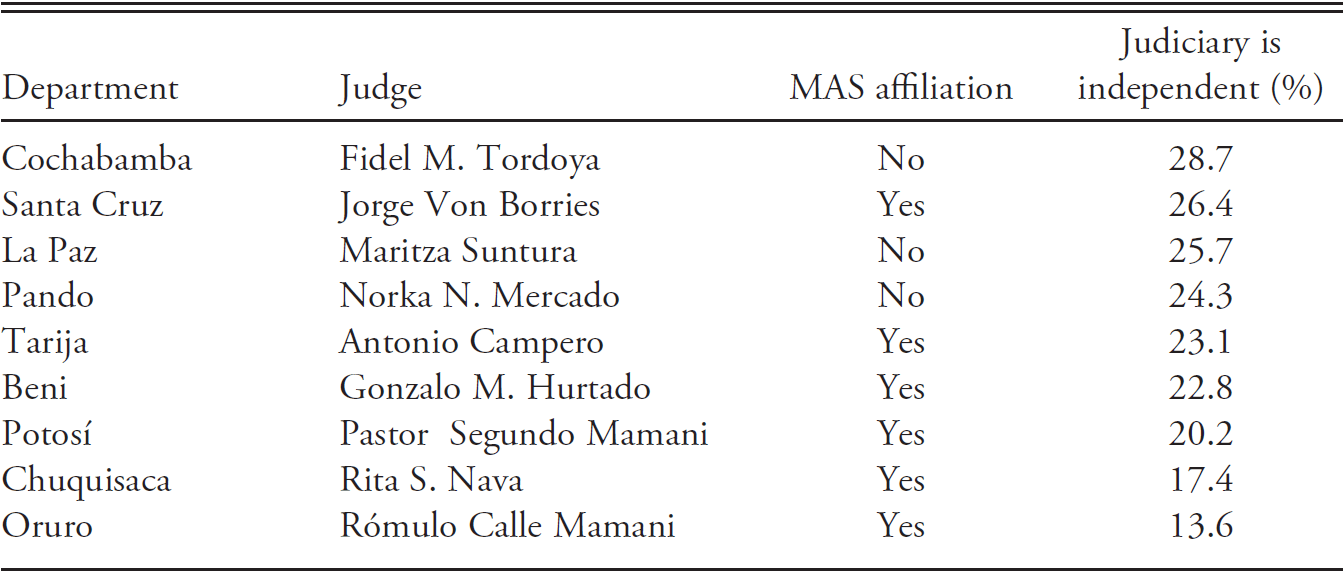
Relatedly, the Bolivian public has received mixed signals regarding the TSJ’s actual degree of independence. While there was a strong sentiment among the opposition that the reform would subordinate the judiciary to President Evo Morales, four of the nine elected candidates had no previous ties to the MAS. The TSJ also showed clear independence in its internal processes for selecting the president of the court by deciding against the explicit desire of the MAS and by opposing some of Morales’s programs (Zolá Reference Zolá2014, Reference Zolá2015). This translated into a divided public opinion. LAPOP data show that a quarter of the electorate disagrees with the idea that the judiciary lacks independence. This variation allows me to examine how perceived independence affects judicial confidence.
I argue that marginalization moderates the importance of normative considerations while bringing instrumental ones to the fore. As one of the more unequal and politically polarized countries in the region, Bolivia offers a good opportunity to examine how the processes through which individuals confer support vary at different ends of the marginalization scale. If instrumental considerations become dominant only below a certain threshold of inclusion, then it is important to pay attention to cases in which widespread systematic exclusion is at play. Additionally, marginalization in Bolivia does not neatly map to socioeconomic status. Well-off groups have been pushed from the political arena as the dominant MAS has strengthened its position. The Bolivian context allows me to differentiate marginalization from socioeconomic status and to treat political and economic exclusion as repeated but independent tests of the same concept. This helps identify marginalization, and not just one of its manifestations, as the key conditioning variable.
Data and Hypotheses
The empirical focus of this study is a subnational analysis of judicial support in Bolivia. The research utilized survey data from LAPOP’s 2014 wave. In that year, LAPOP implemented several questions specific to Bolivia to explore the consequences of the 2011 judicial reform, but so far, these questions remain largely unexplored. The survey was designed to be representative of each of the departments, and thus provides the data needed for the following analyses.
Dependent Variable
The dependent variable is a survey item that asked respondents to indicate how much confidence they had in the TSJ, on a seven-point scale. This approach has been used extensively in previous work (Bühlmann and Kunz Reference Bühlmann and Kunz2011). As mentioned, judicial confidence is an integral part of maintaining the rule of law. People who trust the judiciary are more likely to take their grievances to the system (Brinks Reference Brinks2008) and to avoid seeking resolution through alternative means (Tyler Reference Tyler2003), and they may protect the judiciary from encroachment by other state powers (Staton Reference Staton2010). Moreover, questions worded around the concept of confidence have been shown to capture both normative and strategic considerations (Gibson et al. Reference Gibson, Caldeira and Spence2003). Thus, a focus on confidence is a useful way to compare the extent to which people confer support based on normative or instrumental considerations.
Independent Variables: Ideological Distance
The instrumental support hypothesis suggests that judicial confidence is conditional on the expected content of the court’s decisions. It argues that trust in the judiciary will decrease as the ideological gap between the court and the public increases. In particular, the instrumental support hypothesis predicts that support for the TSJ will decrease as ideological distance increases.
I operationalize ideological distance as the root of the squared difference between the ideology of the judge of department d and the ideology of respondent k, also of department d. The ideology of k is obtained from the LAPOP item asking respondents to place themselves on a ten-point ideological continuum. Obtaining the ideology of each of the nine judges is less straightforward. To estimate it, I utilize a Bayesian item-response theory (IRT) approach, which has been used in the study of judicial politics to measure latent dimensions, such as judicial independence (Linzer and Staton Reference Linzer and Staton2015), judicial training (Driscoll and Nelson Reference Driscoll and Nelson2015), and the ideology of U.S. judges (Martin and Quinn Reference Martin and Quinn2002).
The appendix provides further details about the theory and estimation procedure behind the IRT model employed here. Similar to factor analysis, IRT models utilize categorical indicators (e.g., judicial votes) to estimate underlying dimensions (e.g., judges’ ideology). While these latent traits are not observable, one can make inferences about them by examining the likelihood of answering an indicator (i.e, voting) one way or the other. Thus, to fit the model, I first compiled all nonunanimous decisions made by the TSJ. To maximize information and precision, the analysis covered the period from January 2012 to February 2014. (Further details about the data collection procedure can be found in the appendix.) This strategy resulted in 87 nonunanimous votes that were analyzed through the Bayesian IRT model. Qualitative information was used to set the necessary informative Bayesian priors to address the underspeciation issue with IRT models (Jackman Reference Jackman2009). In particular, I used the three internal elections that the TSJ has had, as well as journalistic accounts of the judges’ affiliation to the MAS, to identify the likely ideological distribution of the court (Pásara Reference Pásara2014).
To compute the final ideological distance measure, I rescaled the IRT ideology scores to correspond with the range of the LAPOP self-report measure. The resulting variable ranges from 0 to 9, with a mean of 3.1 and a standard deviation of 2.2. Since the IRT scores are estimated separately from the self-reported ideology measure, it is important to emphasize what different levels of ideological distance mean. An ideological distance of zero does not mean that judge j holds the same ideological position as respondent k. Instead, it means that respondent k would have higher levels of disagreement with any other judge in the TSJ. While this is not ideal, it still serves the research question equally well, since it is concerned with the relative and not absolute levels of ideological disagreement.Footnote 1
Some IRT applications hinge on the verisimilitude of the sincere voting assumption. Bolivia’s judiciary has historically had very low levels of independence, so it is possible that the decisions made by TSJ judges are not a reflection of their own personal beliefs. However, this study does not attempt to capture true preferences. The focus is instead on observed judicial behavior and how it may be inter-preted by the broader public. Ideology is understood as emerging from a variety of possible factors, including personal beliefs as well as partisan ties. The IRT ideology scores refer the judges’ propensity to vote one way or another, regardless of whether that is a result of their own views or their susceptibility to outside political pressure. This treatment of ideology, with an emphasis on outcomes instead of attitudes, accords with the arguments developed in the literature. The instrumental support hypothesis expects ideology to matter not because the public values specific political principles but because it informs the public about the potential distance between their own self-interest and likely judicial outcomes (Bartels and Johnston Reference Bartels and Johnston2013; Christenson and Glick Reference Christenson and Glick2015).
Perceived Judicial Independence by Department and Partisan Affiliation

The operationalization used here focuses on the distance between each respondent and the judge of the person’s respective district. Conversely, one could opt for the distance between each respondent and the median TSJ judge. The online appendix replicates all the following analyses using this alternative measure and shows that the substantive findings remain the same. I choose to focus on the distance to the judge of one’s district for a few reasons. First, as table 1 shows, the partisan affiliation of each judge seems to play an important role in how people perceive the TSJ. Likewise, people who were ideologically distant from the judge of their department were about 14 percent less likely to support the principle of judicial independence. Both findings suggest that the ideological position of individual judges weighs heavily on people’s willingness to trust the TSJ.
Second, judges have consistently tried to keep a close connection to their constituencies through clientelistic and programmatic appeals. Political parties have also referred to specific judges when talking about the TSJ, making it plausible for the public to be informed about the behavior for each judge. Furthermore, information criteria that measure statistical fit suggest that a focus on distance from individual judges captures the data-generating process more closely.
Judicial Independence
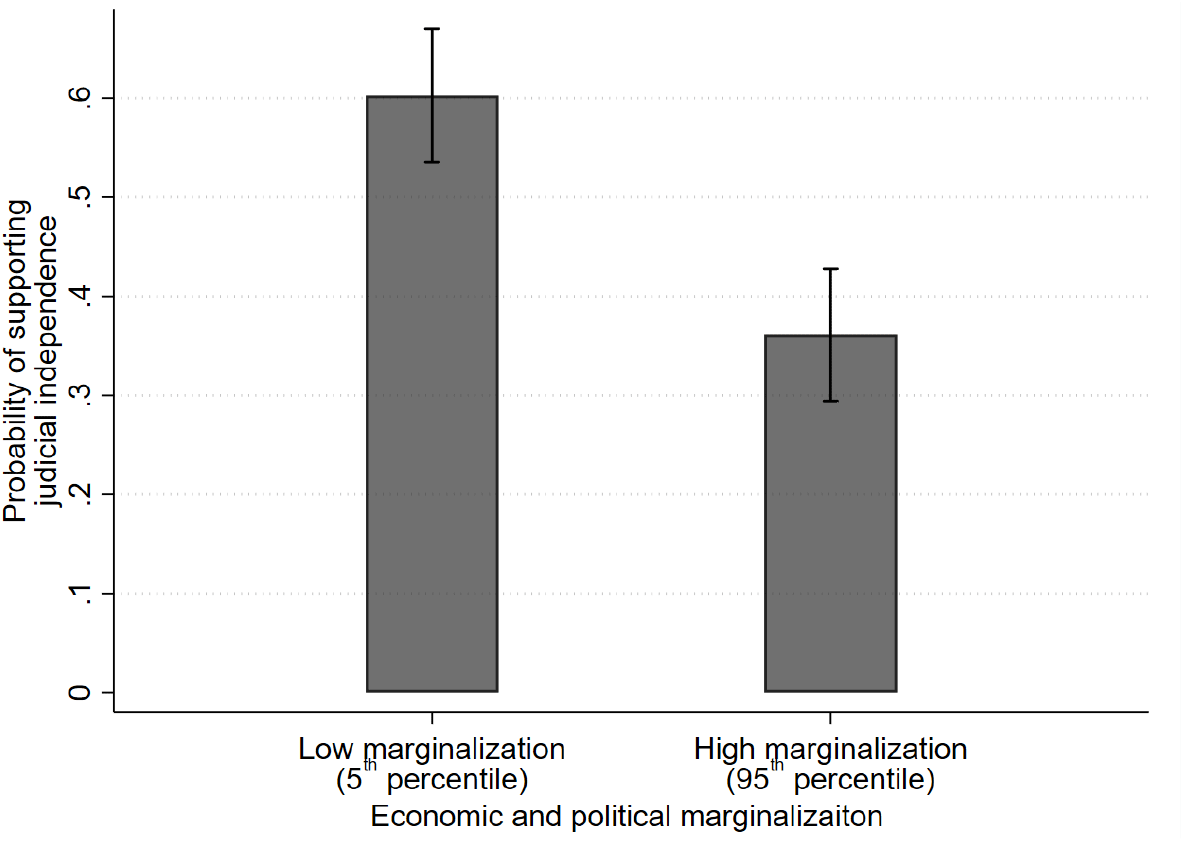
The normative support hypothesis suggests that judicial confidence will be higher when decisions are perceived as lawful and free from political coercion. Therefore, normative support scholars have emphasized the importance of judicial independence in building public support for the judiciary. But this expectation requires qualification, at least in the case of Bolivia. According to LAPOP, only 57 percent of Bolivians believe that the judiciary should be independent. In fact, as anticipated by the opening discussion, whether independence is seen as something valuable depends on the degree of marginalization people face. Those who remain unsatisfied with the political system and face economic hardship are about 17 percent less likely to support the principle of judicial independence (p < .001; see figure 1). Therefore, to test the normative support hypothesis, the following analyses incorporate an interaction term between whether independence is desired and whether it is observed. I expect that confidence in the judiciary will be lower for those who value an independent judiciary but see the TSJ as dependent.
Probability of Supporting Judicial Independence by Degree of Marginalization

An important measurement issue is that the survey question about independence refers to the judiciary and not to the TSJ in particular. Although this is not ideal, there are reasons to think this measure is valid. The executive and legislative branches may have a vested interest in influencing the decisions of a supreme court, but it is not clear that they have the same incentives for influencing the smaller judicial organs. The concept of independence is likely to be more tightly associated with the higher courts. In fact, the framing the opposition adopted when seeking to delegitimize the judicial reform focused primarily on the dangers of creating a submissive TSJ in particular. Moreover, some—but not all—of the judges elected to the TSJ had strong ties to the MAS. Thus, it is possible to contrast the degree of perceived independence across each of the departments and see if it varies systematically depending on the partisan leanings of each judge.
Table 1 shows the percentage of respondents for each department who thought the judiciary in Bolivia was independent. Except for Santa Cruz, a conservative department with a leftist judge, the departments where the judiciary was seen as most independent were also where the elected justices did not have a previous association with the incumbent party. This pattern suggests that the questions about independence were, to a significant degree, specifically tapping into opinions about the TSJ.
Marginalization Variables
I argue that the effect of ideological congruence should be most significant among groups that feel marginalized. For those who do not see themselves as receiving any benefit from the current institutional configuration, ideological congruence becomes a valuable way to achieve a minimum threshold of performance satisfaction, while considerations about the procedural elements in the TSJ become secondary. Conversely, those who do feel represented by other institutions in the regime can be expected to care less about having another venue of representation, in the form of an ideologically proximate judiciary, and more about an independent judiciary that meets the normative standard of procedural integrity. Consequently, the models presented in this analysis incorporate an interaction term to assess the explanatory power of the normative and strategic support hypotheses across different levels of exclusion.
It is not obvious how to operationalize marginalization in the Bolivian context. Indigenous groups, which constitute about 62 percent of the total population, have traditionally been excluded from the political and economic system. While these sectors of the population continue to face pervasive poverty, the almost hegemonic regime of the MAS has brought them significant opportunities for political representation while also pushing historically dominant groups out of the political arena. Therefore, I incorporate economic and political marginalization as distinct variables in the models here, although the theoretical expectations are the same for both of them. Economic marginalization is operationalized through the LAPOP index of household services, which asks respondents about the number of assets (potable water, computers, cars, etc.) they have. Political marginalization is operationalized with a question asking respondents how satisfied they are with the government’s performance.Footnote 2
Besides the predictors described above, the models control for other important factors. Fixed effects for each of the departments are included to account for any potential regional effects. Political interest and education are likely to determine the extent to which people pay attention to the performance of the judiciary, and therefore should be expected to be correlated with the effect of the main predictors in the model. A previous study (Driscoll and Nelson Reference Driscoll and Nelson2015) found that the rural population in Bolivia, usually a strong supporter of the MAS, was more likely to support the TSJ, making it an important control to avoid inflating the effect of the ideological distance variable. I also control for trust in the judiciary as a whole. This is important to consider to ensure that the effects observed relate to the TSJ in particular and are not a consequence of broader perceptions about the justice system. The goal of this variable is not to explain variation but to isolate opinions about the TSJ from those that concern the broader justice system.
Results
This section presents the results from the statistical tests. First, the analysis examines the effects of ideological congruence and procedural integrity independently of the levels of marginalization. The results suggest that normative and strategic considerations are both important in determining the level of judicial confidence. The subsequent models refine this claim by paying closer attention to the degree of economic and political marginalization people experience. The findings suggest that people who feel marginalized care primarily about maximizing the potential for favorable institutional outcomes. Conversely, those who are not marginalized by the broader political and economic system reward procedural integrity.
Instrumental and Normative Sources of Judicial Confidence
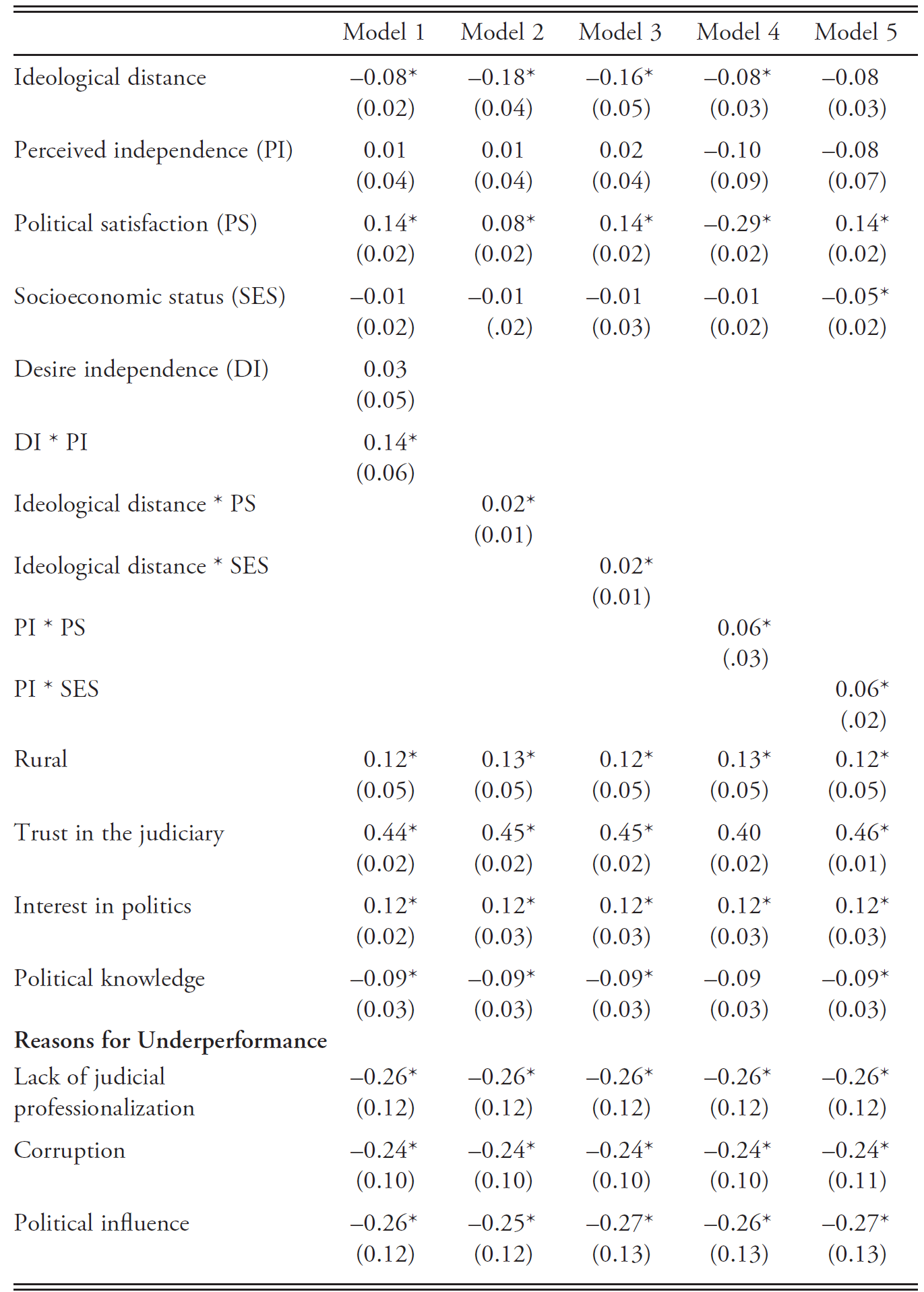
Model 1 in table 2 shows the results of a fixed effects OLS regression comparing the explanatory power of the instrumental and normative support hypotheses.Footnote 3 As expected by the former, ideological distance has a negative and significant effect on trust in the TSJ. In this baseline model, confidence in the TSJ decreases by about 0.8 when ideological distance goes from the minimum to the maximum. For the average respondent, instrumental considerations seem to play an important role when conferring support to institutions.
Normative and Instrumental Predictors of Confidence in the TSJ

N = 2,216. *p < .05.
Notes: All models include fixed effects for departments and control for education. The reference category for the reasons for underperformance is Not Enough Judges.
Another relevant finding is that people who attributed judicial underperformance to outside political pressure were also less likely to trust the TSJ. A supplementary analysis presented in the online appendix finds that the odds of seeing political influence as a negative trait get 20 percent bigger for a unit change in ideological distance. The probability of attributing the underperformance of the judiciary to political interference drops to only 5 percent when ideological distance is at its minimum. In other words, Bolivians seem to accept outside political pressure on the court as long as it results in more favorable outcomes. These findings indicate that confidence in the TSJ, and public support for its independence, are influenced significantly by strategic considerations.
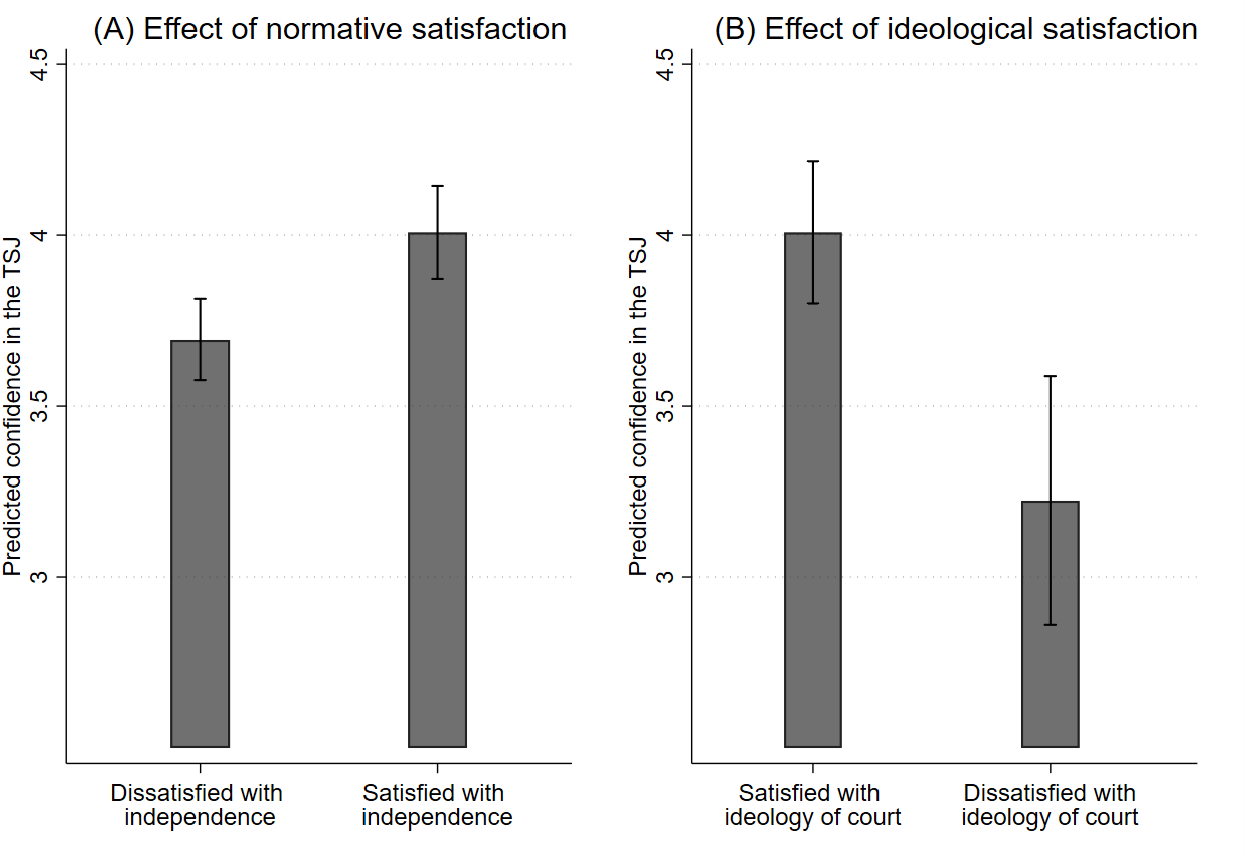
However, model 1 also provides some evidence for the normative support hypothesis. Importantly, perceived independence was not found to have an independent effect on trust in the TSJ. While for the average Bolivian, judicial independence does not appear to be a priority, some do reward it. Panel A in figure 2 presents the predicted levels of confidence at different values of the interaction between wanting judicial independence and the perceived degree of independence (DI * PI). Among those who value independence, the effect of perceiving the judiciary as independent is associated with a 0.34 increase in the dependent variable. This is a smaller effect than that of ideological satisfaction (Panel B), and the model expects no effect for those who do not have a clear preference for independence. Nevertheless, it does suggest that—at least among a smaller subset of the population—Bolivians reward independence. Similarly, another important finding throughout the models is that those who saw the underperformance of the judiciary as a consequence of corruption and lack of professionalization were less likely to trust the TSJ than those who saw it as an issue of institutional capacity. These findings suggest that normative considerations also play an important role in determining institutional support.
Predicted Judicial Confidence by Procedural and Ideological Satisfaction

Overall, these preliminary results show equal support for the normative and instrumental support hypotheses. Both are reliable predictors of confidence in the TSJ. However, the rest of the models suggest a more complex story. While the analysis so far has suggested that both hypotheses are equally plausible, a more detailed investigation reveals that the explanatory power of each hypothesis is limited to the opposite ends of the marginalization spectrum.
Institutional Support and Marginalization
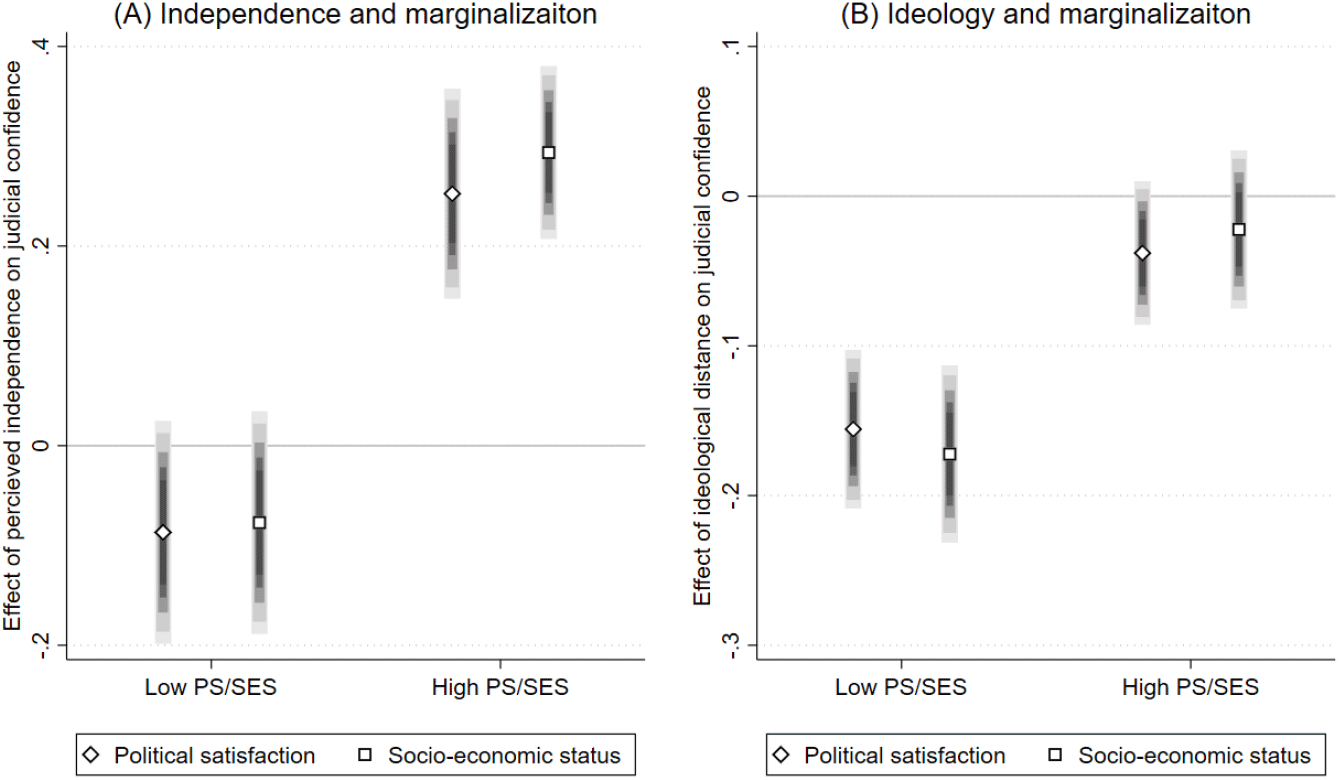
I now examine how marginalization conditions the effect of procedural and ideological satisfaction. Models 2 and 3 in table 2 test the conditioning effect of marginalization on ideological congruence. They interact ideological distance with political satisfaction and socioeconomic status, respectively. As model 1 shows, only portions of the Bolivian public reward judicial independence. I have posited that this variation should be explained by the degree of inclusion. The conditioning effect of support for independence shown in model 1 should reflect the moderating effect of marginalization. Therefore, models 4 and 5 replace the desired independence term with political satisfaction and socioeconomic status. Models 2 and 3 examine how strategic explanations of judicial confidence vary across marginalization levels, and models 4 and 5 do the same for normative explanations. Figure 3 shows the estimated marginal effect of ideological distance and perceived judicial independence on confidence in the TSJ at high and low levels of inclusion.
Marginal Effect of Explanatory Variables at Varying Degrees of Marginalization

The results show that the relative importance of strategic and normative sources of confidence varies across levels of inclusion. Panel A in figure 3 shows the effect that perceived independence has on trust in the TSJ at high and low levels of political satisfaction and socioeconomic status. As expected by the marginalization hypothesis, the effect varies considerably at different levels of the interaction. Perceived independence is associated with more trust among the wealthy or politically satisfied. The results suggest that perceiving the court as independent is associated with about a 0.2 to 0.4 increase in judicial confidence if marginalization is low.
While those who benefit from the status quo appear to reward procedural integrity, these results contrast with the effect of perceived independence among marginalized groups. For those who feel politically excluded and for the poor, independence is not associated with confidence in the judiciary. The perceived value of procedural integrity seems contingent on the institutions’ ability to provide baseline performance satisfaction. Pervasive economic or political marginalization prevents courts from gaining the confidence of the public, even if they appear to adhere to the principle of independence.
The effect of ideological distance is also strongly moderated by the degree of marginalization (figure 3, panel B). When political satisfaction is lowest, the effect of ideological distance in model 1 doubles to –0.18 (±.04). According to model 2, the confidence that the average person has in the TSJ decreases by about 16 percent when a high degree of marginalization is coupled with ideological dissatisfaction. However, ideological distance is not a significant predictor for those who are already satisfied with the political system. A very similar moderation effect is observed in relation to socioeconomic status: the effect of ideological distance reduces in magnitude as socioeconomic status improves. Ideological distance has no discernible effect on support for the TSJ among the wealthy. Like the normative support hypothesis, the instrumental argument can explain institutional confidence only at one end of the marginalization scale.
Conclusions
Public confidence has often been portrayed as a key element for institutional consolidation. However, current research continues to puzzle over what leads people to trust some institutions but not others. In the context of the judiciary, some scholars have argued that meeting the normative standard of judicial independence and procedural fairness is the most important factor, while others posit that confidence derives from performance satisfaction. This article has tested these two leading explanations. It has found conditional support for both hypotheses. The analyses show that people come to trust institutions for different reasons, depending on their perceived degree of political and economic marginalization. Normative considerations play a significant role when inclusion is high, but marginalization brings performance satisfaction to the forefront.
While the evidence for the conditioning effect of marginalization is strong in Bolivia, other contexts may not be as much affected by it. Traditionally, the Bolivian judiciary has failed to protect those unable to wield economic or political influence. This historical background may explain why the marginalized are skeptical of granting political independence to an underperforming judiciary. In countries like Colombia or Costa Rica, where the judiciary has been a source of progressive change, judicial independence may appear more appealing. As discussed here, independence carries no guarantees of inclusion. However, the public may reasonably update its expectations based on the track record of the institution. Nevertheless, the case of Bolivia exemplifies the challenges institutions with a legacy of exclusion face in gaining the trust of the public.
These findings have important implications for comparative studies of judicial confidence and institutional support. In Latin America, the pervasive implementation of neoliberal economic orthodoxy has created increasing inequality and dissatisfaction with political regimes across the region (Holzner Reference Holzner2010). The findings presented here suggest that in such contexts, the public will reward institutions that forgo procedural integrity and the rule of law if they provide satisfactory outcomes. This helps explain why judiciaries that perform reasonably well in terms of a legal-normative standard fail to generate popular support (Helmke and Rosenbluth Reference Helmke and Rosenbluth2009; Tamanaha Reference Tamanaha2004). It may also help explain why populist leaders are able to gather enough popular support to challenge democratic practices despite an overall preference for democratic norms. More research is necessary to see if the conditioning effect of marginalization extends to other institutional contexts.
In recent years, several Latin American countries have debated the potential benefits of “democratizing justice.” Some of them have adopted jury trials to try to promote a more participatory and transparent system of justice (Walker Reference Walker2017). Countries like Argentina, Colombia, and Chile have also considered judicial elections as a way to buttress public support for the judiciary. For these countries, the case of Bolivia carries some important lessons. The evidence here suggests that judicial elections can, in principle, increase the overall confidence in the judiciary, particularly among marginalized groups that lack avenues for political influence. However, the decision in Bolivia to hide partisan ties during the elections diminished the potential for representation by limiting the information available to voters. In the Bolivian case, this resulted in voters’ lacking the necessary cues to make judicial elections an effective tool to gain political representation, while still allowing clientelist practices to percolate through the judiciary and undermine its reputation. Democratizing justice through elections appears to necessitate its politicization. It is unlikely that countries will be able to gain the benefits of the former without paying the costs of the latter.
In addition, the findings highlight the importance of further comparative work on judicial politics. Previous studies of judicial confidence have focused largely on consolidated democracies that are able to provide above-average levels of inclusion. Given the analysis presented here, it is not a surprise that those studies have usually found unqualified support for the normative support hypothesis. This empirical regularity in the developed world has informed the way institutional support is conceptualized, often equating it to diffuse support. The Bolivian case shows that future work should be cautious when applying this empirically laden conceptualization to other contexts, particularly because the broader notion of institutional support is probably shaped by the idiosyncratic power distribution of each society.
Appendix: Data Collection of Judicial Decisions and the Quadratic/Normal IRT Model
The first step in estimating the ideological position of the TSJ judges was to collect the relevant data. Given that hundreds of decisions were made made during the period examined here, manual coding was not viable. Instead, I utilized web-scrapping algorithms (the Beautiful Soup library in Python) to first collect all decisions automatically from the TSJ website. Nonunanimous decisions follow a specific format that was identified using the text-mining environment developed by Feinerer and his colleagues (Feinerer et al. Reference Feinerer, Hornik and Meyer2008). Through this procedure, I identified 89 decisions that I then read to verify their relevance, and coded the dissenting judges. The final coding was compared to an alternative one done in Feinerer’s package in R to check for inconsistencies. The resulting dataset served as the input for the IRT model.
Following spatial theories of voting (Enelow and Hinich Reference Enelow and Hinich1984), the IRT model employed here (developed in Clinton et al. Reference Clinton, Jackman and Rivers2004; Jackman Reference Jackman2009) assumes that each judge has an ideal point (ξj) in the d-dimensional policy space ℝd. When facing a new decision i, judge j decides between voting for (ςi) or against it (ψi), both of which can be mapped into the policy space. The decision is given by standard Euclidean quadratic utilities,
 $$ U_j (\varsigma _i ) = - ||\xi _j - \varsigma _i ||^2 + \eta _{ji} \, and \, U_j (\Psi _i ) = - ||\xi _j - \Psi _i ||^2 + \upsilon _{ji}, $$
where ηji and υji are normally distributed errors. When Uj(ςi) > Uj(ψi), judge j is predicted to vote ςi, and vote ψi otherwise. The likelihood follows the usual form for binary responses:
 $$ L = \prod\limits_{j = 1}^n {\prod\limits_{i = 1}^m {\pi ^{y_{ji} } } _{ji} - (1 - \pi _{ji} )1 - ^ {y_{ji}} } $$
with the utility differential, πji, defined as πji = Φ(β‘i ξj – αj), with j indexing judges, and i indexing court decisions. The β coefficient is usually interpreted as a weight reflecting the discriminatory power of a given voting decision, or the extent to which variation in ξj is linked to changes in the response probabilities (βi = 2(ςi – ψi)/σi). The parameter α simply controls for the probability of a success (y = 1) regardless of ξj (since αj= (ς‘i ςi – ψ’i ψi)/σi). As is conventional, the fitted model employs nonin-formative normal priors for both of these parameters.
A Bayesian approach has computational and substantive advantages over the typical one- and two-parameter models in the frequentist tradition. In regard to estimation, the Bayesian model performs well, even when the number of subjects (judges) is small (Clinton et al. Reference Clinton, Jackman and Rivers2004). In contrast, usual frequentist methods would not be well suited for this case, given their reliance on asymptotic properties, and difficulties in extracting information from lopsided votes (Poole and Rosenthal Reference Poole and Rosenthal1985). In more substantive terms, the Bayesian approach allows for the incorporation of the wealth of prior knowledge that researchers usually have about judges. Additionally, by being able to implement quadratic utilities, as opposed to being restricted to Gaussian ones, the Bayesian approach more accurately reflects the theory behind utility functions in the spatial voting literature.