


1. Introduction
In addition to the canonical NP–I0–VP structure, English has a number of constructions in which the subject follows the inflected verb. These are called ‘inversion constructions’. Some examples are given in (1) and (2).
(1)


(2)
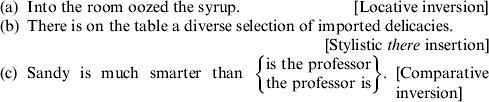
A central goal of contemporary derivational theories in generative grammar has been to provide accounts of such apparently non-canonical constructions within the framework of general principles. For instance, the inversion in (1), Subject Aux inversion (SAI), is typically analyzed as raising of I0, the head of IP, to C0, the head of CP, across the subject, which is in Spec of IP. Such movement is local, structure-preserving, conforms to X′ theory, and can presumably be licensed through a mechanism such as obligatory feature discharge (see e.g. Pesetsky & Torrego Reference Pesetsky, Torrego and Michael2000). Hence SAI can be seen as an instance of narrow syntax. The fact that such an analysis can be formulated supports a research program in which the properties of particular grammatical constructions are a consequence of the feature matrix of functional heads which trigger movement. This approach contrasts with previous work in the Principles and Parameters framework (Chomsky Reference Chomsky1986, Chomsky & Lasnik Reference Chomsky, Lasnik and Jacobs1993) and is in fact closer to the more traditional approach in which constructions are assumed to have some idiosyncratic properties that cannot be completely reduced to general principles.Footnote 2
The inversion constructions in (2), loosely referred to as ‘stylistic inversion’ (SI) present a greater challenge for the minimalist theory of syntactic derivation. In some of these cases, the subject follows the main verb V0, not an auxiliary verb. There is no natural way to account for SI in terms of movement of V0, given the independently motivated and widely accepted analysis of the English verbal cluster in which a non-auxiliary V0 never leaves VP;Footnote 3 the only V0 that can move to the position before the subject, C0, is an auxiliary.
Nevertheless, it often held that the syntax of these constructions, even the more exotic ones, is relatively straightforward. For example, Culicover & Levine (Reference Culicover and Levine2001) argue that in the case of the particular type of SI exemplified in (2a), the subject is VP-internal, and does not move to Spec of IP. Rather, the PP does. The ordering V0–NP is either an underlying order, or V0 moves to the left of the subject NP but not into I0. Stylistic there insertion in (2b) is analyzed as an instance of subject postposing by Ward, Birner & Huddleston (Reference Ward, Birner, Huddleston, Huddleston and Pullum2002). Merchant (Reference Merchant, Schwabe and Winkler2003) argues that the type of SI exemplified in (2c), like SAI, involves movement of the verb to the left.Footnote 4
SI constructions are different from SAI in three crucial respects:
• they are in general optional,
• they do not fall straightforwardly under raising of I0 to C0 (although we might analyze them as movements of the verb to the left, as noted),
• they appear to be tied to focus and other discourse-related functions; see Rochemont Reference Rochemont1978, Reference Rochemont1986; Birner Reference Birner1996; Birner & Ward Reference Birner and Ward1998; Rochemont & Culicover Reference Rochemont and Culicover1990; and Winkler Reference Winkler2005, among many others.
While the idea that the various types of inversion have particular discourse functions is not at issue, it is not trivial to give a precise account of what these functions are; see for example Chen (Reference Chen2003). Accounting for these functions in a principled way is part of the challenge of understanding what their properties are. Moreover, it is not immediately clear why standard SAI of the sort found in questions does not have the same kind of focus and discourse properties as SI does, in spite of their superficial similarities.
In order to keep the presentation to manageable proportions, we restrict our preliminary analysis in section 0 to comparative inversion (CI). CI has a number of properties that make it appear to be a special case of SAI (Merchant Reference Merchant, Schwabe and Winkler2003). Yet it has very special discourse properties, and its syntactic structure is constrained in ways that normal SAI is not. In particular, we will show that in CI, the canonical subject position (Spec,IP) is not filled. Hence CI contrasts dramatically with SAI, and with other cases of SI.
We review Merchant's (Reference Merchant, Schwabe and Winkler2003) analysis of CI and show that it does not account for the full range of attested CI possibilities. In particular, the subject can follow more than one verbal element, as in than would have any of the men who … We consider a number of alternative syntactic analyses of CI, and conclude that it is indeed characterized by a particular syntactic property: the canonical subject position in Spec,IP is empty and the subject appears to remain in its initial position, which for convenience we refer to henceforth as ‘vP-internal position’. We explore several alternatives for accounting for this fact, and suggest that the most straightforward approach is to assume that the subject is in fact in situ. For convenience, we characterize this syntactic feature of CI as ‘suspension of the EPP’, by which we mean that the subject is not in its canonical position in Spec,IP, as is the case in canonical comparatives (CC).Footnote 5 But the subject in situ property of CI and related constructions raises some challenging theoretical issues that may not be best captured in terms of the EPP per se.
The analysis of CI requires us to be explicit about the relationship between constituent order, intonation and focus structure and how the CI construction differs from CC. This issue is taken up in section 0. We argue there that CI is licensed as a consequence of the general English strategy of right-aligning a constituent in focus at the right edge of a intonational phrase. What is special about CI (in contrast to CC) is that the accented subject occurs immediately after the auxiliaries and is interpreted as contrastive focus. The canonical subject position remains unfilled. Beyond this characteristic, CI is completely unexceptional in the way that it articulates with focus and givenness-marking.
In section 0 we situate our analysis of CI within the broader context of specialized stylistic inversions. Analysis of the broader set of inversion constructions shows that although each has somewhat different syntactic and semantic properties, they all show the same characteristic interaction: the phonological constraint of placing a focused subject late is stronger than the EPP requirement of realizing the subject in the canonical subject position.
In our conclusion in section 0 we discuss the theoretical implications of our analysis.
2. Comparative inversion
2.1 CI is not SAI
The first question that we consider is whether comparative inversion (CI) as exemplified in (2c) is an instance of SAI. SAI is conventionally analyzed as raising of the verb in I0 (or some appropriate functional head) to C0. This movement puts the inflected auxiliary to the left of the subject. If CI cannot be analyzed in this way, the obvious alternatives are leaving the subject in situ in Spec,vP or moving the subject to the right, or the equivalent, depending on assumptions about the underlying structure.
Merchant (Reference Merchant, Schwabe and Winkler2003) crucially relies on an SAI analysis of CI in order to account for the fact that the main verb cannot appear when the auxiliary verb appears to the left of the subject NP.
- (3)
(a) Sandy will run faster than Kim will (run).
(b) Sandy will run faster than will Kim (*run).
Merchant's observation is that in (3b), where there is inversion, VP ellipsis appears to be obligatory. This is a puzzle, since in general VP ellipsis is not required when there is inversion; cf. the yes–no question Will Kim run? However, the data would have a very different status if (3b) was not a case of SAI. If it was not, we would still have to explain why the main verb cannot appear. But we would not be faced with the puzzle of why Will Kim run? is grammatical when it lacks ellipsis.
The evidence that CI is not a special case of SAI is that the subject NP can be preceded by a verb cluster. That is, the actual structure of these constructions is roughly of the form in (4a), not (4b), which is the SAI structure. VAUX stands for Modal, have and be, and V* for any number of auxiliary verbs (including none) that may follow the tensed form.
- (4)
(a) X VAUX+Tense V* NP …
(b) X VAUX+Tensei NP t i …
We leave open for now the question of whether there is any movement in the derivation of (4a), so we don't show any traces or bracketing.
We searched the Web for sequences of the form than–VAUX–V*–NP. There are numerous legitimate examples, a small sample of which are reproduced here. There are two categories of examples. One category shows VP ellipsis; these have sequences of the form than–Modal–have–NP. The other category shows ellipsis of the predicate; these have sequences of the form than–have–been–NP, than–Modal–be–NP, and than–Modal–have–been–NP.Footnote 6 Both categories are distinguished by the fact that they contain verb clusters that precede the subject NP. (In these examples the CI construction is marked by square brackets and what we judge to be the accented material is capitalized.)
A. VP ellipsis: than–Modal–have–NP
- (5)
(a) Interesting that his positioning, facing out of the frame but looking back into it, seems to make the portrait at once more candid and more dignified [than would have any of the alternative ‘CONVENTIONAL’ compositions].
(b) They argue that they produced more readable and better researched reviews and editorials [than could have the academics under whose NAMES the papers appeared].
B. Predicate ellipsis
i. than–have–been–NP
- (6)
(a) But Mokotów was much further from the City Center [than had been the OLD town] and the evacuation under the German lines all the more perilous.
(b) Some ranchers still permitted the military to use their property, though the vehicles were far more destructive to the land [than had been the soldiers on HORSEBACK].
ii. than–Modal–be–NP
ii.a than–might–be–NP
- (7)
(a) Today's air travel is unquestionably a much worse experience [than might be the proverbial ROOT canal].
(b) Do you think your polemical stance is more effective in convincing people of your ideas [than might be a more MAINSTREAM and POLITE approach]?
ii.b than–would–be–NP
- (8)
(a) It strikes me that might be a more appropriate way to think about what we are up against here, [than would be any OTHER major conflict].
(b) Who was responsible for keeping the records would be a more reliable witness as to their accuracy as a whole [than would be any of the ORIGINAL MAKERS].
(c) All copies were expensive and the author/publisher, having produced one copy of the work, was no better situated to make another copy of the work [than would be ANY HOLDER of the work].
iii. than–Modal–have–been–NP
iii.a than–would–have–been–NP
- (9)
(a) The Prussian army would have been very much surprised to see their king without his hat; but no more so [than would have been the PEOPLE of those days to find Mrs. Madison without her TURBAN].
(b) In other words, once a storm has destroyed a residential area, the repair costs are higher [than would have been the cost of preventing the release of GREENHOUSE GASES, which would have prevented the storm from HAPPENING].
iii.b than–might–have–been–NP
- (10)
(a) As a pageant, ‘Cammina Cammina’ is far less colorful and even provocative [than might have been the PAGEANT put on by the PEASANTS seen in the precredit sequence].
(b) To her, thinking, as she ever was thinking, about Johnny Eames, Siph was much more agreeable [than might have been a YOUNGER man who would have endeavoured to make her think about HIMSELF].
Examples such as these constitute prima facie counterevidence to the claim that CI is a special case of SAI. An SAI account would require a sequence of verbal head positions in the left periphery to which the verbal elements could move. Or, the verbal cluster would have to be moved to the C-position as a whole (as for example proposed by Rochement and Culicover (Reference Rochemont and Culicover1990: 95) for SI). The least stipulative alternative would be an account without movement of the auxiliaries. We will take up this approach in the next section and provide arguments for the hypothesis that the subject also does not move.
2.2 The subject is ‘low’
Consider now how to derive (4a). Logically there are four possibilities:
1. the subject is in canonical subject position (e.g. Spec,IP) and all of the verbs move to the left;
2. the subject is in canonical subject position and moves to the right;
3. the subject is in canonical subject position, and everything in I′ moves to the left of it;
4. the subject is in situ in Spec,vP, and remains in situ.
We rule out without further discussion option 1; although technically workable, it would require far too many ad hoc stipulations to be credible. Option 2 is more plausible, but involves movement of the subject to the right and adjunction to IP, which is ruled out on standard assumptions. Option 3 conforms more closely to standard assumptions about the direction of movement, although it stipulates an ad hoc movement of I′ (or some XP that contains some empty material along with I′) and involves other complexities.
Option 4 is the least complex in terms of derivation and stipulations (although it is not without problems, as we will see in section 0). Crucially, it differs from the others in that the subject is ‘low’ in this construction, in the sense that it is in Spec,vP.
In this section and the next we present some empirical evidence that suggests that subject in situ is the correct analysis. This allows us to simplify the discussion, in that we do not have to weigh the pros and cons of 1–4. Since our concern here is primarily to establish and explain the properties of CI, we will not pursue in any detail in this paper the possible theoretical consequences of showing that the subject is in situ.
The trick is to show that the subject NP does not pattern with a subject that is in Spec,IP (that is, to the left of the inflected verb), or with heavy NP shift applied to a subject. Since CI is a very rigid construction, there can be no extraction from the subject, or extraction of the subject in the comparative clause. But its configuration can be inferred from its behavior with respect to parasitic gaps and multiple wh-questions, and from its ordering relative to other constituents of VP in somewhat complex but acceptable ‘pseudogapping’ constructions.
i. Parasitic gaps
On option 4, the subject is a constituent of VP, similar to the subject in there-insertion. On the other options, it is either in Spec,IP, or moved out of Spec,IP by a rule similar to heavy NP shift (HNPS). The behavior of CI with respect to parasitic gaps suggests that it groups with direct objects in situ. It does not behave like a heavy shifted object, nor does it behave like an inverted subject in SAI.
We consider first the fact that it is possible to have a parasitic gap (pg) in the subject of a comparative, with CI (11a) or without CI (11b).
- (11)
(a) a person that Sandy gave more money to t than would have [even good friends of pg]
(b) a person that Sandy gave more money to t than [even good friends of pg] would have
The following examples show that parasitic gaps in direct objects or objects of prepositions are not problematic.
- (12)
(a) a person that Sandy gave money to t after talking to [friends of pg]
(b) a person that Sandy gave money to t after introducing [some friends of pg] to Otto
Example (13) shows that parasitic gaps do not appear in heavy-shifted NPs, which argues against the movement analysis of CI. Compare this with the grammatical (12b).
(13) *a person that Sandy gave money to t after introducing to Otto [NP some friends of pg]
A similar contrast can be found for regular there and stylistic there, the latter being the counterpart of heavy NP shift for subjects in English. It is possible to have a true gap in an NP in the regular there construction.
(14) a person that there was [a picture of t] on the table
But a true gap cannot appear in the NP in the stylistic there construction.
(15) *a person that there was on the table [a picture of t]
This contrast is found for parasitic gaps as well. There can be a parasitic gap in the VP-internal NP (16a), but not in the heavy NP shifted NP (16b).
- (16)
(a) ?a person that I didn't recognize t even though there was [a picture of pg] on the table
(b) *a person that I didn't recognize t even though there was on the table [a picture of pg]
The generalization appears to be that parasitic gaps are possible with VP-internal NPs, regardless of their grammatical function. Gaps in rightward shifted NPs, however, are not possible.
At the same time, there is evidence that a parasitic gap is incompatible with a subject when there is SAI. Example (17a) shows a parasitic gap in an NP in canonical subject position. Example (17b), on the other hand, shows the same NP with a parasitic gap in inverted subject position. Example (17c) shows that SAI in the subordinate clause without a parasitic gap, while somewhat complex, is more acceptable than the SAI sentence with the parasitic gap.
- (17)
(a) ?a person that Sandy criticized t because [some good friends of pg] refused to contribute to the proceedings
(b) *a person that Sandy criticized t because to virtually none of the proceedings did [any good friends of pg] contribute posters.
(c) a person that Sandy criticized t because to virtually none of the proceedings did [any good friends of Robin] contribute posters.
The behavior of CI with respect to parasitic gaps, then, shows that CI is not the same as HNPS. The subject is not a postposed heavy NP. The subject may be in situ in Spec,vP, or it may be in its canonical subject position. However, the evidence that we have already considered demonstrating that the subject in CI may follow a cluster of auxiliary verbs shows that this latter possibility is not a viable one. The remaining possibility is the one that we argue for, namely that the subject is in situ in Spec,vP.
ii Multiple wh-questions
We provide evidence that shows that in multiple wh-questions involving comparatives, the subject in CI behaves like a direct object, and not like a subject in CC. We take this to be indirect evidence that the subject CI is in Spec,vP.
First, note that it is possible to have a multiple wh-question in a comparative when the comparative lacks a verb, as in (18).
- (18)
(a) Which (of the) girls run faster than which (of the) boys?
(b) Which (of the) girls did Sandy praise more than which (of the) boys?
(c) Who runs faster than who?
(d) Who did Sandy praise more than who(m)?
Next, note that a subject in a canonical comparative clause may participate in a multiple wh-question, as seen in (19b). (We show the same structures with quantifiers to rule out the possibility that the ungrammaticality has something to do with quantifier scoping into a comparative.)
- (19)
(a) Some (of the) girls praised Leslie more than some (of the) boys did.
(b) Which (of the) girls praised Leslie more than which (of the) boys did?
(c) Who praised Leslie more than who did?
Examples (20b, c) show, however, that the direct object in a canonical comparative clause cannot participate in a multiple wh-construction.
- (20)
(a) Sandy praised some (of the) girls more than she did some (of the) boys.
(b) *Which (of the) girls did Sandy praise more than she did which (of the) boys?
(c) *Who did Sandy praise more than she did who?
And (21b, c) show the same for the object of a preposition.
- (21)
(a) Sandy gave more money to some (of the) girls than she did to some (of the) boys.
(b) *Which (of the) girls did Sandy give more money to than she did to which (of the) boys?
(c) *Who did Sandy give more money to than she did to whom?
Finally, consider the following examples, which show that multiple wh-questions where the CI subject is a wh-phrase are ungrammatical.
- (22)
(a) Which (of the) girls run faster than which (of the) boys do?
(b) *Which (of the) girls run faster than do which (of the) boys?
(c) *Who runs faster than does who?
The subject in CI patterns with the direct object wh-phrase in (20b, c) and (21b, c), and not with the pre-verbal subject wh-phrase in the canonical comparative. This data is consistent with the hypothesis that the subject wh-phrase which (of the) boys in (22b), where there is CI, is in Spec,vP.
iii Pseudogapping
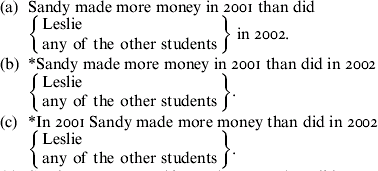
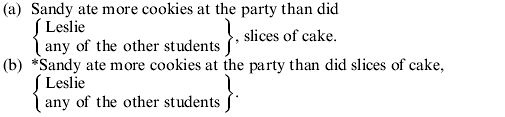
In some cases, the postverbal subject may precede other non-verbal VP material, but it may never follow such material.
(23)
(24)
(25) When my son was younger and played soccer, I found that the parents got more pleasure from watching the games than did the kids from playing them, or the coaches from coaching them.
This constituent ordering follows if the subject is assumed to be at the left edge of the verb phrase, following the auxiliaries and tense and preceding the other constituents of VP. In fact, the observed ordering is what we would expect if the verb were simply omitted, with or without other constituents of VP, although this idea runs afoul of standard assumptions about how ellipsis works. The data are also compatible with the view that the two focus constituents undergo various movements to the left edge of the verb phrase, leaving behind a VP-shell that can be deleted; for such an analysis of pseudogapping see Lasnik Reference Lasnik, Lappin and Benmamoun1999 and for a critique, Culicover & Jackendoff Reference Culicover and Jackendoff2005.
2.3 Licensing subject in situ
The preceding discussion leaves us with an analysis in which the subject NP is in situ in Spec,vP. The most controversial aspect of this analysis is that the subject does not raise to Spec,IP. This is a striking fact, when viewed from the perspective of any theory in which a condition equivalent to the EPP is assumed, that is, a theory that requires that Spec,IP be filled in English. In the Minimalist Program (Chomsky Reference Chomsky1995: 55, 199), [EPP] is a feature of I0 that must be discharged prior to Spell Out. In Optimality Theory (OT), epp is a constraint that ranks higher than stay (no traces). In order to derive the observed facts regarding CI, it is necessary to state somewhere in the grammar that the feature [EPP] is weak or that the constraint stay ranks higher than the constraint epp. But this requirement is construction-specific, and so the special stipulation has to be tied to some special properties of the syntax–semantics–phonology interface.
Clearly, the special syntactic properties have to do with the comparative. Thus, it is natural to say that they are associated with the elements than and as, or the equivalent. On the plausible assumption that the features of a head and a projection are the same, one way to do this would be to say that than and as are complementizers that select an IP without an EPP feature.
But since the construction is optional, this selection must be optional. However, it is not entirely optional, because there are phonological differences between the CI and the CC that must be taken into account. That is, it is not sufficient to say simply that EPP is optional in comparatives. It is necessary to relate the non-application of EPP in CI to the assignment of a focus accent to the low subject in these comparatives (see section 3.1). As we will demonstrate, while focus may appear anywhere in CC, when there is CI the inverted subject must be assigned a focus-accent.
Thus, it is necessary to state the interface conditions in such a way that the non-application of EPP and the focus property go together. That is, the subject can only stay low (and violate the EPP) if it is accented and interpreted as contrastive focus. The syntactic structure of CI is given in (26).
(26)

Most importantly, we show in the next section that the focus property of the subject in this construction is not actually a matter of stipulation, but is a consequence of the way that accent is assigned and interpreted in English on the basis of the syntax, semantics and pragmatics of comparative constructions. Thus the CI construction is not an accidental product of a chain of selection, along the lines just sketched out. Rather, it follows from the interaction of interface constraints with the consequence of fixing the subject position postverbally. In effect, the construction links particular syntactic, semantic, phonological and pragmatic properties. It suspends the general EPP property in much the same way that an irregular form in morphology blocks a regular form (Culicover & Jackendoff Reference Culicover and Jackendoff2005: chapter 1).
2.4 British CI
We must also take into account the interaction between CI and the British type of ellipsis.Footnote 7 This type of ellipsis uses a form of do where American English would have an empty VP.
(27) Sandy will read the book, and Kim will do, too.
Interestingly, do appears before the subject NP in the British variant of CI. The examples in (28) were found in a Web search.
- (28)
(a) This was an eternal source of misery to my father, and broke the neck, at the first setting out, of more good dialogues between them, [than could have done the most petulant CONTRADICTION] – the few which survived were the better for the cuvetts – … (The life and opinions of Tristan Shandy)
(b) The Wong Kar Wai's style is between European and Chinese cinema. For years, he has intended to open the HK cinema to artsy and author genres more [than could have done NEW WAVE directors].
(c) ‘Course I have!’ Which left the twins more dazzled [than would have done the animal's ARRIVAL].
(d) Pausing there, although that was the applicant's perception, there was no finding that her walking the longer distance to the disabled toilet exposed her in fact to more prejudicial comments or actual notice [than would have done the SHORTER WALK to the female (or male) toilet closest to the loading bay], nor, of course, is there anything unfeminine about use of a disabled toilet, which in any event is fairly open to others than those who are ostensibly and physically disabled.
Haddican (Reference Haddican2007) (see also Baltin Reference Baltin2007) argues that British do is a light verb situated above the main verb phrase and below the verbal auxiliaries. This analysis is consistent with our general observation about CI, that the subject is ‘low’ and not raised to the canonical Spec,IP position.
3. The information structure of English focus inversion
A central component of our account is that the function of CI is that of focus-marking the subject. We argue that the particular syntactic configuration of CI falls under general phonological principles for alignment of accented phrases with the right edge of an intonational phrase, and that the focus interpretation follows accordingly. We show that the syntactic configuration of CI is not available generally for English, but is linked to the interaction of the comparative with the mandatory focus marking of the subject. Thus, the CI is similar to the CC in that the semantics of both constructions requires two contrastive foci. However, the CC is less restricted with respect to focus marking in that focus in CC is not restricted to subjects.
In this section, we will establish that information structure and focus suspend the EPP in CI. We show that the non-application of the EPP is tied to highly regular interactions of syntax with semantics and phonology, and of syntax with discourse and pragmatics. On this analysis (i) the subject must be interpreted as a contrastive focus, (ii) the focused constituent must be prosodically highlighted and must occur at the right edge of the intonational phrase, and (iii) the highlighting effect on the focused subject is strengthened by ellipsis of the non-contrastive material. Only if these three conditions are fulfilled can the EPP be suspended. If not, the subject appears in Spec,IP, as in the CC.
In section 0 we show how positioning the subject postverbally produces the intonational contour that is characteristic of obligatory focus in English. We also consider the intonational pattern that arises when there are multiple foci in postverbal position. In section 0 we show how the semantic analysis of contrastive focus applies to comparatives and in particular to CI. In section 0 we provide evidence that the subject in CI indeed functions as a focus, and that it must be interpreted as a contrastive focus in this position. Finally, in section 0 we show that the focus properties of the inversion construction and the semantics of the comparative conspire to give the impression that VP ellipsis is obligatory. Contrary to Merchant's (Reference Merchant, Schwabe and Winkler2003) claim, ellipsis is not a necessary syntactic property of the construction, but occurs systematically as a consequence of its interpretation and intonation.
3.1 The phonology of low subject in CI
Consider the examples in (29).
- (29)
(a) ANNA ran much faster than could have any of her FRIENDS.
(b) ANNA ran much faster than any of her FRIENDS could have.
The first impression is that (29a, b) are prosodic variants in which the contrastive subject is prosodically marked as focus. Both sentences could be uttered in response to a multiple wh-question who ran faster than who could have run. In CI in (29a), a strong falling pitch accent is realized on friends at the right edge of the intonational phrase. The auxiliaries are defocused and integrated in the intonational phrase corresponding to the comparative clause. Example (29b) shows the CC with the subject in the canonical sentence-initial position. The noun friends receives a high pitch accent falling to a low and remaining low on the deaccented auxiliaries. The claim is that while CI is only possible with a heavily focus-accented subject, CC is free in its focus articulation according to the context. In particular, the subject in the canonical Spec,IP position assumes a topic or contrastive function.
The British CI in (30) shows an intonational pattern similar to that of (29a).
(30) ANNA ran much faster than could have done any of her FRIENDS.
In the context of a multiple wh-question ‘who ran faster than who could have done’ the overt proform done is deaccented and a contrastive accent is realized on the sentence-final subject. In both CI examples the variable under comparison is prosodically highlighted. An additional rising accent is possible on the negative polarity item any, an accent which typically marks the scope of the negative operator over the subject. That is, both variants of CI mark their subjects prosodically, place them at the right edge, and require a contrastive focus reading.
Prosodic highlighting operates at the syntax–phonology interface in the derivation of (29a) and (30). It leaves the subject in a low postverbal position, thereby creating the impression that SAI has taken place, as discussed in section 0. One major difference between CI and CC is phonological. While the subject in CI must be accented, different intonational realizations are possible in CC, as seen in in (31b, c):
- (31)
(a) Anna ran much faster than could have MANNY.
(b) Anna ran much faster than MANNY could have.
(c) Anna ran much faster than Manny/he COULD have.
Above, we observed that contrastive focus could be realized in the canonical subject position as well as in the post-auxiliary position. Previous accounts of these constructions (Niinuma & Park Reference Niinuma, Park, Anne and Henk van2004; Gergel, Gengel & Winkler Reference Gergel, Gengel, Winkler, Kerstin and Susanne2007) are vague about the difference between them, in particular with respect to the triggers for SAI. Here we propose that the interaction of syntactic and phonological constraints on intonational phrasing in English provides an additional motivation for the non-application of the EPP in CI.
We base our analysis on Selkirk (Reference Selkirk, Frota, Vigário and João Freitas2005), who argues for the existence of two related interface conditions. First, there is a correspondence between clausal syntactic constituents and intonational phrases (ip), and second, there is an indirect effect of marking a constituent as contrastive focus (CF). More precisely, the first interface constraint specifies that root sentences, which are also called comma-phrases, are right-aligned with ips in English, as stated by the Align R (CommP, ip) constraint in (32) (slightly adapted from Selkirk Reference Selkirk, Frota, Vigário and João Freitas2005: 7):
(32) Align R (Comma, ip)
Align the right edge of a constituent type Comma Phrase in syntactic representation with the right edge of an ip in phonological representation.
The second interface constraint requires that a contrastively focused constituent contain a designated terminal element of the ip, notated as Δip, as specified in (33) (Selkirk Reference Selkirk, Frota, Vigário and João Freitas2005: 18):
(33) Contrastive Focus-dominates-Δip (FOC/Δip)
The terminal string of a contrastive FOCUS constituent in syntactic representation corresponds to a string containing the metrical prominence of an Intonational Phrase in phonological representation.
In addition to these constraints, there is a prosodic markedness constraint in English calling for the alignment of the head of Δip with the right edge of ip (cf. Truckenbrodt Reference Truckenbrodt1995, Selkirk Reference Selkirk, Lee, Gordon and Büring2004), as in (34).Footnote 8
(34) Right Edge Aligment of Focus (REAF)
Each focused constituent is right-aligned in ip.
This prosodic markedness constraint is generally referred to as the Right Edge Alignment Constraint of Focus (REAF) and expresses the fact that focus occurs in a right-peripheral position.
These three constraints taken together can explain why contrastive foci in English are usually followed by an intonational break, or pause. Constraint (32) claims that there is a correspondence between syntactic and phonological constituents. The constraint in (33) requires that a CF be assigned major stress in the ip. The REAF in (34) is the reason that the CF occurs at the right edge of the ip. Since ips are characterized by the fact that they are set off by a pause at either boundary, the constraints create the impression that CFs in general are followed by an intonational break.
The interaction of these constraints also has the effect that the contrastive subject and the contrastive object in comparative gapping constructions in English occur in separate ips – often even realized with a clear break between them (cf. Winkler Reference Winkler2005), as marked by the comma in (35).Footnote 9
- (35)
- (a)
(A) Who ate more of what?
(B) ANNA ate more COOKIES (than MANNY)ip, (pieces of CAKE)ip.
- (b)
(A) Who invited whom more often?
(B) ANNA invited more interesting WOMEN to lunch (than MANNY)ip, (interesting MEN)ip.
- (a)
Applying this analysis to the inverted and canonical comparative constructions, we get the phonological representations in (36a, b), respectively:
- (36)
(a) Anna ran much faster (than could've MANNY)ip.
(b) Anna ran much faster (than MANNY could have)ip.
The CI in (36a) conforms to the constraints in (32)–(34). According to (32) the comparative clause than could've MANNY corresponds to an ip in phonological form. According to (33), the CF is assigned major prominence, and (34) requires that the CF occur right-aligned. The CC in (36b), however, does not conform to (34). Since the CF in (36b) is contained within the canonical subject position than MANNY could have, the sentence violates the REAF requirement of (34). In addition, the auxiliaries which follow the subject in (36b) occur as full forms and must be integrated in ip, a marked phonological option (cf. Selkirk 1995: 443).Footnote 10
We conclude that there are basically two contrasting driving forces: the EPP and the REAF in (34). The REAF interacts with the EPP by preventing movement of the contrastive subject to Spec,IP. Thus, in CI, the REAF is stronger than the EPP, and so the contrastively focused subject remains low. In CC, however, the EPP is stronger than the REAF and the subject moves into its canonical topic position (see section 0 for further arguments).
Contrastive focus marking allows an additional focus following the subject; this produces the pseudogapping pattern seen in section 0.iii. (It may be that this focus marking is linked to a particular syntactic configuration, e.g. locating the focus constituents in the Spec of a functional head, but the question is a complex one and we will not pursue it here.)
Consider next the pseudogapping cases in (37a, b). (37a) answers the question Who made more money in which year? and (37b) answers the question Who ate more of what at the party?.
- (37)
(a) SANDY made more money in 2001 (than did LESLIE)ip (in 2002)ip.
(b) SANDY ate more COOKIES at the party (than did LESLIE)ip, (pieces of CAKE)ip.
In (37a, b) the contrastively focused subject precedes other vP-internal material, such as a prepositional adverb in (37a) or the object of a transitive verb in (37b). The information structural requirement of two-variable comparisons is that both variables must be contrastively focused. The syntax–phonology interface conditions (32)–(34) predict that in constructions with two CFs, as in CI, the CFs are right aligned in their own intonational phrase.
The examples in (38) below show that the requirement of CF marking of the subject and a second remnant (here the object of a ditransitive verb) is sensitive to the discourse context. Contrastive Focus is realized on the element which is not givenness-marked by the comparative context, as we discuss in section 0 below (see also Rooth Reference Rooth1992, Schwarzschild Reference Schwarzschild1999). The requirement in (33) integrates deaccented and anaphoric material.
- (38)
(a) SANDY sent her relatives more electronic BUSINESS CARDS
(than did MANNY)ip, (electronic CHRISTMAS CARDS)ip.
(b) SANDY sent her relatives more ELECTRONIC business cards
(than did any OTHER family member)ip, (PRINTED ones)ip.
The discourse context of (38b) is more complex than the one for (38a). While (38a) answers a multiple wh-question who sent her relatives more of what kind of electronic cards, (38b) answers a question comparing senders out of the set of family members and objects taken out of the set of business cards. Note that in (38b) the REAF is not violated because each focused element occurs at the right edge of ip modulo the backgrounded and deaccented NPs family member and the anaphoric ones in the than-clause.
The contrastivity requirement on the remnants in CI cannot be loosened, as seen by the ungrammatical continuations in (39a) and (39b).
(39) SANDY sent her relatives more electronic BUSINESS cards
(a) *(than did she)ip (electronic CHRISTMAS cards)ip
(b) *(than did MANNY)ip (them)ip
The final phonological factor which must be controlled for in pseudogapping examples is a phenomenon known as stress clash.
- (40)
(a) BILL studied MATH a lot longer than did JOHN GERMAN.
(b) BILL studied MATH a lot longer than did any of his FRIENDS classical CHINESE.
If two contrastive accents are realized in two adjacent constituents, such as John and German in (40a), this causes a stress clash. In (40b), however, the two CF exponents are separated by the intervening prenominal adjective, which avoids a stress clash on the two adjacent nouns. A stress clash can also be remedied by a longer pause between the adjacent foci, or by repeating the complete VP as in (41).Footnote 11
(41) BILL reads LATIN much better (than does JOHN)ip (read GERMAN)ip.
We return to examples like (41) in our discussion of VP ellipsis in CI in section 0.
3.2 Semantics of contrastive focus and CI
Let us turn to the semantics of the comparative and of contrastive focus. The term contrastive focus is informally defined as evoking a suitable set of alternatives from which a subset is chosen (see e.g. Rooth Reference Rooth1992; Molnár Reference Molnár, Hasselgård, Johansson, Behrens and Fabricius-Hansen2002, Reference Molnár, Molnár and Winkler2006). The basic idea behind Rooth's (Reference Rooth1992) proposal is that the focused expression within a constituent is used in constructing a set of alternatives, which are also referred to as the focus semantic values of a sentence ([[α]]f). These alternatives consist of the maximal set of ordinary semantic values ([[β]]0) that can be generated from the relevant constituent by replacing each focus in that constituent with an expression of identical semantic type.
Rooth's proposal can be directly applied to the examples in (29a, b) above, repeated here for convenience in (42), since the semantics of comparison is entirely compatible with the semantics associated with the alternative semantics of CF.
- (42)
(a) ANNA ran much faster than could have any of her FRIENDS.
(b) ANNA ran much faster than any of her FRIENDS could have. (=(29))
Focusing Anna in the antecedent clause in (29) presupposes the existence of another proposition of the form λx [x ran y-much fast]. In this sense the focus expression triggers the construction of a set of alternatives. The comparative than-clause introduces in its unreduced version a proposition of just this form, where x equals the set of Anna's friends.
In terms of the focus semantics of the comparative constructions, there seems at first sight to be no difference between the examples in (29a, b). In both comparatives, the type of contrast expressed is a strong one, since the constructions explicitly specify the members of the alternative set and state that Anna ran faster than any member of the set (cf. Molnár Reference Molnár, Molnár and Winkler2006). Furthermore, the parallelism requirement is observed in both examples in (29). The compared subjects are contrasted because the main clause and the than-clause are parallel, in the sense that they differ only with respect to the highlighted CFs Anna and any of her friends.
Note, however, that the focus parallelism between the antecedent clause and the than-clause does not extend to syntactic parallelism in (29a). If it is true that the REAF in (34) can override the EPP in CI, then we expect an information structural difference between the two constructions. We take up this difference in section 3.3.
3.3 Contrastive focus requirement on subject in CI
Next we show that CI is a contrastive focus construction by comparing the behavior of the subject in CI with the behavior of the subject in CC.
3.3.1 Pronominalization test
CI requires that the low subject actually be right aligned and contain a phonologically accented element, which is interpreted as focus. Other configurations, such as CC, may show greater freedom of focus marking. Consider the following examples; the (a) example shows CC and the (b) example, CI.
- (43)
(a) Annai ran much faster than shei SHOULD have.
(b) Annai ran much faster than SHOULD have *shei/*SHEj/*someone.
Example (43a) shows that CC allows a range of possible focus-marking. The uninverted CC in (43a) has a coreferential and deaccented subject pronoun in the comparative clause. The focus is realized on the modal should.Footnote 12 By contrast, the ungrammaticality of (43b) shows that in CI contrastive focus cannot be realized on the modal and the subject cannot be coreferential with the subject of the antecedent clause. This difference between the two constructions is accounted for if CI is restricted to a CF interpretation of the subject, while in CC a contrastive interpretation of the subject is possible, too.
This is shown by the following set of examples, based on the behavior of epithets. Epithets are referential DPs which behave like pronouns and are subject to condition B of the Binding Theory. Since CI requires that the subject of the than-clause be a CF, we predict that a coreferential epithet NP cannot occur in CI. But it can occur in CC, which is not subject to the CF requirement.
- (44)
(a) Bill Clintoni said more than the presidenti COULD have.
(b) Bill Clintoni said more than could have the PRESIDENTj.
(c) Bill Clintoni said more than the PRESIDENTj could have.
(d) *Bill Clintoni said more than COULD have the presidenti.
This prediction is born out. A coreferential epithet reading is only possible in (44a), where the subject occurs in its canonical topic position. The CI in (44b) and the CC in (44c) only allow a disjoint reference reading of the NP the president. The CI in (43d) with a deaccented low subject is ungrammatical. The inverted order violates both the EPP and the REAF. This is the configuration where the deaccented subject must move into Spec,IP to satisfy the EPP.
3.3.2 Wh-question answer-test
The wh-question answer-test shows the context-sensitivity of the CC (see (45)) and the more constrained discourse-function of the CI ((46) below). As discussed in section 0, in multiple wh-questions only the uninverted order is grammatical (cf. (22)). Therefore, it is not surprising that the CC examples in B's responses in (45) constitute grammatical answers to A's multiple wh-questions.
- (45)
- (a)
(A) Who is taller than who?
(B) ANNA is taller than MANNY.
- (b)
(A) What's new about Manny?
(B) Manny is taller than he WAS.
- (c)
(A) What's new about Anna and Manny?
(B) Anna is taller NOW than Manny ever WAS.
- (d)
(A) Who is taller than who in relation to time?
(B) ANNA is taller NOW than MANNY ever WAS.
- (a)
B's answers in (45) are all comparative constructions without inversion. Example (45a) is a case of bare argument ellipsis where the subject remnant Manny is contrastively focused.Footnote 13 (45b) shows that the subject of the than-clause can be pronominalized. The contrastive accent is realized on the tense-bearing predicate was. (45c) and (45d) are two alternative realizations depending on the specific discourse properties. (45c) is a single-variable comparison, the subjects are given and deaccented and the contrasts are realized on the temporal adverb and the tensed auxiliary. Example (45d) compares two variables and exemplifies the construction frequently referred to as multiple contrastive foci.
The examples in (45) contrast with the set of CI examples in (46). Only (46a) is grammatical, since the subject of the than-clause is contrastively focused as required by the REAF in (34). If the structure of the answer violates the CF requirement the sentence is ungrammatical, as seen in (46b) and (46c).
- (46)
(a) ANNA is taller than will be any of her FRIENDS.
(b) *Annai is taller than WAS shei.
(c) ??Annai is taller than was SHEj.
(46b) is ungrammatical because the subject is not contrastively focused. Example (46c), which fulfils the contrastivity requirement of the REAF, is still marked, because it violates the requirement that CI tends to improve in grammaticality if the contrastive subject bears a focus accent on a full NP. Thus, the wh-question answer-test shows that in CI there is an obligatory contrastive focus on the subject, in contrast to CC, in which the subject has more freedom to adopt different discourse functions.
3.4 Ellipsis in CI
We conclude our discussion of contrastive focus in CI by looking at ellipsis in CI. The foregoing suggests that the superficial pattern of foci in CI is as in (46) (see López & Winkler Reference López, Winkler, Schwabe and Winkler2003, Winkler Reference Winkler2005).
(47) V* NP (XP)
CF (CF)
This pattern produces the appearance of pseudogapping when there is a second focus XP that is an argument or adjunct. However, if our account is on the right track, then it should be possible in principle for XP to be VP just in case it stands in proper contrast to a VP in the antecedent. That is, VP ellipsis should not be obligatory in CI (contrary to Merchant Reference Merchant, Schwabe and Winkler2003). At the same time our analysis should explain why VP ellipsis appears to be obligatory in CI.
With this in mind, consider the following examples.Footnote 14
- (48)
(a) MARY reads FRENCH much better than does JOHN [speak GERMAN].
(b) MARY reads FRENCH much better than does JOHN [read GERMAN].
(c) MARY is reading FRENCH (these days) much better than is JOHN [speaking GERMAN].
(d) MARY is speaking FRENCH (these days) much better than is JOHN [speaking GERMAN].
In (48a) the postverbal subject John in the comparative contrasts with Mary, and the VP speak German contrasts with the entire VP read French in the antecedent. The REAF in (34) applies to the two ips than does JOHN and speak GERMAN and predicts a focus accent at the right edge of each ip. The contrast in the VP is difficult to get, but not impossible. When only one term in the VP contrasts, as in (48b), the contrastive interpretation is more readily available. In any case we get the appearance of SAI, because the auxiliary necessarily precedes the subject NP followed by the VP, in order to satisfy the requirements of the CI construction. A similar pattern is seen in (48c, d), where the auxiliary is be.
Even when two auxiliaries precede the NP and VP, the contrast is possible, although difficult to get. The fact that (49) is possible shows not only that VP ellipsis is not necessary in CI, but also that CI is not a special case of SAI.
(49) MARY would have translated the FRENCH much better than would have JOHN [translated the GERMAN].
But (50) is ruled out because John is not in situ in Spec,vP; it precedes the auxiliary verb have.
(50) *MARY would have translated the FRENCH much better than would JOHN [have [translated the GERMAN]].
Finally, it is possible to have an adjectival predicate in the comparative clause that contrasts with one in the antecedent, which yields an apparent SAI pattern but also falls under the analysis in terms of (47).
- (51)
(a) MARY was ANGRY much longer than was JOHN HAPPY.
(b) MARY will be ANGRY much longer than will JOHN be HAPPY.
In (51a) was is an auxiliary that must appear higher than the subject in situ. In (50b), on the other hand, be is the head of VP and therefore remains below the subject. The pattern is the same as that seen in (48) and (49).Footnote 15
The generalization about obligatory ellipsis in CI, then, holds just when the verb phrases are the same, that is, when the XP fails to display the required focus properties. In the canonical CC, on the other hand, there is no requirement that any particular position be focused. Hence there is no obligatory contrast in this position. If the VP is different from the VP in the antecedent in CI, it must be focused as seen in (47) above. If the VP of the comparative clause is identical to the VP in the antecedent as in (51), VP ellipsis is mandatory in CI as in (51a), and optional in CC as in (52b).
(52) SANDY sent her relatives more electronic BUSINESS cards
(a) than will MANNY (*send)
(b) than MANNY will (send).
The difference between the two cases follows directly from two general information-structural constraints, given here in (53a, b):
- (53)
(a) Phonological Reduction Hypothesis (PRH)
Given or redundant material is deaccented or deleted at Phonological Form.
(b) Contrastive Focus on Remnant(s) Hypothesis
Given or redundant information licenses CF on the remnant(s).
Hypothesis (53a) states that there is an interface condition which requires given or redundant material to be either deaccented or deleted in phonology (see, e.g. Tancredi Reference Tancredi1992; Chomsky & Lasnik Reference Chomsky, Lasnik and Jacobs1993; Klein Reference Klein and Jacobs1993; Hartmann Reference Hartmann2000, Reference Hartmann, Schwabe and Winkler2003; Féry & Samek-Lodovici Reference Féry and Samek-Lodovici2006). The term ‘given material’ in its definition by Halliday (Reference Halliday1967) refers to ‘recoverable information’ in general. The term ‘redundant’ refers to syntactically identical material. The PRH applied to (52) leaves the material in the vP unpronounced or deaccented since it contains only redundant material by virtue of the parallelism of the than-clause to the antecedent clause.
The complementary hypothesis in (53b) captures an information structural regularity.Footnote 16 It states that the discourse function of given or redundant material is to license CF, because such material is typically deaccented or unpronounced. (53a, b) follow from the interface theory of focus and account for the semantics of comparative constructions. The deletion or phonological reduction of the given material licenses CF on the subject in (52a, b).
In summary, the difference between CI and CC can be explained on the basis of the interaction of three different constraints, given in (54):
while the PRH applies in all environments, the REAF can suspend the EPP in those environments where the subject is mandatorily focused. We will show in the following section that the constraints in (54) play a crucial role in the characterization of the class of English focus inversions.
4. More focus inversion constructions
We return now to the syntactic issues. In section 0 we discussed a number of derivational accounts of CI and concluded that such an account is possible, but must incorporate a number of stipulations. In what appears to be the most satisfactory option, it must be stipulated that than and as have variants that select an IP that lacks the EPP feature, and this IP in turn must contain at least one vP-constituent that is accented and interpreted as a contrastive focus.
To broaden the empirical basis, we now discuss the main characteristics of a number of other focus inversion constructions. These demonstrate a range of complexities that are related to, but not identical to, those of CI. Although there are different syntactic properties that must be stipulated for each construction, we will show that the interaction of the three constraints in (54) can account for the requirement that the subject must occur at the right edge of the ip and must carry a focus accent.
4.1 So-goes
One construction in English that shows optional inversion with obligatory focus on the low subject is one that we call so-goes. To our knowledge it has not been discussed in the literature.
(55) As IOWA goes, so goes the NATION.
Inversion is preferred in the second (the so-)clause, but is not necessary. However, when there is no inversion, the construction loses its special rhetorical forceFootnote 17 and the requirement that the subjects be in focus.
- (56)
(a) As Iowa GOES, so the NATION goes.
(b) As Iowa goes on MONDAYS, so it goes on TUESDAYS.
(c) *As Iowa goes on MONDAYS, so goes it on TUESDAYS.
Note also that there can be inversion in the first (the as-)clause.
(57) As goes IOWA, so goes the NATION.
But then there must be inversion in the so-clause too. That is, the so-goes construction is subject to a parallelism constraint requiring the word orders of the antecedent and the so-goes clause to match, and to differ only with respect to the focused NPs.
This construction is well represented in naturally occurring text. Focus marking is added.
- (58)
(a) As goes the STATUE, [so goes the WAR].
(b) As goes the SBC [so goes the LARGER Church in the USA] and, as goes the CHURCH, [so goes the NATION].
E. Ray Moore, Jr, USAR Ret CH (Lt. Col.)
It is most natural to say that the canonical form in (56a) and the inverted realization in (57) are forms of a special so-goes construction. At first sight it appears that this construction is of the form seen in (59), with the focus accent realized on X in the antecedent clause and on Y, the low subject, in the so-clause.
(59)

However, we see from the following naturally occurring examples that there is some flexibility. First, it is possible to use verbs other than go(es).
(60) As runs the FOX, [so flies the BIRD.]
It is also possible to have an auxiliary verb preceding go. Note how goes in (61a) as an alternative to as goes.
- (61)
(a) But he is watching the case with interest. ‘How goes “Oprah”, [so will go the LAW’, he said, adding that 14 more states are considering similar bills].
(b) As Maine goes against global warming, [so might go the NATION].
(c) Where real estate goes, [so could go the ECONOMY – and probably your PORTFOLIOS].
As in CI, the information structural requirement of the so-goes construction is that the subject in the so-goes clause receives a strong pitch accent and is interpreted as focus, as required by (54c). The interpretation of the focus, however, differs. The semantics of the so-goes construction requires a strong focus which is interpreted as an addition to the set and not as an exclusion, as in the CI cases (see Krifka Reference Krifka1999). The data suggest that the construction has roughly the following superficial description.
(62)

The so-goes construction patterns with other cases of English focus inversion because the non-canonical word order comes about by the interaction of the three constraints in (54). The REAF in (54b) is stronger than the EPP and accounts for the requirement that the subject should follow the motion verb goes and be realized with a strong accent at the right edge of the ip. The interpretation of the accented constituent as additive focus depends on the semantics of so in relation to the discourse context and happens in the interpretive component.
4.2 Inversion after so
So-goes is not completely sui generis. Inversion after so and after as are independently possible in English, although they do not have the same interpretation as they do in so-goes. We look at so first.
- (63)
(a) I was there, and so was SANDY.
(b) Leslie eats pretzels, and so does SANDY.
(c) The Yankees will make a bid for Beckham, and so will the RED SOX.
(d) Sandy was there, and so was I.
When so is used in this way, meaning ‘also’, inversion is obligatory.
- (64)
(a) *I was there, and so Sandy was.
(b) *Leslie eats pretzels, and so Sandy does.
(c) *The Yankees will make a bid for Beckham, and so the Red Sox will.
(d) *Sandy was there, and so I was.
When there is no inversion, so is possible, but then it means ‘therefore’. And in such cases, focus may be on the subject or a non-subject.
- (65)
(a) I was there, and so SANDY was, too.
(b) I was there, and so I was not HERE.
It is marginal to have more than one verb in the so-clause when there is inversion, but when there is more than one, there appears to be SAI. But when the subject is ‘heavy’, inversion around the entire verbal cluster appears to be possible as well, and perhaps even preferable.
(66)
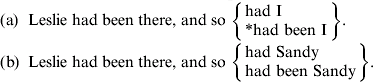
So-inversion is typically possible with a pronominal subject, but as (66) suggests, as the verbal cluster becomes more complex, a pronominal subject is less acceptable.Footnote 18
Examples of so-inversion with complex verbal clusters were found through a Web search.
- (67)
(a) As the pyramid rose, the working space would have diminished, of course, and [so would have the number of TEAMS that could simultaneously work ATOP it …]
(b) [Yet so would have been the chances of entrapping and destroying large Hezbollah forces on the GROUND …]
(c) His hair was light, and [so would have been his COMPLEXION, had it not been burned red by exposure to the hot sun of the TROPICS …]
(d) … would have taken his place – the chain of command – and that person's tasks would have been the same and [so would have been his positional LIMITATIONS …]
As Michael Rochemont points out (p.c.), these examples all have heavy subjects, suggesting the possibility of a parallel with the heavy inversion phenomenon discussed by Culicover & Levine (Reference Culicover and Levine2001).
4.3 Inversion after as
Turning next to as, simple constructed examples appear to be quite well-formed, with both pronominal and non-pronominal subjects.
- (68)
(a) Sandy is very forgetful, as is LESLIE.
(b) Sandy likes baseball, as do I.
(c) Sandy would have refused to do that, as would ISABELLA.
But when the verbal cluster is more complex, a heavier subject NP is preferred.Footnote 19
(69)

As in the case of the other SI constructions, if there is no inversion, focus is not restricted to the subject.
- (70)
(a) Sandy has been very angry, as LESLIE has (been).
(b) Sandy has been very angry, as she USUALLY is.
These examples of so- and as-inversion are characterized by the fact that they involve inversion around auxiliary verbs, including be. The so-goes construction shows that there can be inversion at least around the verb go. Examples found through a Web search show that other verbs may also show so- and as-inversion.
- (71)
(a) I got lost in the maze of narrow, twisting alleys of the Bazaar quarter – Smyrna's only district to have conserved a picturesque air, [as had noted the WRITER …]
(b) [As had noted the Chairman of Board of Tsesnabank JSC DAUREN ZHAKSYBEK], the initial sum of the deal was planning in size of $25m, but was increased …
(c) Dante has it, i.e. of the armorial device of the Visconti, [as runs the note to the passage by Shelley HIMSELF].
4.4 Locative inversion
Two related constructions that involve inversion are locative invsersion (LI) (72) and inversion around be (IAbe) (73) (the terminology is due originally to Emonds Reference Emonds1970).
- (72)
(a) Into the room hopped an extremely angry KANGAROO.
(b) Near Robin on the bench sat several half-empty boxes of Chinese TAKEOUT.
(c) In walked ROBIN, and scared the living daylights out of the rest of the CLASS.
- (73)
(a) Angriest of all was ROBIN.
(b) Less interesting is the fact that the verb is UNINFLECTED.
(c) Sitting on the bench near Robin were several half-empty boxes of Chinese TAKEOUT.
The salient property of these constructions from our perspective is that they permit verb clusters.
- (74)
(a) Into the room was hopping an extremely angry KANGAROO.
(b) Near Robin on the bench were sitting several half-empty boxes of Chinese TAKEOUT.
(c) Then, in will walk ROBIN, and scare the living daylights out of the CLASS.
- (75)
(a) Angriest of all will be ROBIN.
(b) Less interesting has been the fact that the verb is UNINFLECTED.
(c) Sitting on the bench near Robin had been several half-empty boxes of Chinese TAKEOUT.
The LI construction shares with the other focus inversion constructions the property that the postverbal subject must be focused. However, it differs from the previously discussed constructions with respect to the discourse-semantic interpretation of the focused constituent, which is presentational in this case, not contrastive or additive. As Michael Rochemont points out (p.c.), the fact that there is no required contrast leaves open the possibility that the focus is presentational. But the subject in LI can be a contrastive focus if the discourse requires it, e.g.,
(76) First, BILL came into the room, and then, into the room behind him came SALLY.
As in the other cases, there is a question about how to formally represent the idiosyncratic character of such constructions. Here we follow Culicover & Levine (Reference Culicover and Levine2001) in assuming that the subject NP remains in situ in vP. LI appears to occur only with the locational or directional interpretation; in this respect it shares some semantic properties with the constructions V one's way and V PPpath discussed by Jackendoff (Reference Jackendoff2002). Unlike CI, LI and IAbe require that Spec,IP be filled, although in these cases it may be filled by a non-NP subject. But there are many cases in which a Spec,IP that contains a non-NP subject does not permit inversion, as the following examples illustrate.
- (77)
(a) *Into the roomi pushed Sandy the baby carriage t i.
(b) *Next Tuesdayi are driving my parents to California t i.
(c) *Very angryi made Sandy Leslie t i.
The LI cases differ from the focus inversion constructions that we have discussed in this paper in two respects. First, in LI, the EPP is satisfied by a non-NP, which is not generally possible in English. Second, the focus in LI is typically presentational, not contrastive. We take the pairing of syntactic and focus properties to be irreducible characteristics of the individual constructions.
4.5 Apparent SAI
Finally, consider the following naturally occurring examples. These constitute apparent counterexamples to Merchant's claim that SAI in CI necessarily requires VP ellipsis, and to our claim that apparent SAI in CI is actually multiple focus on the subject and the VP.
- (78)
(a) National treasures should not be available for local groups that are often funded and affiliated with national groups with much deeper pockets for their vested interests [than do I have as an individual sending in one LETTER].
(b) Over the years I find that I have a lot more patience [than do I have MONEY].
(c) I no more ‘have’ a DENTIST than do I (for similar reasons of associated misery) have a PENSION, …
We do not have an explanation for why these cases are possible. However, we note that they display some idiosyncrasies of their own. The examples in (78) are the only ones found in a search of the Web. They appear to be restricted to than do I have – for example, we find no valid examples of than does he V …, than will I V …, than do we V …, than do you V …, and so on; e.g.,
- (79)
(a) *Over the years, I found that you had a lot more patience than did you have MONEY.
(b) *Over the years, we find that we have a lot more patience than do we have MONEY.
(c) *Over the years, I find that you have a lot more patience than do you have MONEY.
The acceptable cases in (78) are in fact paraphrases of than I have –
(80) Over the years, I find that I have a lot more patience than I have MONEY.
– which raises the possibility that do is inserted epenthetically for prosodic or rhythmic purposes.
5. Summary and conclusions
In this paper we have shown that the SI constructions differ syntactically from canonical sentences in English in one crucial respect, which is that the subject follows the material in the verbal auxiliary rather than precedes it. We argue that in other respects these constructions are fully regular, in that they articulate with focus in such a way as to express contrast.
We have argued that the generalizations about these constructions are best understood if we treat these subjects as being in situ. If this perspective is correct, the question arises as to how this property is to be implemented within a formal grammatical treatment.
Throughout the paper we have couched the post-verbal subject property in terms of ‘not satisfying EPP’. However, as far as we can see, the phenomena that we have discussed are neutral with respect to the particular grammatical framework in which they are described. Therefore, to the extent possible, we have tried to avoid making any theoretical claims based on our analysis. The overarching conclusion that we derive from our study is that regardless of the theoretical framework, some way has to be found to capture the fact that these focus constructions have subjects in a non-canonical position, and that this position has particular properties with respect to focus.
Thus, if we approach these phenomena from the perspective of minimalism, some way has to be found to suspend the EPP in a comparative clause introduced by than or as. One might stipulate, for example, that than/as optionally select IP complements with a ‘weak’ EPP feature. Similar devices will have to be used for other focus constructions. The important point here is that a special mechanism needs to be invoked in order to capture the non-canonical property of the construction.
Similarly, it would be possible to implement the non-canonical property of these focus constructions in an OT treatment, by linking them to a non-canonical ranking of constraints. For cases in which the subject remains in situ, the constraint that aligns a constituent with the right edge would be ranked above the constraint that positions a subject in Spec,IP. Thus these constructions in English would bear the same relationship to the canonical structure of English that the canonical structure of Italian does; see Samek-Lodovici Reference Samek-Lodovici2004.
Another alternative would be to pursue a construction grammar approach, in which the possibility of a post-verbal subject in these constructions is explicitly stipulated as part of the grammatical description of the language. On such an approach, all that needs to be said is that the subject follows the verbal auxiliary – the focus properties and all ordering relations within the sentence follow from the general principles for the language, as outlined in this paper. In fact, it is standard in construction grammar to define constructions in terms of both idiosyncratic and non-idiosyncratic properties (see for example Fillmore et al. Reference Fillmore, Kay and O'Connor Catherine1988 and Sag Reference Sag1997).
The main point of our discussion is that the phenomenon of focus constructions is one that can be accommodated within any approach in which it is possible to stipulate the non-canonical position of the subject and connect it to the requirement of obligatory subject focus. It is the nature of such constructions that they are otherwise fully regular, and can therefore be fully integrated into a more general account of the syntax–information structure interface.


