Infections caused by carbapenem-resistant Enterobacteriaceae (CRE), mostly carbapenem-resistant Klebsiella pneumonia (CRKP) species, are a major public health threat worldwide.Reference Schwaber and Carmeli 1 – Reference Hidron, Edwards and Patel 5 Available therapeutic options are scarceReference Hirsch and Tam 6 and are of disputed efficacy.Reference Van Duin, Kaye, Neuner and Bonomo 7 The attributable mortality rate of CRKP infections ranges from 37% to 50% globally.Reference Schwaber, Klarfeld-Lidji, Navon-Venezia, Schwartz, Leavitt and Carmeli 2 , Reference Patel, Huprikar, Factor, Jenkins and Calfee 8 , Reference Borer, Saidel-Odes and Riesenberg 9 Special enhanced infection control measures that include cohorting of carriers and treatment by a dedicated staff have been introduced to limit the spread of CRE. 10 – Reference Schwaber and Carmeli 13 Containment of CRE transmission in Israel was strongly correlated with compliance with these guidelines and in some reports with screening for CRE carrier status. 10 , Reference Ben-David, Maor and Keller 14
CRE carriers often have poor functional statusReference Schwaber, Klarfeld-Lidji, Navon-Venezia, Schwartz, Leavitt and Carmeli 2 , Reference Marchaim, Chopra and Perez 15 and are prone to hospital readmissions,Reference Marchaim, Chopra and Perez 15 – Reference Emerson, Eyzaguirre, Albrecht, Comer, Harris and Furuno 17 creating a significant, though highly variable, risk for cross-transmission (6%–58%).Reference Ciobotaro, Oved, Nadir, Bardenstein and Zimhony 12 , Reference Won, Munoz-Price, Lolans, Hota, Weinstein and Hayden 18 , Reference Souli, Galani and Antoniadou 19 Identifying the CRE carrier status upon admission by rectal culture is a precautionary measure, yet it requires 48–72 hours from sample collection to final results.Reference Landman, Salvani, Bratu and Quale 20 Molecular methods are attractive alternativesReference Schechner, Straus-Robinson and Schwartz 21 ; however, their availability is limited and cost-effectiveness is uncertain.
One of the vexing challenges for inpatient management of CRE-colonized patients is the empirical determination of infection control measures for returning CRE carriers. Patients with prolonged CRE carriage present a constant risk of CRE transmission to other hospital patients; therefore, it is critical that carriers are isolated within a CRE cohort. If a persistent CRE carrier is incorrectly assigned out of the CRE cohort, he or she is placing other patients at risk for cross transmission. If a patient is identified as being CRE positive, an intrahospital transfer into the CRE cohort would be required, and former roommates need to be tested for possible CRE cross transmission. Conversely, a past carrier of CRE who is placed within the CRE cohort, but is later identified as CRE negative from the readmission screening, is at a higher risk of reacquiring CRE. Moreover, detectable CRE carriage can fluctuate, and recurring CRE detection has been reported.Reference Feldman, Adler and Molshatzki 22 Recurrence can be related to either reacquisition or to a false-negative test result upon readmission arrival, reflecting a transient decrease in bacterial counts below the detection limit. Thus, the primary prediction of CRE carriage risk upon readmission has implications for the ensuing hospitalization. This information can be used to guide appropriate infection control measures from the outset as well as additional follow-up screening to detect recurrence of CRE carriage.
Although predictors for CRE acquisition have been studied,Reference Schwaber, Klarfeld-Lidji, Navon-Venezia, Schwartz, Leavitt and Carmeli 2 , Reference Patel, Huprikar, Factor, Jenkins and Calfee 8 , Reference Hussein, Raz-Pasteur and Finkelstein 23 the predictors for carriage of CRE upon readmission remain poorly defined.Reference Feldman, Adler and Molshatzki 22 , Reference Zimmerman, Assous, Bdolah-Abram, Lachish, Yinnon and Wiener-Well 24 – Reference Ben-David, Masarwa and Navon-Venezia 26 We conducted a retrospective cohort study of CRE carriers who were readmitted to identify predictors for persistent CRE carriage and to develop a prediction score to estimate this risk.
METHODS
Setting and Data Sources
Kaplan Medical Center (KMC) is a 535-bed, university-affiliated general hospital with 42,500 adult admissions annually and a 30-day readmission rate of 17.7%. An intervention program for CRE containment was implemented at KMC in February 2007.Reference Ciobotaro, Oved, Nadir, Bardenstein and Zimhony 12 The Infectious Diseases Unit maintains a detailed computerized database of CRE carriers. In addition, clinical data were collected from KMC’s electronic health records. The study was approved by the KMC Institutional Review Board.
Study Design and Population
This retrospective cohort study included all readmissions of patients who were identified as CRE carriers at an index hospitalization with at least 1 readmission to KMC between January 1, 2006, and December 31, 2012 (Figure 1). A CRE carrier was defined as any patient who had a CRE-positive culture, obtained either rectally at screening or clinically (based on the patient’s medical status). When tested at the time of readmission, patients could have either a positive CRE culture (positive CRE status, persistent carrier) or a negative CRE culture (negative CRE status). From June 2007, any patient with a history of CRE carriage was rescreened for CRE upon readmission. Infection control measures implemented prior to CRE screening results were determined at the discretion of the infection control unit.
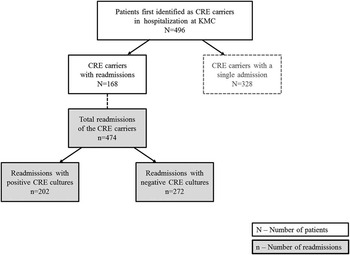
Study enrolment of 168 carbapenem-resistant Enterobacteriaceae (CRE) carriers with 474 readmissions. A total of 496 patients were identified as CRE carriers (index hospitalization) in Kaplan Medical Center (KMC) throughout 2006–2012, the study period. A total of 168 of the CRE carriers were readmitted with overall 474 readmissions. In 202 of these readmissions (42.6%), the patients had positive CRE cultures indicating persistent carriage.

Microbiologic Analysis
CRE isolates were identified using the VITEK2 automated microbiology system (bioMerieux, Marcy l’Etoile, France), CHROMagar KPC (Hy-Labs, Rehovot, Israel),Reference Samra, Bahar, Madar-Shapiro, Aziz, Israel and Bishara 27 and the modified Hodge testReference Anderson, Lonsway and Rasheed 28 according to Clinical and Laboratory Standards Institute guidelines. 29 Antibiotic susceptibility profiling was performed automatically using the VITEK 2 system, and epsilometer tests (Etests) were used to determine the minimal inhibitory concentration for the carbapenems colistin and tigecyclin.
Outcome Variables
The primary outcome was CRE carriage at readmission and the secondary outcome was length of CRE carriage.
CRE Predictor Variables
Different variables were tested as possible predictors of CRE carriage at readmission: demographic characteristics, origin of admission [home or long-term care facility (LTCF)], chronic comorbidities, source of CRE culture (screening/clinical culture), variables from preceding admissions (CRE carriage status, medical status, antibiotic treatment), time between last discharge and the current admission, clinical status on readmission, and Norton score (Table 1).
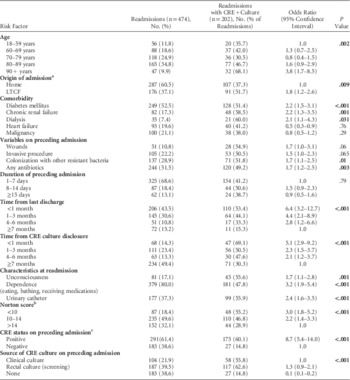
Characteristics of 474 Readmissions of Carbapenem-Resistant Enterobacteriaceae (CRE) Carrier Patients (n=168) and Results of an Univariate Risk Factors Analysis for Being Persistent CRE Carrier on Readmission

NOTE. CRE, carbapenem-resistant Enterobacteriaceae; LTCF, long-term care facility.
a Data missing for 11 readmissions.
b Norton pressure sore risk assessment score; high Norton score (>14): low–medium risk; medium Norton score (10–14): high risk; low Norton score (<10): very high risk.Reference Norton, McLaren and Exton-Smith 30
c All readmissions were of positive CRE carriers on their index hospitalization. On readmission, cultures could be either positive or negative for CRE.
The Norton scoreReference Norton, McLaren and Exton-Smith 30 predicts the risk of pressure sore development and ranges between 5 to 20: low (<10) indicates very high risk, 10–14 indicates high risk, 15–18 indicates intermediate risk, and high (>18) indicates low risk. The intermediate-risk and low-risk groups (Norton score >14) were combined because the rate of CRE positive cultures was similar for these 2 risk groups. For readmissions with a missing Norton score (7.2%), we assigned a Norton score >14 based on the observation that the rate of CRE positivity for these patients is similar to that group.
Statistical Analysis
We calculated descriptive statistics for the predictor variables for all readmissions of patients who were CRE carriers at an index hospitalization. Univariate analysis by χ2 test was applied for categorical variables and by ANOVA test for continuous variables. All analyses were performed using SPSS software (version 20).
Prediction model development and validation
A multivariable analysis using the generalized estimating equations (GEE) modelReference Zeger and Liang 31 , Reference Hanley, Negassa, Edwardes and Forrester 32 was used to assess whether the variables found in the univariate analysis were significantly associated with CRE carriage at readmission. The GEE model accounts for clustering of multiple admissions among patients. We used a split sample design to derive and internally validate the prediction model. Patients were randomly assigned to either the derivation set (~70%, n=322) or validation set (~30%, n=152). Readmissions of a given patient could be considered for only 1 set.
We used the GEE analysis on the derivation set and employed the estimated probability of CRE carriage as a discriminant for positive CRE carriage, which we evaluated using the C statistic (ie, the probability that predicting the outcome is better than chance).
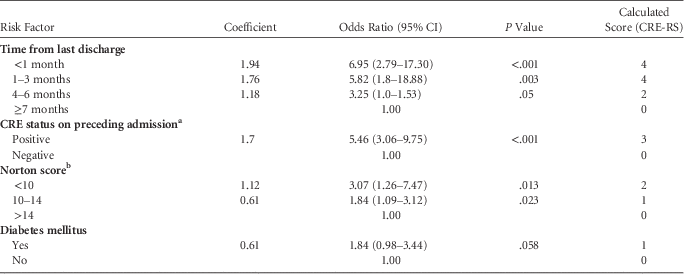
A prediction score was derived for CRE carriage on readmission, a CRE readmission score (CRE-RS), according to the variables identified in the GEE analysis. To form a convenient and rounded point score, we multiplied each of the model coefficients by 2. The integer values from all applicable factors were then added to estimate a total score for each patient. These scores ranged from 0 to 10 and were divided into 3 risk categories; higher scores indicated increasing probability for CRE carriage at readmission.
The developed CRE-RS was tested on the derivation set and was compared with the GEE model to determine accuracy. To confirm its possible utility, we tested its categories on the validation set.
Duration of carriage
The duration of CRE carriage from the first positive CRE culture to the last readmission with negative CRE culture (indicating clearance) or until the last readmission with positive CRE culture (indicating persistence) was estimated using the Kaplan-Meier survival model.
RESULTS
Readmitted Patients
During the 7-years of the study period, 496 CRE carriers were admitted to KMC. Among them, 168 CRE carriers, accounting for a total of 474 readmissions, were eligible for the study (Figure 1). Among the 168 CRE carriers with readmissions, 59% were women and 57% were aged 80 or older. CRE strains included Klebsiella pneumonia (163 patients), Enterobacter cloacae (2 patients), and Enterobacter amnigenus, Escherichia coli, and Klebsiella oxytoca (1 patient each). Of these patients, 60% had ≥2 readmissions during the study period. The 30-day readmission rate of CRE carriers was 43.5% , compared with only 17.7% readmission rate to KMC during the study period.
Predictors of CRE Carriage at Readmission on Univariate Analysis
For 202 of the 474 readmissions (42.6%), the CRE status was positive, involving 91 of the 168 CRE carriers. Of the 202 positive CRE readmissions, 185 readmissions were detected by screening cultures. Overall, 15 demographic and clinical variables in the univariate analysis were statistically significant predictors of CRE carriage at readmission. The rate of positive CRE cultures at readmission declined with time from the last discharge, decreasing from 53.4% (110 of 202) among those who returned within 1 month to 15.3% (11 of 202) among those who returned ≥7 months after the index admission (P<0.001). CRE carriage at readmission was correlated with increasing age and readmission from an LTCF. More than half (51.7%) of the CRE carriers who were readmitted from an LTCF (37.1% of the readmissions) had CRE positive cultures, as opposed to 37.3% in patients who were readmitted from their homes (P=0.009).
Colonization with other resistant bacteria, antimicrobial therapy on preceding hospitalization, and several chronic comorbidities were also significantly associated with CRE carriage upon readmission. Additional results are presented in Table 1.
Predictors of CRE Carriage upon Readmission on Multivariable Analysis
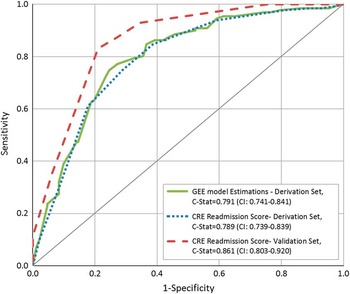
Using a GEE analysis, 4 factors were found upon readmission to significantly predict CRE carriage: readmission within 1 month since the last discharge (OR, 6.95; P<0.001; 95% CI, 2.79–17.30), positive CRE status at the preceding admission (OR, 5.46; P<0.001; 95% CI, 3.06–9.75), low Norton score (OR, 3.07; P=0.013; 95% CI, 1.26–7.47), and diabetes mellitus diagnosis (OR, 1.84; P=0.058; 95% CI, 0.98–3.44) (Table 2). In the univariate analysis, patient age, admission from a LTCF, and the presence of wounds were related to CRE carriage on readmission; these variables were not significant in the GEE analysis. This finding is likely due to the high correlation of these variables with the Norton score (multicollinearity phenomena; data not shown). The C statistic for the GEE model in the derivation set was 0.791 (95% CI, 0.741–0.841) (Figure 2).
Receiver operating characteristics (ROC) curves of the generalized estimating equations (GEE) model. The GEE model of the derivation set is compared to the carbapenem-resistant Enterobacteriaceae readmission scores (CRE-RS) of the derivation set and validation set.

Risk Factors of Carbapenem-Resistant Enterobacteriaceae (CRE) Carriage on Readmissions of Known CRE Carriers in the Final Multivariable Model

NOTE. Values are given for proportions with coefficients, odds ratio and P values. A calculated score for prediction of CRE carriage on readmission was derived from the coefficients.
CRE, carbapenem-resistant Enterobacteriaceae; CRE-RS, CRE readmission score.
a All readmissions were of patients found to be CRE carriers on their index hospitalization. On the preceding readmission, cultures could be either positive or negative for CRE.
b Norton pressure sore risk assessment score; high Norton score (>14): low–medium risk; medium Norton score (10–14): high risk; low Norton score (<10): very high risk.Reference Norton, McLaren and Exton-Smith 30
Prediction Score Derivation and Validation
A CRE-RS was established based on the predicting variables identified in the GEE model. The C statistic for the derivation set of the score was 0.789 (95% CI, 0.739–0.839). The curves of the GEE model and the CRE-RS nearly overlapped, indicating very close performance of the proposed score and the multivariable model. The C statistic for the validation set of the score was 0.861 (95% CI, 0.803–0.920) (Figure 2).
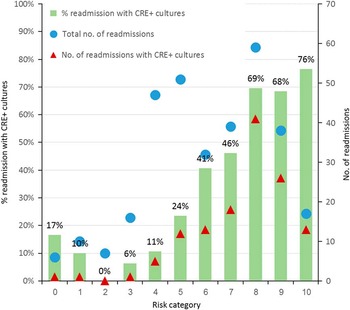
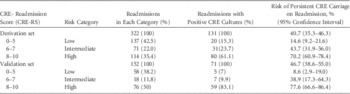
The risk of persistent CRE carriage on readmission ranged from 0 to 76% in each risk category according to the derivation set illustrated in Figure 3. The proximity between the risks in several risk categories enabled us to group the 11 risk points (0–10) into low (0–5), intermediate (6–7), and high (8–10) risk groups. For a patient in the high-risk group, the risk for positive CRE culture on readmission was 70.2% (95% CI, 60.9–78.4) in the derivation set and 77.6% (95% CI, 66.6–86.4) in the validation set. For a patient in the low-risk group, the risk for CRE carriage on readmission was 14.6% in the derivation set (95% CI, 9.2–21.6) and 8.6% in the validation set (95% CI, 2.9–19.0). The groups with low and high scores constituted 78% (251 of 322) or 88% (134 of 152) of the readmissions in the derivation and validation sets, respectively. The remaining readmissions with intermediate scores (6–7) had a 43.7% risk (95% CI, 31.9–56.0) for CRE carriage upon readmission in the derivation set and a 38.9% risk (95% CI, 17.3–64.3) in the validation set (Table 3).
Risk assessment of carbapenem-resistant Enterobacteriaceae (CRE) carriage. The proposed carbapenem-resistant Enterobacteriaceae readmission score (CRE-RS) of the derivation set ranges between 0 and 10. The bars show the proportion of readmissions of CRE carriers with positive CRE cultures in every risk score category. The circles and the triangles show the absolute numbers of CRE carriers' readmissions and CRE carriers' readmissions with positive CRE cultures, respectively.

Grouped Risk Categories of Carbapenem-Resistant Enterobacteriaceae Carriage on Readmission of the Proposed Carbapenem-Resistant Enterobacteriaceae Readmission Score (CRE-RS) in the Derivation and Validation Sets

NOTE. CRE, carbapenem-resistant Enterobacteriaceae; CRE-RS, carbapenem-resistant Enterobacteriaceae readmission score.
Duration of CRE Carriage
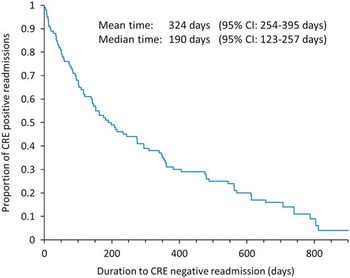
A Kaplan-Meier curve for CRE carriage was derived for the 168 CRE carriers (Figure 4). The mean time to CRE clearance was 324 days (95% CI, 254–395 days) and the median time to CRE clearance was 190 days (95% CI, 123–257 days). One year after the index hospitalization, approximately one-third of patients remained CRE carriers at readmission; 2 years after the index hospitalization, 15% remained CRE carriers. Ultimately, CRE carriage may extend up to 30 months after the index hospitalization.
Kaplan-Meier curve for cumulative survival function of carbapenem-resistant Enterobacteriaceae (CRE) clearance. The curve shows time until the CRE screening and clinical cultures of 168 CRE carriers were negative upon 474 readmissions.

DISCUSSION
CRE carriers are often elderly patients with multiple comorbiditiesReference Schwaber, Klarfeld-Lidji, Navon-Venezia, Schwartz, Leavitt and Carmeli 2 , Reference Marchaim, Chopra and Perez 15 who tend to experience rehospitalizations,Reference Marchaim, Chopra and Perez 15 – Reference Emerson, Eyzaguirre, Albrecht, Comer, Harris and Furuno 17 which consequently pose a threat of cross infection of CRE. Therefore, prediction of CRE carrier status upon readmission is important for supporting screening policies and infection control measures.
Our study identified 4 factors that significantly predict risk of persistent CRE carriage at readmission with strong discrimination: short time from the last discharge, positive CRE-status on preceding admission, low Norton score, and diabetes mellitus.
Our finding that one-third of the patients in which CRE carriage persisted 1 year after their index hospitalization is alarming, although the results are in accord with those of other recent studies. One study showed that 39% of CRE carriers still presented positive CRE cultures 1 year after hospitalization.Reference Zimmerman, Assous, Bdolah-Abram, Lachish, Yinnon and Wiener-Well 24 In another study, 30% of CRE carriers residing in LTCFs remained positive after 10 months.Reference Ben-David, Masarwa and Navon-Venezia 26 Furthermore, our study showed that CRE carriage can be very long, up to 30 months.
As stated, readmissions of CRE-positive patients are common; 60% had ≥2 readmissions in our cohort. The 30-day readmission rate is also as high as 43.5%, more than twice the general rate for readmissions during the study period and in a previous study at KMC.Reference Balla, Malnick and Schattner 33 More than half (53.4%) of these patients were still positive for CRE, creating a substantial burden for the healthcare system.
According to previous studies, the risk factors for prolonged CRE carriage among LTCF residents included antibiotic exposure within the preceding 3 months and screening within 90 days of the first positive culture results.Reference Ben-David, Masarwa and Navon-Venezia 26 The presence of any catheter, LTCF residency, low functional status, and Charlson score were risk factors of persistent CRE carriage after discharge.Reference Feldman, Adler and Molshatzki 22 Another study, which also included outpatients, revealed that previous hospitalizations and clinical CRE cultures, rather than screening cultures, predict prolonged CRE carriage.Reference Zimmerman, Assous, Bdolah-Abram, Lachish, Yinnon and Wiener-Well 24 Our study focused on readmissions to an acute care hospital in which readmitted patients presented with worsening clinical conditions that were likely associated with higher rates of persistent CRE carriage.
The predictor variable for CRE carriage on readmission with the highest odds ratio was time from last discharge. The shorter the time between admissions, the higher the odds ratio for CRE carriage. Conversely, it is plausible that a patient who does not require readmission for a longer time is less likely to maintain resistant bacteria that are associated with increased morbidity and poor general condition. The second ranked factor was positive CRE status at the preceding admission indicating that this factor is a major predictor of carriage on subsequent admission. The third ranked factor was a low Norton score, which predicts the potential patients who will develop pressure sores.Reference Norton, McLaren and Exton-Smith 30 The Norton score has also proven useful for predicting rehabilitation outcome and post-surgery complications.Reference Justo, Vislapu and Shvedov 34 , Reference Gold, Sever, Lerman, Salai and Justo 35 Few studies have examined the role of the Norton score as a predictor of resistant bacteria carriage,Reference Ben-David, Masarwa and Navon-Venezia 26 , Reference Adler, Gniadkowski and Baraniak 36 and our study is the first, to our knowledge, to describe the utility of this score in the prediction of persistent CRE carriage. The susceptibility of patients at high risk of pressure sores for resistant bacteria carriage can be ascribed to healthcare institution admissions and increased nursing needs, which create more opportunities for cross-transmission in bedridden patients who often require antimicrobial therapy.Reference Lim, Cheng and Kennon 37 , Reference O’Sullivan and Keane 38 Finally, diabetes mellitus was examined as a predictor for the multivariable prediction model despite its borderline statistical significance because it is a known risk factor for CRE and other resistant bacteria carriage.Reference McKinnell, Miller, Eells, Cui and Huang 39 Diabetes was previously suggested, using univariate analysis, to increase the risk of CRE carriage by 10%–45%Reference Schwaber, Klarfeld-Lidji, Navon-Venezia, Schwartz, Leavitt and Carmeli 2 , Reference Borer, Saidel-Odes and Riesenberg 9 ; our univariate analysis results are in accord with these findings (Table 1).
The weighted scores of these variables allow for the derivation of a total point score for each patient. The overlapping receiver operating characteristics (ROC) curves of the derivation and validation sets of the score showed that the model calibration was reliable and that the percentage of CRE positive cultures was strongly correlated with the proposed CRE-RS. None of the strata were significantly different between the derivation and validation sets.
A high CRE-RS of 8–10 points predicted positive carriage state in 77.6% of readmissions in the validation set (Table 3). This high score signifies a strong indication for the enhanced precautions used for CRE carriers. 10 – Reference Ciobotaro, Oved, Nadir, Bardenstein and Zimhony 12 In contrast, patients with a low score of ≤5 points have low probability of CRE carriage (8.6% in the validation set). The high and low scoring groups, which bear high certainty of their predicted CRE status on readmission, comprise 88% of the readmitted CRE carriers (Table 3). For patients with an intermediate score of 6–7 points, application of contact precautions (as for other resistant bacteria carriers) and a single-patient room (if possible) while results of CRE screening are pending is a reasonable approach to preventing cross-infection. Derivation of CRE-RS upon every readmission can enable adjustment of the precautions needed.
The identified predictors and the derived score present several potential advantages for healthcare providers. First, these predictors are readily and immediately accessible in hospital medical databases when a patient is admitted. Second, allocation of patients to the most appropriate isolation setting upon arrival, while screening results are pending, would reduce intrahospital transfers, which are time-consuming and adversely affect patient management.Reference Day 40 Third, it would reduce cross infection to roommates. Fourth, institutions with limited resources may prioritize screening for patients with an intermediate score. Finally, CRE-RS may guide the frequency of follow-up CRE screening cultures for patients with either intermediate or high scores that were negative for CRE on initial screening at readmission. These patients may be more prone to reacquisition or more likely to experience reamplification of underdetected CRE strains. They also may require further testing for CRE conversion as well as additional enhanced precautions during long hospitalizations or while in LTCFs.
This study shows that prediction of a patient’s CRE carrier status upon readmission to the hospital can be achieved with reasonable accuracy and can direct infection control measures and inform rescreening decisions in real time. Additionally, a scoring tool can guide the administration of follow-up cultures in known past CRE carriers who tested negative upon initial screening.
ACKNOWLEDGMENTS
We thank Dimitri Drapkin for his technical assistance in data extraction; Harel Eilat for his editing support; and Chandra Cohen, Jenna Berent and Sydney Krispin for their critical reviews of the article.
Financial support. No financial support was provided relevant to this article.
Potential conflicts of interest. All authors report no conflicts of interest relevant to this article.