Implications
The present study evaluated some cytochrome P450 enzyme activities in liver microsomes from uncastrated male pigs, surgically castrated pigs and pigs immunized against gonadotropin-releasing hormone (immunocastrated pigs). We found that CYP1A1, CYP2A, CYP2B and CYP2E1 activities were lower in uncastrated male pigs compared with surgically castrated and immunocastrated pigs. These findings strengthen the hypothesis of testicular steroid involvement in cytochrome P450 enzyme regulation. The differences in the activities of CYP2A and CYP2E1 between intact and castrated male pigs are especially interesting because those two enzymes are essential in the metabolism of skatole – one of the contributors to boar taint.
Introduction
Quantitatively, the liver is a key organ for drug metabolism. Cytochromes P450 (CYP450) are the principal enzymes for the oxidative metabolism of most drugs used clinically as well as a wide variety of endogenous compounds, including steroid hormones (Tsuchiya et al., Reference Tsuchiya, Nakajima and Yokoi2005). CYP450 are also involved in the metabolic activation of many chemical carcinogens and toxins. Thus, alteration of the activities of these enzymes may have considerable consequences not only for the metabolic disposition of the drug, but may lead to diverse disturbances of some important hepatic functions.
CYP450 in pigs have recently attracted considerable attention for several reasons. First, general knowledge about the effects of industrial pollutants and pharmacologically active substances is important in veterinary science (Szotáková et al., Reference Szotáková, Baliharová, Lamka, Nozinová, Wsól, Velík, Machala, Neca, Souček, Susová and Skálová2004). Second, CYP450 in food-producing animals, including pigs, are crucial in the regulation of the amounts of drugs and other chemicals in animal tissues and possibly food products for human consumption and animal feeding stuffs. Finally, the importance of an animal model in human medicine is evident, facilitating research in human endocrinology and toxicology. There is a growing interest in using pigs as an animal model due to the many similarities between porcine and human liver drug-metabolizing enzymes (Monshouwer et al., Reference Monshouwer, Van’t Klooster, Nijmeijer, Witkamp and Van Miert1998).
Of the xenobiotic metabolizing P450s, CYP1A and CYP2B families are particularly of interest due to their ability to metabolically activate and inactivate a number of chemical carcinogens and environmental contaminants. The activities of CYP1A1 and CYP1A2 are usually measured as a rate of the O-dealkylation of ethoxy- and methoxyresorufin, respectively (Burke et al., Reference Burke, Thompson, Weaver, Wolf and Mayer1994; Machala et al., Reference Machala, Souček, Neca, Ulrich, Lamka, Szotáková and Skálová2003), though certain non-specificities of resorufin substrates were found in different species. CYP2B activities can be measured as a rate of the O-dealkylation of pentoxyresorufin (Burke et al., Reference Burke, Thompson, Weaver, Wolf and Mayer1994; Machala et al., Reference Machala, Souček, Neca, Ulrich, Lamka, Szotáková and Skálová2003). In pigs, CYP2E1 and CYP2A are both involved in the metabolism of skatole, a major cause of faecal-like odour in meat from entire male pigs (Diaz and Squires, Reference Diaz and Squires2000). CYP2A activities in biological samples are usually estimated as a rate of coumarin 7-hydroxylation (Souček, Reference Souček1999; Diaz and Squires, Reference Diaz and Squires2000). p-Nitrophenol hydroxylation is often used as a marker of CYP2E1 (Koop et al., Reference Koop, Laethem and Tierney1989; Sohn et al., Reference Sohn, Fiala, Requeijo, Weisburger and Gonzalez2001). In pigs, however, the selectivity of this substrate is somewhat questionable, given that in porcine liver microsomes, p-nitrophenol is partially metabolized by CYP2A (Skaanild, Reference Skaanild2006).
The role of gender in the activities of some CYP450 enzymes is well established in many species, e.g., humans (Parkinson et al., Reference Parkinson, Mudra, Johnson, Dwyer and Carroll2004; Scandlyn et al., Reference Scandlyn, Stuart and Rosengren2008), rats (Mugford and Kedderis, Reference Mugford and Kedderis1998), minipigs and conventional pigs (Skaanild and Friis, Reference Skaanild and Friis1999; Zamaratskaia et al., Reference Zamaratskaia, Chen and Lundström2006). Castration of Meishan male pigs resulted in increased mRNA, protein levels and activities of CYP1A enzymes (Kojima et al., Reference Kojima, Sekimoto and Degawa2008). Whittington et al. (Reference Whittington, Nute, Hughes, McGivan, Lean, Wood and Doran2004) demonstrated that castration of Meishan × Large White male pigs was associated with increased expression of hepatic CYP2E1 protein.
Active immunization against gonadotropin-releasing hormone (GnRH), so-called immunocastration, can be used in domestic animals to control fertility and aggressive behaviour (Thompson, Reference Thompson2000). In pigs, immunocastration is a particularly attractive alternative to surgical removal of the testes since it reduces the levels of androstenone and skatole, the major components of boar taint (Bonneau et al., Reference Bonneau, Dufour, Chouvet, Roulet, Meadus and Squires1994; Jaros et al., Reference Jaros, Bürgi, Stärk, Claus, Hennessy and Thun2005). To the best of our knowledge, no studies on either the expression or catalytic activities of CYP450 have been performed on immunocastrated animals. Since immunization against GnRH causes a reduction in testicular steroid levels, it might indirectly affect activities of CYP450 enzymes, which are under regulation of steroids.
As hepatic activities of CYP450 are known to vary in response to altered physiological conditions, the aim of this study was to investigate the effects of surgical castration and immunization against GnRH on the activities of some enzymes in pig liver microsomes. The activities of the following enzymes were measured: ethoxyresorufin-O-deethylase (EROD, CYP1A1/1A2), methoxyresorufin-O-deethylase (MROD, CYP1A2), pentoxyresorufin-O-depentylase (PROD, CYP2B), coumarin hydroxylase (COH, CYP2A) and p-nitrophenol hydroxylase (PNPH, CYP2A/2E1). This choice was based on existing knowledge on sexual dimorphism of CYP450 enzymes in pigs (Gillberg et al., Reference Gillberg, Skaanild and Friis2006; Zamaratskaia et al., Reference Zamaratskaia, Chen and Lundström2006; Kojima et al., Reference Kojima, Sekimoto and Degawa2008). Effects of testosterone, 17β-estradiol, free estrone and androstenone on the activities of these enzymes in porcine liver microsomes were also investigated.
Material and methods
Animals
The experiment was performed in accordance with Swedish regulations for the use of animals. Pigs were born and raised at the Swedish University of Agricultural Sciences, Funbo-Lövsta experimental station. The study was part of a larger project on the effects of a GnRH vaccine (Improvac; Pfizer Ltd, formerly CSL Ltd, Parkville, Victoria, Australia) on performance in entire male pigs and meat quality. Details about the rearing of the animals are given in Zamaratskaia et al. (Reference Zamaratskaia, Andersson, Chen, Andersson, Madej and Lundström2008). A total of 47 pigs (Swedish Yorkshire dams × Swedish Landrace sires) included in the current study were randomly selected from the larger project. From those pigs, 16 were surgically castrated before 1 week of age, and 15 pigs were given Improvac containing a modified form of GnRH (200 μg GnRH–protein conjugate/ml) in an aqueous adjuvant system. Vaccination was performed twice, 4 weeks apart, with the first injection given 8 weeks prior to slaughter (live weight, mean ± s.d., 57.8 ± 7.6 kg) and the second injection 4 weeks prior to slaughter (live weight 89.5 ± 9.5 kg) as described elsewhere (Zamaratskaia et al., Reference Zamaratskaia, Andersson, Chen, Andersson, Madej and Lundström2008). The remaining 16 male pigs were kept intact throughout the study. No placebo injection was given to the surgically castrated animals. Liver samples were taken at slaughter, frozen in liquid nitrogen and stored at −80°C for later enzymatic assays.
Preparation of liver microsomes and total cytochrome P450 content
The microsomal fraction was prepared from liver homogenate by the Ca-aggregation method described by Nicolau-Solano et al. (Reference Nicolau-Solano, McGivan, Whittington, Nieuwhof, Wood and Doran2006) with minor modifications. Briefly, 2.5 g of frozen liver tissue was homogenized with 5 ml of ice-cold 10 mM Tris–HCl buffer containing 250 mM sucrose at pH 7.4. The homogenate was centrifuged at 10 000 × g for 10 min at 4°C to separate mitochondria from the postmitochondrial fraction. To the supernatant, 8 mM of calcium chloride was added, well-mixed and allowed to stand at 4°C for 4 min. Then, the supernatants were centrifuged at 25 000 × g for 30 min at 4°C to separate the microsomal and cytosolic fractions. The resulting pellet of microsomes was resuspended in 50 mM Tris–HCl containing 0.1 mM ethylenediaminetetraacetic acid and 20% glycerol at pH 7.4. The microsomal protein was assayed with a commercially available kit (Bio-Rad laboratories Inc., Hercules, CA, USA) according to the manufacturer’s instructions, using bovine serum albumin as a standard. Samples were stored in small aliquots at −80°C until required for assay. Enzyme activity assays were performed within 2 months of microsomal preparations.
The total CYP450 content in liver microsomes was determined by the spectrophotometric method of Omura and Sato (Reference Omura and Sato1964) measuring the differences in the spectra (dithionite + carbon monoxide) − dithionite.
Microsomal enzyme activities
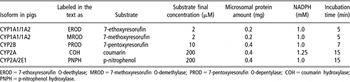
Catalytic activities of CYP1A1/1A2, CYP1A2 and CYP2B were estimated as a rate of 7-ethoxyresorufin O-deethylation, 7-methoxyresorufin O-demethylation and 7-pentoxyresorufin O-depentylation, respectively. The incubations were performed as described by Hanioka et al. (Reference Hanioka, Tatarazako, Jinno, Arizono and Ando2000) and Wanwimolruk and Wanwimolruk (Reference Wanwimolruk and Wanwimolruk2006) with slight modifications and adjustments for MROD and PROD (Table 1). Briefly, incubations in a final volume of 0.5 ml contained microsomal protein, appropriate substrate dissolved in dimethylsulphoxide (DMSO) and NADPH in incubation buffer (50 mM phosphate buffer, pH 7.4). The amount of DMSO was 2.0 μl (EROD; MROD) or 5 μl (PROD) in 0.5 ml incubation volume. After incubation at 37°C, 0.5 ml of cold methanol was added to stop the reaction. The reaction mixture was centrifuged at 7500 × g at 4°C for 5 min, and the amount of resorufin formed in the resulting supernatant was measured using HPLC with fluorescence detector (excitation and emission wavelengths of 560 and 586 nm, respectively) (Wanwimolruk and Wanwimolruk, Reference Wanwimolruk and Wanwimolruk2006).
Experimental conditions for enzyme activities assays in porcine liver microsomes

EROD = 7-ethoxyresorufin O-deethylase; MROD = 7-methoxyresorufin O-demethylase; PROD = 7-pentoxyresorufin O-depentylase; COH = coumarin hydroxylase; PNPH = p-nitrophenol hydroxylase.
Catalytic activities of CYP2A/2E1 and CYP2A were measured as a rate of p-nitrocatechol formation from p-nitrophenol and as a rate of 7-hydroxycoumarin formation from coumarin, respectively, as described earlier (Zamaratskaia et al., Reference Zamaratskaia, Chen and Lundström2006), with slight modifications (Table 1). To measure 7-hydroxycoumarin concentration, 10 mM phosphate buffer (pH 6.8) and acetonitrile (8 : 2, v/v) were used as a mobile phase.
All assays for enzymatic activities were performed under linear conditions of metabolite formation with regard to incubation time and protein concentrations. Enzymatic activities were expressed as pmol of metabolites formed per min and per mg of microsomal proteins.
All HPLC analyses were performed on a system comprising a pump (L-7100), autosampler (L-7200), fluorescence detector (L-7485) or UV-VIS detector (L-4250) and D-7000 HPLC Manager software (Merck-Hitachi, Tokyo, Japan). A Lichrospher RP-18 column (5 μm, 250 × 4 mm) equipped with a guard column was used to quantify p-nitrocatechol, and Hypersil ODS (3 μm, 60 × 4.6 mm) with a guard column for quantification of resorufin and 7-hydroxycoumarin.
Inhibition study
Inhibition studies were performed on microsomes from individual animals (entire male and surgically castrated pigs; three or four animals in each group). The microsomes from immunocastrated pigs were not included because we assumed that modifications, if any, of enzyme activities would be similar in surgically and immunocastrated animals as both groups of pigs have undetectable levels of endogenous steroids (Zamaratskaia et al., Reference Zamaratskaia, Andersson, Chen, Andersson, Madej and Lundström2008). To evaluate the possibility of a direct inhibitory effect of testicular steroids on the catalytic activities of EROD, PROD, COH and PNPH, the assays were conducted in the presence of different concentrations of testosterone (4, 8, 17 and 34 pmol/ml), 17β-estradiol (1.8, 3.6, 36 and 72 pmol/ml), free estrone (1.9, 3.7, 9 and 18 pmol/ml) and androstenone (55, 180, 3760 and 7520 pmol/ml). The range of experimental concentrations was not the same for different steroids, because we tried to link these concentrations to physiological levels of steroids measured in plasma, adipose tissue and liver tissue of entire male pigs (Claus and Hoffmann, Reference Claus and Hoffmann1980; Claus et al., Reference Claus, Münch, Nagel and Schopper1989; Zamaratskaia et al., Reference Zamaratskaia, Babol, Madej, Squires and Lundström2004). Stock solutions of steroids were dissolved in methanol and the final content of methanol was below 0.1% in the reaction volumes. The same amount of methanol was added to the control incubations without addition of tested steroids. All reactions contained the same percentage of methanol. Activities of MROD were not measured in the presence of steroids since MROD did not exhibit gender-related differences.
Statistical analysis
Data were evaluated with the SAS version 9.1 (SAS Institute, Cary, NC, USA). Normality of distribution of measured variables was tested using the Kolmogorov–Smirnov test. A logarithmic transformation was applied to the levels of enzyme activities as the distributions of observed values were skewed. Fixed effect of treatment (entire male pigs, surgically castrated male pigs and immunocastrated pigs) on measured parameters was evaluated with procedure GLM. Results are presented as back-transformed least-squares means with 95% confidence intervals. The effect of steroids in the microsomal inhibition study was evaluated with procedure MIXED, with a model that included steroid concentration, sex (entire male or castrated male) and steroid concentration within sex as fixed factors, and individual microsome preparation as a random factor. Analyses were performed separately for each steroid. In this analysis, we used relative enzyme-activity values expressed as percentage of the enzyme activity in the control incubations. Since the observed values did not show significant deviation from normal distribution, no further data transformation was used. Differences were considered significant at P < 0.05.
Results
Total cytochrome P450 content and enzyme activities
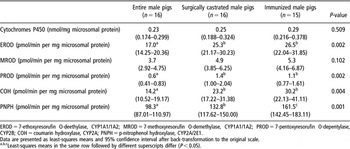
The effect of castration on the total CYP450 content in liver microsomes and on the activities of analysed enzymes is presented in Table 2.
Total cytochrome P450 content and phase I metabolizing enzymes activities in the microsomes from entire male and castrated pigs

EROD = 7-ethoxyresorufin O-deethylase, CYP1A1/1A2; MROD = 7-methoxyresorufin O-demethylase, CYP1A1/1A2; PROD = 7-pentoxyresorufin O-depentylase, CYP2B; COH = coumarin hydroxylase, CYP2A; PNPH = p-nitrophenol hydroxylase, CYP2A/2E1.
Data are presented as least-squares means and 95% confidence interval after back-transformation to the original scale.
a,b,cLeast-squares means in the same row followed by different superscripts differ (P < 0.05).
The total CYP450 content did not differ between the three groups (P = 0.509). Hepatic microsomal activities for EROD, PROD, COH and PNPH were lower in entire male pigs compared with castrated pigs (P < 0.05). Surgically and immunocastrated male pigs were similar with respect to EROD, MROD, PROD and COH activities (P > 0.05), whereas surgically castrated pigs exhibited lower PNPH activity compared with immunocastrated pigs (P = 0.029).
Compared with other measured isoforms, CYP1A2 and CYP2B enzymes measured as a rate of MROD and PROD activity, respectively, exhibited rather low catalytic activities in pigs. Additionally, MROD activities did not exhibit significant differences between the three groups (P = 0.102), although the activities were numerically lower in entire male pigs compared with castrated pigs (Table 2).
In vitro inhibition studies
EROD
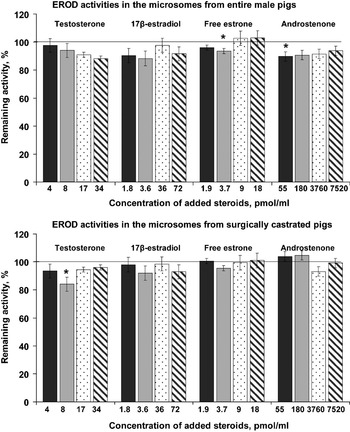
Percentages of remaining EROD activities after the incubations in the presence of steroids are shown in Figure 1. In entire male pigs, EROD activities were inhibited by free estrone at the concentration of 3.7 pmol/ml (P = 0.028) and androstenone at the concentration of 55 pmol/ml (P = 0.040). In surgically castrated pigs, EROD activities were inhibited in the presence of testosterone at the concentration of 8 pmol/ml (P = 0.014). There was no effect of 17β-estradiol on EROD activities in the microsomes from either entire or castrated male pigs (P > 0.05).
Effect of steroids on ethoxyresorufin O-deethylase (EROD) (CYP1A1/1A2) activities in the microsomes from entire and surgically castrated male pigs. Data are presented as a percentage of the enzyme activity in the control incubations. Each bar represents least-squares mean ± s.e. percentage of control enzyme activity (100%, s.e. for different steroids varied from 1.9% to 5.2%) for three independent measurements (duplicate for each). Level of significance: *P < 0.05 different from the control.

PROD
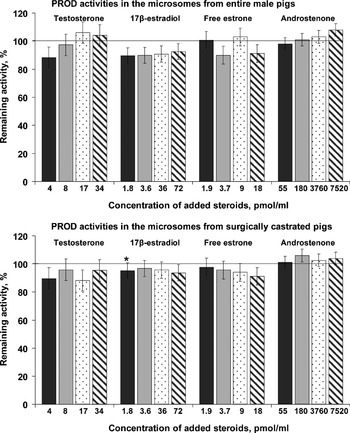
Among tested steroids, only 1.8 pmol/ml of 17β-estradiol had potency to inhibit PROD activities in surgically castrated pigs (P = 0.048; Figure 2). The addition of other steroids in the incubations did not alter PROD activities (P > 0.05).
Effect of steroids on pentoxyresorufin O-depentylase (PROD) (CYP2B) activities in the microsomes from entire and surgically castrated male pigs. Data are presented as a percentage of the enzyme activity in the control incubations. Each bar represents least-squares mean ± s.e. percentage of control enzyme activity (100%, s.e. for different steroids varied from 4.5% to 7.7%) for four independent measurements (duplicate for each). Level of significance: *P < 0.05 different from the control.

COH
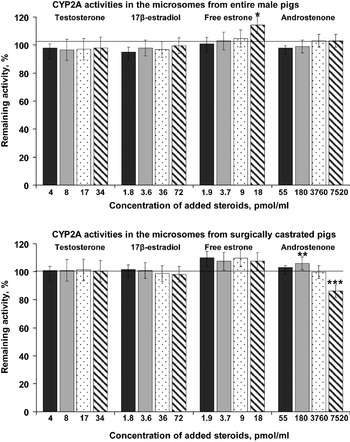
No statistically significant inhibition of COH was observed after the incubation of microsomes, either from entire male or castrated pigs, in the presence of testosterone or 17β-estradiol within the used concentration range (Figure 3). Free estrone at the concentration of 18 pmol/ml induced COH activities in the microsomes from entire male pigs (P = 0.024), but activities in microsomes from castrated pigs were not affected. Androstenone did not affect COH activities in microsomes from entire male pigs but the highest concentration of androstenone (7520 pmol/ml) inhibited COH activities (P < 0.001) and a 42-fold lower concentration of androstenone stimulated COH activities in surgically castrated pigs (P = 0.008; Figure 3).
Effect of steroids on coumarin hydroxylase (COH) (CYP2A) activities in the microsomes from entire and surgically castrated male pigs. Data are presented as a percentage of the enzyme activity in the control incubations. Each bar represents least-squares mean ± s.e. percentage of control enzyme activity (100%, s.e. for different steroids varied from 1.5% to 4.6%) for three independent measurements (duplicate for each). Levels of significance: *P < 0.05; **P < 0.01; ***P < 0.001 different from the control.

PNPH
No statistically significant inhibition of PNPH was observed after the incubation of microsomes, either from entire male or castrated pigs, in the presence of any of the investigated steroids (data not shown).
Discussion
In the present study, we estimated activities of several phase I metabolic enzymes in the liver microsomes from entire male and castrated pigs. The activities of EROD and MROD obtained in the present study were in a similar range to those reported by Kojima et al. (Reference Kojima, Sekimoto and Degawa2008) in 5-month-old Meishan pigs. Szotáková et al. (Reference Szotáková, Baliharová, Lamka, Nozinová, Wsól, Velík, Machala, Neca, Souček, Susová and Skálová2004) found higher activities of those enzymes in six entire male pigs (Landrace) at the age of 7 to 9 months (95 + 16 pmol/min per mg of protein for EROD, and 26 + 8 pmol/min per mg of protein for MROD). PROD activities in the present study were lower compared with those found by Chirulli et al. (Reference Chirulli, Marvasi, Zaghini, Fiorio, Longo and Gervasi2007). In contrast, Monshouwer et al. (Reference Monshouwer, Van’t Klooster, Nijmeijer, Witkamp and Van Miert1998) and Anzenbacher et al. (Reference Anzenbacher, Souček, Anzenbacherová, Gut, Hrubý, Svoboda and Květina1998) could not detect PROD activity in cultured pig hepatocytes and minipig liver microsomes, respectively. The possible reasons for those disagreements between different studies are discussed elsewhere (Szotáková et al., Reference Szotáková, Baliharová, Lamka, Nozinová, Wsól, Velík, Machala, Neca, Souček, Susová and Skálová2004). Activities of COH and PNPH in the present study were approximately within the activity range reported earlier (Zamaratskaia et al., Reference Zamaratskaia, Chen and Lundström2006).
We found that EROD and PROD activities were lower in entire male pigs compared with castrated pigs. Similar findings for EROD were reported by Kojima et al. (Reference Kojima, Sekimoto and Degawa2008) in Meishan pigs. However, the degree of gender-related difference in EROD activities was much higher in the study of Kojima et al. (Reference Kojima, Sekimoto and Degawa2008). Additionally, MROD activities in that study also expressed gender-related differences in contrast to the present results. The method of castration (surgical or immunocastration) did not affect EROD and PROD activities in our study. It is plausible that discrepancies in the activities obtained in different studies are a result of diversity in analytical methods. Additionally, physiological and genetic background of animals, mainly breed, age, hormonal status as well as the number of animals can influence results considerably.
The present study showed that castration significantly induced the activities of COH and PNPH. In pigs, isoforms CYP2E1 and CYP2A, measured as PNPH and COH, are of particular interest since they are involved in the metabolism of skatole, a tryptophan derivative which is responsible for the faecal-like odour in meat from some entire male pigs (Diaz and Squires, Reference Diaz and Squires2000). It is known that skatole is mainly – although not exclusively – accumulated in the adipose tissue of entire male pigs, whereas only low skatole quantities are found in tissues from female or castrated male pigs. One of the mechanisms by which skatole levels are regulated is via effects of testicular steroids on skatole-metabolizing enzymes CYP2E1 and CYP2A in the liver (Doran et al., Reference Doran, Whittington, Wood and McGivan2002; Zamaratskaia et al., Reference Zamaratskaia, Gilmore, Lundström and Squires2007). We have recently shown that CYP2E1 activities (measured as PNPH) were higher in female pigs at market live weight compared with those in entire male pigs at the same weight (Zamaratskaia et al., Reference Zamaratskaia, Chen and Lundström2006). The higher activities of PNPH and COH in castrates in the present study imply that surgically and immunocastrated male pigs have a higher capability to metabolize skatole compared with entire male pigs. An unexpected yet interesting observation is the differences in CYP2E1 activities between surgically and immunocastrated male pigs. The reason for this is unclear. It should also be noted that mean values for CYP2A activities were numerically, but not significantly, higher in immunocastrated pigs. The secretory activity of the testes was drastically suppressed in immunocastrated animals as indicated by undetectable levels of the testicular steroids – testosterone, estrone sulphate and androstenone (Zamaratskaia et al., Reference Zamaratskaia, Andersson, Chen, Andersson, Madej and Lundström2008). The low activity of CYP450 enzymes in entire male pigs is thought to be a result of the action of testicular steroids. Thus, if any trace levels of testicular steroids remain in immunocastrated pigs, it would probably result in lower enzyme activities in immunocastrated pigs compared with surgically castrated pigs with no steroid production. The opposite was true in the present study. The significance of this finding and the molecular mechanism for this is yet to be clarified.
The use of a group of surgically castrated pigs with no added placebo injection might be seen as a potential limitation of the study. It could be argued that vaccination in immunocastrated pigs may lead to stress, which in turn induces changes in hormonal status and, therefore, modulate activities of some CYP450 isoforms. However, it did not play a critical role in our study because the last injection of Improvac was given 4 weeks prior to slaughter. Therefore, the effect, if any, of potential changes in hormonal status of pigs at the moment of vaccination would not be observed 1 month later.
An interesting aspect of the present study is that the effect of castration on enzyme activities was not associated with the amount of total CYP450 content. Similarly, Gillberg et al. (Reference Gillberg, Skaanild and Friis2006) showed that castration did not change the total CYP450 concentration in microsomes from minipigs before and after surgical castration. Cantiello et al. (Reference Cantiello, Carletti, Dacasto, Martin, Pineau, Capolongo, Gardini and Nebbia2008) found that administration of a combination of growth-promoting agents (17β-estradiol, clenbuterol and dexamethasone) did not affect total CYP450 content, but reduced the activities of some drug-metabolizing enzymes. In this respect, it should be emphasized that changes in enzyme activities are not necessarily reflected by changes in total CYP450 content.
Earlier studies conducted in our laboratory with pig microsomes have indicated that the mechanisms of steroid action on CYP450 activities appear to be different in male and female animals (Zamaratskaia et al., Reference Zamaratskaia, Gilmore, Lundström and Squires2007). Thus, in the present study, we performed microsomal assays separately for entire male and surgically castrated pigs. The concentrations of steroids in the incubations were chosen based on an approximate average and high physiological level of steroids in plasma, adipose tissue or liver tissue of entire male pigs (Claus and Hoffmann, Reference Claus and Hoffmann1980; Claus et al., Reference Claus, Münch, Nagel and Schopper1989; Zamaratskaia et al., Reference Zamaratskaia, Babol, Madej, Squires and Lundström2004). Although statistical analyses revealed significant modifications of EROD activities by testosterone, free estrone and androstenone, COH activities by free estrone and androstenone and PROD activities by 17β-estradiol, the degree of these inhibitions and inductions were not concentration-dependent and probably not important clinically. Therefore, the inhibition mechanisms were not further characterized in the present study. PNPH activities were not inhibited by any of the investigated steroids in the present study in contrast to our earlier observations (Zamaratskaia et al., Reference Zamaratskaia, Gilmore, Lundström and Squires2007). This is probably due to the different age of animals used in both studies. An inhibition of PNPH activities was obtained when using microsomes isolated from young animals before the onset of puberty (Zamaratskaia et al., Reference Zamaratskaia, Gilmore, Lundström and Squires2007). The inclusion of testicular steroids in the incubations with microsomes from mature pigs in the present study resulted in no inhibition of PNPH activities. In mature male pigs with high concentrations of endogenous steroids, PNPH activities were probably already inhibited by long-term mechanism and no further inhibition could be observed. This, however, does not explain an absence of inhibition in the microsomes from castrated pigs. The dose-dependent inverse effect of androstenone on COH activities in surgically castrated pigs is also of interest. Such an effect of androstenone on CYP2A6 protein expression has been shown in primary cultured pig hepatocytes (Chen et al., Reference Chen, Cue, Lundström, Wood and Doran2008), but the underlying mechanism is unclear.
Although not demonstrated in the present study, the decreased activities of the investigated enzymes may be confined to suppression of gene or protein expression. It is known that the activities of CYP2A and CYP3A (Gillberg et al., Reference Gillberg, Skaanild and Friis2006) are gender-regulated at the transcriptional level. Kojima et al. (Reference Kojima, Sekimoto and Degawa2008) showed that administration of testosterone propionate to 1-month-old male and female pigs resulted in a significant decrease in the gene expression of CYP1A1 and CYP1A2 in the pigs of both sexes. Additionally, androstenone modified CYP2A6 protein expression (Chen et al., Reference Chen, Cue, Lundström, Wood and Doran2008) and down-regulated the skatole-induced expression of CYP2E1 in primary cultured pig hepatocytes (Doran et al., Reference Doran, Whittington, Wood and McGivan2002). Tambyrajah et al. (Reference Tambyrajah, Doran, Wood and McGivan2004) reported that androstenone decreases CYP2E1 promoter activity by inhibiting the binding of a transcription factor. If the genes are regulated at the transcriptional level, it is not surprising that little or no inhibitory effect of steroids was observed at the protein level in the present study.
There are indications that the nuclear orphan receptor CAR (constitutive androstane receptor) is one of the mediators of the gender-dependent regulation of CYP450. Castration increased the levels of CAR in the liver nucleus of male mice (Kawamoto et al., Reference Kawamoto, Kakizaki, Yoshinari and Negishi2000). Activation of the CAR receptor in primary porcine hepatocytes increased the activity of CYP2A (Gillberg et al., Reference Gillberg, Skaanild and Friis2006).
In conclusion, we showed that EROD, PROD, COH and PNPH activities were lower in entire male pigs compared with those in surgically and immunocastrated pigs. Direct inhibition by the testicular steroids – testosterone, 17β-estradiol, free estrone and androstenone – was not the primary cause of the reduced enzyme activities. The latest finding was observed in an in vitro study.
Acknowledgements
This work was supported by grants from Swedish Animal Welfare Agency and partly from USB RIFCH no MSM6007665809. Pfizer is gratefully acknowledged for providing Improvac. We wish to express our sincere thanks to Mr Michael Pearce for valuable comments on the manuscript, and the staff at Funbo-Lövsta Research Station for taking excellent care of the animals.