Introduction
The appearance of a pharyngocutaneous fistula is the most frequent post-operative complication after total laryngectomy surgery, significantly increasing morbidity and hospital stay. In the literature there is a wide variability in the pharyngocutaneous fistula rate, ranging from 3 to 65 per cent.Reference Paydarfar and Birkmeyer1
One of the most controversial factors related to the appearance of a pharyngocutaneous fistula after total laryngectomy is previous treatment with radiotherapy. According to the results of a meta-analysis performed by Dedivitis et al.,Reference Dedivitis, Aires, Cernea and Brandão2 which included 39 studies, the frequency of pharyngocutaneous fistula in the post-operative period of irradiated patients was 24.6 per cent, compared with 15.5 per cent in patients without a history of previous radiotherapy. The result of another meta-analysis evaluating risk factors in laryngectomised patients by Paydarfar and BirkmeyerReference Paydarfar and Birkmeyer1 found that patients with previous treatment with radiotherapy showed an increased risk of pharyngocutaneous fistula of 2.28 times (95 per cent confidence interval (CI = 1.59–3.25).
Several aspects related to the administration of radiotherapy have been analysed in different studies. Since the introduction of organ preservation protocols based on treatment with chemoradiotherapy,Reference Forastiere, Goepfert, Maor, Pajak, Weber and Morrison3 there has been concern regarding the possible increase in the incidence of complications after total laryngectomy compared with patients treated exclusively with radiotherapy.Reference Furuta, Homma, Oridate, Suzuki, Hatakeyama and Suzuki4,Reference Klozar, Cada and Koslabova5 Other authors have analysed the relationship between the time interval between radiotherapy and surgery and the appearance of post-operative complications.Reference Basheeth, O'Leary and Sheahan6,Reference Scotton, Nixon, Pezier, Cobb, Joshi and Urbano7
The objective of this study was to analyse the impact of exclusive radiotherapy versus chemoradiotherapy and the time interval between radiotherapy and surgery on the risk of pharyngocutaneous fistula in patients treated with total laryngectomy after radiotherapy treatment.
Materials and methods
Patient description
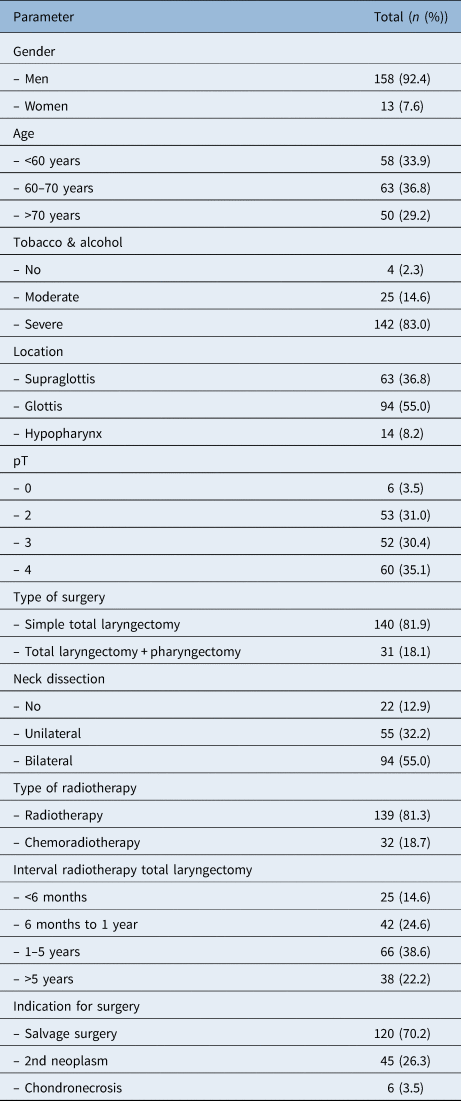
We carried out a retrospective review of the total laryngectomy procedures performed in patients with previous radiotherapy or chemoradiotherapy in the neck at our centre between 2000 and 2018. Cases that required the use of flaps for the reconstruction of the hypopharynx were excluded. During the study period, 171 total laryngectomy procedures were performed. The surgery was indicated as a salvage treatment after local recurrence (n = 120; 70.2 per cent) or as a treatment for a second neoplasm (n = 45; 26.3 per cent). In 6 cases (3.5 per cent), the indication for the surgery was the treatment of a non-functional larynx or chondronecrosis after previous treatment with radiotherapy or chemoradiotherapy.
Post-operative care and fistula definition
In the absence of complications, enteral nutrition was maintained by nasogastric tube until the 12th post-operative day. A fistula was defined as any clinically documented salivary leak, which was confirmed by oral administration of methylene blue dye. After the diagnosis of a pharyngocutaneous fistula, the initial treatment involved antibiotic therapy, continuation of enteral nutrition and daily care of the wound. When the fistula persisted, we evaluated the need for surgical closure on a case-by-case basis. As a general guideline, once the fistulous tract did not show signs of necrosis or infection, the surgical treatment of the pharyngocutaneous fistula was considered, usually one month after the total laryngectomy.Reference Sumarroca, Rodríguez-Bauzà, Lop-Gros, García, López and Quer8
We proceeded to classify pharyngocutaneous fistulas according to their severity. A major pharyngocutaneous fistula was defined as one that persisted for a period longer than four weeks, required surgical treatment or was associated with post-operative mortality. A minor pharyngocutaneous fistula was defined as the one that resolved with a conservative treatment in a period of less than four weeks.Reference Casasayas, Sansa, García-Lorenzo, López, Orús and Peláez9
Analyses of results
The risk of fistula appearance was analysed according to age, gender, alcohol use and smoking habit, location and local extension of the tumour, type of laryngectomy (simple versus extended with pharyngectomy), neck dissection, type of radiotherapy (exclusive radiotherapy vs chemoradiotherapy), interval between radiotherapy and surgery, and indication for treatment.
Given the interaction between the use of tobacco and alcohol, a combined variable of toxic consumption was created with three categories: no tobacco or alcohol use; moderate use (less than 20 cigarettes/day or less than 80 g alcohol/day); and severe use (20 or more cigarettes/day or 80 g or more alcohol/day).
The time interval between the beginning of radiotherapy and surgery was categorised into four periods: less than 6 months, 6 months to 1 year, 1–5 years, and more than 5 years. Table 1 shows the distribution of patients according to the variables analysed. We evaluated the length of the hospital stay as an indirect measure of morbidity. In order to calculate it, we added the number of days hospitalised after the initial surgery and during the fistula appearance and repair.
Characteristics of patients included in the study

pT = pathological tumour size staging
The chi-square test or Fisher's exact test were used, as appropriate, to compare qualitative variables. Comparisons between periods of hospital admission were made with the Student's t-test or an analysis of variance test. Multivariate analyses with logistic regression were carried out using the presence of pharyngocutaneous fistula and major pharyngocutaneous fistula as the dependent variables.
The study was approved by the institutional review committee of the centre (protocol number: 19/126 OBS) and was carried out in accordance with the principles outlined in the Declaration of Helsinki.
Results
A total of 33 patients (19.3 per cent) developed a pharyngocutaneous fistula, of which 5 (2.9 per cent) met the study criteria for minor pharyngocutaneous fistula and 28 (16.4 per cent) for major pharyngocutaneous fistula. In two patients treated with chemoradiotherapy, a delayed fistula appeared on the 15th and the 20th day after hospital discharge. In both cases, a pectoralis major flap was required to repair the defect. The average interval between irradiation and laryngectomy when the indication was a salvage surgery was 1.4 years, 9.7 years for second neoplasms and 5.9 years (p = 0.0001) for cases of chondronecrosis.
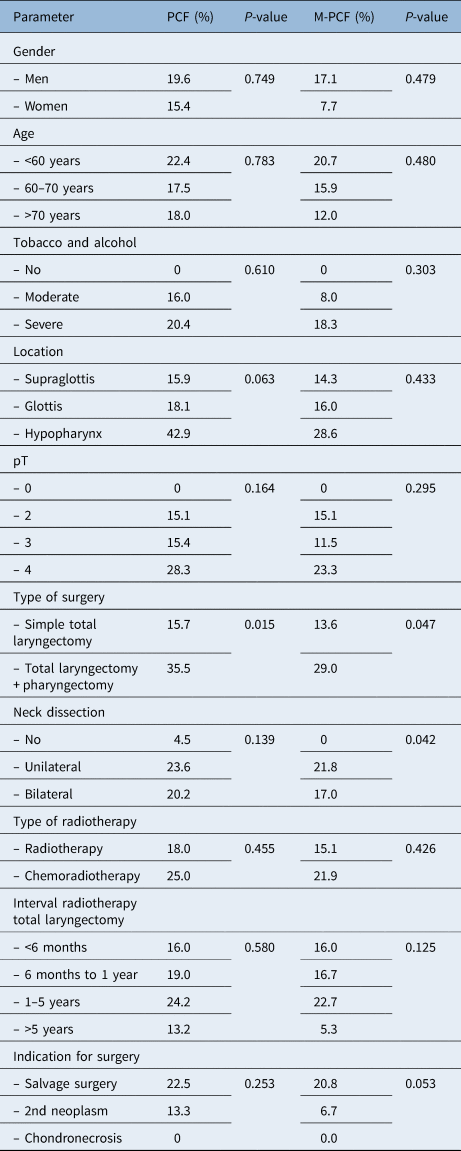
Table 2 shows the frequency of pharyngocutaneous fistula and major pharyngocutaneous fistula appearance in the patients included in the study according to the different variables analysed. There were significant differences in the percentage of pharyngocutaneous fistula and major pharyngocutaneous fistula, depending on the type of surgery performed. The percentage of pharyngocutaneous fistula for simple total laryngectomy procedures and extended laryngectomy procedures with pharyngectomy was 15.7 per cent and 35.5 per cent, respectively (p = 0.015). The percentage of major pharyngocutaneous fistula was 13.6 per cent and 29.0 per cent, respectively (p = 0.047). Patients with tumours located in the hypopharynx showed a higher pharyngocutaneous fistula rate, although it did not reach statistical significance. This finding could be explained by the requirement for extended surgical procedures including pharyngectomy in tumours located in the hypopharynx.
Percentage of patients with pharyngocutaneous fistula and major pharyngocutaneous fistula for the assessed variables

PCF = pharyngocutaneous fistula; M-PCF = major pharyngocutaneous fistula
According to our results, patients previously treated with chemo-radiotherapy showed a higher frequency of pharyngocutaneous fistula compared with patients treated with radiotherapy (25.0 per cent versus 18.0 per cent, respectively, p = 0.455), but the differences did not reach statistical significance.
There were no significant differences in the frequency of pharyngocutaneous fistula or major pharyngocutaneous fistula depending on the interval between irradiation and surgery. Patients with a time interval greater than five years had a non-significant tendency to have a lower incidence of major pharyngocutaneous fistula. It should be noted that, in all the patients from this group, the surgery was performed as a treatment for a second neoplasia or a chondronecrosis.
Tables 1 and 2 in the supplementary material (available on The Journal of Laryngology & Otology website) show the result of the multivariate analysis considering pharyngocutaneous fistula and major pharyngocutaneous fistula as dependent variables. None of the variables included in the multivariate analysis showed a significant relation with the risk of pharyngocutaneous fistula or major pharyngocutaneous fistula.
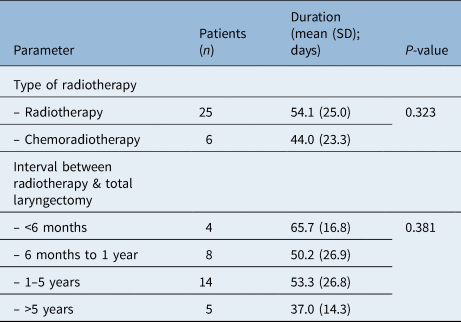
There was a death during the post-operative period in one patient because of a local complication associated with a pharyngocutaneous fistula. The appearance of pharyngocutaneous fistula significantly increased the duration of the hospital stay. For patients without pharyngocutaneous fistula, the average hospital stay was 16.1 days, wheareas for patients with pharyngocutaneous fistula it was 51.6 days (p = 0.0001). Table 3 shows the average hospital stay of patients with pharyngocutaneous fistula depending on the type of radiotherapy (exclusive radiotherapy vs chemoradiotherapy) and the interval between radiotherapy and surgery. None of the comparisons showed significant differences.
Duration of hospital stay for patients with pharyngocutaneous fistula depending on the type of radiotherapy and the interval between treatment with radiotherapy and surgery

SD = standard deviation
Fourteen patients with pharyngocutaneous fistula (42.4 per cent) required a surgical repair, which was carried out in all cases with a pectoralis major flap. Adequate reconstruction of the hypopharynx and restoration of oral feeding was achieved in all cases. The percentage of patients treated with exclusive radiotherapy who presented a pharyngocutaneous fistula that needed surgical repair was 28.0 per cent (n = 7 of 25) compared with 87.5 per cent in patients after chemoradiotherapy (n = 7 of 8; p = 0.005).
Discussion
According to our results, there were no significant differences in the frequency of pharyngocutaneous fistula in the post-operative period after total laryngectomy depending on the previous treatment with radiotherapy or chemoradiotherapy, or on the time interval between radiotherapy and surgery. Patients treated with a primarily closed laryngopharyngectomy had more pharyngocutaneous fistulas than patients with a simple total laryngectomy.
After obtaining these results, we decided to perform a pectoralis major muscle onlay flap in patients with a primarily sutured laryngopharyngectomy, meaning patients in which a direct suture was possible, and an elective onlay flap was placed with the intention to reduce pharyngocutaneous fistula risk. Following this proposal, only four patients were selected to undergo an onlay flap; all of them had extended tumours (T4) and three of them had received previous radiotherapy. Of these, only one patient developed a minor fistula that resolved with local wound care and antibiotics. With the small number of cases, it is too early to draw conclusions, and further research is needed to confirm the benefits of onlay flaps.
• One of the most controversial factors related to the appearance of a pharyngocutaneous fistula after total laryngectomy is previous treatment with radiotherapy
• Patients previously treated with chemoradiotherapy showed a non-significant higher fistula rate compared with patients treated with radiotherapy
• Patients with a pharyngocutaneous fistula after chemoradiotherapy treatment required a secondary surgical repair more frequently than patients treated with radiotherapy
• There were no significant differences in the fistula rate depending on time interval between radiotherapy and surgery
• The only variable that increased the risk of pharyngocutaneous fistula was an extended surgery with a pharyngectomy
Chemoradiotherapy versus radiotherapy
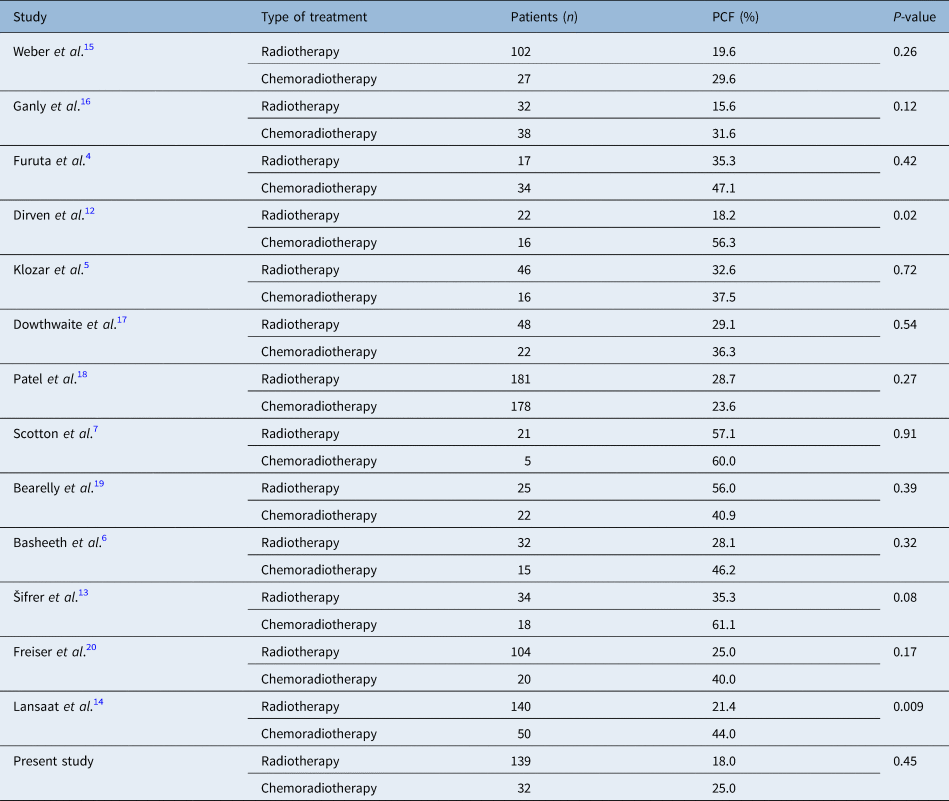
The impairment of healing mechanisms is an important side effect induced by radiotherapy treatments.Reference Haubner, Ohmann, Pohl, Strutz and Gassner10 When chemotherapy is used in conjunction with radiotherapy as a radiosensitising element, the effects at the histological level potentiate the changes caused by radiotherapy, with an increase in obliterative endarteritis and fibrosis.Reference Teknos and Myers11 Some authors have found a significant increase in the rate of complications and pharyngocutaneous fistulas in the total laryngectomy post-operative period of patients previously treated with chemoradiotherapy in relation to patients treated exclusively with radiotherapy.Reference Dirven, Swinson, Gao and Clark12–Reference Lansaat, van der Noort, Bernard, Eerenstein, Plaat and Langeveld14 Table 4 summarises the results of authors who have analysed the risk of pharyngocutaneous fistula in laryngectomised patients based on previous treatment with radiotherapy or chemoradiotherapy. The general trend is that patients treated with chemoradiotherapy had a higher percentage of fistulas than those treated with radiotherapy, but for most studies, including our results, the differences did not reach statistical significance.Reference Furuta, Homma, Oridate, Suzuki, Hatakeyama and Suzuki4–Reference Scotton, Nixon, Pezier, Cobb, Joshi and Urbano7,Reference Weber, Berkey, Forastiere, Cooper, Maor and Goepfert15–Reference Freiser, Ojo, Lo, Saint-Victor, Bollig and Nayak20
Results of studies that analyse the rate of pharyngocutaneous fistula appearance according to the history of previous treatment with radiotherapy or chemoradiotherapy

PCF = pharyngocutaneous fistula
Considering all the patients analysed among the different studies reviewed, including the patients in our study, the rate of patients treated previously with radiotherapy who had a pharyngocutaneous fistula in the post-operative period was 25.6 per cent (n = 229 of 895), whereas for those treated with chemoradiotherapy it was 33.7 per cent (n = 157 of 466; p = 0.005). According to the results obtained in the meta-analysis of Dedivitis et al.,Reference Dedivitis, Aires, Cernea and Brandão2 the increase in the absolute risk of pharyngocutaneous fistula in relation to non-irradiated patients was 8 per cent for the group of patients treated with radiotherapy (95 per cent CI = 5–10 per cent; p < 0.001) and 11 per cent for patients treated with chemoradiotherapy (95 per cent CI = 1–21 per cent; p = 0.04).
Treatment with chemoradiotherapy is carried out in patients with more advanced tumours and, in addition, tumour extension has been related to increased risk of pharyngocutaneous fistula.Reference Dedivitis, Aires, Cernea and Brandão2 Therefore, we believe that the increase in the frequency of pharyngocutaneous fistula in patients treated with chemoradiotherapy observed by some authors should not be attributed exclusively to the addition of chemotherapy to the radiotherapy treatment.
Although the incidence of pharyngocutaneous fistula in our patients was not significantly higher in the group treated with chemoradiotherapy, differences did appear in its severity. Although only 28 per cent of the patients with a pharyngocutaneous fistula after radiotherapy needed a surgical repair, 87.5 per cent of patients who had received chemoradiotherapy required surgical treatment (p = 0.005). Our results agree with those by Furuta et al.,Reference Furuta, Homma, Oridate, Suzuki, Hatakeyama and Suzuki4 who found that patients who developed pharyngocutaneous fistula after chemoradiotherapy tended to require surgical reoperation more frequently than patients with a history of exclusive radiotherapy.
Time interval between radiotherapy and surgery
Another aspect analysed in patients treated with a total laryngectomy after previous treatment with radiotherapy or chemoradiotherapy is the existence of differences in the complications rate depending on the time interval between irradiation and surgery. It has been suggested that there is a safe surgical ‘window’ between the resolution of acute radiation injury and the onset of chronic injury, and it is usually between the fourth and twelfth week after the completion of radiotherapy.Reference Stenson, Haraf, Pelzer, Recant, Kies and Weichselbaum21 This theory has been supported by experimental work on the cellular basis of chronic vascular injury after radiotherapy.Reference Hopewell, Calvo, Campling, Reinhold, Rezvani and Yeung22 This fact is consistent with the opinion of many surgeons regarding the existence of more severe fibrosis and greater surgical difficulties in surgical procedures performed long after radiotherapy. However, the notion of a safe surgical window has been questioned by some authors who have found an increase in the risk of surgical complications in surgical procedures carried out after this 12-week period.Reference Goguen, Chapuy, Li, Zhao and Annino23,Reference Sassler and Esclamado24
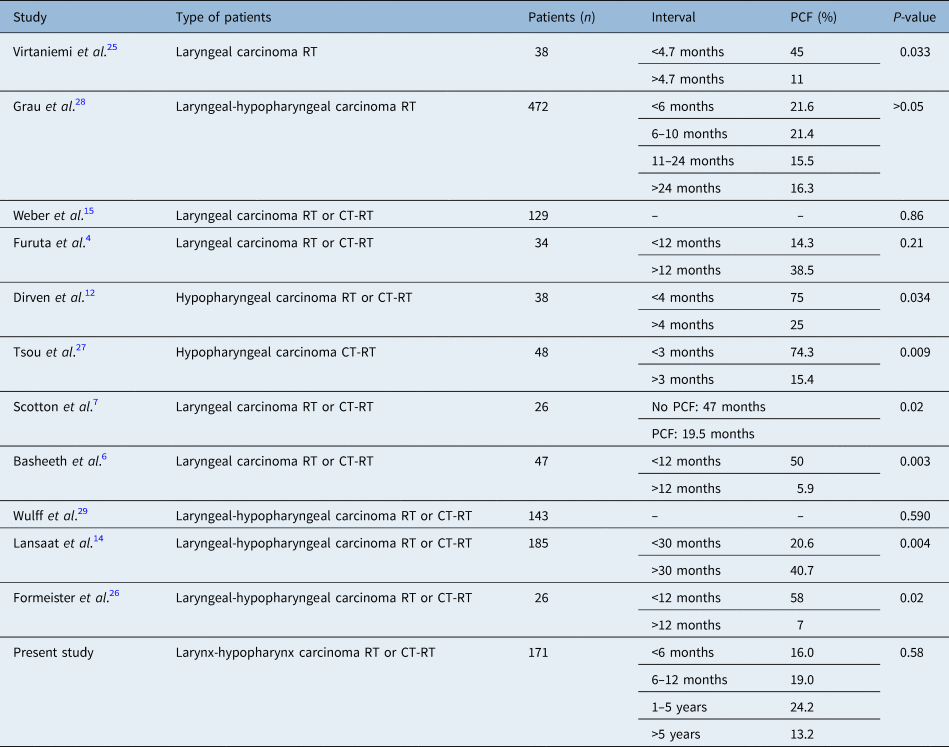
Several authors have evaluated the relevance of the interval between radiotherapy treatment and surgery in patients treated with a total laryngectomy with contradictory results. One of the problems in analysing the literature is the variability in the categorisation of the intervals, with cut-off points ranging from 3 to 30 months. For some authors, performing early laryngectomy (between 3 to 12 months) after the completion of radiotherapy would lead to an increased risk of pharyngocutaneous fistula;Reference Basheeth, O'Leary and Sheahan6,Reference Scotton, Nixon, Pezier, Cobb, Joshi and Urbano7,Reference Dirven, Swinson, Gao and Clark12,Reference Virtaniemi, Kumpulainen, Hirvikoski, Johansson and Kosma25–Reference Tsou, Hua, Lin, Tseng, Tsai and Shaha27 other studies found no significant relationshipReference Furuta, Homma, Oridate, Suzuki, Hatakeyama and Suzuki4,Reference Weber, Berkey, Forastiere, Cooper, Maor and Goepfert15,Reference Grau, Johansen, Hansen, Andersen, Godballe and Andersen28,Reference Wulff, Andersen, Kristensen, Sørensen, Charabi and Homøe29 or have even described an increase in the frequency of pharyngocutaneous fistula as this interval increases.Reference Lansaat, van der Noort, Bernard, Eerenstein, Plaat and Langeveld14 Table 5 summarises the findings of the studies that have analysed the relation between the time interval and the risk of pharyngocutaneous fistula.
Results of studies that analyse the relationship of the time interval between irradiation and laryngectomy with the risk of pharyngocutaneous fistula

PCF = pharyngocutaneous fistula; RT = radiotherapy; CT-RT = Chemoradiotherapy
We believe that, in spite of the healing impairment induced by irradiation, other factors may influence the risk of the pharyngocutaneous fistula related to the time interval between radiotherapy and laryngectomy. Some of them might be the malnutrition status associated with previous treatment or the requirement of a more aggressive surgery because of tumour progression or persistence.
According to our results, there were no significant differences in the percentage of pharyngocutaneous fistula or major pharyngocutaneous fistula depending on the interval between irradiation and surgery. It should be noted that the lowest percentage of major fistulas corresponded to those patients with intervals greater than five years. This group of patients included total laryngectomy indicated for a second neoplasm or chondronecrosis.
This study has certain limitations. We described the experience of a single centre, which limits the size of our cohort and reduces the external validity. Another limitation is the lack of information on the technique, dose and radiation fields used in radiotherapy treatment. It is likely that the dose of radiotherapy administered and the modality used to treat patients (intensity-modulated radiation therapy vs three-dimensional radiotherapy) affect tissue toxicity and fistulisation potential after total laryngectomy. On the other hand, its retrospective design has not allowed for inclusion of relevant information in relation to the risk of pharyngocutaneous fistula appearance, such as the patient's nutritional status, thyroid function or the presence of co-morbidities at the time of surgery.
Conclusion
In this cohort, there were no significant differences in the frequency of pharyngocutaneous fistula after total laryngectomy depending on the previous treatment with radiotherapy or chemoradiotherapy or depending on the interval between radiotherapy treatment and surgery. Patients who developed a pharyngocutaneous fistula after previous treatment with chemoradiotherapy more frequently required a surgical repair of the fistula.
Supplementary material
The supplementary material for this article can be found at https://doi.org/10.1017/S0022215121004370
Acknowledgements
This work was supported by grants from Plan Estatal de investigación, desarrollo e innovación of the Instituto de Salud Carlos III (FIS PI14/01819), Fondo Europeo de Desarrollo Regional, A Way to Build Europe.
Competing interests
None declared