


Introduction
Great benefits have been had from applying concepts from anxiety disorders to psychosis – but are there further useful ideas and techniques that can help? Different cognitive models of psychosis hypothesize that different cognitive processes might be involved, some of which are particular to psychosis (e.g. Bentall, Reference Bentall1990; Chadwick, Birchwood and Trower, Reference Chadwick, Birchwood and Trower1996; Freeman, Garety, Kuipers, Fowler and Bebbington, Reference Freeman, Garety, Kuipers, Fowler and Bebbington2002). Research has provided compelling empirical evidence for the role of cognitive processes on the cognitive, behavioural, affective, and physiological responses to positive symptoms of psychosis and its severity (Bentall, Kinderman and Kaney, Reference Bentall, Kinderman and Kaney1994; Fear and Healy, Reference Fear and Healy1997; Garety, Hemsley and Wessley, Reference Garety, Hemsley and Wessley1991; Peters, Day and Garety, Reference Peters, Day and Garety1997; Peters, Joseph and Garety, Reference Peters, Joseph and Garety1999; Young and Bentall, Reference Young and Bentall1997).
Some cognitive models of positive symptoms of psychosis have much in common with cognitive approaches to other psychological problems, especially anxiety disorders. For instance, Morrison, Haddock and Tarrier (Reference Morrison, Haddock and Tarrier1995) suggested that intrusive thoughts, if attributed to an external source, may result in auditory hallucinations because of their cultural unacceptability. Morrison (Reference Morrison1998) further proposed that beliefs about the potential threat such intrusive thoughts pose to the physical or psychological integrity of the individual mediate the emotional, physiological, and behavioural response to them, in a similar manner to catastrophic misinterpretations in panic. These misinterpretations trigger safety-seeking behaviours and hypervigilance, which would tend to maintain the vicious cycle by preventing belief disconfirmation. Freeman, Garety and Kuipers (Reference Freeman, Garety and Kuipers2001) found that safety-seeking behaviours were a common form of acting on persecutory delusions, and that 96% of their sample (N = 25) had used safety-behaviours during the preceding month. They also reported a significant association between the intensity of distress of the delusion and a greater use of safety behaviours. Freeman and colleagues (Reference Freeman, Garety, Kuipers, Fowler, Bebbington and Dunn2007) hypothesized that by preventing disconfirmation of threat (delusional) beliefs, catastrophic misinterpretations are likely to be maintained by the safety-behaviour itself in a similar way as in other anxiety disorders, and in particular OCD (Salkovskis, Reference Salkovskis1991; Wells et al., Reference Wells, Clark, Salkovskis, Ludgate, Hackmann and Gelder1995). Garety, Kuipers, Fowler, Freeman and Bebbington's (Reference Garety, Kuipers, Fowler, Freeman and Bebbington2001) multi-factorial account of psychosis underscores the role of emotional processes, and anxious states, in the formation and maintenance of psychotic symptomatology. They suggested that previous emotional distress affects the content of delusions, and this subsequently influences levels of emotional distress by providing a “threat-theme” to delusions.
A further area that has received recent attention in the literature on psychosis is the role of metacognitive beliefs (another anxiety-derived concept) in the occurrence and maintenance of psychotic disorders. For example, Baker and Morrison (Reference Baker and Morrison1998) compared metacognitive beliefs of non-patient controls, patients with schizophrenia who experienced auditory hallucinations, and patients with a similar diagnosis who did not experience hallucinations. They reported that patients experiencing hallucinations scored higher than controls on metacognitive beliefs about uncontrollability and danger of their thoughts, hold more positive beliefs about worry, and showed greater bias when processing emotionally charged information. Metacognitive beliefs have also been positively associated with and are predictive of delusion and hallucination proneness (Jones and Fernyhough, Reference Jones and Fernyhough2006; Larøi and Van der Linden, Reference Larøi and Van der Linden2005; Morrison, French and Wells, Reference Morrison, French and Wells2007). For example, individuals experiencing auditory hallucinations scored significantly higher than psychiatric and non-psychiatric controls on negative beliefs regarding the uncontrollability and danger of intrusive thoughts; and these beliefs have been shown to be a good predictor of auditory hallucinations (Morrison and Baker, Reference Morrison and Baker1998; Morrison and Wells, Reference Morrison and Wells2003).
Figures reported by different studies clearly indicate that there is an extensive comorbidity between positive psychotic symptoms and all major forms of anxiety disorders (Cosoff and Hafner, Reference Cosoff and Hafner1998). The high co-occurrence of anxiety and psychosis have been reported in weeks preceding an acute relapse of psychosis (Herz and Melville, Reference Herz and Melville1980), during the acute episode (Emsley, Oosthuizen, Joubert, Roberts and Stein, Reference Emsley, Oosthuizen, Joubert, Roberts and Stein1999), and in the stable phase of the illness (Moorey and Soni, Reference Moorey and Soni1994). Approximately, figures reported by different studies indicate 10% for comorbid phobias, 35% comorbid panic, 13% social anxiety, 15–40% obsessive compulsive disorder, 20–30% panic attacks, and 15–30% PTSD. Most of these figures are considerably higher than in the general population (Robins and Regier, Reference Robins and Regier1991; Tien and Eaton, Reference Tien and Eaton1992; Neria, Bromet, Sievers, Lavelle and Fochtmann, Reference Neria, Bromet, Sievers, Lavelle and Fochtmann2002; Tibbo, Kroetsch, Chue and Warneke, Reference Tibbo, Kroetsch, Chue and Warneke2000). The question of causality has been raised by different authors: Is it that psychosis causes anxiety symptoms?; Could anxiety be a vulnerability marker for psychosis?; Are other variables accounting for both?; or Do they simply co-exist or inter-relate? These questions as yet remain unanswered. Further longitudinal and prospective studies are currently underway and will help to clarify some of these issues. As pointed out by Turnbull and Bebbington (Reference Turnbull and Bebbington2001), the high prevalence of comorbidity is not enough to conclude that both disorders share similar cognitive processes, but suggests further investigations of underlying cognitive mechanisms. For example, despite the epidemiological evidence of the strikingly frequent association between schizophrenia and OCD or panic, many of the key cognitive processes relevant to these anxiety disorders (heightened responsibility for harm, thought-action fusion and catastrophic misinterpretations) have not yet been investigated in acute psychosis.
Heightened responsibility (HR)
Inflated perceptions of responsibility for harm (Rachman, Reference Rachman1976) became the cornerstone of Salkovskis' (Reference Salkovskis1985) influential cognitive model of OCD. This model postulates that OCD symptomatology is associated with appraisals of personal responsibility both for unwanted intrusive thoughts and their dangerous consequences. These appraisals lead to negative mood and guide behaviour in an attempt to neutralize responsibility and/or reduce the likelihood of harm, following the belief that they may have the necessary power to prevent anticipated negative outcomes. HR can result in the person becoming hypervigilant, experiencing increased intrusions and perceived threats (Salkovskis et al., Reference Salkovskis, Rachman, Ladouceur, Freeston, Taylor, Kyrios and Sica1996), as well as substantial self-blame and depression. Empirical studies have supported the importance of HR in OCD (Cartwright-Hatton and Wells, Reference Cartwright-Hatton and Wells1997; Salkovskis and Kirk, Reference Salkovskis, Kirk and Hawton1996). Furthermore, experimental manipulations of responsibility in OCD patients (Arntz, Voncken and Goosen, Reference Arntz, Voncken and Goosen2007) and non-patients (Mancini, D'Olimpio and Cieri, Reference Mancini, D'Olimpio and Cieri2004) have been associated with an increase in obsessive compulsive behaviours, yielding further support for Salkovskis' model, and suggesting a possible causal role of responsibility beliefs.
In 2003, the Obsessive Compulsive Cognitions Working Group (OCCWG), an international research group, proposed a key psychometric factor among OCD-style beliefs was Responsibility/Threat estimation, and suggested that it could also be significant in other maladaptive cognitive states. Indeed, inflated responsibility has received great empirical and theoretical attention in recent years and Salkovskis' cognitive model, or part of it, has been extended to a wide range of other disorders such as PTSD and GAD (Tolin, Worhunsky and Maltby, Reference Tolin, Worhunsky and Maltby2006). Gumley, White and Power (Reference Gumley, White and Power1999) included appraisals of responsibility for harm to themselves or others as an important factor in their theoretical cognitive model of psychotic relapse. However, this contention needs to be empirically tested. A heightened sense of responsibility for harm to themselves or others, accompanied by a need to take action to stop a perceived impending catastrophe, may contribute to the need to respond, be hypervigilant, suspicious, and protect themselves through the use of safety-behaviours in individuals experiencing acute psychotic symptoms.
Catastrophic misinterpretations (CM)
Clark (Reference Clark1986) postulated that CM (automatic cognitive style characterized by a tendency to imagine the worst possible outcome) of bodily sensations are central to the occurrence of panic attacks. This process of catastrophic worry is associated with emotional distress, which in turn instigates further catastrophizing (Davey and Levy, Reference Davey and Levy1998). Birchwood (Reference Birchwood, Haddock and Slade1996) makes a similar point that the appraisals made by psychotic individuals to interpret internal/external events can trigger relapse. In this account, the fear of impending relapse triggers an emotional response that in turn may accelerate relapse.
In spite of the high comorbidity and the occasional mention in the literature of similar processes, the presence of CM in individuals with acute psychotic symptoms has not been empirically evaluated. CM of external or internal events may be particularly important in acute stages by contributing to the idea that “something bad is going to happen” (fear of impending catastrophe) or that “there is something wrong with me” (fear of madness or relapse), possibly contributing to acute psychosis.
The importance of acute episodes
An important limitation of cognitive theories of psychosis is the fact that they do not differentiate between stages of illness (McGorry, Hickie, Yung, Pantelis and Jackson, Reference McGorry, Hickie, Yung, Pantelis and Jackson2006); they perhaps implicitly suggest these biases ebb and flow with psychotic relapse and recovery, but generally studies are conducted on people in remission. They also often neglect the important issue of comorbidity mentioned above. Relapse is a deeply distressing experience for individuals, carers and friends, and is also a time when suicide is most likely (De Hert and Peuskens, Reference De Hert, Peuskens, Hawton and van Heeringen2000). Relapse is also toxic, as impairment accumulates with each subsequent episode, in realms such as function (Shepherd, Watt, Falloon and Nigel, Reference Shepherd, Watt, Falloon and Nigel1989), damage to social networks and increased residual positive symptoms when next in remission (Birchwood, Jackson and Fowler, Reference Birchwood, Jackson and Fowler2000). While it would seem imperative to soothe a relapse as soon as possible, little is known specifically about psychological factors during the acute psychotic phase, other than extrapolating from data from people mostly in remission, or perhaps in the prodromal phase.
This study was undertaken to investigate the presence of (a) HR and CM during acute psychotic episodes. It compared acutely psychotic people with stable and non-patient controls. It was hypothesized that:
1. Individuals with a diagnosis of psychosis who are acutely psychotic will have a higher sense of responsibility and perceived threat compared to clinically stable patients with a similar diagnosis. Both clinical groups will have a higher sense of responsibility and perceived threat compared to a non-clinical control group.
2. Individuals with a diagnosis of psychosis who are acutely psychotic will be more likely to misinterpret cognitive, physical, or social events in a catastrophic way than patients with similar clinical characteristics and considered to be clinically stable. Both clinical groups will be more likely to misinterpret cognitive, physical, or social events in a catastrophic way compared to a non-clinical control group.
3. Individuals with a diagnosis of psychosis who are acutely psychotic will score significantly less than anxious patients on sense of responsibility and CM.
Method
Participants
The study used a cross-sectional design with three groups: 30 acutely psychotic individuals, 30 individuals with a diagnosis of psychosis in stable phase of the illness, and 30 non-clinical controls. The inclusion criteria for the patient group were: adults aged 18–65 with a current diagnosis of schizophrenia, schizoaffective, schizophreniform, or non-specified psychosis, who were capable of informed consent. The exclusion criteria were: risk, primary diagnosis of alcohol/substance abuse intellectual disability, and/or organic brain disease. Recruitment was from several inpatient and outpatient services within the North London area, including: 2 crisis resolution teams; 6 in-patient wards; 3 community mental health teams; and 2 rehabilitation units. Participation was voluntary. Participants were not compensated, although travel expenses were reimbursed. Out of 72 patients approached by their clinician, 60 consented to participate and were recruited (response rate 83%). Those that declined to enter the study resembled the study sample on important variables (i.e. diagnosis, age and gender). Participants in the non-clinical comparison group were selected in order to approximately match the patient group for age, gender and years of formal education; exclusion criteria included current or past history of severe mental illness. This group was recruited from a number of different public spaces such as shopping centres, sport facilities, and transport stations. Recruiting took place simultaneously at all sites over 6 months.
Measures
Obsessional Beliefs Questionnaire (OBQ-44; OCCWG, 2003). The OBQ-44 is a short self-report measure based on cognitive models of OCD considered to provide the best normative assessment of obsessional appraisals (OCCWG, 2003). It consists of three distinct subscales thought to represent fundamental belief domains of OCD: a) Responsibility/Threat estimation (a perceived need to prevent harm from happening to oneself or others, fears of the consequences of inaction, and responsibility for bad things happening), 16 items, each of them rated from 1 (disagree very much) to 7 (agree very much); b) Perfectionism/certainty (high, absolute standards of completion, rigidity, concern over mistakes and feelings of uncertainty), 16 items; and c) Importance/control of thoughts (fears of the consequences of having intrusive and/or distressing thoughts or images, thought-action fusion, and the need to rid oneself of intrusive thoughts), 12 items. The OBQ-44 has been researched on obsessive, anxious and non clinical samples and has demonstrated excellent internal consistency (α = .95) and criterion-related validity (OCCWG, 2003). For the current study, the key subscale was Responsibility/Threat estimation.
Anxiety Sensitivity Index-3 (ASI-3; Taylor et al., Reference Taylor, Zvolensky, Cox, Deacon, Heimberg, Ledley, Abramowitz, Holaway, Sandin, Stewart, Coles, Eng, Daly, Arrindell, Bouvard and Cardenas2007). The ASI-3 is an 18-item self-report measure of anxiety sensitivity with a three-factor structure, including: (1) physical concerns (e.g. belief that palpitations lead to cardiac arrest); (2) cognitive concerns (e.g. belief that concentration difficulties lead to insanity); and (3) social concerns (e.g. belief that publicly observable anxiety reactions will elicit social rejection). Subscales scores can be derived for the three factors, where higher scores are associated to greater psychopathology. Respondents indicate their strength of endorsement for each item on a 5-point scale that ranges from 0 (very little) to 4 (very much), producing total scores in the range of 0–72. This scale has shown grater psychometric properties than the original ASI, and good reliability and validity on a sample of over 4,000 participants across countries (Taylor et al., Reference Taylor, Zvolensky, Cox, Deacon, Heimberg, Ledley, Abramowitz, Holaway, Sandin, Stewart, Coles, Eng, Daly, Arrindell, Bouvard and Cardenas2007).
Psychotic Symptoms Rating Scales (PSYRATS; Haddock, McCarron, Tarrier and Faraher, Reference Haddock, McCarron, Tarrier and Faragher1999). The PSYRATS is a multi-dimensional semi-structured interview, designed to elicit and rate the severity of auditory hallucinations (PSYRATS-AH) and delusional beliefs (PSYRATS-DS). It consists of 17 items that clinicians must rate on a five-point scale (0–4), symptoms are rated over the preceding week. This tool has been shown to have good reliability and validity (Haddock et al., Reference Haddock, McCarron, Tarrier and Faragher1999) and is increasingly being used in psychological treatment (Lewis et al., Reference Lewis, Tarrier, Haddock, Bentall, Kinderman, Kingdon, Leadley, Benn, Grazebrook, Haley, Akhatar, Davies, Palmer, Faragher and Dunn2002) and research studies (Startup, Freeman and Garety, Reference Startup, Freeman and Garety2007). Although the PSYRATS does not provide cut-off scores, values of ≥3 on individual items of subscales are considered to be measuring major/severe acuteness. The authors of these scales have identified the Positive and Negative Syndrome Scale (PANSS; Kay, Fiszbein and Opler, Reference Kay, Fiszbein and Opler1987) as the closest scale with which to make comparisons and judge PSYRATS' validity, and have reported significant correlations between similar subscales on both measures (Drake, Haddock, Tarrier, Bentall and Lewis, Reference Drake, Haddock, Tarrier, Bentall and Lewis2007). A score of ≥4 (moderate/severe) on the hallucinations and delusions items of the PANSS has previously been used to determine severe acute psychotic states (e.g. Lewis et al., Reference Lewis, Tarrier, Haddock, Bentall, Kinderman, Kingdon, Leadley, Benn, Grazebrook, Haley, Akhatar, Davies, Palmer, Faragher and Dunn2002; Tarrier et al., Reference Tarrier, Lewis, Haddock, Bentall, Drake, Kinderman, Kingdon, Siddle, Everitt, Leadley, Benn, Grazebrook, Haley, Akhatar, Davies, Palmer and Dunn2004) and items are consistent with those assessed by ≥3 on the PSYRATS. Therefore, it was decided that scores of ≥33 on the PSYRATS-AH and/or ≥15 on the PSYRATS-DS would identify severe and acute psychotic states. The first five patients recruited for each group were selected to test inter-rater reliability using the PSYRATS. Two of the authors (OL and FN) rated each of the 10 patients simultaneously and good reliability between the two raters was established.
Procedure
Participants were asked to complete the questionnaires during one interview with the first author. In order to establish the validity of the chosen questionnaires for the population of this study, the measures were piloted prior to commencing data collection. It was decided that no amendments were needed and that the questionnaires were appropriate for the client group of the study. All participants were given an identifying number for the study to be used on all questionnaires in order to ensure anonymity and confidentiality at all times.
Statistical analysis
All analyses were conducted using SPSS for Windows (version 12.0.1, SPSS, 2004). Prior to analysis, data were examined for accuracy of data entry and missing values. There were no missing data, and no univariate outliers. After transformation all variables were normally distributed; consequently, parametric statistical analysis could be performed throughout. A multivariate analysis of variance (MANOVA) was used, where participant's group was the fixed factor and scores in the different OBQ-44 and ASI-3 subscales were dependent variables. Subsequently, a series of univariate analyses of variance (ANOVAs) was conducted; where a significant difference was found (p < .05), pairwise comparisons using Games-Howell test were used to identify where this difference was. Using a MANOVA prior to several ANOVAs was intended to protect against inflated Type I error (Tabachnick and Fidell, Reference Tabachnick and Fidell2001). Additionally, MANOVA has greater power to detect an effect than several ANOVAs, decreasing the probabilities of Type II error. All statistical tests of significance reported were two-tailed.
Results
Demographic and clinical characteristics of the participants
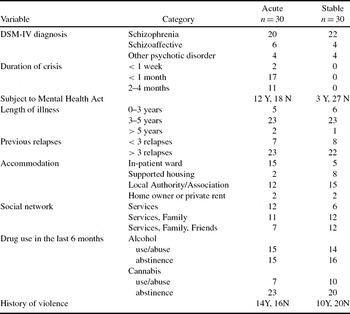
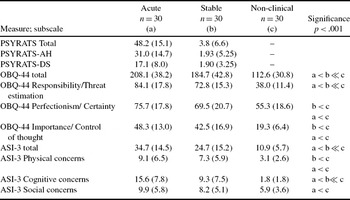
As can be seen in Table 1, the average age of the total sample was 39.5 years, males-females ratio 65:25, which is consistent with other psychosis samples. Over half of the sample were white males, spoke English as their first language, had attended college, were unemployed, and were single/divorced. The majority of the clinical sample met DSM-IV diagnostic criteria for schizophrenia (68%). These group had experienced psychotic symptoms for a mean of 3.2 (SD = 0.5) years, and had experienced an average of 4.1 (SD = 1.6) psychotic episodes. Mean PSYRATS for the clinical control group was 3.8 (SD = 6.6) and 48.2 (SD = 15.1) for the acute group; these values suggest that patients in the acute group were experiencing severe distress associated with psychotic symptoms, with 83% experiencing auditory hallucinations, and 78% exhibiting some degree of delusional beliefs. There were no significant differences between the three groups on important variables: age; gender; ethnic group; English as first language; and education, indicating that the three groups were comparable. Furthermore, it was established that the patient groups were matched on important demographic and clinical characteristics.
Demographic and clinical data of clinical sample (N = 60)

The mean scores and standard deviations were obtained for each of the three groups on all the measures, and results are displayed in Table 2. Chi-squared tests confirmed that patients in the acute group scored significantly higher than stables on both subscales of the PSYRATS, indicating a higher severity of psychotic symptomatology in the acute group (PSYRATS-AH χ 2 (15) = 44.2, p < .001; PSYRATS-DS χ 2 (15) = 41.8, p < .001).
Mean scores, standard deviations and significance values (N = 90)

The MANOVA showed that there was a significant main effect for group, indicating that three groups differed significantly on their OBQ-44 Responsibility/Threat estimation scores (F (2, 87) = 83.7, p < .001, ω = .80).
Hypothesis 1: Sense of responsibility and perceived threat
Planned univariate ANOVAs revealed that both psychotic groups scored significantly higher than the non-clinical group on OBQ-44 Responsibility/Threat estimation (t (63) = 13.1, p < .001, r = .85), and that the acute group scored significantly higher than the stable group (t (57) = 2.5, p < .001, r = .32). For this hypothesis, the study had 99% power to detect an estimated effect size of ω = .80, indicating a large power level (1-β = .99). These results confirmed the first hypothesis, indicating that, as expected, acutely psychotic patients reported significantly higher levels of sense of responsibility and threat estimation than both the stable group and non-clinical participants. Additionally, the stable clinical group reported significantly higher levels of sense of responsibility and threat than the non-clinical group.
Hypothesis 2: Catastrophic misinterpretations
There was a significant main effect for group (F (2, 87) = 35.8, p < .001, ω = .66). Psychotic groups scored significantly higher than the non-clinical group on ASI-3 Cognitive Concerns (t (70) = 10.2, p < .001, r = .75); and the acute group scored significantly higher than stables (t (58) = 3.2, p < .01, r = .16). These results confirmed the cognitive aspect of the second hypothesis, demonstrating that, as predicted, acutely psychotic patients misinterpreted their cognitive processes in a catastrophic manner significantly more than stable patients and non-clinical participants.
Additionally, the three groups significantly differed on ASI-3 Physical concerns (F(2, 87) = 7.9, p < .001, ω = .36), and ASI-3 Social concerns (F (2, 87) = 4.9, p < .01, ω = .28); however, the acute group did not score significantly higher than the control group on either ASI-3 Physical concerns (t (58) = 1.2, ns, r = .15), or ASI-3 Social concerns (t (56) = 1.3, ns, r = .17). For this hypothesis, the study had 99% power to detect an estimated effect size of ω = .66.
Hypothesis 3: Comparison with obsessive and anxious groups
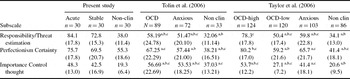
One-sample t-tests were carried out to compare the mean values of the present study to those obtained by other studies with anxious participants. Estimates of effect size were calculated by  , values r ≥.30 were interpreted as indicating medium effect and r ≥.50 as indicating large effect size. First, the results obtained on the OBQ-44 Responsibility/Threat estimation subscale were compared to those reported by three studies using the same measure with anxious and OCD groups (Tables 3 and 4). Tolin et al. (Reference Tolin, Worhunsky and Maltby2006) compared patients with a diagnosis of OCD to anxious and non-clinical controls; by way of example, compared to Tolin et al.'s results the acute group in this study scored significantly higher than the OCD (t (29) = 7.9, p < .001, r = .83) and anxious groups (t (29) = 10.2, p < .001, r = .88) in OBQ-44 Responsibility/Threat estimation; full statistics for the other comparisons are not reported for brevity's sake.
Mean OBQ-44 scores compared to OCD, anxious, and non-clinical groups (mean, SD)

aIndicates significant differences between the acute and the compared group at least at p<.01
bIndicates significant differences between the stable and compared group at least at p<.05
cIndicates significant differences between the control and the compared group at p<.001
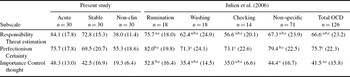
Mean OBQ-44 scores compared to OCD types (mean, SD)

aIndicates significant differences between the acute and the compared group at least at p<.01
bIndicates significant differences between the stable and compared group at least at p<.05
cIndicates significant differences between the control and the compared group at p<.001
Taylor et al. (Reference Taylor, Abramowitz, McKay, Calamari, Sookman, Kyrios, Wilhelm and Carmin2006) distinguished between OCD-high and OCD-low and compared them with an anxious group. The acute group scored significantly higher than the reported means for all three groups reported by these authors on OBQ-44 Responsibility/Threat estimation (t (29) = 1.9, p < .001, r = .33; t (29) = 10.5, p < .001; r = .89; t (29) = 7.4, p < .001, r = .81). The stable group also scored significantly higher than OCD-low and the anxious group (t (29) = 8.1, p < .001, r = .83; t (29) = 4.5, p < .001; r = .65). Finally, when mean scores are compared with data reported by Julien, O'Connor, Aardema and Todorov (Reference Julien, O'Connor, Aardema and Todorov2006) on different subtypes of OCD groups, the acute group scored significantly higher than all of the OCD groups (t (29) = 2.5, p < .01, r = .42; t (29) = 6.8, p < .001, r = .78; t (29) = 8.3, p < .001, r = .84; t (29) = 5.2, p < .001, r = .70, for each of the groups as indicated in Table 4).
In summary, patients with acute psychosis scored significantly higher than all of the OCD and anxious groups on responsibility and threat estimation. Additionally, patients with a diagnosis of psychosis who were in a stable phase also scored significantly higher than most OCD groups, with the exception of OCD Rumination and OCD-high groups. These are interesting results, but it is important to bear in mind that this difference could be due to the different sample sizes of the groups compared and/or other differences between the groups, as the groups belong to different populations and the comparisons were made post-hoc.
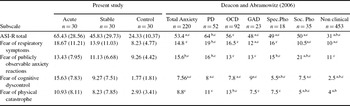
Second, results from the ASI were compared to mean scores of anxious groups. The ASI-3 is a shorter version of the ASI-R (36-items) and, although excellent psychometric properties have been reported, clinical data have not yet been published by other studies. Therefore, ASI-R total and subscales scores for the current sample were calculated and compared to those reported for several anxious groups and a non-clinical control by Deacon and Abramowitz (Reference Deacon and Abramowitz2006). Table 5 displays means, standard deviations (when available) and significance of one sample t-tests between groups. Participants with acute psychotic symptoms reported significantly higher levels of anxiety sensitivity than the total sample of anxious groups (t (29) = 2.4, p < .05, r = .41); and similar to the OCD and panic disorder groups. The stable group reported similar levels of anxiety sensitivity to the overall anxious sample and significantly less than the panic group (t (29) = –3.4, p < .001, r = .53). As indicated in Table 5, the acute group reported similar levels of anxiety sensitivity in most subscales as compared to anxious groups, with the clear exception of the “Fear of Cognitive Dyscontrol” subscale. This scale includes the exact same items as the previously reported ASI-3 Cognitive concerns subscale. Individuals in an acute psychotic state scored significantly higher than all the anxious groups and the total anxiety sample (t (29) = 5.4, p < .001, r = .71). Importantly, this difference remained significant when the acute group was compared with the GAD group which, as the cognitive model would predict, scored the highest out of the anxiety disorders (t (29) = 2.4, p < .05, r = .41) on fear of cognitive dyscontrol. On the other hand, the stable group reported similar levels to those of the total anxious sample (t (29) = 9.4, n.s.).
Mean scores on ASI-R as compared to other anxious and non-clinical groups (mean, SD)

Total Anxiety, mean of all anxiety disorders; PD, panic disorder; OCD, obsessive compulsive disorder; Soc.Ph, social phobia; GAD, generalized anxiety disorder; Spec.Ph, specific phobia. SD values not available from published data by Deacon and Abramowitz (Reference Deacon and Abramowitz2006).
aIndicates significant differences between the acute and the compared group at p<.01
bIndicates significant differences between the stable and compared group at p<.01
cIndicates significant differences between the control and the compared group at p<.001
In summary, these results are in line with the previous statistical analysis and highlight the significance of both CM of cognitive processes and inflated responsibility in psychosis, particularly at a time of acute psychosis. Nonetheless, it is important to keep in mind that the scales employed in this study had not been previously employed with psychotic patients and the norms currently available are based on anxious and non-clinical groups. Confidence in the conclusions may be increased through the conservative statistical tests used to protect against Type I error, and the high power level.
Additional analyses – discriminant function analysis
Group differences were further examined by conducting a discriminant function analysis. This procedure was used to determine which variables discriminated between naturally occurring groups, and was employed in addition to the traditional approach of using separate ANOVAs. This analysis further protected against inflated Type I error, and it also provided information about the potential relationship between the dependent variables and group membership (Field, Reference Field2005). Since in a MANOVA the dependent variables were analysed simultaneously, it was decided to enter all the variables together when running the discriminant analysis (Field, Reference Field2005). Wilks' lambda indicated that only the first variate (or combination of dependent variables) was significant (F (12) = .283, p < .001). Furthermore, eigenvalues showed that 96.4% of the variance was accounted for by the first variate. This indicated that the differences shown by the MANOVA could be explained in terms of one underlying dimension. Standardized discriminant function coefficients gave the relative contribution of each variable, varying within ±1. Using standardized discriminant function coefficients it can be concluded that OBQ-44 Responsibility/Threat contributed most to group separation (b = .79), followed by ASI-3 Cognitive concerns (b = .29), and OBQ-44 Important/Thought control (b = .27). Finally, the group centroids – defined as the mean variate scores for each group – indicated that variate 1 distinctly discriminated between the non-clinical and the two clinical groups (notably the acute group, as the difference between these groups was greatest).
Discussion
Assuming that the data can be taken at face value (limitations will be addressed later), all mechanisms of OCD and panic tested were more prevalent in stable psychosis controls than in non-clinical controls; some were statistically even more prevalent in acute patients. It can be argued that some of these mechanisms are at least as extensive (and possibly more so) in acute psychosis than in their original conceptual target groups of OCD, panic or GAD. For OCD mechanisms this is at a level considerably greater than what might be expected for previously reported co-morbidity.
Inflated responsibility and threat estimation
Looking at the results mechanism by mechanism, Responsibility/Threat estimation clearly escalated from non-clinical to stable to acute psychosis, and rose to levels beyond that seen in published OCD groups. This supports the hypothesis that inflated responsibility beliefs could be both a trait vulnerability factor and also be exacerbated as a state factor in acute psychosis, contributing to the development and/or maintenance of positive psychotic symptoms. These results provide support to Gumley et al.'s (Reference Gumley, White and Power1999) suggestion that responsibility beliefs may be an important variable to consider in psychotic crisis. Cognitive processes shown to be significant in psychosis such as attribution and confirmatory bias, a tendency to jump to conclusions and to make overconfident judgements (Garety and Hemsley, Reference Garety and Hemsley1994; Garety et al., Reference Garety, Hemsley and Wessley1991; Peters et al., Reference Peters, Joseph and Garety1999), may all contribute to exaggerated sense of responsibility; while other cognitive deficits such as impaired reality testing (Bentall and Slade, Reference Bentall and Slade1985) may be contributing to the sense of impending threat. It is also possible that inflated levels of responsibility may be affecting other cognitive processes in the same way as Garety et al. (Reference Garety, Kuipers, Fowler, Freeman and Bebbington2001) has suggested are affected by inflated levels of anxiety; certainly it could increase anxiety itself.
The findings of this study are in accordance with previous studies reporting a distorted or altered threat perception and threat estimation in individuals with a diagnosis of psychosis. It is now well established that people with persecutory delusions give preferential attention to threatening stimuli (e.g. Bentall, Kaney and Bowen-Jones, Reference Bentall, Kaney and Bowen-Jones1995; Mathews, Reference Mathews1990; Phillips, Senior and David, Reference Phillips, Senior and David2000). According to Salkovskis (Reference Salkovskis and Rapee1996) threat appraisals are determined by the interaction between the perception of how negative the consequences of a danger are and the perceived likelihood of the threat. It follows that significant overestimation of threat and catastrophic worry could also be interacting in such a way that they are significantly contributing to psychotic relapse. Statistical analyses revealed a significant positive correlation between heightened Responsibility/Threat estimation and CM of cognitive processes providing support for this argument.
Second, inflated responsibility and threat overestimation have been directly linked to maladaptive behaviour, increased occurrence of intrusions and perceived threat in OCD patients (Salkovskis et al., Reference Salkovskis, Rachman, Ladouceur, Freeston, Taylor, Kyrios and Sica1996). Furthermore, this belief domain has also been strongly linked to harming thoughts in OCD (Salkovskis, Reference Salkovskis1985) and to an increase of compulsive behaviours (Arntz et al., Reference Arntz, Voncken and Goosen2007). Negative appraisals of the personal responsibility for unwanted intrusive thoughts and their dangerous consequences (i.e. going mad, obeying command hallucinations) may be related to acute psychotic symptomatology in the same way as proposed in OCD. It is possible that HR during acute psychosis is also mediating people's dysfunctional behaviours at a time of a crisis, such as withdrawal, safety-seeking, and hypervigilance.
The possible link between inflated responsibility and command hallucinations is a complex one that merits separate discussion. A command hallucination is the experience of hearing a voice that consistently tells the hearer to do things, usually unpleasant or even deplorable things. People who hear command hallucinations may be constantly struggling to not comply with their voice, often bargaining or agreeing to do minor things to avoid having to do major ones. It may be that items on the OBQ may seem more literally true for people hearing command hallucinations – they simply are more at risk of being responsible for catastrophes, in a very real sense. The present study did not note whether psychosis participants had command hallucinations or not, and future research could address this relationship. Possibly the similarity is purely semantics – the OBQ is inadvertently recording scores as if OCD mechanisms were at play when actually the contexts around command hallucinations and OCD are quite different. Alternatively, it might be that whether the content of the catastrophe comes from a source acknowledged as a bullying voice, or from unwanted and worrying automatic thoughts (i.e. from command hallucinations or OCD), the process of worry and maintenance would be effectively the same. Every OCD catastrophe will have its own content, perhaps equally implausible or delusional to the observer as in the case of command hallucinations.
There is a level of thought action fusion (TAF: the belief that having certain thoughts will lead to unwanted acts; Myers and Wells, Reference Myers and Wells2005, p. 807) in both cases that presumably exacerbates the distress. Salkovskis considered TAF as a complex form of responsibility beliefs. TAF implies the belief that unwanted thoughts are morally equivalent to the repulsive actions featured in them, and/or the belief that having destructive thoughts increases the likelihood of harm coming true (Salkovskis, Shafran, Rachman and Freeston, Reference Salkovskis, Shafran, Rachman and Freeston1999). Some of the items included in the OBQ-44 Responsibility/Threat subscale assess individuals' TAF beliefs. Further research is needed to fully understand the role of HR in psychosis: is it akin to OCD, or is it more specific to psychotic symptoms and perhaps associated to command hallucinations?
Although not a hypothesis of this study, the data show that perfectionism was also a real problem for the psychosis group, observed in the acute group at higher levels than in some OCD samples. This could be linked to “need for certainty” (Freeman et al., Reference Freeman, Garety and Kuipers2001), or idealism; in common with non-clinical young adults, people with psychosis can view the world in a romanticised way (Harrop and Trower, Reference Harrop and Trower2001). This may come as a shock to outside observers who see people with acute psychotic symptoms as being generally disorganized, often unkempt; perhaps a more realistic take would be “Fear of Negative Evaluation”, especially for someone experiencing critical voices for whom everything they get wrong provides more material for their voice to use against them.
The fear of an imminent catastrophe
The second hypothesis tested confirmed that psychotic groups catastrophically misinterpreted cognitive, physical and social stimuli significantly more than non-patients. Furthermore, higher levels of anxiety sensitivity were reported at a time of acute psychosis than during a stable phase of the disorder. However, this latter difference was mainly accounted for by the Cognitive concerns variable. This is in line with studies reporting an association between metacognitions and both delusions (Freeman and Garety, Reference Freeman and Garety1999; Morrison and Wells, Reference Morrison and Wells2003) and hallucinations (García-Montes, Perez-Alvarez, Soto-Balbuena, Perona-Garcelan and Cangas, Reference García-Montes, Perez-Alvarez, Soto-Balbuena, Perona-Garcelan and Cangas2005). Startup et al. (Reference Startup, Freeman and Garety2007) investigated the association between persecutory delusions and catastrophic worry. They used a lengthy catastrophizing interview, preventing direct comparisons with the results from the current study. Nonetheless, their study found that individuals with persecutory delusions scored in a comparable range to treatment-seeking individuals with GAD, and showed a tendency towards catastrophic worry. Startup et al. (Reference Startup, Freeman and Garety2007) only recruited patients with delusions, preventing conclusions about the general relevance of catastrophic worry in psychosis.
Additionally, there could be an association between the reported high levels of past traumatic history in individuals with psychotic disorders (Morrison, Frame and Larkin, Reference Morrison, Frame and Larkin2003) and their increased catastrophic worry. Past experience of traumatic events may be significantly contributing to the individual's threat perception and the expectancy of an imminent disaster (cognitive, physical or social in nature). Further research is required to fully understand the role of catastrophic worry in psychosis.
Limitations
The data being cross-sectional means that little can be said about cause and effect. It remains conceivable that the differences observed between clinical groups may be due to differences in levels of symptomatology in the sample, and not only due to the acute/stable status of the participants, or due to possible confounding variables such as comorbid anxiety, duration of untreated psychosis, recent bereavement, or financial stressors. It could also be argued that the differences found may reflect greater psychopathology or more “damaging histories” rather than processes specific to the acute phase. However, the compared groups were matched on length of illness and number of admissions. Replicating the study with larger numbers would seem important, as would be longitudinal follow-up.
Clinical implications and future research
Addressing concerns about impending catastrophes and responsibility thereof may be clinically beneficial and could result in decreasing the associated discomfort, ultimately reducing severity and/or duration of the acute episode. This is in line with suggestions of theoretical “state-specific cognitive behaviour therapy” (Marlowe, Reference Marlowe2003). Thought-action fusion can be fruitfully addressed, as might behavioural experiments aimed at reducing dependence on safety behaviours (although caution will obviously be needed when doing this with command hallucinations). Perfectionism may also be a fruitful clinical focus, as will general education about the ways our minds work (metacognition work) and other ways of experiencing thoughts such as mindfulness (Chadwick, Reference Chadwick2006). Presently, front-line clinicians do not explicitly pursue the assessment and treatment of anxiety symptoms, and their significance (Turnbull and Bebbington, Reference Turnbull and Bebbington2001) with psychotic patients. A first step may involve providing further training to front-line clinicians in the assessment and management of anxiety.
Future research in this area should take into account the limitations encountered by this study and consider the replication of these findings with a larger sample size and using longitudinal methodology. Additionally, potential differences between cognitive processes in patients presenting with first psychotic episode compared to clients who have experienced multiple crisis episodes could also fruitfully be examined, in line with recent calls for “stage of condition” related research (McGorry et al., Reference McGorry, Hickie, Yung, Pantelis and Jackson2006) and intervention (Haddock and Lewis, Reference Haddock and Lewis2005). Qualitative methods could be considered to allow fuller exploration of individuals' experiences during the acute psychotic phase; in particular, to establish possible threat perception and catastrophic worry themes, and how they relate to voice activity, particularly command hallucinations, as the content of the processes described here (in the same way that neutralizing behaviours such as washing hands are the content of OCD-style processes). In conclusion, the results of the current study indicate that obsessive and panic-like mechanisms are very relevant in psychosis; this seems to offer new opportunities for clinical work with people with acute psychosis and also a renewed research agenda to understand acute psychotic states.
Acknowledgments
We wish to thank the patients taking part in the study and the participating clinical teams in Camden and Islington NHS Foundation Trust. We would also like to thank Gill Haddock and Gary Brown for their comments on a previous draft of this paper.



Comments
No Comments have been published for this article.