Introduction
The chronic progressive nature of dementia means that people often live for many years with declining cognitive function, and families and carers will increasingly be called on to be surrogate decision-makers regarding care (Chambaere et al., Reference Chambaere, Cohen and Robijn2015). Families often find it difficult to make decisions and show low reliability in predicting the person with dementia's preferences unless this has been discussed previously (Miura et al., Reference Miura, Asai and Matsushima2006; Sarabia-Cobo et al., Reference Sarabia-Cobo, Pérez and de Lorena2016; Sulmasy, Haller, & Terry, Reference Sulmasy, Haller and Terry1994).
Across populations, advance care planning (ACP) is a process in which people reflect on their values and preferences in consultation with their family and health professionals to ensure their wishes are known and can be implemented if they lose decision-making capacity in the future (Scott et al., Reference Scott, Mitchell and Reymond2013). The promotion of ACP grew from concern that end-of-life medical interventions aimed at sustaining life may sometimes serve to extend the dying process at the expense of dignity and comfort (Danis et al., Reference Danis, Southerland and Garrett1991; Sabatino, Reference Sabatino2010; Teno et al., Reference Teno, Lynn and Phillips1994).
Depending on study aims, the most important outcome for ACP across populations is often considered to be concordance between patient preferences and end-of-life care received; healthcare utilization (e.g., reduced unplanned hospital admissions) is a process measure of care quality; and completion of written documents (such as advance care directives [ACDs]) and appointment of surrogate decision-makers are process measures of ACP itself. The efficacy of ACP in improving end-of-life care and decreasing healthcare utilization within mixed patient populations has been established by a recent systematic review (Brinkman-Stoppelenburg, Rietjens, & van der Heide, Reference Brinkman-Stoppelenburg, Rietjens and van der Heide2014). However, two reviews of ACP for those with dementia have found most studies successful only on process measures (Dening, Jones, & Sampson, Reference Dening, Jones and Sampson2011; Robinson et al., Reference Robinson, Dickinson and Rousseau2012; Wickson-Griffiths et al., Reference Wickson-Griffiths, Kaasalainen and Ploeg2014), with just two studies showing greater concordance with patient or surrogate care preferences (Casarett et al., Reference Casarett, Karlawish and Morales2005; Morrison et al., Reference Morrison, Chichin and Carter2005).
In a departure from the original definition of ACP, many of the interventions included in previous reviews of dementia ACP focused on care planning carried out with families after the person with dementia had lost the capacity to be involved in decision-making. Authors of these reviews also highlighted that most dementia-related ACP studies have occurred in the nursing home setting and provide insufficient guidance on how best to integrate ACP into clinical care, deliver care in response to advance care plans, and allow for changes to advance care plans over time (Dening et al., Reference Dening, Jones and Sampson2011; Robinson et al., Reference Robinson, Dickinson and Rousseau2012).
The current authors undertook a new systematic review with the aim of informing models of ACP that address the special features of dementia and other chronic cognitive impairment and how these might be optimally delivered across the different service settings typically encountered. More specifically, we set out to:
(1) identify and classify the different kinds of interventions, populations and settings that have formed the focus for evaluation of ACP for people with dementia, including the degree to which they have tried to involve people with dementia in making decisions about care;
(2) identify which process and outcome measures have been used to evaluate ACP interventions for people with dementia; and
(3) assess the impact these interventions have had on processes of care and outcomes for people with dementia, families, and healthcare systems.
Method
Eligibility criteria
Articles were included if they were published in peer-reviewed English language journals and reported original research evaluating ACP conducted with people with dementia/cognitive impairment and/or their informal carers/family members, or health professionals involved in their care. We followed previous reviews in extending the definition of ACP to include interventions involving only surrogate decision-makers and not the person with dementia themselves. Where the sample included people with mixed diagnoses, studies were included if 50% or more of the participants had cognitive impairment, or where results for this population were reported separately. Studies of any design were included provided they included quantitative data on the efficacy of one or more ACP intervention. This review focused on quantitative research as the most accepted approach for evaluating interventions. Studies were excluded if they focused on decision-making regarding current care (e.g., withdrawing ventilation) or euthanasia. We excluded case studies, conference reports, and abstracts.
Information sources
A search was completed of electronic databases including Medline, PsycINFO, Embase, AMED, CINAHL, and CENTRAL, from their earliest dates until August 2014, with an update conducted in August 2016. Reference lists of included studies and previous relevant systematic reviews (Dening, Jones, & Sampson, Reference Dening, Jones and Sampson2011; Robinson et al., Reference Robinson, Dickinson and Rousseau2012; Wickson-Griffiths et al., Reference Wickson-Griffiths, Kaasalainen and Ploeg2014) were hand-searched for further relevant studies.
Search
The search strategy was designed to maximize sensitivity and included terms for cognitive impairment and advance care planning. Searches were limited to English following evidence that this does not substantially bias results (Moher et al., Reference Moher, Pham and Klassen2000). The sample search criteria for Medline are included in Box 1. The reference lists of included articles and relevant reviews were searched manually.
Sample search criteria from PubMed

Study selection
Titles/abstracts and, where necessary, full texts, were reviewed against inclusion criteria by one of two possible reviewers (A.K. and L.G.) after reaching 99% agreement on inclusion versus exclusion on more than 100 articles.
Data collection and items
Data from included studies were extracted using a Microsoft Excel proforma on country, aims, study design, sample characteristics, details of capacity assessment, and results. Data on interventions were extracted using the Template for Intervention Description and Replication Checklist (Hoffmann et al., Reference Hoffmann, Glasziou and Boutron2014).
Risk of bias/study quality
The methodological quality of studies was assessed using internal validity criteria developed by the US Preventive Services Task Force by the Agency for Health Care Research and Quality (US Preventive Services Task Force, 2008). These criteria are available from the Agency for Health Care Research and Quality's publication's appendix. Studies where rated as “good,” “fair,” or “poor” quality against criteria by two reviewers (A.K. and T.L.) who discussed any disagreements until consensus was achieved. Criteria were relaxed with regard to the masking of outcomes where these were patient reported. Results from studies rated as poor were interpreted with caution during synthesis. We did not assess external validity because of international variability in health and aged care and lack of a common standard.
Synthesis
Because previous systematic reviews (Dening et al., Reference Dening, Jones and Sampson2011; Robinson et al., Reference Robinson, Dickinson and Rousseau2012; Wickson-Griffiths et al., Reference Wickson-Griffiths, Kaasalainen and Ploeg2014) suggested that studies and interventions were unlikely to be homogenous enough to conduct a meta-analysis, synthesis took a narrative approach using concept mapping and triangulation techniques outlined in Guidance on the Conduct of Narrative Synthesis in Systematic Reviews (Popay et al., Reference Popay, Roberts and Sowden2006). Interventions were categorized according to the setting in which they were conducted to identify any differences. Measures were classified using a taxonomy developed by Donabedian (Reference Donabedian1988) and later refined by Birkmeyer, Kerr, and Dimick (Reference Birkmeyer, Kerr and Dimick2006) into categories of outcomes, processes, and structures. Outcome measures relate to the “end result” of care from the perspectives of patients (e.g., quality of life [QOL]), family (e.g., anxiety) or health system (e.g., cost-effectiveness); process measures relate to the clinical interventions and services delivered to achieve outcomes (e.g., uptake of ACDs); and structural measures relate to physical and human resources and their capacity and organization for delivering care. Measures were classified as process rather than outcome if they could be considered a means to an end rather than an end in their own right. For example, satisfaction with care in general was coded as an outcome measure but satisfaction with ACP was considered to be a measure of process because it was assumed to contribute to satisfaction with care overall.
Results
Study selection
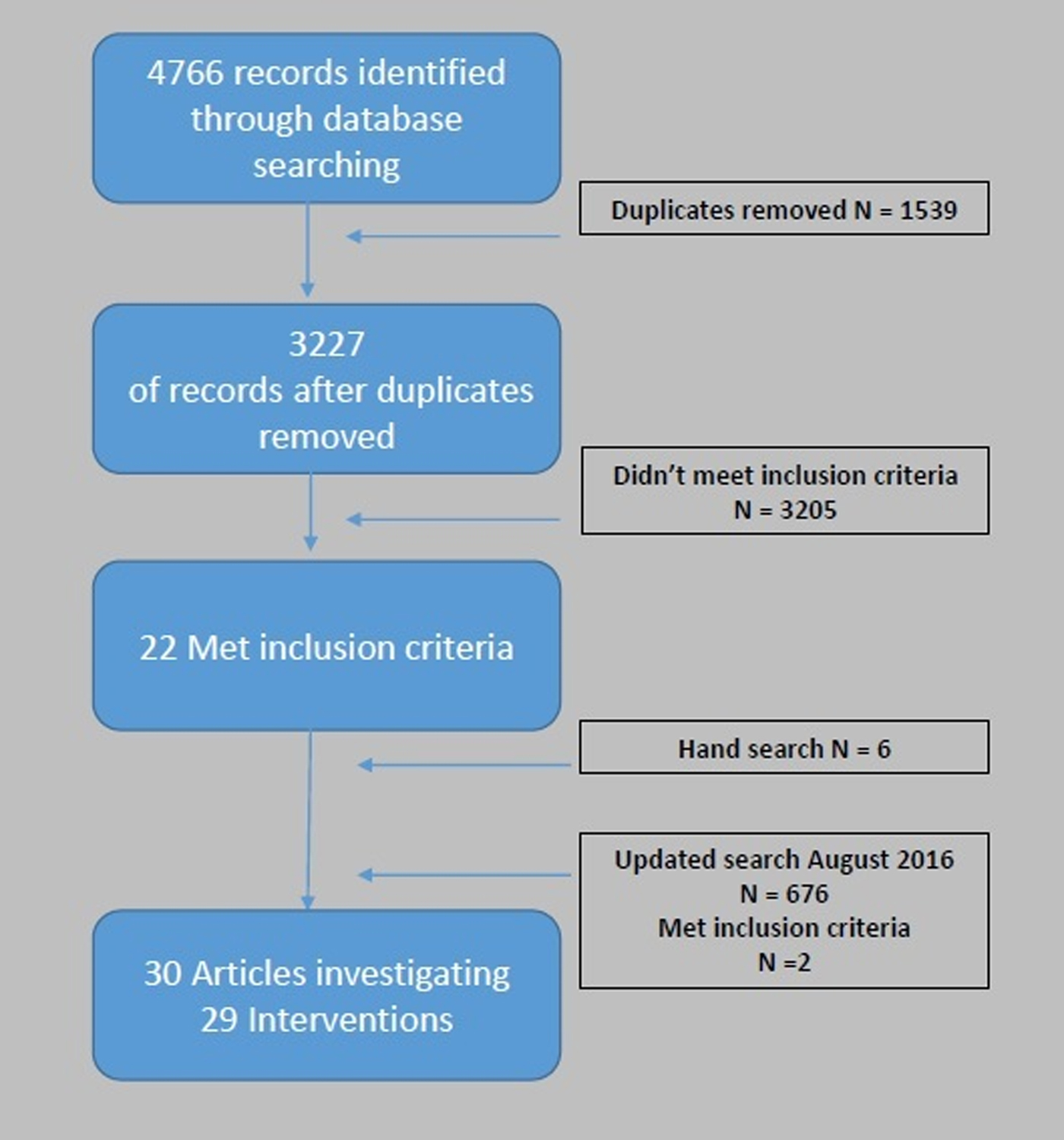
The database search identified 4,766 records. Following the removal of duplicates, 3,227 articles were screened, of which 22 met the inclusion criteria. An additional six articles were identified by hand-searching the relevant literature. An updated search conducted in August 2016 identified a further 676 results, of which two met the inclusion criteria. In total, 30 articles were included in the review, describing 29 interventions (Figure 1).
PRISMA flow diagram.

Results from assessment of risk of bias/study quality
Refer to the online supplementary table for a summary of methodological quality ratings. The quality of included studies varied, with particular areas of weakness concerning lack of masking for non-patient–reported outcome measures, low response rates to surveys, and high attrition. Six of the 10 studies also lacked an adequate control group (Lewis et al., Reference Lewis, Rand and Mullaly2015; Moorhouse & Mallery, Reference Moorhouse and Mallery2012; Pratt et al., Reference Pratt, Nay and Ladd1989; Silverstein & Sherman, Reference Silverstein and Sherman2010; van der Steen et al., Reference van der Steen, Arcand and Toscani2012; van Soest-Poortvliet et al., Reference van Soest-Poortvliet, van der Steen and de Vet2015).
Types of ACP interventions
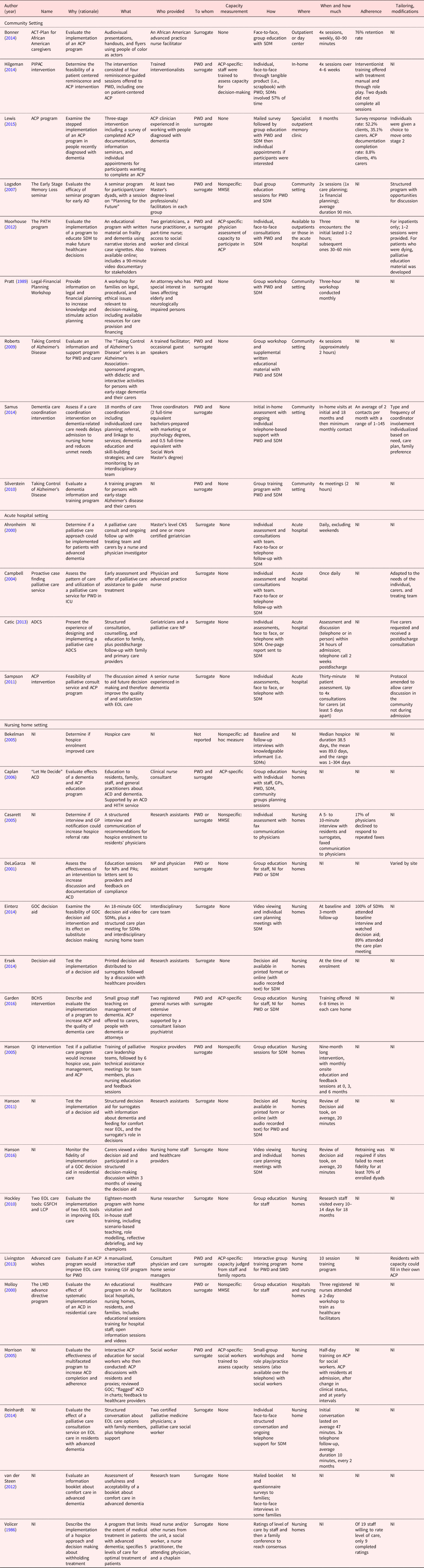
Table 1 summarizes the Template for Intervention Description and Replication checklist-specified characteristics of interventions evaluated by studies in the review.
Characteristics of advance care planning interventions for people with dementia evaluated by studies included in the systematic review

ACD, advanced care directive; ACP, advanced care panning; ACT-Plan: Advanced Care Treatment Plan; AD, Alzheimer's disease; ADCS, Advanced Dementia Consultation Service; BCHS, Bromhead Care Home Service; CNS, clinical nurse specialist; EOL, end of life; GOC, goals of care; GP, general practitioner; GSF, Gold Standards Framework; GSFCH, Gold Standards Framework for Care Homes; HITH: Hospital in the Home; ICU, intensive care unit; LCP, Liverpool Care Pathway; LMD, Let Me Decide; MMSE, Mini Mental State Examination; NI, not identified; NP, nurse practitioner; PA, physician assistant; PIPAC, Preserving Identity and Planning for Advance Care; PATH, Palliative and Therapeutic Harmonization; PWD, people with disability; QI, quality improvement; SDM, surrogate decision-maker.
Community setting
Ten interventions were conducted in a community setting, six of which were group education programs (Bonner et al., Reference Bonner, Wang and Wilkie2014; Lewis et al., Reference Lewis, Rand and Mullaly2015; Logsdon, McCurry, & Teri, Reference Logsdon, McCurry and Teri2007; Pratt et al., Reference Pratt, Nay and Ladd1989; Roberts & Silverio, Reference Roberts and Silverio2009; Silverstein & Sherman, Reference Silverstein and Sherman2010) and four that provided one on one counselling (Hilgeman et al., Reference Hilgeman, Allen and Snow2014; Lewis et al., Reference Lewis, Rand and Mullaly2015; Moorhouse & Mallery, Reference Moorhouse and Mallery2012; Samus et al., Reference Samus, Johnston and Black2014). Most interventions were administered by specifically trained facilitators (Hilgeman et al., Reference Hilgeman, Allen and Snow2014; Lewis et al., Reference Lewis, Rand and Mullaly2015; Logsdon et al., Reference Logsdon, McCurry and Teri2007; Roberts & Silverio, Reference Roberts and Silverio2009), two by nurses (in ambulatory or both ambulatory and inpatients, respectively (Bonner et al., Reference Bonner, Wang and Wilkie2014; Moorhouse & Mallery, Reference Moorhouse and Mallery2012), and one included medical professionals (geriatricians and trainees) (Moorhouse & Mallery, Reference Moorhouse and Mallery2012).
Acute hospital setting
All four interventions in the acute care setting provided a palliative care consult service and were conducted one on one with carers of individuals with advanced dementia. Three programs involved a mix of nursing and medical staff (Ahronheim et al., Reference Ahronheim, Morrison and Morris2000; Campbell & Guzman, Reference Campbell and Guzman2004; Catic et al., Reference Catic, Berg and Moran2013), whereas one was administered by an advance practice nurse (Sampson et al., Reference Sampson, Jones and Thune-Boyle2011). Two programs provided daily palliative care consultations (Ahronheim et al., Reference Ahronheim, Morrison and Morris2000; Campbell & Guzman, Reference Campbell and Guzman2004), whereas the other two programs provided less frequent intervention in the acute setting but provided follow-up in the community setting (Catic et al., Reference Catic, Berg and Moran2013; Sampson et al., Reference Sampson, Jones and Thune-Boyle2011).
Nursing homes
There were 16 studies conducted in nursing home settings. Of these, eight involved education sessions for facility staff (Caplan et al., Reference Caplan, Meller and Squires2006; DeLaGarza, Reference DeLaGarza, Andersen and Mach2001; Garden et al., Reference Garden, Green and Pieniak2016; Hanson et al., Reference Hanson, Reynolds and Henderson2005; Hockley et al., Reference Hockley, Watson and Oxenham2010; Livingston et al., Reference Livingston, Lewis-Holmes and Pitfield2013; Molloy et al., Reference Molloy, Guyatt and Russo2000) and one included education only for social workers (Morrison et al., Reference Morrison, Chichin and Carter2005). Five involved the provision of a decision aid to carers (Einterz et al., Reference Einterz, Gilliam and Lin2014; Ersek et al., Reference Ersek, Sefcik and Lin2014; Hanson et al., Reference Hanson, Carey and Caprio2011, Reference Hanson, Song and Zimmerman2016; van der Steen et al., Reference van der Steen, Arcand and Toscani2012). Decision aids in four of these studies were administered by nursing home nurses with brief training (Einterz et al., Reference Einterz, Gilliam and Lin2014; Hanson et al., Reference Hanson, Song and Zimmerman2016) and by research assistants (Ersek et al., Reference Ersek, Sefcik and Lin2014; Hanson et al., Reference Hanson, Carey and Caprio2011); the fifth study was aimed at assessing acceptability, usefulness of a decision-aid booklet rather than its effect on ACP (van der Steen et al., Reference van der Steen, Arcand and Toscani2012).
Involving persons with dementia in ACP
The degree to which persons with dementia were involved in planning their future care varied across the different settings, with interventions in the community setting being more likely than acute or nursing home interventions to include the person with dementia unless assessment determined they lacked capacity (Lewis et al., Reference Lewis, Rand and Mullaly2015; Moorhouse & Mallery, Reference Moorhouse and Mallery2012; Samus et al., Reference Samus, Johnston and Black2014). However, Bonner et al. (Reference Bonner, Wang and Wilkie2014) chose not to involve the person with dementia despite 43% being rated as not impaired or mildly impaired. In contrast, all planning in acute care was completed with carers only, and only one study asked if the person with dementia had previously expressed any wishes about his or her care (Sampson et al., Reference Sampson, Jones and Thune-Boyle2011). In nursing homes, eight of 16 (50%) studies involved the person with dementia in which they were assessed as competent (Caplan et al., Reference Caplan, Meller and Squires2006; Casarett et al., Reference Casarett, Karlawish and Morales2005; DeLaGarza et al., Reference DeLaGarza, Andersen and Mach2001; Garden et al., Reference Garden, Green and Pieniak2016; Hanson et al., Reference Hanson, Reynolds and Henderson2005; Livingston et al., Reference Livingston, Lewis-Holmes and Pitfield2013; Molloy et al., Reference Molloy, Guyatt and Russo2000; Morrison et al., Reference Morrison, Chichin and Carter2005). Others excluded the person with dementia based on stage assessment without attempts to assess decision-making capacity more specifically (Einterz et al., Reference Einterz, Gilliam and Lin2014; Ersek et al., Reference Ersek, Sefcik and Lin2014; Hanson et al., Reference Hanson, Carey and Caprio2011, Reference Hanson, Song and Zimmerman2016; Hoffmann, Erueti, & Glasziou, Reference Hoffmann, Erueti and Glasziou2013; Reinhardt et al., Reference Reinhardt, Chichin and Posner2014; Volicer et al., Reference Volicer, Rheaume and Brown1986).
Participants
The characteristics of participants in the interventions evaluated by studies in the review are summarized in an online supplementary table.
Community setting
Most studies included individuals with mild to moderate dementia (Hilgeman et al., Reference Hilgeman, Allen and Snow2014; Lewis et al., Reference Lewis, Rand and Mullaly2015; Logsdon et al., Reference Logsdon, McCurry and Teri2007; Roberts & Silverio, Reference Roberts and Silverio2009; Samus et al., Reference Samus, Johnston and Black2014; Silverstein & Sherman, Reference Silverstein and Sherman2010). Some included a mixed level of impairment or did not specify the level of impairment (Bonner et al., Reference Bonner, Wang and Wilkie2014; Pratt et al., Reference Pratt, Nay and Ladd1989); only one study assessed capacity of the individual with dementia to be involved in ACP (Logsdon et al., Reference Logsdon, McCurry and Teri2007). Numbers of participants were low across studies, with a total of 101 in intervention groups across all studies and 112 in control groups from the four studies (Ahronheim et al., Reference Ahronheim, Morrison and Morris2000; Campbell & Guzman, Reference Campbell and Guzman2004; Catic et al., Reference Catic, Berg and Moran2013; Sampson et al., Reference Sampson, Jones and Thune-Boyle2011).
Acute hospital setting
All four studies included individuals with advanced dementia, with decision-making being carried through substitute decision-makers. Three studies assessed capacity using the Functional Assessment Staging Tool, with individuals scoring ≥6 on that scale (Ahronheim et al., Reference Ahronheim, Morrison and Morris2000; Campbell & Guzman, Reference Campbell and Guzman2004; Sampson et al., Reference Sampson, Jones and Thune-Boyle2011); one study assessed capacity using the Global Deterioration Scale, with individuals scoring 7 on that scale (Catic et al., Reference Catic, Berg and Moran2013)).
Nursing homes
There were seven studies that involved only carers in ACP (Einterz et al., Reference Einterz, Gilliam and Lin2014; Ersek et al., Reference Ersek, Sefcik and Lin2014; Hanson et al., Reference Hanson, Carey and Caprio2011, Reference Hanson, Song and Zimmerman2016; Reinhardt et al., Reference Reinhardt, Chichin and Posner2014; van der Steen et al., Reference van der Steen, Arcand and Toscani2012; Volicer et al., Reference Volicer, Rheaume and Brown1986), whereas others included the person with dementia, if assessed as competent (Caplan et al., Reference Caplan, Meller and Squires2006; Casarett et al., Reference Casarett, Karlawish and Morales2005; DeLaGarza et al., Reference DeLaGarza, Andersen and Mach2001; Garden et al., Reference Garden, Green and Pieniak2016; Hanson et al., Reference Hanson, Reynolds and Henderson2005; Livingston et al., Reference Livingston, Lewis-Holmes and Pitfield2013; Molloy et al., Reference Molloy, Guyatt and Russo2000; Morrison et al., Reference Morrison, Chichin and Carter2005; van der Steen et al., Reference van der Steen, Arcand and Toscani2012). Methods used to assess capacity used the Mini-Mental State Examination (Molloy et al., Reference Molloy, Guyatt and Russo2000) either alone or with additional screening methods. One study used a clinical review by a physician to assess capacity rather than a formal tool (Morrison et al., Reference Morrison, Chichin and Carter2005).
Measures
Structural, process, and outcome measures evaluated by each study are summarized in the online supplementary table. Across settings, six studies measured concordance with end-of-life wishes, one in the acute care (Ahronheim et al., Reference Ahronheim, Morrison and Morris2000) and five in nursing homes (Caplan et al., Reference Caplan, Meller and Squires2006; Casarett et al., Reference Casarett, Karlawish and Morales2005; Garden et al., Reference Garden, Green and Pieniak2016; Livingston et al., Reference Livingston, Lewis-Holmes and Pitfield2013; Morrison et al., Reference Morrison, Chichin and Carter2005). Other outcomes measured included patient QOL, mental wellbeing (e.g., depression) and symptom control, and carer wellbeing and satisfaction with care.
Only one study included a measure of structure, using the Therapeutic Intervention Scoring System for classifying critically ill patients (Campbell & Guzman, Reference Campbell and Guzman2004). Nineteen studies measured outcomes from the person with dementia's perspective and 10 from the carer perspective. Two studies measured cost from the perspective of the healthcare system.
Effectiveness of interventions
Community setting
One-on-one programs in the community were demonstrated to increase QOL of people with dementia (Hilgeman et al., Reference Hilgeman, Allen and Snow2014; Samus et al., Reference Samus, Johnston and Black2014) but had mixed results on depression. Group sessions were not shown to alter outcomes for people with dementia (Bonner et al., Reference Bonner, Wang and Wilkie2014; Lewis et al., Reference Lewis, Rand and Mullaly2015; Logsdon et al., Reference Logsdon, McCurry and Teri2007; Pratt et al., Reference Pratt, Nay and Ladd1989; Roberts & Silverio, Reference Roberts and Silverio2009; Silverstein & Sherman, Reference Silverstein and Sherman2010). Group and individual sessions in community settings were shown to increase coping skills of carers, with significant improvements in carer-reported decision-making self-efficacy (Bonner et al., Reference Bonner, Wang and Wilkie2014; Hilgeman et al., Reference Hilgeman, Allen and Snow2014) and QOL (Hilgeman et al., Reference Hilgeman, Allen and Snow2014; Logsdon et al., Reference Logsdon, McCurry and Teri2007). Knowledge of dementia in caregivers was high in the samples and did not show significant improvement (Bonner et al., Reference Bonner, Wang and Wilkie2014; Roberts & Silverio, Reference Roberts and Silverio2009). Group education programs in the community were effective in increasing self-reported ACP behavior (such as legal and financial planning, wanting to learn more about ACP, changes in self-reported ACP choices, formal documentation such as wills, ACPs or power of attorney) (Bonner et al., Reference Bonner, Wang and Wilkie2014; Lewis et al., Reference Lewis, Rand and Mullaly2015; Moorhouse & Mallery, Reference Moorhouse and Mallery2012; Pratt et al., Reference Pratt, Nay and Ladd1989; Roberts & Silverio, Reference Roberts and Silverio2009; Samus et al., Reference Samus, Johnston and Black2014; Silverstein & Sherman, Reference Silverstein and Sherman2010). Only one program was shown to alter health system outcomes, in particular delaying transfer to a nursing home (Samus et al., Reference Samus, Johnston and Black2014).
Acute hospital setting
No studies demonstrated improved adherence to previously expressed wishes, but two studies showed improved satisfaction with end-of-life care (Catic et al., Reference Catic, Berg and Moran2013; Sampson et al., Reference Sampson, Jones and Thune-Boyle2011). All four studies conducted in the acute setting altered ACP behavior (agreement to a palliative care plan, do not resuscitate and other treatment goals) (Ahronheim et al., Reference Ahronheim, Morrison and Morris2000; Campbell & Guzman, Reference Campbell and Guzman2004; Catic et al., Reference Catic, Berg and Moran2013; Sampson et al., Reference Sampson, Jones and Thune-Boyle2011). Two studies demonstrated improvement in health system process measures including emergency visits, hospice referrals, and hospital and intensive care unit length of stay (Campbell & Guzman, Reference Campbell and Guzman2004; Catic et al., Reference Catic, Berg and Moran2013), whereas two showed no effect (Ahronheim et al., Reference Ahronheim, Morrison and Morris2000; Sampson et al., Reference Sampson, Jones and Thune-Boyle2011).
Nursing homes
There was evidence from three studies that interventions increased concordance between individuals’ self- or proxy-reported end-of-life wishes and care provided (Garden et al., Reference Garden, Green and Pieniak2016; Livingston et al., Reference Livingston, Lewis-Holmes and Pitfield2013; Morrison et al., Reference Morrison, Chichin and Carter2005). One study also showed a positive effect on psychiatric symptoms and pain (Bekelman et al., Reference Bekelman, Black and Shore2005), but others showed no effect on resident outcomes (Einterz et al., Reference Einterz, Gilliam and Lin2014; Livingston et al., Reference Livingston, Lewis-Holmes and Pitfield2013). Similarly, carer outcomes and carer satisfaction with care showed mixed results.
There was evidence that the discussion and documentation of preferences for care is possible within nursing homes. Fifteen interventions in nursing homes were shown to increase ACP practice (Bekelman et al., Reference Bekelman, Black and Shore2005; Caplan et al., Reference Caplan, Meller and Squires2006; DeLaGarza et al., Reference DeLaGarza, Andersen and Mach2001; Einterz et al., Reference Einterz, Gilliam and Lin2014; Ersek et al., Reference Ersek, Sefcik and Lin2014; Garden et al., Reference Garden, Green and Pieniak2016; Hanson et al., Reference Hanson, Reynolds and Henderson2005, Reference Hanson, Carey and Caprio2011, Reference Hanson, Song and Zimmerman2016; Hockley et al., Reference Hockley, Watson and Oxenham2010; Livingston et al., Reference Livingston, Lewis-Holmes and Pitfield2013; Molloy et al., Reference Molloy, Guyatt and Russo2000; Morrison et al., Reference Morrison, Chichin and Carter2005; Reinhardt et al., Reference Reinhardt, Chichin and Posner2014; Volicer et al., Reference Volicer, Rheaume and Brown1986). Rates of ACP discussion were higher than rates of ACP documentation; discussions of goals of care were highest, with 33%–90% of carers engaging in these discussions in studies focused on surrogate decision-makers (Catic et al., Reference Catic, Berg and Moran2013; Einterz et al., Reference Einterz, Gilliam and Lin2014; Hanson et al., Reference Hanson, Song and Zimmerman2016), whereas the number of ACDs increased to 70% (Molloy et al., Reference Molloy, Guyatt and Russo2000) and 79% (Bekelman et al., Reference Bekelman, Black and Shore2005) in studies involving the person with dementia..
Of the seven studies that evaluated effectiveness of interventions on healthcare utilization, six had a positive effect, reducing hospitalization and length of stay (Caplan et al., Reference Caplan, Meller and Squires2006; Casarett et al., Reference Casarett, Karlawish and Morales2005; Garden et al., Reference Garden, Green and Pieniak2016; Hockley et al., Reference Hockley, Watson and Oxenham2010; Livingston et al., Reference Livingston, Lewis-Holmes and Pitfield2013; Molloy et al., Reference Molloy, Guyatt and Russo2000), whereas one showed no change (Volicer et al., Reference Volicer, Rheaume and Brown1986).
Discussion
This review suggests that the most compelling evidence for dementia-focused ACP can be found within the nursing home setting, where there is good evidence that the systematic implementation of ACP can influence care practices, decrease hospitalization (Caplan et al., Reference Caplan, Meller and Squires2006; Casarett et al., Reference Casarett, Karlawish and Morales2005; Garden et al., Reference Garden, Green and Pieniak2016; Molloy et al., Reference Molloy, Guyatt and Russo2000) and length of stay (Caplan et al., Reference Caplan, Meller and Squires2006; Casarett et al., Reference Casarett, Karlawish and Morales2005; Hockley et al., Reference Hockley, Watson and Oxenham2010; Molloy et al., Reference Molloy, Guyatt and Russo2000), and, most importantly, increase the concordance between individuals’ end-of-life wishes and care provided (Garden et al., Reference Garden, Green and Pieniak2016; Livingston et al., Reference Livingston, Lewis-Holmes and Pitfield2013; Morrison et al., Reference Morrison, Chichin and Carter2005). Evidence in support for ACP for people with dementia in the nursing home setting extends findings from reviews of ACP in this population by Wickson-Griffiths et al. (Reference Wickson-Griffiths, Kaasalainen and Ploeg2014) and in mixed patient populations more generally (Brinkman-Stoppelenburg et al., Reference Brinkman-Stoppelenburg, Rietjens and van der Heide2014). These findings highlight the need for ongoing efforts to increase the rate of ACP among this group.
In both acute hospital and community settings, ACP interventions have been demonstrated to increase ACP practice but not concordance between care and wishes; evidence for improvements on other patient and family outcomes has been mixed. Interventions in the acute care setting were able to increase goals of care discussions and the completion of do not resuscitate orders, but were not demonstrated to reduce the use of burdensome interventions. Ensuring completion of ACP translates to actual care received is notoriously difficult regardless of dementia status, especially in acute care (Connors et al., Reference Connors, Dawson and Desbiens1995), cautioning against a reliance on process measures of this type as the only measure of effectiveness. Limited efficacy among studies we included from the acute setting may be related to the predominance of a consultant model whereby ACP was conducted by a team providing expert advice without upskilling the team directly involved in delivering acute care. There was also little attention paid to ensuring that goals of care agreed in the acute setting were communicated to longer term care providers on discharge. Community-based programs were found to increase self-reported ACP practice (Bonner et al., Reference Bonner, Wang and Wilkie2014; Lewis et al., Reference Lewis, Rand and Mullaly2015; Pratt et al., Reference Pratt, Nay and Ladd1989; Roberts & Silverio, Reference Roberts and Silverio2009; Silverstein & Sherman, Reference Silverstein and Sherman2010). Evidence was especially strong for individual programs, which were found to increase QOL in people with dementia and (in one study) delayed transfer to long-term care. Group programs were found to alter outcomes for carers but not for people with dementia.
Across settings, the programs that seemed to have the greatest effect on ACP uptake were those that involved a comprehensive education system for staff, especially in nursing homes (DeLaGarza et al., Reference DeLaGarza, Andersen and Mach2001; Garden et al., Reference Garden, Green and Pieniak2016; Hockley et al., Reference Hockley, Watson and Oxenham2010; Livingston et al., Reference Livingston, Lewis-Holmes and Pitfield2013; Molloy et al., Reference Molloy, Guyatt and Russo2000; Morrison et al., Reference Morrison, Chichin and Carter2005), and those that provided multiple prompts over time (Garden et al., Reference Garden, Green and Pieniak2016; Hockley et al., Reference Hockley, Watson and Oxenham2010; Morrison et al., Reference Morrison, Chichin and Carter2005; Reinhardt et al., Reference Reinhardt, Chichin and Posner2014). It has previously been demonstrated that to increase ACP in older adults, it is necessary to provide multiple prompts over time (Bravo, Dubois, & Wagneur, Reference Bravo, Dubois and Wagneur2008). It also appears that engagement of doctors in ACP (either by regularly attending care planning meetings [Hockley et al., Reference Hockley, Watson and Oxenham2010] or being involved in completing or signing of forms [Livingston et al., Reference Livingston, Lewis-Holmes and Pitfield2013; Molloy et al., Reference Molloy, Guyatt and Russo2000; Moorhouse & Mallery, Reference Moorhouse and Mallery2012; Reinhardt et al., Reference Reinhardt, Chichin and Posner2014]) may result in higher completion of ACDs. The physician's role in enhancing ACP has been highlighted as especially important when they have known the resident/family for some time (Rhee, Zwar, & Kemp, Reference Rhee, Zwar and Kemp2012), and may especially be related to their capacity to increase confidence in decision-making (Givens, Kiely, Carey, & Mitchell, Reference Givens, Kiely and Carey2009).
Involvement of people with dementia in care planning was found to be limited both in acute care and (to a lesser extent) in nursing homes. Of the studies reviewed, only four described methods for evaluating the ability of an individual to understand choices relevant to ACP (Caplan et al., Reference Caplan, Meller and Squires2006; Casarett et al., Reference Casarett, Karlawish and Morales2005; Moorhouse & Mallery, Reference Moorhouse and Mallery2012; Morrison et al., Reference Morrison, Chichin and Carter2005). Determining capacity to participate in ACP should consider the individual's ability to understand, appreciate, and communicate the reasons for his or her choices and should be specific to a particular task at a particular time (Purser & Rosenfeld, Reference Purser and Rosenfeld2014). People with dementia may be capable of making certain decisions but not others, and lack of current capacity should not be assumed based on more general cognitive assessments (e.g., Mini-Mental State Examination) or on assessments carried out at another time. Although research in the field is somewhat nascent, there is at least some evidence that people with dementia can be supported to participate in shared decision-making even when they are no longer able to do so independently (Menne & Whitlatch, Reference Menne and Whitlatch2007; Smebye, Kirkevold, & Engedal, Reference Smebye, Kirkevold and Engedal2012). In addition to involvement of persons with dementia in formal ACP, informal discussions between them and their families are useful in case their special relationship enables insights to be gleaned about the person's wishes (Dickinson et al., Reference Dickinson, Bamford and Exley2013). Process measures of how the person with dementia and his or her family have been involved in ACP are important in establishing that directives genuinely reflect the person's wishes both for the purposes of research evaluation and also for motivating health professionals to implement these in end-of-life care.
The findings of this review are limited by inclusion of studies with a range of designs, including nonrandomized studies. Conversely, this review focused on quantitative research only, overlooking any insights qualitative research might have offered regarding mechanisms and barriers/facilitators. Generalizability of findings between countries would need to take into account cultural differences that exist in preferences for personal autonomy (Connolly, Sampson, & Purandare, Reference Connolly, Sampson and Purandare2012; van der Steen et al., Reference van der Steen, Arcand and Toscani2012). Similarly, it is important to consider the country of origin with regard to similarities or differences between health services and legislative arrangements when determining applicability. Also, type and stage of dementia was reported too inconsistently to allow subgroup analyses. Finally, few of the studies reporting positive outcomes provided details of care that was provided as a result of ACP and that was presumably instrumental in obtaining their results. A recent Cochrane review has confirmed that there is a lack of evidence for palliative care interventions in advanced dementia, but suggests there may be studies under way to address this gap (Murphy et al., Reference Murphy, Froggatt and Connolly2016).
Key findings
ACP interventions for people with dementia living in nursing homes have proven efficacy in influencing care practices and increasing the concordance between individuals’ end-of-life wishes and care provided.
Individual and group programs in the community can increase ACP practice, and individual programs can improve quality of life in people with dementia. ACP in the acute care setting can enable development of goals of care for people with dementia; however, its effectiveness in improving outcomes for people with dementia or the health system has not been demonstrated. It is important that any goals developed in the acute care setting are shared with ongoing care providers.
People with dementia were often excluded from ACP discussions without appropriate assessment of capacity. More research is needed to optimize supported decision-making as a person's cognitive function deteriorates.
The most successful programs have been those that provide a comprehensive education system for staff, especially in nursing homes, and multiple prompts for ACP over time. Measurement of the success of ACP needs to go beyond documenting completion of directives to focus on the process (including assessment of capacity and involvement of the person with dementia) and outcomes (including influence on end-of-life care received).
Supplementary material
The supplementary material for this article can be found at https://doi.org/10.1017/S1478951519000257.
Acknowledgments
We would like to thank Ms Ingrid Amgarth-Duff, a research assistant at the University of Technology Sydney, for her assistance with the preparation of tables.
Funding
This work was funded by the National Health and Medical Research Council's (NHMRC) Cognitive Decline Partnership Centre (CDPC).
Conflicts of Interest
The authors declare that there is no conflict of interest.