Introduction
African fertility levels and patterns have been extensively studied (Schultz, Reference Schultz1974; Garenne & Veronique, Reference Garenne and Veronique2003; Shapiro & Gebreselassie, Reference Shapiro and Gebreselassie2008; Schoumaker, Reference Schoumaker2009; Ezeh et al., Reference Ezeh, Mberu and Emina2009a; Machiyama, Reference Machiyama2010; Odimegwu & Adedini, Reference Odimegwu and Adedini2014). Basically, there are two approaches to explaining fertility levels and patterns in demographic research: micro- and macro-level analysis. More focus has been on the micro- or individual-level approach, which assumes that variations in fertility behaviour are due to individual characteristics. The macro-level approach models the effects of structural characteristics of the places or contexts in which people live on their fertility behaviour and examines the effects that the community contexts have on an individual’s reproductive behaviour. This argument is premised on the fact that social structure forces are at work in determining various demographic outcomes such as fertility, mortality and migration (Billy & Moore, Reference Billy and Moore1992; Ononokpono et al., Reference Ononokpono, Odimegwu, Imasiku and Adedini2013; Adedini et al., Reference Adedini, Odimegwu, Imasiku and Ononokpono2015).
Casterline et al. (Reference Casterline, Entwisle and Sayed1988) noted that macro-level variables may be related to intermediate fertility variables either directly or indirectly through their effects on individual-level variables that are directly related to intermediate fertility variables. An example of a direct macro-level effect is high infant and child mortality (within a society), which instils in prospective parents a need for a large number of children to insure against the future loss of some children (Hirschman & Guest, Reference Hirschman and Guest1990).
A number of researchers have sought to understand the role of macro-level factors on fertility behaviour. For instance, Casterline (Reference Casterline1985, Reference Casterline1987), Bilsborrow and Guilkey (Reference Bilsborrow and Guilkey1987) and Benefo (Reference Benefo2012) have previously attempted to analyse ways in which the community setting can influence fertility-related behaviours. Similarly, Bilsborrow and Guilkey (Reference Bilsborrow and Guilkey1987) reviewed studies that aimed to link the community or institutional setting to fertility or fertility-related behaviour through its response to issues such as the availability and costs of contraceptive services, availability of health facilities, availability of educational facilities, the existence of transportation, electrification and other economic infrastructure, and/or economic conditions. A recent study by Colleran (Reference Colleran, Jasienska, Nenko, Galbarczyk and Mace2014) established that community-level education has a significant influence in accelerating the cultural evolution of fertility decline in Africa. Kravdal (Reference Kravdal2012) provided further evidence in support of how community level of education influences fertility levels and patterns in sub-Saharan Africa.
However, while admitting that existing evidence for the effects of community-level factors on fertility and fertility-related behaviour is weak, prior research (Kravdal, Reference Kravdal2012; Colleran, Reference Colleran, Jasienska, Nenko, Galbarczyk and Mace2014) has argued that this is a reflection of inadequate conceptualization of the process whereby community factors influence fertility. As a result, studies on fertility behaviour in Africa have mainly focused on the influence of individual- and household-level characteristics. It is assumed that men and women in a marital dyad are responding to different individual circumstances, which include family socioeconomic conditions. Essentially, most prior research on fertility in Africa has not considered that individual fertility behaviour is constrained by the community contexts in which an individual resides. It is generally agreed that socioeconomic development will provide a platform for fertility change by not only providing family planning facilities but also by inducing social control of fertility (Tienda, Reference Tienda1984; Machiyama, Reference Machiyama2010). There is therefore a need to go beyond the factors that influence fertility pattern at the individual level in order to understand fertility behaviour.
Although little research has been done on the influence of community contexts on fertility levels and pattern in Africa, the few existing studies have mainly been in developed countries. The present work (which is a part of a larger study of macro-level influences on African demographic outcomes) is an attempt to investigate the effects of community or contextual variables on fertility behaviour in Africa. The study focuses on the micro–macro nexus of fertility behaviour depending on social context. This is based on the condition that fertility behaviour may be an outcome of individual women’s background, attitudes, social status and also the socioeconomic structure (macro) of the society. It is specified here that the socioeconomic characteristics of individual African women would affect their fertility behaviour while the contextual characteristics of their location can affect the relationships between socioeconomic characteristics and fertility. Thus, the principal aim of the paper was to examine the variation in fertility across individual characteristics and community contexts. The basic research question of this study was: ‘to what extent do community contexts (net of individual characteristics) influence fertility pattern in Africa?’
Theoretical framework
Criticisms of Demographic Transition Theory (DTT) have led to the introduction of many other theories of fertility, including inter-generational wealth flows, ideational theory, economic theory of fertility, demand and supply models, and diffusion and interaction theories (Hirschman & Young, Reference Hirschman and Young2000). This is perhaps due to the challenges in verifying DTT’s fertility hypotheses using empirical data, particularly in the 1960s and 1970s. However, the theoretical and empirical literature shows that Demographic Transition Theory remains an important theoretical formulation for the study of fertility. In particular, rather than invalidating DTT’s classical argument that fertility decline is often preceded by an initial mortality decline arising from social and economic modernization, many recent theoretical formulations, including those stated above, only further strengthen DTT’s argument about how socioeconomic and structural changes influence demographic processes. Apart from the economic theory of fertility, which stresses the role of the socioeconomic status of women in explaining fertility behaviour, other theories of fertility largely expand the basic tenets of demographic transition theory. Thus, this study has its theoretical underpinning in Demographic Transition Theory and the economic theory of fertility. The two theoretical formulations make (what could be regarded as) complementary arguments regarding fertility behaviour. Demographic Transition Theory and economic theory of fertility distinguish between macro- and micro-level variables of fertility change (Smith, Reference Smith1989; Weeks, Reference Weeks2005; Poston & Bouvier, Reference Poston and Bouvier2010; Odimegwu & Kekovole, Reference Odimegwu and Kekovole2014).
First, DTT argues that community factors (the social and economic structure of an individual’s environment) determine the fertility goals of individuals, either directly or indirectly (Davis & Blake, Reference Davis and Blake1986). These community factors as measured in the present study include community level of women’s autonomy, community poverty and community level of non-professional occupation. Others are community family size norm, community level of education, community media access, region of residence and place of residence. In the attempt to examine the influence of these contextual variables on fertility behaviour, the study drew on DTT’s proposition that stresses structural and socioeconomic conditions as factors that influence fertility levels and pattern (Hirschman & Guest, Reference Hirschman and Guest1990; Hirschman et al., Reference Hirschman, Tan, Chamratrithirong and Guest1994). The theory further posits that social structure, proxied by modernization and mortality levels, shapes the social context of family formation and childbearing. In essence, DTT states that social modernization leads to an initial decline in mortality, which reduces incentives for large families and thus leads to low fertility levels.
On the other hand, the economic theory of fertility posits that individual-level variables are important variables for explaining fertility change (Hirschman & Young, Reference Hirschman and Young2000). Such individual-level variables (as considered in the present study) include measures of women’s socioeconomic status, i.e. education and occupation. From an economic perspective, it is argued that the socioeconomic status of women is a key element in economic theory. It is, however, argued that the effect of socioeconomic status on fertility in demographic transition is secondary to societal and familial structures. Hirschman and Young (Reference Hirschman and Young2000) argued that the difference between the social demographic model of fertility and the economics of the fertility model is the importance of the macro-level versus micro-level determinants.
Based on these theoretical insights drawn from demographic transition theory and economic theory of fertility, this study posits that fertility level and pattern in Africa are products of community influences, brought about by social developments or modernization and individual-level characteristics. Thus, it is hypothesized that community-level and individual-level characteristics are both important drivers of fertility changes in Africa. Billy and Moore (Reference Billy and Moore1992) opined that community structures serve to establish societal constraints within which individuals make fertility-related decisions. Based on this, the study specified that the selected community-level variables are the key explanatory variables and that individual-level variables can be mediators of community-level influences and independent determinants on their own.
Methods
Data for the study came from five countries representing the five regions of Africa. The most recent Demographic and Health Survey (DHS) data for the selected countries were used. The selected countries were Cameroon (Middle Africa), Egypt (Northern Africa), Kenya (Eastern Africa), Nigeria (Western Africa) and Zimbabwe (Southern Africa).
There are two reasons for undertaking a comparative study based on the datasets of the selected countries. First, the African continent has a peculiar antecedent, particularly related to male dominance in fertility decision-making. However, fertility decline on the continent has not been uniform. This is perhaps due to a lack of uniformity in socioeconomic development across the continent. Given that community contexts depend largely on level of socioeconomic development, this paper aimed to undertake a comparative analysis of the extent to which fertility patterns across the continent have been influenced by differences in community contexts, which are the product of level of socioeconomic structure. Second, the DHS datasets allow for comparative analysis, given that similar methodologies are employed in data collection across countries.
Based on the methodologies employed by the DHS programme, all the DHS surveys have nationally representative cross-sectional samples. All enumeration areas in each country were stratified according to the region and urban–rural status. Samples of enumeration areas (EAs) were drawn from these strata with probability proportional to size. The samples for different countries were drawn using stratified, multistage cluster sampling designs. The first stage involved the random selection of EAs while the second stage involved a random selection of households from the sampled EAs. Also, eligible women of reproductive age (15–49 years) were randomly selected from the sampled households. The community-level variables were measured at the level of the EA or primary sampling unit (PSU). A PSU is a small administratively defined homogeneous area which serves as a proxy for community. Across the five countries, response rates ranged from 90% to 95%. For the purpose of standardization, the study included women aged 15–44, excluding those aged 45–49. These were excluded from the analysis based on evidence that African women often conclude childbearing early, and completed family size is often reached well before the age of 30. Data exploration showed that the proportion of women who bore children at the ages of 45–49 was negligible.
Individual women data were analysed for the selected countries. The datasets utilized for the selected countries were the 2011 Cameroon DHS, 2008 Egypt DHS, 2008–09 Kenya DHS, 2008 Nigeria DHS and 2010–11 Zimbabwe DHS. Under the assumption that factors that shape early family formation differ from those that determine fertility at older ages, analyses were disaggregated by respondent’s age, i.e. all women aged 15–29 and only married women aged 30–44 years. Thus, the sample sizes for the selected countries were 14,239 for Cameroon, 14,271 for Egypt, 7774 for Kenya, 30,480 for Nigeria and 8539 for Zimbabwe. Considering that community characteristics are influenced by cultural norms and values, and given that fertility behaviours are partly shaped by cultural norms and values, one country each was selected from the five regional blocks in Africa to deepen understanding of the influence of broad socio-cultural contexts on fertility behaviour in different regions of the continent. The countries selected for this study have similar characteristics with other countries in their respective sub-regions in Eastern, Middle, Northern, Southern and Western Africa.
Outcome variable
Three individual-level measures of fertility have been used as response variables in most studies: the number of children born to a woman during the five years preceding a survey, the number of children surviving and completed family size (Billy & Moore, Reference Billy and Moore1992; Hirschman & Young, Reference Hirschman and Young2000). Of the three measures of fertility, the number of children surviving is less error-prone (Hirschman & Guest, Reference Hirschman and Guest1990). Thus, the dependent variable is an index of current fertility – number of children surviving. Given that it is a count variable, the number of children surviving was treated as a count outcome measure; hence multilevel Poisson regression analysis was employed as the appropriate statistical technique. Rodriguez (Reference Rodriguez2007) noted that a random variable Y can be said to have a Poisson distribution with parameter μ if it takes integer values y=0,1,2,3…, with probability:
 $$\Pr \,\left[ {Y\,{\equals}\,y} \right]\,{\equals}\,{{e^{{{\minus}\mu \,\mu ^{y} }} } \over {y\,!\,}}$$
for μ>0. The mean and variance of the distribution can be shown to be:
 $$E\left( Y \right)\,{\equals}\,{\rm var}\left( Y \right)\,{\equals}\,\mu $$
From the above, the mean and variance of the Poisson distribution are equal. The Poisson regression is regarded as an appropriate technique for analysing a count outcome measure (Rodriguez, Reference Rodriguez2007). All analysis was done using Stata software (Version 11.2).
Independent variables
Community contextual factors
The selected community-level variables considered in this analysis included: region of residence, place of residence, community level of education, community media access, community poverty level, community family size norm, community level of non-professional occupation and community level of women’s autonomy. Women’s autonomy (defined as the extent to which women in a marital dyad participate in household decision-making) was constructed/generated from responses to questions on women’s participation in decision on: (i) household purchases, (ii) own health, (iii) visiting friends or relatives, and (iv) how own income is spent.
The DHS data have hierarchical structures: individual, household and community levels. Community-level variables (defined as characteristics of respondents measured at the level of PSUs or clusters) were generated by aggregating variables at the individual and household levels. As done in previous relevant studies (Harttgen & Misselhorn, Reference Harttgen and Misselhorn2006; Omariba & Boyle, Reference Omariba and Boyle2007; Antai, Reference Antai2009), variables at the level of community were generated by computing the proportion of respondents with a particular characteristic in the community. The constructed community-level characteristics were divided to tertiles, with ‘low’ representing a low proportion of respondents with an attribute and ‘high’ representing a high proportion of respondents with a given attribute. This approach has been used in earlier studies on maternal and child health (Ononokpono et al., Reference Ononokpono, Odimegwu, Imasiku and Adedini2013; Adedini et al., Reference Adedini, Odimegwu, Imasiku and Ononokpono2015).
Individual-level characteristics
The individual-level characteristics of interest for this analysis included maternal education, religion, respondent’s occupation, age at marriage and partner’s education. Existing theoretical and empirical studies have commented on the utility of the selected independent variables as fertility determinants globally (Guilkey & Jayne, Reference Guilkey and Jayne1997; Ezeh et al., Reference Ezeh, Mberu and Emina2009a).
Statistical analysis
Descriptive and inferential statistics were employed in data analysis. The method of statistical analysis most suited for relating both macro- and micro-level behaviours to a behaviour such as fertility is multilevel modelling. Multilevel Poisson regression models were fitted at the multivariate level of analysis to disentangle the individual- and community-level determinants of fertility. For each of the five selected countries, eight multilevel models were fitted, i.e. four models each for age groups 15–29 and 30–44. Although forty multilevel models were fitted in all, only the full models (that incorporated all the selected covariates) are purposively shown in the tables (due to space constraints).
The study employed multilevel analysis using three basic situations: (i) models examining individual-level variables; (ii) models examining community-level variables and (iii) models examining the effects of individual- and community-level variables on children surviving. Model 0 (null model) was fitted to decompose the total variance into individual- and community-level parts. Model 1 added the individual-level variables. Model 2 incorporated the community-level variables into the multilevel model, while Model 3 simultaneously accounted for the effects of individual- and community-level variables on fertility.
Results
Descriptive results
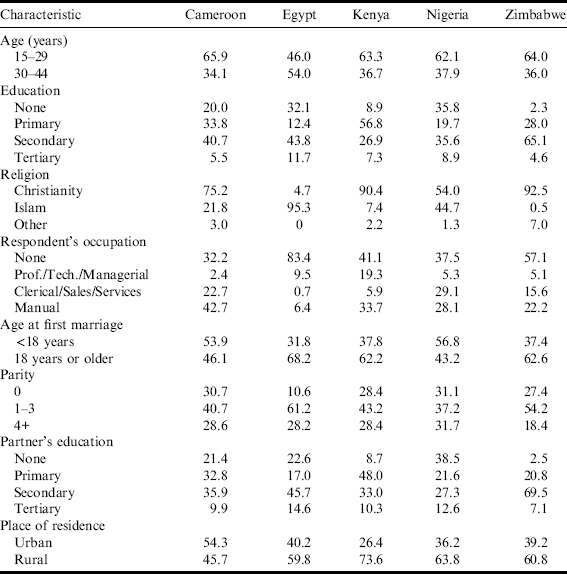
The percentage distributions of respondents by selected individual-level and contextual characteristics were obtained in the first level of analysis (Table 1). The results showed that the majority of the women were aged 15–29 in Cameroon (65.9%), Kenya (63.3%), Nigeria (62.1%) and Zimbabwe (64.0%), while the pattern was different in Egypt as 46.0% were within the age bracket 15–29 as against 54.0% in the age group 30–44 years. The percentage of women with no education was highest in Nigeria (35.8%), followed by Egypt (32.1%), Cameroon (20.0%), Kenya (8.9%) and Zimbabwe (2.3%). As expected, the majority were Muslim in Egypt (95.3%), while the highest proportions of respondents were adherents of the Christian faith in Cameroon (75.2%), Kenya (90.4%), Nigeria (54.0%) and Zimbabwe (92.5%).
Percentage distribution of respondents (women aged 15–44 years) by selected characteristics

Considering respondent’s occupation, Egypt had the highest proportion of respondents with no job (83.4%), followed by Zimbabwe (57.1%). More women (53.9%) tended to marry earlier than age 18 in Cameroon (56.8% in Nigeria). The majority (68.2%) had their first marriage at age 18 or older in Egypt (62.2% in Kenya and 62.6% in Zimbabwe). In all the selected countries, most of the respondents were 1- to 3-parity women. With respect to partner’s education, Zimbabwe had the highest proportion with secondary education. Most women reported that their partners were engaged in clerical/technical/services occupations in all the selected countries. Furthermore, the results indicate that the majority were residing in rural areas in Kenya, Nigeria, Zimbabwe and Egypt, but in Cameroon the percentage of respondents residing in rural area was 45.7%.
Fertility determinants of women: multilevel analysis
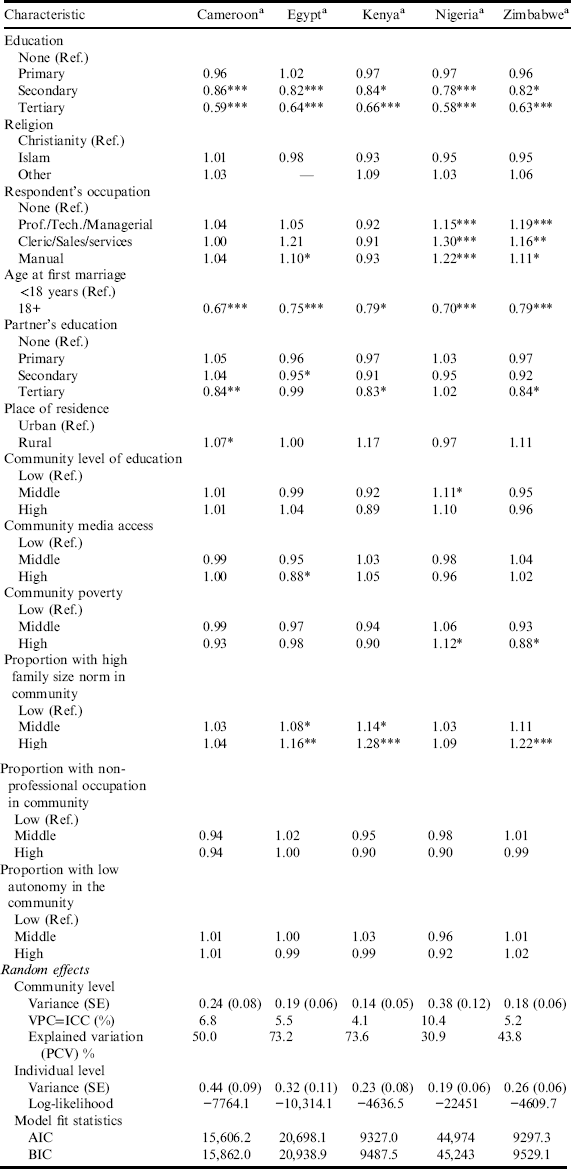
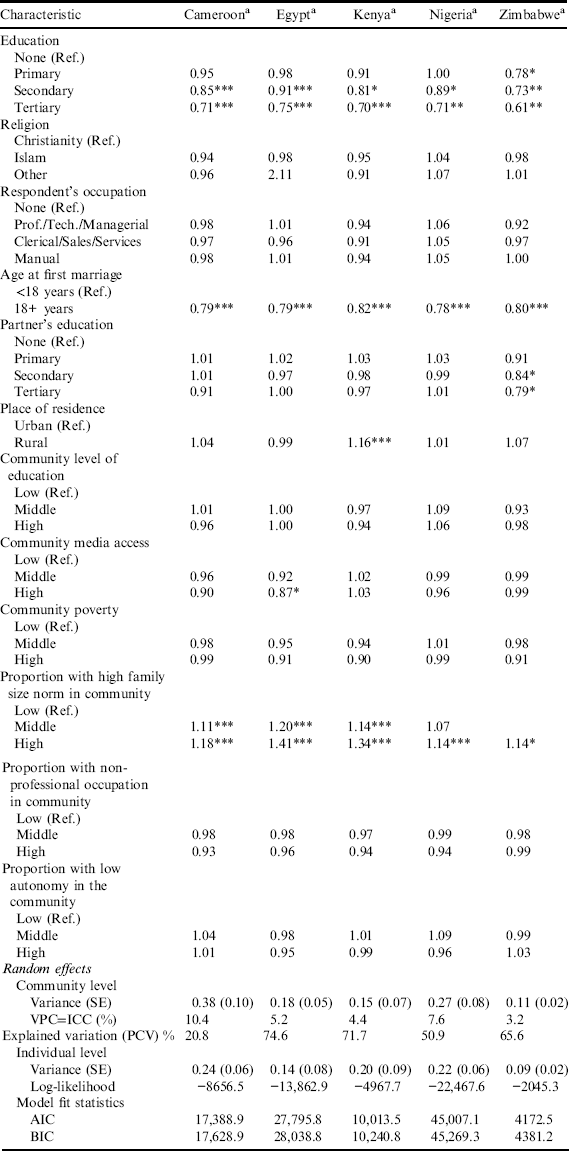
Tables 2 and 3 present the results of the multilevel Poisson regression analysis. At the individual level, in most of the countries, the individual-level characteristics such as respondent’s education, age at first marriage and partner’s education were found to be significantly associated with fertility levels in both age categories (15–29 and 30–44). For instance, compared with women who had no formal education, those with higher education had fewer children in Cameroon (exponential coefficient (EC): 0.57, p<0.001), Egypt (EC: 0.61, p<0.001), Kenya (EC: 0.60, p<0.001), Nigeria (EC: 0.62, p<0.001) and Zimbabwe (EC: 0.57, p<0.001). The results consistently indicated a significant inverse relationship between fertility level and older age at first marriage (18 years or older) in all the selected countries.
Results of Poisson regression analysis showing the effects of individual and contextual factors on number of surviving children in five African countries (all women aged 15–29)

a Only full model presented.
*p<0.05; **p<0.01; ***p<0.001.
SE=standard error, VPC=Variance Partition Coefficient, ICC=Intra-Class Correlation Coefficient, PCV=Proportional Change in Variance; region is controlled for in the analysis.
Results of Poisson regression analysis showing the effects of individual and contextual factors on number of surviving children in five African countries (married women aged 30–44)

SE=standard error, VPC=Variance Partition Coefficient, ICC=Intra-Class Correlation Coefficient, PCV=Proportional Change in Variance; region is controlled for in the analysis.
a Only full model presented.
*p<0.05; **p<0.01; ***p<0.001.
The independent effects of community-level characteristics on fertility levels were examined (analysis not shown). In the full models, community-level and individual-level characteristics were incorporated into the multilevel modelling for all selected countries (Tables 2 and 3). The significant individual-level variables in the initial models (analysis not shown) remained significantly associated with fertility level in all the selected countries, even after adjusting for the effects of community-level characteristics.
The results indicate there was a significant community effect on African fertility patterns as demonstrated by the Intra-Class Correlation (ICC) and proportional change in variance in the null models and full models. The effect of region of residence was relevant for fertility levels for both age groups (15–29 and 30–44) in all selected countries. In addition, compared with urban area, residence in rural areas was significantly associated with higher fertility level among women aged 30–44 in Kenya (EC: 1.16, p<0.001).
Moreover, residence in communities with a high proportion of women with a large-family-size norm tends to significantly influence higher fertility level among older women aged 30–44 in Egypt (EC: 1.41, p<0.001), Nigeria (EC: 1.14, p<0.001) and Zimbabwe (EC: 1.14, p<0.05). Similarly, residence in communities with a high proportion of women with large-family-size norm was important for fertility level among younger women aged 15–29 only in Egypt (EC: 1.17, p<0.01). Residence in communities with high level of media access was also significantly important for fertility patterns for both age categories of women in Egypt (EC: 0.87, p<0.01).
Residence in communities with a high proportion of educated women was found to be important for achieving lower fertility levels (for both age groups) in Cameroon, but these effects waned after adjusting for the influence of individual-level variables (full models, Tables 2 and 3). Similarly, residence in communities with a high proportion of educated women was relevant for achieving a lower fertility level among younger women aged 15–29 in Nigeria (EC: 0.58, p<0.001). However, these significant effects plummeted after controlling for individual-level factors.
Residence in a poor neighbourhood was significantly associated with higher fertility levels in Nigeria (EC: 1.12, p<0.05). Residence in communities where the majority of women had low autonomy was positively associated with a higher fertility level among women aged 15–29 in Cameroon (EC: 1.36, p<0.001), Egypt (EC: 1.14, p<0.001) and Nigeria (EC: 1.47, p<0.001). The results also showed that residing in communities that had a high proportion of women with media access was significantly associated with a lower fertility level in both age categories of women in Egypt in 2008.
Discussion
In this paper, the effects of community contexts (net of individual-level characteristics) on African fertility patterns were examined, using data from Demographic and Health Surveys from five selected countries representing the five regional blocks of Africa: Cameroon (Middle Africa), Kenya (Eastern Africa), Egypt (Northern Africa), Nigeria (Western Africa) and Zimbabwe (Southern Africa). The results reveal that both individual- and community-level characteristics are statistically important factors for the observed level and pattern of fertility in these selected African countries. As indicated by the Intra-Class Correlation (ICC) and the Proportional Change in Variance (PCV), the study established that fertility patterns are not homogenous across different settings and communities in the selected countries and there is a significant community effect on African fertility patterns. The results suggest that the inter-country variations in fertility levels and patterns are attributable to differences in both individual characteristics and contextual or structural factors across countries. In other words, fertility levels in various countries seem to respond to the prevailing forces and mechanisms that operate at the individual and community levels within which fertility decisions are made. The differences in socioeconomic characteristics could be attributed to the peculiarities of each country, and invariably appear to influence the fertility patterns of different countries.
The findings suggest that the fertility pattern of a selected country is jointly determined by the individual- and household-level characteristics of women, as well as by the characteristics of their community or neighbourhood of residence. Some community characteristics were found to have independent effects on fertility levels, even after adjusting for individual-level characteristics. It was found that contextual factors – such as region of residence, place of residence, community level of education, community media access and community family-size norm – are important in explaining fertility patterns in a number of selected countries.
Region of residence was found to be a statistically important factor influencing fertility patterns in the selected countries. Previous studies have established the influence of regions where women reside on demographic outcomes such as infant and child survival (Adedini et al., Reference Adedini, Odimegwu, Imasiku, Ononokpono and Ibisomi2014), maternal health-seeking behaviour (Ononokpono et al., Reference Ononokpono, Odimegwu, Imasiku and Adedini2013), under-five mortality (Antai, Reference Antai2011) and contraceptive use (Imasiku et al., Reference Imasiku, Odimegwu, Adedini and Ononokpono2013). The analysis indicated that residence in a section or region of a country, as opposed to living elsewhere, significantly influences the fertility patterns of countries under study. For instance, while women in south-western and south-eastern parts of Nigeria were found to have fewer children than women in northern regions of the country, women in Urban Governorates had fewer children than those in Frontier Governorates region of Egypt. A plausible explanation for the importance of region of residence in shaping fertility pattern is that women in regions with lower fertility might be exposed to a range of values, ideals, customs and information that women in high-fertility regions are not exposed to. Such information and values could play vital roles in shaping the fertility behaviour of women across different regions and settings.
Similarly, urban residence has been found to be significantly associated with lower fertility in most of the countries under study (Garenne, Reference Garenne2008; Ezeh et al., Reference Ezeh, Mberu and Emina2009b). Evidence shows that rural dwellers are likely to be more pronatalist, engage more in high-risk sexual behaviours and are less likely to seek health care services compared with urban dwellers (Izugbara & Ezeh, Reference Izugbara and Ezeh2010; Abderrahim & Rutstein, Reference Abderrahim and Rutstein2011; Odimegwu et al., Reference Odimegwu, Pallikadavath and Adedini2013). Hence, all the different forms of high-fertility behaviours – too frequent births, too close births and high parities – are more common in rural areas than in urban centres (Adedini et al., Reference Adedini, Odimegwu, Imasiku, Ononokpono and Ibisomi2014).
Education context plays an important role in shaping the fertility patterns of many countries in this study. The results indicate that residence in communities with a high proportion of educated women is associated with lower fertility. This finding suggests that the social capital provided by higher education contexts appears to positively shape the fertility behaviours of women (who themselves had little or no education) towards embracing low-fertility norms and values. Notably, previous studies have established the importance of good education contexts in increasing the survival chances of children under the age of five (Boco, Reference Boco2010; Adedini et al., Reference Adedini, Odimegwu, Imasiku, Ononokpono and Ibisomi2014). The replacement fertility hypothesis suggests that fertility levels will be high as long as child mortality is high because of parents’ desire to replace a dead child. However, because more children could survive to adulthood as a result of favourable community contexts (among other factors), it is plausible that the same positive externalities that increase children’s survival chances could perhaps lead to lower fertility. Community maternal education could shape the fertility levels of a community through optimal uptake of contraceptive methods, the use of maternal and child health care services (Kravdal, Reference Kravdal2004), as well as through the adoption of low-fertility norms and values, not only by educated women but also by uneducated women who co-reside with educated women in the same community.
Community media access and community family-size norms are also established as factors explaining the fertility pattern of many of the countries under study. Residence in areas where women’s autonomy is generally low was found to be associated with a higher fertility level. This suggests that the lower the women’s autonomy (in terms of freedom to seek medical attention, freedom to make personal visits, etc.), the higher the fertility level.
Unobserved factors play important roles in shaping the fertility pattern of the selected countries. In other words, the results of this study suggest that there are unmeasured variables (besides the ones considered in the present analysis) that could influence the fertility pattern in the selected countries, for instance fertility-related norms and values that are peculiar to different countries.
The study has some limitations. First, the process of generating community-level variables at the level of PSUs could lead to auto-correlation. Second, the PSU, which was used as a proxy for community, may misclassify respondents into incorrect administrative boundaries. Third, the DHS data have some limitations, particularly in respect of the available community-level variables. The study was limited to the use of the available variables in the DHS data of the selected countries. Also, being a cross-sectional survey, the explanatory variables were measured at the time of the survey whereas the outcome measure accumulated over a long period of time, and could have been influenced by infant and child mortality. This scenario could pose some limitations because of the difficulty in measuring the impact of infant and child mortality on fertility level. Notwithstanding these limitations, the present analysis has some strengths in terms of the robustness of the data and the analysis technique. The study provides reliable empirical evidence that there is some significant community effect on African fertility patterns.
In conclusion, this study highlights the importance of considering both individual- and community-level characteristics when seeking to explain patterns and levels of African fertility. Although the effects of community-level variables on fertility were found to be somewhat weak across the selected countries, the findings of this paper underscore the need to go beyond focusing on individual-level characteristics when designing population policies and programmes on the continent.
Acknowledgments
This work was based on research supported wholly by the National Research Foundation of South Africa (Grant Number 105931).