Research on political decision-making in the Gulf States focuses almost exclusively on two facts: oil money and its reciprocal impact on state power.Footnote 2 Approaches to rentierism, both old and new, generally agree that oil rents foster socio-political stagnation by buying off citizens, making them rent dependent, and weakening mobilization efforts by societal groups (Gause and Yom 2012).Footnote 3 Since the beginning of the protests labelled as the “Arab Spring,” the thoroughness of this narrative has been called into question. Between 2011 and 2013 a series of events rocked Kuwait to its core, as protesters stormed the parliament and organized some of the largest demonstrations in the country's history. These protests transformed the boundaries of public discussion. Criticism of important figures, cabinet ministers, and general issues of corruption have become commonplace in online fora, especially on Twitter.
Since the protests, the Kuwaiti government has attempted to remedy a perceived lack of openness and availability in the public sphere. One step in this direction has been to expand the government's presence on social media, specifically Instagram, in order to respond to a rising crescendo of criticism and engage with citizens’ concerns. What have Kuwaiti citizens said to their government officials with accounts on social media? And how has the government responded in these new online interactions?
This essay presents the findings of a content analysis of individual tweets and comment sections of Kuwait's municipal government Instagram account. The analysis raises questions about the validity of the payoff thesis. If this thesis is correct, then the Kuwaiti states’ intervention in the public domain should lead to a collapse in societal pressures or signs that criticisms or commentary are reduced. My results show this doesn't appear to be the case. Ultimately, interactions on social media between the government and the people, whether negatively charged or not, are a public form of dialogue that moves beyond the rigid structure of state and society by which we have traditionally understand Gulf rentier societies, and the essay indicates that more nuanced understandings of consent as opposed to acquiescence are required. This project also contributes to filling a gap in the literature on digitally mediated politics, as research that focuses on the use of social media tools by citizens in authoritarian contexts is still in its infancy (Della Porta 2012:51).Footnote 4
The Kuwait Paradox
On December 8, 2010, four members of parliament (MPs), a law professor, and a number of journalists were beaten by special forces police in an episode caught on film and subsequently disseminated, shocking many Kuwaitis.Footnote 5 The self-immolation of a vegetable vendor in Tunisia not long after turned this spark of unrest into a burning flame. In February, several hundred bidoon, a stateless people denied Kuwaiti citizenship despite longstanding ties to the region, launched a series of weekly protests in Taima, an outer suburb of Kuwait City, in demand of basic nationality rights.Footnote 6
Nearer the city center, Kuwaiti youth activists began to form the core of a growing movement.Footnote 7 From February 28, 2011 onward, youth groups planned and organized meetings, seminars, small sit-ins, and recruiting campaigns in the Al Rai, Fahaheel, and Zahra areas to demand political reforms and the immediate resignation of Prime Minister Sheikh Nasser Muhammad Al Sabah.Footnote 8 While the Egyptian and Tunisian revolutions galvanized activists with new tactics and inspiration, Bahrain's uprising led to full-fledged mobilization. Previously divided tribal groups, Islamists, and mainstream Sunnis aligned themselves against both the Bahraini uprising and the Kuwaiti ruling Al Sabah family, who they saw as complicit in it.
Demonstrations intensified in early September as investigations alleged that sixteen MPs had taken upwards of $350 million from Sheikh Nasser in a votes-for-money scheme.Footnote 9 In October a wave of labour strikes and mass walkouts by workers in the oil sector, port customs, Kuwait Airways unions, as well as other public-sector industries that included banking, healthcare, and manufacturing, added to the perception that the government was losing control.Footnote 10 On November 16 approximately 60,000 to 100,000 Kuwaitis demanded the dismissal of the Prime Minister, culminating in the storming of parliament by roughly a hundred activists and six MPs.Footnote 11 In the shadow of a larger protest consisting of tens of thousands of Kuwaitis on November 27, Sheikh Nasser resigned. The event rocked the foundation of formal politics in Kuwait. In the February 2012 parliamentary elections, the main opposition party, now aligned with the protesters, won a majority of the seats.Footnote 12 By March 2012, many groups united under the banner of the “Civil Democratic Movement” (CDM or HADAM – al-Ḥaraka al-dīmūqrātiyya al madaniyya). Footnote 13 The CDM became the masthead of a movement that included many Islamist (al-Haraka al-dusturiyya al-Islamiyya and Nahj) and liberal (Democratic National Circle) youths, bridging a wide swathe of Kuwaiti society.
This opposition parliament produced much drama and division, but no real reforms. Only eight months into the parliament's four-year term, the Emir nullified the results of the February elections on constitutional grounds and changed the electoral system in a move seen to favor pro-government candidates.Footnote 14 The Emir's decree initiated a transformative shift in the parameters of political discourse in Kuwait. From October 2012 into early 2013, Kuwait witnessed unprecedented demonstrations. This new era of protest started with a speech on October 15 by the self-proclaimed voice of a broad coalition of tribal, Islamist, and youth groups, MP Musallam al-Barak, outside the parliament. In a fiery speech al-Barrak shattered the long-established taboo about criticizing the Emir, saying “We will not let you, your highness, rule this country on your own […] We are not scared of your new batons or the jails you have built.” Naming their mass rally Karamet Watan (“the Dignity of the Nation”) the crowd defiantly chanted “we will not allow you, we will not allow you” while riot police fired tear gas and uses batons to break up the rally.Footnote 15 On October 21 an estimated 70,000 to 150,000 Kuwaitis marched in what became the largest demonstration in the country's history. Police again intervened unsuccessfully. Two weeks later, on November 4, a second march was broken up by riot police again.Footnote 16 A march on the eve of the December election took place peacefully. A very weak parliament, comprised of MPs considered to be pro-government stooges or as unaffiliated with major political movements, was elected after a boycott of 62 percent of voters.
Unbeknownst at the time, this was to be the last major protest and effectively the end of the era. In retrospect, activists accomplished only two main objectives: ending the political career of Sheikh Nasser and dissolving a parliament accused of major scandals. Yet they were unsuccessful in their most important goal: to rally public support to reform the larger political system.Footnote 17 Despite the flurry of political activism the groups lacked tangible public support.Footnote 18 Although the new 2012 parliament immediately became the target of ridicule and popular resentment, public apathy indicated there was no longer the heart for protest. The coalition of CDM quickly fragmented. The following election in 2016 saw the parliamentary opposition re-emerge (voter turnout was 70 percent), yet they won only 24 of 50 seats.Footnote 19
A commonly cited explanation in Kuwait for the failure of the reform movement of the 2010s to garner substantial public support is government payoffs. Rentier states maintain power by coopting by cheque, coercing through unequal distribution, or simply ignoring different segments of the population; a phenomena collectively known as the “rentier effect.”Footnote 20 Money is the ultimate source of control, “used to develop the economy in a way that will maximize obedience.”Footnote 21 As Ayubi noted (1996), the reliance of Arab regimes on informal and personal networks based on kinship, ethnicity, or region facilitates the relative flexibility of public payoffs to maintain acquiescence.Footnote 22 In Kuwait's case, Yom (2015) and Herb (2014) argue that rents dampen latent pressures for accountability and transparency in government through collective patronage include public employment, welfare programs, price subsidies, and other policy concessions.Footnote 23
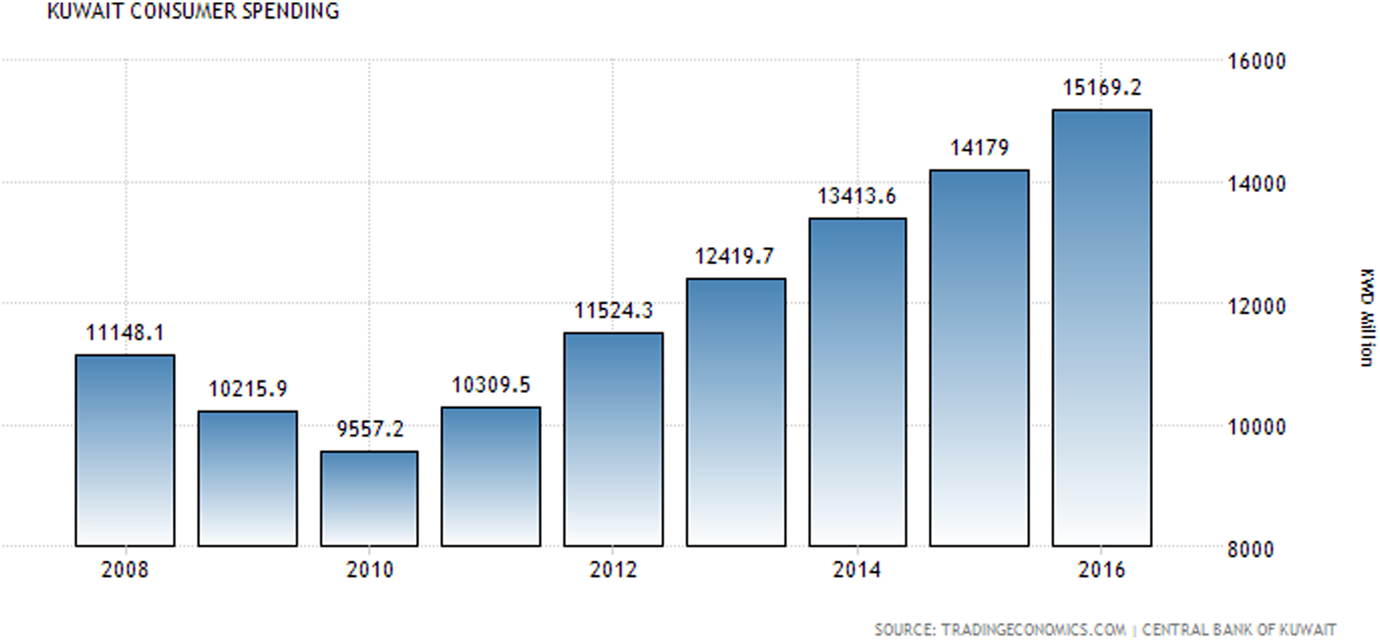
From a narrow view it seems accurate to assume that the readiness of the government to pay off citizens was a structural point of weakness, leaving several points of entry to target protestors and “peel away the layers of the opposition movement” through a combination of targeted outreach, dialogue, and cooptation.Footnote 24. Within a day of the start of the Egyptian protests on January 25, 2011, Kuwait's Emir Sabah Ahmed Al Sabah announced a $5 billion Kuwait Dinar (KD or $18 billion US) increase to subsidies on fuel and energy along with $1000 KD ($3,600 US) in cash to every citizen along with free foodstuffs (rice, oil, meat, eggs, and milk) from February 2011 to March 2012.Footnote 25 One can also see the correlation between payoffs and consumer spending in Kuwait after 2010 [Figure 1].
Kuwait Consumer Spending 2008–2016.

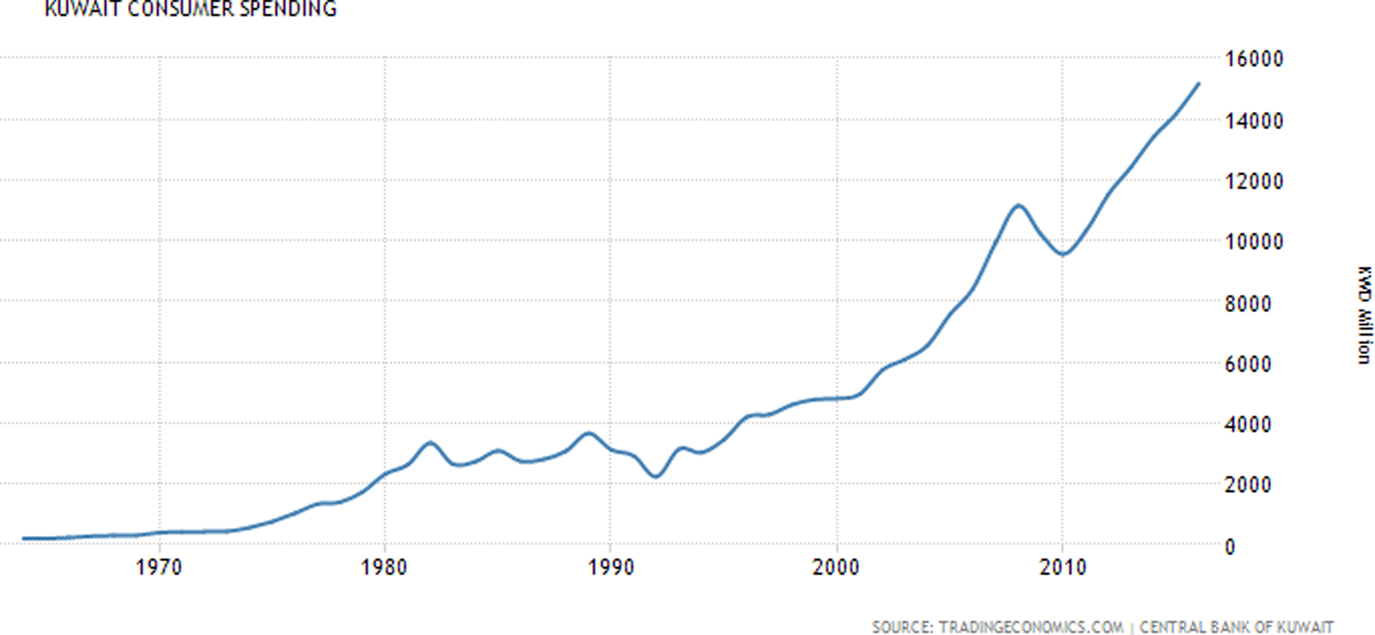
While this process seems straightforward, the protests illustrate a more complicated picture to the “payoffs lead to consent” thesis. This is just a small snapshot of increases to rent distribution, which is part of a historical trend [Figure 2]. Total government subsidies jumped from $817 million KD in 2005 to $3.372 billion KD in 2010. Wages and salaries jumped from $2.125 billion KD in 2005 to $4.047 billion KD in 2010.Footnote 26 Public sector salaries and subsidies increased by a staggering 540 per cent from 2001 to 2011.Footnote 27
Kuwait Consumer Spending 1960–2017.

Yet as Mitchell (2013) comments, approaches to rentierism and authoritarianism have largely neglected how states otherwise legitimate themselves, especially when it relates to the immaterial consent of their citizens.Footnote 28 Scholars are divided on whether acquiescence can be considered consent, or whether more active levels of consent must be observed or can actually be studied objectively away from propaganda efforts.Footnote 29 I, among others, such as Abulof (2017), argue this doesn't mean we should shy away from investigating legitimacy.Footnote 30 The concept of legitimacy informs a revision of rentier state theory by drawing attention to the ways that a state and a society interact beyond economic instrumentalist bargains.Footnote 31 By starting from a revised assumption that economic allocation is a necessary – but not sufficient – part of the overall formula for political legitimacy of rentier states, we can expand our understanding of state–society relations by including consent within this framework.Footnote 32
Public Opinion in the Twitter-sphere: Angry Re-tweets
The difficulty with addressing consent and acquiescence theoretically and empirically can be seen in scholarship devoted to social media forums. While there has been substantial evidence of public opinion shifts in Kuwait, there is significant disagreement among scholars on the utility of social media as a barometer for measuring such shifts. Cyber optimists argue that social media has inherent revolutionary potential as “liberation technology.”Footnote 33 So-called cyber pessimists, on the other hand, are less sanguine about the purported positive impacts of Internet technology for the purposes of mobilizing collective action against states. Instead, according to this viewpoint, states exercise control over Internet technology and use it as they would a new organ of propaganda to manipulate public opinion.Footnote 34 Neither view is wholly correct. Cyber-optimism overstates the usefulness of social media, while the pessimists underestimate the agency of social media users.Footnote 35 Taking a more neutral approach, I recognize both the power of existing hegemonies and how the agency of individual actors allows for the possibility of social change without presuming it to be an automatic outcome of new technology.
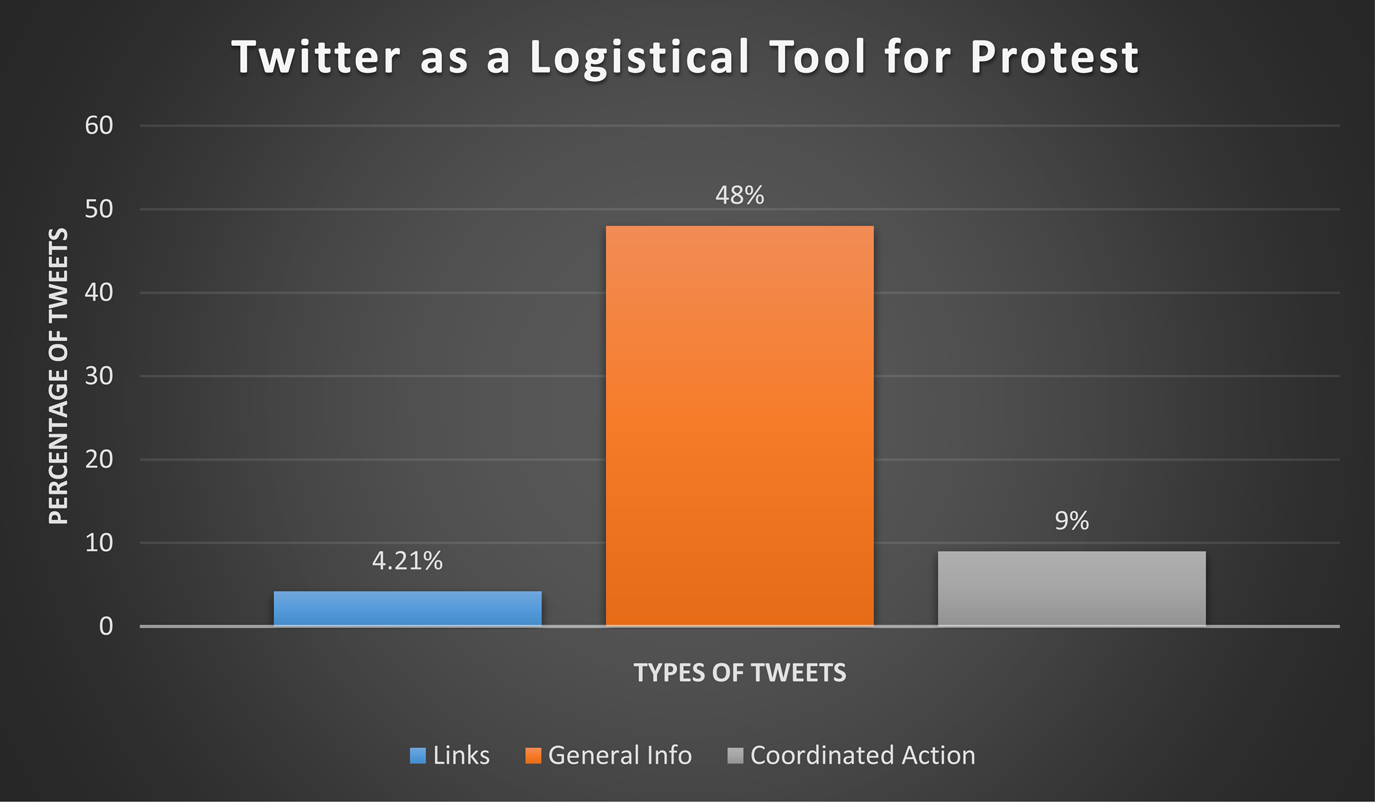
At present, there are no references I could find in the secondary literature directly grappling with the micro-level political implications of social media usage and state responses to it.Footnote 36 Yet looking at Twitter use in Kuwait during the early protests I witnessed the complexity of online politics. From 15 activists’ accounts a random sample of 30,000 tweets (2,000 from each) dating from December 8, 2010 to October 1, 2012 were collected from two Twitter archive sites: snapbird.org and topsy.com. 5,000 tweets were randomly selected (split evenly between the fifteen activists) from the larger random sample. Each tweet was read and categorized using a simple content analysis metric. I found several interesting results. In the coordinated action category, which made up only 9% of the 5,000 tweet sample, there is a marginal number of tweets (450) directing coordinated action or resistance tactics [Figure 3].
Number of Twitter accounts using Twitter to organize protests.

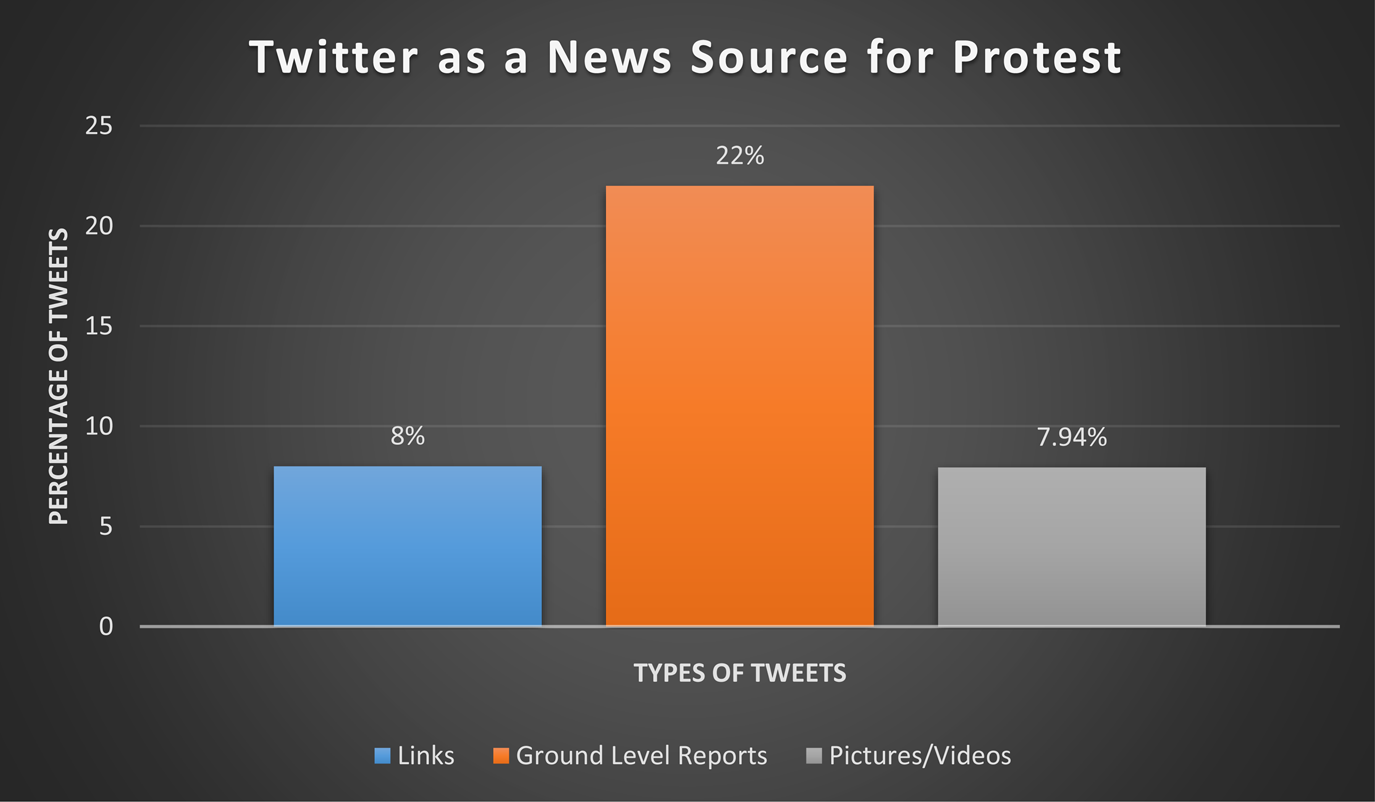
Furthermore, Twitter's use as an alternative free press was not as influential as some might assume [Figure 4]. The most prevalent tweets were on-the-ground-reports, making up 22% of the sample, followed by links and pictures/videos, which each made up approximately 8% of tweets.
Twitter as an independent source of news for users.

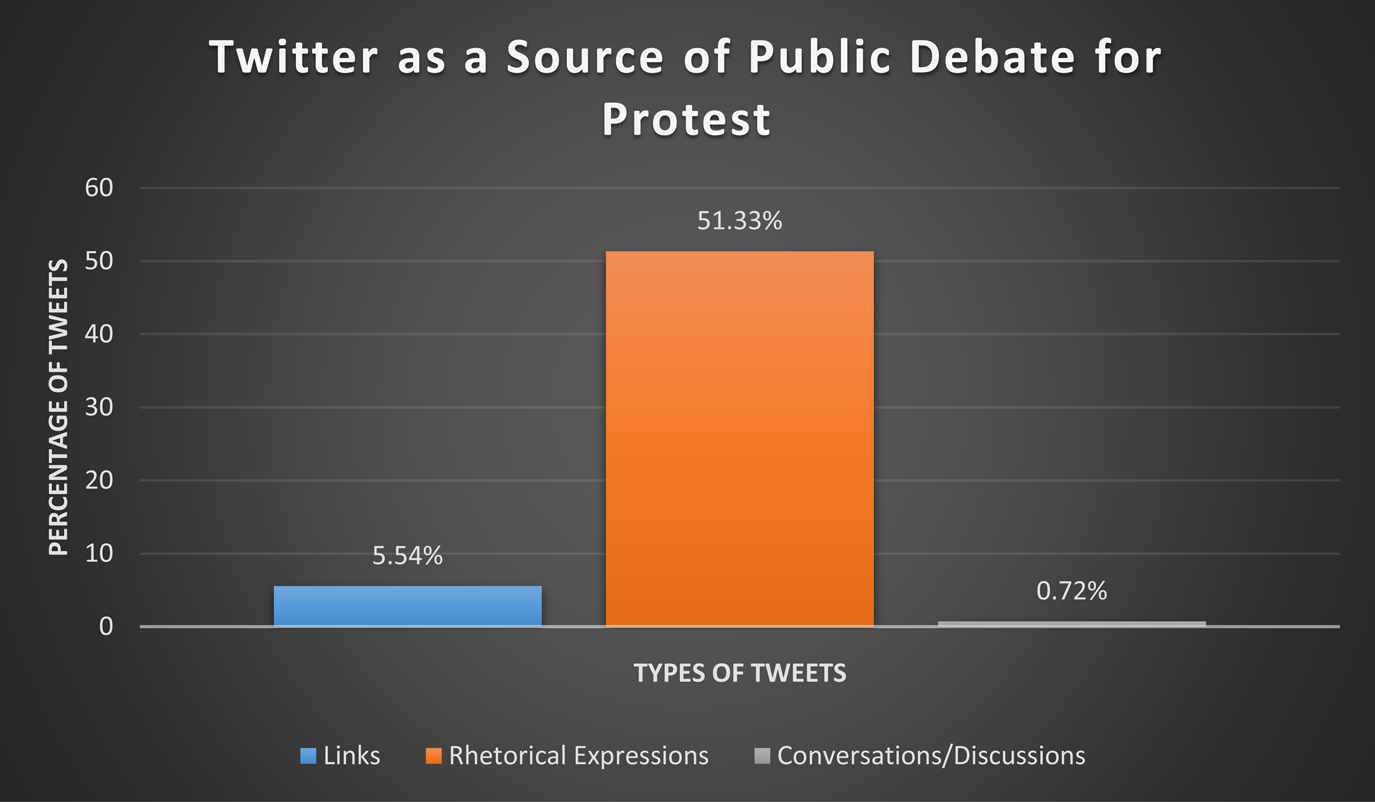
Given that it is common to use Twitter in a conversational fashion, it is surprising that almost every user did not use the medium to engage in debates about protests, political issues, or underlying ideals [Figure 5]. Instead, a majority of 51% of the tweets from this sample consisted of broad rhetorical slogans and statements.
Twitter as a space for public discussion and debate.

If we focus on rhetoric, support for the regime appears to have eroded significantly since 2010. The main usage of Twitter – as a platform for citizen-journalism and rhetorical expression – does provide some valuable data for a sentiment analysis of public opinion. For example, not a single tweet in the entire sample endorsed or even debated support for the regime, indicating that the presence of government supporters and officials on Twitter was severely limited,Footnote 37 a fact that has not gone unnoticed by the Twitterati of Kuwait:
Nasser only has 40 followers…maybe I should sell him my account.
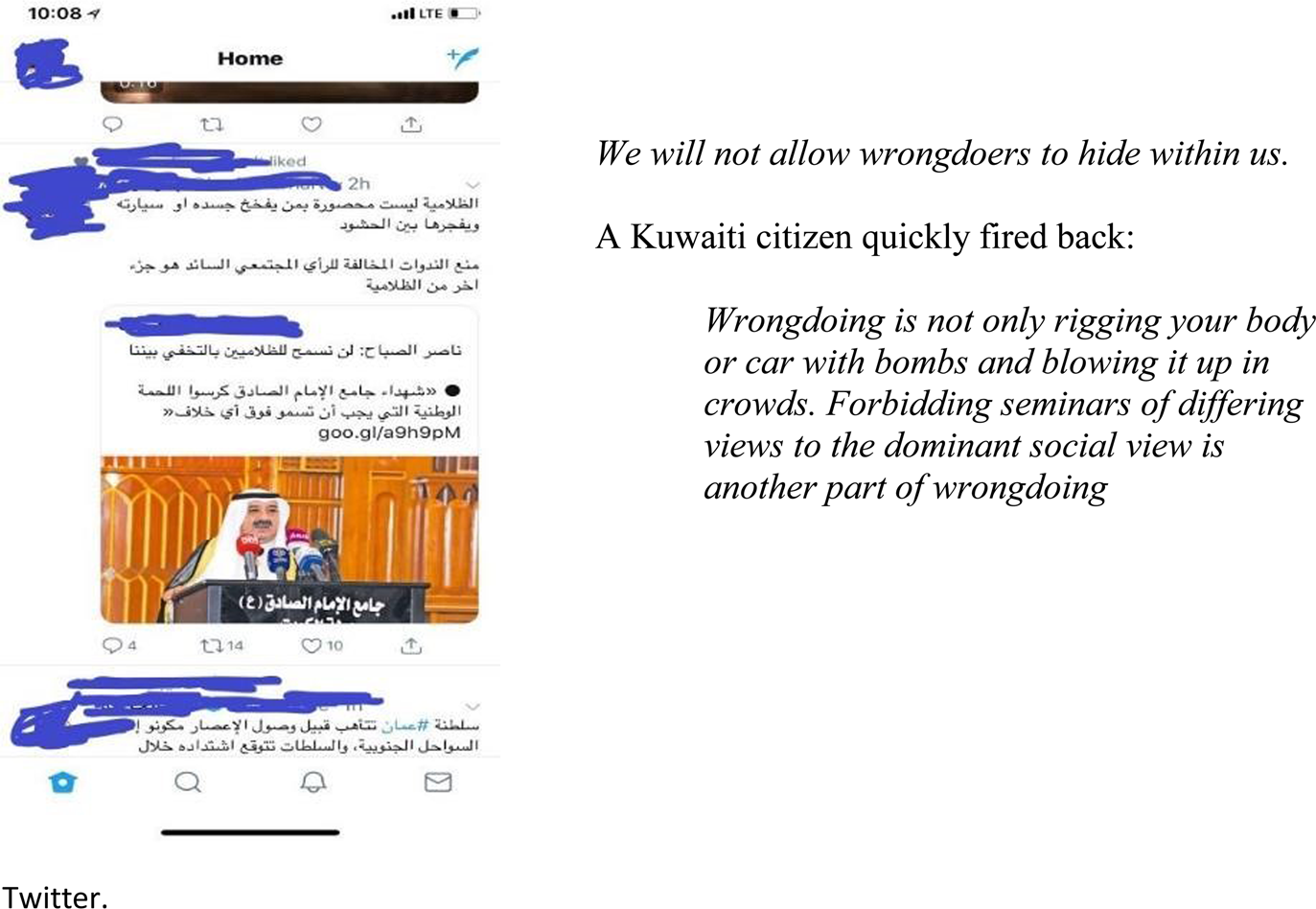
Since 2013, the more critical attitudes toward the government that fuelled the protest movement have not dissipated, even if the actual protests have. From February to November 2018 in a sample of 1,000 tweets taken from 50 different Twitter accounts of government elites we see more and more skeptical and critical views by citizen respondents on their accounts. As the two examples demonstrate below, Kuwaiti Twitter users have not shied from critiquing the royal family or important individuals. Nasser Sabah Al Sabah, the top contender to become the next Crown Prince and son of the Emir, tweeted in reference to combatting terrorism:
Comment on Sheikh Nasser Sabah Al Ahmad Sabah Twitter Feed.

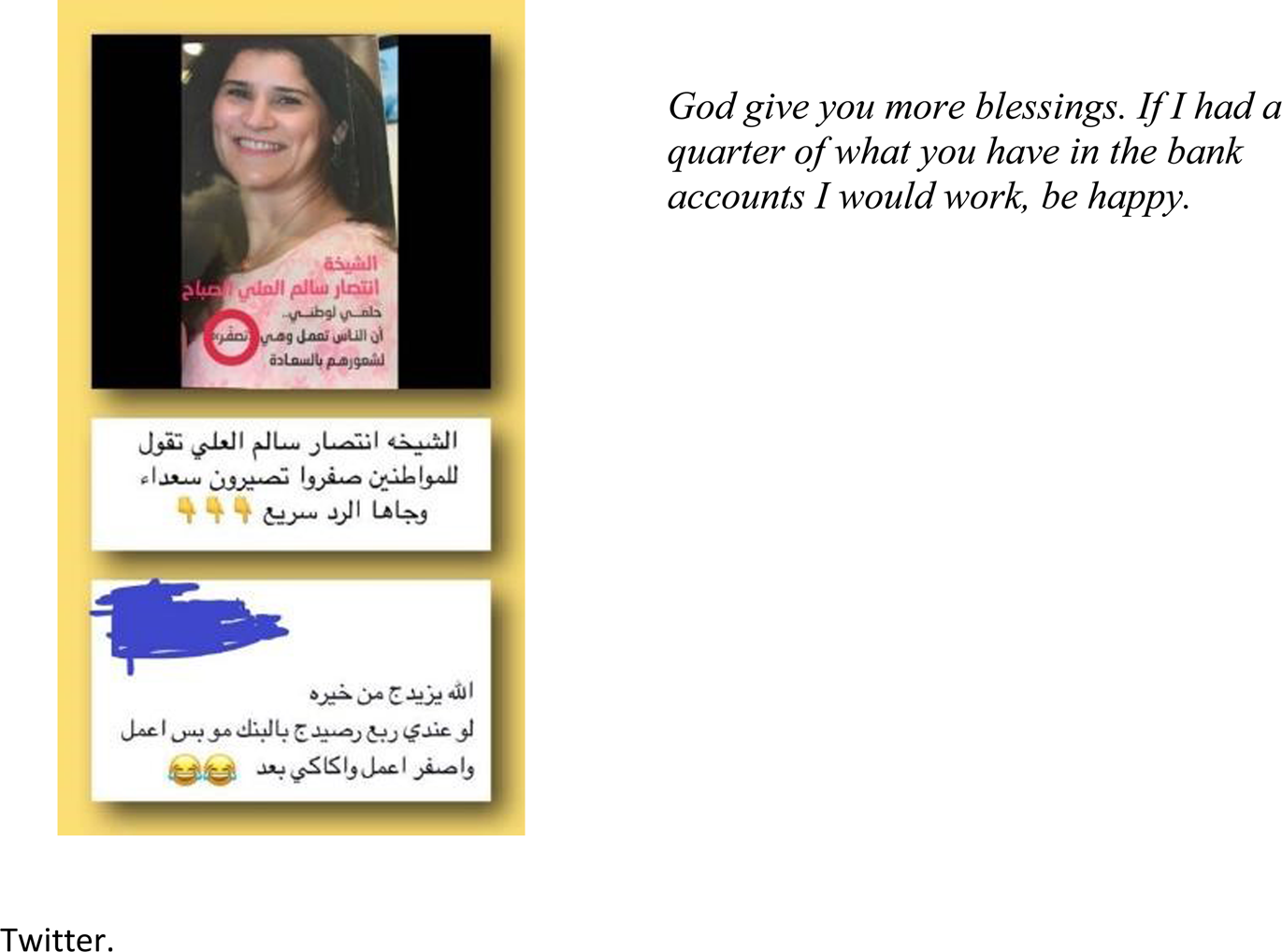
In response to Sheikha Intisar Al Sabah, a top member of the ruling family, saying that she “wished people feel more happiness,” a citizen tweeted:
Comment on Sheikha Intisar Al Sabah Twitter Feed.

In response to a news piece about how the current Prime Minister, Jaber Mubarak Al Hamad Al Sabah, is upset about the corruption a citizen mocks him,
Jaber Al Mubarak has been 8 years PM and every year reports show the corruption of the government, and he's upset. If he's upset then the corrupters are done for. And he created a committee…we are coming, SwedenFootnote 38
There also plenty of critiques about the state, its capacities, and general corruption.
When the person who is in the position is unable to perform the responsibilities of the positions the outcome is: the governmental organizations of Kuwait
Don't blame the Kuwaitis if they are sad or depressed since 80% don't think the government is capable of handling public money and 79% do not think the National Assembly is capable of holding them accountable
#theft of investment #theft of transporters #stations for power, #fines for medicine, #deposits, #billions of development, #transfers to foreign lands, #thefts of insurances, #supporters of heart, #waste of cuts, #residents What are you waiting for to raise the banner of fighting corruption and instill the law? This is all with the existence of a National CouncilFootnote 39
Yet users also acknowledge the inherent weakness of Internet technology through choices in how they use it, as these to tweets sent in quick succession note:
Your tweets are not enough!! Do Something!!!!
I hope that none of us imagined that we could live free and establish a true democracy and the rule of law without sacrifices, arrests, and blood Footnote 40
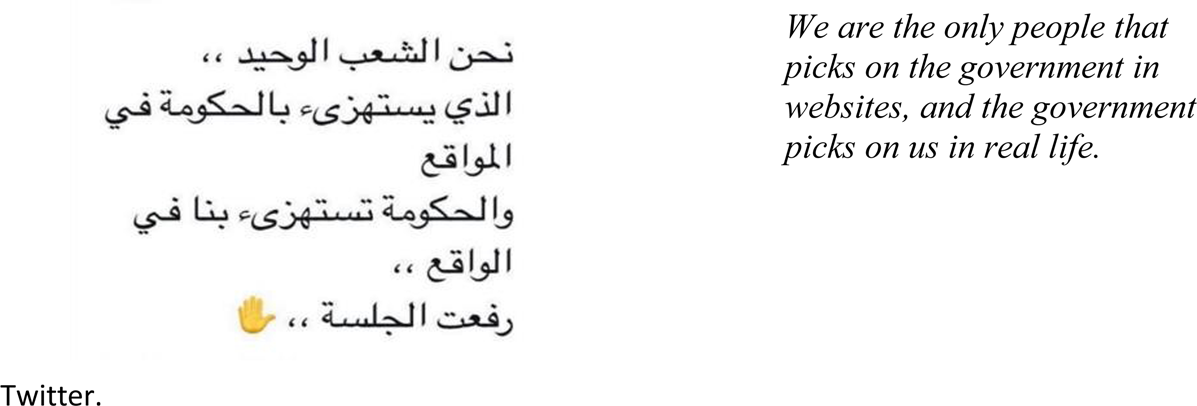
Others mock themselves as this tweet notes:
Tweet Describing Political Atmosphere in Kuwait.

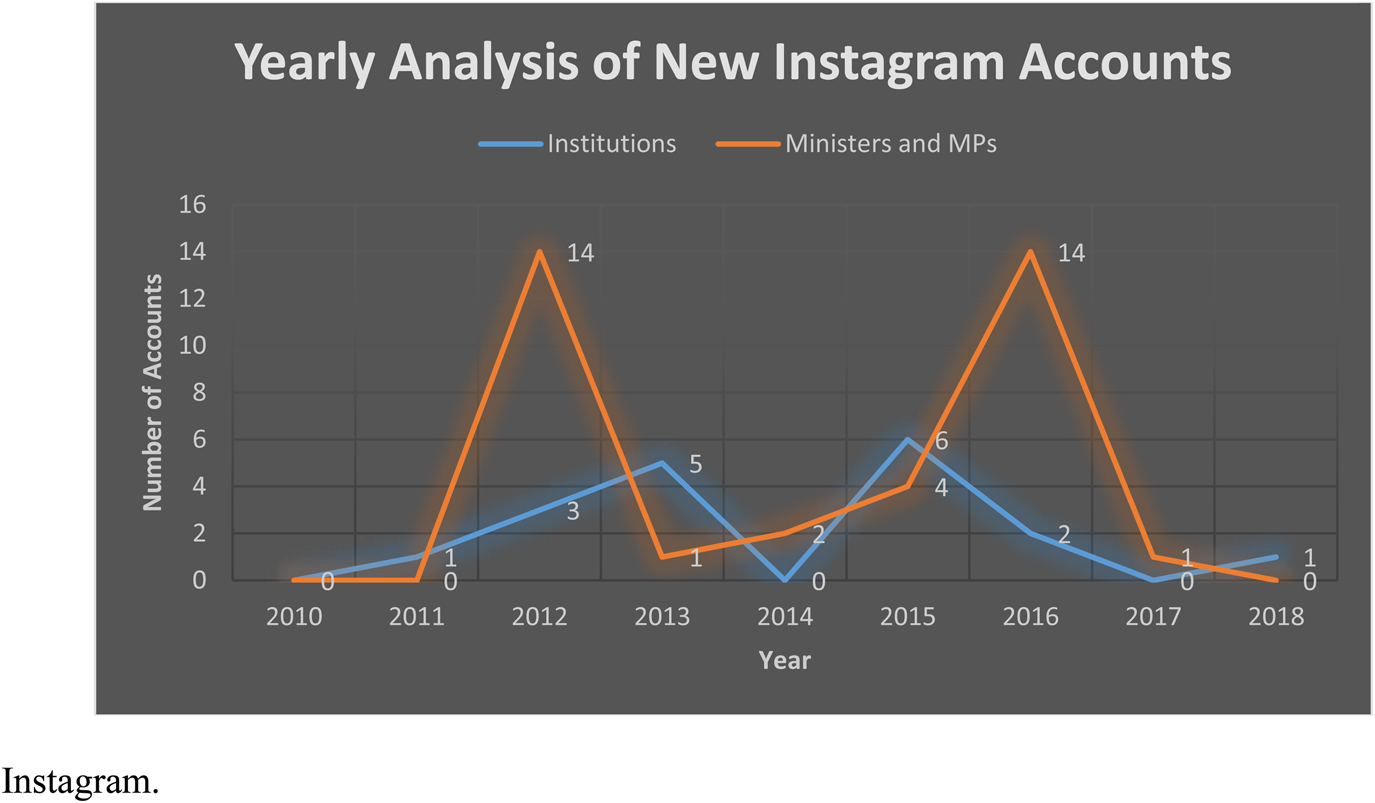
How did the government respond to these changes? Between 2012 and 2016 a plethora of government organizations, political leaders, and notable individuals started using social media. Yet the focus was not on Twitter, but Instagram [Figure 9].Footnote 41
New government Instagram accounts created since 2010.

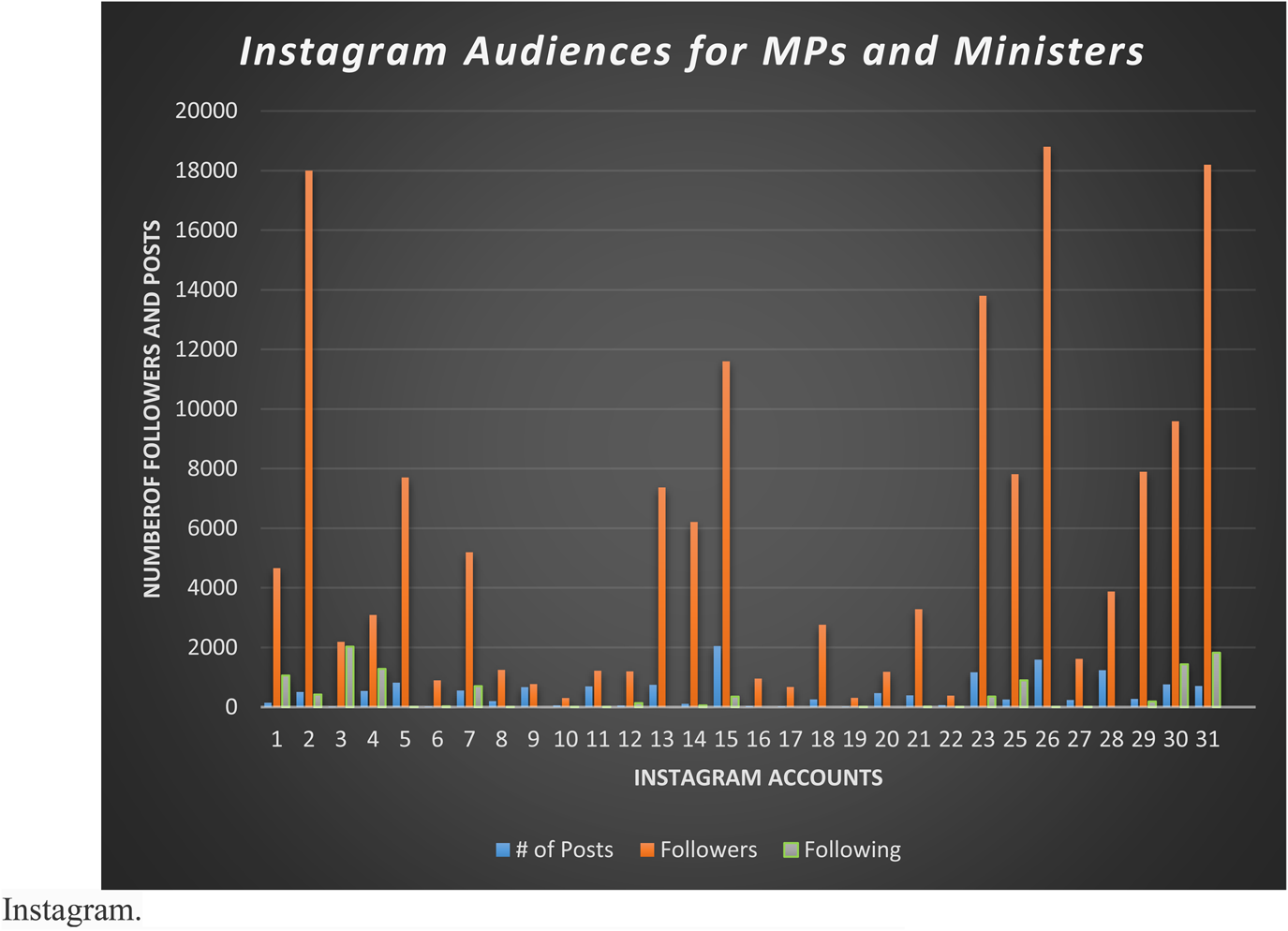
Figure 7 shows the accounts of 31 MPs. Audiences on Twitter and Instagram are not identical. Former MP Waleed Al Tabtabaei, recently stripped of his parliamentary seat due to his role in opposition protests in the last few years only has 896 followers on Instagram, while he had over 903,000 on Twitter. Yet it is important not to discount the potential importance of parliamentary members on Instagram or any other medium. In the 2016 parliamentary election the difference between the winning 10th seat and the losing 11th seat in the five electoral districts (which has ten seats each) was: 57, 55, 95, 13, and 93 votes respectively.Footnote 42 Every vote counts in this highly competitive system as most MPs rely on vote buying, family, friends, neighbors, and business connections in their area of residence to win at all costs. At present, electoral competition has grown fiercer as increasing numbers of candidates join the race, expanding their electoral campaigns to gather votes from outside their familial, business, and local networks – and into new online networks mediated through social media.
Instagram audiences and posts for MPs and Ministers.Footnote 43

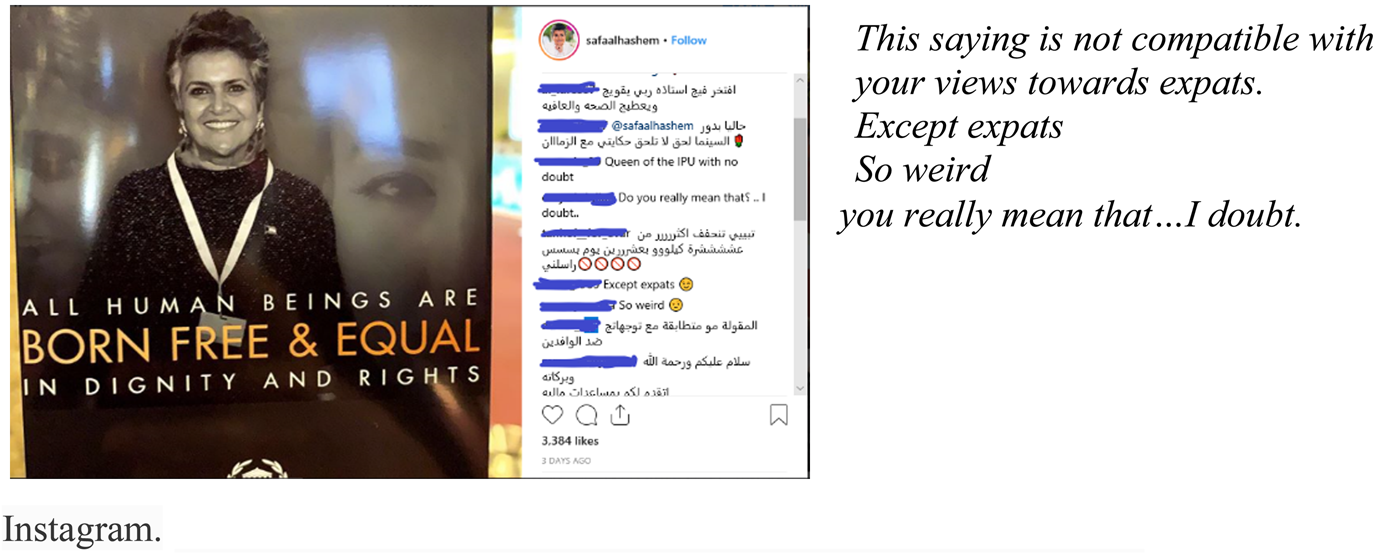
A random sample of 484 posts on government Instagram accounts dating from February 2018 to November 2018 reflects many of the same issues that I observed on Twitter, with many users of Instagram, too, deriding politicians and the state. Safaa Al Hashem, the Kuwaiti equivalent of a right wing, populist, anti-immigrant candidate, is regularly attacked.
Commentary on Kuwaiti MP Safa Al Hashem's Instagram Post.

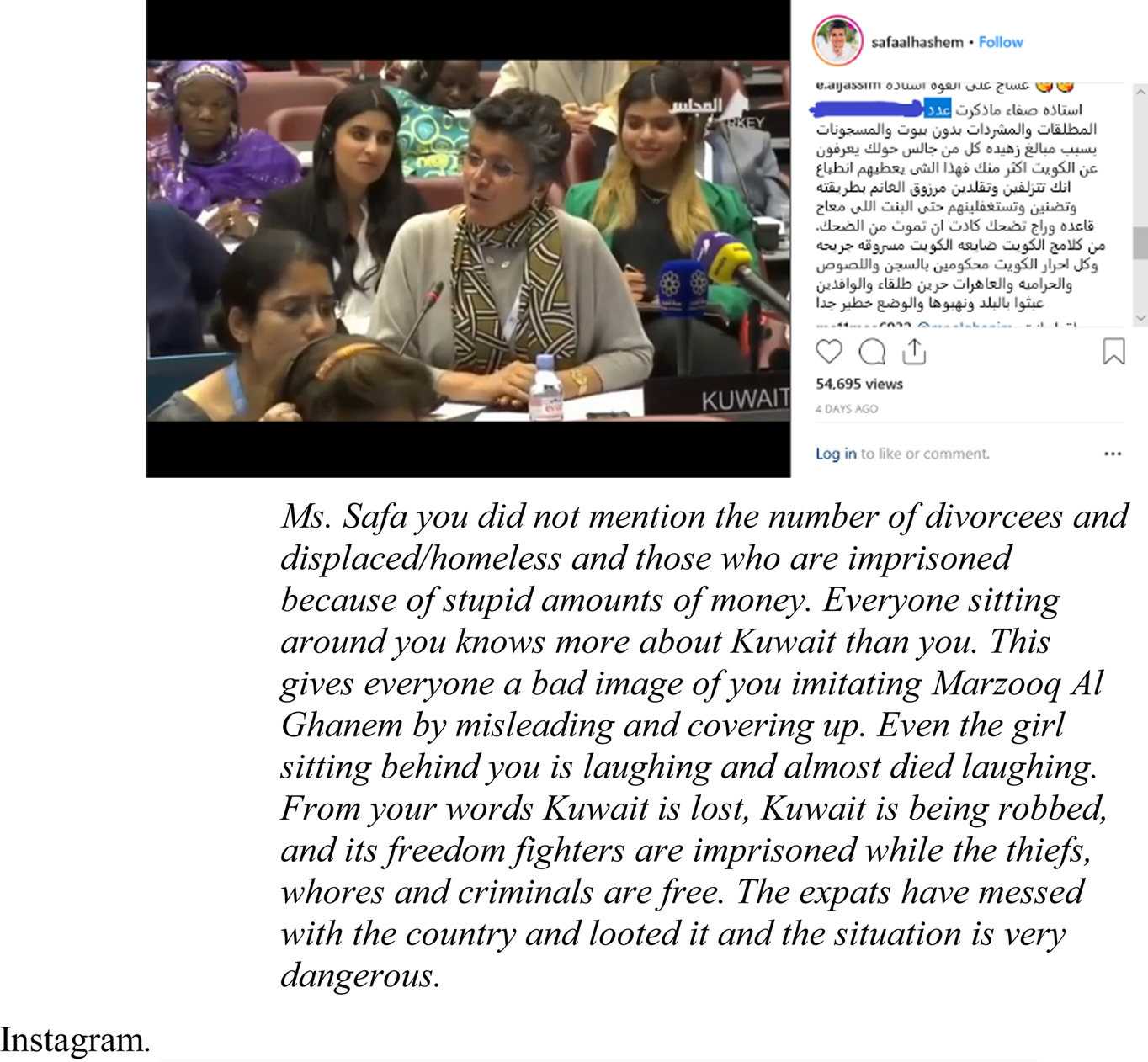
In another video posted on her account Safaa Al Hashem says that Kuwait is amazing for women. One commenter responds:
Commentary on Kuwaiti MP Safa Al Hashem's Instagram Post.

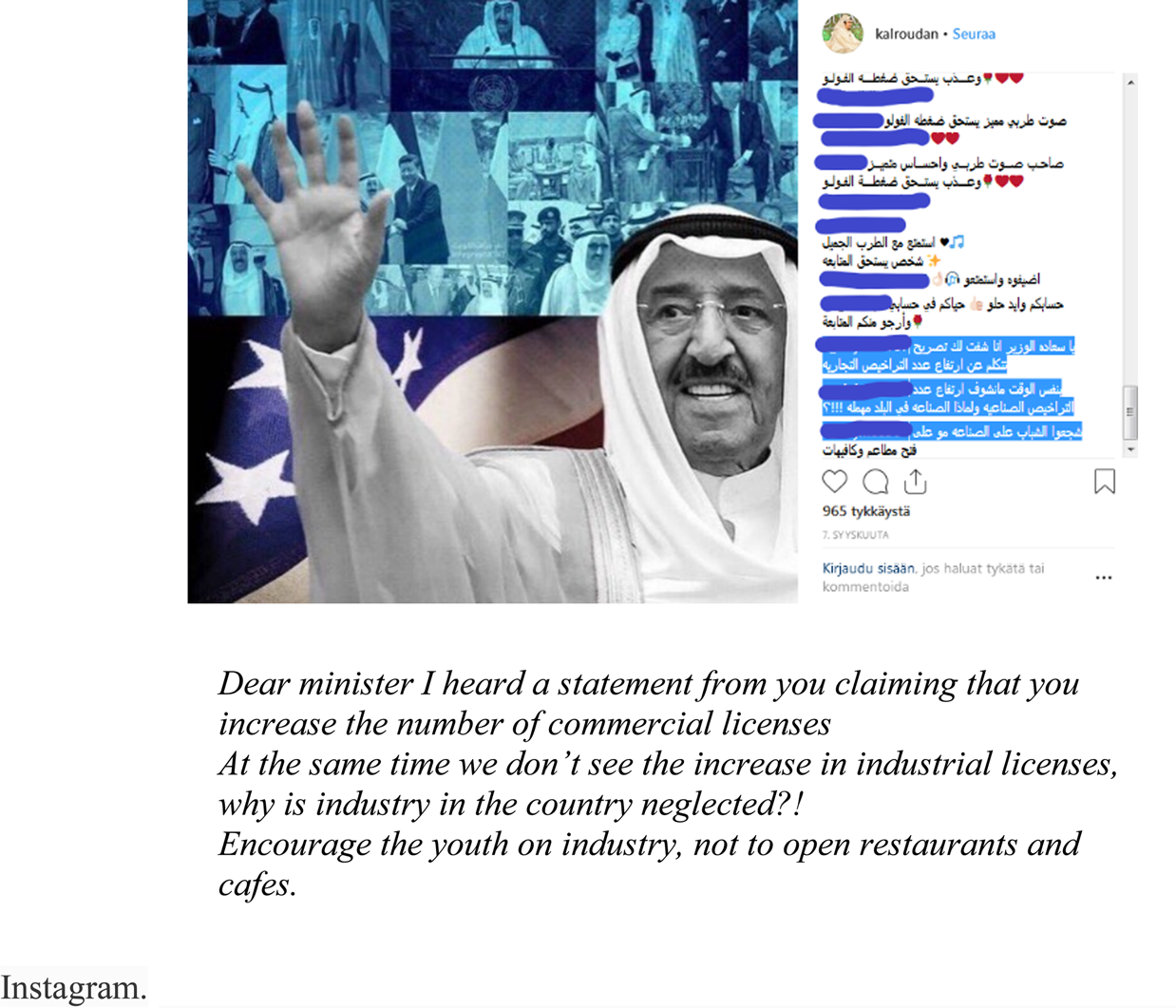
Another of the complaints of many of the Kuwaiti youths I observed online was the lack of opportunities in business. Minister of Commerce and Industry Khaled Al Roudan faces the brunt of many of these comments.
Commentary on Kuwaiti Minister of Commerce and Industry Khaled Al Roudhan's Instagram Post.

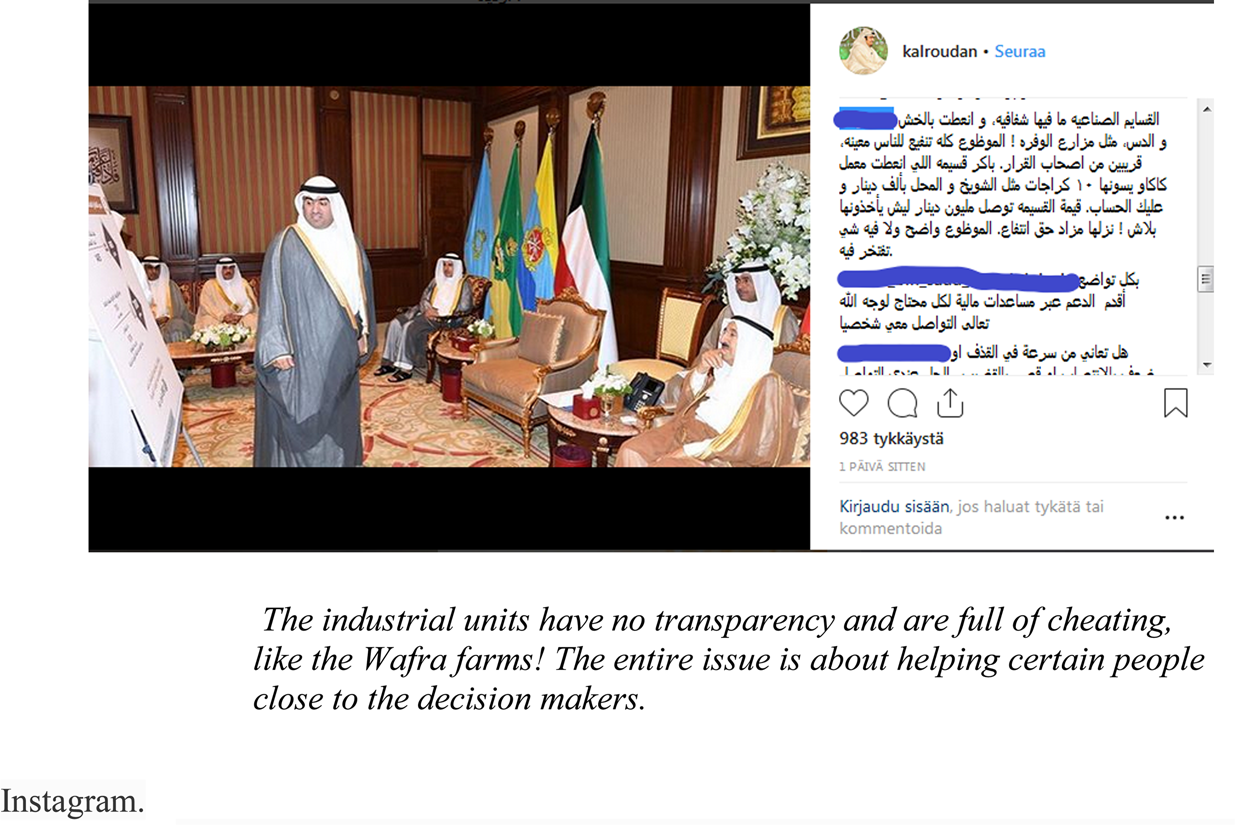
There are also comments about corruption.
Commentary on Kuwaiti Minister of Commerce and Industry Khaled Al Roudhan's Instagram Post.

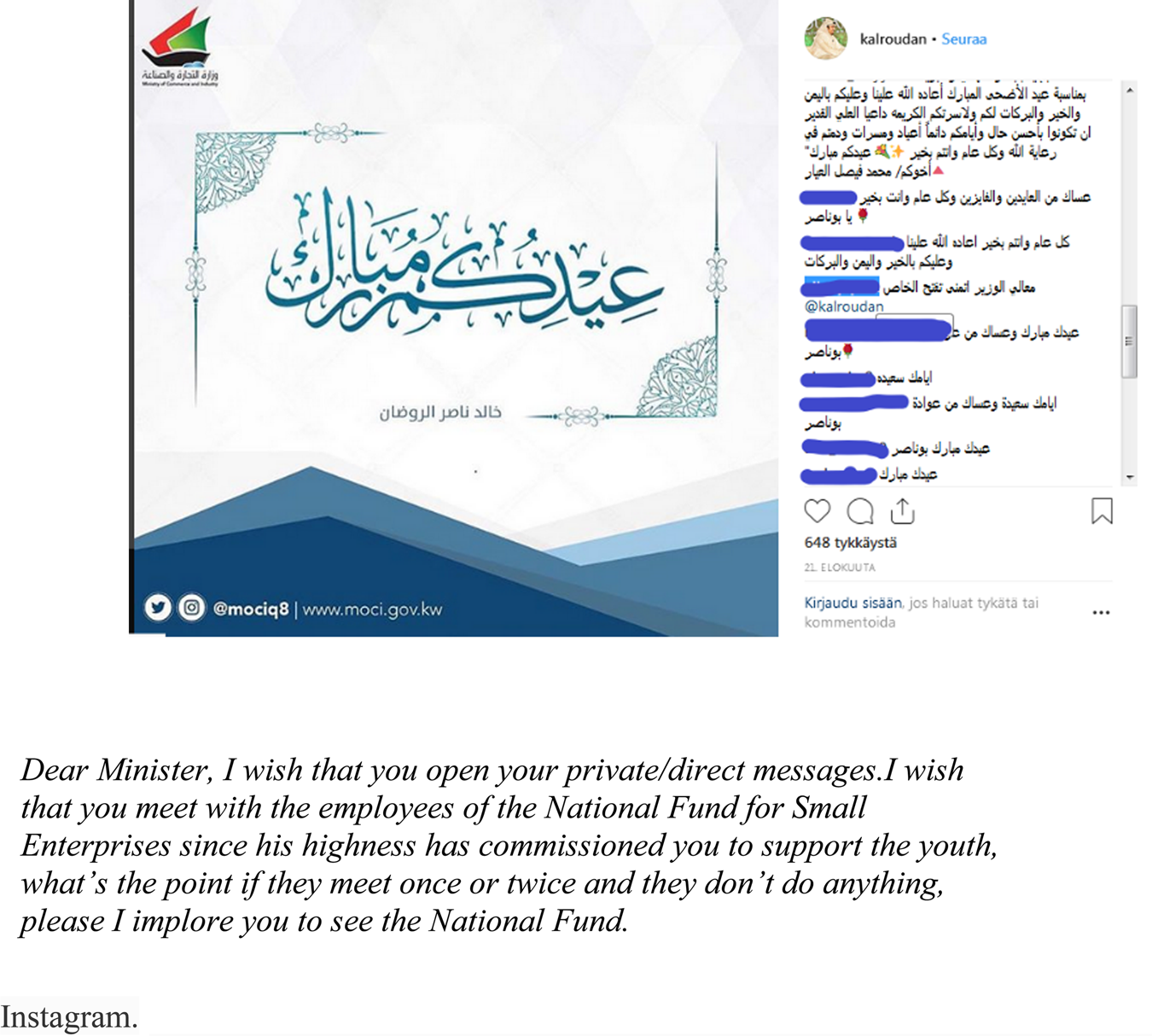
What are elite responses to these criticisms? For the most part there are few responses, even though many people ask directly to be contacted.
Commentary on Kuwaiti Minister of Commerce and Industry Khaled Al Roudhan's Instagram Post.

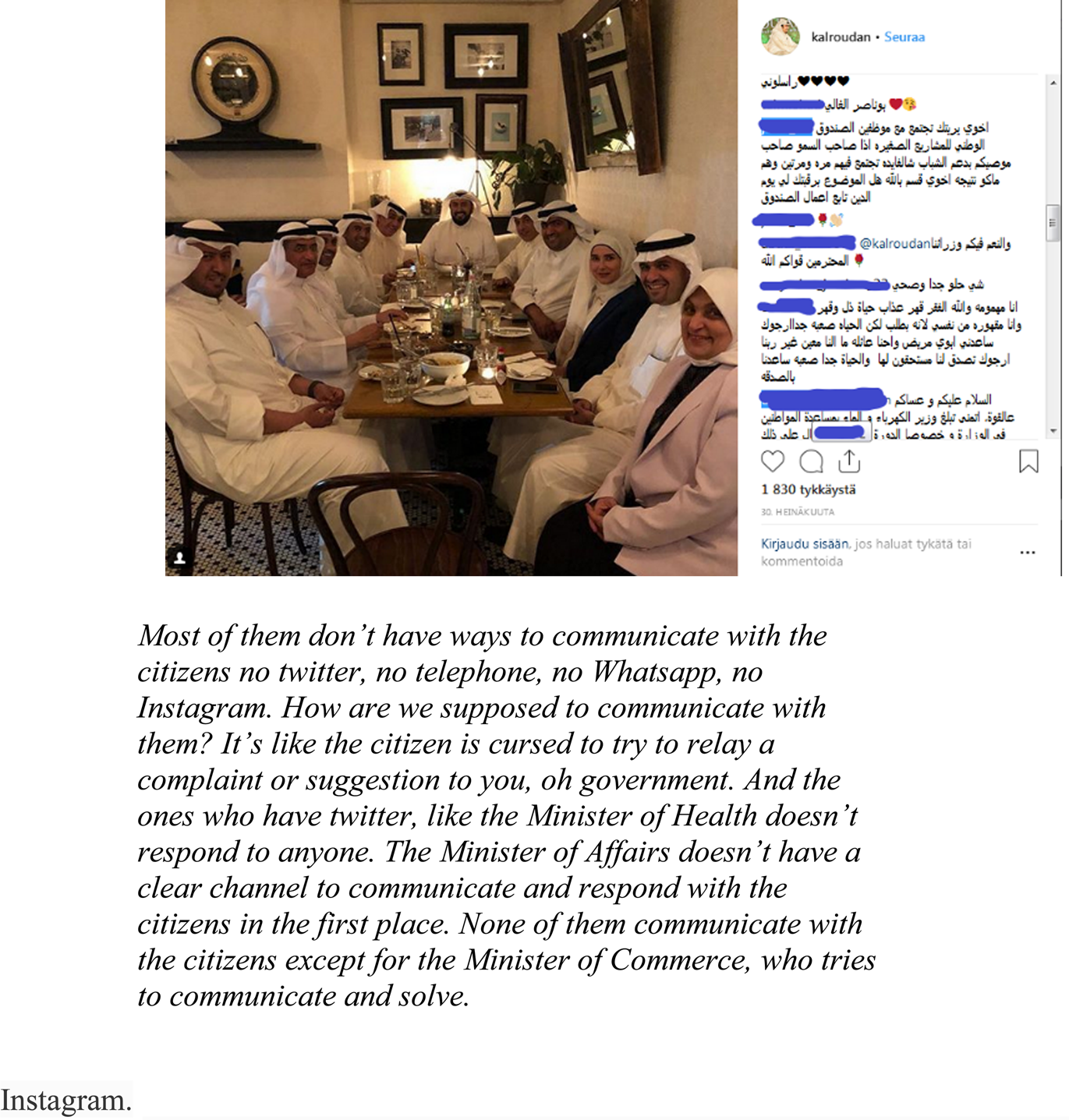
Another commenter makes a critical point concerning this issue:
Commentary on Kuwaiti Minister of Commerce and Industry Khaled Al Roudhan's Instagram Post.

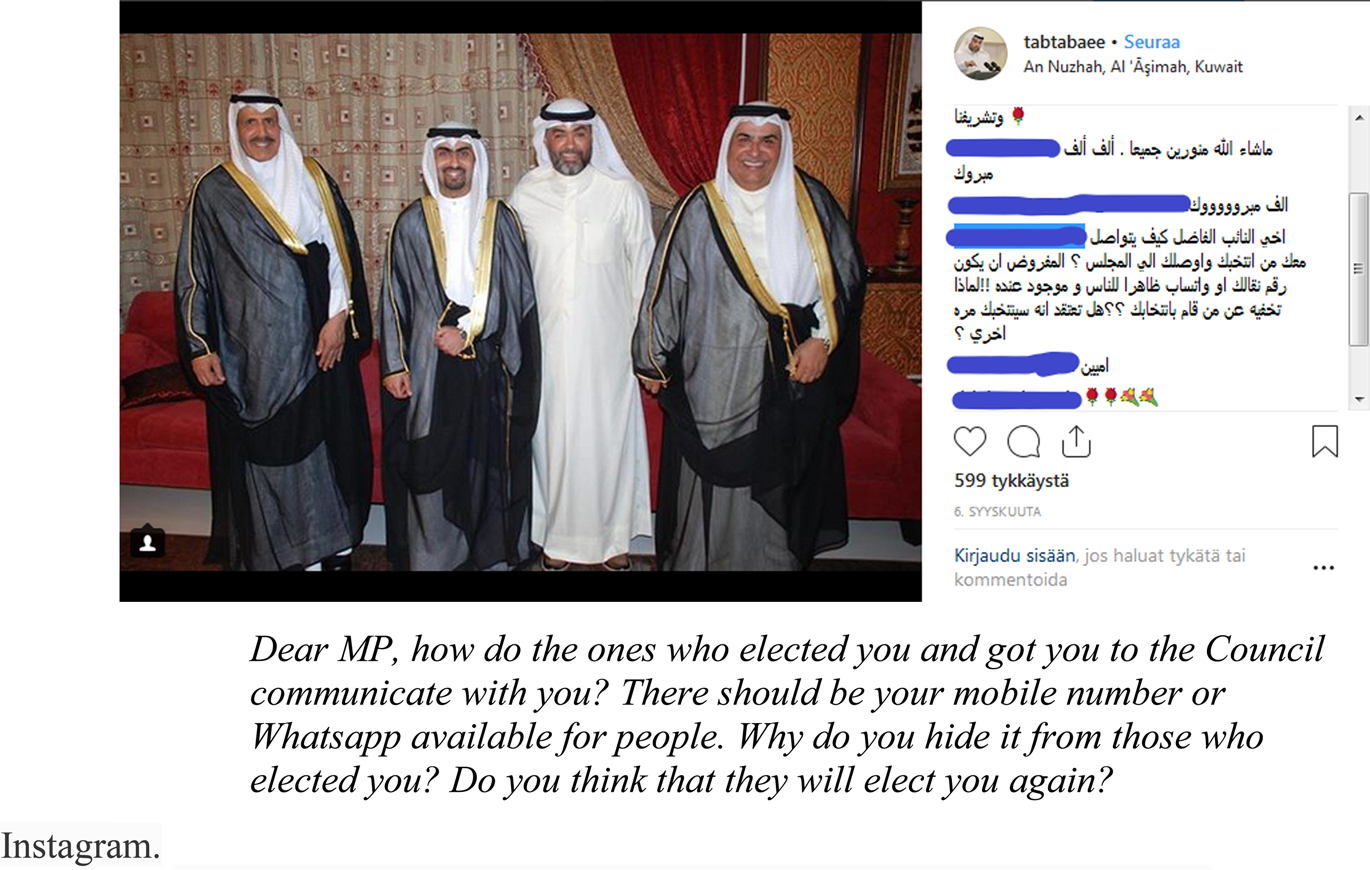
Another commentator takes this concern directly to MP Omar Tabtabaee:
Commentary on Kuwaiti MP Omar Al Tabtabaee's Instagram Post.

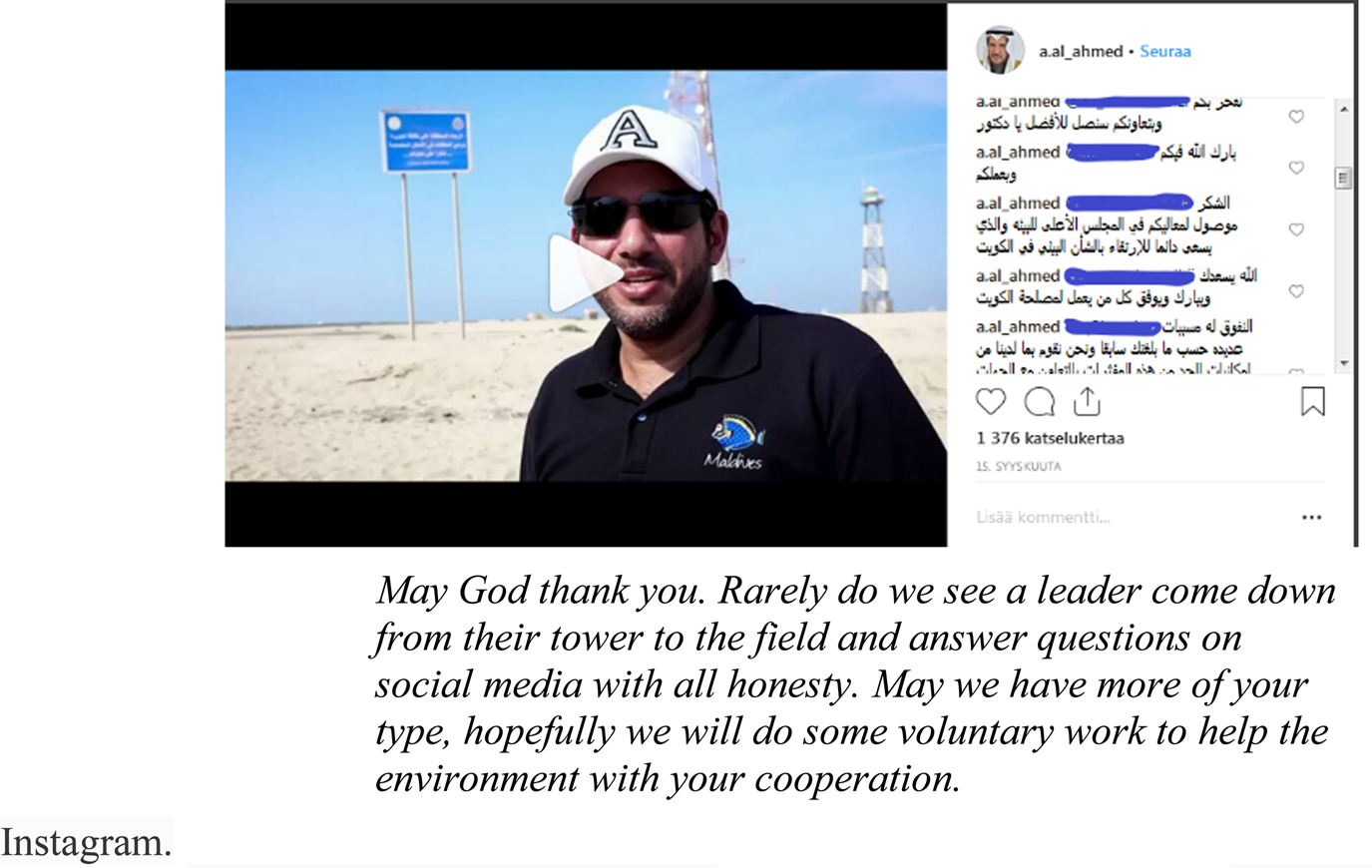
There is at least one outlier to this evidence. Abdullah Al-Ahmed Al-Sabah, the Director General of Environmental Public Authority, regularly engages with commenters and responds with video messages. Users note his exceptional responsiveness with appreciation:
Commentary on Kuwaiti Sheikh Abdullah Al-Ahmed Al-Sabah's Instagram Post.

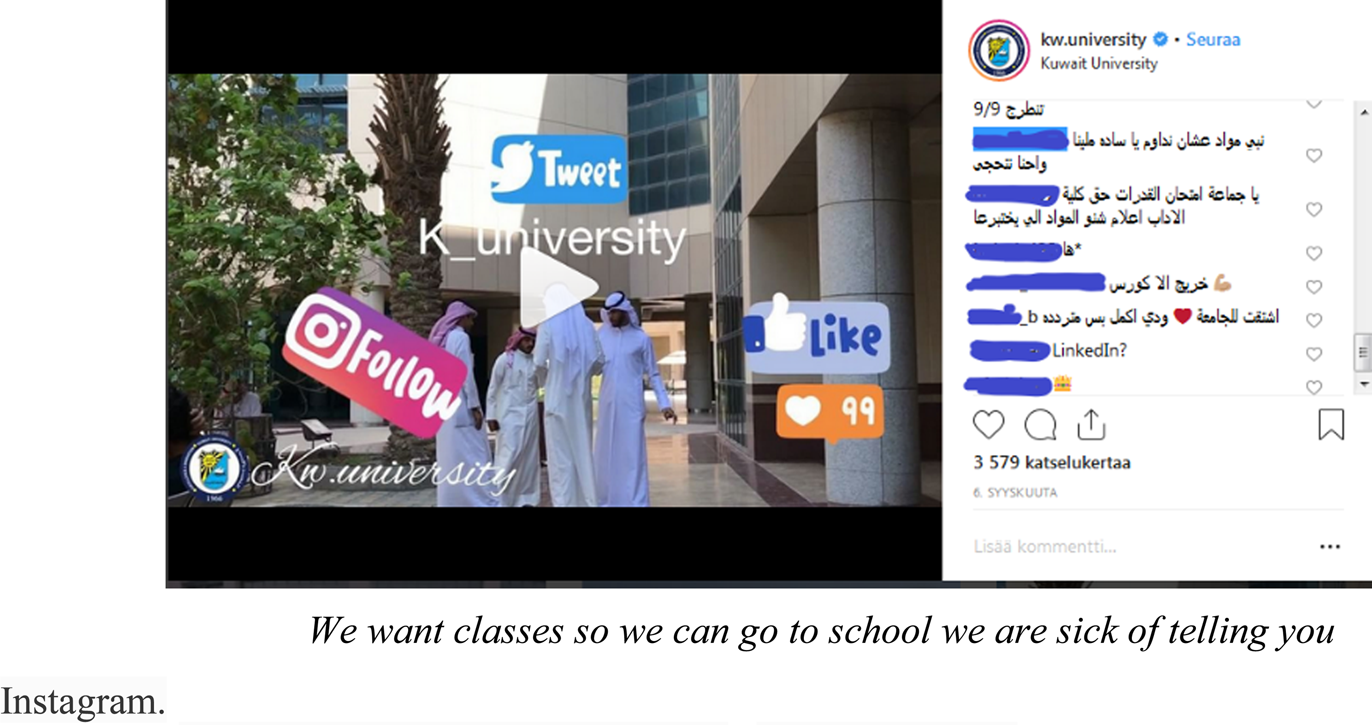
When looking at institutional accounts there are also plenty of comments and criticism. In one post students complain about the lack of available classes and the faulty registration system for selecting classes.
Commentary on Kuwait University's Instagram Post.

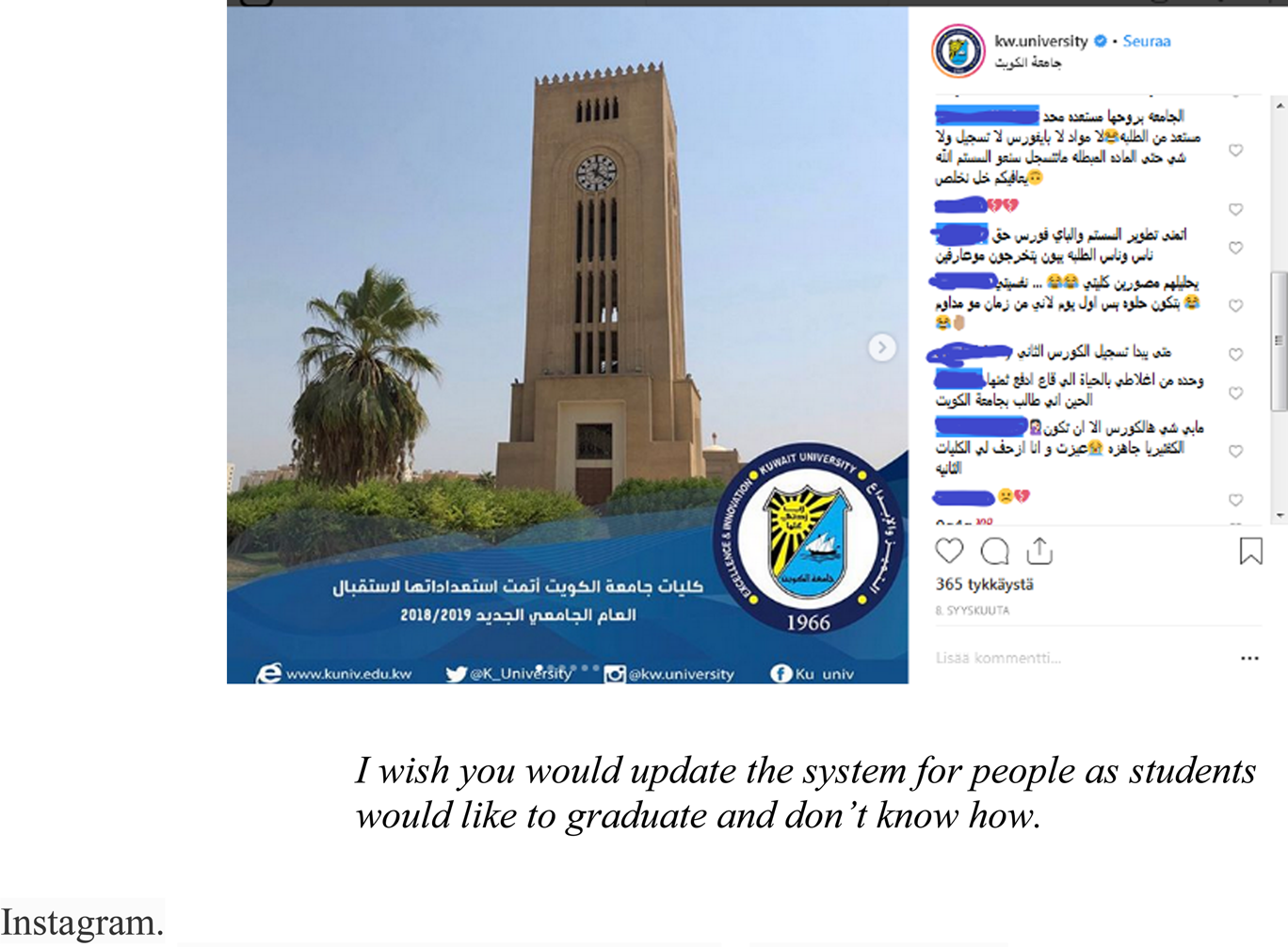
In relation to a post about the university getting ready for the new semester:
Commentary on Kuwait University's Instagram Post.

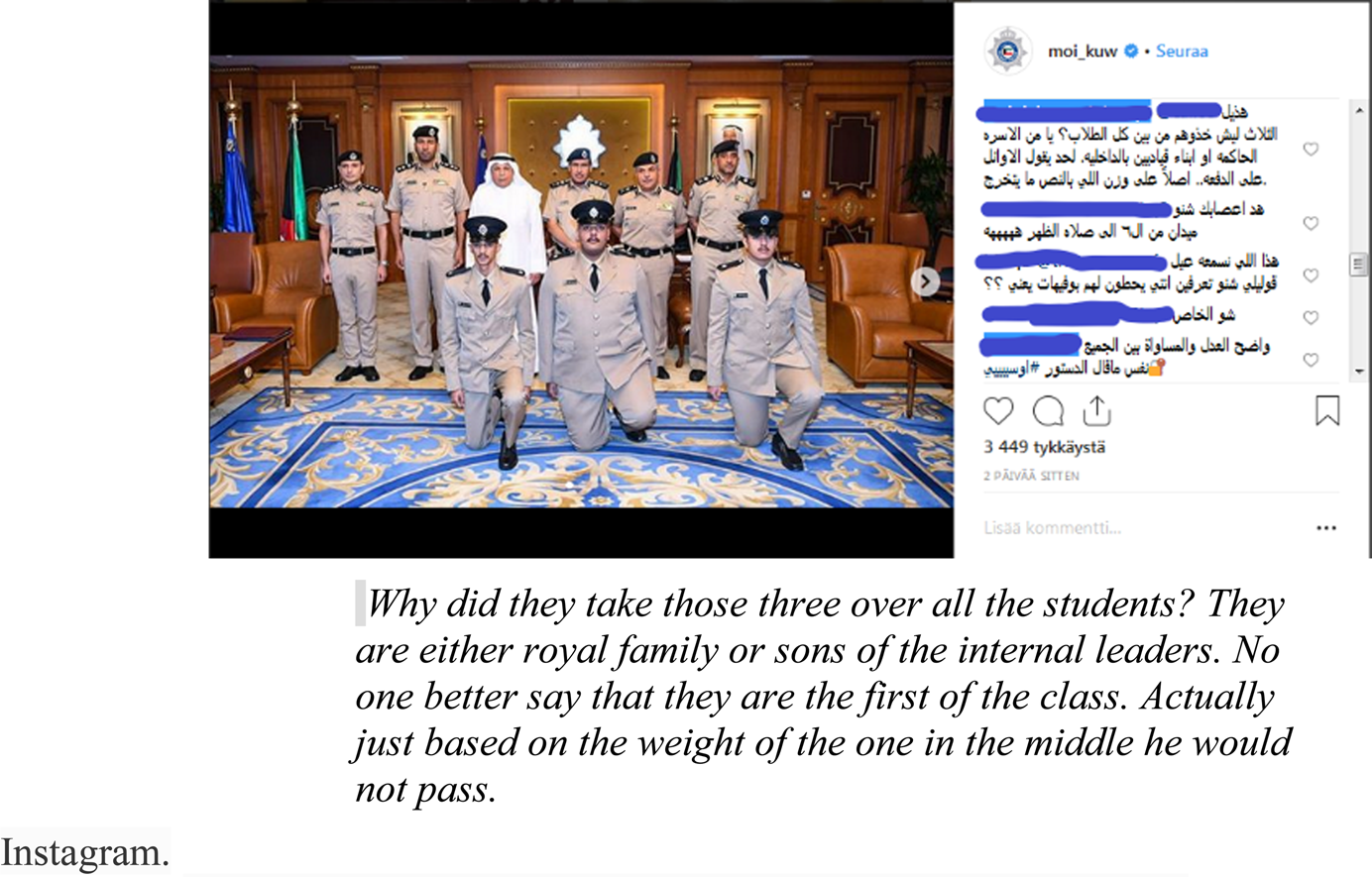
These issues are not isolated to MPs or education for youths. It also relates to the security services. In relation to a post honoring and giving prizes to officers:
Commentary on Kuwait Ministry of Interior's Instagram Post.

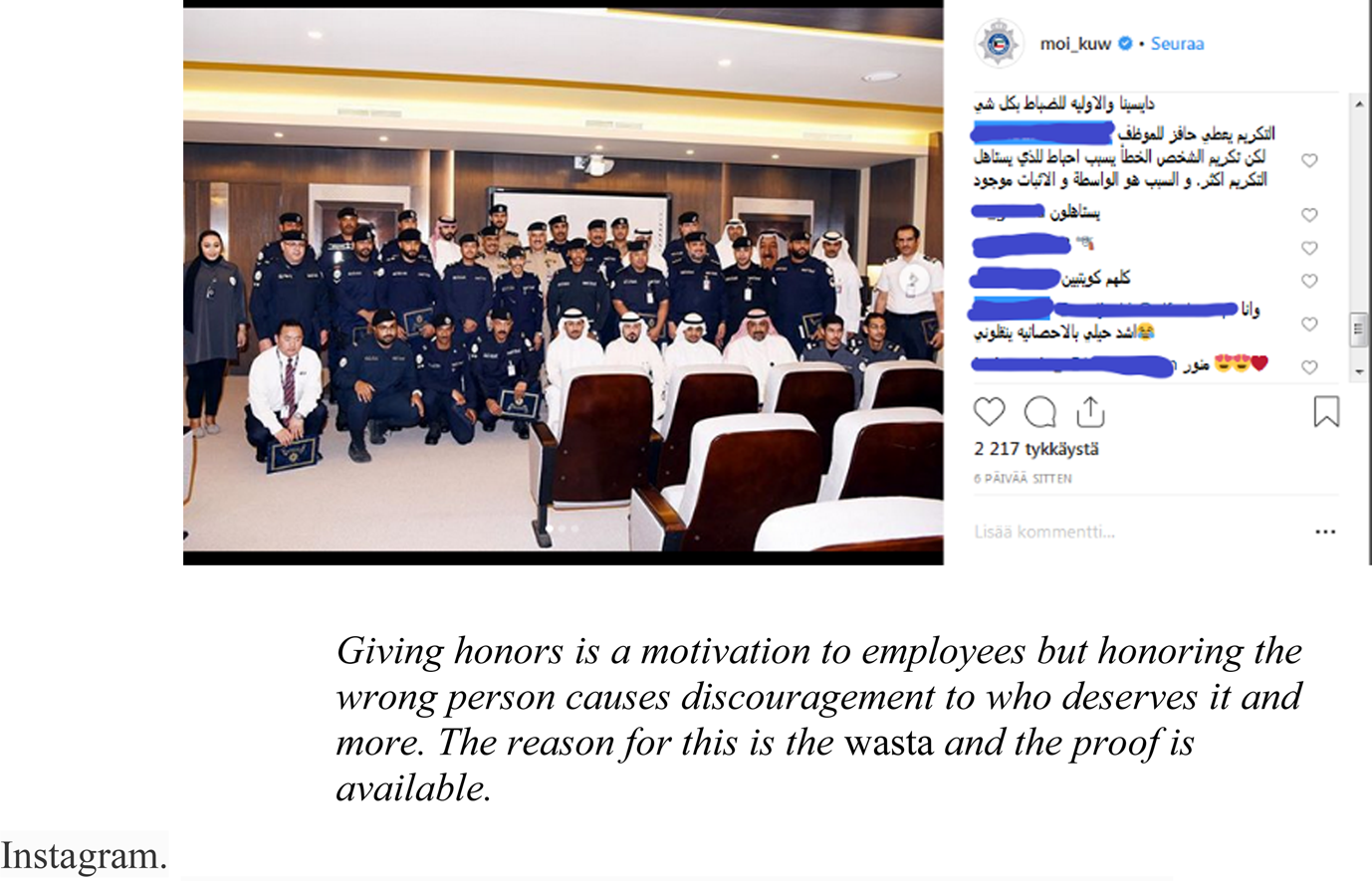
Another post makes the same complaints about corruption in the police promotion process.
Commentary on Kuwait Ministry of Interior's Instagram Post.

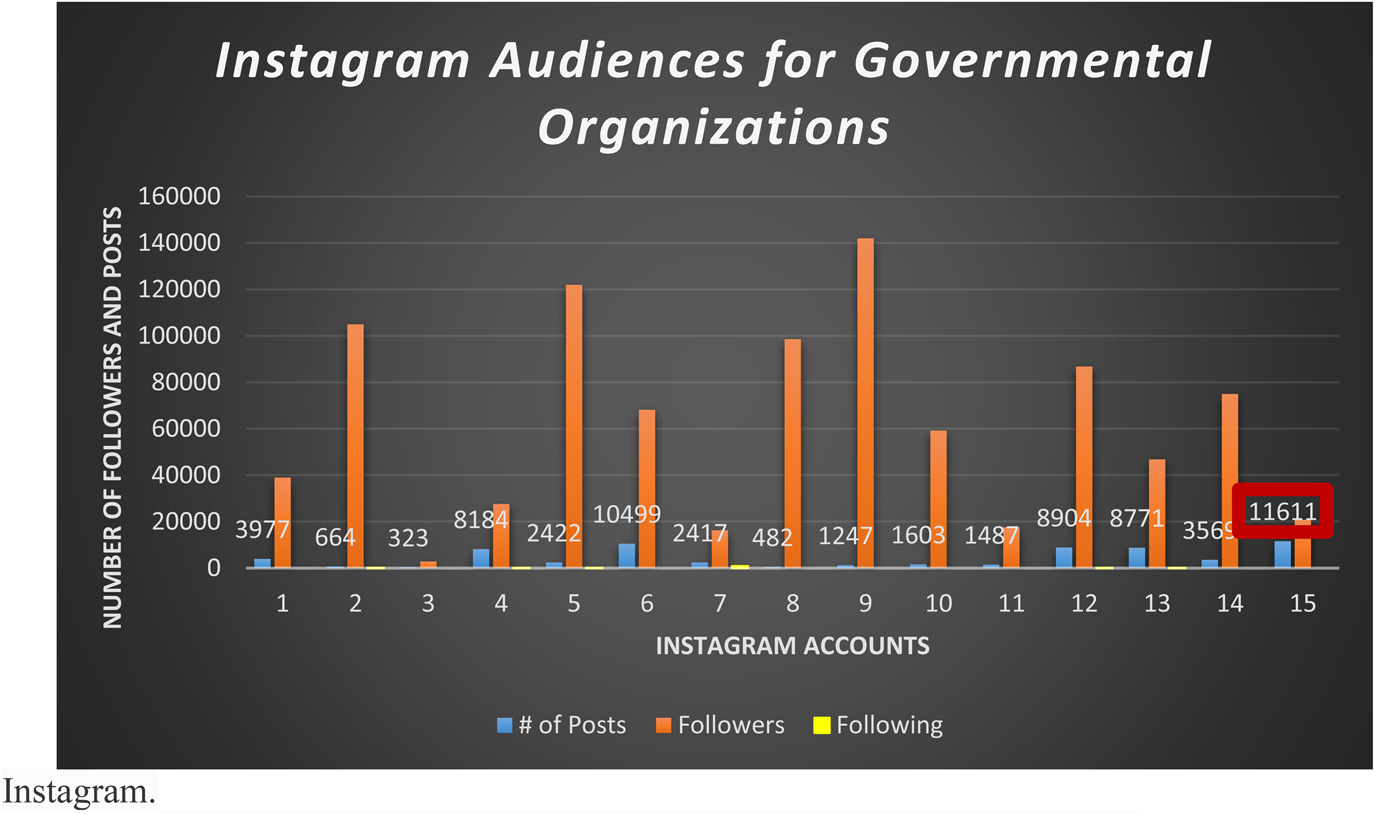
But just because government officials and institutions do not respond to actual comments does not mean they are not trying to convey other messaging. To investigate other ways that the Kuwaiti government may be trying to provide evidence that they are becoming more accountable and transparent in their governance of Kuwait I chose to take a closer look at the Kuwait Municipality (KM) Instagram account because it had published more posts, outlined in red in Figure 23, than any other official account.Footnote 44
Instagram audiences for Kuwaiti government Instagram accounts.

This is also a suitable choice because a major complaint of Kuwaitis is poor maintenance of public property and services. The KM oversees sanitation, maintenance of public infrastructure, inspection of commercial and private property, and other municipal services. The Municipal Council committee and its five sub-committees are responsible for issuing building licenses for housing, commercial enterprises, and public institutions. The people elected to council are responsible for approving urban projects, monitoring the performance of the municipalities, and adjusting fees and fines.
But much of the country's development problems can be attributed to the Kuwait Municipality. The failure is both legislative and fiscal: Kuwait's six governorates exist largely as administrative units and service branches for the central government. meaning they have little local knowledge to be a productive local partner. The constant push and pull of different policy objectives from the center has left KM paralyzed. The lack of trust in these institutions is palpable. Municipal elections reflect this plummeting trust. Elections held in 1999 had a turnout of 61%; in 2005 it was 50%. With 384,229 citizens eligible to vote in Municipal elections in 2013, turnout was below 20%.Footnote 45
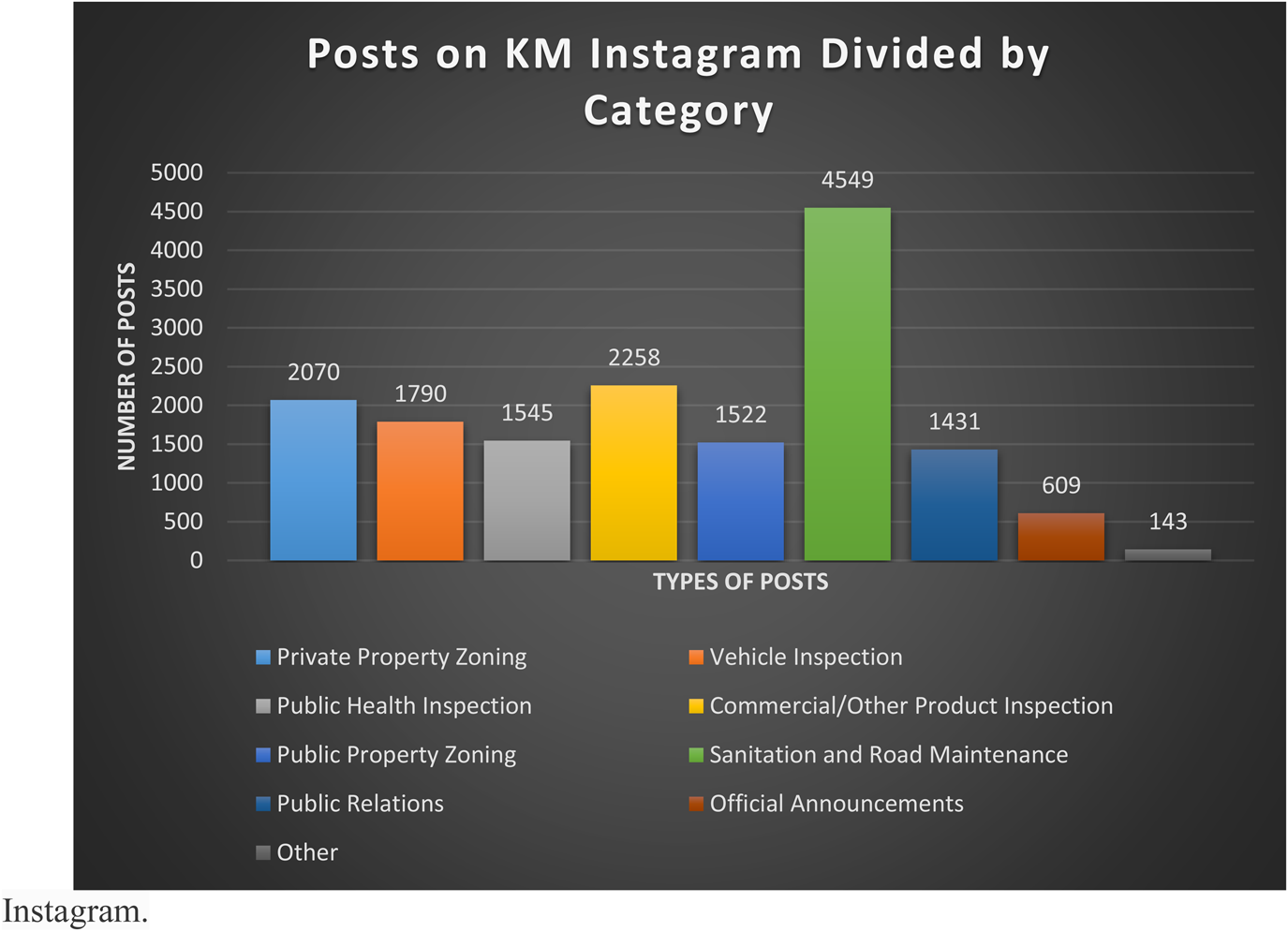
The KM account was founded on August 3, 2016. Between August 2016 and December 2018 I analyzed 11,611 posts and 15,685 comments. I divided the different posts into nine categories [Figure 24].
Total KM Instagram posts divided into categories.

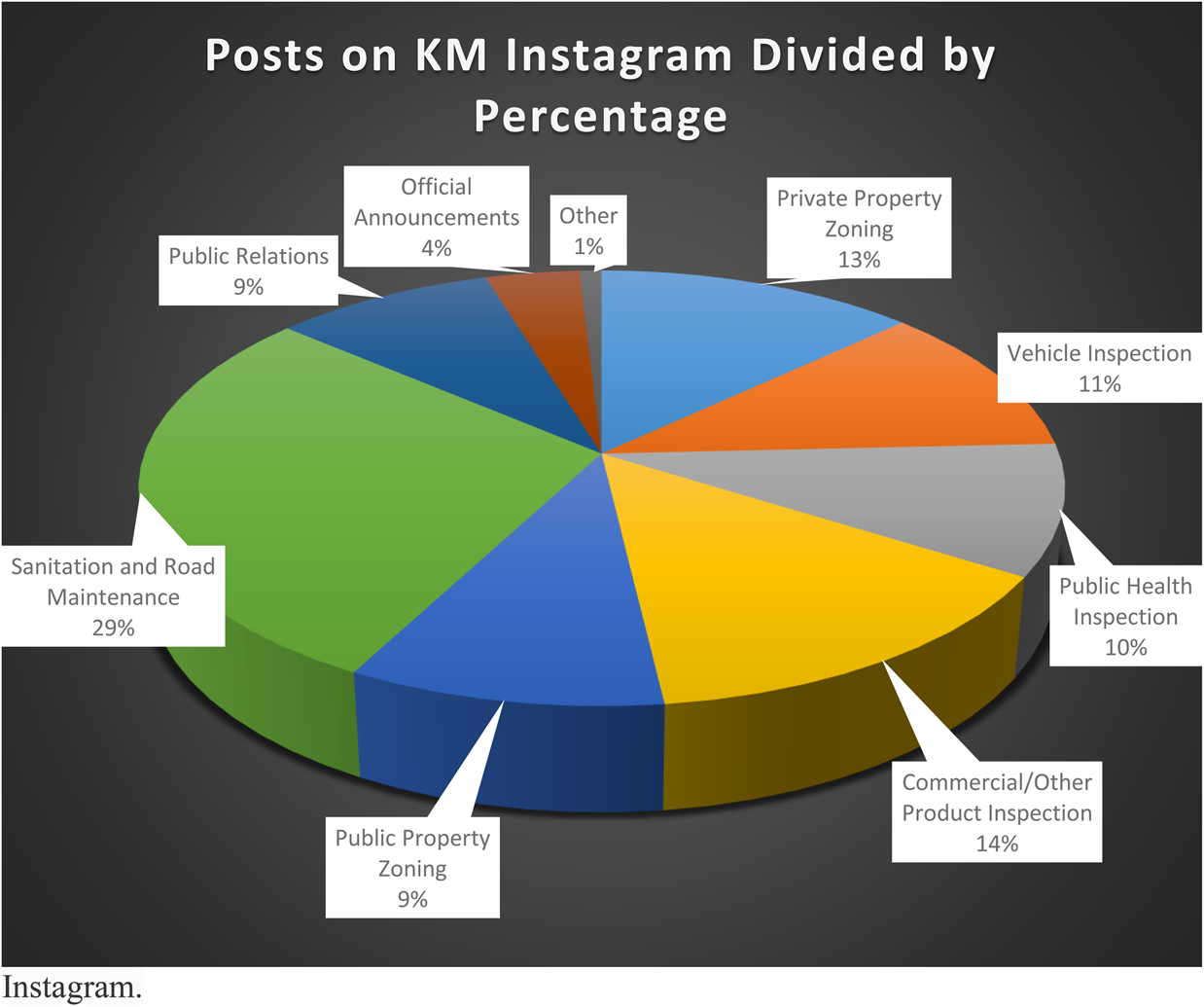
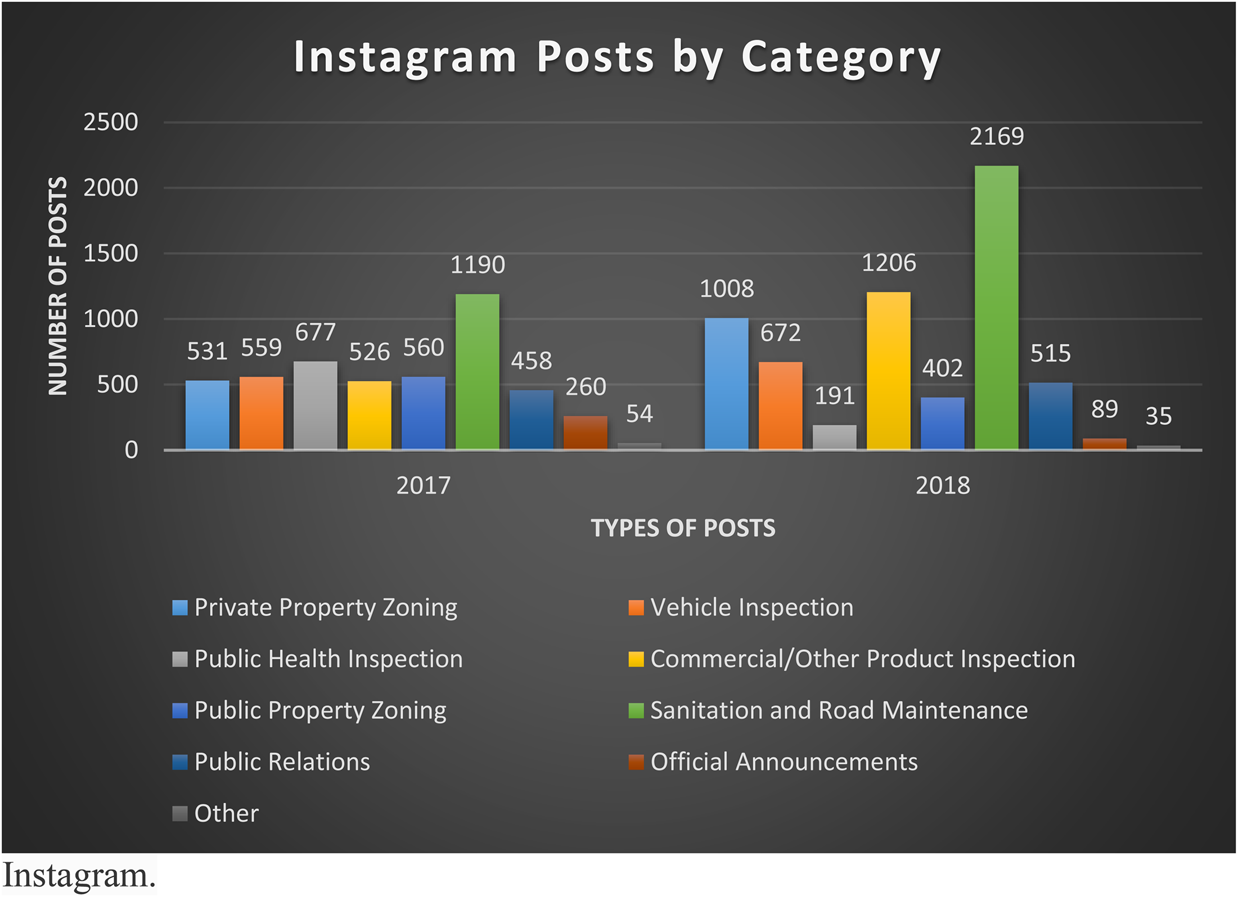
Participation in this account has radically increased over time. From August to September 2016 there were 509 posts and 209 comments. In 2017 there was 4815 posts and 5310 comments and in 2018, 6287 posts and 10,167 comments. Figure 25 illustrates the percentage breakdown of posts from August 2016 to December 2018. Figure 26 outlines the posts by category in calendar year 2017 and 2018.
Total KM Instagram posts from August 2016 to December 2018 divided by percentage.

KM Instagram posts by category, 2017–2018.

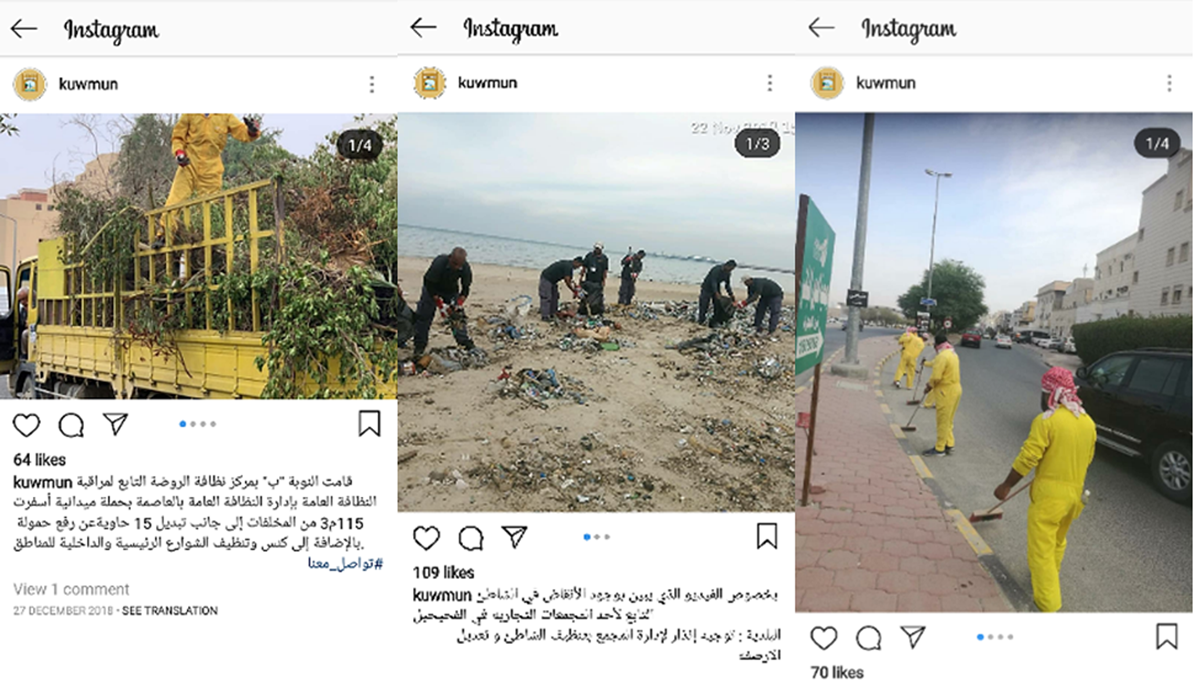
In 2017–18 the KM Instagram account posted most frequently about street maintenance and cleaning, making up 29% of its overall posts. Posts predominantly displayed images of workers cleaning and performing maintenance under the supervision of Kuwaiti inspectors. Most of the posts announce the amount of waste removed and the number of garbage containers replaced [See Figure 27].
Most of the comments on these posts are highly critical of the quality of the cleaning or the equipment used:
Ok, are you proud that you are the cause of a problem, you have workers who do not have tools and do not do work.Footnote 46
In another post the commenters take this line of critique further:
This is rudimentary clean-up with all respect to the workers…This is the work of the Stone Age.
We do not have sophisticated mechanisms, and our country has the means, like European countries and others. Their streets have been cleaned without the presence of any worker on the streets.Footnote 47
A selection of posts from the official Kuwait Municipality Instagram account. The far left post announces that the campaign in the Al Asimah area (downtown Kuwait city) resulted in the removal of 115 metric tons of waste and the replacement of 15 garbage dumpsters.

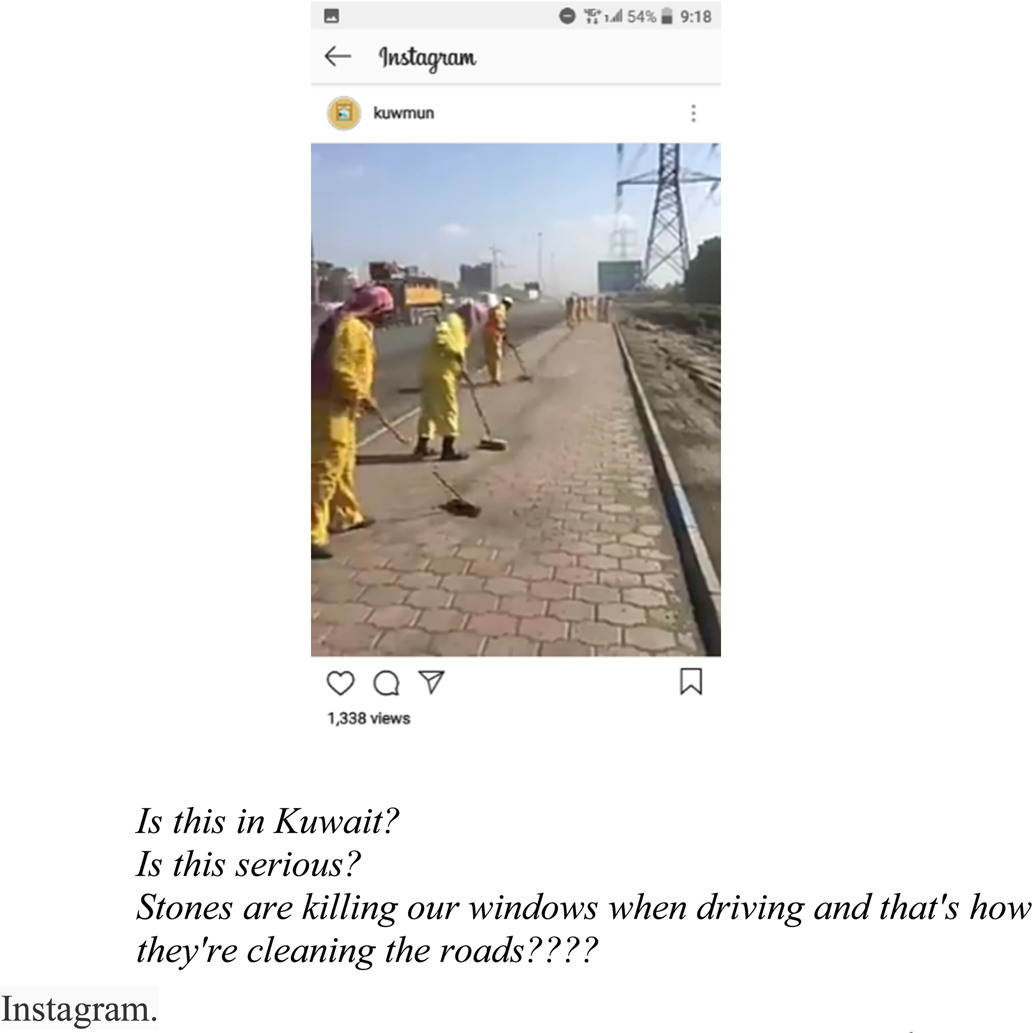
In Figure 28 a commenter exclaims:
KM Instagram post showing workers clean the 5th ring road interchange.

Many complain about the Kuwaiti managers in reference to the quality of maintenance:
I wish all the managers themselves come down to the areas, but they are sitting in their offices.Footnote 48
Others asked that specific places be cleaned.
The beach of Shuwaikh needs cleaning and monitoring 24 hours a day by the guys of the municipality and the Agriculture Authority… The place is beautiful but a little attention … Broken sidewalks … no Containers there is garbage and it is dirty. Lighting needs maintenance…Footnote 49
Go to Al-Rawdah Center to look for abandoned cars there are 4 at the park and many on the streets around themFootnote 50
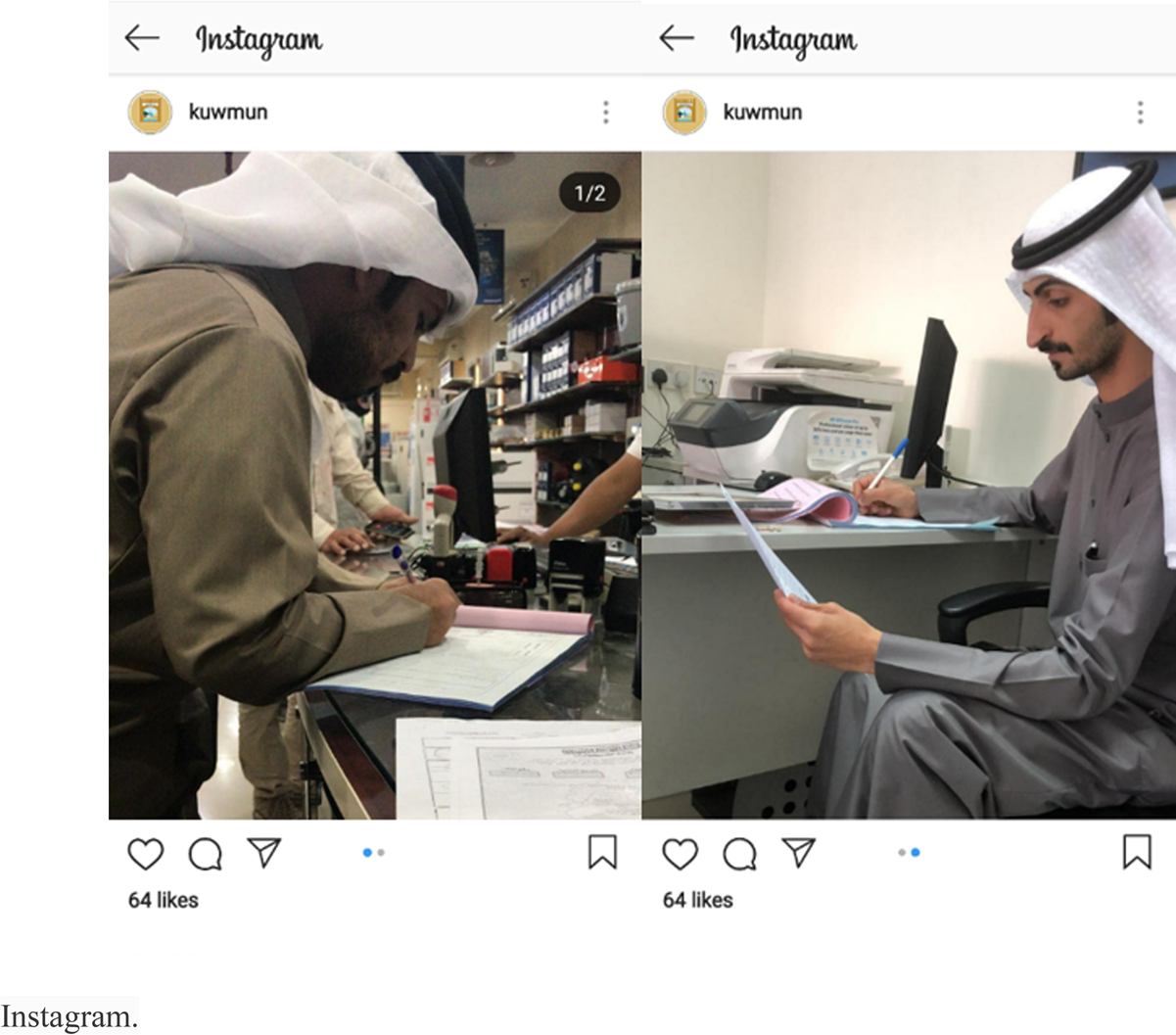
The second most common category of posts featured commercial and product inspections, making up 14% of the entire sample. Most of these posts show inspectors writing fine citations [Figure 29].
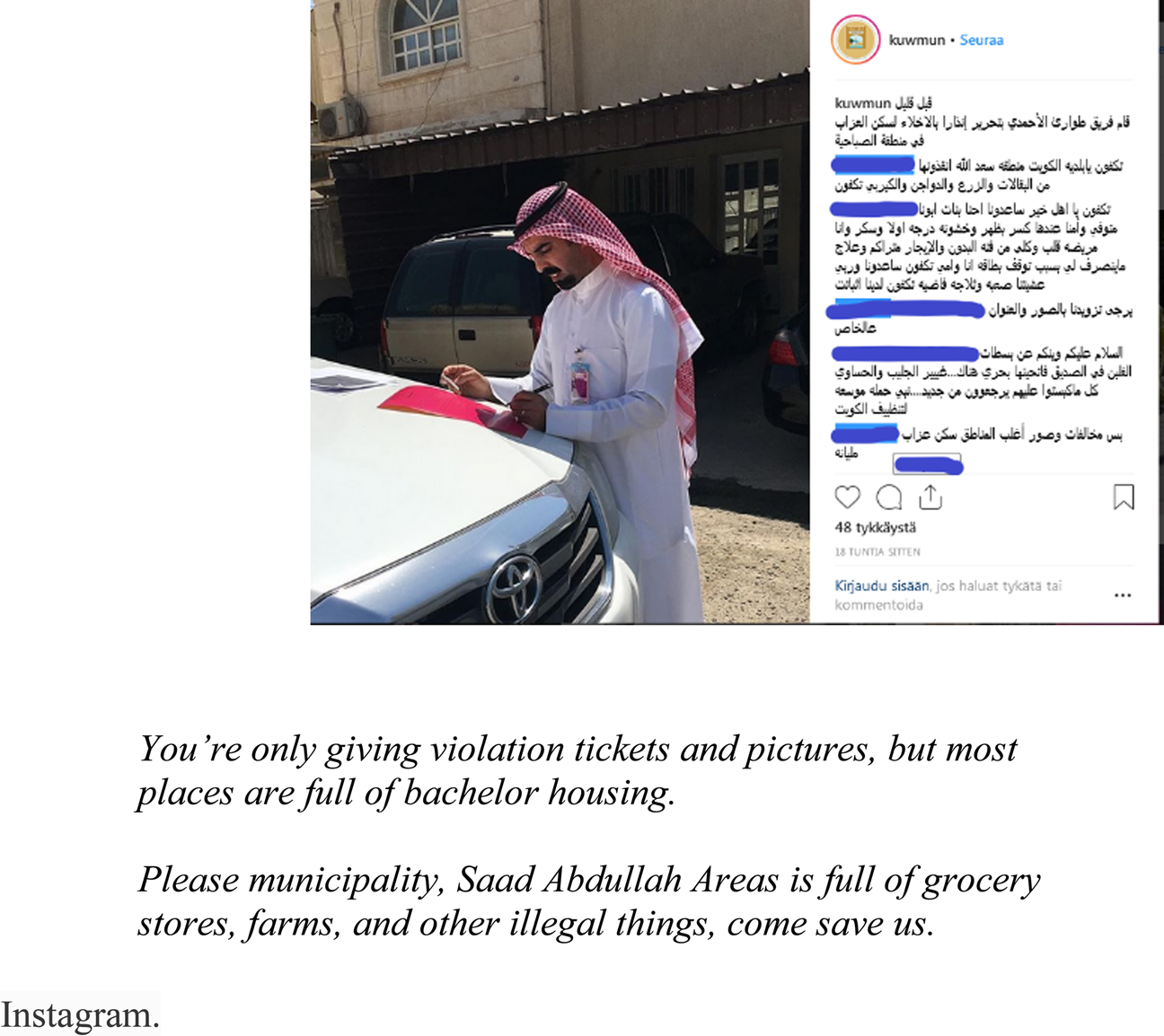
Inspectors from Kuwait Municipality Writing citations for commercial violations.

Some common complaints point to specific employment violations.
If the Ministry of the Interior and the Ministry of Affairs and the Municipality of Kuwait are searching cattle breeding farms, workers are employed more than 14 hours a day with heat and humidity, and are forced to work on Fridays without pay, and they threaten them not to renew their residency.Footnote 51
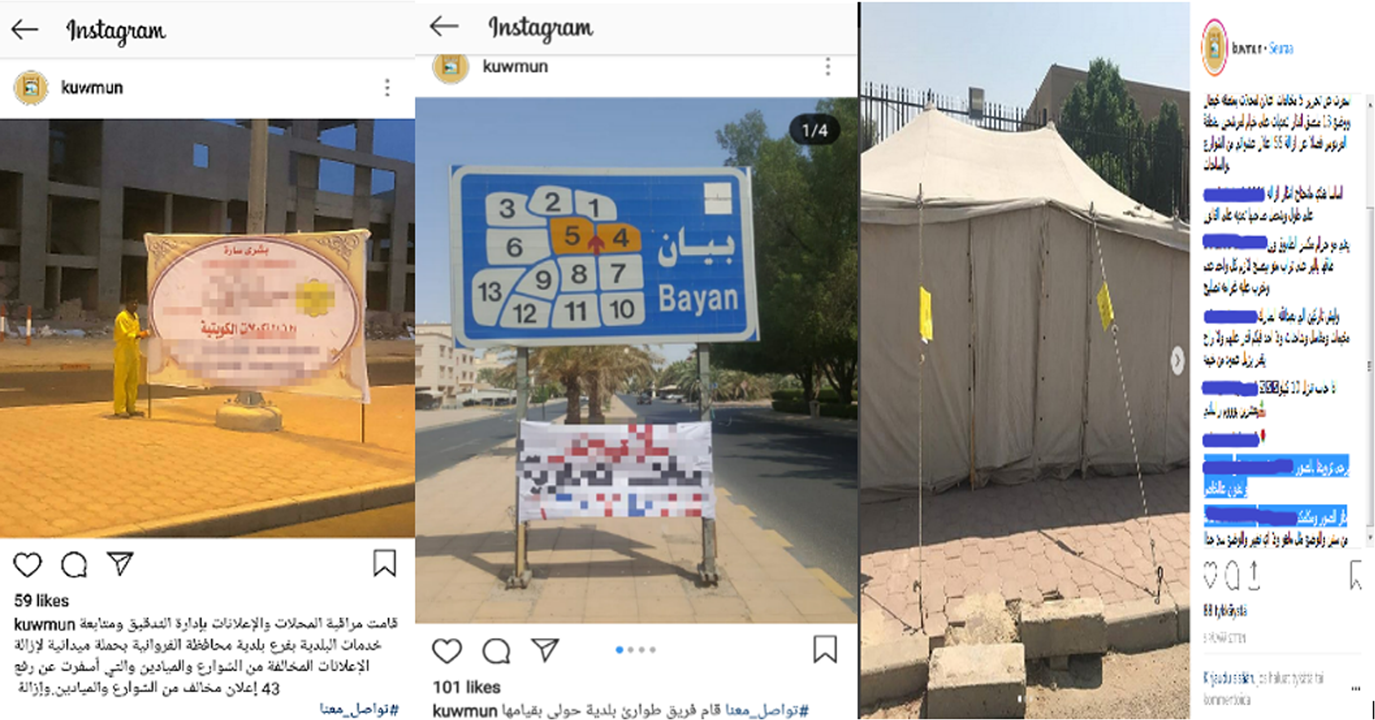
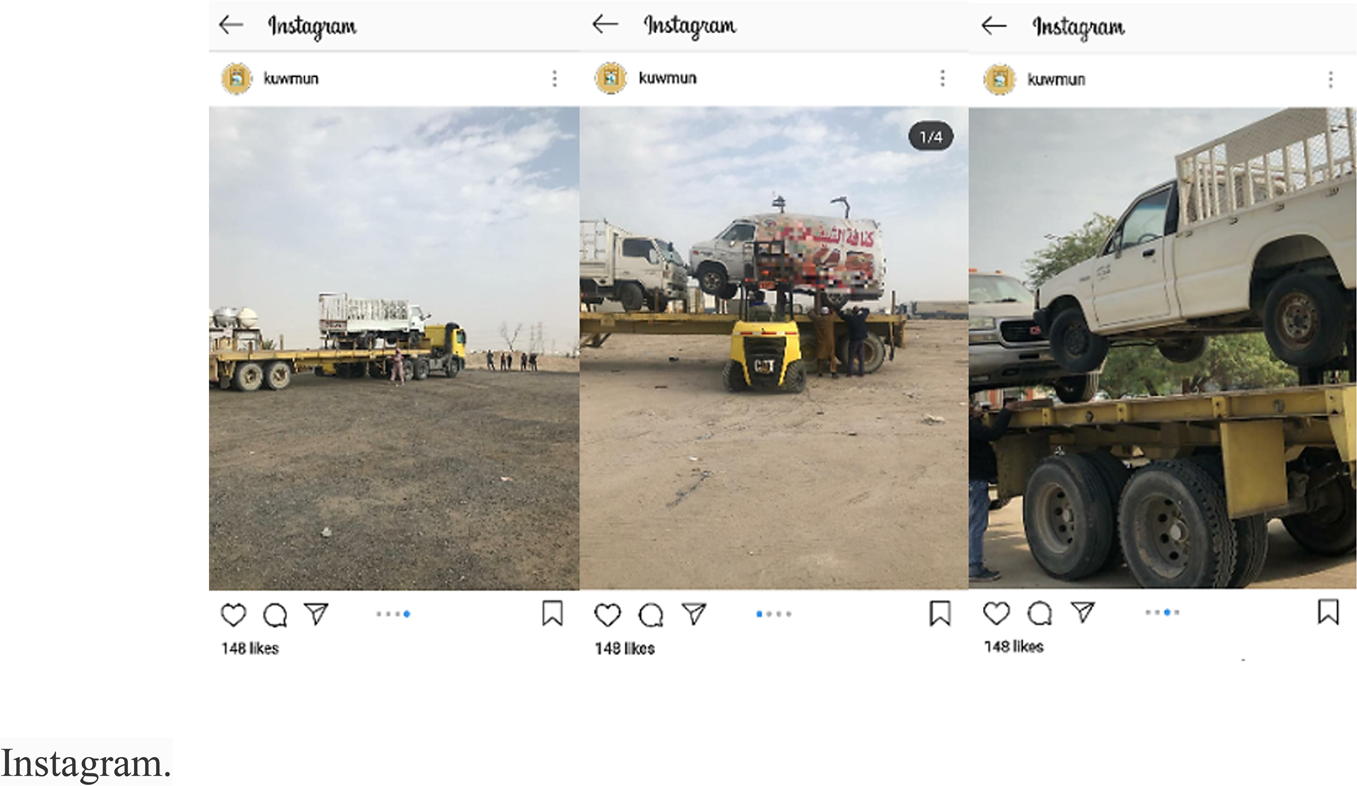
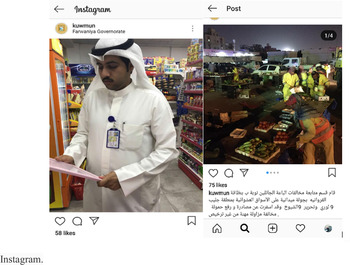
Public Property Zoning, Vehicle Inspections and Public Health Inspections made up 9%, 10%, and 11% of the sample [Figures 30, 31, and 32].
Pictures of Wedding signs and tent prior to removal considered in violation of public property.

Posts of vehicles being removed for parking violations.

Posts of health inspector checking a food safety license at a grocery story and workers confiscating tainted vegetables at a black market in Farwaniya.

Commenters complain about the unfairness in the campaign to remove or fine people for putting signs, tents, or parking vehicles on public property.
Why have you left the ones in Abdullah Al Mubarak, tents, and trucks and others and none of you are able to deal with themFootnote 52
KM responses are almost always identical:
Please provide us pictures and an address on private message.
Response:
I've sent you pictures and spoken to you since years and the situation is still the same with no change, it's a bad situation.
KM responses:
Please provide us pictures and an address on the private message.Footnote 53
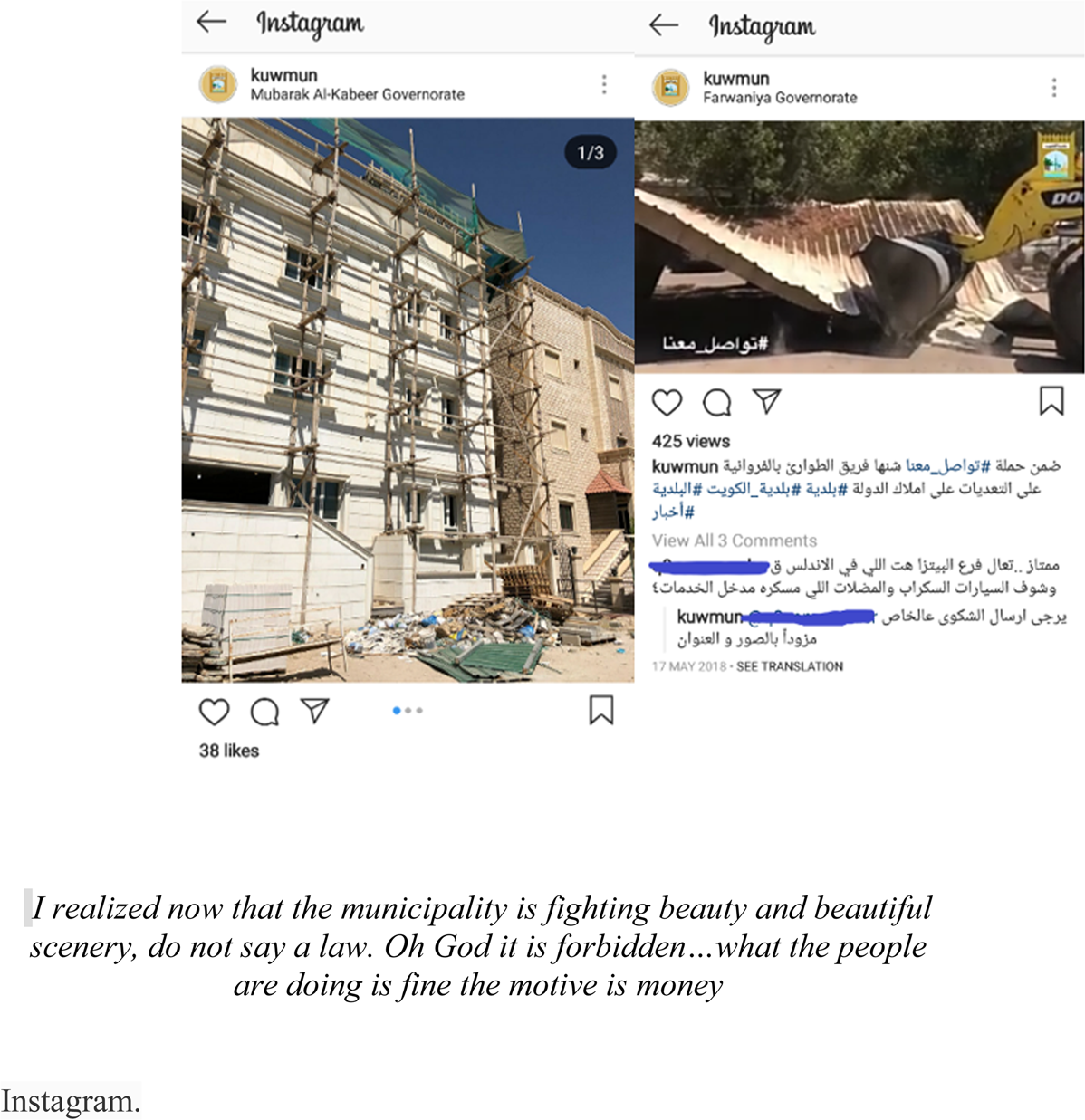
Perhaps the most critical posts focus on private property zoning, which made up 13% of the sample. Many of these posts show the KM workers destroying fences, gardens, large trees, curbs, sheds, and even houses that violate property lines. As one commenter notes,
Pictures of a illegal scaffolding on an improperly zoned housing addition, and a covered parking lot being destroyed.

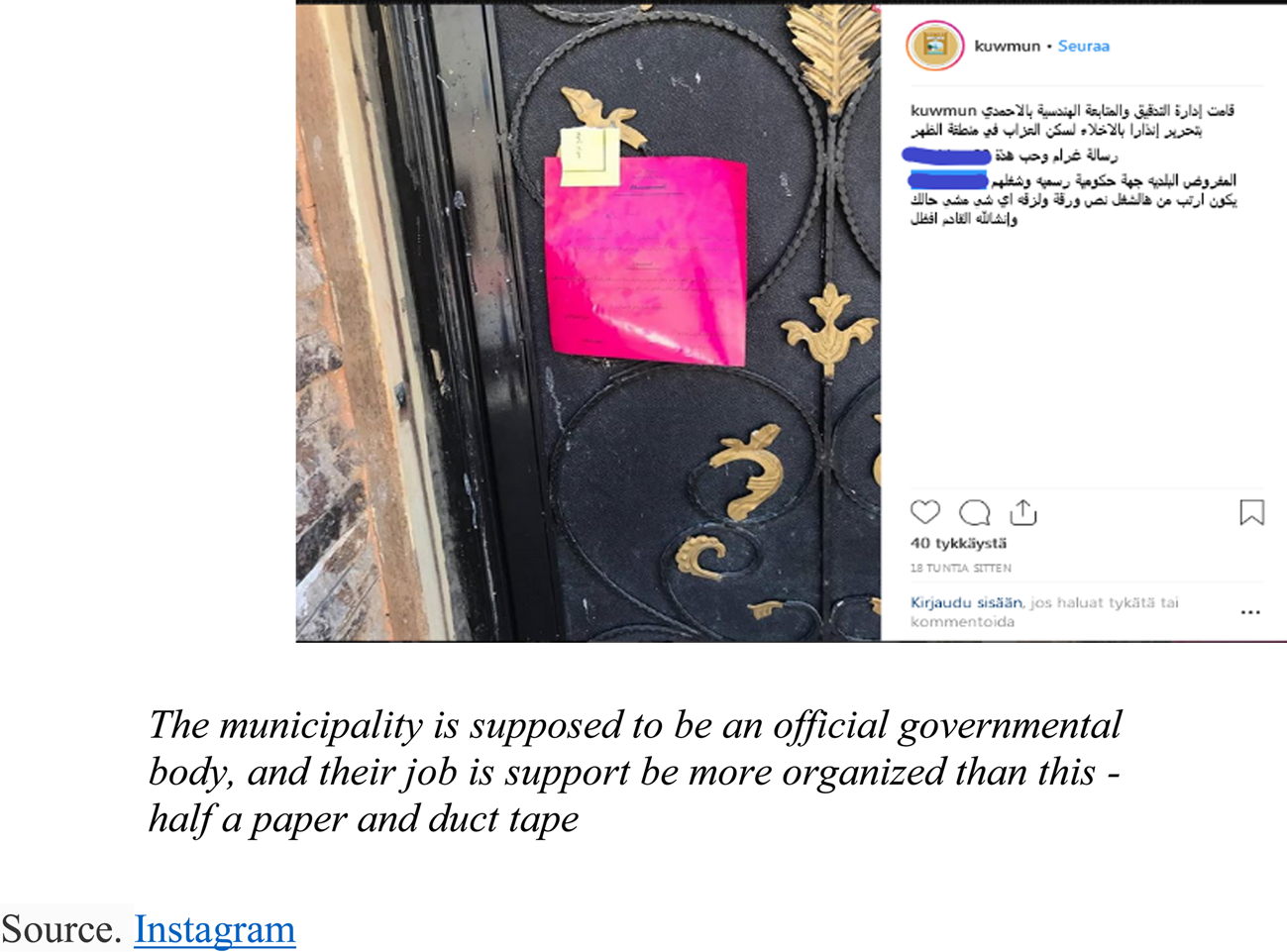
Many comments merely mock.
Picture of KM inspector writing citation for public property violations.

Picture of citation posted on door of alleged public zoning violator.

Most comments illustrate confusion around the official zoning rules:
I want to inquire, I want to make a shade for my car in Al-Raya on the land of the state do I have to get a permit or what, please let me know.
KM responds:
There is not permit for car shades.
Citizen responds:
Okay since there is no permits, the people who have shades, diwaniyas, and farms in Al-Raya road 11 what is their situation????
KM responds:
Please provide us pictures and addresses on the private direct message.Footnote 54
In general, many commenters are unhappy with the overall quality of services and potential solutions.
The solution is not solved unless on social media unfortunately. I have applied for a complaint which is still not solved so I have to resort to social media.Footnote 55
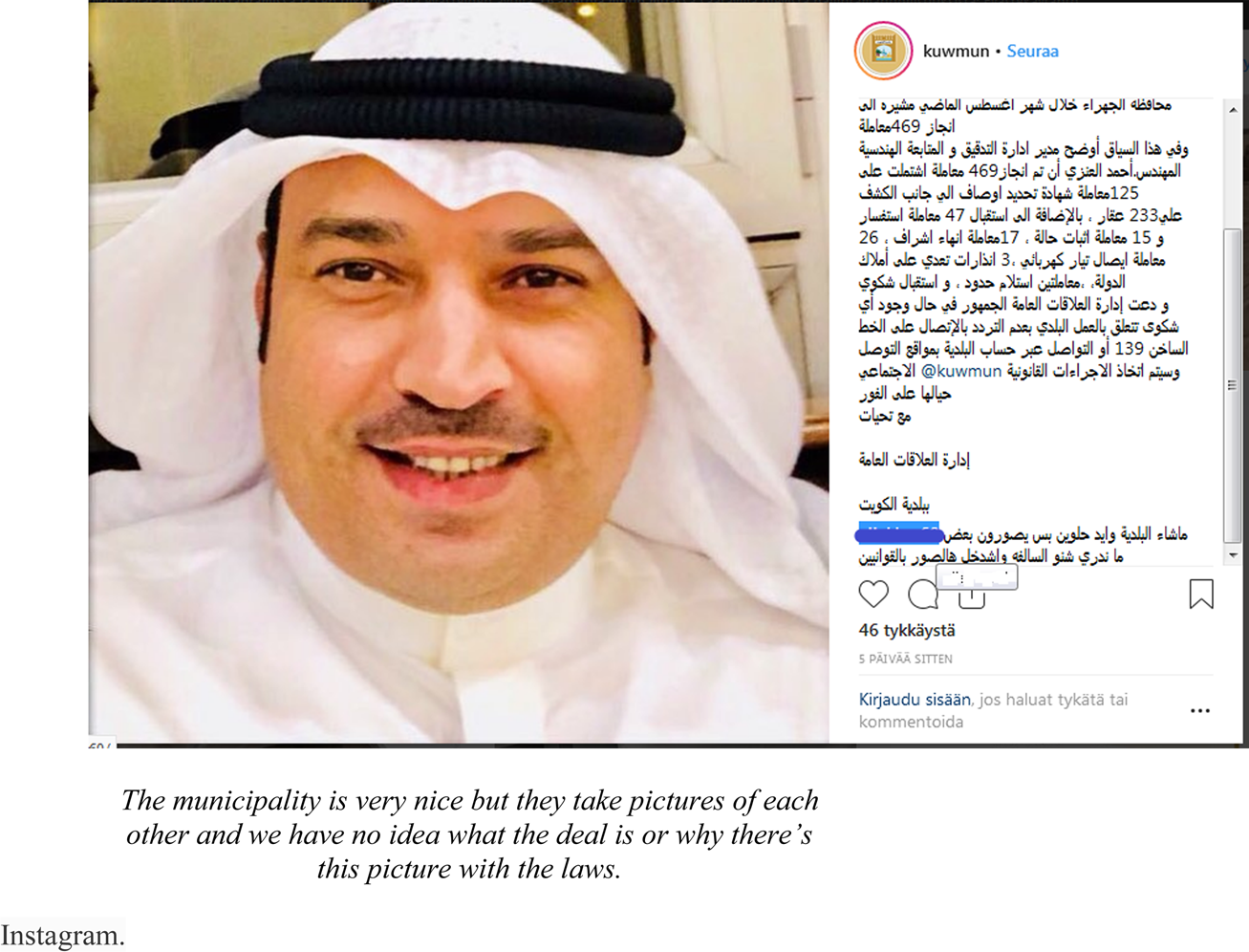
In response to a post about laws and rules one citizen sums up the issue rather nicely:
Picture of Kuwait Municipality Official

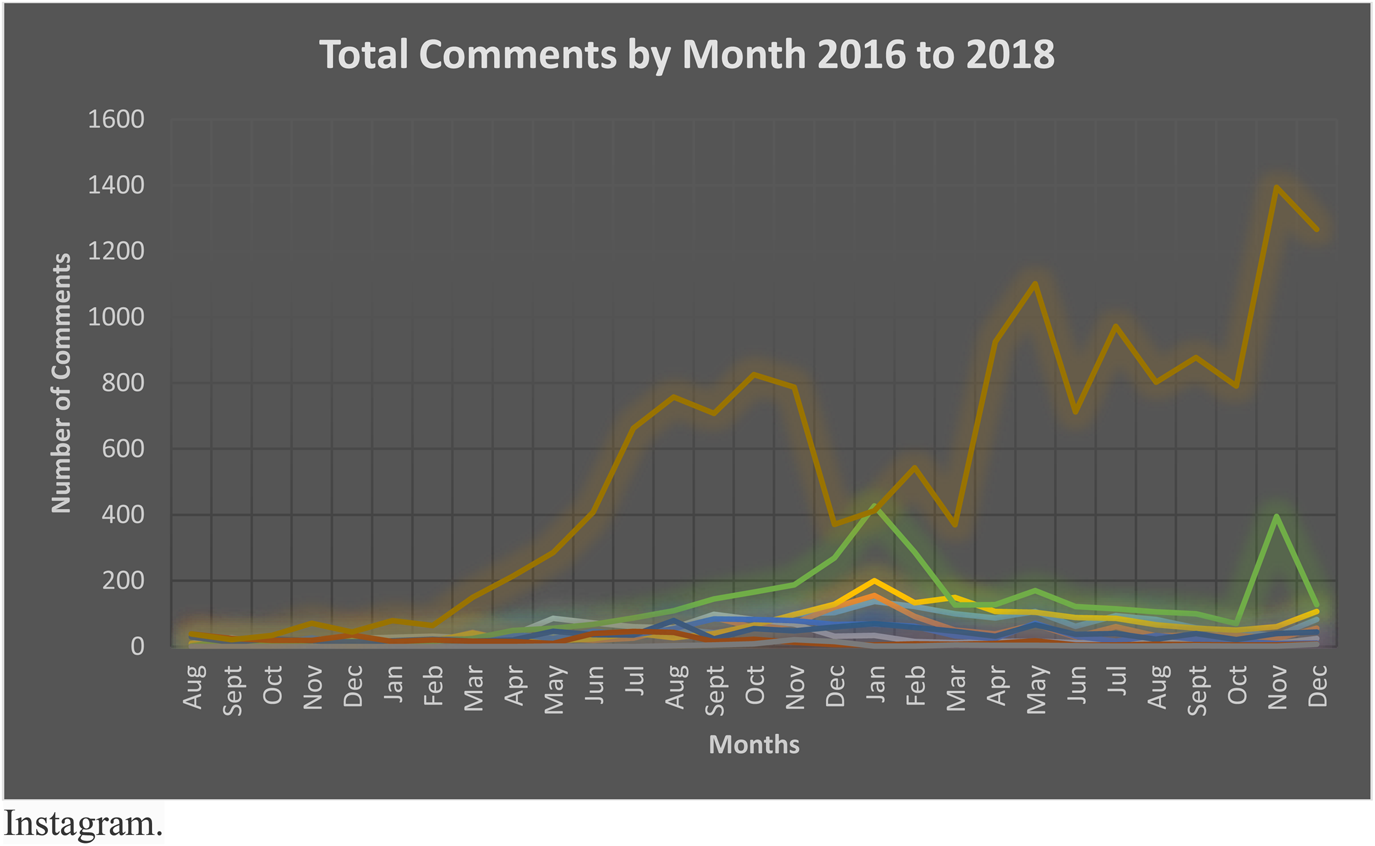
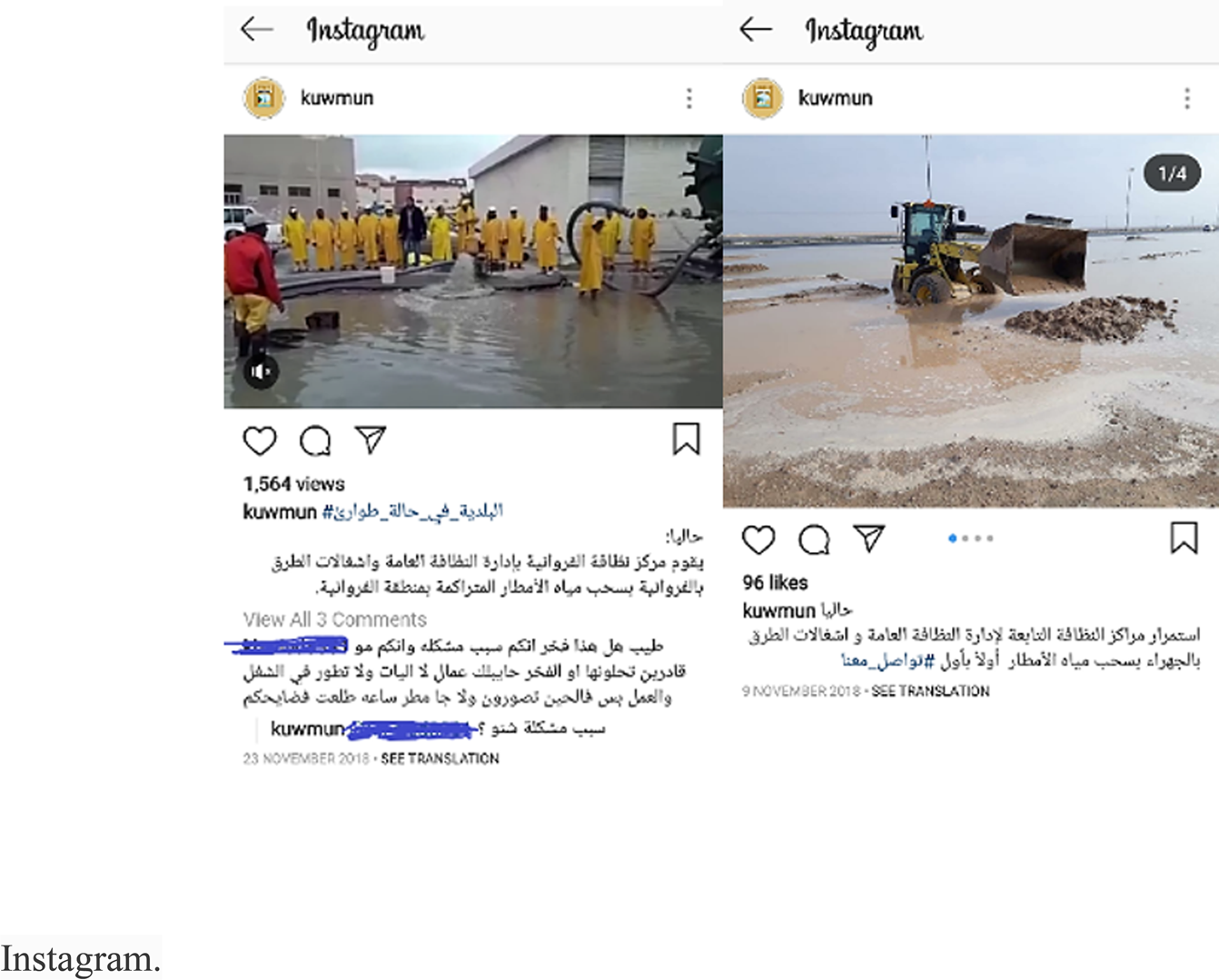
The KM case study is thought provoking. Aside from criticisms similar to those I observed on Twitter, the case study illustrates that the KM is trying to demonstrate a good-faith effort toward transparency and responsiveness to citizen input. It may be that it simply does not know how to do this using its current array of policy tools. But neither the content of the posts nor the complaints lodged in the comments are merely random. The spike in posts [see Figure 37] about sanitation and maintenance reflects the aftermath of the major floods and heavy rains that hit the country in November of 2017 and 2018 [Figure 38], which damaged myriad vehicles, ruined roads, and uprooted trees. In regards to both the floods and heavy rains, KM responded by increasing the volume of its posts demonstrating its cleanup efforts. This demonstrates a responsiveness to specific issues, rather than merely the actions of a shallow propaganda machine.
All comments by month on all analyzed KM Instagram Posts by category from August 2016 to December 2018

Instagram posts showing flooded areas being repaired by KM staff in November of 2018.

Concluding Thoughts
The development of KM's social media account illustrates an attempt by KM to demonstrate to the public its role in maintaining local infrastructure. While clumsy, I would argue the role of this account highlights important political processes. Not only do the posts become a target for criticism and dialogue between citizens, we see a sharp uptake in comments complaining about the lack of information and communication between government offices and citizens, an issue at the core of the 2011 protests. The government did not open itself up to these criticisms blindly. These results defy the expectations of rentier theory, as citizens are still paid off and the regime is not in danger of overthrow. Yet the government still attempts to gain consent, which it should not require, while citizens continue to remain politically active, instead of acquiescent.
The initial findings also contradict the idea that state power is exclusively mediated by economic instrumental concerns. As I discussed earlier, the long-standing hypothesis that money trumps other concerns in Kuwait was undermined by the events after 2011. The boundaries of public discussion have continued to transform, and both the public and the government have adjusted their response to these changes in different online spheres, including Instagram, underscoring the importance of studying digital media in connection to rentier theory. This is especially relevant, in terms of this case study, as the results suggest that Kuwait may be no more exceptional in terms of its public debates than other non-rentier states. The openness and honesty in public criticisms in a considerable number of posts suggest that the theoretical underpinnings of rentier theory, which often treats different societies as a black box instead of a collection of individuals, need to be revised case by case. This allows us to move past superficial conceptions of how these states respond to citizens and how societies interact with government policies, and vice versa.