INTRODUCTION
Hermit crabs are anomuran crustaceans that have a close relationship with gastropod shells, based on the protection of their abdominal exoskeleton, which lacks calcification (Hazlett, Reference Hazlett1981). The shells protect hermit crabs from predators, mechanical damage, dehydration, high temperatures, etc. (Reese, Reference Reese1969; Taylor, Reference Taylor1981); as a consequence, these portable homes are an indispensable resource for hermit crabs (Hazlett, Reference Hazlett1981). The size, type and quality of the gastropod shell influence important aspects of hermit crab life, including its morphology (Turra & Leite, Reference Turra and Leite2003), body growth (Markham, Reference Markham1968), fecundity (Childress, Reference Childress1972; Fotheringham, Reference Fotheringham1976) and survival against predators (Reese, Reference Reese1969; Angel, Reference Angel2000). As a consequence, the occupancy of an adequate shell confers adaptive advantages to hermit crabs (Mima et al., Reference Mima, Wada and Goshima2003; Arce & Alcaraz, Reference Arce and Alcaraz2013).
Hermit crabs are constantly searching for shells (Spight, Reference Spight1977). However, the gastropod shells are commonly a limited resource in intertidal shores (Childress, Reference Childress1972; Mantelatto & García, Reference Mantelatto and García2000). In a limited shell environment most crabs will occupy inadequate shells, which may be of a non-preferred species, tight to the body, or of a bad quality by having epibionts or being damaged (Vance, Reference Vance1972; Kellogg, Reference Kellogg1976; Pechenik & Lewis, Reference Pechenik and Lewis2000; Bulinski, Reference Bulinski2007).
Different mechanisms of shell distribution may occur among these anomurans. Since several hermit crab species coexist in intertidal areas, these may involve intraspecific and interspecific competition. The theory suggests that resource partitioning is required for the coexistence of similar species (Garrett, Reference Garrett1960). Resource partitioning is commonly reached through differences between species that allow each of them to use specific resources more successfully, thus reducing interspecific competition (character displacement; Brown & Wilson, Reference Brown and Wilson1956). Several factors have been proposed to explain the coexistence of different hermit crab species based on the predictions of niche theory (Hazlett, Reference Hazlett1981). Shell partitioning in hermit crabs is commonly associated with differences in body size (Abrams, Reference Abrams1980; Bertness, Reference Bertness1980), shell preference (Grant & Ulmer, Reference Grant and Ulmer1974), habitat selection (Gherardi, Reference Gherardi1990) and environmental tolerance that results in different degrees of niche overlap along the intertidal (Kellogg, Reference Kellogg1977; Gherardi, Reference Gherardi1990).
Competition for shells may be either indirect (exploitative) or direct (interference). Exploitative competition occurs when a crab occupies an available shell, thus taking away the opportunity for another crab to find it (Bertness, Reference Bertness1981a; Turra & Denadai, Reference Turra and Denadai2004). Interference competition occurs via aggression when one crab (the attacker) tries to evict its opponent in order to take its shell away. The ability to acquire and retain an adequate shell is assumed to be highly correlated with a crab's fitness (Bach et al., Reference Bach, Hazlett and Rittschof1976; Sant'Anna et al., Reference Sant'Anna, Dominciano, Buozi and Turra2012).
Calcinus californiensis Bouvier, 1898 and Clibanarius albidigitus Nobili, 1901 inhabit the intertidal rocky shore of Troncones, Guerrero, México. As in other intertidal shores, gastropod shells are scarce in Troncones (Arce & Alcaraz, Reference Arce and Alcaraz2011). Similarly to other coexisting species of these genera (e.g. Calcinus obscurus Stimpson, 1859 and Clibanarius albidigitus; Bertness, Reference Bertness1980, Reference Bertness1981a), Calcinus grow larger in body size than Clibanarius, although both species overlap in smaller range sizes in the high intertidal (Ball & Haig, Reference Ball and Haig1974). Calcinus californiensis and C. albidigitus occupy the same shell species within the range of body size in which they overlap in Troncones, suggesting interspecific competition for shells (Guerrero, Reference Guerrero2015). Calcinus californiensis and C. albidigitus are the most abundant hermit crab species inhabiting the rocky shores of the Pacific coasts of México. In this study, we assess some factors that could be playing a role in the partitioning of shells within the range of body size shared by these hermit crab species. We assess and compare the sequence of preference for different gastropod shells, the ability to find empty gastropod shells through chemical signals (exploitation), and the outcome of fighting for shells between individuals of these species in order to explain shell occupancythrough competition.
MATERIALS AND METHODS
Hermit crabs collection and general procedures
Hermit crabs C. albidigitus and C. californiensis were collected by hand during the ebb and flow tides in the rocky shore of Troncones, Guerrero, México. The hermit crabs were collected in the upper intertidal, in a fringe in which both species coexist according to previous studies in Troncones and other areas of the Pacific coast (Ball & Haig, Reference Ball and Haig1974; Guerrero, Reference Guerrero2015). The crabs were collected along a line parallel to the coast. The collecting sites were close to the shore (no more than 3 m from the highest tide mark). We used hermit crabs within a range size in which both species coexist; during the collection, we used the length of the shells as a predictor of the body size of the occupants (Guerrero, Reference Guerrero2015). Water temperature and salinity were measured during each collection event.
The experiments under controlled conditions were conducted during a period when these crabs are active (0900 to 1400 h; Alcaraz & Kruesi, Reference Alcaraz and Kruesi2012). In the laboratory, the water temperature and salinity were maintained at 27 °C and 35‰, respectively. At the end of each phase of the study, the hermit crabs and their shells were measured and weighed and returned to their original collection site. All the analyses were conducted using Statistica 7.0.
Shell occupancy in the wild
After collection, the hermit crabs were transported to the laboratory in individual containers (0.050 l) and then were maintained submerged in water-circulation systems (50 l). All crabs were removed from their shells by heating the apex of the shell (Kellogg, Reference Kellogg1977). The sex of the hermit crabs was determined by identifying the position of the genital pores using a stereoscopic microscope; the crabs were grouped as males, females, ovigerous females and juveniles. The gastropod shells were identified to species using keys of Morris (Reference Morris1974), Keen (Reference Keen1971) and Abbott (Reference Abbott1968). We compared the similarity in shell species utilization pattern using the Renkonen index (Krebs, Reference Krebs1989; Turra & Denadai, Reference Turra and Denadai2004). The index of similarity in shell use between both species was calculated for the complete sample (grouping crabs of different sex or reproductive stages), and also for males only.
Crabs were weighed (plate balance, OHAUS, ±0.1 g) and measured for shield length and chelae length (digital calliper; ±0.01 mm). The shells were dried and weighed (±0.1 g). The shell adequacy index (SAI) was calculated for the five of seven species occupied with higher frequency by males of C. albidigitus and C. californiensis: Columbella sp. Sowerby, 1832, Nerita funiculata Menke, 1851, N. scabricosta Lamarck, 1832, Mancinella triangularis Blainville, 1832, and Stramonita biserialis Blainville, 1832. The SAI was calculated according to Vance (Reference Vance1972), as the ratio between the mass of a hermit crab for a shell preferred size to the actual mass of the crab. The adequate crab size for a particular shell was calculated using data previously estimated (Guerrero, Reference Guerrero2015). The SAI of males of both species (dependent variable) was compared between the crab and among the five shell species (fixed factor) by a two-way ANOVA.
Sequence of shell preference
The sequence of shell preference for gastropod shells of Columbella sp., N. funiculata, N. scabricosta, M. triangularis and S. biserialis was evaluated using a multiple-alternative test (Arce & Alcaraz, Reference Arce and Alcaraz2012). Individual hermit crabs were placed into a 0.5-l plastic arena submerged in aerated flowing seawater (27 °C, 35‰). Three shells of each of the five species (a total of 15 shells) were given to each hermit crab to choose. The size of the shells given to each crab was established by the results obtained from an experiment of shell-size preference conducted previously (Guerrero, Reference Guerrero2015). The hermit crabs started the experiment occupying the same shell in which they were collected in the sea; a hair clamp was attached to the occupied shell to force the crab to leave this shell and choose another. After 24 h, the shell occupied by the crab was identified; this shell species was assumed to be the first choice and was ranked as number one. The remaining two shells of this species were removed from the arena. The hair clamp (customary hair clip made of resin; 0.53 g; Arce & Alcaraz, Reference Arce and Alcaraz2011) was attached to the chosen shell occupied by the crab to motivate the crab to swap to a shell of a different species. The crab was given 24 h to choose a new shell (second choice). The empty shell with the clamp attached and the two remaining shells of this second species were removed from the tank, and the clamp was attached to the shell now occupied by the hermit crab. This procedure was repeated until all the shell species were ranked (Arce & Alcaraz, Reference Arce and Alcaraz2011). Twelve hermit crabs of each species were tested. The consistency in the sequence of shell choice was analysed for each hermit crab species separately using a Kendall coefficient of concordance (Zar, Reference Zar2010). The water was replaced (30% daily), and the hermit crabs were fed on commercial pellets (New Life Spectrum) once a day.
Exploitation ability
The ability of the two hermit crab species to identify and attend to potential sites of a vacant new shell was tested using chemical cues of dead gastropods (Rittschof, Reference Rittschof1980). We collected hermit crabs C. albidigitus and C. californiensis occupying shells of N. funiculata (N = 66) and gastropods of N. funiculata. The crabs were fed just after collection and maintained with food available for 24 h in a closed water circulation system, in the same conditions as mentioned above. We fed the crabs before testing to avoid them responding to potential food instead of to potential shells. We fed the hermit crabs on commercial pellets (New Life Spectrum); this food has shown to be palatable to this species (Alcaraz & García-Cabello, Reference Alcaraz and García-Cabello2017), therefore we assumed the crabs were not hungry.
Chemical solutions were prepared as cues signalling gastropod predation sites. The gastropods were killed by freezing immediately after collection; the tip of a toothpick was used to keep the gastropod's operculum open. The chemical solution was prepared as suggested by Orihuela et al. (Reference Orihuela, Diaz, Forward and Rittschof1992). Fifteen frozen and thawed N. funiculata (23 g) were placed in 100 ml of aged filtered seawater for 60 min. After this period, the gastropods were removed from the container, and the water was stirred (not filtered) and collected. The solution was maintained at ambient temperature through the day (24 h). The control (blank) solution was prepared using aged filtered seawater, which was also left for 24 h at ambient temperature. The solutions of dead gastropods and control were frozen in different small containers (0.005 l) at −10 °C at least 24 h before use in the experiments (Ferrari et al., Reference Ferrari, Gonzalo, Messier and Chivers2007; Reference Ferrari, Brown, Messier and Chivers2009; Alcaraz & Arce, Reference Alcaraz and Arce2017). The solutions of chemical cues required for the specific trials were thawed immediately before testing.
The trials were conducted using a rectangular arena (36 × 6 cm). The arenas were marked on their inner walls, starting at the middle (central point); two additional marks (non-evident for the crab) were placed at 15 cm from the central point in both directions (at 3 cm from the end of the arena). These marks were used as criteria of the border of the arena (where the stimuli were placed).
Before the start of each trial, 1 l of fresh seawater was placed in the arena. The seawater used for the experiments was obtained from the ocean, away from rocky tide pools to minimize the effect of chemical cues from organisms living in the pools (Webster & Weissburg, Reference Webster and Weissburg2009). Individual hermit crabs were placed in the middle of the experimental arena enclosed in a cylindrical removable PVC tube. After 1 h, 5 ml of a solution with chemical cues from dead gastropods and water control were injected at the same time at the bottom of the borders of the arena (Orihuela et al., Reference Orihuela, Diaz, Forward and Rittschof1992; Rittschof et al., Reference Rittschof, Tsai, Massey, Blanco, Kueber and Haas1992). The cues from dead gastropods and water control to each of the sides of the arena were randomly assigned (by the toss of a coin); the observers were blind to the type of stimulus injected at the extremes of the arena. The PVC tubes were removed 1 min after the injection of the solutions, allowing the crab to move freely in the arena. We scored the side chosen by the crab.
At the end of each trial, the water was discarded, and the arena was rinsed with abundant fresh water. The experiments were conducted using daylight; special care was taken in avoiding shading that might influence the crab`s response. At the end of the experiments, the hermit crabs were removed from their shells, measured as described before, and returned to the site in which they were collected. We compared the number of crabs that reached the end of the arena where the solution of chemical cues was placed vs the number of crabs that reached the end of the arena where the control water was injected using a χ2 test. Crabs that did not reach the end of the arena within 60 s were not considered for the analyses. Different analyses were conducted for C. albidigitus and C. californiensis.
FIGHTING ABILITY
The ability of C. albidigitus and C. californiensis to evict an individual of the same species (intraspecific shell fighting), or the other species (interspecific shell fighting) was tested through a shell-exchange experiment. We collected hermit crabs occupying shells of N. funiculata. The crabs were taken to the laboratory, fed after collection, and maintained for 24 h in the closed water-circulation systems (27 °C, 35‰). We paired individual crabs with opponents occupying a shell of similar size (shell length). Following the protocol described by Turra & Denadai (Reference Turra and Denadai2004), the original shell of all the hermit crabs was peeled in its aperture until the chelipeds of the crab became exposed. The shells and hermit crabs were marked with different colours using non-toxic permanent markers. Crabs were kept in their container for 48 h and fed before being tested.
Once the crabs were paired and their shells peeled as described, the crabs were maintained in individual containers (0.05 l) submerged in a recirculating water system waiting to be assigned to one of four treatment groups. The crabs were tested for fighting ability in intraspecific and interspecific competition in four treatment groups. The treatment groups of intraspecific competition were assembled by 27 pairs of crabs of C. albidigitus and 27 pairs of C. californiensis. In each of these pairs, one individual was tested occupying a suboptimal shell (shell with apertures peeled) and the other using an adequate shell (intact shell). The suboptimal shell was assigned to one of the crabs of each pair based on the toss of a coin; the adequate shell was assigned to the other crab of the pair. In the treatments of interspecific competitions, we formed 54 sized pairs of crabs consisting of one crab of C. albidigitus and one crab of C. californiensis. These pairs were randomly assigned to one of two treatment groups. One group was assembled by 27 pairs of crabs where the individuals of C. albidigitus occupied a suboptimal shell, and the individuals of C. californiensis occupied an adequate shell. The other group was assembled by 27 pairs of crabs where the crabs of C. californiensis occupied a suboptimal shell, and the individuals of C. albidigitus occupied an adequate shell.
Just before starting the experiment, the crabs assigned to use an adequate shell were given an intact shell (undamaged and of a similar size to their original), so they could move to an adequate shell. This procedure enabled that crabs tested in optimal and suboptimal shells were subjected to the same manipulative procedures (peeling; Turra & Denadai, Reference Turra and Denadai2004; Sant'Anna et al., Reference Sant'Anna, Dominciano, Buozi and Turra2012). The contests were conducted in circular arenas 10 cm in diameter with the floor coated with sandpaper. The arenas were immersed in a large seawater recirculating container (27 °C, 35‰). Initially, the hermit crabs were placed enclosed into PVC tubes in the extreme borders of the arena. After 15 min crabs were free in the arena at the same time. Hermit crabs were allowed to interact for 24 h. At the end of the experiment, the number of pairs that had exchanged their shells was recorded. The number of shell exchanges between intraspecific pairs of Clibanarius and Calcinus was compared to know the success of eviction in intraspecific encounters. We also compared the number of shell exchanges in interspecific encounters to establish the fighting success of Clibanarius and Calcinus. The number of shell evictions in the intraspecific and the interspecific encounters was compared by using different χ2 tests, one for each case. The crabs and shells were measured as described above.
RESULTS
Shell occupancy in the wild
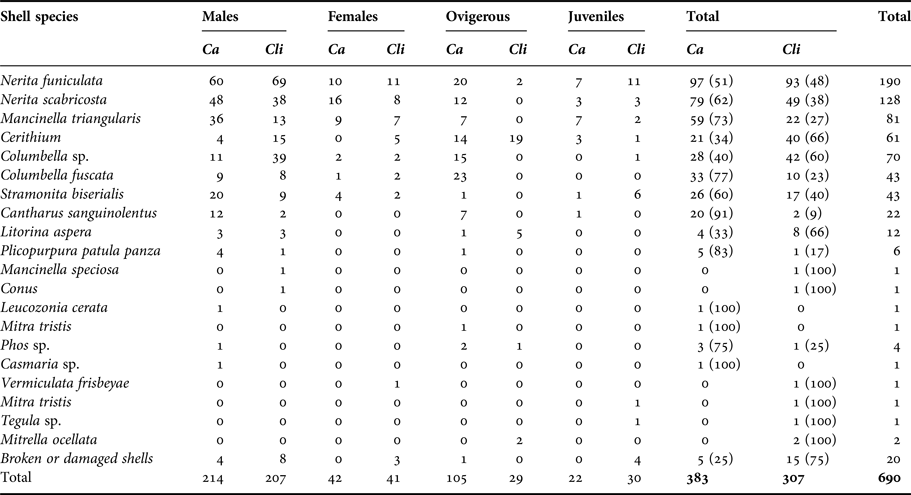
A total of 690 individuals were used for this part of the study with 383 Calcinus californiensis and 307 Clibanarius albidigitus. We collected 22 juveniles (6%), 214 males (56%), 42 females (11%) and 105 ovigerous females (27%) of C. californiensis; and 30 juveniles (10%), 207 males (67%), 41 females (13%) and 29 ovigerous females (9%) of C. albidigitus (Table 1). Calcinus californiensis occupied a total of 15 different shells and C. albidigitus 18 shells. Ninety per cent of both hermit crab species (616 individuals) were found occupying the same seven shell species; these shells in decreasing frequency were N. funiculata, N. scabricosta, M. triangularis, Cerithium menkei, Columbella sp., Columbella fuscata and Stramonita biserialis (Table 1). The gastropod shells most used by both hermit crab species were N. funiculata and N. scabricosta, with 51% of C. californiensis and 48% of C. albidigitus occupying these shells. These hermit crab species showed a high similarity in shell utilization pattern; the per cent similarity of the shell used for the overall population (including crabs of different sex and reproductive stage) was 73.7%; while the percentage of similarity of shell use for males was 72.6%. Clibanarius occupied more broken or damaged shells than Calcinus (75 and 25%, respectively; χ2, P = 0.03; Table 1).
Total number (N) and percentage (%) of gastropod shell species occupied by males, females, ovigerous females and juveniles of the hermit crabs Clibanarius albidigitus (Cli) and Calcinus californiensis (Ca) at Troncones, Guerrero.

The body size (cephalothorax length; CL) differed between the hermit crab species (two-way ANOVA, F (1,609) = 54.97; P < 0.001) and between sex or reproductive stage (F (3,609) = 62.32; P < 0.001). Individuals of Calcinus were larger (CL; mean value 4.65 mm ± 1.32 SD) than those of Clibanarius (4.22 mm ± 1.27 SD; P < 0.001). The males, females and ovigerous females of Calcinus were larger than individuals of the same sex of Clibanarius (P < 0.01). The juveniles of Calcinus and Clibanarius had similar body size (P = 0.95; Table 2).
Body size (cephalothorax length) of males, females, ovigerous females and juveniles of Calcinus californiensis and Clibanarius albidigitus collected at Troncones, Guerrero. Mean values and standard deviation are shown.

The SAI was similar for males of C. albidigitus and C. californiensis (F (1,327) = 3.49, P = 0.06). The SAI of both crab species varied among the shell species (F (4,327) = 2.51, P = 0.04). The males of C. albidigitus and C. californiensis occupied shells of N. funiculata, N. scabricosta, Columbella sp. and M. triangularis with similar sizes (P > 0.05); while C. californiensis occupied shells of S. biserialis relatively larger than those used by C. albidigitus (P = 0.04).
Sequence of shell preference
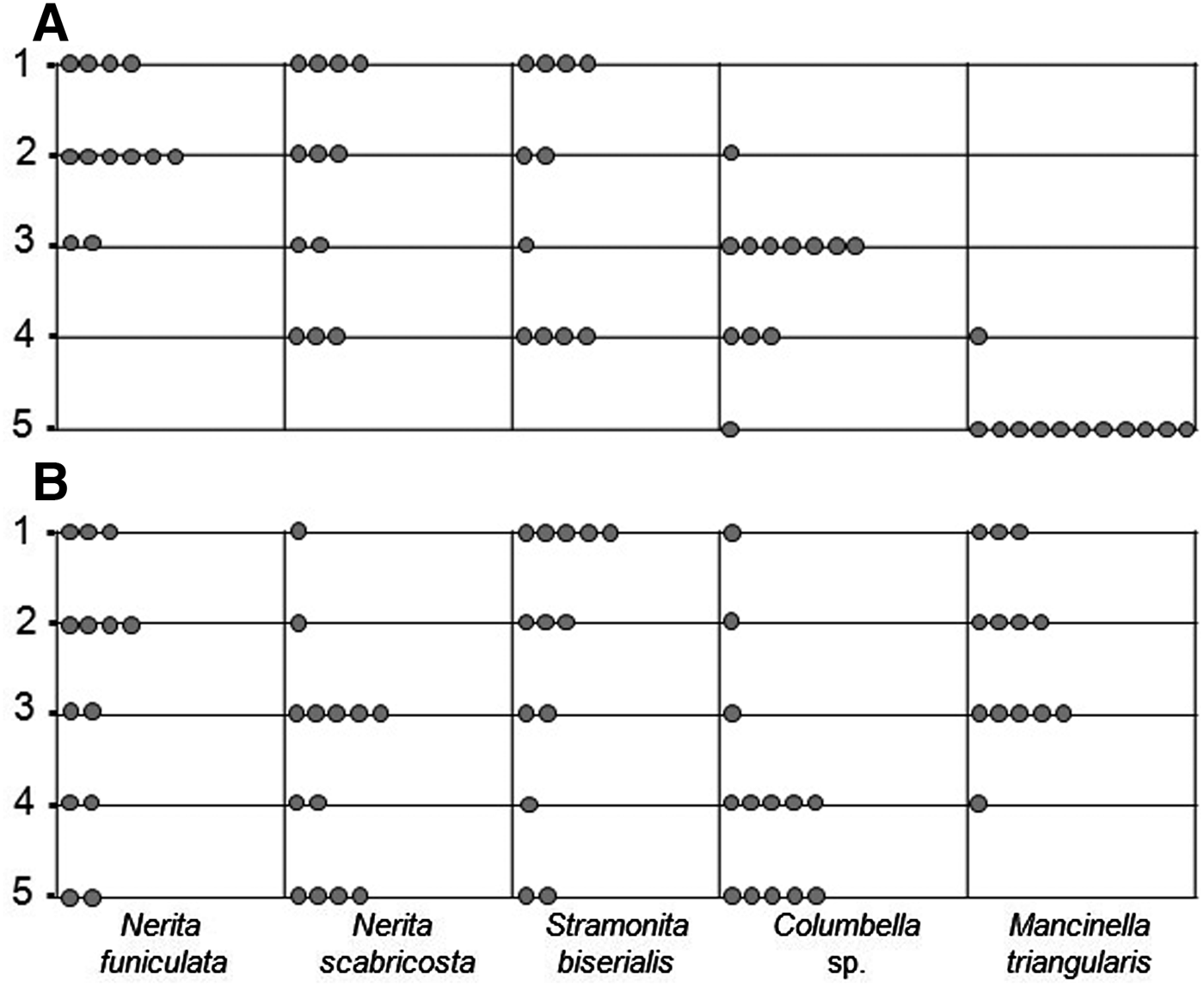
Individuals of Clibanarius albidigitus chose between the different shell species consistently (W (4,12) = 0.53, P < 0.001; average rank, r = 0.49).The sequence of shell preference and average rank (in parentheses) for C. albidigitus in decreasing order was: N. funiculata (1.83) > N. scabricosta (2.38) > S. biserialis (2.58) > Columbella sp. (3.42) > M. triangularis (4.79). Meanwhile, C. californiensis did not establish a hierarchy in shell preference among the six shell species tested (W (4,13) = 0.23, P < 001; average rank, r = 0.16; Figure 1). Since Calcinus do not exhibit a consistent sequence of preference for these five shell species, we did not test the consensus of preference of both crabs through a concordance test.
Sequence of shell preference of C. albidigitus and C. californiensis. The y-axis indicates the decreasing rank order in which the shell species were chosen in different trials for C. albidigitus (A) and C. californiensis (B). The circles show the rank in which each shell was chosen, as the first to a fifth option, when the five shell species were presented simultaneously. The sequence of shell preference was significantly consistent within individuals of C. albidigitus (Kendall; W (4,12) = 0.53), but it was not consistent within the individuals of C. californiensis (W (4,13) = 0.23).

Exploitation ability
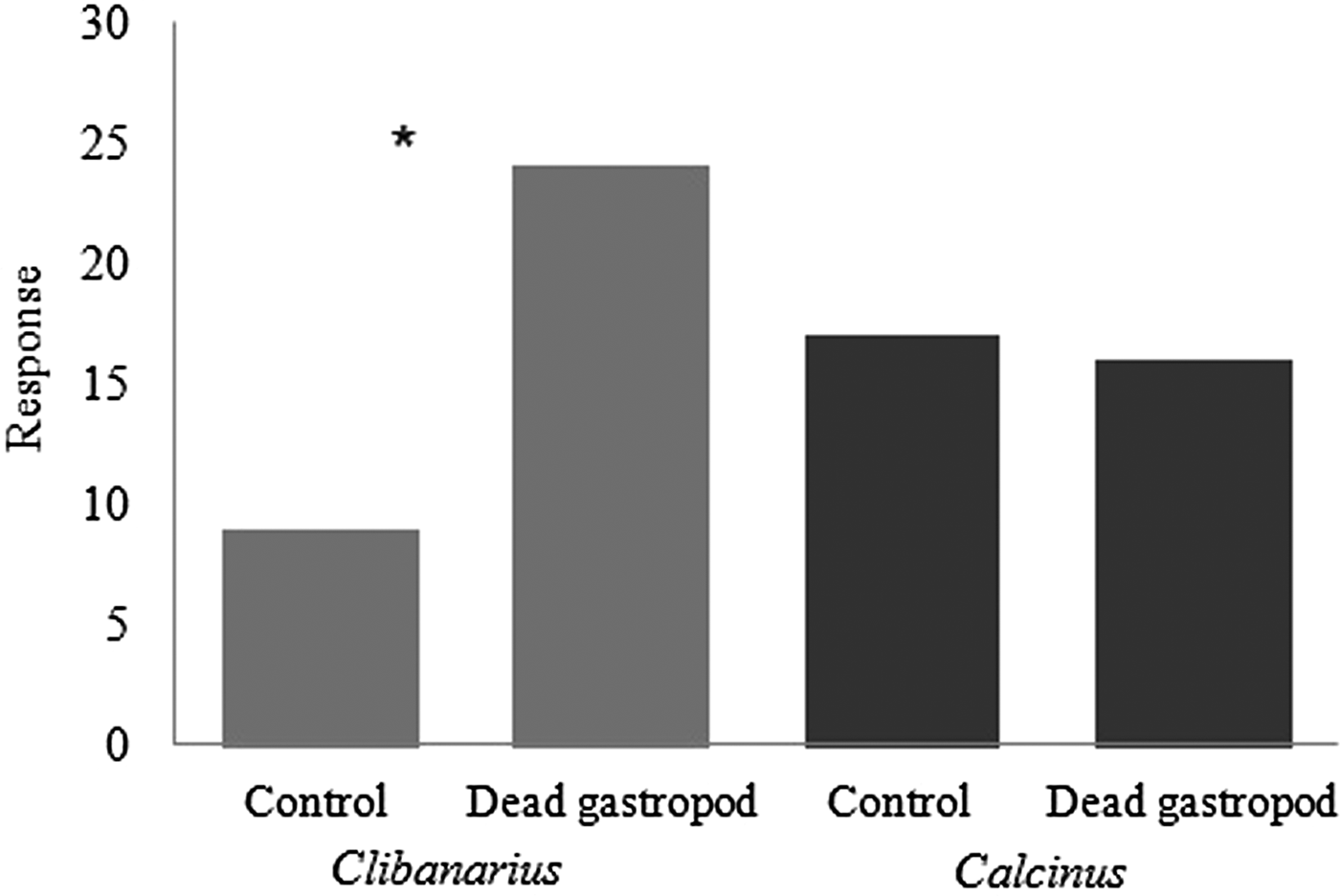
The body size of the crabs tested for response to chemical cues of dead gastropods was similar for individuals of Calcinus (mean CL: 4.22 mm ± 0.93 SD) Clibanarius (4.13 mm ± 0.98; t-test, P = 0.45). Hermit crabs of Clibanarius attended with higher frequency to chemical cues of dead gastropods than to the control (water; χ2, P = 0.009). However, hermit crabs of Calcinus attended with similar frequency to a chemical stimulus of dead gastropod and the control (χ2, P = 0.86; Figure 2).
Hermit crabs of C. albidigitus and C. californiensis that attended to chemical cues of dead gastropods or control. Significant differences are shown in parentheses (P < 0.05).

Fighting ability
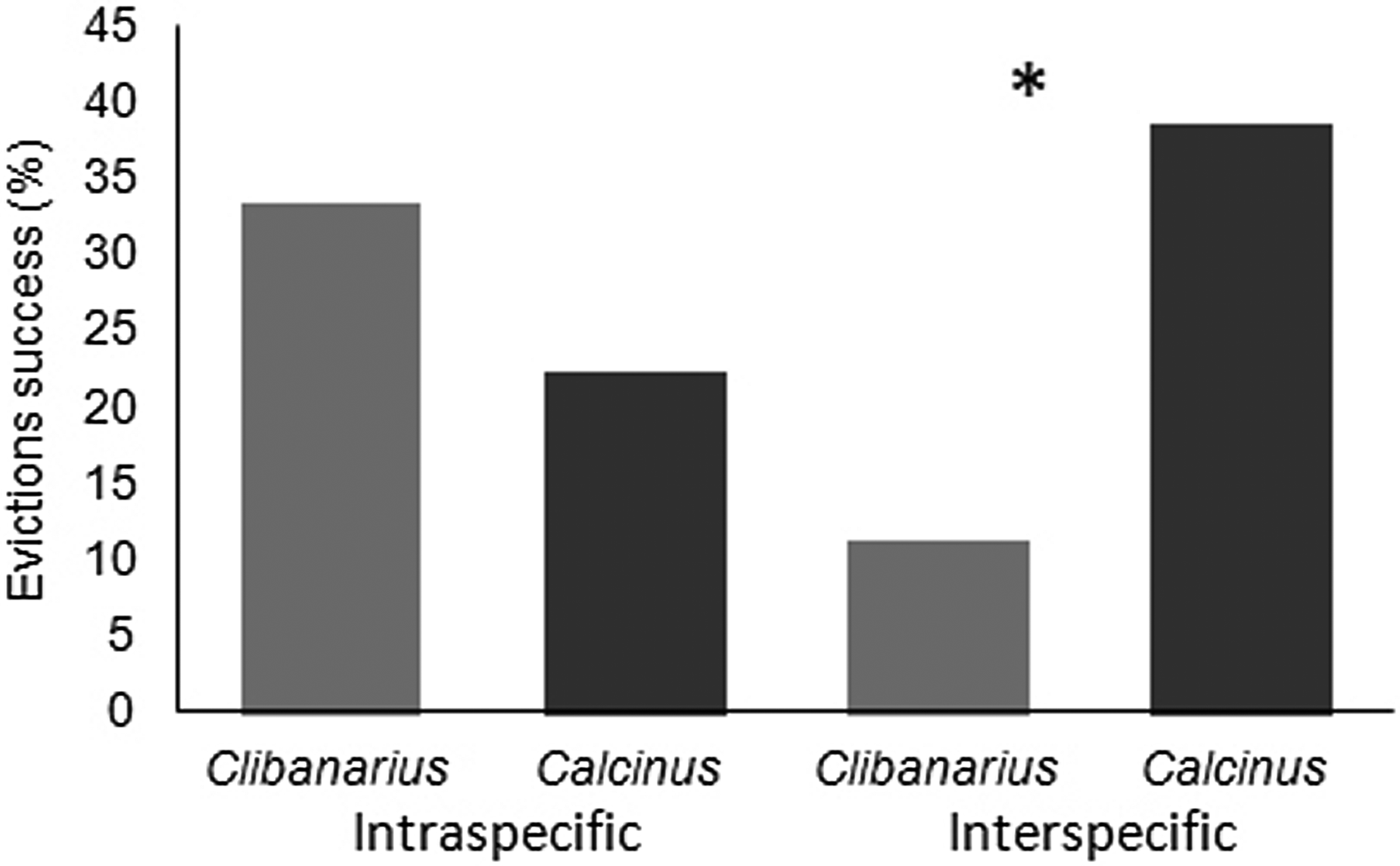
The number of shell evictions of Clibanarius and Calcinus in intraspecific fighting was similar (χ2, P = 0.44). In interspecific contests, Clibanarius attained fewer shell evictions as the attacker over Calcinus than the attackers of Calcinus over Clibanarius (χ2, P = 0.04; Figure 3).
Success of shell fighting estimated as a percentage of shell evictions attained by C. albidigitus and C. californiensis in intraspecific and interspecific encounters. Significant differences are shown in parentheses (P < 0.05).

DISCUSSION
Empty shells are generally scarce in intertidal shores (Vance, Reference Vance1972); this scarcity triggers competitive interactions among individuals of the same species and between individuals of coexisting species. The theory predicts that competitive coexistence is possible due to differences in the species’ utilization of resources. This study showed that Clibanarius albidigitus and Calcinus californiensis exhibit a high degree of overlap in the patterns of shell use in Troncones (similarity in shell use 73.7%). The degree of overlap is higher than that reported for other species such as Clibanarius antillensis Stimpson, 1859 and Pagurus criniticornis Dana, 1852 (52.3%; Turra & Denadai, Reference Turra and Denadai2004). However, even slight differences in resources use may decrease competition and maximize the use of available resources (resource partitioning; Finke & Snyder, Reference Finke and Snyder2008).
The differences in resource utilization by sympatric hermit crab species are not necessarily a direct result of interspecific competition (Gherardi & Nardone, Reference Gherardi and Nardone1995). Several behavioural mechanisms can act to reduce interspecific competition for resources through differing use of the environment, which facilitates the coexistence of similar species (Pianka, Reference Pianka, Cody and Diamond1975). Particularly, variation in the preference for specific resources can result in its partitioning (Dominciano et al., Reference Dominciano, Sant'Anna and Turra2009), as has been suggested for competition for shells in hermit crabs (Vance, Reference Vance1972; Sant'Anna et al., Reference Sant'Anna, Dominciano, Buozi and Turra2012). In this study, Clibanarius showed a sequential order of preference for the gastropod shell species most occupied in Troncones, while Calcinus californiensis did not prefer any of these gastropod shells over the others. Therefore in C. albidigitus and C. californiensis, the preference for gastropod shell species does not diminish the competition for shells to a similar extent as does the shell choice in P. granosimanus Stimpson, 1859 and P. hirsutus Costa, 1829. In those species, the preferred shell for one of these species is ignored by the other, this being a behaviour consistent in the ontogeny of both species (Straughan & Gosselin, Reference Straughan and Gosselin2004). However, the fact that C. albidigitus and C. californiensis do not share the same preference suggests a lower competition for specific shell species than that described for C. obscurus and C. albidigitus which share the same hierarchy of preference for shells (Bertness, Reference Bertness1980). The use of the preferred resources is commonly associated with benefits regarding Darwinian fitness (Block, Reference Block2005). Particularly in C. californiensis, as in other hermit crab species, the use of preferred shells results in high growth and survival probability (Bertness, Reference Bertness1981b; Alcaraz et al., Reference Alcaraz, Chávez-Solís and Kruesi2015; Alcaraz & Arce, Reference Alcaraz and Arce2017). The ability to acquire the preferred resource is assumed to be highly correlated with fitness, especially in limited environments inhabited by sympatric competitive species.
The resource distribution among co-occurring species, sharing a preference for the same resource, is commonly explained by a bias in their competitive ability. Direct predation upon the gastropod is rare in hermit crabs (Rutherford, Reference Rutherford1977). Therefore, hermits can obtain new shells by finding empty shells in the wild, by looking for dead gastropods and exploiting their shells, and by fighting for shells (Rittschof, Reference Rittschof1980; Hazlett, Reference Hazlett1981; Sant'Anna et al., Reference Sant'Anna, Dominciano, Buozi and Turra2012). In this study, C. albidigitus identified and attended to chemical cues of dead gastropods signalling potential sites of available shells; C. californiensis did not respond to the chemical cues of dead gastropods. However, C. californiensis was more successful obtaining a new shell through interspecific shell fighting than C. albidigitus.
Shell distribution among different hermit crab communities has been explained through interspecific differences in exploitation and fighting ability. The use of damaged shells is a disadvantage (Pechenik & Lewis, Reference Pechenik and Lewis2000; Alcaraz & García-Cabello, Reference Alcaraz and García-Cabello2017). Therefore, the bias in the use of broken shells by Clibanarius relative to Calcinus (75 and 25%, respectively) could be the result of interference competition, where Calcinus forces Clibanarius to occupy poor quality shells.
In several hermit crab species, exploitative competition is more important than shell fighting in determining shell distribution within the crab's community (Abrams, Reference Abrams1981). For instance, the disparity between the preference and the resource distribution between Clibanarius erythropus Latreille, 1818 and Calcinus tubularis Linnaeus, 1767 results from the greater ability of the former to find and utilize vacant shells in the habitat, forcing Calcinus to use vermetid tubes (Busato et al., Reference Busato, Benvenuto and Gherardi1998). Meanwhile, in other hermit crab species, interference competition is the main factor controlling shell distribution between species (e.g. C. obscurus and C. albidigitus, Bertness, Reference Bertness1981a). In our study, the higher exploitation ability of Clibanarius over Calcinus is not reflected in the pattern of shells occupied in the wild. Clibanarius use its preferred shell species with similar frequency to Calcinus, and both species use shells of similar adequacy; however, Clibanarius uses more damaged shells than Calcinus. Therefore, it seems that fighting for shells is a major component of interspecific competition, and thus in shell distribution between C. albidigitus and C. californiensis in Troncones. The bias in shell distribution through dominance by fighting, more than by exploitation ability, has also been suggested for other hermit crab species. For instance, Calcinus obscurus dominates over C. albidigitus in shell fighting, Calcinus laevimanus win fights over Calcinus latens, and Clibanarius antillensis dominates over Pagurus criniticornis. In those cases, the dominant species use shells of better quality, even though the subordinated species are better shell exploiters (Hazlett, Reference Hazlett1970; Bertness, Reference Bertness1981a; Turra & Denadai, Reference Turra and Denadai2004).
The coexistence of sympatric species commonly results in a bias in shell adequacy (Bertness, Reference Bertness1981c). For instance in hermit crab species with an extreme overlap in shell use, such as Calcinus tibicen Herbst, 1791 and Clibanarius antillensis, one species (C. tibicen) may drive the other to use shells of a poorer shell size fit resulting in negative adaptive consequences for the latter (Bach et al., Reference Bach, Hazlett and Rittschof1976). Contrarily, in this study the coexistence of Calcinus and Clibanarius does not result in bias favouring any of the crab species regarding shell size adequacy. However, both hermit crab species have a relatively small body size in the fringe of the intertidal gradient in which they co-occur. The effects of the shell size relative to the hermit crab's size diminish as the body size decreases. For instance, the negative effects of using inadequate shells regarding metabolic competence (Alcaraz & Kruesi, Reference Alcaraz and Kruesi2012), muscular strength (Alcaraz & Jofre, Reference Alcaraz and Jofre2017) and foraging efficiency (Alcaraz & García-Cabello, Reference Alcaraz and García-Cabello2017) seem to be unimportant in small crabs. If the shell size is less important regarding fitness for smaller than for larger crabs, interspecific fighting to obtain a shell of an adequate size could be non-cost effective. In contrast, shell fighting seems to be important by biasing the use of less damaged shells toward individuals of Calcinus relative to Clibanarius.
Clibanarius albidigitus and C. californiensis inhabit the same environment but their distribution differs along the intertidal gradient, allowing wide spatial ranges where the interspecific competition is low. Similarly, C. albidigitus and C. obscurus coexist in intertidal areas of Panama; however, the latter has a distribution that mainly extends lower in the intertidal, where individuals of relatively large body size do not inhabit as high a level as that occupied by C. albidigitus (Ball & Haig, Reference Ball and Haig1974; Abrams, Reference Abrams1980). Therefore, hermit crabs of the genus Clibanarius coexist and compete for shells interspecifically in broad ranges of their life phase. In contrast, Calcinus co-occur with Clibanarius only through their early life stages; so, when individuals reach relatively large body sizes (>0.15 g), the competition changes to be exclusively intraspecific. Calcinus and Clibanarius coexist and compete for shells in their early life stages, in which direct and indirect effects of the interspecific competition can affect future aspects their physiology and behaviour. For instance, after experiencing a period of high competition, young Calcinus could compensate for the negative effects of shell limitation minimizing its fitness cost, as has been described for animals exposed to limited resources and environmental stress (Metcalfe & Monaghan, Reference Metcalfe and Monaghan2001; Wei et al., Reference Wei, Zhang, Li and Huang2008). The effects of interspecific competition on the experience with particular shells early in life are especially important in a crab's future morphology (Turra & Leite, Reference Turra and Leite2003), development of shell-handling abilities (Hazlett, Reference Hazlett1971) and future preference for shells (Elwood et al., Reference Elwood, McClean and Webb1979; Hazlett, Reference Hazlett1995). Therefore, although crabs of Clibanarius and Calcinus compete exclusively in a fringe of the intertidal, the consequences of competition could be important beyond the site in which competition takes place.
ACKNOWLEDGEMENTS
We thank Sebastian Zúñiga for his technical assistance.
FINANCIAL SUPPORT
This work was supported by the Programa de Apoyo a Proyectos de Investigación e Innovación Tecnológica (PAPIIT, UNAM, IN-211915) and Consejo Nacional de Ciencia y Tecnología (CONACyT, CB-284007).