Implications
Because the situations in mixed farming systems are complex and very diverse, no easy answers can be expected in project development. Actual commitment to integrated and multidisciplinary research approaches is still required to reduce the current gap between research management and policy-makers.
Introduction
Latin America and the Caribbean (LAC), with 570 million inhabitants in 2007 (United Nations, 2010), is the region that has the most unequal levels of income and living seen from a worldwide perspective. Per capita income during the period 2000 to 2009 (based on gross national income) was just over one fifth (4877 USD) of the 26 132 USD of the European Union (EU) or one eighth of the 40 809 USD of North America (World databank for the period 2000 to 2009; The World Bank, 2011). If the current trends persist, this situation of polarization will become still worse in the future. From a medium- and long-term perspective, the growth process in LAC over the last 30 years has been characterized by instabilities in local policies and gross domestic product (GDP) growth, vulnerability and high population density.
According to a report by the Food and Agriculture Organization of the United Nations (FAO; 2005), the population living below the poverty line in the region has been growing steadily from 110 million in the 1960s to 136 million in the 1980s and it currently stands at more than 230 million. In rural zones, the indigenous people and 62% of the total rural population are particularly vulnerable (FAO, 2005).
However, in the national economies of the LAC, the agricultural sector still represents a greater part than in the rest of the world. This is illustrated by a 6.2% annual growth (2000 to 2009) of agriculture value added, which is higher than the 2.95% world average or 1.93% and 1.10% in the EU and North America, respectively. Such figures are related to a high livestock production index (132.5%) during the last decade in comparison with the period from 1999 to 2001. Thus, rural areas function as a mechanism that can absorb unemployment and underemployment, by providing modes of subsistence for population groups that are excluded from the main dynamics of the current development model.
Promotion of the rural economy in a sustainable way is known to have the potential of increasing employment opportunities in rural areas. In this context, we define ‘sustainable’ as economic, ecological, social and institutional, as discussed by Spangenberg (Reference Spangenberg2004), and insist that a focus on these aspects of sustainability can contribute to reducing regional income disparities and thereby also stem migration to urban areas, which is a major source of poverty. In addition, development of rural areas may contribute to the preservation of rural landscapes as well as the protection of indigenous cultures and traditions. In situations of economic crisis or social urban unrest, rural societies could serve as a social buffer zone (Anríquez and Stamoulis, Reference Anríquez and Stamoulis2007).
In the particular case of the Small and Large Antilles, Caribbean, the shortage of available arable land justifies the enhancement, expansion and development of mixed integrated crop and animal systems or mixed farming systems (MFS), which could mean positive and economic benefits in the promotion of a sustainable and environment-friendly agriculture (Devendra, Reference Devendra2002a). The reasons for this statement are geographical (insularity, smallness; Selwyn, Reference Selwyn1980), natural (vulnerability, vagaries of climate; Atkins et al., Reference Atkins, Mazzi and Ramlogan1998), economic (expansion of tourism and service sector with related increase in land pressure) and social (increase of conscience and resistance to conventional systems through the rescue of rural traditions and practices and/or subsistence agriculture from the poorest rural sector).
Although there is a lack of available literature (e.g. in comparison with Africa or Asia), MFS actually demonstrate a vast informal background of experiences in the history and traditions of the Caribbean countryside. However, these systems can still be improved to play a more significant role in the objectives of agricultural sector development, poverty alleviation, food self-sufficiency and security and economic independency from food imports. In this context, research and development organizations have a great responsibility towards the challenge of increasing the human and social capital in the farmer communities through improved knowledge and facilitation of networks, where experience can be exchanged and common context-relevant knowledge can be developed (Bebbington, Reference Bebbington1999). In addition, institutional sustainability can be enhanced by raising awareness among the political authorities, and voices necessarily have to be raised by the local communities.
The aim of this paper is to review the potential and opportunities for mixed farming approaches as context-relevant solutions to the special challenges existing in the LAC region and to analyse how research can best support this development.
After analysing succinctly the current status and the main characteristics of the agricultures of the LAC and Small Islands Developing States (SIDS), the aim of this paper is, first, to present a synthesis of natural and local individual components justifying the pertinence of planning authentic MFS with a good level of productivity, in consonance with current environmental and social urgencies or demands. Second, taking into account the key role of research institutions in the success of developing MFS, and given the necessity for knowledge advances in such complex systems, we discuss what we consider key aspects related to a necessary change in the functioning and strategies for research in teams and institutions conducting integrated research–development projects with effective knowledge transfer to farmers and practitioners.
Agricultural trends and challenges related to SIDS in the Caribbean
The countries known collectively as SIDS, which refers to 40 member nations of the FAO, have in common their smallness (population and land area or both) and insularity, which also explain their vulnerability (United Nations Conference on Environment and Development (UNCED; Earth Summit), 1992; FAO, 2005). In addition, being surrounded by and exposed to the oceans increases their environmental vulnerability. They are, for example, generally exposed to natural disasters like hurricanes and typhoons, which are followed by economic pressures, and many islands are based on sloping land and mountain areas. Because of the distance from markets and being surrounded by oceans, they are dependent on import/export to produce what is needed on the island. Therefore, they rely on stable markets and are unable to meet the challenges in fluctuating markets and prices. This affects their productivity, development and cooperation policies. A number of internationally agreed development goals have been formulated to build resistance and sustainability in SIDS (FAO, 2005). As states, SIDS often have a small domestic market, a small resource base, a narrow development base (dependence on very few productive sectors) and weak institutions (the lack of a critical mass for specialized institutions reduces the capacity for effective responses and financial sustainability).
Most countries are still dependent on rain-fed production systems, although irrigated agriculture has been developed in high-potential areas. Livestock production systems (large and small ruminants – sheep and goats) range from extensive systems (tethering, grazing of roadside and marginal areas, natural grazing systems with low stocking rates), often using indigenous (‘Creoles’, ‘Criollos’) and well-adapted breeds, to semi-intensive and more intensive systems (e.g. improved grasslands of Panicum sp., Cynodon, Digitaria, Pennisetum, etc., with or without the inclusion of legumes), and using imported feed concentrates. Some systems are based on pure exotic breeds (e.g. Bos taurus in breeding centres for cattle) or several cross grades in crossbreeding programmes with local breeds (e.g. Bos indicus).
Some traditional examples of using MFS strategies in the Caribbean islands include the use of draught animal power (pairs of adult bovines) for land preparation and transport, for example, in sugarcane producing countries like Cuba, Dominican Republic and Haiti, and recycling the solid manure for organic fertilization of crop fields. Other examples include cropping systems associating cassava or maize and beans, where grains and cassava (root) are basically used for domestic consumption, and crop residues – straw, stems – are used for animal feeding. Funes-Monzote (Reference Funes-Monzote2008) and Funes-Monzote et al. (Reference Funes-Monzote, Monzote, Lantinga and van Keulen2009) described the transformation processes of the Cuban agricultural scenario during the 1990s, illustrating how MFS strategies may function as wise alternatives when facing hard economic transition periods. Nelson et al. (Reference Nelson, Scott, Cukier and Leyva Galán2009) also described well the institutionalization of agro-ecological concepts in Cuba during the last two decades as a result of the change in the paradigm of agricultural development in the island.
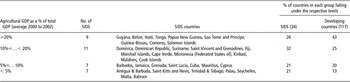
The contribution of agricultural production to GDP in SIDS countries is less important than in the so-called developing countries as a group. Table 1 shows that in a much greater proportion of SIDS, fewer than 10% of economic activities are generated in the agriculture sector. Excluding Cuba (3.6 million ha), the average available arable land area for agriculture is 46 000 ha for the Caribbean SIDS as well as for the Pacific SIDS, reaching only 1000 ha in Grenada and Seychelles (FAO, 2005).
Importance of SIDS agriculture sectors

SIDS = small islands developing states; GDP = gross domestic product.
Source: Adapted from the Food and Agriculture Organization of the United Nations (FAO, 2005).
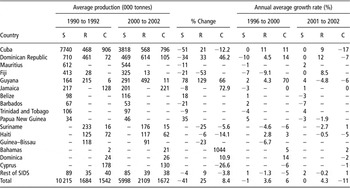
Development of agriculture is important for ensuring food security, rural employment, rural area diversification and infrastructure development, provision of basic services and foreign exchange earnings in the SIDS. However, during the last few years, the total agricultural production in SIDS has declined by 33% (FAO, 2005; see Table 2). The reasons for this include natural disasters, fluctuating world prices, loss of market opportunities and the inability to compete on world markets, expanding tourism and service sectors attracting labour and investment away from the agriculture sector and disincentive of labour-intensive small farming systems.
Production trends, change and average growth rate of three of the main SIDS commodity crops (sugar, rice and citrus)

SIDS = small islands developing states; S = sugar; R = rice; C = citrus.
Source: Adapted from Food and Agriculture Organization of the United Nations (FAO, 2005).
In the particular cases of ex-colonial islands (e.g. Barbados) or current overseas territories (e.g. the Francophone islands of Martinique and Guadeloupe or the Netherlands Antilles), one of the debatable consequences of being too close to, or even an active component of, the original parent colonializing power is their administrative dependence and, therefore, the negative effects of the inherent mechanisms and legislations (e.g. subsidized agriculture of Europe) on the development of local alternatives. Future alternatives looking for agricultural developments in the Caribbean and SIDS must deal with this complex reality.
SIDS are net exporters of fish and fishery products, whereas LAC highlights the increasing production and export of banana during the last decades (in 2004 the region produced 81% – 10 400 thousand tonnes – of banana exports globally; FAO, 2006).
Defining MFS
According to the FAO (Livestock, Environment and Development Initiative – LEAD website), MFS are defined as farming systems conducted by households or by enterprises where crop cultivation and livestock rearing together form integrated components of a single farming system. They include the livestock systems of landless smallholders who rely on the crop cultivation of neighbouring farms. The main reasons for mixed farming are (i) the spreading of risks over crops and livestock productions, (ii) complementarities between crops and livestock and (iii) a flexibility that allows the adjustment of crop/livestock ratios in anticipation of risks, opportunities and needs. Others (Seré and Steinfeld, Reference Seré and Steinfeld1996) define MFS as systems in which more than 10% of the dry matter (DM) fed to livestock comes from crop by-products or stubble, and more than 10% of the value of production comes from non-livestock farming activities. Such context-relevant integration of crops and animals in the same system appears to support a biological, ecological, economic and social sustainability in the global food production chain.
Currently covering 2.5 billion ha of land globally, MFS produce most of the staple food consumed by people in poor regions (41% of maize, 86% of rice, 66% of sorghum and 74% of millet production) and about 75% of the milk and 60% of the meat produced in the so-called developing countries, while also employing several millions of people in value chains (Herrero and Thornton, Reference Herrero and Thornton2010).
Sumberg (Reference Sumberg1998) describes and discusses a range of different systems in Africa, where the positive effect of crop–livestock integrations was recognized. In an interesting review, Akhtar and Malik (Reference Akhtar and Malik2000) discussed the roles of organic soil amendments and soil organisms in the biological control of plant-parasitic nematodes in integrated systems from the perspective of effectively using the impact of crop rotation and green manure treatments against the development of the plant-parasitic nematode population. They argued that control of such nematodes can be achieved through improvements to the soil structure and fertility, alteration of the level of plant resistance, release of nemato-toxic compounds, parasites (fungi and bacteria) and other nematode antagonistic (biological control) agents.
Thus, such eco-intensified methods can meet the challenges arising from the actual global shortage of arable land, and consumer health concerns, as well as rural traditions and development.
On the other hand, food self-sufficiency is known to stabilize local communities confronted with fluctuating market prices and risks related to inputs like herbicides, pesticides and inorganic fertilizers, as represented, for example, by the so-called ‘Green Revolution model’. Devendra and Thomas (Reference Devendra and Thomas2002) emphasized the complementary effects of MFS in case studies from different Asian countries, all describing various crop–animal interactions. Animals were shown to contribute significantly to increased production, income generation and to the improved sustainability of annual and perennial cropping systems.
Given all these potential advantages, however, the interactions between livestock, crops and natural resources in MFS are recognized as multiple and complex, which has meant that their worth has not been well quantified or appreciated, leading to a limited ability to determine the optimum system for specific conditions (Parsons et al., Reference Parsons, Nicholson, Blake, Ketterings, Ramírez-Aviles, Fox, Tedeschi and Cherney2011).
In addition to the farm-level integration, in this paper we consider the integration that is supported at institutional and political as well as trade chain levels regionally and nationally, as a means to add to the sustainable resource use both regionally and nationally. Of course, including these levels also adds to the complexity of the resource management system as well as to the requirements for higher organization and planning exigencies.
Identifying two approaches currently enhancing MFS development
Development must be chosen context-specifically, depending on cultural, climatic, geographical, scientific, religious, political and other factors. In this paper, we want to discuss two main approaches or trends that can guide the development of MFS:
1. the optimization of cycles and use of resources approach (‘South’) and
2. the organic and/or environmental approach (‘North’).
The optimization of cycles and use of resources approach (‘South’)
Much agriculture in the Southern hemisphere (in this case excluding Australia and New Zealand) is already diversified, and is very often subsistence farming with a low use of external inputs, small properties and traditional farmers without formal education or use of new technologies. The ecological and economic sustainability of these systems can often be enhanced by applying agro-ecological concepts and principles (Devendra, Reference Devendra2002a and Reference Devendra2002b; Devendra and Thomas, Reference Devendra and Thomas2002; Paris, Reference Paris2002; Thorne and Tanner, Reference Thorne and Tanner2002; Devendra, Reference Devendra2007).
The organic and/or environmental approach (‘North’)
In many countries in the Northern hemisphere, relatively new ways to enhance environment-friendly agricultural production systems have been introduced and emphasized during the last two or three decades, motivated by pollution and citizens’ concerns about health and environment among others. These initiatives are to some extent supported by legislation and media, and in some cases, MFS agriculture seems to represent an ideal solution (Girardin and Spiertz, Reference Girardin and Spiertz1993; Lantinga and Rabbinge, Reference Lantinga and Rabbinge1997; Lantinga and Oomen, Reference Lantinga and Oomen1998; Oomen et al., Reference Oomen, Lantinga and Goewie1998). The latest developments achieved in the organic and ecological agriculture movements (Lantinga and Rabbinge, Reference Lantinga and Rabbinge1997; Lantinga and Oomen, Reference Lantinga and Oomen1998; Gosling and Shepherd, Reference Gosling and Shepherd2005; Watson et al., Reference Watson, Oborn, Eriksen and Edwards2005) have stimulated the development of ‘independent’ farms, with an increased interest in self-sufficiency.
These two approaches are clearly not mutually exclusive, and can in many cases support each other within the same environments. We suggest that this is a very relevant consideration in the particular case of the Caribbean islands, because of the heterogeneity of the socio-economic conditions and the farming traditions in these countries. Below, we discuss the potential of MFS for helping to develop the agricultural sector in the SIDS, basically focussing on the Caribbean region.
Current availability and use of feed resources for MFS in the Caribbean
The significance of improved animal nutrition in productivity and the wider role and contribution of animals are the most important considerations in the sustainable crop–animal systems approach. Devendra and Sevilla (Reference Devendra and Sevilla2002) describe categories of integrated smallholder systems in Asia, of which the following three main categories of feed resources are relevant for MFS in the Caribbean:
1. native grasses, legumes and other forage resources,
2. crop residues and
3. agro-industrial by-products (AIBP).
Native grasses and legumes
Native grasses are widely used in most of the extensive ruminant and herbivorous (horses, rabbits) production systems (tethered or free-grazing animals), often communally from rangelands, forest, fallows, wastelands, roadsides, riversides and post-harvested cultivated areas. They are resistant to pests and diseases and less sensitive to eventual overgrazing or erratic management practices. An exhaustive inventory of the vast germplasm existing in the LAC is available (Knudsen, Reference Knudsen2000), and work on its conservation is being led by the Caribbean Phytogenetic Resources Network (Recursos Fitogenéticos del Caribe, CAPGERNet).
Because the average area of these islands is small, rangelands for livestock production are scarce. Some sheep and goat production systems allow animals to browse in native vegetation of shrubs and trees with relatively acceptable nutritive value, it being important to match the capacity of the land with the number of animals. Unfortunately, these types of areas are decreasing in many places because of the expansion of tourism and other service sectors.
Low-input animal production systems in the Caribbean very often make use of spontaneous native grasses and legumes for rearing, by grazing, ruminants and horses. The main handicap of depending absolutely on these resources is the limited biomass yield, due to the low herbage productivity of such well-adapted species. However, their nutritive value and quality, when well managed, are sometimes comparable to the so-called genetically improved grasses and legumes resources. This has been demonstrated by Boval et al. (Reference Boval, Cruz, Peyraud and Penning2001), who explored some interactions of growing Creole heifers reared, by tethering, at natural pasture in Guadeloupe. They found that a well-managed herbage allowance of tropical irrigated and fertilized Dichanthium aristatum- and Dichanthium annulatum-based pastures – at 14 or 21 days of regrowth – can have intake and characteristics similar to those of a temperate pasture.
Iglesias et al. (Reference Iglesias, Hernández, Roche, Menéndez and Shateloin1996) reported the regular use of around 20 native species for traditional animal feeding in the Ciénaga de Zapata region of southern Cuba. The plants most commonly consumed under grazing conditions were from the genera Brachiaria, Dichanthium, Sporobolus and Paspalum. The fruits from Calophyllum antillarum and capsules of Guazuma ulmifolia were widely consumed by pigs. Such native vegetation is currently able to support local animal production efficiently in the region without depending on external inputs.
Since three decades ago, in the Caribbean, the DM productivity, persistence in grazing in association with grasses or not and the potential of regional native legumes as protein sources for animal feeding have been reported in the Bahamas (Dorsett et al., Reference Dorsett, Wilson, Katsigianis, Guyton, Cathopoulis and Baylor1980), Belize (Lazier, Reference Lazier1981), Cuba (Menéndez, Reference Menéndez1982) and the Dominican Republic (Wagner, Reference Wagner1981). The main ecotypes of native or endemic forage legumes identified and the most widespread include Centrosema plumieri, Calopogonium caeruleum, Desmodium canum, Centrosema pubescens, Codariocalyx gyroides, Crotalaria retusa, Clitoria ternatea, Macroptilium atropurpureum, Desmodium caricosum, Teramnus labialis, Leucaena leucocephala, Gliricidia sepium, Stylosanthes hamata, Desmodium intortum and Glycine wightii, among others, the forage CP averaging from acceptable (120 to 140 g/kg of DM) to high (160 to 250 g/kg of DM) values. Nevertheless, taking into account the presence of secondary compounds (or anti-nutritional factors) of most of these legumes species, their use in animal feeding must be implemented with prudence and by consulting experienced animal nutritionists in order to avoid toxicity risks, which become sometimes lethal due to deliberate inclusion levels in the diet.
Crop residues
It was predicted some decades ago that feed resources for animal production in the tropics will increasingly be derived from crop residues and by-products (Preston and Leng, Reference Preston and Leng1984), the quantity and availability being determined by many factors, such as the agro-ecological zone, the extent and intensity of crop production, traditions and market opportunities. However, straws and other crop residues are often not used exclusively for animal feed, but also as fertilizers or fuel, for example.
In the Caribbean, the nutritive value of crop residues from sugarcane, bananas, sweet potato, yam, cassava, bean straws, coffee pulp, pineapple, papaya, coconut and citrus has been estimated in research approaches (García-Trujillo and Pedroso, Reference García-Trujillo and Pedroso1989), and their use after harvest has become a common farm practice. In Cuba, for example, the practical experience in this respect is enormous, including feeding systems developed for milk, meat and egg production.
In ruminants, the technologies for using these feeds efficiently are based on treating the animal as a two-component system: the rumen, where the objective is to maximize microbial activity, and the animal, for which by-pass nutrients are needed to complement those produced by the rumen microbes. New developments in this field are the upgrading of fibrous crop residues by the possible use of environment-friendly multi-purpose trees and readily fermentable energy sources (e.g. molasses) as feed supplements to enhance crop residues intake and utilization.
Furthermore, there is potential to develop this further by using available technologies to improve the nutritive value, in relation to season, conservation and digestibility. These relate, for example, to conservation (hays, silages, meal) or biotechnological techniques (prebiotics, probiotics, enzymes, yeasts, essential oils).
AIBP
Several alternative strategies have been evaluated during the last decades in order to enhance the use of AIBP to supplement local basal diets. A notable regional example emerges from the Cuban experience, where technologies with sugarcane AIBP (e.g. molasses, crop residues) have been widely studied and validated under productive conditions in both ruminant and non-ruminant species since as early as the 1960s (Preston et al., Reference Preston, Macleod, Lassota, Willis and Velasquez1968 and Reference Preston, Willis and Martin1969; Preston and Willis, Reference Preston and Willis1970; Elías, Reference Elías1986), and there are other examples in the Caribbean (Gohl, Reference Gohl1970). Since then, the use of sugarcane molasses, for example, has been extended and evaluated in all farm animal species, proving to have many advantages in terms of improved animal health and economics, when used correctly for feeding fattening cattle, pigs, ducks, turkeys or geese (Valdivié et al., Reference Valdivié, Gabel, Hackl, Hidalgo, Dieppa and Febles2004).
Other examples are the use of living microorganisms (i.e. Candida utilis) in the development of fermentation technologies with sugarcane molasses to produce a high-quality feed (i.e. ⩾45% of CP in the so-called ‘Levadura Torula’) to be included in ruminant or non-ruminant diets; the use of multi-nutrient blocks (rice straw, sugarcane molasses, mineral and vitamin mix, etc.) for ruminant supplementation and energy supplementation with fresh or dehydrated citrus pulp.
In the French West Indies, the use of sugarcane (e.g. bagasse, molasses) or pineapple by-products for ruminant feeding during shortage periods has been reported for some decades by Chenost et al. (Reference Chenost, Geoffroy, Bousquet and Candau1976) and Géoffroy (Reference Géoffroy1985).
Other forage and feed resources
There is considerable potential to use local feed resources (Archimède et al., Reference Archimède, Régnier, Marie-Magdeleine Chevry, Gourdine, Rodríguez and González2011) rather than importing expensive raw materials, such as those used in feed concentrates for pigs (Régnier et al., Reference Régnier, Bocage, Archimède and Renaudeau2010a; Xandé et al., Reference Xandé, Archimède, Gourdine, Anais and Renaudeau2010a and Reference Xandé, Régnier, Archimède, Bocage, Noblet and Renaudeau2010b) or small ruminants (Archimède et al., Reference Archimède, González-García, Despois, Etienne and Alexandre2010; Marie-Magdeleine et al., Reference Marie-Magdeleine, Boval, Philibert, Borde and Archimède2010a and Reference Marie-Magdeleine, Mahieu, Philibert, Despois and Archimède2010b).
As is common in developing tropical regions, livestock production in the Caribbean has developed on the basis of grass and forage feeding systems. The search for new ways of promoting sustainable agricultural concepts (like MFS) points to the potential for developing multi-cropping grazing systems, where grasses, legumes and temporary crops (e.g. dolichos – Lablab purpureus, beans – Fabaceae sp., canavalias – Canavalia ensiformes) are integrated. We actually consider that satisfying future protein requirements in the tropics will depend on the strategic and rational use of legumes.
Archimède et al. (Reference Archimède, González-García, Despois, Etienne and Alexandre2010) evaluated mixed diets when combining unripe banana (rejected from first quality production for human consumption) and gliricidia (G. sepium) forage as a substitute for conventional sources of protein (soyabean cake) and energy (corn) in tropical lamb feeding. As all the animals on the gliricidia- and banana-supplemented diets showed good dry matter intake (DMI) levels, gained weight and maintained a positive N balance, we concluded that green banana and gliricidia forage functioned as a viable alternative to replace conventional feedstuffs in sheep diets. Rather than competing with the banana market, using rejected green bananas in animal feeding is complementary to the primary production purpose, while avoiding risks of environmental pollution. We reaffirmed that using these kinds of feedstuffs offers other methods and complementary concepts of supplementation that differ from the classical approach (supplementing concentrate in roughage diets).
The nutritional values of sugarcane products in local Caribbean growing pigs have been reported by Xandé et al. (Reference Xandé, Archimède, Gourdine, Anais and Renaudeau2010a and Reference Xandé, Régnier, Archimède, Bocage, Noblet and Renaudeau2010b), whereas Régnier et al. (Reference Régnier, Bocage, Archimède and Renaudeau2010a and Reference Régnier, Bocage, Archimède and Renaudeau2010b) have also evaluated other tropical feed resources and technological issues for rational pig feeding, such as the effect of processing methods on the digestibility and palatability of fresh ground or chopped and dried (meal) cassava roots, and the nutritive and energy value of four tropical foliages (cassava, sweet potatoes, erythrina and cocoyam) in the local Caribbean Creole pig breed.
In a trial lasting 56 days during the growth phase of cross-breed pigs (Yorkshire × Landrace) from 25 to 56 kg live weight, Rodríguez et al. (Reference Rodríguez, Lopez, Preston and Peters2006) reported the value of fresh New Cocoyam (Xanthosoma sagittifolium) leaves to replace up to half the soyabean protein in diets based on sugarcane juice for growing pigs in Colombia. They found no differences between treatments for DMI, weight gain and feed conversion, the values being within the range normally observed for this type of diet.
Lekule et al. (Reference Lekule, Mtenga and Just1988) demonstrated the potential of cassava and rice polishing as excellent energy sources able to totally replace cereals in Trinidad and Tobago in the diets of growing–finishing pigs.
The special case of agroforestry and agro-silvopastoral technologies
Conversion of primary forest to pasture has been widespread in LAC, while the removal of trees has often been accompanied by land degradation, declining productivity and eventually abandonment (Cajas-Girón and Sinclair, Reference Cajas-Girón and Sinclair2001). The expansion of agro-silvopastoral and agroforestry systems during the last decades in the region is a good example of a successful bio-diverse approach (Topps, Reference Topps1992; Oviedo et al., Reference Oviedo, Benavides and Vallejo1995; Sánchez, Reference Sánchez2000; Atta-Krah et al., Reference Atta-Krah, Kindt, Skilton and Amaral2004), with additional advantages such as bird habitats, land rehabilitation, water management and nutrient recycling.
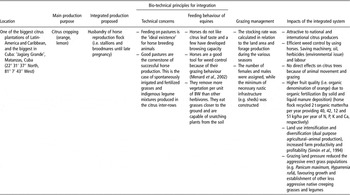
Table 3 gives an example of a successful research project, which includes the combination of trees (citrus fruit) and animal production (horses) in a strategy of profiting from the spontaneous production of grasses and native legumes (considered as weeds, a problem for citrus production) in the inter-rows, whereas the costs for weed control are minimized.
An example of a citrus–horse integrated system, which has been developed in a research approach conducted to explore possibilities in mixed farming systems

The above examples are just some of the multitude of results already published on substituting expensive diet ingredients by cheaper local ones in ruminant or pig diets. Normally, the greater challenge lies in persuading farmers to adopt the technologies proposed. In this respect, the research and development agents and institutions face, in our view, the main challenges for the future, devoting strong efforts to humanize the very often hard demands of field-intensive labour (e.g. through forage harvest mechanization in cut and carry Morus alba-based systems).
Current availability and use of indigenous breeds in farm animals for MFS in the Caribbean
In the tropics, breed substitution of indigenous breeds with ‘exotic’ breeds and crossbreeding from temperate regions has been widely used. These initiatives have at times proved to be unsuccessful or unsustainable in the long term, owing to the incompatibility of the genotypes with the breeding objectives and management approaches of the prevailing low-input traditional production systems in these areas (Kosgey et al., Reference Kosgey, Baker, Udo and Van Arendonk2006). Thus, local native or indigenous breeds are important features when planning MFS because of their adaptability to the environment, rusticity and the importance of supplying these characteristics in crossbreeding programmes with more specialized breeds for a determined productive purpose (milk, meat, eggs, hair, etc.; Bocquier and González-García, Reference Bocquier and González-García2010).
In this sense, Jenet et al. (Reference Jenet, Fernandez-Rivera, Tegegne, Wettstein, Senn, Saurer, Langhans and Kreuzer2006) discussed well the pronounced physiological differences between B. indicus and B. taurus cattle in metabolic nutrient partitioning, which explains, for example, why indigenous B. indicus genotypes that are severely undernourished after calving initially replenish body reserves at the cost of lactation, whereas the opposite is observed in B. taurus cows in tropical conditions. Cows confronted with food scarcity were reported to vary their metabolic rate in order to be able to adjust to the harsh conditions and to improve food utilization efficiency, with the B. taurus genotype following the homeorhetic strategy of predominantly ensuring the survival of the calf by increasing energy expenditure at the cost of body condition and body reserves. These authors argue that this tendency, although apparently favourable for the livestock keeper in the short term (because of, e.g. obtaining more income from milk production), could lead to aggravated metabolic disorders and diseases in the common poor housing conditions of the tropics, and so may decompensate such an apparent advantage.
In the Caribbean region, well-adapted livestock breeds have traditionally been raised in more rustic and domestic ways, using natural and local feeds, and traditional housing and breeding resources and methods. Examples of these breeds are the Creole cattle or Creole pigs from the French Antilles and Spanish-speaking islands (Cuba, Dominican Republic, Puerto Rico), the ‘Ovin de Martinique’ (with a phenotype similar to the Blackbelly; Mahieu et al., Reference Mahieu, Aumont and Alexandre1997) and the Creole goat (Alexandre et al., Reference Alexandre, Aumont, Fleury, Coppry, Mulciba and Nepos1997). The use of well-adapted breeds has been the subject of studies in local projects directed towards more or less intensive production systems in the area. Husbandry conditions have improved, and animal selection programmes have been developed partly through research, for example, for the improvement of the Ovin de Martinique hair sheep, which was supported and evaluated by local breeders (Mahieu et al., Reference Mahieu, Archimède, Fleury, Mandonnet and Alexandre2008), or genetic selection of the local Creole goat population (Mandonnet et al., Reference Mandonnet, Aumont, Fleury, Arquet, Varo, Gruner, Bouix and Vu Tien Khang2001 and Reference Mandonnet, Menéndez-Buxadera, Arquet, Mahieu, Bachand and Aumont2006).
The overall research results in Guadeloupe lead to the conclusion that targeted drenching, pasture management and improved supplementation strategies, genetic programmes aiming to increase the resistance to parasites and mixed grazing of cattle and small ruminants are components of an integrated control of gastrointestinal parasitism (Mahieu et al., Reference Mahieu, Archimède, Fleury, Mandonnet and Alexandre2008), a key factor that limits the production of local small ruminants. Other relevant research approaches and focus areas are the possible mechanisms related to heat dissipation capacity (evaporative and sensible heat loss) in relation to the genetic selection of local pig breeds (Renaudeau et al., Reference Renaudeau, Lecrercq-Smekens and Herin2006).
Such studies still need to be more fully integrated with many other factors, for example, studying the best combinations of animal breeds and relating them to their productive objectives and farmer resources, while the concomitant biological and environmental interactions are considered as highly relevant in the MFS context.
Thus, having demonstrated the evidence of the existing ‘local richness’, the big questions arise: why is the local development of the agricultural and animal production sectors still so dependent on international markets and rules? Which are the related factors limiting the necessary organization and implementation of a sustainable local and regional food self-sufficiency policy? For the most part, the answers, in our view, reside in the establishment of well-adapted and integrated rational strategies in the research and development fields, but also in a responsible cooperation and feedback with local decision- and policy-makers. Working together for the optimization of MFS constitutes a relevant illustration of such a collaboration.
Therefore, in the following we discuss the requirement for integrative strategies and visions, to stimulate a change in the ‘philosophy’ that determines the conception, development and evaluation of MFS projects, so that they can be implemented in practice using effective expertise principles.
Coordinated and multidimensional Research + Development + innovation (R + D + i) efforts to explore MFS complexity
In recent decades, the challenges and complexity facing land owners, farmers, resource managers and scientists have increased, and many new emerging players with different interests in production and systems, landscape, conservation, biodiversity and industrialization are now influencing the policies and practical application of resource management. Scientific approaches to meet such challenges, as well as scientific results, are subject to diverse influences, as well as controversial interpretations.
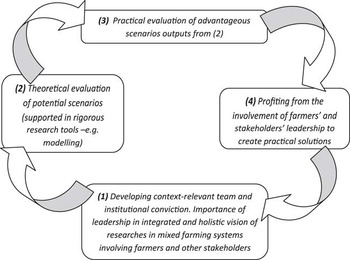
Previously (González-García et al., Reference González-García, Gourdine, Fanchone, Alexandre and Archimède2010), we reflected briefly on the necessity to conduct integrated and multidisciplinary research to advance MFS projects while reducing the current gap between research management and policy-makers. We raised this issue because we have witnessed examples where research organizations continue to use strategies in the knowledge–technologies production chain (from the lab to the field) that do not meet the requirements and expectations of MFS and thus result in the failure of their research–development missions to be effective or have any impact. Furthermore, we have identified a lack of integration between the research work of different disciplines, for example, agronomists, veterinarians and social scientists, which limits the necessary integral vision. To overcome this situation, we have proposed a strategy that includes four mutually dependent elements (Figure 1), discussed below.
Four interrelated strategies for helping to warrant effective research–management processes in a trans-disciplinary holding environment for mixed farming systems development.

First, we recommend the establishment of teams (researchers and end-users of the research e.g. farmer organizations) that represent individual and institutional commitment to the actual requirement for using integrated and holistic concepts in agricultural research. We emphasize that it is very important that people leading the process must be convinced of (from the theoretical basis and practical standpoints) and have the ability to manage this type of research; we also see the development of individual and team leadership capacities as essential.
Second, we propose developing context-relevant theoretical models, on which the practical evaluation of systems can be built. This means that the particularities of each farm, location, edaphoclimatic condition and other agro-ecosystem conditions are considered and that the approach applied will be flexible. We have proposed the use of modern research tools like modelling to enhance the scientific rigour of this phase, as well as to save time, money and effort in the identification and evaluation of potential and pertinent scenarios.
To illustrate this statement, an example of a modelling framework developed specifically for the developing world is the NUANCES-FARMSIM model (Van Wijk et al., Reference van Wijk, Tittonell, Rufino, Herrero, Pacini, de Ridder and Giller2009), which is focused on smallholder systems of Sub-Saharan Africa. Given that disentangling the interactions between crops and livestock is difficult, and that consequently studies have not always reflected the entire value of system components, Parsons et al. (Reference Parsons, Nicholson, Blake, Ketterings, Ramírez-Aviles, Fox, Tedeschi and Cherney2011) contributed to the existing modelling literature by integrating well-developed livestock nutrition and crop simulation models within a dynamic stock-flow-feedback structure for shifting cultivation systems with maize and sheep as key components, and this was applied empirically for a single location in tropical Mexico. On page 2 of their work, they listed some of the many previous modelling efforts that have included crop, livestock and soil components for the relevant assessment of integration or intensification of MFS (e.g. AusFarm, IMPACT, SEAMLESS, GRAZPLAN, APSIM, SRNS, Vensim™ or NUANCES-FARMSIM).
More specifically, intending to optimize the banana systems in the French Antilles, for example, several models have been generated to evaluate the impacts of agro-ecological innovations (e.g. BANAD model including rotations, improved fallow, intercropping, pest-resistant cultivars, integrated organic system; Blazy et al., Reference Blazy, Tixier, Thomas, Ozier-Lafontaine, Salmon and Wery2010), to assess the environmental performance or the improved managerial capacity and investment decision-making with an economic analysis of six different cropping systems (de Barros et al., Reference de Barros, Blazy, Rodrigues, Tournebize and Cinna2009), or to integrate banana and animal production systems.
In La Réunion (Indian Ocean), Vayssières et al. (Reference Vayssières, Vigne, Alary and Lecomte2011) developed a participatory modelling approach to evaluate, through ex-ante assessment, differences in farm sustainability of various degrees of crop–livestock integration in the island to support local policy making. These authors concluded that actual farm simulation was particularly useful for capturing farmers’ expert knowledge while providing insights into the real practices in agro-ecosystems management.
In the continuum of our proposed strategies, third, we emphasize the necessity for complementary practical evaluation of the best outputs from the theoretical scenario. This is to incorporate the still merited relevance and importance of biophysical or biotechnical experimentation into the conception of the entire MFS research process. In this sense, we have stated that, at the same time that we are adapting our work styles, mentality and research philosophy to the current exigencies, ‘we must transform our experimental fields in order to actually do “mixed farming research” ’ (González-García et al., Reference González-García, Gourdine, Fanchone, Alexandre and Archimède2010). This statement comes from the belief that present study areas in numerous research institutions all over the world continue to use physical structures and spatial distributions of their evaluation fields as well as experimental methods that lack the necessary correspondence to the requirements of the bio-diverse systems under theoretical study, and therefore fail in their efforts to achieve knowledge or technology transfer. The basic underlying ‘philosophy’ is that complex systems must be studied in the context of their complexity, rather than studying (separately) their components (often considered as a sum).
In this sense, we agree with Parsons et al. (Reference Parsons, Nicholson, Blake, Ketterings, Ramírez-Aviles, Fox, Tedeschi and Cherney2011), who affirmed:
If livestock are to play a sustained role in improving the livelihoods of the many millions of people who currently depend on them, improved understanding is needed about how these systems function, and tools (and we would add new ways of planning and executing research) are needed for improving system performance for each unique circumstance.
In many cases, agricultural and animal sciences face scepticism from resource managers who perceive science and scientific results as the generally infertile advice, recipes or intentions of technological packages, which cannot be used in specific situations because the context differs from that of the research environment where the results were attained. This can be partly related to the form in which the results are disseminated, as well as the general difficulty of implementing research results produced in one setting within the farming practices of a different setting.
Practical demonstration approaches will often contribute to overcome such barriers. It is well known that farmers and practitioners are more convinced by what they see with their own eyes, rather than what they hear from someone trying to convince them about the guarantee of a given research finding, which seems to have been produced in a context that is irrelevant and difficult to translate into their own realities.
In the MFS context, the comprehension of the interactions of multiple life cycles and how to optimize them is important in order to support the long-term sustainability of farming systems and farming communities using MFS approaches. This requires a strong multidisciplinary and practical approach to integrated research in farming systems, and so depends on the development of a multidisciplinary research environment.
The fourth element of our proposed strategy is to work actively towards implementing and integrating the outcomes of the research in practice, accommodating local farmers’ leaders and building on constant feedback from both successful and unsuccessful local farm cases with similarities to those under research. We argue that farmers and other relevant stakeholders should form part of the team from the very start. In this process, the involvement of farmers’ leadership in local communities must be emphasized to ensure that the results will have a long-term benefit in practice, and that issues that may prevent proper implementation can be discussed as part of the research process. Furthermore, their presence in the global discussion is relevant in order to follow traditions, respect cultural habits and avoid unnecessary mistakes arising from local practices, as well as taking into account the ‘end-user’ vision at each step of the ‘more specialized’ decision-making.
Scientists and farmers’ leadership as a critical tool for the success of the research-management process
Strategies 1 and 4 (Figure 1) are based on a clear concept: leadership and disposition for change. Here we explored the potential role of the research sector and the surrounding society in the process of identifying and describing the context of MFS development. Furthermore, we questioned how science can contribute to ensure that the integration of agricultural and livestock sectors is robust.
Science is sometimes seen as being mystical, esoteric or unfunctional, impractical. Manolis et al. (Reference Manolis, Chan, Finkelstein, Stephens, Nelson, Grant and Dombeck2010) suggest that science lacks influence because of the complexity and size of the challenges in some research fields, the persistent gap between the social and natural sciences perspectives in the make-up of multidisciplinary teams, or due to biases towards academic research rather than practical applications. The issue of research questions being formulated without any connection to the practical end-users can also potentially count among these reasons. This calls for more end-user-driven research, where new knowledge is created to solve the problems identified and where capacity is built throughout the entire environment.
Sustaining the attention of key stakeholders and policy-makers who have the ability to deal with the issue may be desirable in the project environment. Thus, scientific teams need team leaders with a capacity for collaboration and sharing power, combining emotional rather than technical intelligence with humility rather than hubris to inspire and mobilize others to achieve purposeful change (Manolis et al., Reference Manolis, Chan, Finkelstein, Stephens, Nelson, Grant and Dombeck2010).
Ayoko and Callan (Reference Ayoko and Callan2010) stated that leadership clarity is associated with stronger team processes around clarity of objectives, levels of participation, commitment to excellence and support for innovation. They argued that leaders whose leadership behaviour is more transformational (e.g. inspiration and vision) and more emotional (e.g. dealing with conflict and emotions management) are most likely to produce more positive team outcomes, influencing team members’ attitudes, behaviours and social processes. The latter can probably partly be explained by the fact that transformational behaviour flows from the leader's own level of self-confidence, and enthusiasm, together with an awareness of the emotional needs of team members.
We suggest that the development and integration of MFS can be significantly improved through integrative leadership beyond the research community, because this allows policy-makers, managers, citizens and scientists to interact with research and with each other, and hence improves the multi- and trans-disciplinary science. Since MFS situations are complex and very diverse, no easy answers can be expected, and integrative and holistic research ‘styles of work’ will be necessary. In addition, research should also meet the needs of farmers with regard to their livelihood, for example, through the rational utilization of their resources. This may be more achievable when leaders – including farmers – in diverse roles work together in a collaborative way.
Manolis et al. (Reference Manolis, Chan, Finkelstein, Stephens, Nelson, Grant and Dombeck2010) explained that the combined efforts of diverse leaders – in our case, from farmers to scientists – are critical to the efficient development of the project, with leadership responsibility frequently shifting over time from scientists to local community members. To improve leadership capacity, this author group distinguishes between two levels of focus: self-development and development of individuals and institutions. They state that it is important to be intentional, focused and disciplined in order to lead the process, and they emphasize the importance of ‘soft skills’ (communications and conflict management) and emotional intelligence in addition to technical knowledge about the research issues. We found such statements pertinent regarding their interpretation and application in the MFS context we are discussing.
Engaging the entire team in the MFS research process
In the previous section, several characteristics of the leadership of the research process were addressed as crucial to the research. We propose an approach to MFS research that includes researchers, farmers and stakeholders throughout the entire research process, from identifying the research question to implementing results in relevant settings, that is, in local communities with similarities to the research area.
The dynamics of the team, helped by the leaders, may form an ‘enabling environment’ for everybody involved in the process, in which stakeholders exchange information, build trust, develop a shared understanding of project issues and eventually create a positive shared vision. To carry through this complex process, the entire team must engage in a common reflective practice with regular evaluations and improvements of the research process.
Therefore, the creation of a framework, suited to the interests, roles and responsibilities of every member of the team, and allowing the development of their capacity, and fluent communication and feedback, as well as decision-making, is necessary to ensure that the process will be transparent to all participants and hence not subject to conflicts. However, conflict may be inevitable when attempting to change values, attitudes or behaviour, as well as when attempting to integrate science, policy and practice (Heifetz and Linsky, Reference Heifetz and Linsky2002). Conflicts, nevertheless, may function as a sort of engine for change in a learning process when the right enabling teamwork environment is warranted.
Ayoko and Callan (Reference Ayoko and Callan2010) suggested that conflict may be a double-edged sword producing desirable outcomes such as innovation but also undesirable social outcomes such as animosity, with some reports indicating that conflict is beneficial for organizations and can assist in stimulating organizational performance. They confirmed the moderating role of the behavioural style of transformational and emotional leaders in team members’ reactions to conflict and team outcomes. Arguing that how one perceives, defines and interprets a conflict episode is often more critical than the substantive nature of the conflict itself, Felstiner et al. (Reference Felstiner, Abel and Sarat1981) proposed that disputes are social constructs that exist in the minds of the disputants, and whether a dispute becomes a conflict depends on the parties’ interpretation of that event.
Several benefits can also result from increasing the diversity within the project team with regard to disciplines, origins, ethnicity, gender, socio-economic status, level of education, ideologies or thinking perspectives. A high level of diversity within the project team can also lead to several benefits, for example, diversity of discipline, and thought. This diversity can be expected to enhance creativity and to foster understanding of and engagement with a broader set of perspectives, which builds a stronger and more inclusive movement (Manolis et al., Reference Manolis, Chan, Finkelstein, Stephens, Nelson, Grant and Dombeck2010). In addition to this, interaction with people behaving as opponents to the research or to the practical solutions is also important in order to understand their points of view; this can help the research team to address the issues, develop novel strategies and communicate, also incorporating their ideas. Likewise, ‘minority voices’ must be considered as critical representatives of the political, cultural and scientific landscape.
Ideally, a creative team is much more than the sum of its individual parts. More heterogeneous teams have a greater opportunity to leverage the expertise of each individual team member and apply a wider range of information to the creative process. Bercovitz and Feldman (Reference Bercovitz and Feldman2011) investigated the composition of creative teams of academic scientists engaged in inventive activity with the objective of enhancing our understanding of the links between team structure and outcomes. As noted by these authors, technical innovation is increasingly at the intersection of traditional domains of knowledge, and calls for greater use of interdisciplinary creative teams. They define a team as a collection of individuals who share responsibility for an outcome, specifying that, even within the same organization and performing the same task, different teams produce widely varying outcomes.
According to Bercovitz and Feldman (Reference Bercovitz and Feldman2011), ‘moving along the continuum, producing a more significant advance requires a team with individuals who represent somewhat different perspectives that reflect different domains of knowledge’.
Enhancing a multi-, inter- and trans-disciplinary research environment
Elements 2 and 3 (Figure 1) of the proposed strategy ask for complementary theoretical and practical evaluations of systems in a multi-, inter- and trans-disciplinary research environment with constant feedback between practice and theory.
Where discipline-oriented science often develops a profound insight and understanding of a single problem or an aspect of a problem, Phillips et al. (Reference Phillips, Allen, Fenemor, Bowden and Young2010) defined multidisciplinary science as ‘an additive approach that combines the efforts of more than one discipline within a program, and may require co-operation among the different contributors’. They also defined interdisciplinary research as ‘projects that involve several unrelated academic disciplines in a way that forces them to cross subject boundaries to create new knowledge and theory and solve a common research goal’. These authors stated that one important issue facing a trans-disciplinary research team is not only the research focus and issues, but as much how the researchable issues fit within the ‘big picture’. Here, we interpret trans-disciplinary as adding ‘non-scientific’ stakeholders to the interdisciplinary process (e.g. farmers, politicians, other decision-making agents).
Cooperation among the different participants is crucial in the process of creating new common knowledge and theories as well as practical solutions. In addition to this, not only researchers with an academic background, but also research with a participatory approach involving stakeholders and citizens, can contribute in the interdisciplinary research approaches (Phillips et al., Reference Phillips, Allen, Fenemor, Bowden and Young2010). Thus, in the MFS context, it will be highly relevant to incorporate local or indigenous knowledge into the entire knowledge system.
However, in integrative research, it is difficult to escape from the challenges arising from gaps in the research culture, visions, assumptions, methodologies, approaches and interpretations of the different disciplines. This requires comprehension and enough patience and time to enhance the interaction and common understanding of project goals.
Phillips et al. (Reference Phillips, Allen, Fenemor, Bowden and Young2010) reported some factors contributing to a successful integrative research project that addressed challenges and looked for solutions for the integrated management of the Motueka Catchment in New Zealand. They revealed that insufficient time, lack of development of a common terminology and different organizational or cultural approaches were identified as barriers to effective integration of research disciplines and knowledge communities, which could result in the failure of projects, discouraged research teams and incurred high costs in terms of time, personal grief and money.
Although difficult, we consider that it is essential to build a multi-diverse and flexible teamwork dynamic. In this sense, one of the team leader's roles is to ensure that team morale remains high even at the worst moments, as well as helping followers to deal with the emotions associated with their failures and successes (Ayoko and Callan, Reference Ayoko and Callan2010).
Besides natural individual limits, the restricted perspectives inherent in the vision of each discipline can also impair fluent exchange and strategic thinking during the teamwork process. One antidote is to cycle frequently through action and reflection (Manolis et al., Reference Manolis, Chan, Finkelstein, Stephens, Nelson, Grant and Dombeck2010). Reflection means mentally stepping back, observing oneself in action and learning from it, thus preparing for adjustments in strategy or tactics once back in action (Heifetz, Reference Heifetz1994). This action–reflection cycle or second-order reflection process, at both individual and group levels, is essential for learning from our own mistakes and for advancing in a dynamic and progressive perspective. This is also essential to bridge the gap between research and implementation, and for the necessary feedback in practice (e.g. knowing what is going on and why in real farms).
Miller et al. (Reference Miller, Baird, Littlefield, Kofinas, Chapin and Redman2008) emphasize that scientific teams or mixed science-policy teams in integrative research projects should not ignore the knowledge structure of individual disciplines because they feel under pressure from the expectations of stakeholders and the complex challenges. These considerations should be acknowledged and accommodated when planning how to facilitate the actual integration process while allocating time and resources.
Furthermore, integration, more than just linking science, managers and those who live in or use the system, must also be seen as a process involving different geographical and political scales. Thus, integration itself must be considered as a top research priority with care on where to focus and what the benefits of integration will be with multiple, interacting and potentially conflicting implicit biological processes, productive purposes and complex issues of agricultural and society interests.
Concluding remarks
The challenges of MFS are complex and diverse. Because simple and easy answers cannot be expected, we emphasize that research efforts must match the complex nature of the challenges. All relevant actors must be involved in the research throughout the entire process, and they must represent different types of knowledge as well as be involved in the practical implementation of the results. In the tropical SIDS, the situation is particular and vulnerable and self-sufficiency is a clear goal of the efforts and can to a large extent be met by integration and eco-intensification of MFS. We propose a research strategy where teams develop practical solutions that are based on theoretical and practical scenario modelling and helped by the combined knowledge, leadership and experience of scientists, farmers and other relevant stakeholders in an inter- and trans-disciplinary research approach. We emphasize the importance of prioritizing time and resources for integration of the entire team, while also prioritizing common learning and reflection practice during the achievement of an actual integrative research process.
Acknowledgements
The authors thank the editors of animal journal for inviting them to express, through formal invitation for publication of this paper, their modest perspective in the current complex challenge of matching pertinent research strategies and local farmers and communities’ needs for mixed farming systems development. They also thank the anonymous reviewers, whose comments contributed to improving the paper.