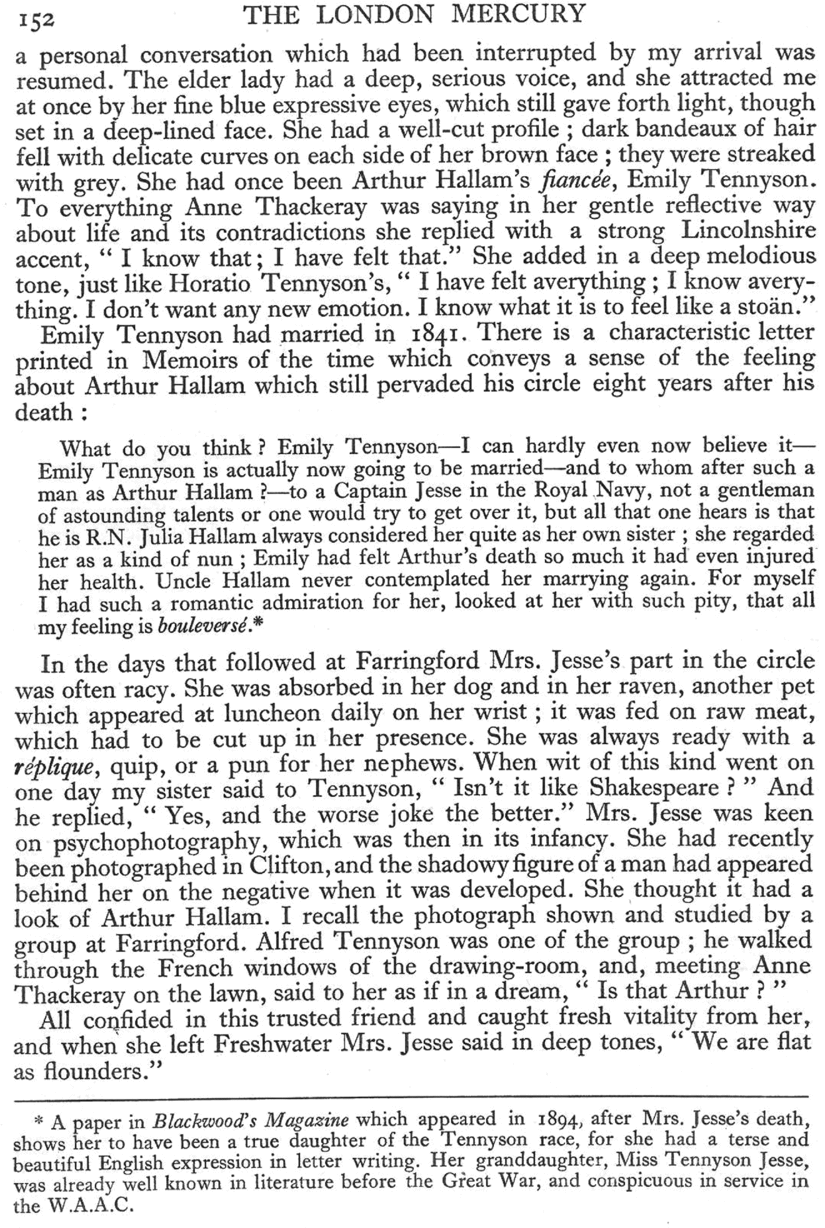
Mrs. Jesse was keen on psychophotography, which was then in its infancy. She had recently been photographed in Clifton, and the shadowy figure of a man had appeared behind her on the negative when it was developed. She thought it had a look of Arthur Hallam. I recall the photograph shown and studied by a group at Farringford. Alfred Tennyson was one of the group; he walked through the French windows of the drawing-room, and, meeting Anne Thackeray on the lawn, said to her as if in a dream, “Is that Arthur?”
Blanche Warre Cornish
Blanche Warre Cornish's 1921–22 tripartite memoir, “Memories of Tennyson,” begins in 1869 when she meets the poet by way of her parents’ friendship with Tennyson's neighbor, the photographer Julia Margaret Cameron (145) (Figure 1).Footnote 1 The photograph that Cornish recalls as “psychophotography” is one instance of a trend in Victorian England of spirit photography that was first practiced around 1872 after it was imported from America, where William Mumler had developed it (Tucker 68; Doyle 2: 128).Footnote 2 Reactions to these spirit photographs took various forms: while some viewers regarded them as a credible medium for communication with the dead, their detractors saw them as deliberate acts of deception. Others employed photography's spectral qualities for entertainment, such as the London Stereoscopic Company that had marketed photographs of angels, fairies, and ghosts for their customers’ amusement in the 1860s (Chéroux 45–53). By the time the “shadowy figure of a man” appears beside Arthur Hallam's erstwhile fiancé, Mrs. Jesse, Tennyson's sister, the practice had been subject to public intrigue and scandal as a part of broader and contentious Victorian debates about the status of photography as art or document.Footnote 3 The already surreal qualities of Cornish's anecdote are amplified by Tennyson's question, “Is that Arthur?,” which entertains the possibility of Hallam being present in a visible, spectral form while unrecognized by his beloved friend.
A photograph of The London Mercury clipping of the spirit photograph anecdote included in Richard Eustace Russell Jesse's Annales Tennysoniani. Tennyson Research Centre, Lincolnshire County Council.

While the study of Victorian photography and literature has tended to focus attention on the realist novel and sometimes has attended to Tennyson's involvement with Julia Margaret Cameron in the 1870s, this essay will show that photography is relevant for reading Tennyson's early poetry as well as the poet's representation of his process of mourning for Hallam.Footnote 4 I will demonstrate the ways that Hallam's spirit photograph participates in the emergence of a dramatic cultural transformation catalyzed by the reproducible image and its relationship with Victorian elegy.
Recent scholarship on Victorian spiritualism has established that spirit photographs exemplify photography's dialectical tendency to mediate between authenticity and contrivance.Footnote 5 In the case of Hallam's photograph, the elegiac afterlife of the subject extends the image's metaphorical value well beyond the history of photography and its occult manifestations. My argument is that this spirit photograph evidences the convergence of a traditionally literary genre, elegy, with a unique mode of technological reproduction, photography, in a way that is characteristic of Tennyson's verse. “As if in a dream,” Cornish writes in her description of Tennyson's response, which frames the poet walking out through a window of his storied residence into a world where photography might transform wishes into realities. The anecdote expresses the wish half-recognized for a new technology to make contact with the dead. The group at Farringford studies the image, suggesting both their hesitance to identify Hallam in the photograph as well as a desire for photography to conjure the dead through a chemical process.
Tennyson's complex reaction depends on a link between photography and elegy within Victorian culture that has not received sufficient attention from scholars of either the poetry or photography. One obvious reason for this failure is the historical fact of photography's 1839 invention several years after Hallam's death and Tennyson's early poetry. However, recent theorists of the medium have opened up the possibility of thinking about photography's emergence as more than just a technical event. Eduardo Cadava and Geoffrey Batchen examine the desires and cultural drives that were conditions for the invention. In his reading of Walter Benjamin's dialectical image of history, Cadava claims that the “language of photography” exists well before the photographic invention, originating with the ancient desire to read the stars, to translate the visual image into language. What Cadava means by the “language of photography” is a metaphor for the conflation of light with language to represent a past that will vanish as soon as it is perceived (Words 85). Batchen, the other theorist developing this approach to photography, has emphasized the significance of photography's roots in a combination of the Greek words phos, meaning light, and graphie, meaning writing, drawing, or delineation (Burning 101). In Batchen's history, photography emerges from an “epistemological dilemma” to mediate between “culture and nature, transience and fixity, space and time.” The “paradoxical coalition” of light with writing is manifested in the “pencil of nature” and “words of light,” which are both phrases that the Victorian inventor Henry Fox Talbot used to describe the new medium. Given the significance of language for the medium identified by these historians, it is not unreasonable to suggest that we are still discovering the connections that exist between literary form and the Victorian photographic imaginary.
We see the necessity of the imagination in photography's earliest images when movement blurs the subject and makes it impossible to photograph anything other than a static object. The blur is a crucial reminder of an image that remains beyond the medium's ability to represent.Footnote 6 This is why Benjamin tells us in both “The Work of Art in the Age of Mechanical Reproduction” and in his “Little History of Photography” that the last vestige of aura resides in the human countenance when it is associated with the blur and imprecision of Victorian photographs at a stage in their development that required prolonged exposure times during which the human being “grew into the picture” (“Little History” 280). In these nascent images, we see the impossibility of clearly viewing the past; however, the presence of a human figure, no matter how shadowy, provokes identification. Photography's power to outline the forms and contingencies of an arrested, irretrievable moment directs our attention to both the simultaneous presence and absence of the photographed object. Like Hallam's spirit photograph, the unseen details of the figure are left to the scrutiny, prejudice, and imagination of the viewer.
The photographic image manifests a relationship between light and language that is also vitally important for Victorian elegy, the literary genre charged with coming to terms with the disappearance, loss, and remains of the dead.Footnote 7 Victorian elegy often defies generic categories and traditional forms to reimagine the work of mourning in a culture undergoing rapid technological change. Cornish gives us two opportunities to reflect on the photographic imaginary and the elegiac in Tennyson's poetry. I have already cited the anecdote about Hallam's spirit photograph with its attendant hopefulness as well as its uncertainty about the possibilities of photography to place one in relation to the dead. Elsewhere in her text Cornish quotes Tennyson's comments about a photographer who wants to discover the location of his early 1832 poem, “The Miller's Daughter.” Tennyson derides the photographer for not recognizing that the poem's location is imaginary. While photography visualizes the material possibilities for contact Tennyson desires to realize in poetic form, it sacrifices literary elegy's unique ability to imagine the deceased rather than to see him in an image. The image ultimately threatens to reify an inert specter of the deceased, thereby overshadowing the imaginative capabilities of language to mediate the spirit. What we might describe, following W. J. T. Mitchell, as the poet's iconophobia informs his constant ambivalence about the relationship between the photographic image and elegy.Footnote 8 Even in his earliest elegiac poems, however, Tennyson is working with what we could usefully call the language of photography, suggesting not that the ambivalence arises as a response to technological change but that the emergent technology itself is a way of working through an issue of longer standing.Footnote 9 The age of photography marks a change in the elegy from a form concerned with mourning the disappearance of the deceased to one that now struggles with what can remain – a problem central to even quite an early work, such as “The Miller's Daughter,” a text to which I will return at the end of this essay.
Tennyson adumbrates a relationship between the present and the past through language that details the remnants, traces, and contiguities of residual figures. What emerge are elegies that envision images through poetic form, but that do not manifest those images visually. Tennyson anticipates Benjamin by recognizing the affective risk of attempting to achieve a clear view of a past that only reveals itself in flits and flashes. The poet wants to find a way to connect with his past, especially to elements as dear to him as Hallam. However, what is lost can only be traced in the light and shadow of what remains.
Photography as Elegy
Elegy not only remembers the deceased; it has to imagine a way forward without him.Footnote 10 Photography's unique ability to make visible both the presence and absence of the deceased threatens to stymie elegy's work of mourning by creating a reproducible specter of the dead. In the context of the Victorians’ pervasive culture of mourning, the previously unseen worlds that photography brought into view in 1839 offered new hope that the dead could return in some form to the physical world or, more astonishingly, proof that they had not yet left it. To make sense of this medium required a negotiation of what was a function of reality and what was made possible solely through the process of representation offered by a new technology.Footnote 11
It is photography's ability to secure the image of what was once before the camera's lens that fascinates Victorians with the possibilities of the medium's power to retain or bring back what would otherwise be lost. In this sense, spirit photographs are an exaggeration of the memorial function evident in the most mundane family portraits.Footnote 12 Critics have identified this crucial feature of photography as the indexical relationship between the objects photography represents in the reproducible image and the objects outside of it in reality. The index, which has emerged as a key semiotic term for twentieth-century writers on photography, simultaneously describes the traces of what remains and suggests a history of what has been lost.Footnote 13 The concept is originally described by the American philosopher C. S. Peirce, who identifies the index broadly as a sign or representation that bears a relation of cause or effect to what it signifies. An index, Peirce suggested, has a “dynamical (including spatial) connection both with the individual object, on the one hand, and with the senses or memory of the person for whom it serves as a sign, on the other hand” (107–08). What Peirce calls “the senses or memory” create a nexus between the index and its objects by identifying contiguity among referents. Peirce gives a number of examples, among them: “I see a man with a rolling gait. This is a probable indication that he is a sailor.” To identify the indexical relationship enables us to see how subjects transform and what they leave behind.Footnote 14 For example, the handprints in the Lascaux cave have an indexical relationship to the people who lived in a culture all but lost to us.
Photography makes it possible to invest all objects with indexical significance and create a traceable relationship with the subject who will inevitably disappear. As Batchen writes on memorial photographs,
Photography is privileged within modern culture because, unlike other systems of representation, the camera does more than just see the world; it is also touched by the world. . . . Photographs are therefore designated as indexical signs, images produced as a consequence of being directly affected by the objects to which they refer. (Forget 31)
Batchen describes the pairing of the memorial photograph with other media as a doubled indexicality. For example, vernacular photographs of the deceased often put a physical remnant of the body, such as a lock of hair, in close proximity to the image.Footnote 15 For Batchen, this practice signifies the limitations of photographs in memorializing the dead (Forget 74–76). At the same time as photography frames iconically and indexically the objects secured by the image, it also signifies the loss of that moment to time. By putting a physical remnant of the body next to its indexical representation, the mourner attempts to reinforce the indexical presence of the subject. However, the need for doubled indexicality in memorial practices suggests that photographs cannot conjure subjects on their own.
There is no more influential work on the relationship between mourning and photography than Roland Barthes's Camera Lucida, which develops the language of photography to form a new kind of elegy. For Barthes, photography's indexicality is unique because of its temporal relationship to the photographic subject; however, to make sense of this indexicality requires the use of language. Barthes wants to understand why one particular photograph of his recently deceased mother wounds him in a way that so many others do not. Barthes does not use Peirce's term, but he clearly draws on the photograph's indexical nature when he names the element that effects this wounding the “punctum,” that which articulates what he calls the “that-has-been” (77). As Tom Gunning contends, however, indexicality is not synonymous with the punctum because the photograph makes “us imagine something else, something behind it, before it, somewhere in relation to it” (Index 35).Footnote 16 The punctum is what establishes a fundamental relationship between the photograph and its viewer of the sort that allows Barthes to locate in the image a kind of “umbilical cord” to his mother.Footnote 17 Barthes describes this sense as a kind of “madness” because the photograph is so much more than an object of representation. As the critic writes,
Here is where the madness is, for until this day no representation could assure me of the past of a thing except by intermediaries; but with the Photograph, my certainty is immediate: no one in the world can undeceive me. The Photograph then becomes a bizarre medium, a new form of hallucination: false on the level of perception, true on the level of time: a temporal hallucination, so to speak, a modest, shared hallucination (on the one hand ‘it is not there,’ on the other ‘but it has indeed been’): a mad image, chafed by reality. (115)
This hallucination requires the viewer's projection to recognize what “has indeed been” by imagining or tracing what no longer exists. As Barthes describes earlier in the book, the punctum is both what actually lies in the photograph and what he reads into it. For this reason, Barthes writes, “I may know better a photograph I remember than a photograph I am looking at . . .” (53). In other words, to love a photograph means both to see and to imagine. Language enables Barthes to situate the Winter Garden photograph in history and in time, to love both his mother and the image of her.Footnote 18 However, neither the photograph nor the elegist's language is adequate to recreate his mother: they can only facilitate a hallucination that runs aground when confronted with the reality of Barthes's loss. Nonetheless, this “mad image” enables a vital connection to the lost mother by creating a friction between her absence and her presence insisted on by a photograph that has been “chafed by reality.” In this way, the photograph's semiotic qualities, the indexical and the iconic, engage with the powerful faculties of the imagination to create an extraordinary object of representation. The photograph as elegy presents the image of the deceased, but it also impels the elegist to imagine her outside of the image through the language of photography.
Tennyson's Spiritualism and Indexicality
In Hallam's spirit photograph, the group at Farringford views a subject who could never be photographed but who nonetheless remains present for his mourners. In this way, Tennyson's reaction to the photograph in Cornish's account resembles Barthes's treatment of the Winter Garden photograph. The negotiation between the real and the imagined – a mediation that Barthes has in mind with the punctum – is one instance of the ways in which Tennyson and his contemporaries struggled with the elegiac desires of spirit photography. The Hallam image shows how the madness of spirit photographs, indeed of all photographs, is disruptive to the mourner because of the inherent ontological instability entailed in their existence: a quality not so different from the one Barthes associated with photography of a more apparently mundane sort. A liminal space opens for the mourner where technology seems to validate the imagined, metaphorical truth of an image that seems to become literal, to become, that is, the very reality the form should only access as an index.
Spiritualists want more than the hallucination Barthes finds in the photograph: they want the total negation of their loss, which entails denying the very temporality that the photograph represents. But to insist on a material resurrection is to diminish the imagination that values the power of metaphor over dubious spirit emanations. For Tennyson, the imagination resides in language, not the image. In one account of Tennyson's spiritualism, we find him considering indexicality in order to define this relationship between the real and the imagined. The story of Tennyson's participation in spiritualism at Freshwater is told by Ella Coltman, a relative of Julia Duckworth, who recalls her time there in an 1888 diary recently brought to light by the archival work of Michael Millgate.Footnote 19 In the first “scéance” Coltman mentions, she describes Tennyson as “very anxious to prove spiritualism true. He says he prayed for years to see his Father after death, but in vain” (5). When Coltman actually witnesses Tennyson at a séance, the affect of “the bard” is noticeably different from that of a solemn mourner: “At times the grave expression changes & his whole face brims over with enjoyment & amusement, creased all over with pleasure. He is delightfully naïve & boyish in the way he enjoys himself” (10).
Coltman's account foregrounds a characteristic vacillation between belief and doubt on the poet's part that is also reflected in his puzzled response to the Hallam spirit photograph. The poet laureate's “constantly changing” expression is described as both a mournful “sad far-off look,” and as that of a boy “twinkling with fun,” when he conjures a specter that summons the suggestively maternal “Macmahooney” to the table (11). At first the spirit identifies itself as “Molly,” who Tennyson initially thinks might be “Molly McGhee,” the imaginative heroine from his poem “Tomorrow” (11 n.36). It turns out that the spirit is “Molly Macmahooney.” Coltman writes, “his pity for Molly Macmahooney was half comical, half pathetic” (11). When Coltman's companion, Mary, questions the existence of spirits, Tennyson rebukes her and claims, “This is the lowest order of all manifestations.” Tennyson implies that the séance's authenticity is undermined by its own performativity:
“I do not mean by this ‘seeing ghosts’, for I do not know of any authentic case of ‘materialization of form’–although I cannot say that there is no such thing.” Such materialization at spiritualist scéances he thinks is usually ocular deception or humbug. His explanation of table-rapping is that “the universe is full of disembodied spirits flying hither & thither & that their outlet into human existence is by contact with life in human beings”. As long as the contact lasts they can exist under human conditions & make themselves understood. (11–12)
The séance fails to perform the necessary mediation between the real and the imagined. At first, Tennyson rejects the idea of ghosts that materialize in recognizably iconic forms; at the same time, he theorizes that there must be some possibility for the spirit world to touch the living. He calls this possibility “contact,” which requires a living person to mediate the spirit's communication. However, communication does not occur through haptic or ocular sensations but within the living where the spirit finds not only expression but also understanding. Of course, from Tennyson's point of view, poets are an ideal medium for this communication. This recalls Shelley's description of poets in A Defence of Poetry as “hierophants of an unapprehended inspiration,” but in Tennyson's case, Romantic idealism does not satisfy the conditions for the contact he desires. He wants to apprehend the spirit and identify it with a name.
Tennyson is looking for a medium that can indexically yoke the real and the imagined to overcome the “ridiculous aspect” and communicate with the “unseen” world that is nonetheless present. The poet's sense of his liminal position manifests both in his affect and his desire; in an attempt to find a new way into this realm, he oscillates between finding the occult practices necessary for contact ridiculous and essential. To communicate with the “spirit world” requires a perfect medium that can render a form where “the bodiless & expressionless can for some brief moments find body and expression through us” (Coltman 12). The search for this indexical form is guided by Tennyson's reading of Swedenborg, whose visions were popular in spiritualist circles and among many seminal literary figures of the nineteenth century (Owen 14, 19–27). Swedenborg's voluminous discussions of the spiritual order identify two concurrent worlds, the reality experienced by the living and the world of the spirits; he explains the relationship between these two worlds in terms of “correspondences.” These “correspondences” between the body and the spirit are another way for Tennyson to conceive of physical traces and their relationship to the imagination. And indeed, as Jason Rudy has pointed out, Tennyson underlines passages in Swedenborg that deal with the “blur” between the body and the spirit (175). In the margin of his edition, the poet asks, “What is the nature of the ‘substantial body’ . . . in which the soul is clothed after death?” Footnote 20 Coltman shows us that even at the end of Tennyson's creative life, he still desires forms that will allow him to make contact with an imagined world that has an indexical connection to his own by finding this form in the language of photography.
Photography and Imagination
From her very first visit to Freshwater during the Christmas holidays of 1869–70, when the poet was sixty-one years old, Blanche Warre Cornish depicts Tennyson's mourning for Hallam's 1833 death as continuous. The reaction to the spirit photograph is but one instance of that persistent sorrow that undergirds the poet's emotional life and creative work. Tennyson's interrelated thoughts about spiritualism, photography, and poetry share a common fixation on how to trace the relationship between reality and the imagination. In one conversation, Tennyson addresses the complexity of the relationship in an instance of the failure of its recognition,
‘I am being driven mad by the way people publish all manner of things about me that haven't the very faintest foundation. I am told by a gentleman who goes into Lincolnshire to take photographs of the scenes of my youth that this mill was the original of the mill in the Miller's Daughter and that oak was the Talking Oak. Never anything of the sort. Why do they give me no credit for any imagination? The power of poetical creation seems totally ignored now. All this modern realism is hateful; there seems nothing but vulgarity everywhere. No man with imagination can be tied down to any one thing for his ideas. Turner was an imaginative painter, and how absurd it would be to account for all his works! There may be special suggestions.’ (267)
While Tennyson rejects the Lincolnshire photographer because he understands the creation of “The Miller's Daughter” as the synthetic result of the imagination without any direct reference to a physical location, he entertains the physical possibility of Hallam's spectral return because the spirit image traces Hallam's form. The fallacy of the Lincolnshire photographer is the assumption that Tennyson's poems originate in reality rather than the imagination. For Tennyson, the Hallam photograph and the Lincolnshire photographs represent two different kinds of images. The spirit photograph relies on both indexicality and imagination to conjure the lost subject whereas the Lincolnshire photographer abjures the imagination in favor of a literal origin. Photography, like the séance Coltman recounts, offers Tennyson a means for touching the past, but he does not accept it as a representation of an unmediated reality. The veracity of photography, like spiritualism, lies in the metaphorical relationship it is able to establish between indexicality and imagination that can faintly adumbrate the lost object but not reproduce it.
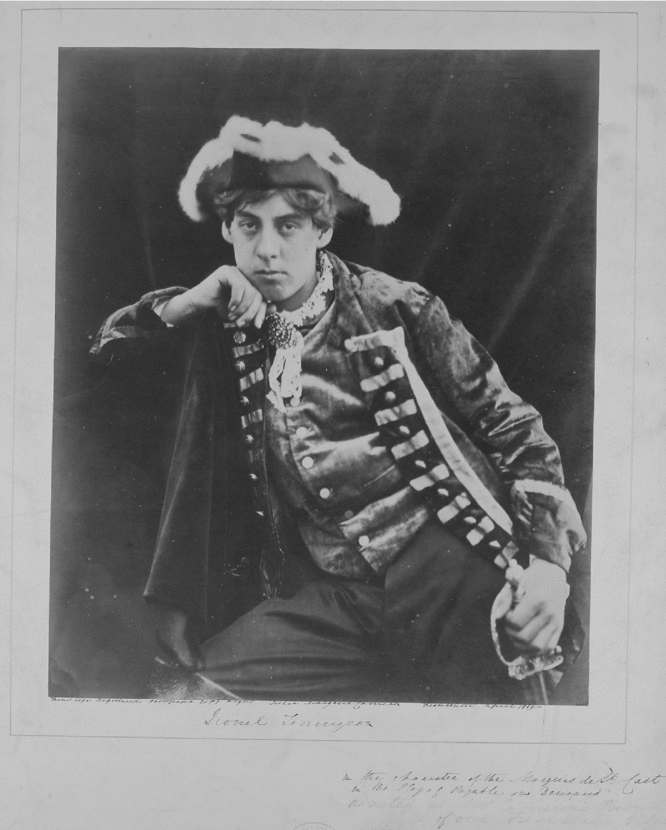
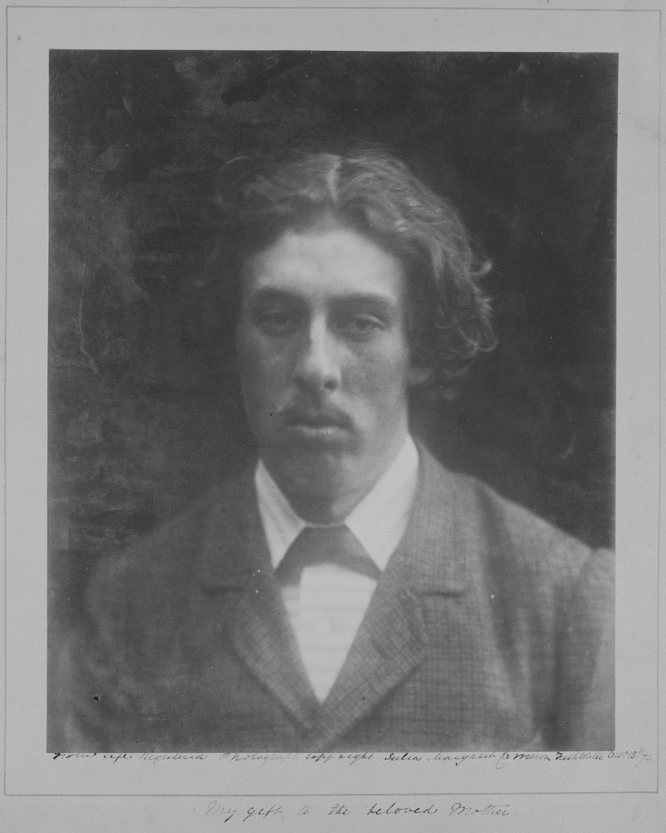
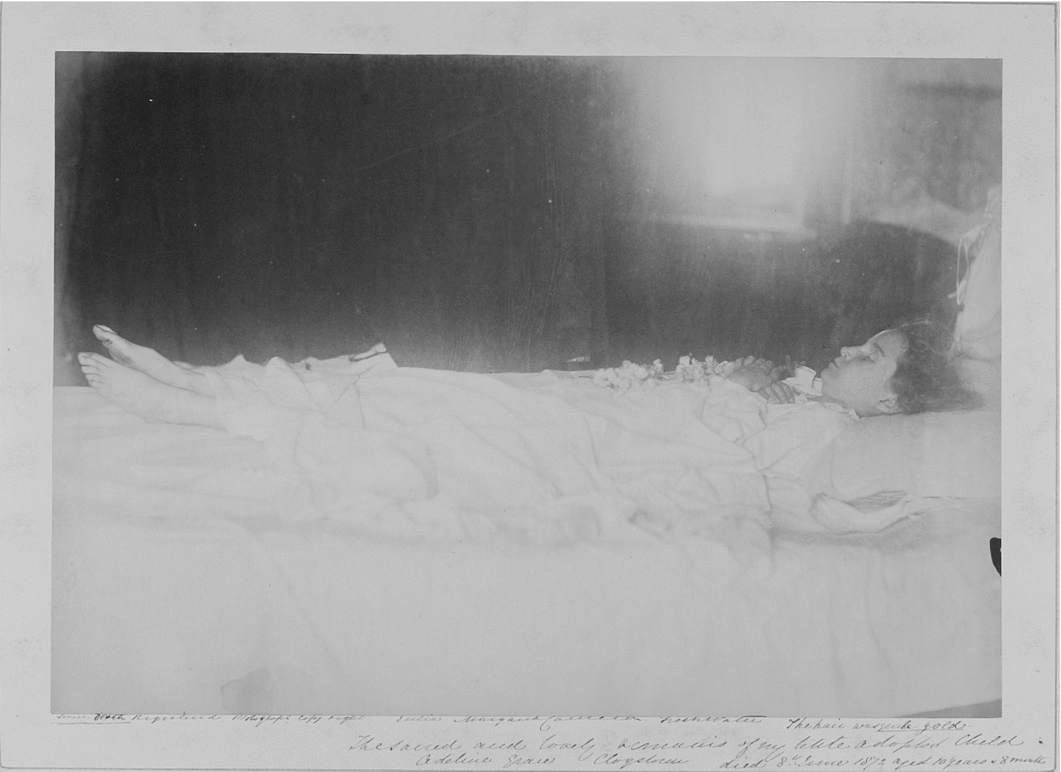
Even though Tennyson sees photography as a potential threat to poetry, the medium also offers a way to connect a physical reality to the imagination, and he is not willing to foreclose on the possibilities the photograph offers.Footnote 21 We find in Tennyson's comments about the medium a struggle to discern a convergence between indexicality and imagination similar to the one that shapes Barthes's elegiac punctum. Tennyson's work with the language of photography includes his famous collaboration with Julia Margaret Cameron, who supplements his poems with images. However, even with these images, a deep sense of loss is palpable. Not only did Cameron make portraits of Tennyson, and stage others as illustrations of the poet's work, but she was also responsible for images of Tennyson's family, including those of his late son, Lionel, which were collected by the poet and served as objects of mourning in the last years of his life.Footnote 22 Several of these images show young Lionel costumed in the fictional role of Marquis de St. Cast for Cameron's 1869 production of Payable on Demand at Freshwater (Figure 2). Cameron saw Lionel develop into a man, which an 1874 portrait clearly shows: the former boy actor now wears the earnest garb of a gentleman (Figure 3). But sorrow suffuses this collection of photographs, which includes Cameron's 1872 post-mortem photograph of her great-niece, Adeline Grace Clogstoun, who lies prostrate on white bedding made luminous by the camera's overexposure and soft focus (Figure 4). Below the albumen print, Cameron identifies the photograph as “the sacred and lovely remains of my little adopted child.” This solemn inscription makes explicit what Tennyson must have seen in the photographs of his son after Lionel's unexpected death at sea in April 1886: the remains of a child whose mirthful image defies his absence.
Julia Margaret Cameron, Lionel Tennyson as Marquis de St. Cast, 1869. Tennyson Research Centre, Lincolnshire County Council.
Julia Margaret Cameron, Lionel Tennyson, 1874. Tennyson Research Centre, Lincolnshire County Council.
Julia Margaret Cameron, Adeline Grace Clogstoun, 1872. Tennyson Research Centre, Lincolnshire County Council.
Impossible as it may be to know what Tennyson saw in these pictures of Lionel, we should not miss the conceptual significance of how Tennyson's comments about “The Miller's Daughter” in the 1870s are part of an uncanny timeline that extends back to the early work of the 1830s as well as forward to Cameron's photographs of the poet's late son. In Cornish's anecdote, Tennyson is looking back on a course of technological development that allows him to frame the relationship between his early involvement with the language of photography and the later photographic illustrations of “The Miller's Daughter.” A critical blind spot has occluded the connections between Tennyson's early work and photography, although Batchen's interest in the metaphorical and imaginative qualities of photography now makes possible the project of bringing the two together. Batchen historicizes a desire to photograph that predates the invention of the medium in 1839 to the 1790s (Burning 57), which he explains in terms of what he calls the “concept metaphors” of the Romantic imagination that redefine the relationship between nature and human subjectivity, thus creating new possibilities for representation (Burning 62). What Batchen identifies is the desire for nature to draw itself and create fixed impressions through forms of light that record nature's agency as manifested in the hands of a human operator, a medium like the Aeolian harp, but with light in the place of wind. I want to suggest that in order to understand the relationship between photography and imagination during the nascence of the medium, it will be helpful to look anew at how Tennyson's poetry of the 1830s redefined the terms of Romanticism. In his seminal 1831 essay on Tennyson, Arthur Hallam defines his friend's work as the “poetry of sensation.” The concept is traced to Tennyson's Romantic predecessors, namely Shelley and Keats, whom Hallam claims “lived in a world of images” where their emotions corresponded with their sensations of the outward world (186). Tennyson's vividness of description and feeling is an expression of inward conditions that are formed by metaphorical details like the landscape.Footnote 23 The poetry's emphasis on inner experience explains Tennyson's resistance to the reified photographic image that would impose the precision of realistic detail on the imagined description that emerges from within the poet and characterizes his early poetry.Footnote 24
Tennyson desires a poetic form in the 1830s that can mediate between the imagination and the physical world that attends to the expectation of inevitable loss evident in these poems, what Herbert Tucker calls the poet's sense of “doom.”Footnote 25 In the 1833 edition of Poems, which includes the first version of “The Miller's Daughter,” loss permeates nearly every verse, from the pitiful death wishes of “New-Year's Eve” and “The Death of the Old Year” to the subtle elisions of “The Lotos-Eaters.” This early work develops an interest in memories and traces to conceive of how the dead remain connected to the living through representation. It is the nature of spectrality that it derives its identity from the traces of a material referent. The specter is traced to its material origins by identifying the contiguities of what remains with the adumbration of what has disappeared. For Tennyson, these traces are found in the landscape where both the body and the past are buried. The challenge for the poet is to create a relationship between the landscape and the text that mediates between indexicality and imagination to trace the latencies of residual forms. A most illustrative example of this problem is found in the work that develops during the long period of mourning that begins immediately after Tennyson learns of Hallam's death. The tortuous problem for Tennyson is the proximity to Hallam evident in the 1833 verses that thematize the unreachable horizon of “Ulysses” and the unrelenting distance between lovers in the landscape of “Tithon.” These are sorrowful, aggrieved responses to loss that try to find solace in variations of elegiac form that struggle with the liminal position between presence and absence. These poems describe an inexorable paradox that follows from trying to possess a thing that has disappeared or is forever displaced, a paradox that recurs frequently in the work composed from the 1830s to the 1850s. Tennyson wants to conjure an impossible medium for elegy, one that has an indexical relationship to the world at the same time as it is resistant to the loss defined by the indexical disjunction between the sign and the object. We see the devastating consequences of this desire in “Tithon” where morbid immortality results in a nightmarish preservation of life. Tithon's damning question admonishes the desire for eternal life, including an eternal image or shape: “Why should a man desire in any shape / To vary from his kind, or beat the roads / Of life, beyond the goal of ordinance / Where all should pause, as is most meet for all?” (ll. 20–23). Artistic representation can incarnate the image of a lost soul, but Tennyson is never able to commit fully to any medium as a means for elegizing Hallam because he cannot reconcile his own perverse yet essentially human desire for Hallam “To vary from his kind” and return in some form. Instead, the poet intermittently exceeds the limits of his poetry by referring the reader to the physical world at the same time as he consigns his poems to the imagination. The elegist moves both towards and away from the text, adumbrating a simultaneous presence and absence with the suggestion of an image that never materializes.
The Language of Photography in “The Miller's Daughter”
The underlying desire for Hallam to return in Tennyson's mournful verse is contiguous with the poet's earlier project of evading loss. We can imagine the devastating grief that followed from the death of his actual friend by considering that Tennyson had already been at work on trying to mitigate loss with the language of photography in “The Miller's Daughter,” published in 1832 before Hallam's death and heavily revised in 1842.Footnote 26 In the poem, a speaker retells falling in love with his wife, Alice, and the story of their marriage, but the narration of this union is inflected with a near constant anxiety that he will lose her. Even before he first sees Alice, the poet presents him as preoccupied with oblivion. We learn the speaker's sense that his love for Alice “dispelled the fear / That I should die an early death” (ll. 89–90). But the fear of his own death becomes a fear that he will lose what he loves. Early on we are told that “There's somewhat flows to us in life, / But more is taken quite away” (ll. 21–22). The conviction in these lines that we lose what we love turns towards a remedy that would circumvent Alice's loss. What follows is the imperative to “Pray, Alice, pray, my darling wife, / That we may die the self-same day” (ll. 23–24). Remarkably, it is not Alice's death that seems to concern the speaker but rather his experience of losing her. He wishes for the end of mourning by not living, but the very impotence of this desire framed as a wish, a prayer, belies the will required to execute it. To guard against prematurely losing Alice, the speaker makes her a ubiquitous presence in the landscape, although the poem raises the possibility that Alice is already dead, implying a melancholic inability to acknowledge what has been lost. To control the terms of her loss, the speaker repeatedly traces an indexical relationship between his wife and her surroundings to keep her present in some form: every figure in the poem becomes a trace of Alice. In this way, “The Miller's Daughter” is evidence of Tennyson's desire to develop the imagination's relationship with the physical world by drawing on configurations of space and time through what I have been calling the language of photography that predates the medium's debut in 1839.Footnote 27
The poem struggles to forge indexical connections between language and the physical world at the same time the text disavows these connections because the speaker wants to recover the past in the present. James Knowles quotes Tennyson saying, “It is what I have always felt even from a boy, and what as a boy I called the ‘passion of the past.’ And it is so always with me now; it is the distance that charms me in the landscape, the picture and the past, and not the immediate to-day in which I move” (170). The poet wants to remain in a perpetual state of desire for a time and location from which he is continuously displaced, which means that the vision that moves him can never be fixed in an image. In this way, Tennyson uses physical distance to blur the spatial and temporal dimensions of experience where a material dualism transforms into a spiritual unity (Joseph, Weaver 58–59). The spiritual unity is made possible by the poet's paradoxical desire to be near something by moving away from it, which can only occur in the confusion of this material dualism that conflates imagination with reality. This problem is described as a kind of self-conscious hypertrophic longing by his Cambridge friend, James Spedding: “[Tennyson is] a man always discontented with the Present till it has become the Past, and then he yearns towards it, and not only worships it, but is discontented because it is past” (qtd. in Brookfield 268). Tennyson's note to “The Miller's Daughter” is simultaneously specific and vague: it is “No particular mill” he has in mind, although he writes, “but if I thought at all of any mill it was that of Trumpington, near Cambridge” (qtd. in Ricks, Poems 1: 406). This indeterminacy about the poem's location is reflected in the desire it engenders within its readers to locate its origin and photograph it. Writing in 1895 for Atalanta, Cuming Walters wants to seek out the exact location of the mill set in picturesque Lincolnshire. Walters wishes “to carry the process of identification to an extreme,” and he thinks he can locate the poem because the text's “descriptions of Lincolnshire scenery are of almost photographic precision” (164).Footnote 28 Similarly, George Napier seeks the location of the mill near Cambridge in his 1889 The Homes and Haunts of Alfred Lord Tennyson. Walters and Napier mistake Tennyson's elegiac trace for an actual place, which is why in “The Miller's Daughter” we see the underpinnings for a poetic form that will be described as photographic by its late Victorian readers. However, to identify the language of photography at work in the poem does not mean the poem can be reduced to a photograph. This elegiac text draws on its indeterminacy to upset any certain identification of its origins either in the world or the imagination.
The poem's evasive indeterminacy similarly confuses the reader's ability to discern the distance between life and death. This difficulty begins with the first lines: “I see the wealthy miller yet, / His double chin, his portly size, / And who that knew him could forget / The busy wrinkles round his eyes?” (ll. 1–4). This is not merely a recollection of the corpulent miller. The vision of the body concludes, “So healthy, sound, and clear and whole, / His memory scarce can make me sad” (ll. 15–16). The speaker looks back at a dead man who nonetheless remains present. This is Tennyson's manifest desire for a subject to be both present and absent. The very first line, “I see the wealthy miller yet,” puts the poem in the present tense and stresses the continuous visibility of the miller with the resilient adverb, “yet.” Details proliferate throughout the introductory stanzas where memories are transformed into the presence of verbal images characteristic of the idyll. In the third stanza, the speaker resolves to Alice that “we must die,” although her father's life after death in the poem's first lines seemingly defies that resolution (l. 18). Throughout the poem, the speaker's address to Alice signifies that she too could be dead. In “The Miller's Daughter,” the alternation between recollection and present address disorients the clear demarcation between life and death.
The poem indexically traces the disappeared or deceased subject back to her body in order to keep her present. After the vision of the miller, the poem's speaker, an aged lover, retells the story of his relationship with Alice that begins with the day he first saw her. What at first appears to be the story of his love becomes recognizable as his history of loss. Beside a pool of water near the mill, the young speaker fishes and recollects, “A love-song I had somewhere read, / An echo from a measured strain, / Beat time to nothing in my head / From some odd corner of the brain” (ll. 65–68). This song haunts the young speaker as he remains silent, sung only inside his head, though it repeats again and again. But this mental activity is disrupted by a vision:
The speaker's love traces the outline of Alice's luminous form as it is reflected on the beck, thus creating an indexical relationship between her and the surrounding landscape. The figure of the “beauteous form” redoubles the problem of separating the living from the dead suggested earlier in the poem in the representation of the miller; the degree of proximity in space and time between the speaker and Alice remains uncertain. “Reflex” suggests a spectral reflection, yet what antecedent is indexical to the image? The figure of Alice at her casement will return after this stanza as the object of reflection and the locus of desire. In the following stanza, the speaker remarks,
The speaker forms a relationship between Alice and the landscape in order to keep alive the vision of her he promises not to lose. After the trout leaps up in the 1842 version, the speaker “watched the little circles die”; Tennyson's melancholic lover fixates on the loss and disfiguration that attend all acts of figuration. However, what coincides with the loss of one figure, the trout, is the presence of another, Alice. The speaker desires to keep her form alive, so he makes Alice contiguous with the features of the landscape.
The ability to transplant Alice into the landscape relies on an aperture of vision – in this case the window – working with figures of reflection, the “reflex,” to form an indexical sign.Footnote 29 What occurs in “The Miller's Daughter” involves a complex circuit of specularity and projection whereby Alice becomes antecedent to every referent in the poem. In short, Alice can be found everywhere in “The Miller's Daughter.” What may seem like the speaker's projection of Alice outward onto the landscape is countered by Alice's own reflection, “the reflex” that manifests on the beck's surface. This ubiquity tracks back to the indeterminacy of the poem regarding life and death, past and present. In “Mariana,” the spectral qualities of the forlorn woman's existence stem from her inability to find anyone else anywhere near her; everywhere she looks, she finds only herself. In the “The Miller's Daughter,” every figure of the poem is a trace of Alice.
The speaker's desire to fuse Alice with the landscape is yet another instance of Tennyson's desire to look back towards something he can never touch. In Walters's article on the poem, he identifies the beck as the one that passes through the mill at Stockworth and the garden at Somersby Rectory (170). He recalls that this is the same brook that captivated Tennyson as a boy and that Arthur Hallam “had seen it and loved it, as the poet tell us in ‘In Memoriam’; but this is the only time that the Beck is associated with a mournful memory” (171). During his idyllic sojourn, Walters discovers that “[t]he blitheness of the brook becomes contagious, and it is easy to understand how it suggested so many bright stories suited for the poet's theme” (171). It is within this picturesque scene that Tennyson formulates a method for visualizing loss. Christopher Ricks contextualizes “The Miller's Daughter” among the other “Daughter” poems in relation to Tennyson's personal losses. Ricks explains, “Faced with a past that had little serenity and much more bitterness than love, Tennyson would take a soulful bounding leap into an imaginary future from which he could look back upon an imaginary past” (101).Footnote 30 This imaginary future, however, has the attendant dangers of looking at the beck only to see a mirror of the self, much like the Lady of Shalott before her mirror cracks, which is why Tennyson works to incorporate the imaginary into the physical landscape.
The speaker lingers in these moments of retrospective experience near the mill: looking at the mill pool, looking up at Alice's window, or recalling the forget-me-not that foretells a remembered loss. Alice is repeatedly viewed through her window: sometimes she is seen spinning and other times only her shadow is visible through the blind (ll. 121–28). This distance between lovers is maintained either physically or emotionally throughout much of the poem. The moment the speaker and Alice do converse and their love is realized, she dies, at least to these moments of figuration. He implores Alice to “Look through mine eyes with thine” (l. 215). The speaker desires to share his vision with Alice, even though this imperative retains a fundamental ambiguity. Does he imagine Alice external to him looking at his eyes, or does he implore her to look out of his eyes from within him? If one can see the same thing as another, then the two perspectives are the same, but we never see the world from Alice's perspective in this poem. It is the speaker's work of mourning that incorporates the lost object into the self, but it threatens to become a melancholic inability to ever consider the subject lost in the first place.
The speaker moves from fusing Alice with the landscape to joining her to himself in an effort to negate his loss. In the 1842 version, even the untimely death of their child remains opaque; the child is vaguely identified as “an outward breathing type” (l. 226). The diction suggests that the child is more a figure for Alice than for its own personhood. In this sense, the death of the child also portends Alice's death, yet it is quickly transfigured from a loss into a fusion:
What we see in these lines is a continuous alternation between indices, which allows the loss of the child to be a measure of gain for the speaker. Throughout the poem, Alice is configured as a part of the mill, and her elegiac trace allows Tennyson's speaker to evade acknowledging the loss of his family. This is why the figure of the seemingly unrelated trout becomes a metonym for Alice herself. The ubiquity of Alice in every figure of the landscape disrupts the relationship between her material form and its specular reflections. In this confusion, the indeterminate objects of the landscape and the seemingly disconnected lives of subjects allow the landscape to become Alice – even the speaker seems to become her. What follows is the conjuration of Alice as light itself like the Aurora of “Tithon.” In the final configuration of the poem's last stanza, the direct tropological connection between the casement and the beck's reflex makes Alice and the speaker part of the landscape.
Given the poem's insistence on the power of its landscape to embody subjects, it makes perfect sense that the Lincolnshire photographer Tennyson derides would be in search of an actual mill. This poem marks a grave in Trumpington where the elegiac trace affirms that someone has actually been lost. However, the confusion of subjects and objects is not without its consequences. By binding the poem to the physical landscape, Tennyson troubles the imagination because the poem is now rooted in a discoverable place. However, just as soon as the poem becomes antecedent to the landscape, it loses the speaker and Alice to a desiccated wasteland: “On the chalk-hill the bearded grass / Is dry and dewless. Let us go” (ll. 245–46). In effect, this leaves the poem open to readers like Walters, who might feel compelled to locate this place and photograph it. Tennyson remains tied to the actual place in the landscape as well. “The Miller's Daughter” conflates the landscape with the speaker's inner state; in turn, the poem invests itself in physical objects by using what Marshall McLuhan not so anachronistically calls Tennyson's “movie-camera eye” (280).Footnote 31 These objects of the landscape are indexical to the lost subjects of the poem. However, the Lincolnshire photographer does not have the power to make visible the subjects that “The Miller's Daughter” buries. Instead, the photographer can only record their absence. Looking back on Tennyson's paradox, the Lincolnshire photographer envisions exactly what the poet desires – “the picture and the past” that can never be touched or even seen. However, it still remains possible to imagine, and this is what the poem provokes from its readers.
Coda: “Strange friend, past, present, and to be”
The attempt to incorporate the subject into both a text and a landscape in “The Miller's Daughter” prefigures Tennyson's mourning after the loss of Hallam. In Memoriam struggles to forge a similar connection between the poet's internal condition and the world outside of himself, and significantly the desire to remain proximate to Hallam uses the language of photography to be physically near him. However, any visible image of Hallam threatens to stymie the imaginative possibilities of the poet's language, and by the conclusion of the poem, the elegist transforms the various visions of Hallam into the sounds and rhythms that only poetic form can represent. We end up with an elegy burning with desire for photography but unable to consummate that desire in an image.
Take, for example, section ninety-five of In Memoriam, where Tennyson comes into contact with Hallam in a flash of light sparked by the friction between Hallam's corporeal absence and the presence of his figurative remains. The scene begins with Tennyson on the lawn at his family's home in Somersby remembering the time when Hallam had visited in 1830. Hallam had written to a friend at Cambridge that “If I die I hope to be buried here: for never in my life, I think, have I loved a place more. I feel a new element of being within me” (Letters 360).Footnote 32 Hallam's actual grave is located far away in Clevedon, but Tennyson is not looking to find his body. At this point in the elegy, the hope for Hallam's literal return has vanished and the desire for an alternative means of contacting Hallam has come into focus. The poet enters into a vision on the lawn after an evening in the company of others who leave him to “read / Of that glad year which once had been, / In those fallen leaves which kept their green, / The noble letters of the dead” (95 ll. 21–24). The leaves are a metaphor for the incantation of the elegist's verse that “strangely” conjures something “strange” in the following stanza. Hallam, of course, is that strange thing who emerges from Tennyson's reading of his letters that pun on the fallen leaves:
The flash is a figure for both fantastic illumination and immediate evanescence in a touch that cannot last any longer than a moment.Footnote 33 This flash comes from the powerful Romantic trope that M. H. Abrams calls the “experience of eternity in a moment”(385) and what Wordsworth describes in The Prelude as “visionary power” with “objects recognised / In flashes” (1805, V ll. 628–29). Tennyson successfully draws on the figure of the flash to make contact with Hallam, although he had tried to use this trope in previous sections to no avail.Footnote 34 Unlike these other attempts, this flash is preceded by an act of reading the landscape Hallam loved in order to summon the “living soul” through the poet's verse.
When Tennyson reads the letters on the lawn, he finds an indexical connection between the place of memory at Somersby and Hallam's spirit that exists elsewhere. Language mediates this contact by conducting the poet's desire for Hallam into a tangible form that he touches in his elegy. Like a flash of light, this contact remains tenuous and momentary, but in the penultimate section of the elegy, we find a conclusive vision of this work:
Here Tennyson writes Hallam's image with the light of the sun, but he cannot guess what he sees in the stanza that follows. Hallam remains beyond the visible field, shrouded in a synaesthetic light that can only be heard in the breeze, the rushing of the water, and the rustle of the poet's language. Defying even the movement of time, Hallam is a “Strange friend, past, present, and to be; / Loved deeplier, darklier understood” (129 ll. 9–10). Like Alice's ubiquitous figure in “The Miller's Daughter,” Tennyson finds Hallam's traces everywhere by drawing on the language of photography, writing with light, to adumbrate the presence of a figure that can no longer be seen and has not yet fully developed. For this reason, at the conclusion of Tennyson's masterful elegy, the contiguity of the index is supplanted by a spirit that stands in the sun, a figure that we must look away from to see.
In spite of Tennyson's resistance to viewing Hallam's spirit directly, the uncanny image manifests in a spirit photograph that makes visible a shadowy afterimage of this brilliant form. Still, though Cornish references this image of Hallam, the archive fails to produce it.Footnote 35 In spite of the ekphrastic hope that the anecdote offers us, the spirit photograph remains extant only in language – a nice metaphor for Tennyson's photography. Grief finds expression and attenuation in the kind of tortuous, inconsolable mourning that even Freud finally had to recognize as unending because never complete. Tennyson sees a possibility for the photograph to work with elegy, yet he also perceives the threat of sacrificing the imagination that creates the necessary, unbridgeable distance between the present and the past. Photographic indexicality both challenges and reaffirms the mourner's relationship to the lost object, and Tennyson is never comfortable with letting it work independently of an imagination that always suggests through language more than the image can show.
Tennyson's vital development of photography's language has been not unsurprisingly neglected by even some of his finest readers. In her 1923 parody, Freshwater, Virginia Woolf looks to Tennyson's photographic collaborator, Julia Margaret Cameron, as an alternative elegist, one without the inconsolable, maudlin grief that characterizes the bard's recurrent mourning for Hallam in In Memoriam. Woolf reads Cameron's photographs of her own grief-stricken mother, Julia Duckworth, as elegy, and she uses these images to construct albums that play an important role in her creative process (Humm 21–63). In contrast to Cameron's images, Woolf parodies Tennyson's In Memoriam when she insinuates Tennyson's erotic interest in Hallam, but her humor hardly negates the poet's loss. Even though Woolf shows how Tennyson's mourning has become a kind of conventional prop for the poet in his later years, she does not deny its gravity. In the play, Hallam figures as Tennyson's dirty secret and a persistent Victorian specter. Woolf is in a position to parody Tennyson's mourning for Hallam, yet when Woolf casts her gaze backwards, she reinforces the significance of Tennyson's mourning for her own creative life.
The superficial parody of her Victorian relatives evident in Freshwater could be taken to mean that Woolf simply wants to expunge Tennyson's sentimentality and melancholy from her past. But instead of looking away from her family and her artistic heritage, she uses photography to see what is lost. As she looks back at these images of her Victorian origins, the past continues to develop in the present, which is, of course, a recurrent motif in Woolf's writing. Woolf sees the connection between photography and elegy, but she is unwilling to commit to the Victorian elegiac form even though her work is indebted to this tradition. In the age of photography, Woolf understands that the elegiac form is radically transformed by a past that continues to linger in the persistence of images; it remains unclear whether or not she recognizes her debt to Tennyson for this realization. In an ironic moment characteristic of the misprision sometimes said to be attendant on all literary influence, Woolf struggles with a question that she shares with her Victorian counterpart. In the diary she kept in the course of the composition of To the Lighthouse, a work deeply shaped by its involvement with mothers, spectrality, and the Victorians, Woolf tries to name the form this new work is taking. “I have an idea that I will invent a new name for my books to supplant ‘novel’,” she writes inconclusively: “A New – by Virginia Woolf. But what? Elegy?” (34).