Reading comprehension is arguably one of the most critical domains of language skills for adult English as a foreign language (EFL) learners (O’Neill, Lavoie, & Bennett, Reference O’Neill, Lavoie and Bennett2003). Regardless of whether learners have direct contact with native English speakers, advanced proficiency in reading English is required to access the most current knowledge and information across many key disciplines, including business, science, and technology (Crystal, Reference Crystal2012). Among the framework of skills necessary for reading comprehension, vocabulary has been identified as one of the most crucial factors (National Reading Panel, 2000; Wright & Cervetti, Reference Wright and Cervetti2017). According to Hu & Nation (Reference Hu and Nation2000), EFL learners needed to know approximately 98% of the words in a text before adequate comprehension of academic texts can be achieved.
Having established that a key pedagogical issue in EFL instruction is the lexical size target, the next logical question to investigate is how to effectively expand EFL learners’ vocabulary. Morphological awareness, which refers to one’s ability to manipulate morphemes and reflect on word formation processes (Kuo & Anderson, Reference Kuo and Anderson2006), has been identified as a vital factor in the expansion of English vocabulary (e.g., Kieffer & Lesaux, Reference Kieffer and Lesaux2007, Reference Kieffer and Lesaux2012a, Reference Kieffer and Lesaux2012b; Nation and Beglar, Reference Nation and Beglar2007). Morphemes are defined as the smallest linguistic units that carry semantic information. For example, the word playful is composed of two morphemes: the base play–, which denotes a sense of humor, or jesting, and the suffix –ful, which marks the word as an adjective and means that the quality is specified in the base.
Morphological awareness is crucial in English vocabulary expansion; research has shown that the mental lexicon of skilled native-speaking readers is morphologically organized. Psycholinguistic studies with adult English speakers have revealed that morphological information is utilized when processing complex words (Clahsen & Felser, Reference Clahsen and Felser2006a, Reference Clahsen and Felser2006b; Harley, Reference Harley2001; Nagy, Anderson, Schommer, Schott, & Stallman, Reference Nagy, Anderson, Schommer, Scott and Stallman1989; Perfetti & Stafura, Reference Perfetti and Stafura2014). These findings suggest that morphological knowledge facilitates the process of comprehending, storing, and retrieving words that are composed of multiple morphemes (Clahsen, Felser, Neubauer, Sato, & Silva, Reference Clahsen, Felser, Neubauer, Sato and Silva2010; Sandra, Reference Sandra1994).
Systematic investigations of the relationship between morphological awareness, vocabulary, and reading comprehension have only recently been conducted (Guo, Roehrig, & Williams, Reference Guo, Roehrig and Williams2011; Kieffer & Box, Reference Kieffer and Box2013). This body of research has consistently found that awareness of derivational morphology plays a particularly important role in vocabulary expansion and reading comprehension in English. Derivational morphology involves the addition of a morpheme to change the lexical category or the meaning of a base. For example, the noun nation becomes an adjective if attached to the suffix –al (national) and a verb if attached to an additional suffix –ize (nationalize). It has been estimated that derived words may make up 60%–80% of the new words in academic texts for English learners (Anglin, Reference Anglin1993; Nagy & Anderson, Reference Nagy and Anderson1984).
Most of the existing research on morphological awareness has been conducted with English-speaking adults (Guo et al., Reference Guo, Roehrig and Williams2011; Tighe & Schatschneider, Reference Tighe and Schatschneider2014, Reference Tighe and Schatschneider2015, Reference Tighe and Schatschneider2016), English-speaking monolingual children (for a review, see Goodwin & Ahn, Reference Goodwin and Ahn2013), or bilingual children who learn English as a second language (e.g., Kieffer, Biancarosa, & Mancilla-Martinez, Reference Kieffer, Biancarosa and Mancilla-Martinez2013; Kieffer & Box, Reference Kieffer and Box2013; Zhang & Koda, Reference Zhang and Koda2013; Zhang et al., Reference Zhang, McBride-Chang, Wong, Tardif, Shu and Zhang2014). While learners’ morphological development may not be identical at different age levels (Carlisle, Beeman, Davis, & Spharim, Reference Carlisle, Beeman, Davis and Spharim1999; Lam, Chen, Geva, Luo, & Li, Reference Lam, Chen, Geva, Luo and Li2012) or among first and second language learners (Hu, Reference Hu2013), it is reasonable to speculate that adult second language learners with more developed morphological knowledge may have an advantage in acquiring and retaining morphologically complex vocabulary.
Morphological awareness, vocabulary development, and reading comprehension among adult english language learners
While the research on the relationship between morphological awareness, vocabulary, and reading comprehension among adult English as a second language (ESL)/ EFL learners is still in its infancy, the few existing studies have laid an important foundation in the field. One of the pioneer studies on this topic, by Zhang & Koda (Reference Zhang and Koda2012), was conducted with adult EFL learners in China. Two aspects of morphological awareness were assessed: base identification and lexical inferencing. For base identification, which was assessed by a multiple-choice test, participants were asked to analyze the structure of low-frequency morphologically complex words and identify the base that represents the core meaning of the morphologically complex words (e.g., the base for reforestation is forest but not station or rest). The lexical inferencing task, which was also multiple-choice, asked participants to infer the meaning of low-frequency morphologically complex words (e.g., meritorious: (a) to reward, (b) people with outstanding contributions, (c) praiseworthy, (d) outstanding contributions). Choices were presented in the participants’ native language. Each test focused on a different aspect of morphological awareness. Stem-identification focused more on the semantics of a morphologically complex word, particularly the stem, whereas lexical inferencing focused more on the meaning of the suffix and the syntactic properties of the morphologically complex words. Vocabulary was measured for size and depth using the Vocabulary Levels Test (Schmitt, Schmitt, & Clapham, Reference Schmitt, Schmitt and Clapham2001) and the Word Associates Test (Read, Reference Read and Kunnan1998). Using structural equation modeling, Zhang & Koda (Reference Zhang and Koda2012) showed that EFL learners’ capacity to recognize the base of morphologically complex words contributed to L2 vocabulary both directly and indirectly, based on their ability to infer the meaning of these words. These authors also found that while the ability to recognize the base of morphologically complex words did not have a direct effect on reading comprehension, its indirect contribution to reading comprehension through vocabulary and lexical inferencing (i.e., the ability to infer the meaning of suffix and the syntactic properties of morphologically complex words) was significant.
Zhang & Koda’s (Reference Zhang and Koda2012) finding on the relationship between morphological awareness and reading comprehension was largely consistent with an earlier study by Jeon (Reference Jeon2012), and a more recent study by To, Tighe, & Binder (Reference To, Tighe and Binder2016). Jeon (Reference Jeon2012) investigated this relationship with 10th-grade EFL learners in Korea. Two types of morphological awareness were assessed: interpretation, which asked participants to provide a derived word in English and its newly generated meaning in Korean based on the base word and a derivational suffix in English, and identification, which asked participants to choose all the inflectional and derivational suffixes that could be attached to a prompt word. Using sequential regression analysis and controlling for several variables, such as phonological decoding, vocabulary knowledge, listening comprehension, and metacognitive reading awareness, Jeon found that interpretation, not identification, made a significant, unique contribution to reading comprehension. It should be noted, however, that the absence of the significant contribution of identification to reading comprehension may be attributed to the inclusion of the unique vocabulary knowledge measure used in the study. The vocabulary measure asked participants to specify the syntactic property (i.e., part of speech) of the prompt words. Given that identifying suitable suffixes for a prompt word also requires the knowledge of the syntactic property of the prompt word, and the syntactic property of a word may be determined by the suffixes, the two measures may tap into constructs that share a significant amount of variance.
The more recent study on morphological awareness and reading comprehension by To et al. (Reference To, Tighe and Binder2016) focused on the comparison of adults with low literacy skills to skilled adult readers. While the study did not specifically target adult EFL learners, English language learners accounted for approximately one-third of the participants with low literacy skills. The findings and the design of the study, therefore, have several important implications for current research on morphological awareness among adult EFL learners. First, regarding the findings, it was shown that for both skilled readers and readers with low literacy skills, morphological awareness made a unique contribution to reading comprehension once decoding skills were accounted for. Morphological awareness was assessed by asking participants to complete sentences using the base of a morphologically complex word, or creating a morphologically complex word using a provided base word. In other words, both the ability to identify the base and the ability to recognize the syntactic and semantic properties of morphologically complex words were measured. Second, the study is unique in that To et al. (Reference To, Tighe and Binder2016) drew our attention to an important, but often overlooked, area of morphological awareness: the effect of word change conditions, or whether a morphological change involves a phonological or orthographic change. This design, combined with the comparison between skilled and less skilled readers, allowed for a more precise identification of the aspects of morphological awareness that readers struggle with. To et al. (Reference To, Tighe and Binder2016) showed that both groups of participants scored significantly lower on phonological change items, compared with items that involved no change or orthographic change. Furthermore, this effect was stronger among the less skilled readers than among the skilled readers.
The present study
The present study aimed to extend the scope of existing research in several directions. First, the study expands current knowledge about the relationship among morphological awareness, vocabulary, and reading comprehension, which has been studied primarily with L1 learners (e.g., Deacon, Kieffer, & Laroche, Reference Deacon, Kieffer and Laroche2014) and young L2 learners (e.g., Lam et al., Reference Lam, Chen, Geva, Luo and Li2012), by focusing on Chinese adult EFL learners at a university in Taiwan. Second, the small number of existing studies with adult EFL learners has all shared a common methodological limitation: the vocabulary measures tend to include both morphologically complex and morphologically simple words (e.g., Vocabulary Level Test by Schmitt et al., Reference Schmitt, Schmitt and Clapham2001; Word Associates Test by Read, Reference Read and Kunnan1998). Such measures can be confounding when vocabulary is predicted by morphological awareness, or serves as a mediating factor in the analysis; the amount of variance explained can be largely determined by the proportion of morphologically complex words in the vocabulary measure. The present study aimed to address this issue by including words of varying frequency levels and morphological complexity.
The morphological awareness measure in the present study examined not only phonological and orthographic change in derivational morphology, as in To et al. (Reference To, Tighe and Binder2016), but also variations in the semantic and syntactic aspects of derivational morphology. These two properties of morphological awareness are particularly important for our participants because Chinese has a very limited number of derivational suffixes (Packard, Reference Packard, Li, Gaffney and Packard2002). By using a longitudinal study design, measures that tap into multiple types of vocabulary and aspects of morphological awareness, and learners from a wide range of reading levels, the present study was able to more specifically identify the facets of vocabulary and morphological awareness that may be challenging to learners of varying reading proficiencies.
Research questions
The following research questions guided the present study:
1. How do college EFL learners develop vocabulary differing in frequencies and morphological complexity? Are there any variations associated with students’ reading proficiency level?
2. Do college EFL learners find certain types of morphologically complex words more challenging than others (e.g., phonological or orthographic changes)? Are there any variations associated with students’ reading proficiency level?
Our first question was guided by previous research with adolescent English language learners (Kieffer & Box, Reference Kieffer and Box2013; Kieffer & Lesaux, Reference Kieffer and Lesaux2012a, Reference Kieffer and Lesaux2012b) and adult native English speakers with low literacy (Tighe & Binder, Reference Tighe and Binder2015). We hypothesized that the college EFL learners in our study would not have fully mastered the core morphological principles in English. Nonetheless, given that morphological awareness facilitates the acquisition of morphologically complex words (Kuo & Anderson, Reference Kuo and Anderson2006), and even adolescent EFL learners have developed some level of morphological awareness (Zhang & Koda, Reference Zhang and Koda2013), we hypothesized that college EFL students’ learning of morphologically complex words may outpace their learning of morphologically simple words. We also hypothesized that more skilled readers would show greater gains in vocabulary than less skilled readers, as existing research suggests that the relationship between vocabulary and reading achievement can be reciprocal rather than unidirectional (Grabe & Stoller, Reference Grabe, Stoller, Coady and Stoller1997; Kuo & Anderson, Reference Kuo and Anderson2006).
Three aspects of morphological awareness were examined to address Research Question 2: (a) base versus suffixes; (b) derivational morphology with or without phonological and orthographic change; and (c) the part of speech of the suffixes. Given that suffixes contain abstract linguistic information (Goodwin, Petscher, Carlisle, & Mitchell, Reference Goodwin, Petscher, Carlisle and Mitchell2017), we hypothesized that learners would find it more challenging to interpret the meaning of the bases than the meaning of the suffixes; further, growth in suffix knowledge might also be smaller. Similarly, because derived words with phonological and orthographic changes have been shown to be more difficult than those without such changes (Carlisle & Katz, Reference Carlisle and Katz2006; Carlisle & Stone, Reference Carlisle and Stone2005; Tighe & Binder, Reference Tighe and Binder2015), we predicted that growth in derived words with phonological and orthographic changes might also be more limited. Regarding part of speech, we hypothesized that growth in nominal adjectival and verbal suffixes would be more evident because there is more variability in nominal, adjectival, and verbal suffixes than in adverbial suffixes (Lieber, Reference Lieber2015), and Chinese has a somewhat consistent adverbial suffix. Finally, research that shows that achievement gaps in literacy tend to persist and widen over time (Ferrer et al., Reference Ferrer, Shaywitz, Holahan, Marchione, Michaels and Shaywitz2015), so we predicted that growth will be more pronounced among skilled readers than less skilled readers in all three aspects of morphological awareness.
Method
Participants
Participants included a total of 523 college freshmen at a university in Taiwan. Freshmen English is a required course for all college students in Taiwan, and usually serves as the final year of formal English instruction. In the study, 550 students participated at Time point 1 and 539 students participated at Time point 2. Sixteen participants had missing data at Time 2 and were not able to participate in the makeup assessments, which yielded a total of 523 students in the present study.
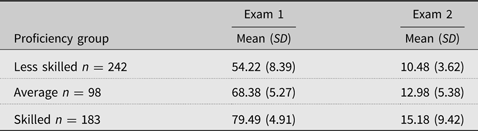
Following previous research models that examine the development of componential reading skills among participants of different reading comprehension levels (e.g., Lipka & Siegel, Reference Lipka and Siegel2012; To et al., Reference To, Tighe and Binder2016), participants were divided into three proficiency groups based on their English scores from one of their two National Entrance College Exams: skilled readers, who scored at or above the 80th percentile; average readers, who scored between the 21st and 79th percentiles; and less skilled readers, who scored at or below the 20th percentile. Most students took one of the two National Entrance College Exams, and both exams focused heavily on reading, with about 80% of the questions pertaining to reading comprehension. Table 1 summarizes the scores from the two National Entrance College Exams. Results from analysis of variance (ANOVA) indicated that the three groups, less skilled readers, average readers, and skilled readers, differed significantly across both exams: Exam 1, F (2, 268) = 45.52, p < .001, η2 = .25; Exam 2, F (2, 441) = 15.75, p < .001, η2 = .07. Significant differences in reading comprehension among the three groups were also confirmed through a researcher-developed reading comprehension test, F (2, 520) = 27.08, p < .001, η2 = .09.
Means and standard deviations of the English section of the National Entrance Exam

Measures
The researcher-developed measures were administered at the beginning of the fall semester and at the end of the spring semester to examine the development of vocabulary, morphological awareness, and morphosyntactic awareness. A complete list of stimulus materials is available from the authors upon request.Footnote 1
Vocabulary and morphological awareness
In adult EFL research, vocabulary has primarily been assessed using either a multiple-choice (e.g., Zhang & Koda, Reference Zhang and Koda2014) or a checklist format (e.g., Schmitt, Jiang, & Grabe, Reference Schmitt, Jiang and Grabe2011). While most of the measures used in past studies have considered the frequency of the target words (e.g., Schmitt et al., Reference Schmitt, Jiang and Grabe2011), to our knowledge, none have considered the morphological complexity of the target words. Vocabulary in this study was assessed via a word association task adapted from Kuo, Ramirez, de Marin, Kim, & Unal-Gezer (Reference Kuo, Ramirez, de Marin, Kim and Unal-Gezer2017) and the Gates-MacGinitie Reading Test (MacGinitie, MacGibitie, Maria, & Dreyer, Reference MacGinitie, MacGinitie, Maria and Dreyer2000). Its format was similar to the Vocabulary Size Test developed by Nation & Beglar (Reference Nation and Beglar2007). Specifically, each item contained a target word, varying in frequency and morphological complexity, along with four definition options.
Morphological complexity can be operationalized differently across studies. Given that derivational awareness is one of the most important types of morphological awareness in academic reading (Nagy & Townsend, Reference Nagy and Townsend2012), the present study focuses on derivational morphology. Morphological complexity in this study is determined by the presence of a productive suffix. A morphologically complex word is thus operationally defined as a word with a productive derivational suffix. Productivity of suffixes can also vary across texts, and judgment of suffix productivity can vary across readers. Therefore, we relied on an experienced English instructor familiar with our targeted participants to assist with the selection and assessment of words. This ensured that we focused on derivational suffixes useful for unlocking meanings of new words that our participants would likely encounter when reading English texts. It should be noted that we do not take an etymological definition of morphological complexity. For example, the word prevent is composed of pr(a)e, meaning before, and venire, meaning come, in Latin. However, the word does not contain a productive derivational suffix. Therefore, even though it may be composed of two morphemes, it would be considered a morphologically simple word in this study.
Participants were instructed to review all four options in each question and select the definition that best explained the target word. The instructions were provided in the participant’s native language, Mandarin Chinese; all of the test items, including the target words and the option words, were in English. During development of the measure, we determined that the options should consist of easier words. An experienced instructor of freshmen English reviewed the definitions to help ensure that most of the participants would be familiar with the words used.
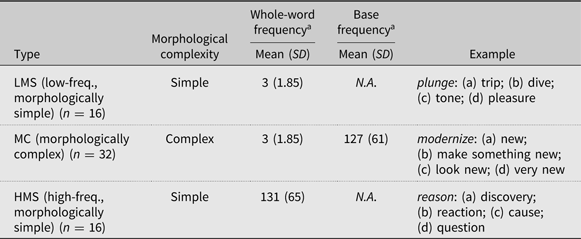
The measure contained 64 items with three types of target words: (a) low-frequency, morphologically simple words (LMS); (b) high-frequency, morphologically simple words (HMS); and (c) morphologically complex words (MC). LMS and HMS each have 16 questions. A total of 32 questions were constructed for MC words; half of the questions contained a target word with a phonological and/or orthographic change from its base word (e.g., receive – receipt), and the other half of the questions contained a target word that did not involve phonological or orthographic change from its base word (e.g., modern – modernize). Within each subtype of the words, half of the questions assessed the knowledge of base words (e.g., receipt – act of returning, act of getting, act of respecting, act of asking), while the other half assessed the knowledge of the suffixes (modernize – new, look new, to make something new, very new).
Following Malabonga, Kenyon, Carlo, August, & Louguit (Reference Malabonga, Kenyon, Carlo, August and Louguit2008), frequency, the number of occurrences of a word in a corpus of 1 million words, served as an indicator of the difficulty of a word. Table 2 presents the whole-word frequency and the base frequency of the three word types on the measure, along with a sample question for each type of word. The frequency information was retrieved from an online database created by Kucera & Francis (Reference Kucera and Francis2009). Whole-word frequency refers to the frequency of a word itself. For example, the whole-word frequency of the word modernize indicates how often modernize occurs in a corpus of 1 million words. The base frequency of the word modernize indicates how often the word modern, which is the base of the word modernize, occurs. For morphologically complex words with allomorphs, the frequency of the word with high frequency was used as the base frequency.
Vocabulary measures

Note: aPer million words.
Participants’ relative performance on the words varying in morphological complexity and frequency allowed us to gauge their morphological awareness. The MC words had the same whole-word frequency as the LMS words, and the same base frequency as the HMS words. If participants had not developed any morphological awareness, they would not have been able to recognize or analyze the structure of the MC words, thus treating them as LMS words. In other words, they would not be able to recognize the high-frequency base or interpret the meaning of the suffix, and would thus perform similarly on the MC words and the LMS words. In contrast, if the participants had a full grasp of the morphological rules of the language and could analyze the structure of complex words, they would perform similarly on the MC words and the HMS words. Participants’ performance would be similar because the HMS words and the base of the MC words were matched on frequency and, therefore, were of similar difficulty; once the base of an MC word is recognized, the meaning of the MC word can be inferred with knowledge of morphological rules.
It should be noted that a participant may have already learned an MC word as a whole and thus did not necessarily need to analyze the morphological structure of the target words to answer the questions correctly. Therefore, assessment of morphological awareness should always take general vocabulary proficiency into account. Our design allowed us to assess participants’ morphological awareness in relation to their general vocabulary development. The task had an internal consistency with a Cronbach’s α coefficient of 0.95, which is considered as high reliability (George & Mallery, Reference George and Mallery2003).
Morphosyntactic awareness
A morphosyntactic awareness measure was developed following the design of Does It Fit in the Process Assessment of Learners (Berninger, Reference Berninger2001). This task is a widely used measure of morphological awareness in research with young English language learners (e.g., Kieffer & Leseaux, Reference Kieffer and Lesaux2010, Reference Kieffer and Lesaux2012a, Reference Kieffer and Lesaux2012b) and adult English speakers (e.g., Tighe & Schatschneider, Reference Tighe and Schatschneider2015). However, because the task taps into both morphological knowledge and syntactic knowledge (i.e., how words of different lexical categories should be sequenced to form sentences), we refer to it as a measure of morphosyntactic awareness in the present study.
On this measure, participants were instructed to complete a sentence using a pseudoword with an existing derivational suffix. For example, Mom told the kids to ___ the bedroom this afternoon. (a) patiful; (b) patinize; (c) patinization; (d) patifully. To accurately answer the question, participants would need to: (a) identify the lexical category of the word in the blank (i.e., verb); and (b) select the pseudoword with the suffix that denotes the lexical category (i.e., –ize). The assessment was administered in the participants’ native language, Chinese; the test items, including the sentences and the pseudowords, were in English.
Due to homophony between suffixes in English, there were items where, strictly speaking, more than one option could be considered correct. For example, there are two homophonous suffixes –y in English: the productive N→ Adj suffix (e.g., hair → hairy) and the no longer productive N→ N suffix (e.g., count-y, victor-y). Thus, two answers can be correct in the question She showed no ___ when she heard the news. (a) vullion, (b) vulliful; (c) vully; (d) vullify. However, –y is a more prominent suffix in adjectives than in nouns. As an adjectival suffix, –y can be attached to many free morphemes (e.g., hair → hairy; shine → shiny; fun → funny; noise → noisy; bump → bumpy; ice → icy), but its function as a nominal suffix can be relatively opaque (e.g., count-y, histor-y, victor-y). In contrast, –ion is used predominantly as a nominal suffix, although words ending with –ion can also function as a verb (e.g., Your request will be actioned.). Therefore, the correct answer for the question is vullion. Given the issue of homophony and productivity, following previous studies (e.g., Berninger, Reference Berninger2001; Kuo et al., Reference Kuo, Ramirez, de Marin, Kim and Unal-Gezer2017), participants were instructed to review all four options and select the best answer to each question.
The measure consisted of 32 total items. There were 8 questions each for the adverb and verb categories. Due to an error, which was noticed after data collection, the adjective category had 7 questions, and the noun category had 9 questions. The task had an internal consistency with a Cronbach’s α coefficient of 0.84, which is considered high reliability (George & Mallery, Reference George and Mallery2003).
Results
The Results section is organized to address the two research questions related to vocabulary and morphological awareness, RQ1: How do college EFL learners develop vocabulary differing in frequencies and morphological complexity? Are there any variations associated with students’ reading proficiency level? and RQ2: Do college EFL learners find certain types of morphologically complex words more challenging than others? Are there any variations associated with students’ reading proficiency level?
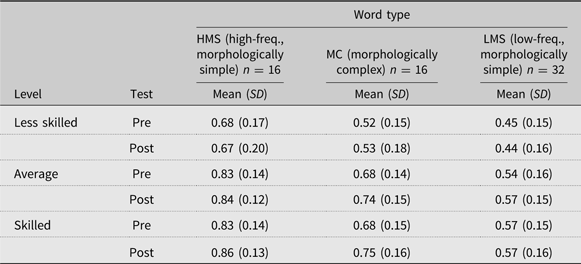
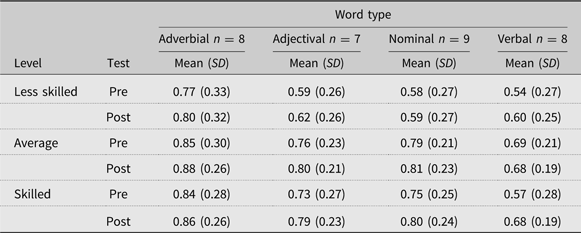
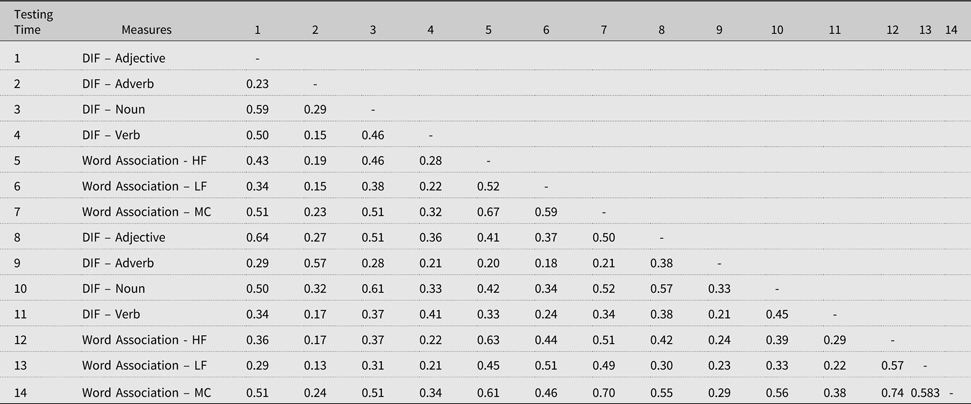
Means and standard deviations of the measures for Word Association and Does It Fit are presented in Tables 3 and 4, respectively. Table 5 presents the correlations between all the measures. All measures were significantly and positively correlated (p < .001).
Means and standard deviations on the word association measure by word type and reading level

Means and standard deviations on the morphosyntactic awareness measure by word type and reading level

Correlations among the measures

Note. N = 523, Does is Fit; HF, High Frequency; LF, Low Frequency; MC, Morphologically Complex. For all correlations, p < .001.
Development of different types of vocabulary
To investigate how college EFL students acquire vocabulary of differing morphological complexity, and how such development varies as a function of reading proficiency level, a 3 × 2 × 3 mixed ANOVA was conducted on the data from the word association measure. The between-subject variable was reading comprehension level (less skilled, average, and skilled) and the within-subject variables were testing time (pre vs. post) and type of vocabulary (high-frequency morphologically simple, low-frequency morphologically simple, and morphologically complex). Mauchly’s test indicated that the assumption of sphericity had been violated for the main effect of type of vocabulary, χ2 (2) = 14.40, p < .01, and the interaction between testing time and type of vocabulary, χ2 (2) = 34.17, p < .001. Therefore, degrees of freedom were corrected using Greenhouse–Geisser estimates of sphericity. The analyses revealed that all effects, except for the three-way interaction, were significant.
There was a significant main effect of testing time, F (1, 520) = 4.53, p < .05, η2 = .01. The main effect of vocabulary type was also significant, F (1.95, 1012.31) = 4.53, p < .001, η2 = .67. Contrast analysis revealed that morphologically complex words were scored higher than the low-frequency words, F (1, 520) = 434.80, p < .001, η2 = .46, but lower than the high-frequency words, F (1, 520) = 726.29, p < .001, η2 = .58. Recall that the morphologically complex words contain bases with frequencies matched to those of the high-frequency words; the whole-word frequency of morphologically complex words was also matched to those of the low-frequency words. Thus, findings from the contrast analysis suggest that while students across all three groups had developed some level of morphological awareness, they had not developed a full capacity to analyze and infer the meaning of morphologically complex words.
The interaction between the two within-group variables, testing time and vocabulary type, was significant, F (3.90, 1012.31) = 8.92, p < .001, η2 = .03, which suggests that improvement from pretest to posttest varied as a function of vocabulary type (see Figure 1). Significant improvement was only observed in the morphologically complex words, F (1, 522) = 11.21, p < .001, η2 = .02, but not in the high or low morphologically simple words, p >.05.
Mean proportion of correct with standard error bars for vocabulary by type and testing time.

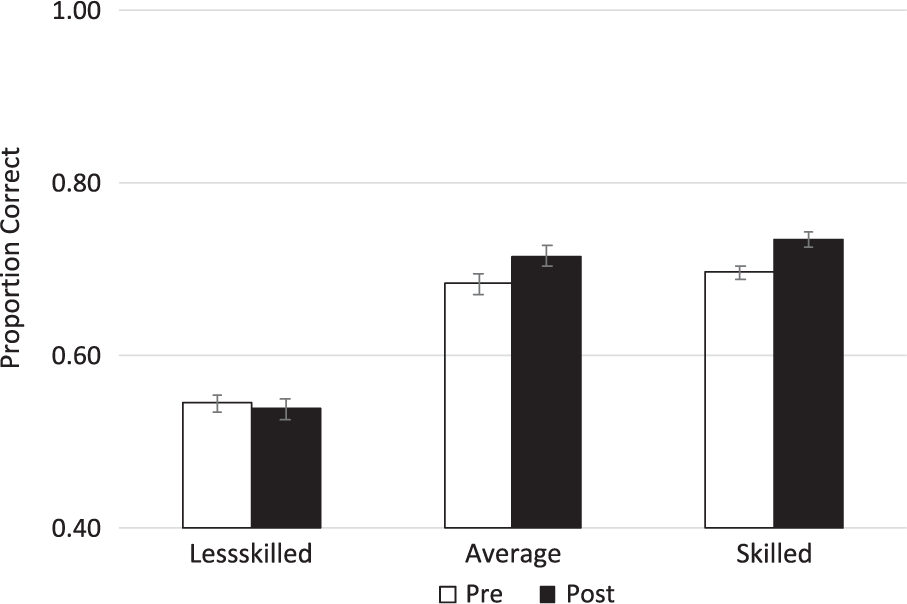
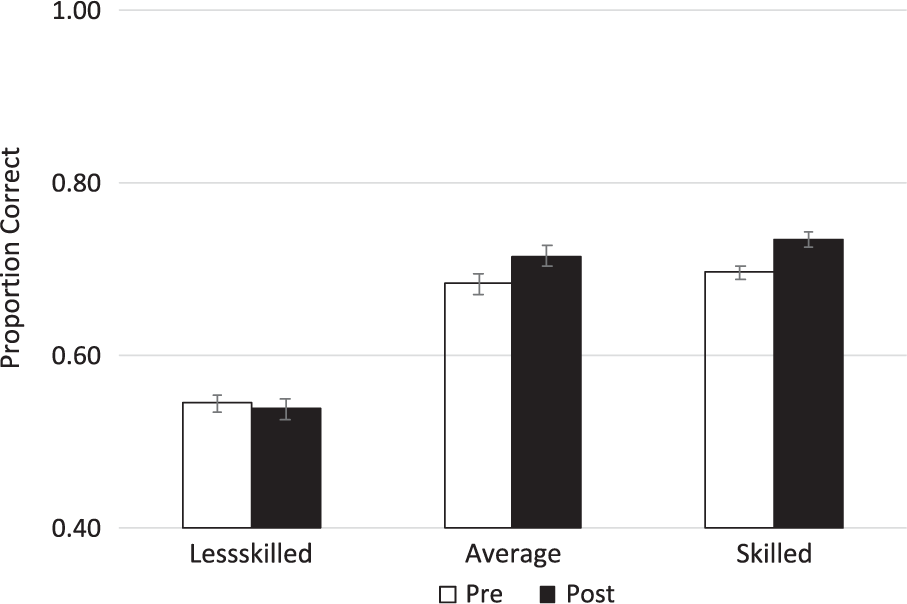
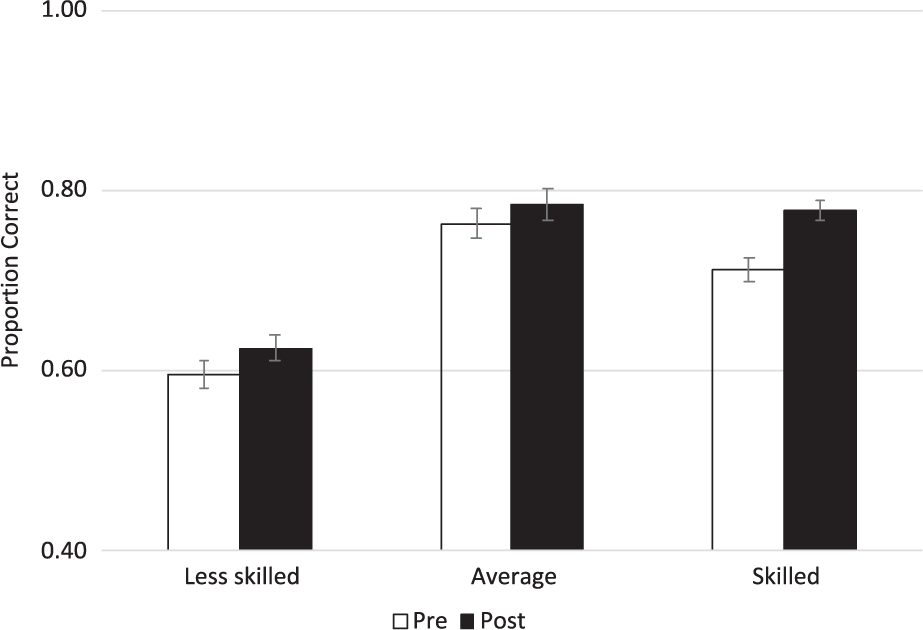
The interaction between testing time and reading level was significant, F (2, 520) = 3.56, p < .05, η2 = .01, which suggests that the degree of improvement from pretest to posttest also varied as a function of reading level (see Figure 2). Further analyses revealed that while the average and skilled readers performed significantly better on the posttest than on the pretest, F (1, 241) = 7.41, p < .01, η2 = .03 for the skilled readers and F (1, 97) = 10.16, p < .01, η2 = .10 for the average readers, the less skilled readers did not show significant improvement, p = .50. It should be noted that the effect size for the skilled readers is considered medium and the effect size for the average readers is considered small (Cohen, Miles, & Shevlin, Reference Cohen, Miles and Shevlin2001).
Mean proportion of correct with standard error bars for vocabulary by reading level and testing time.

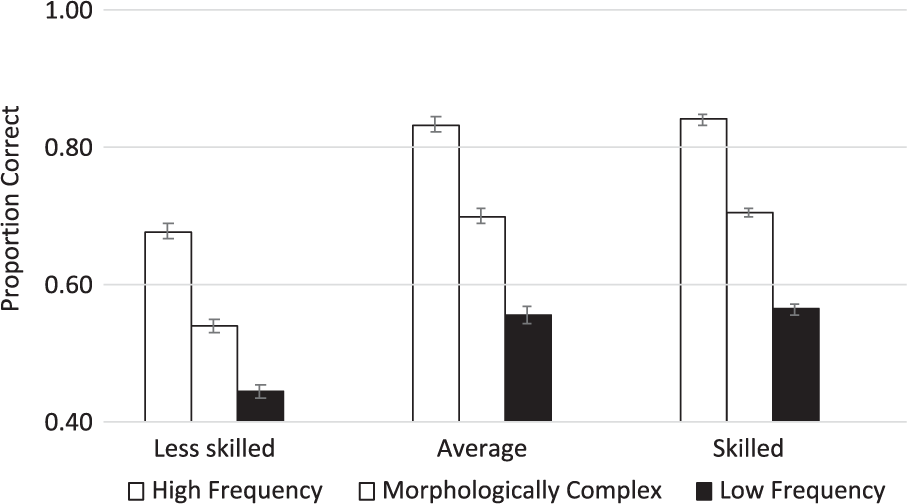
The interaction between vocabulary type and reading level was also significant, F (4, 1040) = 8.92, p < .001, η2 = .03, which indicates that students’ relative performance on the three types of vocabulary varied across the three proficiency groups. Further analyses revealed that the differences between high-frequency words and morphologically complex words were significant and similar across all three groups, F (1, 241) = 868.73, p < .001, η2 = .78 for the skilled readers, F (1, 97) = 329.25, p < .001, η2 = .77 for the average readers, and F (1, 182) = 507.78, p < .001, η2 = .74 for the less skilled readers. However, while the differences between morphologically complex words and low-frequency words were also statistically significant across all three groups, the difference was smaller for the less skilled readers, F (1, 182) = 212.16, p < .001, η2 = .53, than for the skilled, F (1, 241) = 668.77, p < .001, η2 = .74, and average readers, F (1, 97) = 312.26, p < .001, η2 = .76 (see Figure 3). In other words, although students across all three proficiency groups had developed some level of morphological awareness and were not able to fully utilize the knowledge to infer word meaning, the less skilled readers had the least developed morphological awareness.
Mean proportion of correct with standard error bars for vocabulary by reading level and vocabulary type.

Development of different types of derivational awareness
To investigate what types of derivational awareness are more challenging for college EFL leaners to develop, and how such development may vary as a function of their reading level, two separate mixed ANOVAs were conducted with data from the word association measure and the morphosyntactic awareness measure, respectively.
Word association measure
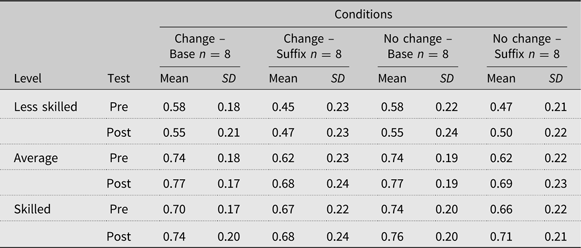
For the word association measure, a 3 × 2 × 2 × 2 mixed ANOVA was conducted on responses with items containing morphologically complex words. The between-subject variable was reading level (skilled, average, or less skilled) and the within-subject variables were testing time (pre vs. post), change (with-change vs. without-change), and type (base vs. suffix). Means and standard deviations of the measure are presented in Table 6. Scores on the high-frequency vocabulary from the pretest were included as a covariate to control for vocabulary.
Means and standard deviations on the morphologically complex words in word association by conditions and reading level

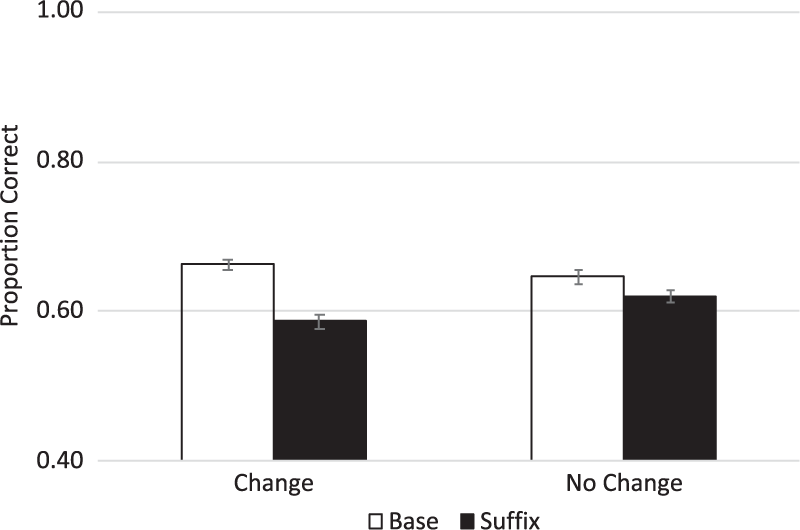
The analysis revealed a main effect of reading level, F (2, 519) = 41.24, p < .001, η2 = .14. The main effect of change was not significant, F (1, 519) = 0.26, p = .61, and neither was its interaction with reading level, F (2, 519) = 0.995, p = .371. However, the two-way interaction between change and type, F (1, 519) = 14.60, p < .001, η2 = .03, was significant. Further analysis of the two-way interaction between change and type revealed that items that assessed the meaning of suffixes were scored significantly lower than items that assessed the meaning of bases only in the change condition, F (1, 521) = 26.31, p < .001, η2 = .05, but not in the no-change condition, F (1, 521) = 1.38, p = .24 (see Figure 4).
Mean proportion of correct with standard error bars for morphologically complex words by change and type.

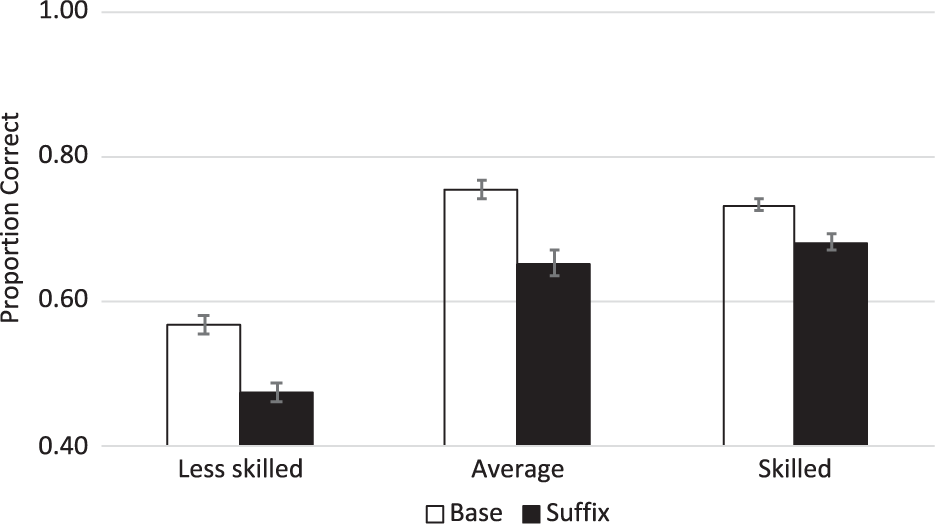
The main effect of type was also significant, F (1, 519) = 4.65, p < .05, η² = .01, and so were the two-way interaction between type and reading level, F (2, 519) = 5.72, p < .01, η2 = .02, and the three-way interaction among type, testing time, and reading level, F (2, 519) = 3.32, p < .05, η2 = .01. Further analysis revealed that across the three groups, items that assessed the meaning of suffixes were scored significantly lower than items that assessed the meaning of bases: less skilled readers, F (1,182) = 65.34, p < .001, η2 = .22; average readers, F (1,97) = 45.40, p < .001, η2 = .23; skilled readers: F (1, 241) = 34.34, p < .001, η2 = .05, and the difference was more pronounced among the less skilled and average readers than the skilled readers (see Figure 5).
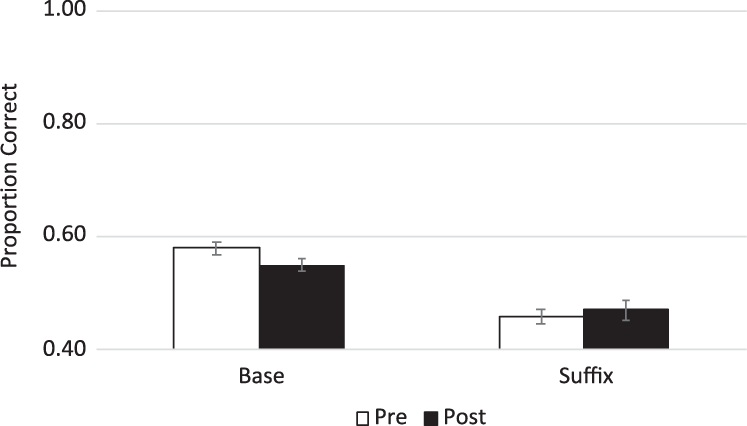
The two-way interactions between type (base vs. suffix) and testing time (pre vs. post) were significant for the less skilled readers, F (1, 182) = 10.56, p < .05, η2 = .03, but not for the average, F (1, 97) = 1.84, p = .356, or the proficient readers, F (1, 241) = .11, p = .165. Further analysis of the two-way interaction between type and testing time for the less skilled readers showed that they scored significantly lower on the base items in the posttest than in the pretest, F (1, 182) = 4.11, p < .05, η2 = .02; the difference was not significant for the suffix items between the pre- and posttests, F (1, 182) = 2.90, p = .335 (see Figure 6). It should be noted, however, that the effect size for the difference is considered small (Cohen, Miles & Shevlin, 2001).
Mean proportion of correct with standard error bars for morphologically complex words by type and reading level.

Mean proportion of correct with standard error bars for morphologically complex words by testing time and type for less-skilled readers.

Morpho-syntactic awareness measure
A 3 × 2 × 4 mixed ANOVA was conducted on the morphosyntactic awareness measure. The between-subject variable was reading level (skilled, average, or less skilled) and the within-subject variables were testing time (pre vs. post) and type (adverbial, adjectival, nominal, and verbal). The means and standard deviations for the measure by proficiency level are summarized in Table 4. Mauchly’s test indicated that the assumption of sphericity had been violated for the main effect of type, χ2 (5) = 101.85, p < .001, and the interaction between testing time and type, χ2 (5) = 119.75, p < .001. Therefore, degrees of freedom were corrected using Greenhouse–Geisser estimates of sphericity.
The analysis revealed a main effect of reading level, F (2, 520) = 34.46, p < .001, η2 = .12. The main effect of testing time was also significant, F (1, 520) = 27.64, p < .001, η2 = .05, with the posttest being scored higher than the pretest. The main effect of type was significant as well, F (2.63, 1365.24) = 118.84, p < .001, η2 = .19. Contrast analyses revealed that adverbial suffixes were the easiest type among the four, F (1, 520) = 171.25, p < .001, η2 = .25, and verbal suffixes were the most challenging, F (1, 520) = 237.54, p < .001, η2 = .31.
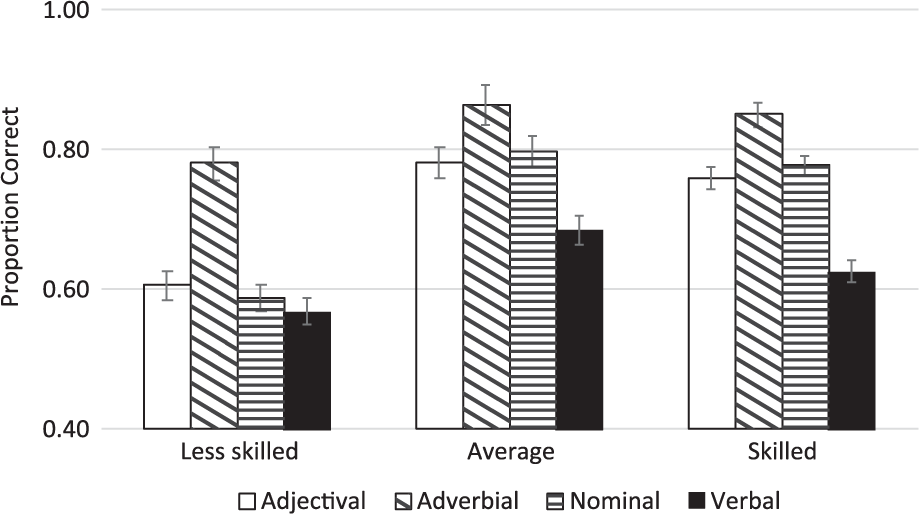
There was a significant interaction between reading level and testing time, F (2, 520) = 3.69, p < .05, η2 = .10; only the skilled readers showed significant improvement over one academic year (see Figure 7). The interaction between level and type was also significant, F (5.25, 136.24) = 8.95, p < .001, η2 = .03. Further analysis revealed that while all three groups found the adverbial suffixes significantly easier than the other suffixes: less skilled readers, F (1, 182) = 70.09, p < .001, η2 = .28; average readers, F (1, 97) = 10.61, p < .05, η2 = .10; skilled readers, F (1, 241) = 32.43, p < .001, η2 = .12, the difference was more pronounced for the less skilled readers than for the average and skilled readers (Figure 8). In addition, while the average and skilled readers found the adjectival and the nominal suffixes significantly easier than the verbal suffixes: average readers, F (1, 97) = 38.12, p < .001, η2 = .28; skilled readers, F (1, 241) = 159.12, p < .001, η2 = .40, the difference was not significant for the less skilled readers, p = .26. The three-way interaction was not significant.
Mean proportion of correct with standard error bars for morphosyntactic awareness by testing time and reading level.

Mean proportion of correct with standard error bars for morphosyntactic awareness by testing time and reading level.

Discussion
The present study revealed several key findings: (a) even the skilled college EFL readers failed to fully grasp morphological principles; (b) the gap in vocabulary between the less skilled readers and the average as well as the skilled readers widened significantly over the course of one academic year; (c) the effect of the phonological and orthographic changes in morphologically complex words did not vary across proficiency levels, but differed for assessment of the meaning of base; (d) progress in different aspects of morphological awareness, such as interpreting the meaning of the suffix or identifying the base of a morphologically complex word, varied significantly among readers of different proficiency levels; and (e) suffixes of different parts of speech pose different challenges to learners. Below we discussed how our findings address each research question, and their relevance to existing literature.
Development of different types of vocabulary
Research Question 1: How do college EFL learners develop vocabulary varying in frequency levels and morphological complexity? Are there any variations associated with students’ reading proficiency levels?
Our findings showed that adult EFL learners’ development of vocabulary did vary with morphological complexity. Learners did not show significant improvement in either low- or high-frequency words. It was unexpected that the learners would not improve in high-frequency words over the course of one academic year, considering that learner performance on the high-frequency words did not reach ceiling. However, these learners demonstrated significant improvement in morphologically complex words during that same time period, which suggests growth in morphological awareness, a core componential skill for effective expansion of academic vocabulary. This finding is also consistent with our hypothesis that college EFL students’ learning of morphologically complex words may outpace their learning of morphologically simple words, given that even adolescent EFL learners have developed some level of morphological awareness (Zhang & Koda, Reference Zhang and Koda2013).
Regardless, it should be noted that none of the groups were able to fully utilize morphological knowledge to interpret morphologically complex words, and the less skilled readers exhibited the least developed morphological awareness. These findings corroborate previous research on the importance of morphological awareness for reading in adult and adolescent ESL learners (Jeong, Reference Jeon2012; To et al., Reference To, Tighe and Binder2016; Zhang & Koda, Reference Zhang and Koda2012). Our vocabulary measure also demonstrated that, with words varying in frequency and morphological complexity, even proficient adult ESL readers may not recognize morphologically complex words with high-frequency bases and treat them as low-frequency or morphologically simple words. These findings have important instructional implications for adult ESL learners. Prior research with young children has shown that explicit instruction on morphology facilitated children’s learning of new words with the same morphological structure (Bowers, Kirby, & Deacon, Reference Bowers, Kirby and Deacon2010). Thus, given the fact that even the skilled adult ESL readers may not fully grasp morphological principles, it is essential that morphological structures are explicitly taught to adult English language learners to support them to become independent learners of English vocabulary.
Our analysis did not reveal an association between reading proficiency level and variations in the development of different types of vocabulary. However, when considering the three types of vocabulary together, we found that while the average and skilled readers performed significantly better on the posttest than on the pretest, the less skilled readers did not show significant improvement. This finding suggests that the vocabulary gap between less skilled and skilled readers is likely to widen over time. The longitudinal design of our study allows us to extend the scope of previous research, and demonstrate that the relationship between vocabulary and reading proficiency can be reciprocal.
There are several reasons why, over time, proficient readers may acquire more new vocabulary than less proficient readers. First, they may internalize vocabulary more efficiently through incidental reading. In a recent study with adult EFL learners, Webb & Chang (Reference Webb and Chang2015) reported that the magnitude of vocabulary increase is positively correlated with initial vocabulary size. In other words, with more advanced reading skills and a wider vocabulary base, proficient readers may be more successful in interpreting the meaning of new words encountered during reading, and also be more strategic in anchoring the new words. Second, as shown in our study and previous research (e.g., Jeon, Reference Jeon2012; To et al., Reference To, Tighe and Binder2016; Zhang & Koda, Reference Zhang and Koda2014), proficient readers tend to have more enhanced morphological awareness. Such a skill helps learners to unlock the meaning of new words that are morphologically complex, and to better retain the meaning of these words. Given the prevalence of morphologically complex words in academic text (Nagy & Townsend, Reference Nagy and Townsend2012), the disparity in vocabulary between the less and the more proficient readers may be more salient in assessments emphasizing academic vocabulary. Third, research has documented a positive and reciprocal relationship between achievement and engagement (e.g., Kaiser, Retelsdorf, Südkamp, & Möller, Reference Kaiser, Retelsdorf, Südkamp and Möller2013). It is thus likely that proficient readers may spend more time on reading than less skilled readers, which will accelerate their vocabulary development. Pinpointing exactly how proficient readers rapidly expand their vocabulary requires controlling for several variables, which is beyond the scope of the present study. However, our research group is collecting relevant contextual data to further explore the issue.
Development of different types of derivational awareness
Research Question 2: Do college EFL learners find certain types of morphologically complex words more challenging than others? Are there any variations associated with students’ reading proficiency level?
Derivational awareness is one of the most important types of morphological awareness when reading academic texts in English (Nagy & Townsend, Reference Nagy and Townsend2012). Considering its multidimensional nature (Kuo & Anderson, Reference Kuo and Anderson2006), derivational awareness in the present study was assessed using two measures: word association and morphosyntactic awareness. While most previous studies have assessed derivational awareness collectively as a single construct, this research examined which specific aspect of derivational awareness posed more of a challenge for adult EFL learners, particularly for less skilled readers.
Word association measures
The analysis of the word association measure focused on two dimensions of derivational awareness. The first dimension is concerned with the phonological and orthographic change of morphologically complex words (e.g., change: receive vs. receipt, simple vs. simplify; no-change: modern vs. modernize). The second dimension focuses on the distinction between knowledge of the base (e.g., receipt: (a) act of returning; (b) act of getting; (c) act of respecting; and (d) act of asking) and knowledge of the suffixes (e.g., modernize: (a) new; (b) look new; (c) to make something new; (d) very new).
Phonological and orthographic change versus no change
Analysis shows that the effect of change is not significant, and neither was its interaction with reading proficiency. These findings may seem inconsistent with previous research that revealed a significant effect associated with phonological and/or orthographic change, and a significant interaction between such change and proficiency levels. For example, Leong (Reference Leong1999) found that college students with and without reading disabilities responded significantly slower to morphologically complex words that involved phonological and/or orthographic change. Fowler, Liberman, & Feldman (Reference Fowler, Liberman, Feldman and Feldman1995) found that skilled child readers outperformed less skilled child readers in identifying the base of a morphologically complex word when the base and the derived form involved a phonological change. More recently, To et al. (Reference To, Tighe and Binder2016) found that while morphological skills were more impaired for both skilled and less skilled adult readers in the phonological change condition, the effect was stronger among the less skilled readers.
The differences in the findings between our studies and previous research may be attributed to a number of factors. First, because the present study emphasized the EFL context and reading skill, a multiple-choice reading task was used. Previous research (i.e., Fowler et al., Reference Fowler, Liberman, Feldman and Feldman1995; Leong, Reference Leong1999; To et al., Reference To, Tighe and Binder2016) used oral production tasks, which could potentially be more challenging, and therefore more sensitive in detecting condition and proficiency-level differences. However, it should also be noted that unlike previous research, which used derivation and base-identification tasks to tap into participants’ implicit understanding of morphological structure, the task used in our study required participants to have a more explicit understanding of morphology. In other words, our study assessed learners’ understanding of what these morphologically complex words mean, rather than just their structure. Therefore, one could argue that the task used in our study was more challenging in this respect.
A second possible explanation for the disparity in the findings is concerned with the inclusion of vocabulary as a controlled variable. Vocabulary was controlled in the present study, but not in any of the previous research that identified the effect of phonological and/or orthographic change. To delve into this explanation further, the covariate vocabulary was removed from the mixed-measure ANOVA in the present study. With the removal of vocabulary as a covariate, the effect of phonological and orthographic change also become significant in our data, which suggests that the inclusion of vocabulary as a covariate in the analysis may be a more plausible explanation for the observed differences between the present study and previous research. We argue that it is essential to control for vocabulary in the analysis to identify the unique role of morphological awareness, and therefore report the findings with vocabulary controlled in our study.
It should be noted, however, that the effect of phonological and orthographic change remains inconclusive in existing research. For example, in To et al. (Reference To, Tighe and Binder2016), the skilled readers showed no difference in the accuracy rate of the condition that involved both phonological and orthographic change, and the condition that involved neither phonological nor orthographic change. Furthermore, the accuracy rate was higher in the conditions that involved both phonological and orthographic change than in the condition that involved phonological change alone. Similarly, in the reaction time results, readers responded either the same or faster in the condition that involved both phonological and orthographic change than in the conditions that involved neither changes. The absence of a consistently lower accuracy rate or longer reaction time was also observed in Leong (Reference Leong1999). These inconsistent findings suggest that some important variables may have been overlooked when examining the effect of phonological and orthographic change. For example, the frequencies of the words across conditions varying in phonological and orthographic change can be a confounding factor (Kuo & Anderson, Reference Kuo and Anderson2006). This variable was not considered in To et al. (Reference To, Tighe and Binder2016) or in Leong (Reference Leong1999). In our study, the frequencies of the morphologically complex words and the bases were all within a certain range. However, token frequencies of the suffixes were not examined in the original design. Future research should more systematically examine how frequencies of morphologically complex words and their bases and suffixes may interact with the effect of phonological and orthographic change on the learning and processing of morphologically complex words.
The effect of phonological and orthographic change was not found to be associated with reading proficiency; however, the interaction between phonological and orthographic change and type was found to be significant and interact with other within-participant variables in important ways. Our findings revealed that the presence of phonological and orthographic change in morphologically complex words posed more of an interference when participants were asked to interpret suffix meanings than base meanings. This finding appears to be somewhat counterintuitive, as phonological and orthographic change typically occurs at the base and not the suffix of morphologically complex words. Further analysis of the data suggests that this interaction may need to be examined in conjunction with the significant effect of type (base vs. suffix) identified in the study. Learners across all three proficiency levels found items assessing the meaning of suffixes to be more challenging than items assessing the meaning of bases. In other words, interpreting the meaning of a suffix is inherently more difficult than identifying the base of morphologically complex words. As revealed in the two-way interaction between type and change, the phonological and orthographic change poses more additional challenge for the suffix condition than for the base condition. This finding may highlight the unique challenge in processing and interpreting the suffixes of morphologically complex words, despite the fact that suffixes typically do not undergo the same amount of phonological or orthographic change as bases.
Our findings complement existing research on the effects of phonological and orthographic change on the acquisition and processing of morphologically complex words in two ways. First, while existing research has primarily used a base-extraction or a derivation task (e.g., Fowler et al., Reference Fowler, Liberman, Feldman and Feldman1995; Leong, Reference Leong1999; To et al., Reference To, Tighe and Binder2016), our study focuses on the impact of phonological and orthographic change on the acquisition and processing of the meaning of morphologically complex words. Second, given the prevalence of morphologically complex words in academic written text, our study used a reading task, instead of an oral task (e.g., Leong, Reference Leong1999; To et al., Reference To, Tighe and Binder2016), to assess morphological awareness.
Type: Base versus suffix conditions
In contrast with the effect of phonological and orthographic change, which affects learners across all levels similarly, the effect of type varies among proficiency levels. The skilled and average readers made significant progress in both the suffix and the base conditions over one semester, and the progress made in both conditions was similar. In other words, the skilled and average readers became more capable of identifying the bases in morphologically complex words as well as more proficient at interpreting the meaning of the suffixes. However, that was not the case for the less skilled readers. Not only was there absence of improvement in their ability to interpret the meaning of the suffixes, but their capacity to identify the base of morphologically complex words declined throughout the semester. This result echoes findings by Jiang, Kuo, & Sonnenburg-Winkler (Reference Jiang, Kuo and Sonnenburg-Winkler2015) who used think-alouds to document how less skilled readers typically process a new word as a single unit without attempting to parcel its structure into familiar parts.
Taken together, these findings have important theoretical and pedagogical implications. Theoretically, the findings reveal that progress in different aspects of morphological awareness, such as interpreting the meaning of the suffix or identifying the base of a morphologically complex word, may vary significantly among readers of different proficiency levels. Pedagogically, the findings suggest that while identifying bases in morphologically complex words may be inherently less challenging than interpreting the meaning of the suffixes, less skilled readers may still require explicit instruction in identifying bases within morphologically complex words.
Part of speech
Morphological awareness is a multidimensional construct (Tighe & Schatschneider, Reference Tighe and Schatschneider2015); a morpheme carries phonological, semantic, orthographic, and syntactic properties. The morphosyntactic measure focused on learners’ understanding of the syntactic properties of morphemes, which was not tapped into by the word association assessment of morphological awareness. Following previous research (e.g., Berninger, Reference Berninger2001; Kieffer & Lesaux, Reference Kieffer and Lesaux2010, Reference Kieffer and Lesaux2012a, Reference Kieffer and Lesaux2012b; Tighe & Schatschneider, Reference Tighe and Schatschneider2015), this task asked participants to complete a sentence containing a morphologically complex word with a base that is a pseudoword coupled with a real suffix (e.g., They expressed no ____ when they saw the accident. (a) walition; (b) waliful; (c) walifully; (d) walify). The purpose of using pseudoword bases is for participants to focus on the syntactic properties of the suffixes. To accurately answer the question, participants would need to: (a) identify the lexical category of the word in the blank (i.e., noun); and (b) select the pseudoword with the suffix that denotes the lexical category. In our measure, all the suffixes are derivational because understanding derivational suffixes is crucial in expanding academic vocabulary in English (Kuo & Anderson, Reference Kuo and Anderson2006).
In accordance with To et al. (Reference To, Tighe and Binder2016), we found that the main effect of reading level is significant, such that average and skilled readers significantly outperformed the struggling readers. Furthermore, while all three proficiency groups made significant improvement from pre- to posttest, the skilled readers showed the most pronounced improvement. The longitudinal design of the study allowed us to expand the scope of existing research and examine how differences in reading proficiency may contribute to later differences in morphosyntactic awareness among adult English language learners.
Our morphosyntactic measure differs from those used in previous studies, as we systematically examined the derivational suffixes with major syntactic properties: noun, verb, adverb, and adjectives. The results showed that the adverbial suffix type was the easiest for all three groups, whereas the verbal suffix type was the most challenging for the average and skilled groups. The finding may seem somewhat unexpected because verbs are conceptually more concrete and are typically acquired earlier in language acquisition than adverbs. Moreover, the English adverbial suffix –ly and verbal suffixes –ize and –fy seem to be comparable in terms of the degree of phonological and orthographic alteration on the base. Further investigation, however, revealed that such differences can be attributed to several factors. First, while Chinese does not have as productive of a derivational morphology as English, Chinese does contain an adverbial affix, –de, which is routinely used and can be attached to most of the adjectives (Packard, Reference Packard, Li, Gaffney and Packard2002). In contrast, the more common verbal affix, –hua4, applies to only a small number of verbs used only in academic text in some fields. Cross-language similarities in morphology may have facilitated the acquisition of adverbial suffixes among our participants, whose native language was Chinese. The second factor was concerned with frequency. The English adverbial suffix –ly not only appears more often than the English verbal suffixes –ize and –ify, both in oral and in written text, but also more consistently applies to adjectives than –ize applies to adjectives or –fy applies to nouns. Such consistency may also contribute to the participants’ mastery of adverbial suffixes.
Another interesting finding is that average and skilled readers find adjectival and nominal suffixes significantly easier than the verbal suffixes, but the low-proficiency readers performed equally across all three types. The observed differences across the three types among the average and skilled readers may appear somewhat counterintuitive at first glance because (a) verbs are conceptually more concrete than adjectives or derived nouns, which typically involve more abstract meanings, and (b) adjectival and nominal suffixes tend to involve more phonological and orthographic change. A possible explanation for this finding is that English has more derived nouns and adjectives than derived verbs. This frequency effect was only evident in the average and skilled readers, but not in the low-proficiency readers, because the latter may not read as often (e.g., Kaiser et al., Reference Kaiser, Retelsdorf, Südkamp and Möller2013) or process text at an abstract level, so therefore the frequency effect would not emerge.
Conclusion and directions for future research
This present study makes several noteworthy contributions to the field. First, the longitudinal design of the study coupled with learners from three different reading proficiency levels allowed us to examine more comprehensively how learners may acquire vocabulary varying in frequency and morphological complexity as a function of proficiency levels over time. Second, the present study calls for a broader conceptualization of morphological awareness. While existing research tends to assess derivational awareness as a single construct, the present study includes an examination of additional aspects of derivational awareness, including explicit understanding of the meaning of the bases and the suffixes and variations associated with syntactic properties of suffixes. Third, the present study identifies two important factors that have been overlooked and may need to be examined more systematically in future research. One is the inclusion of vocabulary as a covariate in assessing the effect of phonological and orthographic change on the acquisition of morphologically complex words. The other factor is the effect of frequency of the morphologically complex words and the associated suffixes.
The present study is not without limitations, several of which should be considered in future research on morphological awareness and vocabulary. First, the reading proficiency levels were established by local assessments, which limited the generalizability of the findings. While we intended to include more widely used reading assessments, such as TOEFL, we unfortunately had to abandon the plan due to time and financial constraints. Future research that involves more widely used reading assessments would increase the generalizability of the findings.
Second, decoding skills were not controlled for in the analysis. Decoding skills have been included in several studies on morphological awareness with adolescent (Kieffer & Box, Reference Kieffer and Box2013; Kieffer & Lesaux, Reference Kieffer and Lesaux2012a, Reference Kieffer and Lesaux2012b) and adult participants (e.g., Tighe & Binder, Reference Tighe and Binder2015). While decoding skills were not found to be a strong and consistent predictor of reading comprehension (Tighe & Binder, Reference Tighe and Binder2015), they did correlate with morphological awareness (Kieffer & Box, Reference Kieffer and Box2013; Tighe & Binder, Reference Tighe and Binder2015). Due to logistic constraints, we were not able to include an assessment of decoding skills, which would need to be individually administered. Future studies should consider controlling for decoding when studying the development of morphological awareness in adult ESL/EFL learners.
The third limitation concerns the frequency norms used to design the word association measures. Kučera and Francis frequency norms were chosen because our measures were adopted from Malabonga et al. (Reference Malabonga, Kenyon, Carlo, August and Louguit2008), Kim et al. (Reference Kim, Kuo, Ramírez, Wu, Ku, de Marin and Eslami2015), and Kuo et al. (Reference Kuo, Ramirez, de Marin, Kim and Unal-Gezer2017), all of which used Kučera and Francis norms. Further, while Kučera and Francis norms are old and based on written text, word difficulties, as indicated by frequency, were consistent with the judgment of an experienced freshmen English instructor at the participating university. In addition, EFL learners may have more experience with written text than oral input in English, making the Kučera and Francis norms appropriate for the context of this study. Nonetheless, several studies have revealed limitations of these norms (e.g., Brysbaert & New, Reference Brysbaert and New2009; Pastizzo & Carbone, Reference Pastizzo and Carbone2007), which should be considered in light of the availability of more updated norms, such as SUBTLEX (Brysbaert & New, Reference Brysbaert and New2009) or HAL (Balota et al., Reference Balota, Yap, Cortese, Hutchison, Kessler, Loftis and Treiman2007).
Fourth, all of our participants are native speakers of Chinese. While Chinese native speakers are considered one of the largest groups of EFL learners, an inclusion of learners from other native languages would provide us with a deeper understanding of how cross-language similarities and differences in morphology would affect adult EFLs’ learning of academic vocabulary; this would have important theoretical and pedagogical implications.
Fifth and finally, contextual factors, such as instructional emphases on vocabulary, morphology and reading strategies, were not examined in the present study, nor were learner factors like reading motivation and learning styles. Each of these factors can potentially affect growth in vocabulary and morphological awareness (Asgari & Mustapha, Reference Asgari and Mustapha2011; Chou, Reference Chou2014), and our research team is currently working on a project to examine the dynamic relationship among these factors and adult EFL learners’ reading and vocabulary development.
Acknowledgments
This research was supported by Grant NSC 100-2410-H-031-043 from the National Science Council, Taiwan. The authors would like to thank the reviewers for their critical comments and feedback on the earlier versions of this manuscript. The authors would also like to thank the students, teachers, and administrators who so graciously participated in or facilitated this research.