
 Δ4,∞,∞;∞
 DΣ
 Δ4,∞,∞;∞
 Δp,q,r;∞


1. Introduction
1·1. Motivation
The relationship between the topology of a manifold and the geometry it admits is a classical topic. For example, Thurston’s work on 3-manifolds has shown that geometry plays an important role in the study of the topology of 3-manifolds.
A spherical CR-structure on a 3-manifold M is a maximal atlas of charts modeled on the boundary
 $\partial \mathbf{H}^2_{\mathbb C}$
of the complex hyperbolic plane
 $\mathbf{H}^2_{\mathbb C}$
, where the transition maps are elements of
 $\mathbf{PU}(2,1)$
. In other words, a spherical CR-structure is a (G, X)-structure with
 $G=\mathbf{PU}(2,1)$
and
 $X=S^3$
. In general, it is difficult to determine whether a 3-manifold admits a spherical CR-structure. In contrast to other geometric structures admitted by 3-manifolds, there are relatively few known examples admitting spherical CR-structures.
We focus on the following important class: a spherical CR-structure on M is called uniformisable if
 $M = \Gamma \backslash \Omega_{\Gamma}$
, where
 $\Omega_{\Gamma}\subset \partial \mathbf{H}^2_{\mathbb C}$
is the discontinuity region of a discrete subgroup
 $\Gamma \lt \mathbf{PU}(2,1)$
acting on
 $\partial \mathbf{H}^2_{\mathbb C}=S^3$
. Thus, the study of discrete subgroups of
 $\mathbf{PU}(2,1)$
is crucial to understanding uniformisable spherical CR-structures. Complex hyperbolic triangle groups provide rich examples of such discrete subgroups.
Let
 $T_{p,q,r}$
be the abstract reflection triangle group with the presentation
 \begin{equation*}\big\langle \sigma_1, \sigma_2, \sigma_3 | \sigma^2_1=\sigma^2_2=\sigma^2_3=(\sigma_2 \sigma_3)^p=(\sigma_3 \sigma_1)^q=(\sigma_1 \sigma_2)^r=id \big\rangle,\end{equation*}
where each of p, q, r is either a positive integer or
 $\infty$
and
 $1/p+1/q+1/r\lt1$
. One can assume that
 $p \leq q \leq r$
. If any of p, q, r is equal to
 $\infty$
, then the corresponding relation is omitted. The ideal triangle group is one with
 $p=q=r=\infty$
. A (p, q, r)-complex hyperbolic triangle group is a representation
 $\rho\;:\; T_{p,q,r}\longrightarrow\mathbf{PU}(2,1)$
where the image of each generator is a complex reflection that fixes a complex line. It is well known [
Reference Pratoussevitch21
] that the space of (p, q, r)-complex hyperbolic triangle groups has real dimension one when
 $3 \leq p \leq q \leq r$
. Therefore, one can parameterise the family of complex hyperbolic triangle groups by
 $\rho_{t}\;:\;T_{p,q,r} \rightarrow \mathbf{PU}(2,1)$
for
 $t \in [0,1]$
. Here
 $\rho_{0}$
corresponds to the
 $\mathbb{R}$
-Fuchsian case, that is,
 $\rho_{0}(T_{p,q,r})$
stabilises an
 $\mathbb{R}$
-plane in
 ${\bf H}^2_{\mathbb C}$
. We denote the image group of a (p, q, r)-complex hyperbolic triangle group by
 $\Delta_{p,q,r}$
, and set
 $\rho_t(\sigma_i)=I_i$
. We further denote the image group by
 $\Delta_{p,q,r;\infty}$
when
 $I_1 I_3I_2 I_3$
is parabolic.
Goldman and Parker first discussed the complex hyperbolic deformation of the ideal triangle group in [
Reference Goldman and Parker10
]. They gave an interval in the moduli space of complex hyperbolic ideal triangle groups whose points correspond to discrete and faithful representations. They conjectured that a complex hyperbolic ideal triangle group
 $\Delta_{\infty,\infty, \infty}=\langle I_1, I_2, I_3 \rangle$
is discrete and faithful if and only if
 $I_1 I_2 I_3$
is not elliptic. Schwartz proved Goldman-Parker’s conjecture in [
Reference Schwartz23, Reference Schwartz24
]. Furthermore, Schwartz [
Reference Schwartz25
] analysed the complex hyperbolic ideal triangle group G when
 $I_1 I_2 I_3$
is parabolic, and showed that the 3-manifold at infinity of the quotient space
 $\mathbf{H}^2_{\mathbb{C}}/G$
is commensurable with the Whitehead link complement in the 3-sphere. In particular, the Whitehead link complement admits a uniformisable spherical CR-structure.
In general, for
 $\Delta_{p,q,r}= \rho_t(T_{p,q,r})$
with
 $\rho_t(\sigma_i)=I_i$
, set
 \begin{equation*}W_A=I_1I_3I_2I_3 \quad \text{and} \quad W_B=I_1I_2I_3.\end{equation*}
Schwartz has also conjectured the following.
Conjecture 1·1 (Schwartz [
Reference Schwartz26
]). The set of
 $t \in [0,1]$
for which
 $\rho_{t}$
is a discrete and faithful representation of
 $T_{p,q,r}$
is the closed interval consisting of the parameters t for which neither
 $W_A$
nor
 $W_B$
is elliptic.
The interval in this conjecture is called the critical interval. The non-zero end-point of the critical interval is called the critical point. The group
 $T_{p,q,r}$
is of type A if
 $W_A$
is parabolic in the representation that corresponds to the critical point. This means that
 $W_A$
becomes elliptic before
 $W_B$
in the moduli space. Otherwise, we say the group
 $T_{p,q,r}$
is of type B. In particular,
 $T_{p,q,r}$
is of type A if
 $p \leq 9$
and of type B if
 $p\ge14$
[
Reference Schwartz26
]. Schwartz’s conjecture has been proved in a few cases [
Reference Parker, Wang and Xie19, Reference Parker and Will20
].
The representation at the critical point is particularly interesting. Note that there is a unique
 $\mathbb{Z}_{3}$
-covering of the Whitehead link complement with four cusps; we denote this manifold by W. If p, q, r are all large enough, then
 $T_{p,q,r}$
is of type B. Moreover, Schwartz [
Reference Schwartz27
] showed that the 3-manifold at infinity of the even subgroup of
 $\Delta_{p,q,r}$
at the critical point is homeomorphic to a manifold obtained by Dehn filling on W. However, for a general critical complex hyperbolic triangle group
 $\Delta_{p,q,r; \infty}$
of type A, the 3-manifold at infinity of it has not been identified yet. Nevertheless, several explicit examples of cusped hyperbolic 3-manifolds admitting uniformisable spherical CR-structures at these critical representations have been found [
Reference Acosta1, Reference Deraux4, Reference Deraux and Falbel3, Reference Jiang, Wang and Xie12, Reference Ma and Xie13, Reference Ma and Xie14
]. The construction of these examples typically relies on sophisticated analysis. The underlying topological or geometric reason for the specific identities of these 3-manifolds at infinity remains unclear. Falbel, Guilloux and Will [
Reference Falbel, Guilloux and Will8
] proposed the philosophy of predicting the 3-manifold when there is an accidental parabolic element. See [
Reference Ma and Xie15
] for the demonstration in a special case. With the main result and conjectures in Section 6, this paper appears to be the initial step in understanding all the 3-manifolds at infinity of complex hyperbolic triangle groups
 $\Delta_{p,q,r; \infty}$
of type A.
1·2. Main result of the paper
The complex hyperbolic triangle group
 $\Gamma=\Delta_{4,\infty,\infty;\infty}$
acting on the complex hyperbolic plane
 ${\bf H}^2_{\mathbb C}$
is generated by complex reflections
 $I_1$
,
 $I_2$
,
 $I_3$
such that the product
 $I_2I_3$
has order four, the products
 $I_3I_1$
,
 $I_1I_2$
are parabolic and the product
 $I_1I_3I_2I_3$
is an accidental parabolic element. Unexpectedly, the product
 $I_1I_2I_3I_2$
is a hidden accidental parabolic element. In this paper, we prove the following.
Theorem 1·2. Let
 $\Gamma=\langle I_1, I_2, I_3 \rangle $
be the critical complex hyperbolic triangle group
 $\Delta_{4,\infty,\infty;\infty}$
. Then the 3-manifold M at infinity of the even subgroup
 $\langle I_1I_2,I_2I_3\rangle$
of
 $\Gamma$
is the quartic cusped hyperbolic 3-manifold
 $S^3-8^4_1$
, where
 $8^4_1$
is the chain link with four components as in Figure 1.
The chain links
 $8^4_1$
(the left) and
 $10^5_1$
(the right). Link diagrams from https://knotinfo.math.indiana.edu/.

The link
 $8^4_1$
in Rolfsen’s list [
Reference Rolfsen22
] is the first link that has crossing number eight and four components. In Hoste–Thistlethwaite’s table,
 $8^4_{1}$
is also the link L8a21.
Let
 $A=I_1I_2 \in \Delta_{4,\infty,\infty;\infty}$
be a parabolic element fixing a point at infinity. We will prove Theorem 1·2 by studying the Ford domain
 $D_{\Sigma}$
of the even subgroup
 $\Sigma$
of
 $\Delta_{4,\infty,\infty;\infty}$
. The topology of the boundary at infinity
 $\partial_{\infty}D_{\Sigma}$
is more complicated than in previous studies [
Reference Deraux5, Reference Jiang, Wang and Xie12, Reference Ma and Xie13, Reference Parker and Will20
]. One reason is that the boundary of
 $\partial_{\infty}D_{\Sigma}$
is an infinite genus (singular) surface, but all those in [
Reference Deraux5, Reference Jiang, Wang and Xie12, Reference Ma and Xie13, Reference Parker and Will20
] are unbounded cylinders. Moreover, even though we know the boundary of
 $ \partial_{\infty}D_{\Sigma}$
is an infinite genus surface, it is also highly non-trivial to prove that
 $ \partial_{\infty}D_{\Sigma}$
is an infinite genus handlebody, rather than a more complicated 3-manifold with incompressible boundary.
Key Ideas of the Proof of the Theorem 1·2. Figure 2 indicates that
 $\partial_{\infty}D_{\Sigma}$
should be an infinite genus handlebody, where each “hole” corresponds to a genus of the handlebody
 $\partial_{\infty}D_{\Sigma}$
. To rigorously prove that
 $\partial_{\infty}D_{\Sigma}$
is a handlebody, our idea is to introduce a set of A-invariant disks
 $A^k(E_B \cup E_{B^{-1}})$
for
 $k \in \mathbb{Z}$
, which cap off the “holes” in Figure 2. The disks can be constructed as follows:
-
(i) first, we choose
 $\mathbb{C}$
-arcs on the spinal spheres such that these arcs are compatible with the side-pairs;
-
(ii) then we construct embedded disks having these
$\mathbb{C}$
-arcs as their boundaries.


This construction involves choices; there is no unique way to select the arcs or the disks they bound. However, we make specific choices that satisfy the necessary invariance properties.
Figure 3 is a combinatorial model of Figure 2. Figure 9 is a small part of Figure 3. The disks
 $E_B$
and
 $E_{B^{-1}}$
are foliated by affine-arcs, so they are ruled surfaces. The intersections
 $E_B\cap\partial_{\infty}D_{\Sigma}$
and
 $E_{B^{-1}}\cap\partial_{\infty}D_{\Sigma}$
are exactly
 $\partial E_B$
and
 $\partial E_{B^{-1}}$
, respectively:
-
(i)
$E_B$
is a purple topological quadrilateral in Figure 9; -
(ii)
$E_{B^{-1}}$
is a red topological quadrilateral in Figure 9.


Figure 5 shows a realistic view of
 $E_B$
and
 $E_{B^{-1}}$
. We decompose
 $\partial_{\infty}D_{\Sigma}$
using the disk family
 ${A^k(E_B \cup E_{B^{-1}}) \;:\; k \in \mathbb{Z}}$
. The resulting complement, denoted
 $\mathcal{H}$
, is an A-invariant horotube homeomorphic to
 $(\mathbb{R}^2 \setminus \mathbb{D}^2) \times \mathbb{R}$
. Having constructed
 $\mathcal{H}$
, we take a fundamental domain for the
 $\langle A \rangle$
-action on it. The 3-manifold M is obtained by applying the full set of side-pairing identifications from
 $D_{\Sigma}$
to this fundamental domain. This process directly yields a presentation for the fundamental group
 $\pi_1(M)$
, completing the proof of Theorem 1·2.
Due to the abundance of conjugacy classes of parabolic elements in
 $\Sigma$
, any fundamental domain for this group is necessarily complicated. For example, a Dirichlet domain D for
 $\Sigma$
centered at the fixed point of
 $I_2I_3$
has an ideal boundary
 $\partial_{\infty}D$
that appears to be a genus-three handlebody. Proving that it is indeed a genus-three handlebody, however, presents significant challenges that are not present in the simpler case of [
Reference Deraux and Falbel3
]. For a Dirichlet domain D of
 $\Delta_{3,3,4;\infty}$
in [
Reference Deraux and Falbel3
], a key step is to show that
 $\partial_{\infty}D$
is a solid torus, that is, a genus one handlebody. Although the proof of Theorem 1·2 is quite involved, we believe that the approach via the Ford domain and the invariant disks offers a clear and effective path to the result.
The fact that there are four, rather than three, cusps of the 3-manifold M at infinity of the even subgroup of
 $\Delta_{4, \infty,\infty;\infty}$
is unexpected. After we have convinced ourselves of this fact (which is not difficult), we continue to study the 3-manifold
 $M_p$
at infinity of the even subgroup of the complex hyperbolic triangle group
 $\Delta_{p, \infty,\infty;\infty}$
for
 $5\leq p \leq 9$
. Inspired by Theorem 1·2 and the main result in [
Reference Ma and Xie14
], we conjecture that the 3-manifold
 $M_p$
is the complement of the chain link
 $C_p$
in the 3-sphere. Moreover, supported by previous results, we conjecture that the chain link
 $C_p$
serves as an ‘ancestor’ in the sense that the 3-manifolds at infinity for complex hyperbolic triangle groups
 $\Delta_{p,q,r;\infty}$
with
 $3 \leq p \leq 9$
can be obtained from (the complement of)
 $C_p$
via Dehn surgery. See Section 6 for details.
In other words, a unified picture of the 3-manifolds at infinity for all type A critical complex hyperbolic triangle groups is starting to take shape.
Outline of the paper. In Section 2 we give the well-known background material on the complex hyperbolic plane. In Section 3, we give the combinatorial information of the Ford domain for the group
 $\Delta_{4,\infty, \infty;\infty}$
. In Section 4, we study the topology of the ideal boundary of the Ford domain of
 $\Delta_{4,\infty,\infty;\infty}$
. Based on the results in Sections 3 and 4, we show that the 3-manifold at infinity of the even subgroup of
 $\Delta_{4,\infty,\infty;\infty}$
is the hyperbolic chain link
 $8_1^4$
in Section 5. Finally, we discuss related topics on 3-manifolds associated with the complex hyperbolic triangle groups with accidental parabolic elements in Section 6.
2. Background
The complex hyperbolic plane is a simply connected Kähler manifold with constant holomorphic sectional curvature
 $-1$
. This section reviews the basic geometry of the complex hyperbolic plane. We also refer the reader to Goldman’s book [
Reference Goldman9
] for more details.
2·1. The complex hyperbolic plane
Consider the Hermitian matrix
 \begin{equation*}H=\left[\begin{array}{c@{\quad}c@{\quad}c}0 & 0 & 1 \\0 & 1 & 0 \\1 & 0 & 0 \\\end{array}\right]\!.\end{equation*}
The Hermitian form on
 $\mathbb{C}^3$
associated with H is given by
 $\langle \mathbf{z}, \mathbf{w} \rangle = \mathbf{w}^* H \mathbf{z}$
. This form has signature (2,1). Then
 ${\mathbb{C}}^3\setminus{0}$
is the disjoint union of the negative cone
 $V_{-}$
, the null cone
 $V_{0}$
, and the positive cone
 $V_{+}$
, where
 \begin{eqnarray*} V_{-} &=& \{ {\bf{z}}\in {\mathbb{C}}^3\;:\; \langle {\bf{z}}, {\bf{z}} \rangle \lt0 \}, \\ V_{0} &=& \{ {\bf{z}}\in {\mathbb{C}}^3\;:\; \langle {\bf{z}}, {\bf{z}} \rangle =0 \}\backslash\{0\} , \\ V_{+} &=& \{ {\bf{z}}\in {\mathbb{C}}^3\;:\; \langle {\bf{z}}, {\bf{z}} \rangle \gt 0 \}.\end{eqnarray*}
Definition 2·1. Let
 $P\;:\; \mathbb{C}^3\backslash\{0\} \longrightarrow \mathbb{C}P^2$
be the natural projectivisation. The complex hyperbolic plane
 $\mathbf{H}^2_{\mathbb{C}}$
is defined to be
 $P(V_{-})$
, and its boundary
 $\partial\mathbf{H}^2_{\mathbb{C}}$
is
 $P(V_{0})$
. The Bergman metric on
 $\mathbf{H}^2_{\mathbb{C}}$
is given by the distance formula
 \begin{equation} \cosh^2\left(\frac{d(u,v)}{2}\right)=\frac{\langle {\bf{u}}, {\bf{v}} \rangle\langle {\bf{v}}, {\bf{u}} \rangle}{\langle {\bf{u}}, {\bf{u}} \rangle \langle {\bf{v}}, {\bf{v}} \rangle}, \end{equation}
where
 ${\bf{u}}, {\bf{v}} \in {\mathbb{C}}^3$
are lifts of u,v. Here d(u,v) is the Bergman distance between two points
 $u,v \in \mathbf{H}^2_{\mathbb{C}}$
.
This model of
 $\mathbf H^{2}_{\mathbb C}$
is also called the Siegel domain. Let
 $q_{\infty}$
be the point at infinity, and let
 $(z_1,z_2)^T$
be a point of
 $\overline {\mathbf{H}^2_{\mathbb{C}}}=\mathbf{H}^2_{\mathbb{C}} \cup \partial \mathbf{H}^2_{\mathbb{C}}$
. We use
 $\mathbf{q}_{\infty}=(1,0,0)^T$
to denote the lift of
 $q_{\infty}$
, and
 $(z_1,z_2,1)^T$
as the standard lift of
 $(z_1,z_2)^T$
.
Let
 $\mathbf{U}(2,1) = \{ A \in \mathbf{GL}(3,\mathbb{C}) \mid A^* H A = H \}$
, and
 $\mathbf{PU}(2,1) = \mathbf{U}(2,1) / \mathbf{U}(1)$
. Let
 $\omega$
be a primitive cube root of unity. Then
 $\mathbf{PU}(2,1)=\mathbf{SU}(2,1)/\langle I,\omega I,\omega^2I\rangle$
, which is the holomorphic isometry group of
 ${\bf H}^2_{\mathbb C}$
.
Elements of
 $\mathbf{SU}(2,1)$
fall into three types. An isometry is loxodromic if it has exactly two fixed points on
 $\partial \mathbf{H}^2_{\mathbb{C}}$
and parabolic if it has exactly one fixed point on
 $\partial \mathbf{H}^2_{\mathbb{C}}$
. An isometry is called elliptic if it has at least one fixed point in
 ${\bf H}^2_{\mathbb C}$
. An elliptic element is called regular elliptic if it has three distinct eigenvalues, otherwise, it is called special elliptic.
The trace of a matrix in
 $\mathbf{SU}(2,1)$
determines the type of the isometry; see Goldman [
Reference Goldman9
, theorem 6·2·4]. Let
 $A \in \mathbf{SU}(2,1)$
be a non-identity element with real trace. Then A is elliptic if
 $-1\leq{\textrm{tr}(A)}\lt3$
. In particular, if
 ${\textrm{tr}(A)}=-1,0,1$
, A is elliptic of order 2, 3 and 4, respectively. Moreover, A is unipotent if
 ${\textrm{tr}(A)}=3$
.
Let
 $\iota$
be given on the level of homogeneous coordinates by complex conjugation
 $(z_1,z_2,z_3)^T\longmapsto(\overline{z_1},\overline{z_2},\overline{z_3})^T$
, which is an anti-holomorphic isometry of
 $\mathbf{H}^2_{\mathbb{C}}$
. Any other anti-holomorphic isometry may be written as the composition of
 $\iota$
and an element of
 $\mathbf{U}(2,1)$
.
2·2. Totally geodesic submanifolds and complex reflections
There are several types of totally geodesic submanifolds in
 $\mathbf H^{2}_{\mathbb C}$
, classified by their dimension: points (0-dim), real geodesics (1-dim), complex lines (2-dim), Lagrangian planes (2-dim), and the entire space (4-dim). Complex lines are the intersections of projective lines in
 $\mathbb{C}P^2$
with
 $\mathbf{H}^2_{\mathbb{C}}$
, which are also called complex geodesics. Lagrangian planes are the images of
 ${\bf H}^2_{\mathbb R}$
under the action of
 $\mathbf{PU}(2,1)$
. As the Riemannian sectional curvature of
 $\mathbf{H}^2_{\mathbb{C}}$
is non-constant, there is no totally geodesic hypersurface in
 $\mathbf{H}^2_{\mathbb{C}}$
.
The ideal boundary in
 $\partial\mathbf H^{2}_{\mathbb C}$
of a complex line is called a
 $\mathbb{C}$
-circle, and that of a Lagrangian plane is called an
 $\mathbb{R}$
-circle. Let C be a complex line. A polar vector of C is the unique positive vector up to scalar multiplication, perpendicular to C with respect to the Hermitian form. Each positive vector corresponds to a complex line.
There is a special class of elliptic elements of order two in
 $\mathbf{PU}(2,1)$
related to complex lines.
Definition 2·2. The complex reflection on a complex line C with polar vector
 ${\bf{n}}$
is a holomorphic isometry of order 2, fixing C pointwise, defined by:
 \begin{equation} I_{C}({\bf{z}})=-{\bf{z}}+\frac{2\langle {\bf{z}}, {\bf{n}} \rangle}{\langle {\bf{n}}, {\bf{n}} \rangle} {\bf{n}}. \end{equation}
The complex line C is usually called the mirror of
 $I_{C}$
.
2·3. The Heisenberg group
Let
 $\mathcal{N}=\mathbb{C}\times \mathbb{R}$
be the Heisenberg group with product
 \begin{equation*} (z,t)\cdot(\zeta,\nu)=(z+\zeta,t+\nu+2\Im(z\bar{\zeta})).\end{equation*}
Then
 $\overline{\mathbf{H}^2_{\mathbb{C}}}$
can be identified with
 ${\mathcal{N}}\times{\mathbb{R}_{\geq0}}\cup \{q_{\infty}\}$
. Any point
 $q=(z,t,u)\in{\mathcal{N}}\times{\mathbb{R}_{\geq0}}$
has the standard lift
 \begin{equation*}{\bf{q}}=\begin{bmatrix}\frac{-|z|^2-u+it}{2} \\[3pt] z \\[3pt] 1 \\\end{bmatrix}.\end{equation*}
Here (z, t, u) is called the horospherical coordinates of
 $\overline {\mathbf{H}^2_{\mathbb{C}}}$
.
When
 $u=0$
, the points are on
 $\partial\mathbf{H}^2_{\mathbb{C}}$
. Hence, we directly identify
 $\partial\mathbf{H}^2_{\mathbb{C}}$
with the union
 $\mathcal{N}\cup \{q_{\infty}\}$
. Fixed
 $u_0 \gt 0$
, the level set
 $u=u_0$
is called the horosphere based at
 $q_{\infty}$
, and the sup-level set
 $u\ge u_0$
is called the horoball based at
 $q_{\infty}$
.
The full stabiliser of
 $\mathbf{q}_{\infty}$
is generated by the isometries of the forms
 \begin{equation*}T_{[z,t]}=\left[\begin{array}{c@{\quad}c@{\quad}c}1 & -\overline{z}& \frac{-|z|^{2}+it}{2} \\ 0 & 1 & z \\ 0 & 0 & 1 \end{array}\right],\ R_{\theta}=\left[\begin{array}{c@{\quad}c@{\quad}c}1 & 0& 0 \\ 0 & e^{i\theta} & 0 \\ 0 & 0 & 1 \end{array}\right] \ \text{and} \ D_{\lambda}=\left[\begin{array}{c@{\quad}c@{\quad}c}\lambda & 0 & 0 \\ 0 & 1 & 0 \\ 0 & 0 & 1/\lambda \end{array}\right],\end{equation*}
where
 $[z,t]\in\mathcal{N}$
,
 $\theta,\lambda\in \mathbb{R}$
and
 $\lambda \neq 0$
. They are called Heisenberg translation, Heisenberg rotation and Heisenberg dilation, respectively. Their actions on
 $\mathcal{N}$
are as follows:
 \begin{equation*} \begin{aligned} T_{(z,t)}\;:\; (\zeta,\nu)&\longmapsto (z+\zeta,t+\nu+2{\textrm{Im}}(z\bar{\zeta}));\\ R_{\theta}\;:\; (\zeta,\nu)&\longmapsto (e^{i\theta}\zeta,\nu);\\ D_{\lambda}\;:\; (\zeta,\nu)&\longmapsto(\lambda \zeta,\lambda^2 \nu). \end{aligned}\end{equation*}
The Cygan metric on
 $\mathcal{N}$
for
 $p=(z,t)$
and
 $q=(w,s)\in\mathcal{N}$
is defined by:
 \begin{equation} d_{\textrm{Cyg}}(p,q)=|2\langle {\bf{p}}, {\bf{q}} \rangle|^{1/2}= | |z-w|^2-i(t-s+2\Im(z\bar{w})) |^{1/2}. \end{equation}
In fact, it is the restriction to
 $\mathcal{N}$
of the extended Cygan metric, defined for
 $p=(z,t,u)$
and
 $q=(w,s,v)\in\mathcal{N}\times{\mathbb{R}_{\geq 0}}$
by the formula
 \begin{equation} d_{\textrm{Cyg}}(p,q)= | |z-w|^2+|u-v|-i(t-s+2\Im(z\bar{w})) |^{1/2}. \end{equation}
The Cygan sphere with center
 $(z_0,t_0)\in\mathcal{N}$
and radius
 $r\gt 0$
in
 $\overline {\mathbf{H}^2_{\mathbb{C}}}$
, is defined by
 \begin{equation} S_{[z_0,t_0]}(r)=\big\{ (z,t,u)\in\overline {\mathbf{H}^2_{\mathbb{C}}}\;:\; \big||z-z_0|^2+u+i(t-t_0+2\Im( z\overline{z_0}))\big|=r^2 \big\}.\end{equation}
Note that
 $S_{[z_0,t_0]}(r)$
can be obtained by the action of
 $T_{[z_0,t_0]}$
on
 $S_{[0,0]}(r)$
. There is another way to define a Cygan sphere:
Definition 2·3. The geographic coordinates
 $(\alpha,\beta,w)$
of
 $q=q(\alpha,\beta,w)\in S_{[0,0]}(r)$
is given by the lift
 \begin{equation} {\bf{q}}={\bf{q}}(\alpha,\beta,w)=\left[ \begin{array}{c} -r^2e^{-i\alpha}/2 \\[2pt] rwe^{i({-}\alpha/2+\beta)} \\[2pt] 1 \end{array} \right], \end{equation}
where
 $\alpha\in [-\pi/2,\pi/2]$
,
 $\beta\in [0, \pi)$
and
 $w\in [-\sqrt{\cos(\alpha)},\sqrt{\cos(\alpha)}]$
. In particular, the ideal boundary of
 $S_{[0,0]}(r)$
on
 $\partial\mathbf{H}^2_{\mathbb{C}}$
are the points with
 $w=\pm\sqrt{\cos(\alpha)}$
.
The following proposition describes the characteristics of the level sets for
 $\alpha$
and
 $\beta$
.
Proposition 2·4 (Goldman [
Reference Goldman9
], Parker and Will [
Reference Parker and Will20
]). Let
 $S_{[0,0]}(r)$
be a Cygan sphere with geographic coordinates
 $(\alpha,\beta,w)$
.
-
(i) For each
$\alpha_0\in [-\pi/2,\pi/2]$
, the set of points in
$S_{[0,0]}(r)$
with
$\alpha=\alpha_0$
is a complex line, called a slice of
$S_{[0,0]}(r)$
. -
(ii) For each
$\beta_0\in [0,\pi)$
, the set of points in
$S_{[0,0]}(r)$
with
$\beta=\beta_0$
is a Lagrangian plane, called a meridian of
$S_{[0,0]}(r)$
. -
(iii) The set of points with
$w=0$
is called the real spine of
$S_{[0,0]}(r)$
.


Regarding the intersection of Cygan spheres, Goldman, Parker and Will proved the following result.
Proposition 2·5 (Goldman [ Reference Goldman9 ], Parker and Will [ Reference Parker and Will20 ]). The intersection of two Cygan spheres is a smooth disk.
Remark 2·6. This disk is frequently called a Giraud disk.
2·4. Isometric spheres and Ford polyhedron
Let
 $g=(g_{ij})$
be an element of
 $\mathbf{PU}(2,1)$
not fixing
 $\mathbf{q}_{\infty}$
. This implies that
 $g_{31}\neq 0$
.
Definition 2·7. The isometric sphere of g, denoted by I(g), is the set
 \begin{equation} I(g)=\left\{ p \in\overline{\mathbf{H}^2_{\mathbb{C}}}\;:\; |\langle {\bf{p}}, {\bf{q}}_{\infty} \rangle | = |\langle {\bf{p}}, g^{-1}({\bf{q}}_{\infty}) \rangle| \right\}. \end{equation}
An isometric sphere is a 3-ball. The spinal sphere of I(g) or g is defined to be
 $I(g)\cap\partial\mathbf{H}^2_{\mathbb{C}}$
, denoted by
 $\partial_{\infty}I(g)$
, which is a 2-sphere. Besides, I(g) is exactly the Cygan sphere with center
 $g^{-1}({\bf{q}}_{\infty})\in\mathcal{N}$
and radius
 $r_g=\sqrt{2/|g_{31}|}$
. The interior of I(g) is the set
 \begin{equation}\left\{ p \in \overline{\mathbf{H}^2_{\mathbb{C}}} \;:\; |\langle {\bf{p}}, {\bf{q}}_{\infty} \rangle | \gt |\langle {\bf{p}}, g^{-1}({\bf{q}}_{\infty}) \rangle| \right\}.\end{equation}
The exterior of I(g) is the set
 \begin{equation}\left\{ p \in \overline{\mathbf{H}^2_{\mathbb{C}}}\;:\; |\langle {\bf{p}}, {\bf{q}}_{\infty} \rangle | \lt |\langle {\bf{p}}, g^{-1}({\bf{q}}_{\infty}) \rangle| \right\}.\end{equation}
We summarise some properties on isometric spheres in the following proposition.
Proposition 2·8 ([
Reference Goldman9
, section 5·4·5]). Let g and h be elements of
 $\mathbf{PU}(2,1)$
which do not fix
 $\mathbf{q}_{\infty}$
and
 $g^{-1}(\mathbf{q}_{\infty})\neq h^{-1}(\mathbf{q}_{\infty})$
. Let
 $f \in\mathbf{PU}(2,1)$
be a unipotent map fixing
 $\mathbf{q}_{\infty}$
. Then the following hold:
-
(i)
$g(I(g))=I(g^{-1})$
, and g maps the exterior of I(g) to the interior of
$I(g^{-1})$
; -
(ii)
$I(gf)=f^{-1}I(g)$
,
$I(fg)=I(g)$
; -
(iii)
$g(I(g)\cap I(h))=I(g^{-1})\cup I(hg^{-1})$
,
$h(I(g)\cap I(h))=I(gh^{-1})\cup I(h^{-1})$
.


Definition 2·9. The Ford domain
 $D_{\Gamma}$
for a discrete group
 $\Gamma \lt \mathbf{PU}(2,1)$
centred at
 $q_{\infty}$
is the intersection of the closures of the exteriors of all isometric spheres of elements in
 $\Gamma$
not fixing
 $\mathbf{q}_{\infty}$
. That is,
 \begin{equation*}D_{\Gamma}=\left\{p\in \overline{\mathbf{H}^2_{\mathbb{C}}}\;:\; |\langle \mathbf{p},\mathbf{q}_{\infty}\rangle|\leq|\langle \mathbf{p},g^{-1}(\mathbf{q}_{\infty})\rangle| \ \forall g\in \Gamma \ \text{with} \ g(\mathbf{q}_{\infty})\neq \mathbf{q}_{\infty} \right\}.\end{equation*}
The boundary at infinity of the Ford domain is made up of pieces of isometric spheres. When
 $q_{\infty}$
is in the domain of discontinuity or is a parabolic fixed point, the Ford domain is preserved by
 $\Gamma_{\infty}$
, the stabiliser of
 $q_{\infty}$
in
 $\Gamma$
. In this case, the fundamental domain for
 $\Gamma$
is the intersection of
 $D_{\Gamma}$
with a fundamental domain for
 $\Gamma_{\infty}$
. Facets of codimensions one, two, three and four in
 $D_{\Gamma}$
are called sides, ridges, edges and vertices, respectively. Moreover, a bounded ridge is a ridge that does not intersect
 $\partial {\bf H}^2_{\mathbb C}$
. Otherwise, the ridge is called an infinite ridge.
It is usually very hard to determine the Ford domain
 $D_{\Gamma}$
because one should check infinitely many inequalities. A common approach is to propose a candidate for the Ford polyhedron and then verify it using the Poincaré polyhedron theorem. The sides of
 $D_{\Gamma}$
should be paired by isometries, and the images of
 $D_{\Gamma}$
under these so-called side-pairing maps should give a local tiling of
 ${\bf H}^2_{\mathbb C}$
. If they do, and if, moreover, the quotient of
 $D_{\Gamma}$
by the identification given by the side-pairing maps is complete, the Poincaré polyhedron theorem implies that the images of
 $D_{\Gamma}$
give a global tiling of
 $\mathbf{H}^2_{\mathbb{C}}$
.
Once a fundamental domain is obtained, one gets a presentation of
 $\Gamma$
. Its generators are given by the side-pairing maps together with a generating set of
 $\Gamma_{\infty}$
. Its relations come from ridge cycles, which correspond to the local tilings around each codimension-two face. For more details on the Poincaré polyhedron theorem, see [
Reference Deraux, Parker and Paupert6, Reference Parker and Will20
].
3. Combinatoric of Ford domain of
$\Delta_{4,\infty,\infty;\infty}$

In this section, we study the combinatorics of the Ford domain of
 $\Delta_{4,\infty,\infty;\infty}$
. The main result is Theorem 3·6.
3·1. The matrix representation of the triangle group
$\Delta_{4,\infty,\infty;\infty}$

Suppose
 $J_1$
and
 $J_2$
are two complex reflections in
 $\mathbf{SU}(2,1)$
such that
 $J_1J_2$
is a unipotent map fixing
 $q_{\infty}$
. Conjugating by a Heisenberg rotation and a Heisenberg dilation if necessary, we may suppose that
 $J_1$
and
 $J_2$
are
 \begin{equation}J_1=\left[\begin{array}{c@{\quad}c@{\quad}c}-1 & 0& 0 \\ 0 & 1 & 0\\ 0 & 0 & -1 \end{array}\right], \quad J_2=\left[\begin{array}{c@{\quad}c@{\quad}c}-1 & -2 & 2 \\ 0 & 1 & -2 \\ 0 & 0 & -1 \end{array}\right].\end{equation}
We want to find
 $J_3$
such that
 $J_2J_3$
is an elliptic element of order 4, and
 $J_3J_1$
,
 $J_1J_2$
,
 $J_1J_3J_2J_3$
are unipotent. Assume that the polar vector of the mirror of
 $J_3$
is
 \begin{eqnarray*} {\bf n}_3 = \left[\begin{matrix} x \\ y+z i \\ 1\end{matrix}\right]\!,\end{eqnarray*}
where
 $x,y,z \in \mathbb{R}$
. Then
 $J_3$
has the following form
 \begin{equation*}J_3=\left[\begin{array}{c@{\quad}c@{\quad}c}\dfrac{-y^2-z^2}{y^2+z^2+2x}& \dfrac{2x(y- z i)}{y^2+z^2+2x}& \dfrac{2x^2}{y^2+z^2+2x} \\[9pt] \dfrac{2(y+z i)}{y^2+z^2+2x} &\dfrac{y^2+z^2-2x}{y^2+z^2+2x}&\dfrac{2x(y+ z i)}{y^2+z^2+2x} \\[9pt] \dfrac{2}{y^2+z^2+2x} & \dfrac{2(y- z i)}{y^2+z^2+2x} & \dfrac{-y^2-z^2}{y^2+z^2+2x}\end{array}\right]\!.\end{equation*}
Note that
 $J_3J_1$
is unipotent, which implies that its trace is 3, yielding
 $x=0$
. Similarly, since
 $J_1J_2$
and
 $J_1J_3J_2J_3$
are unipotent, we have
 $y=1$
and
 $z= \pm 1$
. The groups corresponding to
 $z= \pm 1$
are conjugate via an anti-holomorphic isometry. In this paper, we take
 $z=1$
, then
 \begin{equation*}J_3=\left[\begin{array}{c@{\quad}c@{\quad}c}-1& 0& 0 \\ 1+ i& 1 &0 \\1 & 1-i & -1 \end{array}\right]\!.\end{equation*}
Moreover,
 $\langle J_1, J_2,J_3 \rangle $
is an infinite-index subgroup of the Gauss-Picard modular group
 $\mathbf{PU}(2,1;\mathbb{Z}[i])$
, proving that
 $\langle J_1,J_2,J_3\rangle $
is discrete; see [
Reference Falbel, Francsics and Parker7
]. We thank the referee for pointing out that our results may be derived from the Ford domain of the Gauss-Picard modular group. The discreteness of
 $\Delta_{4,\infty,\infty;\infty}$
was first noted by Thompson [
Reference Thompson28
].
For technical reasons, we conjugate the matrix representation of
 $\Delta_{4,\infty,\infty;\infty}$
by
 \begin{equation*}T=\left[\begin{array}{c@{\quad}c@{\quad}c} 1& 1& \frac{-1-2 i}{2} \\[2pt] 0 &1&-1 \\ 0 & 0 & 1\end{array}\right]\!.\end{equation*}
That is, let
 $I_1=T J_1T^{-1}$
,
 $I_2=T J_2T^{-1}$
, and
 $I_3=T J_3T^{-1}$
be generators of
 $\Delta_{4,\infty,\infty;\infty}$
. Specifically:
 \begin{equation} I_1=\left[\begin{array}{c@{\quad}c@{\quad}c} -1 & 2& 2 \\ 0 & 1 & 2\\ 0 & 0 & -1 \end{array}\right]\!, \quad I_2=\left[\begin{array}{c@{\quad}c@{\quad}c} -1 & 0 & 0 \\ 0 & 1 & 0 \\ 0 & 0 & -1 \end{array}\right]\!,\quad I_3=\left[\begin{array}{c@{\quad}c@{\quad}c} -1/2 & -i/2& 1/4 \\[2pt] i & 0 &i/2 \\[2pt] 1 & -i & -1/2\end{array}\right]\!. \end{equation}
3·2. Ford domain of
$\Delta_{4,\infty,\infty;\infty}$

Let
 $\Gamma=\langle I_1, I_2, I_3\rangle$
be the group
 $\Delta_{4,\infty,\infty;\infty}$
. Let
 $A=I_1I_2$
,
 $B=I_2I_3$
. The subgroup generated by A and B, denoted by
 $\Sigma=\langle A, B\rangle$
, is the even subgroup of
 $\Gamma$
with index two. By direct calculation, we have the following.
 \begin{equation*}A=\left[\begin{array}{c@{\quad}c@{\quad}c}1 & 2& -2 \\ 0 & 1 & -2 \\ 0 & 0 & 1 \end{array}\right]\!, \quad B=\left[\begin{array}{c@{\quad}c@{\quad}c}\frac{1}{2} &\frac{i}{2}&-\frac{1}{4} \\[2pt] i& 0&\frac{i}{2}\\[2pt] -1 &i &\frac{1}{2} \end{array}\right]\!.\end{equation*}
Due to the definition of
 $\Delta_{4,\infty,\infty;\infty}$
, we have that B is elliptic of order 4, and there are three unipotent elements, A, AB, and
 $AB^2$
. In addition,
 $AB^{-1}$
is also unipotent. For future reference, we provide the lifts of their fixed points, as vectors in
 $\mathbb{C}^{3}$
:
 \begin{equation*}\mathbf{p}_{AB}=x_1=\left[\begin{matrix}-\frac{1+2i}{2} \\[2pt] -1 \\ 1 \end{matrix}\right], \ \mathbf{ p}_{AB^2}=x_2=\left[\begin{matrix}-\frac{1}{2} \\[2pt] -1 \\ 1 \end{matrix}\right] \ \text{and} \ \mathbf{ p}_{AB^{-1}}=x_3=\left[\begin{matrix}\frac{-1+2i}{2}\\[2pt] -1\\ 1\end{matrix}\right]\end{equation*}
In this subsection, we will construct a Ford domain
 $D_{\Sigma}$
whose sides are contained in the isometric spheres of some elements of
 $\Sigma$
. The reader is referred to Figures 2 and 3 for visualisations of
 $D_{\Sigma}$
. Figure 2 provides a realistic depiction of the ideal boundary of
 $D_{\Sigma}$
, centered at
 $q_{\infty}$
, for motivational purposes. In this subsection, we will verify that the local combinatorial structure matches this figure.
A realistic view the ideal boundary of the Ford domain of
 $\Delta(4, \infty,\infty;\infty)$
.

An abstract picture of the Ford domain of
 $\Sigma$
. For example, the sphere labelled by B is the spinal sphere
 $\partial_{\infty}I(B)$
, in the notation of Proposition 3·4, it is
 $\partial_{\infty}I^{+}_0$
.

Figure 3 Long description
A diagram of the Ford domain of the complex hyperbolic triangle group Delta(4,∞,∞;∞) acting on the complex hyperbolic plane H^2_C. The diagram includes several labeled spheres and points connected by lines. The central sphere is labeled B, representing the spinal sphere. Surrounding B are other spheres labeled A^-1B^-1A, AB^-1A^-1, A^-1BA, B^-1, and ABA^-1. Points such as x1, x2, x3, y1, w1, w2, w3, and w4 are marked with blue dots and connected by lines indicating relationships and transformations. Arrows and lines illustrate the interactions and transformations between these points and spheres, showing the geometric structure and relationships within the Ford domain.
In Figure 2:
-
(i) the green, black and red spheres are the spinal spheres of
$A^{-1}BA$
, B and
$ABA^{-1}$
, respectively; -
(ii) the blue, purple and steel-blue spheres are the spinal spheres of
$A^{-1}B^{-1}A$
,
$B^{-1}$
and
$AB^{-1}A^{-1}$
, respectively; -
(iii) the cyan, yellow and pink spheres are the spinal spheres of
$A^{-1}B^{2}A$
,
$B^{2}$
and
$AB^{2}A^{-1}$
respectively.


Figure 3 is a combinatorial model of Figure 2. Our subsequent computations will show that the combinatorial model is consistent with Figure 2.
Let I(B),
 $I(B^{-1})$
and
 $I(B^2)$
be the isometric spheres for B,
 $B^{-1}$
and
 $B^2$
, respectively. We give some notation for the isometric spheres, which are the images of I(B),
 $I(B^{-1})$
, and
 $I(B^{2})$
by powers of A.
Definition 3·1. For
 $k\in \mathbb{Z}$
:
-
(1) Let
$I_{k}^{+}$
be the isometric sphere
$I(A^{k}BA^{-k})=A^{k}I(B)$
and
$\partial_{\infty}I_{k}^{+}$
be its corresponding spinal sphere; -
(2) Let
$I_{k}^{-}$
be the isometric sphere
$I(A^{k}B^{-1}A^{-k})=A^{k}I(B^{-1})$
and
$\partial_{\infty}I_{k}^{-}$
be its corresponding spinal sphere; -
(3) Let
$I^{\star}_{k}$
be the isometric sphere
$I(A^{k}B^2A^{-k})=A^{k}I(B^2)$
and
$\partial_{\infty}I_{k}^{*}$
be its corresponding spinal sphere.


The action of A on
 $\mathcal{N}$
is given by
 \begin{equation}(z,t)\longmapsto (z-2, t+4\Im(z)).\end{equation}
In particular, we have the following.
Proposition 3·2. For any value of
 $t_0\in \mathbb{R}$
, A preserves every
 $\mathbb{R}$
-circle of the form
 $(x,t_0)$
with
 $x\in \mathbb{R}$
.
As A is unipotent and fixes
 $q_{\infty}$
, it is a Cygan isometry and preserves the radii of the isometric spheres. This directly proves
Proposition 3·3. For any integer
 $k\in \mathbb{Z}$
:
-
(i) the isometric spheres
$I_{k}^{+}$
and
$I_{k}^{-}$
have the same radius
$\sqrt{2}$
and are centered at
$({-}2k+i,-4k)$
and
$({-}2k-i,4k)$
in Heisenberg coordinates, respectively; -
(ii) the isometric sphere
$I^{\star}_{k}$
has a radius 1 and is centered at
$({-}2k,0)$
in Heisenberg coordinates.


We first consider the intersections of the isometric spheres
 $I_{k}^{\pm}$
and
 $I^{\star}_k$
for
 $k\in \mathbb{Z}$
. By the A-symmetry,
 $I_{l}^{+} \cap I_{l+k}^{+}$
is non-empty if and only if
 $I_{0}^{+} \cap I_{k}^{+}$
is non-empty. Similar properties hold for other intersections of pairs of isometric spheres.
Proposition 3·4. For any
 $k\in \mathbb{Z}$
:
-
(i)
$I_{0}^{+}$
is disjoint from
$I_{k}^{+}$
when
$|k| \geq 2$
; -
(ii)
$I_{0}^{-}$
is disjoint from
$I_{k}^{-}$
when
$|k| \geq 2$
; -
(iii)
$I_{0}^{+}$
is disjoint from
$I_{k}^{-}$
when
$k \neq 0$
; -
(iv)
$I^{\star}_{0}$
is disjoint from
$I^{\star}_{k}$
when
$|k| \geq 2$
; -
(v)
$I^{\star}_{0}$
is disjoint from
$I^{\pm}_{k}$
when
$|k| \geq 1$
; -
(vi)
$I_{0}^{+}$
is tangent to
$I_{1}^{-}$
at the point
$x_1$
; -
(vii)
$I_{0}^{-}$
is tangent to
$I_{1}^{+}$
at the point
$x_3$
; -
(viii)
$I^{\star}_{0}$
is tangent to
$I^{\star}_{1}$
at the point
$x_2$
.


Proof. The assertion (i) follows from the fact that the Cygan distance between the centers of
 $I_{0}^{+}$
and
 $I_{k}^{+}$
is
 $|2k|$
, which is greater than
 $2 \sqrt{2}$
when
 $|k| \geq 2$
. Similarly, we have the assertion (ii).
For (iii), the Cygan distance between the centers of
 $I_{0}^{+}$
and
 $I_{k}^{-}$
is
 $2 \sqrt{k^2+1}$
, which is greater than
 $2 \sqrt{2}$
when
 $|k| \geq 2$
. Hence,
 $I_{0}^{+}$
is disjoint from
 $I_{k}^{-}$
if
 $|k| \geq 2$
. When
 $k= \pm 1$
, we assume that
 \begin{equation*}(x+y i,t) \in \partial_{\infty} I_{0}^{+} \cap \partial_{\infty} I_{ \pm 1}^{-}\end{equation*}
in Heisenberg coordinates with
 $x,y,t \in \mathbb{R}$
. Then considering the equation of an isometric sphere in the Definition 2·7, it is easy to show that there is no
 $(x+y i,t)$
lying in
 $\partial_{\infty} I_{0}^{+} \cap \partial_{\infty} I_{ \pm 1}^{-}$
. This implies that
 $I_{0}^{+} \cap I_{ \pm 1}^{-} = \emptyset$
.
The assertion (iv) follows from the fact that the Cygan distance between the centers of
 $I^{\star}_{0}$
and
 $I^{\star}_{k}$
is
 $|2k|$
, which is greater than 2 when
 $|k| \geq 2$
. The assertion (v) follows from the fact that the Cygan distance between the centers of
 $I^{\star}_{0}$
and
 $I^{\pm }_{k}$
is
 $\sqrt{16k^4+24k^2+1}$
, which is greater than
 $\sqrt{2}+1$
when
 $|k| \geq 1$
.
For a unipotent element
 $g\in \mathbf{PU}(2,1)$
, the isometric spheres I(g) and
 $I(g^{-1})$
are tangent, where the tangent point is exactly the fixed point of g. The assertions (vi), (vii), (viii) follow from the fact that AB,
 $AB^{-1}$
and
 $AB^2$
are unipotent.
Definition 3·5. The infinite polyhedron
 $D_{\Sigma}$
is the intersection of the exteriors of all the isometric spheres in
 $\{I_{k}^{+}, I_{k}^{-},I^{\star}_{k}\;:\; k\in \mathbb{Z}\}$
. That is,
 \begin{equation*}D_{\Sigma}=\{p\in \mathbf{H}^2_{\mathbb{C}}\;:\; |\langle \mathbf{p}, \mathbf{q}_{\infty}\rangle| \leq |\langle \mathbf{p}, A^{k}B^i(\mathbf{q}_{\infty})\rangle|\text{, } \forall k\in \mathbb{Z} \ \text{and} \ i= 1, 2, 3\}.\end{equation*}
We shall use a version of the Poincaré polyhedron theorem for coset decompositions because
 $D_{\Sigma}$
is stabilised by the cyclic subgroup
 $\langle A\rangle$
. See [
Reference Deraux, Parker and Paupert6, Reference Parker and Will20
] for the precise statement of this version of the Poincaré polyhedron theorem. We proceed to show:
Theorem 3·6. The polyhedron
 $D_{\Sigma}$
is a fundamental domain for the cosets of
 $\langle A \rangle$
in
 $\Sigma=\langle A, B \rangle$
. Moreover, the group
 $\Sigma$
is discrete and has the presentation
 \begin{equation*} \langle A, B\;:\; B^4=id\rangle. \end{equation*}
For any
 $k \in \mathbb{Z}$
, we denote
 $I_{k}^{+} \cap D_{\Sigma}$
,
 $I_{k}^{-} \cap D_{\Sigma}$
, and
 $I^{\star}_{k} \cap D_{\Sigma}$
by
 $s_{k}^{+}$
,
 $s_{k}^{-}$
, and
 $s^{\star}_{k}$
, respectively. We will show that they are 3-faces of
 $D_{\Sigma}$
. Let
 \begin{equation*}w_1=\left[\begin{matrix}{-\frac{1+2\sqrt{2}i}{6}} \\[3pt]{-\frac{\sqrt{2}+i}{3}}\\[2pt]1 \end{matrix}\right],w_2=\left[\begin{matrix}{-\frac{1-2\sqrt{2}i}{6}} \\[3pt]{-\frac{\sqrt{2}-i}{3}}\\[2pt]1\end{matrix}\right],w_3=\left[\begin{matrix}{-\frac{1-2\sqrt{2}i}{6}} \\[3pt]{\frac{\sqrt{2}-i}{3}}\\[2pt]1 \end{matrix}\right]\ \text{and}\, w_4=\left[\begin{matrix}{-\frac{1+2\sqrt{2}i}{6}} \\[3pt]{\frac{\sqrt{2}+i}{3}} \\[2pt]1 \end{matrix}\right]\end{equation*}
be four points. Moreover, one can verify that
 $B(w_1)=w_4$
,
 $B(w_4)=w_3$
,
 $B(w_3)=w_2$
, and
 $B(w_2)=w_1$
.
Proposition 3·7. For the isometric spheres
 $I_{0}^{+}$
,
 $I_{0}^{-}$
and
 $I^{\star}_{0}$
:
-
(i) each of
$I_{0}^{+} \cap I^{-}_{0}$
,
$I_{0}^{+} \cap I^{\star}_{0}$
and
$I_{0}^{-} \cap I^{\star}_{0}$
is a Giraud disk; -
(ii) the triple intersection
$I_{0}^{+} \cap I^{-}_{0} \cap I^{\star}_{0}$
is a union of two geodesics crossed at the fixed point of B, whose four endpoints are on
$ \partial {\bf H}^2_{\mathbb C}$
; -
(iii) the four points
$w_1$
,
$w_2$
,
$w_3$
and
$w_4$
are exactly the set
\begin{equation*}I^{+}_0 \cap I^{-}_0 \cap I^{\star}_0 \cap \partial {\bf H}^2_{\mathbb C}.\end{equation*}


Proof. First note that the fixed point of B in
 ${\bf H}^2_{\mathbb C}$
is
 \begin{equation*}\mathbf{p}_{B}=\left[\begin{matrix}-1/2 \\ 0 \\ 1 \end{matrix}\right]\!.\end{equation*}
A direct computation shows that
 $\mathbf{p}_{B}$
lies in
 $I^{+}_0$
,
 $I^{-}_0$
, and
 $I^{\star}_0$
. Moreover,
 $q_{\infty}$
,
 $B(q_{\infty})$
and
 $B^2(q_{\infty})$
are linearly independent. By Proposition 2·5,
 $I_{0}^{-} \cap I^{\star}_{0}$
is a non-empty Giraud disk. Similarly, each of
 $I_{0}^{+} \cap I^{-}_{0}$
and
 $I_{0}^{+} \cap I^{\star}_{0}$
is a non-empty Giraud disk.
We now consider the triple intersection
 $I_{0}^{+}\cap I^{-}_{0}\cap I^{\star}_{0}$
. From (2.6), the geographic coordinates
 $(\alpha,\beta,w)$
of points in
 $I^{\star}_0$
are given by
 \begin{equation} {\bf{q}}={\bf q}(\alpha,\beta,w)=\left[ \begin{array}{c} -e^{-i\alpha}/2 \\[3pt] we^{i({-}\alpha/2+\beta)} \\ 1 \end{array} \right]\!, \end{equation}
where
 $\alpha\in [-\pi/2,\pi/2]$
,
 $\beta\in [0, \pi)$
and
 $w\in [-\sqrt{\cos(\alpha)},\sqrt{\cos(\alpha)}]$
. Since
 ${\bf{q}}\in I^{\star}_0$
, we have
 \begin{equation*}|\langle {\bf{q}}, (q_{\infty}) \rangle |^2 =|\langle {\bf{q}}, B^{-2} (q_{\infty}) \rangle |^2=1.\end{equation*}
We calculate
 $|\langle {\bf{q}}, B^{-1} (q_{\infty}) \rangle |^2 $
to be
 \begin{align} \begin{aligned} w^2+\frac{1+\cos(\alpha)}{2}+w\left(\sin\left(\frac{\alpha-2 \beta}{2}\right)-\sin\left(\frac{\alpha+2 \beta}{2}\right)\right) \end{aligned} \end{align}
and
 $|\langle {\bf{q}}, B (q_{\infty}) \rangle |^2 $
to be
 \begin{align} \begin{aligned} w^2+\frac{1+\cos(\alpha)}{2}-w\left(\sin\left(\frac{\alpha-2 \beta}{2}\right)-\sin\left(\frac{\alpha+2 \beta}{2}\right)\right). \end{aligned} \end{align}
Then the triple intersection
 $I_{0}^{+} \cap I^{-}_{0} \cap I^{\star}_{0}$
is given by
 \begin{align} \left\{ \begin{aligned} w^2+\frac{1+\cos(\alpha)}{2}=1; \qquad & \\[4pt] w\left(\sin\left(\frac{\alpha-2 \beta}{2}\right)-\sin\left(\frac{\alpha+2 \beta}{2}\right)\right)=0. \qquad& \end{aligned} \right. \end{align}
The solutions are
 \begin{equation*}\alpha=\pi, \quad \text{or}\quad w=0, \quad \text{or}\quad \beta=0.\end{equation*}
Since
 $\alpha\in [-\pi/2,\pi/2]$
, we know that
 $\alpha=\pi$
is not a solution of our equation. If
 $w=0$
, then
 $\alpha= 0$
, which corresponds to the point
 $\mathbf{p}_{B}$
. If
 $\beta=0$
, the solutions lie in a meridian of
 $I^{\star}_0$
. In this case, the set
 ${\bf{q}}(\alpha,0,w)$
is a union of two geodesics which intersect at
 $\mathbf{p}_{B}$
, where
 $w = \pm \sqrt{{(1-\cos(\alpha))}/{2}}$
.
Moreover, in the case of
 $\beta=0$
, we consider the intersection of
 $I_{0}^{+}\cap I^{-}_{0}\cap I^{\star}_{0}$
with
 $\partial{\bf H}^2_{\mathbb C}$
. Note that
 $|\langle {\bf{q}}, {\bf{q}} \rangle |^2 =w^2-\cos(\alpha)$
. If
 $\bf{q}\in\partial{\bf H}^2_{\mathbb C}$
, we have
 $w=\pm \sqrt{\cos(\alpha)}$
. Hence the equation
 $\pm \sqrt{\cos(\alpha)}= \pm \sqrt{{(1-\cos(\alpha))}/{2}}$
gives the intersection point. Specifically,
 \begin{equation*}\alpha= \pm \arccos\left(\frac{1}{3}\right)\!,\;\;\beta=0,\;\;\; w= \pm \frac{1}{3^{1/2}}.\end{equation*}
The coordinates of the points
 $w_i$
for
 $i=1, 2, 3, 4$
are as given above.
From Proposition 3·7, we have the following three propositions on the combinatorics of 3-faces
 $s_{0}^{+}$
,
 $s_{0}^{-}$
and
 $s_{0}^{\star}$
. The readers are referred to Figure 4 for illustrations.
3-sides of
 $D_{\Sigma}$
. The left one is
 $s^\star_0$
, the two shaded disks are
 $s^\star_0 \cap \partial {\bf H}^2_{\mathbb C}$
. The central one is
 $s^{+}_0$
, the
 $B^{-1}$
-labelled sectors are
 $s^{+}_0 \cap s^{-}_0$
, the
 $B^{2}$
-labelled sectors are
 $s^{+}_0 \cap s^{\star}_0$
. The right one is
 $s^{-}_0$
, the labelled sectors have similar meanings. In each sub-figure, the fixed point of B is indicated in cyan (for the online edition) or grey (for the print edition).

Proposition 3·8. For the 3-face
 $s_{0}^{+}$
of
 $D_{\Sigma}$
:
-
(i)
$s_{0}^{+} \cap s_{0}^{-}$
is topologically the union of two sectors; -
(ii)
$s_{0}^{+} \cap s^{\star}_{0}$
is topologically the union of two sectors; -
(iii)
$\partial s_{0}^{+} \cap \partial {\bf H}^2_{\mathbb C}$
is a disk; -
(iv)
$s_{0}^{+}$
is a 3-ball in
$\overline{\mathbf{H}^2_{\mathbb{C}}}$
, and
$\partial s_{0}^{+}$
is the union of
$\partial s_{0}^{+} \cap \partial {\bf H}^2_{\mathbb C}$
,
$s_{0}^{+} \cap s_{0}^{-}$
and
$s_{0}^{+} \cap s^{\star}_{0}$
.


Proof. The side
 $s_{0}^{+}$
is contained in the isometric sphere
 $I_{0}^{+}$
. Besides
 $I_{0}^{+}$
is tangent to
 $I_{-1}^{-}$
and
 $I_{1}^{-}$
at a parabolic fixed point respectively, the isometric sphere
 $I_{0}^{+}$
does not intersect with any other isometric spheres except
 $I_{0}^{-}$
and
 $I_{0}^{\star}$
. By Proposition 3·7, both
 $I_{0}^{+} \cap I_{0}^{-}$
and
 $I_{0}^{+} \cap I^{\star}_{0}$
are topologically a union of two sectors. These intersections are glued along
 $I_{0}^{+}\cap I_{0}^{-} \cap I^{\star}_0$
to form a disk in the boundary of
 $s_{0}^{+}$
. The boundary of this disk bounds a disk in
 $I^{+}_0 \cap {\bf H}^2_{\mathbb C}$
. Together, these two disks cobound a 3-ball in
 $I^{+}_0$
, which is
 $s^{+}_0$
.
The proof of Proposition 3·9 is similar and is omitted.
Proposition 3·9. For the 3-face
 $s_{0}^{+}$
of
 $D_{\Sigma}$
:
-
(i)
$s_{0}^{-} \cap s_{0}^{+}$
is topologically the union of two sectors; -
(ii)
$s_{0}^{-} \cap s^{\star}_{0}$
is topologically the union of two sectors; -
(iii)
$\partial s_{0}^{-} \cap \partial {\bf H}^2_{\mathbb C}$
is a disk; -
(iv)
$s_{0}^{-}$
is a 3-ball in
$\overline{\mathbf{H}^2_{\mathbb{C}}}$
, and
$\partial s_{0}^{-}$
is the union of
$\partial s_{0}^{-} \cap \partial {\bf H}^2_{\mathbb C}$
,
$s_{0}^{-} \cap s_{0}^{+}$
and
$s_{0}^{-} \cap s^{\star}_{0}$
.


Proposition 3·10. For the 3-face
 $s^{\star}_{0}$
of
 $D_{\Sigma}$
:
-
(i)
$s^{\star}_0 \cap s_{0}^{+}$
is topologically the union of two sectors; -
(ii)
$s^{\star}_0 \cap s^{-}_{0}$
is topologically the union of two sectors; -
(iii)
$\partial s_{\star}^{-} \cap \partial {\bf H}^2_{\mathbb C}$
is the union of two disjoint disks; -
(iv)
$s^{\star}_{0}$
is a topologically solid light cone in
$\overline{\mathbf{H}^2_{\mathbb{C}}}$
, and
$\partial s_{0}^{+}$
is the union of
$\partial s_{0}^{+} \cap \partial {\bf H}^2_{\mathbb C}$
,
$s^{\star}_0 \cap s_{0}^{-}$
and
$s^{\star}_{0} \cap s_{0}^{+}$
.


Proof. The side
 $s_{0}^{\star}$
is contained in the isometric sphere
 $I_{0}^{\star}$
. Besides being tangent to
 $I_{-1}^{\star}$
and
 $I_{1}^{\star}$
at parabolic fixed points, the isometric sphere
 $I_{0}^{\star}$
does not intersect any other isometric spheres except
 $I_{0}^{+}$
and
 $I_{0}^{-}$
. By Proposition 3·7, both
 $I_{0}^{\star} \cap I_{0}^{+}$
and
 $I_{0}^{\star} \cap I^{-}_{0}$
are topologically a union of two sectors. We also have that
 $I_{0}^{\star} \cap I_{0}^{+}$
and
 $I_{0}^{\star} \cap I^{-}_{0}$
are glued together along
 $I_{0}^{+}\cap I_{0}^{-} \cap I^{\star}_0$
to a light cone on the boundary of
 $s_{0}^{\star}$
. The boundaries of this light cone are two simple curves. Each of them bounds a disk in
 $I^{\star}_0 \cap {\bf H}^2_{\mathbb C}$
. The light cone and the two disks together co-bound a topologically solid light cone in
 $I^{\star}_0$
, which is
 $s^{\star}_0$
.
The side pairing maps on
 $D_{\Sigma}$
are defined by:
 \begin{equation*}A^kBA^{-k}\;:\;s_{k}^{+}\longrightarrow s_{k}^{-},\quad A^kB^{-1}A^{-k}\;:\;s_{k}^{-}\longrightarrow s_{k}^{+}, \quad A^kB^{2}A^{-k}\;:\;s_{k}^{\star}\longrightarrow s_{k}^{\star}.\end{equation*}
By the A-symmetry, we may only consider the following properties.
Proposition 3·11. For the side-pairings B and
 $B^2$
:
-
(i) the side pairing map B is a homeomorphism from
$s_{0}^{+}$
to
$s_{0}^{-}$
. Furthermore, B sends the ridge
$s_{0}^{+} \cap s_{0}^{-}$
to
$s_{0}^{-} \cap s_{0}^{\star}$
and sends the ridge
$s_{0}^{+} \cap s_{0}^{\star}$
to
$s_{0}^{-} \cap s_{0}^{+}$
; -
(ii) the side pairing map
$B^2$
is a self-homeomorphism of
$s_{0}^{\star}$
, and it exchanges the ridges
$s_{0}^{+} \cap s_{0}^{\star}$
and
$s_{0}^{-} \cap s_{0}^{\star}$
.


Proof. The ridge
 $s_{0}^{+}\cap s_{0}^{-}$
is defined by the triple equality
 \begin{equation*}|\langle z, \mathbf{ q}_{\infty}\rangle|=|\langle z, B^{-1}(\mathbf{ q}_{\infty})\rangle|=|\langle z, B(\mathbf{ q}_{\infty})\rangle|.\end{equation*}
The map B sends
 \begin{equation*}\{\mathbf{ q}_{\infty}, B^{-1}(\mathbf{ q}_{\infty}), B(\mathbf{ q}_{\infty}) \}\end{equation*}
to
 \begin{equation*}\{B(\mathbf{q}_{\infty}), \mathbf{ q}_{\infty}, B^2(\mathbf{ q}_{\infty})\}.\end{equation*}
So B sends the ridge
 $s_{0}^{+} \cap s_{0}^{-}$
to
 $s_{0}^{-} \cap s_{0}^{\star}$
. Another claim in Proposition 3·11 can be proved similarly.
Proof of Theorem 3·6. After Propositions 3·8, 3·9, 3·10 and 3·11.
Local tessellation. We prove the tessellations around the sides and ridges of
 $D_{\Sigma}$
.
-
(1) Since
$A^kB^{\pm}A^{-k}$
sends the exterior of
$I_k^{\pm}$
to the interior of
$I_k^{\mp}$
, we see that
$D_{\Sigma}$
and
$A^kB^{\pm}A^{-k}(D_{\Sigma})$
have disjoint interiors and cover a neighbourhood of each point in the interior of the 3-side
$s_k^{\mp}$
. -
(2) For the ridge
$s_{0}^{+} \cap s_{0}^{\star}$
, the ridge circle is This gives the relation
\begin{align*} s_{0}^{+} \cap s_{0}^{\star} \xrightarrow{B} s_{0}^{+} \cap s_{0}^{-} \xrightarrow{B} s_{0}^{-} \cap s_{0}^{\star} \xrightarrow{B^2} s_{0}^{+} \cap s_{0}^{\star}.\end{align*}
$B^4=id$
; By a standard argument as in [
Reference Parker and Will20
], we have that
$D_{\Sigma} \cup B^2(D_{\Sigma}) \cup B^{-1}(D_{\Sigma})$
covers a small neighborhood of
$s_{0}^{+} \cap s_{0}^{\star}$
.


Completeness. We must construct a system of consistent horoballs at the parabolic fixed points. First, we consider the side pairing maps on the parabolic fixed points
 $x_1=p_{AB}$
,
 $x_2=p_{AB^2}$
and
 $x_3=p_{AB^{-1}}$
. We have
 \begin{eqnarray*} B &:& p_{AB} \longrightarrow p_{BA},\\ A&:& p_{BA} \longrightarrow p_{AB},\\ B^2 &:& p_{AB^{2}} \longrightarrow p_{B^2A} ,\\ A &:& p_{B^{2}A} \longrightarrow p_{AB^{2}},\\B^{-1} &:& p_{AB^{-1}} \longrightarrow p_{B^{-1}A},\\A &:& p_{B^{-1}A} \longrightarrow p_{AB^{-1}}.\end{eqnarray*}
Up to powers of A, the cycles for the parabolic fixed points are the following
 \begin{eqnarray*} &&p_{AB} \xrightarrow{B} p_{BA}\xrightarrow{A} p_{AB},\\ &&p_{AB^2} \xrightarrow{B^2} p_{B^2A}\xrightarrow{A} p_{AB^2},\\&& p_{AB^{-1}} \xrightarrow{B^{-1}} p_{BA^{-1}}\xrightarrow{A} p_{AB^{-1}}.\end{eqnarray*}
That is,
 $p_{AB}$
,
 $p_{AB^2}$
and
 $p_{AB^{-1}}$
are fixed by AB,
 $AB^2$
and
 $AB^{-1}$
respectively. The elements AB,
 $AB^2$
and
 $AB^{-1}$
are unipotent and preserve all horoballs at
 $p_{AB}$
,
 $p_{AB^2}$
and
 $p_{AB^{-1}}$
respectively.
This completes the proof of Theorem 3·6.
4. Topology of the ideal boundary of the Ford domain
$D_{\Sigma}$

In this section, we study the topology at infinity of the Ford domain
 $D_{\Sigma}$
of
 $ \Sigma \lt \Delta_{4,\infty,\infty;\infty}$
. Take the singular surface
 \begin{equation*}\mathcal{S} = \bigcup_{k \in \mathbb{Z}} \big(\big(s_k^{+} \cup s_k^{-} \cup s_k^{ \star}\big)\cap \partial \mathbf{H}^2_{\mathbb{C}}\big)\end{equation*}
in the Heisenberg group. Part of
 $\mathcal{S}$
is shown in Figures 2 and 3. The ideal boundary of a Ford domain is the intersection of the exteriors of all spinal spheres. Thus, the ideal boundary of
 $D_{\Sigma}$
,
 \begin{equation*}\partial_{\infty} D_{\Sigma}=D_{\Sigma} \cap \partial \mathbf{H}^2_{\mathbb{C}},\end{equation*}
is the region outside
 $\mathcal{S}$
in Figures 2 and 3. We will show that
 $\partial_{\infty} D_{\Sigma}$
is an A-invariant infinite genus handlebody.
Figure 2 indicates that there are “holes” in
 $\partial_{\infty} D_{\Sigma}$
. One “hole” with a purple boundary (the topological quadrilateral [
 $x_1$
,
 $y_1$
,
 $x_2$
, AB
2 (
 $y_1$
)]) shown in Figure 3 is enclosed by the spinal spheres of
 $I^{+}_0$
,
 $I^{\star}_0$
,
 $I_{1}^{-}$
and
 $I_{1}^{\star}$
, labelled as B,
 $B^2$
,
 $AB^{-1}A^{-1}$
and
 $AB^2A^{-1}$
respectively. The “holes” make the topology of
 $\partial_{\infty}D_{\Sigma}$
dramatically different from that studied in [
Reference Deraux5, Reference Jiang, Wang and Xie12, Reference Ma and Xie13, Reference Parker and Will20
]. The ideal boundaries of the Ford domains in this literature are all infinite cylinders. Since the topology of
 $\partial_{\infty} D_{\Sigma}$
is complicated, we need explicit disks to cut out a 3-ball from it in our proof of Theorem 1·2.
4·1. Two disks
$E_B$
and
$E_{B^{-1}}$


We will construct a set of disks
 \begin{equation*}\big\{A^{k}(E_B \cup E_{B^{-1}})\big\}_{k \in \mathbb{Z}},\end{equation*}
which cap off all the “holes” in
 $\partial_{\infty} D_{\Sigma}$
. By cutting
 $\partial_{\infty} D_{\Sigma}$
along these disks, we obtain an infinite cylinder, which is topologically a solid torus.
Recall the points
 $x_{i}$
for
 $i=1,2,3,4$
in Section 3, and consider two additional points
 \begin{equation*}y_1=\left[\begin{matrix}-\frac{1}{2} \\[4pt] -\frac{\sqrt{3}-i}{2} \\[4pt] 1 \end{matrix}\right] \in \partial_{\infty}I^{+}_0\cap \partial_{\infty}I^{\star}_0, \quad\quad y_2=\left[\begin{matrix}-\frac{1}{2} \\[4pt] -\frac{\sqrt{3}+i}{2} \\[4pt] 1\end{matrix}\right] \in \partial_{\infty}I^{-}_0\cap \partial_{\infty}I^{\star}_0.\end{equation*}
Now, consider the topological circle
 $C_{B}$
consisting of the following four arcs:
-
(i) let
$C_5$
be the arc in
$s^{+}_0 \cap \partial \mathbf{H}^2_{\mathbb C}$
joining
$x_1$
to
$y_1$
given by
\begin{equation*} C_5=\left\{\begin{bmatrix}-\frac{1}{2}-e^{2si}-i\sqrt{2\cos{(2s)}}e^{\frac{2s-\pi}{4}i} \\[4pt]-\sqrt{2\cos{(2s)}}e^{\frac{2s-\pi}{4}i}+i \\[4pt]1\end{bmatrix}\;:\; s\in \left[\frac{5\pi}{6},\pi\right]\right\}\!;\end{equation*}
-
(ii) let
$C_1$
be the
$\mathbb{C}$
-arc in
$s^{\star}_0 \cap \partial \mathbf{H}^2_{\mathbb C}$
joining
$y_1$
to
$x_2$
given by
\begin{equation*} C_1=\left\{\begin{bmatrix}-\frac{1}{2} \\[4pt]e^{is} \\1\end{bmatrix}\;: \ s\in \left[\frac{5\pi}{6},\pi\right]\right\}\!;\end{equation*}
-
(iii) let
$C_6$
be the arc in
$s^{-}_1 \cap \partial \mathbf{H}^2_{\mathbb C}$
joining
$AB^2(y_1)$
and
$x_1$
given by
\begin{equation*} C_6=\left\{\begin{bmatrix}-\frac{5}{2}-2i-e^{2si}+(2-i)\sqrt{2\cos{(2s)}}e^{\frac{2s-\pi}{4}i} \\[4pt]-2-i+\sqrt{2\cos{(2s)}}e^{\frac{2s-\pi}{4}i} \\[4pt]1\end{bmatrix}\;: \ s\in \left[\frac{5\pi}{6},\pi\right]\right\}\!;\end{equation*}
-
(iv) let
$C_2$
be the
$\mathbb{C}$
-arc in
$s^{\star}_1 \cap \partial \mathbf{H}^2_{\mathbb C}$
joining
$x_2$
and
$AB^2(y_1)$
given by
\begin{equation*} C_2=\left\{\begin{bmatrix}-\frac{5}{2}-2e^{is} \\[4pt] -2-e^{is} \\[1pt] 1 \end{bmatrix}\;: \ s\in \left[\frac{5\pi}{6},\pi\right]\right\}\!.\end{equation*}


We will show later that the union of
 $C_5$
,
 $C_1$
,
 $C_6$
, and
 $C_2$
forms a simple closed curve, denoted
 $C_B$
. We use ruled surfaces to construct a disk
 $E_B$
with boundary
 $C_{B}$
. One ruled surface, with directrices
 $C_5$
and
 $C_1$
, is denoted by
 $E_B^l$
; another, with directrices
 $C_6$
and
 $C_2$
, is denoted by
 $E_B^r$
. Let
 $c_i$
represents the coordinates of
 $C_i$
in
 $\mathcal{N}$
for
 $i=1,2,5,6$
. The ruled surfaces can be described as
 \begin{equation*} E_B^l=(1-a)\cdot c_5+a\cdot c_1,\quad E_B^r=(1-a)\cdot c_6+a\cdot c_2\end{equation*}
for
 $a\in[0,1]$
. In Figure 5,
 $E_B^l$
is shown in blue and
 $E_B^r$
in green. We define
 $E_B = E_B^l \cup E_B^r$
. It is easy to verify that
 $E_B^l\cap E_B^r$
is the straight-line segment from
 $x_1$
to
 $x_2$
in
 $\mathcal{N}$
. In Figure 5,
 $E_{B}$
patches up the “hole” of
 $\partial_{\infty} D_{\Sigma}$
enclosed by the spinal spheres
 $\partial_{\infty}I_0^{+}$
,
 $\partial_{\infty}I_1^{-}$
,
 $\partial_{\infty}I^{\star}_0$
and
 $\partial_{\infty}I^{\star}_1$
.
The disks EB (the union of the blue triangle [
 $x_1$
,
 $y_1$
,
 $x_2$
] and green triangle [
 $x_1$
,
 $x_2$
,
 $AB^2(y_{1})$
]) and EB-1 (the union of the cyan triangle [
 $x_2$
,
 $y_2$
,
 $x_3$
] and yellow triangle [
 $x_2$
,
 $x_3$
,
 $AB^2(y_2)$
]).

The disk
 $E_{B}$
caps off the “hole” of
 $\partial_{\infty} D_{\Sigma}$
enclosed by the spinal spheres
 $\partial_{\infty}I_0^{+}$
(black, remaining black in print),
 $\partial_{\infty}I_1^{-}$
(steelblue, appearing grey in print),
 $\partial_{\infty}I^{\star}_0$
(yellow, appearing light grey in print) and
 $\partial_{\infty}I^{\star}_1$
(pink, appearing light grey in print).

As an example, we give the Heisenberg coordinates of
 $E_B^l$
:
 \begin{equation} \begin{cases} x=\cos{(s)}a -\sqrt{2\cos{(2s)}}\sin{\frac{2s+\pi}{4}}\cdot(1-a)\\[4pt] y=\sin{(s)}a+\Big(1+\sqrt{2\cos{(2s)}}\cos{\frac{2s+\pi}{4}}\Big)\cdot(1-a)\\[4pt] t=-2\Big(\sin{(2s)}+ \sqrt{2\cos{(2s)}}\sin{\frac{2s+\pi}{4}}\Big)\cdot(1-a),\end{cases}\end{equation}
where
 $a\in[0,1]$
and
 $s\in[{5\pi}/{6},\pi]$
. We use projection mapping to give results on whether
 $E_B^l$
intersects the spinal spheres.
Lemma 4·1. Let
 $\Pi\;:\;\mathcal{N}\longrightarrow\mathbb{C}$
be the nature projection. The union of
 $\Pi(C_5)$
and
 $\Pi(C_1)$
is a simple closed curve in
 $\mathbb{C}$
contained in
 $\Pi(\partial_{\infty}I_0^{-})$
and
 $\Pi(\partial_{\infty} I_1^{-})$
. Besides,
-
(i)
$\Pi(E_B^l)$
intersects
$\Pi(\partial_{\infty}I_0^{-})$
and
$\Pi(\partial_{\infty} I_1^{-})$
at the same point
$\Pi(x_1)$
; -
(ii)
$\Pi(E_B^l)$
intersects
$\Pi(\partial_{\infty}I_0^{*})$
to be the arc
$\Pi(C_1)$
; -
(iii)
$\Pi(E_B^l)$
intersects
$\Pi(\partial_{\infty}I_k^{*}\cup \partial_{\infty}I_k^{+}\cup \partial_{\infty}I_k^{-})_{k\in \mathbb{Z}}$
to be the empty set for
$k\neq 0,1$
.


Proof. According to the equations of
 $C_5$
and
 $C_1$
, it is easy to know
 \begin{equation*}\Pi(C_5)\cap \Pi(C_1)=\Pi(y_1) \cup \Pi(x_1).\end{equation*}
So
 $\Pi(C_5) \cup \Pi(C_1)$
is a simple closed curve. It is also easy to check that
 $\Pi(C_5)$
and
 $\Pi(C_1)$
are all contained in
 $\Pi(\partial_{\infty}I_1^{+})$
and
 $\Pi(\partial_{\infty}I_0^{+})$
. We have completed the first half of the proof.
For (i), according to
 \begin{equation*}\Pi(x_1)=\Pi(x_2)=\Pi(\partial_{\infty}I_0^{+})\cap\Pi(\partial_{\infty}I_1^{-})=\Pi\big(\partial_{\infty}I_0^{-}\big)\cap\Pi(\partial_{\infty}I_1^{+}),\end{equation*}
and the affine convexity of
 $\Pi(\partial_{\infty}I_0^{+})$
and
 $\Pi(\partial_{\infty}I_1^{+})$
, we know that
 \begin{equation*}\Pi\big(E_B^l\big)\cap\Pi\big(\partial_{\infty}I_0^{-}\big)=\Pi\big(E_B^l\big)\cap\Pi\big( \partial_{\infty}I_1^{-}\big)=\Pi(x_1).\end{equation*}
For (ii), we prove that for a given
 $s\in[{5\pi}/{6},\pi]$
, the projection of each straight line on
 $E_B^l$
, with parameterisation (4.1), intersects
 $\Pi(C_1)$
at one point. Write
 $d_u=\big(\cos{(s)},\sin{(s)}\big)$
, which is the coordinate of some point in
 $\Pi(C_1)$
. It is also the vector from the origin O in
 $\mathbb{C}$
to this point. Write
 $d_l=\big({\partial x}/{\partial a},{\partial y}/{\partial a}\big)\big |_{a=1}$
, which is the direction of the projection of the straight line on
 $E_B^l$
. Note that when
 $a=0$
, the corresponding point of
 $E_B^l$
is in
 $C_5$
, and when
 $a=1$
, the corresponding point is in
 $C_1$
. By calculating the inner product of
 $-d_l$
and
 $d_u$
, we can determine whether the point in the straight line of
 $\Pi(E_B^l)$
is far away from
 $\Pi(C_1)$
when a decreases from 1 to 0. In fact, the inner product of
 $-d_l$
and
 $d_u$
is
 \begin{equation*} \begin{aligned} &\left(\sin{\left(\frac{s}{2}\right)}-\cos{\left(\frac{s}{2}\right)}\right)\sqrt{\cos{(2s)}}+ \sin{(s)}-1\\[4pt] &=-\sqrt{2}\sin{\left(\frac{\pi}{4}-\frac{s}{2}\right)} \cdot \left(\sqrt{2}\sin{\left(\frac{\pi}{4}-\frac{s}{2}\right)}+\sqrt{\cos{(2s)}}\right), \end{aligned} \end{equation*}
which is non-negative when
 $s\in[{5\pi}/{6},\pi]$
. By the affine convexity of
 $\Pi( \partial_{\infty}I^{\star}_0)$
, we have
 $\Pi(E_B^l)\cap \Pi(\partial_{\infty}I^{\star}_0)=\Pi(C_1)$
.
For (iii), because
 \begin{equation*}\Pi\big(E_B^l\big)\subset\Pi\big(\partial_{\infty}I_0^{-}\big)\cap\Pi\big( \partial_{\infty}I_1^{-}\big),\end{equation*}
which is outside all
 $\Pi(\partial_{\infty}I_k^{*}\cup \partial_{\infty}I_k^{+}\cup \partial_{\infty}I_k^{-})_{k\in \mathbb{Z}}$
for
 $k\neq 0,1$
, we get the conclusion.
The projections of
 $\partial_{\infty} I_0^{\pm}$
,
 $\partial_{\infty}I_1^{\pm}$
,
 $\partial_{\infty}I_{0}^{\star}$
,
 $\partial_{\infty}I_1^{\star}$
,
 $E_{B}$
,
 $E_{B^{-1}}$
and F.

Instead of depicting the entire projections of
 $E_B^l$
and
 $E_B^r$
, we show the projections of several representative straight lines from these surfaces in Figure 7, represented by blue and green segments, respectively. The projections of
 $E_{B}$
and
 $E_{B^{-1}}$
are the union of blue and green crescents and the union of yellow and cyan crescents respectively. The projection of
 $\partial_{\infty} I_0^{+}$
,
 $\partial_{\infty} I_0^{-}$
,
 $\partial_{\infty} I_1^{+}$
and
 $\partial_{\infty} I_1^{-}$
are the round disk with radius
 $\sqrt{2}$
and centered at i,
 $-i$
,
 $-2+i$
and
 $-2-i$
, respectively. The projections of
 $\partial_{\infty} I_{0}^{\star}$
and
 $\partial_{\infty} I_1^{\star}$
are round disks with radius 1 and centered at 0 and
 $-2$
respectively. The projection of F is the union of magenta, coral and navy curves. (Colours online. In print: blue and navy appear as dark grey; green, yellow, cyan and coral appear as light grey; magenta appears as grey.) Figure 8 gives an enlarged view of
 $\Pi(E_B^l)$
.
An enlarged view of
 $\Pi(E_B^l)$
and part of
 $\Pi(\partial_{\infty}I^{\star}_0)$
.

For the relationship between
 $E_B^l$
and the remaining spinal spheres, we have:
Lemma 4·2. For
 $E_B^l\cap(\partial_{\infty}I_0^{+}\cup \partial_{\infty}I_1^{+}\cup \partial_{\infty}I_0^{*})$
, we have:
-
(i)
$E_B^l\cap \partial_{\infty}I_0^{+}=C_5$
; -
(ii)
$E_B^l\cap \partial_{\infty}I_1^{*}=x_2$
; -
(iii)
$E_B^l\cap \partial_{\infty}I_1^{+}=\emptyset$
.


Proof. Let
 $p(s,a)=(x(s,a),y(s,a),t(s,a))\in E_B^l$
be the point given by Equation (4.1). For (i), consider the Cygan distance between
 $B^{-1}(q_{\infty})$
and p(s, a). Let
 \begin{equation*}g(s,a)=d_{\textrm{Cyg}}^4\big(B^{-1}(q_{\infty}), p\big)=\big(x^2+(y-1)^2\big)^2+(t-2x)^2\end{equation*}
with
 $a\in[0,1]$
and
 $s\in[{5\pi}/{6},\pi]$
. Then
 \begin{equation*} \begin{aligned} \frac{\partial g(s,a)}{\partial a}\Big |_{a=0}&=16\cos^{3/2}{(2s)}\left(\sin{\frac{s}{2}}-\cos{\frac{s}{2}}\right) +4(\sin{(3s)}-\cos{(4s)}+\sin{(s)})-12\\ &\ge 0, \end{aligned}\end{equation*}
for
 $s\in[{5\pi}/{6},\pi]$
by Lemma 4·3 later. By the affine convexity of the isometric spheres, we know that for
 $a\in[0,1]$
and
 $s\in[{5\pi}/{6},\pi]$
,
 \begin{equation*}d_{\textrm{Cyg}}\big(B^{-1}(q_{\infty}), p(s,a) \big)\ge d_{\textrm{Cyg}}\big(B^{-1}(q_{\infty}), p(s,0) \big),\end{equation*}
and the equality holds if and only if
 $a=0$
, which are points on
 $C_5$
.
For (ii), let
 \begin{equation*}h(s,a)=d_{\textrm{Cyg}}^4\big(AB^2A^{-1}(q_{\infty}), p(s,a) \big)=((x+2)^2+y^2)^2+(t-2y)^2,\end{equation*}
where
 $a\in[0,1]$
and
 $s\in[{5\pi}/{6},\pi]$
. By Lemma 4·3 later, we have
 \begin{equation*} \begin{aligned} \frac{\partial h(s,a)}{\partial a}\Big |_{a=1}=&\left(96\cos^3{\frac{s}{2}}+12\cos{\frac{s}{2}}+ 4\sin{\frac{s}{2}}\right)\sqrt{\cos{(2s)}}+ 52\cos{(s)}-28\sin{(s)} \\ &\qquad+ 12\cos{(2s)}+4\cos{(3s)}- 8\sin{(2s)}+ 40 \le 0, \end{aligned}\end{equation*}
for
 $s\in[{5\pi}/{6},\pi]$
. By the affine convexity of the isometric spheres, we know that for
 $a\in[0,1]$
and
 $s\in[{5\pi}/{6},\pi]$
,
 \begin{equation*}d_{\textrm{Cyg}}\big(AB^2A^{-1}(q_{\infty}), p(s,a) \big)\ge d_{\textrm{Cyg}}\big(AB^2A^{-1}(q_{\infty}), p(s,1) \big)\ge1.\end{equation*}
The first equality holds if and only if
 $a=1$
, and the second equality holds if and only if
 $s=\pi$
, corresponding to the point
 $x_2$
.
For (iii), consider the plane
 \begin{equation*} -3 (X + 1 + Y)+T=0\end{equation*}
in the Heisenberg group. On the one hand, it is easy to check that
 $t-3(x + 1 + y)\le0$
, and the equality holds if and only if
 $p(s,a)=x_2$
. On the other hand,
 \begin{equation*}\partial_{\infty}I_1^{+}=\left\{\begin{bmatrix}2i-e^{-\alpha i}\pm(2+i)\sqrt{2\cos{\alpha}}\cdot e^{({-}\frac{\alpha}{2}+\beta)i}-\frac{5}{2} \\[4pt]-2+i\pm\sqrt{2\cos{\alpha}}\cdot e^{({-}\frac{\alpha}{2}+\beta)i} \\[1pt]1\end{bmatrix}\; : \ \alpha\in \left[-\frac{\pi}{2},\frac{\pi}{2}\right],\ \beta\in [0,\pi)\right\}\!.\end{equation*}
Let
 $p_0\in \partial_{\infty}I_1^{+}$
be a point with Heisenberg coordinates
 $(x_0,y_0,t_0)$
. Then
 \begin{equation*} \begin{aligned} -3(x_0 + 1 + y_0)+t_0&=\mp\sqrt{2\cos{\alpha}}\left(\cos{\left(\frac{\alpha}{2}-\beta\right)}+\sin{\left(\frac{\alpha}{2}-\beta\right)}\right)+2\sin{\alpha}+4\\ &\geq -2\sqrt{\cos{\alpha}}+2\sin{\alpha}+4\gt 0. \end{aligned}\end{equation*}
Hence,
 $E_B^l$
and
 $\partial_{\infty}I_1^{+}$
are separated by the above plane.
Lemma 4·3. Let
 \begin{equation*} \begin{aligned} f_1(s)&=16\cos^{3/2}{(2s)}\left(\sin{\frac{s}{2}}-\cos{\frac{s}{2}}\right) +4(\sin{(3s)}-\cos{(4s)}+\sin{(s)})-12\\ \text{and}\quad f_2(s)&=\left(96\cos^3{\frac{s}{2}}+12\cos{\frac{s}{2}}+ 4\sin{\frac{s}{2}}\right)\sqrt{\cos{(2s)}}+ 52\cos{(s)}-28\sin{(s)} \\ &\qquad\qquad\qquad\qquad\qquad\qquad+ 12\cos{(2s)}+4\cos{(3s)}- 8\sin{(2s)}+ 40 \end{aligned}\end{equation*}
be two functions. For
 $s\in[{5\pi}/{6},\pi]$
, we have:
-
(i)
$f_1(s)\ge0$
, and the equality holds if and only if
$s={5\pi}/{6}$
or
$s=\pi$
; -
(ii)
$f_2(s)\le0$
, and the equality holds if and only if
$s={5\pi}/{6}$
or
$s=\pi$
.


Proof. For (i), it is easy to see that
 $4\cos^{3/2}{(2s)}(\sin{\frac{s}{2}}-\cos{\frac{s}{2}})\gt 0$
and
 \begin{equation*}-\sin{(3s)}+\cos{(4s)}-\sin{(s)}+3\gt 0\end{equation*}
when
 $s\in[{5\pi}/{6},\pi]$
. Then
 \begin{equation*} \begin{aligned} &\frac{f_1(s)}{2}\cdot\left(4\cos^{3/2}{(2s)}\left(\sin{\frac{s}{2}}-\cos{\frac{s}{2}}\right)+({-}\sin{(3s)}+\cos{(4s)}-\sin{(s)}+3)\right)\\ &=-21 + 9\cos{(6s)} - 10\cos{(4s)} + 6\sin{(5s)} - 2\sin{(3s)} + 22\sin{(s)} \\ &\qquad\qquad\qquad\qquad+ 23\cos{(2s)} - \cos{(8s)} - 2\sin{(7s)}. \end{aligned} \end{equation*}
Let
 $x=\sin{(s)}$
, the above equation is written as:
 \begin{equation*}F_1(x)=-32x(2x-1)(2x^6-x^5+2x^3-2x^2-x+1),\end{equation*}
where
 $x\in[0,{1}/{2}]$
. Observe that
 $2x^6-x^5+2x^3=x^3(2x^3+2-x^2)\gt 0$
and
 $1-2x^2-x\gt 0$
for
 $x\in (0,1/2)$
. The roots of
 $F_1(x)$
in
 $[0,{1}/{2}]$
are only 0 and
 ${1}/{2}$
. Thus we have that
 $f_1(s)\ge0$
, and the equality holds exactly when
 $s={5\pi}/{6}$
or
 $s=\pi$
.
For (ii), it is easy to see that
 \begin{equation*}\left(24\cos^3{\frac{s}{2}}+3\cos{\frac{s}{2}}+ \sin{\frac{s}{2}}\right)\sqrt{\cos{(2s)}}\gt 0\end{equation*}
and
 \begin{equation*}13\cos{(s)}-7\sin{(s)}+4\cos{(2s)}+\cos{(3s)}- 2\sin{(2s)}+10\lt0\end{equation*}
when
 $s\in[{5\pi}/{6},\pi]$
. Then
 \begin{equation*} \begin{aligned} &\frac{f_2(s)}{2}\cdot\Big(\left(24\cos^3{\frac{s}{2}}+3\cos{\frac{s}{2}}+ \sin{\frac{s}{2}}\right)\sqrt{\cos{(2s)}}\\ &\qquad-\big(13\cos{(s)}-7\sin{(s)}+4\cos{(2s)}+\cos{(3s)}- 2\sin{(2s)}+10\big)\Big)\\ &=-306 + 32\sin{(4s)} - \cos{(6s)} + 248\sin{(2s)} +95\cos{(4s)} \\ &\qquad +4\sin{(5s)}+109\sin{(3s)}-268\cos{(s)} + 271\sin{(s)}\\ &\qquad +212\cos{(2s)} + 256\cos{(3s)} + 12\cos{(5s)}. \end{aligned} \end{equation*}
Let
 $x=\sin{(s)}$
, the above equation is written as:
 \begin{equation*}F_2(x)=32\left(x-\frac{1}{2}\right)x\left((39-6x^2+5x)\sqrt{1-x^2} + x^4 + \frac{5x^3}{2}+\frac{47x^2}{2}-\frac{35x}{8}-\frac{309}{8}\right),\end{equation*}
where
 $x\in[0,{1}/{2}]$
. Define
 \begin{equation*}G(x)=(39-6x^2+5x)\sqrt{1-x^2} + x^4 + \frac{5x^3}{2}+\frac{47x^2}{2}-\frac{35x}{8}-\frac{309}{8}.\end{equation*}
We claim that
 $G(x)\gt 0$
for
 $x\in [0,{1}/{2}]$
. Note that
 $\sqrt{1-x^2}\geq 1-{x^2}/{2}-{x^4}/{6}$
and
 $39-6x^2+5x\gt 0$
for
 $x\in [0,{1}/{2}]$
. Then
 \begin{equation*} \begin{aligned} G(x)&\geq (39-6x^2+5x)\left(1-\frac{x^2}{2}-\frac{x^4}{6}\right)+x^4 + \frac{5x^3}{2}+\frac{47x^2}{2}-\frac{35x}{8}-\frac{309}{8}\\ &=x^6- \frac{5}{6}x^5 -\frac{5}{2}x^4 - 2x^2 + \frac{5}{8}x + \frac{3}{8}\\ &=\left(x-\frac{1}{2}\right)^6+\frac{13}{6}x\left(x-\frac{1}{2}\right)^4 -\frac{23}{12}x^4 -\frac{3}{4}x^3-\frac{89}{48}x^2 + \frac{65}{96}x + \frac{23}{64}. \end{aligned}\end{equation*}
It is easy to verify that
 ${45}/{96}x -{23}/{12}x^4 -{3}/{4}x^3\geq 0$
and
 $-{89}/{48}x^2 +{20}/{96}x+{23}/{64}\geq 0$
for
 $x\in [0,{1}/{2}]$
. Then we have
 $-{23}/{12}x^4 -{3}/{4}x^3-{89}/{48}x^2 + {65}/{96}x + {23}/{64}\geq 0$
for
 $x\in [0,{1}/{2}]$
. Now we have that
 $F_2(x)\le0$
and the roots of
 $F_2(x)$
in
 $[0,{1}/{2}]$
are only 0 and
 ${1}/{2}$
. Hence
 $f_2(s)\le0$
, and the equality holds exactly when
 $s={5\pi}/{6}$
or
 $s=\pi$
.
Now, we have completed the proofs of (ii) and (iii) of Proposition 4·4 below.
Proposition 4·4. We have:
-
(i) the union of
$C_5$
,
$C_1$
,
$C_6$
and
$C_2$
is a simple closed curve
$C_B$
; -
(ii)
$C_B$
bounds the disk
$E_B$
. The interior of
$E_B$
is disjoint from
$\partial_{\infty}I_k^{*}\cup \partial_{\infty}I_k^{+}\cup \partial_{\infty}I_k^{-}$
for any
$k \in \mathbb{Z}$
; -
(iii)
$E_B \cap A^{k}(E_B)= \emptyset $
if
$k \neq 0$
.


Proof. For (i), by Proposition 3·4, we know that
 $I^{\star}_{0}\cap I^{-}_{1}=\emptyset$
,
 $I^{\star}_{0}\cap I^{\star}_{1}=x_2$
,
 $I_{0}^{+}\cap I_{1}^{-}=x_1$
, and
 $I_{0}^{+}\cap I^{\star}_{1}=\emptyset$
. The curves
 $C_5$
,
 $C_1$
,
 $C_6$
and
 $C_2$
are contained in
 $I_{0}^{+}$
,
 $I^{\star}_{0}$
,
 $I^{\star}_{1}$
and
 $I^{-}_{1}$
, respectively. Therefore, we need only to check that
 $C_5\cap C_1=y_1$
. By the equations of
 $C_5$
and
 $C_1$
, we have
 $C_5 \cap C_1$
is given by
 \begin{equation*} \begin{bmatrix}-\frac{1}{2}-e^{2si}-i\sqrt{2\cos{(2s)}}e^{\frac{2s-\pi}{4}i} \\[3pt]-\sqrt{2\cos{(2s)}}e^{\frac{2s-\pi}{4}i}+i \\[3pt]1\end{bmatrix}=\begin{bmatrix}-\frac{1}{2} \\[3pt]e^{s'} \\1\end{bmatrix}\end{equation*}
for some
 $s, s'\in [{5\pi}/{6},\pi]$
. This holds if and only if
 $s=s'={5\pi}/{6}$
, which corresponds to the point
 $y_1$
.
Another topological circle
 $C_{B^{-1}}$
consisting of four arcs:
-
(i) let
$C_7$
be the arc in
$s^{-}_0 \cap \partial \mathbf{H}^2_{\mathbb C}$
joining
$y_2$
and
$x_3$
given by
\begin{equation*} C_7=\left\{\begin{bmatrix} -\frac{1}{2}-e^{2si}+\sqrt{2\cos{(2s)}}e^{\frac{\pi+2s}{4}i} \\[3pt] -i+i\sqrt{2\cos{(2s)}}e^{\frac{\pi+2s}{4}i} \\[3pt] 1\end{bmatrix} \;: \ s\in \left[0,\frac{\pi}{6}\right]\right\}; \end{equation*}
-
(ii) let
$C_3$
be the
$\mathbb{C}$
-arc in
$s^{\star}_0 \cap \partial \mathbf{H}^2_{\mathbb C}$
joining
$x_2$
and
$y_2$
given by
\begin{equation*} C_3=\left\{\begin{bmatrix} -\frac{1}{2} \\[3pt] -e^{si} \\ 1\end{bmatrix} \;: \ s\in \left[0,\frac{\pi}{6}\right]\right\}\!; \end{equation*}
-
(iii) let
$C_8$
be the arc in
$s^{+}_1 \cap \partial \mathbf{H}^2_{\mathbb C}$
joining
$x_3$
and
$AB^2(y_2)$
given by
\begin{equation*} C_8=\left\{\begin{bmatrix} -\frac{5}{2}+2i-e^{2si}+(1-2i)\sqrt{2\cos{(2s)}}e^{\frac{\pi+2s}{4}i} \\[3pt] -2+i-i\sqrt{2\cos{(2s)}}e^{\frac{\pi+2s}{4}i} \\[3pt] 1\end{bmatrix} \;: \ s\in \left[0,\frac{\pi}{6}\right]\right\}; \end{equation*}
-
(iv) let
$C_4$
be the
$\mathbb{C}$
-arc in
$s^{\star}_1 \cap \partial \mathbf{H}^2_{\mathbb C}$
joining
$AB^2(y_2)$
and
$x_2$
given by
\begin{equation*} C_4=\left\{\begin{bmatrix} -\frac{5}{2} + 2e^{si} \\[3pt] -2+e^{si} \\[3pt] 1 \end{bmatrix} \;: \ s\in \left[0,\frac{\pi}{6}\right]\right\}. \end{equation*}


Similarly, let
 $c_i$
represent the coordinates of
 $C_i$
in
 $\mathcal{N}$
for
 $i=3,4,7,8$
. We then construct two more ruled surfaces:
 \begin{equation*} E_{B^{-1}}^l=(1-a)\cdot c_8+a\cdot c_4,\quad E_{B^{-1}}^r=(1-a)\cdot c_7+a\cdot c_3 \end{equation*}
with
 $a\in[0,1]$
.
Define
 $E_{B^{-1}}=E_{B^{-1}}^l\cup E_{B^{-1}}^r$
. We also have
 $E_{B^{-1}}^l\cap E_{B^{-1}}^r$
is the straight-line segment from
 $x_3$
to
 $x_2$
in
 $\mathcal{N}$
. In Figure 5,
 $E_{B^{-1}}^l$
is the cyan part, and
 $E_{B^{-1}}^r$
is the yellow part. The proof of Proposition 4·5 is similar to the proof of Proposition 4·4, and we omit it.
Proposition 4·5. We have:
-
(i) the union of
$C_7$
,
$C_3$
,
$C_8$
and
$C_4$
is a simple closed curve
$C_{B^{-1}}$
; -
(ii)
$C_{B^{-1}}$
bounds the disk
$E_{B^{-1}}\subset \partial \mathbf{H}^2_{\mathbb C}$
. The interior of
$E_{B^{-1}}$
is disjoint from
$\partial_{\infty}I_k^{+}\cup \partial_{\infty}I_k^{-}\cup\partial_{\infty}I_k^{*}$
for any
$k\in \mathbb{Z}$
; -
(iii)
$E_{B^{-1}} \cap A^{k}(E_{B^{-1}})= \emptyset $
if
$k \neq 0$
.


From the equations of
 $E_B$
and
 $E_{B^{-1}}$
, we have:
Proposition 4·6. The disk
 $E_{B}$
intersects the disk
 $E_{B^{-1}}$
exactly at the point
 $x_2$
.
Proposition 4·7. There is an unknotted infinite line
 $\mathcal{L}$
in
 $\partial \mathbf{H}^2_{\mathbb C}$
such that:
-
(i)
$\mathcal{L} \cap \big(\mathcal{S} \cup_{k \in \mathbb{Z}}A^{k}(E_B \cup E_{B^{-1}})\big)$
is exactly the set
$\cup_{k \in \mathbb{Z}}A^{k}(x_2)$
; -
(ii) the complement of
$\mathcal{S} \cup_{k \in \mathbb{Z}}A^{k}(E_B \cup E_{B^{-1}})$
in
$\partial\mathbf{H}^2_{\mathbb C}$
is an A-invariant
$(\mathbb{R}^2-\mathbb{D}^2)\times\mathbb{R}$
topologically.


Proof. Let
 $\mathcal{L}$
be the line
 \begin{equation*} \{[x,0]\;:\; x\in \mathbb{R}\}\end{equation*}
in
 $\mathcal{N}$
. Then item (i) can be checked directly.
Now, the complement of
 $\mathcal{S} \cup_{k \in \mathbb{Z}}A^{k}(E_B \cup E_{B^{-1}})$
in
 $\partial \mathbf{H}^2_{\mathbb C}$
is isotopic to the boundary of a small neighborhood of
 $\mathcal{L} \cup_{k \in \mathbb{Z}}A^{k}(E_B \cup E_{B^{-1}})$
. Moreover, this isotopy can be performed in an A-equivariant fashion. Therefore, the complement is topologically an A-invariant
 $(\mathbb{R}^2-\mathbb{D}^2) \times \mathbb{R}$
.
4·2. Three more disks and seventeen more arcs
More disks are used to cut out a 3-ball in
 $\partial_{\infty} D_{\Sigma}$
. The quotient space of this 3-ball by suitable side-parings is the 3-manifold at infinity in Theorem 1·2.
-
(i) let
$C_{17}$
be the
$\mathbb{C}$
-arc in
$s^{+}_0 \cap \partial \mathbf{H}^2_{\mathbb C}$
joining
$x_1$
and
$B^{-1}(x_3)$
given by
\begin{equation*} C_{17}=\left\{\begin{bmatrix}-\frac{3}{2}-i\sqrt{2}e^{is} \\[3pt]i-\sqrt{2}e^{is} \\[3pt]1\end{bmatrix}\;: \ s\in \left[\frac{3\pi}{4},\frac{9\pi}{4}\right]\right\}.\end{equation*}
-
(ii) let
$C_{19}$
be the
$\mathbb{C}$
-arc in
$\partial \mathbf{H}^2_{\mathbb C}$
joining
$q_{\infty}$
and
$B^{-1}(x_3)$
given by
\begin{equation*} C_{19}=\left\{\begin{bmatrix}-\frac{1}{2}+si \\[3pt]1 \\1\end{bmatrix}\;: \ s\in [2,\infty]\right\}.\end{equation*}
-
(iii) let
$C_{20}$
be the
$\mathbb{C}$
-arc in
$\partial \mathbf{H}^2_{\mathbb C}$
joining
$x_1$
and
$q_{\infty}$
given by
\begin{equation*} C_{20}=\left\{\begin{bmatrix}-\frac{1}{2}-si \\[3pt]-1 \\1\end{bmatrix}\;: \ s\in [2,\infty]\right\}.\end{equation*}


Now, we construct a disk F. First, we take vertical upward rays (part of
 $\mathbb{C}$
-arcs) along the first half of
 $C_{17}$
, with paramatrization
 \begin{equation*}[-\sqrt{2}\cos{(s)}, 1-\sqrt{2}\sin(s), -2\sqrt{2}\cos{(s)}+a]\end{equation*}
in Heisenberg coordinates with
 $s\in [{3\pi}/{4},{3\pi}/{2}]$
and
 $ a\in [0,+\infty]$
. Denote this part by
 $F_1$
. Next, we take vertical downward rays (part of the
 $\mathbb{C}$
-arcs) along the second half of
 $C_{17}$
, with paramatrization
 \begin{equation*}[-\sqrt{2}\cos{(s)}, 1-\sqrt{2}\sin(s), -2\sqrt{2}\cos{(s)}+a]\end{equation*}
in Heisenberg coordinates with
 $s\in [{3\pi}/{2},{9\pi}/{4}]$
and
 $ a\in [0,-\infty]$
. Denote this part by
 $F_2$
. Finally, we take a vertical half-plane
 $F_3$
, with paramatrization
 \begin{equation*}[0, (1+\sqrt{2})s, t]\end{equation*}
in Heisenberg coordinates with
 $s\in[1+\infty]$
and
 $t\in [-\infty,+\infty]$
. Let
 \begin{equation*}C_F=C_{17}\cup C_{19}\cup C_{20} \quad \text{and} \quad F=F_1\cup F_2\cup F_3.\end{equation*}
They are shown in Figure 10. We draw a part of F together with several spinal spheres in Figure 11. Using the previous method similarly, we give the following results.
The topology of the Ford domain of
 $\Delta_{4,\infty,\infty;\infty}$
. After capping off the holes in Figure 2 by red disks (the quadrilaterals [
 $A^{-1}$
(
 $x_3$
),
 $A^{-1}$
(
 $y_2$
),
 $A^{-1}$
(
 $x_2$
),
 $B^2$
(
 $y_2$
)] and [
 $x_2$
,
 $y_2$
,
 $x_3$
,
 $AB^2$
(
 $y_2$
)]) and purple disks (the quadrilaterals [
 $A^{-1}$
(
 $x_2$
),
 $A^{-1}$
(
 $y_1$
),
 $A^{-1}$
(
 $x_1$
),
 $B^2$
(
 $y_1$
)] and [
 $x_1$
,
 $y_1$
,
 $x_2$
,
 $AB^2$
(
 $y_1$
)]), we need two once-punctured disks
 $D_{-}$
and
 $D_{+}$
, and a triangle F. The boundary of
 $D_{-}$
(green) is the curve [
 $A^{-1}$
(
 $x_3$
),
 $B^2$
(
 $y_2$
),
 $w_4$
,
 $B^2$
(
 $y_1$
),
 $A^{-1}$
(
 $x_1$
),
 $B^{2}$
(
 $y_1$
),
 $w_3$
,
 $B^2$
(
 $y_2$
),
 $A^{-1}$
(
 $x_3$
)], the boundary of
 $D_{+}$
(blue) is the curve [
 $x_1$
,
 $AB^2$
(
 $y_1$
),
 $A(w_3)$
,
 $AB^2$
(
 $y_2$
),
 $x_3$
,
 $AB^2$
(
 $y_2$
),
 $A(w_4)$
,
 $AB^2$
(
 $y_1$
),
 $x_1$
], and the triangle F has an orange boundary (online; light grey in print).

Disks
 $F_1$
(coral),
 $F_2$
(magenta) and
 $F_3$
(blue), curves
 $C_{17}$
(green),
 $C_{19}$
(red) and
 $C_{20}$
(tan).

Add part of the disk F to Figure 2.

Proposition 4·8. We have:
-
(i) the union
$C_F$
is a simple closed curve; -
(ii)
$C_F$
bounds the disk
$F \subset \partial\mathbf{H}^2_{\mathbb C}$
. The interior of F has no intersection with
$\partial_{\infty}I_k^{+}\cup \partial_{\infty}I_k^{-}\cup\partial_{\infty}I_k^{*}$
for any
$k \in \mathbb{Z}$
.


Proof. For item (i), by the equations of the arcs of
 $C_F$
, it is easy to verify that any pair intersect only at one end point.
For item (ii), according to the structure of F, we naturally have
 $\partial F=C_F$
. First, the projection
 $\Pi(F_3)$
is a ray in
 $\mathbb{C}$
, satisfying
 \begin{equation*}\Pi\big(F_3\cap(\partial_{\infty}I_k^{+}\cup \partial_{\infty}I_k^{-}\cup\partial_{\infty}I_k^{*})\big)=(0,1+\sqrt{2})\in\Pi(\partial_{\infty}I_0^{+}).\end{equation*}
Second,
 \begin{equation*}\Pi(F_2)=\big({-}\sqrt{2}\cos{(s)},1-\sqrt{2}\sin{(s)}\big)\subset \partial\Pi(\partial_{\infty}I_0^{+}),\end{equation*}
where
 $s\in [{3\pi}/{4},{3\pi}/{2}]$
. Therefore, the interior of
 $F_2$
is disjoint from
 $\partial_{\infty}I^{+}_k(k\neq 1)$
,
 $\partial_{\infty}I^{-}_k$
, and
 $\partial_{\infty}I^{\star}_k(k\neq 1)$
for
 $k \in \mathbb{Z}$
. We need only to check that if
 $F_2\cap(\partial_{\infty}I^{+}_1\cup \partial_{\infty}I^{\star}_1)$
is an empty set.
On the one hand, consider the plane
 \begin{equation*}3(X + 1 + Y) - 2-T=0\end{equation*}
in the Heisenberg group. For any point
 $(x_0,y_0,t)\in F_2$
, where
 $(x_0,y_0,t_0)\in C_{17}^1$
and
 $t\leq t_0$
, we have
 \begin{equation*} \begin{aligned} 3(x_0 + 1 + y_0) - 2-t&\ge 3(x_0 + 1 + y_0) - 2-t_0\\ &=3({-}\sqrt{2}\cos{(s)}+1+1-\sqrt{2}\sin(s))-2+2\sqrt{2}\cos{(s)}\\ &=4-\sqrt{2}\cos{(s)}-3\sqrt{2}\sin(s)\ge 0. \end{aligned}\end{equation*}
This means that
 $F_2$
is on one side of this plane.
On the other hand, for any point
 $(x_0,y_0,t_0)\in s^{+}_1$
,
 \begin{equation*} \begin{aligned} 3(x_0 + 1 + y_0)-2-t_0&=\mp\sqrt{2\cos{\alpha}}\left(\cos{\left(\frac{\alpha}{2}-\beta\right)}+\sin{\left(\frac{\alpha}{2}-\beta\right)}\right)-2\sin{\alpha}-6\\ &\le 2\sqrt{\cos{\alpha}}-2\sin{\alpha}-6\lt0. \end{aligned}\end{equation*}
Moreover,
 \begin{equation*}\partial_{\infty}I_1^{*}=\left\{\begin{bmatrix}-\frac{e^{-\alpha i}}{2}\pm2\sqrt{\cos{\alpha}}\cdot e^{({-}\frac{\alpha}{2}+\beta)i}-2 \\[3pt]-2\pm\sqrt{\cos{\alpha}}\cdot e^{({-}\frac{\alpha}{2}+\beta)i} \\[3pt]1\end{bmatrix}\;: \ \alpha\in \left[-\frac{\pi}{2},\frac{\pi}{2}\right],\ \beta\in [0,\pi)\right\}.\end{equation*}
So for any point
 $(x_0,y_0,t_0)\in \partial_{\infty}I^{*}_1$
,
 \begin{equation*} \begin{aligned} 3(x_0 + 1 + y_0)-2-t_0 &=-5\pm\sqrt{\cos{\alpha}}\left(3\cos{\left(\frac{\alpha}{2}-\beta\right)}+\sin{\left(\frac{\alpha}{2}\right)}-\beta\right)-\sin{\alpha}\lt0. \end{aligned}\end{equation*}
Therefore,
 $F_2$
and
 $(\partial_{\infty}I^{+}_1\cup \partial_{\infty}I^{\star}_1)$
are separated by the above plane.
Table I gives the other curves we used.
Some curve information

Consider a curve
 $C_{+}$
in
 $\partial_{\infty} D_{\Sigma}-(\cup_{k \in \mathbb{Z}} A^{k}(E_B \cup E_{B^{-1}}))$
which consisting of eight edges:
-
(i) glue two copies of
$C_6$
together along
$x_1$
; -
(ii) take a copy
$C_{21}$
,
$C_{22}$
,
$C_{23}$
, and
$C_{24}$
; -
(iii) glue two copies of
$C_8$
together along
$x_3$
.


These edges were then glued together along
 $AB^2(y_1)$
,
 $A(w_3)$
,
 $AB^2(y_2)$
, and
 $A(w_4)$
to obtain the simple closed curve
 $C_{+}$
(the union of blue edges in Figure 9). Similarly, there is a curve
 $C_{-}=A^{-1}(C_{+})$
that is the union of green edges in Figure 9.
Proposition 4·9. There are proper once punctured disks
 $D_{-}$
and
 $D_{+}$
in the complement of the union of
 $\mathcal{S} \cup_{k \in \mathbb{Z}}A^{k}(E_B \cup E_{B^{-1}})$
in
 $\partial \mathbf{H}^2_{\mathbb C}$
such that:
-
(i)
$\partial D_{-}$
is
$C_{-}$
; -
(ii)
$\partial D_{+}$
is
$C_{+}$
; -
(iii)
$D_{+}=A(D_{-})$
; -
(iv)
$D_{-}\cap F=C_{19}$
; -
(v)
$D_{+}\cap F=C_{20}$
; -
(vi)
$D_{+}\cap D_{-}=\emptyset$
.


Proof. With the boundary
 $\partial D_{-}$
as stated in Proposition 4·9, then by Proposition 4·7,
 $\partial D_{-}$
bounds a proper once punctured disk
 $D_{-}$
in
 $\partial \mathbf{H}^2_{\mathbb C}$
, the punctured point is
 $q _{\infty}$
. Let
 $D_{+}=A(D_{-})$
. Since
 $\partial D_{-} \cap \partial D_{+}=\emptyset$
, by the standard argument in 3-manifold theory, we may assume
 $D_{-} \cap D_{+}= \emptyset$
. Moreover, we may isotope
 $D_{-}$
such that
 $D_{-}\cap F=C_{19}$
and
 $D_{+}\cap F=C_{20}$
. We may also assume that the boundaries of
 $D_{-}$
and
 $D_{+}$
are fixed during the isotopy.
5. 3-manifold at infinity of
$\Delta_{4,\infty,\infty;\infty}$

In this section, we prove Theorem 1·2. In Section 4, it was proven that
 $\partial_{\infty} D_{\Sigma}-\cup_{k \in \mathbb{Z}} A^{k}(E_B \cup E_{B^{-1}})$
is a topologically A-invariant
 $(\mathbb{R}^2-\mathbb{D}^2) \times \mathbb{R}$
. Recall that
 $A(D_{-})=D_{+}$
, the once punctured disks
 $D_{-}$
and
 $D_{+}$
separate
 $\partial_{\infty} D_{\Sigma}-\cup_{k \in \mathbb{Z}} A^{k} (E_B \cup E_{B^{-1}})$
into three parts, and exactly one of them, denoted as U, contains both
 $D_{-}$
and
 $D_{+}$
. Now U is homeomorphic to
 $(\mathbb{R}^2-\mathbb{D}^2) \times [0,1]$
, which serves as a fundamental domain for the A-action. Moreover, the disk F from Subsection 4·2 cuts U into a 3-ball, denoted by N.
The boundary of the polytope N for
 $\Delta_{4,\infty,\infty;\infty}$
.

Figure 12 shows a 2-cell decomposition of the boundary 2-sphere of N. The curves
 $C_{-}$
and
 $C_{+}$
, which are unions of green and blue edges in Figure 8, now correspond to the green and blue paths in Figure 12. In addition, by our choice of
 $D_{-}$
and
 $D_{+}$
, the region U contains only one half of
 $s^{\star}_0 \cap \partial \mathbf{H}^2_{\mathbb C}$
and one half of
 $s^{\star}_1 \cap \partial \mathbf{H}^2_{\mathbb C}$
. The side-pairing between them is
 $AB^2$
.
We list the relevant cells in Table II. The 2-cell decomposition of
 $\partial N$
consists of the following parts:
-
(i) we divide
$s^{+}_0 \cap \partial\mathbf{H}^2_{\mathbb{C}}$
into four subdisks
$B_1$
,
$B_2$
,
$B_3$
and
$B_4$
, and divide
$s^{-}_0 \cap \partial\mathbf{H}^2_{\mathbb{C}}$
into four subdisks
$B_1^{-1}$
,
$B_2^{-1}$
,
$B_3^{-1}$
and
$B_4^{-1}$
; -
(ii) we divide
$s^{*}_0 \cap \partial\mathbf{H}^2_{\mathbb{C}}$
into disks
$B_{+}^2$
and
$B_{-}^2$
, and divide
$s^{*}_1 \cap \partial\mathbf{H}^2_{\mathbb{C}}$
into two disks
$AB_{+}^2A^{-1}$
and
$AB_{-}^2A^{-1}$
; -
(iii) two copies of F, say
$F_+$
and
$F_-$
; -
(iv) two copies of
$E_{B}$
, say
$E^{+}_B$
and
$E^{-}_B$
; -
(v) two copies of
$E_{B^{-1}}$
, say
$E_{B^{-1}}^{+}$
and
$E_{B^{-1}}^{-}$
; -
(vi) we divide
$D_{-}$
into two disks
$D_{-,1}$
and
$D_{-,2}$
, and divide
$D_{+}$
into two disks
$D_{+,1}$
and
$D_{+,2}$
.


By matching the edges of 2-cells in Table II, we have that
 $AB^2(B^2_{-})=AB^2_{-}A^{-1}$
,
 $AB^2(B^2_{+})=AB^2_{+}A^{-1}$
and
 $B(B_i)=B^{-1}_i$
for
 $i=1,2,3,4$
. We also have that
 $A(D_{-,1})=D_{+,1}$
and
 $A(D_{-,2})=D_{+,2}$
.
2-cells and their edges

Let M be the 3-manifold at infinity of the even subgroup
 $\Sigma$
of
 $\Delta_{4,\infty,\infty;\infty}$
, which is the quotient space of N. According to the above analysis, the side-pairings on N are
 \begin{equation*} \begin{aligned} f_1=B&\;:\; B_{1}\longrightarrow B^{-1}_{1},\\ f_2=B&\;:\; B_{2}\longrightarrow B^{-1}_{2},\\ f_3=B&\;:\; B_{3}\longrightarrow B^{-1}_{3},\\ f_4=B&\;:\; B_{4}\longrightarrow B^{-1}_{4},\\ f_5=AB^2&\;:\; B_{-}^2\longrightarrow AB_{-}^2A^{-1},\\ f_6=AB^2&\;:\; B_{+}^2\longrightarrow AB_{+}^2A^{-1},\\ f_7=A&\;:\; D_{1,-}\longrightarrow D_{1,+},\\ f_8=A&\;:\; D_{2,-}\longrightarrow D_{2,+},\\ f_9&\;:\; F_{-}\longrightarrow F_{+},\\ f_{10}&\;:\; E_{B}^{-}\longrightarrow E_{B}^{+},\\ f_{11}&\;:\; E_{B^{-1}}^{-}\longrightarrow E_{B^{-1}}^{+}. \end{aligned}\end{equation*}
Using the side-pairings on
 $\partial N$
, the edge cycles for the 3-manifold M are given in Table III. Then we get a presentation of the fundamental group of the 3-manifold M. It is a group
 $\pi_{1}(M)$
with eleven generators
 $f_1, f_2, \ldots, f_{11}$
and thirteen relations. Using Magma, we simplify this presentation to obtain:
 \begin{equation*}\pi_1(M)=\left\langle x_1, x_2, x_3, x_4 \bigg| \begin{array}{c} x_4 x^{-1}_2x_1x^{-1}_4x^{-1}_1x_2,\quad x_1x^{-1}_4x_3x^{-1}_1x_4x^{-1}_3,\\ [3 pt] x_4x_2x_1x_3x_2x^{-1}_4x^{-2}_2x^{-1}_3x^{-1}_1\end{array}\right\rangle,\end{equation*}
where
 $x_1=f_1$
,
 $x_2=f_2$
,
 $x_3=f_3$
and
 $x_4=f_7$
.
Edge cycles and relations for the 3-manifold at infinity of
 $\Delta_{4,\infty,\infty;\infty}$

Let
 $8_1^4$
be the 4-component chain link in SnapPy Census [
Reference Culler, Dunfield, Goerner and Weeks2
], it is hyperbolic with volume 10.1494160641 and
 \begin{equation*}\pi_{1}\big(S^3-8_1^4\big)=\big\langle a, b, c, d \big| \begin{array}{c} ab^{-1}a^{-1}b,acb^{-1}da^{-1}c^{-1}bd^{-1},acd^{-1}c^2a^{-1}c^{-1}dc^{-2}\end{array}\big\rangle.\end{equation*}
Using Magma, we find an isomorphism
 $\phi\;:\;\pi_1(M) \rightarrow \pi_{1}(S^3-8_1^4)$
given by
 $\phi\;:\;\pi_1(M) \rightarrow \pi_{1}(S^3-8_1^4)$
with
 \begin{equation*}\phi(x_1)=c^{-1}b, \quad \phi(x_2)=c^{-1}, \quad \phi(x_3)=b^{-1}d, \quad \phi(x_4)=a.\end{equation*}
The inverse isomorphism is
 $\phi^{-1}\;:\;\pi_1(S^3-8_1^4)\rightarrow \pi_1(M)$
with
 \begin{equation*}\phi^{-1}(a)=x_4, \quad\phi^{-1}(b)=x_2^{-1}x_1, \quad\phi^{-1}(c)=x_2^{-1}, \quad\phi^{-1}(d)=x_2^{-1}x_1x_3.\end{equation*}
By the prime decomposition theorem for 3-manifolds [
Reference Hempel11
], M is the connected sum of
 $S^3-8_1^4$
and a closed 3-manifold L with trivial fundamental group. By the Poincaré conjecture (now a theorem), it follows that L is the 3-sphere. Therefore, M is homeomorphic to
 $S^3-8_1^4$
, which completes the proof of Theorem 1·2.
Edges in the 3-ball N for
 $\Delta_{4,\infty,\infty;\infty}$
. Since there are too many vertices and 2-cells, we only provide a few of their labels in this figure. Their full labels are the same as Figure 12.

6. A conjectural picture on
$\Delta_{p,q,r;\infty}$
of type A

This section discusses topics related to 3-manifolds associated with complex hyperbolic triangle groups that contain accidental parabolic elements. Our aim is to sketch a global conjectural picture of the 3-manifolds at infinity of the groups
 $\Delta_{p,q,r;\infty}$
for
 $3 \leq p \leq 9$
.
6·1. 3-manifold at infinity of
$\Delta_{p,\infty,\infty;\infty}$
for
$3 \leq p \leq 9$


In [ Reference Ma and Xie14 ], Ma and Xie proved the following
Theorem 6·1. Let
 $\Gamma=\langle I_1, I_2, I_3 \rangle$
be the complex hyperbolic triangle group
 $\Delta_{3,\infty,\infty;\infty}$
. Then the 3-manifold at infinity of the even subgroup
 $\langle I_1I_2,I_2I_3\rangle$
of
 $\Gamma$
is the magic 3-manifold in the SnapPy Census.
The magic 3-manifold in the SnapPy Census [
Reference Culler, Dunfield, Goerner and Weeks2
] is the complement of the chain link
 $6_1^3$
in the 3-sphere, which is hyperbolic with three cusps and volume 5.3334895669 numerically. Recall that we have proved that the 3-manifold at infinity of the even subgroup of
 $\Delta_{4,\infty,\infty;\infty}$
is the complement of the chain link
 $8^4_1$
in the 3-sphere. Compared with the above results, we denote by
 $M_p$
the 3-manifold at infinity of the even subgroup of
 $\Delta_{p,\infty,\infty;\infty}$
for
 $3 \leq p \leq 9$
. Recall that Schwartz’s conjecture in [
Reference Schwartz26
] predicts that this group is discrete, so
 $M_p$
is well-defined. For
 $p \leq 9$
, the complex hyperbolic group
 $\Delta_{p,\infty,\infty}$
is of type A in the sense of Schwartz [
Reference Schwartz26
]. For more details, see [
Reference Schwartz26
]. We note that in the group
 $\Delta_{p,\infty,\infty;\infty}= \langle I_1,I_2,I_3 \rangle $
for
 $3 \leq p \leq 9$
,
 $I_1I_2$
,
 $I_1I_3$
and
 $I_1I_3I_2I_3$
are parabolic by definition. Moreover, one can verify that
 $I_1(I_3I_2)^kI_3$
is parabolic for any
 $2 \leq k \leq p-2$
. Therefore, there are (at least) p conjugacy classes of parabolic elements in
 $\Delta_{p,\infty,\infty;\infty}$
. In particular, there are (at least)
 $p-3$
hidden conjugacy classes of parabolic elements in
 $\Delta_{p,\infty,\infty;\infty}$
which are unexpected. We propose the following conjecture.
Conjecture 6·2. For
 $3 \leq p \leq 9$
, the 3-manifold
 $M_p$
at infinity of the even subgroup of the complex hyperbolic triangle group
 $\Delta_{p, \infty,\infty;\infty}$
is the complement of the chain link
 $C_p$
in the 3-sphere.
Here for each
 $p \geq 3$
, the chain link
 $C_p$
is a hyperbolic link in
 $S^3$
with p components and crossing number 2p. See page 144 of [
Reference Thurston29
] for the diagrams of chain links. We note that chain links
 $C_3$
,
 $C_4$
and
 $C_5$
are links
 $6^3_1$
,
 $8^4_1$
and
 $10^5_1$
respectively [
Reference Culler, Dunfield, Goerner and Weeks2
]. In Figure 1, we show the diagrams of
 $C_4$
and
 $C_5$
. In other words, results in [
Reference Ma and Xie14
] and this paper are special cases of Conjecture 6·2. We also have strong evidence supporting Conjecture 6·2 for
 $p=5$
; a proof will appear in a subsequent paper.
6·2. 3-manifold at infinity of
$\Delta_{p,q,r;\infty}$
for
$3 \leq p \leq 9$


In [ Reference Ma and Xie14 ], Ma and Xie proposed
Conjecture 6·3. The 3-manifold at infinity of the even subgroup of the complex hyperbolic triangle group
 $\Delta_{3,m,\infty;\infty}$
is the hyperbolic 3-manifold obtained via the Dehn surgery of
 $6_1^3$
on the first cusp with slope
 $m-2$
. Moreover, the 3-manifold at infinity of the even subgroup of the complex triangle group
 $\Delta_{3,m,n;\infty}$
is the hyperbolic 3-manifold obtained by the Dehn fillings of
 $6_1^3$
on the first two cusps with slopes
 $m-2$
and
 $n-2$
respectively.
Note that in Conjecture 6·3 we use the meridian-longitude systems of the cusps of
 $S^3-6_1^3$
as in [
Reference Martelli and Petronio16
], which is different from the meridian-longitude systems in SnapPy. Results in [
Reference Acosta1, Reference Deraux and Falbel3, Reference Ma and Xie13, Reference Ma and Xie14, Reference Parker and Will20
] provided very strong evidence of Conjecture 6·3.
In [ Reference Jiang, Wang and Xie12 ], Jiang, Wang and Xie proved
Theorem 6·4. Let
 $\Gamma=\langle I_1, I_2, I_3 \rangle$
be the complex hyperbolic triangle group
 $\Delta_{4,4,\infty;\infty}$
. Then the 3-manifold at infinity of the even subgroup
 $\langle I_1I_2,I_2I_3\rangle$
of
 $\Gamma$
is the 3-manifold s782 in the SnapPy Census.
It is not difficult to show that s782 can be obtained by Dehn fillings on two cusps of
 $S^3-8^4_1$
. So, the 3-manifold at infinity of
 $\Delta_{4,4,\infty;\infty}$
can be obtained from the 3-manifold at infinity of
 $\Delta_{4,\infty,\infty;\infty}$
by Dehn fillings on two cusps.
Motivated by the above, we propose
Conjecture 6·5. For each
 $3 \leq p \leq 9$
, there is a preferred thrice-cusped hyperbolic 3-manifold
 $N_p$
, which is obtained by Dehn filling the
 $p-3$
cusps of
 $M_p$
. Moreover, the 3-manifold at infinity of the even subgroup of the complex hyperbolic triangle group
 $\Delta_{p,q,r;\infty}$
is obtained by Dehn filling two cusps of
 $N_p$
when
 $p \lt q\lt r$
.
Here, we assume
 $p \lt q\lt r $
, so there is no obvious symmetry of the group
 $\Delta_{p,q,r;\infty}$
. From the group
 $\Delta_{p,\infty,\infty;\infty}$
to the group
 $\Delta_{p,q,r;\infty}$
, we first kill
 $p-3$
hidden conjugate classes of parabolic elements. This process corresponds to topological Dehn fillings from
 $M_p$
to
 $N_p$
. Then two more Dehn fillings on
 $N_p$
should result in the 3-manifold at infinity of the even subgroup of
 $\Delta_{p,q,r;\infty}$
. In particular, the manifolds
 $M_3$
and
 $N_3$
are the same. Thus, for
 $3 \leq p \leq 9$
, the proposed 3-manifold
 $M_{p}=S^3-C_p$
serves as a seed that generates numerous explicit 3-manifolds admitting spherical CR uniformisations. The authors have a preliminary conjecture regarding the 3-manifold
 $N_p$
, but extensive computations are needed to substantiate it.
Acknowledgements
The authors would like to thank Nathan Dunfield for the helpful communication on SnapPy via email. We would also like to thank Fangting Zheng for the help with Magma. J. Ma was supported by the National Natural Science Foundation of China (No. 12171092). The second author is grateful to the LMNS (Laboratory of Mathematics for Nonlinear Science) of Fudan University for its financial support and hospitality during his visit. He was also supported by the National Natural Science Foundation of China (No. 12271148) and the Guangdong Basic and Applied Basic Research Foundation (No. 2025A1515011486), and acknowledges the Greater Bay Area Institute for Innovation, Hunan University, Guangzhou, China, where part of this work was completed.
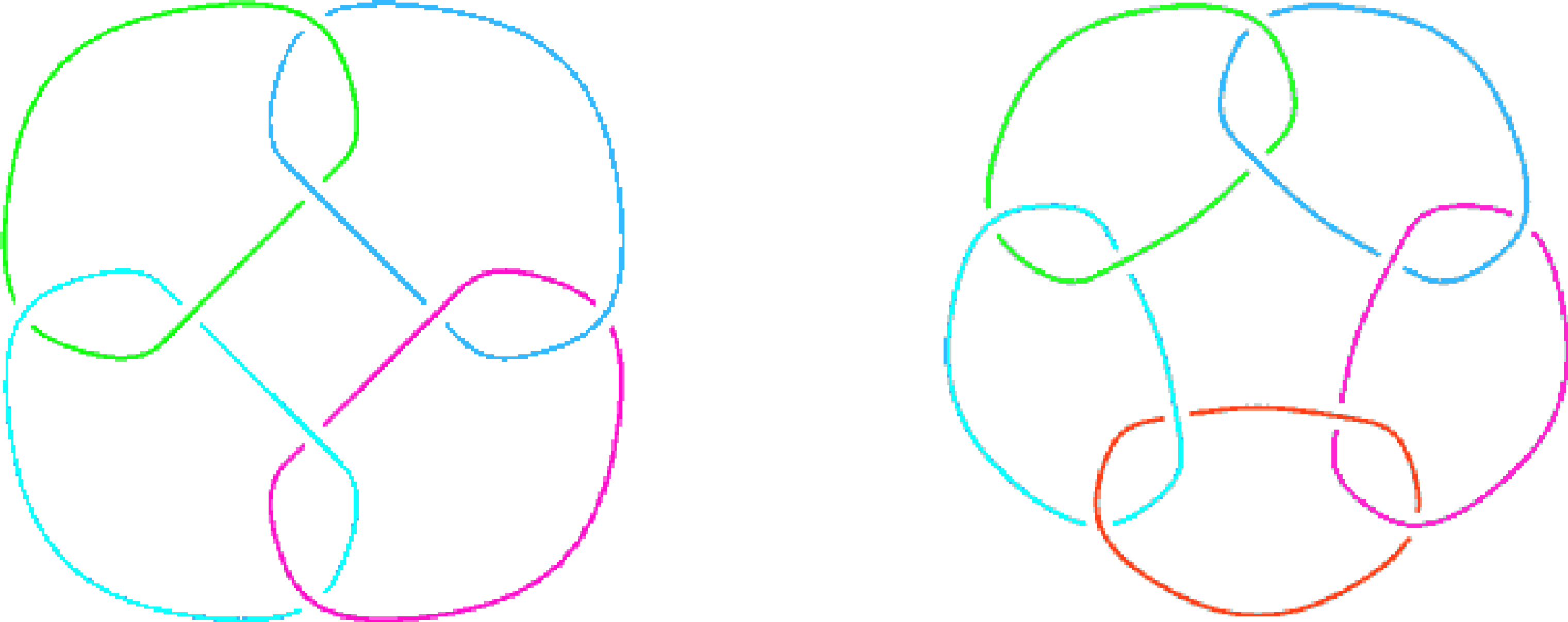
 814
 1015

 Δ(4,∞,∞;∞)

 Σ
 ∂∞I(B)
 ∂∞I0+

 DΣ
 s0⋆
 s0⋆∩∂HC2
 s0+
 B−1
 s0+∩s0−
 B2
 s0+∩s0⋆
 s0−
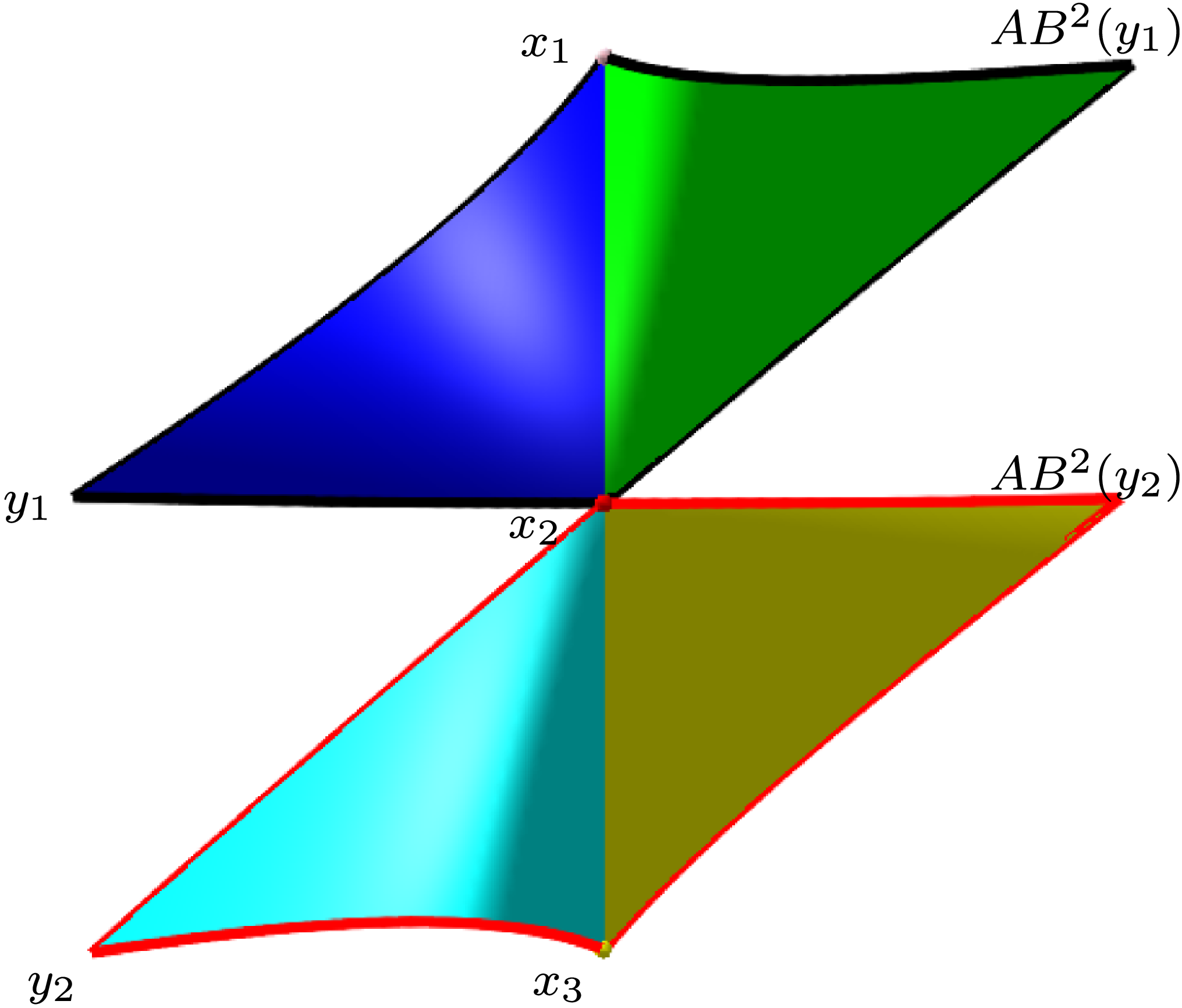
 x1
 y1
 x2
 x1
 x2
 AB2(y1)
 x2
 y2
 x3
 x2
 x3
 AB2(y2)
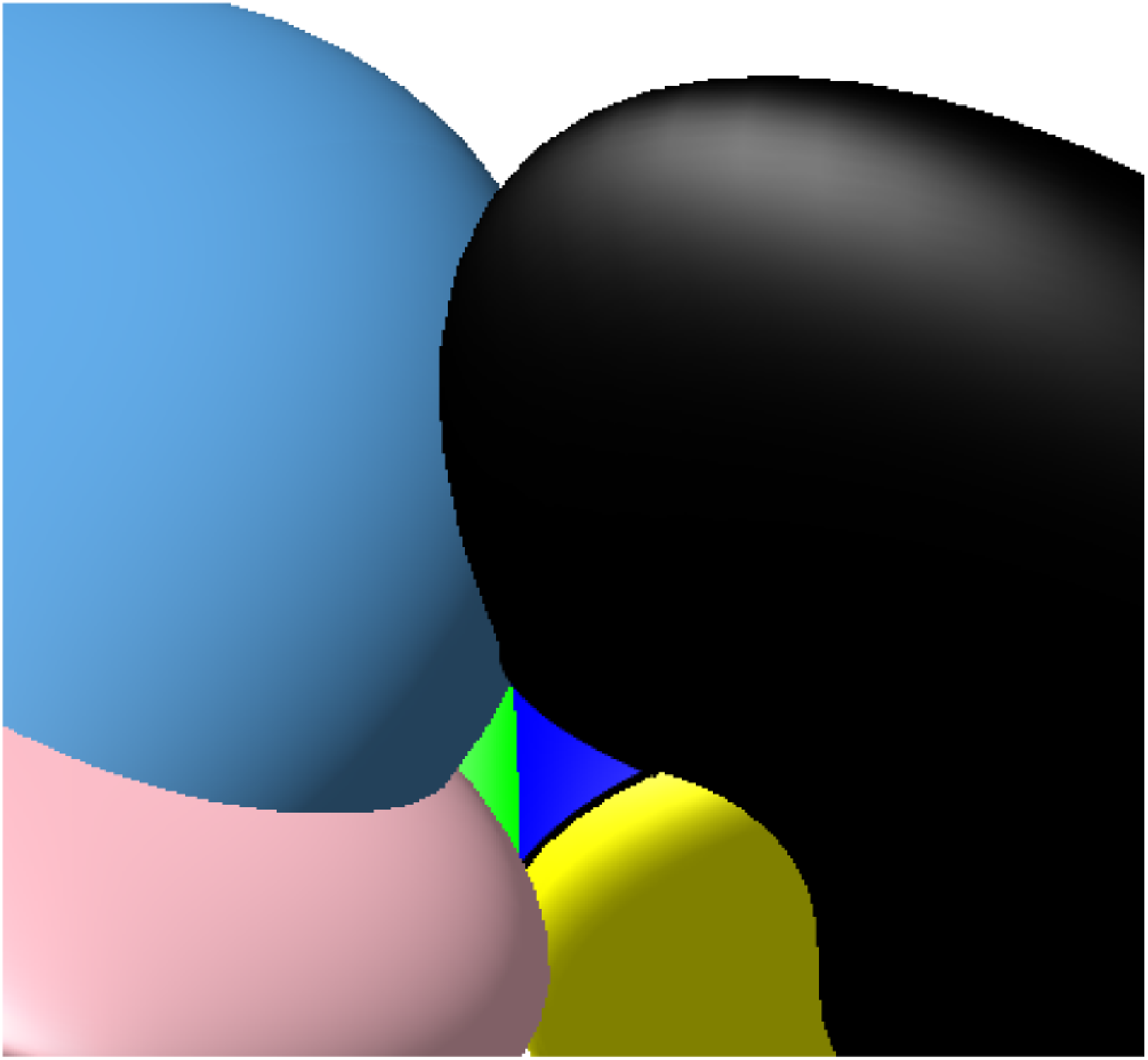
 EB
 ∂∞DΣ
 ∂∞I0+
 ∂∞I1−
 ∂∞I0⋆
 ∂∞I1⋆

 ∂∞I0±
 ∂∞I1±
 ∂∞I0⋆
 ∂∞I1⋆
 EB
 EB−1
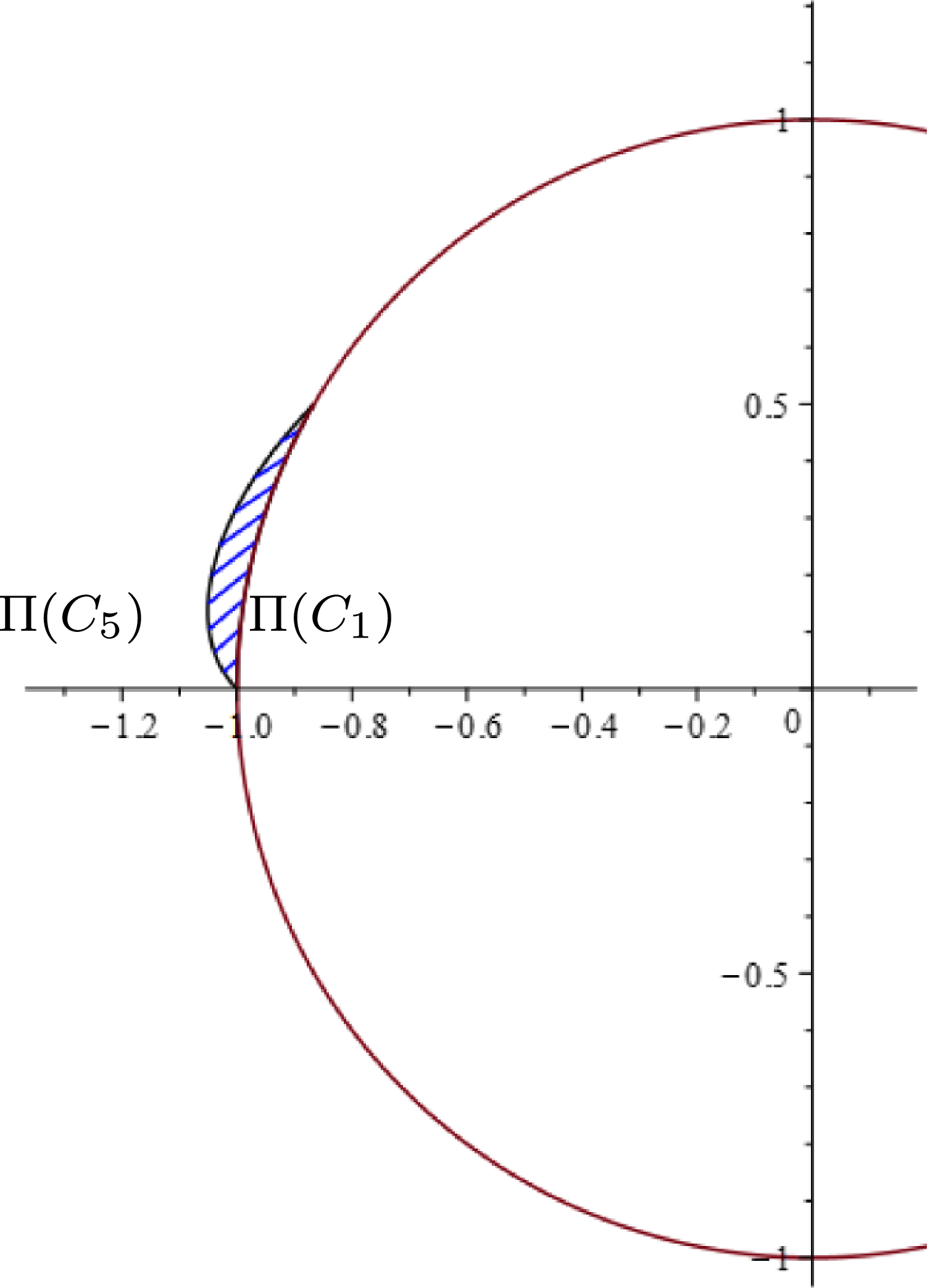
 Π(EBl)
 Π(∂∞I0⋆)

 Δ4,∞,∞;∞
 A−1
 x3
 A−1
 y2
 A−1
 x2
 B2
 y2
 x2
 y2
 x3
 AB2
 y2
 A−1
 x2
 A−1
 y1
 A−1
 x1
 B2
 y1
 x1
 y1
 x2
 AB2
 y1
 D−
 D+
 D−
 A−1
 x3
 B2
 y2
 w4
 B2
 y1
 A−1
 x1
 B2
 y1
 w3
 B2
 y2
 A−1
 x3
 D+
 x1
 AB2
 y1
 A(w3)
 AB2
 y2
 x3
 AB2
 y2
 A(w4)
 AB2
 y1
 x1

 F1
 F2
 F3
 C17
 C19
 C20

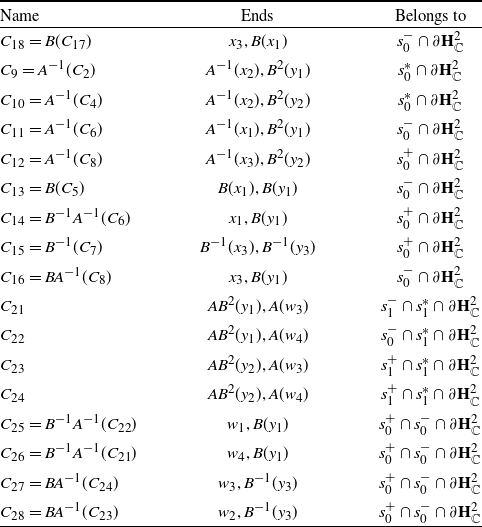

 Δ4,∞,∞;∞
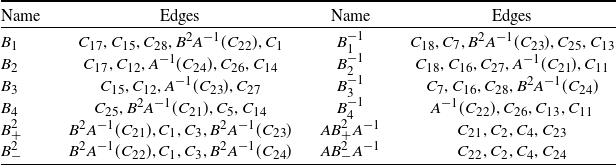
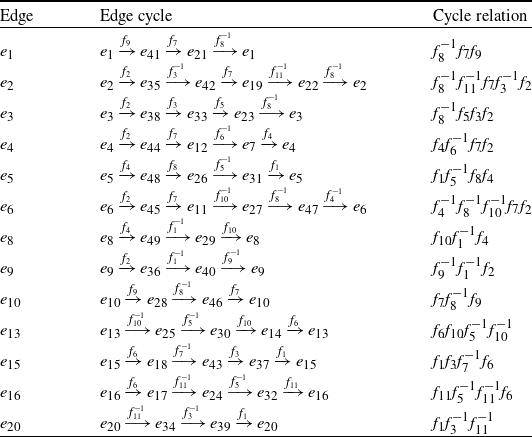
 Δ4,∞,∞;∞

 Δ4,∞,∞;∞


