Introduction
Geriatricians working in long-term-care departments or nursing homes have seen rapidly increasing numbers of patients suffering from dementia, with some studies declaring the prevalence of dementia among long-term-care patients to be 50% or more (Ouslander et al., Reference Ouslander, Osterwick and Morley1997; Mann et al., Reference Mann, Evans and Ohara2005).
The improved survival of patients with dementia, which can be attributed in part to more advanced treatments, both increases the prevalence of dementia in long-term facilities and allows a wider expression of the disease. We hypothesize that the condition referred to by many clinicians as “terminal dementia” includes the diagnosis of persistent vegetative state (PVS).
PVS is defined as a condition in which the patient has no awareness of self or environment at any time and shows no response to stimuli of any kind, but undergoes wake–sleep cycles and has preserved respiration and circulation (Royal College of Physicians, 2003). The differential diagnosis of PVS includes the minimal conscious state (MCS), in which a minimal but definite evidence of awareness exists, and coma in which there are no wake–sleep cycles. It is difficult to clinically differentiate between PVS, MCS and coma since there is always a possibility of some undetected awareness.
Only a handful of studies have approached the issues involved in diagnosing PVS in the elderly (Walshe and Leonard, Reference Walshe and Leonard1985; Kaufman and Lipton, Reference Kaufman and Lipton1992; Volicer et al., Reference Volicer, Berman, Cipolloni and Mandell1997; The Multi-Society Task Force on PVS, 1994; Lavrijsen et al., Reference Lavrijsen, Van Der Bosch, Koopman and Van Weil2005). In the present study we have sought to determine the prevalence of PVS and describe its characteristics in a population of elderly patients in a long-term care geriatric facility.
Methods
The Skilled Geriatric Department in Herzog Hospital, Jerusalem, consists of 60 beds for the admission of elderly patients with the following conditions or treat-ments: bedsores, nasogastic tubes, cancer, tracheostomy and/or hemodialysis.
During the study period (June 2002–November 2003), a questionnaire was completed for every admitted patient by the treating physician, both upon admission and at the end of the follow up (30 November 2003, discharge, or death – whichever was earliest). Data collected included demographic information as well as clinical findings such as nutritional parameters, number of pressure ulcers, presence of contractures on examination, and risk factors for developing pressure ulcers (Norton Scale; Norton, Reference Norton1989). The state of disability was estimated using the Disability Rating Scale (DRS) and the Glasgow Coma Scale (GCS) scoring systems (Teasdale and Jennett, Reference Teasdale and Jennett1974; Rappaport et al., Reference Rappaport, Hall, Hopkins, Belleza and Cope1982).
The DRS scale was originally developed and tested on juveniles and adults with moderate to severe traumatic brain injury (TBI) in an inpatient rehabilitation and LTC setting (Talbot and Whitaker, Reference Talbot and Whitaker1994; Hammond et al., Reference Hammond2001; Lippert-Gruner et al., Reference Lippert-Gruner, Wedekind and Klug2003; Giacino et al., Reference Giacino, Kalmar and Whyte2004; Whyte et al., Reference Whyte2005). The DRS scale measures a wide range of signs: consciousness (“eye opening,” “communication ability” and “motor response”), which represents a slight modification of the GCS and reflects impairment ratings; cognitive ability for “feeding,” “toileting” and “grooming,” which in turn reflects the level of disability; and dependence (“level of functioning” and “employability”), and hence the degree of handicap. The scale ranges from 0 to 30, with a score of 22 or more being consistent with vegetative state. The reliability and validity of the DRS has been previously studied (Rappaport et al., Reference Rappaport, Hall, Hopkins, Belleza and Cope1982).
The Glasgow Coma Scale (GCS) is well recognized as a means of assessing the level of consciousness (particularly comatose state) with a scale ranging from 3 to 15 points. A comatose state has a score of 3–8 while a vegetative state has a score ranging from 6 to 10 points (Royal College of Physicians, 2003).
Data analysis
A DRS score of 22 and above was used to define PVS. Patients with PVS were described and compared to patients without PVS according to their sociodemo-graphic and clinical characteristics upon admission. The clinical features of patients with a GCS score ≤9 were described and compared to patients with a GCS score of ≥10. Categorical variables were compared using χ2 testing while continuous variables were compared using the Student's t-test. Survival time was counted from admission until the end of follow up. Mean and median survival according to state of PVS were computed using the Kaplan-Meier method. All statistical tests were two sided and performed on SPSS statistical software (version 12). A p value of less than 0.05 was considered significant.
Results
During the study period, 88 patients were admitted to the Skilled Geriatric Nursing Department. Of those, 31 (35.2%) were diagnosed with PVS according to the DRS scale.
The median age of patients with PVS was 79 years (mean 78 years, range 36–95), and 58% were women. About half (51.9%) of the patients had 8–12 years of education, and 11% had more than 12 years of education. About half (51.6%) were married, and 45% were widowed. For 60% of them, their previous domicile was their own home while 40% were in an old-age facility. Most (24/31) of these patients were admitted to our department from general hospitals after acute episodes such as infections, stroke and cardiac events. Diagnoses upon admission included cerebrovascular accidents (CVA) (10 patients), Alzheimer's syndrome (n = 11), Parkinson's disease (n = 5), and acute PVS (n = 5).
Verbal communication was absent in 22 patients, and the rest were incoherent and their utterances were not responsive to provocation. Motor response to pain stimuli was totally absent in four (13%) patients, and only one patient could localize pain. The majority of patients (19/31) responded with abnormal flexion, four patients (13%) with withdrawal and three patients (10%) extended their arms in response to pain. Half (n = 15) of the patients had their eyes open spontaneously without focusing or tracking, five (16%) had no eye opening with any kind of stimulation but were assumed to have a wake–sleep cycle, nine (29%) opened their eyes only to pain stimulation, and two patients (6%) opened their eyes in reaction to sound. Of all the DRS categories, eye opening had the highest correlation with the total score (Spearman's correlation r = 0.702, p < 0.001).
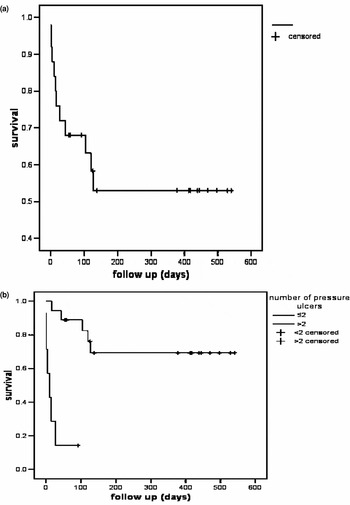
During the 17-month follow-up period, 12 patients (39%) died; none of whom had a diagnosis of acute PVS. The median survival time was 127 days (Figure 1). There was an association between the number of pressure ulcers upon admission and death. Among those who died, 58% (n = 7) had three or more pressure ulcers compared with 17% (n = 3) of the patients who were alive at the end of follow up (p = 0.018).
Survival of patients with PVS. (a) All patients with PVS, (b) Survival of patients with PVS by number of pressure ulcers upon admission.

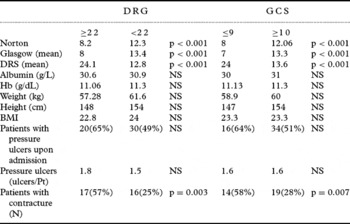
Twenty-five of the 88 patients admitted to the Skilled Nursing Department received a GCS score ≤ 9 upon admission. Overall, the DRS score and GCS score were highly correlated (Spearman's correlation measure = −0.88, p < 0.001); these tests had a high kappa correlation coefficient of 0.75 (p < 0.001) for the diagnosis of PVS/coma. Comparing the groups of patients with either a DRS rating > 22 (N = 31), or a GCS ≤ 9 (N = 25), with patients who had DRS < 22 or GCS ≥ 10, respectively, there were no significant differences in demographic or nutritional characteristics or in the presence of pressure ulcers upon admission (Table 1). Patients who had a DRS score ≥ 22 had a lower predisposition to developing pressure ulcers according to the Norton scale, compared with patient with a DRS score < 22 (median scores of 8 and 12, respectively; Mann Whitney p < 0.001). Patients with a DRS score ≥ 22 also had a higher prevalence of contractures upon admission than patients with DRS < 22 (57% and 25%, respectively; χ2 p = 0.003). Excluding patients with acute PVS from the analysis did not materially change the results (not shown).
Characteristics of the study population by DRG and GCS scores

A clinical diagnosis of PVS, in accordance with the currently accepted parameters, whether acute or chronic, was assigned to 13 (14.8%) patients admitted during the study period. Of the six patients who were assigned a clinical diagnosis of acute PVS (anoxic, hemorrhagic or traumatic), five had DRS scores of > 22 and GCS ≤ 9. Of the seven patients who received a clinical diagnosis of chronic PVS, only three had a DRS score > 22 and GCS ≤ 9.
Discussion
Our findings demonstrate a high prevalence (30.5%) of PVS among patients admitted to our long-term care department. Only eight (26%) of the PVS patients were clinically diagnosed by the admitting physicians at our hospital. We attribute this failure to a low level of awareness among physicians to this condition among elderly people with dementia, as well as to the difficulty of assessing the level of consciousness in a population that has a priori diminished verbal and motor responsiveness.
Patients who received a diagnosis of PVS according to the DRS had similar demographic and clinical characteristics to those without this diagnosis, a finding that suggests that PVS might be part of the natural history of dementia and long-term disability in the elderly. Assuming that PVS might be the progressive stage in the natural history of patients with severe or terminal dementia, it seems likely that as the prevalence of this disorder in long-term-care increases, the burden on family and friends in the provision of their care over the course of their illness will increase (Mitrani et al., Reference Mitrani2006).
Few studies have been undertaken on the survival of elderly patients with PVS (Higashi et al., Reference Higashi1981; Tresch et al., Reference Tresch1991). In our ward, these patients survived for a median of three months. This low survival supports our hypothesis that PVS is the final stage in the progression of dementia.
The main limitation of our study was the small sample size of participants. This limitation prevented us from finding subtle differences in sub-analyses and conducting multiple regressions. The higher prevalence of pressure ulcers among patients with PVS compared with patients without PVS did not reach statistical significance, probably due to the small sample size. However, even in this small sample size the prevalence of contractures was significantly higher among patients with PVS than among those without PVS.
Our study suggests that DRS is a useful quantitative tool for assessing awareness among the elderly. The DRS is the only tool developed for the diagnosis of PVS, although originally developed for head injury (Rappaport et al., Reference Rappaport, Hall, Hopkins, Belleza and Cope1982). The DRS offers parameters for the assessment of the level of awareness, which is essential for a diagnosis of vegetative state (Dyer, Reference Dyer2003). Diagnoses of PVS are important in the context of improving both public health and clinical practice. In the former, a greater awareness of this condition will lead to a better understanding of its natural history and so enable better planning of the number of beds and long-term facilities needed, with the possible establishment of an intermediate unit between general nursing wards and skilled nursing wards. From a clinical practice perspective, the creation of such a department would facilitate the standardization and delivery of appropriate clinical treatment, such as the decision to discontinue unnecessary medication, hospitalization, surgical interventions, and even feeding, hydration, dialysis, and mechanical ventilation and resuscitation (Volicer, Reference Volicer2001).
The sensitivity of the clinical diagnosis of vegetative state could be improved in such long-term care settings, where both physicians, nurses and paramedical staff are well acquainted with patients and their families (who are sometimes the most sensitive to changes in mental status) and can come to a collaborative agreement on the diagnosis. This may prevent diagnostic mistakes (Andrews et al., Reference Andrews, Murphy, Munday and Littlewood1996) of other disorders, such as acute infections, metabolic disturbances or the adverse effect of medications that might lead to a deterioration in mental status. A correct diagnosis might contribute to the legal and ethical aspects associated with withdrawing or withholding treatment.
Conflict of interest
None.
Description of authors' roles
E. Jaul designed the study, supervised the data collection and wrote the paper. R. Calderon-Margalit was responsible for the statistical design of the study and for carrying out the statistical analysis and participated in writing the manuscript.