Despite the recent surge of scholarly interest in depictions of Black subjects in European art, the case of Russia remains largely under-examined.Footnote 1 In the past decade, a number of important studies have addressed questions of race in the Soviet context, but only a handful of publications have analyzed Russian representations of Black subjects and native Russians of African descent in the long nineteenth century.Footnote 2 Given that Russia lacked a physical colonial presence in Africa and that people of color were generally absent from its major cities, it is hardly surprising that there were considerably fewer representations of Blackness in Russian fine and decorative arts as compared to the other great powers. Those that do exist are often quite striking in their radical departures from established European conventions. Accordingly, the present article focuses on a few representative works by canonical nineteenth-century Russian artists: Karl Briullov, Vasilii Polenov, and Il΄ia Repin, paying close attention to the different ways in which their paintings encoded a complex set of interconnected ideas about Russian exceptionalism, imperialist aesthetics, and nationalist versus cosmopolitan pictorial sensibilities. Lastly, it considers the ways in which these paintings both reflected and contributed to the evolving Russian discourses on race and representation in the nineteenth century.
Beginning with Peter I's reign, it became increasingly fashionable among the Russian elite to import Black subjects as household servants, as was the practice in the rest of Europe at the time.Footnote 3 Peter himself, as well as his various successors, acquired a number of people of color to embellish their royal courts—a custom that continued well into the twentieth century until the abrupt end of the tsarist regime in 1917.Footnote 4 These arapy, efiopy, or negry—blackamoors, Ethiopians, or negroes—were often featured in commissioned portraits of the nobility, where their presence served to emphasize the beauty, worldliness, and “whiteness” of the principal sitter and in so doing underwrote the aristocrat's social status, rank, and dignity.Footnote 5 The inclusion of an arap signaled wealth and consumption and they were often paired with expensive and exotic materials such as jewels, baskets of fruit or flowers, and pet animals.
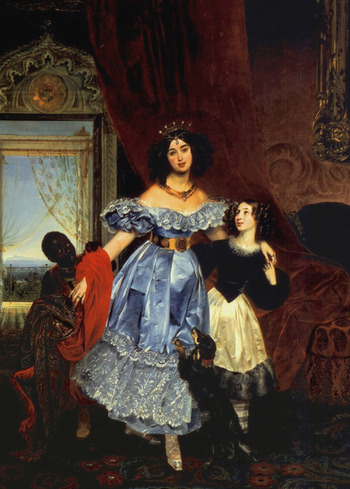
Thus, for example, in Karl Briullov's Portrait of Countess Julia Samoilova and her adopted daughter Giovanina and a Black Page (1832–34) (Fig. 1), the young Black attendant serves as both a conceptual and aesthetic “foil” to his aristocratic mistress. While the whiteness of the countess's skin is accentuated by her dark hair and the deep burgundy curtain behind her, the Blackness of the African boy is heightened by the pale blue sky visible through the window against which he is silhouetted. Paul Kaplan suggests that this conspicuous visual signifier of “difference” was meant to emphasize Samoilova's fundamentally “western” identity in light of Russia's ongoing “complicated relationship with western Europe, involving profound cultural indebtedness and admiration, religious difference, and feelings of cultural and social inferiority.”Footnote 6 Perhaps even more importantly, lurking under the surface of Briullov's painting is the restive issue of Russians’ perceived racial impurity and their semi-Asian identity as a result of almost two hundred years of Mongol domination. Many members of the Russian aristocratic, military, and cultural elites—such as the Usupovs and Sheremetevs—had Tartar and Turkic-Persian ancestry. Within this context, the Black boy functions as a rhetorical visual antithesis and, by extension, a symbolic guarantor of Samoilova's whiteness—a trope further accentuated by the child's admiring, upward glance towards his mistress. His demeanor is directly mirrored by the stance of the small spaniel, tacitly signifying their equivalence in the social hierarchy—an insinuation that is further emphasized by the fact that both the boy and the dog wear prominent collars around their necks. Samoilova's adopted daughter Giovanina also looks up lovingly at the countess completing the triangle of deferential gazes. The fact that she is not Samoilova's biological child and is close in age to the Black boy starkly and poignantly highlights the different prospects of the white adopted child and her Black counterpart.
Karl Briullov, Portrait of Countess Julia Samoilova and her adopted daughter Giovanina and a Black Page, 1832–34, oil on canvas, 269 x 200 cm. Hillwood Museum and Gardens, Washington, D.C.

While the inclusion of the Black boy allowed both the sitter and the artist to assert their fundamental cosmopolitanism and European savoir faire, it is important to note that at the time that this work was painted, chattel slavery was officially illegal in Russia and representatives of Tsar Alexander I had argued for the abolition of the African slave trade at the international Aix-la-Chapelle Congress of 1818. As such, Briullov's depiction of the demeaning slave collar around the boy's neck is strikingly incongruous in light of the provisional elimination of slavery by 1834 throughout most of Europe, including Italy, where the work was painted. Indeed, Samoilova's portrait reflected an established eighteenth-century European convention, but by the 1830s, depictions of Black attendants were increasingly few and far between in European art. Consequently, in its adoption of an already outdated pictorial mode, this painting was strangely aberrant in its self-conscious antiquarianism.
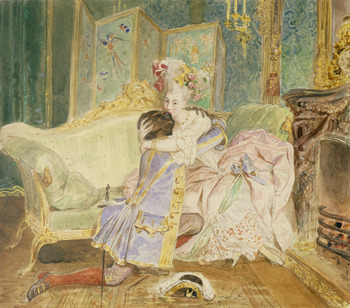
Around the same time, Briullov produced a number of other fairly unorthodox, if not outright transgressive, works featuring Black subjects, such as his two paintings of Bathsheba (1830; 1832), The Sack of Rome by Genseric the Vandal I (1835–36), and most notably, Ibrahim Embracing the Countess (1847–49) (Fig. 2). The latter is a watercolor illustration to Aleksandr Pushkin's unfinished historical novella The Blackamoor of Peter the Great (1827–28)—a fictionalized biography of his great-grandfather, Abram Petrovich Gannibal. Briullov's image depicts the principal African protagonist, Ibrahim, passionately embracing his illicit French lover, Countess D. Akin to the dramatic color contrasts in the portrait of Samoilova, in this image Briullov again intentionally juxtaposed light and dark hues by silhouetting Ibrahim's Black hand against his lover's lily-white shoulder. The countess returns Ibrahim's ardent gesture by running her fingers over the side of his face, creating a mirrored white-on-black visual effect. Although the blazing fire in the right-hand side of the image metaphorically symbolizes the fiery ardor of their mutual passion, the countess's furtive gaze out of the picture frame seems to “gauge the viewer's judgement of this provocative reconfiguration of the otherwise hierarchical relationship between black and white.”Footnote 7
Karl Briullov, Ibrahim Embracing the Countess, 1847–49, watercolor and graphite on paper, 23.7 x 25.9 cm. State Tretyakov Gallery, Moscow.

Ibrahim Embracing the Countess is unprecedented in the history of western art in its frank visualization of a charged interracial erotic encounter. Images of white men embracing Black women or mixed-race romantic dalliances between lowborn servants certainly existed, such as Johann Samuel Mock's Lord Jonimo and the Moor Frederica (1739) and A Black Page Caressing a Shepherdess (1730s), but the reverse was virtually never pictured. Black men were seldom, if ever, depicted in sexual contact with white women. The only exception are representations of Shakespeare's Othello and Desdemona, but even there Othello—when shown as a Black man—was usually placed somewhat apart from Desdemona and was never shown actively touching her body in a sexualized manner. In this sense, Briullov categorically violated an established European pictorial taboo, hinting at the possibility of dreaded miscegenation, as described in Pushkin's narrative, where Ibrahim's love affair results in an illegitimate mixed-race baby who has to be secretly substituted for a white child and hidden away from polite society in order to avert scandal and social ruin.
What is especially intriguing about this arresting image is the uneasy—one could even say fraught—coexistence of positive and negative racialized connotations. On the one hand, as a fictionalized account of the real-life ascension of Gannibal, the figure of Ibrahim thematizes the remarkable elevation of a Black subject within the political, military, and social hierarchy of imperial Russia. On the other hand, it consciously plays on the formulaic negative trope of Black hypersexuality, with Ibrahim portrayed as an insatiable and sexually potent force, who is a danger and a threat to white female—and by extension male—respectability.Footnote 8 Unsurprisingly, Gannibal's famous great-grandson was subjected to the same racial stereotypes with contemporaries often referring to his “unbridled African passions” and “ardor and sensuality,” even suggesting that it was Pushkin's intemperance and womanizing ways that ultimately led to his fateful duel with d'Anthes and his untimely death.Footnote 9
At the same time, both during his lifetime and in the succeeding years of the nineteenth century, Pushkin was actively celebrated as an unparalleled cultural icon and a national literary genius. Rather than his exotic heritage, it was his unique talent and Russianness that were constantly emphasized and “invocations of blackness in Russia never entailed slurs on Pushkin's intelligence.”Footnote 10 Allison Blakely explains this phenomenon by noting the absence “in the entire history of Russia's relationship with Black Africa…[of] any type of racist ideology such as developed in the other major European states.”Footnote 11 Indeed, period commentators such as the Slavophile thinker Aleksei Khomiakov claimed that Russians esteemed the poet, “the descendant of an Ethiopian…with pride and joy, whereas he would have been denied citizenship in the United States and would not have had the right to marry the daughter of a washerwoman in Germany or of a butcher in England.”Footnote 12
From the mid-nineteenth century onwards, Russian racial and imperial discourses were increasingly dominated by such refrains of Russia's supposed enlightened humanism and egalitarianism in contrast to the racist and oppressive structures of western Europe.Footnote 13 For instance, the historian Stepan Eshevskii claimed that in the case of western European nations, “the colonized ‘natives’ tended to die out because of their ill treatment by the colonizers as racially inferior.”Footnote 14 Conversely, in the Russian colonial setting “inorodtsy tribes do not die out, when they are confronted with Russians. They naturally transform into Russians, absorbing specific qualities of European-Christian civilization.”Footnote 15 Similarly, the military geographer and orientalist Mikhail Veniukov differentiated Russia's benign, noncoercive colonizing methods from “the terrible treatment” by Britain and Spain of their colonial subjects, concluding that “Spanish colonization… as well as the English, was accompanied by the bloody annihilation of entire races and the enslavement of many millions of people.…There is nothing comparable in Russian colonization.”Footnote 16 In reality, however, such exalted claims belied the multiple atrocities, abuses, and coercion committed by the Russian military and bureaucratic apparatus in the Baltics, Caucasus, and Central Asia as part of the state's aggressive territorial expansion, but they do testify to the growing sense of Russia's exceptionalism and the discursive construction of national moral superiority in contrast to purported western opportunism and dehumanizing economic exploitation.Footnote 17
Against the backdrop of these debates, it is instructive to examine two very unusual paintings of Black women by Ili΄a Repin and Vasilii Polenov dating from the mid-1870s. Executed during their stay in Paris as pensioners of the St. Petersburg Imperial Academy of Arts, these artworks are as unique in the context of European painting as they are in the history of Russian art. As Adrienne Childs explains, there are virtually no individual portraits of Black women in European art of the long nineteenth century and the very few exceptions that exist such as Marie-Guillemine Benoist's Portrait of a Black Woman (1800) and Frédéric Bazille's Black Woman with Peonies (1870) only prove the general rule.Footnote 18 Artists who traveled to the Middle East and North Africa often produced close-up oil, pencil, and watercolor studies of Black figures, which reflect the “scientific” interest in Black physiognomy and ethnography but resist the traditional categorization of portraiture. In fully developed, finished paintings, Black women were almost always relegated to the secondary roles of servants and slaves, deprived of their individuality and reduced to the status of inanimate props as implied by period commentators often comparing them to “ebony” and “jet”—decorative luxury commodities or accents that punctuate the primary white subjects.Footnote 19
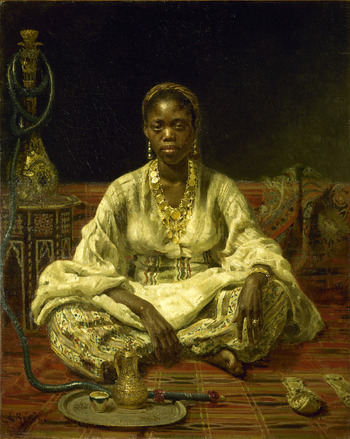
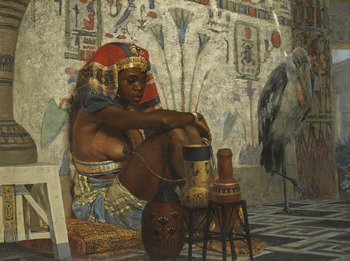
Consequently, Il΄ia Repin's Portrait of a Negro Woman (Fig. 3) and Vasilii Polenov's Egyptian Girl (Fig. 4) departed as much from their European contemporaries as they did from Briullov's earlier portraits of the Russian aristocracy. One explanation for their unconventional choice of subject matter is the sheer accessibility of non-European models in Paris, which was not the case back in Russia. Black people from Africa and the Caribbean, although marginalized, were increasingly part of an international population in the City of Lights. In addition to being laborers and domestic servants, people of color were also active in the entertainment world as musicians, dancers, circus performers, and artists’ models. Repin and Polenov's shared studio on the Rue Véron was part of an area that included one of Paris's most concentrated Black populations. Accordingly, as exotic visualizations of the modern French urban spectacle culture, Black bodies did not only furnish Repin and Polenov with the opportunity to try their hands at novel and unusual subject matter, but also provided them with a rare chance to assert their cosmopolitanism and modernity, much like Briullov had done four decades earlier. By the same token, given their own peripheral position in the Parisian art world as “foreigners” and “outsiders” who moved almost exclusively in Russian émigré circles and who sometimes struggled financially and professionally, Repin and Polenov were potentially less beholden to the established formats and rigid self/other binaries governing such depictions.
Il’ia Repin, Portrait of a Negro Woman, 1875–76, oil on canvas, 115 x 93 cm. State Russian Museum, St. Petersburg.

Vasilii Polenov, The Egyptian Girl, 1876, oil on canvas, 88.5 x 118 cm. Private Collection.

Thus, for example, although the Black female model in Repin's Portrait of a Negro Woman is accessorized and inflected with Orientalist accoutrements and props such as a hookah pipe, discarded Persian slippers, ornate coffee pot, brocaded silk fabrics, and elaborate glistening necklace and pearl earrings, the sitter nonetheless comes across as a confident and dignified individual who commands the viewer's sustained attention. She does not register as merely an odalisque or an “Oriental type,” despite Repin's obvious sensuous delight in rendering the different glimmering surfaces and sumptuous textures. In his monograph on Repin, Igor Grabar΄ noted that the portrait is rendered with “tremendous human warmth,” while the artist and critic Aleksandr Savinov emphasized the model's psychological presence, writing that the “Negro woman is a person who palpably possesses an emotional and intellectual life.”Footnote 20
At the same time, the woman's facial expression is largely inscrutable: is she sad, lost in thought, indifferent, or bored? It is difficult to tell. This signature impenetrability became a hallmark of French modernist painting as exemplified by Edouard Manet's infamous barmaid in A Bar at the Folies-Bergère (1882) or the reclining nude in Olympia (1863).Footnote 21 Unlike the Black servant in the latter work, however, whose presence functions as a veiled symbolic reference to the white woman's implied sexual promiscuity, the model in Repin's portrait does not assume a subordinate role to a central white protagonist, but, on the contrary, entirely replaces the latter as the new, recoded signifier of pervasive ennui and urban, metropolitan modernity.
Akin to Repin's portrait, Polenov's Egyptian Girl is equally elusive and was likely inspired by a confluence of different experiences and diverse sources, such as Polenov's visit to the Egyptian court in the Crystal Palace in London, his exposure to the extensive Egyptian collection in the Louvre, the 1871 premiere of Giuseppe Verdi's opera, Aida, and a series of contemporary paintings on the subject of ancient Egypt and the Biblical Orient, such as Edward John Poynter's Feeding the Sacred Ibis in the Halls of Karnac (1871) and Lawrence Alma-Tadema's Joseph, Overseer of Pharaoh's Granaries (1874). In fact, there are several striking pictorial parallels between Polenov's and Alma-Tadema's paintings. The grainy, textured, impasto surface of the wall, as well as the blue and red floral motifs, the large cut-off ceramic vessel and accompanying white wooden stand on the extreme left hand side of Alma-Tadema's picture all seem to have been directly replicated by Polenov.
Unlike Repin's strong, self-assured woman, Polenov's Egyptian girl seems to be much more vulnerable and withdrawn. Her facial expression is pensive and almost melancholic, her posture is guarded and closed-off, and her gaze is demurely averted from the viewer. Although the model is shown topless and we are given a clear view of her exposed right breast, her shielded posture thwarts a sense of immediate and enticing sexual availability. As in Repin's portrait, Polenov's painting is visually opulent and sensuous, combining a rich array of bright, saturated colors and glittering surfaces with striking juxtapositions of alternating smooth and rough textures. Overall, however, there is something foreboding and ominous about this image. It is not clear who this woman is supposed to be and what her role is in the setting: is she a priestess, a concubine, or a Nubian slave? On the one hand, she wears a luxurious headdress and ornate jewelry, on the other, she sits on the floor and appears to be ill at ease, hemmed in by the ceramic vessels in the foreground. Most unsettling of all is the sinister-looking bird on her left. Although period commentators mistakenly identified the bird as the sacred Egyptian ibis, it is in fact a marabou stork, a scavenging bird of prey.Footnote 22 With its long phallic beak and drooping folds of fleshy pink skin, the bird seems to hint at sexual predation—an avatar for the absent male master.
In contrast to French and English representations of Black women, where, as Childs notes, the subjects’ “black faces [are] often obscured by drapery, or their backs [are] turned to the viewer,” so that only “their dark ornamented bodies activate the scenes,” Repin's and Polenov's representations place considerable visual emphasis on the model's face and, in the case of the Egyptian Girl, attempt to elicit sympathy from the viewer for her plight—a response typically reserved for the white female slaves in European depictions.Footnote 23 Thus, for example, when Jean-Léon Gérôme's Slave for Sale (1873) was first exhibited in London's Royal Academy in 1873, the critic E.B. Shuldham compared the moving pathos of the beautiful lighter-skinned “Eve” who was tragically “doomed to dishonor” as a concubine in an Oriental harem with “the jet-black Abyssinian semi-nude [who] sits careless of her fate, whilst a marvelous monkey…squats by her side, from the terms of the sale, almost an acknowledged equal, the monkey and negress evidently going together as one lot.”Footnote 24 While the white woman is humanized and intended to evoke empathy and pity in the viewer, the Black woman is marked as degenerate and accepting of her fate, implying that slavery is a condition commensurate with the Black body.
There are several possible explanations for Repin and Polenov's manifest divergences from standard European representations of race. As members of the educated Russian elite who associated with the civic-minded Peredvizhniki group, they were deeply committed to social causes and to addressing systemic injustices, as evidenced by a number of their contemporaneous paintings, most notably the Bargehaulers on the Volga (1870–73) and the Right of the Master (1874). The latter work in particular raises the ominous issue of sexual exploitation and coercion, albeit through a historicizing lens. In fact, in the years immediately preceding the creation of these artworks, thinkers such as Aleksandr Herzen and Nikolai Chernyshevskii had repeatedly compared and condemned the parallel plights of Blacks in America and serfs in Russia. Consequently, Repin and Polenov may have intentionally embraced the opportunity to represent marginalized Black female subjecthood as a veiled commentary on the persisting inequalities and injustices faced by people of color in modern western societies on the one hand, and the Russian peasantry on the other.
Perhaps more than any explicit or implicit emancipationist or egalitarian considerations, however, Repin and Polenov were enticed by the creative possibilities of exploring an entirely new artistic theme and the purely technical challenges that it presented, such as rendering a dark-skinned model in a dimly lit room and capturing the way her Black skin reflected the flickering light or created striking coloristic contrasts with her surroundings. Having tried their hands at a range of different genres in Paris such as history painting, plein air landscape, and contemporary urban scenes, the Russian artists evidently felt that the ethnic and racial “other” provided a means to both test and assert their own thematic range and artistic capabilities.
In his review of the Autumn 1876 Imperial Academy of Arts Exhibition in St. Petersburg, where both Egyptian Girl and Portrait of a Negro Woman were shown, the critic Apollon Matushinskii wrote:
…why [have] these talented artists chosen to depict a black creature in their paintings? Which aesthetic thoughts led them to decide to paint an Ethiopian beauty?…It is quite understandable that such a subject can have its place in a painting in order to furnish a superb contrast and augment that which is beautiful, or quite simply to provide a dark passage, necessary for the overall effect of the painting; but to base the entire content of a work of art on that which is hideous, is really rather singular.Footnote 25
This review makes clear that Matushinskii both understood and subscribed to the conventions of European racial representations and implicit hierarchies and was thus genuinely puzzled by Repin and Polenov's unorthodox treatment of their Black sitter. In a single breath, Matushinskii describes the woman as both a “beauty” and “hideous,” highlighting the inherent tensions and contradictions in the Russian public's understandings of and reactions to racial difference. Matushinskii ultimately concludes that Black subjects are not worthy of artistic representation and constitute a fundamental “waste” of Repin and Polenov's talent and time.
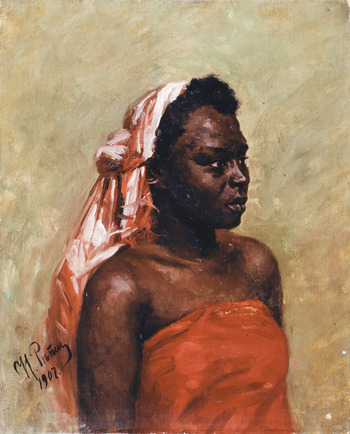
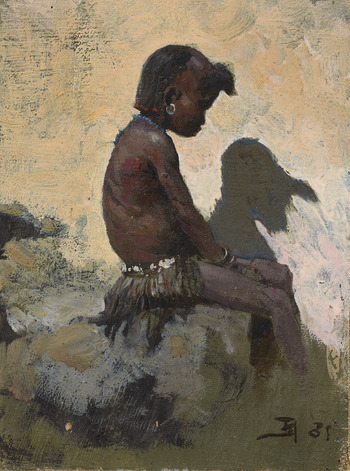
Yet tellingly, both artists returned to the theme of racial “others” again and again in their respective oeuvres. Repin painted a number of ethnically diverse subjects between 1880 and 1910, including another compelling portrait of a Black woman in 1907 (Fig. 5); while Polenov went on to make a name for himself as a leading Russian Orientalist, presenting Russian audiences with an array of Arabs, Jews, and Blacks (Fig. 6). Unlike Briullov's paintings from the first half of the nineteenth century, which always portrayed Black subjects alongside white ones as binary opposites, Repin and Polenov's standalone depictions provocatively questioned who or what is worthy of representation in the first place. Even before they moved to Paris, Repin and Polenov were already invested in diversifying the Russian representational canon by depicting beggars, vagabonds, hunchbacks, and cripples alongside refined upper-class subjects. Black subjecthood furnished them with yet another underrepresented and new aesthetic category to explore and, in the process of reframing and visualizing that which was previously marginalized and invisible, allowed them to challenge the status quo of nineteenth-century Russian and European racial representation.Footnote 26
Il’ia Repin, Portrait of a Negro Woman, 1907, oil on canvas, 49 x 41 cm. Nizhnii Novgorod State Art Museum, Nizhnii Novgorod.

Vasilii Polenov, A Nubian Girl from the Barabra Tribe on the Elephantine Island, 1881, oil on canvas, 17.4 x 13.4 cm. State Tretyakov Gallery, Moscow.