Introduction
Chronic fatigue syndrome (CFS) is characterized by a severe and disabling fatigue which persists at least 6 months and which is not the result of a medical condition or ongoing exertion (Fukuda et al. Reference Fukuda, Straus, Hickie, Sharpe, Dobbins and Komaroff1994). Cognitive behaviour therapy (CBT) has been shown to reduce fatigue severity and impairment in patients with CFS (Malouff et al. Reference Malouff, Thorsteinsson, Rooke, Bhullar and Schutte2008; Price et al. Reference Price, Mitchell, Tidy and Hunot2008). This effect has often been attributed to an increase in activity because activity programmes have traditionally played a central role in CBT for CFS (Sharpe et al. Reference Sharpe, Hawton, Simkin, Surawy, Hackmann, Klimes, Peto, Warrell and Seagroatt1996; Deale et al. Reference Deale, Chalder, Marks and Wessely1997; Bleijenberg et al. Reference Bleijenberg, Prins, Bazelmans, Jason, Fennell and Taylor2003; Quarmby et al. Reference Quarmby, Rimes, Deale, Wessely and Chalder2007). In the present study, we tested a treatment model in which the effect of CBT on fatigue is mediated by an increase in physical activity.
Several studies have demonstrated that the average level of physical activity in CFS patients is substantially lower than in healthy controls (e.g. van der Werf et al. Reference van der Werf, Prins, Vercoulen, van der Meer and Bleijenberg2000; Black et al. Reference Black, O'Connor and McCully2005). A low level of physical activity has also been shown to perpetuate the feeling of severe fatigue in patients with CFS (Vercoulen et al. Reference Vercoulen, Swanink, Galama, Fennis, Jongen, Hommes, van der Meer and Bleijenberg1998). In some approaches of CBT for CFS (e.g. Bleijenberg et al. Reference Bleijenberg, Prins, Bazelmans, Jason, Fennell and Taylor2003), an increase in physical activity is stimulated systematically by asking patients to take short walks on a daily basis which are gradually extended in duration up to twice per h per day. Illness-related cognitions are also targeted in these interventions. In particular, patients' preoccupation with their condition and their belief that they have little control over their symptoms are challenged. These cognitions have been found to perpetuate fatigue in CFS as well (Vercoulen et al. Reference Vercoulen, Swanink, Galama, Fennis, Jongen, Hommes, van der Meer and Bleijenberg1998).
There are behavioural interventions for CFS which rely exclusively on a physical activity programme to improve fatigue. According to the rationale of graded exercise therapy (GET), the key problem in CFS is physical deconditioning which can be overcome by enhancing the level of physical fitness (Fulcher & White, Reference Fulcher and White1997; Wearden et al. Reference Wearden, Morriss, Mullis, Strickland, Pearson, Appleby, Campbell and Morris1998). Patients are stimulated to gradually increase their level of physical activity on exercise bikes or other equipment. Illness-related cognitions are not challenged intentionally. This strategy has been shown to reduce fatigue in CFS as well (Larun et al. Reference Larun, McGuire, Edmonds, Odgaard-Jensen and Price2004; Chambers et al. Reference Chambers, Bagnall, Hempel and Forbes2006).
By now, a substantial body of research is available to support the efficacy of interventions for CFS in which the level of physical activity is targeted. However, considerably less attention has been paid to whether the effect of these interventions actually depends on a change in physical parameters. Such a finding would be vital to the validation of all treatment models which rely on a physical activity programme in some way to improve fatigue. In the only study of such nature that we are aware of, Moss-Morris et al. (Reference Moss-Morris, Sharon, Tobin and Baldi2005) demonstrated that an increase in physical fitness does not contribute to the treatment effect of GET on fatigue in CFS.
The purpose of the present study was to determine whether the treatment effect of CBT on fatigue is mediated by an increase in physical activity. In psychotherapy research, testing mediation is a strategy to identify variables which intervene in the relationship between treatment and outcome and thereby help to better understand how treatment works (Frazier et al. Reference Frazier, Tix and Barron2004). This idea is illustrated in Fig. 1. In Fig. 1 a, a change in fatigue is simply explained by the allocation of treatment (path c). This model is usually tested when the efficacy of an intervention is of primary interest to the investigator. In Fig. 1 b, the effect of CBT on fatigue (path c') is mediated by a change in physical activity (path a) which is responsible for the change in fatigue (path b). We tested this mediation hypothesis to gain more insight into how CBT reduces fatigue in CFS.
The effect of cognitive behaviour therapy (CBT) on fatigue without (a) and with (b) the hypothesized mediator changes in physical activity.

Method
For the purpose of the present study we reanalysed three randomized controlled trials (RCT), previously conducted to test the efficacy of CBT on CFS (Prins et al. Reference Prins, Bleijenberg, Bazelmans, Elving, de Boo, Severens, van der Wilt, Spinhoven and van der Meer2001; Stulemeijer et al. Reference Stulemeijer, de Jong, Fiselier, Hoogveld and Bleijenberg2005; Knoop et al. Reference Knoop, van der Meer and Bleijenberg2008). Treatment was based on the manual of CBT for CFS described in detail by Bleijenberg et al. (Reference Bleijenberg, Prins, Bazelmans, Jason, Fennell and Taylor2003) and effectively reduced fatigue severity in all trials. Patients were randomly assigned to either a treatment or a control group condition. Assessment took place prior and subsequent to treatment or the control group period.
Samples
The first of the three RCTs evaluated the effect of CBT on CFS (Prins et al. Reference Prins, Bleijenberg, Bazelmans, Elving, de Boo, Severens, van der Wilt, Spinhoven and van der Meer2001). All patients were aged between 18 and 60 years and met the Centers for Disease Control and Prevention (CDC) research criteria for CFS (Fukuda et al. Reference Fukuda, Straus, Hickie, Sharpe, Dobbins and Komaroff1994), except for the four additional symptoms criterion. In total, 270 patients were assigned to either CBT, a guided support group, or a natural course condition. CBT consisted of 16 sessions of 1 h over 8 months while the guided support group had 11 meetings of 1.5 h over 8 months. All groups were assessed at baseline and 8 months later (second assessment). The results of the guided support group and the natural course condition were comparable in the original study (Prins et al. Reference Prins, Bleijenberg, Bazelmans, Elving, de Boo, Severens, van der Wilt, Spinhoven and van der Meer2001). We therefore approached the two control groups as one in our analyses.
The second RCT tested the effect of guided self-instructions on CFS (Knoop et al. Reference Knoop, van der Meer and Bleijenberg2008). This minimal intervention consisted of written self-instructions combined with email contact with a trained therapist. All patients were aged 18 years or older and met the 1994 CDC research criteria for CFS (Fukuda et al. Reference Fukuda, Straus, Hickie, Sharpe, Dobbins and Komaroff1994). In total, 169 patients were assigned to either the guided self-instructions or a waiting list control condition. The time between baseline and second assessment varied between 6 and 12 months with a mean time of 10.5 (s.d.=4.0) months in the treatment group and 9.7 (s.d.=3.6) months in the control group.
The third RCT evaluated the effect of CBT in adolescents with CFS (Stulemeijer et al. Reference Stulemeijer, de Jong, Fiselier, Hoogveld and Bleijenberg2005). In total, 69 patients were assigned to either CBT or a waiting list condition. All patients were aged between 10 and 17 years and met the 1994 CDC research criteria for CFS (Fukuda et al. Reference Fukuda, Straus, Hickie, Sharpe, Dobbins and Komaroff1994). Both groups were assessed at baseline and 5 months later (second assessment). CBT consisted of 10 sessions of 1 h over 5 months. Parents of the adolescent patients were actively involved in the treatment process.
Instruments
Fatigue
The subscale fatigue severity of the Checklist Individual Strength (CIS) was used to indicate the severity of fatigue experienced by patients. It consists of eight items which are scored on a seven-point Likert scale. The sum score varies between 8, no fatigue, and 56, severe fatigue. The CIS is a reliable and valid instrument for the assessment of fatigue in CFS (Vercoulen et al. Reference Vercoulen, Swanink, Fennis, Galama, van der Meer and Bleijenberg1994; Dittner et al. Reference Dittner, Wessely and Brown2004). A common cut-off score for severe fatigue is 35 (or higher), which is about two standard deviations above the norm score for healthy patients.
Physical activity
Actigraphy was used to assess physical activity in all trials. The Actometer is a motion-sensing device which is worn around the ankle for 12 consecutive days. An average daily level of physical activity is computed over this period, with higher scores indicating more physical activity. The Actometer is described in more detail by van der Werf et al. (Reference van der Werf, Prins, Vercoulen, van der Meer and Bleijenberg2000). They found a significant difference between the mean Actometer score of CFS patients which was 66 (s.d.=22) and healthy controls who had a mean Actometer score of 91 (s.d.=25). They also identified a group of patients who scored below the mean score of CFS patients on 11 out of 12 days and labelled this group as pervasively passive. We excluded all patients from our study who missed actigraphy at second assessment.
Analyses
We conducted one-way analysis of variance tests to test whether those patients who were excluded from our study due to missing actigraphy at second assessment differed on baseline characteristics from those patients who were included. Fisher's exact test was used in the case of dichotomous dependent variables.
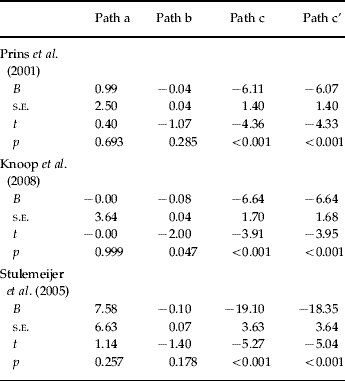
A macro expansion for SPSS introduced by Preacher & Hayes (Reference Preacher and Hayes2004) was employed to conduct mediation analysis. The macro followed the standard for mediation analysis introduced by Baron & Kenny (Reference Baron and Kenny1986). Paths a, b, c and c' of Fig. 1 were analysed using regression analysis. To examine path a, changes in physical activity were regressed on treatment. Path b was examined by regressing changes in fatigue on changes in physical activity, correcting for treatment. In the case of path c, changes in fatigue were regressed on treatment, while path c' was examined by regressing changes in fatigue on treatment, this time correcting for the mediator changes in physical activity. The size of the mediation effect was computed by multiplying path a with path b.
Statistical significance of the mediation effect was tested using a non-parametric bootstrap approach (Preacher & Hayes, Reference Preacher and Hayes2004). The observed dataset was randomly resampled 5000 times with replacement which resulted in 5000 samples with mediation effect. The mean of these mediation effects was used as a population parameter. When the 95% confidence interval (CI) around this parameter did not include zero, the null hypothesis was rejected. When the 95% CI did include zero, the mediation hypothesis was rejected. This procedure increased the power to detect significant effects in small, non-normally distributed samples.
We analysed each trial separately because patient population (adult versus adolescent) as well as presentation of treatment (face-to-face contact versus guided self-instructions) differed considerably between the trials. Since we examined three individual trials in one study, we preferred a p value of ⩽0.017 as the threshold for significance (0.050 divided by 3). All change scores were computed by subtracting second from baseline assessment. A negative change score indicated a decrease while a positive one indicated an increase on the respective variable.
Results
In Table 1, the baseline characteristics of the patients who were included in our study are compared with those patients who were excluded due to missing actigraphy at second assessment. As shown, none of the differences between these two groups yielded significance in our analyses.
Baseline characteristics of included versus excluded patients

CBT, Cognitive behaviour therapy.
Values are given as mean score (standard deviation) unless otherwise indicated; differences were examined with analysis of variance.
a Fischer's exact test.
b One patient missing.
c Two patients missing.
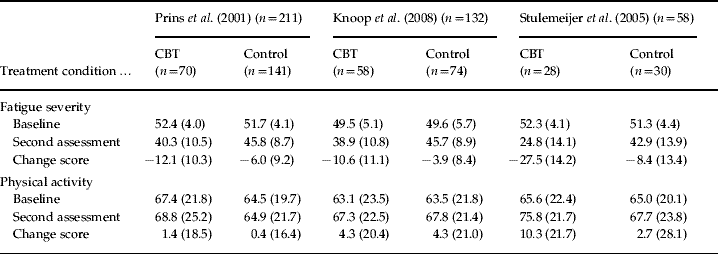
In Table 2, baseline, second assessment and change scores on fatigue severity and physical activity are presented per treatment condition for the group of included patients. In Table 3, it can be seen that fatigue reduced significantly more in the treatment group than in the control group in all samples (path c). However, CBT did not produce a significant change in physical activity in any of the samples (path a). There was also no significant relationship between changes in physical activity and changes in fatigue (path b). The effect of treatment on fatigue remained significant when it was controlled for changes in physical activity (path c').
Baseline, second assessment and change scores on fatigue severity and physical activity in the group of included patients per treatment condition

CBT, Cognitive behaviour therapy.
Values are given as mean (standard deviation).

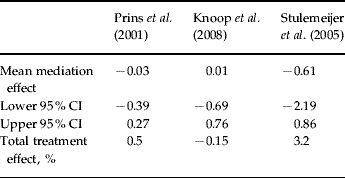
In Table 4, results of the bootstrap analysis are shown. Resampling of the observed dataset resulted in a mean mediation effect with a 95% CI for each sample. The mean mediation effect averaged about 1% of the total treatment effect across the three samples. The 95% CI of the mean mediation effect included zero in all samples. The mediation hypothesis was not confirmed.
Testing the mediation effect according to the bootstrap approach

CI, Confidence interval.
Discussion
The data did not support a treatment model in which the effect of CBT on fatigue is mediated by an increase in physical activity. CBT did neither cause an increase in physical activity at the end of treatment (path a) nor was an increase in physical activity associated with a reduction in fatigue (path b). A formal test of the mediation effect confirmed that CBT yielded its effect independent of a persistent change in physical activity.
These results are in line with the study of Moss-Morris et al. (Reference Moss-Morris, Sharon, Tobin and Baldi2005) in which it was demonstrated that not an increase in fitness but a change in preoccupation with symptoms mediated the effect of GET on fatigue. The results are also consistent with earlier research on CBT for CFS in which a reduction in fatigue was associated with a change in illness beliefs (Deale et al. Reference Deale, Chalder and Wessely1998). In the light of these findings, changing illness-related cognitions seems to play a more crucial role in CBT for CFS than an increase in physical activity.
There are several potential alternative explanations for the fact that we did not find support for our mediation hypothesis. A substantial amount of patients did not complete actigraphy at second assessment and had to be excluded from our mediation analyses. It is possible that we introduced a bias through exclusion which might account for our findings. However, analysis of the baseline characteristics revealed that a selection bias is no likely explanation for our findings.
Our patients were not required to stick to their physical activity programme until the end of therapy. As treatment proceeded, they were allowed to substitute physical activities for other activities such as social ones. Consistently, treatment could have resulted in a temporary increase in physical activity which was no longer existent when second assessment took place. This temporary increase in physical activity during treatment might have been sufficient to facilitate a persistent change in illness-related cognitions. When patients learned that they were able to increase their level of physical activity despite their symptoms, their belief of having little control over their condition should have changed and with it also the perception of fatigue as an inherently aversive state. To examine these mechanisms of change in CBT for CFS, patients' physical activity and illness-related cognitions need to be monitored repeatedly during treatment.
Patients with a pervasively passive activity pattern have extremely low levels of physical activity. These patients do not respond to common CBT for CFS (Prins et al. Reference Prins, Bleijenberg, Bazelmans, Elving, de Boo, Severens, van der Wilt, Spinhoven and van der Meer2001). A specifically tailored approach in which the physical activity programme is delivered earlier showed better effects for these patients (e.g. Stulemeijer et al. Reference Stulemeijer, de Jong, Fiselier, Hoogveld and Bleijenberg2005). They might thus profit from a persistent increase in physical activity after all. Unfortunately, the number of patients was too small to properly examine whether a change in physical activity does mediate the effect of treatment in pervasively passive patients.
In contrast to pervasively passive patients, the majority of CFS patients is not only characterized by a low level of physical activity, but has also a deregulated pattern of physical activity in which short periods of high activity are alternated with longer periods of rest (van der Werf et al. Reference van der Werf, Prins, Vercoulen, van der Meer and Bleijenberg2000). These patients were taught to spread their activities evenly across day and week (Bleijenberg et al. Reference Bleijenberg, Prins, Bazelmans, Jason, Fennell and Taylor2003). Perhaps a change in activity regulation is more important to facilitate improvement in relatively active CFS patients than an increase in physical activity.
Taking these considerations into account, the exact role of physical activity in CBT for CFS remains to be determined. Besides physical activity, future investigations should also examine the role of changes in social, mental and work-related activities in CBT for CFS, preferably based on the time patients actually spend on these activities to limit perception bias. For the time being, our study was the first one to show that the severity of fatigue in patients with CFS is not reduced by CBT because patients have become more physically active at the end of their treatment. Based on these findings, physical activity programmes can better be understood as a way to facilitate change in other mechanisms which are more directly related to a change in fatigue. Among these mechanisms, a change in illness-related cognitions is likely to play a crucial role in CBT for CFS and should therefore be monitored closely during treatment.
Acknowledgements
None.
Declaration of Interest
None.