





Introduction
Studies indicate that individuals who identify with populist radical right parties (PRRPs) display weaker commitments to pluralist values (Akkerman, Mudde and Zaslove Reference Akkerman, Mudde and Zaslove2014). Specifically, PRRP identifiers are less likely to endorse the idea that democracy requires compromise among differing viewpoints and that the perspectives of other groups should be heard. Additionally, PRRP identifiers are more inclined to believe that diversity restricts their personal freedom. In this research note, we offer new insights into anti-pluralism among PRRP identifiers by asking whether they also express a higher sense of understanding for citizens who use violence against political opponents (Baumgartner, Götte, Gügler et al. Reference Baumgartner, Götte, Gügler and Fehr2012; Benson Reference Benson1985; Curasi Reference Curasi2013; Dray Reference Dray2000; Harris Reference Harris2022; Lai Reference Lai2022; Myers Reference Myers1995; Pohja-Mykrä Reference Pohja-Mykrä2016; Smyth, Teicher and Wilde Reference Smyth, Teicher and Wilde2024; Ugelvik Reference Ugelvik2012; Weber Reference Weber2003; Wolberg Reference Wolberg2023).Footnote 1 Building on an existing scholarly debate (Jones and Becker Reference Jones and Becker2022; Urdal Reference Urdal2006; van Driel, Darmody and Kerzil Reference van Driel, Darmody and Kerzil2016; Zohar, Domènech-Abella, De Backer et al. Reference Zohar, Domènech-Abella, De Backer and Lombaerts2022), we also examine whether education strengthens or weakens the association between PRRP identity and sense of understanding.
To meet these goals, we rely on original Flemish data from the 2024 Belgian Not Like Us (NLU) Study (Eck, Michel, Lefevere et al. Reference Eck, Michel, Lefevere, Pilet, Celis, Claes, Rihoux, Van Haute, Walgrave, Close, Baudewyns, Van Ingelgom, Severs, Kern, Wauters and Dodeigne2025). We do so for six reasons. First and foremost, Flanders is home to a PRRP – the Vlaams Belang (VB) (Meijen, Raube andWouters Reference Meijen, Raube and Wouters2023). Second, Flanders represents a deeply divided society where multiple cleavages intersect and mutually reinforce each other (Caluwaerts and Reuchamps Reference Caluwaerts and Reuchamps2020; Deschouwer Reference Deschouwer2012; Kins, Jacobs and Close Reference Kins, Jacobs and Close2026). Third, the VB maintains a significant presence in Parliament, allowing for a meaningful number of PRRP identifiers in the analysis. Fourth, Flanders features a highly fragmented party system and exists within a country that encompasses two very distinct party systems. Given these characteristics, Flanders enables analyses that consider political opponents from several distinct parties. Fifth, Flanders is marked by a relatively strong cordon sanitaire that isolates the VB from other parties (Skrzypek Reference Skrzypek2024). This dynamic creates a unique context that may simultaneously foster and constrain a sense of understanding for citizens who resort to violence against political opponents. Sixth, Flanders is situated within a consolidated liberal democracy – Belgium (Lührmann, Gastaldi, Grahn et al. Reference Lührmann, Gastaldi, Grahn, Lindberg, Maxwell, Mechkova and Pillai2019) – which scores relatively highly on core democratic principles (Van der Brug, Popa, Hobolt et al. Reference Van der Brug, Popa, Hobolt and Schmitt2021). This situation enables generating insights that may be generalizable to other advanced democracies. Importantly, the NLU focuses on two equally relevant forms of political violence (George Reference George2021; Herrick and Thomas Reference Herrick and Thomas2024), especially in the current era of heightened mis/disinformation (McIntyre Reference McIntyre2018): threatening political opponents and spreading false information about them. Research highlights, for instance, that spreading false information can be as harmful as the direct infliction of emotional distress (George Reference George2021) and often serves as a critical stepping stone in attempts to overturn election results (Hunter Reference Hunter2023) – see also George (Reference George2021); Jarutienė, Michailovič and Laurinaitytė (Reference Jarutienė, Michailovič and Laurinaitytė2023); Törnberg and Chueri (Reference Törnberg and Chueri2026). Still, we discuss the need for further research on even more extreme cases of violence – such as killing political opponents – in the concluding section.Footnote 2
Following methodological advances in political science research (Boussalis, Coan and Holman Reference Boussalis, Coan and Holman2024; Cutler, De Marchi, Gallop et al. Reference Cutler, De Marchi, Gallop, Hollenbach, Laver and Orlowski2016; Gava, Jaquet and Sciarini Reference Gava, Jaquet and Sciarini2021; Laloux and Laloux Reference Laloux and Laloux2025; Muchlinski Reference Muchlinski2021; Van der Zwan, Tolsma and Lubbers Reference Van der Zwan, Tolsma and Lubbers2020), we examine NLU data by means of Bayesian zero-inflated regression models. Not only these models mitigate concerns about sample size (Much Reference Much2025) but they accommodate the excess zeros in our outcome variables (Burch and Egbert Reference Burch and Egbert2020) and enable the estimation of the likelihood of structural zeros – that is, zeros that result from a distinct underlying process and that reflect an unconditional rejection of a sense of understanding for citizens who engage in violent behavior (Feng Reference Feng2021; Gava, Jaquet and Sciarini Reference Gava, Jaquet and Sciarini2021). In line with expectations, the Bayesian zero-inflated regression models show that PRRP identity correlates with a higher sense of understanding for citizens who threaten or spread false information about political opponents.Footnote 3 These results represent important evidence that individuals’ partisan allegiance may fundamentally shape their views on political violence (Hawley Reference Hawley2023).Footnote 4 Substantively, these results further suggest that PRRP identifiers may regard the use of violence against opposing views as morally understandable – a perception that could ultimately pave the way for further polarization and the rise of tyrannical systems, importantly, with popular support (Berntzen, Kelsall and Harteveld Reference Berntzen, Kelsall and Harteveld2024; Weber Reference Weber2003). Contrary to expectations (Glaeser, Ponzetto and Shleifer Reference Glaeser, Ponzetto and Shleifer2007; van Driel, Darmody and Kerzil Reference van Driel, Darmody and Kerzil2016), education does not consistently attenuate the relationship between PRRP identity and sense of understanding. It weakens the link for spreading false information but not for threatening. From this perspective, education may be important, but it is unlikely a panacea for violence against political opponents.
By presenting these findings, our study contributes to two related research. First, we extend the analysis of Berntzen, Kelsall and Harteveld (Reference Berntzen, Kelsall and Harteveld2024) by investigating the association between PRRP identity and sense of understanding for citizens who resort to a key form of political violence – spreading false information (George Reference George2021). Also, we examine attitudes toward political violence with an emphasis on individuals’ identification with a PRRP. Second, we expand on the findings of Matsunaga (Reference Matsunaga2025) by drawing on two concrete cases of violence (threatening and spreading false information) – see Westwood, Grimmer, Tyler et al. (Reference Westwood, Grimmer, Tyler and Nall2022) for a defense of such an approach. We also employ an attitudinal measure toward political violence that explicitly identifies political opponents and that follows existing literature on sense of understanding (Elkayam and English Reference Elkayam and English2003; Gottschalk Reference Gottschalk2021; Gupta and Gottschalk Reference Gupta and Gottschalk2025; Pliskin, Sheppes and Halperin Reference Pliskin, Sheppes and Halperin2015; Rokeach andWiener Reference Rokeach and Wiener2022; Smith and Rose Reference Smith and Rose2011; Sugimura, Crocetti, Hatano et al. Reference Sugimura, Crocetti, Hatano, Kaniušonyt, Hihara and Žukauskien2018; Swain Reference Swain2017; Taylor Reference Taylor2015; Thatcher and Krikorian Reference Thatcher and Krikorian2005; Ugelvik Reference Ugelvik2012; Warner Reference Warner2007; Weber Reference Weber2003).
In addition to these contributions, our study adds to three research streams. First and foremost, we advance knowledge on anti-pluralism among PRRP identifiers (Akkerman, Mudde and Zaslove Reference Akkerman, Mudde and Zaslove2014; Meijen, Raube and Wouters Reference Meijen, Raube and Wouters2023; Mudde and Kaltwasser Reference Mudde and Kaltwasser2013; Müller Reference Müller2017; Norris and Inglehart Reference Norris and Inglehart2019; Schwörer and Koß Reference Schwörer and Koß2025; Smeekes and Lubbers Reference Smeekes and Lubbers2024). Specifically, we elucidate the extent to which PRRP identifiers exhibit ‘a value system positing tolerance and respect for opposing views on the basis of mutual reciprocity’ (Medzihorsky and Lindberg Reference Medzihorsky and Lindberg2024) [422], thereby shedding new light on the content of PRRP identity.Footnote 5 (Mols and Jetten Reference Mols and Jetten2016, Reference Mols and Jetten2020).Footnote 6 Second, we offer new evidence that PRRP identifiers may form what psychologists call a ‘loose’ community, in which ‘deviance by others is less likely to be noticed, and even when it is noticed, it will be much more tolerated’ (Gelfand, Nishii and Raver Reference Gelfand, Nishii and Raver2006) [1230]. From this perspective, our study indicates that events like the ones reported in Krause and Matsunaga (Reference Krause and Matsunaga2023); Nieuwsblad (2020); Vrielink (Reference Vrielink2014) may be embedded in a moral structure that allows for – rather than hinders – their replication. In other words, rather than being socially condemned, violent actions may be seen as understandable by PRRP identifiers (Rochtus Reference Rochtus, Backes and Lindenberger2023).Footnote 7 Third, by centering on how individuals react to other citizens’ undemocratic behavior rather than the elite’s, we add an important comparative dimension to existing research –for example, see Hobolt and Osnabrügge (Reference Hobolt and Osnabrügge2025); Howe (Reference Howe2017); Kiewiet de Jonge (Reference Kiewiet de Jonge2016); Westwood, Grimmer, Tyler et al. (Reference Westwood, Grimmer, Tyler and Nall2022).
Our study is organized as follows: first, we discuss the reasons for a correlation between PRRP identity and sense of understanding for citizens who engage in political violence. Second, we present the data and measures used in the analysis. Third, we indicate the results. In the conclusion, we summarize our findings and debate future lines of research.
PRRP identity and sense of understanding for citizens’ political violence
Research provides strong theoretical reasons for a connection between PRRP identity and a sense of understanding for citizens who commit political violence. In particular, Matsunaga (Reference Matsunaga2025) affirms that PRRPs tend to avoid direct involvement in violent acts, as such behavior risks undermining their parliamentary standing and exposing them to judicial consequences. At the same time, the parties’ inflammatory rhetoric toward – and vilification of – political opponents likely signals to voters that violence against these groups is morally understandable (Matsunaga Reference Matsunaga2025).Footnote 8
Matsunaga’s view of PRRPs – particularly their role in fostering a sense of understanding – aligns with two key strands of research. First, social movement scholarship suggests that acts of delegitimation function as crucial mechanisms for rendering violent behavior morally understandable (Bar-Tal Reference Bar-Tal1989; Hodson and MacInnis Reference Hodson and MacInnis2016; Rak Reference Rak2021).Footnote 9 Second, research in political behavior provides extensive evidence of the influence of party rhetoric on individuals’ attitudes, opinions, and behaviors (Albertson and Guiler Reference Albertson and Guiler2020; Clifford and Jerit Reference Clifford and Jerit2013; Jung Reference Jung2020; Kalmoe, Gubler and Wood Reference Kalmoe, Gubler and Wood2018; Lenz Reference Lenz2012), including their support for constitutional rights (Kingzette, Druckman, Klar et al. Reference Kingzette, Druckman, Klar, Krupnikov, Levendusky and Ryan2021) and their perceived threats to those rights (Armaly and Enders Reference Armaly and Enders2024).Footnote 10
Based on the existing literature, it seems therefore logical to expect that PRRP identity correlates with a sense of understanding for citizens who engage in political violence. Through inflammatory rhetoric against political opponents, PRRPs likely contribute to the perception that violence against those groups is morally understandable (Matsunaga Reference Matsunaga2025). An association between PRRP identity and sense of understanding can be further explained in three ways. First, PRRPs often promote narratives of imperilment and crises (Marcks and Pawelz Reference Marcks and Pawelz2022; Vanderwee and Droogan Reference Vanderwee and Droogan2025). By doing so, PRRPs likely foster the belief that opposing parties must be defeated at all costs, even if it means using violence (Colvin and Pisoiu Reference Colvin and Pisoiu2021; Hunter Reference Hunter2023; Kim, Hahl, Poskanzer et al. Reference Kim, Hahl, Poskanzer and Zuckerman Sivan2024; Layman, Lee and Wolbrecht Reference Layman, Lee and Wolbrecht2023; Schumpeter Reference Schumpeter2013; Smeekes and Lubbers Reference Smeekes and Lubbers2024). Second, by blaming political opponents for prior acts of violence, PRRPs may render such behavior more understandable. For instance, although the Alternative for Germany (AfD) condemned the 2020 Hanau shooting, it attributed responsibility to Angela Merkel’s refugee policies (Colvin and Pisoiu Reference Colvin and Pisoiu2021; Curasi Reference Curasi2013; Vanderwee and Droogan Reference Vanderwee and Droogan2025; Ware Reference Ware2019). Third, a sense of understanding for citizens who commit political violence can further originate from horizontal processes on a peer-to-peer basis (Cantin Reference Cantin2021). Such processes may be particularly influential when there are pressures for conformity and group solidarity (Bell Reference Bell2016; Cantin Reference Cantin2021; Cohen Reference Cohen2013; Wood Reference Wood2018).
Following this logic, our first hypothesis is that:
H1: PRRP identifiers are more likely to express a sense of understanding for citizens who threaten political opponents or spread false information about them than non-PRRP identifiers.
At the same time, the literature identifies two possible mechanisms – linked to the so-called paradox of violence and education (Zohar, Domènech-Abella, De Backer et al. Reference Zohar, Domènech-Abella, De Backer and Lombaerts2022) – through which education can moderate the correlation between PRRP identity and sense of understanding. On the one hand, research shows that education correlates with political awareness (Jung Reference Jung2020; Peterson Reference Peterson2019) – though see Hobolt (Reference Hobolt2005) – which, in turn, enhances the influence of party cues (Engelhardt Reference Engelhardt2021; Jones Reference Jones2020; Jones and Becker Reference Jones and Becker2022; Jung Reference Jung2020; Kingzette, Druckman, Klar et al. Reference Kingzette, Druckman, Klar, Krupnikov, Levendusky and Ryan2021; Kriner and Shen Reference Kriner and Shen2014; Layman and Carsey Reference Layman and Carsey2002). Additionally, by virtue of possessing greater political information, highly educated individuals are especially likely to rely on party rhetoric when forming their political opinions (Lodge and Taber Reference Lodge and Taber2013). On the other hand, the literature affirms that highly educated individuals tend to exhibit strong preexisting attitudes, which likely make them resistant to influence from party appeals (Zaller Reference Zaller1992). Moreover, education is shown not only to foster key democratic attitudes such as tolerance (Glaeser, Ponzetto and Shleifer Reference Glaeser, Ponzetto and Shleifer2007; van Driel, Darmody and Kerzil Reference van Driel, Darmody and Kerzil2016), but to augment the perceived costs of violence (Urdal Reference Urdal2006) – but see Barakat and Urdal (Reference Barakat and Urdal2009).
From this perspective, we advance two contrasting hypotheses concerning a moderation effect by education:
H2: Highly educated PRRP identifiers are less likely to express a sense of understanding for citizens who theaten political opponents or spread false information about them than their less educated counterparts.
H3: Highly educated PRRP identifiers are more likely to express a sense of understanding for citizens who theaten political opponents or spread false information about them than their less educated counterparts.
Data
Hypotheses 1–3 are tested using data from the NLU Study (Eck, Michel, Lefevere et al. Reference Eck, Michel, Lefevere, Pilet, Celis, Claes, Rihoux, Van Haute, Walgrave, Close, Baudewyns, Van Ingelgom, Severs, Kern, Wauters and Dodeigne2025) (see Appendix B for additional details). In this study, sense of understanding (the dependent variable) is operationalized using the question, Can you tell us to what extent you understand citizens who take the following measures to express their political opinions? 0 means you do not understand at all, and 10 means you completely understand. Verbally threaten voters of [least liked party]; Spread false information about voters of [least liked party] (see the translations in French and Dutch in Table C1 of the online Appendix).Footnote 11 The identification of political opponents through voters of each respondent’s least liked party (Areal and Harteveld Reference Areal and Harteveld2024) is consistent with Arzheimer and Evans (Reference Arzheimer and Evans2012); Cameron (Reference Cameron2004); Dovidio and Gaertner (Reference Dovidio and Gaertner1993); Lachance and Beauvais (Reference Lachance and Beauvais2024); Peterson and Wrighton (Reference Peterson and Wrighton1998); Richardson (Reference Richardson1991). It also allows for differences in perceptions of out-groups while minimizing poor responses that can result from a long list of survey items (Dillman, Smyth and Christian Reference Dillman, Smyth and Christian2014; Lavrakas Reference Lavrakas2008; Roche, Lee, Pickett et al. Reference Roche, Lee, Pickett, Graham and Cullen2024). As indicated earlier, we do not provide information on the party of those who threaten or spread false information (Kingzette, Druckman, Klar et al. Reference Kingzette, Druckman, Klar, Krupnikov, Levendusky and Ryan2021), as our interest lies in understanding how PRRP identifiers perceive political violence in general (Balliet, Tybur, Wu et al. Reference Balliet, Tybur, Wu, Antonellis and Van Lange2018; Kingzette, Druckman, Klar et al. Reference Kingzette, Druckman, Klar, Krupnikov, Levendusky and Ryan2021). As expected, most Flemish respondents do not express understanding for citizens who threaten or spread false information about political opponents – see Figure D1 and Table E1 in the online Appendix.
We operationalize PRRP identity (our main independent variable) by means of answers to two feel-close questions – Do you feel close to any political party? Which political party do you feel the closest to? (Aldrich, Bussing, Krishnamurthy et al. Reference Aldrich, Bussing, Krishnamurthy, Madan, Ice, Renberg and Ridge2020; Burden and Klofstad Reference Burden and Klofstad2005; Neely Reference Neely2007; Ridge Reference Ridge2022). This approach is consistent with the definition of partisan identity found in Campbell, Converse, Miller et al. (Reference Campbell, Converse, Miller and Donald1960) – see also Burden and Klofstad (Reference Burden and Klofstad2005); Campbell, Gurin and Miller (Reference Campbell, Gurin and Miller1954); Miller, Shanks and Shapiro (Reference Miller, Shanks and Shapiro1996). Those who report feeling close to the VB (213 observations) are coded as ‘1’. Those who report feeling close to another party (1037 observations) or to no party (1713 observations) are coded as ‘0’.Footnote 12 Education (our moderating variable) is categorized into five levels: primary or less, incomplete secondary, complete secondary, tertiary non-university, and tertiary university (Feitosa, Baudewyns, Pilet et al. Reference Feitosa, Baudewyns, Pilet and Talukder2024). See Appendix F for information on control variables – namely, self-reported, left-right ideology,Footnote 13 political interest, gender, and age.
Models
We assess Hypotheses 1–3 by means of two Bayesian zero-inflated regression models. In our first model, we regress sense of understanding on PRRP identity controlling for self-reported ideology, political interest, education, gender, and age. In our second model, we add an interaction term of PRRP identity and education. In line with Much (Reference Much2025), we rely on the default priors in brms (the R package we use to estimate these models), as they ‘sway the results as little as possible while accounting for the bias that can occur with naive uninformative priors’ [19] – see also Bürkner (Reference Bürkner2017); Lucas, Sheffer and Loewen (Reference Lucas, Sheffer and Loewen2025); Orchinik, Dubey, Gershman et al. (Reference Orchinik, Dubey, Gershman, Powell and Bhui2024); Romero Verdugo, van Lieshout, de Lange et al. (Reference Romero Verdugo, van Lieshout, de Lange and Cools2023).Footnote 14 We also rely on the default hyperparameters provided by the brms package – that is, we run four Markov chains with 2,000 iterations each, including 1,000 warm-up iterations and no thinning, resulting in a total of 4,000 post-warm-up posterior draws.
To verify the validity of the results, we conduct two robustness checks. First, while partisanship concerns a long-term attitude (Campbell, Converse, Miller et al. Reference Campbell, Converse, Miller and Donald1960; Huddy, Bankert and Davies Reference Huddy, Bankert and Davies2018) that drives opinions, attitudes, and behavior rather than the reverse (Clifford and Jerit Reference Clifford and Jerit2013; Jung Reference Jung2020; Kalmoe, Gubler and Wood Reference Kalmoe, Gubler and Wood2018; Lenz Reference Lenz2012) – but see Fiorina (Reference Fiorina1981) – we follow Baccini and Urpelainen (Reference Baccini and Urpelainen2014); Conyon and He (Reference Conyon and He2014); Eveland Jr, Hayes, Shah et al. (Reference Eveland, Hayes, Shah and Kwak2005); Kartal (Reference Kartal2025); Lehoucq and Pérez-Liñán (Reference Lehoucq and Pérez-Liñán2014); Lenz (Reference Lenz2009); Steinberg and Malhotra (Reference Steinberg and Malhotra2014); Vliegenthart and Lefevere (Reference Vliegenthart and Lefevere2018) and add a time lapse between the dependent and (main) independent variables to account for potential reverse causation.Footnote 15 Second, we separate independents from other party identifiers to verify potential differences across these groups.
In additional tests, we estimate separate interactions between PRRP identity and each of the following: out-group liking, support for a strong leader, and partisans strength – see Appendix G for their coding. The first test examines potential heterogeneity based on the target of political violence. The second considers heterogeneity associated with authoritarian values (Bartels Reference Bartels2020; Sprong, Jetten, Wang et al. Reference Sprong, Jetten, Wang, Peters, Mols, Verkuyten and Wohl2019; Wuttke, Gavras and Schoen Reference Wuttke, Gavras and Schoen2022) – though see Snagovsky and Werner (Reference Snagovsky and Werner2025). The third assesses heterogeneity stemming from levels of partisanship (Dancey and Sheagley Reference Dancey and Sheagley2013; Ferrari Reference Ferrari2022; Goren, Federico and Kittilson Reference Goren, Federico and Kittilson2009; Peterson Reference Peterson2019; Schaffner and Roche Reference Schaffner and Roche2016; Vidigal Reference Vidigal2022; Zaller Reference Zaller1992). We further substitute PRRP identity with that of either a right-wing nationalist party (N-VA) (Maly Reference Maly2016) or a populist radical left party (PRLP; PVDA/PTB) (Damiani Reference Damiani2020; Feitosa, Pilet and Talukder Reference Feitosa, Pilet and Talukder2026), use PRRP identity to predict structural zeros (Feng Reference Feng2021; Gava, Jaquet and Sciarini Reference Gava, Jaquet and Sciarini2021), and explore variation across levels of relative deprivation and province-level Gini (Fransman and von Fintel Reference Fransman and von Fintel2024).
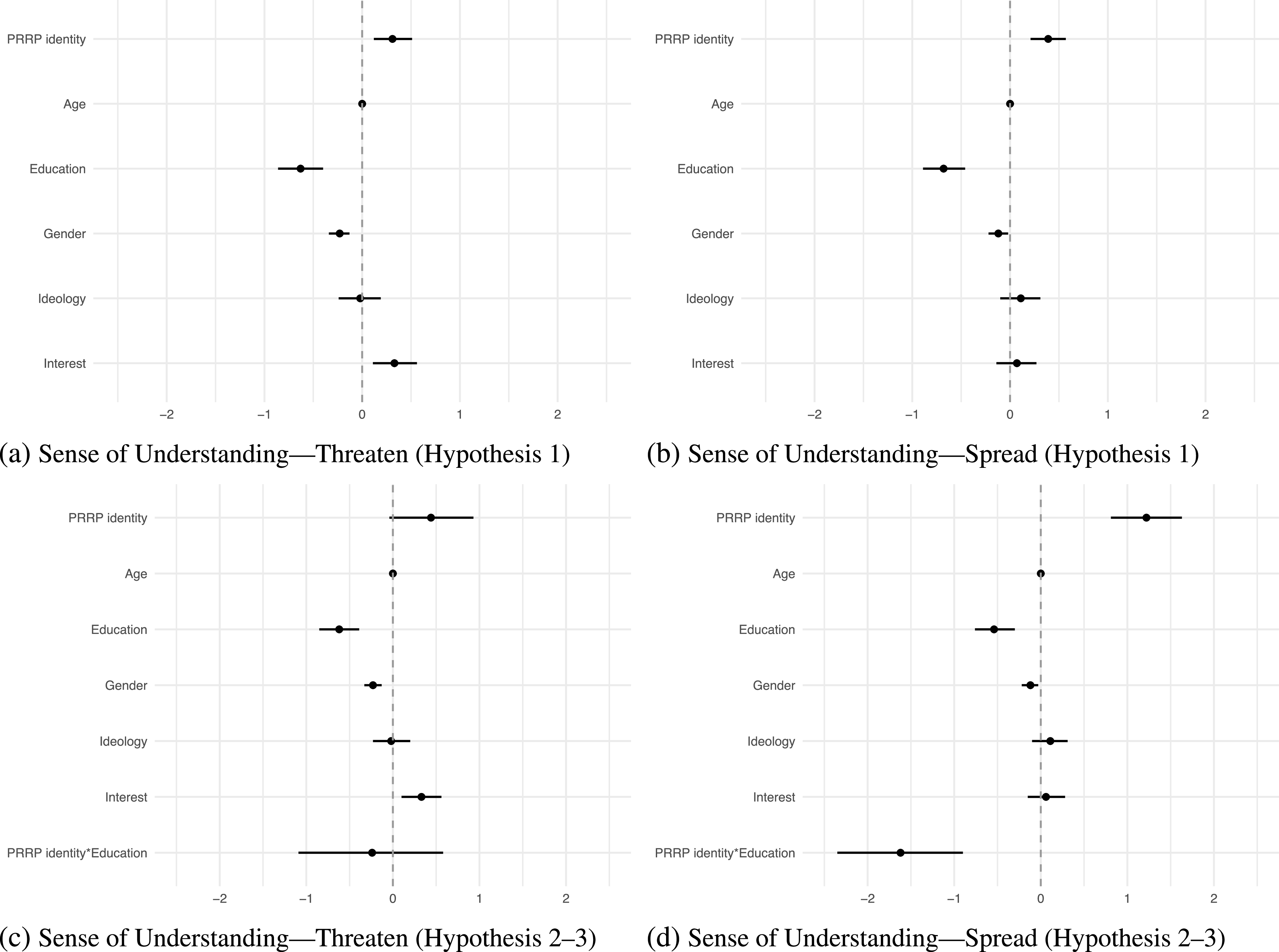
Results
Figure 1 and Table H1 display the main results. In line with Hypothesis 1, PRRP identifiers are more likely to express understanding for citizens who threaten or spread false information about political opponents than non-PRRP identifiers.Footnote 16 Although research warns against over-interpreting estimates for control variables (Angrist and Pischke Reference Angrist and Pischke2009), it is noteworthy that more educated individuals and women exhibit lower levels of sense of understanding (Heyne Reference Heyne2019; Matsunaga Reference Matsunaga2025). Greater political interest is also associated with a higher sense of understanding in the case of threatening behavior, but not of false information.
Bayesian zero-inflated regressions of sense of understanding for citizens who threaten or spread false information on PRRP identity.
Note: Since Bayesian zero-inflated regression models rely on logit transformations of the outcome variables, the reported coefficients are expressed in log-odds. Values in square brackets correspond to 95% confidence intervals. For the results in tabular form, see Table H1.

The supplementary tests discussed earlier – displayed in Tables H1–H6 of the online Appendix – shed additional light on the link between PRRP identity and sense of understanding. Two results stand out. First, PVDA identifiers report a higher sense of understanding of citizens’ violent behavior than their counterparts – see De Lange and Rooduijn (Reference De Lange, Rooduijn, Andeweg and Thomassen2011); Mudde and Kaltwasser (Reference Mudde and Kaltwasser2013) for contrasting findings. Rather than being counterintuitive, this may reflect left-wing traditions that view disruptive tactics, including violence, as sometimes necessary (Hawley Reference Hawley2023). However, this pattern is not observed among PTB identifiers in Wallonia, suggesting limited generalizability across PRLP identities. Second, relative deprivation strengthens the relationship between PRRP identity and sense of understanding in the context of false information, but not threats. Province-level inequality also moderates this relationship: it is negative in more unequal Flemish provinces and positive in less unequal ones, consistent with evidence that favorable economic contexts facilitate radical experimentation (Erhardt, Wamsler and Freitag Reference Erhardt, Wamsler and Freitag2021; Rooduijn and Burgoon Reference Rooduijn and Burgoon2018; Vanhoutte and Hooghe Reference Vanhoutte and Hooghe2013).Footnote 17
Figure 1 and Table H1 also report on the moderation effect by education. They show that education weakens the association between PRRP identity and sense of understanding, but only when it comes to the spread of false information. From this perspective, it is unlikely that education alone may help counter the normalization of political violence (Glaeser, Ponzetto and Shleifer Reference Glaeser, Ponzetto and Shleifer2007; van Driel, Darmody and Kerzil Reference van Driel, Darmody and Kerzil2016). Note, however, that education-based initiatives that explicitly promote the rejection of political violence may prove more effective. We leave the exploration of this possibility to future research.
Conclusion
Our study aimed to extend existing works on anti-pluralism among PRRP identifiers by examining their sense of understanding for citizens who threaten or spread false information about their political opponents. We found evidence of a positive correlation between PRRP identity and sense of understanding. Moreover, education weakens the association between PRRP identity and sense of understanding, although not in the case of threatening. Taken together, these findings suggest a greater permissiveness toward citizens who engage in political violence – a tendency that reflects a broader group-based phenomenon linked to partisan identity. In other words, violence may come to be seen as a legitimate means of acting against political opponents, thereby posing a risk to liberal democracies (Berntzen, Kelsall and Harteveld Reference Berntzen, Kelsall and Harteveld2024).
Our study is obviously not exempt from limitations. First, as noted earlier, our data do not permit a direct test of potential reverse causation, although we do regress understanding on PRRP identity measured at different time points (Albertson and Guiler Reference Albertson and Guiler2020; Armaly and Enders Reference Armaly and Enders2024; Campbell, Converse, Miller et al. Reference Campbell, Converse, Miller and Donald1960; Clifford and Jerit Reference Clifford and Jerit2013; Huddy, Mason and Aarøe Reference Huddy, Mason and Aarøe2015; Jung Reference Jung2020; Kalmoe, Gubler and Wood Reference Kalmoe, Gubler and Wood2018; Kingzette, Druckman, Klar et al. Reference Kingzette, Druckman, Klar, Krupnikov, Levendusky and Ryan2021; Lenz Reference Lenz2012), and interact PRRP identity with political interest (Arzheimer and Schoen Reference Arzheimer and Schoen2016; Schmitt-Beck, Weick and Christoph Reference Schmitt-Beck, Weick and Christoph2006). Second, while examining sense of understanding when it comes to threats and the spread of false information is highly relevant – particularly given the high levels of mis/disinformation (McIntyre Reference McIntyre2018); see also George (Reference George2021); Hunter (Reference Hunter2023); Jarutienė, Michailovič, and Laurinaitytė (Reference Jarutienė, Michailovič and Laurinaitytė2023); Törnberg and Chueri (Reference Törnberg and Chueri2026) – our study does not address more extreme forms of violence (eg the assassination of political opponents) (Bosi, Malthaner, Malthaner et al. Reference Bosi, Malthaner, Della Porta and Di-ani2015). It is worth noting, however, that survey questions addressing such cases raise concerns about social desirability bias – while such bias remains possible for threatening and spreading false information, it is likely to be lower than for killing. Third, while the literature suggests that a greater sense of understanding may stem from PRRPs’ rhetoric, it may also make PRRP identifiers more willing to openly express their views on political violence. As addressing this possibility would require different data, we do not examine it in the present study. Fourth, although we focus on Belgium for a variety of reasons and observe similar rhetoric in other countries, such as Romania (Miscoiu, Pantea and Petrila Reference Miscoiu, Pantea and Petrila2023), we do not examine the relationship between PRRP identity and attitudes toward political violence across different political contexts.Footnote 18 It is possible that PRRP identifiers are as likely as their counterparts – or even less likely – to express understanding toward threatening behavior or the spread of false information about political opponents (Dimopoulos Reference Dimopoulos2023; Hawley Reference Hawley2023; Rooduijn and Burgoon Reference Rooduijn and Burgoon2018). Furthermore, while dissensus over the functioning and principles of liberal democracy is particularly evident across political parties, we do not examine its correlation with attitudes toward political violence beyond the party system (Brack, Coman and Miscoiu Reference Brack, Coman and Miscoiu2025).
In conclusion, our study offers new insights into anti-pluralism among PRRP identifiers. Specifically, it demonstrates that these individuals are not only more likely to reject the idea that democracy requires compromise and openness to differing viewpoints, but they are more understanding toward the use of violence against political opponents. Although the theoretical framework employed – partisanship and its perceptual screen (Campbell, Converse, Miller et al. Reference Campbell, Converse, Miller and Donald1960) – is generalizable (see also Matsunaga Reference Matsunaga2025), the behavior of PRRPs may vary across contexts depending on expected electoral gains and patterns of competition (Dimopoulos Reference Dimopoulos2023; Hawley Reference Hawley2023; Rooduijn and Burgoon Reference Rooduijn and Burgoon2018). Specifically, drawing on the analysis of the moderating effect of province-level Gini, PRRPs may induce lower levels of sense of understanding among their identifiers under adverse political and/or economic conditions. Future research should explore these dynamics, refining our comprehension of the relationship between PRRP identity and sense of understanding. Future research should also investigate how sense of understanding might be mitigated. Partisan bias very likely poses a challenge for such a task – and may be a reason why education failed to consistently lower sense of understanding. State interventions condemning violence-inducing rhetoric and sanctioning party leaders who employ it – as happened in Brazil – may address the source of the problem. Yet the implementation of such interventions may prove difficult.
Supplementary material
The supplementary material for this article can be found at https://doi.org/10.1017/S1475676526101698.
Data availability statement
All replication materials are available in the online Appendix.
Acknowledgements
The authors are grateful to Caroline Close, Lucas Kins, and Laura Jacobs for granting access to the Belgian tweets used in this study. They also thank Ruth Dassonneville, Eline de Rooij, Jean-François Daoust, and the participants at the Future of Electoral Democracy conference, as well as Ignacio Jurado, Sergi Ferrer, and the participants at the 2025 Midwest Political Science Association (MPSA) conference, for their valuable feedback on earlier versions of this manuscript.
Funding statement
The authors are also grateful for the financial support provided by the FNRS and FWO through the Not Like Us (NLU) project (EOS no. 40007494; FWO no. G0H0322N; FNRS no. RG3139).
Competing interests
The authors declare no competing interests.
Ethical standards
Ethical approval for the NLU study was granted by the Ethics Committee of the Faculty of Philosophy and Social Sciences at the Université Libre de Bruxelles.
Use of AI disclosure
During the preparation of this work, the authors used ChatGPT 4o in order to copy-edit written paragraphs of text. After using this tool, the authors reviewed and edited the content as needed and take full responsibility for the content of the publication.


 Open access

