

How do electoral incentives affect legislators’ voting behavior in closed-list proportional representation (CLPR)? Under these rules, voters cannot alter the ranking of candidates in the party list, candidates do not compete against other candidates from the same party, and parties have control over ballot access. As a result, several scholars have inferred that under CLPR, the influence of parties on the behavior of individual legislators should be paramount (Norris Reference Norris2004; Shugart et al. Reference Shugart, Valdini and Suominen2005).
Apart from their personal values regarding public policy, legislators usually face a variety of pressures when deciding how to vote. These include the wishes of voters seeking passage of their preferred policies and the mandates of party leaders striving to enact their legislative agenda. If these views are not aligned, then legislators are cross-pressured. The relevance of these conflicting influences tends to be amplified when the dominant dimension of political conflict in legislative voting is the government-versus-opposition schism rather than an ideological left-right cleavage. The logic behind this argument is simple. Suppose that government (opposition) parties commit to voting for (against) any government-sponsored bill, regardless of the bill’s content. In this case, legislators may be torn between voting based on their consituents’ policy preferences or their party’s alignment along the government-opposition divide.Footnote 1 The implication is that incentives to defect from the party line are also present in CLPR systems.
Given that cross-pressured legislators exist, legislative parties need whips to compel fellow partisans to toe the party line. This is especially true if the party’s position on a given issue is not aligned with the preferences of the party’s voters. However, in these cases, whips do not need to compel all party members to behave in a disciplined manner to maximize their party’s electoral support. The party leadership can still achieve this goal by allowing some legislators to defect from the party line and vote in accordance with their voters’ preferences. The marginal benefits associated with the expected electoral gains that result from having some legislators vote against the party (and in accordance with voters) should help to offset the party’s marginal costs of allowing legislative dissent. Therefore, when considering whether to allow or punish defections, leaders need to evaluate who will give their party a greater bang for their electoral buck. In the case of CLPR systems, we hypothesize that whips will favor electorally motivated ideological shirking by legislators from overrepresented districts. Furthermore, we expect party leaders to tolerate this kind of behavior on lopsided votes rather than on close and important ones.
The search for constituency influence on roll call votes has mostly focused on the case of the US Congress, where electoral incentives to cultivate the personal vote dominate. This article examines legislative behavior in the Argentine Chamber of Deputies. The country has three features that make it ideal for empirically testing our propositions: members elected under CLPR, the presence of a government-versus-opposition divide, and the prevalence of lopsided plenary votes. There are also practical reasons for choosing Argentina for our analysis: access to a unique dataset that allows us to place voters and legislators in a common ideological space.
To evaluate our argument linking electoral incentives and legislative behavior, we rely on a measure of Argentine legislators’ revealed stances in regard to the government, coded from their votes on the plenary floor. The analysis of roll call behavior reveals that malapportionment systematically affects legislators’ propensity to defect from the party line in favor of voters’ ideological preferences. However, the influence of party voters on legislators’ voting behavior is evident in lopsided votes but not in closely contested ones. These findings are consistent with our argument that legislators from districts with higher relative electoral weight are given more freedom to cast votes aligned with the preferences of their party voters. They also support the view that party leaders’ willingness to allow defections is conditional on the effect of such defections on the expected outcome of the plenary vote.
This study’s argument and findings contribute to the literature on the effects of electoral incentives on legislative behavior. Earlier work has shown that electoral systems promoting intraparty competition tend to depress a party’s unity in roll call votes, while CLPR tends to enhance it (Hix Reference Hix2004; Carey Reference Carey2007; Depauw and Martin Reference Depauw, Shane, Giannetti and Benoit2009; Crisp et al. Reference Crisp, Santiago, Michael and Mindi2013). The literature also states that under CLPR, the party’s reputation is crucial for electoral success, and incentives to cultivate a personal vote should be minimized, particularly in high magnitude districts (Carey and Shugart Reference Carey and Shugart1995). Hazan (Reference Hazan, Martin, Saalfeld and Kaare2014), echoing the view of many scholars, argues that partisan control over access to the ballot and the nominating process are key contributors to party unity in legislatures. These arguments have motivated several studies focused on legislators’ incentives to balance the competing interests of party leaders and voters (Fiva and Halse Reference Fiva and Halse2016; Murillo and Pinto Reference Murillo and Pintoforthcoming; Catalinac Reference Catalinac2018; Buisseret and Prato Reference Buisseret and Prato2020; Burke et al. Reference Burke, Kirkland and Slapin2020). The existing literature has also examined the relationship between malapportionment and a variety of outcomes, such as cabinet inclusion (Bhavnani Reference Bhavnani2018), intergovernmental transfers (Pitlik et al. Reference Pitlik, Schneider and Strotmann2006; Galiani et al. Reference Galiani, Torre and Torrens2016), and the formation of territorial coalitions (Gibson and Calvo Reference Gibson and Calvo2000). The argument that we make in this study, linking malapportionment and legislative dissent, bridges the gap between these different strands in the literature.
This study also contributes to the literature on legislative behavior (Jones and Hwang Reference Jones and Hwang2005; Jones et al. Reference Jones, Wonjae and Micozzi2009; Calvo Reference Calvo2014; Alemán et al. Reference Alemán, Micozzi, Pinto and Saieigh2018; Clerici Reference Clerici2020) and the relationship between malapportionment and legislative politics in Argentina (Gibson and Calvo Reference Gibson and Calvo2000; Bonvecchi and Lodola Reference Bonvecchi and Lodola2011; Ardanaz et al. Reference Ardanaz, Leiras and Tommasi2014; Galiani et al. Reference Galiani, Torre and Torrens2016; Gervasoni and Nazareno Reference Gervasoni and Nazareno2017; Garofalo et al. Reference Garofalo, Lema and Streb2020). While various works have examined the behavior of Argentine legislators, this work is the first to link malapportionment to strategic defections from the party line.
The article proceeds to discuss our main argument linking electoral incentives and legislative behavior and the contextual factors that affect legislators’ voting patterns in Argentina. Then it lays out the main hypotheses, describes the data, and discusses the details of the estimation, and then reports the main empirical findings.
Electoral Incentives, Party Loyalty, and Legislators’ Voting Behavior
Legislative production is a team process. As a result, legislators have incentives to free-ride on their colleagues’ efforts. Specifically, they can engage in shirking, interpreted as indulging in their own ambitions rather than towing the party line (Kalt and Zupan Reference Kalt and Zupan1990; Crain et al. Reference Crain, Leavens and Tollison1986; Lott and Bronars Reference Lott and Bronars1993).
The literature on party unity has persuasively argued that despite individual incentives to act independently, most legislators are subordinate to the party leadership (Carey Reference Carey2007). Party leaders typically control the appointment of legislators to coveted positions in the chamber; allocate among them valuable resources, such as staff and other perks of office; and influence the chances that the bills and amendments that legislators seek to pass are addressed by the plenary. Perhaps the most consequential tool that party leaders can have to influence the behavior of their legislative contingent is the ability to affect individuals’ career prospects, whether this involves access to the ballot, renomination, or appointment to other offices. For instance, in line with conventional wisdom on the dominant role of electoral rules, Carey argues that in places where “party leaders draw up lists of candidates that are presented in general elections and cannot be altered by voters … electoral responsiveness to a competing principal is minimized” (Reference Carey2007, 93).
Party loyalty, however, can be a double-edged sword. As Lebo et al. (Reference Lebo, McGlynn and Koger2007) note, while loyalty may increase the likelihood of party victories on the floor, it may also expose individual legislators to electoral backlash. Party leaders prefer to avoid forcing legislators to vote with the party when they expect loyalty to negatively affect the party’s electoral performance. Instead, they try to maximize their party’s popularity by deploying the minimum amount of discipline necessary to achieve a maximum level of legislative success (Lebo et al. Reference Lebo, McGlynn and Koger2007; Patty Reference Patty2008). In other words, party leaders act strategically, encouraging legislators to toe the party line on close and important votes and allowing them to shirk on lopsided ones, where an individual legislator’s defection is less likely to alter the outcome. In the latter case, legislators can send a valuable signal of ideological purity to their constituents (Kirkland and Slapin Reference Kirkland and Slapin2018) and protect their electoral capital.
This reasoning fits well with existing evidence from countries using plurality rule in single-member electoral districts, notably the US Congress. In these cases, legislators can dissociate themselves from inconvenient aspects of their party’s overall reputation, mitigating the negative electoral externalities that stem from sharing a party label. This incentive is not restricted to plurality rule in single-member districts. Under electoral rules in which voters must show a preference for candidates who compete not only against other parties but also against members of their own party, legislators have high incentives to cater to specific electoral constituencies by building a personal reputation distinct from that of their party. The paradigmatic electoral rules that foster this kind of behavior are the single nontransferable vote and open-list proportional representation with high district magnitude (Cox Reference Cox1997). In contrast, under CLPR, the incentive to toe the party line is high. Nevertheless, legislative parties do not need the commitment of every member on every vote; it may be in their interest to allow strategic party disloyalty (Burke et al. Reference Burke, Kirkland and Slapin2020).Footnote 2 We argue that under CLPR, the party leadership will be more likely to allow some legislators to defect from the party’s legislative strategy when two conditions are met. First, the vote should not be expected to be close. In other words, party leaders should be more tolerant of defections on lopsided votes than on close and important ones. Second, defections should have the potential to help the party electorally. Leaders should choose a level of party discipline that balances the marginal costs and marginal benefits of additional party loyalty. The relative weight of different voters affects evaluations of electoral gains. More specifically, the relative influence held by voters in different electoral districts gives party leaders an opportunity to exploit the electoral implications of disciplined behavior.
Consider the effect of malapportionment. Suppose one electoral district has ten thousand voters and another has thirty thousand voters, but both choose the same number of representatives. Due to malapportionment, a voter in the less populated district has three times more influence than a voter in the more populated one. This difference, we argue, affects the costs and benefits of defections in legislative votes. Party leaders should be more likely to allow shirking in favor of party constituents when the legislator is elected from an overrepresented district. By pandering to these overly influential voters, the marginal benefits associated with the electoral gains that accrue from legislative shirking can offset the party’s marginal costs of allowing undisciplined behavior. Gibson and Calvo (Reference Gibson and Calvo2000) characterize coalitions centered on heavily overrepresented districts as having low-maintenance bases of support because they entail comparatively lower electoral costs. If our argument is correct, then tolerance of defections should also be systematically influenced by malapportionment as a revenue maximization strategy.
CLPR, Lopsided Votes, and Legislative Shirking: Case Selection
Unlike research on the US Congress, most comparative studies using roll call votes have focused on analyzing variations in party unity. We extend this literature by examining the impact of electoral incentives on strategic voting behavior in the Argentine Congress. Aside from data availability—which can be particularly challenging in developing countries, where roll call votes are not always systematically recorded and information about voters’ views is not readily available—other reasons make this a potentially illuminating case.
First, the country uses CLPR to elect members to its Chamber of Deputies. Voters cannot alter the ranking of candidates in the party list, candidates do not compete electorally against other candidates from the same party, and nominations are in the hands of party leaders. Second, low re-election rates and limited legislative professionalization conspire against legislators’ efforts to build linkages with distinctive electoral constituencies at the expense of their party’s leadership (Spiller and Tommasi Reference Spiller and Tommasi2007). This context makes Argentina an unlikely case to observe voter effects, providing a tough test of our argument (Gerring Reference Gerring2007). Third, several districts electing legislators to Argentina’s Chamber of Deputies are highly malapportioned, underrepresenting the country’s urban core (Snyder and Samuels Reference Snyder, Samuels and Edward2004; Gibson et al. Reference Gibson, Calvo, Falleti and Gibson2004). Fourth, the fragmented chamber often operates as a plurality rather than a majority-led congress (Calvo Reference Calvo2014). Because plenary time is scarce and majoritarian quorum rules can threaten the passage of bills, leaders of the plurality party usually negotiate with other parties a substantial part of their legislative agenda before sending proposals for consideration by the full chamber. As Calvo (Reference Calvo2014) notes, these agreements tend to translate into lopsided votes on the chamber floor.
Data constraints usually make it difficult to determine voters’ influence over legislative behavior. Information that allows researchers to link voters’ views with those of legislators is not commonly available. However, individual-level data on voters’ ideology, gathered from a public opinion survey fielded in Argentina, and a contemporaneous survey of Argentine members of Congress allow us to overcome this limitation. For all these reasons, we believe that the Argentine Chamber of Deputies provides a particularly good setting to study the effect of electoral incentives on voting behavior in CLPR systems. It must be noted, however, that our argument should apply not only to the Argentine case but also to other settings that meet our scope conditions—CLPR, malapportionment, and lopsided legislative votes.
Legislative Voting in Argentina
According to our main argument, variation in legislators’ roll call votes—more specifically, in their recovered ideal points—should be systematically related, ceteris paribus, to their strategic electoral value as defectors. In addition to the scope conditions previously discussed, we also need to account in our empirical analysis for other contextual factors that affect legislative behavior in Argentina. Specifically, we need to consider the role of actors other than legislative party leaders, whose influence is likely to be reflected in patterns of legislative voting.
Earlier studies of voting behavior have demonstrated that the main dimension of conflict in the Argentine Congress is captured by the government-opposition divide (Jones and Hwang Reference Jones and Hwang2005; Jones et al. Reference Jones, Wonjae and Micozzi2009). There is ample evidence showing that this dimension properly accounts for the overwhelming majority of legislative votes; that is, a one-dimensional spatial model correctly distinguishes around 95 percent of roll call votes. This configuration is also consistent with the findings of Hix and Noury (2016), who examined 16 legislatures and found that government-opposition dynamics are the main drivers of voting behavior in most institutional contexts. Therefore, we focus on legislators’ placement along the latent government-versus-opposition dimension. Specifically, we examine whether the variables of interest identified in our argument move the predicted ideal points of government (or opposition) legislators toward (or against) the government’s position. Absent any relaxation of induced party discipline, a legislator’s alignment with the government or opposition parties should completely explain that legislator’s vote choices.
In addition to electoral incentives, the literature on Argentine legislative politics claims that governors are an additional source of influence over the behavior of national legislators (Gervasoni and Nazareno Reference Gervasoni and Nazareno2017). Governors in Argentina have control over party resources, including access to the ballot, which they could use to influence the composition of the province’s delegation in the national congress (De Luca et al. 2002). For example, according to Jones and Hwang (Reference Jones and Hwang2005, 272), given “superior resources and institutional advantages, a provincial boss who is a governor will on average be more powerful and thus have greater ability to affect the political future of deputies belonging to their provincial delegation, than a boss who does not control the governorship.” The evidence in Cherny et al. Reference Cherny, Figueroa and Scherlis2018 suggests that governors’ ability to nominate legislative candidates varies significantly by province and electoral cycle. Nevertheless, their study shows that most of the viable nominations belonging to the party controlling the provincial government correspond to candidates selected by governors.
Using data from an expert survey, Gervasoni and Nazareno (Reference Gervasoni and Nazareno2017) find support for the notion that Argentine governors influence the voting behavior of their party’s provincial delegation. However, empirical evidence derived from the actual behavior of deputies offers a different picture. For example, Jones and Hwang (Reference Jones and Hwang2005) examine roll call data from six legislative terms in the Argentine Chamber of Deputies and find not only a lack of provincially based effects on the main dimension of conflict but also no signs of gubernatorial effects on legislators’ voting behavior.
From our perspective, which centers on legislators’ opportunities to shirk, we expect that belonging to a provincial party delegation that has a copartisan in the governor’s office should move a legislator’s ideal point closer the federal government along the government-opposition dimension.Footnote 3 This expectation is grounded in studies on fiscal federalism and subnational politics in Argentina. According to this literature, governors are financially dependent on the largess of the federal government. As such, the power of the purse, which is in the hands of the federal government, can be used to pressure governors to side with the central government (Benton Reference Benton2009; González Reference González2012). The empirical record suggests that funds discretionally managed by the president are disbursed regularly in exchange for legislative support from provincial delegations (Gibson and Calvo Reference Gibson and Calvo2000).
Another reason that would make Argentine legislators, irrespective of political orientation and party, more likely to vote with the federal government is public employment. Compared to other Latin American countries, public employment in Argentina is high and is often used for electoral purposes (Calvo and Murillo Reference Calvo and Victoria Murillo2004; Gervasoni Reference Gervasoni2010). In several provinces, there are more public employees than private ones; and in most of these provinces, the salary of public employees is higher than the salary of employees in the private sector. Provincial and local governments depend heavily on the transfer of fiscal resources from the central government to sustain these expenditures. As a result, dependence on federal transfers is also likely to affect legislators’ incentives to side with the government in roll call votes.
These contextual factors notwithstanding, we also need to account for another potential determinant of legislators’ incentives to defect from the party line. As we have noted, in CLPR systems, the party leadership decides candidates’ position on the ballot before the elections. Such a placement is not trivial: it affects the electability of individual legislators in a district, the overall traits of the party’s congressional delegation, and the party’s electoral returns. Party leaders, however, care not only about winning elections but also about the cohesion of their legislative delegation and their ability to pass or block legislation.
In response to these tradeoffs, party leaders create lists with loyalists, experts, and sometimes popular outsiders (Serra Reference Serra2011; Galasso and Nannicini Reference Galasso and Tommaso2015). Buisseret et al. (Reference Buisseret, Folke, Prato and Rickne2019) model the optimal party list choice under CLPR, considering how the party leadership allocates candidates of heterogeneous quality across list ranks depending on the party’s electoral goals and competitive environment. If voters have partisan preferences but also prefer voting for more competent candidates, then parties should assign strong and popular candidates in their ballots’ topmost positions (Buisseret et al. Reference Buisseret, Folke, Prato and Rickne2019). This strategy comes with a nontrivial consequence: strong, popular, and competent candidates may also be less willing to be whipped by party leaders and more likely to want to retain an aura of autonomy. This effect and the others discussed in this section must be controlled for when testing the implications of our main argument.
Empirical Analysis
We have argued that party influence on legislative voting behavior is constrained by electoral incentives, and that party leaders will be willing to tolerate defection among some of their members when floor decisions are unlikely to be close; that is, in lopsided votes. In these instances, some legislators may deviate from their party line and follow the position of their party’s voters.Footnote 4 To examine this implication, we need not only a measure showing legislators’ position along the government-opposition dimension but also a measure linking legislators to the ideological position of their party’s voters.
Our analysis focuses on legislators’ roll call behavior. The use of recorded votes to measure politicians’ spatial preferences can be problematic. First, observed votes (that is, those that reach the plenary floor) may not constitute a random sample of the universe of legislative decisions. Second, if strategic voting exists, then legislators’ actions may not accurately reveal their true preferences. These weaknesses, however, constitute the best justification for the use of roll call data in this study. In our case, we seek to use roll call votes not to recover legislators’ ideological preferences but instead their revealed positions regarding the government (as measured by their voting decisions on the plenary floor). Suppose that the party leadership’s position with respect to the government completely determines the voting choices of its legislative bloc. In this case, the estimated ideal points of all members of the party would be identical. In contrast, if party leaders allow or implicitly encourage legislators to deviate from the party line because it could be electorally advantageous, then intraparty differences in the estimated ideal points would arise.
Given our use of roll call votes to uncover patterns of legislative behavior rather than ideological preferences, we need a measure of legislator ideology constructed independently of the roll call votes themselves. Moreover, we also need to account for voters’ ideological preferences. The main challenge, however, is to measure the preferences of voters and politicians on a common scale. A solution to this problem is to use surveys of voters and legislators containing a common set of questions. We therefore rely on similar items from two surveys conducted in 2007 and 2008, to place voters and legislators in a common ideological space.Footnote 5
Our public opinion data come from a face-to-face national public opinion survey (N = 2,801) conducted in March and April 2007.Footnote 6 To measure legislators’ ideological preferences, we rely on a unique survey conducted by the Fundación Directorio Legislativo in September and October of 2008. A total of 200 legislators (out of 257 members of the body) participated in the survey, all of whom were drawn from samples mirroring the relative influence of their political parties in the legislatures. In both surveys, respondents were asked to place themselves, the country’s main political parties, and prominent politicians on a left-right ideological scale.
A substantive concern about voters’ ideology compared to that of legislators is that respondents may interpret identical questions (e.g., about ideological self-placement) in different ways. To address this problem, known as response incomparability, we rely on “bridge” questions to generate comparable measures of voter and legislator ideology, using the Bayesian implementation of the Aldrich-McKelvey scaling method developed by Hare et al. (Reference Hare, Armstrong, Bakker, Carroll and Poole2015). This procedure allows us to estimate the ideological positions of Argentine legislators and voters on a common scale.
Testable Hypotheses
As we have noted, legislative votes in the Argentine Congress reflect the party position along the government-versus-opposition dimension rather than along a leftright schism. Sometimes ideological preferences do not conflict with positions along the main government-opposition dimension, but at other times they do. According to our main argument, when this occurs some legislators will be allowed to vote based on the policy preferences of their party’s voters rather than along the government-opposition divide. Specifically, if these pressures are not aligned, party leaders should tolerate voting against the party by legislators who belong to overrepresented electoral districts. We can thus derive the following testable hypothesis:
Hypothesis 1. Defections in roll call votes in favor of the ideological position of party voters should be more likely among legislators elected from overrepresented districts than among those from other districts.
As noted, many bills approved in the Argentine Chamber of Deputies receive broad support on the plenary floor. Nonetheless, several legislative initiatives still end up being decided by a razor-thin margin of votes. In these cases, per our theory, we should not see the influence of malapportionment on a legislator’s estimated ideal point. Our second hypothesis derives from this expectation.
Hypothesis 2. Legislators’ responsiveness to the ideological position of their party’s voters is more likely to be manifested in lopsided votes than in close ones.
We test these hypotheses simultaneously.
Data and Estimation
We employ roll call data to examine legislators’ propensity to represent the views of their constituents on the plenary floor. To generate these estimates, we use the method based on Markov chain Monte Carlo (MCMC) simulation within a Bayesian framework proposed by Clinton et al. (Reference Clinton, Jackman and Rivers2004). This approach treats the unknown ideal points, bill parameters, and legislators’ utilities as random variables and conditions on the observed roll call data. The strategy is to impute values to these variables and estimate by regression the ideal points and bill parameters. The MCMC algorithm repeatedly performs these imputations and regressions and generates a large number of samples from the posterior density of the model parameters. Using this estimation procedure, we obtain summary statistics used for inference.
We consider voting decisions recorded in the Argentine Chamber of Deputies between February 28, 2008, and November 25, 2009, to match the coverage of the surveys used to place voters and legislators on a common ideological space.Footnote 7 A total of 251 recorded plenary votes were cast in this period. In most of these votes, the outcome was decided by a unanimous (87) or supermajority (159) decision. In the remaining 5 votes, the outcome was decided by a very thin majority.Footnote 8 To estimate legislators’ ideal points with and without defection opportunities, we consider two disjoint sets of roll call votes. The first one consists of the 159 nonunanimous lopsided votes. The second one includes the 5 closely contested votes.Footnote 9 Lopsided votes and short voting records pose no problems in the Bayesian approach (Clinton et al. Reference Clinton, Jackman and Rivers2004). For this reason, we use the MCMC scaling approach to analyze our roll call data.Footnote 10
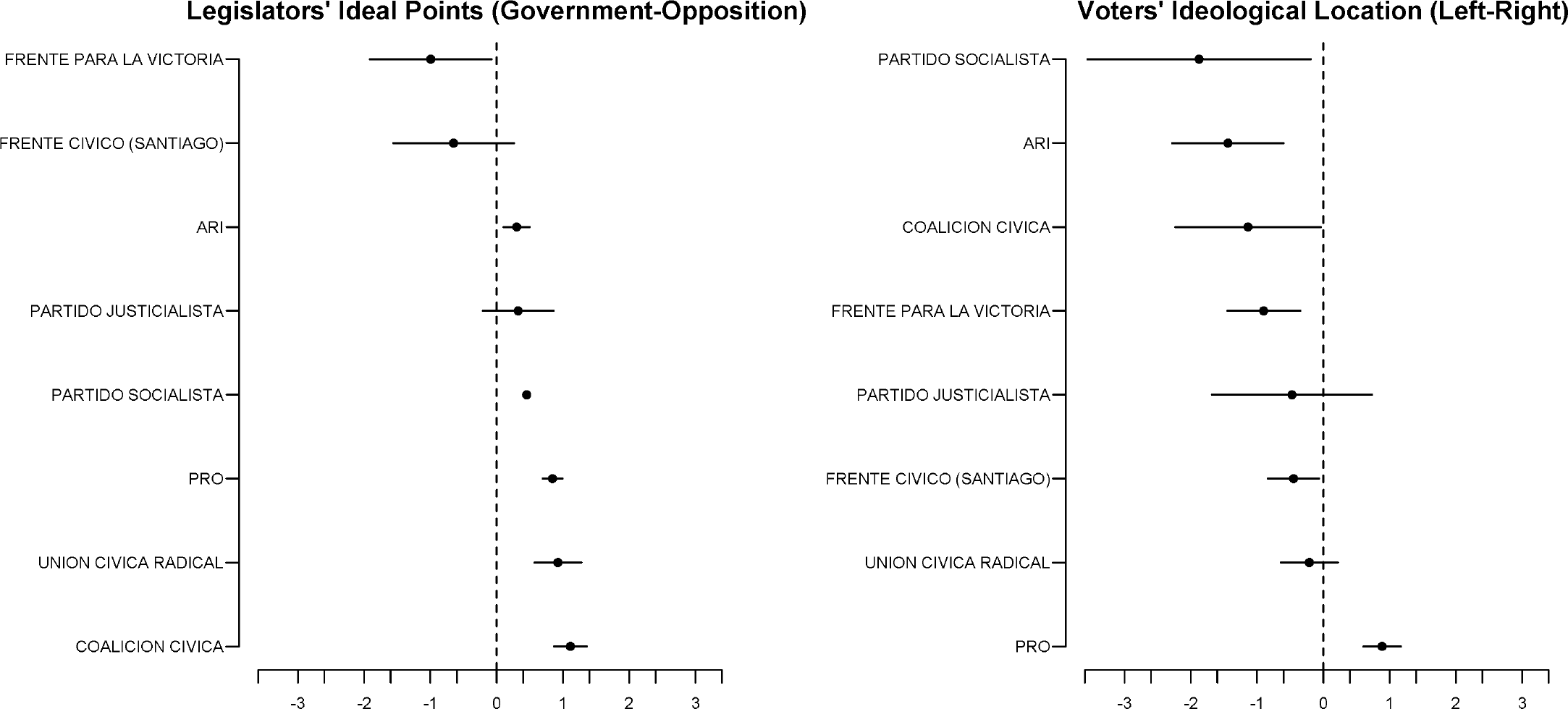
The left panel of figure 1 displays the ideal point of the average legislator in each of the main parties represented in the Argentine Chamber of Deputies, estimated using the sample of 159 lopsided votes. Dots are point estimates, and the spikes depict 95 percent confidence intervals. The dotted vertical line is centered at zero solely for illustrative purposes. From one extreme to the other, we can identify the government party and its main ally (the Frente para la Victoria and the Frente Cívico por Santiago); a couple of “swing” parties (Solidaridad e Igualdad SI-ARI, and the Partido Justicialista); and a bloc of opposition parties (conformed by the Socialist Party, PRO, the UCR, and the Coalición Cívica).
Legislators’ Ideal Points and Voters’ Policy Preferences

This pattern confirms that the recovered ideal points correspond to legislators’ positions in regard to the government. The evidence in figure 1 also shows that for most parties (with the exception perhaps of the Socialist Party), the ideal points of their members are not identical. Instead, as the 95 percent confidence intervals indicate, intraparty differences in the estimated ideal points calculated using lopsided votes exist. With respect to voters’ ideology, the public opinion survey includes information about respondents’ partisanship. We use these data, in conjunction with our common-space scores, to estimate the ideological location of the average voter in each of the seven major parties with legislative representation.
The right panel of figure 1 shows the point estimates of the ideological location of each party’s representative voter (marked by dots) and their 95 percent confidence intervals (indicated by the spikes). The locations are arranged from left to right (with the Socialist Party on one end and the PRO on the opposite one). This alignment clearly differs from the configuration presented in the left panel of figure 1. The Coalición Cívica is a case in point. The ideological location of its representative voter is closer to the Frente para la Victoria than to the PRO; yet when it comes to casting votes in the legislature, its representative member tends to vote with the latter rather than the former.Footnote 11 More important, taken together, these different patterns provide prima facie evidence that Argentine legislators face a dilemma between voting along the government-opposition divide or according to their voters’ policy preferences.Footnote 12
Moving on to our main variable of interest, Malapportionment, we use the distribution of seats per number of inhabitants to identify those electoral districts where voters are underor overrepresented. For example, based on the 2010 census data, the province of Tierra del Fuego had 131,661 inhabitants and 5 seats in the Chamber of Deputies. The population of the province of Salta was almost ten times larger (1,239,111 inhabitants), yet it only had 2 additional legislative seats. So there was one representative per 177,016 inhabitants in the latter province, whereas in the former, there was one representative per 26,332 inhabitants. Considering all of Argentina’s electoral districts, slightly more than half of the legislators in our sample represented 165,469 or fewer inhabitants, while the remaining 124 represented 171,468 inhabitants or more. We use this threshold to capture party leaders’ incentives to exploit malapportionment for electoral purposes. Specifically, the variable Overrepresented takes the value of 1when the population-to-seats ratio in a legislator’s district is 165,469 or less, and 0 otherwise.
In addition to these two measures, we consider other variables to control for the contextual factors that characterize the Argentine case. First, to capture legislators’ loyalty toward their party leadership, we differentiate legislators who belong to the federal government’s legislative party bloc from legislators who belong to various opposition blocs.Footnote 13 Given the government-opposition divide that characterizes Argentine legislative politics, we expect these allegiances to capture the degree of party influence on legislators’ voting behavior. More specifically, in the absence of any other sources of influence on legislators’ roll call voting behavior, this variable should capture all the variation in our estimated ideal points.
Regarding gubernatorial effects, most governors in the period studied were aligned with the federal government. As such, a significant number of government legislators (72 percent) were part of the incumbent party at both the national and provincial levels. The country, however, also had several opposition governors during this period (e.g., Neuquén’s Jorge Sapag, Santa Fe’s Hermes Binner, Buenos Aires City’s Mauricio Macri, and Tierra del Fuego’s Fabiana Ríos). In this case, roughly 38 percent of the opposition legislators were part of the incumbent party at the provincial level. We use this information to create the variable Governor. This indicator takes the value of 1 if a legislator’s party controls the provincial government and 0 otherwise.
We also consider another reason why Argentine legislators, regardless of their political orientation, may vote with the federal government: dependence on federal transfers. To capture public employment in a legislator’s home constituency, the variable Public Employment measures the total number of public employees as a proportion of the number of heads of household in the municipality where this legislator resides.Footnote 14
A final variable is used to control for legislators’ positions on their party’s list. Argentine electoral districts exhibit large differences in their magnitudes. As a result, a third place in the province of Buenos Aires ballot (out of 35 places) is not the same as a third place in the province of Chaco (where 3 or 4 candidates are elected, depending on the electoral calendar). To account for these differences, we created the variable Relative Position. It is calculated as
 $$\left[ {1 - \left( {{{Position} \over {1 + {\rm{Ma}}{{\rm{x}}_{Position}}}}} \right)} \right],$$
where Position is a legislator’s place on the party ballot and Max Position is the maximum value of Position in each district. According to this metric, the third-place candidate in Chaco receives a value of
 $$\left[ {1 - \left( {{3 \over {1 + 4}}} \right)} \right] = 0.4,$$
which is equivalent to a candidate ranked 16th in Buenos Aires.Footnote 15
Main Results
Our sample consists of 256 rather than 257 deputies because the Argentine Chamber of Deputies president seldom casts any votes (and therefore we cannot estimate an ideal point). To capture the effect of electoral incentives on legislators’ behavior, we estimated a series of models by ordinary least squares (OLS).Footnote 16 In our baseline specification, the dependent variable is a legislator’s ideal point, estimated using the lopsided votes. Next, we estimated the same model, but using the ideal points generated using close votes as the dependent variable.Footnote 17
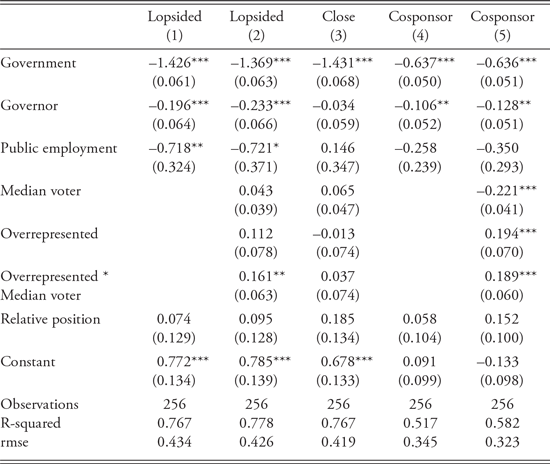
Table 1 shows the results of our OLS models. Negative coefficients indicate a progovernment effect of the covariates, while positive coefficients indicate a proopposition effect. The first model presents a “null” specification using the ideal points estimated from roll call records on lopsided votes as the dependent variable and, as the main covariates, the contextual variables that, according to the existing literature, should explain legislative behavior in Argentina (i.e., our controls).
Determinants of Legislators’ Voting Behavior

*** p < 0.01, ** p < 0.05, * p < 0.1
Robust standard errors in parentheses
The estimated coefficient associated with the variable Government confirms that for the most part, the government-opposition divide defines legislators’ voting behavior. The estimated coefficient of the variable Governor reveals that having a provincial governor from the same party also influences legislators’ voting behavior.
Moving from 0 (being in the opposition at the provincial level) to 1 (being aligned with the provincial governor) shifts a legislator’s position closer to the federal government. The results also show that public employment in a legislator’s home constituency impacts the legislator’s ideal point. The effect is statistically significant but substantively quite small. A one-standard-deviation increase in public employment corresponds to only a –0.06 decrease in the average legislator’s ideal point. The coefficient associated with the variable Relative Position is statistically indistinguishable from zero. Its interpretation, however, is not straightforward, as the dependent variable is measured in the government-opposition dimension. A similar specification that also includes an interaction between Relative Position and Government (not shown) suggests that the effect of party list placement on legislators’ ideal points is null in the case of both government and opposition legislators.Footnote 18
We explicitly test hypothesis 1 in the second model of table 1, where we also use the ideal points estimated from lopsided votes as the dependent variable. Here, we examine how legislators’ electoral incentives affect their voting behavior. If the contextual factors considered in model 1 are completely determinative of legislators’ vote choices, then the coefficient associated with our key indicator of legislators’ responsiveness—the interaction between voters’ ideology and malapportionment—should be statistically indistinguishable from zero.
The results from model 2 are consistent with hypothesis 1. The effect of voters’ policy preferences on a legislator’s ideal point is statistically indistinguishable from zero in underrepresented provinces but positive and statistically significant in over-represented ones. Recall from the right panel of figure 1 that negative (positive) values of voters’ ideological position correspond to those located to the left (right) of the political spectrum. Therefore, a rightward (leftward) movement in the ideological position of voters belonging to the legislator’s party is associated with a corresponding shift in the legislator’s ideal point toward the opposition (government) camp. The marginal effect of voters’ ideology on a legislator’s recovered position is positive and statistically significant (coefficient 0.205, Z-score 3.91) in overrepresented districts and statistically indistinguishable from zero (coefficient 0.043, Z-score 1.34) in underrepresented ones.
These results provide evidence in support of our argument that legislators from overrepresented districts are more likely to accommodate the views of their party’s voters in their voting decisions than legislators from other districts.Footnote 19 Moreover, these findings not only conform to our theoretical expectations, but they are also consistent with other evidence. For example, the responses to a set of questions included in a contemporaneous survey conducted by the Universidad de Salamanca’s Parliamentary Elites of Latin America project (PELA, see Alcántara Reference Alcántara2018) indicate that legislators from malapportioned districts express higher levels of responsiveness to their constituents than legislators from other districts.Footnote 20
A critical test of our main argument involves a comparison between lopsided and close votes. We undertake this task in model 3, which is similar to model 2 but with ideal points constructed using close votes as our dependent variable. The statistical results are consistent with our expectations; we cannot reject hypothesis 2. In the case of votes decided by a thin margin, the only coefficient that is statistically indistinguishable from zero at the 95 percent confidence level is the one associated with the variable Government. Compared to the “null” specification (model 1) and the strategic defection (model 2), the results of model 3 indicate that the party’s alignment along the government-opposition dimension fully explains the variation in its members’ vote choices.
Further examination of the five close votes in our sample provides additional support for our main argument. Three of these votes correspond to an extremely salient and politically divisive bill involving a tax program for agricultural exports. Its passage in the Chamber of Deputies was a key event in a bitter confrontation between agricultural producers and President Cristina Fernández de Kirchner. The conflict originated when the Ministry of Finance issued a decree raising taxes on agricultural exports and linking the tax rates to changes in international prices. The export tax rate hike generated an immediate response by rural producers, who implemented a series of lockouts, protests, and roadblocks. To crush the revolt, President Kirchner, whose party controlled both chambers of Congress, introduced a bill seeking legislative ratification for the tax hike. Despite the comfortable majorities enjoyed by the ruling party in both houses of Congress, the bill barely passed the Chamber of Deputies and was defeated in the Senate.
The other two votes correspond to bills that were discussed after the tumultuous legislative treatment of the agricultural tax bill. The first one took place on October 16, 2008, and involved article 10 of the 2009 budget proposed by President Kirchner. The article was highly controversial, as it delegated significant budgetary authority to the executive branch (so-called superpowers). The second vote was held on March 18, 2009, and the issue at stake was the timing of the forthcoming midterm elections. Fearing a defeat, President Kirchner sought to get legislative approval to hold the elections earlier than initially scheduled. The opposition interpreted the move as an attempt to hold a snap election, intended to tilt the electoral balance in the government’s favor. Thus, this vote was also highly contentious and was decided solely on the basis of the government-versus-opposition division.
Investigating the Mechanism: Party-led Defection?
The results in table 1 lend support to our main argument. Leaders tolerate strategic deviations from the party line when such defections have the potential to enhance their parties’ electoral fortunes. Ideological shirking, however, could also be the result of legislators’ unilateral actions. For example, some legislators may want to enhance their reputation before pursuing an executive office at the provincial level or seeking a senate seat. Others may want to strengthen their support among voters to improve their chances of a hostile takeover of the party’s leadership or to build a reputation with constituents before creating a new party. Furthermore, some legislators may shirk simply because they plan to retire.
As we have noted, recorded votes do not constitute a random sample of the universe of legislative decisions. As a result, ideal points recovered using roll call votes may not accurately reveal legislators’ individual preferences. To determine if legislators’ personal motivations, rather than partisan influence, drive their legislative behavior, we need to consider so-called position-taking actions instead of recorded votes.
As Alemán et al. (Reference Alemán, Calvo, Jones and Noah2009) note, cosponsorship data can be used to obtain a sincere measure of Argentine legislators’ pre-floor preferences. Following both Alemán et al. (Reference Alemán, Calvo, Jones and Noah2009) and Calvo (Reference Calvo2014), we use contemporaneous cosponsorship data to measure legislators’ policy preferences. The location of each legislator, as recovered by this estimate, represents a relatively inexpensive signal to voters, with few costs to the party and potentially large individual reputational benefits. From the perspective of the party leadership, if these positions do not affect the success of their party’s legislative agenda, they should not be subject to party discipline.
If our theory is correct, a comparison between legislative behavior in plenary votes and cosponsorship activity should allow us to distinguish between party-led defection and differences motivated by legislators’ preferences. Existing studies suggest that partisanship (Micozzi Reference Micozzi2014) and belonging to the government or the opposition parties (Alemán and Calvo Reference Alemán and Calvo2013) are strong predictors of joint bill drafting in Argentina. As a result, legislators’ position-taking efforts should resemble voting behavior in lopsided votes rather than in closely disputed ones. However, our theory is “agnostic” with respect to the effect of malapportionment on legislators’ behavior in the case of cosponsorship.
Models 4 and 5 in table 1 correspond to models 1 and 2 but are estimated using as the dependent variable legislators’ policy positions recovered from cosponsorship data (rather than lopsided votes). As before, negative coefficients indicate a progovernment effect of the covariate, while positive coefficients indicate a pro-opposition effect. The “null” specification (model 4) reveals that the government-opposition divide affects legislators’ position-taking behavior, which is consistent with previous studies of cosponsorship.
Regarding legislators’ electoral incentives, model 5 shows that the marginal effect of voters’ ideology on a legislator’s recovered position is indistinguishable from zero in overrepresented districts and negative and statistically significant in underrepresented provinces. In other words, the results reveal that in their position-taking behavior (as measured by cosponsoring bills), legislators do not appear to follow their voters’ ideological views. In contrast, voting on the plenary floor directly affects each party’s legislative strategy. Only a select group of legislators cater to their electoral base through their voting behavior.
Conclusions
This study has examined the tension between the collective goals of parties and legislators’ incentives to represent their constituents’ views in closed-list proportional representation systems. We have argued that parties need both electoral and legislative votes; therefore, in evaluating the costs of defections in legislative votes, party leaders must consider their potential effects in the electoral arena. This strategy should lead them to tolerate some members’ voting against the party line. This decision, however, is not random.
The empirical evidence, based on the behavior of Argentine legislators, indicates that malapportionment systematically affects legislators’ propensity to cater to their electoral base. The influence of this factor on legislators’ behavior, however, is null when outcomes are decided by a razor-thin margin of votes. We interpret these findings as supporting the view that party leaders encourage legislators to please their electoral base, even at the cost of party loyalty, when it is advantageous for the party’s electoral prospects. In this sense, our view is close to cartel theory, in which explicit dissent on the floor is more often a calculated strategy from the top than a demonstration of rebellion.
We believe that our findings advance the understanding of voters’ representation under closed-list proportional representation. More generally, they shed new light on how electoral incentives and institutional constraints interact to affect legislative behavior. We hope that our findings stimulate further studies on this important issue.
Supporting Information
For replication data, see the author’s file on the Harvard Dataverse website: https://dataverse.harvard.edu/dataverse/laps