The slender sunfish Ranzania laevis (Pennant, Reference Pennant1776) is an epipelagic species, inhabiting circumglobally tropical and temperate waters (Fraser-Brunner, Reference Fraser-Brunner1951; Hutchins, Reference Hutchins, Carpenter and Niem2001). This nektonic fish is capable of active displacements and even burst swimming (Robison, Reference Robison1975), occasionally leaping out of the water (Smith et al., Reference Smith, Hammond and Close2010). The slender sunfish preys on pelagic crustaceans (Barnard, Reference Barnard1935; Heemstra, Reference Heemstra, Smith and Heemstra1986) probably chasing and catching them or through ram-filter feeding.
Species from the Molidae family lack a caudal fin (Johnson & Britz, Reference Johnson and Britz2005). The main sources of propulsion for all of them, including R. laevis, are high, rigid symmetrically positioned dorsal and anal fins (Raven, Reference Raven1939; Johnson & Britz, Reference Johnson and Britz2005; Watanabe & Sato, Reference Watanabe and Sato2008). Continuous synchronous strokes of those fins produce lift-based thrust allowing sunfish to swim with a cruising speed 0.4–0.7 m s−1 (Mola mola) (Watanabe & Sato, Reference Watanabe and Sato2008) or perform burst swimming reaching 0.9–1.0 m s−1 (R. laevis) (Robison, Reference Robison1975). Both fins are equally employed in thrust generation (Watanabe & Sato, Reference Watanabe and Sato2008). Using such a propulsion mechanism sunfish are capable of long active migrations with a daily displacement distance exceeding 90 km (M. mola in Cartamil & Lowe (Reference Cartamil and Lowe2004); Sims et al. (Reference Sims, Queiroz, Humphries, Lima and Hays2009)). They demonstrate an active vertical migratory behaviour ranging between upper mixed layer and mesopelagic waters (M. mola in Dewar et al. (Reference Dewar, Thys, Teo, Farwell, Sullivan, Tobayama, Soichi, Nakatsubo, Kondo, Okada, Lindsay, Hays, Walli, Weng, Streelman and Karl2010)). Apparent amputation of one of two principal swimming appendages might logically pose a major problem for a sunfish to swim and to survive in an oligotrophic environment. We report here a capture of an adult slender sunfish, R. laevis, in an apparently healthy condition, without an anal fin.
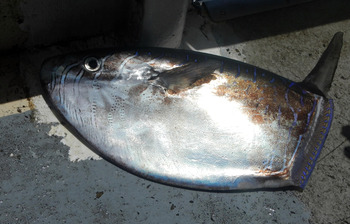
An individual of Ranzania laevis (580 mm, TL) (Figure 1) lacking an anal fin was caught 15 December 2012 on a swordfish longline set by the commercial fishing vessel ‘Laksmi’. It was already dead when taken on-board. In accordance with the routine procedure set in place by the scientific observations programme of the Institut de Recherche pour le Développement, the individual was identified to species, measured to the nearest cm and photographed with a Nikon Coolpix AW100 digital camera (resolution 16 Mpx). Fishing and environmental data were also recorded. Then R. laevis, similarly with other by-catch species, was discarded overboard since preservation of the specimen was not possible due to logistics of fishing operations.
Individual of slender sunfish Ranzania laevis caught without an anal fin.

The approximate capture position (19°26′S 52°02′E mid-point of the pelagic longline gear) was near the eastern limit of the exclusive economic zone of Madagascar. The commercial pelagic drifting longline used in this set consisted of surface shallow sections (6 hooks between floats). Maximum fishing depth of mainline, directly measured with temperature–depth recorders (TDR) ranged 45–78 m; estimated depth range of hooks calculated using catenary curve geometry (Bach et al., Reference Bach, Gaertner, Menkes, Romanov and Travassos2009) with COPAL software v. 2.7 (Bach et al., Reference Bach, Romanov and Gaertner2012) was 35–95 m. The sunfish was caught on a hook baited with squid, Illex spp. Sea surface temperature measured during vertical profiling of the water column with TDR attached to mainline ranged within 27.0–27.4°C; temperature at 95 m depth varied between 24.0° and 25.0°C.
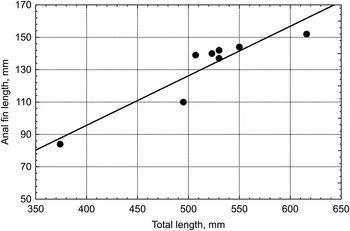
The slender sunfish caught was apparently an adult, i.e. >30 cm TL (Smith et al., Reference Smith, Hammond and Close2010). The absence of an anal fin (estimated length 150 mm) was evident during external examination from both sides of the fish. Fin length estimation was based on a regression equation ‘TL – anal fin length’ developed by the authors from published morphometric data (Jardas & Knežević, Reference Jardas and Knežević1983; Ebenezer & Joel, Reference Ebenezer and Joel1984; Jawad et al., Reference Jawad, Al-Mamary and Al-Kharusi2010, Reference Jawad, Hussein and Bulbil2011; Ramamurthy et al., Reference Ramamurthy, Vinod and Gopakumar2012) (Figure 2). The zone of amputation was completely healed and covered with scale-less regenerated skin (Figure 1). The clean cut and edge shape suggested that the fin amputation was a result of predator attack, most probably a pelagic shark (Lowry et al., Reference Lowry, De Castro, Mara, Whitenack, Delius, Burgess and Motta2009; Hamer et al., Reference Hamer, Childerhouse and Gales2012). The external condition of the fish suggested that it was in a relatively healthy state: no major loss of condition due to the amputation was observed.
Length (mm) of anal fin (A), versus total length (TL), for slender sunfish Ranzania laevis. Linear regression developed for TL range of 374–616 mm is: A = −26.905 + 0.3062 TL, N = 8, r 2 = 0.85, P < 0.01. Measurements are from Jardas & Knežević (Reference Jardas and Knežević1983); Ebenezer & Joel (Reference Ebenezer and Joel1984); Jawad et al. (Reference Jawad, Al-Mamary and Al-Kharusi2010, Reference Jawad, Hussein and Bulbil2011); Ramamurthy et al. (Reference Ramamurthy, Vinod and Gopakumar2012).

Predator attacks do not always lead to lethal injuries of marine animals (Heithaus et al., Reference Heithaus, Wirsing, Thomson and Burkholder2008). Healthy nektonic fish (yellowfin tuna and whale shark) lacking major fins have already been reported in the literature (Graham et al., Reference Graham, Rosenblatt and Gibson1986; Fitzpatrick et al., Reference Fitzpatrick, Meekan and Richards2006) or verbally (T. Nishida, 2009 personal communication; C. Smith, 2009 personal communication). However, none of the surviving fish reported in the literature had lost their principal propulsors.
Indeed, here we observed an amputation of a major locomotory organ, which evidently did not impede post-attack survival and later successful rehabilitation of the injured fish. Strikingly, R. laevis did not die from bleeding, a most probable consequence of amputation.
Many pelagic fish are known to predate on larvae and juveniles of slender sunfish, including istiophorids (Vaske et al., Reference Vaske, Vooren and Lessa2004, Reference Vaske, Travassos, Pinheiro, Hazin, Tolotti and Barbosa2011; Shimose et al., Reference Shimose, Yokawa, Saito and Tachihara2007, Reference Shimose, Yokawa and Saito2010, Reference Shimose, Yokawa and Tachihara2013; M. Potier, 2013 personal communication), tuna (Matthews et al., Reference Matthews, Damkaer, Knapp and Collette1977; M. Potier, 2013 personal communication), longnose lancetfish (Fourmanoir, Reference Fourmanoir1969; Parin et al., Reference Parin, Nesis and Vinogradov1969; authors' observations), dolphinfish (authors' observations) and wahoo (Iversen & Yoshida, Reference Iversen and Yoshida1957; Vaske et al., Reference Vaske, Vooren and Lessa2003). However predation on adult R. laevis was previously unrecorded. To our best knowledge this note is a first documented evidence of a non-lethal predation on slender sunfish.
The presence of a scientific observer on-board the fishing vessel made it possible to document this peculiar event. This fact emphasizes the importance of scientific observations and sampling programmes on-board commercial fishing vessels for routine collection of data, observations of unusual events or the occurrence of rare species.
ACKNOWLEDGEMENTS
We are thankful to the captain and the crew of FV ‘Laksmi’ for their help given to the scientific observer. The scientific observations of the pelagic longline fishery based in Reunion Island are supported by European Union funds allocated to implement the ‘Data Collection Framework’ (European Council Regulation No. 199/2008 of 25 February 2008 concerning the establishment of a Community framework for the collection, management and use of data in the fisheries sector and support for scientific advice regarding the Common Fisheries Policy). Editing and suggestions provided by three anonymous referees improved this paper.