Researchers have long been interested in the interplay between age-salient domains of competence (academics, peer functioning, rule-abiding conduct, work functioning, romantic relationships, and other domains) and symptoms of psychopathology (broad externalizing and internalizing problems as well as more specific symptoms of the Diagnostic and Statistical Manual for Mental Disorders system of mental disorders). Historically, much research examining these relations has focused on a “medical model” perspective, and consequently, has often assumed that impairments in major competence domains are the result of, rather than contributors toward, symptoms of mental disorder. At the same time, theoretical work has emphasized the complex interplay between domains such as parenting, conduct problems, and academic and social failure. For example, coercion theory (Patterson, Reference Patterson1986; Patterson, DeBaryshe, & Ramsey, Reference Patterson, DeBaryshe and Ramsey1989) outlines a process in which the interaction of poor parenting practices and difficult child temperament sets into motion a series of increasingly negative interactions, which spread out from the home environment into the school and peer contexts. The model is noteworthy not only for its highlighting of the consequences of dual failure—failure in both the academic and peer/social contexts—but also for its attention to microsocial interactions occurring over relatively short periods of time. Independent theoretical work on the development of depression has also highlighted the potential negative effects of competence failures in key developmental domains, with a particular focus on middle childhood (e.g., Cole, Reference Cole1991).
More recent research on competence and symptoms has highlighted the varied ways in which competence and psychopathology interface on a broader scale (Masten, Burt, & Coatsworth, Reference Masten, Burt, Coatsworth, Cicchetti and Cohen2006; Masten & Curtis, Reference Masten and Curtis2000), including more detailed research on the epidemiology of impairment in particular (e.g., Ezpeleta, Keeler, Erkanli, Costello, & Angold, Reference Ezpeleta, Keeler, Erkanli, Costello and Angold2001). Clearly, both directions of effect—from competence failures to symptoms and from symptoms to competence—are not only possible but also likely in practice; in addition, questions are often raised regarding whether third variables can account for any competence–psychopathology associations. These remain crucial areas of inquiry, as there are implications for prevention, intervention, and basic developmental science that depend on the precise ways in which competence and symptoms influence each other over time.
Of course, criteria for effective investigation of these questions vary by type of dysfunction and symptom. However, recent focus on broad dimensional models of internalizing (anxiety, depressed mood, withdrawal, somatic complaints) and externalizing (aggression, delinquency, rule breaking) psychopathology, examined in clinical adult populations (e.g., Krueger, Reference Krueger1999) but similar to long-standing epidemiological work in youth (Achenbach, Reference Achenbach1966), continues to raise interest in how these fundamental problem domains might relate to different areas of competence. For example, researchers have theorized that the disruptiveness of externalizing problems might have serious long-term consequences for academic success or failure, theory bolstered by evidence that externalizing problems and academic underachievement are linked even before the start of formal schooling (Hinshaw & Anderson, Reference Hinshaw, Anderson, Mash and Barkley1996), consistent with the coercion models described above. At the same time, failures in the academic domain may themselves contribute to escalations in externalizing behavior problems for those youth already at risk (e.g., Patterson, Forgatch, Yoerger, & Stoolmiller, Reference Patterson, Forgatch, Yoerger and Stoolmiller1998). On the internalizing spectrum, links to both academics (Kellam, Rebok, Mayer, Ialongo, & Kalodner, Reference Kellam, Rebok, Mayer, Ialongo and Kalodner1994) and social competence (Gazelle & Ladd, Reference Gazelle and Ladd2003; Panak & Garber, Reference Panak and Garber1992) have been demonstrated both concurrently and over time, although the connections between internalizing and social competence have generally been stronger. Particular attention has been paid to “cascading” effects in which early problems in one domain spill over to impact multiple domains later in development (Masten et al., Reference Masten, Burt, Coatsworth, Cicchetti and Cohen2006).
One way to begin to tease apart the difficult questions of direction of effects and timing of influence in this research literature is through longitudinal structural equation modeling (Cole & Maxwell, Reference Cole and Maxwell2003; Selig & Preacher, Reference Selig and Preacher2009). It is important to note that this is far from the only methodology suitable to answering questions on the interplay of competence and psychopathology. However, in longitudinal models in which each core construct is assessed at each time point, both concurrent associations as well as the stability inherent in each domain can be controlled statistically. This strategy allows for a rigorous examination of the potential ordering of effects across domains over time. In addition, it dovetails with at least one major implementation of developmental pathways, in which the various “routes” by which an effect may be transmitted are outlined and compared (Pickles & Hill, Reference Pickles, Hill, Cicchetti and Cohen2006). Other common uses of the developmental pathway concept represent the search for qualitatively distinct subgroups of individuals, which is not the focus of the present investigation.
Recent publications from the Project Competence study of longitudinal risk and adaptation have adopted the strategy above in testing links among externalizing, internalizing, and academic competence (Masten et al., Reference Masten, Roisman, Long, Burt, Obradović and Riley2005) and among externalizing, internalizing, and social competence (Burt, Obradović, Long, & Masten, Reference Burt, Obradović, Long and Masten2008) and in combining both academics and social competence using a subset of time points (Obradović, Burt, & Masten, Reference Obradović, Burt and Masten2010). These studies have used nested structural equation models to test various hypotheses regarding timing and direction of links between major age-salient domains of competence and broad indices of behavioral and emotional problems, basing some predictions on theory and prior longitudinal path analytic research with similar constructs (e.g., Mesman, Bongers, & Koot, Reference Mesman, Bongers and Koot2001) and others on more focused research findings from specific competence domains. In brief, the Project Competence studies found that externalizing problems in childhood showed robust negative relations with academic attainment in adolescence, and that academic success in emerging adulthood was linked with fewer internalizing symptoms in young adulthood (Masten et al., Reference Masten, Roisman, Long, Burt, Obradović and Riley2005); these links remained significant controlling for within-domain stability, within-time covariance, and the potential third-variable explanations of IQ, experienced parenting quality, and socioeconomic status. Social competence also showed significant negative links to later internalizing problems, both across the childhood–adolescence time window and the emerging adult–young adult window, with a similar robustness to at least some potential third-variable explanations (Burt et al., Reference Burt, Obradović, Long and Masten2008). Testing of social and academic competence together (Obradović et al., Reference Obradović, Burt and Masten2010) demonstrated independent links from both academic and social competence to later internalizing problems, consistent with the dual failure literature noted above, although operating within a later developmental period.
There are several limitations to the Project Competence studies that necessitate replication and potential extension. These publications rely on a particular sample that, although representative of the broader targeted community and showing a range of socioeconomic and behavioral outcomes, is not national and is of modest size (N ~ 200). In addition, because of intensive multi-informant, multimethod data collection efforts at each time point, the data have relatively long intervals (3–10 years) between assessment waves. Another limitation is that the complexity of models in terms of the number of parameters estimated relative to sample size has necessitated difficult analytic choices, such as the exclusion of externalizing at time points beyond childhood by Obradović et al. (Reference Obradović, Burt and Masten2010). Finally, and perhaps most important, the initial data collection for this sample was at ages 8–12, as the study was originally developed as a cross-sectional enterprise and later extended into longitudinal follow-up. Therefore, testing longitudinal competence–psychopathology links at earlier ages was not possible.
The primary goal of the present study is to address these limitations of the work cited above by following a similar analytic plan in a larger, national (although not nationally representative) sample containing data at briefer intervals and beginning at younger ages. We simultaneously wished to capitalize on the strengths of the Project Competence study methodology, including latent variable measurement models, comparison of nested structural models, and inclusion of follow-up control variable analyses. To accomplish this, the present study uses data from the first four phases of the NICHD Study of Child Care and Youth Development (SECCYD), which are prospective, longitudinal data drawn from a cohort of over 1,000 youth tracked from infancy through age 15. This study also focuses on measurements of externalizing, internalizing, social competence, and academic achievement.
Hypotheses
In general, our hypotheses (and choice of nested models to test) were based on prior research discussed above that has used similar statistical methods. However, because of the differences in age range and assessment intervals employed, we did not make firm predictions on specific time intervals, focusing instead on “ranking” the interplay of particular domains. First, we expected to replicate a longitudinal cross-domain path from externalizing problems, through academic competence, to internalizing problems, and expected that this effect would emerge relatively early on in our structure of assessments. Second, we expected that paths from academic competence to internalizing problems would “outweigh” the reverse. Third, we predicted that our earlier time frame of assessment would result in longitudinal cross-domain paths from externalizing, through social competence, to internalizing problems, a parallel effect to that seen in Masten et al. (Reference Masten, Roisman, Long, Burt, Obradović and Riley2005). Although this specific path was not observed in Burt et al. (Reference Burt, Obradović, Long and Masten2008), it is consistent with the dual failure model discussed above as well as other research showing the diverse potential negative effects of early externalizing problems on later developmental outcomes (e.g., Campbell, Shaw, & Gilliom, Reference Campbell, Shaw and Gilliom2000). Fourth, we generally expected cross-domain paths to remain statistically significant when controlling for potential common cause variables of maternal sensitivity, socioeconomic status (indexed by income/needs ratio), and early cognitive ability.
Note that we selected this set of covariates (from among, of course, many possible sets) for several reasons. First, Masten (Reference Masten2001) conceptually described general cognitive ability and parenting quality in particular as broad developmental resources fundamental to successful adaptation. Before concluding that across-domain associations represent truly dynamic cascade effects we wished to rule out the possibility that such associations could be accounted for by the relative presence or absence of these key developmental assets in the years prior to when cascading influences were to be modeled. Second, parenting quality (as operationally defined as maternal sensitivity), general cognitive functioning, and various indicators of socioeconomic have often been used as covariates in prior analyses of the NICHD SECCYD data set (e.g., Rodkin & Roisman, Reference Rodkin and Roisman2010), in part in recognition of the fact that such variables can serve as confounders in nonexperimental research. Third, prior studies in the “cascades” literature (e.g., Masten et al., Reference Masten, Roisman, Long, Burt, Obradović and Riley2005) have focused on this set of covariates as well. Using these three control variables in the current analysis thus provides a means of more directly contrasting results from the current and previous empirical efforts.
Based on the hypotheses outlined above, we tested a series of five cross-domain models, following establishment of a best-fitting latent variable measurement model and a baseline model (termed “Model 0”) including only within-time associations and longitudinal stability within each domain. Model 1 estimated paths from externalizing to academic competence over time, as this was the hypothesized starting point of our cross-domain effects as well as one of the more robust links seen in prior research. Model 2 estimated paths from academic competence to both externalizing and internalizing over time, representing the latter aspect of effects found in Masten et al. (Reference Masten, Roisman, Long, Burt, Obradović and Riley2005). Model 3 estimated paths from social competence to internalizing, representing effects found in Burt et al. (Reference Burt, Obradović, Long and Masten2008). Model 4 freed bidirectional paths between externalizing and social competence over time, effects not seen in Burt et al. (Reference Burt, Obradović, Long and Masten2008) but which we expected to potentially observe in the present study. The latter two models estimated cross-domain paths less central to our hypotheses; Model 5 freed paths between externalizing and internalizing across each time interval, whereas Model 6 freed paths from internalizing back to social and academic competence across each interval.
It should be emphasized that we do not consider any single statistical model, or set of models, as representing the “true” state of nature with respect to these constructs. As noted by Box (Reference Box, Launer and Wilkinson1979), “all models are wrong but some are useful.” We see certain models as being more useful than others. In addition, the sequence of freely estimated paths was certainly not the only one available to us. However, we felt that the order of models tested here represented a balance between complexity and total number of comparisons, while also being grounded in developmental theory and prior research.
Method
Participants
Participants were enrolled in the NICHD SECCYD, a prospective longitudinal study conducted at 10 research sites across the United States. Of the 8,986 mothers who gave birth during selected 24-hr sampling periods, 5,416 (60%) agreed to be telephoned in 2 weeks and met the eligibility requirements (mother over 18, spoke English, mother healthy, baby not part of a multiple birth or to be released for adoption, family lives within an hour of research site, neighborhood not deemed too dangerous by police to visit). Of that group, a conditionally random sample of 3,015 was selected (56%) for a 2-week phone call. The conditioning assured adequate representation (at least 10%) of single mothers, mothers without a high school degree, and ethnic minority mothers (not mutually exclusive). At the 2-week call, families were excluded if the baby had been hospitalized for more than 7 days (2%), they expected to move in the next 3 years (3%), they could not be reached in at least three attempts at telephone contact (17%), or they refused (21.3%; another 6.1% were lost for other reasons). A total of 1,525 families were selected for the call as eligible and agreed to an interview. Of these, 1,364 completed a home interview when the infant was 1 month old and became study participants. The recruited sample consisted of 52% boys, 24% participants of color, 11% mothers not completing high school, and 14% single-parent families. Additional details about recruitment and selection procedures are available in prior publications from the study (see NICHD Early Child Care Research Network, 2005) and from the study website (http://secc.rti.org). Nonetheless, it is important to note that, although the NICHD SECCYD is a large, national study, it is not based on a nationally representative sample. For nearly all analyses presented below, the working sample comprised 1,160 of the 1,364 participants, which included participants with valid data for at least one of the core indicators used in the analyses (externalizing, internalizing, academic competence, and social competence), from at least one time point between ages 54 months and 15 years. An additional 153 families (total = 1,313) did not have information on any core variables at any time point but provided information on at least one covariate; thus, control analyses and descriptives include information from these families.
Our core measures in the present study (internalizing, externalizing, academics, and social competence) were taken from assessments from age 54 months to 15 years. To avoid potential time confounding, all control variables (maternal sensitivity, income/needs ratio, and cognitive ability) were drawn from assessments prior to those of the core constructs (age 6 months through age 36 months, as detailed below). The restriction of major constructs to the five time points of age 54 months, first grade, third grade, fifth grade, and age 15 was largely pragmatic, because of a desire to include all major constructs at all time points coupled with a desire for approximately equal intervals between assessments throughout the core time points of the present study. Exploratory model runs not presented below suggested that inclusion of additional time points for a subset of constructs had negative implications for model fit, interpretability, and stability. However, we felt that given the complexity of the models being estimated, a focus on these time points allowed an effective trade-off between detailed investigation and overall developmental scope. In addition, it is important in modeling longitudinal data to include enough of a lag between assessments to capture the effect of interest (Cole & Maxwell, Reference Cole and Maxwell2003; Selig & Preacher, Reference Selig and Preacher2009), although it should be noted that the optimal lag for these particular analyses is not known.
The decision to restrict problem behavior and social competence reports to maternal report data was made because of problems with statistical fit of initial longitudinal measurement models that included multiple informants (teacher-reported behavioral and emotional problems in addition to maternal report). Although unfortunate from the point of view of comprehensiveness, this was not unexpected given that prior NICHD SECCYD structural equation modeling analyses have shown poor performance of multiple-informant data when aggregated in single structural equation models for these particular measures and informants (Konold, Brewster, & Pianta, Reference Konold, Brewster and Pianta2004). Although multiple-informant measurement models are generally to be preferred and have been used with similar constructs in other data sets, it was not possible to obtain adequate model fit with multiple informants in the present data set.
Core competence and psychopathology indicators
Internalizing and externalizing problems
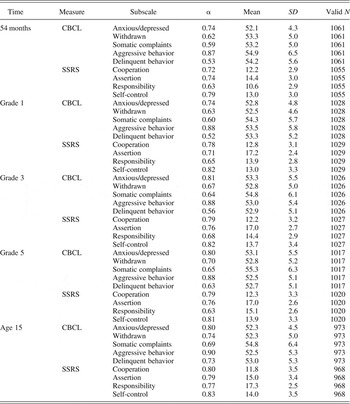
Symptoms of internalizing and externalizing psychopathology were assessed in this study via maternal report using the well-validated subscales of Child Behavior Checklist (CBCL; Achenbach, Reference Achenbach1991a, Reference Achenbach1991b) using data drawn from the following assessments: 54 months, Grades 1, 3, and 5, and age 15. Specifically, we used data from the CBCL anxious/depressed, withdrawn, and somatic complaints scales to assess internalizing distress and the CBCL aggressive behavior and delinquent behavior scales to assess externalizing problems. Alpha reliabilities for these indicators are presented in Table 1; in general, reliabilities were adequate over time, with delinquent behavior and somatic complaints showing somewhat lower alpha levels compared to other subscales.
Social competence
We assessed earlier social competence using mother reports on the four a priori internally consistent subscales (cooperation, assertion, responsibility, and self-control) of the Social Skills Rating System (Gresham & Elliott, Reference Gresham and Elliott1990) when children were age 54 months, Grade 1, Grade 3, Grade 5, and age 15. Higher scores indicated higher levels of social competence. The alpha reliability for these scales (presented in Table 1) was generally high, although alphas for the responsibility subscale were somewhat lower than for other subscales.
Academic achievement
Academic achievement was assessed using the widely employed, individually administered Woodcock–Johnson Test of Academic Achievement—Revised (Woodcock, Reference Woodcock1990; Woodcock & Johnson, Reference Woodcock and Johnson1989). All available subtests at each time point were included, excluding broadband scores such as broad math and broad reading that are themselves composites of subtests. This resulted in a range of indicators at each time point, from a low of four subtests at age 15 to a high of nine in third grade. In initial structural equation measurement models, latent variable estimation of academic achievement was used. However, these models showed a high degree of instability as well as estimation errors that appeared likely to be related to multicollinearity among subtests of the Woodcock–Johnson Test of Academic Achievement—Revised within each time point. Therefore, in the final measurement model subtests were aggregated within time to form a single manifest indicator. The alpha reliabilities of these academic achievement composites in the present sample were as follows: age 54 months, α = 0.80; Grade 1, α = 0.83; Grade 3, α = 0.91; Grade 5, α = 0.88; and age 15, α = 0.89.
Control variables
Early maternal sensitivity
Our measure of maternal sensitivity was calculated from ratings of mothers' behavior during a videotaped interaction between mother and child under semistructured, free-play conditions at 6, 15, 24, and 36 months (NICHD Early Child Care Research Network, 1998, 2002). A summed composite score of maternal sensitivity was created at each age from coding of the videotapes for sensitivity to nondistress, positive regard, and intrusiveness (reversed) at 6, 15, and 24 months, each on a 4-point scale with a possible range of 3–12 for the composite; and supportive presence, respect for autonomy, and hostility (reversed) at 36 months, each on a 7-point scale with a possible range of 3–21 for the composite. These composites were transformed to the same scale and averaged from 6 to 36 months. The early maternal sensitivity score thus represented child-centered interactions that reflected emotional support for the child that was responsive to the child's needs and warmly encouraging of the child's positive engagement with the toys and tasks in the interaction procedures (sensitivity to nondistress, supportive presence), respectful of the child's interests and efforts (lack of intrusiveness, respect for autonomy), and affectively positive (positive regard, lack of hostility). Internal consistency of the sensitivity composite at each age was moderate (α = 0.70–0.78) and interrater reliabilities of the composites calculated with Winer (Reference Winer1971) intraclass correlations across raters ranged from .83 to .87. The standardized α value of the final sensitivity composite was 0.71.
Income/needs ratio
Family income was reported by mothers at each major data collection point and converted to an income/needs ratio by dividing total family income by the US Census based poverty-level income for that family size. Ratios were averaged from data obtained at 6 through 36 months (α = 0.94).
Early cognitive ability
To asses early cognitive ability, we culled the NICHD SECCYD data set for objective measures of cognitive functioning prior to the age 54 month assessments that have (a) been used extensively in prior reports of the NICHD Early Child Care Research Network and/or are (b) well known in the field at large as measures of cognitive functioning. More specifically, we standardized the total scores on the Bayley Mental Development Index at 15 and 24 months (Bayley, Reference Bayley1991) and the Bracken Scale of Basic Concepts (School Readiness Scale; Bracken, Reference Bracken1984) at 36 months and took the resulting mean (α = 0.59).
Statistical analyses
Our overall analytic strategy closely followed prior publications examining similar research questions regarding the longitudinal interplay of competence and psychopathology (e.g., Masten et al., Reference Masten, Roisman, Long, Burt, Obradović and Riley2005). We first tested measurement models, including correlated residuals to model within-informant errors over time, and examined longitudinal invariance of factor loadings. Following establishment of a satisfactory measurement model, we tested a series of nested structural models, as described above. These models began with estimation of only within-time associations and longitudinal stability within each domain, and successively estimated sets of cross-domain paths based on prior literature and theory. Finally, following establishment of a final structural model, we conducted two follow-up analyses; the cross-domain paths were examined for gender invariance, and all model paths were examined in the context of controlling for early maternal sensitivity, income/needs ratio, and early cognitive ability.
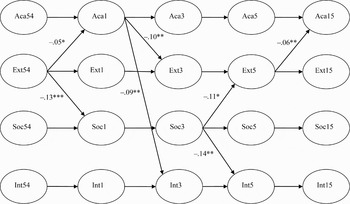
Statistically significant continuity and cross-domain paths estimated in Model 4 (final model); comparative fit index = 0.941, Tucker–Lewis index = 0.930, root mean square error of approximation = 0.037. For clarity, significant within-time associations and numeric estimates of continuity paths are omitted from the figure; however, significant within-time associations are presented in Table 4. Continuity estimates ranged from .70 to .90 (academics), .68 to .74 (externalizing), .62 to .81 (social competence), and .67 to .74 (internalizing); all ps < .001. *p < .05. **p < .01. ***p < .001.

Descriptive statistics for key variables

Note: Academic competence indicators are omitted from this table because they were composites of the Woodcock–Johnson revised subscales at each time point; see text for details. CBCL, Child Behavior Checklist; SSRS, Social Skills Rating Scale.
All models were tested with Mplus version 5.1 (Muthén & Muthén, Reference Múthen and Múthen2007) and used the MLR estimator to adequately account for skewed data. This required the use of a scaled chi-square difference test (Satorra, Reference Satorra, Heijmans, Pollock and Satorra2000) for making key comparisons among nested models, although commonly reported model fit statistics (comparative fit index [CFI], Tucker–Lewis index [TLI], root mean square area of approximation [RMSEA]) are also reported for all models. Although the chi-square statistic in structural equation modeling is known to be sensitive to sample size, there is not yet a widely used alternative index for making comparisons among nested models. As with prior work in this area, the model comparisons in the present study were ultimately based on several criteria, including parsimony, overall fit to the data, and theoretical interpretability. Percentage of missing data on core variables (competence and psychopathology indicators as well as control variables) ranged across measures and time points, from a low of 0.06% missing for the early maternal sensitivity composite to a high of 23% missing for the academic achievement assessment at age 15, with a mean percentage missing across indicators of 11%. All missing data were treated as ignorable (missing at random) and full information maximum likelihood estimation techniques were used for inclusion of all available data for each participating family at each time point.
Results
Descriptive statistics
Table 1 presents descriptive statistics on the core variables included in the study; for comparison with prior research and population data, T scores are presented. Data were generally in line with population norms, with the present sample showing slight elevations (relative to population mean of T = 50) on subscales at most time points. Although not presented in Table 1, skewness statistics suggested that, as expected, behavior problem data tended to be positively skewed, mainly for the anxious/depressed, withdrawn, and aggressive behavior subscales. Mean income/needs ratio from the selected time points was 3.62 (SD = 2.87), with 11% of families below 1.0 (living in poverty) and an additional 20% of families falling between 1.0 and 2.0 (sometimes termed the “working poor”). We omit descriptives for our other control variables as they were standardized within samples because of varying measurement scales. In addition, because of space limitations, a full correlation matrix of all indicators and covariates is not presented here, but is available upon request.
Measurement models
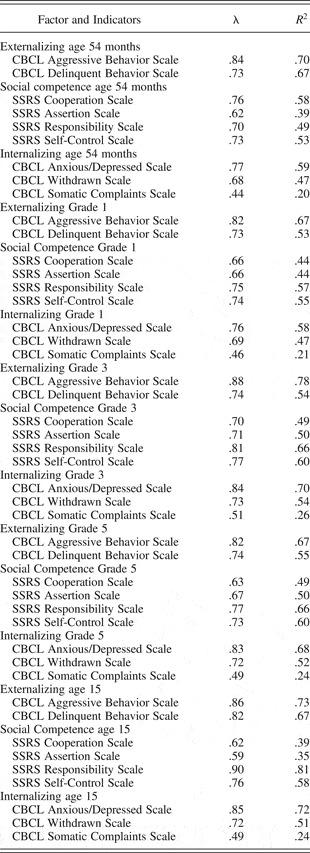
Inspection of initial measurement models suggested that inclusion of longitudinal correlated residuals for CBCL and Social Skills Rating System indicators were necessary to achieve adequate fit; therefore, final measurement models included estimation of these residuals across all time intervals, including nonadjacent assessment points. Omnibus testing of longitudinal measurement invariance suggested that factor loadings were not invariant over time. Subsequent piecewise testing of each construct across each interval suggested that loadings for externalizing problems from Grades 1 to 3, Δχ2 (2) = 3.31, p = .19, and internalizing problems from Grades 3 to 5, Δχ2 (3) = 4.13, p = .25, were invariant; constraining all other construct/interval combinations resulted in significant (p < .01) decreases in model fit. Therefore, the final measurement model adopted for the present study constrained only loadings for those two construct/interval combinations over time. Table 2 presents factor loadings and variance explained for each indicator in the final measurement model.
Descriptions, factor loadings, and variance explained for indicators in the final model (4)
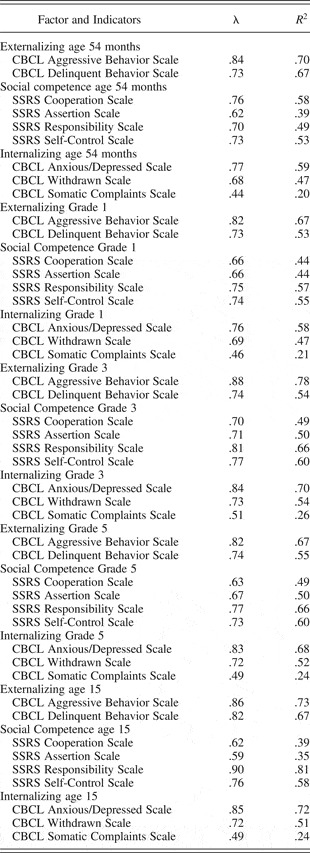
Note: Academic competence at each time point was measured using a manifest composite of individual subtests from the Woodcock–Johnson Tests of Achievement—Revised; see text for details. CBCL, Child Behavior Checklist; SSRS, Social Skills Rating Scale.
Structural models
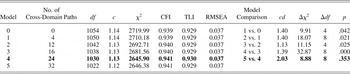
Table 3 presents fit statistics and model comparisons for the core analysis of sequentially testing nested models. Based on standard fit criteria, all models fit reasonably well (CFI and TLI > 0.90, RMSEA < 0.05) and these fit criteria did not substantially differentiate among the models tested. We were thus most interested in the nested model comparisons tested using the scaled chi-square difference test. Relative to the baseline model (Model 0), which estimated only continuity and within-time paths, Model 1 (estimating paths from externalizing to academic competence over time) showed a significant increase in model fit, Δχ2 (4) = 9.91, p < .05. Model 2 (estimating paths from academic competence to both externalizing and internalizing) showed a significant increase in model fit, Δχ2 (8) = 18.07, p < .05. Model 3 (estimating paths from social competence to internalizing) showed a significant increase in model fit, Δχ2 (4) = 11.15, p < .05. Model 4 (estimating paths from externalizing to social competence and vice versa) showed a significant increase in model fit, Δχ2 (8) = 32.87, p < .001. Finally, Model 5 (estimating paths from externalizing to internalizing and vice versa) did not show a significant increase in model fit, Δχ2 (8) = 8.88, p = .35. Thus, Model 4 was adopted as the final model in the present study.
Fit statistics and model comparisons for nested structural equation models

Note: The final selected model is in bold. c, weighting constant for computing the chi-square statistic using robust estimation method; CFI, comparative fit index; TLI, Tucker–Lewis index; RMSEA, root mean square error of approximation; cd, weighting constant for the difference between two chi-square values using robust estimation.
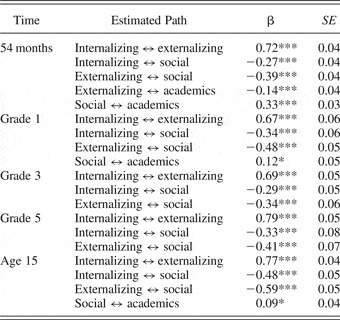
Standardized cross-domain paths for the final model are presented in Figure 1. For purposes of clarity, within-time associations and numeric estimates of continuity paths are omitted from the figure. However, standardized within-time associations below the 0.05 α level are presented in Table 4 and ranges of longitudinal stability estimates are presented in the figure caption. As expected, stability estimates were uniformly high and did not vary substantially across the time range sampled. Within-time associations were very high among the two broad problem domains of internalizing and externalizing at all time points, and were also substantial between social competence and behavioral/emotional problems at all time points. Within-time associations between academics and other domains were less consistent in magnitude, although all associations were in expected directions.
Statistically significant within-time associations for the final model (4)

Note: SE, standard error.
*p < .05. ***p < .001.
Notably, several of the significant cross-domain paths estimated in Model 4 were consistent with cascade effects described in prior research. In particular, an early negative path from externalizing problems to academic competence, then from academic competence to internalizing, showed a similar pattern as that noted in Masten et al. (Reference Masten, Roisman, Long, Burt, Obradović and Riley2005), although seen earlier and over a shorter period of time in the present data set. In addition, an early negative path from externalizing problems to social competence, and a later negative path from social competence to internalizing, showed a pattern hypothesized and partially confirmed by Burt et al. (Reference Burt, Obradović, Long and Masten2008) and consistent with Mesman et al. (Reference Mesman, Bongers and Koot2001). However, the standardized cross-domain path estimates in the present study were uniformly and substantially lower in magnitude compared to those noted in prior studies, with several paths presented in Figure 1 smaller than .10.
Follow-up analyses: Gender and control variables
In addition to our core analyses of sequential model testing, we were interested in examining two primary follow-up analyses: first, whether any estimated cross-domain paths would differ by gender and, second, whether cross-domain paths would remain statistically significant when controlling for three potential common cause variables (each composite indices representing multiple waves of data): (a) early maternal sensitivity, (b) income/needs ratio, and (c) early cognitive ability. Of course, many different possible control variables exist, and different studies have centered on particular constructs tailored to their research goals. We were interested in these specific variables not only because similar constructs have been employed in prior cascade control analyses but also because of the strength of observational reports of early maternal sensitivity available in this data set.
Gender invariance testing was conducting by running a multiple-group analysis in which all cross-domain paths were first freely estimated within each gender group, and subsequently were constrained to be equal. Initial runs of the former model did not converge when longitudinal invariance was also specified within each group; therefore, longitudinal invariance restrictions were lifted. This allowed for a converging model whose overall fit was broadly in line with that of Model 4 (CFI = 0.934, TLI = 0.924, and RMSEA = 0.039). Nested comparison of this model with one constraining cross-domain paths to be equal across gender did not show any significant difference, Δχ2 (24) = 22.5, p = .55, suggesting that the magnitude of the cross-domain paths did not differ substantially by gender.
Effects of maternal sensitivity were tested by running a multiple-indicator/multiple-cause (MIMIC; Muthén, Reference Muthén1989) model in which all major constructs of our final structural model were regressed on our three control variables. Overall fit statistics were comparable with Model 4 (CFI = 0.946, TLI = 0.934, RMSEA = 0.032). Four paths dropped to marginal significance (p < .10) because of increased standard errors but had standardized estimates close to original values: the path from externalizing at 54 months to academics at Grade 1 (identical estimate of −.05), the path from academics at Grade 1 to internalizing at Grade 3 (−.06 from −.09), the path from social competence at Grade 3 to externalizing at Grade 5 (−.09 from −.11) and the path from externalizing at Grade 5 to academics at age 15 (−.04 from −.06). One additional somewhat counterintuitive path not significant in the original model, from social competence in Grade 5 to externalizing at age 15, was significant in this model (standardized estimate of .11, p < .05).
Inclusion of control variables in the MIMIC model allowed us to also shift focus and examine the direct effects of these variables on our constructs of interest, controlling for other core domains of psychopathology and competence. Perhaps not surprisingly, most of the effects of maternal sensitivity appeared to operate during the earlier assessment periods. At age 54 months, earlier maternal sensitivity predicted externalizing problems (−.17, p < .001), internalizing problems (−.11, p < .05), academic competence (.16, p < .001), and social competence (.21, p < .001). Although the longitudinal prediction from early maternal sensitivity to internalizing and externalizing problems dropped at later time points, sensitivity continued to predict social competence at Grade 3 (.09, p < .01) and age 15 (.12, p < .01), as well as academic competence at Grade 3 (.05, p < .05), Grade 5 (.04, p < .05), and age 15 (.08, p < .001).
Early cognitive ability was very strongly related to age 54 months academic achievement (.57, p < .001) and less strongly related to academic achievement at most later time points (.17, p < .001 at Grade 1, .11, p < .001 at Grade 3, and .08, p < .001 at age 15); it was also related to early social competence (.15, p < .001 at age 54 months and .09, p < .01 at Grade 1). Early cognitive ability was negatively related to internalizing problems at Grade 3 (−.08, p < .05) but otherwise no direct paths from early cognitive ability to behavioral/emotional problems reached significance. Finally, income/needs ratio was negatively associated with externalizing problems at grade 1 (−.09, p < .001), Grade 5 (−.06, p < .05), and age 15 (−.06, p < .05), positively with social competence at age 15 (.06, p < .05), and positively with academic competence at all time points (age 54 months = .11, p < .001, later times ranging from .03 to .05, all ps < .05).
Discussion
We believe the results of the present study are striking in their overall consistency with the Project Competence studies using a different sample, different time points, and somewhat different indicators and informants. In addition, the results are consistent with several of the theoretical predictions made by the coercion and competency-based/failure models noted above. A statistically significant “cascading” path from early externalizing problems in preschool, through academic achievement in early grade school, and then to internalizing problems in middle childhood was observed, over and above effects of within-time covariation and stability. In addition, early negative links from externalizing to social competence, coupled with a later negative path from social competence to internalizing in middle childhood, is evidence for a similar “cascade” path, although one that was carried forward somewhat over time in the present study through continuity in social competence. Notably, Burt et al. (Reference Burt, Obradović, Long and Masten2008) speculated that their partial confirmation of this path (observing the social competence → internalizing link but not the externalizing → social competence) may have been because of the lack of early childhood measures and the very high covariation of externalizing and social competence at the start of that study. By extending the time window backward, the present study provides suggestive evidence that that might have actually been the case.
Additional cross-domain paths seen in the present study included effects from social competence in Grade 3 to externalizing problems in Grade 5, and from the latter to academics at age 15. Although not a specific focus of the present study, the time window of the former effect is of interest, as it is consistent with prior research examining the self-selection of less socially competent and/or peer-rejected youth into more aggressive social groups (e.g., Hektner, August, & Realmuto, Reference Hektner, August and Realmuto2000). Overall, what is perhaps most notable of the cross-domain effects seen in the present study is that externalizing problems were the only significant effects of our core constructs operating at the earliest time window, prior to the entry into formal schooling (our control variables showed notable early effects, with cognitive ability and income/needs showing specific links to early academic skills and early maternal sensitivity having widespread predictive significance.) These effects underscore the potential risk of early aggressive and rule-breaking behavior for a variety of domains of later functioning, and demonstrate that risk is not simply because of longitudinal covariation of the domains in question.
The follow-up analyses demonstrated that the magnitude of statistically significant cross-domain paths did not vary systematically by gender, which was a question of primary importance. Clearly, gender mean differences would be expected on most, if not all, of the primary constructs examined in this study, and our aim is not to minimize the importance of gender differences in the development of psychopathology more generally. However, it appears that the effects observed here were largely consistent across gender. In addition, cross-domain effects endured reasonably well even in a model adding our three potential common cause variables as covariates. Although some cross-domain paths were reduced to marginal significance because of increased standard error, the magnitude of paths was generally consistent with the original Model 4.
Limitations of the Present Study
The present study has several limitations that should be kept in mind in terms of interpreting results and integrating findings with prior literature. Many analytic choices were made to reduce the complexity of models tested. In particular, the decision to restrict analyses to maternal informant on primary variables (internalizing, externalizing, and social competence) potentially limits the generalizability of the present findings. In addition, the effect sizes of cross-domain paths were certainly smaller than those found in prior studies. Clearly, some of this difference may be attributable to the use of multi-informant, multimethod composite variables in prior cascade research. In addition, it is important to note that the intervals between assessments in the present study were considerably shorter than those from the Project Competence studies, implying that some cross-domain effects may increase (to a point) with increased assessment interval (for a related discussion, see Cole & Maxwell, Reference Cole and Maxwell2003). Nonetheless, considering the large estimates of stability and within-time associations reported here, we consider the replication of prior cross-domain paths an important finding. Other limitations of the present study include the inability to establish full longitudinal measurement invariance, and the need to completely remove invariant loadings when testing for gender differences in cross-domain effects. Despite a relatively large sample size, the complexity of models tested and unique characteristics of the data resulted in models breaking down (i.e., nonconvergence or other model errors such as nonpositive definite matrices) in some circumstances.
Summary and Conclusions
Results of the present study are consistent with prior research from independent samples demonstrating two particular longitudinal cross-domain effects: one from early externalizing problems, through impaired academic functioning, to increased internalizing problems in later childhood, and another from early externalizing problems, through social competence, also to increased internalizing problems. These patterns offer further support to the coercion model originally posited in developmental psychopathology by Patterson and colleagues at the Oregon Social Learning Center (Patterson, Reference Patterson1986) and more recent tests of this “dual cascade” model (Obradović et al., Reference Obradović, Burt and Masten2010). Although smaller in magnitude than previous cross-domain model paths, similar to prior research the effects observed in the present study were consistent across genders and largely unaffected when including candidate third variables of early maternal sensitivity, income/needs ratio, and early cognitive ability, despite strong links between these variables and some of the core constructs. The present study also extends backward effects observed in prior research with the Project Competence data set, consistent with theoretical and empirical work on early disruptive behavior (Campbell et al., Reference Campbell, Shaw and Gilliom2000), demonstrating that problems with aggressive and disruptive behavior before the start of formal schooling can have consequences for important domains of competence above and beyond the well-known continuity in disruptive behavior itself.
Such findings support a clear need for early intervention and prevention efforts in the externalizing problem domain, such as the comprehensive and multifaceted FAST Track program (Conduct Problems Prevention Research Group, 1992). However, they also underscore the potential for competence-focused intervention and prevention programs that seek to stem the “vicious cycle” of increased problem behavior leading to failure in age-salient developmental tasks that, in turn, further increases other behavioral and emotional problems. In particular, results from the present study suggest that focused interventions at the academic level in the early grade school years, as well as targeted prevention programs for social competence, friendships, and building peer acceptance in middle childhood and early adolescence, might pay off particularly well. Such programs exist and several have demonstrated short-term efficacy (for several examples, see Masten et al., Reference Masten, Burt, Coatsworth, Cicchetti and Cohen2006). Of course, by virtue of experimental design these programs are themselves key vehicles for testing the causal implications of cascade effects such as those presented here. Continued blending of the comprehensive multidomain assessments, such as those available with the NICHD SECCYD, with the experimental or quasi-experimental intervention and prevention designs, such as FAST Track, is of great value in furthering examination of how progression along these developmental pathways can be slowed, interrupted, or even reversed.