


1. INTRODUCTION
Why did the Mediterranean fail to globalise in the 19th century? To be sure, the region was already far behind Europe’s developed economies by the early 19th century. In 1820, Italy, Spain and France’s per capita GDPs were, respectively, 65 per cent, 59 per cent and 67 per cent of Britain’s level (Maddison Reference Maddison2003). The Mediterranean became more of an economic «backwater» by the late 19th century (Hobsbawm Reference Hobsbawm1954, p. 34). In 1870, the respective per capita GDP ratios were at 47 per cent, 59 per cent and 38 per cent (Maddison Reference Maddison2003).
Tortella (Reference Tortella1994) argues that Spanish, Portuguese, and Italian backwardness was due to infertile soils and harsh climates that made these economies unproductive, as well as a cultural lack of interest in schooling. The problem with this argument is time-invariance: eventually these economies did industrialise without overhauling their soil, climate and culture. Indeed, more recent work by Alvarez-Nogal and Prados de la Escosura (Reference Alvarez-Nogal and Prados de la Escosura2007, Reference Alvarez-Nogal and Prados de la Escosura2013) shows that Spain experienced different growth rates over the long run, with per capita income growth in the 16th and early 19th centuries, but contraction and stagnation in the 17th and 18th centuries. Similarly, Caruana-Galizia (Reference Caruana-Galiziaforthcoming a) shows that the 19th century Arab Mediterranean, home to internal conflicts and overpopulation, experienced stagnation in real wages. The above authors do not attempt a systematic causal explanation of these trends. Lains (Reference Lains2007) lists protectionism, low literacy and government misallocation of investment as structural reasons why Portugal failed to converge on Europe’s core in the late 19th century. A similar argument can be made about Italy’s relative backwardness, where by the mid-1930s, around 60 per cent of its labour force was still in agriculture (Felice and Vecchi Reference Felice and Vecchi2012, p. 9). Between 1861 and 1881, Italy’s total factor productivity declined, cutting off a third of its GDP growth (Felice and Vecchi Reference Felice and Vecchi2012, p. 10). Caruana-Galizia (Reference Caruana-Galiziaforthcoming b) showed that real wages in Malta, Cyprus and Gibraltar were not as low as thought, and grew along with Mediterranean commerce during the 19th century. Reis (Reference Reis2000) contrasted the real wage and per capita GDP performance of southern Europe with Scandinavia before 1850, finding that an income gap had opened up before 1850 as a result of demography, factor accumulation and natural resource endowments. Foreman-Peck and Lains (Reference Foreman-Peck and Lains2000) use a neoclassical income convergence model to explain why the Balkans and Iberia fell behind Britain between 1870 and 1914. They explain the income lag with high tariffs, poor natural resource endowments, and low literacy levels. Finally, Pamuk and Williamson (Reference Pamuk and Williamson2011) argue that the transport revolution led to a primary product export boom in the Ottoman Empire and the region’s consequent de-industrialisation and slow income growth in the long run.
Lindert and Williamson (Reference Lindert and Williamson2003, p. 246) characterise the above explanations as «fundamental causes». There is a degree of explanatory power in each one, but they neglect an important feature of the 19th century global economy. Factor market integration, particularly in labour, reached an unprecedented peak by the late 19th century mainly thanks to innovations in transport (O’Rourke and Williamson Reference O’Rourke and Williamson1999; Bordo et al. 2003). As such, an explanation of the Mediterranean’s failure to globalise is an explanation of why it did not participate in this integration.
Williamson (Reference Williamson2000) hypothesised that low emigration from the Mediterranean to the fast-industrialising Atlantic economy could partly explain the region’s fallback. In an earlier paper with O’Rourke, he found that emigration from Italy to Britain and the United States explains most of its real wage convergence on those economies (O’Rourke and Williamson 1997). Migration is the factor flow of labour, and so integrates labour markets. The real wage is the price of labour, and so real wage convergence is a measure of labour market integration: an integrated labour market is one where the real wage paid for the same labour tends to be the same in all areas. The authors argue that had there been more net migration (emigration less immigration) then real wage convergence would have been faster. In this vein, they also show that emigration from Spain and Portugal was lower than expected given their real wage gaps with Britain.
Hatton and Williamson (Reference Hatton and Williamson1998) argue that «under-emigration» from Europe’s Latin economies was a result of poverty: the «poverty constraint». Sanchez-Alonso (Reference Sanchez-Alonso2000a, Reference Sanchez-Alonso2000b) makes the poverty constraint argument more forcefully for Spanish emigration: while emigration was high in absolute terms, it was not high enough to integrate Spain’s labour market with that of the New World. The costs of emigration relative to real wage levels can thus explain variation in market integration and convergence. This is not to say that low emigration is the only valid explanation of Mediterranean backwardness, but that it is an important one that has not yet received adequate attention.
A lack of migration data and real wage data for most of the Mediterranean has stalled the debate, which has so far been focused on the northern Mediterranean. This means we have been unable to accept Williamson’s (Reference Williamson2000) hypothesis with full confidence. Recent work has provided real wage series for Algeria, Tunisia, Cyprus, Gibraltar and Malta (Caruana-Galizia Reference Caruana-Galiziaforthcoming a, Reference Caruana-Galiziaforthcoming b). These new data, in conjunction with Boyer and Hatton’s (Reference Boyer and Hatton1994) technique for measuring labour market integration using only real wage data, allow a fuller return to the debate.
2. THEORY OF GLOBAL MIGRATION AND REAL WAGE CONVERGENCE
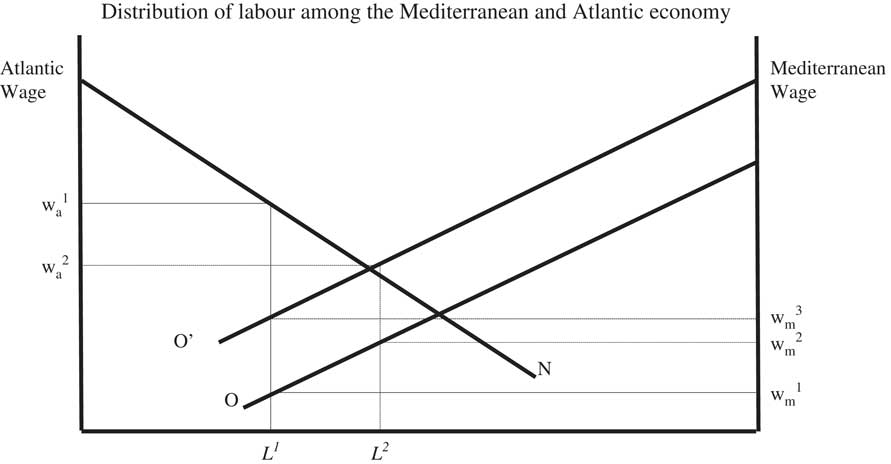
Figure 1 is Hatton and Williamson’s (Reference Hatton and Williamson1998, p. 209) explanation of migration from the «periphery», in this case the Mediterranean, to the Atlantic economy through real wage gaps. Atlantic wages and labour’s marginal product are on the left-hand side vertical axis while Mediterranean wages and labour’s marginal product are on the right-hand side vertical axis. In this two-region world, the world labour supply is measured along the horizontal axis. An equilibrium distribution of labour is at the intersection of the two labour demand schedules, O and N. If we start at L 1 where labour is scarce in the Atlantic economy, and so where the wage gap between the two regions is large, w a 1 −w m 1. If mass migrations redistribute labour towards L 2 in the Atlantic economy, the wage gap closes to w a 2 −w m 2 and we can attribute all the convergence to migration.
DISTRIBUTION OF LABOUR AMONG THE MEDITERRANEAN AND ATLANTIC ECONOMY
Source: Adapted from Hatton and Williamson (Reference Hatton and Williamson1998, p. 210).

It is possible that convergence could have occurred as a result of a relative demand shift: from O and O′. A relative demand shift could have been the result of, for example, technological advance in the Mediterranean. However, there is little evidence of such forces at work in the convergence process. Hatton and Williamson (Reference Hatton and Williamson2008, p. 113) show that in the absence of mass migration from Europe, global real wage dispersion would have increased by seven per cent. Looking at Italy in particular, the authors show without Italian emigration to the United States, the real wage gap between the two countries would have risen by 32 percentage points instead of falling by 102 percentage points (Hatton and Williamson Reference Hatton and Williamson2008, p. 113). In short, for Hatton and Williamson’s (Reference Hatton and Williamson2008) global sample in the late 19th century, when we might expect alternative (to migration) convergence forces to be stronger, the authors attribute 125 per cent of real wage convergence to migration (Hatton and Williamson (Reference Hatton and Williamson2008, p. 114). How can migration over-explain convergence?
As capital accumulation was faster in the New World than in Europe, mass migrations may have been offset by international capital flowsFootnote 1 . Thanks to Obstfeld and Taylor (Reference Obstfeld and Taylor2003) who showed that international capital mobility reached a peak before WWI that was not surpassed until around 2000, we also know these flows were substantial. With these two pieces of evidence in hand, Taylor and Williamson (Reference Taylor and Williamson1997) set up a counterfactual model where labour supply shocks generate capital inflows or outflows to maintain a constant rate of return on capital. Their results show that, while mass migration explained 125 per cent of the real wage convergence, adjusting for capital flows, it explains about 70 per cent. Even adjusting for other large factor flows, then, migration still dominates.
3. EMPIRICAL ANALYSIS OF EMIGRATION RATES
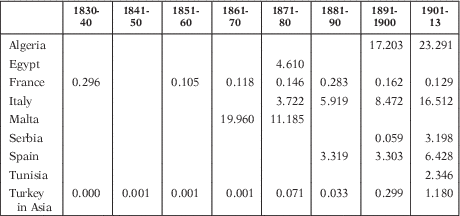
The first step in this story is understanding how and why Mediterranean emigration rates varied. Average decadal emigration rates per thousand population of the sending country are in Table 1. Most are from Ferenczi and Willcox’s (Reference Ferenczi and Willcox1929) authoritative study of pre-WWII global migrationFootnote 2 . The data include emigration to other European countries.
EMIGRATION RATES FROM THE MEDITERRANEAN, 1830-1913

Notes: Emigration rate is number of emigrants per thousand home population. Figures are decadal averages of annual data. «Turkey in Asia» (Anatolia, Syria, Palestine, and present day Asian Turkey) is emigration to the United States only.
Sources: see Appendix for details.
Table 1 shows most data refer to the relatively developed European states: France and Italy. The sources provide long-run data for emigration from «Turkey in Asia» — which refers to Anatolia and the Middle-Eastern Ottoman jurisdictions, including Syria and Palestine — to the United States. Still, it is a useful descriptive proxy for Ottoman emigration. Data for the other Mediterranean countries are scarce: 3 decades for Spain, 2 for Algeria and Malta, and 1 for Egypt and Tunisia. Nevertheless, these data points tell us something about the history of the region’s emigration. Emigration rates vary from very low for France to the very high rates in its colony, Algeria. Malta had high rates in the middle of the period, while the one decadal data point for Egypt is comparable with that of Italy. There is also substantial variation for individual countries over the period. Italian emigration rates increase rapidly over the late 19th century, while French ones decline. Dramatic growth can be seen in «Turkey in Asia», which went from sending 0.001 emigrants per thousand persons to the United States in the 1840s to 1.2 by 1913.
Return migration was high among Mediterranean countries, but data on immigration is even more limited than that on emigration. In the following subsection, I show that available net migration and gross emigration rates are positively correlated. Ultimately, I analyse the effects of migration through real wage data alone. Still, it is worth teasing out some insights from the limited data set summarised in Table 1.
What explains the variation in emigration rates presented in Table 1? The issue cannot be simply one of cultural resistance to emigration. Thistlethwaite (Reference Thistlethwaite1991, p. 27) reminds us that the Italian sharecropper who «pioneered the wheat fields of Argentina and the coffee plantations of Brazil was the compatriot of the Sicilian or Calabrian colonist on a less remote wheat frontier only six hours from Palermo in Tunis». The Greeks who followed the Italians to both North and South America had previously provided their labour to Bulgaria and Romania, and petty-trading skills to Turkey and Egypt. Further, while Figure 1 emphasises real wage gaps, they are not the whole story. I adapt Hatton and Williamson’s (Reference Hatton and Williamson1994a) econometric model of western European emigration to the Atlantic economy, which tests demographic, industrial, chain migration, and wage forces, but did not originally include any Mediterranean countries besides France:
 $$\eqalignno{ {\rm ln}EM_{{mt}} = & \alpha {\plus}\beta _{1} {\rm ln}GDPpc_{{mt}} {\plus}\beta _{2} \ln \left( {{\raise0.7ex\hbox{${W_{{mt}} }$} \!\mathord{\left/ {\vphantom {{W_{{mt}} } {W_{{at}} }}}\right.\kern-\nulldelimiterspace}\!\lower0.7ex\hbox{${W_{{at}} }$}}} \right){\plus}\beta _{3} {\rm \Delta }Pop_{{mt{\minus}2}} \cr & {\plus}{\rm ln}\beta _{4} MST_{{mt}} {\plus}\rho _{i} {\plus}\sigma _{m} {\plus}\mu _{{mt}} $$
where m refers to the Mediterranean country, a refers to the Atlantic economy (Argentina, Britain, Canada, and the United States), t to the year, and ρ and σ are country and year fixed effects termsFootnote 3 .
The first independent variable, per capita GDP, is a proxy for industrialisation levels. Broadberry et al. (Reference Broadberry, Federico and Klein2010) showed that industrial employment shares were highly correlated with per capita GDP in 19th century Europe. Thistlethwaite (Reference Thistlethwaite1991) stresses that the key driver of emigration is industrialisation at home: it relaxes the poverty constraint and brings about social changes that encourage mobility. Maddison (Reference Maddison2003) does not provide per capita GDP estimates for Malta and Serbia for this period. I linearly interpolated missing years. If agricultural attachment to the land holds back labour mobility, then countries with high levels of per capita GDP (low levels of agricultural employment) should have higher emigration rates. However, there could be an offsetting effect that is especially important for the Mediterranean. As the wage data refer to unskilled urban labourers and wages in urban areas were higher than in rural areas, the measured wage gap between the Mediterranean and Atlantic economy would understate the true wage gap facing rural labourers and hence the incentive to emigrate. As Mediterranean countries remained committed to agricultural production longer than northern Europe, we would expect this offsetting effect to be potentially large.
Second is the real wage gap: the log ratio of the Mediterranean country’s real wage to the real wage of the Atlantic economy. As immigration statistics do not offer enough clarity on the origin of Mediterranean migrants, this simple average is the best that can be done to reflect the fact that destinations varied among sending countries, reflecting linguistic and cultural differences. This ratio is a measure of the expected income gain from emigration, and so should take a negative sign. The absolute level of the Mediterranean country’s real wage would matter if it were too low, making for a poverty constraint on emigration. If this is the case, then the real wage would have a non-linear relationship with emigration: when low, emigration is constrained; at an intermediate level, emigration is high; but a yet higher level, the incentive to emigrate is low. I test for these alternative scenarios.
Third is population growth in percentage terms lagged by 2 years. Population data are mainly from Maddison (Reference Maddison2003)Footnote 4 . The ideal would be natural increase lagged by 2 decades, to proxy the arrival of a new generation migrants. The sources do not allow for this. The Mediterranean was labour-abundant and land-scarce (Williamson Reference Williamson2000). This reduced the likelihood that labourers would inherit properties meaningful enough to keep them there. Further, as technological progress in agriculture was slow, population growth meant an ever-increasing demographic burden that encouraged emigration. In Easterlin’s (Reference Easterlin1961) words, emigration was a vent for surplus labour.
Fourth is migrant stock, which measures the «chain migration» or «friends and relatives» effect that comes with the assistance of previous emigrants through more information flows and remittances (Hatton and Williamson Reference Hatton and Williamson1998). Gomellini and O’Grada (Reference Gomellini and O’Grada2011) have recently shown the importance of this variable for emigration from Italian regions. However, the migrant stock is likely to reflect the wide impact of the attractiveness of emigrating to a migrant community with the same language and culture. I measure this as the log cumulative sum of total emigration over total home country population.
The year fixed effects term controls for the drop in migration costs due to faster ships and falling passenger fares. The country fixed effects term controls for country-specific differences in the measurement and legal institutions surrounding migration.
EM is the gross emigration rate, measured as the total number of emigrants per thousand home country population. The countries and years covered are as follows — migration data are not available for all years in the country-periods: Algeria (1893-1915), Egypt (1873-1877), France (1837-1913), Italy (1876-1915), Malta (1861-1915), Serbia (1899-1915), Spain (1882-1915) and Tunisia (1903-1915). This composition means we are covering all parts of the length of the period, using different countries at each time.
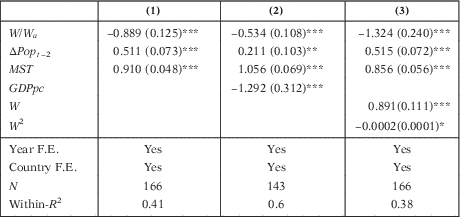
Table 2 contains the results. The model performs well, with within-country R 2s of between 40 per cent and 90 per cent across the different specifications. As the inclusion of per capita GDP removes Malta and Serbia from the sample, the first column of Table 2 shows the results of the estimation without the per capita GDP variable for the sake of comparison. This first estimation produces the expected results. The wage ratio has a large and highly significant effect on the emigration rates; it is almost a one-to-one effect, with every 1 per cent increase in Mediterranean real wages relative to New World ones resulting in a 0.89 per cent decrease in its emigration rate. Lagged population growth and the migrant stock variable all have large and highly significant effects. The former shows a 0.5 per cent increase in emigration rates for every percentage point increase in population 2 years back. The latter shows a 0.9 per cent increase in emigration rates for every 1 per cent increase in the stock of overseas migrants. Looking to column 2, we see that the coefficients retain their high levels of significance and their positions in the hierarchy of magnitude.
ESTIMATION OF EMIGRATION RATES, 1837-1913

Notes: Estimated using OLS. Dependent variable is log emigration per thousand home population. First independent variable is the log ratio of Mediterranean country real wage to Atlantic real wage. Second variable is annual percentage change in home country population lagged by 2 years. Third variable is log stock of emigrants over home population. Fourth is log per capita GDP. Fifth is log home real wage, and sixth is its quadratic. Standard errors reported in brackets. Statistical significance: ***1%; **5%; ***10%. Observations between following years: Algeria (1893-1915); Egypt (1873-77); France (1837-1913); Italy (1876-1913); Malta (1861-1915); Serbia (1899-1913); Spain (1882-1913); and Tunisia (1903-13).
The real wage gap between the Mediterranean and the New World was a powerful force in drawing migrants away from the region. The higher the relative real wage, the lower the emigration. It is also consistent with the historical record, of 19th century real wage divergence between the New World and the Mediterranean, with the latter falling farther and farther behind (Williamson Reference Williamson2000).
In column 3, I test the hypothesis that emigration might be caused by the growth of home real wages alone. That is, as the home real wage increases, the poverty constraint is relaxed and emigration rates increase; but as the real wage continues to grow and closes the wage gap, the incentive to emigrate is reduced. The quadratic of the Mediterranean real wage in column 3 gives the expected negative sign for this hypothesis, while the real wage level gives the correct positive sign. Both coefficients are significant, which supports the poverty constraint argument. This result contrasts with the northern European experience, where Hatton and Williamson (Reference Hatton and Williamson1994a, p. 548) found the right signs, but not the statistical significance for these same coefficients.
These results suggest that the Mediterranean was particularly poverty-constrained. Furthermore, the wage gap coefficient remains large and highly significant. Put together, these results indicate that both the desire to emigrate (as reflected in the wage gap) as well as the means to emigrate (as reflected by the real wage level and its quadratic) were important drivers of Mediterranean emigration to the New World in the 19th century.
The wage gap coefficient in column 2 implies that its 10 per cent increase would result in an emigration rate that is 0.40 emigrants per thousand lower. If the coefficient in column 3 is used, the rate would one emigrant per thousand lower. By way of comparison the Mediterranean sample mean emigration rate was 7.2 emigrants per thousand. While these effects may appear small, they mattered a great deal in the long run.
Moving onto the lagged population growth variable, we see it is highly significant in all specifications, and ranges from 0.21 to 0.52 in magnitude. That is, every percentage point increase in population growth 2 years back resulted in an emigration rate that is 1.2-1.7 emigrants per thousand higher. This is a powerful effect, and shows that demography acted in two ways. First, through its effect on home real wages: population growth created a labour glut, which depressed home real wages relative to Atlantic real wages. Second, this distinct effect shows that population growth in the face of limited land required an emigration vent.
Per capita GDP only enters in column 2, as (1) it is correlated with the Mediterranean absolute real wage in column 3 (and is indeed meant to measure more or less the same factors), and (2) its inclusion necessitates a smaller sample size, and (3) it is mostly interpolated. In spite of these constraints, the coefficient enters as both large and highly significant. It is, in contrast to Hatton and Williamson’s (Reference Hatton and Williamson1994a) measure of agricultural employment, showing that countries with higher levels of industrialisation had lower emigration rates. In northern Europe, the labour mobility effect dominated: non-industrial economies meant most labourers were tied to the land, reducing the possibility of emigration. In the Mediterranean, the offsetting effect dominated: the measured wage gap (based on urban wages) is understating the true one (the Mediterranean was largely rural or agricultural), and so the incentive to emigrate was heightened by the region’s slow industrialisation. The coefficient implies that every 1 per cent decline in a country’s per capita GDP led to an increase in its emigration rate of 3.7 emigrants per thousand. This is clearly a large effect, and is consistent with the Mediterranean’s latecomer status to mass migration and its late demographic transition (Hatton and Williamson Reference Hatton and Williamson1994b).
MST represents persistence in migration over time. In line with Hatton and Williamson (Reference Hatton and Williamson1994a), across all specifications I find that this variable has a large and highly significant effect on current emigration rates. Its every 1 per cent increase results in an emigration rate that is around 2.9 emigrants per thousand higher. In other terms, the coefficient implies that for every 1,000 previous emigrants around 67 more were pulled abroad each year. This is a much larger effect than Hatton and Williamson (Reference Hatton and Williamson1994a, p. 550) corresponding number of 20 more emigrants each year. It indicates that the «chain migration» factor was even more important for the Mediterranean. This is backed up by the geographical distribution of emigrants within destination countries: if the chain migration effect were strong, then we would expect geographical concentrations of the same emigrants, as they select communities that share their language and culture and where their relatives reside. As Foerester (Reference Foerster1919, p. 328) wrote of Italian emigration,
After the initial stage of settlement of any immigrant nationality at its chosen destinations, some scattering, however gradual, invariably ensues. Thus one expects subsequent censuses to show less geographical concentration. As the Italian immigration, however, increased in volume … its concentration actually became more marked.
Between 1900 and 1910, «years of prodigious industrial expansion in the United States», some 2.1 million Italians arrived: three times the number present a decade before, «their stock had increased faster since 1900 than that of any other large group, except the Russians». Of all the Italians in the United States in 1910, 35 per cent were resident in New York State alone (the top rank) and 15 per cent in Pennsylvania (second rank), vs. 0.2 per cent in Oklahoma (the bottom rank) (Foerester Reference Foerster1919, pp. 327-8).
To summarise, the real wage gap exerted a strong pull on Mediterranean migrants, as the region continued to diverge from the Atlantic economy over the course of the 19th century in line with conventional theory. Still, Mediterranean migrants were held back in a significant way by the poverty constraint, as the twin forces of industrialisation and the demographic transition came much later to the Mediterranean, which both heightened the incentive to emigrate but simultaneously diminished the possibility to do so. We have also seen that the «chain migration» effect was particularly strong among Mediterranean migrants, but it is unclear whether this reflects the broader attractiveness of a location to a community with the same cultureFootnote 5 . My focus here is on the real wage gap. For the undeveloped Mediterranean, the most relevant explanation is based on the costs of migration. There is a strong economic incentive to leave pre-industrial poverty behind, and escape to comparatively more productive regions. The costs of actually making the move, however, may be prohibitively high, given pre-industrial wages. It was rare for emigrants to get loans to fund their journey, and their incomes were usually too low to accumulate savings. This explanation shows us that large wage gaps between the labour-abundant Mediterranean and industrialising, labour-scarce Atlantic economy can be consistent with the low emigration rates in Table 1.
3.1 Emigration Rates and Net Migration Rates
While it is true that net migration was low in many Mediterranean countries, the flows back and forth would have still acted to integrate labour markets. Still, it is worth asking whether using net migration (emigration less immigration) would change the picture. Hatton and Williamson (Reference Hatton and Williamson1998, Ch. 3) point out that return migration from Latin countries was especially high, which weakened labour market integration and real wage convergence.
While immigration data is unavailable for most countries, what we can do instead for the limited sample of countries where we do have data is check the correlation between gross emigration rates and net migration. The net migration data restricts my sample to 123 observations: Algeria (23), Egypt (5), Italy (32), Serbia (8), Spain (34), Tunisia (13) and Turkey (8). Controlling for country fixed effects, since there were differences in migration measurement by country, and year fixed effects, since both variables trended up with time, a regression of net migration on gross emigration rates yields a standardised coefficient of 0.62, significant at the 1 per cent level (t-statistic of 5.24). The adjusted-R 2 is 0.76. The partial correlation of net migration and gross emigration rates (stripping out country and year fixed effects) is 0.51. This is a reassuring correlation. The large, but slightly smaller than unity, coefficient fits with Hatton and Williamson’s (Reference Hatton and Williamson1998, p. 254) regression of the determinants of gross emigration rates. When they swap their dependent variable for net migration, they get results that are still significant and positive, but which are slightly smaller in magnitude.
Ultimately, whether migration was acting to integrate labour markets is an empirical question. Further, I implement an empirical approach that gets around constraints of gross or net migration data. The point here is to highlight the fact that large labour flows were taking place; that there is evidence of the mechanism behind labour market integration.
4. EMPIRICAL ANALYSIS OF EMIGRATION AND REAL WAGE CONVERGENCE
Did greater emigration result in faster real wage convergence? Given the limited nature of the emigration data, Boyer and Hatton’s (Reference Boyer and Hatton1994) technique of using only real wage data is particularly useful hereFootnote 6 . The real wage data are detailed in the appendix. The authors provide a model that distinguishes between two drivers of labour market integration: common economic shocks and migration. We have already seen in the discussion around Figure 1 that the main driver of labour market integration was migration, but this model enables a control on common shocks. In the present case of Mediterranean labour markets, m, and the Atlantic one (unweighted average of Argentina, Canada, the United States and London), a, migration from m to a can be represented as
 $$M_{{ma}} =c\left[ {{\rm ln}(W_{a} /W_{m} )\,{\minus}\,k} \right]$$
where M ma is the rate of migration from m to a (as in negative migration from a to m), c the parameter that measures the response of migration to a given wage differential, and k measures the non-wage locational advantages of market m relative to market a. The migration rate depends on the wage ratio as well as the mobility parameter, c. A greater wage ratio means a greater incentive to migrate, and hence a greater migration rate. Parameter c determines the degree of integration between the two labour markets. If they were perfectly integrated, then c would approach infinity, as labour would be perfectly mobile. If c were at zero, then it would indicate no integration. Migration has an effect on the wage ratio itself. If labour migrated from m to a, assuming that c>0, the increase in a’s labour supply would lower W a while the reduction in labour in m would raise W m . The ratio would eventually fall and the process will continue until ln(W a /W m )=k. There is thus a long-run tendency towards a ratio of ln(W a /W m )=e k and if k=0 then in the long run, ln(W a /W m )=1. As in Boyer and Hatton (Reference Boyer and Hatton1994), we can eliminate the migration term and express the relation between the two markets in terms of the wage alone:
 $$\Delta {\rm ln}W_{{mt}} =\alpha {\plus}\beta _{1} \Delta {\rm ln}W_{{at}} {\plus}\beta _{2} {\rm ln(}W_{{mt{\minus}1}} /W_{{at{\minus}1}} {\rm )}{\plus}{\varepsilon}_{{mt}} $$
where β 1 is the degree to which there are common shocks affecting both markets, and β 2 measures the degree of integration of the two markets. The size of β 2 depends on the mobility parameter c outlined in model (3). If this parameter equals zero, then β 2 will also equal zero. As with model (1) and (2), model (4) is sometimes called an error correction model. The two real wages are related in changes, but the error correction term (W mt−1/W at−1) prevents them from drifting apart over time in levels – if β 2 is negative. It thus reveals the degree of integration due to migration. Another benefit of this approach is that it is pair-wise: I ran model (4) for every Mediterranean real wage series against the Atlantic economy real wage, and so could uncover which labour markets were holding the Mediterranean back. I included a time trend in all the estimations.
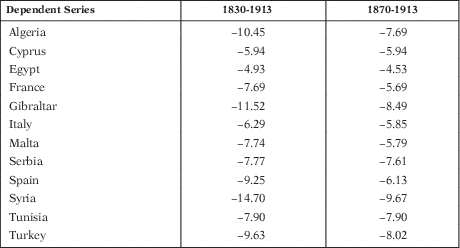
Preliminary Engle and Granger (Reference Engle and Granger1987) co-integration tests on Mediterranean-country real wage series with the Atlantic real wage show us whether there is any basic co-integration. The test is a two-step residual-based test. First, I regressed the first-differenced Atlantic real wage on the first-differenced Mediterranean country one, calculating the residuals. Second, I regressed the first-differenced residuals on the lagged residuals levels without a constant. The z-score is on the lagged residuals, and the null hypothesis is no co-integration. The results are in Table 3. There are two things to point out about the results. First, for the whole period as well as the post-1870 period, integration between each country and the Atlantic economy was statistically significant at the one per cent level. Second, judging by the z-scores, the larger economies tend to be less integrated than many of the smaller economies. For the whole period sample, France, Italy, and Spain have an average t-statistic of −7.74 compared with −8.39 for the British Mediterranean, and −9.29 for the Arab economies. In the post-1870 period, the average z-scores grow for all groups, but the hierarchy remains the same: the Mediterranean’s largest economies were the most weakly integrated, which potentially had implications for the entire region’s integration into the world economy.
ATLANTIC AND MEDITERRANEAN REAL WAGE CO-INTEGRATION TEST STATISTICS, 1830-1913

Notes: test statistics are z-scores, all significant at 1%, from Engle and Granger (Reference Engle and Granger1987) tests for co-integration. The null is no co-integration. The underlying series are first-differenced logged real wages.
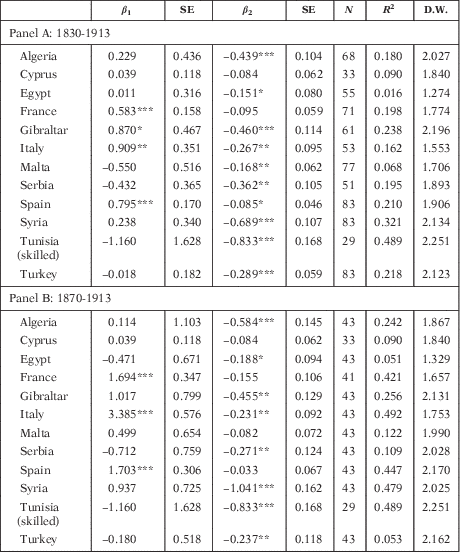
While helpful, Engle and Granger (Reference Engle and Granger1987) tests do not reveal the drivers behind integration and the z-scores have no obvious economic interpretation. This is where the results from model (4) help. The results are in Table 4: Panel A contains the results for the whole period, and Panel B for the post-1870 period.
TIME SERIES TESTS OF REAL WAGE INTEGRATION

Notes: Dependent variable is change in log Mediterranean country real wage. All estimations include time trends and constant terms. «D.W.» is the Durbin-Watson statistic. «SE» refers to the standard errors of the coefficients in preceding column. «β 2» refers to the error correction term, ln(W mt−1/W nwt−1). «β 1» refers to the common shock term, ΔlnW nwt . Panel A uses the whole length of the real wage series, 1830-1913. Panel B uses data from 1870 onwards. For Tunisia and Cyprus, data starts post-1870 in both cases. Tunisian real wages are skilled.
Starting with an overview of Panel A, the results make clear that most labour market integration was the product of migration, not common shocks as measured by β 1. This is to be expected given the discussion around Figure 1 and the findings in Obstfeld and Taylor (Reference Obstfeld and Taylor2003). Unsurprisingly, where common shocks were shared, they were between the Atlantic economy and the largest Mediterranean economies: France, Italy, and Spain. Gibraltar also registered a significant β 1, likely as a result of its connection to the Spanish economy. The results in Panel A call for the following groupings of labour market integration. First, we have the British Mediterranean: Malta, Gibraltar, Cyprus and Egypt. Second, we have the Arab and eastern Mediterranean: Algeria, Tunisia, Turkey, Serbia, and Syria. Third, are the large Mediterranean economies: Italy, Spain, and France. The first group is, apart from Cyprus, well integrated with the Atlantic economy. The second group is strongly integrated with the Atlantic economy. The last group is not meaningfully integrated with the Atlantic economy. The results for this last group are perhaps unsurprising since these are the only Mediterranean countries that the literature has covered and has hence concluded that the Mediterranean, as a whole, was not integrated with the 19th century global economy (Williamson Reference Williamson2000). By enlarging the sample, the results in Table 4 show that things were not so straightforward as previously understood.
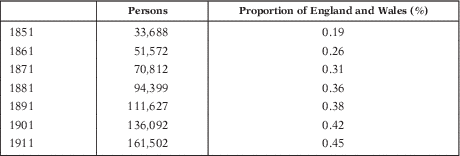
Turning to the British Mediterranean first, the results — insignificant common shocks (β 1), apart from Gibraltar as mentioned above, and mostly significant negative error correction terms (β 2) — show clearly that migratory flows were driving labour market integration. The rate of adjustment of the real wage in the Mediterranean to a shock to the equilibrium real wage ratio, holding W m constant, can be calculated using β 2, as (1−β 2)/β 2. For this group the lag varies from around 13 years in Cyprus to 3 years in Malta. For Egypt, the lag is a considerable 8 years, while it is 7 years in Malta. I have discussed in this chapter that emigration to the New World from Malta, as with much of the British Mediterranean, was limited. What about emigration to northern Europe, particularly the Imperial Metropole of London, which is included in the «Atlantic real wage»? Given Britain was for so long, until the 20th century, a net exporter of people, it is easy to forget all the inflows (Harper and Constantine Reference Harper and Constantine2010). Table 5 shows that the census numbers on people from «British Colonies and India» were quite substantial in absolute terms and grew over time. As the official reporter wrote in the census book,
This increase from Census to Census in the number of persons in this Country of Indian and Colonial birth may be ascribed in a great measure to the quick, regular and comparatively cheap communication now existing between the Colonies and the Mother Country (Census of England and Wales 1904, VI-5)Footnote 7 .
PERSONS BORN IN «BRITISH COLONIES AND INDIA» RESIDING IN BRITAIN

Notes: underlying population data refers to England and Wales.
Sources: 1901 Census of England and Wales, General Report with Appendices (1904 CVIII (Cd. 2174) 1), VI.-Birthplaces of the Population; 1911 Census of England and Wales, General Report with Appendices, Table 94: Birthplaces of Persons, Males and Females, and proportions per 100,000 of the Total Population of each Sex, 1911. Other censuses used for population data.
Admittedly, the numbers are small as a proportion of the total population of England and Wales, where most chose to live (Harper and Constantine Reference Harper and Constantine2010). What matters more, however, is the proportion relative to home populations. The census reporter tells us that the number of emigrants from Gibraltar and Malta (combined) was 7,619 in 1891 and 8,518 in 1901 (Census of England and Wales 1901, VI-5). A more precise reporter in the 1911 census gives us the numbers of 4,662 for Gibraltar («equal to nearly one-fifth of the present population of the colony»); 5,703 for Malta; and 208 for Cyprus (Census of England and Wales 1917, VII)Footnote 8 . Going by these numbers, then, in 1911 three per cent of Malta’s population, and 20 per cent of Gibraltar’s, emigrated to England and WalesFootnote 9 . If we keep their 1911 shares of their total emigration number constant for the 1891 and 1901 total numbers, the proportions are 14 per cent for Gibraltar and three per cent for Malta in both years. These are large flows for small economies. No reporters, unfortunately, give numbers for Egypt. The number for Cyprus is small, in line with its insignificant coefficient in Table 1. While there was a large British military presence in most colonies, in 1881 Cyprus, 3 years after it became a de facto colony, the «Alien» population of Cyprus accounted for only 2 per cent of its total populationFootnote 10 . The results here show that colonial links encouraged freer migration. This is one other area where the proponents of «Anglobalisation» might want to investigate (Ferguson Reference Ferguson2003).
Moving to the Arab and eastern Mediterranean group, we find slower, but still significant, adjustment speeds. They range from around 5 years for Turkish unskilled labourers to around 2 years for Tunisian skilled (unskilled age data are unavailable for Tunisia) labourers. The adjustment speeds for unskilled labourers elsewhere in this group are equally fast: 3 years for Algeria and Syria, and 4 years for Serbia. Compared to the British Mediterranean group, these are faster adjustment speeds. Egypt, which can cross the groupings as both a colony and Arab country, registered a speed of 8 years; double that of Serbia. This set of results might surprise some.
Researchers have written a modern economic history of the Mediterranean — itself an under-researched topic — with little reference to the Maghreb and, apart from Issawi (1966/Reference Issawi1982) and Karpat’s (Reference Karpat1985) early efforts, without Syria as a standalone countryFootnote 11 . The consequent history that emerges from this is one of virtually no integration with the Atlantic economy. Yet emigration from this part of the Mediterranean was considerable. One contemporary observer called the emigration of Syrians out of Beirut to America a «veritable commercial exodus» (Naff Reference Naff1985, p. 79). Karpat (Reference Karpat1985, p. 198) estimated that, between 1871 and 1909, 60,653 Syrians emigrated to Argentina alone. In Algeria, for which we have some useful data, we saw already that gross emigration rates were higher than those in Italy, itself considered to be a major exporter of labourers. The Algerian historian Bennoune (Reference Bennoune2002, p. 76) reminded us that, by the end of the 19th century, «several thousand» Algerians were working in Europe. In her magisterial study of intra-Mediterranean migration, Clancy-Smith (Reference Clancy-Smith2010, pp. 66-70) writes about a number of individual cases of Tunisian migrants to France. It is difficult to put a number on Tunisian emigration, and apart from Clancy-Smith (Reference Clancy-Smith2010) the historiography on Tunisia is thin, but the numbers in Ferenczi and Willcox (1929, pp. 1031-2) indicate a gross emigration rate that went from 3.5 in 1904, to an average of three until 1907, and an average of two until 1914Footnote 12 . This rate compares well with Italy’s average rate of five between 1876 and 1890 (Ferenczi and Willcox 1929, p. 820). If these rates make Italy an «emigration country par excellence», then the same description must apply to these countries (Gould Reference Gould1980, p. 78).
What about the residual category of weakly integrated countries? The Italian series is significantly integrated, but with an adjustment speed of 5 years; slower than most members of the previous group. While we know that outflows were large, they were not large enough to ensure faster integration (Hatton and Williamson Reference Hatton and Williamson1998, Ch. 6). Over 1893-1914, Algeria’s gross emigration rate averaged 20.5 while Italy’s averaged 14.1. Only by 1890 did Italian emigration to America reach 1 per cent of the equivalent of Italy’s population (Cavaioli Reference Cavaioli2008, p. 220). At that point, some 3 per cent of Malta’s population and 14 per cent of Gibraltar’s were living in Britain. Spain’s coefficient is also significant, but the speed is slower still at 13 years. This is the slowest speed in the sample, being marginally slower than Cyprus’. Sanchez-Alonso (Reference Sanchez-Alonso2000a, p. 299) shows us that Spain’s gross emigration rate was even lower than Italy’s. Turkey and Serbia, the real wages for which were taken from Williamson, are on what he based his conclusion of very limited real wage convergence on Britain (Williamson Reference Williamson2000). France’s insignificant coefficient is to be expected, given its average gross emigration rate from 1857 to 1913 was 0.16 emigrants per thousand persons, and it never rose above 0.78. Sicsic (Reference Sicsic1994, p. 119) explains low international emigration from France as a function of spatially uneven labour scarcity within the country. Labourers were «reluctant» to move from the south or the interior to the northwest, let alone to the United States. The relevant literature on France, compared with Italy or Spain, remains undeveloped (Sicsic Reference Sicsic1992, Reference Sicsic1994).
The results in Panel B, which cover data for the post-1870 period, when globalisation really took off, paint the same picture. Indeed, in a technical sense, z-tests for the equality of coefficients between each period show only one statistically significant difference: a larger common shock (β 1) for Italy in the post-1870 period, with a z-score of −2.57. All other z-scores are smaller than −1.60Footnote 13 . Still, there are some notable differences that the z-scores alone miss. The common shock for Gibraltar washed out, adding weight to the previous line of reasoning that its connection was to Spain rather than the Atlantic economy. Interestingly, the common shocks for France, Italy and Spain have all grown in magnitude, reflecting the accelerating integration of global commodity and capital — but not labour, in their case — markets between 1870 and 1913. The Arab and eastern group remains the most significant integrated, with Algeria and Syria registering even faster adjustment speeds. For the post-1870 period, Malta is no longer statistically integrated with the Atlantic economy. This result implies that the flows discussed around Table 5 were, in fact, representative of a slowing trend in Maltese emigration to England. We can only speculate that they were larger still in the pre-1870 period, for which we have no data. Spain’s integration coefficient loses significance in this period, while Italy’s retains its significance but loses in terms of magnitude.
The results in Table 5, particularly the large and significant β 2 coefficients, give the impression that the Mediterranean was very well integrated into the Atlantic economy. It is important to remember, however, that integration may imply co-variance, convergence or both. That is, it is possible to have a situation where wage gaps remain large (as they did in this context), but where integration was significant (as it is in Tables 3 and 4). β 2 does not necessarily imply convergence. Rather, it is the rate of adjustment back to the equilibrium wage ratio after a shock. Table 6 illustrates this point clearly.

Syria and Gibraltar registered similar β 2 coefficients: −0.69 and −0.46, both significant at the 1 per cent level. Their implied adjustment speeds in Table 6 are therefore similar: 2.5 and 3.2 years. Their respective co-integration statistics from Table 3, both significant at 1 per cent, also back this up. Looking at their real wage gaps with the Atlantic economy, we see convergence in both cases, but much more meaningful convergence for Gibraltar, which closed its gap by 53 percentage points compared with 9 percentage points for Syria. Clearly, Syria converged on the Atlantic economy at a faster rate but to a lower level than Gibraltar. This highlights an important point I raised at the start. While labour market integration is an important and overlooked explanation of the Mediterranean’s failure to globalise and converge on the Atlantic economy, it is not everything. Along with market integration, the structural factors emphasised from Tortella (Reference Tortella1994) and Reis (Reference Reis2000) to Lains (Reference Lains2007) and Felice and Vecchi (Reference Felice and Vecchi2012) still matter. Future work would do well to combine this analysis of labour market integration with structural factors, as in O’Rourke and Williamson (Reference O’Rourke and Williamson1997) — something beyond what I am able to do here.
4.1 The Mediterranean as a Whole
These country time-series results revealing varying degrees of integration between Mediterranean countries and the Atlantic economy. What can they tell us about the region in aggregate?
One very crude way of aggregating the results in Table 4 into a bigger picture is to weight the β 2 coefficients by the period-average populationFootnote 14 . In this way, I weight the coefficients by their population-share in the Mediterranean sample population as a whole. Weighting all countries, the resulting coefficient is −0.196, implying an adjustment speed of 6 years. Weighting the British Mediterranean and France-Italy-Spain groups as standalone regions, both get coefficients of −0.151, implying an adjustment speed of 8 years. Weighting the final Arab and eastern Mediterranean group as a standalone region, I get a coefficient of −0.387, implying a much faster adjustment speed of 4 years. Clearly, the «global» adjustment speed of 6 years is lengthened by the large weight of the France-Italy-Spain group. If the Mediterranean consisted solely of Algeria, Tunisia, Turkey, Serbia, and Syria alone — or if France, Italy and Spain’s emigration rates were as high as the former countries’ — then its integration with the Atlantic economy would be 33 per cent greater, as measured by the difference between the «global» weighted coefficient and the Arab-eastern Mediterranean one.
Applying some more rigor, I implemented the same specification used for Table 4 on pooled sub-samples of the British Mediterranean, Arab and eastern Mediterranean, and France-Italy-Spain groups. The standardised β 2 coefficients, in respective order, are: −0.15, −1.12, and −0.12. Their t-ratios are: −2.19 (significant at 5 per cent), −3.27 (significant at 1 per cent), and −1.67 (significant at 10 per cent, with a probability value of 0.097). The difference between the Arab and eastern Mediterranean coefficient and the other two coefficients is large, with an F-statistic of 9.49, significant at 1 per cent.
This is a rough way of tackling a big problem. The idea is to simply show that, first, the Mediterranean comprised more than just the European periphery, Turkey and Egypt; second, it was not a homogenous region; and lastly, as far as this study goes, Italy, Spain, and France were holding back its integration with the Atlantic economy. Without these components, the region’s labour markets would have been more closely integrated with those farther afield. The Arab world is a neglected area of research in economic history, and perhaps because current biases lead us to think of the region as being in perpetual decline, this result might surprise readers. The following section shows that the underlying reasons for this result, as overlooked as they have been, are fairly mundane and fit with the wide literature on poverty constraints in migration as well as the poverty constraint results in Table 2.
5. DESIRE AND MEANS TO EMIGRATE
Now that we have some evidence showing that low emigration from the Mediterranean’s larger countries held back its integration with the Atlantic economy, it is worth spending more time on the emigration constraints. Table 2 has already shown that emigration was poverty constrained across the Mediterranean, but differential rates of real wage convergence imply differential constraints.
How do those constraints compare between countries? Here I have very limited data, but just enough to enlighten the patterns uncovered in the regressions in the previous sections.
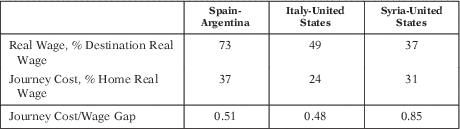
Table 7 compares the costs of moving and wage gaps for Syria, Italy and Spain. Italy is held up as the prime example of 19th century emigration although, like Spain, it experienced less emigration than we would have expected based on its wage gap vs. the Atlantic economy. Syria, as the results presented earlier show, was closely integrated with the Atlantic economy. The Syrian and Italian numbers show their skilled real wage gaps relative to America’s, and the total cost of getting there as a percentage of their skilled real wage. The Spanish numbers show the real wage gap vs. Argentina, since that is where most Spanish emigrants were going, along with the cost of getting there. The numbers fit the historiography well. There is only a 7 percentage point difference between Syrian and Italian emigration costs, but Syria’s real wage gap is 12 percentage points greater: Syrian workers faced a larger incentive to emigrate than their Italian counterparts, and similar costs. It now seems unsurprising that Syria’s integration was much closer, and that Italy «under-emigrated». Turning to Spain, which Sanchez-Alonso (Reference Sanchez-Alonso2000a) tells us «under-emigrated» even more than Italy, we see a very small real wage gap, but the highest travel cost — 54 per cent greater than that of Italy.
REAL WAGE GAPS AND JOURNEY COSTS, CA. 1913

Notes: For Syria, unskilled real wage relative to U.S. unskilled real wage in 1913; and journey costs from «Ottoman jurisdiction to America» in 1914. For Italy, unskilled real wage relative to U.S. unskilled real wage in 1912; and journey costs from Naples to New York in 1912. For Spain, unskilled real wage relative to Argentine unskilled real wage in 1904-13; and journey costs from Galicia to River-Plate in 1904-14. Underlying data are all in 1900 £.
Sources: Journey costs: Syria from Karpat (Reference Karpat1985, p. 187); Italy from Wyman (Reference Wyman1993, p. 24); Spain from Sánchez-Alonso (Reference Sánchez-Alonso2007, table 2) . Conversions to £ done using Global Financial Data (2014), and deflated using Allen’s (Reference Allen2001) London CPI.
The simple incentive-vs.-cost arithmetic favoured emigration from Syria more than Italy and Spain, and that is how history played out. In some cases, like Malta’s, where costs were too high, private individuals and governments stepped in to help (Price Reference Price1954). In Italy, where interest groups tried maintaining abundant labour supplies, governments did the opposite of supporting emigration, passing instead (ineffective) prohibitive laws (Dore Reference Dore1968). Similar legal restrictions were implemented in Syria, but then Syria’s real wage gap was much larger, providing emigrants with greater incentives to take illegal risks (Karpat Reference Karpat1985; Naff Reference Naff1985). These relative costs had implications for the Mediterranean’s integration into the global economy.
6. CONCLUSION
The Mediterranean’s failure to globalise can be partly explained by low emigration rates from its larger component economies, France, Italy and Spain. I only have space to speculate here, but it is worth asking: Why did these economies have particularly poor emigration environments?
For Spain, Sanchez-Alonso (Reference Sanchez-Alonso2000a) stressed the role of policy. While most economies stuck to the gold standard, Spain depreciated its currency and raised tariffs on cereals to protect Spanish agriculture from cheap New World grain imports to the domestic market. The depreciation and tariff hikes did lower imports, but substantially increased the costs of emigration, increasing ticket prices and decreasing the value of Spanish savings overseas. Indeed, a look back to Table 7 shows that Spanish emigrants faced the highest journey costs relative to their real wage levels. Similarly, Italy’s lira was inconvertible between 1866 and 1884 and again between 1894 and 1913, and its tariffs on manufactures and agricultural goods were among the highest in Europe (O’Rourke and Williamson Reference O’Rourke and Williamson1999, p. 243, 98). In France, tariffs were also high throughout most of the late 19th century (O’Rourke and Williamson Reference O’Rourke and Williamson1999, p. 98). These foreign exchange and trade policies acted to increase the costs of emigration in all three economies. As O’Rourke and Williamson (Reference O’Rourke and Williamson1999, p. 141) point out, «(lower) trade and (lower) emigration were complements».
In southern Europe, politically influential agricultural landowners lobbied for protective tariffs, as well as restrictions on emigration (Dore 1969; O’Rourke Reference O’Rourke1997). While attempts to restrict emigration were mostly ineffective, high tariffs alone exacerbated the poverty constraint for labourers: they decreased real wages by stifling demand for labour-intensive goods in what were labour-abundant economies. In contrast, Cyprus, Gibraltar and Malta, being Crown Colonies, adhered to British free trade doctrine, experiencing labour-intensive product export booms (Caruana-Galizia forthcoming b). Likewise, Ottoman jurisdictions were forced to sign «unequal treaties» that capped tariffs at low levels (Pamuk and Williamson Reference Pamuk and Williamson2011).
The Mediterranean’s larger component economies failed to participate in the first globalisation not because they were cut off, as were Africa and Latin America, but out of choice. It was a choice of protectionism that exacerbated poverty constraints on emigration. The region’s smaller components, in contrast, «chose» to participate in globalisation, but their participation was not enough to integrate the region in its entirety into the global economy. Had more Italian, French and Spanish emigrants been able to afford the journey across the Atlantic perhaps the Mediterranean would be a more integrated part of the global economy today.
DATA APPENDIX
Real Wage Data
Cyprus, Gibraltar and Malta: data are from Caruana-Galizia (Reference Caruana-Galiziaforthcoming b), where real wages are calculated in 1900 British pounds. The series run from 1852 to 1913 for Gibraltar, 1836 to 1913 for Malta, and from 1881 to 1913 for Cyprus. Given their small size, Gibraltarian and Maltese sources list a single wage series for the respective country. For Cyprus, wages at different locations were averaged to produce a national series. Unskilled wages are for those in construction and agricultural labour.
Algeria, Egypt, Syria and Tunisia: the data underlying Egypt and Syria are from, respectively, Williamson (Reference Williamson2000) and Issawi (Reference Issawi1988). Caruana-Galizia (Reference Caruana-Galiziaforthcoming a) standardised them into 1900 francs, and also calculated real wages for Algeria and Tunisia. They were converted into 1900 British pounds, using historical exchange rate series in the Global Financial Data (2014). Algeria averages the main colonial cities; Egypt averages Alexandria and Cairo; Tunisia refers to Tunis; and Syria averages the country’s main cities. Tunisian wages are for skilled workers only. For the rest, unskilled wages are for those in agricultural and construction labour and low-level occupations in the colonial administrations. The Syrian series run from 1820 to 1913; the Algerian from 1845 to 1913; the Egyptian from 1858 to 1913; and the Tunisian from 1881 to 1913.
Italy, Spain, and France: data are from Allen (Reference Allen2001). The data are at the Global Price and Income History Group website: http://gpih.ucdavis.edu/Datafilelist.htm#Europe. Unskilled wages are from the «labourer» data set. The wages are in grams of silver per day, and I converted them into British pounds using Allen’s (Reference Allen2001) «London and South England» data set, which is also on the same website. I expressed the series in 1900 pounds by re-basing the city-specific consumer price indices to 1900. All the series cover the entire 1820-1913 period. The series for Italy refers to Florence; France, Paris; and Spain, Madrid.
Turkey: data are online at the Global Price and Income History Group website: http://gpih.ucdavis.edu/Datafilelist.htm#Europe. They are from Pamuk (Reference Pamuk2004) and Ozmucur and Pamuk (Reference Ozmucur and Pamuk2002). They refer to unskilled construction workers from Istanbul. The wages are given in grams of silver per day, converted to annual (250 working days a year, as in Allen (Reference Allen2001)) wages in 1900 British pounds using Allen’s (Reference Allen2001) silver-pound exchange rates in the dataset above. Data for missing years were linearly interpolated. The series cover the entire 1820-1913 period.
Serbia: series from Williamson (Reference Williamson2000), a ratio scale where 1900=100. Assuming Serbian wages were at the same level as those in the Ottoman Empire — it was Ottoman until 1817 — I scaled the series to Pamuk’s (Reference Pamuk2004) unskilled real wage series for Istanbul. Conversion to 1900 British pounds was done using the Global Financial Data (2014). The series refers to Yugoslavia, and are wages paid to unskilled builders. The series run from 1862 to 1913.
The United States, Argentina, Canada, and Britain: data for Britain refer to unskilled builders in London and southern England and are from Allen (Reference Allen2001). The data are online at the Global Price and Income History Group website: http://gpih.ucdavis.edu/Datafilelist.htm#Europe. The wages are in grams of silver per day, and I converted them into British pounds using Allen’s (Reference Allen2001) conversions tab on this same dataset. I expressed the series in 1900 pounds by re-basing the city-specific consumer price indices to 1900. Data for the United States, Argentina and Canada are from Williamson (Reference Williamson1995). For Argentina, the series refers to porters and unskilled farm labourers, mainly in Buenos Aires. For the United States, the series refers to «common» and unskilled labourers on farms and at army forts around the country. For Canada, the series refers to construction workers and labourers in the building trades from various parts of the country. All series are ratio scales, based to 1900. For Canada, I converted the series into dollars using Dick (Reference Dick1982). For the United States, I converted the series into dollars using the Bureau of Labour Statistics (1934), which is digitised under North America at the Global Price and Income History Group website: http://gpih.ucdavis.edu/Datafilelist.htm#NorthAmerica. For Argentina, I used Cortés Condre (Reference Cortés Condre1979). I converted them into 1900 British pounds, using historical exchange rate series in the Global Financial Data (2014). The American series runs from 1830 to 1913; Argentina’s from 1864 to 1913; Canada’s from 1870 to 1913; and London’s from 1820 to 1913.
Emigration Data
Algeria: Ferenczi, I. and Willcox, W.F. (1929), «International Migrations», Vol. 1, pp. 1028-9. The series runs from 1893 to 1913.
Egypt: Ferenczi, I. and Willcox, W.F. (1929), «International Migrations», Vol. 1, pp. 1033. The series runs from 1873 to 1877.
France: Ferenczi, I. and Willcox, W.F. (1929), «International Migrations», Vol. 1, pp. 608, 677. The series runs from 1857 to 1913.
Italy: Ferenczi, I. and Willcox, W.F. (1929), «International Migrations», Vol. 1, pp. 820 and 839. The series runs from 1876 to 1813.
Malta: Ferenczi, I. and Willcox, W.F. (1929), «International Migrations», Vol. 1, p. 871, and Price, C. (1954), «Malta and the Maltese: A Study in Nineteenth Century Migration», pp. 225-35. The series runs from 1861 to 1913, with a gap from 1872 to 1910.
Serbia: Ferenczi, I. and Willcox, W.F. (1929), «International Migrations», Vol. 1, pp. 886-7. They refer to Bulgarian, Serbian, and Montenegrin emigrants to America. The series runs from 1899 to 1913.
Spain: Sanchez-Alonso, B. (1995) Las causas de la emigración española, Appendix, which updates Ferenczi, I. and Willcox, W.F. (1929), «International Migrations», Vol. 1, pp. 849-54. The series runs from 1882 to 1913.
Tunisia: Ferenczi, I. and Willcox, W.F. (1929), «International Migrations», Vol. 1, pp. 1031-2. The series runs from 1903 to 1913.
Turkey Ferenczi, I. and Willcox, W.F. (1929), «International Migrations», Vol. 1, pp. 88-91. They refer to emigration from «Turkey in Asia»(Anatolia, Syria, Palestine and present day Turkey in Asia) to America. The series runs from 1820 to 1913.
Population Data
Cyprus, Gibraltar and Malta: population data are from the blue books. The Cyprus and Gibraltar books are at Cambridge University Library’s Commonwealth Room (classmark: RCS.L.BB.18 and RCS.L.BB.16). The Malta books are at the National Archives of Malta (Classmark: ID: 117 OPU). The Cyprus series runs from 1881 to 1913, and Malta’s from 1838 to 1913.
All other population data are from Maddison, Angus (2003), «The World Economy: Historical Statistics», the data of which are hosted online at: www.ggdc.net/maddison/Historical_Statistics/vertical-file_02-2010.xls. A few missing observations were filled in using www.populstat.info, which collects statistics on most of the world’s countries from a variety of national sources and encyclopedias, or by linear interpolation.