Introduction
French bean (Phaseolus vulgaris L) is a vital source of protein in the human diet and consumed worldwide (Broughton et al., Reference Broughton, Hernandez, Blair, Beebe, Gepts and Vanderleyden2003). The French bean is the most widely cultivated species of the genus Phaseolus and accounts for approximately 95% of the world's Phaseolus bean production (Gonçalves-Vidigal et al., Reference Gonçalves-Vidigal, Cruz, Lacanallo, Vidigal, Sousa and Pacheco2013). It is diploid (2n = 2x = 22) in nature and predominantly self-pollinated, with a 3–5% average out-crossing rate (Ramalho and Abreu, Reference Ramalho, Abreu, Vieira, Paula Junior and Borem2006) although occasionally higher values are also obtained (Ibarra-Perez et al., Reference Ibarra-Perez, Ehdaie and Waines1997). The State of Uttarakhand has a huge diversity of French bean which is uninvestigated yet (Prabha et al., Reference Prabha, Chamoli, Negi and Chauhan2021). According to baseline data on horticultural crops in Uttarakhand (2018), 5776 hectares area of Uttarakhand is under French bean with a production of 38,112 MT. In Uttarakhand, a higher genetic diversity can be seen but the main drawback of the crop is occurrence of different diseases. Angular leaf spot (ALS) is one of them which is caused by the fungus Pseudocercospora griseola (Sacc.). ALS alone can result in 80% losses globally in the production of French bean (Busogoro et al., Reference Busogoro, Duterme and Lepoivre2002); losses can be dependent on the environmental conditions, pathogenicity of the isolates, level of susceptibility of the cultivar and the stage of plant growth (Paula and Zambolim, Reference Paula-Junior, Zambolim, Vieria, Paula-Junior and Borem1998; Tryphone et al., Reference Tryphone, Chilagane, Nchimbi-Msolla and Kusolwa2015). Use of fungicides is an option to control ALS disease, but in tropical countries French bean is commonly grown by small farmers, who cannot afford the expenses of these chemicals (Nay et al., Reference Nay, Souza, Raatz, Mukankusi, Gonçalves-Vidigal, Abreu, Melo and Pastor-Corrales2019). Use of fungicides is also harmful to the environment as well as to the human health. The most effective and eco-friendly way to control the disease is the use of resistant cultivars. However, development of French bean cultivars with durable ALS resistance is difficult due to the broad and changing virulence diversity of the ALS pathogen that renders varieties that are resistant in one year or location and susceptible in another (Pastor-Corrales et al., Reference Pastor-Corrales, Jara and Singh1998; Mahuku et al., Reference Mahuku, Jara, Cuasquer and Castellanos2002; Nay et al., Reference Nay, Souza, Raatz, Mukankusi, Gonçalves-Vidigal, Abreu, Melo and Pastor-Corrales2019). Therefore, it is necessary to screen available bean germplasm for resistance to ALS.
Five ALS resistance loci (Phg-1, Phg-2, Phg-3, Phg4 and Phg-5) have been approved by the Bean Improvement Cooperative Genetics Committee (http://arsftfbean.uprm.edu/bic/wpcontent/uploads/2018/04/bean_Genes_List_2017.pdf) (Gonçalves-Vidigal et al., Reference Gonçalves-Vidigal, Cruz, Garcia, Kami, Vidigal Filho and Sousa2011, Reference Gonçalves-Vidigal, Cruz, Lacanallo, Vidigal, Sousa and Pacheco2013; Oblessuc et al., Reference Oblessuc, Baroni, Garcia, Chioratto, Carbonell, Camargo and Benchimol2012, Reference Oblessuc, Perseguini, Baroni, Chiorato, Carbonell and Mondego2013; Keller et al., Reference Keller, Manzanares, Jara, Lobaton, Studer and Raatz2015) although several authors have detected quantitative control for the disease, and numerous QTLs have already been identified, showing the complex inheritance of ALS resistance (Lopez et al., Reference Lopez, Acosta, Jara, Pedraza, Gaitan-Solis and Gallego2003; Caixeta et al., Reference Caixeta, Borem, Alzate-Marin, Fagundes, Silva, De Barros and Moreira2005; Oblessuc et al., Reference Oblessuc, Baroni, Garcia, Chioratto, Carbonell, Camargo and Benchimol2012; Keller et al., Reference Keller, Manzanares, Jara, Lobaton, Studer and Raatz2015; Perseguini et al., Reference Perseguini, Oblessuc, Rosa, Gomes, Chiorato and Carbonell2016; Bassi et al., Reference Bassi, Brinez, Rosa, Oblessuc, Almeida and Nucci2017; Pereira et al., Reference Pereira, Abreu, Nalin and Souza2019; Librelon et al., Reference Librelon, de-Pádua, de-Fátima, Ramalho and de-Souza2020). Three independent and dominant Phg loci (Phg-1, Phg-2 and Phg-3) and two major QTLs (Phg-4 and Phg-5) are included (Carvalho et al., Reference Carvalho, Paula Junior, Alzate-Marin, Nietsche, Barros and Moreira1998; Sartorato et al., Reference Sartorato, Nietsche, Barros and Moreira1999a; Correa et al., Reference Correa, Good-God, Oliveira, Nietsche, Moreira and Barros2001).
During co-evolution process between pathogen and host, P. griseola can be divided into Andean and Mesoamerican races, and it is observed that Mesoamerican races infect both Mesoamerican and Andean bean genotypes, while Andean races preferentially infect Andean genotypes (Guzman et al., Reference Guzman, Gilbertson, Nodari, Temple and Mandala1995; Pastor-Corrales and Jara, Reference Pastor-Corrales and Jara1995; Crous et al., Reference Crous, Liebenberg, Braun and Groenewald2006). Thus, genetic breeding strategies may use this knowledge to pyramid both Andean and Mesoamerican resistance genes to durable ALS resistance. Furthermore, Andean beans can be used as a source of resistance for introgression of genes to Mesoamerican genotypes, as in the case of the carioca variety (Nay et al., Reference Nay, Souza, Raatz, Mukankusi, Gonçalves-Vidigal, Abreu, Melo and Pastor-Corrales2019). Among five resistant genes, Phg-1, Phg-4 and Phg-5 loci are from French bean accessions of Andean gene pool, whereas Phg-2 and Phg-3 are from beans of Mesoamerican gene pool (Sartorato et al., Reference Sartorato, Nietsche, Barros and Moreira1999a). All these genes alone or in combination can provide high resistance to different races of P. griseola all over the world (Nay et al., Reference Nay, Souza, Raatz, Mukankusi, Gonçalves-Vidigal, Abreu, Melo and Pastor-Corrales2019). Several authors reported molecular markers linked to ALS resistance genes in their studies (Pastor-Corrales et al., Reference Pastor-Corrales, Jara and Singh1998; Mahuku et al., Reference Mahuku, Jara, Cuasquer and Castellanos2002). SCARs (sequence cleaved amplified regions), STS (sequence tagged site) and SSR (Simple sequence repeat) primers show many advantages in studies of germplasm screening, as they are co-dominant, characterize single loci and can perceive high level of polymorphism and reproducibility. Molecular markers reveal the number of resistance loci in the accessions which can help in selection of breeding material for future breeding programmes.
Breeders have developed many bean cultivars, which are resistant to some P. griseola races, but due to changing virulence diversity, the genotypes no longer show resistance to different pathogenic races (Almeida et al., Reference Almeida, de Carvalho, Bonfante, Perseguini, Santos, Gonçalves, Patricio, Taniguti, Gesteira, Garcia, Song, Carbonell, Chiorato and Benchimol-Reis2021). Therefore, new sources of multiple resistances to P. griseola need to be identified. Pyramiding several resistance genes in one variety is a breeding tool to develop wide and durable resistance into French bean varieties (Ddamulira et al., Reference Ddamulira, Mukankusi, Ochwo, Edema, Sseruwagi and Gepts2015). Merging both Andean and Mesoamerican resistance genes into the single accession or variety will possibly result in substantial resistance to many ALS pathotypes (Gil et al., Reference Gil, Solarte, Lobaton, Mayor, Barrera and Jara2019). Therefore, screening of the available French bean germplasm is necessary against different P. griseola races. As the Garhwal region of Uttarakhand has abundant diversity of French bean, this study was designed with the aim to screen the French bean germplasm from Garhwal, Uttarakhand to identify potential sources of resistance to ALS.
Materials and methods
Plant material
One hundred seventy-six accessions of French bean (online Supplementary Table S1) collected from five districts of Garhwal, Uttarakhand, India. An ALS-resistant line Cornell 49-242 was obtained from Dr P. N. Sharma, Head, Department of Plant Pathology, CSK Himachal Pradesh Krishi Vishwavidyalaya, Palampur, Himachal Pradesh, India. In addition to its application in breeding, Cornell 49-242 is a popular line used in various countries because of its resistance to several strains of P. griseola. Further, each accession was planted at farmer's field at New Tehri, Tehri Garhwal, Uttarakhand for multiplication and to check disease severity in the field condition. These accessions were screened for ALS resistance under field and in-vitro condition.
Screening of P. griseola under field condition
First the 176 French bean accessions were screened for ALS under field condition. The experiment was conducted at New Tehri Town in two consecutive years, 2019 and 2020 in the months of May to November. New Tehri is located at coordinates 30.3739´N and longitude is 78.435379´E with an altitude of 1750 m asl. One hundred and seventy-six accessions along with resistant line Cornell 49-242 were planted in the field in randomized block design (RBD) in the years 2019 and 2020 and categorized into three classes viz., resistant (1.0–3.0), moderately resistant (3.1–6.0) and susceptible (6.1–9.0) (Balardin et al., Reference Balardin, Jarosz and Kelly1997). This screening was done to check the disease severity in natural environment. After screening of all the accessions under field condition, accessions which were found resistant in field were selected for in-vitro screening for ALS resistance along with some moderately resistant and susceptible accessions (Gulsum et al., Reference Gulsum, Goksel, Mehmet, Vahdettin and Harun2021).
Screening of selected accessions under in-vitro condition
From both the field trials, 48 accessions were selected to screen for ALS resistance under polyhouse conditions along with resistant line (Cornell 49-242). The experiment was conducted in completely randomized design (CRD). All the accessions were grown in plastic pots (9 inches). The pots were prepared by mixing soil with sand and decomposed manure (1:1:1). Seeds of each accession were disinfected with 1% NaOCl for 2–3 min and then washed with distilled water for 2 min. Two P. griseola isolates P5 and P9 were obtained from the well-characterized repository of Microbiology Lab, Department of Basic Sciences, College of Forestry, Ranichauri, Uttarakhand, India. Both the isolates (P5 and P9) were grown on Streptopenicillin amended PDA plates. The culture plates were then incubated at 25 ± 2°C for 7 days. Conidia were scraped from incubated plates in to 10–20 ml of sterilized distilled water, and the final volume was made up to 50 ml with sterile distilled water. Spore suspension was filtered through the sterile muslin cloth, and spore concentration was adjusted to 50 × 105/ml. Three to four drops of Tween-20 (0.01%) were added to it just before spraying. After 21 days, the plants were sprayed with freshly prepared spore suspensions of P. griseola isolates P5 and P9. The disease reaction of each accession was assessed after 7 days of inoculation. The plants were categorized on a 1–9 scale as resistant (1.0–3.0), moderately resistant (3.1–6.0) and susceptible (6.1–9.0) (Balardin et al., Reference Balardin, Jarosz and Kelly1997).
Evaluation of disease symptoms in field and in-vitro
At the onset of the disease, the lesions appear as brown spots with a tan or silvery centre on leaves which were initially confined to the leaf tissue between major veins, giving it an angular appearance. In highly susceptible accessions, many lesions were observed in stem and pods, while approximately 90% of the leaf area was affected by the lesions. In pods, lesions were oval or circular and initially superficial with margins that were almost black and reddish-brown centres, which were sharply defined. The disease caused by P. griseola was assessed by each inoculated plant using Centro International de Agricultura Tropical (CIAT) 1–9 scale adapted from Balardin et al. (Reference Balardin, Jarosz and Kelly1997). This scale was also used to select the accessions under field conditions.
Detection of P. griseola-resistant loci in 176 accessions along with resistant line
DNA extraction and PCR amplification of Phg resistance gene
The DNA was extracted of all the 176 accessions along with the resistant line (Cornell 49-242) from fresh and young leaves of plants using CTAB (cetyl trimethyl ammonium bromide) method by Devi et al. (Reference Devi, Punyarani, Sing and Devi2013) with few modifications. For molecular screening of 176 French bean accessions, a total of six primers were used, which were present on five loci (Phg-1, Phg-2, Phg-3 and Phg-5) (Table 1). The PCR (polymerase chain reaction) reaction mixture was prepared in 10 μl volumes, containing 50 ng DNA, 2× PCR buffer, 1 μM primer, 100 μM of each dNTPs and 0.3 U Taq DNA polymerase. The PCR amplifications were done by 35 cycles of initial denaturation (at 95°C for 5 min), denaturation (at 94°C for 30 s), annealing (temperature varied according to primer specifications) for 1 min, synthesis (at 72°C for 1:30 min) and extension (at 72°C for 5 min) (Table 1).
Details of primers used in the study for screening of angular leaf spot resistance genes in French bean accessions collected from Garhwal Himalayas

Yield of primers were ranging from 62.7 nmol (SAA-19) to 29.1 nmol (SH13), which was further diluted to prepare stock solution of 10 μM.
Data analysis
Disease scores of the accessions were subjected to analysis of variance using RBD/CRD to calculate the significance by magnitude of the F value (P = 0.05). The K-means algorithm was used to make clusters based on disease reaction under in-vitro conditions. The objective of using a non-hierarchical cluster function is to minimize the sum of the squared distances of accessions from their cluster.

Results
In our study, we evaluated Phg-resistant loci in French bean accession from Uttarakhand Himalayas by using molecular markers which will contribute in breeding strategies for ALS disease. Therefore, a total of 176 accessions with a control line were screened with five SCAR primers, one STS and one SSR primer (online Supplementary Table S1) linked to Phg-1, Phg-2, Phg-3 and Phg-5 genes, which confer combined or independent resistance to ALS.
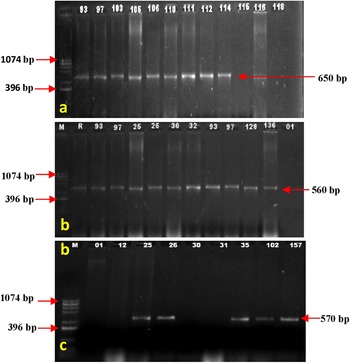
All the primers (SAA19, SBA16, SM02, SN02, Pv-at006 and TGA1.1) amplified the specific DNA fragments. The primer SAA19 (associated with gene Phg-3) produced a specific amplicon of 650 bp and out of 176 accessions, 89 accessions showed specific bands. SBA16 (Phg-3) produced amplicon of 560 bp and 28 accessions showed specific bands (online Supplementary Table S1, Fig. 1). The plant DNA of 96 accessions showed specific binding with the primer SM02 (Phg-3) and produced amplicon of 460 bp and the plant DNA of 62 accessions amplified with the primer SN02 (Phg-2) and produced amplicon of 890 bp. The STS (TGA1.1570) and SSR (pv-at006, 132 bp) primers both produced specific amplicon in five and four accessions, respectively (online Supplementary Table S1, Fig. 1). Primers TGA1.1570 and pv-at006 amplified with the DNA of French bean accessions with large seed size (GFB-25, GFB-26, GFB-35, GFB-102, GFB-157 and GFB-163).
Amplification of resistance gene in French bean accessions using disease-specific primers. (a) Amplification with primer SAA19 (650 bp). (b) Amplification with primer SBA 16 (890 bp). (c) Amplification with primer TGA1.1 (570 bp).

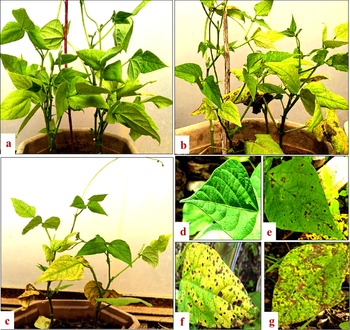
All the 176 accessions of French bean were sown in field in the two consecutive years 2019 and 2020 and the disease incidence was recorded on 1–9 scale for both years. Out of the 176 accessions, 19 accessions were found resistant, 96 were moderately resistant and 61 accessions were susceptible under field condition (online Supplementary Table S1). Accessions GFB-93 and GFB-97 were found highly resistant under field condition, their resistant score was 0.5 in both the field trials (2019 and 2020) (online Supplementary Table S1). Disease score of accessions GFB-32, GFB-35 and GFB-58 ranged from 1 to 1.5 in both field trials, showing good resistance under field condition. The accessions which were found resistant (19) in both the field trials were again screened under in-vitro screening with some moderately resistant (26) and susceptible accessions (3). Moderately resistant and susceptible accessions were selected on the basis of disease-resistant loci identified by molecular markers and their performance in field trials. The accessions with different combinations of loci were selected for in-vitro screening for, e.g. loci Phg-3 (GFB-9, GBF-8), Phg-2 and Phg-3 (GFB-77, GFB-81) and no loci (GFB-140) (online Supplementary Table S1). Finally, 48 accessions along with Cornell 49-242 were selected for artificial inoculation (Fig. 2).
Symptom of ALS disease on different French bean plants and leaves after in-vitro screening. (a) Resistant plant. (b) Moderately resistant plant. (c) Susceptible plant (growth of plant was hindered). (d) Healthy leaf, e.g. leaves showing different levels of disease severity.

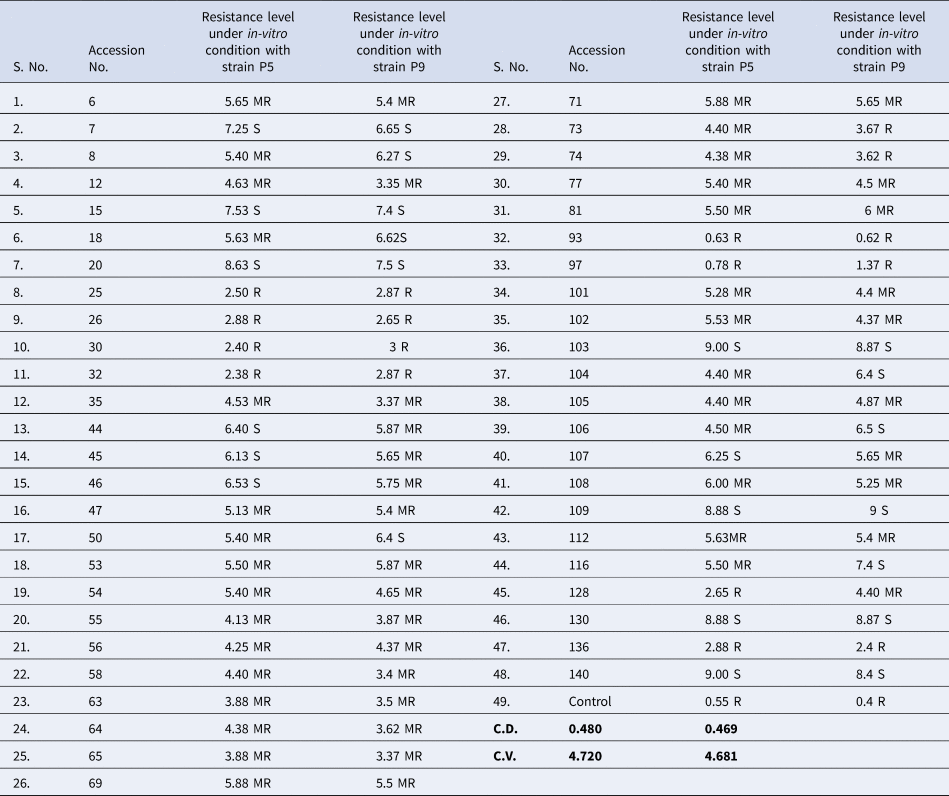
The pathogenicity test reveals a significant difference between both strains (P5 and P9). The mean disease severity of both the strains was 5.04 and 4.96, respectively. Out of 19 accessions which were found resistant in both the field trials, seven accessions were found resistant (GFB-25, GFB-26, GFB- 30, GFB-32, GFB-93, GFB-97 and GFB-136), one accession (GFB-128) was found resistant to strain P5 and moderately resistant to P9, two accessions (GFB-73 and GFB-74) were found moderately resistant to strain P5 and resistant to P9 while nine accessions (GFB-12, GFB-35, GFB-55, GFB-56, GFB-58, GFB-63, GFB-64, GFB-65 and GFB-102) were found moderately resistant after in-vitro screening by both the strains. Accessions GFB-08, GFB-18, GFB-104, GFB-50 and GFB-116 were found moderately resistant to strain P5, but they were susceptible to the strain P9. Similarly, GFB-44, GFB-45, GFB-46, GFB-69, GFB-107 and GFB-112 were found susceptible to strain P5 but to strain P9 they were moderately resistant. Seven accessions (GFB-07, GFB-71, GFB-81, GFB-112, GFB-116, GFB-130 and GFB-140) that were found moderately resistant in field trials were found susceptible after in-vitro screening by both the strains (online Supplementary Table S1, Table 2, Fig. 2). The coincidence per cent of disease reaction of accessions under screen house condition is 66.67%, which means 33.33% of accession changed their phenotypes from resistant to moderately resistant or susceptible, while 66.67% of accessions showed no change in disease reaction.
Disease score of resistant and moderately resistant accessions under in-vitro conditions

S, susceptible; MR, moderately resistant; R, resistant
Bold values are significant an p > 0.05.
On the basis of screen house trial, the K mean cluster was prepared which distributed the accessions into 10 groups (K = 10). Groups 8 and 10 included all the resistant accessions while groups 1, 3, 4, 6 and 9 consist of moderately resistant accessions and groups 2, 5 and 7 consist of all susceptible accessions (Table 3).
K-mean cluster analysis of French bean accessions for disease score produced by both strains (P5 and P9) under in-vitro conditions

SS, sum of square, 49 accessions were screened under in-vitro conditions.
Discussion
Six primers were used to screen the French bean accessions which identified four different ALS-resistant loci in accessions collected from Garhwal region of Uttarakhand. STS primer TGA1.1 detected locus Phg-1, SCAR primer SN02 detected locus Phg-2, three SCAR primers SAA19, SM02 and SBA16 detected locus Phg-3 and SSR primer Pv-at006 detected locus Phg-5. According to Sartorato et al. (Reference Sartorato, Nietsche, Barros and Moreira1999a), loci Phg-1 and Phg-5 are from Andean gene pool while Phg-2 and Phg-3 are from Mesoamerican gene pool of French bean. A preliminary indication of diversity of French bean accessions was observed in our study. We recorded that loci (Phg-1, Phg-5) were detected only in large seeded accessions (GFB-25, GFB-26, GFB-35, GFB-102, GFB-157 and GFB-163) of the Andean gene pool. Loci Phg-2 and Phg-3 were present in both Mesoamerican and Andean gene pools. However, more research is needed to describe the diversity of French bean accessions from Garhwal Himalayas.
The accessions GFB-30, GFB-32, GFB-97 and GFB-136 consist of only Phg-3 loci and were found resistant against both ALS strains (P5 and P9) after artificial inoculation. This indicated that the Phg-3 gene alone was effective in restoring resistance to ALS in some French bean accessions. Earlier it was reported that Phg-3 gene present in Ouro Negro was very important for French bean breeding programmes in Brazil which confer resistance to at least seven P. griseola races, including highly virulent race 63–63 (Marin et al., Reference Marin, Costa, Arruda, Barros and Moreira2003, Souza et al., Reference Souza, Dessaune, Sanglard, Moreira and de Barros2011; Gonçalves-Vidigal et al., Reference Gonçalves-Vidigal, Cruz, Lacanallo, Vidigal, Sousa and Pacheco2013). On the other hand, 14 accessions which were having Phg-3 gene were found moderately resistant and susceptible. The French bean accessions with single genes responsible for resistance to ALS will likely succumb to new virulent races of the ALS pathogen in the future because ALS has a virulent diversity. This has been reported several times that bean cultivars harbouring single genes for resistance to the rust and anthracnose pathogens were broken down (Kelly et al., Reference Kelly, Afanador and Cameron1994; del Rio et al., Reference del Rio, Lamppa, Gross, Brolley and Prischmann2003; Pastor-Corrales et al., Reference Pastor-Corrales, Rayapati, Osorno, Kelly, Wright and Brick2010; Prabha et al., Reference Prabha, Chamoli, Negi and Chauhan2021). Because of the intrinsic evolutionary changeability of P. griseola, gradually new strains of pathogen develop that overcome the resistance in bean varieties (Pedro et al., Reference Pedro, Merion, Liebenberg, Braun and Groenewald2006).
Phg-2 locus was present in many accessions but they did not show resistance in field as well as in screen house trials. This gene alone was not very effective for resistance against ALS in accessions from Garhwal, Uttarakhand. Our study was not in accordance with Sartorato et al. (Reference Sartorato, Nietsche, Barros and Moreira1999b), who reported that, the Phg-2 locus was effective in restoring resistance in Mesoamerican cultivar Mexico 54. Accessions GFB-25 and GFB-26 confirm the presence of Phg-1, Phg-2, Phg-3 and Phg-5 genes, which were effective for resistance against ALS in field as well as under in-vitro conditions. Caixeta et al. (Reference Caixeta, Borem, de Morais Silvia, Rocha, de Barros and Moreira2002) and Mahuku et al. (Reference Mahuku, Montoya, Henriquez, Jara, Teran and Beebe2004) also reported that the ALS-resistant genotype AND 227 has four ALS resistance genes (Phg-1a, Phg-22, Phg-32 and Phg-42), Mexico 54 has three (Phg-2, Phg-5 and Phg-6) and MAR-2 has two (Phg-4, Phg-5). The presence of a greater number of genes provides broad resistance in accessions.
Some accessions were moderately resistant to strain P5 but susceptible to strain P9 or vice-versa. Similar results were also reported by Sanglard et al. (Reference Sanglard, Ribeiro, Balbi, Arruda, De-Barros and Moreira2013), where they studied the resistant locus of Ouro Negro in relation to five other ALS-resistant sources (‘AND 277’, ‘BAT 332’, ‘Cornell 49-242’, ‘MAR-2’ and ‘Mexico 54’). They reported that Cornell 49-242 and AND 277 were resistant to 62.23 race of ALS, while susceptible to 63.39 race.
Some accessions which were found resistant in the field showed less resistance or susceptibility for ALS under screen house condition. GFB-55, GFB-58, GFB-63, GFB-64, GFB-65, GFB-74 and GFB-102 were resistant under field conditions while they were moderately resistant in polyhouse condition by both the strains. Accession GFB-45 was resistant in field condition but found moderately resistant towards strain P9 and susceptible to strain P5. Oblessuc et al. (Reference Oblessuc, Baroni, Garcia, Chioratto, Carbonell, Camargo and Benchimol2012) recorded the mapping of seven ALS-resistant QTLs that had variable magnitudes of phenotypic effects under different environments (wet season, dry season and greenhouse condition). They observed that there is high correlation in ALS disease severity in the greenhouse condition then dry and wet season. This accuracy of disease development was due to the maintenance of accurate amount of inoculum, proper humidity and temperature for the progress of disease under screen house condition. Our findings indicated the close association with Gulsum et al. (Reference Gulsum, Goksel, Mehmet, Vahdettin and Harun2021) who found the resistant source and reaction of French bean to anthracnose by two isolates (k9 and T2) in 40 French beans by molecular markers and by producing pathogen inoculum artificially in M3 medium. They recorded that out of 40 cultivars, three cultivars were resistant to k9 strain, but susceptible to T2 strain and vice versa. This in-vitro screening method is very advantageous because the screen house provides all the favourable conditions for the disease to grow out.
This information will broaden the advantage of marker-assisted breeding, identification of new resistant sources and gene information will help breeders to choose the useful gene in breeding for ALS resistance. This gene information can be used in breeding programmes to target the introgression of chromosomal segment especially associated with resistance genes, rather than emphasizing on only introgression of single disease resistance genes. ALS is one of the most devastating diseases of French bean which badly affects its production (up to 80%). Because of high virulence diversity of P. griseola pathotypes, there is high possibility of overcoming resistance; therefore, it is important to combine various effective genes (gene pyramiding) for durable resistance.
Conclusion
In this study, seven French bean accessions (GFB-25, GFB-26, GFB-30, GFB-32, GFB-93, GFB-97 and GFB-136) were found resistant against ALS. Accessions GFB-25 and GFB-26 have four (Phg-1, Phg2, Phg3 and Phg-5), GFB-30 and GFB-32 have two (Phg-2 and Phg-3) and GFB-93, GFB-97 and GFB-136 have one (Phg-3) resistant gene to restore resistance against ALS. GFB 25 and 26 are of Andean origin while the rest five are of Mesoamerican origin. Combining the genes of both origins, different varieties with durable resistance to ALS can be developed. Information generated by this study is helpful in acquiring knowledge about the resistance level of accessions against ALS from Garhwal region. The identification of agronomically superior and ALS-resistant accessions will be useful in the relocation of disease resistance genes in previously available high-yielding but susceptible varieties.
Supplementary material
The supplementary material for this article can be found at https://doi.org/10.1017/S1479262123000126.
Author contributions
All authors contributed to the study conception and design. Material preparation, data collection and analysis were performed by Dr Deepti Prabha and Dr Navneeti Chamoli. The first draft of the manuscript was written by Dr Navneeti Chamoli and Dr Deepti Prabha. All authors read and approved the final manuscript.
Financial support
The research got financial support from the Departmental funding from HNB Garhwal University, Srinagar, Uttarakhand.
Conflict of interest
The authors have no relevant financial or non-financial interests to disclose.
Ethical standards
This manuscript does not contain any studies with human participants or animals performed by any of the authors. The paper does not have any ethical consideration.