1. Introduction
The main concern of this paper is a  $\mathbb {\mathcal {C}}^{0}$-rigidity result for the area spectrum and Maslov class of Lagrangian submanifolds. It can be stated in the language of
 $\mathbb {\mathcal {C}}^{0}$-symplectic geometry. We recall the following definition due to Eliashberg and Gromov.
Definition 1.1 A symplectic homeomorphism  $h: (M, \omega ) \to (M', \omega ')$ is a homeomorphism which is a
 $\mathbb {\mathcal {C}}^{0}$-limit of symplectic diffeomorphisms.
The Eliashberg–Gromov  $\mathbb {\mathcal {C}}^{0}$-rigidity theorem shows that a smooth symplectic homeomorphism is a symplectic diffeomorphism. This definition raises the question of determining how close symplectic homeomorphisms are to their smooth cousins. In [Reference Buhovsky and OpshteinBO16] it was suggested to study this question from the perspective of the action of symplectic homeomorphisms on submanifolds.
Question 1 Let  $N\subset (M,\omega )$ be a submanifold and assume that its image by a symplectic homeomorphism is a smooth submanifold
 $N'\subset (M',\omega ')$. Is
 $N'$ symplectomorphic to
 $N$? Which classical symplectic invariants must coincide for
 $N$ and
 $N'$?
The question is far from having an easy and definitive answer, as demonstrated by the collection of results showing  $\mathbb {\mathcal {C}}^{0}$-rigidity (e.g. [Reference Laudenbach and SikoravLS94, Reference OpshteinOps09, Reference Humilière, Leclercq and SeyfaddiniHLS15, Reference Humilière, Leclercq and SeyfaddiniHLS16]) or, in contrast,
 $\mathbb {\mathcal {C}}^{0}$-flexibility (e.g. [Reference Buhovsky and OpshteinBO16, Reference Buhovsky, Humilière and SeyfaddiniBHS18]). In the large the picture suggested by these works is that
 $\mathbb {\mathcal {C}}^{0}$-rigidity prevails for coisotropic submanifolds (although several of their invariants have not yet undergone investigation), while it fails completely for most others. For instance, in [Reference Buhovsky and OpshteinBO16] a symplectic homeomorphism of
 $\mathbb {R}^{6}$ is constructed that maps an open symplectic disk to another smooth symplectic disk with half the symplectic area. On the other hand, from [Reference Laudenbach and SikoravLS94] we know that if
 $L\subset M$ is a closed Lagrangian submanifold and
 $h(L)$ is smooth for a symplectic homeomorphism
 $h$, then
 $h(L)$ is Lagrangian. Our main result is that in this situation the area spectrum and the Maslov class of
 $L$ and
 $h(L)$ coincide. More precisely, given a Lagrangian submanifold
 $L\subset (M,\omega )$, define its area homomorphism
 \[\begin{array}{rcccl} {\mathcal{A}_\omega^{L}} & : & {H_2(M,L)} & \longrightarrow & {\mathbb{R}} \\ & & {\sigma} & \longmapsto & {\int_\Sigma \omega,\ \text{where}\ [\Sigma]=\sigma,}\end{array}\]
and its Maslov index  $\mu _L:\pi _2(M,L)\to \mathbb {Z}$ (see § 4.1 for the definitions of Maslov indices).
Theorem 1. Let  $h: (M, \omega ) \to (M', \omega ')$ be a symplectic homeomorphism that sends a closed Lagrangian submanifold
 $L$ to a smooth (hence Lagrangian) submanifold
 $L'$. Then
(a)
 $\mathcal {A}_{\omega '}^{L'}=h_*\mathcal {A}_{\omega }^{L}$,
(b)
$\mu _{L'}=h_*\mu _L$.


It is not hard to see that Theorem 1(a) provides a positive answer to Question 1 for Lagrangian submanifolds, when the nearby Lagrangian conjecture holds for  $T^{*}L$ (see Proposition 4.2). This conjecture is known to hold in
 $T^{*}\mathbb {T}^{2}$ [Reference Dimitroglou Rizell, Goodman and IvriiDGI16], so symplectic homeomorphisms act on two-dimensional tori in the same way as symplectic diffeomorphisms do. For instance, a symplectic homeomorphism of
 $\mathbb {C}\mathbb {P}^{2}$ cannot take the Chekanov torus to the Clifford torus. The
 $\mathbb {\mathcal {C}}^{0}$-rigidity of the area homomorphism of Lagrangian tori has already been proved in [Reference Buhovsky and OpshteinBO16], but even follows from a theorem by Benci and Sikorav (see [Reference SikoravSik89]).
For the sake of completeness we briefly discuss an alternative approach to Theorem 1. This approach differs from the one proposed in this paper and relies on deep results by Abouzaid and Kragh on Lagrangian submanifolds in cotangent bundles [Reference AbouzaidAbo11, Reference KraghKra13], but thus far a complete proof has not been written explicitly in the literature. Given a closed manifold  $L$ endowed with a Riemannian metric
 $g$, we define
 $\ell _g^{\min }(\beta )$ to be the length of the minimizing geodesic in a class
 $\beta \in H_1(L;\mathbb {Z})$. In the cotangent bundle
 $\pi : T^{*}L \to L$ endowed with its standard symplectic structure
 $d\lambda =d(pdq)$ we also define
 \[ \mathcal{W}(L,g,r) := \{\Vert p\Vert_g < r\} := \{(q,p) \in T^{*}L \,|\, \Vert p\Vert_{g_q} < r\}\subset T^{*}L, \]
where  $\Vert \cdot \Vert _{g_q}$ is the natural dual norm on
 $T_q^{*}L$. Let
 $L'\subset \mathcal {W}(L,g,\varepsilon )$ be a Lagrangian submanifold whose projection to the zero section induces an isomorphism in the homology of degree
 $1$. In this context, Kragh and Abouzaid proved on the one hand in [Reference KraghKra13, Appendix E] that
 \begin{equation} \mu_{L'}(\beta')=0,\quad \forall\ \beta'\in H_1(L'), \end{equation}
and Abouzaid computed on the other hand the wrapped Floer homology of  $L'$ with a fiber of the cotangent bundle [Reference AbouzaidAbo11]. This computation allows for constructing a graph selector for
 $L'$ [Reference Amorim, Oh and Oliveira dos SantosAOO18], similar to the one obtained in [Reference Paternain, Polterovich and SiburgPPS03] via generating functions for those
 $L'$ which are Hamiltonian isotopic to the zero section. This graph selector can be used as in [Reference Paternain, Polterovich and SiburgPPS03] to show that
 \begin{equation} \lambda(\beta')\leq \varepsilon \ell^{\min}_g(\pi_*\beta'),\quad \forall\ \beta'\in H_1(L'). \end{equation}
By the Weinstein neighborhood theorem, these local results imply that if  $L,L'$ are two Lagrangian submanifolds of a symplectic manifold
 $M$ satisfying the assumptions of Theorem 1, the area homomorphisms of
 $L$ and
 $L'$ are
 $\varepsilon$-close and their Maslov classes coincide, which in turn implies Theorem 1. This approach puts the
 $\mathbb {\mathcal {C}}^{0}$-rigidity of these symplectic invariants in the framework of Abouzaid's work on wrapped Floer homology and Fukaya categories.
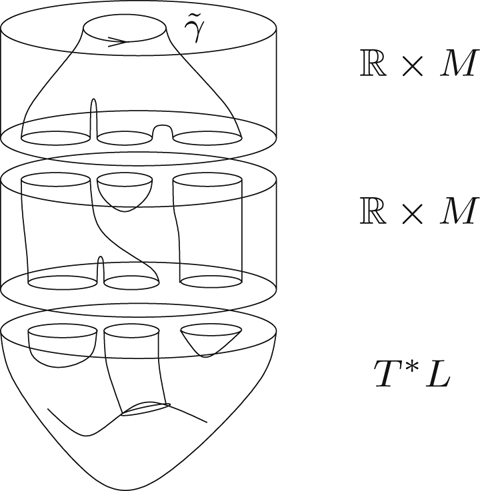
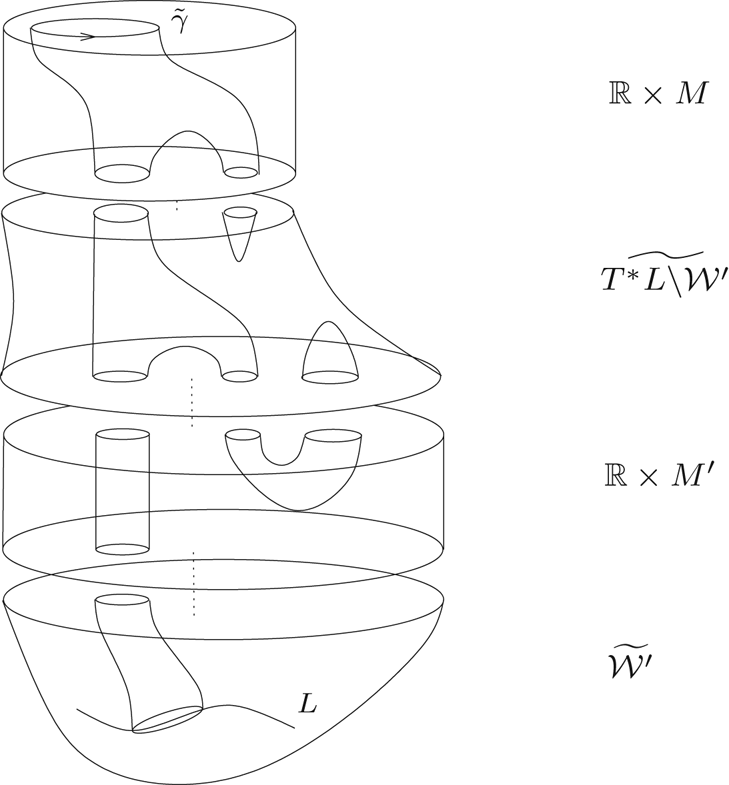
In the present paper we choose to explain another approach, which lies more within the classical framework of pseudoholomorphic techniques in symplectic geometry. The advantages are twofold. Apart from providing an easier and totally self-contained proof of Theorem 1, the technical tool on which it relies is a new existence result for certain punctured holomorphic curves in cotangent bundles, which proves very useful. The following result is the technical core of our paper.
Theorem 2. Let  $(L,g)$ be a closed Riemannian manifold and
 $\beta \in H_1(L;\mathbb {Z})$. Assume that
 $g$ is generic, in the sense that it has a unique minimizing geodesic
 $\gamma (\beta )$ in class
 $\beta$. Then, for every almost complex structure
 $J$ on
 $T^{*}L$ compatible with
 $d\lambda$ and
 $g$-cylindrical at infinity, there exists a
 $J$-holomorphic punctured disk
 $u:(D\backslash \{0\},\partial D)\to (T^{*}L, L)$ asymptotic to a lift of
 $\gamma (\beta )$ at
 $0$.
See the beginning of § 3, and in particular Definition 3.1, for a complete description of  $g$-cylindrical almost complex structures. This theorem has several applications. Some of them, for example, Theorem 1 or Theorem 5.2, can be obtained by arguments based on existing techniques such as wrapped Floer homology [Reference AbouzaidAbo11] or symplectic homology [Reference Abbondandolo and SchwarzAS06, Reference Salamon and WeberSW06], but Theorem 2 provides a unified way of looking at these results. For instance, we recover (1) and (2) under stronger assumptions, which turn out to be enough for the proof of Theorem 1.
Theorem 3. Let  $(L, g)$ and
 $(L', g')$ be two closed Riemannian manifolds and
 $\iota : L' \hookrightarrow (T^{*}L, d\lambda )$ a Lagrangian embedding such that
 $\pi _* \circ \iota _*: H_1(L',\mathbb {Z}) \to H_1(L,\mathbb {Z})$ is an isomorphism. Assume that
 $\iota$ extends to a symplectic embedding
 $\mathcal {I}$ of a neighborhood of
 $L'$ such that
 \[ L \subset \mathcal{I}(\mathcal{W}(L',g',\varepsilon')) \subset \mathcal{W}(L,g,\varepsilon) \subset T^{*}L \]
for some  $\varepsilon , \varepsilon ' > 0$. Then for all
 $\beta ' \in H_1(L';\mathbb {Z})$ we have
(a)
$|\iota ^{*}\lambda (\beta ')| \leq \varepsilon \ell _g^{\min }(\pi _*\circ \iota _* \beta ')$,(b)
$\mu _{\iota (L')}(\iota _*\beta ')=0$.


On the other hand, these holomorphic curves also have further applications, like the computation of some Poisson bracket invariants that can be used to bound the size of Weinstein neighborhoods of Lagrangian submanifolds. We briefly elaborate further on this application. In [Reference Entov, Ganor and MembrezEGM18], invariants of tuples  $(L,\pi ,M)$ were constructed, where
 $L$ is a Lagrangian torus of
 $M$ with a fibration
 $\pi :L\to S^{1}$. We generalize this invariant to arbitrary Lagrangian submanifolds, replacing
 $\pi$ by any cohomology class
 $a$ of degree
 $1$. We denote this invariant by
 $bp(L,a,M)$ (see § 5.2). Theorem 2 allows an exact computation of this invariant in cotangent bundles.
Theorem 4. Let  $(L,g)$ be a closed Riemannian manifold and
 $\mathcal {W}(L,g,r) := \{\Vert p \Vert _g < r\} \subset T^{*}L$. Let also
 $a \in H^{1}(L;\mathbb {Z})$ be a primitive class. Then we have
 \[ \text{bp}(L,a,\mathcal{W}(L,g,r)) = \frac{r}{\Vert a\Vert_\textrm{st}} = r \inf \bigg\{\frac{\ell_g(\gamma)}{a([\gamma])}\,\bigg|\, \gamma\in \mathbb{\mathcal{C}}^{1}(S^{1},L),\ a([\gamma]) > 0 \bigg\}. \]
The invariants  $bp(L,a,M)$ being monotone in
 $M$, the previous theorem allows us to bound the size of Weinstein neighborhoods of Lagrangian submanifolds. We illustrate this idea with the example of the Clifford torus in
 $\mathbb {C}\mathbb {P}^{2}$ (see § 5.2).
We wish to make a final remark in this introduction. The problem of  $\mathbb {\mathcal {C}}^{0}$-flexibility/rigidity of submanifolds was introduced in [Reference OpshteinOps09, Reference Humilière, Leclercq and SeyfaddiniHLS15, Reference Buhovsky and OpshteinBO16]. At least for the second author of the present paper, the formalization of these questions in the framework of
 $\mathbb {\mathcal {C}}^{0}$-symplectic geometry came with the hope of starting a study of a new type of geometry. Ideally, the
 $\mathbb {\mathcal {C}}^{0}$-rigid properties of
 $\mathbb {\mathcal {C}}^{0}$-rigid submanifolds (e.g. the coisotropic ones) would provide interesting invariants. For instance, the fact that the characteristic foliation of a hypersurface is
 $\mathbb {\mathcal {C}}^{0}$-rigid [Reference OpshteinOps09] led to conjecturing that topological hypersurfaces in a symplectic manifold are covered by ‘characteristic sets’, which would be invariant under symplectic homeomorphisms. In [Reference Humilière, Leclercq and SeyfaddiniHLS15], the concept of a
 $\mathbb {\mathcal {C}}^{0}$-Lagrangian submanifold was introduced: these are topological
 $n$-dimensional submanifolds of symplectic manifolds which can be locally straightened via symplectic homeomorphisms to
 $\mathbb {R}^{n}\subset \mathbb {C}^{n}$. In this perspective Theorem 1 raises the question whether
 $\mathbb {\mathcal {C}}^{0}$-Lagrangian submanifolds can be equipped with an area homomorphism invariant by
 $\mathbb {\mathcal {C}}^{0}$-symplectic homeomorphisms. This is not the case, however, starting from dimension
 $6$. Indeed, let
 $L := \partial D \times \partial D \times \partial D \subset \mathbb {C}^{3}$, where
 $D$ is the closed Euclidean disk of radius
 $1$ centered at
 $0$ in
 $\mathbb {C}$. Then
 $D' := D \times \{1\}\times \{1\}$ is a disk of area
 $\pi$ attached to this Lagrangian submanifold. By [Reference Buhovsky and OpshteinBO16] there exists a symplectic homeomorphism
 $h$ of
 $\mathbb {C}^{3}$ such that
 $h(D') = \frac 12 D' := D(0,\frac 12)\times \{1\}\times \{1\}$. Then
 $h(L)$ is a
 $\mathbb {\mathcal {C}}^{0}$-Lagrangian submanifold of
 $\mathbb {C}^{3}$, but the area of
 $h(D')$ does not coincide with the area of
 $D'$. Even worse, since the homeomorphism
 $h$ can have support localized in an arbitrary neighborhood of
 $D'$, the area of smooth disks with boundary on
 $h(L)$ does not depend only on the relative homology class of these disks.
Organization of the paper
In § 2 we present yet another short proof of Theorem 1 for Lagrangian tori based on holomorphic disks, which illustrates our motivation for establishing Theorem 2. Section 3 is the technical core of the paper and provides the proof of Theorem 2. Although this result might not be a surprise to experts in the field, we have not been able to find details in the literature and we give a detailed account here. The Fredholm theory for punctured holomorphic disks in symplectic cobordisms with boundary on a Lagrangian submanifold is provided in Appendix A for the sake of completeness. In § 4 we establish our main applications, Theorems 1 and 3. In § 5 we discuss further applications of Theorem 2, such as Theorem 4.
Notation
We work in the smooth category. Unless explicitly stated, all our manifolds and their structures are smooth. We adopt the following notation in this paper. It will be regularly recalled in the course of the paper. Let  $(L,g)$ be a closed Riemannian manifold.
•
$L \subset (T^{*}L, d\lambda )$ denotes the zero section of the cotangent bundle with its standard Liouville form $\lambda$, and $L$ is a Lagrangian submanifold.•
$T_r^{*}L = \mathcal {W}(L,g,r) := \{(q,p)\in T^{*}L\,|\, \Vert p\Vert _g< r\}$ and $\mathcal {W}_g := \mathcal {W}(L,g,1) = \{(q,p)\in T^{*}L\, |\, \Vert p\Vert _g < 1\}$ is the unit (co)disk bundle.•
$M := \partial \mathcal {W}_g$ is the contact boundary of $\mathcal {W}_g$ with the contact form $\alpha := \lambda _{|M}$.•
$\gamma : [0,\ell ] \to L$ is a geodesic with unit speed with respect to $g$ and $\ell _g(\gamma ) = \ell$ is the length of $\gamma$.•
$\ell _g^{\min }(\beta )$ is the minimal length of a closed connected curve in a class $\beta \in H_1(L;\mathbb {Z})$. We call a closed geodesic with this length a minimizing geodesic in class $\beta$.•
$\tilde \gamma : [0,\ell ] \to M$ is the lift of a unit-speed geodesic $\gamma$ to $M$ given by $\tilde \gamma (t) = (\gamma (t), g(\dot \gamma (t), \cdot ))$. Note that
\[ \int_{\tilde \gamma} \alpha = \ell_g(\gamma) = \ell. \]•
$D = \{ z \in \mathbb {C} \,|\, |z| \leq 1 \}$ is the closed unit disk and $\partial D = \{ z \in \mathbb {C} \,|\, |z| = 1 \}$. $D(z,R)$ denotes the closed disk of radius $R$ centered at $z$.•
$\mathrm {int}\,\Omega$ denotes the interior of a set $\Omega$.•
$\mathrm {Op}(X, Y)$ or $\mathrm {Op}(X)$ is an open neighborhood of $X \subset Y$.


2. A source of motivation for Theorem 2
This section is independent of the rest of the paper. It aims to explain at least one source of motivation for establishing Theorem 2 (existence of punctured holomorphic disks). We start the discussion with a proof of Theorem 1(a) for tori, which we think illustrates our purpose well. As explained in [Reference Buhovsky and OpshteinBO16, Lemma 5.1], it follows directly from the following theorem.
Theorem 2.1 For  $\varepsilon >0$ let
 $\iota :L\hookrightarrow (S^{1}\times (-\varepsilon ,\varepsilon ))^{n} \subset (T^{*}\mathbb {T}^{n}, d\lambda )$ be a Lagrangian embedding such that
 $\pi \circ \iota :L\to \mathbb {T}^{n}$ induces an isomorphism in homology. Let
 $e_j:=(\pi \circ \iota )^{*}([ 0_{\mathbb {T}^{j-1}} \times S^{1} \times 0_{\mathbb {T}^{n-j}}]) \in H_1(L)$,
 $j=1,\dots ,n$. Then
 \[ |\iota^{*}\lambda(e_j)| \leq \varepsilon. \]
Proof. We prove that  $|\iota ^{*}\lambda (e_1)|\leq \varepsilon$. Without loss of generality we can assume that
 $\iota ^{*}\lambda (e_1) \geq 0$ and
 $\varepsilon <1$. Put
 $\iota ^{*}\lambda (e_j) = \varepsilon \Delta _j$, with
 $\Delta _j \in \mathbb {R}$ and
 $\Delta _1 \in [0,\infty )$. Denote by
 $\lfloor \Delta _1\rfloor \in \mathbb {N}$ the integer part and by
 $\text {Frac}(\Delta _1):=\Delta _1-\lfloor \Delta _1\rfloor \in [0,1)$ the fractional part. Define
 \begin{align*} \kappa &:= 1 + \varepsilon \lfloor\Delta_1\rfloor, \\ a_1 &:= 1-\varepsilon\text{Frac}(\Delta_1) > 0, \\ a_j &:= N\kappa-\varepsilon\Delta_j, \end{align*}
with  $N$ chosen large enough such that
 $a_j > a_1 > 0$ and
 $a_j + \varepsilon \Delta _j \geq 2 \kappa$ for
 $j = 2, \ldots , n$. Consider now the standard symplectic embedding
 $\Phi : ((S^{1}\times (-\varepsilon ,\varepsilon ))^{n}, d\lambda ) \hookrightarrow (\mathbb {C}^{n},\omega _\textrm {st})$ with
 $\Phi (0_{\mathbb {T}^{n}}) = S^{1}(a_1) \times \dots \times S^{1}(a_n) \subset \mathbb {C}^{n}$ (
 $S^{1}(a)\subset \mathbb {C}$ being the circle that encloses a disk of area
 $a$). Then
 $\mathcal {W}:= \textrm {Im}\, \Phi = \{\bigcup S^{1}(t_1)\times \cdots \times S^{1}(t_n) \,|\, |t_i-a_i| < \varepsilon \}$. Obviously,
 \[ e_d(\mathcal{W})\leq a_1+\varepsilon\leq 1+\varepsilon, \]
and equality in the second inequality can hold only if  $a_1 = 1$, that is,
 $\Delta _1 \in \mathbb {N}$ (
 $e_d$ denotes the displacement energy in
 $(\mathbb {C}^{n},\omega _\textrm {st})$). On the other hand, the disks with boundaries on
 $\Phi \circ \iota (L)$ representing the classes
 $e_1, \ldots , e_n$ have symplectic areas
 $a_1+\varepsilon \Delta _1 = 1 + \varepsilon \lfloor \Delta _1\rfloor = \kappa$,
 $a_2 + \varepsilon \Delta _2 = N\kappa , \ldots , a_n + \varepsilon \Delta _n = N\kappa$. Since
 $\pi \circ \iota$ is an isomorphism in homology, we therefore see that every disk with boundary on
 $\Phi \circ \iota (L)$ and positive area has area equal to a multiple of
 $\kappa$. By a theorem of Chekanov [Reference ChekanovChe98], we infer that
 \[ 1 + \varepsilon \lfloor\Delta_1\rfloor =\kappa \leq e_d(\Phi\circ \iota (L)) \leq e_d(\mathcal{W}) \leq 1 + \varepsilon. \]
We conclude that  $\varepsilon \lfloor \Delta _1\rfloor \leq \varepsilon$, so
 $\Delta _1 \leq 1$, with equality only if
 $\Delta _1\in \mathbb {N}$. Thus
 $\iota ^{*}\lambda (e_1) \leq \varepsilon$. Applying the same procedure to the classes
 $e_2, \ldots , e_n$, we obtain the statement of the theorem.
What makes this proof easy (although it ultimately relies on a deep theorem by Chekanov [Reference ChekanovChe98]), is that we have a very large sample of Lagrangian embeddings of tori in  $\mathbb {C}^{n}$ with holomorphic disks of arbitrary relative areas, so that we can choose which is responsible for the displacement energy of the Lagrangian submanifold. This situation is unfortunately very specific to tori: there are very few examples of Lagrangian embeddings of a given manifold into a symplectic manifold, even without speaking of the freedom to choose the area of holomorphic disks with boundary on this submanifold. On the other hand, a manifold always embeds into its cotangent bundle as the zero section, which is Lagrangian. In this setting there are no symplectic disks with boundary on the zero section, but punctured holomorphic disks may replace the compact disks with a similar benefit.
3. Punctured holomorphic curves in cotangent bundles
Let  $L$ be a closed manifold and
 $(T^{*}L\overset {\pi }\to L,\lambda )$ be its cotangent bundle equipped with the Liouville form
 $\lambda =pdq$. The cotangent bundle is endowed with an
 $\mathbb {R}^{+}_*$-action given by
 $\tau \cdot (q,p):=(q,\tau p)$. Let
 $g$ be a Riemannian metric on
 $L$ and
 $\beta \in H_1(L{;\mathbb {Z}})$. If
 $g$ is generic,
 $\beta$ has exactly one connected representative of minimal length, hence a geodesic, whose arc-length parameterization is henceforth denoted by
 $\gamma (\beta )$ (or even
 $\gamma$ when there is no risk of confusion). For general
 $g$ there may be several connected minimal representatives, and
 $\gamma (\beta )$ is then one of them. We give a short proof of these claims. Let
 $\beta \in H_1(L)$. By a standard theorem (see, for example, [Reference ChavelCha06, Theorem IV.5.1]), every non-trivial free homotopy class in a compact Riemannian manifold has a minimal closed geodesic. Free homotopy classes are in a one-to-one correspondence with conjugacy classes of the fundamental group
 $\pi _1(L)$. Now since the Hurewicz homomorphism
 $\pi _1(L) \to H_1(L)$ is surjective and
 $H_1(L)$ is abelian, we get a well-defined surjective map from the set of conjugacy classes of
 $\pi _1(L)$ to
 $H_1(L)$. Thus there is at least one closed and connected geodesic representing the class
 $\beta$, but also possibly many whose lengths form a subset
 $\Lambda (\beta )$ of
 $\mathbb {R}^{+}$. Consider now a sequence of constant-speed geodesic loops
 $\gamma _n:S^{1}\to L$ representing
 $\beta$ whose lengths tend to the infimum of
 $\Lambda (\beta )$. By the Arzelà–Ascoli theorem a subsequence converges uniformly to a loop
 $\gamma :S^{1}\to L$, whose length equals
 $\inf \Lambda (\beta )$ by semi-continuity of the length functional in the uniform topology. This loop is then automatically a geodesic (else there would be a geodesic with even shorter length in the same free homotopy class by the theorem mentioned just above), with minimal length among the connected geodesic loops representing the class
 $\beta$. Note that, by [Reference AbrahamAbr70, Reference AnosovAno82], for generic Riemannian metrics the length spectrum is discrete and for any closed geodesic only its time-reversal has the same length. This proves that there is a unique connected minimal geodesic representing
 $\beta$ in the generic case.
The metric  $g$ induces an isomorphism
 $\sharp : TL \to T^{*}L, v \mapsto v^{\sharp } = g(v, \cdot )$, hence an inner product (still denoted
 $g$) and a norm
 $\Vert \cdot \Vert _g$ on the fibers of
 $T^{*}L$. We write for the unit disk bundle and its boundary
 \[ \mathcal{W}_g := \mathcal{W}(L,g,1) := \{(q,p) \,|\, q\in L,p\in T_q^{*}L, \Vert p\Vert_g < 1\}\quad \text{and}\quad M:=\partial \mathcal{W}_g. \]
Then  $\alpha :=\lambda _{|M}$ is a contact form on
 $M$, whose Reeb vector field is denoted by
 $R$. It is well known that
 $R$ generates the cogeodesic flow on
 $M$: its trajectories are the lifts
 $\tilde \gamma (t) := (\gamma (t),\dot \gamma (t)^{\sharp })$ of the unit-speed geodesics
 $\gamma$. Moreover,
 $(T^{*}L, d\lambda )$ is a symplectic cobordism with one positive end given by the identification
 \begin{equation} ([1, \infty) \times M,r\alpha) \overset \sim\longrightarrow (T^{*}L \backslash \mathcal{W}_g,\lambda),\quad (r,(q,p)) \longmapsto (q,rp). \end{equation}
Note that this map extends to  $((0, \infty ) \times M,r\alpha ) \simeq (T^{*}L \backslash L,\lambda )$. The function
 $r = \Vert p \Vert _g \in [0,\infty )$ is called the radial coordinate in
 $T^{*}L$. The image of the vector field
 $r (\partial /{\partial r})$ under this identification is Liouville.
An almost complex structure  $J$ on
 $T^{*}L$ is compatible with
 $\omega :=d\lambda$ if
 $\omega (\cdot ,J\cdot )$ is a positive-definite quadratic form. An almost complex structure
 $J$ on
 ${(0,\infty )}\times M$ is compatible with
 $\alpha$ if
 $J$ preserves
 $\ker \alpha _{| \{r\}\times M}$ and is compatible with
 $d\alpha =\omega$ on this subbundle, sends
 $r (\partial /{\partial r})$ to the Reeb vector field
 $R$ of
 $(\{r\}\times M,\alpha )$ and is invariant by the
 $\mathbb {R}^{+}_*$-action on
 $(0, \infty ) \times M$. Hence a metric
 $g$ on
 $L$ defines on
 $T^{*}L$ a fiberwise convex hypersurface
 $M$, which in turn determines a
 $1$-form
 $\alpha$, and in fine a class of almost complex structures on
 ${(0,\infty )} \times M\simeq T^{*}L\backslash L$, namely those which are compatible with
 $\alpha$. Let
 $\gamma$ be a closed geodesic with unit speed and length
 $\ell := \ell _g(\gamma )$ and let
 $\tilde \gamma$ be its lift to
 $M$. Then for any almost complex structure
 $J$ compatible with
 $\alpha$ it can be shown that
 \begin{equation} v_{\gamma, g}: \mathbb{R} \times \mathbb{R} / \ell \mathbb{Z} \longrightarrow (0, \infty) \times M,\quad (s, t) \longmapsto (e^{s}, \tilde{\gamma}(t)), \end{equation}
is  $J$-holomorphic for the complex structure
 $j \partial _s = \partial _t$ on
 $\mathbb {R} \times \mathbb {R} / \ell \mathbb {Z}$.
Definition 3.1 An almost complex structure  $J$ on
 $T^{*}L$ compatible with
 $d\lambda$ is cylindrical at infinity (with respect to
 $g$) if it is compatible with
 $\alpha$ outside a compact neighborhood of the zero section. We denote by
 $\mathcal {J}^{\infty }_{\textrm {Cyl},g}$ the set of all such almost complex structures, where the
 $\infty$ of the notation reminds us that these structures are constrained only near infinity. A
 $J$-holomorphic curve
 $u$ defined on
 $U\backslash \{z_0\}\subset \mathbb {C}$ (where
 $U$ is an open subset and
 $z_0\in U$) is said to be asymptotic to
 $\tilde \gamma$ at
 $z_0$ if there exists a biholomorphic identification of a punctured neighborhood of
 $z_0$ with
 $[0, \infty ) \times \mathbb {R} / \ell \mathbb {Z}$ that provides coordinates
 $(s,t)$ such that
 $d(u(s,t),v_{\gamma {,g}}(s,t))\underset {s\to \infty }{\longrightarrow } 0$. Here,
 $d$ stands for any distance which is
 $\mathbb {R}^{+}_*$-invariant on the cylindrical end.
The aim of this section is to prove the following result. We say that a metric  $g$ has discrete length spectrum in the class
 $\beta$ if the lengths of the geodesics representing this class form a discrete set.
Theorem 3.2 Let  $(L,g)$ be a closed Riemannian manifold,
 $\beta \in H_1(L;\mathbb {Z})$ be a homology class in which
 $g$ has discrete length spectrum and
 $\tilde \gamma (\beta )$ be the lift of a unit-speed connected geodesic of minimal length in class
 $\beta$. Then for all
 $J \in \mathcal {J}^{\infty }_{\textrm {Cyl},g}$ there exists a map
 $u_J : (D\backslash \{0\},\partial D) \to (T^{*}L,L)$ which solves the following problem:
 \begin{equation} \left\{\begin{array}{@{}l} du_J\circ j = J(u_J)\circ du_J, \\ {u_{J*}[\partial D]}= \beta, \\ u_J \text{ is asymptotic to $\tilde\gamma(\beta)$ at 0.} \end{array}\right.\end{equation}
In other words, the set  ${\widehat {\mathcal {M}}(J,\beta )}$ of solutions of
 $\mathcal {P}(J,\beta )$ is non-empty for all
 $J \in \mathcal {J}^{\infty }_{\textrm {Cyl},g}$.
Remarks 3.3
(i)
$S^{1}$ acts on $\widehat {\mathcal {M}}(J,\beta )$ by holomorphic source reparameterizations (of $D\backslash \{0\}$). We denote in the sequel $\mathcal {M}(J,\beta ):=\widehat {\mathcal {M}}(J,\beta )_{/S^{1}}$, the space of unparameterized solutions of $\mathcal {P}(J,\beta )$.(ii) As already mentioned, when a metric has several minimizing geodesics in the class
$\beta$, $\gamma (\beta )$ stands for some minimizing geodesic.(iii) If the length spectrum is not discrete, the proof of Theorem 3.2 will provide for all
$\varepsilon >0$ a map $u_{J,\varepsilon }$ asymptotic to a lift of a geodesic in the class $\beta$ of length at most $\ell _g(\gamma (\beta ))+\varepsilon$.(iv) Theorem 3.2 also holds in homotopy. Namely, if
$\beta$ is a free homotopy class, and $g$ satisfies the assumptions of the theorem, then for all $J \in \mathcal {J}^{\infty }_{\textrm {Cyl},g}$ there exists a punctured $J$-holomorphic disk asymptotic at the puncture to the minimal geodesic in the class $\beta$.


The scheme of proof of Theorem 3.2 is mostly standard and we explain it in the present section, under the assumption that  $\gamma (\beta )$ is a primitive geodesic, that is, not a multiple-cover. Let
 $g$ be a metric with discrete length spectrum in the class
 $\beta$, and assume that
 $\gamma (\beta )$ is primitive. We first define an almost complex structure
 $J_h \in \mathcal {J}^{\infty }_{\textrm {Cyl},h}$ for an arbitrary metric
 $h$ on
 $L$ (§ 3.1) which has a unique
 $J_{h}$-holomorphic punctured disk
 $u_{\gamma , h} \in \widehat {\mathcal {M}}(J_h,\beta )$ modulo reparameterization (§ 3.2). We also prove that all elements of
 $\mathcal {M}(J,\beta )$ for
 $J\in \mathcal {J}_{\textrm {Cyl},h}^{\infty }$ are somewhere injective (§ 3.5). For a suitable perturbation
 $g_\varepsilon$ of our metric
 $g$ we prove the surjectivity of the linearization of the
 $\bar \partial _{J_{g_\varepsilon }}$-operator at
 $u_{\gamma ,g_\varepsilon }$ (§§ 3.3 and 3.4). In § 3.6 we show compactness: if a sequence of almost complex structures
 $J_n \in \mathcal {J}_{\textrm {Cyl},g_\varepsilon }^{\infty }$ coincide with
 $J_{g_\varepsilon }$ outside a compact set and converge to
 $J\in \mathcal {J}_{\textrm {Cyl},g_\varepsilon }^{\infty }$ in the
 $\mathbb {\mathcal {C}}^{\infty }$-topology, then a sequence
 $u_n$ of solutions of
 $\mathcal {P}(J_n,\beta )$ has a subsequence that converges to a solution of
 $\mathcal {P}(J,\beta )$. Classical arguments then show that if
 $\{J_t\}_{t\in [0,1]}$ is a smooth generic path of almost complex structures from
 $J_{g_\varepsilon }$ to a generic
 $J_n \in \mathcal {J}_{\textrm {Cyl}, g_\varepsilon }^{\infty }$ that coincide with
 $J_{g_\varepsilon }$ outside a compact set, the set
 $\bigcup \{t\}\times \mathcal {M}(J_t,\beta )$ is a one-dimensional compact cobordism between the point
 $\{0\}\times \mathcal {M}(J_{g_\varepsilon },\beta )$ and
 $\{1\}\times \mathcal {M}(J_n,\beta )$, hence the latter space is non-empty. Applying again compactness to a generic sequence
 $J_n$ of approximations of
 $J$ that coincide with
 $J_{g_\varepsilon }$ outside a compact set, we find a solution of
 $\mathcal {P}(J,\beta )$ for all
 $J\in \mathcal {J}^{\infty }_{\textrm {Cyl}, g_\varepsilon }$ that coincide with
 $J_{g_\varepsilon }$ at infinity. We finally use a symplectic field theory (SFT) compactness argument to obtain the theorem for the metric
 $g$ itself (§ 3.7).
3.1 A particular almost complex structure
Let  $g$ be an arbitrary Riemannian metric on
 $L$. In this subsection we describe a particular almost complex structure on
 $T^{*}L$ that is determined by the metric
 $g$.
The Levi-Civita connection  $\nabla$ of
 $g$ induces a natural connection
 $\nabla ^{*}$ on
 $T^{*}L$ by the identity
 \[ d(\sigma(X)) = \nabla^{*}\sigma(X) + \sigma(\nabla X) \]
for any 1-form  $\sigma$ and vector field
 $X$ on
 $L$. This connection provides a splitting
 $T(T^{*}L)=H\oplus F$, where
 $H$ is the horizontal distribution of
 $\nabla ^{*}$ and
 $F$ is the distribution of the tangent spaces to the fibers. Note that we have a canonical identification
 $F_{(q,p)}\simeq T^{*}_qL$. We call
 $\pi :T^{*}L\to L$ the natural projection and, by abuse of notation,
 $\pi :H_{(q,p)} \to T_qL$ the isomorphism
 $d\pi _{|H}$, at least when there is no risk of confusion. In order to define our almost complex structure we first need to explain some relations between the Riemannian geometry on
 $L$ and the contact structure on
 $M$. Recall that
 $R$ denotes the Reeb vector field on
 $M$, hence defines a vector field on
 $(0,\infty )\times M$, independent of the first coordinate. We also see it as a vector field on
 $T^{*}L\backslash L\simeq (0,\infty )\times M$ via the isomorphism that extends (3). Notice then that
 $R$ is
 $\mathbb {R}_*^{+}$-invariant on
 $T^{*}L\backslash L$. The vector field
 $r (\partial /{\partial r})=p$ is the infinitesimal generator of the
 $\mathbb {R}^{+}_*$-action on
 $T^{*}L\backslash L$. Also notice that
 $g$ induces an inner product on
 $T_q^{*}L$, still denoted
 $g$, by
 $g_q(u^{\sharp },v^{\sharp }) := g_q(u,v)$ for
 $u, v \in T_qL$. By definition
 $M=\{ (q,p) \,|\, g_q(p,p) = 1 \}$.
Lemma 3.4 On  $T^{*}L\backslash L \simeq (0, \infty )\times M$ we have the following assertions.
(i)
$R(q,p)\in H_{(q,p)}$ and $g_q(\pi (R(q,p)),\cdot )= p/{\Vert p \Vert _g} = \partial /{\partial r}$ (in other terms, $\pi (R)^{\sharp }= \partial /{\partial r}$).(ii)
$H$ is a subspace of $T(\{r\}\times M)$ for every $r \in {(0,\infty )}$ and is Lagrangian with respect to $d\lambda$.(iii) The map
$\sharp \circ \pi$ is an isomorphism between $\ker \alpha \cap H_{(q,p)}$ and $\ker \alpha \cap F_{(q,p)}$. Moreover,
\begin{align*} \ker \alpha\cap H_{(q,p)} &= \{V\in H_{(q,p)}\,|\, p(\pi(V))=0\},\\ \ker \alpha\cap F_{(q,p)} &= \{V\in F_{(q,p)}\,|\, g_q(V,p)=0\}. \end{align*}(iv)
$\ker \alpha =(\ker \alpha \cap H_{(q,p)})\oplus (\ker \alpha \cap F_{(q,p)})$.


Proof. (i) Let us recall that  $R(p,q)$ generates the cogeodesic flow of speed
 $1$ on
 $\{1\}\times M$, and is extended to
 $T^{*}L\backslash L$ by
 $\mathbb {R}^{+}_*$-invariance. So
 $R(q,p)$ is horizontal in
 $\{1\}\times M$, and since the horizontal distribution is also
 $\mathbb {R}^{+}_*$-invariant,
 $R(q,p)\in H_{(q,p)}$ for all
 $(q,p)\in T^{*}L$. Moreover, the
 $\mathbb {R}^{+}_*$-action is trivial in
 $q$ (meaning that
 $\pi (\tau \cdot (q,p))=q$), so
 \[ \pi(R(q,p))=\pi \bigg(R\bigg(q,\frac p{\|p\|}\bigg)\bigg)=\bigg(\frac {p}{\|p\|}\bigg)^{\sharp}. \]
It follows that  $\pi (R)^{\sharp }= p/{\|p\|}= \partial /{\partial r}$.
(ii)  $H\subset T(\{r\}\times M)$ because parallel transport preserves the metric. It is also Lagrangian since the Levi-Civita connection has no torsion [Reference Grigor'yantsGri98].
(iii) The fact that  $\ker \alpha \cap H_{(q,p)} = \{V\in H_{(q,p)}\, |\, p(\pi (V))=0\}$ and
 $\ker \alpha \cap F_{(q,p)} = F_{(q,p)} \cap$
 $T_{(q,p)}M=\{V\in F_{(q,p)}\,|\, g_q(V,p) =0\}$ are immediate by definition. Now let
 $V \in \ker \alpha \cap H_{(q,p)}$. Since
 $\sharp$ is an isometry by definition of
 $g_q$ on
 $T_q^{*}L$ and
 $p(\pi (V))=0$, we have the chain of equalities
 \[ g_q(\pi(V)^{\sharp},p) = \Vert p\Vert_g \,g_q(\pi(V)^{\sharp},\pi(R)^{\sharp}) = \Vert p\Vert_g \,g_q(\pi(V),\pi(R)) = p(\pi(V)) = 0, \]
which means that  $\pi (V)^{\sharp }\in \ker \alpha \cap F_{(q,p)}$. By dimension considerations we see that
 $\sharp \circ \pi$ is indeed an isomorphism.
(iv) This is obvious by dimension considerations, since by (3), we have  $\dim \ker \alpha \cap F_{(q,p)}=n-1=\dim \ker \alpha \cap H_{(q,p)}$.
We now choose a smooth non-decreasing function  $\chi : (0,\infty ) \to [1,\infty )$ with
 $\chi (r)= 1$ near
 $0$ and
 $\chi (r)= r$ near
 $\infty$. Lemma 3.4 implies that
 \[ T_{(q,p)}T^{*}L =\bigg\langle \frac\partial{\partial r}, R(q,p)\bigg\rangle \oplus \ker \alpha\cap H_{(q,p)}\oplus \ker \alpha\cap F_{(q,p)} \quad \forall\ q\in L, p\neq 0. \]
We define the almost complex structure  $J_g$ on
 $T^{*}L\backslash L$ by
 \[ \left\{\begin{array}{@{}l} \displaystyle J_g(R)={-}\chi(r)\dfrac\partial {\partial r}\\ \begin{array}{lccc} J_g: & \ker \alpha\cap H_{(q,p)} & \longrightarrow & \ker \alpha\cap F_{(q,p)}\\ & V & \longmapsto & -g_q(\pi(V),\cdot), \end{array}\\ J_g^{2}={-}\textrm{Id}\,. \end{array}\right.\]
By Lemma 3.4,  $J_g$ indeed exchanges
 $\ker \alpha \cap H_{(q,p)}$ and
 $\ker \alpha \cap F_{(q,p)}$: if
 $V \in \ker \alpha \cap H_{(q,p)}$,
 \[{-}g_q(J_gV,p) = g_q(\pi(V)^{\sharp},p)= \Vert p\Vert_g\, g_q(\pi(V)^{\sharp},\pi(R)^{\sharp}) = \Vert p\Vert_g\, g_q(\pi(V),\pi(R)) = p(\pi(V))=0. \]
Since  $\chi =1$ near
 $0$, the first point of Lemma 3.4 shows that
 $J_g$ has the following alternative definition near the zero section: for
 $V\in H$,
 $J_gV=-g(\pi (V),\cdot )\in F$. This obviously shows that
 $J_g$ extends smoothly to the zero section, because
 $H_{(q,p)}$ varies smoothly with
 $(q,p)$ and equals
 $T_qL$ when
 $p=0$. On the zero section we have a canonical isomorphism
 $T(T^{*}L)_{|L} \simeq TL \oplus T^{*}L$ and
 $J_g=-\sharp$.
Lemma 3.5  $J_g\in \mathcal {J}_{\textrm {Cyl},g}^{\infty }$.
Proof. By definition,  $J_gR(q,p)=-r (\partial /{\partial r})$ when
 $\Vert p\Vert _g\gg 1$ and
 $J_g$ preserves
 $\ker \alpha$. Since
 $H_{(q,p)}$ is Lagrangian, showing that
 $J_{g|\ker \alpha }(q,p)$ is compatible with
 $d\lambda (q,p)$ amounts to proving that
 $d\lambda (V,J_g V) > 0$ for
 $V \in \ker \alpha \cap H_{(q,p)}$. Moreover, since
 $d\lambda$ is invariant by the lifts of diffeomorphisms of
 $L$ to
 $T^{*}L$, a straightforward computation shows that we can assume
 $g_{q}=\sum dq_i^{2}$. Then, for
 $V\in \ker \alpha \cap H_{(q,p)}$,
 \begin{align*} d\lambda(V,J_gV) &= \sum dp_i\wedge dq_i (V,J_gV)\\ &={-}\sum dp_i(J_gV)dq_i(\pi(V))& \text{(because $J_gV \in F_{(q,p)}$, so $dq_i(J_gV)=0$)}\\ &=\sum dp_i(g(\pi(V),\cdot))dq_i(\pi(V))\\ &=\sum dq_i(\pi(V))^{2}>0 & \text{(because $g_q=\sum dq_i^{2}$).} \end{align*}
Finally, to show that  $J_g$ is dilation invariant at infinity, it is enough to work on
 $\ker \alpha \cap H$ (because
 $H=(\ker \alpha \cap H)\oplus \langle R \rangle$). If
 $V\in \ker \alpha \cap H$, then
 $J_gV\in F\cap TM$, so the dilations on
 $(0,\infty )\times M$ act by the identity on both
 $V$ and
 $J_gV$.
We will also need the following properties of the almost complex structure  $J_g$.
Proposition 3.6 The automorphism of  $T^{*}L$ defined by
 $\sigma (q,p):=(q,-p)$ is
 $J_g$-antiholomorphic. Moreover, the sub-levels
 $\{\|p\|_g\leq r\}$ are
 $J_g$-pseudoconvex domains for
 $r>0$.
Proof. We consider canonical coordinates  $(q,p) \in T^{*}L$ determined by a local choice of coordinates
 $q = (q_1, \ldots , q_n)$ on
 $L$. One can show that the horizontal distribution
 $H_{(q,p)}$ of the connection
 $\nabla ^{*}$ is spanned by the vectors
 \begin{equation} \frac{\partial}{\partial q_i}^{H} = \frac{\partial}{\partial q_i} + \sum_{k,l} \Gamma^{k}_{il}(q) p_k \frac{\partial}{\partial p_l}, \quad i = 1, \ldots, n, \end{equation}
where  $\Gamma ^{k}_{il}$ are the Christoffel symbols of the metric
 $g$. Since
 $d\sigma ({\partial }/{\partial p_l}) = -({\partial }/{\partial p_l})$, we see that
 $\sigma$ preserves the lifts
 $ ({\partial }/{\partial q_i})^{H}$ and hence the horizontal distribution. A brief calculation then reveals that
 $\sigma$ is
 $J_g$-antiholomorphic.
In  $T^{*}L \backslash L$ one easily sees that
 $J_g$ preserves the contact distribution
 $\ker \alpha$ and is compatible with
 $d\alpha$, hence the sets
 $\{\|p\|_g\leq r\}$ are
 $J_g$-pseudoconvex for
 $r > 0$.
3.2 Computation of $\mathcal {M}(J_g,\beta )$

The almost complex structure  $J_g$ sends
 $R$ to a multiple of the radial vector field
 $ {\partial }/{\partial r}$, hence for any closed unit-speed geodesic
 $\gamma : \mathbb {R} / \ell \mathbb {Z} \to L$ the image of the map
 $v_{\gamma ,g}$ of (4) is
 $J_g$-holomorphic (its tangent planes are
 $J_g$-invariant). We now need a holomorphic parameterization of this set. Recall that
 \[ J_g R ={-}\chi(r)\frac\partial{\partial r}, \]
where  $\chi$ is an increasing, weakly convex function with
 $\chi (r)=1$ for
 $r$ close to
 $0$ and
 $\chi (r)=r$ outside a compact set. Then
 \[ G(u):=\int_{0}^{u}\frac{dr}{\chi(r)} \]
is a well-defined strictly increasing function  $G: [0,\infty ) \to [0, \infty )$ with
 $G(0)=0$. Its inverse defines a function
 $G^{-1}: [0,\infty ) \to [0, \infty )$ that satisfies the differential equation
 $h'=\chi \circ h$. A straightforward computation shows that
 \begin{equation} u_{\gamma,g}: (0, \infty)\times \mathbb{R} / \ell \mathbb{Z} \longrightarrow (0, \infty)\times M,\quad (s,t) \longmapsto (G^{{-}1}(s), \tilde\gamma(t)) \end{equation}
is a  $J_g$-holomorphic parameterization of
 $\textrm {Im}\, {v_{\gamma ,g}}$. One can see that this map extends as a map from the half-cylinder
 $[0, \infty )\times \mathbb {R} / \ell \mathbb {Z}$ to
 $T^{*}L$, which we also call
 $u_{\gamma ,g}$. The half-cylinder
 $([0, \infty )\times \mathbb {R} / \ell \mathbb {Z}, j)$ is conformally equivalent to the closed punctured disk
 $(D\backslash \{0\}, i)$ via the map
 $(s,t) \mapsto \exp (-2\pi (s+it)/ \ell )$. In general we will use the half-cylinder and closed punctured disk interchangeably. Hence we can consider
 $u_{\gamma ,g}: (D\backslash \{0\}, \partial D) \to (T^{*}L, L)$. It is asymptotic to
 $\tilde \gamma$ at the puncture and we have
 $u_{\gamma ,g}(e^{-2\pi i t / \ell }) = \gamma (t) \subset L \subset T^{*}L$. In other words,
 $u_{\gamma ,g}\in \widehat {\mathcal {M}}(J_g,\beta )$. The aim of this subsection is to prove that
 $\mathcal {M}(J_g,\beta )$ consists of the unique element
 $\{[u_{\gamma ,g}]\}$. We require some preliminary lemmas.
Lemma 3.7 Let  $u:(D\backslash \{0\},\partial D)\to (T^{*}L,L)$ be a
 $J_g$-holomorphic map asymptotic to
 $\tilde \gamma$ at
 $0$. Then
(i)
$u$ is smooth up to $\partial D$,(ii)
$\textrm {Crit} (u)$ is a finite set of $D\backslash \{0\}$,(iii)
$u^{-1}(L)\cap \mathrm {int}\,D\backslash \{0\}$ is countable and can only accumulate at critical points of $u$.


Proof. Point (i) is a general and classical fact that relies on the ellipticity of the  $\bar \partial _{J_g}$-operator on the space of curves with boundary on totally real submanifolds (see also [Reference Ivashkovich and SukhovIS10]). Points (ii) and (iii) are specific to our situation. They rely on the special form of
 $J_g$ that makes the involution
 $\sigma (q,p):=(q,-p)$ anti-holomorphic; see Proposition 3.6.
Let  $u:(D\backslash \{0\},\partial D)\to (T^{*}L,L)$ be a
 $J_g$-holomorphic map asymptotic to
 $\tilde \gamma$ at
 $0$. The map
 $v:\mathbb {C}\backslash \mathrm {int}\,D \to T^{*}L$ defined by
 $v(z):=\sigma \circ u( 1/{\bar z})$ is
 $J_g$-holomorphic and coincides with
 $u$ on
 $\partial D$ (because
 $u(\partial D)\subset L=\text {Fix}\, (\sigma )$). Thus, the map
 \[\begin{array}{rcccl} {w} & : & {\mathbb{C}\backslash\{0\}} & \longrightarrow & {T^{*}L} \\ & & {z} & \longmapsto & {\left\{\begin{array}{@{}l} u(z)\ \text{if}\ z\in D\backslash\{0\} \\ v(z)\ \text{if}\ z \in \mathbb{C}\backslash D \end{array}\right.}\end{array}\]
is holomorphic on  $\mathbb {C}\backslash \partial D$, continuous on
 $\partial D$, and since
 $u$ and
 $v$ are smooth up to
 $\partial D$,
 $w$ is
 $J_g$-holomorphic on
 $\partial D$ as well. Thus,
 $w: \mathbb {C}\backslash \{0\}\to T^{*}L$ is
 $J_g$-holomorphic. Since
 $w$ is asymptotic to
 $\tilde \gamma$ at
 $0$, it has no critical points near
 $0$ and [Reference McDuff and SalamonMS12, Lemma 2.4.1] guarantees that
 $w$ has only finitely many critical points in
 $D \backslash \{0\}$, where it coincides with
 $u$. This proves (ii).
We prove (iii) by contradiction. First assume there exists a sequence  $z_n\in \mathrm {int}\, D\backslash \{0\}$ that converges to a point
 $z \in \mathrm {int}\, D\backslash \{0\}$ which is not a critical point of
 $u$, and such that
 $u(z_n) \in L$ for all
 $n$ (hence
 $u(z) \in L$). We define
 \[ \Omega:=\{\xi\in \mathrm{int}\,D\backslash\{0\} \,|\, \exists\,\xi'\in \mathbb{C} \backslash D : u(\xi)=v(\xi')\}. \]
In particular,  $\Omega \supset u^{-1}(L)\cap \mathrm {int}\,D\backslash \{0\} \ni z_n$. By [Reference McDuff and SalamonMS12, Lemma 2.4.3],
 $\Omega$ contains a neighborhood of each of its accumulation points in
 $\mathrm {int}\,D\backslash \{0\}$ that are not critical points of
 $u$. It therefore contains a neighborhood of
 $z$ by assumption. Notice that the asymptotic behavior of
 $u$ at
 $0$ implies that
 $\Omega$ does not meet some neighborhood of the puncture
 $0$. Now let
 $c:[0,1]\to D$ be a continuous curve between
 $c(0)=z$ and
 $c(1)=0$ that avoids the (finitely many) critical points of
 $u$. Let
 ${t_*} :=\sup \{t\,|\, c([0,t])\subset \Omega \}$. Since
 $z\in {\mathrm {int}\,\Omega }$ and
 $c(\textrm {Op}\,(1))\cap \Omega = \emptyset$, we have
 $0<{t_*}<1$. Now let
 $t_n < {t_*}$ be any sequence that converges to
 $t_*$. By assumption
 $c(t_n)\in \Omega$, so there exists
 $\xi _n'\in {\mathbb {C} \backslash D}$ such that
 $v(\xi _n')=u(c(t_n))$. Obviously
 $\xi _n'$ cannot accumulate at
 $\infty$ because
 $v(\xi _n') = u(c(t_n))\to u(c(t_*))\in T^{*}L$. Nor can it accumulate at a point
 $\xi '\in {\mathbb {C} \backslash D}$ because then, by [Reference McDuff and SalamonMS12, Lemma 2.4.3],
 $c(t_*)$ would be an accumulation point of
 $\Omega$, so would be contained in
 ${\mathrm {int}\,\Omega }$. Thus
 $c(t)$ would belong to
 $\Omega$ for
 $t<{t_*}+\varepsilon$,
 $\varepsilon >0$, which contradicts our definition of
 ${t_*}$. We therefore conclude that, after extraction,
 $\xi _n'\to \xi '\in \partial {D}$, so
 $u(c(t_*))=\lim u(c(t_n)) =\lim v(\xi _n')=v(\xi ')\in v(\partial D)\subset L$. This shows that any curve that joins
 $z$ to
 $0$ in
 ${D} \backslash \textrm {Crit} (u)$ intersects
 $u^{-1}(L)$. Since
 $\textrm {Crit}(u)$ is finite, we conclude that the connected component
 $U$ of
 $z$ in
 ${D}\backslash u^{-1}(L)$ does not contain
 $0$. Thus
 $u_{|U}:(U,\partial U)\to (T^{*}L,L)$ is
 $J_g$-holomorphic. If
 $\partial U$ is smooth, we can conclude by Stokes’ theorem. In general, we can invoke the pseudoconvexity of the hypersurfaces
 $\{\|p\|_g=r\}$ for
 $r > 0$ (see Proposition 3.6) to conclude that
 $u_{|U}$ takes values in
 $L$. Since
 $U$ is open and
 $L$ is totally real, we conclude that
 $u_{|U}$ is constant, which implies that
 $u$ is constant. But this contradicts the fact that
 $u$ is asymptotic to
 $\tilde \gamma$ at
 $0$.
This contradiction shows that  $u^{-1}(L)$ can only accumulate at
 $\textrm {Crit}(u)\cup \partial {D}$. On the other hand, since
 $L$ is totally real, any non-critical point of
 $u$ in
 $\partial {D}$ is a point where the intersection of
 $u$ with
 $L$ is clean. These points cannot therefore be accumulated by points of
 $u^{-1}(L)\cap {\mathrm {int}\, D\backslash \{0\}}$. This completes the proof of (iii).
In the next lemma,  ${D}^{+} := {D}\cap \{\textrm {Im}\, z\geq 0\}$. Recall that
 $\alpha$ is the
 $1$-form obtained by
 ${\alpha } := \lambda _{|M}$ on
 $M$ and is extended by invariance under the
 ${\mathbb {R}_*^{+}}$-action on
 $T^{*}L\backslash L$. It is not defined on
 $L$.
Lemma 3.8 Let  $u:(D^{+},[-1,1])\to (T^{*}L,L)$ be a
 $J_g$-holomorphic map. Assume that
 $\varepsilon _n\to 0$ verifies
 $u(D^{+}\cap \{\textrm {Im}\, z=\varepsilon _n\})\cap L=\emptyset$. Then
 \begin{equation} \lim_{n\to \infty} \int_{D^{+}\cap \{\textrm{Im}\, z=\varepsilon_n\}}u^{*}\alpha={-}\ell_g(u_{|[{-}1,1]}), \end{equation}
where  $D^{+}\cap \{\textrm {Im}\, z=\varepsilon _n\}$ is oriented from left to right.
Notice that both sides of equality (7) are well defined. The assumption guarantees that  $u^{*}\alpha$ is well defined on
 $D^{+}\cap \{\textrm {Im}\, z=\varepsilon _n\}$. Moreover, by ellipticity of
 $\bar \partial _{J_g}$,
 $u$ is smooth up to
 $[-1,1]$, so
 $u([-1,1])$ has finite length.
Proof. Since both sides of the equality (7) are additive with respect to a partition of  $\textrm {Op}\,([-1,1],D^{+})$, we can freely assume that
 $u$ takes values in a small chart of
 $T^{*}L$ localized on
 $L$, which amounts to assuming that
 $L=\mathbb {R}^{n}$. Let
 $\gamma :=u_{|[-1,1]}$ and
 $\gamma _\varepsilon :=u_{|D^{+}\cap \{\textrm {Im}\, z=\varepsilon \}}$. Taking into account that for the coordinates
 $x + iy \in D^{+}$,
 \[ \partial_y u(t,0) = J_g \partial_x u(t,0) = J_g \dot \gamma (t) ={-}g_{\gamma(t)}(\dot \gamma(t),\cdot)\in T^{*}_{\gamma(t)}\mathbb{R}^{n}, \]
we have
 \begin{align*} & \dot \gamma_\varepsilon(t)=\dot \gamma (t)+O(\varepsilon),\\ & \gamma_\varepsilon(t)=(\gamma(t),-\varepsilon g_{\gamma(t)}(\dot \gamma(t),\cdot))+O(\varepsilon^{2}). \end{align*}
Thus  $p(\gamma _\varepsilon (t)):= p_{\gamma _\varepsilon (t)} = -\varepsilon g_{\gamma (t)}(\dot \gamma (t),\cdot )+O(\varepsilon ^{2})$ and
 $\|p(\gamma _\varepsilon (t))\|_g=\varepsilon \|\dot \gamma (t)\|_g+O(\varepsilon ^{2})$. If
 $\dot \gamma (t)\neq 0$, this implies
 \[ \alpha(\gamma_\varepsilon(t)) := \alpha_{\gamma_\varepsilon(t)} = \frac p{\|p\|_g}(\gamma_\varepsilon(t)) ={-}g_{\gamma(t)}\bigg(\frac {\dot \gamma(t)}{\|\dot \gamma(t)\|_g},\,\cdot\, \bigg)+O(\varepsilon). \]
Notice now that, using the reflection argument as in Lemma 3.7, one immediately sees that the critical set of the restriction of  $u$ to any compact set of
 $(-1,1)$ is a finite set, so the Lebesgue measure
 $\mathcal {L}eb(\textrm {Crit}(\gamma ))=0$. Thus, one can cover
 $\textrm {Crit}(\gamma )$ by an open set
 $J_\delta \subset (-1,1)$ of total length
 $\delta$. We can also assume that
 $J_\delta$ contains some neighborhood of
 $\{-1,1\}$, so that for some
 $\varepsilon (\delta )>0$,
 $\gamma _\varepsilon (t)$ is well defined for
 $t\in (-1,1)\backslash J_\delta$ for all
 $\varepsilon < \varepsilon (\delta )$. Then, for
 $\varepsilon _n<\varepsilon (\delta )$, we have
 \begin{align*} \displaystyle\int_{({-}1,1)\backslash J_\delta+i\varepsilon_n} u^{*}\alpha \displaystyle &= \int_{({-}1,1)\backslash J_\delta} {\alpha_{\gamma_{\varepsilon_n}(t)} (\dot \gamma_{\varepsilon_n}(t))} \,dt \\ &={-}\int_{({-}1,1)\backslash J_\delta} {g_{\gamma(t)}}\bigg(\frac{\dot\gamma(t)}{{\|\dot\gamma(t)\|_g}}, \dot\gamma(t)+O(\varepsilon_n) \bigg) + O(\varepsilon_n)\,dt\\ &={-}\int_{(1,-1)\backslash J_\delta}\|\dot\gamma(t)\|_g + O(\varepsilon_n)\,dt. \end{align*}
Notice also that our  $O(\varepsilon _n)$ depends on
 $u$ and
 $\delta$, but is uniform in
 $t$, so
 \[ \lim_{n\to \infty}\int_{({-}1,1)\backslash J_\delta+i\varepsilon_n} u^{*}\alpha ={-}\ell_g(\gamma(({-}1,1) \backslash J_\delta)). \]
Now letting  $\delta$ go to
 $0$, the right-hand side of this equality obviously converges to
 $-\ell _g(\gamma )$ because
 $\gamma$ is smooth. On the other hand,
 \[ \bigg|\int_{J_\delta+i\varepsilon_n}u^{*}\alpha\bigg| \leq \int_{J_\delta}\bigg| \frac p{{\|p\|_g}}{\bigg|_{\gamma_{\varepsilon_n}(t)}}(\dot\gamma_{\varepsilon_n}(t))\bigg|dt \leq \int_{J_\delta} {\| \dot \gamma_{\varepsilon_n}(t)\|_g}\,dt \leq C\delta, \]
where  $C$ is an upper bound for
 ${\|du\|_g}$. This shows equality (7).
Lemma 3.9 If  $\gamma$ is a geodesic of minimal length in its homology class
 $\beta$, then
 $u_{\gamma ,g}$ is the only
 $J_g$-holomorphic punctured disk with boundary on
 $L$ and asymptotic to
 $\tilde \gamma$ at 0 up to
 $S^{1}$-reparameterization. In other terms,
 \[ \mathcal{M}(J_g,\beta)= \{[u_{\gamma,g}]\}. \]
Proof. Let  $u \in \widehat {\mathcal {M}}(J_g,\beta )$. By Lemma 3.7 we have
 $u^{-1}(L)=\mathcal {I}\cup \partial {D}$, where
 $\mathcal {I} \subset {\mathrm {int}\,D\backslash \{0\}}$ can only accumulate at critical points of
 $u$. On
 $\Omega := {D\backslash (u^{-1}(L) \cup \{0\})}$ we can write
 $u=(a,\tilde u)\in {(0, \infty )} \times M$. Calling
 $P:TM\to \ker \alpha$ the projection along the Reeb vector field and putting
 $V=\langle V,R\rangle R+P(V)$ for
 $V\in TM$, the equations for a
 $J_g$-holomorphic map can be written
 \begin{gather*} d a = \chi(a)\langle d\tilde u\circ j, R\rangle, \\ J_g(u) P (d\tilde u) = P(d\tilde u\circ j). \end{gather*}
As a result, if  ${s + it}$ are local holomorphic coordinates near some point in
 $\Omega$,
 \begin{align*} u^{*}d\alpha\bigg(\frac{\partial}{\partial s},\frac{\partial}{\partial t}\bigg) &= \tilde u^{*}d\alpha\bigg(\frac{\partial}{\partial s},\frac{\partial}{\partial t}\bigg)= d\alpha\bigg(\frac{\partial \tilde u}{\partial s},\frac{\partial \tilde u}{\partial t}\bigg)\\ & = d\alpha\bigg(P\frac{\partial \tilde u}{\partial s},P \frac{\partial \tilde u}{\partial t}\bigg) = d\alpha\bigg(P\frac{\partial \tilde u}{\partial s}, J_g P\frac{\partial \tilde u}{\partial s}\bigg) \geqslant 0, \end{align*}
and equality holds if and only if  $P ({\partial \tilde u}/{\partial s}) =P ({\partial \tilde u}/{ \partial t})=0$.
Now fix  $\varepsilon \ll 1$ such that
 $\partial D(0,1-\varepsilon )$ avoids
 $\mathcal {I}$. Since
 $\mathcal {I}$ can only accumulate at critical points of
 $u$ and
 $\textrm {Crit}(u)$ is finite, it is possible to find a finite number of disjoint disks
 $D(\zeta _j, \varepsilon _j) \Subset D(0,1-\varepsilon )$ such that
 $\mathcal {I} \cap D(0,1-\varepsilon ) \subset \bigcup _j D(\zeta _j, \varepsilon _j)$. Here the
 $\varepsilon _j$ are chosen small enough and the number of disjoint disks
 $k$ depends on these choices. Let also
 $\gamma _\varepsilon ^{j} := \partial D(\zeta _{j},\varepsilon _{j})$,
 $\gamma _\varepsilon := \partial D(0,\varepsilon )$,
 $\gamma _{1-\varepsilon }:=\partial D(0,1-\varepsilon )$, all those circles being oriented as the boundary of
 $\partial \Omega _\varepsilon := \partial (D(0, 1-\varepsilon ) \backslash (D(0,\varepsilon ) \cup \bigcup _j D(\zeta _j, \varepsilon _j)))$. Then
 \[ {0 \leq \int_{\Omega_\varepsilon}u^{*}d\alpha}= \int_{\partial \Omega_\varepsilon} u^{*}\alpha = \sum_{j=1}^{k} \int_{\gamma_\varepsilon^{j}} u^{*}\alpha+\int_{\gamma_\varepsilon} u^{*}\alpha +\int_{\gamma_{1-\varepsilon}}u^{*}\alpha. \]
Since  $u$ is asymptotic to
 ${\tilde \gamma }$ at
 $0$, a straightforward computation shows that
 \[ \lim_{\varepsilon\to 0}\int_{\gamma_\varepsilon}u^{*}\alpha=\ell_g(\gamma). \]
On the other hand, since  $\alpha = p/{{\| p \|_g}}$ is a bounded
 $1$-form on
 $T^{*}L\backslash L$, its integral over the small loops
 $u\circ \gamma _\varepsilon ^{j}$ tends to
 $0$ when
 $\varepsilon _j\to 0$ (recall that
 $u$ is smooth near the
 $\zeta _j$). Since
 $u$ is smooth on int
 $D\backslash \{0\}$ and
 $\mathcal {I}$ does not approach
 $0$, we can assume that
 \[ \bigg|\sum_{j = 1}^{k} \int_{\gamma_\varepsilon^{j}} { u^{*}\alpha }\bigg| < \varepsilon \]
by decreasing  $\varepsilon _j$ and increasing
 $k$ if necessary. Finally, taking orientation into account, Lemma 3.8 shows that
 \[ \lim_{\varepsilon\to 0} \int_{\gamma_{1-\varepsilon}}u^{*}\alpha={-}\ell_g(u(\partial {D})). \]
Putting all these estimates together, we get
 \[ 0\leq \int_\Omega u^{*}d\alpha=\ell_g(\gamma) - {\ell_g}(u(\partial {D})). \]
However, the reverse inequality holds as well, because the projection of  $u$ to
 $L$ provides a singular chain between
 $\gamma$ and
 $u(\partial {D})$, and
 $\gamma$ is the geodesic of minimal length in its homology class. We therefore conclude that
 $u^{*}d\alpha =\tilde u^{*}d\alpha =0$ on
 $\Omega = {D}\backslash (\mathcal {I} \cup \{0\})$, so
 $\pi \circ d\tilde u=0$ on
 $\Omega$, which means that
 $\textrm {Im}\, du(z)\in \langle R, \partial/ {\partial r}\rangle$ for all
 $z\in \Omega$. Since
 $u$ is asymptotic to
 ${\tilde \gamma }$ at
 $0$, we see that
 $\textrm {Im}\, u=\textrm {Im}\, u_{\gamma ,g}$. But then
 $u=u_{\gamma ,g}$ modulo source reparameterization.
3.3 Transversality
The object of this subsection is to study the surjectivity of the linearized Cauchy–Riemann operator at  $u_{\gamma ,g}$. We recall the following facts.
•
$(L,g)$ determines $M=\{g=1\}, \alpha , R$.•
$T_{(q,p)}(T^{*}L) = \langle \partial /{\partial r}, R(q,p)\rangle \oplus \ker \alpha \cap F_{(q,p)} \oplus \ker \alpha \cap H_{(q,p)}\ \forall \ q \in L, p \neq 0$.•
$J_gR=-\chi (r)g_q(\pi (R),\cdot )=-\chi (r) (\partial /{\partial r})$, where $\chi (r)=1$ near $r=0$ and $\chi (r)=r$ near $\infty$.•
$J_gV=-g_q(\pi (V),\cdot )\in \ker \alpha \cap F_{(q,p)}$ for $V\in \ker \alpha \cap H_{(q,p)}$.•
$\gamma$ is a minimizing geodesic in the class $\beta$ whose length $\ell _g(\gamma )$ will be denoted $\ell$.•
$u_{\gamma ,g}(s,t) = (f(s), \tilde \gamma (t)) \in (0, \infty )\times M\subset T^{*}L$ and $f(s):=G^{-1}(s)$ with $G(r)=\int _0^{r} ({dr}/{\chi (r)})$. In fact $f$ solves the differential equation $f' = \chi \circ f$.


The functional analytic setup is as follows. Since this approach is fairly standard, we refer the reader to the Appendix (p. 2485) for the precise definitions and recall the main points here. We define a Banach manifold of maps  $\mathbb {\mathcal {B}}^{k,p,\delta }$ that contains
 $u_{\gamma ,g}$. We consider a Banach space bundle
 $\mathcal {E}^{k-1,p,\delta } \to \mathbb {\mathcal {B}}^{k,p,\delta }$ whose fibers are spaces of complex antilinear bundle maps. The nonlinear Cauchy–Riemann operator
 $\bar \partial _{J_g}$ defines a smooth section of this bundle by
 \[ \bar \partial_{J_g}(u) = du + J_g(u) \circ du \circ j, \]
and we have  $\bar \partial _{J_g}(u_{\gamma ,g}) = 0$. The linearization of
 $\bar \partial _{J_g}$ at
 $u_{\gamma ,g}$ is given by
 \[\begin{array}{rcccl} {\mathbf{D}_{u_{\gamma,g}} } & : & { T_{u_{\gamma,g}}\mathbb{\mathcal{B}}^{k,p,\delta} } & \longrightarrow & { \mathcal{E}^{k-1,p, \delta}_{u_{\gamma,g}}} \\ & & {\xi} & \longmapsto & { \nabla \xi + J_g \circ \nabla \xi \circ j + (\nabla_{\xi}J_g) \circ d u_{\gamma,g} \circ j,}\end{array}\]
where  $\nabla$ is any symmetric connection on
 $T^{*}L$. Using local coordinates in a neighborhood of our geodesic. our operator takes the form
 \[ \mathbf{D}_{u_{\gamma,g}}(\xi) = \bar \partial_{J_g}\xi + (dJ_g(\xi))du_{\gamma,g} \circ j := d\xi + J_g(u)\circ d\xi \circ j+(dJ_g(\xi))du_{\gamma,g} \circ j. \]
In the Appendix we show that this operator is Fredholm and has index  $1$ if
 $\gamma$ is minimal (see Corollary A.7). By elliptic regularity the kernel of
 $\mathbf {D}_{u_{\gamma ,g}}$, which will be our only concern, does not depend on
 $k,p$ and
 $\delta$ provided
 $kp>2$ and
 $\delta > 0$ small enough.
The idea is clear: the linearized operator  $\mathbf {D}_{u_{\gamma ,g}}$ is Fredholm and has index
 $1$. Establishing surjectivity therefore amounts to proving that its kernel has dimension
 $1$. Introducing appropriate coordinates, we manage to compute the operator explicitly. Under certain conditions on the metric we then compute its kernel and show that it has the right dimension. In § 3.4 we will show that the metrics that satisfy these conditions are
 $\mathbb {\mathcal {C}}^{0}$-dense in the set of Riemannian metrics on
 $L$.
We first need to introduce good coordinates, called Fermi coordinates, in a neighborhood of our closed geodesic  $\gamma$. Unfortunately, without any assumption on the parallel transport along
 $\gamma$, these coordinates are multi-valued (equivalently, they only give local coordinates on some cover of
 $L$), so we need to introduce a new set of notation. Let
 $(\dot \gamma (0), v_1,\dots , v_{n-1})$ be an orthonormal basis of
 $T_{\gamma (0)}L$, and let
 $(\dot \gamma (t), V_1(t),\dots ,V_{n-1}(t))$ be the orthonormal basis obtained by parallel transport of
 $(\dot \gamma (0), v_1,\dots ,v_{n-1})$ along
 $\gamma _{|[0,t]}$. We define
 \[\begin{array}{rcccl} {\varphi} & : & {\mathbb{R}\times ({-}1,1)^{n-1}} & \longrightarrow & {L} \\ & & {(x_n,x')} & \longmapsto & {\displaystyle \exp_{\gamma(x_n)}\bigg(\sum_{i=1}^{n-1} x_iV_i(x_n)\bigg)\quad (x'=(x_1,\ldots,x_{n-1})).}\end{array}\]
By restricting this map to  $\mathbb {R}\times (-\delta ,\delta )^{n-1}$ for
 $\delta > 0$ small enough, we get an immersion. This can alternatively be achieved on
 $\mathbb {R}\times (-1,1)^{n-1}$ by rescaling the metric. Such a rescaling obviously does not affect the generality of our argument, so we assume that
 $\varphi$ itself is an immersion. When the parallel transport
 $O$ along
 $\gamma _{|[0,\ell ]}$ is the identity,
 $\varphi$ induces an embedding
 $S^{1}\times (-1,1)^{n-1}\hookrightarrow L$, which provides coordinates near
 $\gamma$. In general, however, this immersion only provides multi-valued coordinates (it satisfies
 $\varphi (x_n+\ell ,x')=\varphi (x_n,Ox')$). The map
 $\varphi$ naturally lifts to an immersion
 \[ \Phi:T^{*}(\mathbb{R}\times ({-}1,1)^{n-1})\looparrowright T^{*}L \]
such that  $\Phi (x_n+\ell ,y_n,x',y')=\Phi (x_n,y_n,Ox',{}^{t}O^{-1}y')=\Phi (x_n,y_n,Ox',Oy')$. Here
 $(y_n, y') \in \mathbb {R}^{n}$ are the coordinates in the fiber. We define
 $\hat g,\hat J_g,\hat \alpha ,\dots$ to be the pull-backs of their corresponding objects in
 $T^{*}L$ by
 $\Phi$. By construction,
 $\hat g_{ij}=\delta _{ij}+O(\|x'\|^{2})$, where
 $\|\cdot \|$ is any norm on
 $\mathbb {R}^{n-1}$ (equivalently,
 $\hat g_{ij}(x_n,0)=\delta _{ij}$ and
 $ ({\partial \hat g_{ij}}/{\partial x_l})(x_n,0)=0$). Notice that by functoriality of the Liouville form, we get
 $\hat \alpha =\alpha _{\hat g}$, so
 $\hat R=R_{\hat g}$, …, and finally
 $\hat J_g=J_{\hat g}$ (provided we use
 $\hat \chi =\Phi ^{*}\chi$ in the definition of
 $J_{\hat g}$). Also,
 $\gamma$ pulls back to
 $\hat \gamma (t)=(t,0)\in \mathbb {R}\times (-1,1)^{n-1}$,
 $\tilde \gamma$ to
 $\widetilde {\hat \gamma }$, and
 $u_{\gamma ,g}$ to the map
 \[\begin{array}{rcccl} {\hat u_{\gamma,g}=u_{\hat \gamma,\hat g}} & : & {[0, \infty) \times \mathbb{R}} & \longrightarrow & {T^{*}(\mathbb{R}\times ({-}1,1)^{n-1}) \simeq \mathbb{R}^{2}_{(x_n,y_n)}\times ({-}1,1)^{n-1}_{x'}\times \mathbb{R}^{n-1}_{y'}} \\ & & {(s,t)} & \longmapsto & {(t,f(s),0,0).}\end{array}\]
This map is  $J_{\hat g}$-holomorphic for the standard holomorphic structure
 $j\partial _s =\partial _t$ on
 $[0, \infty ) \times \mathbb {R}$ (recall that
 $J_{\hat g}(x_n, y_n, 0,0) (\partial /{\partial x_n})=-\chi (y_n) (\partial /{\partial y_n})$). Finally,
 $\xi$ lifts to a vector field
 $\hat \xi$ along
 $u_{\hat \gamma ,\hat g}$,
 \[\begin{array}{rcccl} {\hat \xi} & : & {[0,\infty)\times \mathbb{R}} & \longrightarrow & {T_{\hat u_{\gamma, g}}(T^{*}(\mathbb{R}\times ({-}1,1)^{n-1})) \simeq \mathbb{R}^{2}\times \mathbb{R}^{2n}} \\ & & {(s,t)} & \longmapsto & {(t,f(s),\hat z(s,t))}\end{array}\]
(the tangent bundle to  $T^{*}(\mathbb {R}\times (-1,1)^{n-1})$ is trivial). The vector space
 $\mathbb {R}^{2n}$ naturally splits into
 $\mathbb {R}^{2}\times \mathbb {R}^{2(n-1)}$ tangent to
 $T^{*}\mathbb {R}$ and to
 $T^{*}(-1,1)^{n-1}$, respectively. Both factors
 $\mathbb {R}^{2}$ and
 $\mathbb {R}^{2(n-1)}$ further split as
 $\mathbb {R}\times \mathbb {R}$ and
 $\mathbb {R}^{n-1} \times \mathbb {R}^{n-1}$, where the second factors are tangents to the fibers of the cotangent bundles, while the first factors are non-canonical ‘horizontal spaces’ (not to be confused with the subbundle
 $H$), which are tangent to
 $L$ at the zero section. We thus write
 \begin{align*} \hat z(s,t) &= (\hat z_n(s,t),\hat z'(s,t))\\ &= (\hat a_n(s,t),\hat b_n(s,t),\hat a'(s,t),\hat b'(s,t))\in \mathbb{R}^{2}\times \mathbb{R}^{2(n-1)}\\ &= (\hat a_n(s,t),\hat b_n(s,t),\hat a_1(s,t), \ldots, \hat a_{n-1}(s,t), \hat b_1(s,t),\ldots, \hat b_{n-1}(s,t)). \end{align*}
Then  $\hat z(s,t)$ has the following properties (see Appendix A.2).
(i)
$\hat z\in W^{k,p}_\textrm {loc}( [0,\infty ) \times \mathbb {R},\mathbb {R}^{2n})$.(ii)
$\hat z(0,t)$ is tangent to the zero section (i.e. $\hat b_i(0,t)=0$ $\forall \ i$).(iii)
$\Vert \hat z'(s,t)\Vert \leq Ce^{-\delta s}$ for some constant $C$. In particular, $\hat a'$ and $\hat b'$ tend to $0$ uniformly when $s$ tends to $+\infty$.(iv)
$\hat a_n(s,\cdot )$ and $\hat b_n(s,\cdot )$ tend to constants uniformly when $s$ tends to $+\infty$.(v) Finally,
$\hat z$ satisfies a certain pseudoperiodicity with regard to the parallel transport map $O$. Recall that $\Phi (x_n+\ell ,y_n,x',y')=\Phi (x_n,y_n,Ox',Oy')$, thus we have
\[ \hat z_n(s,t+\ell) = \hat z_n(s,t),\quad \hat z'(s,t+\ell) = O\hat z'(s,t) := (O\hat a'(s,t), O\hat b'(s,t)). \]


We call  $W$ the space of maps
 $\hat z:[0,\infty )\times \mathbb {R}\to \mathbb {R}^{2n}$ that satisfy the four properties listed above. For
 $\hat z\in W$ and
 $\hat \xi =(t,f(s),\hat z(s,t))$, we then define
 \[ \hat D\hat \xi:=\bar \partial_{\hat J_g}\hat \xi + (d \hat J_g(\hat \xi))d\hat u_{\gamma,g}\circ j. \]
The naturality of the lift  $\Phi$ of
 $\varphi$ readily implies that for
 $\Phi _* \hat \xi = \xi$,
 \[ \Phi_* \hat D \hat \xi = \mathbf{D}_{u_{\gamma,g}}(\xi), \]
so if  $\xi$ lies in the kernel of
 $\mathbf {D}_{u_{\gamma ,g}}$,
 $\hat D\hat \xi =0$ as well. Thus,
 $\mathbf {D}_{u_{\gamma ,g}}$ is surjective as soon as
 $\dim \ker \hat D=1$. We can get a more explicit expression for
 $\hat D$ by making the following observations.
•
$\hat D\hat \xi$ is a $(0,1)$-operator, so it is determined by its action on $ \partial /{\partial s}$. We will therefore identify $\hat D\hat \xi$ with $\hat D\hat \xi ( \partial /{\partial s})$. Moreover, $d u_{\hat \gamma ,\hat g}\circ j (\partial /{\partial s}) = (\partial /{\partial x_n})$.•
$J_{\hat g}$ is a tensor field on $T^{*}(\mathbb {R}\times (-1,1)^{n-1})\simeq \mathbb {R}^{2}\times (-1,1)^{n-1}\times \mathbb {R}^{n-1}$, whose tangent bundle is trivial. It can therefore be seen as a map $J_{\hat g}:\mathbb {R}^{2}\times (-1,1)^{n-1}\times \mathbb {R}^{n-1}\to M_{2n}(\mathbb {R})$. Via this identification, $dJ_{\hat g}(\hat \xi ) = dJ_{\hat g}(\hat z)$ and $\bar \partial _{J_{\hat g}}\hat \xi (\partial /{\partial s})= ({\partial \hat z}/ {\partial s})+J_{\hat g} ({\partial \hat z}/{\partial t})$.


Thus, putting  $\hat J(s,t):=J_{\hat g}(u_{\hat \gamma ,\hat g}(s,t)) = J_{\hat g}(t,f(s),0,0)$, we get
 \begin{align*} \hat D\hat \xi\bigg(\frac\partial{\partial s}\bigg) &=\frac{\partial \hat z}{\partial s}+\hat J(s,t)\frac{\partial \hat z}{\partial t}+dJ_{\hat g}(\hat z)\frac\partial{ \partial x_n}\\ &=\frac{\partial \hat z}{\partial s}+\hat J(s,t)\frac{\partial \hat z}{\partial t} +d\bigg(J_{\hat g}\frac\partial{\partial x_n}\bigg)\hat z. \end{align*}
Let us also finally simplify our notation. In the remainder of this section no further reference to  $\hat g,\hat J_g,\hat u_{\gamma ,g},\hat \xi$ will be made. We only pay attention to our operator
 $\hat D$ that lives on the pull-back space. In order to keep the notation as light as possible, we therefore suppress all hats
 $\hat {}$ from our letters, remembering that all objects correspond to their pull-backs by
 $\Phi$. In other words, in the rest of this section,
 $\gamma (t)=(t,0)\in \mathbb {R}\times (-1,1)^{n-1}$,
 $u_{\gamma ,g}= (t,f(s),0,0)) \in T^{*}\mathbb {R} \times T^{*}(-1,1)^{n-1}$,
 $g=\Phi ^{*}g$,
 $J_g=J_{\hat g}$ …. We only call
 $\hat L:=\mathbb {R} \times (-1,1)^{n}$ in order to keep the reader aware that we work in our cover.
Summarizing our discussion we obtain the following proposition.
Proposition 3.10 Our initial linearized Cauchy–Riemann operator is surjective as soon as the kernel of the operator
 \[\begin{array}{rcccl} {D} & : & {W} & \longrightarrow & {W^{k-1,p}([0,\infty)\times \mathbb{R},\mathbb{R}^{2n})} \\ & & {z} & \longmapsto & {\displaystyle \dfrac{\partial z}{\partial s} + J_g(s,t)\dfrac{\partial z}{\partial t} + d\bigg(J_g\dfrac\partial{\partial x_n} \bigg) z}\end{array}\]
has dimension  $1$.
We now wish to explicitly compute our operator  $D$ in the coordinates
 $(x_n,y_n,x',y')$ that we have introduced in the neighborhood of
 $\textrm {Im}\, u_{\gamma ,g}$. Recall that
 $g$ is flat of order
 $1$ near
 $\gamma$ in these coordinates (
 $g_{ij}=\delta _{ij}+O(\Vert x'\Vert ^{2}$)).
Lemma 3.11 On  $T^{*}\hat L$, endowed with the coordinates
 $(x_n, y_n, x_1, \ldots , x_{n-1}, y_1, \ldots , y_{n-1})$ defined above, we have at
 $(x_n,y_n,0,0)$,
 $y_n\geq 0$:
•
$\displaystyle J_g\frac \partial {\partial x_i} = - \frac \partial {\partial y_i}$ $\forall \ i< n\quad $ and $\quad\displaystyle J_g\frac \partial {\partial x_n}=-\chi (y_n)\frac \partial {\partial y_n}$;•
$\displaystyle \frac {\partial J_g}{\partial y_i}\bigg (\frac \partial {\partial x_n}\bigg )= {\frac {1-\chi (y_n)}{y_n}\frac \partial {\partial y_i}}$ $\forall \ i < n\quad $ and $\quad\displaystyle \frac {\partial J_g}{\partial y_n}\bigg (\frac \partial {\partial x_n}\bigg ) = -\chi '(y_n)\frac \partial {\partial y_n}$;•
$\displaystyle \frac {\partial }{\partial x_i}\bigg (J_g\frac {\partial }{\partial x_n}\bigg ) =-\frac {y_n}2 \sum _{l\neq n} \frac {\partial ^{2}g_{nn}}{\partial x_i\partial x_l} \frac {\partial }{\partial x_l}$ $\forall \ i < n$ and $\displaystyle \frac {\partial }{ \partial x_n}\bigg (J_g\frac {\partial }{\partial x_n}\bigg ) = 0.$


Proof. Until now, we have not made a distinction between the metric  $g$ on the manifold and the induced metric on the cotangent bundle. In this proof alone, we need to make a clear distinction, so the metric in the cotangent bundle will be denoted
 $g^{\sharp }$. By definition of the Fermi coordinates the vector fields
 $( \partial /{\partial x_i})$ are parallel along the geodesic
 $\gamma$, so the vectors
 $( \partial /{\partial x_i})$ belong to the horizontal space at every point of the lift of
 $\gamma$, which are precisely the points
 $(x_n,y_n,0,0)$. Since
 $\alpha = \textrm {sign}(y_n)dx_n$ at these points, we thus see that
 $ \partial /{\partial x_i} \in \ker \alpha \cap H$ for
 $i\neq n$, so
 \[ J_g\frac\partial{\partial x_i}(x_n,y_n,0,0)={-}\frac\partial{\partial y_i} \quad \forall\ i\neq n. \]
Since  $R$ flows along the cogeodesic flow in such a way that its projection on
 $L$ has speed
 $1$, it is also clear that
 $R(x_n,y_n,0,0)= \partial /{ \partial x_n}$, so
 \[ J_g\frac\partial{\partial x_n}(x_n,y_n,0,0)={-}\chi(y_n)\frac\partial{\partial y_n}. \]
This proves the first assertion of the lemma and shows as well that
 \[ \frac\partial{\partial x_n}\bigg(J_g\frac\partial{\partial x_n}\bigg)(x_n,y_n,0,0)=0,\quad \frac\partial{\partial y_n}\bigg(J_g\frac\partial{\partial x_n}\bigg)(x_n,y_n,0,0) ={-}\chi'(y_n)\frac\partial{\partial y_n}. \]
In order to compute the other derivatives, we need to compute  $J_g (\partial /{\partial x_n}) (x_n,y_n,x',y')$ at first order, which requires us to decompose
 $ \partial /{\partial x_n}$ along
 $\langle R, \partial /{\partial r}\rangle \oplus \ker \alpha \cap H \oplus \ker \alpha \cap F$.
Preliminary step: computation of  $R$.
 $R$ is colinear to the Hamiltonian vector field associated to the function
 $H(x,y) := \|y\|^{2}_{g^{\sharp }_x} = \sum g_{ij}^{\sharp }(x)y_iy_j$, because both generate the cogeodesic flow on the level sets of
 $H$, which coincide with the hypersurfaces
 $\{r\}\times M$. This shows that for
 $r > 0$,
 $R$ is colinear to
 \[ \sum_l\Bigg(\bigg(\sum_{i,j}\frac{\partial g_{ij}^{\sharp}}{\partial x_l}y_iy_j\bigg) \frac\partial{ \partial y_l}-2\bigg(\sum_jg_{lj}^{\sharp} y_j\bigg)\frac{\partial}{\partial x_l}\Bigg). \]
We specialize to two situations. When  $x'=0$, we have
 $ {\partial g_{ij}^{\sharp }}/{\partial x_l}=0$ and
 $g_{lj}^{\sharp } =\delta _{lj}$, so for
 $y_n > 0$,
 \[ R(x_n,y_n,0,y')\propto R':=\frac\partial{\partial x_n}+\sum_{{l\neq n}} \frac{y_l}{y_n}\frac\partial{\partial x_l}. \]
Taking into account again that  $g_{ij}(x_n,0)=\delta _{ij}$ and that
 $\pi (R)^{\sharp }= \partial /{\partial r}$, we thus get
 \[ \frac{\partial}{\partial r}(x_n,y_n,0,y')\propto \pi(R')^{\sharp}=g(\pi(R'),\cdot)= \frac\partial{ \partial y_n}+\sum_{l\neq n}\frac{y_l}{y_n}\frac\partial{\partial y_l}. \]
When  $y'=0$, we get
 \[ R(x_n,y_n,x',0)\propto \sum_l \frac{\partial g_{nn}^{\sharp} }{\partial x_l}y_n^{2} \frac\partial{ \partial y_l} - {2}\sum_l g_{ln}^{\sharp} y_n\frac\partial{\partial x_l}. \]
Taking into account that  $g_{ln}^{\sharp } (x_n,x')=\delta _{ln}+O(\|x'\|^{2})$, we therefore get
 \[ R(x_n,y_n,x',0)\propto R'=\frac\partial{\partial x_n}-{\frac{y_n}2}\sum_l \frac{\partial g_{nn}^{\sharp} }{ \partial x_l}\frac\partial{\partial y_l}+O(\|x'\|^{2}) \]
and
 \[ \frac{\partial}{\partial r}(x_n,y_n,x',0)\propto \pi(R')^{\sharp}=g \bigg(\frac{\partial}{ \partial x_n},\cdot\bigg)+O(\|x'\|^{2})=\frac{\partial}{\partial y_n}+O(\|x'\|^{2}). \]
Computation of  $ ({\partial }/{\partial y_i})(J_g ({\partial }/{\partial x_n}))$ for
 $i < n$. Using the preliminary step, we see that
 \[ J_g\frac{\partial}{\partial x_n}(x_n,y_n,0,y')=J_g \bigg(R'-\sum_{l\neq n} \frac{y_l}{y_n}\frac{\partial}{ \partial x_l}\bigg). \]
Taking into account that  $y_l\in O(\|y'\|)$ and
 $J_g ({\partial }/{\partial x_l}) = - ({\partial }/{ \partial y_l})$ for
 $l\neq n$ (using (5) and the fact that
 $x' = 0$), we thus get
 \[ J_g\frac{\partial}{\partial x_n}(x_n,y_n,0,y') ={-}\chi(\|y\|_{g^{\sharp}})\pi(R')^{\sharp}+ \sum_{l\neq n}\frac{y_l}{ y_n}\frac{\partial}{\partial y_l}. \]
Since  $y_n>0$,
 $\chi (\|y\|_{g^{\sharp }})=\chi (y_n)+O(\|y'\|^{2})$, so
 \[ J_g\frac{\partial}{\partial x_n}(x_n,y_n,0,y')={-}\chi(y_n) \frac{\partial}{\partial y_n}+\sum_{l \neq n}\frac{y_l}{y_n}(1-\chi(y_n)) \frac{\partial}{\partial y_l}+O(\Vert y'\Vert^{2}). \]
Differentiating with respect to  $y_l$, we get the announced formula for
 $ ({\partial }/{\partial y_l})(J_g ({\partial }/{\partial x_n}))$.
Computation of  $ ({\partial }/{\partial x_i})(J_g ({\partial }/{\partial x_n}))$ for
 $i < n$. Using the preliminary step, we can write
 \[ \frac{\partial}{\partial x_n}(x_n,y_n,x',0)=R' + {\frac{y_n}2}\sum_l \frac{\partial g_{nn}^{\sharp} }{ \partial x_l}\frac{\partial}{\partial y_l}+O(\|x'\|^{2}). \]
Noticing that  $ {\partial g_{nn}^{\sharp } }/{\partial x_l} \in O(\|x'\|)$ for all
 $l$,
 $J_g ({\partial }/{\partial y_l})= ({\partial }/{\partial x_l})+O(\|x'\|)$ for all
 $l\neq n$, and
 $J_g ({\partial }/{\partial y_n})= (1/{\chi (y_n))} ({\partial }/{\partial x_n})+O(\|x'\|)$, we conclude that
 \begin{align*} J_g\frac{\partial}{\partial x_n}(x_n,y_n,x',0)&=\displaystyle-\chi(y_n)\pi(R')^{\sharp}+ \frac{y_n}{{2} \chi(y_n)}\frac{\partial g_{nn}^{\sharp} }{\partial x_n}\frac{\partial}{\partial x_n}+ \frac{y_n}{2}\sum_l \frac{\partial g_{nn}^{\sharp} }{\partial x_l}\frac{\partial}{\partial x_l}+O(\|x'\|^{2}), \\ &\displaystyle={-}\chi(y_n)\frac{\partial}{\partial y_n}+\frac{y_n}{{2}\chi(y_n)} \frac{\partial g_{nn}^{\sharp} }{ \partial x_n}\frac{\partial}{\partial x_n}+ \frac{y_n}{2}\sum_{l\neq n} \frac{\partial g_{nn}^{\sharp} }{ \partial x_l} \frac{\partial}{\partial x_l}+O(\|x'\|^{2}). \end{align*}
Since  $\sum _{j = 1}^{n} g_{nj}^{\sharp } (x_n, x') g_{jn} (x_n, x') = 1$ and each factor for
 $j\neq n$ is
 $O(\|x'\|^{2})$, we see that
 $g_{nn}^{\sharp } = 1/{g_{nn}} + O(\Vert x'\Vert ^{4})$. Using
 $g_{nn}(x_n,x')=1+O(\|x'\|^{2})$, we obtain
 $ {\partial g_{nn}^{\sharp }}/{\partial x_l} = - (1/{g_{nn}^{2}}) ({\partial g_{nn}}/{\partial x_l}) + O(\|x'\|^{3}) = - ({\partial g_{nn}}/{\partial x_l})+O(\|x'\|^{2})$. Differentiating with respect to
 $x_j$, we get
 \[ \frac\partial{\partial x_j}\bigg(J_g\frac\partial{\partial x_n}\bigg)(x_n,y_n,0,0) ={-}\frac{y_n}{2\chi(y_n)}\frac{\partial^{2} g_{nn}}{\partial x_n\partial x_j} \frac\partial{\partial x_n} -\frac{y_n}2\sum_{l\neq n}\frac{\partial^{2} g_{nn}}{\partial x_j\partial x_l} \frac\partial{\partial x_l}. \]
Notice, finally, that  $ ({\partial g_{nn}}/{\partial x_j})(x_n,0)\equiv 0$, so
 $ {\partial ^{2} g_{nn}}/{\partial x_n\partial x_j}=0$. We thus get
 \[ \frac\partial{\partial x_j}\bigg(J_g\frac\partial{\partial x_n}\bigg)(x_n,y_n,0,0) ={-}\frac{y_n}2\sum_{l\neq n}\frac{\partial^{2} g_{nn}}{\partial x_j \partial x_l} \frac\partial{\partial x_l}, \]
which is the third point of the lemma.
We are now in position to compute the kernel of our operator  $D:W\to W^{k-1,p}([0, \infty )\times \mathbb {R},\mathbb {R}^{2n})$. Recall that
 $z=\sum a_i (\partial /{\partial x_i})+b_i (\partial /{ \partial y_i})$ and that
 \[ Dz = \displaystyle \frac{\partial z}{\partial s} + J_g(s,t)\frac{\partial z}{\partial t} + d\bigg(J_g\frac\partial{\partial x_n}\bigg) z. \]
Then
 \begin{align*} \displaystyle \frac{\partial z}{\partial s} + J_g(s,t)\frac{\partial z}{\partial t} &= \displaystyle \sum_{l} \frac{\partial a_l}{\partial s}\frac{\partial }{\partial x_l} +\frac{\partial b_l}{\partial s}\frac{\partial }{\partial y_l} +\sum_{l\neq n}-\frac{\partial a_l}{\partial t}\frac{\partial }{\partial y_l} +\frac{\partial b_l}{\partial t}\frac{\partial }{\partial x_l} \\ &\quad -\chi\circ f\frac{\partial a_n}{\partial t}\frac{\partial}{\partial y_n} +\frac 1{\chi\circ f}\frac{\partial b_n}{\partial t}\frac{\partial}{\partial x_n} \\ &= \sum_{l\neq n} \bigg(\frac{\partial a_l}{\partial s}+\frac{\partial b_l}{\partial t}\bigg) \frac{\partial }{\partial x_l} + \sum_{l\neq n} \bigg(\frac{\partial b_l}{\partial s} -\frac{\partial a_l}{\partial t}\bigg)\frac{\partial }{\partial y_l} \\ &\quad + \bigg(\frac{\partial a_n}{\partial s}+\frac 1{\chi\circ f} \frac{\partial b_n}{\partial t}\bigg)\frac{\partial}{\partial x_n} + \bigg(\frac{\partial b_n}{\partial s}- \chi\circ f\frac{\partial a_n}{\partial t} \bigg) \frac{\partial}{\partial y_n}. \end{align*}
On the other hand,
 \begin{align*} d\bigg(J_g\frac\partial{\partial x_n}\bigg) z &= \sum a_i\frac{\partial J_g}{\partial x_i} \bigg(\frac{\partial}{\partial x_n}\bigg) +\sum b_i\frac{\partial J_g}{\partial y_i}\bigg(\frac{\partial}{\partial x_n}\bigg) \\ &={-}\sum_{l\neq n} \bigg(\sum_{i\neq n}a_i(s,t){\frac{f(s)}2}\frac{\partial^{2}g_{nn}}{ \partial x_i\partial x_l}(t)\bigg) \frac\partial{\partial x_l} \\ &\quad + \frac{1-\chi\circ f(s)}{f(s)}\sum_{l\neq n}b_l(s,t) \frac\partial{\partial y_l} - b_n(s,t) \chi'\circ f(s)\frac\partial {\partial y_n}, \end{align*}
(we put  $ ({\partial ^{2}g_{nn}}/{\partial x_i\partial x_j})(t) := ({\partial ^{2} g_{nn}}/{\partial x_i \partial x_j})(t,0)$). Taking into account the boundary conditions and the pseudoperiodicity, we finally obtain the following proposition.
Proposition 3.12  $z=\sum a_i ({\partial }/{\partial x_i})+b_i ({\partial }/{\partial y_i})\in \ker D$ if and only if
 \begin{equation} \begin{aligned} \frac{\partial a_l}{\partial s} + \frac{\partial b_l}{\partial t} - \frac{f(s)}{2} \sum_{i\neq n}a_i\frac{\partial^{2} g_{nn}}{\partial x_i\partial x_l}(t) & = 0 \quad \forall\ l\neq n, \\ \frac{\partial b_l}{\partial s}-\frac{\partial a_l}{\partial t} + \frac {1-\chi\circ f(s)}{f(s)} b_l & = 0 \quad \forall\ l \neq n, \\ \frac{\partial b_n}{\partial s}-\chi\circ f(s)\frac{\partial a_n}{\partial t} -\chi'\circ f(s)b_n & = 0, \\ \frac{\partial a_n}{\partial s}+\frac 1{\chi \circ f(s)}\frac{\partial b_n}{\partial t} & = 0, \end{aligned} \end{equation}
and satisfies the boundary and pseudoperiodicity conditions
 \begin{align*} & b_j(0,t)\equiv 0\quad \forall\ j,\quad a_j(\infty,t)= b_j(\infty,t)=0\quad \forall\ j < n, \\ & a_n(s,\cdot) \text{ and } b_n(s,\cdot) \text{ converge uniformly to constants }\nu,\mu \text{ when }s\to \infty,\\ & a'(s,t+\ell) = Oa'(s,t),\quad b'(s,t+\ell) = Ob'(s,t),\\ & a_n(s,t+\ell) = a_n(s,t),\quad b_n(s,t+\ell) = b_n(s,t). \end{align*}
It will be convenient to observe that this computation did not really involve the precise formula for our Fermi coordinates, but only depended on some of its properties, namely that  $\varphi :\mathbb {R}\times (-1,1)^{n-1}\to L$ is a covering of a neighborhood of
 $\gamma$ (so that we can lift everything), and that
 $g_{ij}=\delta _{ij}+O(\|x'\|^{2})$ along
 $\hat \gamma =\mathbb {R}\times \{0\}$. The pseudoperiodicity will soon turn out to be important. This justifies the following definition.
Definition 3.13 A map  $\varphi :\mathbb {R}\times (-1,1)^{n-1}\looparrowright L$ provides generalized Fermi coordinates near
 $\gamma$ if
 $\varphi (t,0)=\gamma (t)$,
 $(\varphi ^{*}g)_{ij}(x_n,x')=\delta _{ij}+O(\Vert x'\Vert ^{2})$, and if
 $\varphi (x_n+\ell ,x')= \varphi (x_n,Ox')$ for some matrix
 $O\in O_{n-1}^{+}(\mathbb {R})$ (then
 $O$ must correspond to the parallel transport along
 $\gamma _{|[0,\ell ]}$).
In general, we do not know how to solve system (8). We now impose some assumptions on the metric that allow us to explicitly compute the solutions and check that the kernel is indeed one-dimensional.
Proposition 3.14 Let  $g$ be a Riemannian metric on
 $L$ with a closed geodesic
 $\gamma$. We assume that the metric has the following expansion in some generalized Fermi coordinates:
 \[ \hat g(x_n,x')=(1+{k}\Vert x'\Vert^{2})\delta_{ij}+o(\Vert x'\Vert^{2}), \quad k>0. \]
Then the operator  $\mathbf {D}_{u_{\gamma ,g}}$ is surjective.
Proof. Notice that the coefficients of our partial differential equations depend only on the second derivatives of our metric, so they coincide for two metrics which are tangent of order  $2$. We can therefore easily compute these coefficients under the assumptions of Proposition 3.14 and we find
 \[ \frac{\partial^{2} g_{nn}}{\partial x_i\partial x_j}(t)=\left\{\begin{array}{@{}ll} {2}k & \text{ if } j=i\neq n,\\ 0 & \text{ otherwise.} \end{array}\right. \]
The solutions  $z=(a,b)$ of (8) thus satisfy
 \begin{equation} \begin{aligned} \frac{\partial a_l}{\partial s} + \frac{\partial b_l}{\partial t} - k f(s)a_l & = 0 \quad \forall\ l\neq n, \\ \frac{\partial b_l}{\partial s}-\frac{\partial a_l}{\partial t} + \frac {1-\chi\circ f(s)}{f(s)} b_l & = 0 \quad \forall\ l \neq n, \\ \frac{\partial b_n}{\partial s}-\chi\circ f(s) \frac{\partial a_n}{\partial t} -\chi'\circ f(s)b_n & = 0, \\ \frac{\partial a_n}{\partial s}+\frac 1{\chi \circ f(s)}\frac{\partial b_n}{\partial t} & = 0. \end{aligned} \end{equation}
We need several changes of variables. First we define  $\tilde a_n := a_n$,
 $\tilde b_n:= {b_n}/{\chi \circ f}$. Let
 $\rho (s):=\exp ({\int _0^{s}} ({1 - \chi \circ f(s'))}/{f(s')}ds'): [0, \infty ) \to \mathbb {R}$ be a solution of the differential equation
 \[ \rho'(s)=\rho(s)\frac {1- \chi\circ f(s)}{f(s)}, \quad \rho(0) = 1, \]
and put  $\tilde a_l:=\rho (s)a_l(s,t)$ and
 $\tilde b_l:=\rho (s)b_l(s,t)$ for
 $l = 1, \ldots , n-1$.
Since  $f(s)$ tends to
 $\infty$ when
 $s$ goes to
 $\infty$ and
 $\chi (r)=r$ at infinity, we see that
 $\rho$ and
 $ 1/{\chi \circ f}$ tend to
 $0$ at
 $\infty$. As a result, the
 $\tilde a_l,\tilde b_l,\tilde a_n$ satisfy the same boundary conditions at
 $s=0,\infty$ as
 $a_l,b_l,a_n$ for
 $l\neq n$, but now
 $\tilde b_n(0,t)\equiv 0$ and
 $\tilde b_n( \infty ,t)=0$. Putting also
 $g(s) := - ({\rho '}/{\rho })(s) - kf(s)$, a straightforward computation shows that these functions now satisfy
 \begin{equation} \begin{array}{l} \displaystyle \dfrac{\partial \tilde a_l}{\partial s}+\dfrac{\partial \tilde b_l}{\partial t}+g(s) \tilde a_l=0,\\ \displaystyle \dfrac{\partial \tilde b_l}{\partial s}-\dfrac{\partial \tilde a_l}{\partial t}=0, \end{array}\quad \forall\ l\neq n,\quad \begin{array}{l} \displaystyle \dfrac{\partial \tilde a_n}{\partial s}+\dfrac{\partial \tilde b_n}{\partial t}=0, \\ \displaystyle \dfrac{\partial \tilde b_n}{\partial s}-\dfrac{\partial \tilde a_n}{\partial t}=0.\\ \end{array} \end{equation}
Let us first focus on our system for  $l\neq n$. The functions
 $\tilde b_l$ satisfy
 \[ \Delta \tilde b_l+g(s)\frac{\partial \tilde b_l}{\partial s} = 0, \]
together with the pseudoperiodicity and boundary conditions
 \[ \tilde b_l(0)=0,\quad \tilde b_l(s)\underset{s \to \infty}\longrightarrow 0,\quad \tilde b'(s,t+\ell)=O\tilde b'(s,t). \]
Since  $\Delta h^{2}=2h\Delta h+2\Vert \nabla h\Vert ^{2}$, we get
 $\Delta \tilde b_l^{2}+g(s) ({\partial \tilde b_l^{2}}/{\partial s})=2\Vert \nabla \tilde b_l\Vert ^{2}\geq 0$. Summing these
 $l$ equations, we get
 \begin{equation} \Delta \Vert \tilde b'\Vert^{2}+g(s)\frac{\partial \Vert \tilde b'\Vert^{2}}{\partial s} \geq 0. \end{equation}
Now define  $h_\varepsilon (s,t):=\Vert \tilde b' \Vert ^{2} + \varepsilon e^{- \alpha s- (\beta /2) t^{2}}$. An immediate computation gives
 \[ \Delta h_\varepsilon+g(s)\frac{\partial h_\varepsilon}{\partial s} \geq \varepsilon(\alpha^{2} -\beta+\beta^{2}t^{2} - g(s)\alpha)e^{-\alpha s- (\beta/ 2)t^{2}}. \]
We recall that  $g(s) = - ({\rho '}/{\rho })(s) - kf(s) = -(({1 - \chi \circ f})/{f})(s) - kf(s)$, that
 $f(s)\underset {s\to \infty }\longrightarrow +\infty$, and that
 $\chi (r)=r$ when
 $r\gg 1$. We therefore see that
 $-g$ is bounded from below on
 $[0,\infty )$, so the right-hand side of this last inequality is positive if
 $\alpha$ is large enough, which we assume henceforth. The function
 $h_\varepsilon$ is positive by definition, and does not have any maximum on
 $[0,\infty )\times \mathbb {R}$ (because its Laplacian is positive at each critical point). Let
 $(s_n,t_n)$ be a maximizing sequence for
 $h_\varepsilon$, that is,
 $h_\varepsilon (s_n,t_n)\to \sup h_\varepsilon$. Obviously,
 $s_n$ remains bounded because
 $h_\varepsilon$ converges uniformly to
 $0$ as
 $s$ goes to
 $\infty$. We also claim that thanks to the quasi-peridodicity (
 $\tilde b'(s,t+\ell ) = O\tilde b'(s,t$)), we can assume that
 $t_n\in [0,\ell ]$. Indeed, if Frac
 $( {t_n}/{\ell })$ denotes the fractional part of
 $ {t_n}/{\ell }$ (whose sign is the same as that of
 $t_n$), we have
 \begin{align*} h_\varepsilon(s_n,t_n) = \Vert \tilde b'(s_n,t_n)\Vert^{2}+e^{-\alpha s_n^{2}- (\beta/ 2)t_n^{2}} & = \bigg\Vert \tilde b'\bigg(s_n,\ell\text{Frac}\bigg(\frac{t_n}\ell\bigg)\bigg)\bigg\Vert^{2} + e^{-\alpha s_n^{2}- (\beta / 2)t_n^{2}} \\ & \leq h_\varepsilon\bigg(s_n,\ell\text{Frac}\bigg(\frac{t_n}\ell\bigg)\bigg). \end{align*}
Since  $(s_n,t_n)$ cannot accumulate at an interior point, we see that
 $s_n\to 0$, so
 $\sup h_\varepsilon =\varepsilon$. This implies that
 $h_\varepsilon \leq \varepsilon$, so
 $\Vert \tilde b'\Vert ^{2}\leq \varepsilon$. Since this holds for all
 $\varepsilon >0$, we conclude that
 $\tilde b'\equiv 0$, so
 $b'=0$. Thus, using the second equation of the system (9), we see that
 $a'=a'(s)$, and from the first equation, that
 \[ \frac{d a'(s)}{ds} - k f(s)a'(s)=0. \]
This last equation gives
 \[ a'(s) = a'(0)e^{k\int_0^{s}f(u)\,du}. \]
Letting  $s\to \infty$, and taking into account that
 $f(s) > 0$ and
 $a'(\infty )=0$, we thus get
 $a'(0)=0$, and therefore
 $a'=0$.
The equations for  $(\tilde a_n,\tilde b_n)$ are the standard Cauchy–Riemann equations, so
 $\tilde h(z):=\tilde a_n(z)+i\tilde b_n(z)$ is a holomorphic function. By the condition
 $\tilde b_n(0,t)=0$, Schwarz reflection provides an extension
 $h:\mathbb {C}\to \mathbb {C}$, and in view of the boundary conditions and periodicity, this extension is bounded. By Liouville's theorem, this function
 $h$ is constant, so
 $\tilde b_n\equiv 0$ and
 $\tilde a_n$ is a constant. We therefore get that
 $\ker D$ is one-dimensional, being parameterized by the sole value of the constant
 $\tilde a_n=a_n$. By Proposition 3.10,
 $D$ is surjective.
3.4 A good Riemannian metric
The aim of this subsection is to construct a metric close to the reference metric  $g$, which satisfies the assumptions of Proposition 3.14. A metric
 $g'$ is said to be
 $\varepsilon$-close to a metric
 $g$ if for all
 $q\in L$ and for all
 $u,v\in T_qL$,
 $| g_q(u,v)-g_q'(u,v) | \leq \varepsilon \| u \|_g \| v \|_g$. This defines a topology on the space of metrics which we call the
 $\mathbb {\mathcal {C}}^{0}$-topology.
Proposition 3.15 Let  $g$ be a Riemannian metric on a manifold
 $L$ and
 $\beta \in H_1(L)$. For all
 $\varepsilon >0$ there exists a Riemannian metric
 $g_{\varepsilon ,\beta }$ with the following properties.
(i)
$g_{\varepsilon ,\beta }$ is $\varepsilon$-close to $g$ in the $\mathbb {\mathcal {C}}^{0}$-topology.(ii)
$g_{\varepsilon ,\beta }$ has a unique minimizing geodesic $\gamma$ in the class $\beta$. Moreover, for some generalized Fermi coordinates $\varphi :\mathbb {R}\times (-1,1)^{n-1}\looparrowright L$ near $\gamma$ and some $k > 0$, $\varphi ^{*}g_{\varepsilon ,\beta }=(1 + k\Vert x'\Vert ^{2})\delta _{ij}+o(\Vert x'\Vert ^{2})$. In other terms, $\varphi ^{*}g_{\varepsilon ,\beta }$ is tangent at order $2$ to a metric with constant scalar curvature $-k$.


As a result of Proposition 3.14 and Lemma 3.9, we see that there exists a unique solution to  $\mathcal {P}(J_{g_{\varepsilon ,\beta }},\beta )$. Furthermore, the differential of the operator
 $\bar \partial _{J_{g_{\varepsilon ,\beta }}}$ is surjective at this solution.
Proof. Since the Riemannian metrics with a unique minimizing geodesic in class  $\beta$ are
 $\mathbb {\mathcal {C}}^{l}$-generic (for any
 $l$), we can assume that this uniqueness property holds for
 $g$. Then the minimizing geodesic
 $\gamma (\beta )$ is the
 $k$-cover of some primitive geodesic
 $\gamma '$ in a class
 $\beta '$ such that
 $k\beta '=\beta$ (we say that a geodesic is primitive if it is not a multiple-cover of another one). It is then immediate to check that
 $\gamma (\beta ')=\gamma '$. In dimension
 $2$, a primitive geodesic that minimizes the length in a homology class is always simple (i.e. injective). In dimension higher than
 $2$, the property of a primitive geodesic being simple is
 $\mathbb {\mathcal {C}}^{l}$-generic (in the metric), so a further perturbation of
 $g$ ensures that
 $\gamma '$ is simple. Summarizing this preparatory discussion, we can slightly perturb
 $g$ so as to ensure that
 $\gamma := \gamma (\beta ) = \gamma (k\beta ')$ for some
 $k\geq 1$ is the unique
 $\beta$-minimizing geodesic, while
 $\gamma ':=\gamma (\beta ')$ is a simple closed geodesic. We denote its length by
 $\ell '$ and let
 $\varphi :\mathbb {R}\times (-1,1)^{n-1} \looparrowright L$ be Fermi coordinates near
 $\gamma '$. Then
 \[ \varphi^{*}g=\delta_{ij}+h_{ij}(x_n,x'),\quad |h_{ij}(x_n,x')|\leq C(x_n)\Vert x'\Vert^{2}. \]
The pseudoperiodicity of  $\varphi$ has some immediate consequences.
•
$\varphi _*\Vert x'\Vert$ is a well-defined function locally near $\gamma '$ on $L$. With slight abuse of notation, we therefore understand $\Vert x'\Vert$ as a function defined on both $\mathbb {R}\times (-1,1)^{n-1}$ and $L$ (near $\gamma '$).• Similarly,
$\varphi _*\delta _{ij}$ is a well-defined tensor locally near $\gamma '$ on $L$, because the ambiguity in multi-valuedness of $\varphi$ is given by an orthogonal matrix $O$ in the fiber direction, whose derivative is again $O$, which precisely preserves the metric $\delta _{ij}$. By construction of the Fermi coordinates, $g=\varphi _*\delta _{ij}+O(\Vert x'\Vert ^{2})$.•
$h_{ij}(x_n+{\ell '},x')=h_{ij}(x_n,Ox')$, so our bound on $h_{ij}$ is in fact uniform in $x_n$: $|h_{ij}(x_n,x')|$ $\leq C\Vert x'\Vert ^{2}$ for some constant $C$ large enough.


Now let  $\rho :[0,\infty ) \to [0,1]$ be a smooth non-increasing function that equals
 $1$ near
 $0$, with
 $\text {Supp}\, \rho =[0,1]$, and define
 $\rho _\varepsilon (t):=\rho ( t/\varepsilon )$. The previous remarks show that
 \[ g_\varepsilon:=\rho_\varepsilon(\Vert x'\Vert^{2}) (1+nC\Vert x'\Vert^{2})\varphi_*\delta_{ij}+(1- \rho_\varepsilon(\Vert x'\Vert^{2}))(1+\varepsilon)g \]
is a well-defined metric on  $L$. We claim that it has the required properties provided
 $\varepsilon$ is chosen small enough. Indeed, since both
 $g$ and
 $(1+nC\Vert x'\Vert ^{2})\varphi _*\delta _{ij}$ are tangent to
 $\varphi _*\delta _{ij}$, the difference
 $\Vert g-g_\varepsilon \Vert _{\mathbb {\mathcal {C}}^{0}}$ is of order
 $\varepsilon$ for
 $\varepsilon$ small enough, so point (i) of the proposition holds. Next, we prove that
 $\gamma$ is the unique
 $\beta$-minimizing geodesic for
 $g_\varepsilon$. Notice that
 \begin{align*} \varphi^{*}g_\varepsilon-\varphi^{*}g & = \rho_\varepsilon(\|x'\|^{2})((1+nC\|x'\|^{2})\delta_{ij}-(\delta_{ij}+h_{ij}(x_n,x'))) + (1-\rho_\varepsilon(\|x'\|^{2}))\varepsilon g\\ &\geq \rho_\varepsilon(\|x'\|^{2})(nC\|x'\|^{2}\delta_{ij}-h_{ij}(x_n,x')), \end{align*}
and the estimate  $|h_{ij}(x_n,x')|\leq C\|x'\|^{2}$ holds. Thus,
 $\varphi ^{*}g_\varepsilon \geq \varphi ^{*}g$ for
 $\varepsilon$ small enough, with equality if and only if
 $x'=0$. Thus,
 $g_\varepsilon \geq g$ in the neighborhood of
 $\textrm {Im}\,\gamma '=\textrm {Im}\, \gamma$ endowed with our Fermi coordinates, with equality exactly on
 $\textrm {Im}\, \gamma$. On the other hand, if
 $\varepsilon$ is small enough,
 $g_\varepsilon =(1+\varepsilon )g$ outside this neighborhood. Thus we see that
 $g_\varepsilon \geq g$ on
 $L$, with equality exactly on
 $\textrm {Im}\, \gamma$. Then
 $\ell _{g_\varepsilon }(\gamma )=\ell _g(\gamma )=\ell$, while if
 $\gamma _2$ is any other closed connected curve in the class
 $\beta$,
 $\ell _{g_\varepsilon }({\gamma _2})>\ell _g({\gamma _2})\geq \ell$. We conclude that
 $\gamma$ is indeed the unique
 $g_\varepsilon$-minimizing geodesic in the class
 $\beta$. Moreover, in the multi-valued coordinates
 $\varphi$ near
 $\gamma$, we have
 $\varphi ^{*}g_\varepsilon =(1+nC\Vert x'\Vert ^{2})\delta _{ij}$. Finally, notice that although
 $\varphi$ does not provide Fermi coordinates for
 $g_\varepsilon$ near
 $\gamma '$, it does provide generalized Fermi coordinates because
 $\varphi (x_n+{\ell '},x')=\varphi (x_n,Ox')$ and
 $\varphi ^{*}g_\varepsilon$ is indeed tangent to
 $\delta _{ij}$ at order
 $2$ (see Definition 3.13). Point (ii) therefore holds for
 $g_\varepsilon$.
Remark 3.16 We have proved more than stated. In fact, we see that we can even choose a minimizing geodesic  $\gamma$ for
 $g$ and construct a deformation of
 $g$ that achieves the conditions of Proposition 3.15, for which
 $\gamma$ remains a geodesic for the parameter of the deformation. This point is not really important in our argument. It simply allows for an easy and explicit computation of the index of the operator
 $\mathbf {D}_{u_{\gamma ,g}}$ (Corollary A.7).
3.5 Somewhere injectivity
We recall the context first.  $(L,g)$ is a Riemannian manifold,
 $J\in \mathcal {J}_{\textrm {Cyl},g}^{\infty }$ is an almost complex structure on
 $T^{*}L$,
 $\beta \in H_1(L)$ is a class with a unique minimal representative, which has a primitive geodesic (i.e. not a multiple-cover). This last assumption is essential in this section. Let
 $\mathcal {M}(J,\beta )$ be the set of
 $J$-holomorphic maps from the punctured disk to
 $T^{*}L$, asymptotic at
 $0$ to a lift of the minimal geodesic in the class
 $\beta$ and with boundary on
 $L$ (see the precise definition on p. 2439). Recall that a map
 $u: D\backslash \{0\}\to T^{*}L$ is said to be somewhere injective in a region
 $K\subset T^{*}L$ if there exists a point
 $z\in D\backslash \{0\}$ with
 $u(z)\in \mathrm {int}\,K$ and
 $u^{-1}(u(z))=\{z\}$. We call such a point an injectivity point. The aim of this subsection is to show that all elements of the moduli space
 $\mathcal {M}(J,\beta )$ have a somewhere injective point in a region where we will be free to vary our almost complex structure.
Lemma 3.17 (Somewhere injectivity) For any  $0< r< R< \infty$, every element
 $u\in \mathcal {M}(J,\beta )$ has an injectivity point in
 $T^{*}_RL\backslash T^{*}_rL$.
Proof. Let  $u:(D\backslash \{0\},\partial D)\to (T^{*}L,L)$ be a
 $J$-holomorphic map asymptotic to the lift of the geodesic
 $\gamma (\beta )$, which is primitive by assumption. Notice that this lift is then automatically injective. Let
 $0<\varepsilon < r$ be a regular value of
 $\|u\|_g$, so that the subset
 $\{\,\|u\|_g = \varepsilon \,\} \subset D\backslash \{0\}$ is a finite union of closed circles. Let
 $\Omega$ be the connected component of a neighborhood of
 $0$ in
 $\{\,\|u\|_g > \varepsilon \,\}$ and
 $\Omega _1,\dots , \Omega _n$ the other components (there are finitely many). Let
 $v:=u_{|\Omega }$ and
 $v_i:=u_{|\Omega _i}$. Note that since
 $u(\partial D)\subset L$, none of these components touches
 $\partial D$.
3.5 Somewhere injectivity of $v$

The map  $v$ is a proper
 $J$-holomorphic map
 $\Omega \to T^{*}L\backslash T^{*}_\varepsilon L$. We define the following subsets of
 $\Omega$:
 \begin{align*} \mathcal{I}(v)& := \{z \, | \, v^{{-}1}(v(z))=\{z\}\}, \\ \mathbb{\mathcal{C}}(v)& := \{z \, | \, dv(z)=0 \}, \\ \mathcal{D}(v)& := \{z \, | \, \exists z'\neq z, v(z)=v(z') \text{ and } v(\textrm{Op}\,(z))\neq v(\textrm{Op}\,(z'))\}. \end{align*}
Another description of  $\mathcal {D}(v)$ is that the image of the restriction of
 $v$ to any two neighborhoods of
 $z$ and
 $z'$ never coincides (this set corresponds to the points where distinct branches of
 $v$ intersect). It is well known that Micaleff and White's theorem implies that the sets
 $\mathbb {\mathcal {C}}(v)$ and
 $\mathcal {D}(v)$ are discrete (in fact
 $\mathbb {\mathcal {C}}(v)$ is even finite in our situation) [Reference Micallef and WhiteMW95, Reference McDuff and SalamonMS12]. Moreover, we have the following standard fact.
Claim 3.18  $\mathcal {I}(v)\backslash \mathbb {\mathcal {C}}(v)$ is open and
 $\mathcal {I}(v)\cup \mathcal {D}(v)$ is closed.
Proof. We first prove that  $\mathcal {I}(v)\backslash \mathbb {\mathcal {C}}(v)$ is open in
 $\Omega$, hence that
 ${}^{c}\mathcal {I}(v)\cup \mathbb {\mathcal {C}}(v)$ is closed. Since
 $\mathbb {\mathcal {C}}(v)$ is discrete, from a sequence of points
 $z_n$ in the complement of
 $\mathcal {I}(v)\backslash \mathbb {\mathcal {C}}(v)$ that converges to a point
 $z\in \Omega$, we can either extract a constant subsequence in
 $\mathbb {\mathcal {C}}(v)$ or a subsequence in
 ${}^{c}\mathcal {I}(v)$. In the first case,
 $z\in \mathbb {\mathcal {C}}(v)$ and we are done. So we assume henceforth the latter and we replace
 $z_n$ by its subsequence, so
 $z_n\notin \mathcal {I}(v)$ for all
 $n$. Thus, there exist points
 $z_n'\neq z_n$ in
 $\Omega$ such that
 $v(z_n)=v(z_n')$. Since
 $v$ is proper, continuous, and
 $v(z_n)$ converges, we can extract further so that
 $z_n'\to z'\in \Omega$, with
 $v(z)=v(z')$. If
 $z\neq z'$, these points do not belong to
 $\mathcal {I}(v)$, and if
 $z=z'$,
 $v$ is injective in no neighborhood of
 $z$, so
 $z\in \mathbb {\mathcal {C}}(v)$.
To see that  $\mathcal {I}(v)\cup \mathcal {D}(v)$ is closed, it is enough to prove that
 $\overline {\mathcal {I}(v)}\subset \mathcal {I}(v)\cup \mathcal {D}(v)$ (because
 $\mathcal {D}(v)$ is discrete). Consider a sequence
 $z_n\in \mathcal {I}(v)$ that converges to a point
 $z\in \Omega \backslash \mathcal {I}(v)$. Then there exists
 $z'\neq z$ such that
 $v(z')=v(z)$, and since
 $z_n\in \mathcal {I}(v)$,
 $v(\textrm {Op}\,(z'))$ cannot coincide with
 $v(\textrm {Op}\,(z))$. This finishes the proof of our claim.
Since  $\mathbb {\mathcal {C}}(v),\mathcal {D}(v)$ are discrete their union is countable. So there exists a smooth embedded path
 $\gamma \subset D$ emanating from the origin, joining
 $\partial D$, that avoids
 $\mathbb {\mathcal {C}}(v)$ and
 $\mathcal {D}(v)$ and such that
 $\gamma \cap \Omega$ is connected. It is then clear that
 $\mathcal {I}(v)\cap \gamma \cap \Omega$ is both open and closed in
 $\gamma \cap \Omega$. Now since
 $v$ is asymptotic at
 $0$ to the lift of a primitive geodesic, which is injective as we noticed already, a neighborhood of
 $0$ in
 $\Omega$ is contained in
 $\mathcal {I}(v)$. We therefore conclude that
 $\gamma \cap \Omega \subset \mathcal {I}(v)$ and by the intermediate value theorem there exists an element
 $z\in \mathcal {I}(v)$ with
 $v(z)=u(z)\in T^{*}_RL\backslash T^{*}_rL$ (recall that
 $\|v(z)\|_g$ goes to
 $\infty$ when
 $z$ tends to
 $0$ and goes to
 $\varepsilon < r$ when
 $z$ tends to
 $\partial \Omega$). In fact, there even exists a connected open sub-arc
 $\gamma ' \subset \gamma \cap \Omega \subset \mathcal {I}(v)$, whose image by
 $v$ lies in
 $T^{*}_R L \backslash T^{*}_rL$.
3.5 Somewhere injectivity of $u$

We now conclude our proof by showing that some point of  $\gamma '$ is a point of injectivity for
 $u$ itself. We argue by contradiction. Assume that this is not the case; then for every
 $z \in \gamma '$ there exist
 $j \in \{1, \ldots , n\}$ and
 $\xi _j \in \Omega _j$ such that
 $v(z) = v_j(\xi _j)$. In particular, for all
 $j$ the subsets
 $\{z \in \gamma '\,|\, \exists \xi _j \in \Omega _j: v(z) = v_j(\xi _j)\}$ are closed in
 $\gamma '$. Indeed, if
 $z_n \in \gamma ' \to z \in \gamma '$ is such that
 $\exists \xi _n \in \Omega _j$ with
 $v(z_n) = v_j(\xi _n)$, then by properness of
 $v_j$,
 $\xi _n$ has a subsequence converging to
 $\xi _* \in \Omega _j$ and we have
 $v(z) = v_j(\xi _*)$.
Since  $\gamma '$ is open in
 $\gamma \cap \Omega$, this is only possible if one of these subsets contains an open sub-arc of
 $\gamma '$. Thus, replacing
 $\gamma '$ by this sub-arc if needed, one of the maps
 $v_j$ (say,
 $v_1$) must satisfy
 $\textrm {Im}\, v_1\supset v(\gamma ')$. Let
 $\Omega '$ be the connected component of
 $\gamma '$ in the set of points
 $z\in \Omega$ such that
 $v(z)=v_1(z')$ for some
 $z'\in \Omega _1$. Then, by the same argument as above,
 $\Omega '$ is closed in
 $\Omega$ by properness of
 $v_1$. Notice that since
 $\mathbb {\mathcal {C}}(v)$ is finite,
 $\Omega '\backslash \mathbb {\mathcal {C}}(v)$ is also closed in
 $\Omega \backslash \mathbb {\mathcal {C}} (v)$. We claim that
 $\Omega ' \backslash \mathbb {\mathcal {C}}(v)$ is also open in
 $\Omega \backslash \mathbb {\mathcal {C}}(v)$. Indeed, if
 $z\in \Omega '\backslash \mathbb {\mathcal {C}}(v)$, there is by definition a sequence of distinct points
 $z_n\in \Omega '$ that converges to
 $z$ (because
 $\Omega '$ is the connected component of an open arc). Notice that the Micaleff–White theorem shows that the preimage of any point
 $v(z_n)$ is finite, so we can assume that the
 $v(z_n)$ are distinct as well. By definition of
 $\Omega '$, there are distinct points
 $z_n'\in \Omega _1$ such that
 $v_1(z_n')=v(z_n)\to v(z)$. Now since
 $z\in \Omega$, we have
 $\|v(z)\|_g>\varepsilon$, and since
 $v_1$ is proper into
 $\{\|p\|_g > \varepsilon \}$, the sequence
 $z_n'$ is compactly contained in
 $\Omega _1$. Thus, we can assume that
 $z_n'$ converges to
 $z'\in \Omega _1$. Then
 $v(z)= v_1(z')$, and using [Reference McDuff and SalamonMS12, Lemma 2.4.3] (
 $z\notin \mathbb {\mathcal {C}}(v$)), we get that
 $z\in \textrm {int}\, \Omega ' \backslash \mathbb {\mathcal {C}}(v)$. Thus
 $\Omega '\backslash \mathbb {\mathcal {C}}(v)$ is open and closed in
 $\Omega \backslash \mathbb {\mathcal {C}}(v)$, which is connected, so
 $\Omega '\backslash \mathbb {\mathcal {C}}(v)=\Omega \backslash \mathbb {\mathcal {C}}(v)$. Since
 $\Omega '$ is also closed in
 $\Omega$, we get that
 $\Omega '=\Omega$. But this is impossible, since
 $\| v_1 \|_g$ is bounded while
 $\| v \|_g$ is not.
3.6 Compactness results for punctured holomorphic disks
We state compactness results for sequences of punctured holomorphic disks in cotangent bundles. In this subsection we will use results from SFT and various constructions therein, such as the notion of holomorphic buildings and the splitting of symplectic manifolds along a contact hypersurface (stretching the neck). We give details where possible, but for the sake of the exposition we refer the reader to [Reference Bourgeois, Eliashberg, Hofer, Wysocki and ZehnderBEHWZ03, Reference AbbasAbb14] for the precise definitions and notions in SFT. In order to make this subsection more readable we adapt the notation to the setting of punctured disks in cotangent bundles, even though the results may hold in more general settings.
Our setting is as follows. For a closed Riemannian manifold  $(L, g)$ we denote by
 $M \subset T^{*}L$ the unit cotangent bundle and by
 $\mathcal {W}_g$ the open unit disk bundle (i.e.
 $\partial \mathcal {W}_g = M$). Then
 $(M, \alpha := \lambda |_M)$ is a contact manifold and
 $(T^{*}L, d\lambda )$ has a cylindrical end
 $E$ given by
 $(E := T^{*}L \backslash \mathcal {W}_g, d\lambda ) \simeq ([1,\infty ) \times M, d(r \alpha ))$. As before, we denote the zero section by
 $L \subset T^{*}L$ and note that the above identification extends to
 $(T^{*}L\backslash L ,d\lambda )\simeq ((0, \infty ) \times M, d(r \alpha ))$.
3.6.1 Energy of holomorphic curves in cotangent bundles
Let  $J \in \mathcal {J}^{\infty }_{\mathrm {cyl},g}$ be an almost complex structure on
 $T^{*}L$ that is cylindrical on the whole end
 $E$. Let
 $(S,j)$ be a compact Riemann surface (possibly with boundary) and let
 $Z \subset S$ be a finite subset of interior punctures. For a
 $J$-holomorphic map
 $F:(S \backslash Z, j) \to (T^{*}L, J)$ we write
 $F = (a, f): U \subset S \backslash Z \to [1, \infty ) \times M$ on the subset
 $U := F^{-1}(E)$. In
 $(T^{*}L, \omega := d\lambda )$ we define the
 $\omega$-energy of
 $F$ as
 \begin{equation} \mathcal{E}_{\omega}(F) = \int_{F^{{-}1}(\mathcal{W}_g)} F^{*}\omega + \int_{F^{{-}1}(E)} f^{*}{d\alpha}. \end{equation}
Let  $\Lambda := \{\varphi \in C_{c}^{\infty }([1,\infty )) \,|\, \varphi \geq 0, \int _1^{\infty } \varphi (s) ds = 1 \}$. We define the
 $\alpha$-energy to be
 \[ \mathcal{E}_{\alpha}(F) = \sup_{\varphi \in \Lambda} \int_{F^{{-}1}(E)} \varphi \circ a \, da \wedge f^{*}\alpha. \]
The total energy of  $F$ is then defined as the sum
 \[ \mathcal{E}(F) = \mathcal{E}_{\omega}(F) + \mathcal{E}_{\alpha}(F). \]
In order to apply the SFT compactness theorem we must find a uniform upper bound on the energy of a sequence of punctured holomorphic curves. Compared with the lemmas of these kind present in [Reference Bourgeois, Eliashberg, Hofer, Wysocki and ZehnderBEHWZ03], for instance Proposition 6.3, the following estimation allows us to consider a sequence of almost complex structures that are all cylindrical, but not fixed at infinity.
Lemma 3.19 Let  $J$ be an almost complex structure on
 $T^{*}L$ that is cylindrical on the end
 $E$. Let
 $\gamma$ be a closed unit-speed geodesic on
 $L$ and
 $\tilde \gamma$ its lift to
 $M$. For every
 $J$-holomorphic curve
 $u : (D \backslash \{ 0 \}, \partial D) \to (T^{*}L, L)$ asymptotic to
 $\tilde \gamma$ at
 $0$ we have
 \[ \mathcal{E}(u) \leq {3}\alpha(\tilde \gamma) = 3\ell_g(\gamma). \]
Proof. Let  $u:(D\backslash \{0\}, \partial D) \to (T^{*}L,L)$ be a
 $J$-curve asymptotic to
 $\tilde \gamma$ at
 $0$. Recall that
 $T^{*}L = \mathcal {W}_g\cup E$, where
 $E \simeq ([1,\infty ) \times M,d(r\alpha ))$ and
 $\mathcal {W}_g \backslash L\simeq ((0, 1) \times M, d(r\alpha ))$, that
 $J$ is
 $d\lambda$-compatible on
 $T^{*}L$ and compatible with
 $\alpha$ on
 $E$. These compatibilities imply that
 $d\alpha (\cdot ,J\cdot )\geq 0$ and
 $dr \wedge \alpha (\cdot , J\cdot )\geq 0$ on
 $E_{-\delta }:=[1 -\delta ,\infty ) \times M$ for some
 $\delta >0$ small enough. We will exploit this non-negativity below, under the wording that
 $\alpha$ is tamed by
 $J$.
On  $u^{-1}(E_{-\delta })$ we put
 $u = (a,\tilde u)\in [1-\delta ,\infty )\times M$. The total energy of
 $u$ is then given by
 $\mathcal {E}(u)=\sup \{\mathcal {E}_\varphi (u) \, | \, \varphi \in \Lambda \}$, where
 \[ \mathcal{E}_\varphi(u) = \int_{u^{{-}1}(\mathcal{W}_g)}u^{*}\omega + \int_{u^{{-}1}(E)} \tilde u^{*}d\alpha + \varphi\circ a \,da\wedge \tilde u^{*}\alpha. \]
Let us fix  $\varphi \in \Lambda$ (thus
 $\varphi : [1, \infty ) \to [0, \infty )$ has compact support and
 $\int _1^{\infty } \varphi =1$) and consider a smooth function
 $\tilde \varphi : (0, \infty ) \to [0, \infty )$ such that
 $\tilde \varphi (t) = 1$ for
 $t \in (0, 1-\delta ]$,
 $\tilde \varphi (t)\geq 1$ for
 $t \leq 1$,
 $\tilde \varphi (t)\geq \varphi (t)$ for
 $t > 1$,
 $\tilde \varphi = 0$ near
 $\infty$, and
 $\int _{0}^{\infty } \tilde \varphi \leq 3$ (this is possible because
 $\int _{0}^{1} 1 dt = \int _{1}^{\infty }\varphi (t)dt = 1$). Then define
 $h(t) := \int _{0}^{t} \tilde \varphi (s)ds$ and
 $\omega _h := d(h\alpha )$. Since
 $h(t) = t$ for
 $t < 1-\delta$,
 $\omega _h$ coincides with
 $\omega =d\lambda$ on
 $(0, 1-\delta ]\times M$ and, in particular, extends to the zero section. We claim that
 \begin{align} 0 & \leq u^{*}\omega_h, \end{align}
 \begin{align} \mathcal{E}_\varphi(u) & \leq \int u^{*}\omega_h. \end{align}
Let us first see how to conclude. By (13) we have
 \[ \int_{D\backslash \{0\}}u^{*}\omega_h = \underset{\varepsilon\to 0}\lim\int_{D\backslash D_\varepsilon} u^{*}\omega_h = \underset{\varepsilon\to 0}\lim\int_{D\backslash D_\varepsilon} u^{*}d(h\alpha) ={-} \underset{\varepsilon\to 0}\lim\int_{\partial D_\varepsilon}h\circ a\tilde u^{*}\alpha. \]
Since  $h$ is constant near
 $\infty$,
 $h(\infty ) \leq 3$ and
 $u$ is asymptotic to
 $\tilde \gamma$ at
 $0$. Note that the orientation of
 $\partial D_{\varepsilon }$ corresponds to
 $-\tilde \gamma :=\tilde \gamma (-t)$ in the limit as
 $\varepsilon \to 0$ (see p. 2442). Now using (14), we get
 \[ \mathcal{E}_\varphi(u)\leq \int u^{*}\omega_h={-} h(\infty) \int_{-\tilde \gamma} \alpha =h(\infty)\alpha(\tilde \gamma)\leq 3\ell_g(\gamma). \]
Since this holds for all  $\varphi$, we have our desired bound on
 $\mathcal {E}(u)$.
It remains to establish our claim. For (13), notice that  $\omega _h=d\lambda$ on
 $(0,1-\delta ]\times M$, so
 $u^{*}\omega _h\geq 0$ on
 $u^{-1}(L\cup (0,1-\delta )\times M)$. On
 $[1-\delta , \infty )\times M$,
 $\alpha$ being tamed by
 $J$, it is easy to see that
 $\tilde u^{*}d\alpha \geq 0$ and
 $da\wedge \tilde u^{*}\alpha \geq 0$. Thus, since
 $h'\geq 0$, we get
 \[ u^{*}\omega_h=u^{*}d(h\alpha)= h(a)\tilde u^{*}d\alpha+h'(a)da\wedge \tilde u^{*}\alpha\geq 0. \]
We now prove (14). We have
 \begin{align*} \mathcal{E}_\varphi(u) &\displaystyle = \int_{u^{{-}1}(\mathcal{W}_g)}u^{*}\omega + \int_{u^{{-}1}(E)} (\tilde u^{*}d\alpha+\varphi\circ a \displaystyle \, da\wedge\tilde u^{*}\alpha) \\ &\displaystyle = \int_{ u^{{-}1}(\mathcal{W}_g \backslash E_{-\delta})} u^{*}\omega + \int_{u^{{-}1}(\mathcal{W}_g \cap E_{-\delta})} u^{*}d(r\alpha) + \int_{ u^{{-}1}(E)}(\tilde u^{*}d\alpha+\varphi\circ a \displaystyle \,da\wedge\tilde u^{*}\alpha) \\ &\displaystyle = \int_{ u^{{-}1}(\mathcal{W}_g \backslash E_{-\delta})} u^{*}\omega_h + \int_{u^{{-}1}(\mathcal{W}_g \cap E_{-\delta})} (a \tilde u^{*}d\alpha + da \wedge \tilde u^{*}\alpha) \\ &\quad + \int_{u^{{-}1}(E)}(\tilde u^{*}d\alpha+\varphi\circ a \, da\wedge\tilde u^{*}\alpha). \end{align*}
As we have already noticed, since  $u$ is
 $J$-holomorphic for a
 $J$ which tames
 $\alpha$ on
 $E_{-\delta }$, we have
 $\tilde u^{*}d\alpha \geq 0$ and
 $da\wedge \tilde u^{*}\alpha \geq 0$, so the inequalities
 $h(t)\geq t$ and
 $h'(t)\geq 1$ for
 $0< t <1$,
 $h(t)\geq 1$ for
 $t \geq 1$,
 $h'(t)\geq \varphi$ on
 $t \geq 1$ imply that
 \begin{align*} \mathcal{E}_\varphi(u) & \displaystyle \leq \int_{u^{{-}1}(\mathcal{W}_g \backslash E_{-\delta})} u^{*}\omega_h + \int_{u^{{-}1}(\mathcal{W}_g \cap E_{-\delta})} (h(a)\tilde u^{*}d\alpha+h'(a)\, da\wedge \tilde u^{*}\alpha) \\ &\quad + \int_{u^{{-}1}(E)}(h(a)\tilde u^{*}d\alpha+h'(a) \, da\wedge\tilde u^{*}\alpha)\\ &\displaystyle \leq \int_{u^{{-}1}(\mathcal{W}_g \backslash E_{-\delta})} u^{*}\omega_h + \int_{u^{{-}1}(E_{-\delta})}u^{*}d(h\alpha)= \int u^{*}\omega_h. \end{align*}
This concludes the proof of (14) and thus of our lemma.
If  $J$ is only compatible with
 $\alpha$ on
 $[K,\infty )\times M$ for a constant
 $K > 1$, a rescaling provides the estimate
 $\mathcal {E}(u)\leq 3K\ell _g(\gamma )$. Thus Lemma 3.19 implies the following statement.
Corollary 3.20 Let  $J_n$ be a sequence of almost complex structures in
 $\mathcal {J}_{\textrm {Cyl},g}^{\infty }$ which are compatible with
 $\alpha$ outside a fixed compact set. Then there exists a constant
 $C > 0$ that depends only on the fixed compact set, such that every
 $J_n$-holomorphic curve
 $u_n: (D\backslash \{0\},\partial D) \to (T^{*}L,L)$ asymptotic to
 $\tilde \gamma$ at
 $0$ satisfies the energy bound
 $\mathcal {E}(u_n)\leq C$.
3.6.2 Compactness for punctured holomorphic disks I
Our first compactness result concerns sequences of  $J_n$-holomorphic curves, where
 $J_n\in \mathcal {J}_{\textrm {Cyl},g}^{\infty }$ converge to some
 $J\in \mathcal {J}_{\textrm {Cyl},g}^{\infty }$.
Theorem 3.21 Let  $(L, g)$ be a closed Riemannian manifold which has a unique minimizing geodesic
 $\gamma$ in the class
 $\beta \in H_1(L;\mathbb {Z})$. Let
 $J_n \in \mathcal {J}_{\textrm {Cyl},g}^{\infty }$ be a sequence of almost complex structures on
 $T^{*}L$ that are fixed outside a compact subset and converge to an almost complex structure
 $J \in J_{\textrm {Cyl},g}^{\infty }$ in the
 $C^{\infty }$-topology. Assume
 $u_n: (D \backslash \{ 0 \}, \partial D) \to (T^{*}L, L)$ is a sequence of
 $J_n$-holomorphic curves asymptotic to
 $\tilde \gamma$ at 0. Then, after restricting to a subsequence,
 $u_n$ converges in
 $C^{\infty }_{\mathrm {loc}}$ to a
 $J$-holomorphic map
 $u: (D \backslash \{0\}, \partial D) \to (T^{*}L, L)$ asymptotic to
 $\tilde \gamma$ at
 $0$.
Proof. Since all  $u_n$ are asymptotic to
 $\tilde \gamma$ at
 $0$, by Corollary 3.20 the energy
 $\mathcal {E}(u_n)$ is uniformly bounded. We now apply the SFT compactness theorem for punctured holomorphic curves with boundary in symplectic cobordisms [Reference Bourgeois, Eliashberg, Hofer, Wysocki and ZehnderBEHWZ03, Reference AbbasAbb14]. It implies that there exists
 $N \in \mathbb {N}$ such that our sequence
 $u_n: (D \backslash \{0\}, \partial D) \to (T^{*}L, L)$ converges to a stable holomorphic building of height
 $N$. This is given by the following data in our situation (an illustration is provided in Figure 1).
A holomorphic building appearing as a limit of  $u_n$.

(i)
$v_0: (S_0 \backslash Z_0, \partial S_0, j_0) \to (T^{*}L, L, J)$ is a proper $J$-holomorphic map from a compact Riemann surface with boundary $S_0$ with a finite set of punctures $Z_0 \subset S_0 \backslash \partial S_0$ to the almost complex manifold $(T^{*}L, J)$ such that $v_0(\partial S_0) \subset L$ and $v_0$ has finite energy. Note that $S_0$ may have multiple components.(ii) For
$k = 1, \ldots , N$ we have holomorphic maps $v_k: (S_k \backslash Z_k, j_k) \longrightarrow (\mathbb {R} \times M, \hat {J})$ from closed Riemann surfaces $S_k$ with a finite set of punctures $Z_k \subset S_k$ to the symplectization $\mathbb {R} \times M$. Here the almost complex structure $\hat {J}$ is $\mathbb {R}$-invariant and coincides with $J$ in the region of $[1,\infty )\times M$ where $J$ is translation invariant. Furthermore we have decoration maps $\Phi _k$ for $k = 1, \ldots , N$ that glue all of the negative punctures of $Z_k$ to the positive punctures of $Z_{k-1}$. More precisely, let $\bar {S}_k$ denote the oriented blow-up of $S_k$ at the points $z \in Z_k$. The conformal action $j_k$ defines a circle action at every boundary circle of $\bar {S}_k$ and a decoration $\Phi _k$ is a choice of map from the negative boundary circles of $\bar {S}_k$ to the positive boundary circles of $\bar {S}_{k-1}$ that anti-commutes with the circle action ($\Phi _k(e^{it}\xi )=e^{-it}\Phi _k(\xi$)).(iii) Denote by
$\bar {S} := \bar {S}_0 \cup _{\Phi _1} \bar {S}_1 \cup \cdots \cup _{\Phi _N} \bar {S}_N$ the piecewise smooth surface obtained by gluing together all blow-ups $\bar {S}_k$ of $S_k$ at their punctures via the decoration maps $\Phi _k$. Then $\bar {S}$ has no nodal points and is homeomorphic to $\widehat {D_0} := \mathbb {R}_{\geq 0} \times S^{1} \cup \{ \infty \} \times S^{1}$, which is homeomorphic to the oriented blow-up of $D$ at $0$. This holds because $T^{*}L$ and $\mathbb {R}\times M$ are exact symplectic manifolds, so there can be bubbling neither of spheres, nor of disks with boundary on $L$ (in a more general context with possible bubbling, this point holds only if we add nodal points to our discussion). Furthermore, there exists a diffeomorphism $G: T^{*}L = \overline{\mathcal {W}}_g \cup _M E \to \mathcal {W}_g$ such that the compositions $G \circ v_0$ and $\pi \circ v_k$ for all $k$ fit together into a continuous map $\bar {S} \to \overline{\mathcal {W}}_g$ that maps $\{\infty \} \times S^{1}$ to $\tilde \gamma$, where $\pi : \mathbb {R} \times M \to M$ is the projection.


We now analyze the limit holomorphic building. We start by considering the top floor of the building, that is, the holomorphic curve given by  $v_N: (S_N \backslash Z_N, j_N) \longrightarrow (\mathbb {R} \times M, \hat {J})$. By point (iii) the piecewise smooth surface
 $\bar {S}$ is homeomorphic to
 $\widehat {D_0}$, hence only one component of
 $S_N$ has a positive puncture in
 $Z_N$. This implies that there are no other components of
 $S_N$, since the maximum principle asserts that every punctured holomorphic curve in
 $\mathbb {R}\times M$ must have at least one positive puncture. The genus of
 $\bar {S}$ is 0, thus we have
 $S_N = \mathbb {C}P^{1}$,
 $Z_N = \{ z_0, z_1, \ldots , z_l \}$ is a finite set of punctures and
 $v_N: (\mathbb {C}P^{1} \backslash \{ z_0, z_1, \ldots , z_l \}, j_N) \to (\mathbb {R}\times M, \hat {J})$ is a
 $\hat {J}$-holomorphic curve asymptotic to the Reeb orbit
 $\tilde \gamma$ at the positive puncture, say
 $z_0$, and asymptotic to Reeb orbits
 ${\tilde \gamma _1, \ldots , \tilde \gamma _l}$ at the negative punctures.
Considering now the map given by the composition of  $\mathbb {R}\times M \twoheadrightarrow M \subset T^{*}L$ with the natural projection
 $\pi :T^{*}L\to L$, the image of
 $v_N(S_N\backslash Z_N)$ provides a cobordism between
 $\gamma = \pi (\tilde \gamma )$ and
 $\bigcup _{i=1}^{l}\gamma _i := \bigcup _{i=1}^{l} \pi (\tilde \gamma _i)$, so
 $\sum [\gamma _i] =[\gamma ]=\beta$. On the other hand, since
 $v_N$ is
 $\hat J$-holomorphic, we have
 \[ 0\leq \mathcal{A}(v_N) := \int_{S_N\backslash Z_N}v_N^{*}d\alpha = \int_{\partial (S_N\backslash Z_N)}v_N^{*}\alpha = \int_{{\tilde\gamma}}\alpha-\sum_{i=1}^{l} \int_{{\tilde\gamma_i}} \alpha = \ell_g(\gamma) - \sum_{i = 1}^{l} \ell_g(\gamma_i). \]
Notice now that,  $\bar S$ being homeomorphic to a cylinder, the building provides a capping of all but one of the
 $\tilde \gamma _i$. Projecting these cappings to
 $L$, we deduce that only one of the
 $\gamma _i$ is homologically non-trivial. Thus, one of the
 $\gamma _i$ represents the class
 $\beta$, while all the others vanish in homology. Since
 $\gamma$ is the unique minimal geodesic in class
 $\beta$, we infer that
 $\{\gamma _1,\ldots ,\gamma _l\}=\{\gamma \}$, that
 $\mathcal {A}(v_N)=0$, so that
 $v_N$ is a trivial cylinder above the Reeb orbit
 $\tilde \gamma$. Iterating this argument for the floors below, we see that the stable holomorphic building consists only of the holomorphic map
 $v_0:S_0\backslash Z_0\to T^{*}L$ with a unique puncture (
 $\# Z_0=1$) at which
 $v_0$ is asymptotic to
 $\tilde \gamma$. By point (iii) above,
 $S_0$ is a disk, so
 \[ v_0: (D \backslash \{ 0 \}, \partial D) \to (T^{*}L, L) \]
is  $J$-holomorphic and asymptotic to
 $\tilde \gamma$ at
 $0$.
3.6.3 The splitting construction
In the following we will use a well-known splitting construction, also called stretching the neck [Reference Bourgeois, Eliashberg, Hofer, Wysocki and ZehnderBEHWZ03]. In this subsection we review this construction and explain our viewpoint on the different objects introduced by the theory. We insist on our definition of the completion of a symplectic cobordism, which might slightly differ from the usual one.
Symplectic cobordisms. A symplectic cobordism is a compact symplectic manifold  $(X,\omega )$ with boundaries
 $M^{\pm }$ of positive (respectively, negative) contact type: in a neighborhood of
 $M^{\pm }$,
 $\omega =d\lambda _\pm$ is exact, and the corresponding Liouville vector field, defined by
 $\omega (Y_\pm ,\cdot )=\lambda _\pm$, points outside
 $X$ for positive boundaries and inside
 $X$ for negative ones. Then
 $\alpha _\pm := \lambda _{\pm |M^{\pm }}$ is a contact form on
 $M^{\pm }$. One of the boundaries may be empty, but not both. It is called an exact symplectic cobordism if
 $\omega$ has a global primitive
 $\lambda$ on
 $X$ and
 $\lambda _\pm =\lambda$. This should not be confused with the case where
 $(X,\omega )$ is an exact symplectic manifold and
 $\lambda _{\pm } \neq \lambda$. We illustrate these points using the main examples that will appear in the sequel. Let
 $(L,g)$ be a closed Riemannian manifold.
•
$(\overline {\mathcal {W}(L,g,r)},d\lambda )$ is an exact symplectic cobordism with $M^{-}=\emptyset$, $M^{+}=\partial \mathcal {W}(L,g,r)$.• For
$r > r'$, $\overline {\mathcal {W}(L,g,r)}\backslash \mathcal {W}(L,g,r')$ is an exact symplectic cobordism with $M^{+}=\partial \mathcal {W}(L,g,r)$ and $M^{-}=\partial \mathcal {W}(L,g,r')$.• If
$L'\subset T^{*}L$ is a Lagrangian submanifold and $\mathcal {W}'\subset \mathcal {W}(L,g,r)$ is a Weinstein neighborhood of $L'$, $\overline {\mathcal {W}(L,g,r)}\backslash \mathcal {W}'$ is exact as a symplectic manifold since it lies in $T^{*}L$, but it is an exact symplectic cobordism only if $L'$ is an exact Lagrangian submanifold of $T^{*}L$.





Cylindrical ends and completions. In a neighborhood of a boundary component of a symplectic cobordism (say, positive), the transverse Liouville vector field provides a coordinate  $r$ and a symplectic identification between this neighborhood and
 $(M^{+}\times (1-\varepsilon ,1],d(r\alpha _+))$. One can then glue a cylindrical end
 $M^{+}\times [1,\infty )$ to
 $X$ and obtain a completion of
 $X$ along
 $M^{+}$ (glue
 $M^{-}\times (0,1]$ for a negative component). From a set-theoretic point of view this completion is unambiguous:
 $\tilde X := X \sqcup M^{+}\times (1,\infty )$. We now want to give details on the structures involved. First we describe the completion from the differential viewpoint more precisely. Let
 $f^{+}:(1-\varepsilon ,1)\to (1-\varepsilon ,\infty )$ be a diffeomorphism that coincides with the identity near
 $1-\varepsilon$ (respectively,
 $f^{-}:(1,1+\varepsilon )\to (0,1+\varepsilon )$ is the identity near
 $1+\varepsilon$). We get a bijection
 $\Phi :X\backslash M^{+}\to \tilde X$ given by
 $\Phi =\textrm {Id}\,$ outside
 $M^{+}\times (1-\varepsilon ,1)$ (or
 $M^{-}\times (1,1+\varepsilon )$) and defined in this region by
 $\Phi (x,r)=(x,f^{+}(r))$. Since
 $f^{+}$ is a diffeomorphism, we get a natural structure of smooth manifold on
 $\tilde X$ which makes
 $\Phi$ a diffeomorphism. Then
 $\tilde X$ can be endowed with the symplectic form
 $\widetilde {\omega }:= \Phi _*\omega$, which we do (the symplectic forms which arise this way are all isomorphic). We insist on this last point: a perhaps more common way to define a symplectic form on the completion is to take
 $d(r\alpha )$ on the ends, which enlarges the symplectic structure. For instance, the completion of
 $(\overline {\mathcal {W}(L,g,1)}, d\lambda )$ along its boundary in this way is
 $(T^{*}L,d\lambda )$ and has infinite volume. We choose a different path here. For us in this paper, the completion is endowed with a symplectic structure which makes
 $\tilde X$ symplectomorphic to
 $X\backslash M^{+}$. On the other hand, on
 $\tilde X$ we now have dilations on the end
 $M^{+}\times (1,\infty )$ (contractions if we complete a negative end), and we say that an almost complex structure on
 $\tilde X$ is cylindrical at infinity if it is compatible with
 $\widetilde {\omega }$ on
 $\tilde X$ and compatible with
 $\alpha _+$ at infinity, in a similar way to that already defined for the cotangent bundle: outside a compact set of
 $\tilde X$ it sends
 $r (\partial /{\partial r})$ to the Reeb vector field of
 $\alpha _+$ and is invariant by the dilation on the positive end (by the contractions on the negative end, respectively). In other terms, the completion
 $\tilde X$ coincides with
 $X\backslash M^{+}$ from a symplectic point of view, but it has very specific almost complex structures, which will usually be denoted with a tilde. This completion can be made along several boundaries at a time, and by the completion of
 $X$ we mean its completion along all boundary components. We say that an almost complex structure on
 $X\backslash M^{+}$ is cylindrical at infinity if it coincides with the pull-back of a cylindrical almost complex structure on the completion
 $\tilde X$ of
 $X$. Similarly, a holomorphic curve in
 $X\backslash M^{+}$ is said to be asymptotic to some Reeb orbit of a boundary component if it is when pushed forward to the completion
 $\tilde X$. The following example will be useful in the sequel.
Example 3.22 Since the completion of  $\overline {\mathcal {W}(L,g,r)}$ is
 $T^{*}L$ from the almost complex point of view, the statement of Theorem 3.2 for almost complex structures
 $J \in \mathcal {J}^{\infty }_{{\rm cyl}, g}$ is equivalent to the existence of punctured holomorphic disks in
 $\mathcal {W}(L,g,r)$ with boundary on
 $L$ and asymptotic to the lift of some minimal geodesic in class
 $\beta$ to
 $\partial \mathcal {W}(L,g,r)$ for almost complex structures on
 $\mathcal {W}(L,g,r)$ cylindrical at infinity. We will freely switch from one setting to the other in the following.
Stretching the neck. Now let  $X$ be a symplectic cobordism and
 $M\subset \mathrm {int}\, X$ be a (separating) closed contact type hypersurface. As previously, a collar neighborhood of
 $M$ in
 $\mathrm {int}\, X$ is symplectomorphic to
 $(M\times (1-\varepsilon ,1+\varepsilon ),d(r\alpha ))$. We start with an almost complex structure
 $J$ that is compatible with
 $\omega$, cylindrical at infinity on
 $\mathrm {int}\, X$ and compatible with
 $\alpha$ in our collar neighborhood. For small
 $\varepsilon > 0$ we define a collection of manifolds
 $X_\varepsilon$ by replacing our collar neighborhood in
 $\mathrm {int}\, X$ with a very large collar
 $M\times (\varepsilon ,1/\varepsilon )$, by a procedure analogous to the one described above. We extend
 $J$ to an almost complex structure
 $J_{\varepsilon }$ on
 $X_\varepsilon$ by choosing
 $J_{\varepsilon }$ to be dilation invariant in the collar. There is a diffeomorphism between
 $X_\varepsilon$ and
 $\mathrm {int}\,X$, and
 $X_\varepsilon$ can be endowed with the pull-back symplectic form. Again,
 $X_\varepsilon$ coincides with
 $\mathrm {int}\,X$ from the symplectic point of view, but the almost complex structures compatible with
 $\alpha$ in this larger collar are different. In our context, neck stretching involves letting the parameter
 $\varepsilon$ go to zero and studying the behavior of sequences of
 $J_{\varepsilon }$-holomorphic curves in
 $X_\varepsilon$. The compactness theorem of [Reference Bourgeois, Eliashberg, Hofer, Wysocki and ZehnderBEHWZ03] related to this splitting can be summarized in an imprecise way as follows.
Theorem (Bourgeois et al.) Let  $J_n:=J_{\varepsilon _n}$ be a sequence of almost complex structures on a symplectic cobordism, cylindrical and fixed at infinity, that stretch the neck of a closed contact type hypersurface
 $M$. Assume that
 $M$ splits
 $X$ into
 $X_+\cup X_-$, with
 $\partial X_+=M^{+}\cup M$ and
 $\partial X_-=M^{-}\cup M$. Let
 $u_n:\Sigma \to X$ be a sequence of
 $J_n$-holomorphic curves which satisfy some energy bound. Then, after extraction,
 $u_n$ converges to a holomorphic building with finite energy: a collection of punctured holomorphic curves in
 $M^{+}\times (0,+\infty )$,
 $\widetilde {X}_+$,
 $M\times (0,\infty )$,
 $\widetilde {X}_-$,
 $M^{-}\times (0,\infty )$, asymptotic at their punctures to Reeb orbits and organized in levels (see the more detailed descriptions in our specific situations below).
Remarks 3.23
• The statement above makes sense, and still holds, when
$M=\emptyset$. Then the sequence $J_n$ does not stretch any neck, and the components of the limit building take values in $M^{+}\times (0,+\infty )$, $\tilde X$ and $M^{-}\times (0,+\infty )$. This is exactly the compactness statement of Theorem 3.21.• We do not wish to discuss here the notion of energy of a curve or a holomorphic building in a cobordism. What we need to know for the rest of the paper is as follows and can also be found in [Reference Bourgeois, Eliashberg, Hofer, Wysocki and ZehnderBEHWZ03]. In
$T^{*}L$ this notion coincides with the energy that we defined in § 3.6.1. The buildings that arise as a limit of curves with finite energy have finite energy. Then any component of such a building itself has finite energy. And finally, punctured holomorphic curves with finite energy are asymptotic in a $\mathbb {\mathcal {C}}^{l}$-sense to trivial cylinders over closed Reeb orbits.


Symplectic area of a building in a split manifold. In the setting defined above, there is a natural concept of symplectic area for a holomorphic building  $B$ with finite energy in a split manifold, henceforth denoted
 $\mathcal {A}(B)$, which is very close to the notion of symplectic energy [Reference Bourgeois, Eliashberg, Hofer, Wysocki and ZehnderBEHWZ03]. This is simply the sum of the symplectic areas of the components in the different pieces of the split manifolds, where:
• the symplectic area of a component in a completion (
$\widetilde {X}_+, \widetilde {X}_-$ in the previous statement) is computed with the symplectic form. We recall that int$\,X$ and $\tilde X$ are symplectomorphic. This quantity is a positive number.• the symplectic area of a component in a cylindrical piece
$M\times (0,\infty )$ is computed by integration of $\pi ^{*}d\alpha$ (where $\pi :M\times (0,\infty )\to M$ is the projection). Notice that $\pi ^{*}d\alpha$ is not a symplectic form on $M\times (0,\infty )$. This is, however, a non-negative number when evaluated on a holomorphic curve that vanishes if and only if the component is a trivial cylinder over a Reeb orbit.


The name symplectic area is justified by the following result, proved in [Reference Bourgeois, Eliashberg, Hofer, Wysocki and ZehnderBEHWZ03, Proposition 9.4] in the language of symplectic energy.
Proposition 3.24 Let  $u_n$ be a sequence of
 $J_n$-holomorphic curves for a sequence of almost complex structures that stretch the neck of a closed contact type hypersurface (possibly empty). Then the symplectic area of the limit building is the limit of the symplectic area of the curves
 $u_n$.
For a subbuilding  $B' \subset B$ the symplectic area
 $\mathcal {A}(B')$ has an easy geometric interpretation, which we will not use: it simply represents, up to a small error that goes to
 $0$ with
 $n \to \infty$, the symplectic area of the restriction of
 $u_n$ to a subset that converges to this subbuilding (see [Reference Bourgeois, Eliashberg, Hofer, Wysocki and ZehnderBEHWZ03] for the precise definition of this convergence). We will, however, use the following fact: in an exact setting (to be made precise in the following statement) the symplectic area of a building depends only on its asymptotic Reeb orbits.
Lemma 3.25 Let  $(X,\omega )$ be a symplectic cobordism between
 $(M^{+},\alpha _+)$ and
 $(M^{-},\alpha _-)$ such that
 $\omega = d\lambda$ is exact. Let
 $(M,\alpha )$ be a closed contact type hypersurface that splits
 $X$ in
 $X_+$ and
 $X_-$. Let
 $B$ be a finite-energy holomorphic building with components in the floors
 $M^{-}\times (0,\infty )$,
 $M^{+}\times (0,\infty )$,
 $M\times (0,\infty )$,
 $\widetilde {X}_-$ and
 $\widetilde {X}_+$. We call
 $\{\gamma _i^{+}\}$ and
 $\{\gamma _i^{-}\}$ the positive and negative Reeb orbits to which
 $B$ is asymptotic at its positive and negative punctures. Then the symplectic area of
 $B$ is
 \[ \mathcal{A}(B)=\sum_i\int_{\gamma_i^{+}}\lambda - \sum_j \int_{\gamma_j^{-}}\lambda. \]
Proof. The proof is almost immediate. The formula is additive with respect to the decomposition of the building in different floors, hence we only need to verify the formula for each floor.
For the components in  $\widetilde {X}_+$ or
 $\widetilde {X}_-$ we can apply Stokes’ theorem. For a component in
 $M\times (0,\infty )$ given by
 $u: \Sigma \backslash Z \to M\times (0,\infty )$, where
 $Z := \{z_i\}$ is a set of punctures of the closed Riemann surface
 $\Sigma$ and
 $\Gamma := \{\gamma _i^{+}\} \cup \{\gamma _j^{-}\}$ their corresponding asymptotic closed Reeb orbits, we proceed as follows. Let
 $f:(0,1)\to (0,\infty )$ be an increasing diffeomorphism and
 $F:=\textrm {Id}\,\times f: M\times (0,1)\to M\times (0,\infty )$ the induced diffeomorphism. By the asymptotic properties of the holomorphic buildings with finite energy, the pull-back
 $F^{*}u: \Sigma \backslash Z \to M\times (0,1)$ can be considered as a smooth map of the compact surface
 $\hat \Sigma$ obtained by blowing up the punctures to
 $M\times [0,1]$. This map is therefore amenable to Stokes' theorem. Moreover,
 $F^{*}(\pi ^{*}d\alpha ) = (\pi \circ F)^{*}d\alpha =\pi ^{*}d\alpha =\pi ^{*}d\lambda$ because
 $d\alpha _{|M}=\omega _{|M} = d\lambda _{|M}$. Thus,
 \begin{align*} \displaystyle \int_{\Sigma\backslash Z} u^{*}\pi^{*}\,d\alpha & \displaystyle =\int_{\textrm{int}\,\hat \Sigma} (F^{*}u)^{*}F^{*}\pi^{*}\,d\alpha = \int_{\textrm{int}\hat \Sigma} (F^{*}u)^{*}\pi^{*}\,d\lambda=\int_{\hat \Sigma} (F^{*}u)^{*}\pi^{*}\,d\lambda=\int_{\partial \hat \Sigma} (\pi\circ u)^{*}\lambda \\ &\displaystyle = \sum_{\gamma\in \Gamma}\int_{\gamma}\lambda=\sum_i\int_{\gamma_i^{+}}\lambda - \sum_j \int_{\gamma_j^{-}} \lambda. \end{align*}
3.6.4 Compactness for punctured holomorphic disks II
We recall the setting:  $g$ is a Riemannian metric on
 $L$ and
 $M=\{\|p\|_g=1\}$. Let
 $\mathcal {W}'$ be a smoothly bounded open neighborhood of the zero section such that
 $(M' := \partial \mathcal {W}', \alpha ' )$ is a closed hypersurface of contact type. Assume that the projection
 $\pi : T^{*}L \to L$ induces an isomorphism
 $\pi _*: H_1(\mathcal {W}') \to H_1(L)$. We consider a sequence
 $J_n \in \mathcal {J}_{\mathrm {cyl}, g}^{\infty }$ of almost complex structures which stretch the neck near
 $M'$; in particular, these almost complex structures are cylindrical and fixed in the complement of a compact set of
 $T^{*}L$. For a chosen class
 $\beta \in H_1(L)$ and
 ${\tilde \gamma }$ a lift of a minimal geodesic
 $\gamma$ representing
 $\beta$, let
 $u_n: D \backslash \{ 0 \} \to T^{*}L$ be a sequence of
 $J_n$-holomorphic punctured disks such that
 $u_n(\partial D) \subset L$,
 $[u_n(\partial D)] = \beta$ and
 $u_n$ is asymptotic to
 $\tilde \gamma$ at 0. We write
 $\widetilde {T^{*}L \backslash \mathcal {W}'}$ for the completion of
 $T^{*}L \backslash \mathcal {W}'$ with a negative cylindrical end
 $(0,1) \times M'$ and
 $\widetilde {\mathcal {W}'}$ for the completion of
 $\mathcal {W}'$ with a positive cylindrical end
 $(1,\infty ) \times M'$. Note that these completions are symplectomorphic to the underlying spaces. Recall also that the splitting process provides almost complex structures, each denoted
 $\widetilde {J}$, on
 $(0,\infty )\times M$,
 $\widetilde {T^{*}L \backslash \mathcal {W}'}$,
 $(0,\infty )\times M'$ and
 $\widetilde {\mathcal {W}'}$. These structures are cylindrical at infinity in
 $\widetilde {T^{*}L\backslash \mathcal {W}'}$ and
 $\widetilde {\mathcal {W}'}$ for the contact form
 $\alpha '$, and cylindrical in
 $(0,\infty )\times M'$ (meaning that they are compatible with
 $\alpha '$ and
 $\mathbb {R}_*^{+}$-invariant).
Theorem 3.26 The sequence  $(u_n)_{n \in \mathbb {N}}$ converges to a holomorphic building with the following properties.
• It has no component in
$(0,\infty )\times M$ (in other words, the top floor of the holomorphic building is $\widetilde {T^{*}L \backslash \mathcal {W}'}$).• It contains, as a subbuilding, a disk with one positive puncture with boundary on
$L$ and asymptotic at the puncture to a Reeb orbit $\tilde \gamma '$ in $M'$ that projects to a representative of $\beta \in H_1(L)$.• If
$\widetilde {T^{*}L\backslash \mathcal {W}'}$ is exact (i.e. $\alpha '=\lambda _{|M'}$) we can be more precise: the bottom level contains a $\tilde {J}$-holomorphic map $v_{0}: (D \backslash \{0 \}, \partial D) \to (\widetilde {\mathcal {W}'}, L)$ that is asymptotic to a Reeb orbit ${\tilde \gamma '}$ in $M'$ that projects to a representative of $\beta \in H_1(L)$).


Proof. Since all  $u_n$ are asymptotic to
 $\tilde \gamma$ at
 $0$, by Corollary 3.20 the energy
 $\mathcal {E}(u_n)$ is uniformly bounded. The SFT compactness theorem for split symplectic manifolds [Reference Bourgeois, Eliashberg, Hofer, Wysocki and ZehnderBEHWZ03, Reference AbbasAbb14] implies that our sequence
 $u_n: (D \backslash \{0\}, \partial D, j) \to (T^{*}L, L, J_n)$ converges to a stable holomorphic building. In our situation this is given by the following data (Figure 2 illustrates points (i)–(v) below).
A limit holomorphic building when stretching the neck of  $M'$.

(i)  $v_0: (S_0 \backslash Z_0, \partial S_0, j_0) \to (\widetilde {\mathcal {W}'}, L, \tilde {J})$ is a proper
 $\tilde {J}$-holomorphic map from a compact Riemann surface
 $S_0$ with boundary
 $\partial S_0$ with a finite set of punctures
 $Z_0 \subset S_0 \backslash \partial S_0$ to the almost complex manifold
 $(\widetilde {\mathcal {W}'}, \tilde {J})$ with finite energy. Moreover, although
 $S_0$ may have several components,
 $\partial S_0$ is a unique circle,
 $v_0(\partial S_0)\subset L$, and since
 $(u_n)_*[\partial D] = \beta$,
 $v_0(\partial S_0)$ represents the class
 $\beta$ in
 $H_1(L)$. The almost complex structure
 $\tilde J$ is cylindrical at infinity on
 $\widetilde {\mathcal {W}'}$ (for the contact form
 $\alpha '$).
(ii) For  $k = 1, \ldots , {p-1}$ we have holomorphic maps
 \[ v_k: (S_k \backslash Z_k, j_k) \longrightarrow ((0,\infty) \times M', \tilde J), \]
from closed Riemann surfaces  $S_k$ with a finite set of punctures
 $Z_k \subset S_k$ to the symplectization
 $(0,\infty ) \times M'$. The almost complex structure
 $\tilde J$ is cylindrical with respect to the contact form
 $\alpha '$. As in § 3.6.2, there are decoration maps
 $\Phi _k$ for
 $k = 1, \ldots , p-1$ that glue all of the negative punctures of
 $Z_k$ to the positive punctures of
 $Z_{k-1}$ in the corresponding oriented blow-ups
 $\bar {S}_{k}$ and
 $\bar {S}_{k-1}$.
(iii)  $v_p: (S_{p} \backslash Z_{p}, j_{p})\to (\widetilde {T^{*}L \backslash \mathcal {W}'}, \tilde {J})$ is a
 $\tilde {J}$-holomorphic map from a closed Riemann surface
 $S_p$ with a finite set of punctures
 $Z_{p} \subset S_{p}$ to the almost complex manifold
 $(\widetilde {T^{*}L \backslash \mathcal {W}'}, \tilde {J})$ such that
 $v_{p}$ has finite energy. The almost complex structure
 $\tilde {J}$ is cylindrical at infinity at both ends of
 $\widetilde {T^{*}L\backslash \mathcal {W}'}$. Furthermore, similar to (ii), there is a decoration map
 $\Phi _{p}$ that glues all of the negative punctures of
 $Z_{p}$ to the positive punctures of
 $Z_{p-1}$ in the corresponding oriented blow-ups
 $\bar {S}_{p}$ and
 $\bar {S}_{p-1}$.
(iv) For  $k = {p+1, \ldots , q}$ we have holomorphic maps
 \[ v_k: (S_k \backslash Z_k, j_k) \longrightarrow ((0,\infty) \times M, \tilde J) \]
from closed Riemann surfaces  $S_k$ with a finite set of punctures
 $Z_k \subset S_k$ to the symplectization
 $(0,\infty ) \times M$. As before,
 $\tilde J$ is cylindrical on
 $(0,\infty )\times M$ with respect to the contact form
 $\alpha$. Similar to (ii), there are decoration maps
 $\Phi _k$ for
 $k = p+1, \ldots , q$ that glue all of the negative punctures of
 $Z_k$ to the positive punctures of
 $Z_{k-1}$ in the corresponding oriented blow-ups
 $\bar {S}_k$ and
 $\bar {S}_{k-1}$
(v) Denote by
 \[ \bar{S} := \bar{S}_0 \cup_{\Phi_1} \bar{S}_1 \cup \cdots \cup_{\Phi_{p}} \bar{S}_{p} \cup_{\Phi_{p+1}} \cdots \cup_{\Phi_q} \bar{S}_q \]
the piecewise smooth surface obtained by gluing together all blow-ups  $\bar {S}_k$ at their punctures via the decoration maps
 $\Phi _k$. Then
 $\bar {S}$ has no nodal point and is homeomorphic to
 $\widehat {D_0} := \mathbb {R}_{\geq 0} \times S^{1} \cup \{ \infty \} \times S^{1}$, which is homeomorphic to the oriented blow-up of
 $D$ at
 $0$. Again, this is due to the exactness of the manifold (not to be confused with exactness of the cobordism), which prevents the formation of sphere or disk bubbles by Lemma 3.25.
We now analyze the limit holomorphic building. Notice first that the argument for the top floor in the proof of Theorem 3.21 applies word for word and proves the first assertion of our theorem: there is no component of the limit holomorphic building in  $(0,\infty )\times M$.
Now by a subbuilding we mean a collection of connected components  $(S_{i}^{j})$ of the
 $S_i$ together with the maps
 $v_i^{j}:=v_{i\,|\,S_i^{j}}$. We say that a subbuilding is connected if the surface obtained by gluing the
 $\bar {S}_i^{j}$ via the corresponding decoration maps is connected. We focus first on the lowest level of the limit building, that is, we consider only the map
 $v_0: (S_0 \backslash Z_0, \partial S_0, j_0) \to (\widetilde {\mathcal {W}'}, L, \tilde {J})$ and restrict to the component of
 $S_0$ containing the boundary
 $\partial S_0$. We label this component by
 $S_0^{\partial }$ and write
 $v_0^{\partial }$ for the restricted map. Since the domain of our sequence of maps is a punctured disk, the domain
 $S_0^{\partial }\backslash Z_0^{{\partial }}$ can only be a punctured disk, although with arbitrarily many punctures that we call
 $\{z_1,\dots ,z_l\}$. Thus
 $S_0^{\partial }\backslash Z_0^{{\partial }}=D \backslash \{ z_1, \ldots , z_l \}$ and
 $v_0^{\partial }$ is asymptotic to Reeb orbits
 $\tilde \gamma _i'$ at the punctures
 $z_i$. For each puncture
 $z_i$, let
 $B(z_i)$ denote the maximal connected subbuilding which has
 $\tilde \gamma _i'$ as a single negative puncture. Since
 $\bar {S}$ is homeomorphic to an annulus, exactly one of the
 $B(z_i)$, say
 $B(z_1)$, is a topological annulus, while all the other ones are topological disks. The subbuilding composed of
 $S_0^{\partial }$ and the
 $B(z_i)$,
 $i=2,\ldots ,n$, is the required subbuilding: it is indeed a topological disk with one positive puncture at
 $z_1$ and with boundary on
 $L$. Moreover, its projection to
 $L$ – well defined because each floor of the decomposition of
 $T^{*}L$ naturally projects to
 $L$ – provides a homotopy between
 $\pi (\widetilde {\gamma _1}')$ and
 $v_0(\partial S_0)$, which represents the class
 $\beta$ in
 $H_1(L)$.
Finally, when  $\widetilde {T^{*}L\backslash \mathcal {W}'}$ is an exact cobordism we show that the
 $B(z_i)$,
 $i\geq 2$, simply do not appear. Indeed, for each
 $i\geq 2$,
 $B(z_i)$ has a maximal floor, whose components therein have only negative punctures. By the maximal principle these maximal floors cannot lie in
 $(0,\infty )\times M$ or
 $(0,\infty )\times M'$, so they have to be contained in
 $\widetilde {T^{*}L \backslash \mathcal {W}'}$. Now
 $\widetilde {T^{*}L \backslash \mathcal {W}'}$ is an exact cobordism by assumption and the almost complex structure
 $\tilde J$ tames the exact symplectic form. By Stokes’ theorem components with only negative punctures do not exist in
 $\widetilde {T^{*}L \backslash \mathcal {W}'}$, since they would have non-positive symplectic area. Hence we may rule out the existence of such holomorphic subbuildings and we see that
 $v_{0}^{\partial }$ has only one (positive) puncture, whose asymptote we call
 $\tilde \gamma ' \subset M'$. The proof that
 $[\tilde \gamma ']=\beta$ is similar to the non-exact case above.
3.7 Proof of Theorem 3.2
Let  $g$ be a Riemannian metric on
 $L$ satisfying the assumptions of Theorem 3.2 and let
 $\varepsilon > 0$. We divide the proof into two steps. We first prove our theorem for the Riemannian metric
 $g':=g_{\varepsilon ,\beta }$ provided by Proposition 3.15. In particular, it is
 $\varepsilon$-close to
 $g$ in the
 $\mathbb {\mathcal {C}}^{0}$-norm. We consider the metric
 $g$ itself in the second step.
Step 1: proof of Theorem 3.2 for those  $J$ that coincide with
 $J_{g'}$ at infinity. Let
 $J_{g'}\in \mathcal {J}_{\textrm {Cyl},g'}^{\infty }$ be the almost complex structure as defined in § 3.1. Let
 $\mathcal {J}_{g'}$ denote in this paragraph the set of almost complex structures on
 $T^{*}L$ that coincide with
 $J_{g'}$ outside a compact subset. We first show that the set
 $\mathcal {M}(J,\beta )$ (defined on p. 2439) contains at least one element for all
 $J \in \mathcal {J}_{g'}$. Recall that by construction
 $g'$ has a unique minimizing geodesic
 $\gamma (\beta )$ of the form
 $\gamma (\beta ')^{k}$ for some primitive geodesic
 $\gamma (\beta ')$, where
 $k\geq 1$ and
 $\beta = k \beta '$. Lemma 3.17 then implies that the space
 $\mathcal {M}(J,\beta ')$ and its subspace consisting of somewhere injective curves coincide for all
 $J \in \mathcal {J}_{\textrm {Cyl}, g'}^{\infty }$.
The proof relies on the compactness Theorem 3.21 and the Fredholm theory for punctured holomorphic disks with boundary on a Lagrangian as summarized in the following lemma. Although it may be considered folklore we explain this lemma in Appendix A.
Lemma 3.27 There is a subset  $\mathcal {J}_{g'}^{\textrm {Reg}}\subset \mathcal {J}_{g'}$, dense in the
 $\mathbb {\mathcal {C}}^{\infty }$-topology, such that for all
 $J \in \mathcal {J}_{g'}^{\textrm {Reg}}$ the set
 $\mathcal {M}(J,{\beta '})$ is a manifold of dimension
 $0$. Moreover, if
 $J_0,J_1\in \mathcal {J}_{g'}^{\textrm {Reg}}$, for a generic smooth path
 $\{J_t\}_{t\in [0,1]}$ in
 $\mathcal {J}_{g'}$ that interpolates between
 $J_0$ and
 $J_1$, the space
 $\bigcup _{t\in [0,1]}\mathcal {M}(J_t,{\beta '})$ is a smooth manifold of dimension
 $1$.
Proposition 3.15 shows that  $\mathcal {M}(J_{g'},{\beta '})$ consists of exactly one element and
 $J_{g'}\in \mathcal {J}_{g'}^{\textrm {Reg}}$. Let
 $J\in \mathcal {J}_{g'}^{\textrm {Reg}}$ and
 $\{J_t\}$ be a regular path between
 $J_{g'}$ and
 $J$ consisting of almost complex structures which coincide with
 $J_{g'}$ outside a compact set, as defined in Lemma 3.27. Then
 $\bigcup _{t\in [0,1]}\mathcal {M}(J_t, {\beta '})$ is a one-dimensional cobordism between
 $\mathcal {M}(J_{g'},{\beta '})$ and
 $\mathcal {M}(J,{\beta '})$ by Lemma 3.27 and is compact by Theorem 3.21. Both ends of the cobordism therefore have the same – odd – parity, so
 $\mathcal {M}(J,{\beta '})$ is non-empty when
 $J$ is regular. Finally, if
 $J\in \mathcal {J}_{g'}$ does not belong to
 $\mathcal {J}_{g'}^{\textrm {Reg}}$, let
 $J_n\in \mathcal {J}_{g'}^{\textrm {Reg}}$ be a sequence of regular almost complex structures that converge to
 $J$ in the
 $\mathbb {\mathcal {C}}^{\infty }$-topology. The previous argument shows that there exist elements
 $u_n\in \mathcal {M}(J_n,{\beta '})$ for all
 $n$. By Theorem 3.21 we can extract from
 $u_n$ a subsequence that converges to an element
 $u \in \mathcal {M}(J,{\beta '})$, thus
 $\mathcal {M}(J,{\beta '})$ is non-empty. Finally, if
 $u\in \mathcal {M}(J,\beta ')$, its
 $k$-cover
 $u(z^{k})\in \mathcal {M}(J,\beta )$, so
 $\mathcal {M}(J,\beta )$ itself is indeed non-empty. This completes the first step of the proof.
Before we prove Theorem 3.2 for  $g$ itself, let us recall that by Example 3.22, establishing the existence of a punctured holomorphic disk asymptotic to a lift of a geodesic
 $\gamma$ at the puncture for all structures in
 $\mathcal {J}^{\infty }_{\textrm {Cyl}, h}(T^{*}L)$ is equivalent to establishing their existence for all elements of
 $\mathcal {J}_{\textrm {Cyl},h}^{\infty } (\mathcal {W}(L,h,r))$ (the almost complex structures that are cylindrical at infinity in
 $\mathcal {W}(L,h,r)$). We will freely switch from one problem to the other in the remaining of this paper. In particular, the previous theorems (compactness, neck stretching) are applicable in this new setting.
Step 2: from  $g'$ to
 $g$. Now let
 $J\in \mathcal {J}_{\textrm {Cyl},g}^{\infty }(\mathcal {W}(L,g,1))$ Since
 $g'$ is
 $\varepsilon$-close to
 $g$ in the
 $\mathbb {\mathcal {C}}^{0}$-topology,
 $\mathcal {W}(L,g',(1-\varepsilon )^{- 1/2}):=\{\Vert p\Vert _{g'}<(1-\varepsilon )^{- 1/2}\}\Supset \mathcal {W}(L,g,1)$. We can therefore consider a sequence of almost complex structures
 $J_n$ that are cylindrical at infinity in
 $\mathcal {W}(L,g',(1-\varepsilon )^{- 1/2})$, stretch the neck along
 $\partial \mathcal {W}(L,g,1)$, and converge to
 $J$ in
 $\mathbb {\mathcal {C}}^{\infty }_{\mathrm {loc}}$ on
 $\mathcal {W}(L,g,1)$. By the discussion above, the first step of our proof guarantees that for every
 $n$, there exists a punctured
 $J_n$-holomorphic disk
 $u_n:(D\backslash \{0\},\partial D) \to (\mathcal {W}(L,g',(1-\varepsilon )^{- 1/2}), L)$ asymptotic to
 $\tilde \gamma '$ (the lift of the unique
 $g'$-minimizing curve in class
 $\beta$). Applying Theorem 3.26 to the sequence of punctured holomorphic disks
 $u_n$, we get a limit holomorphic building
 $(v_0,\ldots ,v_p,\dots ,v_q)$ as described in the § 3.6.4. Since we have an exact symplectic cobordism, the domain of
 $v_0$ contains a punctured disk
 $D\backslash \{0\}$ and
 $v_0^{\partial }:=v_{0\,|\, D\backslash \{0\}}$ is asymptotic at the puncture to a Reeb orbit
 $\tilde \gamma \subset \partial \mathcal {W}(L,g,1)$, whose projection to
 $L$ is a geodesic
 $\gamma$ that represents the class
 $\beta$. Gluing all the components of the building together, except for
 $(v_0^{\partial }, D\backslash \{0\})$, we get a subbuilding which is a punctured 2-sphere with one positive puncture asymptotic to
 $\tilde \gamma '$ and one negative puncture asymptotic to
 $\tilde \gamma$. By Lemma 3.25 (we are indeed in the exact setting), the symplectic area of this subbuilding is therefore
 \[ 0 < (1-\varepsilon)^{- 1/2}\ell_{g'}(\gamma')-\ell_g(\gamma), \]
so  $\ell _g(\gamma )<(1-\varepsilon )^{- 1/2}\ell _{g'}(\gamma ')$. On the other hand, since
 $g'$ is
 $\varepsilon$-close to
 $g$ in the
 $\mathbb {\mathcal {C}}^{0}$-topology, we get
 \[ \ell_g^{\min}(\beta) \leq \ell_g(\gamma) < \frac{1}{(1-\varepsilon)^{ 1/2}} \ell_{g'}^{\min}(\beta) \leq \sqrt{\frac{1+\varepsilon}{1-\varepsilon}}\ell_g^{\min}(\beta). \]
Since  $g$ has a discrete length spectrum in the class
 $\beta$, we can take
 $\varepsilon$ much smaller than the gap between the length of the
 $\beta$-minimizing
 $g$-geodesic and the other elements in this spectrum. In view of the estimation above, we see that
 $\gamma$ must then be a
 $\beta$-minimizing geodesic.
Notice also that, as stated in Remark 3.3, if  $g$ does not have a discrete length spectrum in class
 $\beta$, the proof above shows the existence of a punctured holomorphic disk with boundary on
 $L$, now not necessarily asymptotic to the minimal geodesic in class
 $\beta$, but still asymptotic to a geodesic in class
 $\beta$ with length
 $\varepsilon$-close to the minimal length.
4. $\mathbb {\mathcal {C}}^{0}$-rigidity of the area homomorphism and the Maslov class

4.1 The Maslov class of a Lagrangian
We define the Maslov index  $\mu ^{\tau }_L$ of a Lagrangian submanifold
 $L$ and state some useful properties. We refer to [Reference McDuff and SalamonMS12, Appendix C.3] for a general treatment of the Maslov index. First recall that given any two Lagrangian distributions
 $\tau ,\tau '$ along a loop
 $\gamma : S^{1} \to (M,\omega )$, the relative Maslov index
 \[ \mu_{\gamma}(\tau, \tau') \in \mathbb{Z} \]
is a homotopy invariant that counts (with signs and multiplicities) the number of non-transverse intersections of  $\tau$ and
 $\tau '$ along
 $\gamma$. Furthermore, one can show that for three Lagrangian distributions
 $\tau , \tau ', \tau ''$ we have the composition equality
 \[ \mu_{\gamma}(\tau, \tau'') = \mu_{\gamma}(\tau, \tau') + \mu_{\gamma}(\tau', \tau''). \]
Let  $u:(D,\partial D)\longrightarrow (M,L)$ be a disk with boundary on a Lagrangian submanifold
 $L\subset M$,
 $\gamma :=u_{|\partial D}$, and let
 $\tau$ be a Lagrangian distribution of
 $u^{*}TM$. Then
 $\mu ^{\tau }_L(u):=\mu _\gamma (TL,\tau )$ is the Maslov index of the loop of Lagrangian subspaces
 $T_\gamma L$ relative to
 $\tau _{|\gamma }$. This index does not depend on the choice of
 $\tau$ (recall that
 $\tau$ is a Lagrangian distribution over the whole disk
 $D$) or the representative of
 $[u]$ in
 $\pi _2(M,L)$. We therefore get a map
 $\mu _L:\pi _2(M,L)\to \mathbb {Z}$ that assigns this index to each class. Note that to emphasize the ambient manifold we may sometimes write
 $\mu ^{\tau }_L([u], M)$. Given the above formula, if
 $\tau '$ denotes any Lagrangian distribution along
 $\gamma :=u_{|\partial D}$, we have
 \begin{equation} \mu^{\tau}_L([u]) = \mu_\gamma(TL,\tau)= \mu_\gamma(TL,\tau')+\mu_\gamma(\tau',\tau). \end{equation}
When a symplectic manifold has a globally defined Lagrangian distribution  $\tau$ (e.g. cotangent bundles with their vertical distributions) we can define a map
 $\mu ^{\tau }_L : H_1(L)\to \mathbb {Z}$ by simply assigning to each class
 $\beta \in H_1(L)$ the Maslov index of the loop
 $t\mapsto T_{\gamma (t)}L$ relative to
 $\tau$ for an arbitrary choice of representative
 $\gamma$ of
 $\beta$ (i.e. that is,
 $\mu ^{\tau }_L(\beta ) = \mu _\gamma (TL, \tau )$). Notice that, in this case, the Maslov class depends on the choice of
 $\tau$.
4.2 Area homomorphisms and Maslov classes of nearby Lagrangian submanifolds
We now aim to explain the proofs of Theorems 1 and 3. We recall the context. Given a closed Riemannian manifold  $(L,g)$ and a class
 $\beta \in H_1(L)$, we denote by
 $\ell _g^{\min }(\beta )$ the minimal length of loops that represent the class
 $\beta$. The Riemannian structure endows the zero section of the cotangent bundle with a basis of neighborhoods denoted
 $\mathcal {W}(L,g,\varepsilon )$. By the Weinstein neighborhood theorem, whenever
 $L$ has a Lagrangian embedding into a symplectic manifold
 $M$, this embedding can be extended to a symplectic embedding of
 $\mathcal {W}(L,g,\varepsilon )$, which furthermore transports the vertical distribution of
 $T^{*}L$ to a Lagrangian distribution that we call
 $\tau$ in the sequel. We simply denote such data by
 $L\subset \mathcal {W}(L,g,\varepsilon )\subset M$. We recall Theorem 3 and then prove Theorem 1.
Theorem 3. Let  $(L,g)$ and
 $(L',g')$ be two closed Riemannian manifolds and
 $\iota : L'\hookrightarrow (T^{*}L,d\lambda )$ a Lagrangian embedding such that
 $\pi _* \circ \iota _*: H_1(L')\to H_1(L)$ is an isomorphism. Assume that
 $\iota$ extends to a symplectic embedding
 $\mathcal {I}$ of a neighborhood of
 $L'$ such that
 \[ L\subset \mathcal{I}(\mathcal{W}(L',g',r'))\subset\mathcal{W}(L,g,r)\subset T^{*}L \]
for some  $r,r'>0$. Then for all
 $\beta ' \in H_1(L';\mathbb {Z})$ we have
(a)
$|\iota ^{*}\lambda (\beta ')|\leq r\ell _g^{\min }(\pi _*\circ \iota _*\beta ')$,(b)
$\mu _{\iota (L')}^{\tau }(\iota _*\beta ')=0$.


Proof of Theorem 1. Let  $h:(M,\omega )\to (M',\omega ')$ be a symplectic homeomorphism that takes a closed Lagrangian submanifold
 $L\subset M$ to a smooth, hence Lagrangian, submanifold
 $L'\subset M'$. Let
 $g,g'$ be Riemannian metrics on
 $L,L'$, respectively. By the Weinstein neighborhood theorem there exists
 $\varepsilon _0,\varepsilon _0'$ such that
 $\mathcal {W}(L,g,\varepsilon _0)\subset M$ and
 $\mathcal {W}(L',g',\varepsilon '_0)\subset M'$ and we can even assume (by decreasing
 $\varepsilon _0$ if necessary) that
 $h(\mathcal {W}(L,g,\varepsilon _0))\Subset \mathcal {W}(L',g',\varepsilon _0')$. Fix
 $\varepsilon <\varepsilon _0$ and choose a sequence of symplectic diffeomorphisms
 $f_n$ that approximate
 $h$. For
 $n$ sufficiently large we have
 \[ f_n(\mathcal{W}(L,g,\varepsilon))\Subset \mathcal{W}(L',g',\varepsilon_0'). \]
Since, moreover,  $h(L)=L'$, there exists
 $0 < \varepsilon '' < \varepsilon ' \leq \varepsilon _0'$ such that
 $\mathcal {W}(L',g',\varepsilon '') \Subset h(\mathcal {W}(L,g,\varepsilon )) \Subset \mathcal {W}(L',g',\varepsilon ')$ and thus
 $\mathcal {W}(L',g',\varepsilon '') \Subset f_n(\mathcal {W}(L,g,\varepsilon )) \Subset \mathcal {W} (L',g',\varepsilon ')$ for all
 $n$ large enough. Since
 $\{\mathcal {W}(L,g,\varepsilon )\}_{\varepsilon >0}$ is a basis of neighborhoods of
 $L$,
 $\varepsilon '$ can be chosen to tend to
 $0$ when
 $\varepsilon$ goes to
 $0$. Putting all this together, we therefore get
 \[ L' \subset f_n(\mathcal{W}(L,g,\varepsilon)) \Subset \mathcal{W}(L',g',\varepsilon') \]
for all  $n$ sufficiently large.
We now prove Theorem 1(a). Let  $\sigma \in H_2(M,L;\mathbb {Z})$ be represented by a smooth surface
 $\Sigma$ with boundary on
 $L$ and
 $\beta := \partial \sigma \in H_1(L;\mathbb {Z})$ be represented by
 $\partial \Sigma$. Then
 $f_n(\Sigma )$ is a smooth surface with boundary on
 $f_n(L)$ and
 \[ \mathcal{A}_{\omega'}(f_n(\Sigma))=\mathcal{A}_\omega(\Sigma)=\mathcal{A}_\omega^{L}(\sigma), \]
because  $f_n$ is a symplectic diffeomorphism. Moreover, since
 $f_n(L)\subset \mathcal {W}(L',g',\varepsilon ') \subset (T^{*}L',d\lambda ')$, for
 $n$ large enough we have
 \[ \mathcal{A}_{\omega'}^{L'}(h_*\sigma) = \mathcal{A}_{\omega'}(f_n(\Sigma)) + f_n^{*}\lambda'(\partial \sigma). \]
This can be seen as follows. Since  $f_n\to h$ in the
 $\mathbb {\mathcal {C}}^{0}$-norm, for
 $\pi ': T^{*}L' \to L'$ we see that
 $\pi '\circ f_{n\,|\,L} : L\to L'$ is
 $\mathbb {\mathcal {C}}^{0}$-close to
 $h_{|L}$. So
 $\pi '\circ f_{n\,|\,L}$ induces an isomorphism in homology and
 $\pi '_*\circ f_{n\,*}= h_{*} : H_1(L)\to H_1(L')$. Then we can extend
 $f_n(\Sigma )$ by a straight cylinder (in the coordinates provided by
 $\mathcal {W}(L',g',\varepsilon _0')\supset f_n(L)$) that connects
 $f_n(\partial \Sigma ) \subset f_n(L)$ to
 $\pi '(f_n(\partial \Sigma )) \subset L'$ (see [Reference Buhovsky and OpshteinBO16, Lemma 5.1] for the details). The
 $\omega '$-area of this cylinder is given by
 $f_n^{*}\lambda '(\partial \sigma )$. Rewriting, we thus obtain
 \[ \mathcal{A}_{\omega'}^{L'}(h_{*}\sigma)=\mathcal{A}_\omega^{L}(\sigma)+f_n^{*}\lambda'(\beta). \]
By Theorem 3(a),
 \[ |f_n^{*}\lambda'(\beta)| \leq \varepsilon'\ell_{g'}^{\min}(\pi'_* \circ {f_n}_* \beta), \]
and therefore
 \[ |\mathcal{A}_\omega^{L}(\sigma) - \mathcal{A}_{\omega'}^{L'}(h_{*}\sigma)| \leq \varepsilon' \ell_{g'}^{\min}(h_*\beta). \]
Since this holds for all  $\varepsilon '$ sufficiently small, in the limit we get
 $\mathcal {A}_\omega ^{L}(\sigma )=\mathcal {A}_{\omega '}^{L'}(h_*\sigma )$.
We prove Theorem 1(b). Let  $u:(D,\partial D)\to (M,L)$ represent a class in
 $\pi _2(M,L)$,
 $\gamma :=u_{|\partial D}$,
 $\beta :=[\gamma ]\in H_1(L)$, and let
 $\tau$ be a Lagrangian distribution along
 $u$. We recall that we have fixed a Weinstein neighborhood
 $\mathcal {W}'$ of
 $L'$, equipped with its projection
 $\pi ':\mathcal {W}'\to L'$, and
 $n$ is large enough so that
 $f_n(L)\subset \mathcal {W}'$ and
 $\pi '\circ f_{n\,|\,L}$ is homotopic to
 $h_{|L}$. We denote by
 $\tau '$ the vertical Lagrangian distribution in
 $\mathcal {W}'$. Let
 $u_n':=f_n\circ u$,
 $\gamma _n':=f_n\circ \gamma$ and
 $\tau _n':=f_{n*}\tau$. Since
 $f_n$ is symplectic,
 $\tau _n'$ is a Lagrangian distribution of
 $TM'$ along
 $u_n'$. Since
 $\textrm {Im}\, \gamma _n'\subset \mathcal {W}'$, the map
 \[\begin{array}{rcccl} {\varphi} & : & {S^{1}\times[0,1]} & \longrightarrow & {\mathcal{W}'} \\ & & {(t,r)} & \longmapsto & {r\gamma_n'(t)}\end{array}\]
provides a cylinder that can be glued to  $u_n'$ in order to produce a disk
 $u':(D,\partial D)\to (M',L')$. We denote
 $\gamma ':=u'_{|\partial D}$. Since
 $f_n$ is close enough to
 $h$, this disk represents the class
 $[u']=[h\circ u]\in \pi _2(M',L')$. Now
 $\tau _n'$ can be continuously extended to a Lagrangian distribution
 $\tau ''$ over
 $u'$, with the (automatic) property that
 $\mu _{\varphi (.,r)}(\tau '', \tau ')$ does not depend on
 $r$. As a result, using (15), we have
 \[\begin{array}{ll} \mu_{L'}([h\circ u],M') & = \mu_{L'}([u'],M')=\mu_{\gamma'}(TL',\tau'')\\ & =\mu_{\gamma'}(TL',\tau')+\mu_{\gamma'}(\tau',\tau'')=\mu_{\gamma'}(\tau',\tau'')= \mu_{\gamma_n'}(\tau',\tau'')=\mu_{\gamma_n'}(\tau',\tau_n'), \end{array} \]
where  $\mu _{\gamma '}(TL',\tau ') = 0$ because
 $\tau '$ is the vertical fiber distribution in
 $\mathcal {W}'$. Using formula (15) again, we thus have
 \[\mu_{L'}([h\circ u],M') = \mu_{\gamma_n'}(\tau',Tf_n(L))+ \mu_{\gamma_n'}(Tf_n(L),\tau_n')={-}\mu^{\tau'}_{f_n(L)}([\gamma_n']) + \mu_{f_n(L)}^{\tau_n'}([u_n'],M'). \]
By Theorem 3(b),  $\mu ^{\tau '}_{f_n(L)}([\gamma _n'])=0$, and
 $\mu _{f_n(L)}^{\tau _n'}([u_n'],M')=\mu _{L}^{\tau }([u],M)$ because
 $f_n$ is symplectic.
4.3 Proof of Theorem 3(a)
Let  $\iota : L' \hookrightarrow T^{*}L$ be a Lagrangian embedding which extends to a symplectic embedding
 $\mathcal {I} : \mathcal {W}(L',g',r') \hookrightarrow T^{*}L$ such that
 \[ L,\iota(L') \subset \mathcal{I}(\mathcal{W}(L',g',r')) \subset \mathcal{W}(L,g,r)\subset T^{*}L. \]
We fix  $\beta '\in H_1(L';\mathbb {Z})$ and write
 $\beta := \pi _* \circ \iota _*\beta '$. We aim to prove that
 $| \iota ^{*}\lambda (\beta ')|\leq r\ell _g^{\min } (\beta )$. We can obviously slightly perturb the metric
 $g$ to prove the theorem, so we assume henceforth that
 $g$ satisfies the assumptions of Proposition 3.15. In particular, there is a unique minimizing geodesic
 $\gamma$ in the class
 $\beta$ and Theorem 3.2 applies. Notice that
 $\iota ^{*}\lambda (\beta ')$ is the symplectic area of the cylinder
 \[\begin{array}{rcccl} {C_{\iota\circ\gamma'}} & : & {[0,1]\times \mathbb{R}/\ell\mathbb{Z}} & \longrightarrow & {\mathcal{W}(L, g, r)} \\ & & {(s,t)} & \longmapsto & {s\,\iota\circ\gamma'(t),}\end{array}\]
where  $\gamma ' : \mathbb {R}/\ell \mathbb {Z} \to L'$ is any smooth curve that represents the class
 $\beta '$.
Let  $J_n$ be a sequence of almost complex structures on
 $\mathcal {W}(L,g,r)$ that are cylindrical at infinity (near
 $\partial \mathcal {W}(L,g,r)$), and that stretch the neck along the contact type hypersurface
 $\mathcal {I}(\partial \mathcal {W}(L',g',r')) \subset \mathcal {W}(L,g,r)$. By Theorem 3.2 there exists for each
 $n$ a
 $J_n$-holomorphic map
 \[ u_n:(D\backslash \{0\},\partial D) \longrightarrow (\mathcal{W}(L,g,r), L) \]
which is asymptotic to the lift  $\tilde \gamma$ of the minimal geodesic
 $\gamma$ at
 $0$. An easy computation shows that the symplectic area
 $\mathcal {A}(u_n)= r \ell _g^{\min }(\beta )$. By Theorem 3.26 a subsequence of
 $(u_n)$ converges to a holomorphic building that contains, as a subbuilding
 $B$, a punctured disk with boundary on
 $L$ that represents the class
 $\beta$ and one positive puncture asymptotic to
 $\mathcal {I}(\tilde \gamma ')$ in
 $\mathcal {I}(\partial \mathcal {W}(L',g',r'))$, the lift of a geodesic
 $\gamma ': \mathbb {R}/\ell ' \mathbb {Z} \to L'$ that represents the class
 $\beta '$. By Proposition 3.24 the total symplectic area of the building is
 $r\ell _{g}^{\min }(\beta )$, and by non-negativity of the area of each subbuilding we get
 $\mathcal {A}(B) \leq r\ell _g^{\min }(\beta )$.
Now  $\mathcal {W}(L,g,r)$ is an exact symplectic manifold with
 $L$ as an exact Lagrangian submanifold, so by Lemma 3.25 we can compute the area of
 $B$ by means of any piecewise smooth cylinder that connects
 $\mathcal {I}(\tilde \gamma ')$ to a curve on
 $L$ in the class
 $\beta$ in
 $\mathcal {W}(L,g,r)$. Such a cylinder can be obtained by concatenation of two cylinders: one is given by
 \[\begin{array}{rcccl} {\mathcal{I}\circ C_{\tilde{\gamma}'}} & : & {[0,1] \times \mathbb{R}/\ell'\mathbb{Z}} & \longrightarrow & { \mathcal{W}(L,g,r)} \\ & & {(s,t)} & \longmapsto & { \mathcal{I}(s\tilde \gamma'(t)),}\end{array}\]
and the other one by  $C_{\iota \circ \gamma '}$ (see Figure 3). Notice that
 $\mathcal {A}(\mathcal {I}\circ {C}_{\tilde {\gamma }'}) \geq 0$ because it is the image by the symplectomorphism
 $\mathcal {I}$ of a trivial cylinder on a Reeb orbit of
 $\partial \mathcal {W}(L' , g', r')$. The area of the second cylinder is
 $\iota ^{*}\lambda ([\gamma ']) = \iota ^{*}\lambda (\beta ')$, as already noticed. We therefore obtain
 \[ r \ell_g^{\min}(\beta) \geq \mathcal{A}(B) = \mathcal{A}(\mathcal{I}\circ C_{\tilde{\gamma}'}) + \iota^{*}\lambda(\beta') \geq \iota^{*}\lambda(\beta'). \]
Estimating  $|\iota ^{*}\lambda ([\gamma '])|$:
 $r\ell _{g}(\gamma )>\mathcal {A}(B) = \mathcal {A}(\mathcal {I}(C_{\tilde \gamma '})) + \mathcal {A}(C_{\iota \circ \gamma '})\geq 0+\iota ^{*}\lambda ([\gamma '])$.

Considering the class  $-\beta '$ instead of
 $\beta '$ in the last inequality, we have
 $\ell _g^{\min }(-\beta ) = \ell _g^{\min }(\beta )$, thus only the sign of
 $\iota ^{*}\lambda (\beta ')$ changes and we get
 \[ |\iota^{*}\lambda(\beta')| \leq r\ell_g^{\min}(\pi_*\circ \iota_*\beta'). \]
4.4 Proof of Theorem 3(b)
We recall the assumptions of the theorem:  $\iota : L' \hookrightarrow T^{*}L$ is a Lagrangian embedding which extends to a symplectic embedding
 $\mathcal {I}: \mathcal {W}(L',g',r') \hookrightarrow T^{*}L$ such that
 \[ L,\iota(L') \subset\mathcal{W}':= \mathcal{I}(\mathcal{W}(L',g',r')) \subset \mathcal{W} := \mathcal{W}(L,g,r)\subset T^{*}L. \]
Without loss of generality we assume in the following that we have perturbed  $g$ so that there is a unique minimizing geodesic
 $\gamma$ in the class
 $\beta$ and that Theorem 3.2 applies to this class. Again
 $\beta '\in H_1(L';\mathbb {Z})$,
 $\beta := \pi _* \circ \iota _*\beta '$ and we aim to prove that
 $\mu _{\iota (L')}(\iota _*\beta ')=0$. As before, we consider a sequence of almost complex structures
 $J_n$ on
 $\mathcal {W}$ that are cylindrical at infinity and that stretch the neck along the contact type hypersurface
 $\partial \mathcal {W}' \subset T^{*}L$. By Theorem 3.2 there exists for each
 $n$ a
 $J_n$-holomorphic map
 $u_n:(D\backslash \{0\},\partial D) \longrightarrow (\mathcal {W}, L)$ which is asymptotic to the lift
 $\tilde \gamma$ of
 $\gamma$ at
 $0$. Letting
 $n$ go to infinity, we apply Theorem 3.26 and get a limit holomorphic building. We focus henceforth on the unique component in the top floor
 $\mathcal {W}\backslash \mathcal {W}'$ with a positive puncture. Since
 $L\subset \mathcal {W}'$ and
 $\pi :\mathcal {W}'\to L$ induces an isomorphism in homology, Theorem 3.26 ensures that this component is a map
 $v:S^{2}\backslash Z\to \mathcal {W}\backslash \mathcal {W}'$, where
 $Z \subset S^{2}$ is a finite set of punctures. Here
 $v$ is asymptotic at the unique positive puncture
 $z^{+}\in Z$ to the curve
 $\tilde \gamma$ and at the negative punctures
 $z_i^{-} \in Z$ to curves
 $\mathcal {I}(\tilde \gamma _i')$. The important point here is that
 $\tilde \gamma _i'$ are lifts of geodesics of
 $L'$ and that
 $\sum [\gamma _i']=\beta '$ (this is seen as usual by considering
 $\pi \circ v$ as a cobordism between
 $\pi (\tilde \gamma )=\gamma$ and
 $\sum \pi \circ \iota (\gamma _i')$). In particular, using Lemma 3.25 the area of
 $v$ is given by
 $\mathcal {A}(v) = r\ell _{g}^{\min }(\beta ) - \sum _i \lambda (\mathcal {I}(\tilde \gamma _i'))$. Moreover, we have
 \begin{align*}\lambda(\mathcal{I}(\tilde \gamma_i')) & = [\lambda-\mathcal{I}_*\lambda'](\mathcal{I}(\tilde \gamma_i'))+ \mathcal{I}_*\lambda'(\mathcal{I}(\tilde \gamma_i'))\\ & =[\mathcal{I}^{*}\lambda-\lambda'](\tilde \gamma_i')+\lambda'(\tilde \gamma_i')\\ & =[\mathcal{I}^{*}\lambda-\lambda'](\gamma_i')+r'\ell_{g'}(\gamma_i')\quad \text{(because $\mathcal{I}^{*}\lambda-\lambda'$ is closed)}\\ & =\iota^{*}\lambda([ \gamma_i' ]) + r' \ell_{g'}(\gamma_i'). \end{align*}
Thus,
 \begin{align*} 0 < \mathcal{A}(v) = r\ell_{g}^{\min}(\beta) - \sum_i \lambda(\mathcal{I}(\tilde \gamma_i')) & = r\ell_{g}^{\min}(\beta) - \sum_i (\iota^{*}\lambda([ \gamma_i' ]) + r' \ell_{g'}(\gamma_i')) \\ & = r \ell_g^{\min}(\beta) - \iota^{*}\lambda(\beta') - \sum_i r'\ell_{g'}(\gamma_i'). \end{align*}
This gives a bound on the total length of the multi-curve  $\{\gamma _i'\}$ that depends only on
 $\beta$. Since this multi-curve represents a given homology class, we see that, provided
 $g'$ is chosen generically, it belongs to some finite set that depends only on
 $\beta$. Thus
 $v$ belongs to a set of maps whose asymptotics belong to a given finite set. Without loss of generality we assume that
 $\beta$ is a primitive class, so
 $v$ is somewhere injective. Moreover, we have total freedom in the choice of
 $J$ in some compact subset of
 $\mathcal {W}\backslash \overline {\mathcal {W}'}$, which all possible
 $v$ must pass through. By standard transversality arguments we can therefore assume that the index of
 $v$ is non-negative. This index is given by formula (A.4) in the Appendix, corrected by the dimension
 $6g-6+2\# Z$ of the Teichmüller space of the domain of
 $v$:
 \[ \mathrm{ind}(v) = (n-3)\chi(S^{2}\backslash Z)+2c_1^{\hat \tau} (v^{*}T(T^{*}L) ) + \mu_\textrm{CZ}^{\hat \tau}(\tilde \gamma)- \sum_i\mu_\textrm{CZ}^{\hat\tau}(\mathcal{I}\circ\tilde\gamma_i'). \]
The precise definitions of these quantities are recalled in the Appendix. The symbol  $\hat \tau$ denotes an asymptotic symplectic trivialization of
 $v^{*}T(T^{*}L)$, that is, choices of
 $2n$ sections
 $(e_1,\ldots ,e_n,f_1,\ldots ,f_n)$ near the punctures
 $Z \subset S^{2}$ such that
 $\omega (e_i,e_j)=\omega (f_i,f_j)=0$ and
 $\omega (e_i,f_j)=\delta _{ij}$. The different quantities are Chern classes and Maslov indices of various objects computed with respect to this choice. In fact, the Lagrangian subbundle
 $\tau :=\langle e_1,\ldots ,e_n\rangle$ of
 $\hat \tau$ constitutes the crucial data. In particular, the Conley–Zehnder indices depend only on
 $\tau$. Indeed, by [Reference GuttGut12, Proposition 35], the difference of Conley–Zehnder indices computed in two different symplectic trivializations is given by twice the Maslov index of the loop of symplectic matrices that define the change of basis from one trivialization to the other. The latter can be expressed as the relative Maslov index of a reference Lagrangian distribution and its image under the change of basis along the loop. Assuming the two trivializations have the same reference Lagrangian distribution
 $\tau$, this Maslov index then vanishes (see, for instance, [Reference McDuff and SalamonMS95, Theorem 2.35]). In our setting, the vertical fiber distributions provide natural global Lagrangian distributions
 $\tau , \tau '$ in
 $T(T^{*}L)$ and
 $T(T^{*}L')$. Since the domain of
 $v$ is a punctured sphere,
 $v^{*}\tau$ admits a Lagrangian trivialization
 $(e_1,\ldots ,e_n)$, that can be completed to a symplectic trivialization
 $\hat \tau$ of
 $v^{*}T(T^{*}L)$ by adjunction of
 $(f_1=Je_1,\ldots ,f_n=Je_n)$, where
 $J$ is any compatible almost complex structure (e.g.
 $J=J_g$). Then
 $c_1^{\tau }(v)$ vanishes, while the computation in the proof of Corollary A.7 shows that
 $\mu _\textrm {CZ}^{\hat \tau }(\tilde \gamma )=\mu _\textrm {CZ}^{\tau }(\tilde \gamma )=0$. By [Reference GuttGut12, Proposition 35],
 \[ \mu_\textrm{CZ}^{\tau}(\mathcal{I}\circ\tilde\gamma_i') = \mu_\textrm{CZ}^{\mathcal{I}_*\tau'}(\mathcal{I}\circ\tilde\gamma_i') + 2\mu_{\mathcal{I}\circ\tilde \gamma_i'}(\mathcal{I}_*\tau',\tau) = \mu_\textrm{CZ}^{\tau'}(\tilde\gamma_i') + 2\mu^{\tau}_{\iota(L')}(\iota_*[\gamma_i']). \]
The equality of the first terms of the last equation is obvious because  $\mathcal {I}$ is a symplectomorphism. For the second terms, notice that
 $\mathcal {I}\circ \tilde \gamma _i'$ is homotopic to
 $\iota \circ \tilde \gamma _i'$ in
 $\mathcal {W}'$, where both
 $\mathcal {I}_*\tau '$ and
 $\tau$ are well-defined Lagrangian distributions. So
 \[ \mu_{\mathcal{I}\circ\tilde \gamma_i'}(\mathcal{I}_*\tau',\tau)=\mu_{\iota\circ \gamma_i'}(\mathcal{I}_*\tau',\tau)= \mu_{\iota\circ \gamma_i'}(T\iota(L'),\tau)=\mu^{\tau}_{\iota(L')}(\iota_*[\gamma_i']). \]
The second equality holds by composition and the fact that  $\mu _{\iota \circ \gamma _i'}(\mathcal {I}_*\tau ',T\iota (L')) = \mu _{\gamma _i'}(\tau ',TL') = 0$. Getting back to the previous equation, and taking into account that
 $\mu _\textrm {CZ}^{\tau '}(\tilde \gamma _i')$ is non-negative as the Morse index of a geodesic, we therefore get (putting
 $\# Z=:k+2$)
 \begin{align*} 0 \leq \mathrm{ind}(v) &= (3-n)k - \sum_i \mu_\textrm{CZ}^{\tau'}(\tilde\gamma_i') - 2 \sum_i \mu_{\iota(L')}^{\tau}(\iota_*[\gamma_i'])\\ &\leq (3-n)k - 2 \mu_{\iota(L')}^{\tau}(\iota_*\beta'). \end{align*}
When  $n\geq 3$ we get
 $\mu _{\iota (L')}^{\tau }(\iota _*\beta ')\leq 0$ and, replacing
 $\beta$ by
 $-\beta$ (which is still primitive), the vanishing of
 $\mu _{\iota (L')}^{\tau }(\iota _*\beta ')$. When
 $n=1$, this vanishing is obvious.
We are therefore left with the case  $n=2$, meaning that the manifolds
 $L$ and
 $L'$ are surfaces. In this case, the fact that
 $L$ and
 $L'$ have isomorphic integral homologies of degree
 $1$ implies that they are diffeomorphic. Moreover, when
 $L$ is
 $S^{2}$ or
 $\mathbb {R}\mathbb {P}^{2}$ there is again nothing to prove, so we assume that
 $L$ is either an orientable surface of genus at least
 $1$, or a connected sum of at least two projective planes. Then there exists a metric
 $met$ on
 $L$ and
 $L'$ with non-positive curvature. Since
 \[ L\subset \mathcal{I}(\mathcal{W}(L',g',\varepsilon'))\subset \mathcal{W}(L,g,r), \]
one checks easily that after perhaps extending  $\mathcal {I}$, one may assume that
 \[ L\subset \mathcal{I}(\mathcal{W}(L',met,\rho))\subset \mathcal{W}(L,met,R), \]
for appropriate  $\rho$ and
 $R$. To see this, one checks that the
 $1$-form
 $\mathcal {I}_*\lambda '$ extends to a Liouville
 $1$-form on
 $T^{*}L$, and uses this extension to embed
 $T^{*}L'$ into
 $T^{*}L$. In other words, we can assume that
 $L$ and
 $L'$ are the same manifolds, equipped with the same metric
 $g=g'$ with non-positive curvature. Remark now that the argument already used in Theorems 3.21 and 3.26 shows that all but one negative puncture of
 $v$ are capped by some subbuilding (which are topological disks), so they are asymptotic to images by
 $\mathcal {I}$ of lifts of contractible geodesics of
 $L'$. But since the metric
 $g'$ has non-positive curvature, it has in particular no contractible geodesic, so
 $v$ has exactly one positive and one negative puncture. Our formula above therefore shows
 $\mu _{\iota (L')}^{\tau }(\iota _*\beta ')\leq 0$. Again considering
 $-\beta$ instead of
 $\beta$, we obtain the vanishing of the Maslov index. This concludes our proof.
4.5 Arnold's conjecture and the $\mathbb {\mathcal {C}}^{0}$-rigidity of Lagrangian submanifolds

Theorem 1 implies that the strongest form of  $\mathbb {\mathcal {C}}^{0}$-rigidity for Lagrangian submanifold follows from the Nearby Lagrangian conjecture, or even from the following weaker version.
Conjecture 4.1 Let  $K\subset T^{*}L$ be an exact Lagrangian submanifold. If some Weinstein neighborhood of
 $K$ contains the zero section,
 $K$ is Hamiltonian isotopic to
 $L$.
Proposition 4.2 Let  $h:M\to M'$ be a symplectic homeomorphism that takes a Lagrangian submanifold
 $L$ to a smooth submanifold
 $L'$. Assume that Conjecture 4.1 holds for
 $T^{*}L$. Then there exists a symplectic diffeomorphism
 $f:M\to M'$ such that
 $f(L)=L'$.
Proof. Let  $h:M\to M'$ be a symplectic homeomorphism that takes a Lagrangian submanifold
 $L$ to a Lagrangian submanifold
 $L'$. We assume that Conjecture 4.1 holds for
 $T^{*}L'$ (considering
 $h^{-1}$ instead of
 $h$, this amounts to assuming that it holds for
 $T^{*}L$). Let
 $f_n:M\to M'$ be a sequence of symplectic diffeomorphisms that approximate
 $h$ and put
 $L_n:=f_n(L)$. As explained in § 4.3, we have
 \[ L' \subset f_n(\mathcal{W}(L,g,\varepsilon))\Subset \mathcal{W}(L',g',\varepsilon')\Subset \mathcal{W}(L',g',1)\subset M' \]
for any  $\varepsilon '\ll 1$,
 $\varepsilon$ small enough compared with
 $\varepsilon '$ and
 $n$ large enough. We need to find a symplectic diffeomorphism of
 $M'$ that takes
 $L_n$ to
 $L'$. We proceed as follows. Denote by
 $\lambda '$ the natural Liouville form on
 $\mathcal {W}(L',g',1)\subset M'$ and
 $\pi :\mathcal {W}(L',g',1)\to L'$ the projection. For
 $n$ large enough it induces an isomorphism
 $\pi _*:H_1(L_n)\to H_1(L')$. The proof of Theorem 3(a) shows that the cohomology class
 $a_n:=[\lambda '_{|L_n}]\circ \pi _*^{-1}\in H^{1}(L')$ satisfies
 $\Vert a_n\Vert \leq C\varepsilon '$. Moreover, the symplectic areas of the disks
 $D, h(D)$ and
 $f_n(D)$ with boundaries on
 $L, L'$ and
 $L_n$, respectively, coincide by Theorem 1(a), so if
 $\delta :H_2(M',L')\to H_1(L')$ is the connecting morphism,
 $a_{n \,|\, \mathrm {Im}\delta }$ vanishes. As a result, together with the exact sequence
 $H^{1}(M')\overset r\longrightarrow H^{1}(L')\overset {\delta ^{*}}\longrightarrow H^{2}(M',L')$, we see that
 $a_n\in \textrm {Im}\,(r)$ and hence
 $a_n$ is the restriction to
 $H_1(L')$ of a cohomology class
 $A_n\in H^{1}(M')$. Now let
 $\theta _n$ be a closed
 $1$-form on
 $M'$ that represents
 $A_n$. Since
 $\mathcal {W}(L',g',1)$ retracts to
 $L'$, we can chose
 $\theta _n:=\pi ^{*}\eta _n$ in
 $\mathcal {W}(L',g',1)$ where
 $\eta _n$ is a closed
 $1$-form on
 $L'$ that represents the class
 $a_n$. Since
 $a_n$ is
 $\varepsilon '$-small, we can choose
 $\eta _n$, and hence
 $\theta _n$ in
 $\mathcal {W}(L',g',1)$, to be
 $\varepsilon '$-small (in the uniform norm). Consider now the symplectic vector field on
 $M'$ defined by
 \[ \omega'(X_n,\cdot)={-}\theta_n, \]
and its time- $1$ map
 $\Phi _n$. Since
 $\theta _n$ is small on
 $\mathcal {W}(L',g',1)$, we have
 $\Phi _n^{t}(\mathcal {W}(L',g',\varepsilon '))\subset \mathcal {W}(L',g',1)$ for all
 $0 \leq t \leq 1$, so
 $\Phi _{n|\mathcal {W}(L',g',\varepsilon ')}$ coincides with the map
 $(q,p)\mapsto (q,p-\eta _n(q))$. One thus verifies without difficulty that
 $[\lambda '_{|\Phi _n(L_n)}]$ vanishes. Thus,
 $\Phi _n(L_n)$ is an exact Lagrangian submanifold in
 $\mathcal {W}(L',g',1)$ when considered in
 $T^{*}L'$. It is also easy to see that for
 $\varepsilon _0$ chosen small enough but fixed (so that
 $\varepsilon '\ll \varepsilon _0$),
 $\Phi _n\circ f_n(\mathcal {W}(L,g,\varepsilon _0))$ is a Weinstein neighborhood of
 $\Phi _n(L_n)$ that contains the zero section. If, as we assume in the statement of our proposition, Conjecture 4.1 holds for
 $T^{*}L'$, there exists a Hamiltonian diffeomorphism
 $\varphi$ in
 $T^{*}L'$ which takes
 $\Phi _n(L_n)$ to
 $L'$. A classical argument even shows that our Hamiltonian isotopy can also be modified so as to be supported in
 $\mathcal {W}(L',g',1)$. As a result
 $\varphi$ can be seen as a Hamiltonian diffeomorphism of
 $M$ with support in
 $\mathcal {W}(L',g',1)$, and the symplectomorphism
 $\varphi \circ \Phi _n\circ f_n:M\to M'$ takes
 $L$ to
 $L'$.
5. Some embedding problems
5.1 A symplectic order on Riemannian metrics
The set of Riemannian metrics  $\mathcal {M}\textrm {et}(M)$ on any manifold
 $M$ is endowed with a partial order defined by
 $g \leq g'$ if and only if
 $g_x(v,v)\leq g_x'(v,v)$ for all
 $x\in M$ and all
 $v\in T_xM$. This amounts to saying that for all
 $x\in M$, for all
 $p\in T_x^{*}M$,
 $\Vert p\Vert _{g'}\leq \Vert p\Vert _g$, which in turn means that
 \[ \mathcal{W}_g\subset \mathcal{W}_{g'}\quad (\mathcal{W}_g:=\mathcal{W}(M,g, 1)=\{\Vert p\Vert_g < 1\}). \]
In this perspective it is tempting to define a symplectic order on the space of Riemannian metrics in the following way.
Definition 5.1 We say that  $g\prec _\omega g'$ if there exists a symplectic embedding
 $\Phi :\mathcal {W}_g\hookrightarrow \mathcal {W}_{g'}$ with
 $\Phi (M)=M$ and such that
 $\Phi _{|M}$ is homotopic to the identity, where
 $M$ is identified with the zero section of the cotangent bundle
 $T^{*}M$.
This relation is only a preorder because any diffeomorphism  $f$ isotopic to the identity lifts to a symplectic diffeomorphism between
 $\mathcal {W}_g$ and
 $\mathcal {W}_{f_*g}$ that preserves the zero section, so
 $f_*g \prec _\omega g$ and
 $g \prec _\omega f_*g$ for all
 $g$. Thus
 $\prec _\omega$ induces another preorder
 $\prec _\omega$ on
 $\mathcal {M}\textrm {et}(M)_{/\textrm {Diff}\,^{0}(M)}$. Knowing whether this new relation is now a partial order is related to subtle problems known as rigidity of metrics (see, for example, [Reference Croke and KleinerCK94, Reference Besson, Courtois and GallotBCG95] or [Reference CourteCou14] for a contact analogue). The persistence of punctured holomorphic disks asymptotic to lifts of minimizing geodesics immediately implies a rigidity of this preorder. To state it recall that if
 $\beta \in H_1(M)$ we have defined
 \[ \ell_g^{\min}(\beta) = \min\{\ell_g(\gamma) \,|\, \gamma\in \mathbb{\mathcal{C}}^{1}(S^{1},M),\ [\gamma]=\beta\in H_1(M)\}. \]
Theorem 5.2 Let  $M$ be a closed manifold endowed with two Riemannian metrics
 $g$ and
 $g'$ such that
 $g \prec _\omega g'$. Then for all
 $\beta \in H_1(M)$ we have
 \[ \ell_g^{\min}(\beta)\leq \ell_{g'}^{\min}(\beta). \]
Proof. Let  $g,g'$ be two Riemannian metrics on
 $M$ with
 $g\prec _\omega g'$. Let
 $\Phi :\mathcal {W}_g\hookrightarrow \mathcal {W}_{g'}$ be a symplectic embedding such that
 $\Phi _{|M}$ is homotopic to the identity. For any
 $\varepsilon > 0$ the map
 $\Phi$ embeds
 $\mathcal {W}_{g}$ compactly into
 $\mathcal {W}_{(1+\varepsilon )g'}$. Let
 $J_n$ be a sequence of cylindrical almost complex structures on
 $\mathcal {W}_{(1+\varepsilon )g'}$ which stretch the neck of
 $\partial \Phi (\mathcal {W}_g)$. By Theorem 3.2, completed by Remark 3.3, there exists a
 $J_n$-holomorphic map
 $u_n:(D\backslash \{0\},\partial D)\to ({\mathcal {W}_{(1+\varepsilon )g'}}, M)$, asymptotic to a lift
 $\tilde {\gamma }'$ of a geodesic
 $\gamma '$ in the class
 $\beta$ that satisfies
 $\ell _{(1+\varepsilon )g'}(\gamma ')\leq (1+2\varepsilon )\ell _{g'}^{\min }(\beta )$. A brief calculation shows that
 $\mathcal {A}(u_n) = \ell _{(1+\varepsilon )g'}(\gamma ')$. Since
 $\Phi _{|M}$ is homotopic to the identity, the projection
 $\pi : \partial \Phi (\mathcal {W}_g) \to M$ induces an isomorphism of homotopy groups, hence in homology, so we can apply Theorem 3.26 exactly as in the second step of the proof of Theorem 3.2 (§ 3.7) We get a limit holomorphic building
 $B$ that satisfies
 $\mathcal {A}(B) = \ell _{(1+\varepsilon )g'}(\gamma ')$. The holomorphic building contains a subbuilding
 $B'$ which is a disk with boundary on
 $M$ and with one positive puncture asymptotic to a Reeb orbit
 $\tilde \gamma$ of
 $\partial \Phi (\mathcal {W}_g)$, whose projection to
 $M$ is a geodesic
 $\gamma$ that represents the class
 $\beta$. Since
 $\Phi (M)=M$, we can apply Lemma 3.25 in the exact setting and the symplectic area of the subbuilding
 $B'$ is
 \[ \mathcal{A}(B') = \ell_g(\gamma). \]
We have  $\mathcal {A}(B) \geq \mathcal {A}(B')$ and thus
 \[ 0\leq \ell_{(1+\varepsilon)g'}(\gamma')-\ell_g(\gamma) \leq (1+2\varepsilon)\ell_{g'}^{\min}(\beta)-\ell_g(\gamma). \]
Thus,  $\ell _g^{\min }(\beta )\leq \ell _g(\gamma )\leq (1+2\varepsilon )\ell _{g'}^{\min } (\beta )$. Since this estimate holds for all
 $\varepsilon$ we obtain the desired inequality.
It might be worth mentioning that Theorem 5.2 can also be proved with symplectic homology, and might not be new at all (see [Reference Abbondandolo and SchwarzAS06, Reference Salamon and WeberSW06] for the computation of the symplectic homology and spectral invariants of  $\mathcal {W}(L,g,r)$). This paragraph is only meant to show that the holomorphic punctured disks provided by Theorem 3.2 allow us to recover some of the quantitative invariants of
 $\mathcal {W}(L,g,r)$ obtained by spectral invariants associated to its symplectic homology.
5.2 A Poisson bracket invariant
In the previous section we saw that Theorem 3.2 allowed us to study relative embeddings of Weinstein neighborhoods of Lagrangian submanifolds one into another (relative means here that the Lagrangian submanifold has to be fixed by the symplectic embedding). It is also natural to consider symplectic embeddings of Weinstein neighborhoods of the zero section into a general symplectic manifold and ask about the maximal symplectic size of such Weinstein neighborhoods. In this general setting there are no punctured holomorphic disks of the ambient manifolds that can be exploited (although this may happen in some particular cases). The aim of this subsection is to define a monotone symplectic invariant of a Lagrangian embedding and to compute it explicitly for the zero section in certain Weinstein neighborhoods in the cotangent bundle. This invariant is associated to a pair  $(L,a)$ given by an embedded Lagrangian submanifold
 $L$ and a primitive integral cohomology class
 $a \in H^{1}(L;\mathbb {Z})$. It is similar to the one defined in [Reference Entov, Ganor and MembrezEGM18] and is based on the Poisson bracket invariants of [Reference Buhovsky, Entov and PolterovichBEP12]. By computing this invariant for a Lagrangian submanifold
 $L$ in a general symplectic manifold
 $M$ and using monotonicity, our computations here will provide information on the symplectic sizes of Weinstein neighborhoods of
 $L$ in
 $M$. Estimating the size of Weinstein neighborhoods is a natural question and has been already considered in the literature; see, for instance, [Reference ZehmischZeh13, Reference Cieliebak and MohnkeCM18].
We start with the definition of our Poisson bracket invariant and then show how it relates to Lagrangian embeddings. Let  $L \subset (M, \omega )$ be a connected closed Lagrangian submanifold, where
 $M$ is not necessarily compact. We associate to each non-zero primitive cohomology class
 $a \in H^{1}(L;\mathbb {Z})$ a Poisson bracket invariant in the following way. By the de Rham isomorphism we can represent
 $a$ by a closed 1-form
 $\theta$ on
 $L$. Now choose a base point
 $x_0 \in L$. Define a function
 $\Theta : L \to \mathbb {R}/\mathbb {Z}$ as follows. For
 $x \in L$ set
 \[ \Theta(x) := \int_{\gamma_x} \theta \, \mod 1, \]
where  $\gamma _x$ is any smooth path in
 $L$ from
 $x_0$ to
 $x$. Since a different choice of path changes the integral by an integral value, this map is well defined. Consider the four sets given by
 \[ X_0 := \Theta^{{-}1}\big(\big[0,\tfrac{1}{4}\big]\big),\quad Y_{0} := \Theta^{{-}1}\big(\big[\tfrac{1}{4}, \tfrac{1}{2}\big]\big),\quad X_1 := \Theta^{{-}1}\big(\big[\tfrac{1}{2}, \tfrac{3}{4}\big]\big),\quad Y_{1} := \Theta^{{-}1}\big(\big[\tfrac{3}{4}, 1\big]\big). \]
Then we have  $X_0 \cap X_1 = Y_0 \cap Y_1 = \emptyset$ and
 $L = X_0 \cup Y_0 \cup X_1 \cup Y_1$. Following the definition in [Reference Buhovsky, Entov and PolterovichBEP12], we consider the set
 $\mathcal {F}(\theta ,x_0)$ of all pairs
 $(H,K)$, where
 $H, K \in C^{\infty }_c(M)$ such that
 $H|_{\textrm {Op}\,(X_0)} =0$,
 $H|_{\textrm {Op}\,(X_1)} = 1$,
 $K|_{\textrm {Op}\,(Y_0)}= 0$ and
 $K|_{\textrm {Op}\,(Y_1)} = 1$. We then set
 \[ pb^{+}(L, \theta,x_0) := \inf_{\mathcal{F}(\theta,x_0)} \max_M \{ H,K \}\in [0,\infty). \]
We now define (cf. [Reference Entov, Ganor and MembrezEGM18])
 \[ bp(L,a) := \frac{1}{\inf \{pb^{+}(L, \theta,x_0) \,|\, [\theta] = a, x_0\in L \}} \in(0,\infty]. \]
We also write  $bp(L, a, M)$ when we want to emphasize the ambient symplectic manifold. When
 $a$ runs through the set of primitive classes of
 $H^{1}(L;\mathbb {Z})$ the numbers
 $bp(L, a)$ provide a set of quantitative invariants for Lagrangian submanifolds. More precisely, if
 $\varphi : (M, \omega ) \to (M',\omega ')$ is a symplectomorphism that maps a Lagrangian submanifold
 $L$ to
 $L' := \varphi (L)$, then
 $bp(L,\varphi ^{*}a',M) = bp(L',a', M')$. These invariants are obviously monotone: if two symplectic manifolds
 $M$ and
 $M'$ contain Lagrangian submanifolds
 $L$ and
 $L'$ and there exists a relative symplectic embedding
 $f: (M,L) \hookrightarrow (M',L')$, then
 \[ bp(L,(f_{|L})^{*}a',M) \leq bp(L',a',M') \]
for all primitive  $a' \in H^{1}(L'; \mathbb {Z})$. A version of these invariants was introduced and computed in several examples in [Reference Entov, Ganor and MembrezEGM18]. There a list of properties of
 $bp$ is given and the definition is extended to include non-primitive
 $a$, which is also possible in our case. In the rest of this section we compute these invariants for the zero section in Weinstein neighborhoods in cotangent bundles. Before we state our result we recall the stable norm of a cohomology class together with an estimate of this number using closed curves.
Definition 5.3 For a Riemannian manifold  $(L,g)$ we endow its cohomology group
 $H^{1}(L;\mathbb {R})$ with the stable norm
 \[ \Vert a\Vert_\textrm{st} := \inf_{[\theta]=a} \max_{q\in L} \Vert \theta(q)\Vert_g. \]
Then [Reference GromovGro99, Proposition 4.35]
 \[ \Vert a \Vert_\textrm{st}= \sup\bigg\{\frac{a([\gamma])}{\ell_g(\gamma)}\,\bigg|\, \gamma\in \mathbb{\mathcal{C}}^{1}(S^{1},L),\ a([\gamma]) > 0 \bigg\}. \]
The main result of this section is Theorem 4, which we now recall.
Theorem 4. Let  $(L,g)$ be a closed Riemannian manifold and
 $\mathcal {W}(L,g,r) := \{\Vert p \Vert _g < r\} \subset T^{*}L$. Let also
 $a \in H^{1}(L;\mathbb {Z})$ be a primitive class. Then we have
 \[ bp(L,a,\mathcal{W}(L,g,r)) = \frac{r}{\Vert a\Vert_\textrm{st}} = r \,\inf \bigg\{\frac{\ell_g(\gamma)}{a([\gamma])}\, \bigg|\, \gamma\in \mathbb{\mathcal{C}}^{1}(S^{1},L),\ a([\gamma]) > 0\bigg\}. \]
By monotonicity these numerical invariants provide bounds for the symplectic size of Weinstein neighborhoods of Lagrangian embeddings. To put it in a general framework, consider for a Lagrangian submanifold  $L\subset (M,\omega )$ with a given Riemannian metric
 $g$ on
 $L$ the quantity
 \[ c_{(M,L)}(L,g):=\sup\{r>0 \,|\, (\mathcal{W}(L,g,r),L)\overset \omega \hookrightarrow (M,L)\}. \]
This is a relative version of the embedding capacity  $c^{(M,\omega )}(L,g)$ defined and studied in [Reference Cieliebak and MohnkeCM18, p. 9] (the embedding of
 $L$ for
 $c^{(M,\omega )}(L,g)$ is not fixed). We have the inequality
 $c_{(M,L)}(L,g)\leq c^{(M,\omega )}(L,g)^{-1}$.
Corollary 5.4 Let  $L\subset M$ be a Lagrangian submanifold and
 $g$ a metric on
 $L$. If for
 $r > 0$ there is a relative symplectic embedding
 $(\mathcal {W}(L,g,r), L) \hookrightarrow (M,L)$, then for all primitive classes
 $a\in H^{1}(L;\mathbb {Z})\backslash \{0\}$ we have
 \[ r \leq bp(L,a,M)\cdot \Vert a\Vert_\textrm{st}. \]
In other terms,
 \begin{equation} c_{(M, L)}(L,g)\leq \inf_{a \in H^{1}(L) \backslash \{0\}} bp(L, a, M) \cdot\Vert a\Vert_\textrm{st}. \end{equation}
This corollary relies on the lower bound for  $bp(L,a, \mathcal {W}(L,g,r))$ which, as will be clear from the proof, only requires soft techniques. The hard part in using this corollary therefore really lies in obtaining an upper bound for
 $bp(L,a,M)$.
As an illustration of (16), let us prove the following result.
Corollary 5.5 Let  $(\mathbb {C}\mathbb {P}^{n},\omega )$ be normalized such that the class
 $[\mathbb {C}\mathbb {P}^{1}]$ has area
 $1$ and let
 $L_\textrm {Cliff}$ denote the Clifford torus. Then
 \[ c_{(\mathbb{C} \mathbb{P}^{n}, L_\textrm{Cliff})}(\mathbb{T}^{n},g) = \frac 1{\sqrt{n}(n+1)} \]
Proof. We endow  $\mathbb {T}^{n} = \mathbb {R}^{n}/{\mathbb {Z}^{n}}$ with the flat metric
 $g$ and consider the parameterization of
 $L_\textrm {Cliff}$ by
 $\mathbb {T}^{n}$ given by
 $(t_1,\ldots ,t_n)\mapsto [e^{2i\pi t_1}:\cdots :e^{2i\pi t_n}:1]$. The standard Hamiltonian
 $\mathbb {T}^{n}$-action on
 $\mathbb {C} \mathbb {P}^{n}$ gives us a moment map
 $\Phi : \mathbb {C} \mathbb {P}^{n} \to (\mathbb {R}^{n})^{*}$ whose image is the simplex
 \[ \Delta := \{(x_1, \ldots, x_n) \in (\mathbb{R}^{n})^{*} \,|\, x_1, \ldots, x_n \geq 0,\ 0 \leq x_1 + \cdots + x_n \leq 1\}, \]
and  $L_{\textrm {Cliff}} = \Phi ^{-1}(\mathbf {x})$ for
 $\mathbf {x}:=(1/{n+1},\ldots , 1/{n+1})$. Note that we have a canonical isomorphism
 $(\mathbb {Z}^{n})^{*} \simeq H^{1}(\mathbb {T}^{n})$ that we identify with
 $H^{1}(L_\textrm {Cliff})$ via our specific embedding. Then, for the class
 $a := (1, \ldots , 1) \in H^{1}(\mathbb {T}^{n})$, one can show that
 $bp(L_\textrm {Cliff}, a, \mathbb {C}\mathbb {P}^{n}) \leq 1/(n(n+1))$ by applying an adapted version of Theorem 1.4 together with the computation in Theorem 2.16 of [Reference Entov, Ganor and MembrezEGM18]. We also easily see that for the flat metric we have
 $\Vert a\Vert _\textrm {st} = \sqrt {n}$, so
 \[ c_{(\mathbb{C} \mathbb{P}^{n}, L_\textrm{Cliff})}(\mathbb{T}^{n},g)\leq \frac 1{\sqrt{n}(n+1)}. \]
Now note that  $\Phi ^{-1}(\mathrm {int}\,\Delta )$ is symplectomorphic to
 $\mathbb {T}^{n} \times \mathrm {int}\,\Delta \subset T^{*}\mathbb {T}^{n}$, and that there is an explicit symplectic embedding of
 $\mathcal {W}(\mathbb {T}^{n}, g, r_{\max })$ into
 $\mathbb {T}^{n}\times \mathrm {int}\,\Delta$ relative to
 $\mathbb {T}^{n}\times \{\mathbf {x}\}$, with
 $r_{\max }:= 1/{\sqrt n(n+1)}=d_{\text {eucl}}(\mathbf {x},\partial \Delta )$. This provides a relative symplectic embedding of
 $(\mathcal {W}(\mathbb {T}^{n},g,r_{\max }),0_{\mathbb {T}^{n}})$ into
 $(\mathbb {C}\mathbb {P}^{n},L)$, thus we obtain the lower bound
 $c_{(\mathbb {C} \mathbb {P}^{n}, L)}(\mathbb {T}^{n},g) \geq 1/{\sqrt {n}(n+1))}$.
Proof of Theorem 4. As is common with Poisson bracket invariants (cf. [Reference Buhovsky, Entov and PolterovichBEP12, Reference Entov, Ganor and MembrezEGM18]), we obtain an upper bound from the persistence of holomorphic punctured disks under a deformation of the almost complex structure (Theorem 3.2). For the lower bound we provide an explicit construction.
Step I: upper bound. Consider first a curve  $\gamma$ in a class
 $\beta \in H_1(L)$ that satisfies
 $a(\beta ) > 0$. We can freely perturb
 $g$ in the
 $\mathbb {\mathcal {C}}^{0}$-topology for this proof, since the assumption on
 $g$ implies a symplectic embedding
 $(\mathcal {W}(L,g',r-\varepsilon ),L)\hookrightarrow (M,L)$ for any metric
 $g'$
 $\varepsilon$-close to
 $g$. So we can assume that
 $g$ has a unique minimal geodesic
 $\gamma (\beta )$ in the class
 $\beta$ and a unique
 $J_g$-holomorphic map
 $u_{\gamma ,g}$, as defined on p. 2442, which is Fredholm regular. Fix a closed
 $1$-form
 $\theta$ that represents the class
 $a$ and a base point
 $x_0 \in L$. This choice fixes the sets
 $X_0, Y_0, X_1, Y_1$ as above. Let
 $(H, K) \in \mathcal {F} (\theta ,x_0)$ be a pair of smooth functions supported in
 $\mathcal {W}(L,g,r')$ for some
 $r' < r$. Since
 $H, K$ are constant in neighborhoods of
 $X_i$ and
 $Y_i$ we have
 $dH \wedge dK \equiv 0$ on
 $L$ and hence
 $H dK$ is a closed 1-form on
 $L$. Following the calculation in [Reference Entov, Ganor and MembrezEGM18, Theorem 3.4] we see that
 $[H dK|_L] = a \in H^{1}(L)$ and the exact form
 \[ \omega_s:=\omega + s\, dH\wedge dK \]
is symplectic for all  $s \in I := [0, 1/ \max _M \{ H, K \})$. Note that
 $\omega _s$ coincides with the symplectic form
 $\omega = d\lambda$ near the boundary. Thus there exists a generic smooth family of almost complex structures
 $\{J_s\}_{s \in I}$ in
 $\mathcal {W}(L,g,r)$ compatible with
 $\omega _s$,
 $g$-cylindrical at infinity and starting at
 $J_0 = \Phi ^{*}J_g$ (where
 $\Phi : \mathcal {W}(L,g,r) \to T^{*}L$ is the map defined in § 3.6.3). Since there is a unique
 $J_0$-holomorphic punctured disk asymptotic to
 $\tilde \gamma (\beta )$ and it is regular, there is a family
 $\{u_s\}$ of
 $J_s$-holomorphic punctured disks asymptotic to
 $\tilde \gamma (\beta )$ for small
 $s\geq 0$. The proof of Theorem 3.2 (§ 3.7) shows that this family persists for all
 $s\in I$. Indeed, the main ingredient is the compactness theorem (Theorem 3.21), which only relies on the fact that
 $\tilde \gamma (\beta )$ has least action among the lifts of the curves in class
 $\beta$, and this still holds for
 $\omega _s$. Thus, for all
 $s \in I$ there exists a
 $J_s$-holomorphic map
 $u_s:(D\backslash \{0\}, \partial D) \to (\mathcal {W}(L,g,r),L)$ which is asymptotic to
 $\tilde \gamma (\beta )$. Then, using Stokes’ theorem, we have
 \[ 0 < \int u_s^{*}\omega_s = \int u_s^{*} \,d\lambda + s\int u_s^{*}\,dH\wedge dK = r\ell_g(\gamma(\beta)) - s a(\beta). \]
Thus we have  $s < {r\ell _g(\gamma (\beta ))}/{a(\beta )} = {r\ell _g^{\min } (\beta )}/{a(\beta )}$. This holds for all
 $s \in I$, hence
 \[ \frac{1}{\max_M \{ H, K \}} \leq \frac{r\ell_g^{\min}(\beta)}{a(\beta)}. \]
Varying  $(H, K) \in \mathcal {F}(\theta ,x_0)$ as well as
 $\theta$ in the class of
 $a$ and the choice of base point
 $x_0 \in L$, we see that
 \[ bp(L, a, \mathcal{W}(L,g,r)) \leq r\frac{\ell_g^{\min}(\beta)}{a(\beta)} \leq r \frac {\ell_g(\gamma)}{a([\gamma])}. \]
Step II: lower bound. It is enough to find good functions. We first prove the weaker inequality
 \[ bp(L,a,\mathcal{W}(L,g,r))\geq \frac{r}{2 \Vert a \Vert_\textrm{st}}, \]
because the proof is more visual. We then get rid of the constant  $\frac {1}{2}$. Figure 4 shows the different functions that appear in the proof.
The almost optimal functions for the  $bp$-invariant.

Let  $\theta$ be a closed
 $1$-form that represents the class
 $a$ with
 $\Vert \theta \Vert _g < \Vert a \Vert _\textrm {st} + \varepsilon$ and
 $\Theta$ its
 $\mathbb {R}{/\mathbb {Z}}$-valued primitive as defined above. Let
 $h, k : \mathbb {R}{/\mathbb {Z}}\to [0,1]$ be smooth functions such that
 $h$ equals
 $0$ on
 $[0,\frac {1}{4}]$ and
 $1$ on
 $[\frac {1}{2},\frac {3}{4}]$ and
 $k$ equals
 $0$ on
 $[\frac {1}{4},\frac {1}{2}]$ and
 $1$ on
 $[\frac {3}{4},1]$. Let also
 $\chi : [0,r) \to [0,1]$ be a smooth, compactly supported function that equals
 $1$ near
 $0$. We define the compactly supported functions
 $H, K: \mathcal {W}(L,g,r) \to [0,1]$ as follows. For canonical coordinates
 $(q,p)\in T^{*}L$ we set
 \begin{align*} H(q,p) & := \chi(\Vert p\Vert_g) h\circ \Theta(q), \\ K(q,p) & := \chi(\Vert p\Vert_g) k\circ \Theta(q). \end{align*}
Then
 \[ \{ H, K\}(q,p) = \chi(\Vert p\Vert_g) h \circ \Theta(q) \{\chi(\Vert p\Vert_g), k \circ \Theta(q) \} + \chi(\Vert p\Vert_g) k \circ \Theta(q) \{h\circ \Theta(q),\chi(\Vert p\Vert_g)\}. \]
Now for any function  $f(q)$ we have
 \[ \{f(q), \chi(\Vert p\Vert_g)\} = \sum_{i = 1}^{n} \frac {\partial f(q)}{\partial q_i} \frac{\partial \chi(\Vert p\Vert_g)}{\partial p_i} = \chi'(\Vert p\Vert_g) \sum_{i = 1}^{n} \frac{\partial f(q)}{\partial q_i} \frac{\partial \Vert p\Vert_g}{\partial p_i}. \]
For a point  $q_0 \in L$ we choose coordinates in a neighborhood such that the metric
 $g$ satisfies
 $g_{ij}(q_0) = \delta _{ij}$. Then at
 $q_0$ we have
 $ {\partial \Vert p\Vert _g}/{\partial p_i} = {p_i}/{\Vert p\Vert _g}$. Applying this to our case, we get at
 $q_0$,
 \[ \{ H, K \}(q_0,p) = \chi(\Vert p\Vert_g) \chi'(\Vert p\Vert_g)(h' k - h k')\circ \Theta(q_0) \sum_{i = 1}^{n} \frac{\partial \Theta(q_0)}{\partial q_i}\frac{p_i}{\Vert p\Vert_g}. \]
Note that  $ {\partial \Theta (q)}/{\partial q_i} = \theta _q(\partial _{q_i})$ and
 $\sum _i ({p_i}/{\Vert p \Vert _g})\partial _{q_i} := v$ has norm
 $\Vert v \Vert _g = 1$ for
 $p \neq 0$. By our choice of
 $\theta$ we have
 $|\theta _{q_0}(v)| < \| a \|_{\mathrm {st}} + \varepsilon$. We therefore get
 \[ \{ H, K \}(q_0,p) \leq \bigg|\bigg(\frac{\chi^{2}}{2}\bigg)'\bigg| \cdot|(h'k - h k')\circ \Theta(q_0)|\cdot (\Vert a\Vert_\textrm{st}+\varepsilon). \]
Now notice that because of the properties of  $h,k$ (see also Figure 4),
 \[ h'k - h \,k' =\left\{\begin{array}{@{}ll} h' & \text{ on } \Big[\dfrac 34, 1\Big],\\ -k' & \text{ on } \Big[\dfrac 12,\dfrac 34\Big], \\ 0 & \text{ otherwise. } \\ \end{array}\right. \]
Taking into account that the only constraint on  $h', k'$ is that their integral equals
 $\pm 1$ on
 $[\frac 34,1]$ and
 $[\frac 12,\frac 34]$, respectively, we see that for a good choice of
 $h, k$ we have
 $\Vert h'k - h k' \Vert _{\mathbb {\mathcal {C}}^{0}} \leq 4+\varepsilon$. Also, since the only constraint on
 $\chi$ is that
 $\chi$ varies from
 $1$ to
 $0$ within the interval
 $[0, r)$, we see that for a good choice of
 $\chi$ (for which
 $\chi ^{2}$ is almost linear) we can ensure that
 $\Vert ( {\chi ^{2}}/2)' \Vert _{\mathbb {\mathcal {C}}^{0}}\leq 1/{2r} + \varepsilon$. Altogether we get
 \begin{equation} \{H,K\}(q_0,p) \leq \bigg(\frac 1{2r} + \varepsilon\bigg)(4+\varepsilon)(\Vert a\Vert_\textrm{st} + \varepsilon) \leq \frac{2 \Vert a\Vert_\textrm{st}}{r} + C\varepsilon \end{equation}
for  $\varepsilon \ll 1$ and a constant
 $C$. The choice of
 $q_0 \in L$ was arbitrary and
 $\varepsilon > 0$ can be chosen arbitrarily small. Thus,
 \[ bp(L,a,\mathcal{W}(L,g,r))\geq \frac{r}{2 \Vert a\Vert_\textrm{st}}. \]
Finally, in order to get rid of the constant  $\frac {1}{2}$ we use an equivalent definition of
 $bp(L, a, M)$. For the function
 $\Theta$ one can choose the four sets
 \[ X_0' := \Theta^{{-}1}([0,\varepsilon]),\quad Y_0' := \Theta^{{-}1}([\varepsilon,2\varepsilon]),\quad X_1' := \Theta^{{-}1}\big(\big[2\varepsilon, \tfrac{1}{2}\big]\big),\quad Y_1' := \Theta^{{-}1}\big(\big[\tfrac{1}{2},1\big]\big), \]
and choose the functions  $H, K \in C^{\infty }_c(M)$ to satisfy
 $H_{|\textrm {Op}\,(X_0')} = 0$,
 $H_{|\textrm {Op}\,(X_1')} = 1$,
 $K_{|\textrm {Op}\,(Y_0')} = 0$ and
 $K_{|\textrm {Op}\,(Y_1')} = 1$ in the definition of
 $bp(L, a, M)$. Indeed, if
 $\rho : \mathbb {R}/\mathbb {Z} \to \mathbb {R}/\mathbb {Z}$ is a diffeomorphism that equals the identity near
 $0$ and sends the intervals
 $[0,\varepsilon ]$,
 $[\varepsilon ,2\varepsilon ]$,
 $[2\varepsilon ,\frac {1}{2}]$ and
 $[\frac {1}{2},1]$ to
 $[0,\frac {1}{4}]$,
 $[\frac {1}{4},\frac {1}{2}]$,
 $[\frac {1}{2},\frac {3}{4}]$ and
 $[\frac {3}{4},1]$, then as in [Reference Entov, Ganor and MembrezEGM18, § 3.2] one can show that
 $\rho \circ \Theta =: \Theta ' = \int \theta '$ for a closed 1-form
 $\theta '$ representing the class
 $a$. Thus pairs of functions in
 $\mathcal {F}(\theta ', x_0)$ are equivalent to pairs
 $(H,K)$ with the corresponding values on
 $X_i'$ and
 $Y_j'$. Since for
 $bp(L, a, M)$ the infimum is taken over all
 $[\theta ] = a$, we see that this definition is equivalent to the original one.
For this extremalization problem the result is slightly better, since now  $h'k - h k'$ is supported on
 $[2\varepsilon ,\frac {1}{2}] \cup [\frac {1}{2}, 1]$ and we can choose the slopes of
 $h$ and
 $k$ to be close to
 $\pm \frac {1}{2}$ on these intervals. For a suitable choice of
 $h$ and
 $k$ we therefore have
 $\Vert h'k - h k'\Vert _{\mathbb {\mathcal {C}}^{0}} \leq 2+\varepsilon$, and the inequality (17) becomes
 \begin{equation} \{H,K \} \leq \bigg(\frac 1{2r} + \varepsilon\bigg)(2+\varepsilon)(\Vert a\Vert_\textrm{st} + \varepsilon) \leq \frac{\Vert a\Vert_\textrm{st}}{r} + C\varepsilon \end{equation}
Since  $\varepsilon > 0$ can be chosen arbitrarily small, we indeed conclude that
 $bp(L,a,\mathcal {W}(L,g,r))\geq r \Vert a\Vert _{\textrm {st}}^{-1}$.
Acknowledgements
E.O. wishes to thank Nicolas Vichery and Frol Zapolsky for their suggestion of using the work of Abouzaid to prove Theorem 1. He also wishes to very warmly thank Charles Boubel for many discussions on Riemannian geometry. Part of this work was carried out during a visit of E.O. to the Technion and Tel Aviv University in fall 2014. He thanks Misha Entov and Lev Buhovski for the invitation and for many stimulating discussions, in particular on  $pb_4$-type invariants, which ultimately resulted in the present proof of Theorem 1. C.M. would like to thank Paul Biran and Leonid Polterovich for enlightening discussions and stimulating questions related to the work. Both authors would like to thank Chris Wendl very warmly for help on issues of transversality for punctured holomorphic disks.
Appendix A. Transversality for punctured holomorphic disks
In this appendix we prove generic transversality for moduli spaces of punctured pseudoholomorphic curves with boundary in symplectic cobordisms. This result is essentially folklore and the statement follows mostly from standard results in the literature where parts have already been done (see [Reference DragnevDra04, Reference McDuff and SalamonMS12, Reference WendlWen10, Reference Hofer, Wysocki and ZehnderHWZ99]). Nevertheless, as far as we are aware, transversality has not been explicitly published for punctured surfaces with totally real boundary conditions in symplectic cobordisms of arbitrary dimension, so we provide a proof for the sake of completeness. This is mostly a matter of compiling the different sources cited above. For the case without boundary we refer the reader to the excellent exposition by Wendl [Reference WendlWen16].
We fix notation. Let  $(X, \omega )$ be a symplectic cobordism. Thus
 $(X, \omega )$ is a symplectic manifold containing a compact domain
 $K \subset X$ with contact boundary such that
 $(X \backslash \mathrm {int}(K), \omega )$ is symplectomorphic to the union
 $([0,\infty ) \times M_+, d (e^{r} \alpha _+)) \sqcup ((-\infty , 0] \times M_-, d (e^{r} \alpha _-))$ for suitable contact manifolds
 $(M_+, \alpha _+)$ and
 $(M_-, \alpha _-)$. Here
 $r$ denotes the
 $\mathbb {R}$-coordinate. The contact manifolds
 $M_{\pm }$ may contain several components, and one, but not both, may be empty. Let
 $L \subset (X, \omega )$ be a compact Lagrangian submanifold contained in
 $\mathrm {int}(K)$. We fix a Riemannian metric
 $g$ that is translation invariant outside a compact set containing
 $K$ and such that
 $L$ is totally geodesic. Let
 $\gamma$ be a non-degenerate Reeb orbit of a contact manifold
 $(M, \alpha )$ with period
 $T > 0$. Define
 $Z_+ := [0, \infty ) \times S^{1}$ and
 $Z_- := (-\infty ,0] \times S^{1}$ with the coordinates
 $(s,t)$ and conformal structure
 $j \partial _s = \partial _t$. We say that a map
 $v = (a, u): Z_+ \to \mathbb {R} \times M$ is positively asymptotic to
 $\gamma$ if
 $\lim _{s \to \infty } a(s,t) = \infty$ and
 $\lim _{s \to \infty } u(s,t) = \gamma ( T t)$. We say a map
 $v' = (a', u') : Z_- \to \mathbb {R} \times M$ is negatively asymptotic to
 $\gamma$ if
 $\lim _{s \to -\infty } a'(s,t) = -\infty$ and
 $\lim _{s \to -\infty } u'(s,t) = \gamma (T t)$. Here we assume uniform convergence of the limits. For a fixed Riemann surface
 $(\Sigma , j)$ (possibly with boundary) let
 $\Gamma = \{ z_1, \ldots , z_{l+m} \} \subset \mathrm {int}(\Sigma )$ be a set of punctures. Given a family of non-degenerate Reeb orbits
 $\mathcal {O}_{\Gamma } = \{ \gamma _1^{+}, \ldots , \gamma _l^{+}, \gamma _1^{-}, \ldots , \gamma _m^{-} \}$ in
 $M_{\pm }$, we say that a map
 $\varphi : \Sigma \backslash \Gamma \to X$ is asymptotic to the family
 $\mathcal {O}_{\Gamma }$ if for all
 $i$ there exists a disk neighborhood
 $\mathcal {U}_{i}$ of
 $z_i$ in
 $\Sigma$, a biholomorphism
 $\psi _i: Z_\pm \to \mathcal {U}_{i}\backslash \{ z_i \}$ such that
 $\varphi \circ \psi _i : Z_\pm \to X$ is asymptotic to
 $\gamma _i^{\pm }$.
Let us fix an almost complex structure  $J_\textrm {Cyl}$ on
 $X$ that is compatible with
 $\alpha _\pm$ outside a compact neighborhood of
 $K$. Denote by
 $\mathcal {J}^{\infty }_\textrm {Cyl}(J_\textrm {Cyl})$ the space of smooth almost complex structures on
 $X$ that are compatible with
 $\omega$ and coincide with
 $J_\textrm {Cyl}$ outside this fixed compact neighborhood of
 $K$. We endow this space with the
 $C^{\infty }$-topology. Then
 $\mathcal {J}^{\infty }_\textrm {Cyl}(J_\textrm {Cyl})$ is a contractible space. In order to lighten notation we omit the
 $J_\textrm {Cyl}$ and only write
 $\mathcal {J}^{\infty }_\textrm {Cyl}$. In this Appendix, this notation will always refer to
 $\mathcal {J}_\textrm {Cyl}^{\infty }(J_\textrm {Cyl})$. For a chosen
 $J \in \mathcal {J}^{\infty }_\textrm {Cyl}$ and family
 $\mathcal {O}_{\Gamma }$ we define the moduli space of punctured Riemann surfaces with boundary on
 $L$,
 \[ \mathcal{M}(\mathcal{O}_{\Gamma}, J) := \Bigg\{ u: (\Sigma \backslash \Gamma, \partial \Sigma; j) \longrightarrow (X, L; J) \, {\Bigg |}\! \begin{array}{c} du + J \circ du \circ j = 0,\ u(\partial \Sigma) \subset L, \\ \quad u \text{ is asymptotic to } \mathcal{O}_{\Gamma} \end{array}\Bigg\}. \]
We also consider the subset  $\mathcal {M}^{*}(\mathcal {O}_{\Gamma }, J)$ consisting of curves in
 $\mathcal {M}(\mathcal {O}_{\Gamma }, J)$ that are somewhere injective in
 $\mathrm {int}(K)$, that is, elements
 $u$ for which there exists a
 $z \in \mathrm {int}(\Sigma \backslash \Gamma )$ such that
 $du(z) \neq 0$,
 $u(z) \in \mathrm {int}(K)$ and
 $u^{-1}(u(z)) = \{ z \}$. The main result of this section is as follows.
Theorem A.1 There exists a subset  $\mathcal {J}^{\mathrm {reg}} \subset \mathcal {J}^{\infty }_\textrm {Cyl}$ such that the following assertions hold.
(i) If
$J \in \mathcal {J}^{\mathrm {reg}}$, then $\mathcal {M}^{*}(\mathcal {O}_{\Gamma }, J)$ is a smooth manifold of dimension
(A.1)locally around the element\begin{align} \mathrm{dim}(\mathcal{M}^{*}(\mathcal{O}_{\Gamma}, J)) &= n\chi(\dot{\Sigma}) + 2c_1^{\tau} (u^{*}TX) + \mu^{\tau}(u^{*}TX, u^{*}TL) \nonumber\\ &\quad + \sum_{i = 1}^{l} \mu_{\mathrm{CZ}}^{\tau}(\gamma_i^{+}) -\sum_{j = 1}^{m} \mu_{\mathrm{CZ}}^{\tau}(\gamma_j^{-}) + \# \Gamma, \end{align}$u \in \mathcal {M}^{*}(\mathcal {O}_{\Gamma }, J)$. Here $\tau$ denotes a trivialization of $u^{*}TX$ on the cylindrical ends and boundary.(ii) The subset
$\mathcal {J}^{\mathrm {reg}}$ is of second category in $\mathcal {J}^{\infty }_\textrm {Cyl}$.


We refer the reader to the end of § A.1 for the definitions of the topological invariants  $c_1^{\tau }$,
 $\mu ^{\tau }$ and
 $\mu _\textrm {CZ}^{\tau }$. We call the elements
 $J \in \mathcal {J}^{\mathrm {reg}}$ regular. For our applications we need to discuss the dependence of
 $\mathcal {M}^{*}(\mathcal {O}_{\Gamma }, J)$ under variations of
 $J \in \mathcal {J}^{\mathrm {reg}}$. For a smooth path
 $\{J_t\}_{t \in [0,1]} \subset \mathcal {J}^{\infty }_\textrm {Cyl}$ define
 \[ \mathcal{W}^{*}(\mathcal{O}_{\Gamma}, \{J_t \} ) = \{(t, u)\,|\, t \in [0,1], u \in \mathcal{M}^{*}( \mathcal{O}_{\Gamma},J_t) \}. \]
For two regular  $J_0, J_1 \in \mathcal {J}^{\mathrm {reg}}$ we denote by
 $\mathcal {J}(J_0, J_1)$ the space of all smooth paths in
 $\mathcal {J}^{\infty }_\textrm {Cyl}$ connecting
 $J_0$ to
 $J_1$.
Theorem A.2 There exists a subset  $\mathcal {J}^{\mathrm {reg}}(J_0, J_1) \subset \mathcal {J}(J_0, J_1)$ such that the following assertions hold.
(i) If
$\{J_t \}_{t \in [0,1]} \in \mathcal {J}^{\mathrm {reg} }(J_0, J_1)$, then $\mathcal {W}^{*}(\mathcal {O}_{\Gamma }, \{J_t \} )$ is a smooth oriented manifold with boundary
\[ \partial \mathcal{W}^{*}(\mathcal{O}_{\Gamma}, \{J_t \} ) = \mathcal{M}^{*}( \mathcal{O}_{\Gamma}, J_0) \cup \mathcal{M}^{*}( \mathcal{O}_{\Gamma}, J_1). \](ii) The set
$\mathcal {J}^{\mathrm {reg}}(J_0, J_1)$ is of second category in $\mathcal {J}(J_0, J_1)$.


The proof of Theorem A.1 follows the standard line of arguments in the literature; see, for example, [Reference McDuff and SalamonMS12]. We first recall various notions from the general theory of Cauchy–Riemann type operators on punctured Riemann surfaces. In the functional analytical setup we explain the Banach manifolds and bundles involved in our setting. We then introduce the universal moduli space as a Banach submanifold of the aforementioned Banach manifolds and use this construction to prove Theorem A.1. Adaptations of these arguments then provide a proof of Theorem A.2.
A.1 Cauchy–Riemann type operators on Hermitian bundles over punctured surfaces
Let  $(\Sigma , j)$ be a compact Riemann surface of genus
 $g$ with
 $m \geq 0$ boundary components. Choose a non-empty finite set
 $\Gamma \subset \mathrm {int}(\Sigma )$ of positive and negative interior punctures; we write
 $\Gamma = \Gamma ^{+} \cup \Gamma ^{-}$. The punctured surface is then denoted
 $\dot {\Sigma } = \Sigma \backslash \Gamma$. Now for every puncture
 $z \in \Gamma ^{\pm }$ we choose a closed neighborhood
 $\mathcal {U}_z \subset \Sigma$ of
 $z$ together with a biholomorphic map
 $\varphi _z: (\dot {\mathcal {U}}_z, j) \to (Z_{\pm }, i)$, where
 $\dot {\mathcal {U}}_z := \mathcal {U}_z\backslash \{z \}$ is the punctured neighborhood and
 $Z_+ = [0, \infty )\times S^{1}$,
 $Z_- = (-\infty , 0]\times S^{1}$ are complex cylinders. Note that the assumption that
 $\varphi _z$ is a biholomorphism implies that
 $\varphi _z(w)\to \pm \infty$ when
 $w\to z$. The union of punctured neighborhoods
 $\dot {\mathcal {U}}_z$ will be called the cylindrical ends of
 $\dot {\Sigma }$.
Let  $(E, \omega , J) \to (\dot {\Sigma }, j)$ be a smooth Hermitian vector bundle of rank
 $n$ over the punctured surface. By Hermitian structure we mean that
 $(E, \omega )$ is a symplectic vector bundle and
 $J$ is an
 $\omega$-compatible almost complex structure. The inner product is then given by
 \[ \langle \cdot, \cdot \rangle_E := \omega({\cdot}, J \cdot) + i \omega({\cdot}, \cdot). \]
We call a trivialization  $\Phi$ of
 $E$ near
 $z \in \Gamma ^{\pm }$ admissible, if
 $\Phi : E|_{\dot {\mathcal {U}_z}} \to Z_{\pm } \times \mathbb {C}^{n}$ is a unitary bundle isomorphism which projects to the biholomorphism
 $\varphi _z$. Here
 $\mathbb {C}^{n}$ is identified with the standard Hermitian vector space. Note that every Hermitian vector bundle
 $E$ over
 $\dot {\Sigma }$ has admissible trivializations over the cylindrical ends. Furthermore, there exist admissible trivializations that extend over
 $\dot {\Sigma }$, since
 $\Gamma \neq \emptyset$ and thus
 $\dot {\Sigma }$ has the homotopy type of a one-dimensional cellular complex. For a choice of admissible trivialization
 $\Phi$ near all
 $z\in \Gamma$ we fix a volume form
 $dvol$ on
 $\dot {\Sigma }$ such that
 $dvol$ is equal to
 $ds \wedge dt$ in the cylindrical coordinates induced by
 $\Phi$.
Let  $(E', \omega ', J')$ and
 $(E, \omega , J)$ be two Hermitian vector bundles over
 $\dot {\Sigma }$. We denote by
 $\mathrm {Hom}^{1,0}(E', E)$ and
 $\mathrm {Hom}^{0,1}(E', E)$ the corresponding complex vector bundles consisting of complex linear and antilinear bundle maps
 $E' \to E$. Sometimes we include the complex structures
 $J$,
 $J'$ in the notation to provide more clarity. In the following we will often consider the bundle
 $F := \mathrm {Hom}^{0,1}(T\dot {\Sigma }, E)$ (and sections thereof). In particular, this bundle inherits a Hermitian structure
 $(F,\bar {\omega }, \bar {J})$ by setting
 \[ \bar{J}\eta = J\circ \eta,\quad \bar{\omega}_p(\eta, \eta') = \frac{\omega_p(\eta(v), \eta'(v))}{dvol(v, jv)}, \]
for  $p \in \dot {\Sigma }$,
 $\eta , \eta ' \in F$ and any non-zero choice of
 $v \in T_p\dot {\Sigma }$. Furthermore, any admissible trivialization
 $\Phi$ of
 $(E, \omega , J)$ induces an admissible trivialization of
 $(F, \bar {\omega }, \bar {J})$ over
 $\bigcup _{z\in \Gamma }\dot {\mathcal {U}}_z$ via
 \[ F|_{\dot{\mathcal{U}}_z} \to Z_{{\pm}} \times \mathbb{C}^{n},\quad \eta \longmapsto \Phi(\eta(\partial_s)), \]
where  $\partial _s$ is the vector field on
 $T\dot {\Sigma }|_{\dot { \mathcal {U}}_z}$ arising from
 $\varphi _z$. On
 $E$ and
 $F$ we define the
 $L^{2}$-inner product to be
 \begin{align*} \langle \eta, \xi \rangle_{L^{2}(E)} &:= \int_{\dot{\Sigma}} \omega( \eta, J \xi ) \, {dvol} \quad \text{for } \eta, \xi \in C^{\infty}_0(E), \\ \langle \nu, \rho \rangle_{L^{2}(F)} &:= \int_{\dot{\Sigma}} \bar{\omega}( \nu, \bar{J} \rho ) \, {dvol} \quad \text{for } \nu, \rho \in C^{\infty}_0(F). \end{align*}
We recall the theory of Cauchy–Riemann type operators on Hermitian bundles over punctured surfaces. We begin with the notion of an asymptotic operator.
Let  $(S^{1} \times \mathbb {R}^{2n}, \omega _0, J_0) \to S^{1}$ be the standard Hermitian vector bundle of complex rank
 $n$. An asymptotic operator
 $\mathbf {A}$ on
 $S^{1} \times \mathbb {R}^{2n}$ is any real linear differential operator
 \[ \mathbf{A}: C^{\infty}(S^{1}, \mathbb{R}^{2n}) \longrightarrow C^{\infty}(S^{1}, \mathbb{R}^{2n}), \quad \eta \longmapsto - J_0 \partial_t \eta - S(t)\eta, \]
where  $S: S^{1} \to \mathrm {End}(\mathbb {R}^{2n})$ is any smooth loop of symmetric matrices. Equivalently, an asymptotic operator
 $\mathbf {A}$ is any operator of the form
 $-J_0 \nabla _t$, where
 $\nabla$ is a symplectic connection on
 $(S^{1} \times \mathbb {R}^{2n}, \omega _0)$. For the real
 $L^{2}$-bundle metric given by
 \[ \langle \eta, \eta' \rangle_{L^{2}} := \int_{S^{1}} \omega_0 (\eta(t), J_0 \eta'(t))\,dt, \]
the operator  $\mathbf {A}$ is symmetric. If we consider
 $\mathbf {A}$ as a bounded linear operator
 $H^{1}(S^{1}, \mathbb {R}^{2n}) \to L^{2}(S^{1}, \mathbb {R}^{2n})$, then
 $\mathbf {A}$ is Fredholm with index equal to
 $0$ (see, for example, [Reference WendlWen16]). We say that
 $\mathbf {A}$ is non-degenerate, if its spectrum
 $\sigma (\mathbf {A})$ does not contain 0. In this case the operator
 $\mathbf {A}: H^{1}(S^{1}, \mathbb {R}^{2n}) \to L^{2}(S^{1}, \mathbb {R}^{2n})$ induces an isomorphism.
We recall the standard  $\bar {\partial }$ operator for smooth functions on
 $(\dot {\Sigma },j)$,
 \[ \bar{\partial}: C^{\infty}(\dot{\Sigma}, \mathbb{C}) \longrightarrow \Omega^{0,1}(\dot{\Sigma}, \mathbb{C}),\quad f \longmapsto df + i \circ df \circ j. \]
Definition A.3 Let  $(E, \omega , J)$ be a smooth Hermitian vector bundle over
 $(\dot { \Sigma },j)$. A real linear first-order differential operator
 $\mathbf {D}: \Gamma (E) \to \Gamma (\mathrm {Hom}^{0,1}(T\dot {\Sigma }, E))$ is called of Cauchy–Riemann type if it satisfies
 \[ \mathbf{D}(f\eta) = \bar{\partial}(f) \eta + f \mathbf{D}\eta \]
for every  $\eta \in \Gamma (E)$ and
 $f \in C^{\infty }(\dot {\Sigma }, \mathbb {C})$. For a puncture
 $z \in \Gamma$ we say that
 $\mathbf {D}$ is asymptotic to an asymptotic operator
 $\mathbf {A}_z$ at
 $z$, if in an admissible trivialization near
 $z$ the operator
 $\mathbf {D}$ takes the form
 \[ \mathbf{D}\eta(s,t){\frac{\partial}{\partial s}} = \partial_s \eta(s,t) + J_0 \partial_t \eta(s,t) + S(s, t) \eta(s,t), \]
where  $S(s,t)$ is a smooth family in
 $\mathrm {End}_{\mathbb {R}} (\mathbb {C}^{n})$ such that
 $S(s,t)$ converges uniformly as
 $s \to \pm \infty$ to a smooth loop of symmetric matrices
 $S_z(t)$, and where
 $-J_0 \partial _t - S_z(t)$ is the expression for
 $\mathbf {A}_z$ in the trivialization.
Let  $k \geq 1$ and
 $p > 2$. For a smooth Hermitian vector bundle
 $(E, \omega , J) \to (\dot {\Sigma },j)$ with fixed admissible trivialization at the cylindrical ends we consider the topological vector space
 $W^{k,p}_{\mathrm {loc}}(E)$ of
 $W^{k,p}_{\mathrm {loc}}$-sections of
 $E$. We define the Banach space
 \[ W^{k,p}(E) := \{ \eta \in W^{k,p}_{\mathrm{loc}}(E)\,|\, \eta_z \in W^{k,p}(\mathrm{int}(Z_{{\pm}}), \mathbb{C}^{n})\ \forall\ z \in \Gamma^{ {\pm}} \}, \]
where  $\eta _z$ is
 $\eta |_{\dot {\mathcal {U}}_z}$ in coordinates induced by the admissible trivialization and the area form
 $dvol$ is used to define the
 $W^{k,p}$-norm of
 $\eta _z$. By choosing a compact set
 $C$ that contains
 $\dot {\Sigma } \backslash \bigcup \dot {\mathcal {U}}_z$ we obtain a Banach space norm by summing the corresponding
 $W^{k,p}$-norms over
 $C$ and the cylindrical ends. Norms that arise in this way are equivalent. Now for a smooth totally real subbundle
 $\Lambda \subset E|_{\partial \Sigma }$ we consider the Banach subspace
 \[ W^{k,p}_{\Lambda}(E) := \{ \eta \in W^{k,p}(E) \,|\, \eta(\partial \Sigma) \subset \Lambda \}. \]
We recall the following statement on Cauchy–Riemann type operators; see [Reference SchwarzSch95, Reference WendlWen10].
Theorem A.4 Let  $\mathbf {A}_z$ be asymptotic operators for each
 $z \in \Gamma$ and let
 \[ \mathbf{D}: W^{k,p}_{\Lambda}(E) \longrightarrow W^{k-1,p}(\mathrm{Hom}^{0,1}(T\dot{\Sigma},E)) \]
be a Cauchy–Riemann type operator asymptotic to  $\mathbf {A}_z$ for each
 $z$. Then
 $\mathbf {D}$ is a Fredholm operator if all
 $\mathbf {A}_z$ are non-degenerate. Moreover,
 $\mathrm {ind}(\mathbf {D})$ and
 $\ker (\mathbf {D})$ are independent of
 $k$ and
 $p$.
In order to compute the index of the Fredholm operator  $\mathbf {D}$ we briefly recall certain topological invariants.
Let  $(E, J) \to (\Sigma , j)$ be a complex vector bundle over a compact Riemann surface
 $\Sigma$ with boundary
 $\partial \Sigma$. Let
 $\tau : E|_{\partial \Sigma } \to \partial \Sigma \times \mathbb {C}^{n}$ be a trivialization over the boundary. We define the relative first Chern class with respect to the trivialization
 $\tau$ as follows. If
 $(E,J)$ is a line bundle, then
 $c_1^{\tau }(E)$ counts the zeros (with signs) of a generic smooth section that is non-zero and constant over
 $\partial \Sigma$ with respect to
 $\tau$. For two complex vector bundles
 $(E_1, J_1)$ and
 $(E_2, J_2)$ with trivializations
 $\tau _1$ and
 $\tau _2$ over
 $\partial \Sigma$ we set
 $c_1^{\tau _1 \oplus \tau _2}(E_1 \oplus E_2) = c_1^{\tau _1}(E_1) + c_1^{\tau _2}(E_2)$. Since every complex vector bundle over a Riemann surface splits into a sum of line bundles this uniquely determines
 $c_1^{\tau }(E)$ for all complex vector bundles. The definition then extends to complex vector bundles over punctured Riemann surfaces where
 $\tau$ equals a chosen admissible trivialization on the cylindrical ends. For a totally real subbundle
 $\Lambda \subset E|_{\partial \Sigma }$ the trivialization
 $\tau$ also defines a Maslov index
 $\mu ^{\tau }(E, \Lambda ) \in \mathbb {Z}$; see [Reference McDuff and SalamonMS12].
Now let  $\mathbf {A}_z$ be an asymptotic operator for
 $z \in \Gamma$. In the admissible trivialization we have
 $\mathbf {A}_z = - J_0 \partial _t - S(t)$. Let
 $\Psi (t) \in \mathrm {Sp}(n)$ be a smooth loop of symplectic matrices satisfying the differential equation
 $\dot {\Psi } (t) = J_0 S(t) \Psi (t)$. If
 $\mathbf {A}_z$ is non-degenerate, then
 $\Psi (1)$ does not have 1 as an eigenvalue and we can consider its Conley–Zehnder index
 $\mu _{\mathrm {CZ}}^{\tau }(\Psi (t))$; see [Reference SalamonSal99]. We then set the Conley–Zehnder index of
 $\mathbf {A}_z$ to be
 $\mu _{\mathrm {CZ}}^{\tau }(\mathbf {A}_z) := \mu _{\mathrm {CZ}}^{\tau }(\Psi (t))$.
We recall the following statement from [Reference WendlWen10].
Theorem A.5 Let  $\mathbf {A}_z$ be non-degenerate asymptotic operators for each
 $z \in \Gamma$ and let
 \[ \mathbf{D}: W^{k,p}_{\Lambda}(E) \longrightarrow W^{k-1,p}(\mathrm{Hom}^{0,1}(T\dot{\Sigma},E)) \]
be a Cauchy–Riemann type operator asymptotic to  $\mathbf {A}_z$ for each
 $z$. Then the Fredholm index of
 $\mathbf {D}$ is
 \begin{equation} \mathrm{ind}(\mathbf{D}) = n \chi(\dot{\Sigma}) + 2 c_1^{\tau}(E) + \mu^{\tau}(E, \Lambda) + \sum_{z \in \Gamma^{+}} \mu_{\mathrm{CZ}}^{\tau}(\mathbf{A}_z) - \sum_{z \in \Gamma^{-}} \mu_{\mathrm{CZ}}^{\tau}(\mathbf{A}_z), \end{equation}
where  $n = \mathrm {rank}_{\mathbb {C}}(E)$.
Note that the dependence of (A.2) on the choice of trivialization  $\tau$ cancels out. In subsequent sections we will consider Banach spaces of sections of
 $E$ with exponential weights at the punctures. Let
 $(E, \omega , J) \to (\dot {\Sigma }, j)$ be a Hermitian vector bundle over a punctured Riemann surface equipped with an admissible trivialization. For
 $k \in \mathbb {N}, p > 2$ and
 $\delta \in \mathbb {R}$ we define the Banach space
 \[ W^{k,p,\delta}_{\Lambda}(E) \subset W^{k,p}_{\mathrm{loc}}(E) \]
to be the space of sections  $\eta \in W^{k,p}_{\mathrm {loc}}(E)$ whose restriction to the neighborhood of any puncture
 $z \in \Gamma ^{\pm }$,
 $\eta _{z}: Z_{\pm } \to \mathbb {C}^{n}$, satisfies
 \[ \| e^{{\pm} \delta s}\eta_{z} \|_{W^{k,p}(Z_{{\pm}})} < \infty, \]
and  $\eta (\partial \Sigma ) \subset \Lambda$. Thus for
 $\delta = 0$ we recover the Banach space
 $W^{k,p}_{\Lambda }(E)$ from before and for
 $\delta > 0$ the sections in
 $W^{k,p,\delta }_{\Lambda } (E)$ are guaranteed to have exponential decay at infinity. Note that for
 $k = 0$, the dual space
 $(L^{p, \delta }(E))^{*}$ is isomorphic to
 $L^{q, -\delta }(E)$ for
 $1/p + 1/q = 1$ via the
 $L^{2}$-inner product.
A.2 Functional analytic setup
We describe the Banach spaces used in the proof of Theorems A.1 and A.2. Let  $k \in \mathbb {N}$,
 $p > 2$ and
 $\delta > 0$ and let
 $\mathcal {O}_{\Gamma } = \{\gamma _z \}_{z \in \Gamma }$ be a collection of Reeb orbits of
 $M_{\pm }$, one for every puncture
 $z \in \Gamma = \Gamma ^{+} \cup \Gamma ^{-}$. We define the space
 \[ \mathcal{B}^{k, p, \delta} := \mathcal{B}^{k, p, \delta}(\dot{\Sigma}, \partial \Sigma; X, L; \mathcal{O}_{\Gamma}) \]
to consist of maps  $u: \dot {\Sigma } \to X$ of class
 $W^{k,p}_{\mathrm {loc}}$ which satisfy
 $u(\partial \Sigma ) \subset L$ and have asymptotically cylindrical behavior approaching
 $\gamma _z$ at the puncture
 $z \in \Gamma ^{\pm }$. Basically, one can view
 $u$ as a decreasing perturbation of
 $y(s,t):=(Ts,\gamma _z(Tt))$ up to a shift in the cylindrical ends. To be precise, this means that in cylindrical coordinates
 $(s,t) \in Z_{\pm }$ near
 $z$, there exist constants
 $s_0$ and
 $t_0$ such that for sufficiently large
 $|s|$ we have
 \[ u(s + s_0, t+ t_0) = \exp_{y(s,t)}h(s,t), \]
where  $h \in W^{k,p,\delta }(y^{*}T H_{\pm })$ and the exponential map is defined with respect to any
 $\mathbb {R}$-invariant metric on
 $H_{\pm } := \mathbb {R}\times M_{\pm }$. The condition
 $kp > 2$ implies via the Sobolev embedding theorem that
 $\mathcal {B}^{k, p, \delta } \hookrightarrow C^{0}(\dot {\Sigma }, X)$. Even though
 $\dot {\Sigma }$ is non-compact, we can still give the space
 $\mathcal {B}^{k, p,\delta }$ the structure of a smooth, separable and metrizable Banach manifold by generalizing the results of [Reference ElĭassonElĭ67],
 \[ T_u\mathcal{B}^{k, p, \delta} = W^{k,p, \delta}_{\Lambda}(u^{*}TX) \oplus V, \]
where the summands are defined as follows.  $\Lambda$ is the Lagrangian subbundle
 \[ \Lambda := (u|_{\partial \Sigma})^{*}TL \longrightarrow \partial \Sigma, \]
so that sections  $v \in W^{k,p, \delta }_{\Lambda }(u^{*}TW)$ are required to decay exponentially near the puncture and satisfy
 $v(\partial \Sigma ) \subset \Lambda$.
 $V$ is a
 $2(\#\Gamma )$-dimensional real vector space with basis given by non-canonical choices of two sections
 $\dot {\Sigma } \to u^{*}TW$ supported in
 $\mathcal {U}_z$ for every puncture
 $z \in \Gamma$ and asymptotic to the vector fields
 $\partial _r, R_{\alpha _{\pm }}$ of
 $T(\mathbb {R} \times M_{\pm })$. In particular,
 $V$ contains vector fields that are asymptotically parallel to orbit cylinders
 $y(s, t) = (Ts, \gamma _z(Tt))$ in the cylindrical ends.
Let  $J \in \mathcal {J}^{\infty }_\mathrm {cyl}$. Note that by [Reference Hofer, Wysocki and ZehnderHWZ96, Theorem 1.5], for a finite family of non-degenerate orbits
 $\mathcal {O}_{\Gamma }$ there exists an open set
 $I \subset \mathbb {R}$ containing 0, such that for all
 $\delta \in I$ maps satisfying
 $du + J\circ du \circ i = 0$ and the asymptotic condition at
 $\mathcal {O}_{\Gamma }$ automatically satisfy the exponential decay estimate near each puncture. Hence for
 $\delta$ sufficiently small the space
 $\mathcal {B}^{k, p, \delta }$ contains all pseudoholomorphic maps asymptotic to a chosen finite family of Reeb orbits.
For  $l \geq k$ consider now the space
 $\mathcal {J}^{l}$ of almost complex structures of class
 $C^{l}$ on
 $X$, compatible with the symplectic structure and cylindrical at infinity. Since
 $\mathcal {J}^{l}$ consists of almost complex structures that are translation invariant outside of a compact set, we can give
 $\mathcal {J}^{l}$ the structure of a smooth separable Banach manifold by using the translation-invariant metric. For
 $J \in \mathcal {J}^{l}$ the tangent space
 $T_J\mathcal {J}^{l}$ consists of compactly supported
 $C^{l}$-sections
 $Y$ of the smooth bundle
 $\mathrm {End}(TX, J, \omega ) \to X$ that satisfy
 \[ YJ + JY = 0,\quad \omega(Yv, w) + \omega(v, Yw) = 0. \]
The first equation is derived from the condition  $J^{2} = -\mathrm {Id}$ and the second equation comes from the compatibility of
 $J$ with
 $\omega$. The space of such sections is a Banach space and provides a local chart containing
 $J$ via the mapping
 $Y \mapsto J \exp (-JY)$.
We now consider the bundle  $\mathcal {E}^{k-1, p, \delta } \to \mathcal {B}^{k, p,\delta } \times \mathcal {J}^{l}$, whose fiber over
 $(u, J)$ is given by
 \[ \mathcal{E}^{k-1, p, \delta}_{(u,J)} := W^{k-1, p, \delta}(\mathrm{Hom}^{0,1} ((T\dot{\Sigma}, j), (u^{*}TX, J))), \]
the space of complex antilinear bundle maps. One can show that  $\mathcal {E}^{ k-1, p, \delta }$ has the structure of a
 $C^{l-k}$ Banach space bundle; see the proof of [Reference McDuff and SalamonMS12, Proposition 3.2.1]. The map
 $\mathcal {F}: \mathcal {B}^{k, p,\delta }\times \mathcal {J}^{l} \to \mathcal {E}^{k-1, p, \delta }$ given by
 \begin{equation} \mathcal{F}(u,J) := du + J\circ du \circ j \end{equation}
then defines a  $C^{l-k}$-section of the bundle, because
 $\mathcal {F}(u,J) \in \mathcal {E}^{k-1, p, \delta }$ satisfies the exponential weighting condition when
 $J$ is translation invariant on the ends. The zeros of this section are given by the union of the moduli spaces
 $\mathcal {M}(\mathcal {O}_{\Gamma }, J)$ for
 $J \in \mathcal {J}^{l}$. For
 $(u, J)$ such that
 $\mathcal {F}(u,J) = 0$ the vertical differential
 $D\mathcal {F}(u, J): T_u \mathcal {B}^{k, p, \delta }\times T_J\mathcal {J}^{l} \to \mathcal {E}^{k-1, p, \delta }_{(u, J)}$ of the section
 $\mathcal {F}$ is given by [Reference McDuff and SalamonMS12, § 3.2]:
 \[ D\mathcal{F}(u, J)(\xi, Y) := \nabla\xi + J\circ \nabla \xi \circ j + (\nabla_{\xi} J) \circ du \circ j + Y(u) \circ du \circ j, \]
where  $\nabla$ is any symmetric connection on
 $X$. For fixed
 $J \in \mathcal {J}^{l}$ we also consider the restriction of
 $\mathcal {F}$ to
 $\mathcal {B}^{k, p, \delta }$ and the associated vertical differential
 $\mathbf {D}_u: T_u \mathcal {B}^{k, p, \delta } \to \mathcal {E}^{k-1, p, \delta }_{(u, J)}$ at the zero section,
 \[ \mathbf{D}_u(\xi) = \nabla\xi + J\circ \nabla \xi \circ j + (\nabla_{\xi} J) \circ du \circ j. \]
The smooth manifold structure of  $\mathcal {M}^{*}(\mathcal {O}_{\Gamma }, J)$ depends on the properties of the map
 $\mathbf {D}_u$ as a Fredholm operator. We continue with the analysis of this operator. Let
 $\tau$ be an admissible trivialization of
 $u^{*}TX$ on the cylindrical ends and boundary of
 $\dot {\Sigma }$.
Proposition A.6 For  $\delta > 0$ sufficiently small the operator
 $\mathbf {D}_u: T_u \mathcal {B}^{k, p,\delta } \to \mathcal {E}^{k-1, p, \delta }_{(u, J)}$ is Fredholm and has index
 \begin{equation} \mathrm{ind}(\mathbf{D}_u) = n\chi(\dot{\Sigma}) + 2c_1^{\tau} (u^{*}TX) + \mu^{\tau}(u^{*}TX, \Lambda) + \sum_{i = 1}^{m} \mu_{\mathrm{CZ}}^{\tau}(\gamma_i^{+}) - \sum_{j = 1}^{n} \mu_{\mathrm{CZ}}^{\tau}(\gamma_j^{-}) + \# \Gamma. \end{equation}
Proof. Since  $T_u \mathcal {B}^{k, p, \delta } = W_{\Lambda }^{k,p, \delta }(u^{*}TX) \oplus V$ and
 $V$ is finite-dimensional, it suffices to prove that
 $\mathbf {D}_u$ restricted to
 $W_{\Lambda }^{k,p, \delta }(u^{*}TX)$ is Fredholm. By abuse of notation let
 $\mathbf {D}_u$ be the restricted operator. We proceed by showing that
 $\mathbf {D}_u$ is conjugate to a Cauchy–Riemann type operator with non-degenerate asymptotic operators at the punctures.
Let  $z \in \Gamma ^{\pm }$ be a puncture and suppose
 $\mathbf {D}_u(\cdot ) ({\partial }/{\partial s})$ takes the form
 $\bar {\partial } + S(s,t)$ in the coordinates of the admissible trivialization on the cylindrical end of
 $z$, where
 $S(s,t)$ converges uniformly as
 $s \to \pm \infty$ to a smooth loop of symmetric matrices
 $S_{z}(t)$. A computation reveals (see the proof of [Reference DragnevDra04, Theorem 3.6]) that
 $S_{z}(t) = 0_{2 \times 2} \oplus S_{\gamma _z}(t)$, where we use the splitting in the trivialization arising from
 $T(\mathbb {R} \times M_{\pm }) \simeq \beta \oplus \xi _{\pm }$. Here
 $\beta$ is the complex line bundle generated by
 $\partial _r$ and the Reeb vector field
 $R_{ \alpha _{\pm }}$ and
 $\xi _{\pm }$ is the pull-back of the contact distribution on
 $M_{\pm }$. The matrix
 $S_{\gamma _z}(t)$ is derived from the linearization of the Reeb flow at
 $\gamma _z$ and is symmetric and non-singular since
 $\gamma _z$ is non-degenerate. Now since
 $S_z(t)$ is zero on the complex line bundle
 $\beta$, this implies that the associated asymptotic operator
 $\mathbf {A}_z := -J_0 \partial _t - S_z(t)$ is degenerate. In particular, the operator (for
 $\delta = 0$)
 \[ \mathbf{D}_u: W_{\Lambda}^{k,p}(u^{*}TX) \longrightarrow W^{k-1, p}(\mathrm{Hom}^{0,1}(T\dot{\Sigma}, u^{*}TX)) \]
is not Fredholm. This issue is resolved by considering spaces with exponential weights.
Let  $(E, \omega , J)$ be a Hermitian vector bundle over
 $\dot {\Sigma }$. For
 $\delta \in \mathbb {R}$ pick a smooth function
 $f: \dot {\Sigma } \to \mathbb {R}$ such that
 $f(\pm s, t) = {\mp \delta s}$ on the cylindrical ends. Then we obtain Banach space isomorphisms
 \[ \Phi_{\delta}: W^{k,p}(E) \to W^{k,p, \delta}(E),\enspace \eta \mapsto e^{f} \eta,\quad \Psi_{\delta}: W^{k-1,p, \delta}(E) \to W^{k-1,p}(E),\enspace \theta \mapsto e^{f} \theta. \]
Returning to our setting, we consider the bounded linear map
 \[ \mathbf{D}_u' := \Psi_{\delta}^{{-}1} \mathbf{D}_u \Phi_{\delta}: W^{k,p}_{\Lambda} (u^{*}TX) \to W^{k-1, p}(\mathrm{Hom}^{0,1}(T\dot{\Sigma}, u^{*}TX)). \]
We see that  $\mathbf {D}_u'$ is a linear Cauchy–Riemann type operator on
 $\dot {\Sigma }$. Moreover, a short calculation reveals that at a puncture
 $z \in \Gamma ^{\pm }$ the operator
 $\mathbf {D}_u'$ takes the form
 \[ \mathbf{D}_u' \eta = \bar{\partial} \eta + (S(s,t) \mp \delta \, \mathrm{Id}_{2n\times 2n}) \eta \]
in the trivialization and is therefore asymptotic to the operator
 \[ \mathbf{A}'_z :={-}J_0 \partial_t - S_z(t) \pm \delta \, \mathrm{Id}_{2n\times 2n} = \mathbf{A}_z \pm \delta \, \mathrm{Id}_{2n\times 2n}. \]
The spectrum of  $\mathbf {A}_z$ is discrete. Thus for
 $\delta > 0$ chosen small enough, we can assume that
 $\ker (\mathbf {A}'_z)$ remains trivial for all
 $z \in \Gamma ^{\pm }$. The Conley–Zehnder index for
 $z \in \Gamma ^{\pm }$ then computes to (see [Reference WendlWen16])
 \[ \mu^{\tau}_{\mathrm{CZ}}(\mathbf{A}'_z) ={\mp} 1 + \mu^{\tau}_{\mathrm{CZ}} (\gamma_z). \]
Applying Theorems A.4 and A.5, we see that  $\mathbf {D}_u'$ is Fredholm with index equal to the right-hand side of (A.4)
 $-2\# \Gamma$. We then include the dimension of
 $V$ to obtain the index given by (A.4).
Corollary A.7 Let  $(L,g)$ be a Riemannian manifold and
 $(X,\omega ) := (T^{*}L,d\lambda )$, seen as a symplectic cobordism with one positive end
 $M \times [0,\infty )$, where
 $M=\partial \mathcal {W}_g$ is the unit sphere bundle associated to the metric
 $g$. Let
 $J_g$ be the almost complex structure defined in § 3.1,
 $\gamma$ a closed geodesic of minimal length in its homology class, and
 $u_{\gamma ,g}$ the unique element of
 $\mathcal {M}(J_g,\beta )$ asymptotic to
 $\tilde \gamma$ modulo reparameterization. Then
 \[ \mathrm{ind} (\mathbf{D}_{u_{\gamma,g}}) = 1. \]
Proof. Recall that  $\textrm {Im}\, u_{\gamma ,g} = \{s\tilde \gamma (t) \,|\, (s,t)\in [0,\infty ) \times \mathbb {R}/\ell \mathbb {Z}\}$, where
 $\tilde \gamma (t) = (\gamma (t),\dot \gamma (t)^{\sharp })$ is the natural lift of
 $\gamma$ to
 $M$. Choose an orthonormal basis
 $(\dot \gamma (t),e_2(t),\ldots , e_n(t))$ along
 $\gamma$ and lift these vectors to vectors
 $(\dot {\tilde \gamma }(t),E_1(s,t),\ldots ,E_n(s,t))$, where
 $E_j(s,t)$ is a horizontal vector in
 $T_{u_{\gamma ,g}(s,t)} T^{*}L$. Since
 $H$ is totally real for the structure
 $J_{g}$, we get a complex splitting of
 $T^{*}L$ along
 $u_{\gamma ,g}$ given by
 \[ u_{\gamma,g}^{*}T(T^{*}L)(s,t) = \bigg\langle R,\frac\partial{\partial r}\bigg\rangle \oplus \langle E_1(s,t),J_g E_1(s,t) \rangle \oplus \cdots \oplus \langle E_n(s,t), J_g E_n(s,t)\rangle. \]
Let  $\tau$ be the symplectic trivialization of
 $u_{\gamma ,g}^{*}T(T^{*}L)$ induced by this decomposition. Then
 $c_1^{\tau }(u_{\gamma ,g}^{*}T(T^{*}L))$ and
 $\mu ^{\tau }(u_{\gamma ,g}^{*}T(T^{*}L),TL)$ obviously vanish. Since
 $\chi (D\backslash \{0\})=0$, we get
 \[ \mathrm{ind}(\mathbf{D}_{u_{\gamma,g}}) = \mu_{\text{CZ}}^{\tau} (\tilde \gamma) + 1. \]
It remains to show that  $\mu _\text {CZ}^{\tau }(\tilde \gamma )=0$. We recall that this is the Maslov index of the path of symplectic matrices given by the linearization of the Reeb flow (hence the cogeodesic flow) along
 $\gamma$. Notice that any deformation
 $g_\varepsilon$ of the metric that leaves
 $\gamma$ a geodesic of fixed length induces a continuous deformation of
 $\mathbf {D}_{u_{\gamma ,g}}$ among Fredholm operators defined on the same Banach space (because
 $u_{\gamma ,g_\varepsilon } = u_{\gamma ,g}$ for all
 $\varepsilon$ under this assumption). These Fredholm operators thus all have the same index. By Proposition 3.15, completed by Remark 3.16, we can therefore assume for our computation of
 $\mathrm {ind}(\mathbf {D}_{u_{\gamma ,g}})$ that
 $g$ has the very particular form achieved by Proposition 3.15: in Fermi coordinates near
 $\gamma$ we have
 $g_{ij}=(1+k\|x'\|^{2})\delta _{ij}$. Now for this special metric the derivative of the geodesic flow can be computed explicitly. It preserves the horizontal and the vertical distributions. In the basis
 $(\dot \gamma (t),e_2(t),\ldots ,e_n(t))$ of the horizontal distribution it has the form
 \[ \bigg(\begin{matrix} 1 & 0\\ 0 & k\textrm{Id}\, \end{matrix}\bigg). \]
The vanishing of the Conley–Zehnder index readily follows.
A.3 A universal moduli space
Choose an integer  $l \geq 2$ and a real number
 $p > 2$, and let
 $k \in \{ 1, \ldots , l \}$. We define the universal moduli space
 \[ \mathcal{M}^{*}(\mathcal{O}_{\Gamma}, \mathcal{J}^{l}) := \Bigg\{ (u, J) \,{\Bigg|}\!\! \begin{array}{c} J \in \mathcal{J}^{l},\ u \in \mathcal{M}(\mathcal{O}_{\Gamma}, J), \\ u \text{ has an injective point mapped to } \mathrm{int}(K) \end{array}\!\!\!\Bigg\}. \]
Proposition A.8 The universal moduli space  $\mathcal {M}^{*}(\mathcal {O}_{\Gamma }, \mathcal {J}^{l})$ is a
 $C^{l-k}$-Banach submanifold of
 $\mathcal {B}^{ k, p,\delta } \times \mathcal {J}^{l}$.
Proof. The universal moduli space  $\mathcal {M}^{*}(\mathcal {O}_{\Gamma }, \mathcal {J}^{l})$ is a subset of the zero set of the
 $C^{l-k}$-section
 $\mathcal {F}$ (A.3) of the Banach space bundle
 $\mathcal {E}^{k-1, p, \delta }$. By showing that the vertical differential
 $D\mathcal {F}$ is surjective on
 $\mathcal {M}^{*}( \mathcal {O}_{\Gamma }, \mathcal {J}^{l})$, this provides us with the structure of a
 $C^{l-k}$-Banach submanifold via the infinite-dimensional implicit function theorem.
First note that, as in the proof of [Reference McDuff and SalamonMS12, Proposition 3.2.1], we can give  $\mathcal {E}^{k-1, p, \delta }$ the structure of a Banach space bundle of class
 $C^{l-k}$. The map
 $\mathcal {F}$ defines a
 $C^{l-k}$-section of the bundle
 $\mathcal {E}^{k-1, p, \delta }$ such that the zero set of
 $\mathcal {F}$ contains
 $\mathcal {M}^{*}(\mathcal {O}_{\Gamma }, \mathcal {J }^{l})$. We now show that the operator
 $D\mathcal {F}(u, J)$ is surjective for every pair
 $(u, J) \in \mathcal {M}^{*}(\mathcal {O}_{\Gamma }, \mathcal {J}^{l})$.
We prove surjectivity first in the case  $k = 1$; we consider the operator
 $D\mathcal {F}(u, J): T_u \mathcal {B}^{1, p,\delta } \times T_J \mathcal {J}^{l} \to L^{p, \delta }(\mathrm {Hom}^{0,1}(T\dot {\Sigma }, u^{*}TX))$, where
 $D\mathcal {F}(u, J)(\xi , Y) = \mathbf {D}_u(\xi ) + Y \circ du \circ j$. By Proposition A.6 the map
 $\mathbf {D}_u$ is Fredholm and thus has a closed range; by a standard result in functional analysis this implies that the range of
 $D\mathcal {F}(u, J)$ is closed as well. Thus we prove that the image of
 $D\mathcal {F}(u, J)$ is dense. If the image of
 $D\mathcal {F}(u, J)$ is not dense, then by the Hahn–Banach theorem, there exists a non-zero section
 $\eta \in L^{q, -\delta }(\mathrm {Hom}^{0,1}(T\dot {\Sigma }, u^{*}TX))$ for
 $1/p + 1/q = 1$ which annihilates the image of
 $D\mathcal {F}(u, J)$. In particular, this implies
 \[ \langle D\mathcal{F}(u, J)(\xi, Y), \eta \rangle_{L^{2}} = 0, \]
for every  $(\xi , Y) \in T_u \mathcal {B}^{1, p,\delta }\times T_J \mathcal {J}^{l}$, which in turn implies
 \begin{equation} \langle \mathbf{D}_u(\xi), \eta \rangle_{L^{2}} = 0,\quad \langle Y \circ du \circ i, \eta \rangle_{L^{2}} = 0, \end{equation}
for all elements in the domain. In particular, this implies that  $\eta$ is a weak solution to the formal adjoint equation
 $\mathbf {D}_u^{*}(\eta ) = 0$. By elliptic regularity
 $\eta$ is continuous and, applying the Carleman similarity principle [Reference McDuff and SalamonMS12], we see that
 $\eta$ has isolated zeros. Now the set of injective points of
 $u$ is open, so there exists a
 $z_0 \in \dot {\Sigma }$ such that
 $z_0$ is an injective point of
 $u$ that maps to
 $\mathrm {int}(K)$ and
 $\eta (z_0) \neq 0$. By [Reference McDuff and SalamonMS12, Lemma 3.2.2] there exists a
 $Y \in T_J \mathcal {J}^{l}$ such that
 $Y \circ du \circ j(z_0) = \eta (z_0)$, so the inner product
 $\langle Y \circ du \circ i, \eta \rangle _{L^{2}} > 0$ in some neighborhood of
 $z_0$. Now multiply
 $Y$ with a non-negative bump function
 $\beta$ on
 $X$ which has support in the aforementioned neighborhood. Then we have
 $\langle (\beta Y) \circ du \circ i, \eta \rangle _{L^{2}} > 0$ since
 $z_0$ is an injective point, which violates (A.5) and hence surjectivity in the case
 $k = 1$ holds.
In the general case assume  $\theta \in W^{k-1,p, \delta }(\mathrm {Hom}^{0,1} (T\dot {\Sigma }, u^{*}TX))$ for
 $k \geq 2$. Then
 $\theta \in L^{p, \delta }$ and by surjectivity for
 $k = 1$ there exists
 $(\xi , Y) \in T_u \mathcal {B}^{1, p,\delta }\times T_J \mathcal {J}^{l}$ such that
 $\mathbf {D}_u(\xi ) + Y \circ du \circ i = \theta$.
 $Y$ is of class
 $C^{l}$, so
 $Y \circ du \circ i$ is of class
 $W^{k-1, p, \delta }$ and thus
 $\mathbf {D}_u (\xi ) = \theta - Y \circ du \circ i$ is of class
 $W^{k-1, p, \delta }$. Elliptic regularity then implies that
 $\xi$ is of class
 $W^{k, p,\delta }$. This proves that
 $D\mathcal {F}(u, J)$ is surjective for general
 $k$.
Now, since  $\mathbf {D}_u$ is a Fredholm operator, by [Reference McDuff and SalamonMS12, Lemma A.3.6]
 $D\mathcal {F}(u, J)$ has a right inverse. The infinite-dimensional implicit function theorem then implies that
 $\mathcal {M}^{*}(\mathcal {O}_{\Gamma }, \mathcal {J}^{l})$ is a
 $C^{l-k}$-Banach submanifold of
 $\mathcal {B}^{k, p,\delta } \times \mathcal {J}^{l}$.
Definition A.9 An almost complex structure  $J \in \mathcal {J}^{\infty }_{\mathrm {Cyl}}$ is called regular if the operator
 $\mathbf {D}_u$ is onto for every
 $u \in \mathcal {M}^{*}(\mathcal {O}_{\Gamma }, J)$. We denote by
 $\mathcal { J}^{\mathrm {reg}} \subset \mathcal {J}^{\infty }_{\mathrm {Cyl}}$ the subset of all regular almost complex structures on
 $X$.
Proof of Theorem A.1(i). We prove that  $\mathcal {M}^{*}(\mathcal {O}_{\Gamma }, J)$ is a smooth manifold of the prescribed dimension around
 $u$. Let
 $J \in \mathcal {J}^{\mathrm {reg}}$ and
 $u \in \mathcal {M}^{*}(\mathcal {O}_{\Gamma }, J)$. By Lemma 3.7,
 $u$ is smooth. For an integer
 $k \geq 1$ and
 $p > 2$ we consider the section
 $\mathcal {F}$ for
 $J$ fixed in a trivialization of
 $\mathcal {E}^{k-1,p, \delta }$ over a neighborhood
 $\mathcal {N}(u)$ of
 $u \in \mathcal {B}^{k,p, \delta }$. We can identify
 $\mathcal {N}(u)$ with a neighborhood
 $U$ of
 $0$ in
 $T_u \mathcal {B}^{k,p, \delta }$ and consider the restricted map
 \[ \mathcal{F}_u := \mathcal{F}_{|U} : U \longrightarrow W^{k-1,p, \delta}(\mathrm{Hom}^{0,1}(T\dot{\Sigma}, (u^{*}TX, J))). \]
Then  $\mathcal {F}_u$ is a smooth map between Banach spaces and the differential
 $d\mathcal {F}_u(0) = \mathbf {D}_u$ is surjective by assumption. By the infinite-dimensional implicit function theorem [Reference SmaleSma65],
 $\mathcal {F}_u^{-1}(0)$ intersects a sufficiently small neighborhood of
 $0$ in a smooth finite-dimensional submanifold of dimension
 $\mathrm {ind}(\mathbf {D}_u)$. The image of this submanifold under the map
 $\xi \mapsto \exp _u(\xi )$ is a smooth submanifold of
 $\mathcal {B}^{k,p, \delta }$ that agrees with a neighborhood of
 $u \in \mathcal {M}^{*}(\mathcal {O}_{\Gamma }, J)$. Hence
 $\mathcal {M}^{*}(\mathcal {O}_{\Gamma }, J)$ is a smooth submanifold of
 $\mathcal {B}^{k,p, \delta }$ of dimension
 $\mathrm {ind}(\mathbf {D}_u)$ locally around
 $u$.
Proposition A.10 The projection  $\mathcal {M}^{*}(\mathcal {O}_{\Gamma }, \mathcal {J}^{l}) \to \mathcal {J}^{l}$ is a nonlinear Fredholm map and for
 $l$ large enough the set of regular values in
 $\mathcal {J}^{l}$ is dense.
Proof. The projection  $\pi : \mathcal {M}^{*}(\mathcal {O}_{\Gamma }, \mathcal {J}^{l}) \to \mathcal {J}^{l}$ is, by Proposition A.8 for
 $k = 1$, a
 $C^{l-1}$-map between separable
 $C^{l-1}$-Banach manifolds. The tangent space at
 $(u, J)$,
 \[ T_{(u, J)}\mathcal{M}^{*}(\mathcal{O}_{\Gamma}, \mathcal{J}^{l}) \subset T_u \mathcal{B}^{1, p, \delta} \times T_J \mathcal{J}^{l}, \]
consists of all pairs  $(\xi , Y)$ such that
 $\mathbf {D}_u (\xi ) + Y(u) \circ du \circ j = 0$. The derivative
 $d\pi (u, J)$ is just the projection
 $(\xi , Y) \mapsto Y$. Thus the kernel of
 $d\pi (u, J)$ is isomorphic to the kernel of
 $\mathbf {D}_u$. By a standard result in functional analysis [Reference McDuff and SalamonMS12, Lemma A.3.6] the cokernel of
 $d\pi (u, J)$ is also isomorphic to the cokernel of
 $\mathbf {D}_u$. It follows that
 $d\pi (u, J)$ is a Fredholm operator with the same index as
 $\mathbf {D}_u$. Moreover, the operator
 $d\pi (u, J)$ is onto precisely when
 $\mathbf {D}_u$ is onto. This implies that a regular value
 $J$ of
 $\pi$ is an almost complex structure with the property that
 $\mathbf {D}_u$ is onto for every somewhere injective curve
 $u \in \mathcal {M}^{*}(\mathcal {O}_{\Gamma }, J) = \pi ^{-1}(J)$. In other words,
 \begin{equation} \mathcal{J}^{\mathrm{reg}, l} := \{ J \in \mathcal{J}^{l} \,|\, \mathbf{D}_u \text{ is onto for all } u \in \mathcal{M}^{*}(\mathcal{O}_{\Gamma}, J) \}, \end{equation}
the set of regular almost complex structures of class  $C^{l}$ is the set of regular values of
 $\pi$. By the Sard–Smale theorem [Reference SmaleSma65], this set is of second category in the sense of Baire. Here we use the fact that
 $\mathcal {M}^{*}(\mathcal {O}_{\Gamma }, \mathcal {J}^{l})$ and the projection
 $\pi$ are of class
 $C^{l-1}$ and we can apply Sard–Smale whenever
 $l - 2 \geq \mathrm {ind}(\mathbf {D}_u)$. Thus the set
 $\mathcal {J}^{\mathrm {reg},l}$ is dense in
 $\mathcal {J}^{l}$ with respect to the
 $C^{l}$-topology for
 $l$ sufficiently large.
Proof of Theorem A.1(ii). We must show that the set  $\mathcal {J}^{\mathrm {reg}}$ is of second category in
 $\mathcal {J}^{\infty }_{\mathrm {Cyl}}$.
We fix metrics on  $X$ and
 $\dot {\Sigma }$ that are translation invariant on the cylindrical ends and we denote by
 $\mathrm {dist}(\cdot , \cdot )$ the induced distance functions. For
 $N \in \mathbb {N}$ consider the set
 \[ \mathcal{J}^{\mathrm{reg}}_N := \mathcal{J}^{\mathrm{reg}}_N (\mathcal{O}_{\Gamma}) \subset \mathcal{J}^{\infty}_{\mathrm{Cyl}} \]
of all smooth almost complex structures  $J$ such that the operator
 $\mathbf {D}_u$ is onto for every
 $J$-holomorphic curve
 $u \in \mathcal {M}^{*}(\mathcal {O}_{\Gamma }, J)$ that satisfies the following conditions:
(i)
$\sup _{z \in \dot {\Sigma }} | du(z) | \leq N$;(ii) there exists a
$z_0 \in \dot {\Sigma }$ such that
\[ \mathrm{dist}(u(z_0), X \backslash \mathrm{int}(K)) \geq \frac{1}{N},\quad |du(z_0)| \geq \frac{1}{N},\quad \inf_{z \in \dot{\Sigma} \backslash \{ z_0 \}} \frac{\mathrm{dist} (u(z_0), u(z))}{\mathrm{dist}(z_0, z)} \geq \frac{1}{N}. \]


Note that the set of such  $u$ has a somewhere injective point mapped to
 $\mathrm {int}(K)$. Furthermore, every asymptotically cylindrical
 $J$-holomorphic curve with an injective point mapped to
 $\mathrm {int}(K)$ satisfies these conditions for some value of
 $N \in \mathbb {N}$.
We claim that  $\mathcal {J}^{\mathrm {reg}}_N$ is open and dense in
 $\mathcal {J}^{\infty }_{\mathrm {Cyl}}$. We first show that this set is open, which is equivalent to the complement being closed. Assume we have a sequence
 $J_{\nu } \notin \mathcal {J}^{\mathrm {reg}}_N$,
 $J_{\nu } \to J$ in
 $C^{\infty }$. This means that for every
 $\nu$ there exist a
 $J_{\nu }$-holomorphic
 $u_{\nu }$ and a
 $z_{\nu } \in \dot {\Sigma }$ that satisfy conditions (i) and (ii) and such that
 $\mathbf {D}_{u_{\nu }}$ is not surjective. Since the first derivatives of
 $u_{\nu }$ are uniformly bounded and (ii) is a closed condition, by a standard elliptic bootstrapping argument [Reference McDuff and SalamonMS12, Theorem B.4.2] there exists a subsequence
 $u_{\nu _i}$ that converges uniformly with all derivatives to a smooth
 $J$-holomorphic curve
 $u$ that satisfies conditions (i) and (ii). Since the operators
 $\mathbf {D}_{u_{\nu _i}}$ are not surjective, it follows that
 $\mathbf {D}_u$ is not surjective either. This shows that
 $J \notin \mathcal {J}^{\mathrm {reg}}_N$ and thus
 $\mathcal {J}^{\mathrm {reg}}_N$ is open in the
 $C^{\infty }$-topology. We now prove that
 $\mathcal {J}^{\mathrm {reg}}_N$ is dense in
 $\mathcal {J }^{\infty }_{\mathrm {Cyl}}$. Let
 $\mathcal {J}^{\mathrm {reg}, l}_N \subset \mathcal {J}^{l}$ be the set of all
 $J \in \mathcal {J}^{l}$ such that the operator
 $\mathbf {D}_u$ is onto for every
 $u \in \mathcal {M}^{*}( \mathcal {O}_{\Gamma }, J)$ that satisfies conditions (i) and (ii). Now note that
 \[ \mathcal{J}^{\mathrm{reg}}_N = \mathcal{J}^{\mathrm{reg}, l}_N \cap \mathcal{J}^{\infty}_{\mathrm{Cyl}}. \]
Let  $J \in \mathcal {J}^{\infty }_{\mathrm {Cyl}} \subset \mathcal {J}^{l}$. Now by Proposition A.10 the set
 $\mathcal {J}^{\mathrm {reg}, l}$ of (A.6) is dense in
 $\mathcal {J}^{l}$ for large
 $l$, so there exists a sequence
 $J_l \in \mathcal {J}^{\mathrm {reg}, l}$ such that
 \[ \| J_l - J \|_{C^{l}} \leq 2^{{-}l}. \]
Since  $J_l \in \mathcal {J}^{\mathrm {reg}, l}_N$ and
 $\mathcal {J}^{ \mathrm {reg}, l}_N$ is open in the
 $C^{l}$-topology, there exists an
 $\varepsilon _l$ such that for every
 $J' \in \mathcal {J}^{l}$,
 \[ \| J_l - J' \|_{C^{l}} < \varepsilon_l \Longrightarrow J' \in \mathcal{J}^{\mathrm{reg}, l}_N. \]
Choose  $J_l' \in \mathcal {J}^{\infty }_{\mathrm {Cyl}}$ to be any smooth element such that
 \[ \| J_l' - J_l \|_{C^{l}} \leq \mathrm{min}\{ \varepsilon_l, 2^{{-}l} \}. \]
Then  $J_l' \in \mathcal {J}^{\mathrm {reg}, l}_N \cap \mathcal {J}^{\infty }_{\mathrm {Cyl}} = \mathcal {J}^{\mathrm {reg}}_N$ converges to
 $J$ in the
 $C^{\infty }$-topology. This shows that the set of
 $\mathcal {J}^{ \mathrm {reg}}_N$ is dense in
 $\mathcal {J}^{\infty }_{\mathrm {Cyl}}$ as claimed. Thus
 $\mathcal {J}^{\mathrm {reg}}$ is the intersection of a countable number of open dense sets
 $\mathcal {J}^{\mathrm {reg}}_N$,
 $N \in \mathbb {N}$, and so is of second category.
Proof of Theorem A.2. Applying the ideas of the proof of Theorem A.1(i) to the bundle  $\mathcal {E}^{k-1, p, \delta } \to \mathcal {B}^{k,p, \delta } \times [0,1]$ gives us the manifold structure of
 $\mathcal {W}^{*}( \mathcal {O}_{\Gamma }, \{ J_t \})$. For (ii) we proceed analogous to the proof of Theorem A.1. Define
 $\mathcal {J}^{l}(J_0, J_1)$ to be the space of
 $C^{l}$-homotopies in
 $\mathcal {J}^{l}$ from
 $J_0$ to
 $J_1$. Consider the universal moduli space
 $\mathcal {W}^{*}(\mathcal {O}_{\Gamma }, \mathcal {J}^{l}(J_0,J_1))$. One can show that this space is a
 $C^{l-1}$-Banach manifold and that the projection map to
 $\mathcal {J}^{l}(J_0,J_1)$ is a
 $C^{l-1}$ Fredholm map. By Sard–Smale, the regular values of this map are dense for
 $l$ sufficiently large and produce the desired subset of regular homotopies. The conclusion to the case of smooth homotopies is then as in the proof of Theorem A.1.