Introduction
Private pensions across the world lost USD 5.4trn in 2008. The average pension fund return declined by 23%, even if the long-term (over 15 years) performance was still positive. The current financial turmoil has shed concern on sponsors' solvency and funding levels in defined-benefit (DB) schemes.
Among events that prevent DB pension contracts from being enforced at retirement, a sponsoring firm's bankruptcy is the most striking. The sponsoring firm's bankruptcy results in a pension capital loss for plan participants equivalent to the difference between the amount of pension rights they should have received at retirement and the amount of pension rights they get at bankruptcy.
Pension capital loss is exacerbated by DB plans' underfunding.Footnote 1 Indeed, since the beginning of this century the market value of DB plans assets has considerably decreased with poor investment returns. At the same time, the present value of pension liabilities has sharply increased with the decline of interest rates and the extension of life expectancy. These two phenomena led to a growing number of underfunded schemes. Moreover, this pension capital loss is aggravated since the unfunded pension liabilities are not securedFootnote 2 debts for plan participants when the sponsoring firm goes bankrupt.
The treatment of unfunded pension rights in case of a sponsor's bankruptcy is subject to controversy well summarized by Stewart (Reference Stewart2007) about the priority of unfunded pension rights.
Arguments for a priority of unfunded pension rights rely on the fact that workers who participate in a pension plan forgo a part of their wages in exchange for pension promises. These forgone wages are collected as contributions and then invested in financial assets by the sponsoring firm on behalf of its plan participants, the same way firms collect and invest money on behalf of investors. However, unlike investors' financial contracts, which are contingent to default risk, DB pension contracts are not designed the same way. DB plan participants are instead exposed to the risk of underfunding, with the default of the sponsoring firm resulting from unfunded pension rights. Giving a priority to unfunded pension rights may therefore reduce the pension capital loss suffered by DB plan participants in case of sponsor's bankruptcy. Arguments against priority underline the fact that a priority of unfunded pension rights may amplify the default risk faced by traditional creditors such as banks and other debt-holders when underfunding of DB plans rises. A higher default risk of the sponsoring firm may in turn increase the cost of loans, lower a firm's debt quality, or increase the number of bankruptcies due to the unwillingness of investors to lend. In general, any improvement in the priority of underfunded pension rights may enhance the cost of capital for DB sponsoring firms.
The purpose of this paper is to explore the implications of an ex post (i.e. at bankruptcy) enforcement of a priority of unfunded pension rights on the terms of the DB pension contract offered ex ante (i.e. before bankruptcy) by a firm to its employees. We build a simple theoretical framework to show that an ex post enforcement of a priority of unfunded pension rights may enhance the level of funding of the pension plan.
The rest of the paper is organized as follows. In the following section, we discuss the previous literature that explores the design of pension contracts under the perspective of contracting theory. We explain why pension contracts should be considered as financial contracts on the basis of the earliest papers by Oldfield (Reference Oldfield1977) and Treynor et al. (Reference Treynor, Regan and Priest1978), and in light of the recent empirical work conducted by Bodie et al. (Reference Bodie, Merton and Jin2006). In Section 2, we present the main features of our theoretical model. Our framework is close to Cooper and Ross (Reference Cooper and Ross2001) and Besley and Prat (Reference Besley and Prat2003), but differs from them in two ways. First, we assume that the contribution rates to a pension plan are chosen by plan participants. While unusual compared to other analyses, this assumption plays a crucial role in our model. Indeed, this assumption is consistent with the observed shift from DB to DC plans. This demise of DB plans raises concerns about the ability of plan participants to manage pension savings themselves as they do in DC plans. However, sponsoring firms are still responsible for the provision of pension benefits, which is the main feature of DB pension plans in our model. Our pension contract closely resembles a cash-balance plan, which represents a compromise between the DB and DC forms of pension contracts in the current context (Anenson and Lahey, Reference Anenson and Lahey2007). Second, the potential firm's default on unfunded pension rights is explicitly taken into account in the design of pension contracts. Indeed, a firm's default on unfunded pension rights is a term of the pension contract that gives a priority to plan participants' claims in case of bankruptcy. In the Section 3, we demonstrate and discuss our main result on pension cost-sharing between firms and plan participants.
1 Pension contracts as financial contracts
Among the major shortcomings that have contributed to the demise of traditional DB plans is the incompleteness of the contracts involved in DB schemes. Undoubtedly, pension promises are part of a labour contract between an employer and an employee, as far as a pension benefit is a deferred wage. But pension promises are also part of a financial contract between a sponsor, a member (or a participant), and a pension fund, sharing risks along time and across individuals. Plan participants delegate financial life cycle planning to pension funds. With the increase of life expectancy and the larger volatility of financial markets, DB pension schemes are exposed to a potential mismatch of their assets and liabilities. Indeed, occupational DB schemes, promising guaranteed pensions to their employees, are being replaced by stand-alone pension funds in which risk is shared between participants through financial market vehicles. Of course, regulatory solutions such as a public insurance program, which takes over pension liabilities in the event of corporate default, can mitigate the problem. However, regulation may have adverse effects from its initial intentionFootnote 3 or results in countercyclical funding rules when firms are enabled to take pension holidays in a stock market boom,Footnote 4 or when more contributions are imposed on firms during a stock market bust or an economic downturn.Footnote 5
In order to secure pension promises in DB schemes, how should pension contracts be designed to provide optimal risk-sharing between sponsor, plan participants, and the pension fund? The literature dealing with the relationship between sponsors' pension plans and sponsors' financial structure under the perspective of contracting theory is relatively scarce.
Leaving aside financial markets, which can provide a better risk–return trade-off for a given level of pension funds' liabilities, an alternative solution can be explored through an optimal liability structure of DB funds from members' viewpoints. Under the assumption of complete markets, pension funding policy is irrelevant as long as the risk of underfunding can be fully insured (Sharpe, Reference Sharpe1976). In the same vein, Besley and Prat (Reference Besley and Prat2003) provide several theoretical propositions related to the allocation of control and decision rights on the investment and funding policies of pension funds, depending on their DB or DC formula. They show that under complete contracts, a DB plan is always optimal for risk-adverse participants and risk-neutral sponsors. However, in an incomplete market framework, Arnott and Gersovitz (Reference Arnott and Gersovitz1980) show that sponsoring firms have an incentive to underfund when corporate bonds are senior to pensions in case of sponsor's insolvency.
Oldfield (Reference Oldfield1977) argues that unfunded pension pension rights give a non-tradable claim to plan participants over the sponsoring firm's future cash flows. Treynor et al. (Reference Treynor, Regan and Priest1978) suggest that plan participants hold a claim whose value has to be compared with the value of the asset given as collateral in case of sponsoring firm's default. They argue that if the value of participants' claims is lower than the collateral value (i.e. pension plan's assets), then plan participants should have the right to require more than this value. A recent empirical work conducted by Bodie et al. (Reference Bodie, Merton and Jin2006) shows that the default risk on pension promises is taken into account in the valuation of sponsoring firm's stocks. This result suggests that a corporate default on pensions is valued as any other default risk and that plan participants are viewed by stock market analysts as firms' creditors.
But are plan participants ordinary creditors? There is an ongoing debate on this issue. Our paper argues that unfunded pension rights are debts whose holders should get priority at bankruptcy. Pension debt resulting from DB plans' underfunding and firm's traditional debt such as corporate bonds are not only different regarding their specific risks, but DB plan participants and bond-holders are different in the way they entrust their resources to the firm. Indeed, unlike bond-holders or other traditional creditors such as banks, plan participants in most DB plans do not choose the amounts invested in the pension fund. Moreover, their claims resulting from a plan's underfunding are not secured.
Nonetheless, plan participants and bond-holders are similar with respect to at least two issues. First, the implementation of a corporate DB pension scheme can be thought of as an investment project conducted by firms on behalf of their employees who forgo a part of their current wages in exchange for pension benefits at retirement, as long-term investors can be thought of as giving up their present consumption by investing in a project in exchange for future consumption financed by the investment return. This ‘bond-holder’ view of plan participants was theoretically expressed early on by Lazear (Reference Lazear1979), and later explored by Ippolito (Reference Ippolito1985, Reference Ippolito1986, and Ippolito, Reference Ippolito1997). Second, pension debt and a firm's traditional debt share the common feature that firms can default on them. However, only traditional debt-holders can force firms to file for bankruptcy and get priority in bankruptcy proceedings.
In our paper, we argue that a pension contract is a financial contract in the sense that it is based on a collection of contributions in exchange for pension promises the same way as money is raised by firms from investors in exchange for dividends or interest payments. The pension fund resulting from the pension contract is managed in the sole interest of plan participants and has the following feature: any pension fund surplus or deficit is allocated between parties according to a rule defined by the firm.
What are the priority rules in the event of underfunding and the sponsoring firm's bankruptcy? In the real world, when bankruptcy leads to liquidation, the assets of the insolvent firm are allocated by bankruptcy courts according to rules defining the order of payment of each claim. In the US for instance, bankruptcy courts use the Absolute Priority Rule (APR), which allocates the assets in the following order (White, Reference White1989): administrative fees, including courts and trustees in bankruptcy fees are paid first, then regulatory claims such as tax and wages claims that fall due before liquidation, and unsecured claims are paid last. Secured claims are not included in this order of payments since their claims are attached to a specific asset (collaterals or mortgages for banks). Other rules may also be used such as the ‘Me-First Rule’ for unsecured creditors, e.g. bond-holders, which implies that the payments are based on the seniority of each debt, or the ‘Last-Lender Rule’ used for creditors who grant loans to the firm just before bankruptcy and are given a higher priority at that time.
Unfunded pension rights fall into none of these claims, and as a result are not given a priority. They are instead taken over, when they exist, by pension protection funds such as the Pension Benefit Guarantee Corporation (PBGC) in the US or the Pension Protection Fund (PPF) in the UK, which implies a pension loss for plan participants since the guaranteed pensions are limited to a certain amount determined by law.
China, which is now an open market, has recently experienced the question of the priority of workers' claims to include in its Enterprise Bankruptcy Law. Arguments were raised for and against a priority of workers' claims in the event of a firm's bankruptcy that were quite similar to those discussed in our paper for unfunded pension rights in Western Economies. Guoqiang (Reference Guoqiang2006), among others, pledged for a median way consisting in a ‘Limited Priority’ of workers claims, which imposes limitations on scope, time and the amount of preferential payments of workers' claims.
In the following model, unfunded pension rights are given the same priority as other claims. This assumption is consistent with the creditor status of plan participants taken into account in the valuation of firms, even if this feature is not clearly recognized in any DB pension contract. Our model aims at addressing how a pension contract can be structured in such a way as to give more security to pension promises in case of underfunding and a firm's bankruptcy.
2 The model
Our model combines two key elements: a productive process, with a random output, which involves financial resources and work to be performed and a financial process, with an (independent) random outcome, which stylizes a DB fund. In our model, an entrepreneur/sponsor jointly achieves an investment project and sets up a DB fund to provide pension payments for his workers at retirement. Contingent on the realization of outcomes both for the investment project and for the portfolio management, the promised pension payments can be honoured depending on the allocation of claims on surpluses or deficits between the entrepreneur and the workers. Our model assumes an active role for workers in the allocation of these claims, which enables them to secure their pension payments.
2.1 Timeline
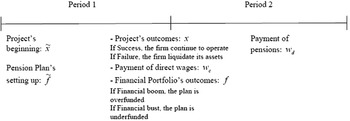
Consider a simple two-period framework in which an entrepreneur endowed with financial resources denoted R achieves an investment project consisting in the purchase of a productive asset at the beginning of period 1. This productive asset generates a random cash flow  where outcomes x at the end of period 1 are distributed along two states of nature as follows

If the productive asset generates a cash flow  at the end of period 1, the entrepreneur continues to operate. On the other hand, if the cash flow generated is
 , the entrepreneur liquidates his productive asset at an exogenous value denoted
 .
To operate, the entrepreneur employs workers assumed to be homogenous in terms of age, skill, seniority, life expectancy, and so on. These workers receive a direct wage denoted w c at the end of period 1, and are promised a pension denoted w d at the end of period 2. As collateral to pension promises, the entrepreneur creates, at the beginning of period 1, a pension fund that collects contributions which serve as provisions invested in financial assets; the outcome of the financial investment enables the entrepreneur to pay pension promises in period 2. The outcome of the financial portfolio is a random variable denoted  with the following distribution at the end of period 1

When the financial outcome is  , pension funding exceeds pension promises w d. The value of the financial portfolio is large enough to pay pensions, and the remainder (fund surplus) is assumed to be allocated according to an exogenous rule β defined by the entrepreneur. On the other hand, if the financial outcome is
 , the value of the financial portfolio is lower than the pension promises w d. Pension contributions denoted c are collected at the beginning of period 1, and serve as provisions with c=w d.
If the firm is not liquidated, it continues to operate with a new (not modelled) generation of workers in period 2, and pays pension benefits to retiring workers in period 2 contingent on the outcome of the financial investment.
We assume that  ,
 and R≫c. All events are depicted along a timeline given in Figure 1.
Timeline

2.2 Decision and priority rules
Any pension fund surplus is allocated between the sponsoring firm and participants, according to an exogenous and common-knowledge rule (i.e., according to the common law of trusts, any remaining assets in a trust after its purpose – here, providing pension benefits – has been fulfilled). This rule is consistent with US courts' decisions,Footnote 6 and formalized by the exogenous parameter β in our model.
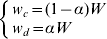
Let W denote total wages, which break down into direct wages w c and pension contributions c. Let α denote the contribution rate defined as the fraction of contributions in total wages with  . Thus, w c and w d can be written as follows:
 .
The contribution rate (i.e. the allocation of total wages between direct wages and pension contributions) is assumed to be the participants' control variable. This assumption is crucial because it implies that plan participants are somehow more involved in the funding of the pension plan. It contrasts with the present situation in the United Kingdom, for instance, where DB sponsoring firms have been unable to change contribution policies to meet the increasing cost of pensions (Clark and Monk, Reference Clark and Monk2007).
As far as priority rules are concerned, we assume that when the pension plan is underfunded and the sponsoring firm goes bankrupt, unfunded pension rights are given the same priority as other claims issued by the firm. When the entrepreneur is enforced to liquidate his productive asset, the liquidation proceeds are allocated according to the weight of participants' claims in entrepreneur's total debt, and first used to pay direct wages and pension promises. The weight of participants' claims is denoted by τi,j, the index i representing the nature of the claims (direct wage or pension benefits), and the index j representing the state of nature (stock market boom or bust). The sponsor is therefore assumed to be a residual claimant.
2.3 Payoffs
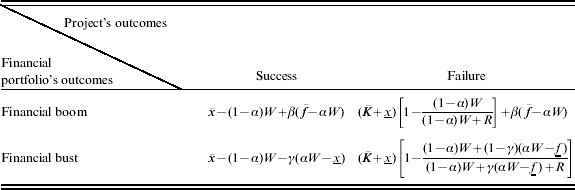
Payoffs to each stakeholder depend on the outcomes of the investment project and of the financial portfolio. Payoffs to the entrepreneur over the two periods are summed up in Table 1.
Payoffs to the entrepreneur in each state of nature
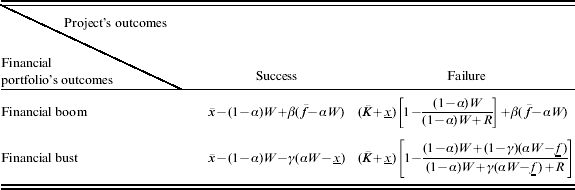
In case of a project's success and financial boom, the entrepreneur receives the proceeds of the net added value (project's return minus direct wage) plus a fraction of the net financial return (portfolio return minus promised pension benefit). In case of the project's success and financial bust, the entrepreneur receives the proceeds of the net added value, minus a fraction of the pension fund deficit. In case of the project's failure and financial bust, the entrepreneur is left with a fraction of his liquidated real asset plus a fraction of the net financial return. In the worst case (project's failure and financial bust), his payoffs resume to a smaller fraction of his liquidated asset since he has to pay the promised pension benefits out of the liquidation proceeds.
The entrepreneur is assumed to be risk neutral and to maximize his undiscounted expected profit over the two periods with respect to his chosen level of pension funding γ

With the following variables representing:
(i) the liquidation proceeds
 ,
(ii) the weight of wages claims at bankruptcy without pension fund deficit
(iii) the weight of wages and pensions claims at bankruptcy in presence of pension fund deficit
 ,
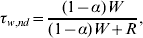

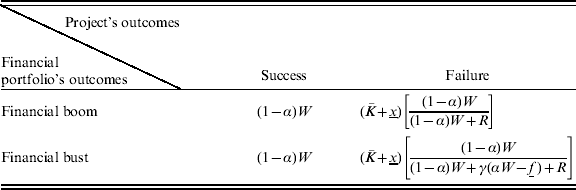
Payoffs to participants in period 1 are given in Table 2.
Payoffs to participants in period 1
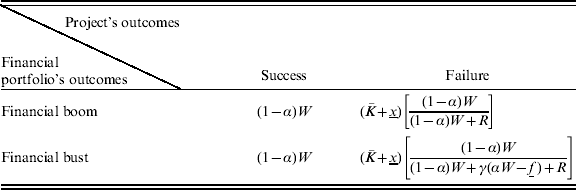
Participants' payoffs in period 1 are direct wages if the investment project succeeds, and a fraction of the liquidated real asset of the project fails (the fraction depending on the success or failure of the financial portfolio).
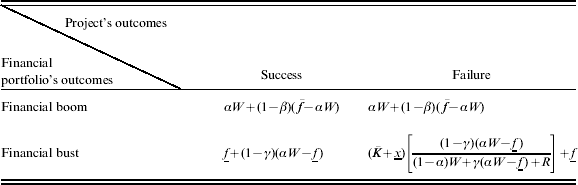
For period 2, participants' payoffs are given in Table 3.
Payoffs to participants in period 2
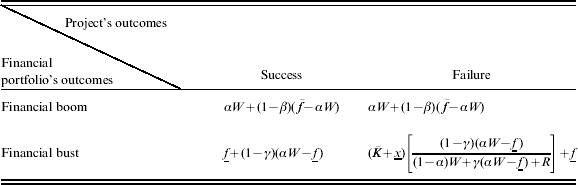
Plan participants are also assumed to be risk-neutral and to maximize an expected undiscounted utility function by choosing their desired contribution rates. Their intertemporal preferences are represented by an additive and separable utility function. For the sake of simplicity, we assume that the utility of consumption in each period is equal to participants' payoffs in each period. Therefore, the expected utility function can be written as

With the following variables representing:
(i) the weight of wages claims at bankruptcy in presence of pension fund deficit
(ii) the weight of pension claims at bankruptcy in presence of pension fund deficit


3 Optimal contribution rate and funding level
Considering the above assumptions, the optimal level of funding chosen by the entrepreneur is given by the optimization program
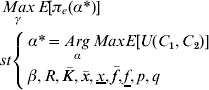
The entrepreneur chooses the level of funding to maximize his expected profit subject to the plan participants' constraint. This participation constraint states that plan participants accept the funding level determined by the entrepreneur, as long as it is compatible with the contribution rates they choose to maximize their expected utility.
The resolution of this maximization program leads to the following relationship between the optimal contribution level α* and the optimal funding level γ*

This non-linear relationship depends on the difference between the two terms in the numerator of equation (4) which are respectively defined by:
(i) the product of the odds of the project's failure
, the expected value of the liquidation proceeds at bankruptcy (), and the expected value of the firm's debt without pension fund deficit minus the value of the pension plan's financial portfolio in case of a financial bust ;(ii) the expected value of the firm's debt without pension fund deficit
.
 , the expected value of the liquidation proceeds at bankruptcy (
 ), and the expected value of the firm's debt without pension fund deficit minus the value of the pension plan's financial portfolio in case of a financial bust
 ;
 .
Notice that the optimal funding level and the optimal contribution rate are independent of the value of β, the sharing rule of the financial surplus.
As no tractable analytical solution can be found, we perform numerical simulations for several sets of parameters. In the base case, with α* varying from 0.1 to 0.9, we set the parameters at the following values:  , = 10, = 0, = 5, p=0.5, q=0.5, R=100, W=60, and = 120. We then vary each parameter over an arbitrary range, holding constant the values of all other parameters. Two regimes can be identified depending on threshold values for key parameters that affect each of the two terms or both in the numerator of the equation defining the relationship between α* and γ*.
Proposition 1
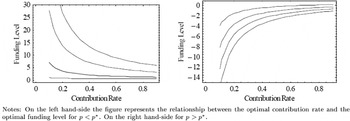
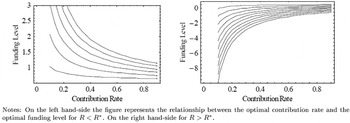
All things being equal, there exist two threshold values p* and R* such that:
(i) If p<p* or R<R*, the relationship between α* and γ* is decreasing and convex and the optimal funding level is strictly positive;
(ii) If p>p* or R>R*, the relationship between α* and γ* is increasing and concave and the optimal funding level is strictly negative.
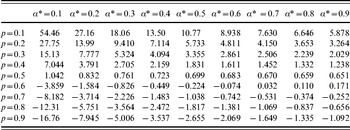
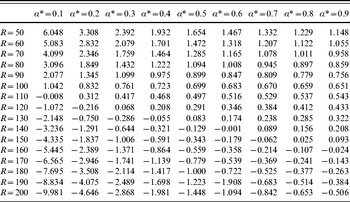
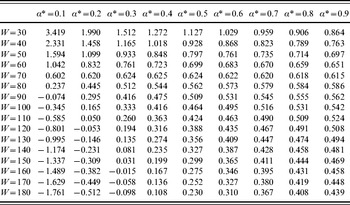
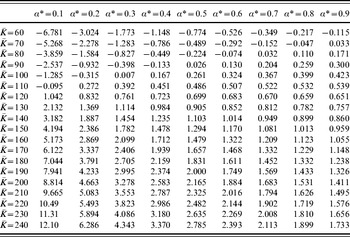
Explicit solutions are plotted in Figures 2 and 3 (Tables 6 and 7 in appendix provide the numerical values for the simulated solutions).
Proposition 2
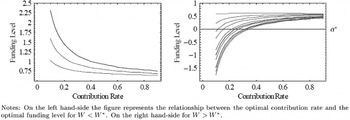
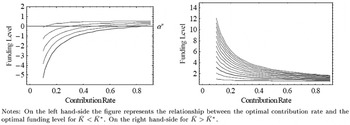
All things being equal, there also exist two threshold values W* and * such as:
(i) If W<W* or
, the relationship between α* and γ* is decreasing and convex, and the optimal funding level is strictly positive;(ii) If W>W* or
, the relationship between α* and γ* is increasing and concave, and the optimal funding level is negative and becomes positive as the contribution rate increases.
 , the relationship between α* and γ* is decreasing and convex, and the optimal funding level is strictly positive;
 , the relationship between α* and γ* is increasing and concave, and the optimal funding level is negative and becomes positive as the contribution rate increases.
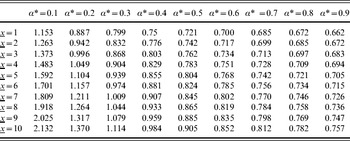
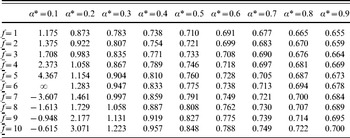
Figures 4 and 5 illustrate the pattern of the relationship between the optimal contribution rate and the optimal funding level (see also Tables 8 and 9 in the appendix).
Proof
The existence of threshold values is due to the difference in the two terms in equation (4) defining the relationship between α* and γ*. Each term is influenced by the values of the parameters. Indeed, all other parameters held constant, varying a given parameter over a specific range affects one of the two terms, or both, of the numerator in equation (4). For variations of each parameter above or below its threshold value, this spread appears either positive or negative, determines the shape of the relationship between α* and γ*, and results in positive or negative values of γ*.
Any decrease in the amount of financial resources R, in the amount of total wages W and in the probability of the project's success p below their respective threshold values, or any increase in the value of the productive asset above its threshold value result in positive values of γ*. These results mean that the entrepreneur pays what he has to in case of a financial bust, and the decreasing and convex relationship between α* and γ* may seem straightforward at first sight: more contributions by employees may lead to a smaller funding burden on behalf of the sponsor. In fact, the intuition is different: allowing plan participants to choose their desired contribution rates and get a priority of unfunded pension rights at the firm's bankruptcy give the entrepreneur greater incentives for sufficient funding of the pension plan.
Evolution of γ* with respect to α* for given values of p

Evolution of γ* with respect to α* for given values of R

Evolution of γ* with respect to α* for given values of W

Evolution of γ* with respect to α* for given values of

On the other hand, any increase in the amount of financial resources, R, in the amount of total wages W and in the probability of the project's success p above their respective threshold values, or any decrease in the value of the productive asset below its threshold value result in negative values of γ*. These results mean that the entrepreneur does not pay what he ought to in case of underfunding, the relationship between α* and γ* is increasing and concave: plan participants must increase their optimal contribution rates to induce the entrepreneur to raise his optimal funding level. For instance, the more successful the project is, the smallest the entrepreneur's willingness to fund the pension plan, since negative optimal funding levels increase his expected profit. This result suggests that a weaker threat of bankruptcy leads the entrepreneur to let plan participants increase their contribution rates to fill any pension fund deficit. However, any increase in the optimal contribution rate raises the weight of the plan participants' claims and negatively affects the entrepreneur's expected profit. The entrepreneur can mitigate this adverse effect by raising his optimal funding level. Thus, by increasing their contribution rates, plan participants still preserve a means to give the entrepreneur incentives to fund the pension plan; in some cases, these incentives are strong enough to make the optimal funding level turn from negative to positive values.
In both regimes, the incentive to fund the pension plan is efficient for the entrepreneur since it reduces the weight of the plan participants' claims at bankruptcy and increases their expected profits in case of continuation. The difference in the two regimes relies on the coordination process between the contractors. When the optimal funding level is positive, the plan participants' and the entrepreneur's optimal choices are substitutes: a smaller contribution rate leads to a higher funding level. On the other hand, when the optimal funding level is negative, these choices are complementary: favourable economic conditions (i.e. a higher probability of the project's success, higher wages, or more important financial resources) unbind the constraints on both contractors, who coordinate to increase their respective optimal effort.
Notice that when an economic recession or a financial bust is less severe (respectively measured by an increase in or the sponsoring firm has a greater incentive for funding its pension plan for small values of plan participants' contribution rates.
Conclusion
Our analysis is aimed at enriching the debate on the priority of unfunded pension rights in case of the sponsoring firm's bankruptcy. Starting from the idea that pension promises in DB schemes are part of a financial contract between a sponsor and participants to a sponsored pension plan, we argue that plan participants are not ordinary creditors and should be given the same priority as other claimants in the event of underfunding and the sponsoring firm's bankruptcy. We build up a model consistent with this view, which gives room for more participants' involvement in pension fund management. We assume that the sponsoring firm chooses the optimal share of pension fund deficit that it commits to cover in case of insolvency, while participants choose the contribution rates that maximize their expected utility. We show that two regimes govern the pattern of the relationship between the optimal level of funding chosen by the sponsor and the optimal contribution rates chosen by the plan participants. Allowing plan participants to determine their desired contribution rates gives the entrepreneur the proper incentives to fund the pension plan.
Our model assumes that plan participants are risk-neutral, whereas in the real world they may be risk-adverse in the management of their pension savings. Risk-neutrality is justified in our analysis since it is consistent with the priority of unfunded pension rights in case of a sponsoring firm's bankruptcy. Without any assumption on plan participants' risk-aversion, we show that the inclusion of a priority of unfunded pension rights in the pension contract design may enhance the level of funding of pension plans. Unlike Besley and Prat (Reference Besley and Prat2003) who suggest that a defaulting firm may have an incentive not to fund the deficit of its pension plan, we show that for small contribution rates, the entrepreneur is led to fund the deficit in order to reduce the weight of plan participants' claims in case of liquidation.
However, our main results deserve a cautious interpretation because they rest on the assumption that the contribution rates are determined by plan participants, not by the entrepreneur. Under this assumption, we show that plan participants can induce the entrepreneur to fund suitably the pension plan. Hence, our results underline that to increase the plan participants' involvement in pension management, the contribution rates must be determined by participants, or their representatives in the trust, which was also mentioned but not demonstrated in Besley and Prat (Reference Besley and Prat2003). In a certain way, our pension contract resembles a cash-balance plan and has some implications in the security of pension saving. Contrary to a traditional cash-balance plan that tends to increase the pension risk of older workers, our model suggests that a cash-balance plan, which states a priority of unfunded pension rights in case of a sponsoring firm's bankruptcy, can give more security to plan participants in their pension savings.
Our results are based on a simple one-period model, and a multi-period model would be useful to test its robustness. An avenue for further research could rely on an overlapping generation model in which a new generation of workers in the second period coexists along with the previous generation of retired workers. Our conjecture is that this new working generation alleviates the sponsoring firm's incentive to fund the pension plan: the new contributions levied on the second-period workers could compensate for the bad outcomes of either the project or the financial portfolio in period 1.
In the real world, public insurance agencies have proven to be unsustainable in dealing with underfunding and firms' bankruptcy. Based on our framework, further research could be made in order to design an optimal insurance mechanism against the bad outcomes of cash flows and/or financial portfolio values.
Appendix
Values of γ* with respect to α* for given values of

Values of γ* with respect to α* for given values of

Values of γ* with respect to α* for given values of p

Values of γ* with respect to α* for given values of R

Values of γ* with respect to α* for given values of W

Values of γ* with respect to α* for given values of