Introduction
Host selection by ovipositing females is one of central themes in plant–insect interactions. Selection of oviposition sites by phytophagous insects is crucial for the fate of offspring, especially when the offspring develop within the plant units such as fruits and seeds (Sallabanks and Courtney Reference Sallabanks and Courtney1992; Desouhant Reference Desouhant1998; Stamps and Linit Reference Stamps and Linit2002). Preference-performance hypothesis, which is also known as mother-knows-best hypothesis, in host selection by herbivorous insects predicts that females maximise the fitness by laying their eggs on plant units on which their offspring perform the best (Thompson Reference Thompson1988; Gripenberg et al. Reference Gripenberg, Mayhew, Parnell and Roslin2010; Wennström et al. Reference Wennström, Hjulström, Hjältén and Julkunen-Tiitto2010). When ovipositing females distinguish between egg-containing and egg-free host units, they tend to avoid host units already bearing eggs and prevent the offspring from reducing the fitness (Prokopy Reference Prokopy1972). Females also distinguish the different numbers of eggs in a host unit and prefer to oviposit on host units with lower egg loads (Messina and Renwick Reference Messina and Renwick1985). Such behaviours lead to a nearly uniform dispersion of eggs among host units (Prokopy Reference Prokopy1972).
The seed parasitoid wasp, Macrodasyceras hirsutum (Hymenoptera: Torymidae) specialises on Ilex integra Thunberg (Aquifoliaceae) (Kamijo Reference Kamijo1981). Adults of the overwintered generation emerge from early May through early June (Takagi et al. Reference Takagi, Iguchi, Suzuki and Togashi2010). Their flight season is between early May and mid-June. Some of the first-generation larvae (0–62.5%) emerge as an adult in August (Takagi et al. Reference Takagi, Iguchi, Suzuki and Togashi2010). Both the remaining first-generation larvae and the second-generation larvae overwinter (Takagi et al. Reference Takagi, Iguchi, Suzuki and Togashi2010). They emerge as an adult between May and June of the following year.
Ilex integra is dioecious and blooms from late March through mid-April. One to five female flowers emerge from the leaf axils of one-year-old twigs. Immediately after flowering, the ovary starts to develop into a spherical berry. Each berry usually has four cavities enclosed by endocarps, each of which contains one ovule at the time of anthesis. Fertilised ovules develop into viable seeds enclosed with hard endocarps (pyrenes) within the berry. The berries are green in mid-spring and throughout summer, turning red as they ripen in autumn. Each I. integra tree shows a marked, yearly fluctuation in berry production (Katsuta et al. Reference Katsuta, Mori and Yokoyama1998). They are known to change the sex expression (Takagi and Togashi Reference Takagi and Togashi2012). No seed predators or parasitoids other than M. hirsutum have been reported in I. integra.
The seed parasitoid wasp females selectively deposit the eggs into the fertilised seeds of I. integra (Takagi et al. Reference Takagi, Iguchi, Suzuki and Togashi2010). Before ovipositing, females walk around and sometimes back and forth on berries with tapping them with the antennae. Once they cease walking, they gradually lift the abdominal tips, place the tips of ovipositors on the berry, and penetrate the ovipositors a little into the berries. They withdraw the two sheath valves of ovipositors with retaining the tip of ovipositor shaft in the berries. More than 10 minutes are required to behavioural sequences between stopping walk and withdrawing the sheath valves. The females extend two sheath valves backward and press down the abdomens to penetrate the ovipositors into the berries, deposit the eggs in seeds, and withdraw the shafts. Females place the ovipositor shafts in the berries over 10 minutes after removing the sheath valves from berries.
In summer the adults of first generation lay the eggs in larva-free, developing seeds (Kamijo Reference Kamijo1981). When berries have no parasitised seeds, they change the colour from green to red in autumn to winter, whereas berries with parasitised seeds retain green in winter. The berry colour is manipulated in a density-dependent manner: greater the number of live wasp larvae in a berry, more intense is the green colour of the berry (Takagi et al. Reference Takagi, Iguchi, Suzuki and Togashi2012). As the green berries do not attract frugivorous birds or are not consumed by them in winter (Takagi et al. Reference Takagi, Iguchi, Suzuki and Togashi2012), larvae harboured in green berries survive in winter. In M. hirsutum, only one larva develops in a fertilised seed. Therefore, preference-performance theory may predict a uniform distribution pattern of M. hirsutum eggs among fertilised seeds. In addition, it also predicts a clumped distribution pattern of M. hirsutum eggs among berries if different berries differ in nutrition values of seeds. The objective of this study was to determine the spatial distribution pattern of wasp eggs among fertilised seeds and berries based on a five-year study.
Materials and methods
Field survey
The study was conducted over a five-year period from 2008 to 2012 in central Japan. The study site was a ≥80-year-old plantation of 26 I. integra trees on a south-facing slope at an angle of 25 °, which occupied an area of ∼150 m2 (10 m × 15 m) in the university forest of the University of Tokyo at Chiba, Kimitsu City, Chiba Prefecture, Japan.
To determine the initial berry density per twig, 40 one-year-old twigs were randomly selected from each of 26 trees and the berries on them were counted using a binocular telescope of 7× magnification. The survey was conducted on 19 May 2009, 13 May 2010, 18 May 2011, and 15 May 2012.
Soon after the end of oviposition period by overwintered generations, on 16 June 2008, 18 June 2009, 18 June 2010, 21 June 2011, and 19 June 2012, three twigs bearing berries were randomly collected from each of nine, six, six, six, and nine trees, which produced berries in each year from 2008 to 2012. The twigs were kept at 5 °C in the dark until the berries were dissected. Then, 15 berries per tree were randomly sampled from the three twigs for 35 trees and six berries from the twigs of the remaining tree because of poor berry production. The berries were dissected under a microscope and the number of wasp eggs (Fig. 1) in each seed was recorded.
A Macrodasyceras hirsutum egg. Bar = 0.5 mm.

Analysis
To determine the distribution patterns of wasp eggs among seeds, aggregation indices were calculated using Iwao's patchiness regression (Iwao Reference Iwao1968). Iwao's patchiness regression is expressed as
 $${{m}^\ast} \, = \,{\rm{\alpha }}\, + \,{\rm{\beta }}m$$
 $${{m}^\ast} \, = \,\frac{{\sum _{{i\, = \,{\rm{1}}}}^{n} {{x}_i}\left( {{{x}_i}\,{\rm{ - }}\,1} \right)}}{{\sum _{{i\, = \,{\rm{1}}}}^{n} {{x}_i}}}\, = \,\frac{{\sum _{{i\, = \,{\rm{1}}}}^{n} x_{i}^{{\rm{2}}} }}{{\sum _{{i\, = \,{\rm{1}}}}^{n} {{x}_i}}}\,{\rm{ - }}\,1$$
where m is the mean density, m* the mean crowding (Lloyd Reference Lloyd1967), n the total number of fertilised seeds dissected, and xi the number of eggs in the ith fertilised seed (i = 1, 2, …, n) at the scale of tree. Coefficients α and β are designated as index of basic contagion and density-contagiousness coefficient, respectively (Iwao Reference Iwao1968). The α values of 0 and >0 indicate individual and colony as the unit of distribution, respectively. Random distribution is characterised by a β value equal to unity. The β values higher than unity indicate clumped distributions of units, while the β values lower than unity indicate uniform distributions. In theory, however, completely uniform distribution of individuals is expressed by a broken line composed of m* = 0 (0<m ≤ 1) and m* = −1 + m (m > 1; Iwao Reference Iwao1968). Therefore, when the eggs showed a uniform distribution, a straight line and a broken line were fitted to data using a simple linear regression and a piecewise linear regression. Calculation was performed using R 2.14.1 and the segmented package (Muggeo Reference Muggeo2003). The Akaike information criterion (AIC) and Bayesian information criterion (BIC) were used to select the better statistical model, because all current model selection criteria fall into two classes, efficient class including AIC or consistent class including BIC (Burnham and Anderson Reference Burnham and Anderson2002). Models with lower AIC and BIC values are better (Burnham and Anderson Reference Burnham and Anderson2002).
The above-mentioned procedures were used to determine the egg distribution patterns among seeds at the scale of berry. Namely Iwao's patchiness regression was applied to the mean densities and crowding of eggs per fertilised seed at the scale of berry. The analysis was more favourable to evaluate the mean density/mean crowding relationship because unsusceptible berries the wasps had never visited were excluded from the analysis due to acalculia of mean crowding. The regression of mean crowding of eggs to the mean density per berry was also used to determine the distribution pattern of eggs among berries at the tree scale.
Patchiness defined as m*/m ratio expresses the degree of aggregation of individuals (Lloyd Reference Lloyd1967); patchiness more than unity for clumped distribution, patchiness equal to unity for random distribution, and patchiness less than unity for uniform distribution. Therefore, to determine relationships between the berry production and the aggregation level of eggs among seeds, Pearson's correlation coefficients were calculated between patchiness of eggs among seeds and mean berry density per twigs at two scales of tree and berry. It was also calculated between patchiness of eggs among berries and mean berry density per twigs at the tree scale.
Seeds and berries were two different hierarchies in oviposition site selection by the wasps. If female wasps preferentially oviposit into seeds in specified berries within a tree, it is presumed that the mean crowding of eggs among berries is higher than expected by random selection of berries to oviposit. To break the connection of seeds within berries, we made a set of fertilised and unfertilised seeds obtained from berries containing four seeds in each tree and then selected four seeds randomly from the set of seeds. Next we selected four seeds randomly from the remaining seeds. In such a way, we formed 15 or fewer imaginary berries containing four seeds and calculated the mean crowding of eggs per berry at the scale of tree. This procedure was repeated 10 000 times, and the median of m* values and the 95% confidence intervals were calculated for each tree.
A generalised linear mixed model (GLMM) with Poisson distribution and log link was used to determine the effects of the number of fertilised seeds in a berry on the total number of eggs in a berry. The number of fertilised seeds was considered as a fixed effect, and tree and year as random effects. Another GLMM with Poisson distribution and log link was also used to determine the effects of the number of fertilised seeds in a berry on the number of eggs in a seed. The number of fertilised seeds was considered as a fixed effect, and berry nested within tree, and year as random effects. The analysis was performed using R 2.14.1 and the lme4 package. The AIC and BIC values were used to select the models that described the number of eggs better (Burnham and Anderson Reference Burnham and Anderson2002). The Akaike weight was used to assess the relative importance of the models (Burnham and Anderson Reference Burnham and Anderson2002; Johnson and Omland Reference Johnson and Omland2004).
Results
Field survey in mid-May revealed that trees bore many berries on twigs with different heights when producing plentiful berries, whereas those bore scarce berries in the upper crown, especially on the top twigs when berry production was poor. The survey showed great differences in mean density of early berries per twig among trees: 12 trees had had female flowers at least once of the four-year study period, whereas 14 remaining trees had never had female flowers. Mean berry density per twig over the four years differed among trees, ranging from 0.00 to 1.49. Mean berry density per twig over the 26 trees also differed among years: the greatest berry density was 3.63 in 2009 and the lowest 1.78 in 2010.
Dissection of 531 berries showed that M. hirsutum deposited one to five eggs into a fertilised seed (Fig. 2) and one to ten eggs into a berry, although there were no M. hirsutum eggs in all berries collected from six trees (i.e., F4, F16, F19, F20, F23, and F25) in 2008 (Supplementary Appendix 1–2).
Relationship between the number of fertilised seeds in a Ilex integra berry and the number of Macrodasyceras hirsutum eggs in a seed. The seeds were sampled in June from 2008 to 2012 in Chiba Prefecture, Japan. Numerals above columns represent the numbers of seeds examined.
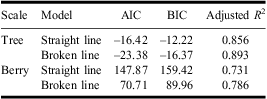
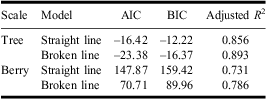
Iwao's patchiness regression between mean density and crowding of M. hirsutum eggs per seed suggested a uniform distribution of the wasp eggs among fertilised seeds at the scale of tree: the β value was 0.873 (SE = 0.066, 95% confidence interval = 0.737–1.009) and the α value was −0.250 (SE = 0.057, 95% confidence interval = −0.367 to −0.134; Fig. 3). The piecewise linear regression gave a broken line composed of m* = 0 and m* = −0.459 + 1.059m (SE of β value = 0.110, the 95% confidence interval = 0.833–1.285), whose intersection point (±SE) was 0.433 ± 0.109 (Fig. 3). The ΔAIC and ΔBIC values were 6.961 and 4.159 at the scale of tree, respectively, between the regressed straight line and the broken line, indicating that the broken line was fitter than the straight line (Table 1).
Relationship between mean crowding (m*) and mean density (m) of Macrodasyceras hirsutum eggs per fertilised seed of Ilex integra at the scale of tree. Circles represent I. integra trees examined from 2008 to 2012. A regression line depicted in the figure is m* = −0.459 + 1.059m (R 2 = 0.893, n = 30).
AIC, BIC, and adjusted R 2 values for a regressed straight line and broken line fitted to the relationship between mean density and mean crowding of Macrodasyceras hirsutum eggs per fertilised seed of Ilex integra at the two scales of tree and berry.
AIC, Akaike information criterion; BIC, Bayesian information criterion.
Iwao's patchiness regression between mean density and crowding of M. hirsutum eggs per seed at the scale of berry showed a uniform distribution of the wasp eggs among berries; the β value of 0.798 (SE = 0.026, 95% confidence interval = 0.747–0.849) and the α value of −0.393 (SE = 0.029, 95% confidence interval = −0.449 to −0.336; Fig. 4). The piecewise linear regression gave a broken line composed of m* = −0.078 + 0.249m (SE of β value = 0.073, the 95% confidence interval = 0.106–0.393) and m* = −0.846 + 1.070m (SE of β value = 0.051, the 95% confidence interval = 0.970–1.170), whose intersection point (±SE) was 0.936 ± 0.073 (Fig. 4) at the scale of berry. The ΔAIC and ΔBIC values were 77.16 and 69.46 at the berry scale, respectively, between the regressed straight line and the broken line, indicating that the broken line was fitter than the straight line (Table 1).
Relationship between mean crowding (m*) and mean density (m) of Macrodasyceras hirsutum eggs per fertilised seed of Ilex integra at the scale of berry. Circles represent I. integra berries examined from 2008 to 2012. The regression lines depicted in the figure are m* = −0.078 + 0.249m and m* = −0.846 + 1.070m (n = 348).
On the other hand, Iwao's patchiness regression showed a random distribution of wasp eggs among berries at the scale of tree; the β value was 1.083 (SE = 0.061, 95% confidence interval = 0.958–1.208) and the α value was −0.234 (SE = 0.169, 95% confidence interval = −0.581 to 0.112; Fig. 5). Destroying the connections between seeds within berries showed that female wasps randomly selected berries for oviposition in 27 of 30 trees, whereas in three other trees they preferentially selected specified berries rather than they randomly selected berries (Fig. 5).
Relationship between mean crowding (m*) and mean density (m) of Macrodasyceras hirsutum eggs per berry of Ilex integra at the scale of tree. Open and filled circles show observed m* values and the median of 10 000 m* values obtained when the connection between seeds and berries was reconstructed randomly, respectively. Bars reveal the 95% confidence intervals of the median m* values. Data from 2008 to 2012 were pooled.
There were no correlations between patchiness of eggs among seeds or berry and berry production at the scale of tree over four years (r = 0.087, n = 27, P = 0.66 between egg patchiness among seeds and berry density per twig at the tree scale; r = 0.034, n = 27, P = 0.87 between egg patchiness among berries and berry density per twig at the tree scale). At the scale of berry, no correlation was found between patchiness of eggs among seeds and berry production over four years either (r = 0.046, n = 332, P = 0.40).
A GLMM revealed that the number of eggs in a berry could be explained by the number of fertilised seeds in a berry (Table 2). On the other hand, GLMM showed that the number of eggs in a fertilised seed remained constant and was not affected by the number of fertilised seeds within a berry (Table 2): the ΔAIC and ΔBIC values were 1.224 and 6.441, respectively, between the best model including an intercept only and the model including the number of fertilised seeds in a berry (Fig. 2).
Statistics of best performing GLMMs to explain the number of Macrodasyceras hirsutum eggs in an Ilex integra berry or in a seed.

*Number of parameters.
GLMMs, generalised linear mixed models; AIC, Akaike information criterion; BIC, Bayesian information criterion.
Discussion
This study revealed a uniform distribution pattern of the wasp eggs among fertilised seeds and that the seed parasitoid wasps laid one to five eggs into the fertilised seeds. A uniform distribution pattern of M. hirsutum eggs among fertilised seeds at the scales of berry and tree suggests that the seed parasitoid wasps distinguish different numbers of eggs in a fertilised seed and prefer to oviposit in the seeds with lower egg loads. In addition, berry density per twig did not affect the distribution pattern of M. hirsutum eggs among fertilised seeds. Selection of oviposition sites by phytophagous insects has great impact on the fate of offspring, especially when the insects have low mobility in the immature stages; for example, offspring that develop within fruits and seeds (Sallabanks and Courtney Reference Sallabanks and Courtney1992; Desouhant Reference Desouhant1998; Stamps and Linit Reference Stamps and Linit2002). Because the performance of offspring is closely connected to the fitness of the mother, ovipositing females can evolve beneficial behaviour for larval performance and should oviposit on plant units that maximise offspring performance (Thompson Reference Thompson1988; Gripenberg et al. Reference Gripenberg, Mayhew, Parnell and Roslin2010; Wennström et al. Reference Wennström, Hjulström, Hjältén and Julkunen-Tiitto2010). In the case of M. hirsutum, as only one larva develops in a fertilised seed (Takagi and Togashi Reference Takagi and Togashi2012), multiple eggs deposited cause severe larval competition in the fertilised seeds. The present study suggests that selective oviposition into egg-free or low egg load seeds by M. hirsutum females may reduce the progeny competition for food resource in fertilised seeds, indicating that oviposition behaviour of M. hirsutum females did not conflict with preference-performance hypothesis.
On the other hand, this study showed a random distribution pattern of M. hirsutum eggs among I. integra berries at the scale of tree. Destroying the connections between seeds within berries showed that female wasps randomly selected berries for oviposition in most trees but in a few trees they preferentially deposited the eggs into specified berries rather than they randomly selected berries. When there is a great difference in environmental conditions among parts of a tree crown, the female wasps may prefer to reside in a particular part of tree crown, where all seeds have a heavy egg load. In such a case, random sampling may show a clumped distribution of eggs among berries as shown in the chestnut gall wasp, Dryocosmus kuriphilus Yasumatsu (Hymenoptera: Cynipidae) (Itô Reference Itô1967). This study does not suggest that M. hirsutum females distinguish between berries with different numbers of fertilised seeds. A clumped distribution may also result from a mixture of elementary distributions, for instance different females ovipositing into seeds randomly but with a different mean number of eggs being laid.
The chestnut weevil Curculio elephas Gyllenhal (Coleoptera: Curculionidae) selected the oviposition site neither by host size nor by the presence of offspring (Desouhant Reference Desouhant1998). In the Hymenoptera herbivores, to our knowledge, the almond seed wasp Eurytoma amygdali Enderlein (Hymenoptera: Eurytomidae) is the only species that responds to the host marking pheromone and avoids insect-infested almonds (Kouloussis and Katsoyannos Reference Kouloussis and Katsoyannos1993). On the other hand, the alfalfa seed chalcid, Bruchophagus roddi Gussakovsky (Hymenoptera: Eurytomidae), discriminates suitable seeds with the sensilla on the ovipositor (Kamm and Buttery Reference Kamm and Buttery1986). As post-oviposition M. hirsutum females did not exhibit peculiar behaviours to emit marking pheromones such as dragging the ovipositors. In addition, other observations showed that complete oviposition behaviour by M. hirsutum is not always connected to actual egg deposition into fertilised seeds (personal observation by E.T.). The results of this study suggested that M. hirsutum distinguish with the ovipositor between fertilised and unfertilised seeds and between fertilised seeds with different numbers of eggs. Further experiment and careful direct observation of oviposition behaviour are needed to determine the mechanisms of selective oviposition in M. hirsutum females.
Acknowledgements
The authors are grateful to Y. Adachi and I. Murakawa (The University Forest in Chiba, The University of Tokyo), and K. Iguchi and M. Suzuki (The University Forest in Hokkaido, The University of Tokyo), for assistance with field surveys. They are also grateful to S. Tamura (The University of Tokyo), for assistance with statistical analysis. E.T. was supported by a fellowship and research funding from the Japan Society for the Promotion of Science.