Introduction
Within the large and heterogeneous genus Lecanora Ach., the L. varia group is characterized by corticolous and lignicolous species with usnic acid as the major constituent and the lack of atranorin. The species included in this group have been morphologically, anatomically and chemically well studied by different authors such as Vänskä (Reference Vänskä1984), Hernández Padrón et al. (Reference Hernández Padrón, Vänskä and Pérez de Paz1991), Printzen (Reference Printzen2001), Śliwa & Wetmore (Reference Printzen2001), Printzen & May (Reference Printzen and May2002), Laundon (Reference Laundon2003) and Martínez & Aragón (Reference Martínez and Aragón2004).
Systematic publications or lichen floristic lists which included taxa other than the L. subfusca group in Argentina are rare (Müller Arg. Reference Müller Argoviensis1889; Cengia Sambo Reference Cengia Sambo1926, Reference Cengia Sambo1930; Lamb Reference Lamb1958; Ferraro Reference Ferraro1978; Osorio Reference Osorio1987; Dickhäuser et al. Reference Dickhäuser, Lumbsch and Feige1995; Messuti Reference Messuti1995; Lumbsch et al. Reference Lumbsch, Guderley and Elix1996; Messuti et al. Reference Messuti, Vobis and Lumbsch2003; Scutari et al. Reference Scutari, Diez and Lumbsch2002; Rosato Reference Rosato2006).
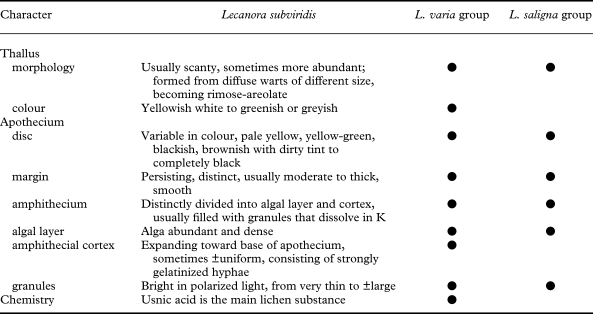
As part of a broader study of Lecanora s. lat. in Argentina, we collected some specimens which by the main anatomical and chemical characters can be regarded as members of L. varia group but cannot be assigned to any described taxon. Superficially these specimens combine characters of the L. varia and L. saligna groups (Table 1) and are described as a new species and compared with the related species.
Main diagnostic characters of Lecanora subviridis and its relationship with the Lecanora varia group and the Lecanora saligna group.

● shared characters.
Materials and Methods
All material examined is deposited at BCRU and F. Anatomical features were studied on thin hand-cut sections and squash preparations mounted in water or lactophenol-cotton blue. An Olympus SZ-STU1 dissecting microscope and an Olympus BX-50 microscope fitted with polarized light were used for anatomical studies. Pol+ means a light reaction caused by crystals, while Pol− means that no lighting can be observed in polarized light. Tests on pigments and granules were performed with 50% HNO3 (N), 10–25% KOH (K). Chemical constituents were identified by high performance thin-layer chromatography (HPTLC) using standardized techniques as outlined by Arup et al. (Reference Arup, Ekman, Lindblom and Mattsson1993) and Lumbsch (Reference Lumbsch, Kranner, Beckett and Varma2002).
The Species
Lecanora subviridis de la Rosa & Messuti sp. nov
MycoBank no.: MB515514
Thallus crustaceus, luteo-viridis usque ad luteo-griseus. Prothallus nigrus. Apothecia lecanorina, sessilia vel ad basin plusminusve constricta, 0.2-0.5 mm in diametro, disci luteo-albidi vel grisei, epruinosi vel pauce pruinosi. Margines apotheciorum tenue vel crassi, leaves, rari flexuosi, epruinosi, luteo-albidi vel luteo-grisei. Amphithecium lateriter 35–75 μm, basaliter 75–115 μm. Cortex distinctus, hyalinus, inspersus, lateraliter 12–25 mm, basaliter 20–50 mm, crystalla minuta continens. Parathecium indistinctum, hyalinum, 10–12 μm crassum. Epihymenium luteo-bruneum vel olivaceo-griseum, granulosum. Subhymenium hyalinum. Hypothecium indistinctum, hyalinum, 12–20 μm altum. Asci clavati vel cylindrici, octospori. Ascosporae hyalinae, ellipsoideae, 6–9 × 5–7 μm mm. Thallus et apothecia acidum usnicum continens.
Typus: Argentina, Río Negro Province, S.C. de Bariloche, San Pedro Peninsula, transitional forest near the shore of Nahuel Huapi Lake, down beach access from Campanario Avenue, 15 March 2009, I. N. de la Rosa (BCRU 5024—holotypus; F—isotypus).
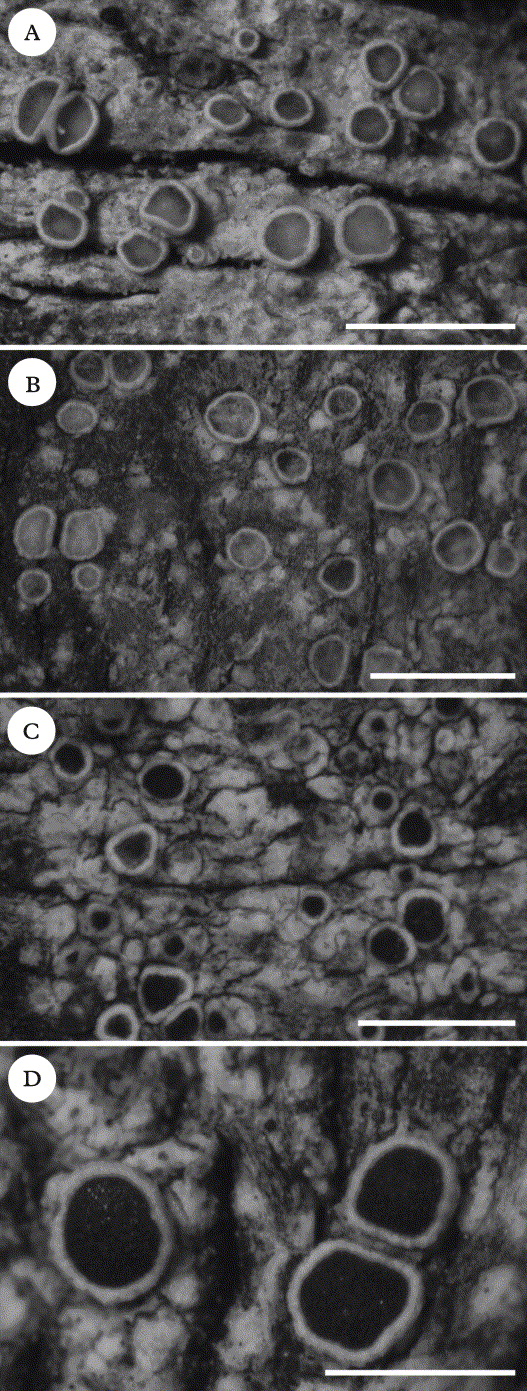
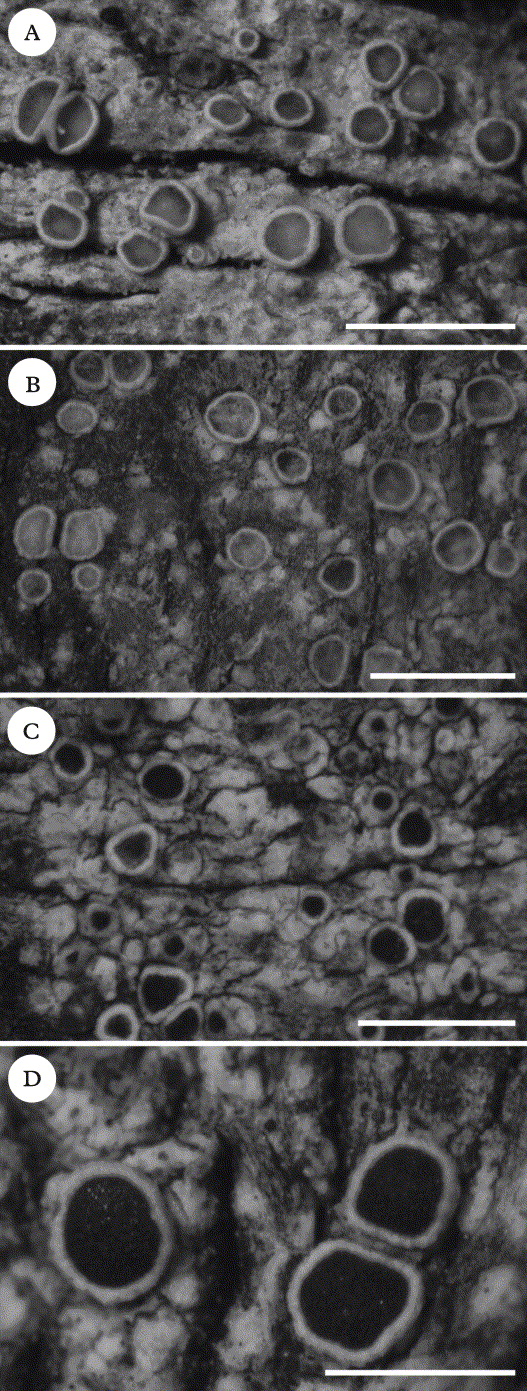
Lecanora subviridis, habitus. A, thin thallus with pale apothecial discs (BCRU 5024); B, thallus of dispersed warts with pale apothecial discs (BCRU 5025); C & D dark apothecia on developed thallus (BCRU 5024). Scales A–C = 1 mm; D = 0·5 mm.
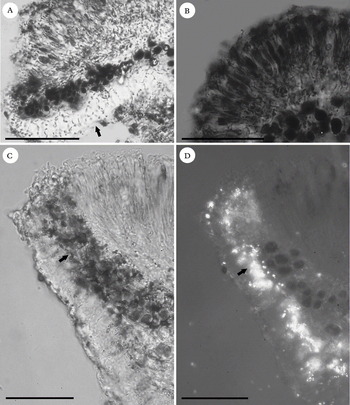
Lecanora subviridis, section showing the apothecial anatomy. A, detail of amphithecial cortex (⬆) (BCRU 5024); B, hymenium (BCRU 5024); C, amphithecium filled with granules (⬆) (BCRU 5025); D, amphithecial granules viewed in polarized light (⬆) (BCRU 5025). Scales A & B = 100 μm; C & D = 50 μm.

Thallus crustose, often superficial, poorly developed and inconspicuous, thin, rimose-areolate or consisting of dispersed warts, yellowish white to greenish or greyish, frequently sparse on a black prothallus.
Apothecia lecanorine, disciform, sessile at first to slightly constricted at the base with age, occurring singly or clustered in groups of 2–4 (–5), 0·2–0·5 mm diam.; disc moderately concave, flat to slightly convex, mostly epruinose, pale yellowish to greyish, often almost black. Apothecial margin level with the disc to prominent, persistent, smooth, entire, rarely flexuose, epruinose, paler than the disc, concolorous with thallus. Amphithecium laterally 35–75 μm, basally 75–115 μm thick, corticate with a continuous and dense algal layer, c. 50 μm. Amphithecial cortex distinctly delimited, sometimes ±uniform in thickness to thickened at the base, laterally 12–25 μm, basally 20–50 μm thick, hyaline to pale brownish, consisting of strongly gelatinized, anticlinally arranged hyphae, with small yellowish to brownish granules (Pol+), soluble in K, insoluble in N. Parathecium indistinct, hyaline, without crystals (Pol−), gelatinous, 10–12 μm thick. Epihymenium shades of pale yellowish brown to olivaceous grey, granules small (Pol±), superficial, sometimes scanty, soluble in K, insoluble in N, K+ olive-green to yellowish blackish, N± reddish. Hymenium hyaline, clear, 40–70 μm high. Subhymenium indistinct, hyaline, 12–25 μm high. Hypothecium not well developed, hyaline, with oil droplets, 12–20 μm high. Paraphyses simple to often weakly branched in the uppermost part, slightly expanded apically, tips mostly brownish to blackish pigmented. Asci Lecanora-type, clavate to cylindrical, 8-spored, rarely with 12 spores. Ascospores hyaline, simple, broadly ellipsoid, 6–9 ×5–7 μm.
Pycnidia not seen.
Chemistry. Thallus and apothecia K−, C−, Pd−. Usnic acid detected and an unidentified substance with Rf class 6, spot pale greyish yellow-green and UV+ pinkish before and after charring (epanorin?).
Etymology. The specific epithet subviridis refers to the colour of the thallus and apothecial discs.
Distribution and ecology. Lecanora subviridis was found in two different habitats: on fallen branches of Nothofagus dombeyi (Mirb.) Oerst. in a young forest of this evergreen species tree; and on twigs and trunks of Discaria chacaye (G. Don.) Tortosa in transition forests near Nahuel Huapi Lake. These two localities are in a suburban environment.
Discussion. According to the current circumscription, the L. varia group includes species with a mostly corticolous habit, containing usnic acid as main substance, lacking atranorin, and having a corticate amphithecium (Śliwa & Wetmore Reference Printzen2000; Printzen Reference Printzen2001; Martínez & Aragón Reference Martínez and Aragón2004). We consider our new species to be a member of that group. Nevertheless, it exhibits some features of the L. saligna group, but differs by the lack of isousnic acid (Table 1).
The species L. subviridis, can be recognized morphologically and anatomically by pale yellowish to greyish apothecia with a weakly constricted base when mature and an entire margin. The amphithecial cortex is broadened basally, consisting of thick, short hyphae of anticlinal arrangement, and the paraphyses tips are brownish to blackish, the epihymenium reacts N± reddish. Chemically it is characterized by the presence of usnic acid.
The variation in the external appearance among and within the species with usnic and/or isousnic acid are not fully understood (Printzen Reference Printzen2001). For that reason, this discussion was based in those useful characters associated with the apothecial anatomy (e.g. amphithecium, hymenium, subhymenium, hypothecium) and chemistry (presence or absence of usnic acid and/or isousnic acid as major substances).
Easily confused with the variable L. laxa (Śliwa & Wetmore) Printzen, included in L. varia group; however, L. subviridis can be distinguished by somewhat smaller apothecia, with a rather constricted base at maturity, and smooth, epruinose and entire margins, narrower ascospores (Śliwa & Wetmore Reference Ryan, Lumbsch, Messuti, Printzen, Śliwa, Nash, Nash, Ryan, Diederich, Gries and Bungartz2000, Printzen Reference Printzen2001). Another character that differs in both species is the thickness of the amphithecium, which is thinner at the base in L. subviridis.
The new taxon is similar in appearance to species of the L. saligna group, such as L. albellula Nyl., L. mughicola Nyl., L. saligna (Schrad.) Zahlbr. and L. subintricata (Nyl.) Th. Fr.; but presents a different combination of characters (Śliwa & Wetmore Reference Śliwa and Wetmore2000; Printzen Reference Printzen2001; Martínez & Aragón Reference Martínez and Aragón2004; Ryan et al. Reference Ryan, Lumbsch, Messuti, Printzen, Śliwa, Nash, Nash, Ryan, Diederich, Gries and Bungartz2004; van den Boom & Brand Reference van den Boom and Brand2008). Lecanora albellula differs chemically in containing isousnic acid, anatomically in having a thinner amphithecium (laterally 50–80 μm and basally 60–85 μm thick) without a distinct amphithecial cortex (7–20 μm thick), and higher subhymenium (20–60 μm) and hypothecium (60–95 μm). Lecanora mughicola is distinguished by the presence of isousnic acid as the single secondary substance, amphithecium [laterally 35–125 μm and basally (55–)110–165 μm thick], higher subhymenium (25–80 μm) and hypothecium [(5–)45–100 μm], epihymenium N+ reddish violet, and more elongated and narrower ascospores [(7·0–)8·5–11·9 (–14) × (3·0–)3·5–4·6(–5·5) μm]. Lecanora saligna can be distinguished from the new species by having isousnic acid as the main constituent, a laterally thicker amphithecium (60–120 μm), an amphithecial cortex that is regular in thickness, is thin and consists of moniliform hyphae and by larger ascospores [(6·5–)7–13(–15) × 3–5(–5·5) μm]. The superficially similar L. subintricata is readily distinguished by its regular amphithecial cortex (15–30 μm) with an inner layer of periclinal hyphae, shallower hymenium (30–45 μm), subhymenium and hypothecium moderately higher [20–50 μm; (5–) 20–75 μm, respectively], epihymenium N+ reddish violet, and narrower ascospores [(2·5–)3·0–3·7(–4·0) μm].
Additional specimens examined. Argentina: Río Negro Province: S.C. de Bariloche, 15 km from downtown, Don Orione Neighborhood, 41°05′S, 71°27′W, 810 m, 18 ix 2008, L. E. Lorenzo (BCRU 5026); ibid., 20 xi 2008, I. N. de la Rosa & L. E. Lorenzo (BCRU 5027); ibid., 27 ii 2009, I. N. de la Rosa (BCRU 5028); San Pedro Peninsula, transitional forest near the shore of Nahuel Huapi Lake, down beach access from Campanario Avenue, 15 ix 2007, I. N. de la Rosa (BCRU 5025).
We wish to thank to L. Śliwa (Kraków, Poland) for her valuable comments on the manuscript. This study was financially supported by UNComahue (Secretaría de Investigación y Extensión, Grant Nº B140).