Introduction
Even though one of the public health's top achievements of the 20th century involves tobacco cessation, a disproportionate burden of tobacco-related comorbidity still affects those with mental illness (Centers for Disease Control and Prevention, 2017; Cook et al., Reference Cook, Wayne, Kafali, Liu, Shu and Flores2014). There is evidence suggesting that psychiatric disorders are associated with an increased prevalence in cigarette smoking (Tsoi, Porwa, & Webster, Reference Tsoi, Porwal and Webster2013). One explanation for this is the potentiating effect of nicotine on dopamine receptors (Mao, Gallagher, & McGehee, Reference Mao, Gallagher and McGehee2011). Other explanations include poverty, educational advancement and industry bias in tobacco marketing (MMWR Vital Signs: Current Cigarette, Reference Jamal, King, Neff, Whitmill, Babb and Graffunder2016; CDC Morbidity and Mortality, 2013). We know that adults with mental illness smoke at rates twice that of the general population, and are nicotine-dependent at rates up to three times higher than the general population (Cook et al., Reference Cook, Wayne, Kafali, Liu, Shu and Flores2014; Grant, Hasin, Chou, Stinson, & Dawson, Reference Grant, Hasin, Chou, Stinson and Dawson2004). Adults with mental illness comprise about 19% of the population, but smoke approximately one-third of all the cigarettes smoked (MMWR Vital Signs: Current Cigarette, Reference Jamal, King, Neff, Whitmill, Babb and Graffunder2016). In the United States, the national tobacco use prevalence is estimated at 19%; however, prevalence among those with bipolar disorder is 51%–70% and 36%–80% among those with major depressive disorder (Grant et al., Reference Grant, Hasin, Chou, Stinson and Dawson2004; King, Dube, & Tynan, Reference King, Dube and Tynan2012; Lasser et al., Reference Lasser, Boyd, Woolhandler, Himmelstein, McCormick and Bor2000). Despite these high rates, recent studies suggest that smokers with mental illness are highly motivated to quit (Cook et al., Reference Cook, Wayne, Kafali, Liu, Shu and Flores2014). However, it remains rare for mental and behavioural health professionals to offer tobacco cessation pharmacotherapy and counselling to clients with psychiatric disorders.
The state of Oklahoma has one of the highest rates of both mental illness and tobacco use in the United States and the need for education and intervention around these medical and public health concerns is clear (Oklahoma department of mental health and substance abuse services, 2017b). As a result, the Oklahoma Department of Mental Health and Substance Abuse Services (ODMHSAS) adopted the University of Colorado School of Medicine's tobacco cessation program, entitled DIMENSIONS: Tobacco Free Program (Behavioral Health and Wellness Program, 2017a). DIMENSIONS was developed in 2006, is now used in 17 states, and was created in response to focus group feedback highlighting the lack of tobacco cessation resources available to people with mental illness. The program is evidence-based, peer-delivered, comprises six sessions and is offered monthly. The program is based on the theory of motivational interviewing as it assesses participants’ quit attempts over the course of six sessions, and quit attempts are a proxy for motivation to quit using tobacco (Rollnick & Miller, Reference Rollnick and Miller1995).
This study is one of the first known evaluations of the DIMENSIONS program. We examine the replication of DIMENSIONS as a state-wide pilot approach to reduce tobacco-related health disparities among individuals with mental illness in the state of Oklahoma. The primary objective of this study is to examine tobacco quit attempts among people with mental illness in the context of a preliminary program evaluation of one state-wide service. We hypothesise that as the number of DIMENSIONS sessions attended increases, participants will report making more quit attempts.
Methods
ODMHSAS is a state agency and serves as a safety net institution (an institution providing social services to low-income, ethnically diverse and uninsured individuals) in its provision of tobacco cessation services to clients with mental illness. Since 2011, ODMHSAS has been the agency ‘responsible’ for Medicaid-funded behavioural health services (Oklahoma Department of Mental Health and Substance Abuse Services, 2017a). Consequently, ODMHSAS chose to implement the DIMENSIONS program beginning in October 2016. The six DIMENSIONS sessions were: Session A – creating a plan, B – healthy behaviours, C – the truth about tobacco, D – changing behaviours, E – coping with cravings and F – maintaining change.
Participants were employees at ODMHSAS's sister agencies across the state of Oklahoma and attended the DIMENSIONS program with the goal of establishing DIMENSIONS-based tobacco cessation groups at their respective agencies. These participants were also all ‘peers’ (adults aged 18 and over with self-reported mental health conditions, including, but not limited to, major depressive disorder, generalised anxiety disorder and bipolar disorder (I or II), who were seeking tobacco cessation treatment). Participants were compensated for their time in that they could count their attendance at the DIMENSIONS sessions towards various certifications, e.g., the Wellness Coach certification (Behavioral Health and Wellness Program, 2017b).
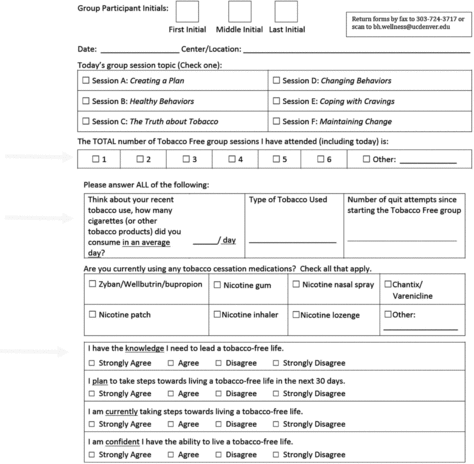
At each session, participants filled out a personal progress form, which gathered information pertaining to three main domains: total number of sessions attended, tobacco use (type, frequency and quit attempt) and personal outlook (subjective ability to live a tobacco-free life, measured on a scale from strongly disagree to strongly agree.) (Figure 1). All variables were assessed via self-report. Since participants filled out the same form at every visit, we expected to have six forms on every person who attended the entire program. For simplicity, missing data were not included in the analysis. All data were de-identified, and this study was exempt from Institutional Review Board review (Office for Human Research Protections, 2016).
Personal progress form used at the DIMENSIONS: Tobacco free program. Arrows indicate the three main domains used in this analysis (the quit attempt question (indicated by the second arrow) is different in newer versions; the new version, and the one used in this study, reads ‘have you quit for at least one day since the last group you attended?’ All other items are the same in both versions).

Statistical Analysis
Analyses were conducted using SAS release 9.4 (SAS Institute, Inc., 2012). For session attendance, we chose self-reported number of sessions attended. We first calculate descriptive statistics for study participants (n = 108), including number of sessions attended, tobacco use frequency (ranging from light to heavy user), tobacco type (cigarettes, cigars, e-cigs, chew, snuff/snus and other), quit attempt (yes or no) and personal outlook regarding tobacco use (measured using a five-point Likert scale). Our dependent variable is whether participants made a quit attempt (yes vs. no), and the primary exposure is number of sessions attended. Lastly, we perform a chi-square test to analyse the association between quit attempts and number of sessions attended (less than three vs. three or more). We use results from the chi-square test as an indication of whether greater attendance at the program is associated with an increased number of quit attempts.
Results
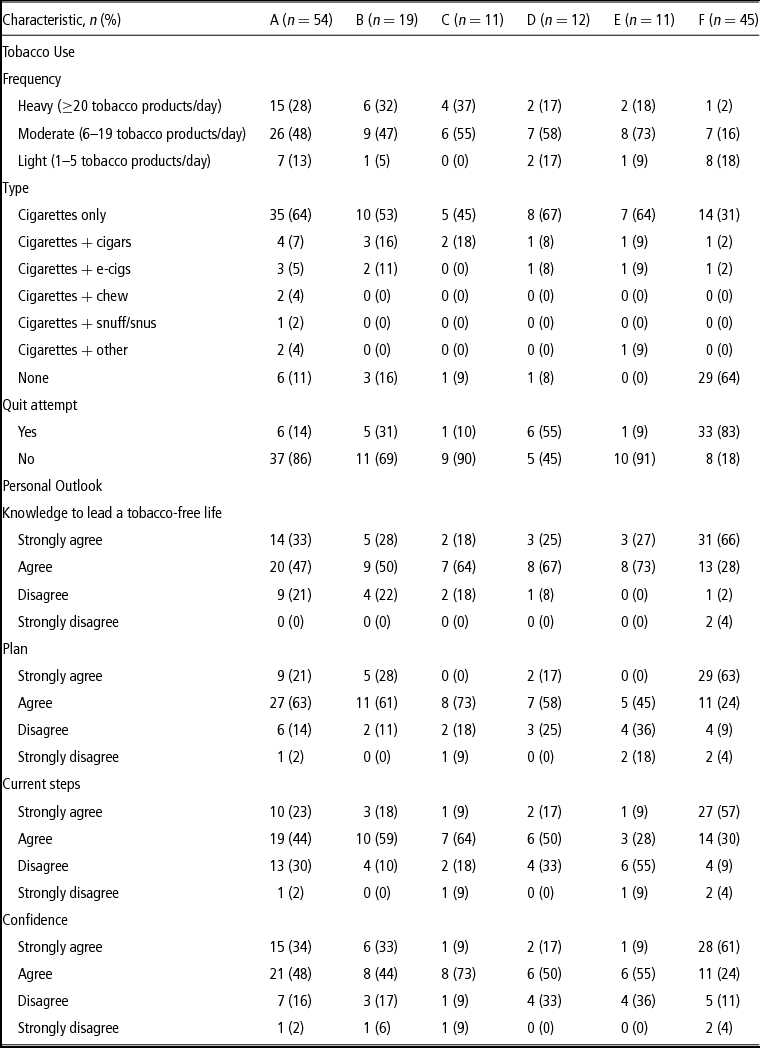
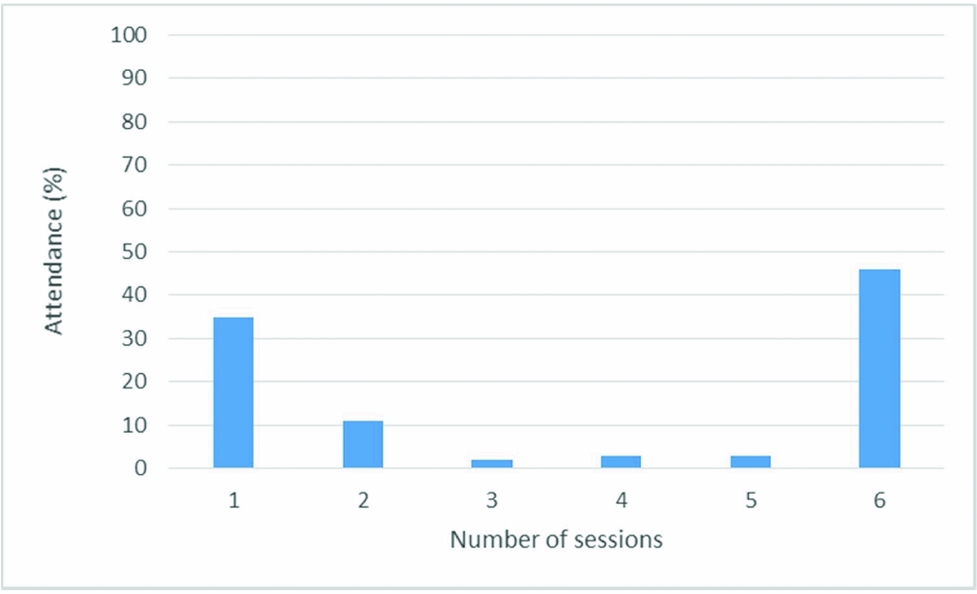
The October’ 16 to March’ 17 DIMENSIONS: Tobacco Free Program sample includes 108 respondents. (Table 1) shows that participants are more likely to report heavy use, defined as using 20 or more tobacco products per day, at session A than session F (28% vs. 2%); conversely, they are more likely to report light use, defined as using between one and five tobacco products per day, at session F than session A (18% vs. 13%). There is a greater proportion of participants reporting quit attempts at the conclusion of the program (83%) than at the beginning (14%). Also, in terms of personal outlook variables, there is almost twice the number of participants reporting the confidence to live a tobacco-free life at session F than session A (61% vs. 34%). (Figure 2) displays participant attendance at the DIMENSIONS: Tobacco Free Program. On average, participants attended less than four sessions, with 35% attending just one session and 46% attending six sessions.
Participant smoking characteristics (n = 108) by session*,a

*Session A = Creating a Plan, B = Healthy Behaviours, C = The Truth About Tobacco, D = Changing Behaviours, E = Coping with Cravings, F = Maintaining Change.
a46 participants attended the same session more than once, and so, the first row sums to greater than 108.
Participant attendance at DIMENSIONS: Tobacco free program.

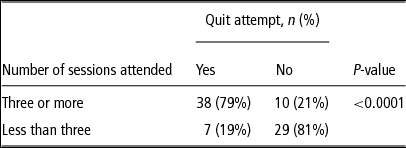
(Table 2) displays results from a chi-square test, assessing quit attempts (dependent variable) by whether participants attended three or more sessions or less than three sessions (primary exposure). A significantly larger proportion of participants made a quit attempt if they attended three or more sessions compared to if they attended less than three sessions (79% vs. 19%, p<0.001).
Chi-square test for quit attempts by whether participants attended three or more sessions or less than three sessions*

*There are 24 individuals who did not respond to the quit attempt question, and so, the cells sum to 84.
Discussion
We have determined that the proportion of participants reporting heavy tobacco use decreased from 28% to 2% at the conclusion of the program, and the proportion of participants reporting quit attempts increased from 14% to 83% at the end of the program. Participants were significantly more likely to make a quit attempt if they attended three or more sessions as compared to those who attended less than three sessions (79% vs. 19%, p<0.001).
This study was one of the first evaluations of the DIMENSIONS program and, as such, is a preliminary overview of a state agency's approach to reducing tobacco use disparity in individuals with mental illness. As both quit attempts and confidence to live a tobacco-free life increased at the end of the program, this evaluation provides preliminary results to suggest that the DIMENSIONS program may support people with a mental illness to increase their confidence in, and initiation of, quit attempts. In this way, our study results reinforced the notion of providing integrated treatment of psychiatric disorders and tobacco use. Improvements for future research on the DIMENSIONS program should address discrepancy between self-reported number of sessions attended and the actual number of forms on file for individuals in attendance. Future iterations of the DIMENSIONS program should include, and control for, demographic variables like age, sex, education and income. Also, as mentioned in (Table 1), there are 54 participants who did not even attend the first session, so suggestions for future research using the DIMENSIONS dataset should consider a way to address this when determining sample size. The high attendance at the first and last sessions could be because participants lent greater importance to sessions titled ‘Creating a Plan’ (first session) and ‘Maintaining Change’ (last session). In conclusion, we urge the medical community to offer tobacco cessation services to individuals with mental illness in a similar fashion as it does to individuals without such diagnoses. In doing so, we join efforts to reduce tobacco-use disparities among adults with mental illness.
Acknowledgements
We thank all members of the Department of Behavioral Health and Wellness at ODMHSAS for their contribution to the project. We thank, in particular, Ms. Jae Jackson for her guidance and support.
Financial support
This research received no specific grant from any funding agency, commercial or not-for-profit sectors.
Conflict of Interest
None.
Ethical Standards
The authors assert that all procedures contributing to this work comply with the ethical standards of the relevant national and institutional committees on human experimentation and with the Helsinki Declaration of 1975, as revised in 2008.