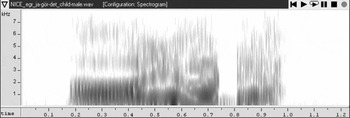
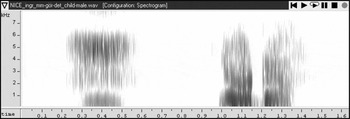
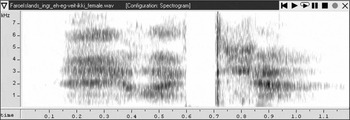
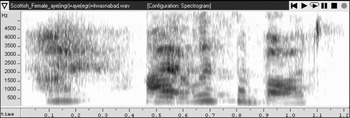
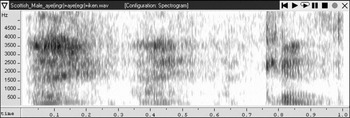
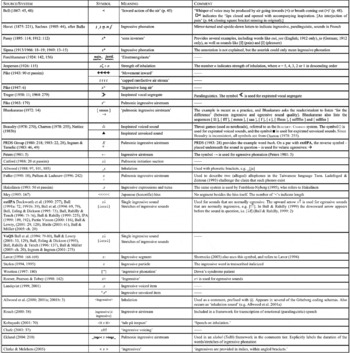
If asked, ‘Will you marry me?’ no one would answer with an ingressive ja.
(Louis A. Pitschmann Reference Pitschmann1987: 156)1 Introduction
Many immigrants to Sweden report being surprised by a strange phenomenon in the speech of locals. While talking to a Swede, they will suddenly hear him or her gasping, as if short of breath or shocked or terrified at what is being said. However, what is happening is simply that it is very common to speak on a pulmonic ingressive airstream in Swedish, and that people from countries (languages) where this does not occur react with legitimate bewilderment when they hear it for the first time.
When asked about this phenomenon, native speakers of Swedish will often answer that ‘women do it’ or ‘people in Norrland [the northern half of Sweden] do it’, while in fact research and experience show that everyone does it, albeit in varying degrees. Anecdotes and general opinion aside, there is – to the best of the author's knowledge – no comprehensive overview of this phenomenon. A few years ago, having stumbled across ingressive speech while analyzing data for a different purpose (reported later in this paper), the author decided to explore in depth the phenomenon of ingressive phonation.
This paper aims to describe pulmonic ingressive phonation and speech from many angles. Consequently, such widely different areas as zoology, physiology, acoustics, pathology, anthropology, ventriloquism, shamanism, musicology, general linguistics, paralinguistics, phonetics, and sociolinguistics will be covered, as will more practical aspects such as the annotation of ingressive phonation within various disciplines. This paper should be regarded as a linguistic-phonetic overview that goes back to the Pythea of Delphi (and even earlier than that) and extends to present-day automatic speech synthesis and recognition.
This article is a review paper that summarizes a cornucopia of the literature. The paper's working title was based around the words what, how, where, who and why, which is reflected in its structure. Consequently, the paper starts out by describing what ingressive speech is and how it is produced (part I), where it is found and who uses it (part II), and why it is used (part III). Finally (part IV), an overview of different annotation systems encountered in the literature is presented, followed by spectral analysis of authentic and spontaneous egressive and ingressive speech produced by the same speakers.
I What and how
2 Ingressive phonation (not necessarily speech)
This section will provide some basic facts about breathing and airstream mechanisms, followed by a summary of ingressive phonation/breathing as it occurs in certain medical conditions, both as a symptom and as a tool, for treatment or experimental investigation.
2.1 Breathing basics
While speech breathing is a prerequisite for the phenomenon under study here, it is also something that, to some extent, falls outside the scope of this paper. The reader who is interested in obtaining more general background information on speech breathing from a wide range of different perspectives is referred particularly to Hixon and collaborators (Reference Hixon and collaborators1987), and also e.g. Behnke (Reference Behnke1882?), Browne & Behnke (Reference Browne and Behnke1884), van den Berg, Zantema & Doornenbal (Reference van den Berg, Zantema and Doornenbal1957), Grosjean & Collins (Reference Grosjean and Collins1979), Weismer (Reference Weismer and Daniloff1985), Hoit & Hixon (Reference Hoit and Hixon1987), Hodge & Rochet (Reference Hodge and Rochet1989), Hoit et al. (Reference Hoit, Hixon, Ellen Altman and Morgan1989), Hixon & Weismer (Reference Hixon and Weismer1995), Winkworth et al. (Reference Winkworth, Davis, Adams and Ellis1995), Stevens (Reference Stevens1998), Ladefoged & Loeb (Reference Ladefoged and Loeb2001) and McFarland (Reference McFarland2001).
In the following sections, an account of different airstream mechanisms is given to provide the reader with a backdrop against which pulmonic ingressive phonation can be treated in the remainder of the paper. Before turning to the details of airstream mechanisms and initiation, it is of interest to point out that breathing in and by itself can be used to signal linguistic meaning (see e.g. Local & Walker Reference Local, Walker, Hicks and Walker2005, to appear).
2.2 Airstream mechanisms and initiation
In this section, the literature on airstream mechanisms will be summarized from a physiological and a phonetic perspective.Footnote 1
Throughout the article, in all direct quotations and the two appendices, the original spelling, punctuation and typography have been preserved as far as possible, with the exception of bold, which has been added to the original by the present author in most cases. Bold is used to highlight central terms and concepts, such as animal names and languages, when new items are introduced within a given theme (section). As is usual for this journal, small capitals indicate emphasis and some technical terms, and italics indicate linguistic examples and certain expressions in languages other than English.
2.2.1 General overview
Human speech is normally produced by pushing air through a set of cavities and articulators, as conveniently described by Kenneth Pike, for example. The human speech apparatus includes five cavities: oral, nasal, pharyngeal, pulmonic and esophageal (p. 85). The cavities can be either active or passive, depending on the sound in question (p. 86), but what is required is that some part acts as the initiator of the sound. In humans, the initiator used most commonly is the lungs, but the larynx, lips, tongue, and esophagus can also be used as the initiator(s). Most often the initiator is located inside the air chamber, e.g. the way the lungs are located beneath the oral and nasal cavities (p. 88).
However, sounds can be produced in other ways, and while most human speech sounds are made on a pulmonic egressive airstream, there are also sounds that do not require an air stream, e.g. gnashing or grinding of teeth (Abercrombie Reference Abercrombie1967: 24) or by moving the jaw from side to side, clashing or scraping the teeth together (Catford Reference Catford1977: 63), or simply opening and closing the lips (Pike Reference Pike1943: 103). Such sounds are called percussives (Pike Reference Pike1943: 103; Catford Reference Catford1977: 63). The ultimate goal of sound production is the creation of vibration in a transmitting medium (air in this case).Footnote 2
In human speech, Ladefoged & Maddieson (Reference Ladefoged and Maddieson1996: 77) summarize the situation thus:
Nearly all of the world's languages are made with the pulmonic airstream mechanism, in which lung air is pushed through the vocal tract by the action of the respiratory system.
Pulmonic egressive speech can be referred to as ‘modified breathing’ (Abercrombie Reference Abercrombie1967: 25; Ball & Rahilly Reference Ball and Rahilly1999: 20). Rosner & Pickering (Reference Rosner and Pickering1994: 2) and Clark, Yallop & Fletcher (Reference Clark, Yallop and Fletcher1995: 17) observe that no known language seems to use ingressive airflow as a distinctive feature. According to Davenport & Hannahs (Reference Davenport and Hannahs1998), among the six possible types of airstream mechanism, two are not found: ingressive pulmonic and velaric egressive, but, they say, ‘it is unclear why this is so’ (p. 9). More recently, Bloomer, Griffiths & Merrison (Reference Bloomer, Griffiths and Merrison2005: 234) observe that while ‘[m]ost speech sounds . . . are made using a pulmonic egressive airstream mechanism . . . [i]t is . . . possible to reverse the direction of airflow so that the air moves from outside the body down towards the lungs’.
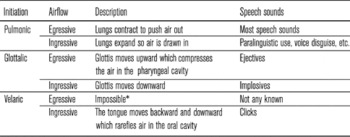
The six possible air stream combinations are shown in table 1. As can be seen in this table, glottalic ingressive airstream is used in the production of implosives, and velaric ingressive airstream is used in the production of clicks.Footnote 3 The latter can also be found in English in the production of such non-speech sounds as tut-tut and tsk-tsk (Jespersen Reference Jespersen1922: 419; Mitchell Reference Mitchell1957: 22; Gimson Reference Gimson1994: 33; Abercrombie Reference Abercrombie1967: 31; Catford Reference Catford1977: 70, 72; Jackson Reference Jackson1980: 3; Roach Reference Roach1992: 20; Brinton Reference Brinton2000: 45; McMahon Reference McMahon2002: 25). However, Cruttenden (Reference Cruttenden2001: 32) points out that the ingressive pulmonic airstream may occur in English as ‘a common way of expressing surprise or pain’. He also mentions an ‘ingressive interdental fricative for hurt’ (Reference Cruttenden1986: 180), while Jackson (Reference Jackson1980: 3) mentions that ingressive lung air is sometimes used in ‘moments of tension’.
Summary of airstream mechanisms (see also Ladefoged Reference Ladefoged1971: 23).

* John Ohala (p.c.) points out that certain kinds of non-speech acts can be executed this way, e.g. ‘squirting out a mouthful of water’.
Ingressive ‘clicks’, used for paralinguistic purposes, are also noted in French. Thus, Havet (Reference Havet1875) points out that ingressive t is used to express doubt; and ingressive palatal t expresses surprise, but can also be used to call horses; ingressive u and ou are kisses (normal and ‘gros’, respectively), while ingressive f expresses surprise and une satisfaction de gourmet (Havet Reference Havet1875: 221; see also Passy Reference Passy1895: 114; Reference Passy1912: 112).Footnote 4 Jespersen (Reference Jespersen1922: 419) mentions that an ‘inbreathed voiceless l’ is used to express delight in eating and drinking, something with which Passy (Reference Passy1895: 114; Reference Passy1912: 112) agrees; and Nyrop (Reference Nyrop1924) notes that inspiratory [f] signals doubt, hesitation, indifference, pain as well as ‘satisfaction du gourmet’ (p. 3).
Beach (Reference Beach1938: 74) points out that
The English word potato may be produced almost equally well by lung expansion (inward breathing) as by lung contraction (outward breathing). In this abnormal (“inspirated”) pronunciation of the word, the initial p produced by inward breathing may be termed a bilabial pulmonic click, since the rarefaction of air is caused by the expansions of the lungs.
Further, Vendryes (Reference Vendryes1950: 39) mentions that in French
En revanche, les clics servent dans toutes les langues à donner des interjections. Ainsi le français a un t inspiré pour exprimer le doute ou attirer l'attention; en inspirant un t alvéolaire on marque l'admiration, la surprise; l'inspiration de f exprime tantôt la satisfaction du gourmet, tantôt la sensation d'un effort ou d'une douleur vive et légère.Footnote 5
Finally, an exhausitive account of paralinguistic click usage is provided by Gil (Reference Gil, Haspelmath, Dryer, Gil and Comrie2005), who – besides repeating after Jespersen (Reference Jespersen1922) that tut-tut and tsk-tsk occur in English – lists a variety of languages from all over the world where paralinguistic click sounds are used, both for affective meanings and to denote ‘yes’ or ‘no’ (e.g. in Hebrew and San'ami Arabic). Gil also provides typological distribution maps.
While most speech is produced on a pulmonic egressive airstream, the alternatives are used for other purposes. However, as Pike (Reference Pike1943: 89) pointed out, more sounds can be produced on lung air than with any of the other mechanisms. Concerning ingressive phonation, he has the following to say (pp. 32–33; footnotes removed):
Types requiring an inverse air stream (suction sounds), whether sounds inbreathed to the lungs or inverse to the mouth, may be illustrated by sounds of pain, drinking, pleasure, kissing, surprised commiseration, impatience, or by a signal to urge horses, and the like.Footnote 6
Although these sounds do not constitute speech, he provides symbols for the annotation of ingressive sounds (Pike Reference Pike1943: 90) and even a (separate) symbol for the annotation of ingressive airstream (Pike Reference Pike1947: 6).
Why does speech so overwhelmingly make use of only one of these possibilities? Catford (Reference Catford1977: 67) provides an answer:
The anthropophonic distribution of pulmonic pressure sounds is universal. Most sounds in all languages have this type of initiation. This is not surprising since, as we have seen, pulmonic initiation makes use of a large volume of air, which allows one to talk for relatively long periods without having to stop and ‘re-charge’ the initiator with air. And the vocal folds, by their shape, present converging, nozzle-like, surfaces to air-flow from below, but present flat surfaces, at right angles to the flow, to airflow from above. They are, consequently, better adapted to the egressive flow of pulmonic pressure than the ingressive flow of pulmonic suction.
Catford (Reference Catford1977) also points out that pulmonic pressure proper differs between egressive and ingressive production. While speech normally lies in the range of 1 to 12 cm H2O, the pulmonic initiator can generate up to 180 cm H2O egressively (Reference Catford1977: 66). Ingressively, however, ‘the absolute maximum inspiratory pressure that can be generated in the vocal tract is somewhat lower than maximum expiratory pressure, being about 100 cm H2O’ (p. 68).Footnote 7 He summarizes this comparison by concluding that (p. 68)
Pulmonic suction initiation, as indicated above, does not accord well with the shape of the vocal folds. Consequently, it is impossible to produce good pulmonic suction voiced sounds; a ‘croaking’ type of inverse voice can, however, be produced with pulmonic suction.Footnote 8
Catford (Reference Catford1988: 57) restates this by simply saying that the ‘shape of the glottis is such that it vibrates well under pressure from below, but not at all well under pressure from above’.
Not only is pulmonic ingressive phonation in general less sonorous and harsher-sounding than its egressive counterpart but it is also less suited to the production of certain specific sounds. As Abercrombie (Reference Abercrombie1967: 25) and Catford (Reference Catford1977: 68) pointed out, the English word yes is only produced ingressively on the ye part, the final s being egressive.Footnote 9 This is attributable to physiological-acoustic reasons. Catford (Reference Catford1988: 20–22) addresses this issue in some detail:Footnote 10
Indeed, while the pulmonic suction [f↓] sounds fairly normal, the pulmonic suction [s↓] hardly sounds like an [s] at all. Why? The reason for this difference is easily explained . . . the air-stream, whether egressive as for pressure [f] . . . or ingressive as for suction [f↓] . . . squeezes through between the teeth and lower lip and through the interstices between the teeth, becoming turbulent and noisy as it does so. But the articulatory channel through which the air squeezes is of much the same shape whichever way the air is flowing—so the turbulent airflow and the resultant hiss-sound are much the same for each direction of the flow. . . . In the pulmonic pressure [s] . . . the egressive airstream first squeezes through a narrow channel between the tongue and the ridge behind the upper teeth (alveolar ridge). As it passes through this channel it is accelerated, becomes turbulent (‘channel turbulence’), and issues from the channel in a high-velocity turbulent jet. This jet strikes the teeth, and this imparts further turbulence to it: beyond the teeth, ‘downstream’ from the teeth, there is a turbulent wake, full of swirling movements or ‘vortices’. The turbulence of the wake (‘wake turbulence’) contributes an additional rather high-frequency component to the hiss-noise of [s]. In the pulmonic suction [s↓] . . . however, the ingressive air-stream coming from outside of the mouth flows rather slowly and non-turbulently past the teeth and inwards through the narrow [s]-type articulatory channel. Once again, it is accelerated as it passes through the channel, and emerges as a turbulent high-velocity jet. But this inflowing, ingressive, jet, as it shoots into the interior of the mouth, meets with no obstacle comparable to the teeth and so acquires no additional wake turbulence. Because of the absence of wake turbulence the ingressive, pulmonic suction [s↓], sounds noticeably different from the egressive, pulmonic pressure [s].Footnote 11
Ohala (Reference Ohala, MacNeilage and Kreidler1983: 192) provides an account of the differences between egressive and ingressive sound production in general, and describes the overall differences in sub- and supra-glottal pressure between the two initiation processes; he also discusses the shape of the vocal folds. Ohala points out that certain sounds, notably sibilants such as [s,ʃ], do not easily lend themselves to ingressive production. However, he also mentions that he can ‘phonate in falsetto voice about as well ingressively as egressively’ (p. 192).Footnote 12 This is attributable to the fact that in falsetto production, ‘the vocal cords are considerably thinned and thus have a more symmetric coronal profile’ (p. 192).Footnote 13
Although there are different ways in which the human speech apparatus can be used to produce sounds, the overwhelming majority of sounds are produced on a pulmonic egressive airstream. The reason for this is attributable to phenomena such as breath control, the shape of the vocal cords, sub- and super-glottal pressure. We have also seen that even when speech is in fact produced on a pulmonic ingressive airstream, not all sounds can be produced, at least not ones with similar phonetic-acoustic properties.
2.2.2 Detailed description
This section gives an in-depth description of the physiological and acoustic detail of inspiratory vocalization.
Moore & Van Leden (Reference Moore and Von Leden1958) provided a detailed account of how the vibratory pattern of the inspiratory voice differs from that which occurs during exhalation based on high-speech cinematography of the larynx, and described the transition from exhalation to inhalation as a five-step process (p. 220):
1. Vocal folds stop vibrating during the moment exhalation ceases
2. During this transition the motionless vocal folds are partially abducted
3. The arytenoid cartilages are abducted and remain so throughout inspiratory phonation
4. Vocal folds begin to vibrate with a small lateral displacement at the edges
5. This motion is followed by a sudden medial sweep of the folds that accomplishes the vibratory closure of the glottis
When these authors looked at a single vibratory cycle, they observed a ‘marked difference from the vibrations of expiratory phonation’ (p. 220), including ‘an unusually long opening phase and a very brief closing phase’, and also that it ‘is evident that all points on the glottal margins do not move at the same time, at the same rate, or the same degree’ (p. 221).
Hartlieb, Luchsinger & Pfister (Reference Hartlieb, Luchsinger and Pfister1960) compared expiratory and inspiratory phonation at low, middle, and high frequencies, and observed among other things that the inspiratory voice had a shorter closed phase.
Orlikoff, Baken & Kraus (Reference Orlikoff, Baken and Kraus1997) investigated F0, electroglottographic (EGG) and airflow patterns in sixteen men and women who alternated between expiratory and inspiratory phonation. They observed that F0 increased by 5.1 semitones (on average) during inspiratory phonation, that inspiration showed a more symmetrical pattern of vocal fold contact, that both jitter and EGG amplitude perturbation were significantly higher during inspiration, and that the airflow rate was on average 48.5% higher during inspiration. They also observed that both inspiratory pulse and falsetto could be produced by at least some of the subjects, ‘indicating some control over the mode and frequency of vocal fold vibration when driven by an ingressive airflow’ (p. 1838).
Hoole, Munhall & Mooshammer (Reference Hoole, Munhall and Mooshammer1998) investigated how tongue movements are affected by changes from egressive to ingressive airstreams. They observed ‘consistent reductions in forward tongue movement during consonant closure in the ingressive conditions’ (p. 131). They also observed that ‘respiratory activity for the ingressive tokens is rather vigorous compared to the egressive tokens’ (p. 142), thus confirming the observation made by Orlikoff et al. (Reference Orlikoff, Baken and Kraus1997) that airflow rate is higher during inspiration. (See also Hoole Reference Hoole, Hahn, Schneider and Hahn1999.)
Kelly & Fisher (Reference Kelly and Fischer1999) studied laryngeal adduction, F0 and intensity in egressive and ingressive phonation. They observed a decrease in vocal fold contact and an increase in F0 during inspiration, but no consistent differences with regard to intensity. They also pointed out that all subjects produced ingressive speech with a ‘breathy quality’ (p. 395), and that ingressive phonation is used ‘for artistic purposes such as jazz singing’ (p. 400).
Robb et al. (Reference Robb, Chen, Gilbert and Lerman2001) – who adhered to the Lehmann (Reference Lehmann1965) terminology of ‘reverse phonation’ – studied vowel articulation produced on egressive and ingressive airstreams. They repeated the observations mentioned above that F0 is higher in ingressive speech, but also found that F1 and F2 values varied (in both directions) as a function of the particular vowel being produced.
2.3 Pulmonic ingressive clicks
Click sounds are normally produced on a velaric ingressive airstream, but Traill (Reference Traill1991) mentions a type of click that is accompanied by a pulmonic ingressive airstream:
[E]vidence is provided from !Xóõ, a Khoisan language of Botswana, that nasally ingressive airflow occurs during the production of a certain class of aspirated consonants (so-called “delayed aspirated” click consonants . . ., and that this is due to pulmonic suction. . . . It has been shown for both Nama and Zhu that the mechanism which produces the aspiration with an inaudible release of the velar closure involves venting the pulmonic pressure nasally during the articulation of the click. (p. 13)
These tracings show that voiced and unvoiced nasalisation use egressive pulmonic air, while “delayed aspiration” uses ingressive pulmonic air. (p. 17)
Ladefoged & Traill (Reference Ladefoged and Traill1984) had already pointed out that ‘[i]nsofar as sounds with delayed aspiration are widespread in Khoisan languages, this is an areal rather than a language-specific phenomenon’ (Reference Ladefoged and Traill1984: 13–14). It is clear that pulmonic ingressive airstream is used in at least one form of click sound production, even if it is not a part of the click itself. (See also Beach's (Reference Beach1938) observation mentioned in section 2.2.1 above.)
2.4 Medical observations
Not all ingressive speech is produced deliberately, but can instead be a symptom of a speech disorder. For example, ingressive phonation plays a role in pathological wheezing (Gavriely et al. Reference Gavriely, Palti, Alroy and Grotberg1984), and has been observed in a child with Down's Syndrome (Wootton Reference Wootton, Beveridge, Conti-Ramsdem and Leudar1997). Some cases where ingressive phonation occurs in pathology will be described in the following section.
2.4.1 Inspiratory phonation in various pathological conditions
In a paper on spastic dysphonia, Critchley (Reference Critchley1939) discusses previous publications on dysarthria where the term inspiratory phonation was used to describe the condition in question. The characteristics of this particular voice condition are said to be voiced sounds ‘emitted in a peculiarly harsh and constrained fashion, the pitch being at times unduly low and at others excessively high’ (p. 96). However, the speech condition thus described is, in fact, not ingressive speech, but ‘[a]lthough the whole of the speech takes place during expiration, the sound-effect is unnatural and suggests the pictoresque though incorrect title of “inspiratory speech”’ (p. 96). However, Critchley does not entirely rule out the possibility that some such speech may indeed be produced on an inspiratory airstream, although he makes the (erroneous) observation that ‘only in whispered speech is it possible to speak upon an inspiratory phase’ (p. 102).Footnote 14 Another early source is Curry (Reference Curry1940), who mentions that ‘inspiratory voice may come also as a disorder or pathology of normal voice’ (p. 2). Even though the title of Critchley's paper includes the phrase ‘inspiratory phonation’, it seems likely that it did not refer to the use of pulmonic ingressive phonation, at least not in any important way.
Stewart (Reference Stewart1968: 153) mentions that ‘pulmonic ingressive fricatives’ were observed in deaf children.
Frint & Kelemen (Reference Frint and Kelemen1969) describe a case of inspiratory phonation with a psychogenic origin (which lasted for months), while Nwokah et al. (Reference Nwokah, Hsu, Davies and Fogel1999) describe inspiratory phonation as one of several ‘pathological’ deviations from normal laughter.Footnote 15
Coombes (Reference Coombes, Yule and Rutter1987: 358) mentions that some ‘cerebral-palsied children . . . sometimes phonate on an ingressive air stream’, and ingressive speech as part of the speech in speakers with cerebral palsy is also mentioned in Hewlett & Beck (Reference Hewlett and Beck2006: 29). Finally, O'Regan & Brown (Reference O'Regan, Brown, Cockerill and Carroll-Few2001: 60) point out that children with hyperkinetic bulbar palsy sometimes phonate on an ingressive airstream.
2.4.2 Inspiratory phonation as a part of stuttering
Early sources to mention ingressive phonation as part of stuttered speech are Viëtor (n.d.a, b: 4; Reference Viëtor1884: 3), Zwaardemaker (Reference Zwaardemaker1909: 7) and Eijkman (Reference Eijkman1937: 12/1955: 11). More recently, Van Riper (Reference Van Riper1982: 129) describes sudden inhalations as one of the secondary behaviors among some people who stutter:
Among some of the most severe secondary behaviors shown by confirmed stutterers are the sudden gaspings that seem to be used to interrupt the closures of the airway. There are the so-called “sniffing stutterers” who seek to open the laryngeal closures by inhaling air through their noses, and the “sucking stutterers” who inhale through the mouth, thus opening lip and tongue closures.
Also, Ball et al. (Reference Ball, Code, Rahilly and Hazlett1994: 79) report that one of their subjects exhibited ingressive speech:
[A] young adult male stutterer (Mr S), aged 24 at the time of the recording. . . . In spontaneous speech he used excessive struggle behaviors . . . He had particular difficulty with initiating voicing at sentence boundaries, due to an intermittent ingressive gasp of air, or intrusive nasal snort. Ingressive air flow was also found in other situations.
It has been shown several times that people who stutter have reaction times longer than people who do not stutter on a number of tasks, be they speech-related or non-speech related (e.g. Dinnan, McGuiness & Perrin Reference Dinnan, McGuiness and Perrin1970; Cross & Luper Reference Cross and Luper1979, Reference Cross and Luper1983; Cross, Shadden & Luper Reference Cross, Shadden and Luper1979; Venkatagiri Reference Venkatagiri1981). A question that presents itself is whether inspiratory phonation is performed differently by people who stutter and people who do not stutter, and this issue has been addressed in a couple of studies.
Reich, Till & Goldsmith (Reference Reich, Till and Goldsmith1981) compared laryngeal and manual reaction times in adults that stuttered and adults that did not stutter, and found that people who stuttered performed significantly slower than people who did not stutter only on speech phonation tasks, while no reaction time differences were found on non-speech phonation tasks, which included inspiratory phonation. Till et al. (Reference Till, Reich, Dickey and Seiber1983) performed a similar study on adults that stuttered and adults that did not stutter, and obtained the same results, i.e. while people who stuttered had slower reaction times on speech phonation tasks, no such differences were found with regard to inspiratory phonation. This could, they argue, be taken as suggestive evidence that inspiratory phonation is not a normal mode of producing speech.
2.4.3 Psychiatric observations
Key (Reference Key1975a) mentions that ‘vocal behavior of mentally disturbed patients sometimes shows more use of ingressive air movement during speech’ and that ‘[p]sychiatrists have noted that a disturbed patient may speak for long periods of time with only ingressive air’ (Reference Key1975a: 69–70). However, there is no reference to any corroborating psychiatric work.
2.4.4 Ingressive speech as a tool and treatment
Ingressive vocalization has also been used as a tool within the medical discipline, both when examining patients and as a treatment for patients with some type of speech disorder. Already as early as in the 19th century, Merkel (Reference Merkel1866: 278–280) pointed out that inspiratory speech was useful in the treatment of certain speech disorders.
Powers, Holtz & Ogura (Reference Powers, Holtz and Ogura1964) used inspiratory phonation to examine the larynx and pharynx for medical reasons. They observed (p. 14) that inspiratory phonation was ‘of considerable value’ in this respect and that during inspiratory phonation, the ‘ventricle is widely dilated and the enlargement of the true cord is easily seen’ and that the ‘configuration of the medial aspect of the hypopharynx is easily identified’.
In a follow-up of the Powers et al. (Reference Powers, Holtz and Ogura1964) study, Lehmann (Reference Lehmann1965) pointed out that ‘[d]uring reverse phonation the main change is distention of the ventricles . . . Other changes are less striking’ (p. 216), and concluded that reverse phonation ‘is useful in determining the extent of vocal cord tumors, in differentiating exophytic from invasive tumors, and in deciding upon appropriate therapy’ (p. 221).
Réthi (Reference Réthi1965) used inspiratory–expiratory phonation to treat stuttering and dysphonia. Kollár (Reference Kollár1973) reported successfully treating hundreds of patients diagnosed with recurrent palsy, ventricular voice, vox fistulosa and other disorders by having them phonate on inspiratory airstreams. Kollár (Reference Kollár1973) also pointed out that some of his patients produced much better-sounding speech on ingressive airstream than they did on an egressive airstream. Inspiration can also be used constructively by people who stutter, as observed by Van Riper (Reference Van Riper1982: 130):
Some stutterers even seek to overcome their blockages by resorting to speech on inhalation and this too can occasionally be successful. Some old therapists used to recommend “drawback phonation” as a major part of their therapy. Unfortunately the speech produced thereby is so weak and abnormal that few stutterers will use the technique and a few of them manage to close off the airway so that even inhalation is impossible. We have had some stutterers who fainted and fell to the floor when doing this.
Harrison et al. (Reference Harrison1992: 375) report on a patient who uses inspiratory speech deliberately as a communicative tool:
We report a case study of one of the authors (G.A.H.), who has used inspiratory speech (IS) for 6 years to the virtual exclusion of expiratory speech (ES) as a means of overcoming the communication problems associated with severe adductor spastic dysphonia (ASD). This voice is perceptually rough but fluent. The loudness is such that he has been able to resume teaching, public speaking, and other forms of vocal communication that were impossible with ES. . . . Two years after the onset of ASD, the subject started producing an occasional word on the deep inspiration required before attempting expiratory phonation. Within a few weeks his IS was fluent enough for social use.
The authors report that the patient is able to speak for prolonged stretches of time in this manner, with only a need to clear his throat with a cough or two every five or ten minutes. All in all, the patient has found a good means of keeping up his communicative abilities, and ‘has found IS more comfortable than ES’ (p. 381). (See Colton, Casper & Leonard (Reference Colton, Casper and Leonard2006: 354–355) for a recent discussion of Harrison et al. Reference Harrison1992.)
Reich & Till (Reference Reich and Till1983) examined reaction times in ten women with spasmodic dysphonia compared to ten normal-speaking women. They found no performance differences on the inspiratory phonation task and concluded that spasmodic dysphonic patients only exhibit longer reaction times on ‘speech-like or motorically complex’ tasks (p. 16), implying that inspiratory phonation is not ‘speech-like’.
Rammage, Morrison & Nichol (Reference Rammage, Morrison and Nichol2000: 167) simply observe in their chapter on voice therapy that ‘ingressive airflow techniques can be trained’.
There are other sources within voice therapy that mention inspiratory phonation as either a tool or a treatment. For example, Schulman (Reference Schulman and Stemple1993) indicates that this is still an acknowledged method within speech pathology.Footnote 16 For recent accounts of the use of ingressive phonation as a therapeutic tool, see Maryn, De Bodt & Van Cauwenberge (Reference Maryn, De Bodt and Van Cauwenberge2003), Finger & Cielo (Reference Finger and Cielo2007) and Shiba, Isono & Nakazawa (Reference Shiba, Isono and Nakazawa2007).
2.5 Ingressive speech in physiology
In the early 1920s, Panconcelli-Calzia (Reference Panconcelli-Calzia1921, Reference Panconcelli-Calzia1924) had a subject produce ingressive phones in respiration experiments.Footnote 17 Ingressive phonation has also been used more recently to test physiological theories in speech production.
2.5.1 Formant production
Miller et al. (Reference Miller, Sulter, Schutte and Wolf1997) asked a singer to produce the vowels /i/, /u/, /a/ and /ɛ/ in three different ways: singing, with a vocal fry and on ingressive airstream. Using magnetic resonance imaging (MRI) and linear predictive coding (LPC) they compared the acoustic and spatial dimension of the vocal tract, and observed (pp. 8–9) that
Comparing the acoustic with the spatial data, one is faced with a puzzle. On the one hand, the subject demonstrates the ability to produce accurate acoustic imitations, with respect to the first two formant frequencies, among various phonation types. On the other hand, the MR images reveal markedly, and in some respects systematically, dissimilar vocal tract articulations among the phonation types. These facts seem sufficient evidence to falsify the hypothesis that the accurate imitations are achieved by maintaining or repeating a specific posture of the vocal tract. The accurate reproduction of the first two formants of the vowels appears to have an aural basis.
Dedouch et al. (Reference Dedouch, Horáček, Vampola, Švec, Kršek, Havlik and Zolotarev2002) used ingressive phonation to estimate formant frequencies for the five short vowels in Czech. One of the authors, Jan Švec (p.c.), reports that ingressive speech was used simply because it made the estimation of the formant frequencies simpler, and that ingressive speech does not normally occur in Czech. Fuchs & Perrier (Reference Fuchs and Perrier2005) also used ingressive phonation when studying kinematic behaviour in speech production.
2.5.2 F0 declination and expanding rib cages
It has often been observed that there is an F0 declination in phrases and sentences, and a number of hypotheses have been proposed to explain this phenomenon. Dunn & Ohala (Reference Dunn and Ohala2000) hypothesized that F0 declination is a feature of planned speech, used as a means to help the listener, and set out to reassess the hypothesis that F0 declination is automatic and caused by the collapsing rib cage, which, during speech, creates an inward air flow. Dunn & Ohala asked ten speakers to produce a total of 260 scripted utterances, a half on an egressive airstream, and a half on an ingressive airstream. They found that 75% of the egressive utterances exhibited F0 declination, while 50% of the ingressive utterances showed F0 declination. The most important conclusion, however, was not the quantitative difference between the egressive and the ingressive utterances, but the fact that despite the expanding rib cage, half the ingressive utterances were still produced with F0 declination. A similar experiment was carried out by Ohala, Dunn & Sprouse (Reference Ohala, Dunn and Sprouse2004), and the same results were obtained. The authors take this as partial support for their claim that F0 declination is not automatic, but purposely imposed.
II Where and who
3 Ingressive phonation and ingressive speech
Before addressing the where and who questions, the present section describes how well known ingressive speech really is. A simple metric is to consult a few linguistic dictionaries and encyclopedias to get a general impression of the status of the phenomenon under scrutiny.
3.1 Ingressive speech in dictionaries and encyclopedias
In The Cambridge Encyclopedia of Language (Crystal Reference Crystal1987: 125) the following passage is found:
It is also possible – though not usual – to speak while the air stream is flowing inwards to the lungs (pulmonic ingressive air). We occasionally hear this air stream used in English when someone is trying to talk while laughing or crying, or when out of breath. Words such as yes and no are sometimes said with an ingressive air stream, when we use a ‘routine’ tone of voice to acknowledge what someone is saying. An alternate use of egressive and ingressive air streams is sometimes heard when people are counting rapidly, ‘under their breath’. But ingressive air is of poor quality, muffled, and croaky, and many people find it unpleasant to listen to. It is never put to routine use in everyday English speech.
In A Dictionary of Linguistics and Phonetics (Crystal Reference Crystal1997: 197) the entry ‘ingressive’ reads thus:
ingressive A term used in the phonetic classification of speech sounds, referring to all sounds produced using an inwards-moving airstream mechanism. The opposite category is egressive, which is the normal mode for speech production. Ingressive sounds are often heard incidentally, as when one speaks while breathing in, when out of breath, or vocalizes upon a sudden intake of breath when expressing pain or surprise. Two types of ingressive sound are used as part of the phonemic systems of some languages: implosive consonants such as [ɠ], [ɗ], [ɓ], made by an inward flow of air in conjunction with glottal vibration; and velaric consonants, which constitute such click sounds as [ǀ] (as in ‘tut tut’), made by in inward flow of air in conjunction with contact made at the velum.
Roach (Reference Roach1992: 54; Reference Roach2002) includes the following passage in the entry for ‘ingressive’ in his printed Introducing Phonetics and its online relative:
It is possible to speak while drawing air into the lungs: we may do his when out of breath, or coughing badly; children do it to be silly.
Finally, a slightly more technical and succinct description is given in the Routledge Dictionary of Language and Linguistics (Bussmann Reference Bussman1996: 231):
ingressive [Lat. ingredi ‘to go into,’ ‘to begin’]
. . .
2. Speech sound formed, in contrast with an egressive, when air flows into the initiating air chamber. As a rule, clicks are ingressive; implosives are by definition ingressive. If air flows into the lungs, then the ingressive sound is said to be an inspiratory sound.
Because human speech is based on underlying principles (physiological-acoustic) that are shared by other species to meet specific communicative needs, the question presents itself whether ingressive phonation shows up in animal sound production.
3.2 ‘Ingressive species’ with ingressive ‘speeches’
Sound production is not an exclusively human characteristic and occurs also in most animals. Although animal sounds can be produced in a wide variety of ways, some are produced by using the throat in a way similar to human speech.
3.2.1 General observations and sundry animals
Segond (Reference Segond1848:14–16) mentions that dogs, foxes, cats, horses, donkeys and birds (e.g. chickens) employ ingressive phonation. Milne-Edwards (Reference Milne-Edwards1876–1877) – who seems to have read Segond – mentions that both the ass and the horse (pp. 600, 601) exploit ingressive airstream in their vocalizations, while Waller (Reference Waller1891: 149/1896: 153) points out that ‘animals such as the cat, pig, and ox, vocalise with inspiration’. Horses are also mentioned by Pressman & Kelemen (Reference Pressman and Kelemen1955: 547).
In his classic work, The Mechanism of the Larynx, Negus (Reference Negus1929: 366–367) includes a paragraph on ‘inspiratory phonation’:
There is little to say on this subject. It would be almost impossible for a Lemur to cause its inferior folds to vibrate during inspiration, because they would almost certainly be forced into firm apposition by the air current, and once tightly closed they would not again separate until the intake of air had ceased. A Cow, on the other hand, could produce vibrations during inspiration quite as easily as during expiration, because the thyro-arytenoid folds are not valvular, and are of almost equal shape at their upper and lower limits . . . . The syrinx of Birds is well adapted to the production of sound during inspiration, as well as during expiration; it is partly for this reason, in association with the large capacity of the system in their air sacs, that tones can be sustained for a prolonged time, and a song continued without any pause for respiration. It has been observed in the case of an Amazon Parrot that all the words were spoken on the inspired breath.
Further, according to Negus ‘the Bush Dog appears to make sounds in this manner . . . A Horse and an Ass neigh partly in inspiration’ (Negus Reference Negus1929: 367, referring to Milne-Edwards Reference Milne-Edwards1876–1877). Negus also pointed out that ‘Cats purr continuously, both when blowing out and taking in the breath, with a partly closed glottis’ (p. 367), and this is also mentioned by Darwin (Reference Darwin1872: 129):
Cats use their voices much as a means of expression, and they utter, under various emotions and desires, at least six or seven different sounds. The purr of satisfaction, which is made during both inspiration and expiration, is one of the most curious. The puma, cheetah, and ocelot likewise purr; . . . It is said that the lion, jaguar, and leopard, do not purr.Footnote 18
That cats purr on inhalation is a widespread observation, and is encountered both in the scientific literature and in popular accounts; early sources include Zwaardemaker & Eijkman (Reference Zwaardemaker and Eijkman1928), Eijkman (Reference Eijkman1937/1955), Moelk (Reference Moelk1944) and Hussel (Reference Hussel1949). Zwaardemaker & Eijkman (Reference Zwaardemaker and Eijkman1928: 14) and Eijkman (Reference Eijkman1937: 12/1955: 11) confirm also that the cat miaows ingressively, and Moelk (Reference Moelk1944) notes also that ingressive phonation in the cat is employed in a wide variety of sounds besides purring, with a variety of communicative functions.
Remmers & Gautier (Reference Remmers and Gautier1972) conducted an electro-myographic study of feline purring. More recent works include Bradshaw & Cameron-Beaumont (Reference Bradshaw, Cameron-Beaumont, Turner and Bateson2000: 71), Sunquist & Sunquist (Reference Sunquist and Sunquist2002), who also point out that purrs ‘are louder and rougher-sounding during inspiration than during expiration’ (p. 422), and Fisher (Reference Fisher2005: 41) tells us that purring occurs ‘both while the cat is breathing in and while it is breathing out’.Footnote 19 Sunquist & Sunquist (Reference Sunquist and Sunquist2002: 423) mention also the existence of an ingressive ‘vocalized gasp’ which is present in the leopard's sawing (i.e. roaring sequence).
3.2.2 Birds
As was observed by Negus (Reference Negus1929), songbirds sustain tones for very long stretches of time and one of the reasons that this is possible is because they produce sounds on both inspiration and expiration. This is addressed by Hunter (Reference Hunter1980: 101), who, in a study on the Eurasian nightjar (Caprimulgus europaeus), observes that
Nightjars can sing for several minutes during which the interval between pulses never exceeds 40 ms. This presents two complementary problems: (1) how do the birds get enough air to vocalize for so long and (2) how do they get oxygen while vocalizing?
Contrary to Negus (Reference Negus1929), Hunter (Reference Hunter1980: 102) states that it is ‘widely accepted that avian vocalizations occur only during exhalation’, but he also points out that ‘this idea is largely based on a limited amount of work on dead birds’ (p. 102). He concludes ‘that nightjars may sustain long vocalizations by singing one part of their song, the short trill, during inhalation’ (p. 103).
Gaunt & Gaunt (Reference Gaunt and Gaunt1977: 15) observe that the chicken (Gallus gallus) ‘may reverse the flow of air by inhaling . . . may be accompanied by a distinct, sometimes quite loud, wheezing sound’. Hunter (Reference Hunter1980) follows Gaunt & Gaunt noting that the turtle dove (Streptorella turtur) produce parts of their vocalizations on inspiration, and he cites Kneutgen (1969),Footnote 20 who hypothesized that the white-rumped shama (Copsychus malabaricus) probably vocalized during inhalation.
In a more recent study on the zebra finch (Taeniopygia guttata), Goller & Daley (Reference Goller and Daley2001: 2301) report that ‘some male zebra finches also sing particular syllables of their motif during inspiration’. Interestingly, it seems that this feature of male zebra finch singing is learned behavior, copied from ‘tutors’; Goller & Daley (Reference Goller and Daley2001: 2304) speculate that given the ‘growing evidence that songbird females exhibit a preference for complex songs’, perhaps inspiratory syllables are especially attractive.Footnote 21 Unlike the inspiratory vocalizations made by the nightjar, which were made during long stretches of song, the zebra finches produce their inspiratory vocalizations on short songs. From an acoustical point of view, inspiratory syllables are ‘acoustically distinct from all other zebra finch song syllables’ (Goller & Daley Reference Goller and Daley2001: 2301), having a high fundamental frequency. However, when Leadbeater, Goller & Riebel (Reference Leadbeater, Goller and Riebel2005) investigated whether ingressive sound production was more attractive to female zebra finches, they concluded (p. 909) that although ‘songs containing inspiratory phonation clearly differ both in performance aspects (syllable rate and motif length) and in structure from those that are wholly expiratory’ and that ‘inspiratory syllables are indicative of enhanced motor control . . . [s]ong motifs containing inspiratory phonation were not systematically preferred . . . implying that this unusual trait does not impact significantly upon song attractiveness in an intersexual context’.
Finally, Wild, Goller & Suthers (Reference Wild, Goller and Suthers1998) studied muscle activity during song in the zebra finch and the cowbird (Moluthrus ather), and concluded that both expiratory and inspiratory muscles are active during vocalization in both birds. However, it is not completely clear in their article whether actual singing took place during inhalation, as distinguished from their observation that inspiratory muscles were active during song.
3.2.3 Frogs
Turning to amphibians, Weber (Reference Weber1974) studied the bioacoustics of two types of painted frog, the Discoglossus pictus and the Discoglossus sardus. He found that several types of calls exploited inspiratory phonation, notably mating calls and release calls.
Schneider (Reference Schneider, Frisch, Ryan, Wilczynski, Hetherington and Walkowiak1988: 543) observes that ‘in male Bombina (Discoglossidae) the inspiratory airstream produces the calls, although the closely related genus Alytes vocalizes in the usual way, by expiration’.
Wilczynski, McClelland & Rand (Reference Wilczynski, McClelland and Rand1993: 428) mention that ‘H. microcephala usually produced its secondary notes as doublets, or “biphasic notes”’ (sonogram on p. 429), while Cameron & Cogger (Reference Cameron and Cogger1992: 18) refer to the ‘low soft biphasic notes’ of the Litoria genimaculata.
3.2.4 Monkeys and apes
Turning to our closest relatives, monkeys and apes, several sources mention ingressive call production. Tenaza (Reference Tenaza1989: 200) discusses langurs (Simias concolor), endemic to the Mentawai islands off the west coast of Sumatra:
Loud barks in TOLC's [type 1 loud call] often were followed by audible gasps. Presumably, the bark is produced on exhalation, the gasp on inhalation.
Richman (Reference Richman1976: 719–720) mentions that gelada monkeys ‘produce long strings of alternations of egressive and ingressive phonations’ (see also Richman Reference Richman1978: 571, 573; Reference Richman1993: 722), and includes spectrograms of ingressive phonation (Reference Richman1976: 720–722; Reference Richman1978: 574, 576).
Itani (Reference Itani1963: 15) mentions that the ‘wild Japanese monkey’ produces ‘sounds uttered in inhalation’ and that in one group studied ‘are included both sounds uttered by the exhaling breath and by the inhaling breath’ (p. 19).
That various species of gibbons exploit ingressive call production is mentioned in a range of papers by Thomas Geissmann and colleagues (Geissmann Reference Geissmann1984: 219, 222, 231; Reference Geissmann1991: 360; Reference Geissmann and Wallin2000: 113 et passim; Geissmann & Dallmann Reference Geissmann and Dallmann2002: 25; Geissmann & Nijman Reference Geissmann and Nijman2006: 5, 9):
The use of biphasic notes (alternate production of exhalation and inhalation sounds) probably represents a primitive characteristic for both male and female vocalizations. Of interest, biphasic notes occur in the great calls of only few gibbon species (H. agilis, H. lar, H. hoolock), but are dominant in those of a hybrid between H. muelleri and H. syndactulus, although neither males nor females of the two parental species are known to produce these types of notes. Biphasic notes are dominant in the female great calls of H. hoolock and H. syndactulus, and they also occur rarely in H. agilis, H. lar, and H. moloch. These types of notes are also dominant in the male song of H. hoolock, H. agilis, and H. pileatus, and occur occasionally in H. lar and H. moloch as well. (Geissmann Reference Geissmann and Wallin2000: 113)
Interestingly, the ingressive parts of the calls are also produced ‘approximately one fifth higher’ than the egressive parts (Geissmann Reference Geissmann1984: 219), as has been pointed out for human sound production by e.g. Robb et al. (Reference Robb, Chen, Gilbert and Lerman2001) (see section 2.2.2 above). Spectrograms of ingressive sound production can be found in Geissmann (Reference Geissmann1984: 27; Reference Geissmann and Wallin2000: 114).
Orangutans are also known to produce ingressive sounds. Already in 1922, Hornaday mentioned that under excitement ‘the orang can produce a roar by inhalation’ (Hornaday Reference Hornaday1922: 61). Dixson (Reference Dixson1998: 49) mentions that the orangutan's long call ‘consists of a series of loud moaning vocalizations, interspersed with “bubbling sounds” produced by inhalation’. Geissmann (Reference Geissmann and Wallin2000: 113, 115), citing a number of works, also mentions ingressive sound production in the orangutan (Pongo pygmaeus) calls. A sonogram of an orangutan ‘inhalation sound’ is given in Davila Ross & Geissmann (Reference Davila Ross and Geissmann2007: 313), who also mention (p. 314) that orangutans ‘often purr during inhalation’.
Turning to chimpanzees, an early source that mentions ingressive calls is Marler (Reference Marler1969), which refers to grunts that ‘alternate rapidly with “panting” sounds during inhalation’ (p. 97). The paper also includes (p. 96) spectrograms of inspiratory pant grunts. Goodall (Reference Goodall1986) reports several cases of inspiratory vocalization in the sound production of chimpanzees, notably laughter (p. 130) and general ‘pant-hoots’, which include a variety of subclasses such as ‘inquiring pant-hoots’, ‘arrival pant-hoots’, and ‘roar pant-hoots’ (p. 134; see also Marshall, Wrangham & Arcadi Reference Marshall, Wrangham and Arcadi1999: 826). More recently, Notman & Rendall (Reference Notman and Randall2005: 180, 187) confirm inhalation in the ‘build-up phase’ of chimpanzee (Pan troglodytes) pant-hoot, which ‘consists of a series of shorter exhalation/inhalation, or “panting” elements’ (p. 180).Footnote 22 Berntson et al. (Reference Berntson, Boysen, Bauer and Torello1989: 777) mention ‘ingressive voiceless noise ranging from 1 to 6 kHz with four to six periodic clicklike pulses between 6.5 and 7.5 kHz’ as one the traits of chimpanzee laughter. Arcadi (Reference Arcadi1996) mentions that the build-up phase of chimpanzee pant hoots are ‘voiced on both inhalation and exhalation’ (p. 163), and that ‘the inhalations between the concluding elements were loudly voiced’ (p. 169), and he provides a spectrogram that shows ingressive phonation (p. 170). Marler (Reference Marler and Wallin2000: 42) provides a spectrogram of a chimpanzee pant hoot, and the caption text points out that sound ‘is produced on both inhalation and exhalation’. Similarly, Falk (Reference Falk and Wallin2000: 210) mentions that chimpanzee calls are ‘voiced on both inhalation and exhalation’. Geissmann (Reference Geissmann and Wallin2000: 114) provides a spectrogram of a chimpanzee pant hoot that includes ingressive stretches.
Geissmann (Reference Geissmann and Wallin2000: 116–117) points out that biphasic notes have been reported for many different species of monkeys and apes, including Cercocebus, Lophocebus, Macaca silenus, Papio, Presbytis potenziani:thomasi, Simias concolor, Trachypithecus, Cercocebus galeritus, Trachypithecus johnii, and Semnopithecus entellus, but, interestingly, have not been observed in the gorilla (p. 115–116).
Finally, primate researcher Roger Fouts mentions that ‘chimpanzee laughter occurs on the inhale and exhale, while ours is primarily done on our exhales’ (quoted in Johnson Reference Johnson2007: 61).
Summing up, it is clear that ingressive sound production is very common in the calls produced by monkeys and apes, however intriguingly ‘absent in gorillas’ (Geissmann Reference Geissmann and Wallin2000: 116).Footnote 23
3.3 Humans
Having looked at ingressive sound production in animals, notably monkeys and apes, let us now turn to humans.
3.3.1 Infant cry
Infant cry is partly characterized by inspiratory phonation. Already Zwaardemaker (Reference Sipma1909: 7) mentions that small children produce ‘sons inspiratoires’ [inspirated sounds]. Negus (Reference Negus1929), citing Darwin (Reference Darwin1872), pointed out that ‘the sobbing in infants is produced “at the moment when the inspiration conquers the resistance of the glottis, and the air rushes into the chest”’ (Negus Reference Negus1929: 367), and Trask (Reference Trask1999: 9) also notes that ingressive airstream is found in ‘child sobbing’. Bosma (Reference Bosma and Jacob1964: 105) mentions that ‘commonly the laryngeal vocalization is continued longer than expiration, so that the vocalization is carried over into the succeeding inspiration’. Other early sources which mention ingressive phonation as a normal part of infant cry are Truby & Lind (Reference Truby, Lind and Lind1965) and Bosma, Truby & Lind (Reference Truby, Lind and Lind1965). Bosma et al. (Reference Bosma, Truby, Lind and Lind1965) made the same observation, and pointed out that the ‘pitch of the ingressive phonation is almost invariably higher than the pitch of the associated egressive phonation’ (p. 72), an observation echoed by McMahon (Reference McMahon2002: 25) in a discussion of voice disguise. Truby & Lind (Reference Truby, Lind and Lind1965: 35) also mention that
It is a commonplace that the ingressive phonation in a given cycle is of higher pitch than the associated egressive phonation, a physical phenomenon acceptable in view of structure and action . . . of the glottis, whose basic design favors sound generation originated in the outgoing rather than the ingoing air-stream.Footnote 24
Golub & Corwin (Reference Golub and Corwin1982) and Corwin & Golub (Reference Corwin, Golub, Milunsky, Friedman and Gluck1985) – who listed inspiratory phonation as one of four acoustic types of phonatory behavior that infants exhibit during crying, viz. phonation, hyperphonation, dysphonation and inspiratory phonation (Corwin & Golub Reference Corwin, Golub, Milunsky, Friedman and Gluck1985: 166). Grau, Robb & Cacace (Reference Grau, Robb and Cacace1995) – focus on the least researched of these four types (i.e. inspiratory phonation) and discuss its anatomical and physiological bases. They observe that ‘F0 of inspiratory cries was found to be significantly higher in comparison to pre-inspiratory and post-inspiratory cries’ (p. 378), for which they offer a range of alternative explanations, mainly physiological. They also point out that their study was based on newborns and that one might predict a decrease in inspiratory cry phonation beginning at 4–6 months of age. Stark (Reference Stark, Fletcher and Garman1986: 167) mentions that vegetative sounds are equally likely to be ingressive or egressive, while Papoušek, Papoušek & Koester (Reference Papoušek, Papoušek, Koester, Izard and Read1986: 111) list ingressive phonation as one of the characteristics of ‘maximal displeasure’ cry. Other sources that include mentions or analyses of inspiratory phonation in infant cry (from various perspectives) are Drachmann (Reference Drachmann, Brettschneider and Lehmann1980), Oller & Eilers (Reference Oller, Eilers, Papousek, Jürgens and Papoušek1992: 182), Protopapas (Reference Protopapas1993), Robb & Goberman (Reference Robb and Goberman1997), Robb, Goberman & Cacace (Reference Robb, Goberman and Cacace1997), Gierut & Champion (Reference Gierut and Champion2000), Leonard (Reference Leonard2000, Reference Leonard, Fletcher and MacWhinney1997), Koopmans-van Beinum, Clement & van der Dikkenberg-Pot (Reference Koopmans-van Beinum, Clement and van den Dikkenberg-Pot2001), Lederman (Reference Lederman2002), Solé (Reference Solé2002), Branco, Behlau & Rehder (Reference Branco, Behlau and Rehder2005), Branco et al. (Reference Branco, Fekete, Rugolo and Rehder2007) and Ertmer, Young & Nathani (Reference Ertmer, Young and Nathani2007).Footnote 25 Finally, Nathani, Ertmer & Stark (Reference Nathani, Ertmer and Stark2006) mention ingressive phonation as part of level four (out of five levels) in infant speech development (Reference Nathani, Ertmer and Stark2006: 367–368).
Inspiratory phonation in infants can also be due to pathological conditions or acquisition problems in speech development. Ingram & Terselic (Reference Ingram and Terselic1983) and Ingram & Ingram (Reference Ingram and Ingram2001: 275) discuss a child that produced ingressive instead of egressive [s], but who dropped this phonological behavior after intervention. Gillis, Schauwers & Govaerts (Reference Gillis, Schauwers, Govaerts, Schauwers, Govaerts and Gillis2002: 26) discuss infants with cochlear implants, and point out that for ‘vocal development the distinction between cry and non-cry sounds [in infants] is crucial. The latter sounds are egressive such as normal speech sounds, while the former are ingressive as well as egressive’. Chin (Reference Chin2003: 857–858) mentions an infant with a cochlear implant who produced the ingressive nasals [m↓] and [n↓] in free variation with their egressive counterparts. (For a recent and succinct review of ingressive, or ‘non-pulmonic-egressive’, speech in clinical data, see Ball & Müller Reference Ball and Müller2007.)
3.3.2 Adult sounds
Several non-speech sounds are produced on an ingressive pulmonic airstream in adults. Already Segond (Reference Segond1848: 3–4) mentioned that ingressive voice was used in laughter, crying and hiccoughs, as well as in speaking. Bell (Reference Bell1867: 64) mentions that the ‘lips closed and opened with accompanying inspiration’ constitutes an ‘interjection of pain’. Trall (Reference Trall1875: 24) mentions sighing, groans, smacking and clicking, while Kitchen (Reference Kitchen1885: 56) lists yawning, hiccoughs, sobbing, laughing, crying and chuckling'. Kitchen (Reference Kitchen1885: 69) also mentions that ‘especially in women, the effect of a sudden fright . . . usually causes the emission of a scream . . . produced by the inspiratory current’. Passy (Reference Passy1895: 114; Reference Passy1912: 112) mentions that ingressive [f] signals pain, while ingressive [l] signals pleasure. Other early sources that mention that ingressive speech is possible include Turner (Reference Turner1857: 99), who mentions that ‘sighing consists of a long and forcibly drawn inspiration’. ‘Sighing’ is also mentioned by Pressman & Kelemen (Reference Pressman and Kelemen1955: 547). Milne-Edwards (Reference Milne-Edwards1876–1877: 490), von Meyer (Reference Meyer1884) and Negus (Reference Negus1929: 367) list ‘Hiccough, Gaping, and Stammering’ as inspiratory ‘disturbances’ (von Meyer Reference Meyer1884: 174). Voegelin & Voegelin (Reference Voegelin and Voegelin1959: 11) mention that ‘inspiratorial vowels’ are used to produce ‘folkloristic and emotional exclamations, and to even longer stretches of speech in situations of excitement’.
Moore & Von Leden (Reference Moore and Von Leden1958: 220) observe that ‘inspiratory vocalization can be produced by anyone with a normal larynx, and it is heard frequently in laughter, crying, rapid emotional speech, and children's vocal play’.Footnote 26 Abercrombie (Reference Abercrombie1967: 24) informs us that yawning and snoring might occur on ingressive airstream – also mentioned by Viëtor (n.d.a, b: 4; Reference Viëtor1884: 3) and Key (Reference Key1975a: 69) – as can sobs (Abercrombie Reference Abercrombie1967: 25; also Viëtor, n.d.a, b: 4; Reference Viëtor1884: 3). We also saw earlier that laughing, crying and rapid counting can be produced ingressively (Collins & Mees Reference Collins and Mees1981: 26; Crystal Reference Crystal1987: 125; Rogers Reference Rogers2000: 255; MacMahon Reference MacMahon, Aarts and McMahon2006: 363), and that ingressive production is also encountered when the speaker expresses pain (Klinghardt Reference Klinghardt1914: 30; Bhaskararao 1976: 14; Crystal Reference Crystal1997: 197; Anderson Reference Anderson1998: 124) or surprise (Crystal Reference Crystal1997: 197), or when simply wanting to be silly (Roach Reference Roach1992: 54). That ingressive phonation is part of laughter is also mentioned by Richman (Reference Richman1976: 720).
Peterson & Harary (Reference Peterson, Harary and Jakobson1980: 146) mention that both vowels and consonants can be produced ingressively, and Johnson (Reference Johnson1998: 78) mentions that ingressive phonation occurs in English and German when speakers try ‘to talk while out of breath, crying, or laughing’; Collins & Mees (Reference Collins and Mees1981: 26) mention ‘sobbing, or out of breath’ as well as when ‘counting quickly’.Footnote 27 Hewlett & Beck (Reference Hewlett and Beck2006: 29) note that ingressive phonation occurs in ‘running out of breath, or speaking while laughing’, and Otis (Reference Otis, Mathew and Sant'Ambrogio1988: 530) also notes laughter, as well as ‘whooping cough’.
Orlikoff et al. (Reference Orlikoff, Baken and Kraus1997: 1838) observe that ‘inhaled breath . . . is, in fact, not an uncommon form of phonation, usually manifest as a brief audible gasp in vocal expressions of surprise, fear, or joy’, but also that it ‘is not surprising that anecdotal evidence points to phonation on inspired air as generally difficult, uncomfortable, and prone to elicit involuntary coughing’.
Having listed these non-linguistic and paralinguistic uses of ingressive phonation, let us turn to speech proper. After all, as Smalley (Reference Smalley1963: 490) mentions,
Children at play, or anyone else who wants to try it, can say short sentences in English with continuous ingressive lung air. They simply draw in the air as they talk rather than expelling it.
3.3.3 Ventriloquists and (other) shamans
Negus (Reference Negus1929: 367) mentions that ‘ventriloquial voice’ can be produced ingressively. It is possible that this information was obtained from Milne-Edwards (Reference Milne-Edwards1876–1877: 490), who also remarked that ingressive airstream is employed by ventriloquists: ‘Beaucoup des effets acoustiques produits par la ventriloquie sont obtenus ainsi’ [Many of the acoustic effects produced by ventriloquism are obtained thus [ingressively]].
The word ‘ventriloquism’ comes from Latin ventriloquus, literally meaning ‘belly speaker’, which in turn is derived from the Greek word engastromythos (Connor Reference Connor2000: 50); it was long believed that ventriloquists in fact spoke through their bellies. Lipton (Reference Lipton1983) and Findley (Reference Findley1998) point out that ventriloquism is a very old phenomenon and that throughout history has mainly been used by shamans and priests to make people believe that either statues or effigies, or even the dead, were speaking.Footnote 28 For example, Lipton (Reference Lipton1983: 604) mentions that ventriloquists ‘believe that the miracles of early oracles such as that of Delphi were probably utterances of priests referring ventriloquial sounds to statues’. Findley (Reference Findley1998: 191–192) notes that Inuit shamans ‘made extensive use of ventriloquism’ (see section 4.1 below, on throat games).
Another idea that was proposed to explain ‘belly speaking’ was that ventriloquists achieved the effect by speaking ingressively. The first person to suggest that ventriloquists spoke on an ingressive airstream was most likely van Helmont (Reference Helmont1657: 22), but it is Amman (Reference Amman1694, Reference Amman and Rieber1873) that this theory is most commonly attributed to.Footnote 29, Footnote 30 Amman, whose main interest was in helping deaf people learn to speak, also claimed to have heard ingressive voice used, by both deaf speakers and ventriloquists (Reference Amman1694: 90–91; Reference Amman and Rieber1873: 131).
The first person to question the van Helmont/Amman ‘ingressive theory’ was, in all likelihood, von Haller (Reference Haller1761: 434), but well into the 19th century many, if not most, researchers held that at least part or most of the ventriloquists's speech was produced ingressively. Thus, people like Nol[l]et (1754–1765: 470), Arnott (Reference Arnott1831: 515) and Liskovius (Reference Liskovius1846: 50) supported the ingressive speech explanation of ventriloquism, while others, like Richerand (Reference Richerand1837: 300) rebutted it.Footnote 31 It is of interest to note, however, that the ingressive theory was believed to be true as late as in Pressman & Kelemen (Reference Pressman and Kelemen1955: 547).
Müller (Reference Müller1843: 704) writes thus:
It [ventriloquism] is imagined to depend on some common cause, which modifies all the tones uttered, for example on the articulation taking place during inspiration. This last is the view generally taken of the cause of ventriloquism. It is certainly possible to articulate during inspiration, though with difficulty; and the sounds thus produced have some similarity with the tones of the voice of the ventriloquist. But, nevertheless, I regard the opinion in question as erroneous. . . . A great part of the art of the ventriloquist . . . consists merely in deceiving other senses than hearing.
Silliman (Reference Silliman1861 284) mentions that ventriloquism ‘is supposed by many investigators to consist chiefly in the use of inspiratory sounds; this is true only to a certain extent’, and Merkel (Reference Merkel1866: 279–280) mentions that it was previously believed that ventriloquists made use of ingressive phonation, but that this method ‘in neuerer Zeit, nur selten von den Bauchrednern verwendet würde’ [in more recent times only rarely is used by ventriloquists]; see also Merkel (Reference Merkel1857: 640).
The history of various theories of how ventriloquists produce their voices is perhaps most succinctly summarized by Kodman (Reference Kodman1955: 1066):
One of the earliest hypotheses concerning the manner of vocal production was that the ventriloquist spoke on inhalation. Another theory was that the ventriloquist's voice came from the stomach. Among later studies there is unanimity of agreement that the phonation is laryngeal in origin.
Recent sources, e.g. Lipton (Reference Lipton1983) or Findley (Reference Findley1998) do not mention ingressive speech as part of the production of ventriloquial voice. Rather, the focus is on speaking without moving the lips or jaws, or to divert attention towards a puppet or similar device, and is ‘based on acceptance of an illusion’ (Lipton Reference Lipton1983: 602).Footnote 32
However, modern ventriloquists confirm Merkel's (Reference Merkel1857, Reference Merkel1866) claim that certain effects in ventriloquism are indeed produced ingressively. Stephen Knowles (p.c.; http://www.stephenknowles.us/) reports (with ample demonstration) that he uses ingressive phonation to achieve certain effects, like infant cry, dog barks, pig squeals or other animal sounds (including donkey and horse sounds). Swedish ventriloquist Fredrik Eklöv (p.c.) reveals that he personally never speaks on inhalation airstream since it is hard on the vocal cords, but that he knows that other ventriloquists do it, and that many books mention it. Both Knowles and Eklöv believe that ingressive production probably was more common in earlier times when the ventriloquists' goal was to make their audience believe that the voices either came from statues, the dead, or another dimension, since the ingressive voice has an ‘other-worldly’ quality to it.Footnote 33 It is not hard to imagine that a prophecy from the Pythea at Delphi (the oracle) given in ingressive voice would have sounded more impressive than the same prophecy given in ‘normal’ voice.
That audiences were indeed religiously affected by ingressive phonation is also pointed out by Voltaire (1734: 21–22; 1880: 90), who, in his Troisieme lettre sur les Quakers (Voltaire 1734: 17–25; 1880: 88–94), mentions that the Quaker George Fox impressed his proselytes by speaking on ingressive airstream:
Fox se croyait inspiré. Il crut par conséquent devoir parler d'une manière différente des autres hommes; il se mit à trembler, à faire des contorsions & des grimaces, à retenir son haleine, à la pousser avec violence; la Prêtresse de Delphes n'eût pas mieux fait; en peu de tems il acquit une grande habitude d'inspiration, & bientôt après, il ne fut gueres en son pouvoir de parler autrement. Ce fut le premier don qu'il communiqua à ses Disciples, ils firent de bonne foy toutes les grimaces de leur Maître; ils trembloient de toutes leurs forces au moment de l'inspiration.Footnote 34
It is not absolutely clear whether ‘inspiration’ here refers to phonetic or religious inspiration, of course. However, Segond (Reference Segond1848: 7) and Milne-Edwards (Reference Milne-Edwards1876–1877: 490) both take it for granted that Voltaire is referring to ingressive voice; the following is from Segond (Reference Segond1848: 7):
S'il faut ajouter foi à l'histoire que Voltaire nous donne des Quakers, dans son Dictionnaire philosophique, il paraîtrait qua la voix inspiratoire employée par les prédicateurs de cette secte contribua beaucoup à leur faire des proselytes.Footnote 35
Perhaps the strongest indication that this interpretation is in fact the correct one is that Voltaire refers to the Pythea at Delphi, at the time regarded to be a ventriloquist, and consequently an ingressive speaker.
3.4 Summary
The above listing concerning ingressive sound production is surely not exhaustive. Nevertheless, it is clear that ingressive phonation is not limited to human sound production but is found in other species as well.
It has also been shown that ingressive phonation occurs in humans in a number of different vocal activities, indicating that the phenomenon per se is a natural part of human sound production. In particular, ingressive phonation in speech has been used as a speech trick exploited by ventriloquists (and other shamans) – possibly since the dawn of modern civilization – in order to make statues or effigies (or even the dead) ‘speak’, and more recently by entertainers for certain vocal effects.
The next sections describe ‘normal’ speech activities, where ingressive phonation appears in a variety of functions.
4 Languages with reported pulmonic ingressive speech
There are additional early sources that mention ingressive phonation as a possible means of speech production. Two intriguing early examples are Kratzenstein (Reference Kratzenstein1781: 16; Reference Kratzenstein1782: 365) and von Kempelen (Reference Kempelen1791: 104). Both authors note that they are able to speak ingressively, although Kratzenstein points out that he is not able to produce the ‘letters’ C, R, S, X and Z (although he suggests that some practice could perhaps remedy that), and von Kempelen mentions that ingressive phonation sounds unpleasant (see section 4.4.10 below).Footnote 36 Other early sources are found in Müller (Reference Müller1843: 704) and in the volume Natural Philosophy (1850), where it is stated that ‘the vocal chords [sic] . . . are capable of sonorous vibrations when a strong enough current of air is forced through the slit, either in inspiration or expiration, the sounds being more perfect in the latter case’ (p. 67). Moreover, Revere (Reference Revere1855: 212, 213) – a translation of Magendie (Reference Magendie1838) – also points out the possibility of ingressive phonation, but ‘inspiratory voice is hoarse, unequal, and of small extent’, and that humans ‘can both speak and sing during inspiration’.
As it turns out, pulmonic ingressive phonation in human languages comes in a plethora of varieties, not all of which are speech or language in the most commonly used sense. The first two sections below explore the more ‘exotic’ forms of ingressive speech, while sections 4.3 and 4.4 describe ‘normal’ language.
4.1 Throat games
On the boundary between music and language are throat games, a type of musico-linguistic interaction where ingressive phonation is intrinsic to its production. Throat games are found among two different populations, the Inuit (Canada) and the Ainu (Japan).
4.1.1 The katajjaq of the Inuit (Canada)
According to Charron (Reference Charron1978: 245),
An unusual form of musical behavior is the throat-game of the Inuit . . . of the Eastern and Central Arctic of Canada. Unusual, because two of the principal parameters of traditional musical analysis are not adequate for its study: neither fixed pitches nor fixed intervals occur with significant regularity in the patterns of the throat-game songs. Unusual also, because transcription of the micro-structure of this genre confronts the ethnomusicologist with new dichotomies of sound categories, among which are voiced pitch and voiceless pitch.
Katajjaq (katajjait in plural) can be seen as some form of recreation and is commonly performed to celebrate a successful hunt or to greet visitors from other villages. According to Charron (Reference Charron1978: 246), anyone can play, ‘but in actual practice, it seems that the performance is mostly an activity of women and some children’. A katajjaq is normally performed by two persons sitting very close to each other and facing each other. Sometimes the acoustics are enhanced through resonators such as oil drum lids, cooking pots or bread pans. On the performance of katajjait, Charron (Reference Charron1978: 246–247) states:
Performance practice involves any one of several types of alternations of musical material. In some of them, the lead woman selects a syllabic-rhythmic context in which pitch and respiration patterns are alternated by each performer; in others, rhythmic contexts are created exclusively by certain breathing patterns set to vocables. . . . Because of the exhaustive breathing conditions, performances rarely last more than twenty-five or thirty seconds before players must stop for air. . . . no matter what the reason for stopping, performances usually terminate with a chuckle or laugh.
And on the linguistic material used (p. 247):
[P]layers . . . may select words referring to names of older people, they may use names of animals, they may employ toponyms, or they may utilize any name of whatever they see at the moment of the performance itself. They could also select vocables referring to either to archaisms that they no longer understand or to imitations of the sounds of some animals; and, to quote one of our informants, they could be “just playing with sounds,” . . .
Interesting as it is in and by itself, our specific interest in this work is the fact that katajjaq has as one of its features inhaled sounds, i.e. ‘performers are not merely breathing in and out; rather, their inspiration and expiration is realized at specific intonation levels. . . . Instead of using breathing only as punctuation or as a means for filling the lungs and activating the vocal cords, the Inuit also use it melodically’ (Charron Reference Charron1978: 251). Or, more succinctly, a ‘discernible, regular feature is the use of sound generated both by inspiration and expiration of the airstream’ (p. 252). Further mention of inspirated pitches in katajjait are found in Cavanagh (Reference Cavanagh1976: 45), Beaudry (Reference Beaudry1978: 269), Nattiez (Reference Nattiez, Falck and Rice1982: 134; Reference Nattiez1983b: 457, 460) and Bagemihl (Reference Bagemihl1988: 2, 4–5, 7).
On how to classify katajjait, Bagemihl (Reference Bagemihl1988: 2) states that the katajjaq ‘can and should be considered a primarily linguistic rather than musical system’. However, he continues (p. 7):
[N]one of the phonetic distinctions utilized in the katajjait – voiceless vowels, pulmonic ingressive airstream, or tone – occur as contrastive features in the Inuktitut language on which the vocal games are based. Thus, one cannot consider the occurrence of these elements in the katajjait as the result of transfer from the spoken language, the way, for example, a language with distinctive ejectives would carry these segments over into the text of a song. The only conclusion is that, at least on a phonological basis, the katajjait represent an independent linguistic system.
4.1.2 The rekkukara of the Ainu (Japan)
Throat games are also found in Japan, among the Ainu people. Their particular form of throat games is called rekkukara, and Collaer (Reference Collaer1956: 203), in his work on sixteen Japanese folksongs recorded between 1947 and 1951, includes a transcription of rekkukara (recorded in 1951):
This is a song peculiar to the Saghalian Ainu people. It is a kind of game music in which strange sounds are made in the throat as the singer inhales the air. Two or three pairs of girls sit facing each other and kiss each other on the mouth. Then they cover their mouths with their hands and make this strange noise as in a dialogue.
Nattiez (Reference Nattiez1983a: 33) compared the katajjaq and the rekkukara, and stated that the two forms ‘can be considered as two manifestations of the same circumpolar music culture’. He also pointed out (p. 34) that the rekkukara has become extinct, since the ‘last interpreter of rekkukaras died in 1976’. The most striking similarity between the katajjaq and the rekkukara, according to Nattiez (p. 36), is that they ‘both systematically use a combination alternating between voiced and unvoiced sounds, inhaled and exhaled’.
4.2 Whistled languages
Whistled languages are languages where the sound production is made entirely by whistling, in many cases with considerable phonemic reduction. Busnel & Classe (Reference Busnel and Classe1976: 107) point out:
One striking aspect of whistled languages of all types is their appearance anywhere in the world. They do not seem to be linked with any particular linguistic group or language type. It has been shown that what seems to be responsible for their emergence is a combination of topological and ecological features.
According to Meyer (Reference Meyer2004: 405–406), whistled languages are reported already in the 6th century in the treaty of the Tao in Asia, and have been observed in as diverse places as Southern China, Papua New Guinea, the Amazon forest, Sub-Saharan Africa and Mexico. Whistled languages appear where people, notably shepherds, have had the need to communicate over long distances, and since whistles far exceed spoken language in overall amplitude, they have proven to be an effective means of speaking to one another over great distances. Amplitudes between 108 and 110 dB have been observed at 2 kHz, one meter from the source (Busnel Reference Busnel, Sebeok and Umiker-Sebeok1976a: 914); this produces a sound signal which, under the right circumstances, can carry well above two kilometers and still be understood by the listener.
Whistled languages that have been studied include: Mazateco in Mexico (Cowan Reference Cowan1948; Busnel & Classe Reference Busnel and Classe1976; Cowan Reference Cowan, Sebeok and Umiker-Sebeok1976b; Meyer Reference Meyer2008); Aas in France (Busnel Reference Busnel, Sebeok and Umiker-Sebeok1976a; Busnel & Classe Reference Busnel and Classe1976; Busnel, Moles & Vallancien Reference Busnel, Moles, Vallancien, Sebeok and Umiker-Sebeok1976; Busnel, Moles & Gilbert Reference Busnel, Moles, Gilbert, Sebeok and Umiker-Sebeok1976); Silbo Gomero in Canary Islands (Quedenfeldt Reference Quedenfeldt, Sebeok and Umiker-Sebeok1976 [1887]; Classe Reference Classe1957, Reference Classe, Sebeok and Umiker-Sebeok1976a, Reference Classe, Sebeok and Umiker-Sebeokb; Busnel Reference Busnel, Sebeok and Umiker-Sebeok1976a; Busnel & Classe Reference Busnel and Classe1976; Lajard Reference Lajard, Sebeok and Umiker-Sebeok1976; Meyer Reference Meyer2008); Kusköy in Turkey (Busnel Reference Busnel, Sebeok and Umiker-Sebeok1976b, Reference Busnel, Sebeok and Umiker-Sebeokc; Busnel & Classe Reference Busnel and Classe1976; Lenneberg Reference Lenneberg, Sebeok and Umiker-Sebeok1976; Leroy Reference Leroy, Sebeok and Umiker-Sebeok1976a, Reference Leroy, Sebeok and Umiker-Sebeokb; Moles Reference Moles, Sebeok and Umiker-Sebeok1976; Meyer Reference Meyer2008); Tepehua in Mexico (Cowan Reference Cowan, Rigault and Charbonneau1972, Reference Cowan, Sebeok and Umiker-Sebeok1976a; Busnel & Classe Reference Busnel and Classe1976); Chepang in Nepal (Caughley Reference Caughley, Sebeok and Umiker-Sebeok1976; Reference Caughley1969; Meyer Reference Meyer2008); and Kickapoo in Mexico (Hurley Reference Hurley, Sebeok and Umiker-Sebeok1976; Ritzenthaler & Peterson Reference Ritzenthaler, Peterson, Sebeok and Umiker-Sebeok1976) and in the USA (Hurley Reference Hurley, Sebeok and Umiker-Sebeok1976; Voorhuis Reference Voorhuis, Sebeok and Umiker-Sebeok1976).Footnote 37
Whistling can be executed in different ways, some of which exploit inspiratory sound production. Busnel & Classe (Reference Busnel and Classe1976: 44) provide an extensive account of whistling techniques:
As far as can be ascertained, the mechanism of whistle production by the human mouth, except in the case of the bilabial method, has failed to attract the attention of physicists. A brief discussion of the question may therefore not be amiss. . . . It may be added that one kind of bird-call, which imitates the blackbird's song, seems to function much in the same way as the mouth in a labial whistle. Like it, it works equally well on expiration and inspiration, that is to say, it is immaterial whether the initiator precedes or follows the resonator/filter along the path of the airstream, the two arrangements producing acoustically indistinguishable results. All the other whistling techniques are different in this respect; they work only on expiration.Footnote 38
Considering the question of what whistled languages (bi)labial whistling is employed in, Busnel & Classe (Reference Busnel and Classe1976: 47) continue:
This bilabial whistle is never used at La Gomera, Aas, or Kusköy, at least for the purpose of telecommunication, undoubtedly because of the insufficient number of decibels it produces. . . . On the other hand, it is a technique normally used in Mazateco where short- and medium-distance whistled communication is the norm.
In fact, Cowan (Reference Cowan1948: 285) stated that:
The Mazateco whistle, so far as has been observed, is always produced bilabially, with quite well rounded and somewhat protruded lips.
This tells us that at least in Mazateco we could, theoretically, encounter ingressive whistled language. However, none of the articles on Mazateco make any mention of inspiratory phonation. However, inspiratory phonation is mentioned in work on another Mexican whistled language, Tepehua, as shown in the following quotations:
In whistled Tepehua, the whistle is normally produced with protruding lips, i.e. it is a lip-whistle, accompanied by movements of the tongue and lips, and with either egressive or ingressive lung air. (Cowan Reference Cowan, Rigault and Charbonneau1972: 695)
The Tepehua whistle is produced with protruding lips, accompanied by movements of the lips and tongue, and with either egressive or ingressive lung air. Usually whistling is with egressive airstream, but it was observed that on longer utterances Juan would shift occasionally to an ingressive whistle. (Cowan Reference Cowan, Sebeok and Umiker-Sebeok1976a: 1401)
Another language where lip whistling is used is Chepang:
The whistle is produced, either at the lips, which are slightly rounded, or with the tongue tip in an interdental position with the lips being in a relaxed open condition. (Caughley Reference Caughley, Sebeok and Umiker-Sebeok1976: 998)
Furthermore, Meyer (Reference Meyer2005: 45) mentions that a certain whistling technique which consists of pulling the lower lip – ‘en tirant sur la lèvre inférieure’ – while breathing in is used throughout Latin America by younger generations, both for linguistic and non-linguistic whistles. Meyer also points out (p. 45) that all other types of whistles are egressive, while this one exploits an ingressive airstream.
A final point about whistled languages is that they are declining, partly due to cell phones, as recently reported by Beard (Reference Beard2005).
4.3 Do ingressive phonemes exist?
A natural starting point when turning to human speech is to ask whether there are any languages with attested ingressive phonemes. There are two languages where ingressive phonemes have been claimed to exist: Tsou in Taiwan and Damin in Australia.
4.3.1 Tsou in Taiwan
Fuller (Reference Fuller1990) studied the speech of a Taiwanese speaker from the southern Taiwan village of Punguu, where the language Tsou is spoken. The subject's speech included two pulmonic ingressive allophonic fricatives, viz. [f↓] and [h↓], both of which appeared before stops. Fuller observed that these sounds had never been described in the literature on Tsou. He also pointed out (p. 11) that whenever a pulmonic ingressive is produced, ‘there is a relatively long time period between the pronunciation of the ingressive phone and the onset of the following egressive phone’.
Fuller's claim is contested by Ladefoged & Zeitoun (Reference Ladefoged and Zeitoun1993). They report from a visit to Punguu, where they had 14 subjects record all the words (one of which was not known to any of their speakers) listed in Fuller (Reference Fuller1990). The speakers included the parents of Fuller's subject. For both /f/ and /h/, Ladefoged & Zeitoun observed only egressive productions in all speakers, and consequently concluded that Fuller's speaker must be special, and not representative of the language Tsou. Ladefoged & Zeitoun conclude (p. 14) that ‘it is absolutely clear that these sounds do not occur in the speech of other Tsou speakers’.
If Ladefoged & Zeitoun are correct, then Fuller (Reference Fuller1990) has only shown that it is possible to have ingressive allophones as part of a speaker's idiosyncratic speech behavior. Which, of course, is interesting in itself.Footnote 39
4.3.2 Damin (Lardil) in Australia
As we have seen, there is strong evidence to discard the claim that there are ingressive phones in Tsou. There was, however, a language where an ingressive phoneme did exist – the ritual language Damin used in Australia.
Hale (Reference Hale and Sebeok1973; see also Hale Reference Hale, Grenoble and Whaley1998: 205) described the language Lardil, spoken on Mornington Island in the Gulf of Carpentaria, south of New Guinea, in Australia. Although Lardil is of interest in its own right, what we will focus on here is a variety of Lardil – or ‘auxiliary form of speech’, to use Hale's (Reference Hale and Sebeok1973: 442) wording – called Damin.
When Lardil men underwent subincision they also learned a special secret language, Damin. The vocabulary of Damin was small, perhaps around 250 words, and it was said that it could be learned in a single session. The basic grammar was identical to Lardil, but with regard to phonology Damin differed not only from Lardil but also from any other known language. Damin included several sounds not found anywhere else in Australia, such as nasalized clicks /m!/, /nh!/, an apico-alveolar /n!/, and an ejective bilabial stop /p'/.Footnote 40 However, most interesting of all, an ingressive lateral fricative /L/ was also included, not found in any other known language (Hale Reference Hale and Sebeok1973: 443). Catford (Reference Catford1977: 65) commented thus:
Damin has a pulmonic suction [l] and a velaric pressure type of [p]: these are unique in the world, so far as we know. So unusual does this ritual language appear that we may hypothesize that its sound system is a deliberately invented one.
Dixon (Reference Dixon1980: 218), in his work on Australian languages, reached a similar conclusion:
Of the 200 or so Australian languages the majority conform exactly to the general phonological pattern . . . The only really startling phonological system is that of Damin, the Lardil secret language. . . . As we have already remarked, this system is unusual – not only in comparison with other Australian phonologies but also against the phonology of any known language, from anywhere in the world – making it seem likely that it was deliberately invented.
The last fluent speaker of Damin died more than a decade ago (Waugh Reference Waugh1995), so this language can no longer be studied.Footnote 41
4.4 Countries and regions with reported ingressive speech
Previous examples show ingressive phonation occurring in language in ways that are ‘special’, e.g. whistled, or invented. Now we will turn to ‘normal’ spoken language, i.e. speech that differs only from normal everyday speech production in that it is produced ingressively.
Sources on ingressive speech vary in quality: some are dubious,Footnote 42 and many include brief mentions only, while others offer detailed descriptions and are complemented by sound files from collected data. While the inclusion of the less reliable, hearsay-type, sources could be questioned from a usefulness perspective, they serve the purpose of highlighting to what extent ingressive speech occurs in the literature.
To the best of the author's knowledge, the oldest mention of ingressive speechFootnote 43 is in Cranz (Reference Cranz1765),Footnote 44 whose Historie von Grönland includes a passage on ingressive speech among the ‘Greenlanders’. Since this might be the first printed mention of ingressive speech, the title page and the page in question are shown here in plate 1.
Frontispiece and page 279 from David Cranz's Historie von Grönland, enthaltend. . . (Cranz Reference Cranz1765). The relevant passage runs from line 16 to line 23 and reads: ‘Hiebey ist noch zu merken, daß die Grönländer, besonders die Weibs-Leute manche Worte nicht nur mit einem besondern Accent, sondern auch mit Mienen und Augen-Winken begleiten, und wer dieselben nicht gut wahrnimmt, der kan des Sinnes leicht verfehlen. Wenn sie z. B. etwas mit Wohlgefallen bejahen, schlurfen sie die Luft durch die Kehle hinunter, mit einem gewissen Laut.’ [Hereby, one should also observe that the Greenlanders, especially the women, accompany many words not only with a special accent, but also with countenances and eyewinks, and whoever does not carefully take this into consideration might easily miss the intended meaning. When they, for instance, affirm something with pleasure, they suck the air down the throat with a specific kind of sound.]

Two interesting observations can be made here. The first is that the Greenlanders obviously used ingressive speech in the way it is still used in Northern Europe, i.e. to confirm (or affirm) something (in this case ‘with pleasure’). The second observation is that Cranz pointed out that it is ‘especially’ used by women, a claim which is still made for a large number of languages where ingressive affirmatives are still used. Thus, one can conclude that the habit of using pulmonic ingressive affirmative particles is very old.
In the following sections, sources that mention ingressive speech will be listed in a basically geographically-coherent manner.Footnote 45 All countries and languages, as well as their sources and descriptions of what linguistic items are produced ingressively, are listed alphabetically in appendix A.
4.4.1 Latvia
Clarke & Melchers (Reference Clarke, Melchers, Filppula, Klemola, Palander and Penttilä2005: 56) report the use of ingressive ‘yes equivalents’ in Latvian.
4.4.2 Estonia
Kalevi Wiik (p.c.) asserts that ingressive speech is used in Estonian. Diana Krull of Stockholm University confirms (p.c.) that it is as common as it is in Swedish (i.e. very common). Ingressive speech in Estonian is also mentioned in Shorrocks (Reference Shorrocks and Tristram2003: 377, 387), including the word jah ‘yeah’. Clarke & Melchers (Reference Clarke, Melchers, Filppula, Klemola, Palander and Penttilä2005: 56) also report the use of ingressive ‘yes equivalents’ in Estonian.
4.4.3 Russia, Armenia and Georgia
Rousselot (Reference Rousselot1924: 489) mentions that ingressive speech has been demonstrated in Russian, and among the people in Armenia (p. 489) and Georgia (p. 491). Liston (Reference Liston1971: 481 et passim) mentions that interjections in Russian are often produced with ingressive features, including ‘[h], [w], [ψ]’ [sic], and others. Clarke & Melchers (Reference Clarke, Melchers, Filppula, Klemola, Palander and Penttilä2005: 56) also report the use of ingressive ‘yes equivalents’ in Russian spoken in the St. Petersburg area.
4.4.4 Finland
Peters (Reference Peters1981: 4) mentions that Finnish ‘has a bilabial pulmonic’ ingressive. Wiik (Reference Wiik1981: 14) mentions that both the word juu ‘yes’ in Finnish and short phrases, especially at the end of utterances, are produced on ingressive airstream. Wiik suggests that this habit is more common in female speech, and perhaps also when the speaker is in a ‘tired state of mind’.Footnote 46 Hakulinen (Reference Hakulinen and Ivars1993: 54–55) lists the following items joo, mm, nii ‘yes’, on ‘to be 3sg’, ei ‘no’, just and jaaha ‘oh yes, allright’. Abondolo (Reference Abondolo1998: 9), referring to Laver (Reference Laver1994: 170), mentions that ‘[l]ong stretches of Finnish . . . are often spoken on an ingressive pulmonic airstream’. Ursin (Reference Ursin2002: 17) mentions that ‘ingressive air flow to the lungs is utilized’ for speech production in Finnish. Shorrocks (Reference Shorrocks and Tristram2003: 377) points out that ingressive speech in Finnish is ‘relatively common’ and ‘seems to be associated with informal speech, but is construed as being standard rather than dialectal’. Lennes Mietta (University of Helsinki) confirms (p.c.) the items above, and adds instances like ai kauhee and herrajumala ‘oh my God!’. Finally, Forsblom-Nyberg (Reference Forsblom-Nyberg1995) reports ingressive speech in Finland Swedish.
4.4.5 Sweden
Elert (Reference Elert1989: 84) observes that the word ja ‘yes’ is sometimes produced on inspiratory airstream in Swedish, and that this is especially common among women. He also mentions that this is very striking for foreigners.
Key (Reference Key1975a: 69) mentions that ‘Scandinavians, especially the women, sometimes say the word ja ‘yes’ with the breath drawn in- -often unvoiced’, and again (p. 150) that ‘the women but not the men, express agreement by articulating ‘ja’ with air drawn in’. Peters (Reference Peters1981: 1) also acknowledges that Swedish makes use of paralinguistic ingressive airstream, noting that there is ‘at least one’ variant of ingressive in Swedish (p. 4).
Extensive research on Swedish dialog has been carried out by Jens Allwood and colleagues at Göteborg University. Since their aim is primarily interactional, it comes as no surprise that they include references to Swedish ingressive feedback signallers in several of their works. For example, Allwood (Reference Allwood1981: 33) points out that
Ett ur tvärkulturellt perspektiv mycket ovanligt återkopplingsljud är den svenska vanan att svara ja eller nej på inandningsluft. Detta ger de flesta icke-svenskar, när de hör ljudet första gången, intrycket att personen som använder det håller på att kvävas eller har utsatts för en svår chock.Footnote 47
Allwood (Reference Allwood, Linell, Adelswärd, Nilsson and Pettersson1988: 97) lists several other items that are produced ingressively, all variants of either ‘yes’ (ja, m, a, ɑɑː, ha, ɑː, ʲɑ, jo, j, ho, o) or ‘no’ (nej, nä). Some of these words/sounds occur both in voiced and unvoiced versions. Further mentions and lists of ingressive feedback are given in Allwood (Reference Allwood1981: 33; Reference Allwood and Allwood1985: 33; Reference Allwood, Taylor, Néel and Bouwhuis2000: 19; Reference Allwood2001: 33); Allwood & Strömqvist (Reference Allwood, Strömqvist, Strömqvist and Strömqvist1988: 88); Allwood & Björnberg (Reference Allwood and Björnberg1999: 7); Nivre, Ahlsén & Allwood (Reference Nivre, Allwood and Ahlsén1999); Allwood et al. (Reference Allwood, Björnberg, Grönqvist, Ahlsén and Ottesjö2000, Reference Allwood, Ahlsén, Björnberg, Nivre and Allwood2001a, Reference Allwood, Grönqvist, Ahlsén, Gunnarsson, Kuppevelt and Smith2001b: 3).
Ohala (Reference Ohala, Hardcastle and Marchal1990: 23) observes that ja ‘yes’ and nej ‘no’ are sometimes produced ingressively in ‘Scandinavian’ (which is likely to include Danish). Laver (Reference Laver, Aronoff and Rees-Miller2000: 162) mentions the paralinguistic use of ingressive speech ‘in Scandinavian cultures’. Landqvist (Reference Landqvist2001) includes descriptions of inspiratory ja ‘yes’ and mm ‘yes’, and points out that the most common place for it to occur is as the third ‘yes’-turn, to close a topic. Landqvist (Reference Landqvist1999) also includes the version hh ‘yes’. Lindahl (Reference Lindahl2001: 6, 18, 24, 48) lists ingressive ja and mm (both meaning ‘yes’) but erroneously claims (p. 24) that they are always voiceless.
Eklund (Reference Eklund2002), in a comparison between human–human and human–machine dialogs, observed the items ja ‘yes’, mm ‘yes’, a ‘yeah’, nej ‘no’, jorå ‘affirmative yes’, jadå ‘indeed’ and bra ‘good’. He also observed that ingressive ja constituted about 10% of all ja, which made it as frequent as egressive nej ‘no’, med ‘with’ or inte ‘not’ in his data, corresponding to the 33rd most common item (token) overall. Shorrocks (Reference Shorrocks and Tristram2003: 378) mentions ingressive ja in Swedish and observes that it is ‘emphatic’.
Clarke & Melchers (Reference Clarke, Melchers, Filppula, Klemola, Palander and Penttilä2005: 52, 54 et passim) list å herre gud det var ju läckert ‘oh my God it's fantastic’, så sprang ‘then ran’, ja, jo, mm ‘yes’, nej, nä ‘no’.Footnote 48 Gunnel Melchers (p.c.) also reports that some female students say their names (both first names and surnames) ingressively when they register at the Department of English at Stockholm University.Footnote 49
Salö (Reference Salö2007) focusses on the use of ingressive jo (‘yes’ variantFootnote 50), often referred to as ‘Norrland vacuum cleaner’,Footnote 51 given its alledged frequency in Norrland (the northern part of Sweden). Salö analyzed 46 instances of jo, interviewed local radio stations throughout Sweden and concluded that the frequency of jo actually increases the further north in Sweden one goes, confirming popular perceptions. It must be borne in mind, however, that interviews are not a totally reliable data source, and that the conclusion might be based on popular perceptions rather than confirming them.
4.4.6 Norway
The oldest source found that mentions ingressive speech in Norwegian is Broch & Selmer (Reference Broch and Selmer1938: 8). It includes the following passage:
Leilighetvis forekommer nok sådant som et med innånding uttalt, lett henkastet, nærmest halvt åndsfraværande «ja»; men forøvrig er sproglyd med inngående luftstrøm — med et dumpt, uharmonisk preg som følge av de artikulerende organers rekkefølge — bara å høre i hesblesende, stakkåndet tale og hos individer som ikke förstår å økonimisere med sitt luftforbruk.Footnote 52
According to Peters (Reference Peters1981: 1), Norwegian makes use of paralinguistic ingressive airstream. He notes that there are ‘three, perhaps four’ ingressive variants in Norwegian (p. 4) and that some Norwegians use ingressives when speaking English to him (p. 84), and reports people using ingressives when speaking to animals, viz. a parrot, a dog, a mouse and a rabbit (p. 93). As previously mentioned (for Swedish), Ohala (Reference Ohala, Hardcastle and Marchal1990: 23) observed that ja ‘yes’ and nej ‘no’ are sometimes produced ingressively in ‘Scandinavian’.
Laver (Reference Laver1994: 169; see also Laver Reference Laver, Aronoff and Rees-Miller2000: 162) observes that
In Norwegian, for example, there is a not uncommon pulmonic ingressive pronunciation of ja [j˒ɑː˒] (‘yes’) and nei [nʾ æɪʾ] (‘no’), where the whole syllable is pronounced on an indrawn breath. It may be voiceless throughout, or may be made with breathy or whispery voice for the first part. . . . The word ja pronounced in this way expresses sympathy, agreement or commiseration, and nei expresses surprise.
Finally, Kobayashi (Reference Kobayashi2001) devotes her entire M.A. dissertation to the use of ingressive ja ‘yes’, jo ‘affirmative yes’ and nei ‘no’ in Norwegian.
4.4.7 Denmark
Jespersen (Reference Jespersen1926: 124–125) mentions inspiratory phonation in Danish:
Auch bei Einatmung (Inspiration, ζ÷) können Laute erzeugt werden (inspiratorische Laute). Bei einiger Übung kann man es so weit bringen, auf diese Weise einen ganzen Satz auszusprechen, aber es ist anstrengend und nicht vollautend. Das häufigste Vorkommen von inspiratorischer Rede ist bei kleinen Antworten wie ja und dergl., die man gedankenlos, geistesabwesend, schnell, ausspricht, ohne dass man sich Zeit nimmt, die Einatmung vorher zu vollziehen.Footnote 53
Almost exactly the same passage appears, in Danish, in Jespersen (Reference Jespersen1966: 78), without the annotation symbol, however. Jespersen also mentions there that ingressive sounds are used to express happiness, especially over good food and drinks.
Fischer-Jørgensen (Reference Fischer-Jørgensen1962: 20) provides the following information:
Tale ved hjælp af indåndingsstrømmen (inspirationsstrømmen) kan høres i visse situationer, fx. hvis man er forpustet eller forskrækket eller græder. Og mange mennesker bruger ikke så sjældent et inspiratorisk «ja» (især i telefon, når man mere mekanisk tilkendegiver, at man følger med). Et inspiratorisk «nå» høres heller ikke så sjældent. Men det er kun lejlighedsdannelser. En fonematisk utnyttelse af forskellen mellem expiratoriske och inspiratoriske lyd findes vist ikke i hidtil kende sprøg.Footnote 54
Peters (Reference Peters1981: 1) mentions that Danish makes use of paralinguistic ingressive airstream, of which there are two variants (p. 4). As was previously mentioned (for Swedish and Norwegian), Ohala (Reference Ohala, Hardcastle and Marchal1990: 23) observes that ja ‘yes’ and nej ‘no’ are sometimes produced ingressively in ‘Scandinavian’.
Stølen (Reference Stølen, Bucholtz, Liang, Sutton and Hines1994: 668) mentions that the ‘particle Ja’ is ‘a typical listener signal of assent . . . pronounced with an ingressive pulmonic airstream mechanism’. She also mentions that it is commonly used in telephone conversations, ‘as a listener's way of compensating for the absence of visual cues’ (p. 671). In a second study, Stølen (Reference Stølen1995) returns to the use of the ingressive affirmative particle ja in informal conversation. She concludes (pp. 222–223) that ‘significantly more ingressive particles were used by women than by men in the role of the listener and by female than male speakers in utterances in which the particle was used in an inner-directed way’.
Grønnum (Reference Grønnum1998: 8) reports the following:
Danskerne har imidlertid en vane, som udlændinge studser over, med at sige eller hviske ja på indadgående luft som tegn på at man følger med og samstemmer i hvad den anden siger.Footnote 55
Finally, Laver (Reference Laver1994: 169) mentions that an ingressive ja is used to express sympathy, agreement or commiseration (as in Norwegian), while an ingressive nei can also be used to express sympathy (see also Laver Reference Laver, Aronoff and Rees-Miller2000: 162).
4.4.8 Germany
Winteler (Reference Winteler1876: 5) mentions two different usages of inspiratory speech in German, voice disguise and the affirmative particle:
Die gewöhnliche Form der Respiration beim Sprechen ist die exspirirende. Von dieser Regel macht die Mundart nur in dem Falle eine Ausnahme, dass junge Bursche Abends vor dem Hause oder der Thüre der Mädschen, um ihre Stimme unkenntlich zu machen, lediglich inspirirend sprechen. . . . Auch die Bejahungspartikel kommt, aber nur für sich stehend, inspiratorisch gesprochen vor.Footnote 56
Sievers (Reference Sievers1885: 23) mentions that, in German, the particles ja and juch are sometimes produced ingressively, and that more rarely also the particle so (which is then pronounced ho (cf. section 2.2.1). Interestingly, he also mentions that whistling can be produced ingressively. Sacleux (Reference Sacleux1905: 35) states that ya in German is sometimes produced ingressively, and Passy (Reference Passy1912: 112) mentions ja ‘yes’ too, without specifying which country/language the ja is from, however. Forchhammer (Reference Forchhammer1924: 142, 156) mentions that words like ‘najn’ nein/‘no’ and ‘javōl’ jawohl/‘yes’ are sometimes produced ingressively, and he proposes a phonetic character to indicate ingressive production (see appendix B).
Pitschmann (Reference Pitschmann1987) studied the use of ingressive airstream in German and the Scandinavian languages. Although his study focused on Icelandic, he mentions that both ja ‘yes’ and nein ‘no’ are produced ingressively by German speakers. Pätzold & Simpson (Reference Pätzold and Simpson1995: 512) state that ‘German ja produced on a pulmonic ingressive airstream is doing both linguistic and interactional work; counting out loud can be carried on while inhaling’. Finally, Hall (Reference Hall2003: 12, footnote) repeats the observation mentioned above that a ‘brief ingressive “Ja!” can sometimes be heard in German’.
4.4.9 Switzerland
Dieth (Reference Dieth1950) lists three occasions where one might encounter inspiratory speech, despite its inferior phonetic-acoustic characteristics: when counting or adding; when speaking in affection, for example, no!, nee ‘why not’, f ‘how stupid!’ and ja; and in voice disguise, the so-called Fensterle, where village boys courted their loved ones and wanted to keep their own identities secret.
4.4.10 Austria
Von Kempelen (Reference Kempelen1791: 103–104) mentions that ingressive speech occurs both when people speak ahead of themselves and in Catholic prayer:
Ich habe unter dem gemeinen Haufen manches geschwätzige Weib bemerkt, das ihrer Nachbarinn mit so viel Eifer erzählte, daß sie, um ja keinen Augenblick zu verlieren, fast immer unter dem Athemholen ganze Redensarten hineinwärts sprach. Man findet sich in katholischen Kirchen, wo ein jeder für sich bethet, oft in der Gelegenheit dieses zu hören, wenn man da neben jemanden zu stehen kömmt, der mit zu heftigem Eifer, und mit einer halblauten Stimme bethet, dabey aber ohne abzusetzen eben zo viel Worte zum Munde hinein als heraus murmelt. Ich selbst kann, wenn ich will, alles hineinwärts verständlich und laut sprechen, aber die Stimme hat da etwas gezwungenes, rauhes und unangenehmes.Footnote 57
4.4.11 The Netherlands
Perhaps the longest lists of ‘words’ produced on ingressive airstream that appear in the literature are found in Sipma (Reference Sipma1913/1966, Reference Sipma1949), who described speech on inhalation in Frisian. In Sipma (Reference Sipma1913/1966: 18–19), the following is found:
Inverse sounds
83. It is a matter of course that in Frisian sounds are regularly produced by expiration. In some cases, however, sounds are made by inhalation. This often happens with the words j*ɑː* and n*e* (with expiration mostly pronounced jɑː, neː). Besides these, we find in Frisian (among others) the following inverse sounds:
m* (short) used to express alarm.
m* (long) to express amazement or pleasure.
f* in case of a sudden pain.
t* t* t* to express pleasure; also, with or without lip-rounding, to silence or to allure dogs.
t* l* with ɑ and u-resonance, to draw the attention of little children.
t* r* to incite horses.
The corresponding list in Sipma (Reference Sipma1949: 14–15) is much longer (31 items), and like the list above, it mainly contains paralinguistic and/or onomatopoetic items.
Zwaardemaker & Eijkman (Reference Zwaardemaker and Eijkman1928), on Dutch, mention that speech is sometimes produced ingressively, but without listing specifically what items are thus produced. More recently, Rietveld & van Heuven (Reference Rietveld and van Heuven1997: 58) have made the following remark:
Ingressieve pulmonische luchtstroom vindt normaal gesproken alleen plaats om in te ademen; het produceren van spraakgeluid tijdens het inademen komt wenig voor. Soms komt deze vorm van initiatie voor bij een conversatie, waarbij een van de deelnemers aan het gesprek een korte bevesting – ‘ja’ – realiseert met en ingressieve pulmonische luchtstroom.Footnote 58
They also point out (p. 58) that ‘ingressif pulmonair’ [ingressive pulmonic airstream] is used in ‘schrikgeluid’ [startle sound]. Finally, there is acoustic evidence of ingressive speech in Dutch from the Spoken Dutch Corpus (Boves & Oostdijk Reference Boves and Oostdijk2003).Footnote 59
4.4.12 Belgium
Peters (Reference Peters1981: 46) mentions that French oui ‘yes’ occurs ingressively in Belgium although no mention of ingressive speech in Flemish has been found in any of the sources consulted.
4.4.13 France
Already in the 19th century, Segond (Reference Segond1848: 3) pointed out that speaking on ingressive airstream is possible, and as was previously noted, both Havet (Reference Havet1875) and Sacleux (Reference Sacleux1905) listed several ingressive sounds used for paralinguistic purposes in French. Havet (Reference Havet1875: 221) suggested that ingressive sounds be annotated using mirror-turned and upside-down letters, an idea that he attributed to Ballu (‘Suivant M. Ballu’) and that Sacleux (Reference Sacleux1905: 44) adopted later, too.
Passy (Reference Passy1895: 114; Reference Passy1912: 112) and Sacleux (Reference Sacleux1905: 35) mention that the word oui ‘yes’ is sometimes produced ingressively. Rousselot (Reference Rousselot1924: 488) mentions that oui and non ‘no’, as well as a few other sounds, mainly used to address animals, are sometimes produced ingressively in French and that he had encountered ingressive speech in Breton (p. 489), although in Breton the phenomenon involves single phones rather than full words (pp. 492–494). This passage from Rousselot is widely quoted, in e.g. Sacleux (Reference Sacleux1905: 44), Stopa (Reference Stopa1935: 15) and Vendryes (Reference Vendryes1950: 39). Vendryes (Reference Vendryes1950: 39, quoted here from Vendryes Reference Vendryes2003: 33) reports that
The word oui when it means a doubtful or complaisant ‘oui’ (yes) is often inspirated, as in non (no) when uttered in a low and careless voice.
Peters (Reference Peters1981: 46) mentions a number of reports of ingressive oui in French, both first and second hand. That oui occasionally is produced ingressively in French is also mentioned in Fitch (Reference Fitch1994: 11).
However, the most authoritative source on ingressive speech in French is Léon (Reference Léon1993: 52):
L'inspiration est toujours brève par rapport à l'expiration. C'est sur l'expiration que se produit la phonation. C'est surtout dans les sanglots qu'on peut entendre une phonation sur l'inspiration, or lorsque celui qui parle a de longs moments d'inspiration, provoquée par la hâte ou une forte émotion. Le mot oui est parfois prononcé sur l'inspiration, surtout par les femmes. Il semble connoter la réticence.Footnote 60
Thus, Léon (Reference Léon1993) mentions sobs, impatience and strong emotion as causes, and also that women are the most frequent users of ingressive oui. The use of an ingressive oui in French is also mentioned by Ohala (Reference Ohala, MacNeilage and Kreidler1983: 192; Reference Ohala, Hardcastle and Marchal1990: 23), Sampson (Reference Sampson1999: 30), Collins & Mees (Reference Collins and Mees2003: 26) and Shorrocks (Reference Shorrocks and Tristram2003: 378).
4.4.14 England
A translation of Viëtor (Reference Viëtor1884), Rip[p]man (Reference Rip[p]man1910/1918: 2) is an early source which mentions the occurrence of ingressive speech in English:
It is not impossible to speak by means of inhaled breath, and short words are sometimes produced in this way; e.g. no, or the first sound in oh dear. But the expiratory stream of air is better adapted to speech, because speech is meant to carry sound to a distance from us.
Later, Ripman (e.g. Reference Ripman1933?: 33; Reference Ripman1947?: 33) mentions that English speakers ‘very occasionally, in conversation, say a word, such as yes, while taking in breath’. Sacleux (Reference Sacleux1905: 35) mentions that yes is sometimes produced ingressively in English. Passy (Reference Passy1912: 112) also mentions yes, and observes that while the ye part is ingressive, the s is ‘normal’ (i.e. egressive).
Although Jespersen (Reference Jespersen1926) mainly treats Danish, he cites (p. 125) two sources attesting the use of ingressive phonation in English:
Nach Elworthy, Dial. of West Somersetshire II 229, wird dort oft ein inspiratorisches ʃ statt yes benutzt. Nach Ellis (E E P. V. 760) haben die Schulknaben in Dundee eine lässige Verneinung, die aus inspiratoriertem [f], bisweilen mit Zungenhebeung verbunden besteht.Footnote 61
Hockett (Reference Hockett1955) notes that speech can be produced on intake of air, although the larynx makes such sounds harder to produce, especially voiced sounds that come out hoarse. On English, he says (p. 26):
Occasional speech during intake of air occurs even in English, under various abnormal circumstances. Less sporadic is the habit of some speakers of English of producing an assenting “grunt,” something like yeah, with inflowing air. Even this, however, is in some sense marginal.
Abercrombie (Reference Abercrombie1967: 27), Catford (Reference Catford1977: 68) and Laver (Reference Laver1994: 169) mention that yes is occasionally produced ingressively by English speakers, with the final [s] egressive. Catford (Reference Catford1977: 68) also mentions that no is sometimes produced ingressively. Malmberg (Reference Malmberg1968: 313) mentions that ‘in English no may be said entirely ingressively, and yes may be uttered with pulmonic ingressive ye but pulmonic egressive [s]’. Wells & Coulson (Reference Wells and Coulson1971: 2) mention that yes ‘may be said ingressively sometimes’, and Peters (Reference Peters1981: 1) states carefully that British English ‘possibly’ makes use of paralinguistic ingressive airstream.
Crystal (Reference Crystal1987: 125) also says that yes and no are sometimes produced ingressively, as is also the case with laughing, crying and counting rapidly. He also tells us (p. 125) that ‘ingressive speech is of poor quality, muffled, and croaky, and many people find it unpleasant to listen to’. Shorrocks (Reference Shorrocks and Tristram2003: 388) reports ingressive use of yeah and no as ‘confirmed’ for locations in Cumbria, Durham, Teesside and East Yorkshire. Kreidler (Reference Kreidler2004: 18) only observes that it ‘is possible’ to produce yes on an ingressive airstream, and Clarke & Melchers (Reference Clarke, Melchers, Filppula, Klemola, Palander and Penttilä2005: 56) mention that the words aye and neh occur ingressively in Cumbria, in the village of Patterdale.
4.4.15 Wales
Peters (Reference Peters1981: 1) mentions that Welsh English makes use of paralinguistic ingressive airstream. He mentions (p. 45) that a ‘JA type ingressive’ was collected from a female speaker of Welsh English in 1979. Morris Jones (Reference Morris Jones1999: 85) notes that in Welsh spoken in North Wales ‘responsives and nonresponsives’ can sometimes be ‘delivered with ingressive air mechanism’.
4.4.16 Ireland and Northern Ireland
Peters (Reference Peters1981: 1) mentions that Irish English makes use of paralinguistic ingressive airstream and points out (p. 7) that the negative form no can also occur ingressively. Shorrocks (Reference Shorrocks and Tristram2003: 389) reports that
Colleagues confirm the existence of ingressives in Irish English, with reactions ranging from “all over, rife” to specific places such as “Co. Donegal, Belfast, Cork”, etc. Ingressives mentioned include yeah, no, ah, so, wha'? ‘what?’, and I will so.
Lamb (Reference Lamb2003: 97) also reports having heard it in Ireland.Footnote 62
4.4.17 Scotland, Faroe, Orkney and Shetland Islands
Johnson (Reference Johnson1962: 49) provides an account of the ‘remarkable native of Shetland, Laurence Williamson’, a self-trained folklorist who studied, among other things, the phonetics of the Shetland dialect. Johnson gives the following description of a festivity which features inspiratory speech (pp. 56–57; cited later in Marwick Reference Marwick1975: 116):
Hallowmas or Halluday was a great festival with the young folk. Bands of boys went in skakling, from house to house, from village to village, but never mixed bands. . . . They disguised their voices by speaking while drawing their breath. Their chief phrases were, “Gie me something i me bogie, a penny o money, a bit o flesh”.
The tradition of bands of people disguising themselves, going from home to home and (more or less) scaring people is found in the entire North Atlantic region. Gunnell (Reference Gunnell2001, Reference Gunnell1995) treats the Shetland tradition of grøleks, and the Faroese grýlur, who used ‘grunting’ to hide their identities, and (‘more recently’) also ‘reversed speech’, i.e. speaking on inhalation airstream (Gunnell Reference Gunnell2001: 43; this is also described in Marwick Reference Marwick1975: 91, 116). Gunnell (Reference Gunnell2001: 34) reports that this tradition is also encountered in Sweden, western Norway and northern Iceland. Whether or not the different versions of identity disguise all included ingressive speech is not mentioned. Gunnell (Reference Gunnell2001: 44) offers a hypothesis that there is a link between these variants and the southern Scottish mumming tradition, the ‘Galoshins’, which then also links it with Newfoundland. Moreover, ‘reverse speech’ (Gunnell Reference Gunnell1995: 117, 164, 169) was also used both in the julebukk tradition and among skeklers in the Shetland, the Orkneys, as well as in Scandinavia.
J. K. F. Anthony (cited in Gould & Okamura Reference Gould, Okamura and Wyke1974: 363) mentioned that ‘women between 50 and 60 years of age or so sometimes speak . . . on inhaling, as a normal thing’, in the Edinburgh area.
That ingressives are still used in Scottish English and Gaelic is shown by Thom (Reference Thom2005), whose M.A. dissertation possibly constitutes the most exhaustive survey of ingressive speech ever carried out. She collected various forms of data – including video tapes (of TV shows) and recordings in sound archives – but obtained most of her results from a nationwide survey that yielded 121 responses from all over Scotland. Her consultants provided her with the longest list of ingressive items found in the literature (alongside the work by Pieter Sipma and Jens Allwood and his colleagues cited in this article), and includes aye ‘yes’, ken, weel, uh huh, wow, no, wait, eh, yin for one, away you go, here, ouch, feech, what, yep, well, ooh, right, och, ach, saise, weesh, siadh, and many others (Thom Reference Thom2005: 39–40 et passim). Thom observes that ingressive speech is most common in Aberdeenshire, Morayshire, the Highlands, Orkney, Shetland Islands and the Western Islands. Somewhat surprisingly, she reports that 35% of her consultants thought that ingressive speech is more common in men, as opposed to 9% who thought it is more common in women. Most people thought that ingressive speech is more common among the elderly and several consultants thought it was a trait of ‘agricultural workers’ rather than fishermen (pp. 31–33). Many consultants also associated ingressive speech with Gaelic (p. 34).
Lamb (Reference Lamb2003: 96–97) writes the following on Gaelic:
One remarkable Gaelic characteristic is ingressive speech. This is particularly pronounced, and most frequently heard with interjections, particularly ‘aye’, which can sound like the speaker, whilst agreeing with his or her addressee(s), is simultaneously inhaling. But multi-syllabic words, phrases, and even entire monologues—in particularly skilled ‘circular breathers’—can be performed ingressively. Although this tendency is easily lampooned in imitations of the ‘Highlanders’, it is not restricted to the Scottish Gàidhealtachd. The first time the author heard ingressive affirmation was in Cape Breton. He then noticed it throughout Maritime Canada (settled by Gaelic-speakers in large numbers) and in Ireland. If it were not also a feature of some Scandinavian speech (possibly a indication of its origins), it could be appropriately called the ‘Gaelic Gasp’.Footnote 63
Lamb also points out (p. 97) that the phrase uell uell ‘well well’ ‘should be performed ingressively for full effect’.
Thom (Reference Thom2005) mentions that ingressive speech is also encountered in Faroese, where short phrases can be produced ingressively.Footnote 64 Examples of what can be heard are ja ‘yes’, nei ‘no’ and veit ikki ‘I don't know’. Helgason (Reference Helgason2002) recorded several instances of ingressive speech in Faroese, including entire phrases like eh eg veit ikki ‘eh, I don't know’, making it similar to Icelandic in that entire phrases might be produced ingressively.Footnote 65
4.4.18 Iceland
While Peters (Reference Peters1981: 4) mentions that there is ‘at least one’ ingressive particle in Icelandic, Pitschmann (Reference Pitschmann1987) studied the use of ingressive airstream in German and the Scandinavian languages. He observes (p. 154) that Icelandic has an outstanding position:
Close observation has shown that the ingressive articulation occurs in German and the Scandinavian languages most frequently with the affirmative particle ja and occasionally with the negatives nej, nei etc.; only in Icelandic is it used to articulate full sentences.
He also observed that not only do Icelandic men and women utter entire phrasesFootnote 66 on an ingressive airstream when they speak Icelandic, they also use it to a large degree when speaking English. Pitschmann (Reference Pitschmann1987: 157) provides the examples please, thank you, you're welcome, that poor guy, I was so mad, etc., all produced (in English) ingressively by Icelanders.
As an example of an Icelandic phrase, Pitschmann (Reference Pitschmann1987: 158) mentions ég veit það ekki ‘I don't know’. However, since certain phones are more suited to ingressive articulation than other phones, the dental fricatives /þ/ and /ð/ are not pronounced ingressively, but either dropped or changed into plosives.
4.4.19 Greenland
Cranz (Reference Cranz1765) mentions ingressive speech on Greenland already in the middle of the 18th century. More recent reports of ingressive speech in Greenland have not been found, however.
4.4.20 Canada
Canada is a place where ingressive speech (English) is widely reported. In the words of Kirwin (Reference Kirwin1971: 24),
Ingressive speech is so widespread in Newfoundland English that numerous details of this inhalation used for voice disguise appear in the recent publication Christmas Mumming in Newfoundland.
Mumming (or mummering)Footnote 67 is related to the previously mentioned skeklers and grýlurs, and is also linked to more contemporary traditions such as the Philadelphia Mummer's Parade, the New Orleans Mardi Gras, the Northern English Sword Dance, the German tradition of ‘belsnickles’ in, for example, Nova Scotia, Pennsylvania and Virginia (Halpert Reference Halpert, Halpert and Story1969: 39). Christmas mumming includes groups making house visits, while attempting complete disguise, including voice disguise, most often realized as phonation on ingressive airstream.Footnote 68 Mumming occasionally degenerates into ‘boisterous and violent behavior’ which resulted in official bans of the tradition (Halpert Reference Halpert, Halpert and Story1969: 51).
Newfoundland Christmas mumming is well described and there are several accounts of it in the literature.Footnote 69 Williams (Reference Williams, Halpert and Story1969) described janneying in a small fishing community in Trinity Bay, where ‘groups of two or three men will make the rounds of the houses of their friends and neighbours’ (p. 209). To hide their identities, janneys always used janney-talk (p. 211):
‘Janney-talk’ may sometimes be ingressive, that is, air is drawn into the lungs during speech instead of being exhaled as in normal talk. Some janneys are able to disguise their voices so successfully as to make it very difficult to determine whether a man or woman is speaking.
Firestone (Reference Firestone, Halpert and Story1969: 66) described mummers, or ‘janneys’, who during the twelve days of Christmas go from house to house while donning disguises. He reports that
Insofar as they speak at all the speech of mummers is disguised. Some are able to ‘talk like a janney’ – ingressive utterances at a high pitch. (“Yes” and sometimes “no” are indeed normally uttered ingressively in this area as in other parts of Newfoundland.)
Szwed (Reference Szwed, Halpert and Story1969) treats mumming in a small village in the Gulf of St. Lawrence, and informs us that not only is speech ‘reversed’ in mumming, but also dress (p. 110):
Men usually dress as “generalized” women and women as “generalized” men. . . . a covered face is a necessity. . . . As mummers reverse their sexual roles in their dress, so they reverse their speech. On deep gulps of breath, words are swallowed in a rapid monotone or short phrases.
Chiaramonte (Reference Chiaramonte, Halpert and Story1969: 82–83) reports that
Both the ‘little mummers’ and the ‘big mummers’ give the same cue before entering a house: they knock on the door, and give an ingressive shout (that is, they draw in their breath) while saying “Mummers allowed in?”.
Faris (Reference Faris, Halpert and Story1969: 130–131) reports:
Mummers, ‘janneys,’ or ‘Dark Ones’ as they are sometimes called, are the disguised individuals who visit from house to house during Christmastide. . . . They bang loudly on the door with the split, and when it is answered, ask in reverse speech (i.e. inhaling), “Mummers allowed?” . . . Sometimes the two mummer spokesmen are asked how many they are, to which they reply, again in an inhaling voice, “Just us!”.
Sider (Reference Sider1976: 102, 115) notes that while the first mention of mumming dates back to 1819, it had disappeared in the mid-1970s, and he discusses ‘the recent rapid decline of Christmas Mumming’ (see also Sider Reference Sider2003: 155).
Paddock (Reference Paddock1981: 35) describes the Carbonear dialect of Newfoundland in detail, and devotes some space to ingressive speech and phonation:
A striking articulatory phenomenon sometimes occurs in conversations in which the participants are producing many utterances in high key. Whole utterances may be produced with an ingressive breath stream. Such utterances are rarely longer than a single macrosegment, and are usually produced by girls or women in very animated exchanges. The ingressive utterances occur at short intervals so that a single speaker intersperses them with normal utterances at the rate of perhaps one or two per minute.
He also discusses (pp. 35–36) the ingressive speech encountered in more phonetic detail than most other linguists do:
Speech produced with ingressive air stream shows strong phonetic changes. First, one hears from the glottal region a vibration pitched so low that its fundamental frequency is heard as a series of separate vibrations. Second, the distinction between voiced and voiceless consonants is generally lost so that such pairs as goat and coat become homonyms. Third, the normal alveolar and alveopalatal consonants with friction, / s z š ž č  /, are radically distorted so that they all sound much like /
 / or /ð/. Perhaps this is because the normal egressive airstream in the former six sounds are modified by breaking against the teeth after passing the point of primary structure. This normal secondary modification cannot, of course, take place with an ingressive breath stream. Despite the above extensive segmental changes, the intonation patterns are still clearly audible in ingressive speech.
Paddock finishes his account of ingressive speech with a very interesting and important observation (p. 36), which highlights the interactional aspects of ingressive speech:
Since ingressive speech seems to occur normally[footnote] only in very animated spontaneous conversations, I found it impossible to elicit samples. I am therefore not sure of its distribution in the community (1981: 36).
[footnote] Mummers or jannies . . . also use ingressive speech to disguise their voices.
In his Dictionary of Prince Edward Island English, Pratt (Reference Pratt1988: 177) mentions that ‘the word yes indicated by forming the y consonant with the mouth and sucking in the breath rather than expelling it . . . also found in New Brunswick speech’. Steinbergs (Reference Steinbergs1993) studied the use of the paralinguistic sympathetic ingressive affirmative in the St. John's area in Newfoundland, and recorded uses of yes, yeah and no in males and females. She confirms, on the basis of a quantitative analysis, the oft-repeated claim that women are more frequent users of ingressive articulation (p. 9). In his survey of Canadian English, Woods (Reference Woods1999: 318) lists 18 ‘ingressive speech occurrences’ divided between one male and four female ‘ingressive speakers’. Lamb (Reference Lamb2003: 97) reports hearing ingressive speech in Cape Breton and much of Newfoundland.
Poyatos (Reference Poyatos2002: 148–149) – discussing narrative literature, cinema, etc. – mentions that ingressive ‘air intake’ is a means to indicate ‘fear, surprise, indignation, physical pain, etc.’ and provides the examples ‘Oh God’, ‘Bill, Bill’, ‘A Gentleman’ and ‘Ah-h-h’. Although these examples are most likely not authentic, it is clear that Poyatos think they could be since ingressive speech is ‘a most typical feature in, for instance, the Canadian province of New Brunswick’ (p. 149). Shorrocks (Reference Shorrocks and Tristram2003) sets out to trace the origin of ingressive speech in Canada, and studies recordings made on the West Coast, the Great Northern Peninsula and at Trinity Bay, Newfoundland. He observes items such as yeah, no, oh and ah. He also observes that ingressive yeah ‘seems to be used very frequently in telephone conversations’ (p. 386) and reports that consultants hypothesize that it is more common among older people (p. 387). Shorrocks does not rule out the possibility of multiple sources for the use of ingressives in Newfoundland English, although it seems likely that a major contributor is the influx of Irish-English settlers. Clarke & Melchers (Reference Clarke, Melchers, Filppula, Klemola, Palander and Penttilä2005: 59 et passim) mention that the items yeah, mm and no are encountered in Newfoundland.
4.4.21 The United States
Starting with American English, in the Linguistic Atlas of New England (LANE, Kurath et al. Reference Kurath, Hanley, Bloch, Lowman and Hansen1943), inspirated versions of words like yes, yep, ya, eh ya, why and similar items are reported from several locations in Massachusetts (Kurath et al. Reference Kurath, Hanley, Bloch, Lowman and Hansen1943, maps 588 and 589).Footnote 70 Without specifying a geographical area, Fries (Reference Fries1952: 52) mentions that oh can be produced on ‘ingressive air’ in English.
Peters (Reference Peters1981) studied the paralinguistic affirmative in English and the Scandinavian languages. Although his main focus is on speakers from Vinalhaven, Maine, one of his hypotheses is that ingressive forms were brought to Maine and other parts of the Northeastern United States by Scandinavian immigrants. He also reports evidence of ingressive speech in Massachusetts (e.g. Kurath et al. Reference Kurath, Hanley, Bloch, Lowman and Hansen1943), where the forms why and why yes occur (Peters Reference Peters1981: 17). Peters also devotes some space (pp. 22–24) to a discussion of whether there is evidence of ingressive forms in Middle English, which has been argued, but concludes that there is no evidence for such a hypothesis. An interesting feature of Peters's study is that he had collected much data from films, radio shows and TV shows. Peters concludes (p. 195) that he is ‘not able to find any further evidence that use of ingressive had been influenced by the arrival of Scandinavian immigrants’.
That ingressive speech still exists in Maine is confirmed by Aimee Baker (p.c., 2005) who reports having heard it ‘around’ in Maine. Hockett (Reference Hockett1955: 26) mentions that the Maidu (Indians) have two consonants that in combination with the following vowel are always produced ingressively:
But in Maidu there are reported to be two consonants, otherwise much like b or d, which occur only before a vowel, and which, together with the vowel, are pronounced with inflowing air. This occurs in the middle of a word or sentence the rest of which is pronounced with outflowing air, and can in no sense be regarded as marginal.
Key (Reference Key1975a: 69) mentions that the ‘Maidu Indians use a long inspirated high vowel sound [iː] for an exclamation’. Napoli (Reference Napoli1996: 30) also mentions the Maidu Indians when discussing ‘ingressive pulmonic air pressure’.
A very interesting case is described in Hill & Zepeda (Reference Hill, Zepeda and Jonz1999). They discuss the use of pulmonic ingressive speech in the Southern Arizona language Tohono O'odham. In this language, ‘women use PIAS [pulmonic ingressive airstream] in their everyday conversational speech to construct an intimate interactional quality’ (p. 16). The authors observe that whisper has exactly the same distribution in women's speech, and seemingly plays the same role. While some women use ingressive speech more than whisper, most women use both types. In Tohono O'odham, ingressive speech is obviously a female characteristic (p. 17):
Tohono O'odham speakers agree that PIAS [pulmonic ingressive airstream] is used mainly by women and only very rarely by men; it is, in fact, a stereotyped feature of women's speech. . . . One or two men used ingressive airstream perhaps once during the interview, and no further tokens occurred. Typically, men used PIAS on only a single expression, the word heu'u/hau'u ‘yes’.
Hill & Zepeda (Reference Hill, Zepeda and Jonz1999: 21–22) found no dialect differences in the use of ingressive speech, despite huge differences in e.g. speech rate in the Tohono O'odham language. Nor did they find any age-related variation. The examples they provide include the following phrases, produced on ingressive airstream:
s-kawk g ñ–mo'o ‘for sure my head was hard’
weːs hegam ‘all of them’
mas hekid hu i, hegai'i ‘when it was supposed to be, that one’
Hill & Zepeda provide an in-depth analysis of the occurrence of ingressive speech in Tohono O'odham, including discourse, grammar and gender perspectives, and also mention that ingressive voicing in women's speech does not possess the ‘croaking quality’ that Catford (Reference Catford1977) mentions for ‘inverse speech’ (Hill & Zepeda Reference Hill, Zepeda and Jonz1999: 38).
4.4.22 Mexico
Nigel Ward (p.c.) reports the existence of ‘ingressive backchannels’ in Mexican Spanish as spoken by a female speaker in her twenties from the Chihuahua state in Northern Mexico. The items in question, transcribed as ‘ih!’, are not words proper but are exclamations used to express ‘surprise/empathy/concern’. The data are described in Acosta-Reyes (Reference Acosta-Reyes2004).
4.4.23 Colombia
Flórez (Reference Flórez1957: 162–163) includes the following passage on affirmation adverbs in Colombian Spanish:
Sí. El adverbio sí lo oímos varias veces a diversos hablantes en Segovia pronunciado con la s como una leve aspiración, y la í muy abierta: hi o he. De manera semenjante pero con inspiración lo oímos decir a algunos sujetos de Sopetrán (á propósito: la pronunciación «inspirada» es individual y no característica de un habla local en particular).Footnote 71
4.4.24 Argentina
Vidal de Battini (Reference Vidal de Battini1949: 25), in her book on Argentine Spanish rural speech of San Luis, includes this intriguing passage:
Una particularidad muy curiosa se observa en la elocución del puntano de todas las clases sociales. Palabras y expresiones íntegras se pronuncian para adentro, en inspiración. No siempre, pero lo corriente es que se expresen así sentimientos negativos, que se completen frases o se contest dudando: No vendrá más. . . Yo no sé. . . Vaya a saber uno. . . Los forasteros tinen la impresión de que se tragan las palabras. Es un recurso efectivo-expresivo. Este fenómeno es general en las provincias argentinas de Cuyo, se observa en la Rioja, en Tucumán, y en todo el Norte[footnote].
[footnote] El Norte argentino llamamos a la región comprendida desde Tucumán hasta la frontera boliviana.Footnote 72
Nardi (Reference Nardi1958, Reference Nardi1960) picks up on this thread and points out that ingressive speech ‘es frecuente en el habla rural de una gran parte de nuestro pais’ [is frequent in the rural speech in a great part of our country] (Reference Nardi1958: 153). He also points out that it occurs in dialog and that it is predominantly observed in the speech of women and children (p. 154). Apart from sí ‘yes’ (already mentioned by Vidal de Battini Reference Vidal de Battini1949), Nardi (Reference Nardi1960: 223–224) lists several other items, including the following:Footnote 73
¡Y sigue lloviendo! ‘and it still rains’
¡Un trabajo matador! ‘quite some work!’
¡todos estos! ‘all these’
¡Ahí vivía! ‘there she lived’
¡Con permiso! ‘excuse me’
¡Sirvase! ‘you're welcome!’
It is clear from these, and the other, examples given by Nardi that ingressive phonation is not restricted to but a small number of fixed words or phrases, but is used frequently whenever the discourse situation calls for its use. Indeed, Nardi identifies seven different conversational functions of ingressive speech – very similar to what has been observed for e.g. the Nordic languages – including exclamations, courtesy phrases, and other circumstances under which it is observed, such as the final words or phrases and in whispers.
Nardi (Reference Nardi1960: 226) discusses possible origins of this phenomemon, and posits that it is of Spanish origin, or that it is indigenous to Latin American Spanish, or that its origins are to be found in the substrate languages of South America. He notes that he had found no sources that mention the occurrence of ingressive phonation in Spain, but that ingressive phonation is observed in the Indian language Mapuche in the Argentinian province Neuquén (El Malleo, Auca Pan, Ruca Choroy), possibly hinting at substrate influences.
Nardi also points out that ingressive phonation is known to exist in European cultures but is less known in (Argentine) Spanish. Contrary to its most common use in Europe (i.e. single words), entire phrases like ‘un trabajo matador’ are produced ingressively in Argentine Spanish.
4.4.25 Chile
Navarro Tomás (Reference Navarro Tomás1945: 56) mentions that in Chilean Spanish, an ‘enfático ya’ [emphatic ‘yes, indeed, sure’] is sometimes observed. As was noted earlier, Vidal de Battini (Reference Vidal de Battini1949: 25) mentions that the ingressive speech characteristic of certain parts of Argentina is also found in Chile, obviously implying Spanish.
4.4.26 Turkey
There is some evidence that ingressive speech might occur in Turkish. Laura DilleyFootnote 74 reports (p.c.) that a Turkish consultant confirms pulmonic ingressives ‘in short utterances perhaps as a kind of paralinguistic marker’.
4.4.27 Cyprus
Catford (Reference Catford1988: 31) reports that
Pulmonic suction initiation is used occasionally to disguise the voice: I have heard Greek spoken with pulmonic suction initiation for precisely this purpose by disguised mummers on a feast-day in a village in Cyprus.
4.4.28 Malta
Borg & Azzopardi-Alexander (Reference Borg and Azzopardi-Alexander1997: 299) report that in Maltese
In circumstances which are brought about by extralinguistic conditions such as breathlessness and sighing, some speakers occasionally utter one or more syllables on a pulmonic ingressive airstream. This can be considered an incidental occurrence and not a regular one even for the particular speakers involved.
4.4.29 India
In a paper on prosodic functions in Marathi (spoken in southern and western India, in the provinces of Maharashtra, Goa, Daman and Diu, and Dadra Nagar Haveli), Kelkar (Reference Kelkar1991/1992: 293) notes that as a part of what is called ‘marginal phonology’ or ‘speech gestures’, two ingressive sounds are found, ‘[ s pulmonic ingressive], [
 ḁ
 pulmonic ingressive]’. Although the author is not explicit as to the exact function of these sounds, it seems clear that their use is paralinguistic.
4.4.30 China
Key (Reference Key1975a: 69) mentions, without any specification, that ‘Chinese’ includes a sound ‘[Ss!] with the air sucked in’.
4.4.31 Mongolia
Several people with first-hand experience from Mongolia confirm that the words tiim ‘yes’ and ugui ‘no’ are frequently produced on ingressive air in Khalka Mongolian. Thus, Matthew Patenaude (Baptist Bible Translators Institute, Bowie, Texas) mentions (p.c.) that it is ‘a very common thing to hear’. He also points out that it is more common in the countryside, although urban dwellers also do it. Amy LaCross (Linguistics Department, University of Arizona, Tucson) agrees (p.c.) that ingressive phonation of tiim and ugui is the ‘everyday, informal way of doing it’. She also points out that the negative suffix particles are sometimes produced ingressively. Joakim Enwall (Department of Linguistics and Philology, Uppsala University, Sweden) says (p.c.) that the [m] in tiim is frequently dropped, and that the [i] turns into a fricative, resulting in an ingressive [txː], while ugui is produced (ingressively) as [qxu].
Finally, Carsten Naeher (Department of General Linguistics, Institute for Communications (IfK), Bonn) mentions (p.c.) that his Mongolian teacher (in Germany), a native speaker of Khorchin Mongolian, produced ingressive speech ‘quite regularly’, and ‘by no means confined to the words ‘yes’ or ‘no’’. Interestingly, Naeher also points out that his teacher spoke ingressively in German (cf. section 4.4.18 above and Pitschmann Reference Pitschmann1987: 157) as well.
4.4.32 Japan
The Japanese ‘hiss’ is mentioned in several sources. An ‘alveolar continuant, with inspiration’ is mentioned by Trager (Reference Trager1958: 7; Reference Trager1964: 277), and Critchley (Reference Critchley1939: 102) mentions an honorific, which is a ‘hissing inspiratory sound’. Key (Reference Key1975a: 69) also lists the ‘Japanese hiss, which is produced with air drawn in’.Footnote 75 Maynard (Reference Maynard1990: 259) provides the following description of the Japanese hiss:
Japanese male adult speech (especially when formal) is characterized by an inhaling hissing sound. The inhaling hissing sound functions as an opener and a filler.
Mey (Reference Mey1993: 166–167) gives the following account of the Japanese hiss:
Some languages have extensive prosodic means of signaling preference; breath mechanisms especially are often employed in this connection. Scandinavians manifest assent or ‘aizuchi’ . . . by producing an inbreathed ja (‘yes’); the Japanese show the difficulties involved in what they are talking about by sucking in their breath sharply, either through the mouth (producing a hissing sound) or through the nose (producing what sounds more like an inverted snort; the behavior seems to be restricted to males). For good reasons, the utterance itself is not breathed in Japanese (like the implosive Scandinavian ja), as this might result in a shortage of breath and hamper normal conversation.
4.4.33 The Philippines
Conklin (Reference Conklin1949, Reference Conklin1959) describes different ways to modify normal speech patterns used by the Hanunóo people of the Minduro province in the Philippines. The Hanunóo ‘are pagan jungle farmers living in small hamlets dispersed over a mountainous area of about 800 square kilometers’ (Conklin Reference Conklin1959: 634). Normal linguistic forms can either be modified by rearrangement, substitution, affixation of reduplication, but there are also four ways to modify the manner of articulation or vocalization, one of which is ingressive phonation (Conklin Reference Conklin1959: 632, 633):
paha .gut, any sequence of articulations during which the direction of air flow in normal speech is reversed, i.e. in which the air flow is produced entirely by inhalation instead of by exhalation. . . . [T]he most frequent users of these techniques are those Hanunóo occupying the status of marriageable but unmarried youth, a combined marital-status-and-age group called layqaw (or balwas).
In what situations, then, is ingressive speech used? Conklin provides the answer:
Paha .gut, finally, is the most effective means of voice disguise know to the Hanunóo. It is used exclusively by layqaw, and only during the initial stages of courting when maximum concealment of the speaker's identity is required. (1959: 636)
This unusual form of speech, the main purpose of which is the concealment of a serenading dandy's identity while conversing with a would-be girlfriend, is caused not as in normal articulation by expiration, but instead by inspiratory processes. Needless to say it is a most effective means of oral disguise. To my knowledge it is not known among any of the other pagan peoples of either Mindoro or Palawan. (1949: 268)
4.4.34 Indonesian Province of Papua (Western New Guinea/Irian Jaya)
Bromley (Reference Bromley1961: 47) reports that in the Lower Grand Valley Dani dialect, spoken in the Baliem Valley of what was then Central Netherlands New Guinea ‘[i]ngressive lung air occurs as an extra-systematic airstream most commonly used in attention-assuring forms spoken by a listener periodically throughout the speech of a speaker’. Although Bromley's terminology is different, it is clear that the use of ingressive phonation in Dani is identical to its feedback use in several of the previously mentioned languages.
4.4.35 Papua New Guinea
Chung & Chung (Reference Chung and Chung1993: 5) report from the New Ireland (Papua New Guinea) language Kuot that a ‘[d]eep ingressive breath’ signals ‘That's right’ or ‘It's correct’. This is confirmed, in more detail, in Lindström (Reference Lindström2002: 123; bold in the original):
An alternative but relatively infrequent way of expressing ‘yes’ (normally aa) is on an ingressive pulmonic airstream. There are two variants. First, it can be done with pursed lips; this produces a faintly whistling sound. Secondly, it can be done with relaxed lips and vocal tract and mid-open jaw position, with voicing from about halfway through (like saying /ha/ or /hə/ while breathing in).
4.4.36 Vanuatu
Thieberger (Reference Thieberger2004: 79) reports that in the language South Efate, spoken in Central Vanuatu, ingressive voice is used to ‘encode resignation on the part of the speaker event described as if to say “that's the way it is”’. Thieberger provides examples where tefla ‘like that’ and su  rowat ‘house of sago leaves’ are produced on ingressive voice.Footnote 76
4.4.37 New Zealand
Professor Paul Warren (p.c.) reports that ingressive yeah occurs in New Zealand English, expressing surprise and incredulity.
4.4.38 Australia
Despite its occurrence in New Zealand English, it has not been possible to confirm that ingressive speech exists in Australian English. Most people consulted, including linguists and phoneticians, responded that they would be surprised if it did not exist, but that they cannot confirm or prove its existence. And as we all know, ‘absence of evidence is not evidence of absence’.
The ritual language Damin included an ingressive phoneme, but we also saw that the remarkable phonology of Damin probably could be attributed to it being deliberately invented, most likely with the intention of making the language ‘special’ (cf. section 4.3.2 above).
There is, however, a language where ingressive speech occurs in a pattern similar to Damin. Laughren (Reference Laughren1984: 87) describes speech styles in Warlpiri, of Central Australia:
Like other languages, Warlpiri has a number of speech styles, each one having a different social and/or communicative function.[footnote]
[footnote] There are other speech styles . . . Some speech styles involve dramatic changes to the mode of voice production, such as speech on indrawn breath used by women, or creaky voice used by both men and women.
What we see here is that ingressive speech seems to be a female phenomenon, and although Laughren (Reference Laughren1984) does not explicitly mention what kind of linguistic items are produced ingressively, it would seem to be the case that this might concern longer stretches of speech, not only single words.
Amery (Reference Amery, Cunningham, Ingram and Sumbuk2006: 169), mentions ‘ingressive whispers’ when discussing Australia's indigenous languages, notably Youlŋu and Aṉangu.
4.4.39 Malawi
Sam Mchombo (p.c.) reports that loud inhalation sounds are used as a paralinguistic marker in Chichewa. It functions as an ‘I'm following’ or ‘I'm listening’ marker. As far as Mchombo knows, no words are produced ingressively, though, but it is still intriguing that inhalations serve the same function in Chichewa as they do in the northern European languages. Laurel MacKenzie (p.c.) also reports that one of her Malawi consultants uses inhalations when she speaks English, with the same function.
4.4.40 Guinea, Sierra Leone and Liberia
Childs (Reference Childs1995: 146) mentions that in Kisi, an ‘ingressive pulmonic’ version of  έ ‘yes’ is used ‘to show agreement, comparably to the way in which it is used in South Africa, northern Europe, and Canada’. He also points out (p. 1) that around 20.4% of Kisi speakers reside in Sierra Leone and that around 19.3% reside in Liberia (1995: 1).
4.4.41 Togo
Kirk Miller (p.c.) reports that a non-lexical, voiced, ‘ingressive schwa’ is very frequently used in Ewe for backchanneling, very often accompanied ‘by raising of the eyebrows’. He mentions that speakers ‘also use it when speaking French’, on oui ‘yes’, although ‘not frequently’.
4.4.42 Tanzania
Pike (Reference Pike1947: 22, footnote 1) includes the following, intriguing, remark:
An ingressive lung-air vocoid is commonly used among a number of small tribes, for example the Wazanaki in the Musoma District, Tanganyika Territory, East Africa. It is used in giving assent to a statement or in giving a positive answer to a question. It sounds like a jerky gasp for breath; usually it is voiceless but often it is accompanied by a slight quick raising of the head.
Note that Pike uses the phrase ‘for example’ here, implying that the Wazanaki are not the only tribe known to employ ingressive assent.
4.4.43 South Africa
Given its occurrence in Dutch, it is not unreasonable to expect ingressive speech in Afrikaans. Professor Daan Wissing (p.c., 2005) confirms this:
I am pretty confident that it does occur in Afrikaans “ja” too, serving (mainly) as affirmational code, perhaps to indicate that one is listening, and probably agreeing on what is said. I could not tell whether it occurs more in one or the other gender's speech – frankly, . . . I am not so sure about “nee” in the case of Afrikaans; but it is possible.
In later correspondence, Wissing reports that his students and colleagues also agree that ingressive speech is used in Afrikaans.
Childs (Reference Childs1995: 146), when discussing Kisi (see section 4.4.40 above), mentions that an ‘“ingressive pulmonic” is also used to show agreement . . . comparably to the way in which it is used in South Africa, northern Europe, and Canada’, however without specifying in what language in South Africa it occurs.
4.4.44 ‘Arabia’
Without specifying either country or region, Sacleux (Reference Sacleux1905: 35) states that the interjection nam in ‘arabe’ [Arabic] is sometimes produced ingressively.
4.4.45 ‘Pays des Hottentots’
Finally, Rousselot (Reference Rousselot1924: 489) asserts that the ‘terrain classique’ for ingressive words is ‘le pays des Hottentots’:
Mais leur [ingressives] terrain classique est le pays des Hottentots. Les Pahouins en emploient une pour dire « oui », et certains d'entre eux, en y joignant un clignement d'œil, pour dire « non ».Footnote 77
Rousselot does not specify exactly what country/countries he has in mind. According to Alexandre & Binet (Reference Alexandre and Binet1958), the Pahouins was a collective term for a group of tribes (Fang, Boulou, Beti) who (at the time of publishing, 1958) inhabited ‘Cameroun’, ‘Guinée Espagnole’, ‘Gabon’ and ‘Moyen-Congo’ (see Alexandre & Binet Reference Alexandre and Binet1958: 10–11 and final fold-out map on page 153). The authors do not mention ingressive speech in their chapter on language (ch. III: 18–25).
Pither Medjo (p.c., by way of Lolke van der Veen) confirms that ingressive phonation is sometimes used to say ‘oui’ in Fang, Ewondo and Bulu, but never to say ‘no’.
Sacleux (Reference Sacleux1905: 35) mentions that the interjections e, ye, o and ndo are produced ingressively in ‘les langues africaines’ [the African languages].
4.5 Summary
As we have seen, ingressive speech is reported in far more countries and languages than perhaps would be expected given the wide-spread opinion that ingressive speech is a characteristic of mainly Scandinavian languages. The list cannot be considered exhaustive – especially since new sources that mention ingressive speech are being found on a regular basis, implying that there might still be a substantial hidden number of languages with pulmonic ingressive speech. However, inquiries made to native speakers of south-European languages have only yielded negative responses, so it would seem that there might be areas where ingressive speech seemingly does not occur. Thus, it does not seem too far-fetched to claim that the list is at least fairly indicative as to the geographical distribution of ingressively produced speech world-wide. The main observation, however, is clearly that contrary to the notion that ingressive speech is a phenomenon that is restricted to Scandinavia, we have seen that it exists on all continents (except Antarctica), although admittedly varying in both frequency and concerning the linguistic items that are produced.
III Why
5 Functions of ingressive speech
Having dealt with what and how, where and who, let us focus on the question of why people use ingressive speech. Or, one might perhaps ask why ingressive speech is not employed more frequently in the production of speech, given that, as Otis (Reference Otis, Mathew and Sant'Ambrogio1988: 530) points out,
One might speculate that the efficiency of speech could be improved or at least that its continuity would be prolonged if phonation occurred during inspiration as well as expiration. Speech could thus be a continuous process with no unwanted pauses, and would require less modification of the nonphonatory breathing pattern.
Be that as it may, it seems clear that there are two main uses of ingressive speech: the first is to hide one's identity and the second is (more or less) subconscious paralinguistic feedback-signaling, which occurs at several locations in the world, with a striking example in an unbroken chain of languages from the Baltic States, through northern Europe, covering the northern Atlantic into Atlantic Canada and New England. In the following paragraphs the various functions of ingressive speech will be summarized.
5.1 ‘Shamanic’ function
The oldest use of ingressive phonation pertains to the shamanic use of ventriloquial voice, given the other-worldly sound quality that characterizes this mode of speech. It seems likely that ventriloquists – i.e. priests and priestesses, shamans – have employed ingressive speech for this reason for thousands of years. It is hard to evaluate the sources here, but one cannot rule out the possibility that some ventriloquist-shamans made use of ingressive phonation quite extensively, or perhaps even exclusively. However, the theory proposed by van Helmont (Reference Helmont1657) that ventriloquism is achieved by ingressive voice only is incorrect. Most likely Merkel (Reference Merkel1857, Reference Merkel1866) is correct in his assumption that some ventriloquists used it, to some extent, which seems to be the case among present-day ventriloquists (who tend to be entertainers rather than shamans, etc.).
5.2 Phonemic function
As we have seen, there is very little evidence that ingressive phonemes occur in any language. Fuller's (Reference Fuller1990) claim that there were two ingressive allophones in the Taiwanese language Tsou was shown to be an idiosyncratic trait of one particular speaker (Ladefoged & Zeitoun Reference Ladefoged and Zeitoun1993).
The other case is the ritual language Damin, which had an ingressive phoneme ‘[L]’. But, as was shown, this language was so peculiar that it is likely that this – and other unique sounds of the language – was deliberately invented, perhaps even with the intention of it being peculiar.
5.3 Voice disguise
The use of ingressive airstream to disguise one's identity is clearly a trick many speakers have employed, and it occurs in many unconnected places and in unrelated languages. It has been attested for German (Dieth Reference Dieth1850; Winteler Reference Winteler1876), English (Johnson Reference Johnson1962; Chiaramonte Reference Chiaramonte, Halpert and Story1969; Faris Reference Faris, Halpert and Story1969; Firestone Reference Firestone, Halpert and Story1969; Szwed Reference Szwed, Halpert and Story1969; Williams Reference Williams, Halpert and Story1969; Kirwin Reference Kirwin1971; Marwick Reference Marwick1975; Gunnel Reference Gunnell1995, Reference Gunnell2001), Faroese (Gunnell Reference Gunnell1995, Reference Gunnell2001), Greek (Catford Reference Catford1988), Hanuóo (Conklin Reference Conklin1949, Reference Conklin1959), Icelandic (Gunnell Reference Gunnell1995, Reference Gunnell2001) and possibly also other north European languages (Gunnell Reference Gunnell2001). The main point to bear in mind here is, of course, that voice disguise is a deliberate and conscious linguistic device, unlike the paralinguistic affirmative feedback found at various locations around the globe.
5.4 The paralinguistic sympathetic affirmative feedback signal
Feedback is typical of human interaction, and while some of it occurs as nods and facial gestures, some of it consists of verbal feedback, like uh-huh, mm. That the term ‘paralinguistic sympathetic ingressive affirmative particle’ is frequently used indicates that feedback seems to be one of the main functions of ingressive speech.Footnote 78
Several studies have discussed the function of ingressive feedback particles. Hakulinen (Reference Hakulinen and Ivars1993) lists the functions affective, self-directed, turn-taking, responsive and topic-closing in her data from Finnish. Stølen (Reference Stølen, Bucholtz, Liang, Sutton and Hines1994, Reference Stølen1995) mentions the functions affirmative, inner-directed, and aligning in Danish, and Allwood (Reference Allwood, Linell, Adelswärd, Nilsson and Pettersson1988: 19) lists ingressive speech as one of several possible phonological and morphological operations used for feedback words in Swedish. Landqvist (Reference Landqvist2001: 142–146), also studying Swedish, argues that the main functions of ingressive speech are argumentative – restating information already mentioned – and topic-closing, signaling that everything that could be said within a discourse fragment is already said. Kobayashi (Reference Kobayashi2001: 27–29) lists seven possible functions of ingressive speech in Norwegian and finds support (p. 95) for the functions feedback, confirmative, concluding, and turn-taking, which more or less corroborates Landqvist's findings for Swedish.Footnote 79
When discussing the unbroken ‘back-to-back’ distribution of ingressive speech, from the Baltic states into Canada and the USA, Clarke & Melchers (Reference Clarke, Melchers, Filppula, Klemola, Palander and Penttilä2005: 57) argue thus:
The spread of pulmonic ingressive articulation at the western edges of the Zone finds a ready historical explanation, in the form of early westward expansion by the Vikings to the Faroes, Iceland, Scotland, England and Ireland. Indeed, the areas of Britain in which ingressive usage is currently attested are areas which in medieval times came under varying degrees of Scandinavian influence and settlement; the apparent result was the diffusion of ingressive articulation into both the Gaelic and English varieties spoken in these regions.
If the ingressive particle is to be ascribed to the Vikings, then the use of ingressive speech in Finland, Estonia, Latvia and Russia could also be explained in terms of Viking eastward expansion. However, the earliest (known) source is Cranz (Reference Cranz1765). He does not point out that the use of ingressives among Eskimo women is similar to any use among, e.g. German or Swedish women (or men). Instead, he seems somewhat puzzled by the odd behavior, which could indicate that he had never encountered it before, which perhaps could indicate that the origin of the ingressive affirmative particle is to be found among the Eskimo, rather than the Vikings. Suffice it to say that the areal characteristics of the paralinguistic pulmonic ingressive particle under discussion can hardly be coincidental, regardless of whether it was dispersed by the Vikings or not.
However, and of greater interest, is the observation that the use of paralinguistic (affirmative) ingressives is not confined to the geographical area mentioned above. Instead, several clear exceptions to this areal coherence are found, scattered around the world at locations in Central America (Mexico), South America (Colombia, Argentina and Chile), Oceania (Papua New Guinea and Vanuatu) and Africa (Malawi and present-day Tanzania, and possibly also West Africa). It goes without saying that these instances can hardly be explained in terms of Viking expansion. On the contrary, while it seems likely that the use of ingressives in Colombia, Argentina and Chile (and possibly Mexico) might be related, it would seem likely that the use of ingressive speech in Africa and Oceania are independent of its occurrence in the northern hemisphere and in Central or South America. This opens up an intriguing perspective: that the production of ingressive speech, especially seen in the light of its potential biological underpinning, could in fact be deeply rooted in our communicative behaviour. Admittedly, this is speculative, but the observation that ingressive phonation is common in the calls of monkeys and apes, and the fact that ingressive speech, when it occurs, seems to serve more or less the same (para)linguistic function, could be taken as an indication that there is some deeper process at play here, especially since the use of ingressive feedback is not a conscious manner of speaking, unlike voice disguise.
Beginning with Cranz (Reference Cranz1765) and von Kempelen (Reference Kempelen1791), it has often been claimed that ingressive speech is especially common in female speech, or even that it is exclusively used by women. Good examples of the latter claim are Cranz (Reference Cranz1765) for the Eskimo and Key (Reference Key1975a, Reference Keyb) for Swedish (which is clearly incorrect). The most interesting example of women-only ingressive speech is Tohono O'odham (Hill & Zepeda Reference Hill, Zepeda and Jonz1999), which is also interesting since this language variety is conscious, so the ‘bonding’ (intimacy) effect caused by the subconscious feedback signals encountered in the northern European languages is here the result of a deliberate speech style, or has perhaps resulted in a deliberate speech style. Something similar might also be at play in the case of Warlpiri (Laughren Reference Laughren1984), although Laughren is not entirely clear on that point.
Most sources that address the gender issue refer to more or less strong tendencies, e.g. Wiik (Reference Wiik1981) for Finnish; Stølen (Reference Stølen, Bucholtz, Liang, Sutton and Hines1994, Reference Stølen1995) for Danish; Peters (Reference Peters1981) for Welsh English; Ohala (Reference Ohala, MacNeilage and Kreidler1983), Léon (Reference Léon1993), and Hill & Zepeda (Reference Hill, Zepeda and Jonz1999) for French; Nardi (Reference Nardi1958, Reference Nardi1960) and Elert (Reference Elert1989) for Spanish; and Sandra Clarke (p.c.) for Swedish. Most of these claims seem to be based on general impressions, and it is always good to be wary of potential risks associated with claims that are not supported by quantified data. Also, one study, by Thom (Reference Thom2005), reports the opposite, namely that men are more likely to speak ingressively than are women. One quantitative study, Eklund (Reference Eklund2002), did not find any gender differences in Swedish, but instead found strong individual differences. However, Eklund's data sample was small and must be treated with caution. Steinbergs (Reference Steinbergs1993) and Clarke & Melchers (Reference Clarke, Melchers, Filppula, Klemola, Palander and Penttilä2005) contain quantified data that lend support to the notion that women do in fact use ingressive speech more often than men, at least in English and Swedish.
It must also be borne in mind that gender proper is not always the decisive factor. Interestingly, it has been shown that same-sex conversations differ from different-sex conversations in many ways, including the frequency of supportive particles. For example, while Eklund (Reference Eklund2002) found no sex differences in his data concerning ingressive production, he also found that the dialogs where most ingressive particles were produced were in same-sex conversations. According to Coates (Reference Coates, Coates and Tannen1989: 120), interruptions are rarer in single-sex conversations than in mixed-sex conversations. Holmes (Reference Holmes1984: 57) claims that women use more facilitating tags than do men, and it could be argued that ingressive feedback signals constitute facilitating tags.Footnote 80
Concerning the bonding or intimacy function, the most intriguing observations are found in Eklund (Reference Eklund2002), a study which analyzed a group of subjects making travel reservations.Footnote 81 In one setting the subjects thought that they were making the reservation by talking with a machine (in fact, it was an actor pretending to be a talking computer), while in another setting the same subjects performed exactly the same tasks speaking with real travel agents. Consequently, in both settings the same eight subjects performed the same tasks by speaking with a human interlocutor, the only difference being that in one of the settings the subjects thought that they were speaking with a machine. The results showed that while no subjects used ingressive speech when they talked with the ‘computer’, all subjects used ingressive speech when actually talking with what they knew was a human interlocutor.
Reeves & Nass (Reference Reeves and Nass1996) claim that people tend to treat and react to media (TV, computers, etc.) in much the same way that they treat and react to human beings, based on the assumption that human behavior is profoundly social for evolutionary reasons. One example that confirms this claim is the observation that paralinguistic feedback in general does occur in the human–‘machine’ setting in the Eklund (Reference Eklund2002) study. However, the Eklund observation that no ingressive feedback is given in the human–‘machine’ setting seems to run counter to at least a strong interpretation of Reeves & Nass, since this seems to suggest that human beings do make a difference with regard to how they treat media. It must, however, be borne in mind that the more constrained dialog in the human–‘machine’ setting could be partly responsible for the observed differences.Footnote 82
5.5 Physiological aspects
Finally, one could raise the question why pulmonic ingressive speech is not more widespread than seems to be the case. After all, it is both commonplace in the call production of monkeys and apes, and – as Kratzenstein (Reference Kratzenstein1781, Reference Kratzenstein1782) and von Kempelen (Reference Kempelen1791) observed – easy to produce, albeit with a harsh-sounding quality. More specifically, why are there no ingressive phonemes? An explanation is given by Spencer (Reference Spencer1996: 23), who simply points out that the ‘ingressive pulmonic airstream is not a very practical way of making speech sounds’. Likewise, Edwards (Reference Edwards2002: 24) concludes that ‘it is easier to use the air coming out’, and Wells & Coulson (Reference Wells and Coulson1971: 2) point out that we ‘can only talk for very short stretches with an ingressive air-stream’. This, however, is hardly satisfying. Ladefoged (Reference Ladefoged1971: 23) argues that it ‘would probably be too inconvenient (if not impossible) to reverse the action of the respiratory system with sufficient dexterity’. A similar view is expressed by Ball & Rahilly (Reference Ball and Rahilly1999), who also point out that ‘we are not as able to slow down the inspiratory part of the breathing cycle as the expiratory, therefore we have only a small amount of air to use for speech’ (p. 23). Discussing the pulmonic air-stream, Kohler (Reference Kohler, Hurford, Studdert-Kennedy and Night1998: 268) points out that
The egressive air-stream becomes highly controlled and thus allows speech generation over long periods of time without the need for breathing in. On the other hand, the ingressive air-stream cannot be so regulated for physiological reasons, and is consequently only used paralinguistically, not for concatenative elements of phonological sound systems.
Hewlett & Beck (Reference Hewlett and Beck2006: 29) point out that pulmonic ingressive phonation is ‘less efficient . . . due to the shape of the vocal folds’ but also ‘due to habitual patterns of controlling air flow from the lungs’.
Without summarizing the entire literature on this issue, there are clearly physiological differences between egressive and ingressive phonation that could be at least partly responsible for the obvious differences with regard to frequency of use.
5.6 Final comments
This ingressive journey has taken us to several different places, chronological, virtual and geographical. We have also looked at different uses of ingressive phonation, where the overwhelming majority falls into either the (deliberate) category of voice disguise, or the (more or less) unconscious category of affirmative feedback.
The most important observation is that ingressive speech is far more common than is generally believed and, contrary to what is often believed, pulmonic ingressive speech is not confined to Scandinavia – or even parts thereof, which is a common idea in Sweden, for example – but is rather found on all continents, although it seems clear that it is far more frequent in Scandinavia.Footnote 83 Also, ingressive speech seems to occur independently on different continents and in different language groups, with more or less the same types of function whenever, and wherever, it occurs. Indeed, Busnel & Classe (Reference Busnel and Classe1976: 107), pointed out, for whistled languages, that one ‘striking aspect of whistled languages of all types is their appearance anywhere in the world. They do not seem to be linked with any particular linguistic group or language type’. This may also be true of ingressive speech.
Given that pulmonic ingressive speech is reported from all continents, that it seems to serve more or less the same linguistic functions whenever and wherever it occurs, that it seems to occur independently in various languages, and that it has a biological–communicative basis in the calls of monkey and apes, the question presents itself whether ingressive speech, rather than being ‘highly marked from a typological perspective’ (Clarke & Melchers Reference Clarke, Melchers, Filppula, Klemola, Palander and Penttilä2005: 51) might constitute some kind of universal linguistic phenomemon instead?
Eklund (Reference Eklund2007) argues that pulmonic ingressive speech does indeed reflect a universal process, and compares the observations made in the present paper to the four different types of universals listed in Croft (Reference Croft2003: 236):
1. Linguistic phenomena that are areally widespread, and common in genetically closely related languages may be frequent and stable. Examples include front unrounded vowels.
2. Phenomena that are widespread but relatively sporadic within genetic groups may be frequent but unstable; examples include nasal vowels and definite articles.
3 Phenomena that are relatively scarce in the world's languages, but common in genetic groups in which they occur, may be stable and infrequent. Examples include vowel harmony and verb-initial word order.
4 Finally, phenomena that are both scarce and sporadic may be unstable and infrequent; examples include velar implosives and object-initial word order.
Eklund (Reference Eklund2007) concludes that pulmonic ingressive speech matches well point 2 above, i.e. widespread but fairly rare. However, not knowing how large the hidden number actually is makes it hard to draw any far-reaching conclusions with regard to the status of ingressive speech from a ‘highly marked’ versus ‘universal’ perspective.
A final comment is that ingressive speech not only is far more common than is commonly believed but also far more multi-faceted and fascinating. And the author has to admit that at least it tickles his mind to consider the possibility of the Pythea of Delphi delivering the prophecies in a pulmonic ingressive voice.
IV Annotation and spectrograms
6 Annotation
As discussed previously, ingressive speech is a multi-faceted phenomenon, and as a consequence it has been transcribed and annotated in a variety of ways, depending on whether the studies in question have been carried out within zoology, musicology, sociolinguistics, general linguistics, folklore studies, or phonetics. An annotated list of symbols will be found in appendix B.
Within ethnomusicology, symbols for voiced and unvoiced expirated and inspirated sounds in throat games are described by Beaudry (Reference Beaudry1978: 270) and Charron (Reference Charron1978) in the so-called Beaudry–Charron system (see e.g. Nattiez Reference Nattiez1983b: 461–462 and Bagemihl Reference Bagemihl1988: 10). Since the symbols in the Beaudry–Charron system were meant to be used as part of normal (music) staff notation as noteheads (e.g. indicating pitch), their specific function differs in some respects from the systems employed in linguistic and phonetic transcription (e.g. IPA).
Trager (Reference Trager1958: 11; Reference Trager1964: 279) includes several symbols for the transcription of paralinguistic phenomena, among them expirated and inspirated sounds.
As Edwards (Reference Edwards, Schiffrin, Tannen and Hamilton2001: 340) points out, scholars (linguists) have ‘attempted to encode spoken language for scientific study’ since the 1500s. Within general linguistics, Sipma (Reference Sipma1913/1966, Reference Sipma1949) used an asterisk to mark ingressively produced segments, a method which is easy to reproduce on a modern keyboard but which results in cluttered representations of entire utterances produced on an ingressive airstream. Within general linguistics and sociolinguistics several methods that do not require any particular software or special fonts have been used, such as, e.g. the use of italics (Stølen Reference Stølen, Bucholtz, Liang, Sutton and Hines1994, Reference Stølen1995), a ‘half-circle’ symbol following the word in question (Laver Reference Laver1994: 169; Shorrocks Reference Shorrocks and Tristram2003), a full stop preceding the ingressive word (Landqvist Reference Landqvist1999, Reference Landqvist2001), or the tag <ingressive> (Allwood Reference Allwood, Taylor, Néel and Bouwhuis2000, Reference Allwood2001). Within conversation analysis, Jefferson (Reference Jefferson, Atkinson and Heritage1984a) constitutes the standard method of transcriptions, and includes instructions for transcription for ‘inhalations’ (Jefferson Reference Jefferson, Atkinson and Heritage1984a: xii).Footnote 84
Several of the methods mentioned above have the advantage of being easy to type, and where more fine-grained phonetic intricacies are not the focus of a study, these methods serve their purpose.
Within phonetics, in his Visible Speech, Bell (Reference Bell1867) proposed a symbol for ‘inward action of the air’ (p. 45) which was motivated since ‘[w]hisper or voice may be produced by air going inwards’ (p. 48). Another early source is Havet (Reference Havet1875: 221), who suggested that mirror/up-side-down letters should be used to indicate ingressive sounds. Other early sources that include symbols for ingressive phonation are Passy (Reference Passy1895: 114; Reference Passy1912: 112) and Forchhammer (Reference Forchhammer1924: 142, 156). Pike (Reference Pike1943: 90) used a repeated leftward arrow to denote ‘movement inward’ and a repeated ‘r’ to denote ‘capped rarefactive air stream’. Later, when it was realized that the International Phonetic Alphabet (IPA) needed to be expanded in order to cover paralinguistic and pathological sounds, a conference was held in Wallingford, UK, in July 1977, where a group of British phoneticians and speech pathologists discussed the limitations of the IPA for the transcription of disordered speech, including cases like the ‘normal, but immature, articulation of young children’ (PRDS 1983: 1). A working party was formed – the Phonetic Representation of Disordered Speech (PRDS) group – which published a preliminary report in 1980 and a final report in 1983 (PRDS 1980, 1983). The symbol used for pulmonic ingressive phonation was a leftward arrow placed underneath the segment/word in question.
However, before much work had been published following the PRDS schema, the PRDS ‘were overtaken by the developments at the 1989 Convention of the IPA held in Kiel, Germany’ (Ball, Rahilly & Tench Reference Ball, Rahilly and Tench1996: 74; see also Duckworth et al. Reference Duckworth, Allen, Hardcastle and Ball1990: 274; Bernhardt & Ball Reference Bernhardt and Ball1993: 35). At this meeting a group was formed to establish symbols for normal and disordered voice quality, and while many of the PRDS symbols were kept, it became clear that many more symbols were needed. This extension to the IPA has become known as extIPA (Duckworth et al. Reference Duckworth, Allen, Hardcastle and Ball1990: 277; Ball Reference Ball1991a: 72; Reference Ball1991b: 39; 1994: 69, 79; Ball, Esling & Dickson Reference Ball, Esling and Dickson1995: 73; Ball et al. Reference Ball, Rahilly and Tench1996: 75–76; Ball & Rahilly Reference Ball and Rahilly1999: 225; IPA 1999: 189, 193; Partin Vinson Reference Partin Vinson2000: 116; Ball & Lowry Reference Ball and Lowry2001: 12, 29; Bleile Reference Bleile2003: 61; Ball & Müller Reference Ball and Müller2005). As for ingressive phonation, extIPA employs a downward arrow, equal to the method employed by Catford (Reference Catford1988: 20 et passim).Footnote 85 The description cited here is from Ball et al. (Reference Ball, Rahilly and Tench1996: 76); see also Ball (Reference Ball1991a: 72–73; Reference Ball1991b: 39–40):
To mark pulmonic ingressive speech, extIPA provides a downward pointing arrow that may be placed after the symbol for the sound that was pronounced ingressively, for example [p↓]. Should it be necessary to mark egressive velaric sounds (i.e. reverse clicks), one can employ an upward pointing arrow—[!↑]—although such sounds are not particularly common. The arrows themselves can be used to mark inhalation and exhalation should that be necessary. . . . If one wishes to mark that a stretch of speech was uttered on a pulmonic ingressive airstream rather than a single segment, then one can use the extIPA innovation of the labeled braces.
A concrete example of this notation is reproduced here from Ball et al. (Reference Ball, Rahilly and Tench1996: 76), and can be found also in Ball et al. (Reference Ball, Code, Rahilly and Hazlett1994: 79; Reference Ball, Esling and Dickson1995: 74), Ball & Lowry (Reference Ball and Lowry2001: 75, 80) and Ball & Müller (Reference Ball and Müller2005: ch. 20):
[ˈwʌn {↓ ˈtuː ↓} ˈθʴiː {↓ ˈfɔːʴ ↓}] – “one, two, three, four”
There is an additional, parallel, system for the transcription of voice quality, known as the Voice Quality System – VoQS (Ball et al. Reference Ball, Code, Rahilly and Hazlett1994: 78–79; Reference Ball, Esling and Dickson1995; Reference Ball, Rahilly and Tench1996: 137; Ball & Lowry Reference Ball and Lowry2001: 33, 129; Ball & Müller Reference Ball and Müller2005). VoQS includes the downward arrow to annotate pulmonic ingressive airflow and uses curly brackets for longer stretches of speech.
A couple of comments should be made here concerning the use of downward and upward arrows. First, a downward arrow was used by Weber (Reference Weber1974) to indicate shift from egressive to ingressive airstream (‘↓ Umschlag zwischen exspiratorischen und inspiratorischen Impulsgruppen’) in spectrograms of frog calls (pp. 60, 61 et passim). The same practice is found in Schneider (Reference Schneider, Frisch, Ryan, Wilczynski, Hetherington and Walkowiak1988: 544), Geissmann (Reference Geissmann and Wallin2000: 114) and Geissmann & Dallmann (Reference Geissmann and Dallmann2002: 27), so this method has been used previously, albeit in a non-human context.
The second comment is more substantial. It arises from Ball et al. (Reference Ball, Rahilly and Tench1996: 76, footnote):
The arrows used for ingressive and egressive airflow are potentially confusable with IPA symbols for upstep and downstep in intonation. These latter, however, are shorter than the extIPA symbols [↑], [↓] as compared to extIPA [↑], [↓].
Indeed, in the Handbook of the International Phonetic Association (IPA 1999), the differences are not all that obvious. While the pulmonic ingressive symbol ↓ found on page 193 is clearly longer than the downstep arrows found on pages 184 and 203, the ingressive airflow downward arrow that appears on page 189 could be confused with the downstep arrow. The graphical distinction between the two different symbols is not completely obvious as presented in Ball (Reference Ball1991a: 63, 72) either. This could be taken as a word of caution in case the speech researcher is annotating material where confusion could occur; a certain amount of typographical awareness is called for.
Details of annotation systems encountered in the literature are given in appendix B.
7 Spectrograms
In this section the acoustic differences between egressive and ingressive utterances will be illustrated by showing a few spectrograms of both types of speech.
In figures 1a/b and 2a/b, the Swedish word ja ‘yes’ is presented as produced in the two ways by two male speakers. One can easily see a consistent trait: the ingressive version shows increased jitter and noise, and has fewer distinct formants than the egressive counterpart.
Spectrogram of the Swedish word ja ‘yes’ produced egressively by a male speaker (same as in figure 1b). Recorded in 1997 (see Eklund Reference Eklund2004). 16 kHz, 16 bit, mono.

Spectrogram of the Swedish word ja ‘yes’ produced ingressively by a male speaker (same as in figure 1a). Recorded in 1997 (see Eklund Reference Eklund2004). 16 kHz, 16 bit, mono.

Spectrogram of the Swedish word ja ‘yes’ produced egressively by a male speaker (same as in figure 2b). Recorded in 1997 (see Eklund Reference Eklund2004). 16 kHz, 16 bit, mono.

Spectrogram of the Swedish word ja ‘yes’ produced ingressively by a male speaker (same as in figure 2a). Recorded in 1997 (see Eklund Reference Eklund2004). 16 kHz, 16 bit, mono.

In figure 3 the Swedish (affirmative) mm ‘yes’ is shown as produced egressively (first) and ingressively (second) by a female speaker. The difference between the two variants is less clear here than in figures 1 and 2.
Spectrogram of the Swedish word mm ‘yes’ produced egressively (first) and ingressively (second) immediately after each other by a female speaker. Recorded in 1997 (see Eklund Reference Eklund2004). 16 kHz, 16 bit, mono.

In figure 4 the Swedish word nej ‘no’ is shown as produced egressively (first) and ingressively (second) by a female speaker. Once again, the ingressive version exhibits a noisier spectrogram with less distinct formant pattern.
Spectrogram of the Swedish word nej ‘no’ produced egressively (first) and ingressively (second) immediately after each other by a female speaker. Recorded in 1997 (see Eklund Reference Eklund2004). 16 kHz, 16 bit, mono.

In figures 5a/b the phrase ja gör det ‘yes, do that’ is compared to its equivalent variant mm gör det ‘yes, do that’ as produced by a nine-year-old Swedish boy. The difference here, pitting egressive ja against ingressive mm, is less clear, most likely partly due to the fact that the speaker is very young,Footnote 86 but also because different phonemes are involved.
Spectrogram of the Swedish phrase ja gör det ‘yes, do that’ produced egressively by a male child speaker, age 9. Recorded in 2005. 48 kHz, 16 bit, mono. Thanks to Joakim Gustafson for providing this sound file. The data collection is described in Bell et al. (Reference Bell, Boye, Gustafson, Heldner, Lindström and Wirén2005).

Spectrogram of the Swedish phrase mm gör det ‘yes, do that’ produced where mm is produced ingressively, and gör det is produced egressively by a male child speaker, age 9. Recorded in 2005. 48 kHz, 16 bit, mono. Thanks to Joakim Gustafson for providing this sound file. The data collection is described in Bell et al. (Reference Bell, Boye, Gustafson, Heldner, Lindström and Wirén2005).

Figure 6 shows the Faroese phrase eh eg veit ikki ‘eh I don't know’, produced ingressively by a female speaker. It can be observed that the spectrogram exhibits a noisy appearance with distinct formant patterns.
Spectrogram of the Faroese phrase eh eg veit ikki ‘eh, I don't know’, the entire phrase produced ingressively by a female speaker. 16 kHz, 16 bit, mono. Thanks to Pétur Helgason for providing the sound file. The data collection is described in Helgason (Reference Helgason2002).

Figure 7a shows the Scottish-English phrase aye aye it wasn'a bad ‘yes, yes it wasn't bad’ with the first aye produced ingressively and the rest of the utterance produced egressively by a female speaker. Figure 7b shows the Scottish-English phrase aye aye I ken ‘yes, yes I know’ with the first aye produced ingressively and the rest of the utterance produced egressively by a male speaker.
Spectrogram of the Scottish-English phrase aye aye it wasn'a bad ‘yes, yes it wasn't bad’ with the first aye produced ingressively and the rest of the utterance produced egressively by a female speaker. 11.025 Hz [sic], 16 bit, mono. Thanks to Eleanor Thom for providing the sound file. The data collection is described in Thom (Reference Thom2005). A spectrogram of this sound file appears in Thom (Reference Thom2005: 62).

Spectrogram of the Scottish-English phrase aye aye I ken ‘yes, yes I know’ with the first aye produced ingressively and the rest of the utterance produced egressively by a male speaker. 11.025 Hz [sic], 16 bit, mono. Thanks to Eleanor Thom for providing the sound file. The data collection is described in Thom (Reference Thom2005).

There are very few spectrograms of ingressive speech to be found in the literature surveyed in this article. Thom (Reference Thom2005: 60–62) is – to the best of the author's knowledge – the only work that includes spectrograms of ingressives in normal speech (cf. section 4.4.17 above). Her five spectrograms (and waveforms) show the Scottish-English word aye ‘yes’ produced ingressively and egressively by a female speaker (p. 60) and by a male speaker (p. 61), and the phrase aye aye it wasn'a bad ‘yes, yes it wasn't bad’ produced by a female speaker (same as figure 7a). Thom's spectrograms provide clear evidence for the observations made above that ingressives have less clear formants and are less cyclic than their egressive counterparts. It has to be noted, however, that formant differences are not overwhelming.
Several other cases of spectrograms should be noted here. First, there are the spectrograms of the alleged ingressive phones in Tsou (Fuller Reference Fuller1990: 12–13; cf. section 4.3.1). Although it seems that the phones recorded are most likely idiosyncratic traits of one specific speaker, one can see from the spectrograms that the ingressive sounds are much lower in energy than the egressive surroundings, unlike the examples in figures 1–7.
Secondly, there are spectrograms of the vowels ‘A’ and ‘E’ uttered by a normal-speaking person and by a patient with inspiratory phonation (Frint & Kelemen Reference Frint and Kelemen1969: 109; cf. section 2.4.1). A notable feature of this material is that the higher formants are clearly visible in the vocalizations of the ingressive speaker.
Thirdly, we have three figures showing the transition from ‘voiced to a voiceless pitch’ – including ingressive stretches – in katajjait (Charron Reference Charron1978: 256–267; cf. section 4.1.1). Of interest here is that not only are the ingressive stretches apparently as energetic as the egressive stretches but also the formants in the ingressive samples are at least as clear as – if not clearer than – they are in the egressive-voiceless passages.
Fourthly, in Branco et al. (Reference Branco, Behlau and Rehder2005: 684), we find a spectrogram of the cry of a newborn human infant (cf. section 3.3.1), which shows parts with inspiratory phonation.
The remaining spectrograms of ingressive phonation are either of clicks (Ladefoged & Traill Reference Ladefoged and Traill1984; cf. section 2.3) or of animal phonation (cf. section 3.2). The latter include sound samples from frogs (Weber Reference Weber1974; Wilczynski et al. Reference Wilczynski, McClelland and Rand1993), nightjars (Hunter Reference Hunter1980), zebra finches (Wild et al. Reference Wild, Goller and Suthers1998; Goller & Daley Reference Goller and Daley2001), and monkeys and apes (Marler Reference Marler1969, Reference Marler and Wallin2000; Richman Reference Richman1976, Reference Richman1978; Arcadi Reference Arcadi1996; Geissmann Reference Geissmann and Wallin2000; Geissmann & Dallmann Reference Geissmann and Dallmann2002; Davila Ross & Geissmann Reference Davila Ross and Geissmann2007).
8 Website
The author is maintaining a website devoted to ingressive speech, where additional information and maps can be found: http://ingressivespeech.info/. The website includes the sound files corresponding to the spectrograms presented in this paper as well as other sound files from various languages.
It is the author's intention to maintain the website as a living document. Anyone wishing to obtain data on the incidence of ingressive speech or any sound files, or to offer comments may e-mail email@ingressivespeech.info.
Acknowledgements
The author would like to extend his gratitude to a large number of people who have helped in various ways during the writing of this article. Some pointed out relevant literature or sent it themselves. Some helped to contact relevant people, while some simply provided moral support. In order to avoid giving the impression of ranking, the following people are listed in alphabetical order. Hopefully, no one has been forgotten. The author extends thanks to: Lars Ahrenberg, Jens Allwood, Ingalill Ankarberg, Jan Anward, Rose-Juliet Anyanwu, Matthew Aylett, Aimee Baker, Martin Ball, Dawn Behne, Harald Berthelsen, Roger Blokland, Johan Boye, Mary Buchholtz, Deborah Chen Pichler, Verónica Chiaravalli, Karen Chung, Östen Dahl, Terrence Deacon, Keith Dede, Laura Dilley, Christoph Draxler, Jens Edlund, Hilding Eklund, Ingabritt Eklund, Fredrik Eklöv, Olle Engstrand, Joakim Enwall, Christine Ericsdotter, John Esling, Gunnar Fant, Kerstin Fischer, William Tecumseh Sherman Fitch III, Michael Fortescue, Jane Fox-Anderson, Horacio Franco, Dafydd Gibbon, Frank Gibbons, Charlotte Gooskens, Nina Grønnum, Leif Grönqvist, Joakim Gustafson, Auli Hakulinen, Pétur Helgason, Lars Hellgren, Qina Hermansson, Eva Holmberg, Phil Hoole, Merle Horne, Larry Hyman, Birgitte Jacobsen, Louis Janus, Paul Johnston, Mark Jones, Jussi Karlgren, Anita Karlsson, Nagi Khadr, Michael Kiefte, Stephen Knowles, Nazuki Kobayashi, Klaus Kohler, Diana Krull, Amy LaCross, Peter Ladefoged, Håkan Landqvist, Anatoly Liberman, Robin Lickley, Johan Liljencrants, Eva Lindström, Harald Lüngen, Ian Maddieson, Laurel MacKenzie, Pither Medjo, Gunnel Melchers, Julien Meyer, Lennes Mietta, Kirk Miller, William Morris, Carsten Naeher, Leonardo Neumeyer, Katerina Nicolaidis, Jenny Öqvist, Jesse Parker, Mikael Parkvall, Matthew Patenaude, Peter Patrick, Emil Perder, Marc Picard, Louis Pitschmann, Saskia te Riele, Anna Lena Ringarp, Peter Roach, Philip Rose, Justus Roux, Stevie Russell, Linus Jonatan Salö, Lena Santamarta, Florian Schiel, Graham Shorrocks, Elizabeth Shriberg, Ryan Shosted, Adrian Simpson, Rita Steinbergs, Jan Švec, Marc Swerts, Nick Thieberger, Mathias Thiel, Eleanor Thom, Gunilla Thunberg, Edward Vajda, Lolke Van der Veen, Jean Véronis, Ljuba Veselinova, Dan Villa, Elaine Vine, Willem Visser, Juliette Waals, Petra Wagner, Gareth Walker, Nigel Ward, Paul Warren, Mirjam Wester, Ruth Wester, Åsa Wengelin, Febe de Wet, Kalevi Wiik, Daan Wissing, Sidney Wood, Malcah Yaeger-Dror, Ofelia Zepeda, and Matthias Zimmermann.
Besides the named people above, several library staff members have been extremely helpful. Although not all are listed, many thanks are extended to the following: Umeå University Library; Karolinska Institute Library and the Royal Library (Kungliga Biblioteket), Stockholm; Berkeley Public Library, Berkeley, CA; and Education–Psychology Library, Bioscience and Natural Resources Library, and Gardner Library and Anthropology Library, all three at the University of California at Berkeley.
Part of this work was carried out while the author was employed at TeliaSonera Sweden AB. The infrastructure provided was of great help (especially the library service), which is hereby acknowledged.
Special thanks are extended to John Ohala, who took an early interest in this project, permitted access to his private book collection, pointed out several interesting sources, and provided many insightful and helpful comments.
Finally, the author would like to thank two anonymous reviewers whose comments helped make this paper more concise. Thanks also to Michael Kiefte for helpful proofreading and valuable and insightful comments.
This paper is dedicated to the memory of Peter Ladefoged, who early on announced his interest in this project, and who over the years provided much help and encouragement, but sadly passed away just a few days before it was submitted.
An alphabetical listing of countries with reported ingressive phonation and/or speech. For each country, the region(s), language(s), linguistic item(s) and source(s) are given, where available. Note that throat games, whistled languages and similar phenomena are not included.

Chronological overview of different systems for transcribing ingressive phonation/speech. The symbol x denotes the sound(s) produced on ingressive airstream. Note that animal phonation is not included.