Ce n’est qu’en comparant que nous pouvons juger que nos connoissances roulent même entièrement sur les rapports que les choses ont avec celles qui leur ressemblent ou qui en diffèrent […] [. S]’il n’existoit point d’animaux, la nature de l’homme seroit encore plus incompréhensibleFootnote 1 .
Lors de sa conférence Marc Bloch du 9 novembre 2023 au Musée de l’homme au Trocadéro, le prix Nobel de médecine Svante Pääbo, pionnier de la paléo-génétique humaine, est revenu de manière réflexive sur les travaux menés par son équipe au Max Planck Institute for Evolutionary Anthropology de Leipzig pour séquencer le génome complet du Néandertalien. Ce séquençage a révélé que les deux humains, Sapiens et Néandertal, ont un ancêtre commun et qu’ils se sont reproduits entre eux. Entre 4 et 7 millions d’années, ils partagent également un ancêtre commun avec le chimpanzé et, si l’on remonte encore davantage dans le temps, avec l’orang-outanFootnote 2 . Cette mise en perspective semble clore, du moins provisoirement, un débat qui a traversé les sciences de l’homme et de la nature pendant des siècles, à savoir la possibilité de croisements entre espèces différentes. Celle-ci a longtemps été exclue en raison de la définition même de la notion telle qu’établie par l’histoire naturelle des Lumières, qui reposait sur la capacité d’une « espèce » à se reproduire et à engendrer une descendance fécondeFootnote 3 .
Les recherches de S. Pääbo bousculent ainsi les concepts et les temporalités hérités des Lumières tout en s’appuyant sur une méthode familière aux sciences sociales : la comparaison. Déclinée à deux niveaux – entre Néandertal et Sapiens, puis entre Néandertal et chimpanzé, à partir de vastes biobanques –, elle permet de dégager certains traits caractéristiques de ce que le chercheur désigne comme la spécificité de « l’homme moderne » dans ses travaux de vulgarisationFootnote 4 . Depuis l’article devenu canonique de Marc Bloch, il y a désormais un siècle, cet outil analytique est au cœur de réflexions méthodologiques et épistémologiques en histoire et dans les sciences sociales ; toutefois, nos disciplines sont moins familières des usages de la comparaison dans d’autres domaines de la scienceFootnote 5 . En effet, la question complexe des relations entre sciences de la vie et de la nature, d’un côté, et sciences sociales, de l’autre, mérite d’être posée dans sa dimension réflexive sur les disciplines, leurs découpages et les histoires dont elles sont le résultatFootnote 6 .
Pour une historienne des Lumières, l’approche de S. Pääbo entre en résonance avec les questionnements et les pratiques des savants d’un xviii e siècle identifié par l’historiographie comme le siècle de la « science de l’homme »Footnote 7 . Édifiée sur une nouvelle forme d’interrogation, la « science de l’homme » des Lumières – tous les termes sont au singulier à l’époque – fonde ses analyses sur la comparaison. La « découverte » de « l’orang-outan » comme objet d’enquête anatomique et naturaliste est la piste que j’ai suivie. Ce terme, venu de Malaisie et dont l’orthographe n’est pas stabilisée à la période moderne, signifie littéralement « homme des bois » et désigne l’ensemble des grands singes alors connus, aussi bien l’« orang-outan » asiatique (dans la nomenclature actuelle) que le « chimpanzé » africain. Quant au gorille, il n’est pas connu en Europe avant le milieu du xix e siècle. D’autres termes, issus de la littérature de voyage ou de textes anciens mêlant terminologies modernes et mythologiques ainsi que des vocabulaires européens, asiatiques et africains, sont employés comme synonymes d’orang-outan : pygmée, satyre indien, pongo, jocko, barris, drill, smitten, Quoias Morrou, salvage et, à partir de la fin des années 1730, chimpanzéFootnote 8 . Ainsi, au xviii e siècle, « orang-outan » ne renvoie pas à une espèce définie, mais fonctionne par associations. L’opération de dénomination dessine une frontière instable et incertaine entre l’orang-outan/homme des bois et « l’homme sauvage ».
Qu’est-ce que le cas de l’orang-outan apporte à notre compréhension de la science de l’homme des Lumières et, plus généralement, à la formation des sciences sociales occidentales ? De quelle manière a-t-il été utilisé, et par qui, pour conceptualiser l’humanité, et à travers quels outils ? Quelles sont les conséquences de la comparaison ? Peut-on comparer sans établir de hiérarchies ? Pour répondre à ces questions, il ne suffit plus de restreindre l’étude à un cercle d’acteurs que l’histoire des sciences (de l’homme) a longtemps considérés comme les seuls légitimes, ni de se cantonner à ce qui serait « l’arène savante ». Il n’est pas non plus possible de s’en tenir à une perspective anthropocentrée qui ne ferait des animaux que des éléments du décor. Tout au long du xviii e siècle en effet, médecins et historiens de la nature autant que géographes, juristes, marchands ou administrateurs prennent part, pour des raisons politiques et intellectuelles différentes, aux controverses des Lumières, où humains et grands singes ne cessent de se croiser.
En partant de la pratique de l’anatomie comparée, cet article vise à montrer comment l’orang-outan remet en question les conceptions de l’humanité dans les querelles scientifiques des Lumières autour d’un ensemble d’enjeux juridiques et économiques qui traversent les sociétés esclavagistes. Son arrivée, dès les années 1630, dans les ménageries, dans les foires ou sur les tables de dissection anatomique européennes résulte de circulations à l’échelle du monde. Il a en effet fallu l’essor des empires néerlandais, puis anglais et français, dans le sillage des ibériques, pour que les grands singes d’Afrique et d’Asie arrivent sur les marchés européens, en parallèle et selon les mêmes logiques que les produits d’Amérique, issus du commerce triangulaire et de la traite : Amsterdam, Paris ou Londres, entrepôts du monde, deviennent des espaces métropolitains pourvoyeurs de ces animaux « étrangers »Footnote 9 . Qu’ils soient un nouveau produit pour la curiosité des Lumières est attesté par les publicités dont leur exposition fait l’objet dans les journaux de ces grandes capitales comme par la multiplication des images qui les rendent familiers. Spécimens vivants à l’appui, les marchands qui en sont les propriétaires donnent à voir sur des champs de foire des animaux à l’apparence humaine troublante.
Mon analyse s’ouvre sur l’anthropologie des Lumières et sa méthode comparative, qui redéfinit l’humanité à l’aune des autres animaux. Comme je chercherai à le montrer, l’orang-outan y joue un rôle fondamental. Au centre de l’article se trouve la dimension publique de l’anatomie, ses liens avec le spectacle et la marchandisation du grand singe. L’arrivée sensationnelle de celle que l’on nomme bientôt « Madame Chimpanzé » à Londres en 1738, ramenée d’Angola à bord d’un navire marchand, conduit vers les lieux emblématiques de la sociabilité des Lumières, ces coffee-houses dont l’économie repose sur les routes du commerce triangulaire. Si l’on sait aujourd’hui que le xviii e siècle coïncide avec une intensification croissante et sans précédent de la traite, on mesure encore insuffisamment l’enchevêtrement entre l’histoire coloniale et impériale de l’Europe des Lumières et l’histoire des sciences de l’homme, telle qu’elle se configure alors. C’est dans cette articulation que l’histoire des animaux prend toute sa place. À travers le cas de l’orang-outan, cette enquête porte sur la question des degrés d’humanité et la construction de la race, tout en visant à contribuer à l’histoire animale.
Les animaux à l’horizon de la comparaison dans la « science de l’homme » des Lumières
Situé au cœur du Jardin des Plantes, ancien Jardin du roi et lieu d’arrimage de l’institution révolutionnaire du Muséum d’histoire naturelle, l’amphithéâtre Verniquet – où j’ai prononcé la conférence à l’origine de cet article – est l’un des lieux de savoirs où le comparatisme s’inscrit dans les pratiques d’une discipline en pleine expansion au xviii e siècle, l’anatomie comparéeFootnote 10 . Il se trouve à deux pas du bureau où Georges-Louis Leclerc, comte de Buffon, intendant du Jardin du roi à partir de 1739, développe le travail d’écriture de son Histoire naturelle, publiée en 36 volumes, sur quarante ans, entre 1749 et 1789Footnote 11 . C’est dans cette œuvre monumentale que le naturaliste pose les fondements de la comparaison et de sa nécessité épistémologique, la plaçant à « l’origine de nos connoissances » et en en faisant une condition de la constitution d’une « science de l’homme ». Dans les mots de Buffon, « [p]lus nous aurons de sujets de comparaison […] sous lesquels nous pourrons envisager notre objet, plus aussi nous aurons de moyens pour le connoître et de facilité à réunir les idées sur lesquelles nous devons fonder notre jugementFootnote 12 ».
C’est donc à Buffon que nous devons d’avoir pris la « voie de la comparaison », pour qui « ce qui est absolument incomparable […] est entièrement incompréhensible »Footnote 13 . Le comparatisme devient ainsi le geste de la méthodeFootnote 14 . Buffon y recourt au fil des années, en faisant de ce même procédé un outil polémique contre la nomenclature linnéenne. Pour lui, « [l]e vrai travail d’un Nomenclateur ne consiste point […] à faire des recherches pour alonger [sic] sa liste, mais des comparaisons raisonnées pour la raccourcirFootnote 15 ». Il s’agit donc de réduire la variété des caractères à un nombre limité et raisonné, plutôt que d’étendre les inventaires. C’est ici que commence le travail propre à l’historienne, celui qui consiste à comprendre dans quelles conditions (intellectuelles, politiques, sociales et matérielles) s’est opérée la conceptualisation de l’humain en questionnant les continuités et discontinuités entre différents groupes d’individus. Bien que Buffon établisse une discontinuité radicale entre humanité et animalité, en raison des capacités humaines de réflexion, de communication, de perfectionnement et d’invention, il souligne qu’il faut « examiner la nature des animaux, comparer leur organisation, étudier l’économie animale en général » pour « nous conduire à la science importante dont l’homme même est l’objet »Footnote 16 .
L’anthropologie des Lumières tient en ces deux opérations majeures : l’insertion de l’homme dans l’ordre naturel, à partir de grandes entreprises de classifications naturalistes ; l’inscription de ces classifications dans le temps et l’espace, en liant la variété des peuples aux différentes étapes du progrès humain. Ainsi, l’être humain est à la fois naturalisé et historicisé. Ces deux processus remettent en question les conceptions traditionnelles de l’humanité, fondées sur l’idée d’un statut distinctif et unique des êtres humains dans l’ordre de la création. En ouverture de son Histoire naturelle, Buffon avertit le lecteur : « La première vérité qui sort de cet examen sérieux de la Nature, est une vérité peut-être humiliante pour l’homme ; c’est qu’il doit se ranger lui-même dans la classe des animaux, auxquels il ressemble par tout ce qu’il a de matérielFootnote 17 . » Dès la première édition de son Systema naturae en 1735, le naturaliste suédois Carl von Linné avait classé l’homme dans le règne animal, tout en s’appuyant sur une grammaire et sur une méthode très différentes, que l’on pourrait, en suivant Claude-Olivier Doron, qualifier de « logico-taxinomique » et géographique, par contraste avec l’approche généalogique et historique adoptée par le naturaliste françaisFootnote 18 . Détrôné de sa position privilégiée, l’homme est traité comme le représentant d’une espèce parmi d’autres – même si l’espèce humaine se distingue des autres par sa capacité à domestiquer la nature, la sienne propre et celle des trois règnes minéral, végétal et animal. La naturalisation de l’être humain le place sous le même régime de savoirs que le reste de la nature : il est saisi dans une logique de distinction entre différentes races ou variétés, comme toute la fauneFootnote 19 . L’attention accordée au physique est ce qui permet de le décrire comme on le fait du cheval, du chien ou du mouton. Avec l’entrée de l’humain dans le règne animal, la question qui se pose immédiatement est celle des frontières : entre l’humain et l’animal, entre l’homme et le grand singe, entre l’homme et l’homme, entre les sexes et les genresFootnote 20 .
La remise en cause du statut privilégié de l’homme au sein de la nature s’accompagne de l’historicisation et de la temporalisation des sociétés humaines et de la nature elle-même. Science de l’homme et science de la société se construisent ensemble au siècle des Lumières. De Voltaire à Adam Smith, philosophes, historiens et naturalistes tracent un chemin universel, depuis la « sauvagerie » jusqu’à la société civilisée, au cours duquel les peuples passent d’une condition quasi animale à l’atteinte de la pleine humanitéFootnote 21 . L’humanité devient alors un produit de l’histoire. C’est au sein de ce modèle progressiste que l’homme s’érige en maître de la nature. Les implications de ce processus apparaissent lorsque Buffon traite des animaux domestiques. Si « l’homme » est placé aux côtés des autres animaux, lui seul, grâce à « son industrie », peut « augmenter, diminuer, renouveler, dénaturer, détruire ou multiplier à l’infini » les végétaux. Lui seul a le pouvoir de « change[r] l’état naturel des animaux en les forçant à lui obéir, et en les faisant servir à son usage ». Par conséquent, « un animal domestique est un esclave dont on s’amuse, dont on se sert, dont on abuse, qu’on altère, qu’on dépayse et que l’on dénature »Footnote 22 .
Cette anthropologie dessine ainsi un double processus, plaçant l’humanité à la fois à l’intérieur et au-dessus de la nature. Les deux phénomènes sont intrinsèquement liés : naturaliser l’homme a consisté à historiciser et inscrire dans le temps les sociétés humaines et la nature elle-même. L’être humain est naturalisé parce que la nature est historicisée et, inversement, l’histoire naturelle est historicisée parce que l’homme n’est plus défini par sa raison ni par son âme, mais par son physique, qui devient un marqueur de différence auquel correspond un caractère moral spécifiqueFootnote 23 . L’anthropologie des Lumières introduit ainsi une nouvelle conception du tempsFootnote 24 .
Il convient de rappeler qu’au xviii e siècle, le terme « anthropologie » relève d’abord du vocabulaire médical : il est défini, dans les dictionnaires de l’époque, comme « la doctrine de l’anatomie ; la doctrine de la forme et de la structure du corps humain ». Sa signification reste également liée à l’anthropomorphisme, c’est-à-dire l’attribution des caractéristiques humaines à la divinitéFootnote 25 . Inversement, l’« Anatomie », qui « a pour objet, ou, si l’on aime mieux, pour sujet le corps humain », est « l’art que plusieurs appellent Anthropologie », selon l’article de l’Encyclopédie écrit par Denis DiderotFootnote 26 . Comme le rappelle Rafael Mandressi, « la division de l’anthropologie en deux branches – une science du corps et une science de l’âme – fait partie d’une distribution des champs du savoir dont les prémices remontent à la première moitié du xvi e siècleFootnote 27 ». Cependant, l’ancienne science de l’anatomie acquiert une fonction toute nouvelle au xviii e siècle, alors que les humains se voient intégrés à l’histoire naturelle et extraits par là même du cadre biblique traditionnel dans lequel ils s’inscrivaient jusqu’alors.
La similitude anatomique entre l’homme et le singe, bien connue depuis l’Antiquité, fut réaffirmée au cours du Moyen ÂgeFootnote 28 . Vésale ne reprochait-il pas à Galien d’avoir fondé son anatomie davantage sur le singe que sur l’hommeFootnote 29 ? Si, au début de l’époque moderne, la science anatomique se construit comme une démonstration de la spécificité humaine par rapport aux autres animaux, l’arrivée du grand singe en Europe relance la question. Quand, en 1630, une femelle vivante est accueillie dans la ménagerie du prince d’Orange Frédéric-Henri à La Haye, le célèbre médecin néerlandais Nicolaes Tulp s’appuie sur son observation pour introduire l’« orang-outan » dans l’un des premiers traités de casuistique médicale, aux côtés d’autres cas cliniquesFootnote 30 . La gravure, publiée dans ses Observationum Medicarum (1641), fixe durablement l’image du grand singe (femelle), copiée, réimprimée et réadaptée aussi bien dans la littérature de voyage que dans les traités scientifiques tout au long du xviii e siècleFootnote 31 .
Le médecin londonien Edward Tyson, membre de la Royal Society et du Royal College of Physicians, dissèque, à la toute fin du xvii e siècle, un jeune chimpanzé qu’il nomme « orang-outan » ou « pygmée », et le compare au corps humain et à celui d’un singe. Il complète son anatomie de l’Orang-Outang, Sive Homo Sylvestris (1699) par un Essai philologique où il analyse les sources anciennes sur les singes et les satyres, montrant ainsi que la science expérimentale de l’époque moderne repose à la fois sur l’observation et la philologieFootnote 32 . Contrairement à ce qu’ont longtemps suggéré des historiens des sciences en quête d’un récit des origines, son enquête ne s’inscrit pas dans une perspective évolutionniste. Elle vise plutôt à reconstituer la « grande chaîne des êtres », principe organisateur de la nature, et à identifier le « chaînon manquant » (« the intermediate link », selon les mots mêmes de Tyson) entre le singe et l’homme, conformément aux objectifs scientifiques de son époqueFootnote 33 . C’est dans cet esprit que l’anatomiste anglais mène une analyse minutieuse du grand singe, qui a d’importantes conséquences pour la définition de l’humanité et de ses divisions. L’orang-outan devient ainsi le « point de jonction entre l’animal et le rationnel » (« nexus of the animal and rational »)Footnote 34 . La dissection révèle en effet une proximité frappante avec le corps humain, tant sur le plan du squelette, des muscles et des organes que du cerveau, conduisant Tyson à envisager une possible continuité entre le monde animal et le monde humain, et à questionner la stabilité des frontières qui les séparent. Les planches qui accompagnent le texte contribuent à fixer la dimension anthropomorphe du chimpanzé, décrit comme bipède avec le support d’un bâtonFootnote 35 . Tyson termine son analyse en réintroduisant l’opposition entre homme rationnel et animal sensible, entre âme et corpsFootnote 36 .
Cependant, le geste anatomique qui rapproche le grand singe de l’homme est le même qui fragmente le genre humain. Tyson suggère explicitement l’existence d’une continuité, d’une « similitude », entre ce qu’il définit comme « le rang [rank] le plus bas des hommes et le type [kind] le plus élevé des animaux »Footnote 37 . La comparaison instaure ici une hiérarchie d’un autre ordre, non plus entre humains et animaux, mais au sein de l’humanité elle-même, dont une partie est décrite comme bestiale, ou du moins très proche des animaux. La question de la porosité des frontières de l’humain est ainsi indissociable de la construction des catégories raciales, laquelle occupe une place de plus en plus centrale dans le débat européen au cours du xviii e siècleFootnote 38 .
Le voisinage entre orang-outan et « homo » est acté par le Systema naturæ de Linné, qui aspire à remettre en ordre les règnes de la nature en les renommant. Le naturaliste suédois pointe à plusieurs reprises la difficulté à relever des différences précises entre l’être humain et le grand singeFootnote 39 . Dans la nouvelle taxinomie qu’il inaugure avec la dixième édition de son ouvrage en 1758, l’homme est d’abord inséré dans la classe des mammifères pour ses mamelles, puis dans l’ordre des primates à cause de sa denture, et se trouve divisé en deux espèces : d’un côté, l’Homo sapiens ou Homo diurnus, dont les variations dépendent de la culture et de la géographie ; de l’autre côté, le Troglodyte, étymologiquement « habitant des cavernes », ou Homo nocturnus, amalgame singulier entre l’orang-outan et l’albinos. Non seulement le Troglodyte a une forme humaine, mais, dans les termes de Linné, « il parle en sifflant, il pense [cogitat], et il croit que la terre a été faite pour lui et qu’un jour il en retrouvera l’empireFootnote 40 ».
Si Buffon critique cette classification et réaffirme l’incommensurabilité entre l’âme et le corps, il ne maintient pas non plus une division rigoureuse entre l’homme et le singe lorsqu’il parle de peuples « sauvages »Footnote 41 . Quand il traite de singes à la fin de son Histoire naturelle dans les tomes 14 et 15 publiés en 1766, il s’appuie sur l’anatomie de l’orang-outan de Tyson, dont il traduit des parties entièresFootnote 42 . Cette référence à Tyson pointe le caractère cumulatif de la production des savoirs : à longueur d’anatomies qui se reprennent, se citent, se complètent, le débat sur le statut de l’homme dans la grande histoire du vivant se constitue, se stratifie, se complexifie.
La description des orangs-outans se stabilise autour de quatre caractéristiques principales : ce sont des « quadrumanes » (selon l’expression forgée par Buffon) ; ils ont un visage et des organes humains ; ils marchent debout ; ils vivent en société. Non seulement ils utilisent des outils, construisent des abris, enterrent leurs morts, mais ils expriment des émotions, aiment s’habiller, boivent dans des tasses, dorment avec une couverture et un oreiller, sont des domestiques efficaces. Plusieurs récits de l’époque assurent que les orangs-outans pleurent et que, s’ils ne parlent pas, ils comprennent le langage humain. Selon certains, ils seraient même capables de parler, et s’en abstiendraient pour ne pas travaillerFootnote 43 . Leur mutisme serait ainsi un choix rationnel pour préserver leur propre liberté, et non une distinction par rapport aux êtres humains. En outre, on prétend que les grands singes mâles enlèveraient et violeraient des femmes humaines. Moins partagée est l’idée que ces unions puissent engendrer une progéniture fertile, qui impliquerait l’appartenance à une même espèce.
Fournir la « science de l’homme » en orangs-outans : les réseaux esclavagistes
La présence en Europe de l’orang-outan ne se limite pas aux théâtres d’anatomie, ou, plus exactement, si ceux-ci en constituent parfois le point de chute, les animaux y parviennent au terme de bien d’autres pérégrinations. Cela invite à déployer l’enquête, depuis les lieux institutionnels et légitimes du travail des savants vers d’autres espaces de savoir – des espaces coloniaux, des navires de la traite, des foires, jusqu’aux coffee-houses londoniens et aux ménageries privées ou publiques –, dans lesquels interviennent des acteurs différents. Il s’agit de quitter provisoirement les sources canoniques de l’histoire des sciences de l’homme.
Une annonce du Flying Post de mai 1698 illustre les logiques de marchandisation du grand singe et témoigne de son inscription dans les réseaux esclavagistes :
Le Monstre, exposé au coffeehouse Moncrief, rue Threadneedle, près de la Bourse Royale, mourut samedi dans la soirée, et fut disséqué par le savant Dr Tyson, Lecteur en viscères auprès de la Surgeons-Hall et médecin de Bridewell et Bedlam, qui a l’intention d’en publier un rapport, pour la satisfaction des curieux, accompagné de planches qui en décrivent l’anatomie. Tout cela, ainsi qu’une vue d’ensemble de son squelette et de sa peau embaumée de telle sorte que tous ses linéaments et proportions peuvent encore être observés, sera mis à la portée de ceux qui viendront le voir, comme ou même plus que quand il était vivant. Le récit donné par ceux qui l’ont apporté est le suivant : qu’il est venu d’Angola en Afrique, et a été vendu au Capitaine au milieu d’un groupe d’esclavesFootnote 44 .
Cette annonce pourrait être lue comme le simple témoignage de l’entrée d’un nouveau monstre dans une société déjà saturée d’exhibitions de monstruosités destinées aux curieux, un phénomène largement documenté par l’historiographieFootnote 45 . Ce serait manquer sa portée. Deux éléments m’intéressent ici. Tout d’abord, l’orang-outan – qualifié de monstre pour souligner son extraordinaire proximité avec l’homme (un terme issu de monstrare, montrer, démontrer, ou de monere, avertir) – est à la fois un objet de consommation et un sujet scientifique. Le lieu d’exposition contribue à ce statut hybride : le coffee-house constitue non seulement le produit culturel d’une société urbaine de consommation – le nom du café et sa localisation soulignant le caractère publicitaire de l’annonce –, mais aussi l’un des espaces où la Royal Society tenait ses démonstrations publiques, touchant ainsi un auditoire bien plus large que celui des salles de son lieu de savoir « légitime », le Gresham College. Le chimpanzé y est d’abord exposé vivant, puis, après sa mort, embaumé et sous forme de squelette. Son squelette est d’ailleurs toujours visible dans les collections du Natural History Museum de Londres, aux côtés du livre de Tyson et des planches dessinées par son collègue William Cowper (fig. 1). Les mots-clefs sont ici observation, information et curiosité – cette dernière s’appliquant aussi bien à l’objet observé qu’au public qui observe. L’énonciation des titres scientifiques de Tyson et l’autorité de la Royal Society sont invoquées comme garantie de la véracité de ce qui est annoncé.
L’orang-outan/chimpanzé d’Edward Tyson
Source : Squelette exposé au Natural History Museum de Londres (photographie de Markman Ellis).

Deuxième élément intéressant, l’annonce met en lumière les différents espaces de circulation et de monstration du grand singe, un aspect jusqu’ici négligé par l’historiographie : le chimpanzé a été vendu au capitaine parmi des personnes esclavagisées et a voyagé au milieu de cette cargaison humaine. Cette précision donne des indications sur le transport d’animaux dans les navires de traite et souligne le rôle joué par les réseaux esclavagistes dans l’approvisionnement et l’enrichissement des collections de « curiosités » naturalistes des capitales européennes. La date du voyage du chimpanzé est également significative : 1698 correspond à l’année de l’abolition du monopole de la Royal African Company, qui entraîne une augmentation brutale de la participation britannique à la traite.
L’étude répétitive et fastidieuse des journaux de l’époque, des journaux de bord des médecins ou des capitaines et des carnets de naturalistes nous renvoie à ce qui était probablement de l’ordre de l’évidence au xviii e siècle : humains mis en esclavage et grands singes partageaient les mêmes cales. C’était le cas aussi d’autres animaux. Un exemple frappant est fourni par les observations naturalistes de George Edwards – bibliothécaire et administrateur du Royal College of Physicians entre 1733 et 1760, renommé pour la qualité de ses dessins d’oiseaux – concernant l’origine du « Little Red-Headed Parrakeet », ou « Guiney Sparrow », dont il offre un portrait soigneux (fig. 2). Tandis qu’il était considéré par certains comme un oiseau brésilien, Edwards le pensait originaire de Guinée et attribuait cette confusion aux circuits du commerce triangulaire. Il expliquait ainsi que les routes commerciales vers la Guinée ne prévoyaient pas de retour direct en Europe, mais se poursuivaient presque systématiquement vers les colonies américaines, avant de revenir en métropole :
La diversité de ces récits vient de ce que ces oiseaux nous sont apportés par des vaisseaux, qui partent en dernier lieu d’Amérique. Car ceux qui trafiquent en Guinée n’en reviennent presque jamais directement en Europe ; mais en conséquence de leur abominable et barbare commerce de chair humaine, il y chargent leurs vaisseaux de Négres, et se rendent aux colonies d’Amerique, où ils vendent ces pauvres misérables, comme les gens civilisés vendent les bêtes brutes ; après quoi ils s’en reviennent en Europe avec leur gain mal acquis. De sorte que ce qui nous vient par cette voye passe souvent pour être d’Amerique, quoique ce soit originairement du produit d’Afrique ; ce qui est le cas à l’égard de cet oiseau-ci, qui selon tout ce que j’en ai pu apprendre, est certainement d’Afrique, et ne se trouve point du tout en AmeriqueFootnote 46 .
« La petite Perruche a [sic] tête rouge, ou le Moineau de Guinée »
Source : George Edwards, A Natural History of Uncommon Birds, Londres, 1743, planche 237, p. 55.

En 1758, Edwards condamnait le « commerce infâme » dans ses Gleanings of Natural History dédiés aux administrateurs («trustees ») du British Museum. Pourtant, son mécène, Hans Sloane, le grand collectionneur président de la Royal Society, tout comme nombre d’autres naturalistes et médecins, recevait régulièrement des spécimens transportés à bord des vaisseaux esclavagistes. Des travaux récents ont montré que les circulations d’objets, de plantes et d’animaux à travers les réseaux de la traite ont joué un rôle décisif dans l’émergence des nouveaux savoirs scientifiques des Lumières, invitant à y chercher les sources des collections naturalistes encore exposées dans les grands musées du monde occidentalFootnote 47 . Cette nouvelle manière de regarder ensemble science, exposition et traite dépasse le cadre universitaire : aujourd’hui, le hall d’entrée du British Museum consacre une salle à cet aspect des origines de la muséographie scientifique, en se concentrant sur la figure de Sloane, son fondateurFootnote 48 .
Comme l’a noté Louise E. Robbins, les circuits du commerce triangulaire étaient largement utilisés pour le transport des animaux exotiques en France à la même époque, en particulier des oiseaux, au cœur d’un marché florissant. Pourtant, les capitaines hésitaient à transporter ces cargaisons vivantes (biocargo), en particulier les gros animaux, qui requéraient des compétences et des soins particuliers, de la nourriture, de l’eau et un espace précieux à bord des naviresFootnote 49 . La plupart des animaux transitant à travers l’Atlantique comme spécimens scientifiques étaient déjà morts au moment de l’expédition, et gardés dans du brandy ou du rhum, à une période où la question des techniques de conservation et les méthodes de transport présentaient des enjeux majeursFootnote 50 . Le transport d’animaux vivants était si rare que les instructions imprimées, qui se multiplient avec le siècle, ne fournissaient aucune indication à ce sujet, tout en détaillant la bonne préparation des peaux et des spécimens naturalisésFootnote 51 .
La recherche récente a également mis en lumière l’omniprésence des animaux dans le contexte colonial et leur centralité dans la reproduction des sociétés esclavagistes – un phénomène que Christopher M. Blakley a qualifié d’« Empire of Brutality »Footnote 52 . Une historiographie importante s’est développée autour de l’esclavage humain et animal, croisant parfois, mais non systématiquement, les Animal Studies Footnote 53 . La nouvelle attention portée aux animaux a permis de dégager les ressorts d’une économie de plantation qui reposait tout à la fois sur les humains esclavagisés et sur le bétail : réduits à l’état de marchandises, achetés et vendus, ils vivaient et travaillaient côte à côte, figuraient ensemble dans les inventaires de succession, et étaient juridiquement assimilés à des biens meubles – le « stock »Footnote 54 . Il était d’ailleurs fréquent d’associer les esclaves à des animaux de pâturage – en ce sens, l’étymologie de « cattle » et de « chattel » et leur signification originelle de capital et de propriété sont révélatricesFootnote 55 . Mais les animaux, ou du moins certains d’entre eux, pouvaient également constituer un soutien direct au système esclavagiste, comme c’est le cas des chiens dressés pour traquer les fugitifsFootnote 56 .
D’autres formes d’assimilation entre esclaves humains et animaux se dessinaient dans les discours et les pratiques, les deux faisant l’objet de débats et d’expériences portant sur les enjeux de leur « domestication », comme en témoignent des projets d’ingénierie du vivant récemment étudiésFootnote 57 . Le monde de la plantation – et plus généralement l’essor des économies extractivistes importées par les Européens – renforce à son tour l’animalisation des esclaves, non seulement d’un point de vue métaphorique, mais aussi pratique. Les nombreuses métaphores animalières et les références aux « bêtes »/« brutes » pour désigner les Africaines et Africains mis en esclavage constituent, tant dans les colonies qu’en métropole, une des déclinaisons concrètes du débat sur les frontières de l’humain, longtemps abordé sous un prisme exclusivement philosophiqueFootnote 58 . Dans les années 1780, l’abolitionniste britannique Thomas Clarkson, déclarant que « brute » et « slave » étaient désormais devenus synonymes, dénonçait ce chevauchement : « Ils étaient apprivoisés, comme des bêtes, […] dans le même but : en faire des instruments de travail dociles et utilesFootnote 59 . » Ainsi, depuis les dissections mises en livre au xvii e siècle, les traités naturalistes des décennies suivantes, les foires et les grandes collections savantes, la question des frontières de l’humain est remontée des cales des bateaux de traite et, plus directement encore, des plantations qui ont fait la fortune des puissances coloniales européennes, pour prendre place dans l’un des premiers grands combats menés à l’échelle du globe : celui contre l’esclavage – un combat toujours d’actualité.
Il y a plus d’un demi-siècle, l’historien Winthrop D. Jordan notait que les colonisateurs, les commerçants et les « observateurs » anglais « savaient très bien » qu’Africains et Africaines étaient des êtres humains ; pourtant ils les décrivaient comme « brutal », « bestial » ou « beast ». Ainsi, « traiter un homme comme un esclave, c’était le traiter comme une bête »Footnote 60 . Suivant cette analyse, David Brion Davis place l’animalisation « au cœur de l’esclavage », comme l’un de ses attributs spécifiques qui le distingue d’autres formes de servageFootnote 61 . Il ne s’agit pas seulement de reconnaître les aspects « bestialisants » de l’esclavage, mais également son paradoxe, à savoir que les esclavagistes n’ont jamais vraiment cru que les esclaves n’étaient pas humains. Plus qu’un animal au sens strict, l’esclave était considéré comme un « animal humain ». Par conséquent, « l’objectif de bestialiser (sous la forme d’animaux de compagnie et de bêtes de somme) une classe d’humains » se heurtait à cette humanité irréductibleFootnote 62 .
Loin des plantations et au cœur des métropoles européennes, la superposition entre animaux et esclaves trouvait ses propres modes d’expression : elle se manifestait notamment par l’assimilation de ces derniers à des animaux exotiques ou de compagnie. Présents dans les grandes maisonnées aristocratiques ou commerçantes européennes – caractérisées par leur participation à des réseaux politiques ou économiques trans-impériaux et transocéaniques –, les esclaves humains trouvaient leur place aux côtés de singes et de perroquets : ils pouvaient porter des colliers fabriqués par les artisans qui fournissaient également ceux destinés aux chiens ; ils pouvaient même être intégrés, avec eux, dans l’espace visuel de certains tableaux ; ils pouvaient enfin recevoir des noms pseudo-héroïques tels que Pompée ou César. Perroquets, singes et esclaves partageaient jusqu’aux espaces décoratifs des porcelaines et meubles « japonisants », à la mode du tempsFootnote 63 .
Madame Chimpanzé : le chaînon manquant ?
« Madame Chimpanzé » fait son entrée sensationnelle sur la scène londonienne en septembre 1738. Capturée en Angola, elle boit du thé et s’habille à la française, devenant ainsi l’illustration la plus aboutie de la mise en scène de l’humanité de l’orang-outan. Son cas, largement repris par la presse qui publie, en l’espace de cinq mois, des dizaines de notices à son propos, illustre de manière exemplaire l’imbrication complexe entre culture savante et marchandisation du grand singe dans la nouvelle société londonienne du spectacle, où le développement de la science elle-même repose aussi sur la dimension publique du divertissement et de la curiositéFootnote 64 .
Les journaux londoniens relatent l’événement en détail. Le Randall’s coffee-house est présenté comme un lieu où, en plus de la consommation de boissons exotiques comme le thé ou le café, on propose de voir des animaux étrangers à faible coût. Pour un shilling, Londoniennes et Londoniens pouvaient assister à un spectacle « jamais vu auparavant » et observer ce que le London Post désignait comme la « plus grande curiosité du monde connu »Footnote 65 . La présence de Madame Chimpanzé est relayée à travers publicités, journaux, gazettes, gravures, affiches et récits de visiteurs. Outre l’exposition de « choses rares », ce type de spectacle est aussi l’occasion de mettre en avant les nouvelles valeurs sociales incarnées par les coffee-houses : la politesse et les bonnes manièresFootnote 66 . Plus discrètement, ces représentations tissent des liens entre les métropoles européennes et leurs empires, présents dans la vie quotidienne de larges groupes sociaux. Ainsi, les différents supports médiatiques permettent de retracer un double processus : d’un côté, l’humanisation du, ou plutôt de la, chimpanzé, qui s’accompagne de sa féminisation ; de l’autre, son assimilation croissante à une partie de l’humanité qui, comme elle, provient d’Afrique.
La première annonce identifiée à ce jour, et qui inaugure une longue série de nouvelles tout aussi emphatiques et pompeuses, apparaît dans le London Magazine du 21 septembre 1738 (selon le calendrier julien, que je reprends ici). Celle-ci fournit un ensemble d’informations décisives, tout en précisant les itinéraires des chimpanzés vers l’Europe :
Une créature des plus surprenantes a été transportée à bord du [navire] Speaker, récemment arrivé de la Caroline, après avoir été capturée dans un bois en Guinée. C’est une femelle d’environ quatre pieds de haut, en toute partie semblable à une femme, à l’exception de la tête qui ressemble beaucoup à celle d’un singe : elle marche naturellement debout […] et se nourrit avec ses mains, comme une créature humaine. Elle aime beaucoup un garçon qui se trouve à bord, et l’on remarque qu’elle est toujours triste en son absence. Elle est habillée d’un fin vêtement de soie et manifeste un grand mécontentement lorsqu’on soulève sa robe pour dévoiler son sexe. C’est la femelle de la créature que les Angolais appellent Chimpanzé ou Mockman Footnote 67 .
Les journaux adoptent et diffusent le nouveau terme « chimpanzé », introduit dans la langue anglaise par le commandant Henry Flower comme un mot d’origine angolaise. Le terme entre alors dans les langues anglaise et française en tant que synonyme d’orang-outan. Commandant du navire Speaker, Flower a transporté à Londres l’animal, dont il est le propriétaire. L’alternative « Mockman » – « parodie d’homme », ou « imitation moqueuse de l’homme », ou encore « simulacre d’homme », « quasi-homme » – met en évidence la relation mimétique entre le singe et l’être humain, une relation qui demeure gravée dans les langues française et anglaise comme le montre le verbe « singer »/« to ape »Footnote 68 . Le portrait qui est fait de la chimpanzé est construit autour de ce mimétisme. Malgré un visage simiesque, la « créature » se tient « naturellement » debout et mange comme les humains, consommant les mêmes mets. « Elle » (« she » dans le texte) est décrite comme très douce et capable d’exprimer ses émotions, ce qui transparaît dans son attachement à un jeune marin, en l’absence duquel elle se montre toujours triste ; des commentaires ultérieurs soulignent que, pour la satisfaire et la divertir, il a fallu garder le garçon avec elleFootnote 69 . Le clou de la mise en scène de la femme-singe est qu’elle est habillée de soie et présentée dans la pratique sociale de la consommation du thé.
Plusieurs articles soulignent que « la créature » s’assoit à table pour manger et boit son thé de manière tout à fait convenable (« in so decent a manner »)Footnote 70 . Son « grand mécontentement lorsqu’on soulève sa robe pour dévoiler son sexe » est interprété comme la marque évidente, et distinctement féminine, d’un sens inné de la pudeur. Le contraste avec les descriptions des grands singes mâles, violeurs de femmes – l’un des topoï relayés par la littérature de voyages et repris par les textes savants de Tulp, Tyson, Linné et Buffon –, émerge ici avec force.
L’historien George S. Rousseau a été le premier à faire entrer « Madame Chimpanzé » parmi les grands singes célèbres dans un article publié au milieu des années 1980, montrant comment la presse de l’époque en fait l’incarnation des valeurs – et des vices – féminins, sur fond de querelle sur le luxeFootnote 71 . Elle devient l’emblème même de la « gendered ape », selon la belle formule de Londa L. Schiebinger, qui en suit les traces dans les textes scientifiques du xviii e siècleFootnote 72 . En 2010, Laura Brown est revenue sur son cas à l’aune de la littérature et du débat philosophique post-humaniste, alors que Richard Nash en a fait l’un des actants de son Wild Enlightenment Footnote 73 . Les prismes de la sensibilité, de l’humanité et de la féminité, ainsi que l’attention à la société de consommation à laquelle Madame Chimpanzé participe malgré elle ont été largement mobilisés et ont contribué à la construction de sa célébrité.
En revanche, les éléments mis en lumière dans les premières lignes de la notice du London Magazine, reportée plus haut, ont été négligés par la recherche. En effet, grâce aux bases de données aujourd’hui disponibles sur les itinéraires et les cargaisons humaines des navires de la traite atlantique, il est possible de reconstituer les quatre voyages de Henry Flower, dont le dernier, au cours duquel il ramène à Londres cette chimpanzé vivante. Elle y débarque, avec toutes les apparences d’une femme de la haute société pour divertir un public urbain, après avoir été pendant son voyage la voisine de cale des esclaves africains embarqués sur le Speaker, qui relie les ports européens à l’Angola et à la Caroline, puis à Londres. Dans les journaux, la traite est seulement évoquée de façon impliciteFootnote 74 .
Le même dispositif opère dans la littérature enfantine, qui puise aux informations relayées dans la presse. Dans son célèbre A Description of Some Curious and Uncommon Creatures (1739) destiné à instruire la jeunesse, Thomas Boreman offre un récit du caractère aimable, sensible et affable de la chimpanzé. L’« Account of the Female Chimpanzee », qui fait suite à « The Natural History of the Male Pygmy, or Chimpanzee », met en lumière le parcours de domestication et de socialisation de la chimpanzé : de l’histoire naturelle au « show » mondain dans la ville moderne, elle devient une « compagnie très jolie [pretty] à la table du thé », suscitant une « grande satisfaction chez les dames qui la gratifiaient d’une visite »Footnote 75 . Derrière l’idylle apparente se cache cependant un panorama plus sombre où la chimpanzé est vendue, achetée, transportée, exposée et demeure la propriété d’un marchand d’esclaves. La nouvelle société de consommation, qui l’exhibe, se permet le luxe d’être polie et « humaine » tout en s’appuyant sur un commerce brutal et infâme.
L’histoire de Madame Chimpanzé relève le caractère indissociable de la brutalité de l’esclavage et de la politesse et sensibilité de la nouvelle société de consommationFootnote 76 . On retrouve ce lien dans la fabrique de sa prétendue féminité. Un visiteur, « Stranger », ajoute à la longue liste des caractéristiques féminines qui lui sont attribuées un instinct maternel « naturel », illustré par sa réaction attendrie face à un bébé que sa mère lui tend et qu’elle embrasse, délaissant pomme et tasse de théFootnote 77 . L’insistance sur la modestie, la pudeur, la gentillesse et l’instinct maternel de la chimpanzé suggère la « naturalité » de ces traits féminins et opère comme un modèle prescriptif pour les femmes européennes des classes élevées et moyennes du xviii e siècleFootnote 78 . Dans le contexte colonial de l’époque, la naturalisation de la délicatesse et de la pudeur conduit à une hiérarchisation des femmes à travers le globe. Représentées comme impudiques et insensibles, les femmes d’autres régions, notamment africaines, ne sont pas seulement jugées aptes aux travaux physiques, mais sont aussi rapprochées des animaux, alors que la chimpanzé est admirée pour sa délicatesseFootnote 79 .
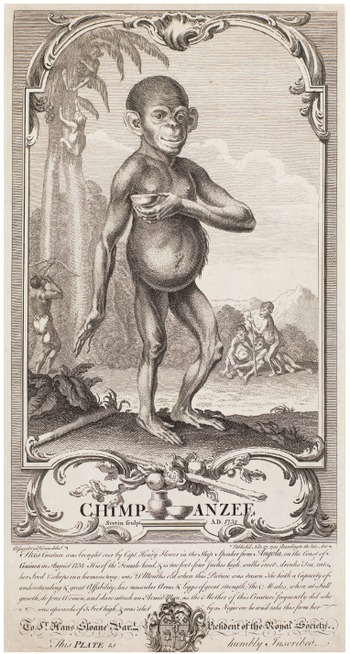
L’humanisation de la chimpanzé atteint son paroxysme à travers le langage visuel. La gravure réalisée par Gérard Jean-Baptiste Scotin II, d’après un dessin de Hubert-François Gravelot, deux figures majeures du rococo en plein essor à l’époque, certifie et conforte le statut de célébrité atteint par la chimpanzé, qui « a posé pour son portrait »Footnote 80 (fig. 3). Le décor rococo qui compose la gravure renvoie à un mouvement artistique où la frontière entre le naturel et l’artificiel devient le fondement de l’esthétiqueFootnote 81 . La chimpanzé n’est pas montrée dans le coffee-house, mais replacée dans son milieu « naturel » supposé. À l’arrière-plan, à gauche, un chimpanzé grimpe à un palmier, poursuivi par un Africain armé d’un arc et de flèches, incarnant l’élément violent du tableau. La scène évoque la capture de Madame Chimpanzé ou la mise à mort de sa mère, sur le dos de laquelle elle était accrochée et qui a été tuée pour pouvoir l’arracher – selon un récit constamment rapporté par la littérature de voyage et relaté dans le texte sous l’image. Derrière, à droite, apparaît un chimpanzé en famille, s’appuyant sur un bâton, posture que Tyson avait popularisée en présentant son spécimen comme bipède, mais instable en raison de sa nature quadrumane, nécessitant ainsi un soutien – signe néanmoins de sa capacité à utiliser des outils. Madame Chimpanzé, au premier plan, est en revanche parfaitement bipède. Son bâton abandonné à terre, elle tient dans sa main, en l’exhibant, une tasse de thé, symbole par excellence des produits de luxe importés de Chine et réservés à la consommation des élitesFootnote 82 . On serait tenté de lire la gravure comme la mise en scène des étapes d’un apprivoisement progressif, se traduisant par un processus d’humanisation. « Apprivoiser », c’est-à-dire « rendre doux & traitable », selon la définition du Dictionnaire universel d’Antoine Furetière en 1690, pouvait s’appliquer aussi bien aux animaux non humains qu’humains : « on a eu de la peine à apprivoiser les Sauvages de l’Amérique, on apprivoise aisément les singes, les perroquetsFootnote 83 ». Sur la gravure, l’ensauvagé, c’est l’Africain qui chasse. Par contraste, la chimpanzé incarne la domestication du monde par l’Empire.
– Madame Chimpanzé
Source : Gérard Jean-Baptiste Scotin II, d’après un dessin de Hubert-François Gravelot, 1738, avec l’aimable autorisation de la Lewis Walpole Library, Yale University.

La consommation de thé – en plein essor sur le marché britannique après l’ouverture régulière du commerce avec la Chine par la Compagnie anglaise des Indes orientales en 1717Footnote 84 – restait encore, dans les années 1730, un privilège des élites. Il en irait autrement cinquante ans plus tard, le thé devenant un produit populaire du milieu du xviii e siècleFootnote 85 . De nombreuses peintures de l’époque témoignent de cette distinction aristocratique. The Tea Party, réalisé en 1727 par l’artiste anglais Richard Collins, en est un excellent exemple : il montre une famille réunie autour d’une table richement dressée pour la dégustation du thé (fig. 4). Les trois produits de luxe oriental, associés à Madame Chimpanzé, y sont présents : le thé, le sujet même du tableau ; la soie, dont la mère est habillée ; les tasses en porcelaine chinoise sans poignées, selon les conventions de cette époque. La famille londonienne participe à l’économie mondialisée, tout comme la chimpanzéFootnote 86 .
– The Tea Party
Source : Richard Collins, The Tea Party, v. 1727, huile sur toile, The Goldsmiths’ Hall, Londres.

Dans le dessin de Gravelot, on aurait pu s’attendre à voir la chimpanzé habillée de soie, comme la presse en faisait état. Or prévaut ici le « regard » de l’anatomiste : son corps nu répond à l’exigence d’une description précise caractéristique des dessins anatomiques. On pourrait faire l’hypothèse que le dénuement vise à réinsérer l’animal, dompté ou civilisé, dans la nature, afin d’en faire aussi bien un objet d’étude anatomique que d’histoire naturelle. Dans cette perspective, un tel choix illustrerait le chevauchement d’exigences et de perspectives diverses, caractéristiques de la réflexion sur les frontières de l’humanité de cette époque.
Le texte au bas de l’image est une dédicace à Sir Hans Sloane, successeur de Newton, depuis 1727, à la tête de la Royal Society : c’est une pratique ordinaire de l’époque, qui vise à chercher le patronage de l’institution scientifique la plus prestigieuse pour en capter l’autorité et le créditFootnote 87 . Les éléments saillants de l’« histoire » de la chimpanzé – son origine angolaise (sur la côte de Guinée), son âge (21 mois), sa taille (deux pieds quatre pouces), son caractère (grande affabilité), sa capacité de compréhension et ses bonnes manières – y sont repris et une information y est ajoutée : les mâles de l’espèce forcent les femmes, et les adultes peuvent attaquer un homme armé, comme ce fut le cas de sa mère, abattue par un Africain. L’espace de la dédicace déploie tout à la fois une logique d’objectivation, par la consignation de faits, et une logique de validation de l’expérience, par la place accordée au témoignage et le crédit donné au témoin, capitaine de navire de la traite de son étatFootnote 88 .
Le portrait fait l’objet d’une intense publicité et connaît un immense et soudain succès public à Londres. S’adressant « Aux curieux », les journaux invitent à acquérir la « vraie image de la chimpanzé », dessinée « d’après nature » par le célèbre Gravelot, qui en détient l’exclusivité. L’invitation à se méfier des imitations est explicite. Pour attirer les acheteurs, on précise qu’elle vient à peine d’être imprimée, qu’elle est accessible pour le prix d’un shilling (comme le coût d’entrée au coffee-house), qu’elle est dédiée à Hans Sloane et accompagnée d’une « description historique de cette créature extraordinaire »Footnote 89 . Preuve de son succès, au bout de deux semaines, les libraires de Londres et de Westminster annoncent l’épuisement des copies disponibles.
L’image joue ici un double rôle de stabilisateur du récit et de la représentation, malgré son caractère mouvant où se mêlent imaginaire colonial et masculin, et observations anatomiques. Elle est sans cesse republiée les années suivantes, avec des variations, dans des récits de voyageFootnote 90 ainsi que dans les circuits scientifiques des nouveaux journaux savants ou des universités. C’est le cas, notamment, dans l’espace germanique, des Nova acta eruditorum fondées par Leibniz, qui reproduit le portrait de Gravelot et canonise l’histoire en en proposant une traduction latineFootnote 91 . Dans la dissertation Amoenitates academicae (1763) de Christian HoppiusFootnote 92 , l’étudiant russe de Linné, en Suède, la tasse originale disparaît et laisse apparaître le sein, une transformation analysée par L. L. Schiebinger comme la traduction visuelle de l’émergence de la « classe » des mammifères dans la taxinomie linnéenneFootnote 93 . Quant à Thomas Boreman, il renonce lui aussi à la tasse de thé et représente la chimpanzé femelle marchant avec un bâton, cherchant ainsi à établir une symétrie avec le chimpanzé mâle de Tyson, peut-être dans l’intention de construire un coupleFootnote 94 .
Durant son séjour dans la capitale britannique, la chimpanzé réalise une impressionnante ascension sociale qui la conduit, « en suivant le désir de plusieurs personnes de qualité », de son premier coffee-house bon marché vers un autre espace d’exposition plus élitiste où elle est intégrée à la haute société : le White Peruke de Mr. Leflour, à Charing CrossFootnote 95 . C’est à partir de ce changement de statut social qu’elle devient, dans la presse, « madame » ou « mademoiselle », ou même « African Lady Mademoiselle Chimpanzee ». Entrée dans le monde aristocratique et des élites, elle y dispose d’un « appartement séparé pour les dames » et est vêtue de manière toujours plus élégante, selon la dernière « mode de Paris » (« Now entirely dress’d after the newest Fashion A-la mode à Paris »)Footnote 96 . Si l’on pouvait vérifier l’hypothèse qu’elle réside dans le même White Peruke qui accueillit Voltaire, dix ans plus tôt, pendant son exil londonien alors qu’il écrivait ses Lettres sur les Anglais et La Henriade Footnote 97 , on disposerait d’un nouvel indice du changement de statut social de l’animal, comme d’un lien renforcé avec la France, déjà suggéré par la référence à son style vestimentaire.
En tout état de cause, par cette requalification, elle entre aussi dans les récits et journaux intimes de son nouveau public, indifféremment masculin et féminin. John Perceval, premier comte d’Egmont, homme politique et membre de la Royal Society, lui consacre de longs commentaires à partir de la visite qu’il lui rend avec sa famille le 1er février 1739Footnote 98 . Les origines en Afrique, la mort de la mère, une attitude comparable à celle des Africains parmi lesquelles elle vit et l’humanisation : c’est une enfant prodige, comme la société européenne en connaît de nombreux dans ces années, et dont la curiosité non moins contemporaine pour les enfants sauvages ne constitue que l’autre revers d’une seule et unique médailleFootnote 99 . D’autres qualités humaines sont encore évoquées, comme la dextérité, le goût des mets raffinés et du confort. De la description physique qui procède par comparaisons avec celle d’un corps humain Egmont passe aux qualités morales, en s’appuyant sur le jugement qu’il emprunte à Hans Sloane : prête à parler, elle le ferait sitôt éduquée, voire elle pourrait devenir une écrivaine en suivant le modèle de la femme savante française, Madame DacierFootnote 100 . (Difficile de ne pas y voir misogynie et nationalisme anti-français – a fortiori si Voltaire avait aussi été pensionnaire du White Peruke.)
Quand le comte va la voir, la carrière de Madame Chimpanzé est à son acmé : les journaux rapportent les visites de son altesse royale le prince de Galles, du duc de Cumberland et de nombreux autres membres de la noblesse. Les descriptions s’intensifient, informant sur son état de santé et insistant sur l’admiration exprimée par tous les types de public, savant, aristocratique ou populaireFootnote 101 . Une croissance de deux pouces est interprétée comme le corollaire d’une croissance intellectuelle de ses « capacités et compréhension humaines »Footnote 102 . Le corps devient ainsi, dans les récits journalistiques, l’expression et la preuve visible de la perfectibilité observée et mesurée.
The show must go on
« Hier, vers deux heures de l’après-midi, est décédée à Charing-Cross, Mademoiselle Chimpanzé, originaire d’Afrique, et très admirée par tous ceux qui l’ont vueFootnote 103 . » Malgré tous ces succès, la fabuleuse carrière de Madame Chimpanzé, minutieusement fabriquée et rapportée par les journaux, prend fin avec sa mort inattendue le 23 février 1739, cinq mois après son arrivée triomphale à Londres. Dans la description de l’événement faite par le London Daily Post, il convient de souligner qu’elle est perçue comme « une native d’Afrique », adoptant le comportement des « autres » Africains dans une mort dont elle a conscience.
On dit qu’elle semblait être très consciente qu’elle allait mourir, et à la surprise des présents, se comporta en grande partie comme une Négresse [Negro] dans des circonstances similaires. Sa mort représente une perte très considérable pour son propriétaire, car elle était comme un domaine [Estate] pour luiFootnote 104 .
L’allusion à la grave perte économique pour le propriétaire due à cette disparition nous ramène à une histoire d’animal exhibé. Dans ce passage, qui naturalise le parallèle entre Africains et grands singes, c’est le système de la traite qui revient et compose le cadre du rapprochement de leurs destins. La chimpanzé est ici associée à un « Estate », un domaine, une propriété. Elle semble ainsi avoir acquis un double statut, de nature contradictoire : celui de bien meuble, issu de sa vente initiale dans le réseau esclavagiste en Afrique, et celui lié à sa nouvelle position relevant de la propriété foncière britannique que l’on pourrait qualifier d’aristocratique – tout en demeurant enserrée dans une logique de marchandisation. Difficile de ne pas penser au titre de l’un des ouvrages pionniers des Animal Studies, The Animal Estate de Harriet Ritvo, où l’historienne états-unienne montre comment, à l’époque victorienne, les animaux, en particulier domestiques et d’élevage, faisaient pleinement partie des domaines fonciers de l’aristocratie et de la gentry anglaises, symboles de leurs statuts et instruments d’affirmation sociale et politiqueFootnote 105 . The Animal Estate renvoie également à la condition des animaux classés, exhibés et instrumentalisés, et reflète – en les consolidant – les hiérarchies sociales et impériales de l’époque. Ce double statut révèle leur insertion dans un système de valeurs économiques ancré dans celui, plus vaste, du monde de l’esclavage. Posséder un chimpanzé devient alors plus rentable que posséder des esclaves – comme le laisse entendre le commentaire qui, en contribuant à la fabrique de l’orang-outan, participe aussi à l’exotisation de l’Africain. La mémoire de la célébrité de Madame Chimpanzé est attestée quelques mois plus tard : c’est à elle que son propriétaire, Henry Flower, doit de figurer dans les notices nécrologiques de la presse londonienneFootnote 106 .
Les journaux regorgent de détails sur l’épisode de la disparition de Madame Chimpanzé, où le brouillage des frontières entre l’humain et l’animal se concentre sur deux moments : l’autopsie et les funérailles. Hans Sloane en personne réalise l’autopsie, assisté du chirurgien de la famille royale John Ranby, nouveau témoignage de l’importance sociale et économique acquise par la chimpanzéFootnote 107 . La présence du président Sloane au coffee-house comme spectateur, puis son rôle dans l’autopsie constituent une illustration exemplaire de cet Ancien Régime des savoirs marqué par le chevauchement des espaces institutionnels et non institutionnels de la science, le croisement de savoirs vernaculaires et savants, le rôle des formes sociales de la légitimation des énoncés de vérité et le fonctionnement ordinaire de l’administration de la preuveFootnote 108 . Cette double présence rend aussi compte d’une faible stabilisation des protocoles savants. Les journaux rapportent que le président de la Royal Society se dit « extrêmement satisfait » de ses observations qui le conduisent à déclarer que la chimpanzé est « la créature la plus proche de l’espèce humaine »Footnote 109 . L’autopsie fait encore franchir une frontière : la cause de la mort de Madame Chimpanzé est attribuée à l’addiction au thé, retrouvé en « quantité extravagante » dans son corps, et cause de jaunisseFootnote 110 . Au-delà d’un rapport médical appelé à faire sourire le lectorat d’aujourd’hui nous importe ici que les autorités scientifiques, relayées par la presse, concordent sur le fait que la chimpanzé est « parfaitement de l’espèce humaine »Footnote 111 . La crédibilité de la proposition énoncée est proportionnelle au statut/crédit de ceux qui l’énoncent, et son effet conduit à en faire un jalon important dans le débat sur les frontières de l’humain.
C’est le même Sloane qui mobilise son statut d’expert dans une autre configuration, où il assure une fonction d’intermédiaire entre les aristocrates, consommateurs d’animaux exotiques, et les marchands, fournisseurs de tous types de produitsFootnote 112 . Dans ce même registre d’indétermination des frontières de la science, c’est lui qui collectionne activement les feuilles volantes de monstruosités disponibles dans l’espace public londonien, tout en étant un visiteur assidu du Don Saltero’s Coffee House, ouvert en 1695 par son ancien serviteur James Salter et dont une salle, la « Coffee Room of Curiosities », était spécialisée dans l’exhibition de monstruositésFootnote 113 .
L’annonce de la mort de Madame Chimpanzé coïncide avec la présentation d’un spécimen mâle jusqu’alors inconnu du grand public, ou à tout le moins jamais « médiatisé » et conservé dans le rhumFootnote 114 . Qui est donc ce chimpanzé mâle qui sort de l’anonymat, dans un moment si particulier, aux côtés de cette femelle, « lady » pour quelques mois ? La mention, par les journaux, de son propriétaire permet ici encore d’en retracer la trajectoire. Amené cinq ans auparavant à Londres par le même commandant Henry FlowerFootnote 115 , ce spécimen témoigne d’une double réalité occultée par la célébrité de sa congénère : peu d’animaux survivaient à la longue traversée transatlantique ; les commerçants de la traite et les marchands d’animaux étaient souvent les mêmes personnes. Sa révélation post-mortem lève ainsi le voile sur les conditions de voyage et de maintien en vie des animaux transportés, avec un fort taux de perte lié au transfert. On le connaît aussi par un texte célèbre pour avoir introduit le polygénisme dans un cadre médical, attribuant les différences entre les habitants de la Guinée et le « reste de l’humanité » à des distinctions ab origine : A Voyage to Guinea, Brazil and the West Indies (1735) de John AtkinsFootnote 116 . Chirurgien pour une compagnie maritime elle aussi engagée dans la traite, Atkins est également l’auteur du fameux The Navy Surgeon: Or, a Practical System of Surgery (1734) destiné aux médecins de bord. Dans un passage du Voyage to Guinea, où il évoque la présence abondante de grands singes à l’apparence et au comportement humain dans le golfe de Guinée, Atkins note :
Le capitaine Flower ramena un [Orang-Outan] d’Angola en 1733, éviscéré et conservé dans du rhum : il vécut quelques mois avec lui, avait un visage lisse, peu de poils, des organes génitaux semblables à ceux des humains, avec des testicules à l’extérieur ; souvent, il marchait volontairement sur ses pattes arrière et s’asseyait sur une chaise pour siroter ou boireFootnote 117 .
L’animal mort pendant le voyage ne saurait représenter une perte. C’est sans doute ce qui justifie qu’il fasse l’objet d’une procédure de conservation dans l’alcool, de qualité suffisante pour que son propriétaire puisse en tirer quelque chose, par exemple l’exposition (ou la vente) de sa peau une fois arrivé à terre. Dans le cas qui nous intéresse, il est vraisemblable que Flower, ne s’en étant pas encore séparé, avait vu la possibilité de l’utiliser pour enrichir et poursuivre le spectacle d’une Madame Chimpanzé défunte. En le sortant ainsi de l’ombre, il s’apprête à lui conférer une reconnaissance posthume par sa possible acquisition par le British Museum. C’est ce que suggère une annotation de George Edwards, l’auteur déjà cité des Gleanings of Natural History, qui affirme non seulement avoir vu la célèbre chimpanzé exposée avec « un autre (mâle) », mais aussi que celui-ci était désormais – en 1758 – entre ses mains. Il précise que les deux chimpanzés, mâle et femelle, se ressemblaient « exactement en toutes leurs parties, excepté en ce qui fait la différence des sexes »Footnote 118 . Sous le patronage de Sloane, Edwards avait accès à l’ensemble de sa collection, qui lui fournissait les modèles de la plupart de ses dessins. Il est donc raisonnable de supposer que le chimpanzé qu’il avait à disposition faisait bien partie de la collection de son mécène.
L’index du volume 25 du catalogue des quadrupèdes, rédigé de la main de Sloane et aujourd’hui conservé à la bibliothèque du département de Paléontologie du Natural History Museum de Londres, recense la présence de quatre « orangs-outans » dans la collection avant 1753 (date de la mort de Sloane), en fournissant quelques indications sur leur provenanceFootnote 119 . Jugeant insuffisantes les représentations existantes, celle de Gravelot comprise, Edwards réalise un nouveau dessin de ce qu’il désigne sous le nom composite de « Satier, Sauage, Wild-man, Pigmy, Orang-outang, Chimpanzee, etc. ». Il précise que « le sujet d’après lequel cette figure a été dessinée » est conservé au British Museum, où il a été naturalisé « dans l’attitude » qu’il lui a donnée : assis sur un banc, avec un bâton (fig. 5)Footnote 120 . Il a été démontré, de manière à mon sens convaincante, que le portait d’Edwards représente le spécimen « 1851. The homo sylvestris, Orang outang, or Chimpanze from Borneo », qui est donc un « véritable » orang-outan asiatiqueFootnote 121 . Il me semble tout aussi probable que l’exemplaire enregistré comme « 1777. The viscera of the Champoncie Orang outang or homo sylvestris » puisse être le « frère » mâle de Madame Chimpanzé dont parle EdwardsFootnote 122 . On serait ainsi en mesure, grâce aux logiques de la société du spectacle qui doit renouveler en permanence ses numéros, de suivre celles des trajectoires de ces biens, vivants ou morts, qui, au gré des conditions de voyage – dont le taux de mortalité pour les humains esclaves est aujourd’hui bien étudié –, disparaissent de l’histoire ou y reviennent, en sortant des cales des bateaux, pour rejoindre foires, coffee-houses, ménageries publiques ou princières, jusqu’aux musées anatomiques et cabinets d’histoire naturelle, multipliant ainsi les lieux où se met en scène l’humanisation du grand singe.
– « Satier, Sauage, Wild-man, Pigmy, Orang-outang, Chimpanzee etc. »
Source : George Edwards, Gleanings of Natural History, Exhibiting Figures of Quadrupeds, Birds, Insects, Plants, &c. Most of Which Have Not, Till Now, Been Either Figured or Described, vol. 1, Londres, Printed for the Author, at the Royal College of Physicians, 1758, p. 6.

La seconde conséquence de l’apparition de celui qui ne sera jamais désigné comme « Monsieur Chimpanzé » prend toute sa signification dans le moment post-mortem que constituent les funérailles. Elle s’exprime dans l’exposition conjointe des deux corps, où la réunion des sexes offre, à travers la fiction d’un couple, un nouvel élément à soumettre à la curiosité du public, comme en atteste la cérémonie funéraire. Ce faisant, elle met en place, dans l’espace public, une représentation de l’organisation de la vie sociale des chimpanzés selon le modèle de la famille, garante d’humanité, tout en proposant une naturalisation des rapports sociaux humains. Il est également à noter que la grammaire des genres est assurée, dans la salle d’exposition, par une « gentlewoman » en charge de présenter le spectacle aux « Ladies ».
Il y a également exposé un mâle de la même espèce, qui a été rapporté d’Angola par le même gentleman qui a ramené la chimpanzé, mais celui-ci est mort pendant le voyage, bien qu’il soit bien conservé. Ils peuvent être vus ensemble au White Peruke, à Charing Cross. Une dame [gentlewoman] est présente pour les montrer aux femmes [Ladies] uniquementFootnote 123 .
Dans la même notice est également souligné l’avantage d’examiner l’anatomie de la chimpanzé, décédée la semaine précédente et « parfaitement conservée dans l’alcool », sans l’encombrement des vêtements qu’elle portait de son vivant, lesquels entravaient l’observation. On revient ici au geste anatomique accompli par Gravelot pour son dessin. Avec cette deuxième étape, le processus d’humanisation, alimenté par l’exposition en famille, prend une nouvelle tournure dans le cadre des funérailles. Dans le respect des coutumes que l’on associe aux Angolais (selon son lieu de naissance), considérées comme particulièrement sophistiquées, il continue à reposer sur les ressorts de la publicité et de la spectacularisation. Le rituel majestueux répond au respect dû à la noblesse. On promet de ne montrer, assure la presse, ni demi-dragons, huîtres ou griffons volants, ni quoi que ce soit qui n’ait jamais existé dans la Création : il ne s’agit que de donner à voir ce qui, dans la nature, « peut être supposé réel »Footnote 124 . Les funérailles, suivies de quelques semaines d’exposition sous alcool des corps de ce qui devient la famille chimpanzé – par adjonction d’un troisième « frère »Footnote 125 – constituent l’un des derniers actes de la performance de Madame Chimpanzé dans les coffee-houses londoniens.
« À VOIR (encore pour un temps limité, puis sera transféré en France) au White Peruke, Charing-Cross. Cette grande Curiosité, la Chimpanzé, accompagnée d’un mâle de la même espèce […]. Ils sont tous deux si bien conservés qu’ils offrent une satisfaction agréable aux plus curieux des deux sexesFootnote 126 . » Un mois après sa mort, le London Daily Post du 15 mars 1739 annonce ainsi que le corps de Madame Chimpanzé doit être envoyé en France, nouvelle présentée de façon concise et sans ambiguïté. Du point de vue de l’histoire des animaux, les transformations des modes de conservation, de l’alcool à la taxidermie, en relation avec les types de transports et les distances sont encore à écrire, comme celle des variabilités des représentations des corps morts et de leurs effets de réel. Reste que le mystère est entier sur la sortie française de Madame Chimpanzé. Certains l’ont reconnue dans le « jocko » de BuffonFootnote 127 , et par là associée au nouveau type d’espace muséal qui s’impose comme un dispositif d’exposition et de validation de la science : le musée d’histoire naturelle tel qu’il est amené à se développer à la fin du xviii e siècle. Si cette entrée conjointe de l’humain et de l’animal, avec les autres éléments des règnes de la nature, dans ce nouveau temple de la science ouvre des pistes de recherche qui dépassent les cadres déjà larges de cette analyse, elle permet néanmoins un épilogue.
Le fait est qu’une femelle en provenance d’Angola a également été exhibée vivante à Paris en 1740, soit l’année suivant la mort de l’héroïne londonienne. Buffon affirme l’avoir vue à la Foire Saint-Germain et la décrit en détail en des termes qui rappellent ceux utilisés dans la presse londonienne pour présenter Madame ChimpanzéFootnote 128 . Il écrit ainsi que « l’orang-outang qu’[il a] vu marchoit toujours debout sur ses deux pieds », aimait les caresses, était gourmand et possédait un « naturel doux et très différent de celui des autres singes »Footnote 129 . De plus, cette femelle était sociable et, elle aussi, buvait du thé avec une grande élégance – un trait que le naturaliste décrit avec minutie :
J’ai vu cet animal présenter sa main pour reconduire les gens qui venoient le visiter […] ; je l’ai vu s’asseoir à table, déployer sa serviette, s’en essuyer les lèvres, se servir de la cuiller et de la fourchette pour porter à sa bouche, verser lui-même sa boisson dans un verre, le choquer, lorsqu’il y étoit invité, aller prendre une tasse et une soucoupe, l’apporter sur la table, y mettre du sucre, y verser du thé, le laisser refroidir pour le boire, et tout cela sans autre instigation que les signes ou la parole de son maître, et souvent de lui-mêmeFootnote 130 .
Il ajoute que « le signe et la parole » de son propriétaire, présenté comme « le sieur Nonfoux », « suffisoient pour faire agir notre orang-outang », que Buffon rebaptise « Jocko », selon son hypothétique nom vernaculaire d’Angola, reporté par l’un des premiers récits de voyage décrivant l’animalFootnote 131 . Comme un enfant, « il aimoit prodigieusement les bonbons, tout le monde lui en donnoit ; […] cette grande quantité de choses sucrées contribua sans doute à abréger sa vie : il ne vécut à Paris qu’un étéFootnote 132 ». Parti ensuite en Angleterre, c’est là que le (ou plutôt « la ») jocko décède, toujours selon le témoignage du naturaliste français, où – ajoute Daubenton, qui en revanche ne l’a jamais vu vivant – « il fut ouvert »Footnote 133 . Quelques années plus tard, Buffon en fait l’acquisition : il en achète la peau sous alcool et son squelette, en 1747, contre la somme, payée à Nonfoux, de 1 200 livresFootnote 134 . L’exemplaire, ouvert à Londres, est naturalisé à Paris et rentre dans les collections du cabinet du roiFootnote 135 . C’est probablement le spécimen qui est toujours conservé aujourd’hui dans les réserves du Muséum national d’histoire naturelle (fig. 6)Footnote 136 .
– Le Jocko de Buffon
Source : Muséum national d’histoire naturelle de Paris.

La tentation de faire coïncider « la » jocko de Buffon avec Madame Chimpanzé est forte : la rareté des spécimens arrivés vivants en Europe et les témoignages attestant leur périple entre France et Angleterre pourraient en être la preuve. Sa représentation dans le geste de boire du thé (à Paris !) suscite elle aussi des interrogations. La piste paraît cependant peu plausible. Malgré leur proximité, les dates diffèrent de presque deux ans entre l’exposition dans les coffee-houses londoniens et celle à la Foire Saint-Germain, et rien jusqu’à présent n’a permis de retrouver, dans la presse britannique, la trace d’un voyage de Madame Chimpanzé vivante à Paris – qui ne serait certainement pas passé inaperçu dans le régime de publicité dont elle faisait l’objet. Quant au nom du propriétaire mentionné par Buffon, il reste lui aussi sans correspondance et de nouvelles recherches s’imposent à son sujet. Une autre hypothèse, qui me semble plus probable, est celle de l’intensification de la quête des grands singes vivants dans les milieux naturalistes européens dans les années 1740. Si ces animaux intéressent aussi bien Buffon que Hans Sloane, on peut faire l’hypothèse que, dans les autres capitales des métropoles impériales, des marchands ont pu en fournir, davantage morts que vivants.
Les cas de Madame Chimpanzé ou de Jocko ont familiarisé un large public britannique, français et européen avec l’image de grands singes polis, sensibles et éduqués. La contingence de ces histoires, le croisement de ces trajectoires ne relèvent pas uniquement d’une histoire des sciences et des savoirs caractéristique des Lumières, ni d’une histoire de l’émergence de la science de l’homme dans le processus d’élargissement et de complexification de la grammaire européenne des disciplines. Ces cas nous intéressent parce qu’ils portent un débat sur les frontières de l’humain dont les scènes et les temporalités sont multiples. Lorsque, dans les années 1770-1780, l’Empire britannique est confronté à la crise de son modèle de croissance dans le cadre de la campagne abolitionniste, c’est tout un siècle d’accumulation de savoirs sur l’anatomie, de spéculations philosophiques sur le progrès de l’histoire et le rôle des sexes dans celui-ci, d’expériences d’ingénierie raciales dans les plantations, d’imaginaire et de peurs qui se voit mobilisé en faveur de ou contre la traite, puis l’esclavage. Le débat se transforme en combats, et l’enquête sur les frontières de l’humain se reconfigure autour de la question de la race, devenue centrale depuis lors et jusqu’à nos joursFootnote 137 . Penser avec les animaux n’était donc pas seulement une spéculation philosophique, mais une question politique centrale au siècle des Lumières, comme aujourd’huiFootnote 138 .
La célébrité acquise par des chimpanzés dans les coffee-houses, les foires ou les cabinets d’histoire naturelle, en faisant la démonstration du caractère plurisitué – ou « impur », pour reprendre l’expression de Steven ShapinFootnote 139 – de la science, mobilise deux régimes complémentaires de curiosité. Le premier, savant et « anthropologique », s’appuie sur la comparaison anatomique qui aspire à la généralisation ; le second, public, repose sur les ressorts de la presse et de la spectacularisation, qui tendent à souligner les singularités – exemplifié ici par le cas de Madame Chimpanzé. Ce sont les mêmes acteurs qui tissent les fils permettant le passage de l’un à l’autre : Buffon fait partie du public des curieux de la Foire Saint-Germain, tout comme Sloane se glisse dans les coffee-houses londoniens. En même temps, le premier acquiert la peau de la femelle chimpanzé pour la présenter montée dans le cabinet du roi, tandis que le second rassemble plusieurs spécimens dans ses collections. Tous deux exposent des curiosités à destination d’un nouveau public urbain. Dans chaque situation, la comparaison dessine l’écart entre deux espaces où se rejoue la définition des frontières de l’humanité : la comparaison anatomique fabrique des spécimens et les met en série ; la comparaison ethnographique forge la grammaire des comportements, tels que la politesse, la pudeur, l’alimentation. Dans le premier espace, le geste comparatif naturalise ; dans le second, il culturalise, laissant ouverte la question de la classification des espèces. Le grand singe émerge ainsi au croisement d’une enquête sur les rapports entre l’homme et les autres animaux. Le « chaînon manquant » des Lumières ne renvoie nullement à la conception évolutionniste darwinienne, bien que l’expression y soit aujourd’hui associée, et encore moins aux génomes perdus de S. Pääbo. Pendant une grande partie du xviii e siècle, l’orang-outan est envisagé comme un « maillon [link] intermédiaire » et un « point de jonction [nexus] entre l’animal et le rationnel », pour reprendre les termes déjà cités de Tyson. Il remplit la fonction ambivalente de défier, tout en le consolidant, l’exceptionnalisme humain au sein d’un ordre naturel pensé comme hiérarchique.
C’est alors une nouvelle question, de nature épistémologique, qui s’ouvre : l’acte comparatif produit-il une telle indétermination ? Retraçant les trajectoires des orangs-outans à partir de sources diverses – du navire de la traite, où ils sont assimilés à des biens meubles, aux coffee-houses, où ils sont associés à la propriété foncière, en passant par le catalogue muséal qui les transforme en spécimens naturalistes –, cet article a mobilisé plusieurs formes de comparaison : une comparaison d’ordre historique entre humains et orangs-outans, qui n’est pas seulement de nature scientifique, mais engage aussi des dimensions socio-économiques et politiques ; une comparaison d’ordre historiographique, saisie entre les Animal Studies et l’histoire des sciences humaines, entre l’historiographie sur l’animalisation des personnes esclavagisées et celle sur la curiosité des spécimens, et plus largement entre sciences sociales et sciences naturelles. Au siècle des Lumières, le recours à la comparaison avec le grand singe a souvent brouillé – voire effacé – les frontières entre les humains et les autres animaux, pour élargir les distinctions à l’intérieur de l’espèce humaine. Ce glissement se cristallise à la fin du xviii e siècle, en Grande-Bretagne comme en France, dans un débat sur les « races » humaines, puisant au même arsenal comparatif.