





Introduction
Advances in palliative care have increased the number of patients living longer with life-threatening chronic illnesses, resulting in a significant portion of caregiving responsibilities being assumed by family members and caregivers (Karimi Moghaddam et al. Reference Karimi Moghaddam, Rostami and Zeraatchi2023; Cui et al. Reference Cui, Yang and Hu2024). Family caregivers of patients receiving palliative care, despite patients having different diagnoses, undertake multidimensional, common responsibilities, including the individuals’ physical care, symptom management, support with activities of daily living, and the fulfillment of emotional and existential needs (Karimi Moghaddam et al. Reference Karimi Moghaddam, Rostami and Zeraatchi2023; Cui et al. Reference Cui, Yang and Hu2024). This multifaceted care burden often causes caregivers to postpone their own health needs, withdraw from social life, experience economic difficulties, and face intrafamilial role conflicts. All these factors lead to a significant decrease in caregivers’ quality of life by increasing their psychological distress levels (Karimi Moghaddam et al. Reference Karimi Moghaddam, Rostami and Zeraatchi2023; Cui et al. Reference Cui, Yang and Hu2024; Nargis et al. Reference Nargis, Noreen and Jauhar2025). Particularly during the end-of-life care process, factors such as the progressive nature of the disease, fear of loss, uncertainty, and frequent hospital admissions further exacerbate the care burden and emotional strain; this situation makes caregivers’ well-being fragile while increasing the risk of burnout, hopelessness, anxiety, and depression (Spatuzzi et al. Reference Spatuzzi, Giulietti and Ricciuti2019; Altinel et al. Reference Altinel, Saygili Duzova and Duzova2025; C. Lee et al. Reference Lee, Hwang and Lee2025). This indicates that, in palliative care, care should not only be directed at the patient but also encompass a psychosocial support dimension for caregivers. It is stated that caregivers who lack psychosocial support both neglect their own health and negatively affect the quality of care provided to the patient (Liu et al. Reference Liu, Chen and Hu2023; Cui et al. Reference Cui, Yang and Hu2024). In this context, recent studies highlight that interventions aimed at strengthening the psychosocial well-being of caregivers should not merely address the reduction of problems and burden, but should also incorporate positive emotions such as self-compassion, spiritual well-being, and hope (Sun et al. Reference Sun, Kim and Irish2016; Lalani et al. Reference Lalani, Duggleby and Olson2019; Diggory and Reeves Reference Diggory and Reeves2022).
Self-compassion is the capacity of an individual to approach themselves with understanding and kindness in moments of pain, difficulty, or feelings of inadequacy, just as they would approach a loved one, rather than criticizing themselves harshly (Neff Reference Neff2003). Based on this core concept, self-compassion emerges as a significant determinant in the psychological well-being of individuals living with life-threatening illnesses and their caregivers. Studies conducted with caregivers of different patient groups demonstrate that self-compassion is closely associated with psychological resilience, stress and anxiety levels, and quality of life (Ardıç et al. Reference Ardıç, Anuk and Özkan2024; Nargis et al. Reference Nargis, Noreen and Jauhar2025; Zainab et al. Reference Zainab, Waheed and Batool2025). Ardıç et al. (Reference Ardıç, Anuk and Özkan2024) reported that increased levels of self-compassion among caregivers of cancer patients strengthen psychological resilience, reduce distress, and improve quality of life. Similarly, Zainab et al. (Reference Zainab, Waheed and Batool2025) and Nargis et al. (Reference Nargis, Noreen and Jauhar2025) showed that self-compassion can play a mediating role in the relationship between care burden and psychological well-being in caregivers. Systematic review and meta-analysis findings also reveal that self-compassion is inversely correlated with psychological distress and positively correlated with psychological well-being in patient and survivor groups with severe illness experiences (Bitan et al. Reference Bitan, Hasson-ohayon and Lavidor2025).
Alongside these psychological processes, spirituality and spiritual well-being are increasingly recognized as integral to palliative care. Spiritual well-being is defined through a person finding meaning and purpose in their life, a sense of inner peace, and the connection they establish with themselves, others, or a transcendent being, and it is considered a fundamental resource in coping with severe illness (Lalani et al. Reference Lalani, Duggleby and Olson2018; Spatuzzi et al. Reference Spatuzzi, Giulietti and Ricciuti2019). Studies involving family caregivers in the context of palliative care show that high spiritual well-being is associated with a lower care burden and a better quality of life; these findings indicate that spiritual resources may play a protective role in mitigating the negative outcomes of the caregiving process (Spatuzzi et al. Reference Spatuzzi, Giulietti and Ricciuti2019; C. Lee et al. Reference Lee, Hwang and Lee2025; J. Lee et al. Reference Lee, Lee and Ahn2025). Qualitative studies also reveal that family caregivers intensely utilize spirituality, the search for meaning, and spiritual coping strategies when providing care to terminally ill patients (Lalani et al. Reference Lalani, Duggleby and Olson2018; Wikert et al. Reference Wikert, Treutlein and Theochari2022).
Some recent studies have emphasized the significance of this area by examining the relationships among care burden, anxiety, depression, and spiritual well-being in family caregivers of patients receiving palliative and end-of-life care. For example, Altinel et al. (Reference Altinel, Saygili Duzova and Duzova2025) demonstrated the relationship among anxiety, care burden, and spiritual well-being in caregivers of patients in a palliative care context. In contrast, J Lee et al. (Reference Lee, Lee and Ahn2025) revealed that emotional distress could play a key role in the relationship between spiritual well-being and care burden among families of terminally ill patients. However, existing studies have predominantly focused on the relationships among care burden, psychological distress, and spiritual well-being; the number of studies addressing self-compassion and spiritual well-being together has remained quite limited (Altinel et al. Reference Altinel, Saygili Duzova and Duzova2025; J. Lee et al. Reference Lee, Lee and Ahn2025; Spatuzzi et al. Reference Spatuzzi, Giulietti and Ricciuti2019).
Self-compassion is thought to be an important internal resource that enables caregivers to approach their own emotional processes with more understanding, reduces guilt and self-criticism, and thus supports spiritual well-being (Ardıç et al. Reference Ardıç, Anuk and Özkan2024; Bozkir et al. Reference Bozkir, Tekin and Kartal2025). This study is grounded in Kristin Neff’s (Reference Neff2003) Theory of Self-Compassion, which serves as the primary conceptual framework to evaluate the emotional resilience and well-being of caregivers (Neff Reference Neff2003). According to Neff, self-compassion consists of 3 interacting components: self-kindness versus self-judgment, a sense of common humanity versus isolation, and mindfulness versus over-identification (Neff Reference Neff2003). In the highly stressful context of palliative caregiving, individuals frequently face prolonged emotional burden and existential distress (Boston and Mount Reference Boston and Mount2006; Rocha et al. Reference Rocha, Pereira and Rmcra2018). Neff’s framework posits that self-compassion acts as a vital emotional regulatory mechanism (Neff Reference Neff2003). By approaching their own suffering with warmth (self-kindness), recognizing their caregiving challenges as a shared human experience rather than an isolating burden (common humanity), and holding their negative emotions in balanced awareness (mindfulness), caregivers can prevent emotional exhaustion (Diggory and Reeves Reference Diggory and Reeves2022). We propose that this compassionate self-relation is associated with the caregiver’s spiritual well-being by potentially supporting inner peace, a sense of meaning, and connectedness, thereby reflecting a possible link with lower levels of anomie or despair (Ekşi and Kardaş Reference Ekşi and Kardaş2017; Spatuzzi et al. Reference Spatuzzi, Giulietti and Ricciuti2019).
In fact, self-compassion among caregivers can even influence the psychological and physical states of individuals receiving care (Bozkir et al. Reference Bozkir, Tekin and Kartal2025). However, studies examining self-compassion and spiritual well-being together within the same model – particularly on family caregivers providing care to palliative care patients with various diagnoses – are exceedingly limited. In the Turkish context, no study directly investigating the relationship between self-compassion levels and spiritual well-being among family caregivers of patients receiving palliative care was found. Therefore, the purpose of this study is to determine the relationship between self-compassion levels and spiritual well-being among family caregivers of patients receiving treatment in palliative care. Demonstrating this relationship within the Turkish context is expected to contribute to the development of psychosocial and spiritual support programs for caregivers and to the structuring of nursing practices in palliative care in a way that strengthens the internal resources of the caregivers.
Research questions. In line with this main purpose, the study sought answers to the following questions:
1. What are the self-compassion and spiritual well-being levels of caregivers of patients receiving palliative care?
2. Is there a significant relationship between caregivers’ self-compassion levels and their spiritual well-being?
3. Do caregivers’ levels of self-compassion significantly predict their spiritual well-being?
Methods
Study design and type
This is a cross-sectional and correlational study.
Study population and sample
The population of the study consisted of caregivers in a palliative care unit, and a non-probability convenience sampling method was used. The minimum sample size for the study was determined using a priori power analysis in G*Power 3.1.9.7. Pearson correlation analysis was used as the basis to examine the relationship between the variables; according to Cohen’s (Reference Cohen1988) criteria, assuming a medium effect size (r = 0.30), a 2-tailed hypothesis, a significance level of α = 0.05, and 95% statistical power, the minimum required sample size was calculated as 138. During the data collection process, 5 forms that were incomplete or incorrectly filled out were excluded from the study, and the research was completed with exactly the targeted 138 participants, achieving 95% statistical power.
Inclusion criteria: Being a caregiver for a patient receiving treatment in a palliative care unit, the palliative patient receiving care having been diagnosed at least 6 months prior, volunteering to participate in the study, and being 18 years of age or older.
Exclusion criteria: Those with communication problems, visual and hearing impairments, a history of psychiatric illness, and any history or current use of psychotropic drugs were excluded from the study.
Data collection tools
The data of the study were collected using the Introductory Characteristics Form, the Self-Compassion Scale (SCS), and the Spiritual Well-Being Scale.
Introductory Characteristics Form: Developed by the researchers based on the literature (Neff Reference Neff2003; Deniz et al. Reference Deniz, Kesici and Sümer2008; Ekşi and Kardaş Reference Ekşi and Kardaş2017), this form consists of 18 questions encompassing caregivers’ demographic characteristics (age, gender, education level, marital status, degree of relationship with the patient) and variables thought to affect their self-compassion/spiritual well-being levels (duration of palliative care, duration of caregiving, daily care hours, challenging areas during the palliative care process, time allocated to oneself in daily life, state of being kind to oneself, need for spiritual support, etc.).
Self-Compassion Scale: Originally developed by Neff (Reference Neff2003), the SCS measures individuals’ levels of compassionate, mindfulness-based, and nonjudgmental attitudes toward themselves. The Turkish validity and reliability study was conducted by Deniz et al. (Reference Deniz, Kesici and Sümer2008). It was stated that the 24-item single-factor structure is related to the holistic perception of the compassion concept in Turkish culture. The score range for the 5-point Likert-type scale (1 = Almost never, 5 = Almost always) is 24–120; 10 items are reverse-coded (item numbers: 1, 3, 5, 10, 12, 15, 17, 19, 22, 23). A high score indicates a high level of self-compassion. The original Cronbach’s α was 0.92; the Turkish form’s α was 0.92; in this study, α was 0.79.
The Spiritual Well-Being Scale: Developed by Ekşi and Kardaş (Reference Ekşi and Kardaş2017), the scale evaluates spiritual well-being across 3 subscales: transcendence (15 items; score range: 15–75), which reflects connection to a higher power; harmony with nature (7 items; score range: 7–35), which addresses environmental connectedness; and anomie (7 items; score range: 7–35), which assesses existential void and dissatisfaction. The total score range for the 29-item 5-point Likert-type scale is 29–145. Since anomie represents negative spiritual states such as a lack of purpose or feelings of life dissatisfaction (e.g., “I feel a sense of dissatisfaction with life”), these items are reverse-coded for the total score calculation. While the scale is a continuous measure without established categorical cut-off levels, higher scores represent a greater alignment with ultimate meaning and values. For caregivers, these elevated levels are considered more appropriate as they signify a stronger internal resource for maintaining spiritual integrity and resilience amidst the emotional stressors of palliative care. The original Cronbach’s α of the scale was 0.886 (transcendence: 0.95; harmony with nature: 0.86; anomie: 0.88); in this study, the total α was calculated as 0.879 (transcendence: 0.92; harmony with nature: 0.64; anomie: 0.79).
Study implementation
Research data were collected in the palliative care unit between March 15 and September 15, 2025. We verbally explained the purpose, method, and consent (confidentiality and the right to withdraw) to the patients’ relatives, and obtained written consent from those who agreed to participate. Administering the scales took an average of 15–20 minutes. We carried out data collection individually at convenient times.
Data analysis
Data were analyzed using the SPSS 25.0 (or 28.0) software package. Descriptive statistics (number, percentage, mean, standard deviation, Min-Max) were calculated; normal distribution was determined using the Kolmogorov–Smirnov test and skewness-kurtosis coefficients (Tabachnick and Fidell Reference Tabachnick and Fidell2013). In order to enhance the clinical interpretability of the findings, the SCS total scores were categorized into 3 levels (low, moderate, and high) based on the sample’s quartiles (25th and 75th percentiles). These quartile-based thresholds (Q1 = 72.75 and Q3 = 87.25) served as the primary classification criteria to evaluate the distribution of caregivers’ internal resources. Since the data were normally distributed, parametric tests were preferred. Demographic differences in self-compassion and spiritual well-being were examined using independent t-tests and a one-way Analysis of Variance (ANOVA); relationships among scales were analyzed using Pearson’s correlation. A simple linear regression analysis was applied to determine the predictive effect of self-compassion on spiritual well-being. The significance level was accepted as p < 0.05 for all tests. Correlation coefficients were interpreted as: 0.00–0.29 low, 0.30–0.70 moderate, 0.71–1.00 high-level relationship (Büyüköztürk Reference Büyüköztürk2007).
Ethical aspects of the study
Approval was obtained from the Ethics Committee for the research (Decision No: 15-2024/337). Institutional permission was obtained from the hospital where the research was conducted. We informed participants in accordance with the principles of the Declaration of Helsinki and obtained their consent (verbal and written). We stored data in a coded format and did not share it with third parties.
Results
Table 1 presents the introductory characteristics of the caregivers (n = 138). The mean age of the caregivers participating in the study was 47.18 ± 12.36 (Min-Max: 24–78); 77.5% were female, 76.8% were married, and the highest education level group was primary school graduates at 49.3%. When participants’ relationship to the patient receiving palliative care was examined, 27.5% were others (aunts, uncles, grandchildren, etc.), and 26.8% were the patient’s mother or father. It was determined that the most common diagnosis of palliative care patients was Geriatric syndrome at 58.7%, and the duration of care was mostly more than 1 year (56.5%). It was determined that 60.9% of caregivers provided full-time care (6 hours or more per day), and 55.8% had someone else supporting them in caregiving. While physical care (50.7%) was the most challenging area during the palliative care process, 50.7% of participants had participated in a similar caregiving process before. While 47.1% of the participants stated that they could spare a moderate amount of time for themselves in their daily lives, it was observed that participants mostly gave the answer “moderate” for the situations of being able to be kind and understanding to oneself (45.6%) and being able to show oneself the compassion shown to others (45.6%). Finally, it was determined that 72.5% of the caregivers needed spiritual support during this process; their greatest source of spiritual support was their family and close circle (51.4%), and they turned mostly to prayer/worship (81.9%) to increase their spiritual well-being.
Introductory characteristics of the caregivers (n = 138)

Table 1 Long description
Caregiver characteristics are summarized for 138 participants using counts and percentages, plus age as an average with spread and range. Most caregivers were female (107, 77.5%) and married (106, 76.8%). Education was most often primary school (68, 49.3%), followed by high school (40, 29.0%), with smaller shares university or above (20, 14.5%) and illiterate (10, 7.2%). Employment status was mixed: unemployed (58, 42.0%) was most common, then employed (50, 36.2%) and retired (30, 21.7%). Relationships to the patient were varied, led by others such as extended family (38, 27.5%), parents (37, 26.8%), and spouses (35, 25.4%). Patients were most often reported as having geriatric syndrome (81, 58.7%), with cancer (30, 21.7%), Alzheimer’s (14, 10.0%), and cerebrovascular disease (13, 9.6%) less common; palliative care duration was more than one year for 78 (56.5%). Daily caregiving time was usually full-time at six hours or more (84, 60.9%), and 77 caregivers (55.8%) had another person helping. The most challenging area was physical care (70, 50.7%), and about half reported prior similar caregiving experience (70, 50.7%). Most could spare moderate or very little personal time (65, 47.1% and 58, 42.0%), and self-kindness and self-compassion were mainly rated low or moderate (each 43.5% low, 45.6% moderate). Spiritual support was needed by 100 (72.5%), most often sourced from family and close circle (71, 51.4%), and prayer or worship was the most common spiritual well-being activity (113, 81.9%). Caregiver age averaged 47.18 years, ranging from 24 to 78.
X̄ = mean; SD = standard deviation; Min = minimum; Max = maximum; n = sample size; % = percentage.
Table 2 shows the distribution of the scores obtained by the caregivers from the SCS and the Spiritual Well-Being Scale and its subscales. The caregivers’ mean total score on the Spiritual Well-Being Scale was 109.26 ± 13.59. When the subscales were examined, it was determined that they scored 63.05 ± 9.93 on the transcendence subscale, 28.10 ± 3.91 on the harmony with nature subscale, and 18.11 ± 5.28 on the anomie subscale; meanwhile, the mean total score of the SCS was found to be 79.94 ± 11.68.
Distribution of caregivers’ scores from the self-compassion scale and the Spiritual Well-Being Scale and its subscales (n = 138)
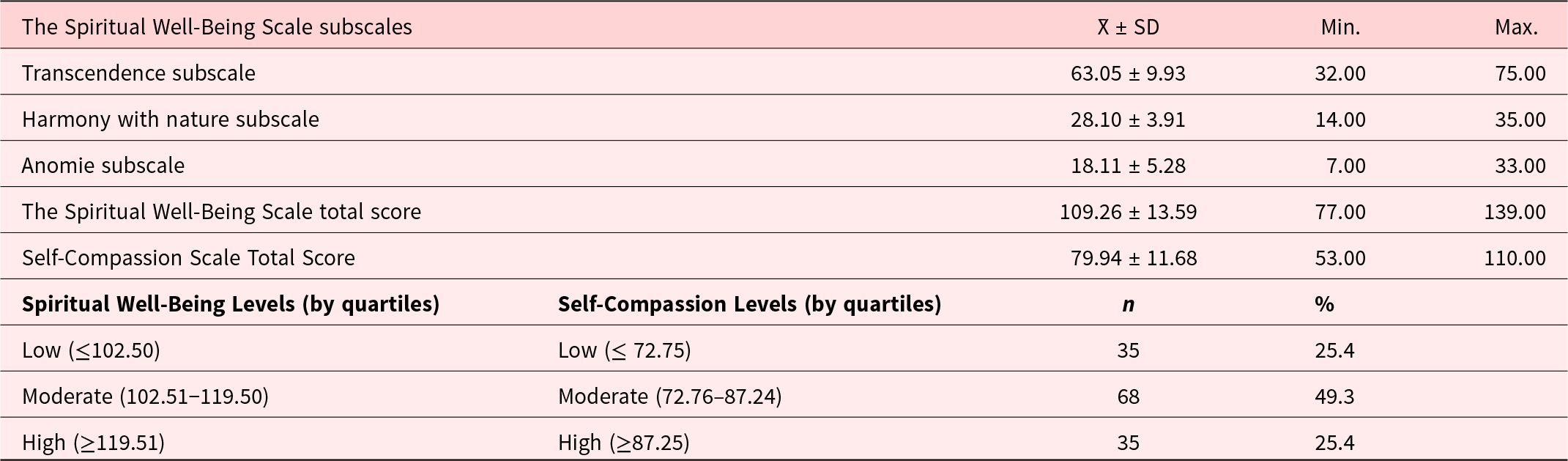
Table 2 Long description
Caregiver scores are summarized for spiritual well-being (total and three subscales) and for self-compassion, using averages with standard deviations plus minimum and maximum values. Spiritual well-being subscales averaged 63.05 for transcendence (range 32.00 to 75.00), 28.10 for harmony with nature (range 14.00 to 35.00), and 18.11 for anomie (range 7.00 to 33.00). The spiritual well-being total averaged 109.26 with scores ranging from 77.00 to 139.00. The self-compassion total averaged 79.94 with scores ranging from 53.00 to 110.00. When grouped by quartiles, 35 caregivers (25.4 percent) were low on both spiritual well-being and self-compassion, 68 (49.3 percent) were moderate on both, and 35 (25.4 percent) were high on both. Quartile cut points indicate relative standing within this sample and do not by themselves establish clinical thresholds or causation.
X̄ = mean; SD = standard deviation; Min = minimum; Max = maximum; n = frequency; % = percentage.
Table 2 shows the distribution of the scores obtained by the caregivers from the SCS and the Spiritual Well-Being Scale and its subscales. The mean total score of the SCS was 79.94 ± 11.68 (Min = 53.00, Max = 110.00). According to the quartile-based categorization, 25.4% of caregivers were classified as having low self-compassion, 49.3% as moderate, and 25.4% as high. The caregivers’ mean total score on the Spiritual Well-Being Scale was 109.26 ± 13.59 (Min = 77.00, Max = 139.00). When the subscales were examined, it was determined that they scored 63.05 ± 9.93 (Min = 32.00, Max = 75.00) on the transcendence subscale, 28.10 ± 3.91 (Min = 14.00, Max = 35.00) on the harmony with nature subscale, and 18.11 ± 5.28 (Min = 7.00, Max = 33.00) on the anomie subscale. According to the quartile-based categorization, 25.4% of caregivers were classified as having low self-compassion, 49.3% as moderate, and 25.4% as high. Similarly, based on the quartile distribution of the Spiritual Well-Being Scale total scores (Q1 = 102.50, Q3 = 119.50), 25.4% of caregivers were classified as having low spiritual well-being, 49.3% as moderate, and 25.4% as high.
Table 3 presents the correlation analysis results of the SCS with the Spiritual Well-Being Scale and its subscales. Positive, moderately significant relationships were found between the total score of the SCS and the total score of the Spiritual Well-Being Scale (r = 0.349, p < 0.001), the transcendence subscale (r = 0.217, p < 0.05), the harmony with nature subscale (r = 0.213, p < 0.05), and the anomie subscale (r = 0.333, p < 0.001).
Correlation analysis results between caregivers’ self-compassion scale and The Spiritual Well-Being Scale scores (n = 138)

Table 3 Long description
Caregivers’ self-compassion scores are correlated with spiritual well-being scores across three subscales and the overall spiritual well-being total. All relationships are positive, meaning higher self-compassion tends to align with higher spiritual well-being. The strongest association is with the overall spiritual well-being score, with a correlation of 0.349 and a p-value below 0.001. The next strongest is with the anomie subscale, with a correlation of 0.333 and a p-value below 0.001. Weaker positive associations appear for transcendence and harmony with nature, with correlations of 0.217 and 0.213 and p-values of 0.011 and 0.012, respectively. Overall, the pattern suggests small to moderate positive links, with the overall score and anomie showing the clearest relationships. Results reflect correlation only and do not establish cause and effect.
** r = Pearson Correlation. *Correlation is significant at the 0.01 or 0.05 level, 2-tailed.
According to the regression analysis conducted in the study, self-compassion (independent/predictor variable) was found to have a significant and positive effect on the caregivers’ spiritual well-being (dependent/predicted variable) (β = 0.349, t = 4.349, p < 0.001). It was determined that the self-compassion levels of the caregivers participating in the study predicted their spiritual well-being by 11.2%, and this prediction was statistically significant (R = 0.349; R2 = 0.112; F = 18.910; p < 0.001). While the regression model utilized continuous data, the sample’s “high self-compassion” interval was defined by a threshold of ≥87.25 (the 75th percentile), identifying caregivers with the most robust internal compassionate resources.
Discussion
During the palliative care process, caregivers face profound existential and spiritual distress alongside physical and psychological care burdens (Boston and Mount Reference Boston and Mount2006; Rocha et al. Reference Rocha, Pereira and Rmcra2018). Recent research in Turkey indicates that traditional familial and cultural expectations significantly shape these caregiving dynamics and increase the existential burden (Kıraç Utku & Şengür Reference Kıraç Utku and Şengür2025). Therefore, understanding how these specific cultural norms intersect with spiritual practices and internal resources remains critical for supporting this population. In this context, the literature emphasizes that spiritual well-being (Lalani et al. Reference Lalani, Duggleby and Olson2019; Altinel et al. Reference Altinel, Saygili Duzova and Duzova2025) and self-compassion practices (Ardıç et al. Reference Ardıç, Anuk and Özkan2024; Karakurt et al. Reference Karakurt, Erden and Bahcecioğlu Turan2025) are crucial protective internal resources in alleviating the intense stress experienced by caregivers. Building upon this foundation, this study aimed to shed light on factors that could enhance caregivers’ psychosocial resilience by examining the relationship between self-compassion levels and spiritual well-being among caregivers of patients receiving palliative care.
The findings obtained were evaluated within the context of current evidence aimed at supporting caregivers’ quality of life and psychological well-being (Spatuzzi et al. Reference Spatuzzi, Giulietti and Ricciuti2019; Nargis et al. Reference Nargis, Noreen and Jauhar2025). In the study, 25.4% of caregivers were found to have high levels of self-compassion, while 25.4% exhibited high levels of spiritual well-being (Table 2). A high level of self-compassion suggests that caregivers, in the face of the difficulties they experience, do not ruthlessly criticize themselves; rather, they adopt a compassionate, mindful, and accepting attitude toward themselves (Neff Reference Neff2003; Diggory and Reeves Reference Diggory and Reeves2022). A high level of spiritual well-being indicates that individuals can find meaning and purpose in their lives during this challenging process, maintain a sense of inner peace, and establish strong bonds with nature, people, or a transcendent being (Ekşi and Kardaş Reference Ekşi and Kardaş2017; Wikert et al. Reference Wikert, Treutlein and Theochari2022). Upon reviewing the literature, there are no studies addressing these 2 concepts together among relatives of palliative care patients. Existing studies generally examine these concepts separately, focusing on care burden or psychological distress (Altinel et al. Reference Altinel, Saygili Duzova and Duzova2025; Ardıç et al. Reference Ardıç, Anuk and Özkan2024; Karakurt et al. Reference Karakurt, Erden and Bahcecioğlu Turan2025; J Lee et al. Reference Lee, Lee and Ahn2025; Nargis et al. Reference Nargis, Noreen and Jauhar2025; Spatuzzi et al. Reference Spatuzzi, Giulietti and Ricciuti2019). The findings of our research parallel those of studies reporting that caregivers heavily rely on spirituality as a coping strategy (Lalani et al. Reference Lalani, Duggleby and Olson2018; Wikert et al. Reference Wikert, Treutlein and Theochari2022). Similarly, it has been reported that high self-compassion among caregivers increases psychological resilience (Ardıç et al. Reference Ardıç, Anuk and Özkan2024). However, some studies have presented results differing from our findings, reporting that caregivers struggle to utilize their internal resources under heavy burden and experience deep spiritual distress and existential crises (Boston and Mount Reference Boston and Mount2006; Rocha et al. Reference Rocha, Pereira and Rmcra2018). The possible reasons for this difference might be that the caregivers participating in our study indicated having spiritual support resources, and more than half of them had previously participated in a similar caregiving process, allowing them to activate their internal resources more effectively thanks to the experience they developed over time (Table 1). Furthermore, in the Turkish cultural context, where close-knit family structures and emotional interdependence are deeply embedded (Kağıtçıbaşı), the fact that the vast majority of caregivers stated turning to prayer and worship to enhance their spiritual well-being suggests that these cultural and faith-based dynamics function as a strong protective shield in coping with difficulties (Altınel et al. Reference Altinel, Saygili Duzova and Duzova2025; Lalani et al. Reference Lalani, Duggleby and Olson2019; Wikert et al. Reference Wikert, Treutlein and Theochari2022).
The research findings revealed that there are positive, moderately significant relationships between caregivers’ self-compassion levels and their spiritual well-being and its subscales (transcendence, harmony with nature, anomie) (Table 3). In this regard, it is observed that as individuals’ levels of self-understanding and compassion increase, their spiritual well-being also rises across all its dimensions. Although there is no direct study in the literature testing self-compassion and spiritual well-being together in caregivers, the theoretical structures of the concepts support this finding. It is reported that self-compassion reduces psychological distress, depression, and care burden, which in turn lays the groundwork for the internal welfare of individuals (Bitan et al. Reference Bitan, Hasson-ohayon and Lavidor2025; Zainab et al. Reference Zainab, Waheed and Batool2025). The tendency of individuals overwhelmed by the care burden to blame themselves by feeling inadequate can often lead to a sense of meaninglessness in life (anomie) and existential distress (Boston and Mount Reference Boston and Mount2006; Spatuzzi et al. Reference Spatuzzi, Giulietti and Ricciuti2019). In our study, the decrease in feelings of anomie and the increase in harmony with nature and a transcendent being, alongside rising self-compassion, suggest that self-compassion protects the caregiver emotionally and facilitates spiritual integrity (Diggory and Reeves Reference Diggory and Reeves2022; Rasby Reference Rasby2025). The literature states that individuals who can approach their own pain with compassion can more easily make sense of their existential agonies (Boston and Mount Reference Boston and Mount2006; Ortega-Galán et al. Reference Ortega-Galán, Ruiz-fernández and Carmona-rega2019).
According to the study’s regression analysis, self-compassion has a significant, positive predictive effect on caregivers’ spiritual well-being (Table 4). The self-compassion levels of the caregivers participating in the study explain a certain portion of the variance in their spiritual well-being. This predictive finding proves that caregivers’ ability to accept their inner pain without judgment directly nourishes their capacity to find spiritual meaning and peace. In self-compassion-based intervention studies targeting family caregivers, this approach was also found to significantly reduce burnout (Kılıç et al. Reference Kılıç, Tosun Taşar and Cengiz2024; Karakurt et al. Reference Karakurt, Erden and Bahcecioğlu Turan2025). Although our research findings are consistent with this protective mechanism, as indicated by the explained variance ratio, spiritual well-being is a construct too multidimensional to be explained solely by self-compassion. Different studies report that environmental factors, such as the patient’s deteriorating condition, difficulties with physical care, economic insufficiencies, and a lack of social support, also have strong negative impacts on caregivers’ spiritual well-being (Karimi Moghaddam et al. Reference Karimi Moghaddam, Rostami and Zeraatchi2023; Cui et al. Reference Cui, Yang and Hu2024). In this context, while self-compassion is acknowledged as a strong internal driving force supporting spiritual well-being, it is believed that nurses wishing to support spirituality in the clinical setting should not settle merely for cognitive approaches to increase self-compassion, but should also integrate practical, physical, and social support systems into the care process. Furthermore, existing evidence-based interventions specifically designed to address spiritual well-being, such as Meaning-Centered Psychotherapy for cancer caregivers, offer structured support opportunities, including innovative online platforms (Applebaum et al. Reference Applebaum, Kulikowski and Breitbart2015; Takemura et al. Reference Takemura, Li and Chan2026). Integrating such interventions, which focus on fostering existential meaning, alongside self-compassion training, provides a comprehensive framework to enhance the emotional and spiritual resilience of palliative caregivers (Applebaum et al. Reference Applebaum, Walsh and Zaider2026; Takemura et al. Reference Takemura, Li and Chan2026).
Regression analysis results regarding the predictive effect of self-compassion on spiritual well-being in relatives of palliative care patients (n = 138)

Table 4 Long description
Regression results assess whether self-compassion predicts spiritual well-being among 138 relatives of palliative care patients. Self-compassion has a positive unstandardized coefficient of 0.406 with a standard error of 0.093, indicating higher self-compassion is associated with higher spiritual well-being. The standardized effect size is 0.349, and the test statistic is 4.349 with a p value below 0.001, showing a statistically reliable association. The intercept is 76.781 with a standard error of 7.549, also statistically significant with a p value below 0.001. Overall model fit indicates a multiple correlation of 0.349 and explains about 11.2 percent of the variance in spiritual well-being, with an F value of 18.910. Results describe association in this sample and do not by themselves establish causation.
B = unstandardized coefficient; β = standardized coefficient; R = multiple correlation coefficient; R 2 = coefficient of determination).
* p < 0.05.
Study limitations
Several limitations should be considered when evaluating the findings of this study. First, the cross-sectional design of the research restricts the establishment of causal relationships between variables and prevents the monitoring of dynamic changes over time. Second, collecting data from a single palliative care center using non-probability sampling limits the generalizability of the findings to different populations and cultural contexts. Third, collecting data through self-report instruments carries the risk of social desirability bias. Finally, the lack of control for potential confounding variables, such as caregivers’ mental states prior to caregiving, personality traits, or psychological support received, makes it difficult to isolate the relationship between self-compassion and spiritual well-being. All these limitations must be taken into account when considering the study’s contributions to the field and planning future research.
Conclusion and recommendations
In this study, it was found that 25.4% of caregivers had high levels of self-compassion and 25.4% had high levels of spiritual well-being. A positive, significant relationship was found between patients’ relatives’ self-compassion levels and their total spiritual well-being score and its subscales. Additionally, self-compassion was found to predict spiritual well-being significantly. In line with these results, psychosocial and spiritual support programs for caregivers in palliative care settings should be developed, and nursing practices should be restructured to strengthen caregivers’ internal resources and feelings of compassion. Support programs should not only provide theoretical knowledge but also equip caregivers with practical coping and self-compassion skills to manage their own burnout in clinical and home environments. In light of these findings, it is recommended that the spiritual well-being and self-compassion levels of caregivers of palliative care patients be periodically evaluated during the process, and that future research be conducted using longitudinal designs with larger samples.
Supplementary material
The supplementary material for this article can be found at https://doi.org/10.1017/S1478951526103502.
Data availability statement
The data that support the findings of this study are available from the corresponding author upon reasonable request.
Acknowledgments
The authors wish to thank the provincial health directorate, the hospital administration, and the palliative care unit staff for their cooperation during the data collection process. The authors are deeply grateful to the family caregivers who generously shared their time and experiences during a profoundly difficult period in their lives.
Author contributions
G.K.: conceptualization, data collection, formal analysis, writing – original draft, writing – review and editing. H.Ö.: conceptualization, data collection, formal analysis methodology, supervision, writing – review and editing.
Funding
This research received no specific grant from any funding agency in the public, commercial, or not-for-profit sectors.
Competing interests
The authors declare no conflicts of interest.
Ethical approval
The study was conducted in accordance with the principles of the Declaration of Helsinki. Ethical approval was obtained from the relevant Institutional Ethics Review Board (Approval No: 15-2024/337). Written institutional permission was also obtained from the Provincial Health Directorate and the hospital where the research was conducted.
Ethics and consents
Participants were provided with comprehensive information regarding the study’s purpose and procedures, and both verbal and written informed consent were obtained from all participants prior to data collection.


 Open access

