Introduction
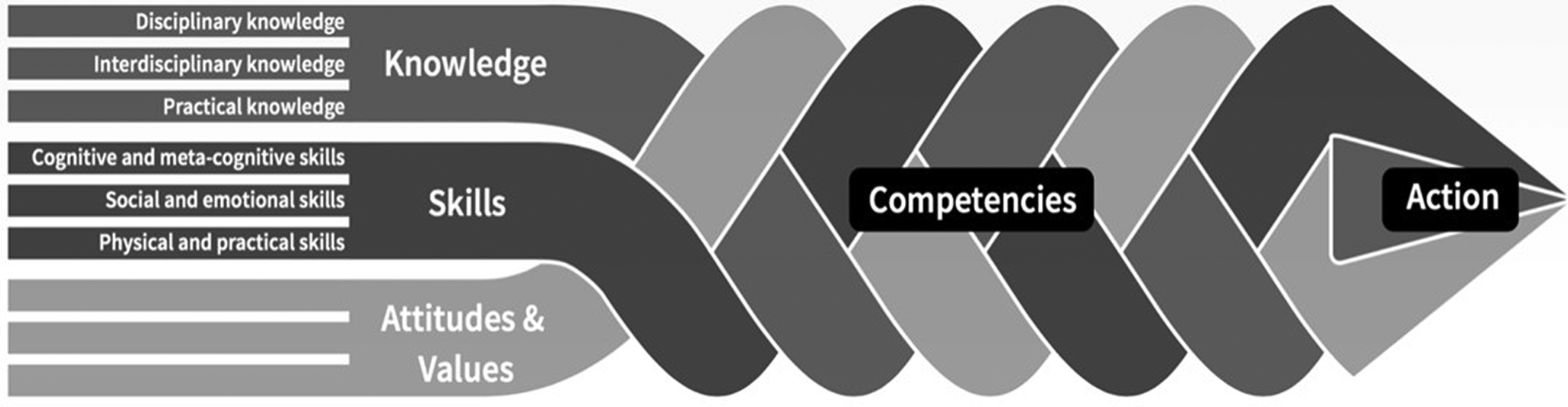
One of the objectives of the 9th (Industry, Innovation, and Infrastructure) and of the 12th (Responsible Consumption and Production) Sustainable Development Goal edited by the United Nations is to reduce GHG emissions by 75% in 2050. In France, it is also an objective of the law on energy transition for green growth voted in 2015, but the first results are not convincing. Industries (but other sectors too) have to contribute to the achievement of this objective and have to change their design and manufacturing strategies (Vezzoli et al., Reference Vezzoli, Ceschin, Diehl and Kohtala2015). This change refers to the concepts of sustainability, sustainable development, and also ecodesign that emerged in the 1990s. Many companies empowered the environmental problem and evolved toward taking into account the other parameters of sustainable development (economic and social pillars) (Pigosso et al., Reference Pigosso, McAloone and Rozenfeld2015; Dekoninck et al., Reference Dekoninck, Domingo, O'Hare, Pigosso, Reyes and Troussier2016; Brones et al., Reference Brones, Carvalho and Zancul2017). Moreover, more and more industrials and academic researchers (McAloone and Pigosso, Reference McAloone, Pigosso, Stark, Seliger and Bonvoisin2017) think that ecodesign should take a more prominent place in business strategies. The objective of ecodesign is to minimize the environmental impact of a product by focusing on early phases of its life cycle and particularly on the design phase (ISO 14006:2011). To make evolve the business of the companies from an economic logic to an environmental transition one, decision-makers', managers', and engineers' states of mind have also to evolve. So, companies are searching now managers, engineers, and technicians with sustainable competencies (Jamison, Reference Jamison2012). They are also looking for trained youth collaborators in sustainable development. We assume that one way to achieve this goal is educating by enriching the trainings with sustainability values and new skills. Aware of this fact, European Union postulated that “Education for Sustainable Development (ESD) should be central in education and training throughout the life and should, where appropriate, be integrated at all levels and in all aspects of education to better equips citizens to cope with imminent unpredictable problems and to find long-term solutions to these problems in the many different situations in life” (European Union, 2010/C327/05). Considering this postulate, many European countries have integrated training modules about sustainable development concepts in their educational programs. For instance, in France, technical competencies about ecodesign have been incorporated in the module “engineering sciences” in programs of the secondary school since 2012. Furthermore, many French universities and engineering schools propose sustainable development courses in their training programs (Shift project, 2019). In such a context, our research goal is to propose models and tools helping teachers and professors to define appropriate trainings for future engineers. These trainings have to allow pupils and students to acquire knowledge, skills, and values related to sustainability and ecodesign in the actual social and industrial contexts. Our hypothesis, in accordance with the OECD Education 2030 framework (OECD, 2019), is that knowledge, skills, attitudes, and values associated with sustainability and ecodesign concepts have to be integrated and linked in future engineers' training programs to generate positive actions (Fig. 1).
The future of education and skills: OECD education 2030 framework (OECD, 2019).

Such a hypothesis leads to develop a reflection on:
• The knowledge, skills, values, and attitudes:
○ What knowledge, skills, values, and attitudes are needed to work with students to foster the acquisition of specific knowledge to ecodesign?
• The “temporality” and the curricula:
○ When knowledge, skills, values, and attitudes have to appear in school curricula to be understandable and useful for pupils or students?
○ Is a training continuum from high school to university or engineering schools the most relevant solution?
The aim of this paper is to contribute to identifying the strengths and limits of current sustainability education practices to improve future decision-makers' and product designers' training. The first section concerns the presentation of the aims of our work and of our research methodology. In the second section, we present a state of the art on competencies, knowledge and skills required to develop ecodesign practices. We identify knowledge, skills, attitudes, and values associated with sustainability and ecodesign and highlight specificities of engineers' competencies for sustainability. A French education case study from secondary school to university is presented in the third section. In this case study, we particularly focused on ecodesign integration in different technological French curricula. The objective is to identify the effective place of sustainable development and ecodesign in the technological training courses and to discuss about it. We propose in the last section a discussion about the relevance of the current programs to provide an adapted answer to sustainable development issues. We also study the opportunity to integrate different themes in programs to possibly permit the development of multidisciplinary curricula covering most of these issues. Finally, we conclude by questioning the possibility to enrich our study with the integration of best practices of international universities and of industrial expectations concerning sustainable development.
Aims and methodology
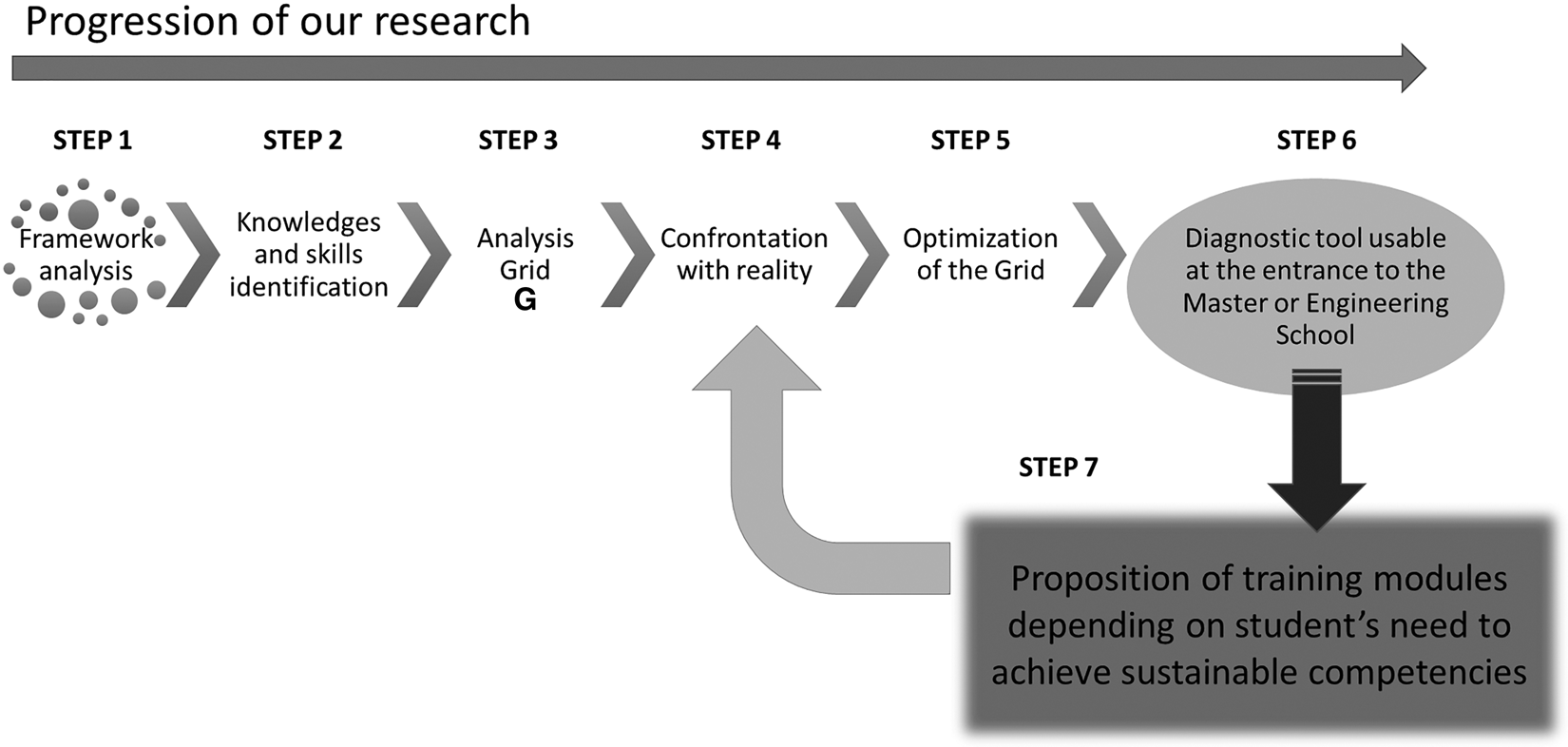
The aim of this paper is to contribute to identifying the current education practices to train future decision-makers, engineers, and product designers to be able to improve them if it is necessary. Our research methodology is composed of different steps (Fig. 2), and our scientific approach is based on the analysis of the French education system case study (from secondary school to university).
Different steps of the research methodology.

Our research methodology and our analysis of the French education system case study allow us to provide in the paper:
• An identification of knowledge and skills associated with ecodesign (steps 1 and 2, Fig. 2) to develop an analysis grid to study official programs (step 3, Fig. 2).
• An analysis of official programs provided by the French Ministry of education (EDUSCOL, 2019; MEN, 2019a, 2019b).
• Different teaching practices based on observations of classes and exchanges with teachers (20 different classes), feedbacks of associations of teachers (ANFTECH, 2019), and reports of the French administration (IGEN, 2016).
• An analysis of programs in different French universities (Besançon, Bordeaux, Grenoble, Strasbourg, Troyes, etc.) and French engineering schools (Centrale-Supelec, Polytechnique, Mines Paris Tech, etc.).
• Many observations of professors' practices based on interviews, feedbacks, and the report of a French Think Tank (Shift project, 2019).
• A synthetic table of existing training on the French case study.
• A study of strengths and lacks of the French education system to ecodesign education for companies and proposal of new programs.
The next section presents a study of knowledge and skills required to develop ecodesign practices (steps 1 and 2, Fig. 2).
State of the art on competencies, knowledge and skills required to develop ecodesign practices
According to a normative point of view (ISO 14006:2011), ecodesign can be defined as “a process integrated within the design and development that aims to reduce environmental impacts and continually to improve the environmental performance of the products, throughout their life cycle from raw material extraction to end of life”. Even if ecodesign is sometimes compared with green design, ecodesign is a more global approach since it concerns the whole life-cycle of products from extraction of raw materials to their end-of-life (Boks and McAloone, Reference Boks and McAloone2009; Pigosso et al., Reference Pigosso, McAloone and Rozenfeld2015). So, ecodesign allows designers to identify the environmental impact of products across all life-cycle phases, to compare between different product concepts of the same category and helps design decision-making (Bhander et al., Reference Bhander, Hauschild and McAloone2003; Millet et al., Reference Millet, Bistagnino, Lanzavecchia, Camous and Poldma2006). Moreover, considering evolution of the society, ecodesign is also a process to develop sustainable solutions that are “products, services, hybrids, or system changes that minimize negative and maximize positive sustainability impacts economic, environmental, social, and ethical throughout and beyond the life-cycle of existing products or solutions, while fulfilling acceptable societal demands/needs” (Charter and Tischner, Reference Charter and Tischner2001). Currently, research expands the traditional ecodesign scope toward managerial and strategic issues (Pigosso et al., Reference Pigosso, Rozenfeld and McAloone2013; Fargnoli et al., Reference Fargnoli, De Minicis and Tronci2014; Pigosso et al., Reference Pigosso, McAloone and Rozenfeld2015). Ecodesign also evolves toward a more sustainable and global vision of design (McAloone and Pigosso, Reference McAloone, Pigosso, Stark, Seliger and Bonvoisin2017). These evolutions of the scope lead barriers to develop an environmental strategy in industry and a gap between ecodesign theory and practice (Bey et al., Reference Bey, Hauschild and McAloone2013). To reduce this gap, we assume that one issue for companies is to employ engineers with multi-technical skills and knowledge in accordance with a sustainable and global vision of design. To train future engineers or engineers already in the companies, we have to identify what kind of knowledge, skills, attitudes, and values have to be considered in ecodesign trainings. The next section presents our analysis of knowledge, skills, and values associated with ecodesign.
Knowledge, skills, attitudes, and values associated with sustainability and ecodesign
Many experts agree that for ecodesign, strong technical knowledge in engineering design are needed but also a capacity to identify issues raised in other areas impacting the social and economic component of the business. Thus, it is not enough to handle tools or methods to meet the challenges of the environmental transition (Bergea et al., Reference Bergea, Karlsson, Hedlund-Åström, Jacobsson and Luttropp2006). Decision-makers and engineers have also to reflect on long-term impacts and to open up their minds on all the areas affected by their decisions. Our preliminary analysis of the literature has revealed that the current training in ecodesign consists of a superposition of layers, in which knowledge and skills are accumulated (De Vere et al., Reference De Vere, Melles and Kapoor2010). The interrelations between knowledge and skill are rarely highlighted. We have to work on interconnections to allow engineers to aware of all the key skills to solve technical and societal issues that will arise to them. Thanks to a holistic sustainable thinking strategy, students can understand different stakeholders' expectations and develop skills to contextualize appropriate choices (Andrews and Soares, Reference Andrews and Soares2017). We have to rely on disciplinary foundations that lead to the training of a specialist engineer and develop both disciplinary knowledge of design, skills, and abilities. Then, students will combine them with transversal skills and knowledge broadening their scope of assessment of selected technological solutions.
What kind of engineers' competencies for sustainability and ecodesign?
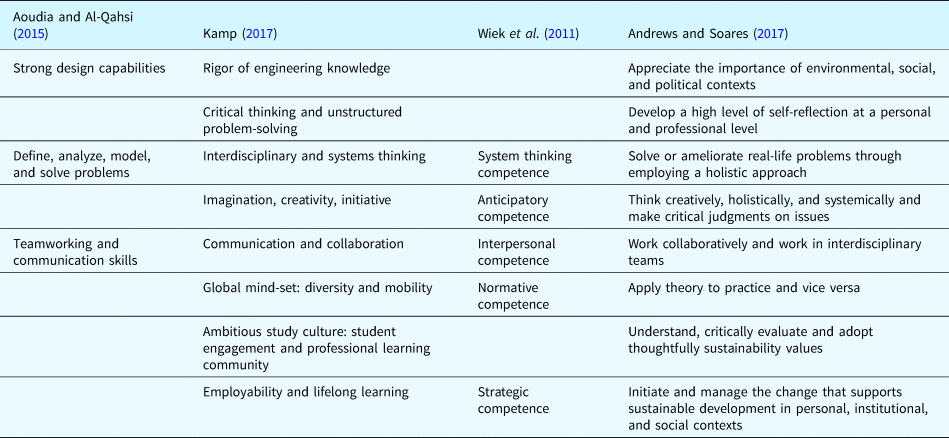
A transition toward “Circular Economy and the integration of social innovation into sustainability initiatives can be observed, which leads to strategic and holistic sustainability considerations in the design of complex systems” (McAloone and Pigosso, Reference McAloone, Pigosso, Stark, Seliger and Bonvoisin2017). Many industries which move toward implementation of ecodesign strategy search to identify different ways to involve all the actors of the company (Bhamra, Reference Bhamra2004). It means that future engineers, in addition to the environmental parameters, have to take into account the social and economic impacts involved in the design process. In such a context, the normative approach of sustainability and ecodesign is not satisfactory for companies, and they are waiting for new skills and competencies. Thus, integrating sustainable development into the skills of future engineers is a key challenge. It is also above all a necessity to change and reduce our environmental impact and to allow a global understanding of the complexity of our society. Some researchers have identified some requirements in skills and competencies in engineering courses which permit to enter in a sustainable way (Wiek et al., Reference Wiek, Withycombe and Redman2011; Aoudia and Al-Qahsi, Reference Aoudia and Al-Qahsi2015; Andrews and Soares, Reference Andrews and Soares2017; Kamp, Reference Kamp2017). Table 1 shows some examples of different kind of competencies and skills linked to sustainability and ecodesign that can be developed during an engineering curriculum.
Competencies and skills for an engineering curriculum

The Swedish Higher Education Act has also determined what students have to acquire in an engineering training considering the sustainability concept. Pargman and Eriksson (Reference Pargman and Eriksson2015) have categorized four sorts of ability to:
• develop and design products, processes and systems while taking into account the circumstances and needs of individuals and the targets for economically, socially, and ecologically sustainable development set by the community;
• make assessments informed by relevant disciplinary, social and ethical aspects;
• demonstrate insight into the possibilities and limitations of technology, its role in society and the responsibility of the individual for how it is used; and
• identify the need for further knowledge and undertake.
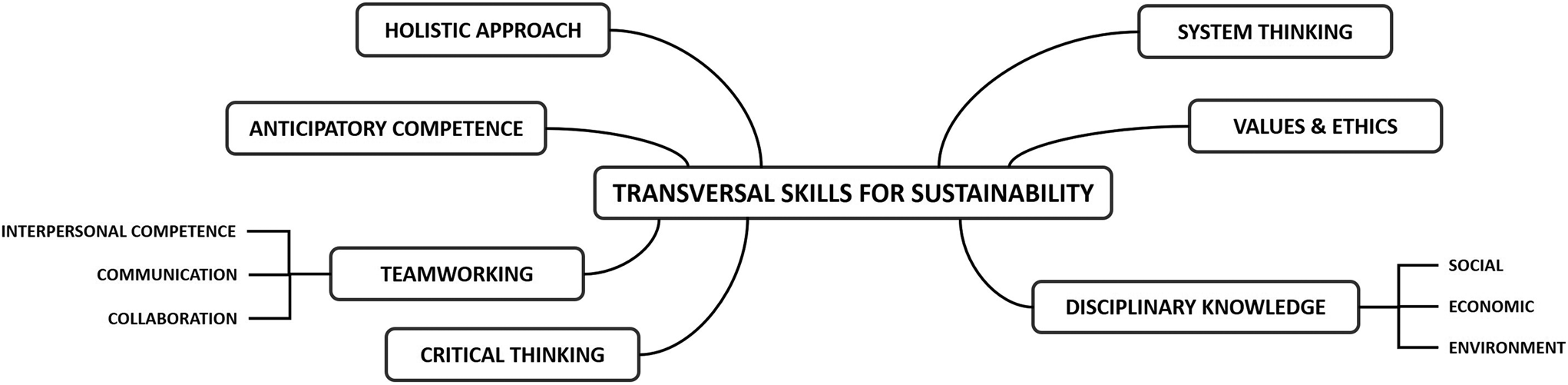
Disciplinary knowledge, strategic views (social and economic aspects), system thinking, critical thinking, building values and ethics, strategic competencies are components of these four abilities. Segalàs et al. (Reference Segalàs, Mulder and Ferrer-Balas2012) demonstrated engineers need to explore cognitive (knowledge and understanding) and meta-cognitive (skills, abilities, and attitudes) domains during their training. The analysis of these different contributions allows to identify transversal skills for sustainability that have to be mastered (Fig. 3).
Mapping of competencies and skills to enter in a sustainable project.

In addition to this mapping, we tried to adopt a more practical view by integrating sustainability in a professional context and combining them with ecodesign cursus (Vallet et al., Reference Vallet, Millet, Eynard, Glatard-Mahut, Tyl and Bertoluci2013).
Ecodesign: skills to cross
Ecodesign is based on two strong concepts, namely the identification of environmental impacts and life cycle assessment (LCA). To be able to integrate these two concepts, the literature shows that it is necessary to have transversal skills in which will be integrated the disciplinary skills necessary to answer the problems posed in a context of sustainable development (Brones et al., Reference Brones, Carvalho and Zancul2017). Thus, according to Boks (Reference Boks2006), we could distinguish the ecodesign “hard-side” and “soft-side”. On the one hand, it integrates theoretical knowledge in design engineering in terms of so-called hard, such as environmental assessment and the handling of the associated theoretical tools. On the other hand, “soft” that includes nontechnical skills. Pezeshki et al. (Reference Pezeshki, Panchal, Ameta, Kaufmann and Lee2012) complete this vision by distinguishing four areas for their ecodesign and sustainability model for higher education:
1. Core science;
2. Facilitative strategies, for instance, tool development;
3. Canonical ecodesign philosophy, that is, decision-making processes;
4. Conceptual knowledge and paradigms shift.
This reading of skills must also be cross-checked with the needs of companies in this field. Some companies note that “engineers should have a better understanding of the natural resource constraints facing our world, as well as economic constraints and opportunities for sustainable development” (Hanning et al., Reference Hanning, Priem Abelsson, Lundqvist and Svanström2012). The companies surveyed also mentioned, “communication problems concerning the problems of sustainable development and the difficulties encountered by their employees to understand the link between their work and sustainable development” (Hanning et al., Reference Hanning, Priem Abelsson, Lundqvist and Svanström2012). The question is not about the disciplinary knowledge that is acquired but about the transdisciplinary skills or related to a global consideration of sustainable development in everyday practices. Thus, the current challenges for companies wanting to engage in an ecodesign or sustainable approach are to act on knowledge, business strategy, interpersonal skills, collaboration and management (Dekoninck et al., Reference Dekoninck, Domingo, O'Hare, Pigosso, Reyes and Troussier2016).
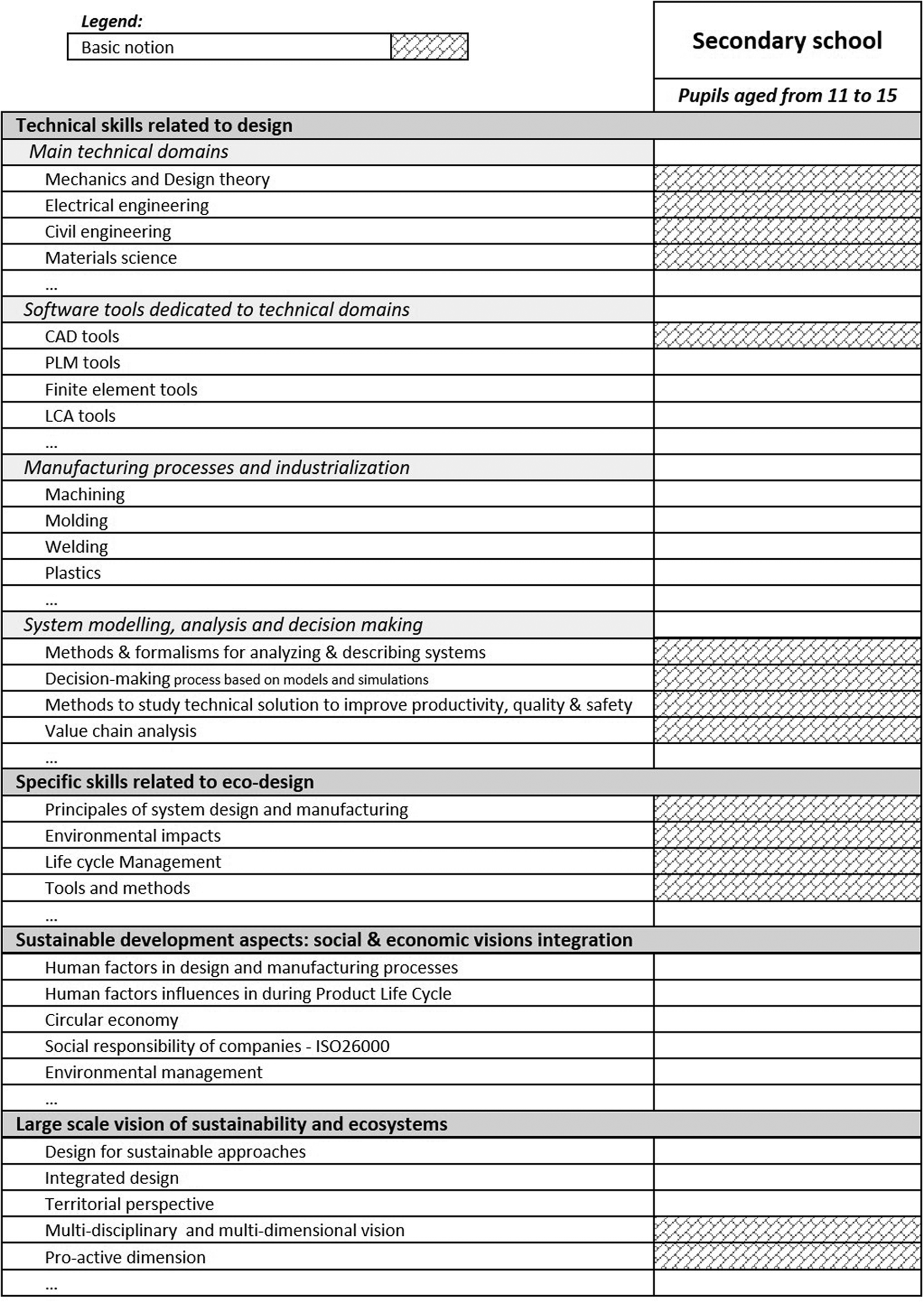
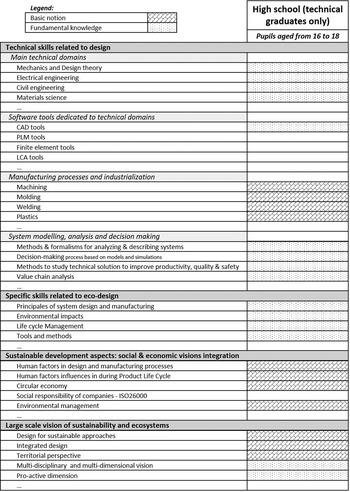
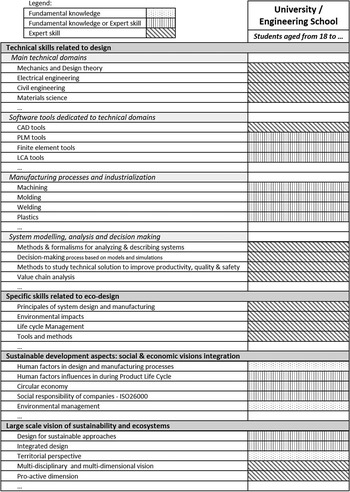
In such a context, we conducted a study on the French education system from secondary school to university to check if this system prepares future decision-makers and engineers to be actors to the sustainable transition. The study is presented in the next section. We particularly focused on programs and teachers' practices analysis. To check if competencies, knowledge and skills identified in this section (Fig. 3) are in the French education programs, we designed our own analysis grid (step 3, Fig. 2), in which we have different inputs in accordance with our state of the art (Figs. 4–6):
• technical skills related to design;
• specific skills related to ecodesign;
• sustainable development aspects: social and economic visions integration; and
• large-scale vision of sustainability and ecosystems.
As we use the same grid to analyze all the programs, we are able to put in evidence if a continuum in ecodesign training exists or not from secondary school to university.
Knowledge, skills, and values related to ecodesign in the secondary school programs.

Knowledge, skills, and values related to ecodesign in the high school programs.

Knowledge, skills, and values related to ecodesign in curricula in universities/engineering school.

French sustainable and ecodesign education case study from secondary school to university
Since 2011, we observe a consolidation of ecodesign research as a multidisciplinary research area, that is continuously optimizing the foundations and expanding the borders (Pigosso et al., Reference Pigosso, McAloone and Rozenfeld2015). The “sustainable society” industries need engineers problem-solving oriented and with transdisciplinary, holistic and systemic visions (Secundo et al., Reference Secundo, Passiante, Romano and Moliterni2013). It means that engineering education has to evolve to allow students to develop new competencies, skills and knowledge (identified in the previous section). Pupils and students have to be concerned with sustainable development issues as soon as possible. We assume that we have to think about a coherent and progressive continuous curriculum in technological and engineering training from secondary school to university to be efficient. The curriculum has to be a reference for teachers that will be able to understand the possible logical links between graduate levels.
To achieve our objective and to contribute to identifying the strengths and limits of current sustainability education practices, we first study the French education system. The choice of the French case study allows us easier access to data, to teachers, and professors in secondary schools, high schools, and universities/engineering schools. This study is the first step to test and refine our analysis elements and to bring our first propositions.
Ecodesign in the French secondary school programs
Analysis of the French secondary school programs
Ecodesign courses in programs of French secondary school appear in the module “Technology” (a part of the largest “Engineering sciences” thematic). The main objective of these courses is to allows pupils (from 11 to 15 years old) to explore complexity between society and industry and processes to design or manufacture products. To achieve this objective, a new technology curriculum was proposed in 2016 for secondary school. It promotes to
1. develop good practices in the use of communicating objects,
2. analyze the environmental impact of an object and its constituents,
3. analyze the life cycle of a product (an “object” in the official terminology), and
4. adopt an ethical and responsible behavior.
All these expected sub-objectives are particularly oriented on an environmental vision of materials or energy problematics. The program also indicates that pupils have to work skills related to solving technical problems taking into account environmental parameters. The purely disciplinary contributions related to ecodesign are relatively weak.
Observation of teachers in secondary schools
Our observations of teachers in different classes and administrative reports put in evidence that teachers often take over the propositions of the program to teach the largest vision of sustainable development. They also work on the first concepts of a holistic vision for sustainable design. In such cases, teachers' aim is to develop an ethic and an awareness of sustainable development with early aged pupils. They generally highlight the importance of taking account of all aspects of sustainability in the design of a product. They are also focused on “soft skills” (Harris and Rodgers, Reference Harris and Roggers2008) like teamworking, getting organized, listening to each other, learning to communicate with others with the report and oral presentation. They consider that these skills will allow future students to understand problems to be solved by taking into account wider perimeters that can be impacted by their solution. These soft skills are associated with more participative teaching practices such as project-based learning or inquiry-based learning to develop other essential skills related to sustainable development:
• an ethic and a system of values,
• systemic thinking,
• a complex thought,
• forward thinking and anticipation.
The predominant difficulty concerning the teaching of ecodesign in secondary school is that teachers are not really prepared during initial and continuous training.
Synthesis for secondary school
Figure 4 presents an analysis grid of program in secondary school. The program is focused on basic notions on mechanical domains, CAD tools (SolidWorks), system modeling (SysML), and specific skills related to ecodesign.
Ecodesign training in the French high school programs
Analysis of the French high school programs
Our study of the high school programs highlights that there is a discontinuity in the study of sustainable issues and in ecodesign courses between the secondary school and the high school. Indeed, these courses are optional during the first year in high school and many pupils chose other optional trainings. Since 2011 and the reform of technological baccalaureate, at the end of the first year, pupils can access to specific training in Science and Technology for Industry and Sustainable Development (STI2D) during their second and third years in the high school. The name of this new diploma corresponds to an evolution in the organization of technical education or a desire to change old paradigms. Program of this diploma is focused on the acquisition of a technical culture with a comprehensive approach to multi-technology systems. In the specific training STI2D, all pupils receive an ecodesign training, and the program integrates a large panel of competencies, knowledge and skills (see Fig. 5).
Observation of teachers in high school
Our observations show that teachers base their ecodesign courses on disciplinary elements and rarely take into account of a global vision of sustainability. One explanation could be in France, in education we have “the cult of the disciplines” and as a consequence, the initial teachers' training is essentially a disciplinary one (no transversal approach). Moreover, the lack of continuous training not allows teachers' knowledge evolution (less than 20 h/year). For instance, there is no continuous training to present ecodesign to teachers. As a result, in ecodesign courses, the consideration of environmental impacts is done either from a point of view of materials (linked to discipline “mechanics”) or energies (linked to discipline “electronics”) but not by scrutinizing the two criteria. Teachers almost never address the economical, ethical, or societal parameters that are more and more changing the definition of ecodesign. We observed that pedagogical teams with teachers of different disciplines are occasionally constituted but not on ecodesign projects. In such a context, it is not possible to create interactions between disciplines and different visions that put in evidence during the real project the multiplicity of the sustainability concept. So, one of the first challenges is to create relationships between the secondary school and the high school. Other opportunity is to make teachers sensitive about what pupils have learnt before. The adoption of ecodesign and sustainability principles requires building “a coherent approach to the field for students and professors” (Vallet et al., Reference Vallet, Eynard and Millet2014).
Synthesis for high school
Figure 5 is the analysis grid of program in the high school (technical graduates only).
In technical graduates, and in the STI2D curriculum particularly, plenty of the competencies, knowledge and skills identified in the “State of the art on competencies, knowledge and skills required to develop ecodesign practices” section are presented to pupils. STI2D curriculum seems to be adapted to develop specific skills that could be potentially useful in the university. Nevertheless, in 2017, according to a national education report, only 6.8% of pupils in the last year of high followed courses in STI2D. So, in such a context, universities and engineering schools always consider that no student at the end of the high school has a satisfactory level of knowledge in ecodesign.
Ecodesign training in French universities/engineering schools
Analysis of programs in universities/engineering schools
In France, universities and engineering schools have to train students for companies, in which they will be decision-makers and will have to define and manage strategies to integrate sustainable development. So, students may have a global overview of the sustainable development concept and of the approaches and tools to achieve sustainable objectives in companies. They must also be able to provide specific answers to environmental, social, and/or economic problems depending on their activities in the companies.
The study of programs in universities/engineering schools is complex because they have no national framework to develop training offers. It means that each university is free to design its own training offer. The main conclusion of our research is that few Bachelor and Master degrees in Engineering Sciences offer modules related to ecodesign or sustainability.
Observation of professors in universities/engineering schools
When ecodesign courses or sustainable development courses exist in university or engineering school, we identified two different approaches used by professors. One approach refers to a global vision of sustainability by presenting DFS approaches and interdependencies between environmental, economic, and social aspects of product all along its life cycle. The second approach is more a technical one, in which professors refer to the methods and tools used to apply effectively conceptual methodologies and norms in companies depending on the phases of the design process. Moreover, we observed that training modules are also often directly in relation to professors' disciplinary specificities (ecodesign, eco-materials, eco-energy, circular economy, etc.) and not really multidisciplinary. Ecodesign in French university or engineering school is characterized by heterogeneity of the curricula and different uses of ecodesign tools depending on professors' habits.
Synthesis for universities/engineering schools
A global cross-analysis of many French curricula is presented in Figure 6. Even if curricula are heterogeneous, we identified that university and engineering schools develop courses to permit students to develop their capability to analyze design situation, to specify the problem (classical or specific one), and then to adapt their response to the situation by using appropriate methods and tools. Professor tries to really develop students' “hard-side” and “soft-side” of the ecodesign (complex thinking, prospective thinking, and interest to adopt a systemic vision of problems, for instance) (Brones et al., Reference Brones, Carvalho and Zancul2017).
Discussion and perspectives
Even if concepts, knowledge and skill related to ecodesign appear in different programs, our analysis of ecodesign trainings emphasizes that there is not a continuum between pre-secondary school, high school, and university. As a consequence, students at the end of the high school are not comfortable with the issues of sustainability and ecodesign and the main difficulties concern:
• The links between knowledge and action are essential in ecodesign to evaluation impacts of decisions, but students systematically provide simple answers to a complex problem. Rapidity and facility are often preferred to quality…
• The values and ethics of sustainability depend on institutional injunctions and are clear, so students know these elements. Worse still, few students have a counterproductive filling of guilty and a feeling of powerlessness.
• The fact that students are used to provide simple answers by applying determinist methods, whereas they have to adopt a complex thinking posture to understand sustainability. A great number of them has not a systemic vision of sustainable issues.
• The identification of the way to solve problems while students are able to identify problems to solve.
• The development of prospective thinking that is a crucial issue for sustainable development. Students often develop this competence in a personal context, but it seems to be not so easy in school.
• The students' lack of systemic vision to adopt a global vision of the context in which their actions take place. Such a vision is an important key since “the crucial element of specification in ecodesign is the state of the environment(s) in which the solution will function” (Krishnaswamy and Chandran, Reference Krishnaswamy, Chandran, Chakrabarti and Chakrabarti2017).
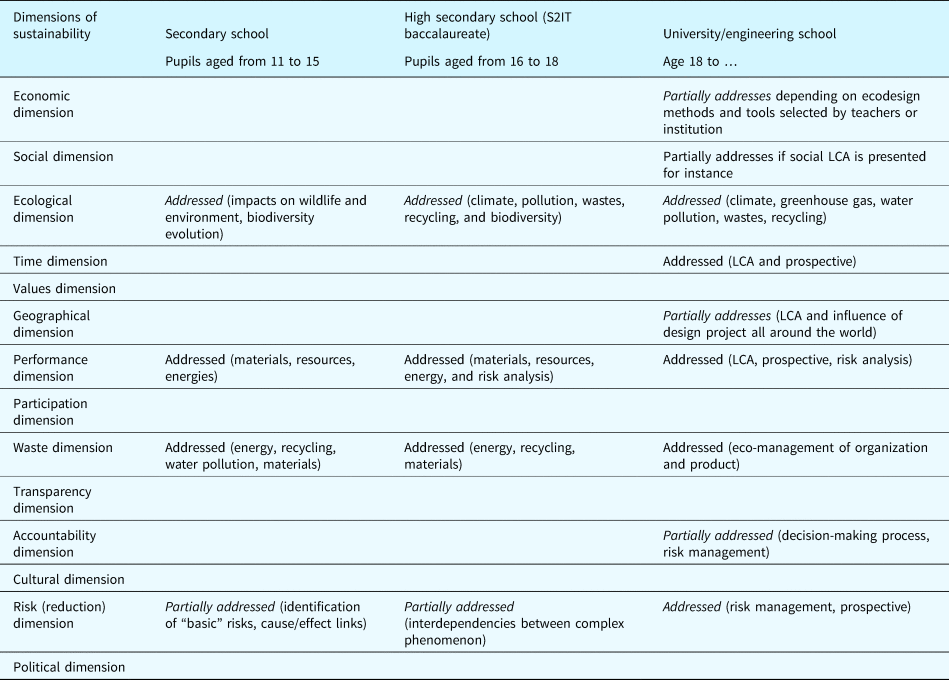
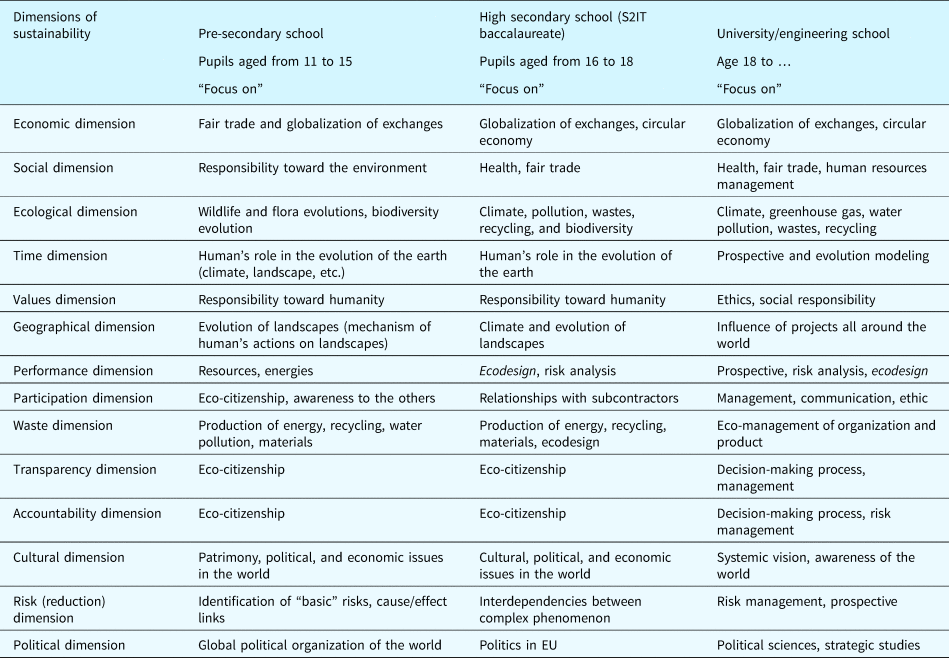
We complete our analysis with a study that places curricula in a global perspective of sustainability by proposing a parallel between institutional programs and the 14 invariant dimensions of sustainability (Silvius and Schipper, Reference Silvius and Schipper2014; Table 2). With such a representation, our objective is to check if all dimensions of sustainability are addressed (or not) across curricula programs. As these dimensions are considered as important ones when we talk about “sustainable” project management, it seems interesting to study if French students are trained to manage this kind of project. We highlight complexity to cover all dimensions of sustainability with the existing programs. So, evolutions of ecodesign trainings in a more global sustainable vision closed to companies' expectations could be profitable to students.
Dimensions of sustainability addressed by ecodesign training in France

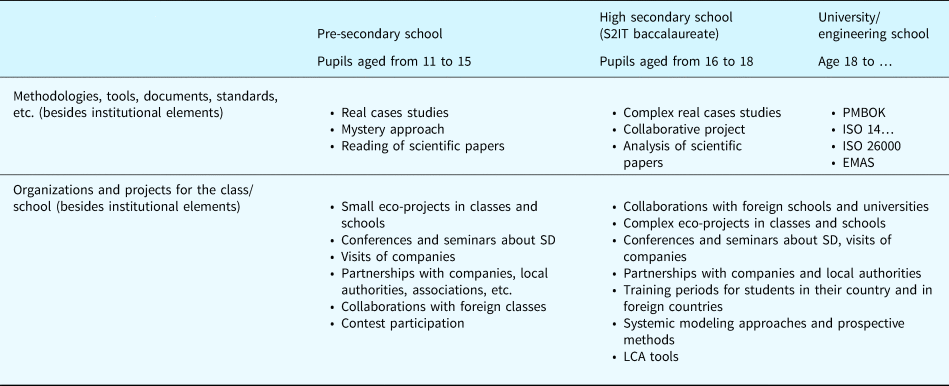
The history and culture of the French education system could partially explain students' and teachers' difficulties. In our system, trainings are historically based on disciplinary magistral courses, and students have to listen carefully teachers. In such a context, it is not easy for students to express their ideas and to develop personal initiatives. It is also not easy for teachers to develop transdisciplinary courses and to create a context in which students could express their ideas. Nevertheless, the education system is evolving and pedagogic approaches based on projects, collaborative activities and considering students as the “main actors of their learning” are encouraged. In Table 3, we present a synthesis of pedagogic approaches used by the teachers during our observations.
Pedagogic approaches used by the teacher during ecodesign courses

In France, curricula and teachers' state of mind and trainings (initial and continuous ones) have to evolve. To sum up, concerning teaching strategy, we have to bring students at the highest level of intellectual development according to Felder and Brent (Reference Felder and Brent2004):
1. possess the skepticism and inclination to challenge what is currently known;
2. question the assumptions underlying all accepted wisdom;
3. are reluctant to accept the first reasonable explanation;
4. employ both logic and intuition; and
5. avoid transferring judgments made in one situation to another situation without critical evaluation.
These kinds of skills must be developed during technology or engineering sciences courses since the secondary school to university master. In the same time, it is also an important issue to train pupils and students to all dimensions of sustainability and associated skills and knowledge to provide a large vision of sustainability problematic. So, to achieve this issue, it could have an interest to explore potential synergies between ecodesign and other DfS approaches to enlarge the scope of the concept. Ecodesign could be integrated with DfS approaches of Spatio-Social and/or Socio-Technical System innovation levels (Ceschin and Gaziulusoy, Reference Ceschin and Gaziulusoy2016) to obtain a global DfS approach addressing the environmental, socio-ethical, and economic dimension of sustainability. In Table 4, we propose themes (“focus on”) for each dimension of sustainability at each graduate level that possibly permits to develop multidisciplinary curricula covering most of the sustainability issues (ecodesign, geography, political sciences, human sciences, etc.).
Themes proposal to develop multidisciplinary curricula

Conclusion
To conclude, the paper proposes an analysis of the French curriculum in an ecodesign case study to analyze the way it addresses the required features identified in the state of the art. The critical analysis enables to build the first draft of a new proposal of the curriculum. The principle of a continuum of knowledge on different education levels and programs is difficult to envisage because the training paths of the students are very varied and depend on different training policies in France. However, the notion of continuum deserves to be deepened and refined on the axis of competencies.
The following step of the research will consist of interviews with professionals in companies to identify which tools and methods can be used to enrich our diagnosis of required knowledge and skills for students. This diagnosis will then offer them a training path that will lead them to an integrated, comprehensive and ecodesign-relevant training that will allow them to take into account all the industrial issues related to the environmental transition.
However, our case study-based methodology must be also reinforced with international practices. So, it seems interesting to deepen this line of work as do many European and Anglo-Saxon universities (Mihelcic and Hokanson, Reference Mihelcic, Hokanson, Nemerow and Agardy2005; Hokanson et al., Reference Hokanson, Mihelcic and Phillips2007; Svanström et al., Reference Svanström, Palme, Wedel, Carlson, Nyström and Edén2012; Olsen et al., Reference Olsen, Fantke, Laurent, Birkved, Bey and Hauschild2018; Pérez-Foguet and Lazzarini, Reference Pérez-Foguet and Lazzarini2019) and Asian universities (Akiyama et al., Reference Akiyama, Onuki and Li2012). The objective will be to propose a wider and more generic framework for ecodesign education as a contribution to sustainability education.
Catherine Perpignan is a PhD student in the mechanical department at the Université de Technologie de Compiègne (France). She is an engineering science teacher. Her work focuses specifically on sustainability in engineering curricula with a view to the integration of transversal and technical competencies in undergraduate training.
Vincent Robin is an Associate Professor at the University of Bordeaux and a member of the IMS Laboratory. His research interests include coordination of engineering design, human factors in system coordination and performance evaluation of the collaborative design process and of collaborative systems. His research focuses on the analysis of the impacts of organization, management and trainings in companies on human resources to make evolve organizations to be more “sustainable” and “human-centered”. He is the author of more than 70 papers at the international level. He has participated and coordinated several French research projects.
Yacine Baouch is an Assistant Professor at the University of Technology of Compiègne. He teaches Ecodesign in the Department of Mechanical Engineering Sciences. He completed his PhD at the University of Grenoble Alpes in Industrial Engineering. His current research is Knowledge Management applied to Ecodesign.
Professor Benoît Eynard is currently the leader of Integrated Product-Process Engineering team of Roberval research institute at the Université de Technologie de Compiègne – UTC, France. In 2007, he has joined UTC as a Full Professor for leading the Department of Mechanical Systems Engineering until 2012. Since 2013, he is the general chairman of the division on Factories of the Future of French Society of Mechanical Engineering also known as S.mart (formerly AIP-PRIMECA) academic group. He is also a member of the IFIP working group 5.1 dealing with “Global Product Development for the Whole Life-Cycle” and of the Design Society where he currently leads the special interest group on “Design Methods for Cyber-Physical Systems”. He is a recognized researcher in product life-cycle management, collaborative design, systems engineering, mechatronics design, digital factory, manufacturing process management, cyber-physical production systems, ecodesign and sustainable manufacturing. He has published over 70 papers of international journals and 200 international conferences. He also has been the guest editor for 15 journal special issues and academic books.