Introduction
Governments around the developed world are seeking to meet the challenges of ageing populations through strategies which promote a holistic approach to ageing, captured in catch-phrases such as ‘successful’, ‘active’, ‘positive’ and ‘healthy’ ageing. At a policy level, the challenge for governments is to maximise the health and wellbeing of older people, whilst at the same time meeting obligations of state pensions and funding the inevitable growth in demand for health, residential and social services. However, the changing dependency ratio (i.e. the proportion of non-workers to workers) will have significant implications for government spending and allocation. In New Zealand, this will be further compounded by falling home ownership rates and the impact of the 2008 global financial crisis on personal wealth, particularly the retirement savings of many people approaching retirement age.
Healthy ageing has an important role to play in meeting this challenge through enhancing wellbeing and quality of life and supporting older people to remain independent for as long as possible or, in other words, to ‘age in place’. Healthy ageing and ageing in place are well supported in the New Zealand policy context by the national ‘Positive Ageing Strategy’ which includes amongst its objectives the promotion of healthy nutrition and active lifestyles, and the development of policy and services to facilitate ageing in the community (Ministry of Social Policy 2001). Furthermore, extensive biomedical and social research is revealing an increasingly clear picture of the minimum individual needs for a healthy life. However, as is the case throughout the lifecourse, income (including wealth) in later life is one of the most important determinants of health – influencing all aspects of life, from the quality and location of one's house through to how often one socialises. In New Zealand, 43 per cent of those aged 65 years and over depend solely upon the universal state pension (New Zealand Superannuation – NZS) for their income.
If health is the standard of living to which we aspire, what then is the minimum income needed to live a healthy life in older age? This question was investigated by the London School of Hygiene and Tropical Medicine (LSHTM) in their research entitled ‘A Minimum Income for Healthy Living (MIHL): Older Age, England’ (Morris et al. Reference Morris, Dangour, Deeming, Fletcher and Wilkinson2005, Reference Morris, Dangour, Deeming, Fletcher and Wilkinson2007). The MIHL: Older Age, England used a health lens to investigate the retirement income needs of older people living in England, based on the proposition that everyone, including the most vulnerable, should have at least the opportunity to satisfy basic health requirements (Morris et al. Reference Morris, Donkin, Wonderling, Wilkinson and Dowler2000). The research concluded that the (then) current State Pension and the official safety net, the Pension Credit Guarantee (after means-testing), fell below the estimated MIHL, suggesting that inadequate income could be a barrier to healthy living for older people in England. Morris et al. (Reference Morris, Dangour, Deeming, Fletcher and Wilkinson2007) further concluded that, due to the fact that the MIHL was not intended to cover those living in private households with a significant disability (on the basis that this would likely entail additional costs of healthy living), the actual disparity between benefit levels and the MIHL was likely to be even greater.
The MIHL methodology represents an important tool for the assessment of retirement income in the light of the large body of biomedical and social research on the needs for healthy living developed in the latter part of the 20th century. This New Zealand-based research aimed to replicate, and build on, the work of Morris et al. (Reference Morris, Dangour, Deeming, Fletcher and Wilkinson2007) for the New Zealand context. Despite the strong, historical linkages between New Zealand and England, there are clear differences between the two countries in terms of cultural preferences, purchasing practices, availability of infrastructure and services and levels of public subsidies. The objective of the MIHL: Older New Zealanders was therefore to define, using available knowledge, the requirements for healthy living of people aged 65 and over with no significant disability living in private households, and to estimate the minimum weekly budget that would be needed to meet those requirements. The MIHL: Older New Zealanders is compared with the NZS to give some indication of the extent to which older New Zealanders are currently receiving an income which supports healthy living.
Methods
The MIHL: Older New Zealanders uses a methodology known as ‘budget standard’ methodology. A budget standard represents ‘what is needed by a particular type of household, living in a particular place at a particular time in order to achieve and maintain a specific standard of living, in terms of its consumption of goods and services’ (Saunders, Patulny and Lee Reference Saunders, Patulny and Lee2004). The formulation of budget standards, including decisions about what personal needs are included and excluded, the decision makers and the basis on which those decisions are made, are subject to wide variation. Budgets have been developed for variously defined standards of living and for specific populations and household types (Deeming Reference Deeming2005; Morris et al. Reference Morris, Donkin, Wonderling, Wilkinson and Dowler2000, Reference Morris, Dangour, Deeming, Fletcher and Wilkinson2007; Saunders, Patulny and Lee Reference Saunders, Patulny and Lee2004). The budget standard approach has become increasingly popular since the early 1990s, being employed for a wide variety of policy and poverty measurement purposes in countries including the United States of America, the United Kingdom, Canada and Australia (Fisher Reference Fisher2007).
In line with the MIHL: Older Age, England (Morris et al. Reference Morris, Dangour, Deeming, Fletcher and Wilkinson2005, Reference Morris, Dangour, Deeming, Fletcher and Wilkinson2007), the standard sought in this research is ‘healthy living’. It is divided into seven main categories of expenditure necessary for healthy living: nutrition, physical activity, housing, social connectedness, transport, health care and hygiene. A final category of ‘Other costs of healthy, social living’ was included to pick up on certain miscellaneous costs, contingencies and inefficiencies. For each main area, the literature was reviewed and a statement of what would be needed for healthy living was developed based on the best available scientific evidence. Those statements of need were then translated into presumptively acceptable ways of living and the minimum personal costs of that lifestyle were then estimated.
In developing the statements of need, the research relied on the best available evidence, where possible in the form of systematic reviews, meta-analyses and randomised controlled trials. New Zealand-based survey data and other research were used to translate those statements of need into a presumptively acceptable lifestyle. The minimum personal costs of that lifestyle were established using a variety of means including publicly available information (such as published electricity prices and average rentals), actual costings (such as supermarket prices) or data on the expenditure patterns of New Zealanders (such as the three-yearly Household Economic Survey). Actual expenditure data were only used to establish personal costs as a last resort, in an effort to avoid the ‘circularity’ associated with estimating minimum expenditure levels based upon actual expenditure (where income constraints may already have influenced behaviour and spending).
Once completed in draft, the key assumptions made in developing the budgets were tested for acceptability with three focus groups comprised exclusively of older adults. These focus groups also played a key role in translating statements of need into a lifestyle which was likely to be acceptable to older adults in New Zealand. This step was not reported on as part of the MIHL: Older Age, England (Morris et al. Reference Morris, Dangour, Deeming, Fletcher and Wilkinson2005, Reference Morris, Dangour, Deeming, Fletcher and Wilkinson2007) but has been acknowledged as an important feature of the MIHL methodology (Morris and Deeming Reference Morris and Deeming2004).
The MIHL: Older New Zealanders was based on an average low-income older New Zealander living in a (non-specific) urban centre. An indicative budget was developed for a person living alone as well as a couple, and for a person renting as well as a debt-free home owner.
ResultsFootnote 1
The results for each category of expenditure follow in summary form. In each category, the cost of living is considered for people living alone as well as couples on the basis that, because many cost of living items are fixed, the cost of living for couples cannot be assumed to be double that of those living alone. Full details of the costings, data sources and underlying assumptions are available from the authors. All references to $ refer to NZ $ (see note in Table 7).
Nutrition
The importance of good nutrition for healthy ageing is well established amongst experts on ageing. Good nutrition in older age has been recognised for its positive influence on mortality, morbidity, disability and functional status as well as quality of life (Nowson Reference Nowson2007). Maintaining functional status, and thus the ability to carry out daily tasks, promotes prolonged independence (and delayed entry into residential care).
A weekly diet was constructed using readily available foods which are commonly consumed in New Zealand, easy to access and prepare, and hence, likely to be well accepted by older New Zealanders. The menu was also designed to meet the unique nutritional requirements of, and food-based recommendations for, older adults. Specifically the diet was designed to meet:
1. daily energy requirements of 11,055 kilojoules (2,642 kilocalories) for a moderately active 73-year-old male and 9,180 kilojoules (2,194 kilocalories) for a moderately active 75-year-old female;Footnote 2
2. the basic nutrient requirements (when averaged over seven days) of older adults by reference to national and international guidelines (National Health and Medical Research Council 2005; World Health Organization/TUFTS 2002) with vitamin D provided in supplement form (Autier and Gandini Reference Autier and Gandini2007); and
3. Ministry of Health and internationally accepted food-based guidelines, such as those for fruit and vegetables (Ministry of Health 2006; World Health Organization/TUFTS 2002).
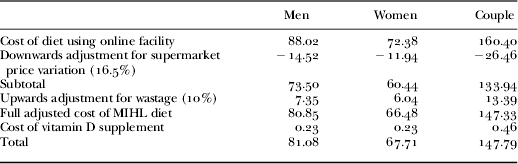
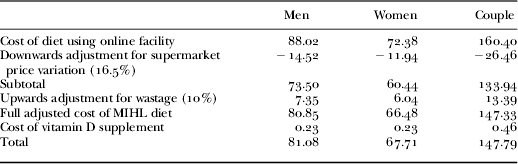
The weekly personal costs of a healthy diet are detailed in Table 1. The diet was priced using an online shopping facility provided by a leading national supermarket. The total cost was adjusted downwards by 16.5 per cent to reflect the variation in grocery prices at different supermarkets (Consumer New Zealand 2009). A 10 per cent allowance for wastage was also included (Morris et al. Reference Morris, Dangour, Deeming, Fletcher and Wilkinson2005, Reference Morris, Dangour, Deeming, Fletcher and Wilkinson2007).
Weekly personal costs of a healthy diet (NZ $)
Note: MIHL: Minimum Income for Healthy Living.
For the purposes of the final MIHL for a person living alone, the mean of the cost for men and women (i.e. $74.64) was used. By comparison, the actual weekly expenditure on food by low-income 65+ households is approximately $92 per household, amounting to $57.50 per person (assuming a mean occupancy of 65+ households of 1.6; Statistics New Zealand 2009b).
Physical activity
Regular physical activity, including aerobic and muscle-strengthening exercise, is a crucial component of healthy ageing. Physical activity is now recognised by experts as one of the most modifiable determinants of health, representing the ‘best preventive medicine for old age’ (Swedish National Institute of Public Health 2007: 99). Nevertheless, in New Zealand, the 65+ population has the lowest levels of physical activity compared with all other adult age bands (Ministry of Health 2008; Sport and Recreation New Zealand 2008).
In the absence of New Zealand or Australian guidelines tailored specifically to older adults, the MIHL: Older New Zealanders was based on recommendations developed by the American Heart Association and American College of Sports Medicine (Nelson et al. Reference Nelson, Rejeski, Blair, Duncan, Judge, King, Macera and Castaneda-Sceppa2007) relating to:
1. aerobic exercise on at least five days of the week;
2. muscle-strengthening exercise on at least two days of the week; and
3. flexibility exercises (and balance exercises for those at risk of falls) on at least two days of the week.
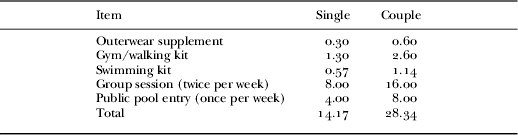
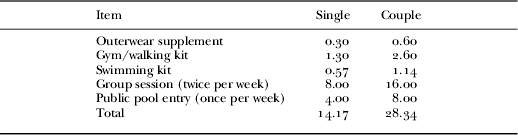
The MIHL budget recognises that if physical activity is to become a habitual and sustainable part of an older adult's weekly routine, it must be enjoyable, varied and provide opportunity for social contact. Interventions shown to be most effective are targeted solely at physical activity, delivered in groups, based in centres rather than homes and encourage moderate-intensity activity (Conn, Valentine and Cooper Reference Conn, Valentine and Cooper2002). On this basis, the MIHL budget for physical activity (Table 2) was designed to include two group exercise sessions and one swim per week with the balance of exercise needs coming from walking and daily chores. The MIHL also allows a modest amount for the kit required for participating in these activities. No allowance was included for transport to the gym or swimming pool and this would need to come from the weekly transport budget provided for as part of the MIHL.
Weekly personal costs of physical activity (NZ $)
A healthy home
Access to safe, secure and good quality housing is an important determinant of good health (Howden-Chapman and Carroll Reference Howden-Chapman and Carroll2004). The relationship between housing and health is most clearly seen in older people who have the highest prevalence of chronic disease and spend the most time indoors (Donald Reference Donald2009). Older people are also particularly sensitive to the cost of housing, as most are on fixed incomes which they are unable to supplement through paid employment. For low-income older people, ‘housing costs are the main determinant of how much food is on the table and, when it is cold, whether the heater will be turned on. Some choices can be fatal’ (Howden-Chapman, Signal and Crane Reference Howden-Chapman, Signal and Crane1999: 25).
Estimating the costs of a healthy home for the MIHL: Older New Zealanders was particularly challenging. Housing costs are highly variable across New Zealand and within cities themselves. Housing costs also depend on whether the house is rented or owned and if owned, the level of debt, as well as the number of people living in the house and sharing the costs. The MIHL was based on two alternative housing scenarios. The first scenario assumed debt-free home ownership. The second scenario assumed a private rental arrangement. Approximately 70 per cent of New Zealanders aged 65+ years enjoy debt-free home ownership: only around 8–9 per cent rent the home in which they live (Statistics New Zealand 2009c; Waldegrave and Cameron Reference Waldegrave and Cameron2009) of which approximately half live in a privately owned rental property. While renters currently represent a relatively small minority of older New Zealanders, they are likely to be those with the least accumulated wealth and therefore the lowest incomes. This group is also likely to grow in the future as home ownership rates are declining in middle-aged and pre-retirement age groups.
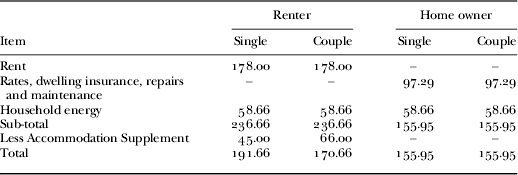
For home owners, the MIHL excludes any mortgage repayments (because it assumes that the home is owned debt-free) but includes other costs of home ownership such as repairs and maintenance, local council rates and house insurance. Costings included:
1. an average weekly cost ($14.35) to bring the home to ‘as new’ condition spread over 10 years. This was intended to act as a proxy for the widespread underspend by older adults on repairs and maintenance as shown by housing condition surveys (Saville-Smith, James and Fraser Reference Saville-Smith, James and Fraser2008);
2. an additional weekly amount ($43.19) for routine repairs and maintenance based on the median annual expenditure by older adults on their dwellingsFootnote 3 and adjusted upwards by 100 per cent to reflect the tendency to under-invest in this area; and
3. $35.90 for rates and $3.85 for house insurance.Footnote 4
For renters, an average weekly rental cost of $178 was included in the MIHL budget. This was based on New Zealand lower-quartile market rental data for a one-bedroom flat ($155 per week) (Department of Building and Housing 2009), inflated by 15 per cent to recognise that flats and houses in the lower quartile of rentals are less likely to be well maintained, safe and secure, built of good materials, energy efficient (including fully insulated) and weather tight – all of which have implications for health. A state-funded benefit (the ‘Accommodation Supplement’) is available to assist low-income renters with housing costs and this was accounted for in the MIHL costings.
Fuel costs are an important part of the MIHL budget for older New Zealanders. Those living on low incomes, including older people, are more likely to rent poorer quality housing which is less likely to be insulated and have an efficient and effective heating system. Fuel consumption was estimated using established modelling (Lloyd Reference Lloyd2006) based on the heating regime specified in the UK Fuel Poverty Strategy, which assumes that a satisfactory heating regime is one where the main living area is heated to 21°C, with 18°C in other occupied rooms. Adjustments were made to ensure the costs appropriately reflected a one-bedroom home and weighted averages were taken across Auckland, Wellington, Christchurch and Dunedin, to reflect the varying climates (and hence fuel needs) and the distribution of the older adult population across New Zealand.
MIHL costs were estimated based on electricity consumer prices published periodically by the Ministry of Economic Development. The cost of heating a one-bedroom flat to internationally accepted standards for health was estimated to be $58.66 per week. This represents 18.8 per cent of the weekly net NZS payment for a single person and 12.3 per cent of the combined weekly net NZS payment for a couple. New Zealand has not adopted a definition of fuel poverty: however if the UK definition of fuel poverty were applied (where, in order to maintain a satisfactory heating regime, a household needs to spend more than 10 per cent of its annual household income on all household fuel use; Department of Environment, Food and Rural Affairs 2008), those living on less than $586 per week would be considered to be in fuel poverty. This would include the 43 per cent of older New Zealanders who are living on NZS as their sole source of income and others earning a small amount of additional income per week.
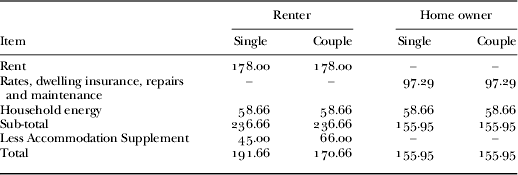
As detailed in Table 3, the weekly costs of living in a healthy home were $191.66 for a renter living alone, $170.66 for a couple renting and $155.95 for homeowners (whether living alone or as a couple).
Weekly personal costs of a healthy home (NZ $)
Social connectedness
Social connectedness means ‘the relationships people have with others’ (Ministry of Social Development 2009: 112) and is increasingly being recognised by ageing experts as a critical component of healthy ageing and quality of life. Clear links have been established between social connectedness and physical and mental health (Berkman and Syme Reference Berkman and Syme1979; Marmot and Wilkinson Reference Marmot and Wilkinson2006; Seeman Reference Seeman2000). More recently, linkages have also been demonstrated between social relations and cognitive health (Zunzunegui et al. Reference Zunzunegui, Alvarado, Del Ser and Otero2003).
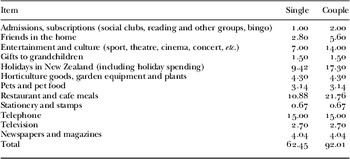
The MIHL costings for social connectedness (Table 4) were based on the findings of recent New Zealand research into the social preferences of older New Zealanders (Koopman-Boyden and van der Pas Reference Koopman-Boyden, van der Pas, Koopman-Boyden and Waldegrave2009; Wright-St Clair et al. Reference Wright-St Clair, Kerse, Hayman and Dyall2009), combined with focus-group feedback. The social life provided for in the MIHL budget amounts to around three social outings per week. Added to this are the two group exercise sessions included within the weekly costs for Physical Activity (refer above), which also provide social contact.
Weekly personal costs of social connectedness (NZ $)

Expenditure relating to gardening, pets, eating out and newspapers/magazines were derived from actual expenditure data in the Household Economic Survey 2007 (Statistics New Zealand 2009b). All other items were costed directly based upon modest assumptions. For example, annual holiday costs were based on a one-week trip to visit family elsewhere in New Zealand. This included flights or other transport ($200 return per person), transport to and from the airport ($80) and a daily allowance of spending money over and above the normal MIHL budget ($30 per person per day). It made no provision for accommodation costs.
Health care
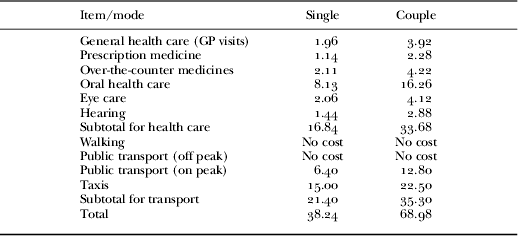
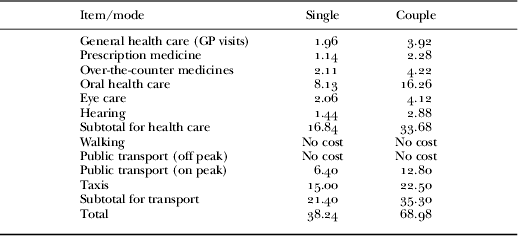
New Zealand's health-care system is publicly funded through taxation. Hospital and specialist care is fully funded and therefore costs nothing to the patient. Laboratory tests are also fully funded but part charges apply to pharmaceuticals. Part charges also apply to general practitioner (GP) consultations but these vary between GP practices. There is little in the way of publicly funded services for older people for oral health or hearing or vision loss. The MIHL budget for health care was based on the minimum personal costs for the following six areas of health care:
1. GP consultations: costings were based on four visits to the GP per year at an average cost of $25.50 per visit (Ministry of Health 2008).
2. Prescriptions: costings were based on 19.7 prescription items per year (Martin, Hall and Gardner Reference Martin, Hall and Gardner2002) at $3 per item.
3. Over-the-counter medicines.Footnote 5
4. Oral health: costings were based on a person with their own teeth, attending an annual dentist check-up, having biannual X-rays and an annual hygienist appointment. A conservative estimate of treatment costs ($240 per year) was derived from a recent survey published by Consumer New Zealand (2008) and amounts to the cost of two amalgam fillings. This is less than the cost of one composite crown. The total annual cost for oral health was $422.50, or $8.13 per week.
5. Hearing: impaired hearing can affect an older adult's health in many ways, from making it difficult to follow a doctor's advice, to compromising personal safety, to affecting one's ability to interact socially. MIHL costings included provision for a hearing aid spread over five years and adjusted downwards by 66 per cent to reflect the fact that only one-third of older New Zealanders are likely to have hearing loss (based on US prevalence estimates).
6. Eye care: costings were based on the cost of a two-yearly eye examination (at $55) as well as the cost of a new pair of spectacles (and lenses) every five years ($399).
The weekly personal costs of health care are detailed in Table 5.
Weekly personal costs of health care and transport (NZ $)
Note: GP: general practitioner.
Transport
‘Affordable and accessible transport options for older people’ is one of the ten goals of New Zealand's Positive Ageing Strategy (Ministry of Social Policy 2001) and is an essential component of the MIHL: Older New Zealanders. Affordable and accessible transport enables an older person to get to the supermarket to buy healthy food at affordable prices, to go to the gym, swimming pool or exercise class, to get to the doctor, dentist and optometrist or to participate in the wider community and maintain social networks.
The weekly personal costs of transport are detailed in Table 5. Owning a private car was not considered a necessary requirement for healthy living, particularly in urban areas with good public transport systems. In addition, off-peak public transport is free for older New Zealanders. However, as it may not always be possible to travel off-peak, a small amount of on-peak travel (two bus trips) was included.
Provision was also made for one taxi ride of $15 (approximately ten minutes) per week. This may be necessary for a trip to the supermarket or the doctor when public transport is less manageable. The amount for couples was discounted to allow for the fact that some taxi rides (such as for groceries) would be shared.
Personal hygiene
Personal hygiene helps to limit the spread of infectious disease both in the person and in the home. There are also physiological and social benefits of having good personal hygiene through promoting social connections and supporting personal esteem and respect (Morris et al. Reference Morris, Dangour, Deeming, Fletcher and Wilkinson2005).
In the absence of any minimum standard of hygiene established for physical health and social wellbeing, the MIHL costs of $10.11 for those living alone and $15.51 per week for couples were based on the actual expenditure of over 65-year-olds on cleaning products and other household supplies and personal care (including toiletries).
Other costs of healthy social living
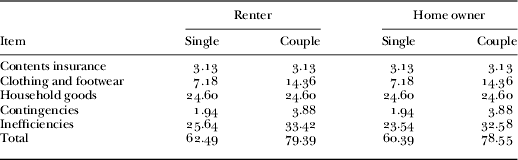
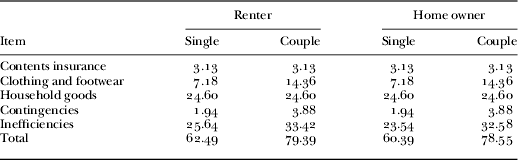
Some other necessary costs of healthy living were included in the MIHL (Table 6), such as contents insurance, clothing and footwear, and household goods.Footnote 6 Provision was also made for savings for contingencies and emergencies (Table 6), such as replacing lost or broken property which is otherwise uninsured or under the claims threshold, or even savings for funeral expenses. This was necessarily based on actual expenditure data. Furthermore, it cannot be assumed that every 65+ household in New Zealand could, in real life, always purchase goods and services at the prices included in the MIHL budget. To recognise this, the total MIHL budget was adjusted upwards by 6 per cent following the MIHL: Older Age, England (Morris et al. Reference Morris, Dangour, Deeming, Fletcher and Wilkinson2005).
Other weekly personal costs of healthy social living (NZ $)
Focus groups
In general, participants in the three focus groups were happy with the weekly menu although some indicated that the total amount of food included in the menu was somewhat greater than their own perceived needs. Similarly, the focus groups were generally supportive of the physical activity regime proposed, in particular the inclusion of group exercise sessions. Assumptions in relation to transport, health care and personal hygiene were all found to be generally acceptable.
The focus-group participants demonstrated good knowledge of the importance of a warm, dry home for health, reflecting perhaps the growing profile that this issue has had in New Zealand over recent years. However, when presented with the weekly costs of heating a one-bedroom home to internationally accepted standards for health, all participants agreed that they would not be able to afford that level of expenditure on household energy and that in any case they would not consider spending that much on electricity. This feedback highlights the need for healthy housing policy in New Zealand to recognise not only the income-driven barriers to heating but also the cultural barriers, driven by New Zealanders’ tendency to undervalue household heating (suggested to stem from a ‘masculine pioneer heritage’) (Cupples, Guyatt and Pearce Reference Cupples, Guyatt and Pearce2007) in favour of extra clothing and bedding. As suggested by a focus-group participant, it is simply a matter of ‘putting an extra blanket on’.
The focus groups were unanimous in the importance they placed on social activity as a component of healthy ageing, with one group suggesting that it was ‘the answer’. All three groups talked of how they enjoyed ‘watching the world go by’ or ‘people watching’, often by way of walking around the community. This feedback confirms the central role that social activity plays in older adults’ quality of life. It also highlights the importance of good urban planning for an ageing society, where design elements such as seats at regular intervals to allow older walkers to rest, convenient public toilets and footpaths which are both walker and mobility scooter friendly become important enablers of an age-friendly community.
Total minimum income for healthy living
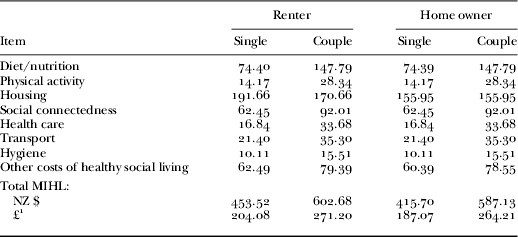
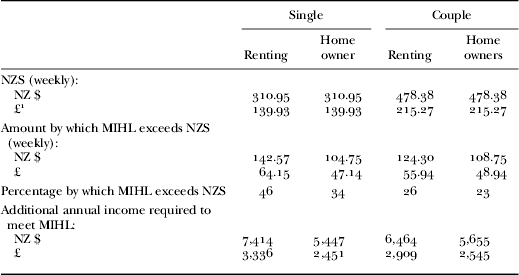
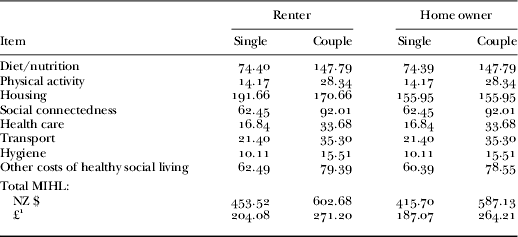
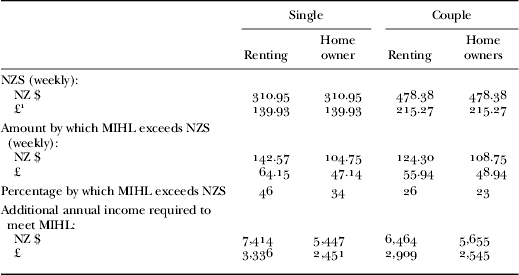
Table 7 shows the weekly costs of the MIHL: Older New Zealanders while Table 8 contains an analysis of the MIHL results when compared with the state pension (NZS).
Weekly cost of the Minimum Income for Healthy Living (MIHL) for single persons and couples aged 65 years and over (NZ $)
Note:
1. 1Final analysis data converted from dollars into sterling at a rate of NZ $1.00 to £0.45 (November 2009 exchange rate).
Analysis of Minimum Income for Healthy Living (MIHL) results
Notes: NZS: New Zealand Superannuation.
1. 1Final analysis data converted from dollars into sterling at a rate of NZ $1.00 to £0.45 (November 2009 exchange rate).
The MIHL results demonstrate that the cost of healthy living is higher for people living alone compared with couples. The MIHL for a single person who rents their home is $453.52 (£204.08) per week. This is $142.57 (£64.15) (or 46 per cent) more per week than the NZS payment of $310.95 (£139.93). This means that a single renter would need additional income of $7,414 (£3,336) per annum. For a home owner living alone, the position improves slightly due to the advantages of owning one's own home debt-free. Nevertheless, the MIHL still exceeds NZS by 34 per cent requiring $5,447 (£2,451) of additional income per year. The situation improves considerably for couples, whether renting or owning, with the MIHL exceeding NZS by 26 and 23 per cent, respectively.
Discussion
This research brings life and meaning to the minimum level of retirement income required for older New Zealanders to live a healthy lifestyle. Many New Zealanders are likely to have retirement income aspirations over and above this minimum standard. These research results highlight the importance of ongoing work at a national level to understand the savings patterns and position of future cohorts of retirees. The study also provides a useful guide to both policy makers and citizens about how the amount of income required in retirement might be calculated. If the level of savings of future retirees is not enough to support ‘healthy living’, which has been defined in this research by reference to solid health evidence, then there will be implications for the health and social sectors, in terms of demand for services and unmet need.
The results suggest that, whilst the universal state-funded pension, NZS, provides a strong and stable foundation for retirement income, NZS alone is not enough to support healthy living. NZS has traditionally been the principal source of income for retirees with approximately 43 per cent of New Zealanders aged 65+ years reporting NZS to be their sole source of income in the 2006 Census (Statistics New Zealand 2009a). The median (after-tax) income of older New Zealanders is estimated to be around $3,600 per annum ($4,500 pre-tax) more than the amount a single older person receives under NZS (Koopman-Boyden and Waldegrave Reference Koopman-Boyden, van der Pas, Koopman-Boyden and Waldegrave2009). This is less than half of the estimated additional income required by a renter living alone to meet the MIHL: Older New Zealanders.
In New Zealand, employer-subsidised pensions are less common than in many countries. Moreover, any entitlements from these private schemes are usually offered in the form of a lump-sum at retirement rather than as a pension throughout the retirement period. In 2007, the government introduced a new, work-based savings scheme to assist New Zealanders to save for their retirement. Employer contributions to the scheme attract a tax credit and all new employees are automatically enrolled. However, membership is voluntary and people can opt in or out as and when they wish. The stated purpose of the scheme is ‘to encourage a long-term savings habit and asset accumulation by individuals who are not in a position to enjoy standards of living in retirement similar to those in pre-retirement’ (Kiwisaver Act 2006: 11). This scheme has the potential to improve the financial situation of retirees quite considerably over time as contributions accumulate.
This study highlights the additional cost of living burden borne by people living alone compared with those living as a couple. In 2006, of the 65+ age group who lived in private dwellings, 56 per cent lived with a spouse or partner and 31 per cent lived alone (Statistics New Zealand 2007). Research and health statistics clearly demonstrate that older people living alone are already at a health disadvantage compared to older couples. For example, living alone is a risk factor for malnutrition (Yeung and Imbach Reference Yeung and Imbach1988) as well as for depression, loneliness and social isolation (Prince, Harwood and Thomas Reference Prince, Harwood, Blizard and Thomas1997). The Living Standards research (Jensen et al. Reference Jensen, Krishnan, Hodgson, Sathiyandra and Templeton2006) also confirmed that the living standards of older couples are slightly higher than those of older single people, with more older single people living in some degree of hardship compared with couples.
The results also demonstrate that the cost of living for older renters is significantly higher than the cost of living for older home owners, most of whom own their own homes free from debt. Only 9 per cent of the 65+ population in New Zealand live in rental accommodation, of which 53 per cent (or 24,000 people) live in privately owned rental accommodation (Statistics New Zealand 2009c). Whilst these rates may be low compared with many other developed countries, the proportion of older renters in New Zealand is set to rise due to falling home ownership rates amongst those in mid-life and approaching retirement. The Accommodation Supplement (a state-funded welfare benefit payable to low-income renters to assist with housing costs) does, in part, help to equalise the position between renters and home owners but a clear inequality remains. Older renters are more likely to live in poor housing, are less likely to have accumulated wealth and are likely to have greater health issues developed over the lifecourse, as a result of their position on society's ‘ladder’. These layers of disadvantage are only exacerbated in retirement, with higher housing costs.
From a health policy perspective, the MIHL: Older New Zealanders provides information about the variables that might impact upon the health of older New Zealanders. The challenge for the health sector is to understand the barriers (in addition to income) experienced by older people in living a healthy life and to work with other government and non-government sectors to address those barriers. It is also important to understand the ‘lifestyle’ choices made by older people when their income does not provide for everything they need. For example, when there is not enough money for everything, what goes first? Is it heating, eating, social outings or a trip to the dentist? There are important health implications of each of these choices and further research is required to understand the nature of these choices. Although the health sector cannot directly influence the income of older New Zealanders, it must have a role in helping to minimise the health impact of these income-driven health choices.
Budget standard methodology is favoured for its transparency and flexibility. A strength of this research is that all assumptions underlying the budgets are made explicit and can therefore be scrutinised and debated. Transparency of assumptions means that the budget is also flexible and can easily be tested for sensitivity by removing and changing items. In this research, housing costs presented a challenge in terms of their regional variability and the differences between home ownership and rental. For the latter issue, both possibilities have been explored. To address the regional variability issue, rental costs in different parts of the country could be considered as part of a sensitivity analysis.
Budget standards can be criticised for being arbitrary in nature due to the assumptions required to establish a way of living. However, one advantage of using ‘health’ as the standard of living is that there is a strong body of research knowledge as to what a healthy life entails. For example, there are clear guidelines as to the level and nature of physical activity needed for good health. The availability of solid evidence limits the number of assumptions that need to be made compared with some other ‘standards’ of living, where a more subjective approach may be necessary due to a lack of evidence. In any case, it is a key tenet of the budget standard approach that the budgets developed are indicative estimates only. As such, they are designed to provoke discussion and evoke a real sense of what it might actually mean to have the specified standard of living, and what income might be required to support that standard.
The major limitation of this research was the availability of data. In some categories, such as Social Connectedness, where there was insufficient evidence to develop a detailed statement of need capable of being priced, data on the actual expenditure patterns of older New Zealanders were used. Using these data can import an element of ‘circularity’ due to the fact that income constraints may already have influenced behaviour or spending and therefore compromised the ability of the budget standard to provide an independent benchmark for adequacy of income. For example, what older New Zealanders actually spend on repairs and maintenance of their home may not be equal to what an older New Zealander should spend on repairs and maintenance. Where circularity was likely to be an issue in this research, efforts were made to source other data, price the items directly at low-cost retailers or adjust the actual expenditure data upwards using a conservative assumption.
A further limitation of this research was its treatment of people aged 65 years and over as a homogeneous population, which of course is far from being the case. This approach was taken to enhance the potential for the MIHL: Older New Zealanders to inform policy. In particular, it allowed comparison with the NZS, which makes no distinction based on wealth or means, region, ethnicity, age or any other relevant variables. However, it is acknowledged that a policy approach based on national averages for the entire 65+ population is less helpful for the purpose of using this research to encourage older New Zealanders to save for their retirement, or at least to understand what level of savings they may need as a bare minimum to live a healthy life. For example, the sample diet would cost more for an active 65-year-old than it would for a sedentary 65-year-old. The picture would be different again for an 85-year-old. However, the MIHL can be tailored for any population group by adapting the variables and assumptions to match the needs and preferences of that particular group.
No discussion of these results would be complete without comparing this New Zealand-based research with the MIHL: Older Age England (Morris et al. Reference Morris, Dangour, Deeming, Fletcher and Wilkinson2005, Reference Morris, Dangour, Deeming, Fletcher and Wilkinson2007). The most notable differences were seen in the categories of diet and housing. The cost of a healthy diet as a proportion of the total MIHL was significantly higher under the English research (24 per cent for a person living alone compared with 16–18 per cent under the New Zealand MIHL). Housing costs as a proportion of the total MIHL were significantly higher under the New Zealand research (38–42 per cent for a person living alone compared with 28 per cent under the English MIHL). Health-care, transport and physical activity costs also represent a larger proportion of income in New Zealand compared with England. In the case of health care, this is to be expected given the higher levels of public funding of services in England, including GP services and services related to oral health, eye care and hearing loss.
Comparisons should, however, be approached with some caution, given differences in calculation methods and assumptions. These differences arise in a variety of ways, including in the availability of relevant data (as, for example, in the calculation of fuel costs), in cultural preferences (such as the weekly menu and social activities), in infrastructure (such as the availability of public transport) and in public funding of services (such as the significant differences in health funding between the two countries). Also, the English MIHL did not include separate budgets for rental and home ownership, although the costings emphasised home ownership. These differences highlight the importance and relevance of each country developing its own MIHL.
The New Zealand MIHL reveals a broadly similar picture to the English study in terms of the gap between the state-funded pension and the MIHL. In the English study, the MIHL was 50 per cent higher than the ‘Basic State Pension’ for singles and 46 per cent for couples. However, it was only 12 per cent higher for singles and 15 per cent higher for couples than the ‘Pension Credit Guarantee’, which is the means-tested income safety floor for low-income people. By comparison, the New Zealand MIHL was between 34 and 46 per cent greater than the NZS for singles living alone and 23–26 per cent greater for couples. When comparing singles with couples, singles in New Zealand appear to be at a greater disadvantage than in England, despite a similar level of equalisation through the state-funded payments (i.e. at the time of the MIHL: Older Age, England, singles were paid 62–65 per cent of what couples were paid, which is the same level applying under NZS). Again, these comparisons should be interpreted with caution, given differences in calculation methods and pension policies in the two countries. Nevertheless, the results in both countries emphasise the need for people – especially those who are living alone and those who are renting – to save for their retirement years if they wish to live a healthy life as they grow older.
Conclusion
The MIHL: Older New Zealanders provides an assessment of the minimum income required in older age by reference to the wealth of biomedical and social knowledge now available. The disparity between the MIHL and the income of many older New Zealanders suggests that income may act as a barrier to healthy ageing. The implications of this are already being felt with increasing demand for health and social services driven by the 65+ population and are set to increase as the proportion of older New Zealanders increases. In the age of ageing, these implications are important, not only for social and retirement policy makers and those charged with reducing health inequalities and containing the health budget, but also for New Zealanders approaching retirement, their families and communities.
Acknowledgements
This research was partly funded by the Hawke's Bay Medical Research Foundation whose support is gratefully acknowledged. We are also grateful to the many colleagues and experts who contributed their support and advice and to the focus-group participants for their valuable time and contribution to this research.