INTRODUCTION
The racial climates found on college campuses have garnered increasing national attention in recent years; for example, the New York Times lead story on March 21, 2014, covered “I, Too, Am Harvard,” a student-led campaign designed to raise awareness about microaggressions against ethnic and racial minorities on campus (Vega 2014). Such campaigns have become widespread and are now featured on over thirty campuses, particularly at predominately White institutions. At the same time, Justin Simien’s feature film Dear White People (2014) brought the conversation about microaggressions on campuses into popular culture (Brody Reference Brody2014). Dear White People and the “I, Too, Am…” campaigns underscore the need to study the impact of racial climates on college campuses.Footnote 1 Each campus creates a specific racial climate (Hurtado Reference Hurtado1992; Milem et al., Reference Milem, Clayton-Pedersen, Hurtado and Allen1998)—often experienced distinctly by underrepresented ethnic and racial minorities— that serves as a site for identity-formation processes to unfold (Feliciano Reference Feliciano2009; Tovar and Feliciano, Reference Tovar and Feliciano2009). This study analyzes the experiences of Latino students situated within three distinct racial campus climates in California: a regional public university, a public research university, and a private liberal arts college.
I draw on data obtained through twenty months of ethnographic observations, sixty in-depth interviews, and eighty surveys with Latino students involved with six comparable student organizations. I compare student experiences across campuses and organizations to address the following questions: (1) How are specific racial campus climates constructed?; (2) How do Latino students interact and form intergroup and intragroup boundaries within these specific campus racial climates?; and (3) How do students’ interactive boundary formation processes shape label preferences and meanings within these racial climates?
Ethnoracialization theory underscores the simultaneous and dialectical relationship of external ascription and self-identification in the process of constructing ethnoracial understandings and categories (Brown and Jones, Reference Brown and Jones2015). This paper draws on ethnoracialization theory to describe the identity-formation processes of Latino college students. I bring ethnoracialization theory into conversation with organizational theories by examining how the dialectical processes of Latino identity construction happen on the meso-interactional level within higher educational institutions. I show how the organizational dynamics of each campus shape the colleges’ racial climate, or the mesolevel context in which students interact to construct racial understandings. Borrowing from Acker’s theory of gendered organizations, which challenges the assumption that organizations are gender neutral by showing that they are instead built upon a substructure of gender difference (Acker Reference Acker1990), I argue that college campuses are not race neutral. Each college creates a particular racial climate (Milem et al., Reference Milem, Clayton-Pedersen, Hurtado and Allen1998) based on both organizational arrangements—e.g., student residential patterns, student demographic composition, school size, and diversity policies and programming—and interactive arrangements constructed by college actors. In line with Amy Binder and Kate Wood’s (2014) observation that campus organizational cultures must be understood in specific rather than general terms, I look at how the organizational dynamics particular to each of the three different sites influence unique interactional dynamics and identity processes.
After describing the specific racial climate of each campus, I examine the interactive process by which students construct and enact intraethnic boundaries. Further, I show how these interactive processes produce three different patterns of panethnic identification: inclusive Latino identification signifying solidarity above all, qualified Latino identification mediated through specific organizational membership, and national origins identification only or, more accurately, the rejection of a panethnic identity. I conclude by reflecting on how the racial climate of each university might influence the production of particular and specific understandings of Latino boundaries and identity labels and how further research might investigate this relationship.
LITERATURE REVIEW
Universities: Organizational Sites for Ethnic-Racial Formation
A growing literature addresses the impact of college beyond academics (Epenshade and Radford, Reference Epenshade and Radford2009; Kuh Reference Kuh1995; Stuber Reference Stuber2011). Sociologists and education scholars examine schools’ organizational cultures (Binder and Wood, Reference Binder and Wood2014; Clark Reference Clark1992; Stevens Reference Stevens2007) and identify several latent functions of the college experience, including creating a sociopolitical consciousness (Castillo-Montoya Reference Castillo-Montoya2013), and teaching students how to act politically (Binder and Wood, Reference Binder and Wood2014), how to socialize (Armstrong and Hamilton, Reference Armstrong and Hamilton2013), and even how to date (Mullen Reference Mullen2010). Scholars also document how colleges shape male, female, high-income, middle-income, and low-income students’ academic and social experiences differently (Armstrong and Hamilton, Reference Armstrong and Hamilton2013; Mullen Reference Mullen2010; Thiele Reference Thiele2016). Like the college activists involved in the “I, Too, Am…” campaigns, these scholars contend that ethnic and racial minorities experience the college setting distinctly from their White peers, particularly at predominantly White institutions (Bonilla-Silva Reference Bonilla-Silva2012; Feagin et al., Reference Feagin, Hernan and Imani1996; Hughey Reference Hughey2010; Lewis Reference Lewis2012; Rankin and Reason, Reference Rankin and Reason2005; Saenz et al., Reference Saenz, Ning Ngai and Hurtado2007; Sidanious et al., 2010). Feelings of isolation, marginalization, and non-belonging are common among minorities on many campuses (Lopez Reference Lopez2005; Solórzano et al., Reference Solorzano, Ceja and Yosso2000).
Organizational characteristics such as campus policies and programming can significantly mitigate these feelings of non-belonging (Beasley Reference Beasley2011; Hurtado Reference Hurtado1992; Hurtado et al., Reference Hurtado, Griffin, Arellano and Cuellar2008; Milem et al., Reference Milem, Clayton-Pedersen, Hurtado and Allen1998). Thus, it is important to examine a university’s organizational dynamics to reach a fuller understanding of the factors shaping the experiences of ethnic and racial minority students. Organizational analysis provides a treatment of race that extends beyond essentialism to unpack the context-specific construction of racial-ethnic boundaries rather than reifying them as monolithic.
One latent function of postsecondary schooling might be the lessons about race relations that students learn as they navigate campus, establishing who they are and where they fit in. Education scholars have documented this racial learning process in primary and secondary schools (Beattie Reference Beattie2014; Flores-Gonzalez Reference Flores-Gonzalez2002; Goldsmith Reference Goldsmith2009; A. Lewis Reference Lewis2003; Ochoa Reference Ochoa2013; Perry Reference Perry2002; Valenzuela Reference Valenzuela1999). For example, Gilda Ochoa (2013) finds that high schools racialize Asian American and Latino students differently in ways that set them up for distinct academic trajectories. These racialization processes in schooling continue as students transition to college where many develop a stronger sense of ethnic consciousness, especially on campuses where they are the minority (Feliciano Reference Feliciano2009; Tovar and Feliciano, Reference Tovar and Feliciano2009; Umaña-Taylor Reference Umaña-Taylor2004). Yung-Yi Diana Pan (Reference Pan2015) argues this process occurs among Asian and Latino law students, as they become more race-conscious and aware of their panethnic unity while in predominantly White law school.
Acknowledging that campuses are racialized organizations, this research is designed to examine the particular processes that mediate students’ identity development on each campus. Racial and ethnic identities are processual outcomes, and these processes are often set in motion through and in organizations. Therefore, I bridge organizational theories and literature about Latino identity formation as I provide a process-oriented comparative analysis of how identity formation plays out among students within the racial climates provided on three different campuses. I am particularly attentive to the interactive processes in each context and how these processes imbue Latino identities with different meanings.
Constructing Latino Identities
In May of 2014, journalist Nate Cohn published a piece in the New York Times arguing that more Latinos were self-identifying as White. This article caused an uproar, unleashing a plethora of rebuttals highlighting the problem with nomenclature among the Latino population in the United States (Hanna and DeFina, Reference Hanna and DeFina2014). The US Census treats the labels Hispanic and Latino as panethnic, distinct and separate from race. Whether Hispanic and Latino are best understood as a racial or panethnic categories is a highly contentious question. In a recent Pew Research Center survey, Ana Gonzalez-Barrera and Mark Lopez (2015) found that 67% of Latinos adults see Latino and Hispanic categories as racial categories. Moreover, in a Census pilot for the 2020 questionnaire, 81% of Latinos checked a Hispanic/Latino box as their racial identity.
Hana Brown and Jennifer Jones (2015) challenge the separate and disparate treatment of panethnic and racial categories in both mainstream and scholarly texts. They introduce the concept of “ethnoracialization” to describe how racial and panethnic categories are constituted by similar processes: both through external ascription and self-identification (p. 186). They argue that that “ascription and self-identification are not sequential but mutually constitutive processes whose relative influences and effects vary with the structure of institutional power relations and the discursive reinterpretation of group meanings and boundaries” (p. 186). Ethnoracialization establishes similarities between racial and panethnic categories and provides theoretical leverage to understand the processes that shape identities. This theory acknowledges that: 1) ascriptive processes affect self-identification by creating common experiences among similarly situated individuals; 2) ascriptive processes change over time, resulting in different identities; and 3) the interpretation of everyday encounters with discrimination, the state and other social institutions can solidify or weaken group attachments (Brown and Jones, Reference Brown and Jones2015, (p. 187).
The mechanisms identified in ethnoracialization theory are not new; panethnic scholars have documented similar processes. Louis DeSipio (Reference DeSipio and Rich1996) identifies five steps that make Latino panethnicity salient: (1) increased contact with people of different ancestries; (2) common public policy needs and concerns; (3) statutory recognition of Latino rather that national-origin based ethnicity; (4) the role of elites in shaping a common identity; and (5) common cultural characteristics. Milagros Ricourt and Ruby Danta’s study (2003) of a neighborhood in Queen’s, NY, found that Latinas of several national origins came to see themselves as similar through their daily interactions, leading them eventually to organize in service associations and identify panethnically.
Common treatment and ascription are significant parts of the panethnic construction processes. Whether a group constitutes a minority or a critical mass is likely to shape how they come to see themselves and identify. If an entire panethnic group is segregated within a given context, this encourages panethnic collective action and identification; yet when a single subgroup within the panethnic group is segregated from the rest, panethnic action and identification are less likely. For example, panethnic action is depressed where Koreans are segregated from other Asians in the United States (see Okamoto Reference Okamoto2003, Reference Okamoto2014), and scholars observe similar processes among Latinos (Moore and Pachon Reference Moore and Pachon1985; Umaña-Taylor Reference Umaña-Taylor2004). Jessica Tovar and Cynthia Feliciano (Reference Feliciano2009) find that Latinos have a heightened sense of ethnic consciousness in colleges where they are the minority.
Immigration scholars have advanced our understandings of Latino identity formation. Sociologist Jessica Vasquez argues that Mexican incorporation and identity trajectories are segmented by “bumps” or points of departure (Vasquez Reference Vasquez2011, p. 9). One important “bump” or point of departure that Latinos face is discrimination, which reminds Latinos that they do not blend into mainstream American and cannot adopt “plain” or “unmarked” American identities (Golash-Boza and Darity, 2008; Portes and Rumbaut, 1996; Rumbaut Reference Rumbaut and Weisner2005). Discrimination is an external ascriptive process, where boundaries of belonging are deployed and access to resources and space is foreclosed (see Cornell and Hartmann, Reference Cornell and Hartmann2007; Pettigrew and Tropp, Reference Pettigrew and Tropp2011; Vasquez Reference Vasquez2010; Wimmer Reference Wimmer2008). Immigration scholars highlight agency in the process of self-identification as minorities react to external ascription, and they note that the children of Latino immigrants use ethnic identification to respond to hostile environments. However, the findings differ on whether these children hold on to their parents’ national origins more tightly (M. Lopez 2013; Portes and Rumbaut, Reference Portes and Rumbaut1996; Tovar and Feliciano, Reference Tovar and Feliciano2009), identify panethnically (Golash-Boza and Darity, Reference Gonzalez-Barrera and Lopez2008), or simultaneously identify with both their national origins and panethnically (Diaz-McConnell and Delgado-Romero, Reference Diaz McConnell and Delgado-Romero2004; Itzigsohn and Dore-Cabral, Reference Itzigsohn and Dore-Cabral2000; Okamoto Reference Okamoto2014; Oropesa et al., Reference Oropesa, Landale and Greif2008; Rodriguez Reference Rodriguez2000).
Discussions regarding Latino identity-label preferences risk falling into two distinct traps. First, some scholars tend to frame Latino identity as the static outcome of deterministic processes and narrate these processes in a decontextualized way. Second, other scholars who instead unpack the situational nature of Latino identities tend in some cases to focus too heavily on contingencies, obscuring a broader theoretical understanding of identity formation. To avoid both of these traps, organizational studies approach identity formation as contextually specific. In her macrolevel analysis, Cristina Mora (Reference Mora2014a) studied how the category “Hispanic” was popularized through the cross-field effects of social movements organizing for better data, the Census constructing and collecting data, and the media adopting the term. Mora’s book is a part of an emerging literature that examines how organizations mediate the construction and deployment of ethnic, racial, and panethnic identities and boundaries (see Mora Reference Mora2014b; Ochoa Reference Ochoa2013; Okamoto Reference Okamoto2006; Okamoto and Mora, Reference Okamoto and Cristina Mora2014; Renzulli et al., Reference Renzulli, Parrott and Beattie2011; Ricourt and Danta, Reference Ricourt and Danta2003; Rojas Reference Rojas2007). Beside these scholars, however, mesolevel processes are not often the foci of racial-ethnic analysis. This theoretical deficit is partly due to the absence of dialogue between race and organizational scholars.
Organizations are the prime location to observe how racial formation occurs at the mesolevel. Understanding the interplay between ascription and identification requires an organizationally embedded analysis of identities that sheds light on boundary and identity construction and deployment processes. This study provides a rich portrait of the interactive components of ethnic identity formation and how these play out in the racial climates of three different colleges. By focusing on colleges in particular, I am able to consider how organizational context might influence identity formation at a unique and significant stage of development when identities are refashioned or “discursively reinterpreted” (Brown and Jones, Reference Brown and Jones2015).
The Latino students at the center of this study represent an upwardly mobile segment of the Latino population. Their racial identification processes are significant not just individually, but also for the future of this community. Taking the particular campus attended by Latino students as a “bump,” or a point of departure in their identities, I answer the questions: How do Latino students draw ethnic boundaries in three distinct contexts? How do students in distinct contexts process and imbue identity labels with meaning? And what organizational features of college campuses might shape these boundary- and identity-making processes? Throughout, I emphasize that Latino students’ ethnic boundaries and identities—their general sense of who they are—are reconstructed and reprocessed not in a vacuum, but in the specific racial climates provided by college institutions. As such, my findings point to universities as important structures for racial learning.
DATA AND METHODS
The data were collected as part of a larger study using multiple methods, including a review of quantitative and qualitative university data and reports, ethnographic observations of Latino campus organizations, and in-depth interviews with leaders and members of these organizations. This fieldwork took place at three sites: one small private liberal arts college (LAC), one large public research university (RU), and one large regional public university (RPU) in California. The three schools differ by type and scholastic ranking, and each is a mesocontext embedded in a broader national and statewide context. Located within forty miles of one another, each school occupies a different place in a stratified system of higher education, varying in resources, status, and the types of students it serves.
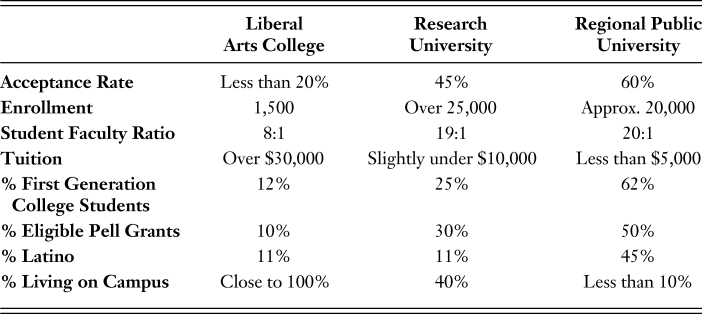
Table 1 shows diversity across these campuses in 2008. It sketches the structural and cultural landscape of each campus, showing the acceptance rate, size of the student body, student-teacher ratio, percent of students eligible for Pell grants (a good proxy for the percentage of low-income students on campus), percent of first-generation college students enrolled, and racial-ethnic demographics. Each campus has a Chicano-Latino Studies department and offers courses about Mexican American and Chicano, Central American, and panethnic Latino experiences. Specific course offerings reflect the research and teaching interests of faculty in these departments, which are diverse across all three settings.
Campus Characteristics

Data Obtained from the Campus Office of Institutional Research at Each Campus
Data Collection
I purposefully chose to study boundary and identity formation within student organizations because I wanted to capture the process through which students construct a collective sense of being and representing Latinidad on campus. Latino student organizations are an ideal place to observe this process because we can assume that only students who see themselves as Latinos select into these organizations. In my time with these organizations, I observed students constructing, negotiating, and deploying Latino ethnic boundaries. This research design only accounts for the definition and understandings of Latinidad and identity-label preferences among members of the six Latino organizations studied.
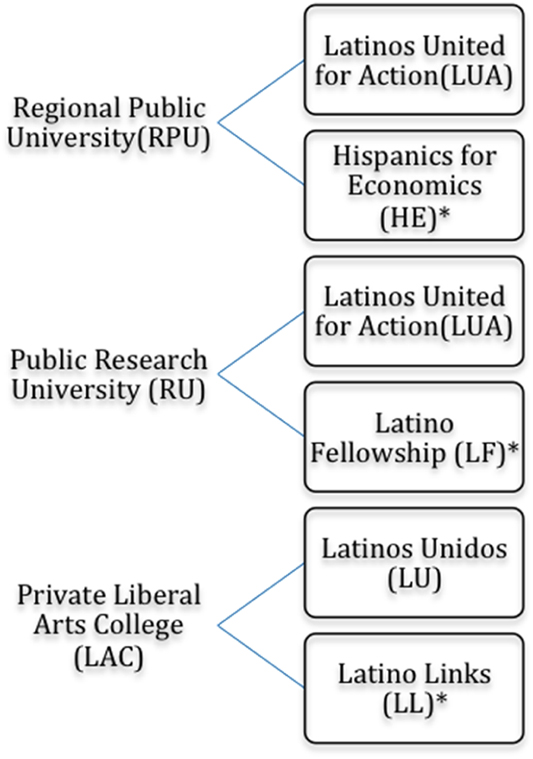
I began by collecting institutional data about all Latino student organizations on each campus. Each campus housed several Latino student organizations: four at Liberal Arts College, fourteen at Research University, and fourteen at Regional Public University. I profiled each organization and searched for similarities in mission and function across campuses. By design, I chose one expressly political and one non-political organization on each campus because I initially expected to find different identity processes within these types of groups.Footnote 2
Each campus housed only one Latino political organization. In selecting the second organization on each campus, I chose between three at LAC, thirteen at RU, and thirteen at RPU. I then narrowed the sample to exclude single-gender organizations, leaving one organization at LAC, six at RU, and five at RPU. I then selected the second organization at RU and RPU based on access, meeting times, and my ability to travel between campuses. All of the selected organizations were active and stable over a long period of time. Each organization had a faculty sponsor, a requirement of all organizations registered with the office of student life. In my time in the field, I only saw the advisors at RPU. The advisor attended one meeting a year at the beginning of each academic year, and sat quietly in the back. The role of the advisors appeared minimal across campuses.
Organizational Information.
*Indicates explicitly nonpolitical organization.

I simultaneously conducted fieldwork at all three campuses and all six organizations from the fall of 2008 through the spring of 2010. During my 20 months in the field, I attended over 150 meetings where I sat quietly and observed. I wrote detailed fieldnotes after each meeting, which generated rich descriptions of each organizational context and allowed me to interpret student interactions in their natural settings (Lofland et al., Reference Lofland, Snow, Anderson and Lofland2006). I observed how and when student organizations invoked Latino collective identities, and how they drew ethnic boundaries through direct observations of meetings and other events. I witnessed how members deliberated during formal meetings, how members were recruited, what types of events they chose to sponsor, and how students responded to one another. I draw heavily from these observations in this paper.
I surveyed the entire active membership of all six organizations to get a broader sense of their biographies. I asked students for basic demographic information and about their reasons for joining an organization, their perceptions of the benefits of being a member, their ideas about group sameness, and their individual ethnic identities. I conducted longer open-ended interviews with ten leaders and members of each Latino student organization, for a total of sixty students. I asked each student about their personal experiences in college, their ethnic identifications, and their feelings of connection and attachment to the organization. With participants’ permission, I audio-recorded interviews.
Student Demographics
Campuses recruit different types of students who, in turn, self-select into institutions that are “like” them. For example, wealthier students are most likely to apply to elite schools, and they bring extensive social and cultural capital to these campuses (Radford Reference Radford2014). It is therefore possible that the students at the three different schools were very different at the outset; I used the survey data to examine this premise. I found that the Latino respondents were broadly similar on several measures across these different settings and were more demographically similar to each other than to their non-Latino college mates. At Liberal Arts College, only 12% of all students were first-generation, but 82% of my Latino respondents were. This statistic was essentially the same at Research University (82%) and Regional Public University (78%). Respondents’ families fell in the same median income bracket and were alike in terms of immigrant generation. Most students in this study were similarly close to the migration experience mostly as second-generation Americans, while 17% at Regional Public University, 14% at Research University, and 9% at Liberal Arts College were third-generation Americans and beyond. The students in all six organizations were predominately Mexican American but included a few students of other national origins: Salvadoran, Nicaraguan, Guatemalan, Cuban, and Puerto Rican.
Data Analysis
I transcribed each interview and typed up all fieldnotes after each meeting observation. I took an open-coding approach to examine these notes and transcripts line-by-line in Atlas.ti Qualitative Software. I coded for representations and definitions of Latinidad in meetings. I also coded each of the interviews, especially when I probed students to discuss their identities. In this initial coding phase, I looked for emerging concepts and codes (Hammersley and Atkinson, Reference Hammersley and Atkinson2007; Huberman and Miles, Reference Huberman, Miles, Denzin and Lincoln1994; LeCompte and Schensul, Reference LeCompte and Schensul2010). After open coding, I used the emerging concepts and codes to conduct “second cycle coding,” line-by-line coding for these concepts (Miles et al., Reference Miles, Huberman and Saldaña2014). This cycle revealed the themes expressed by my participants about identity-label preferences and ethnic boundaries. Though my design was intended to track differences in identity and boundary formation processes for members of political versus nonpolitical student organizations, the analysis did not find diversity in this area. Except for at Research University, where I observed significant differences between the two organizations, students were largely similar within a single campus. The analysis revealed substantial variation across campuses.
FINDINGS
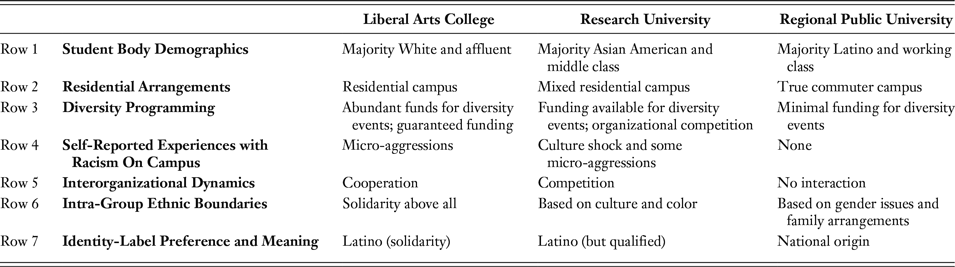
In the following sections, I describe the factors shaping the racial climate on each campus as experienced by the six Latino student organizations studied. In Table 2, I provide a summary of my typology, identifying the following influential campus characteristics that contribute to the racial climate: the racial-ethnic composition of student body, residential arrangements, and diversity programming (rows 1–3). These characteristics are external to the student organizations examined and together they create the organizational contexts in which students are racially ascribed and interact. Row 4 highlights how the university and organizational dynamics in Rows 1–3 shape students’ racialized experiences on campus. In row 5, I describe the relationship of the Latino student organizations studied on each campus; this relationship is especially significant to identity processes at Research University. In Row 6, I summarize how my respondents construct and define ethnic boundaries on each campus. Finally, Row 7 illustrates the preferred identity label of my respondents on each campus and their rationale. A description of how the dynamics in this table operate follows.
Boundary and Identity Formation Across Campuses

Liberal Arts College: Inclusive Panethnic Identification and Cooperation
Liberal Arts College (LAC) is a small private institution that ranks among the top schools of its kind. It is highly selective and admits fewer than 20% of its applicants. LAC enrolls only 1500 students and maintains an 8 to 1 student-to-faculty ratio. Respondents at Liberal Arts College reported feeling a strong community connection to their campus. Small class sizes along with a true residential college experience (nearly all students live on campus) create opportunities for intense peer interaction and feelings of integration into the campus community. Students spend most of their time within campus borders, so much so that they describe LAC as their primary community. My Latino respondents report feeling tied to their campus and consider it a “bubble” separated from the outside world.
LAC enrolls mostly affluent students—only 10% of students are eligible for Pell grants. The student body is approximately 50% White, 15% Asian American, 11% Latino, and 8% African American. Like most colleges, LAC expresses a commitment to diversity, and the school offers several campus programs intended to integrate ethnic minority students, which begins with recruitment. A large endowment allows LAC to fly in ethnic minority recruits from all over the country. Though the majority of the students in the two organizations I studied (Latino Links and Latinos Unidos) were mostly Mexican or Central American in origin, students also mention the presence of Caribbean-origin students from the U.S. east coast and Latin American internationals on campus.
Because Latino students represent a small minority on campus, many students reported initially feeling racially marginalized. Yet the school dedicates considerable effort to ameliorating these feelings; once enrolled at LAC, each new Latino freshmen is assigned a Latino peer mentor and connected to the Latino cultural center. Latino student organizations also have access to ample funding to organize cultural events on campus. Nonetheless, many students disclose experiences with alienation and culture shock upon arriving on campus. Paloma described her first moments on campus:
My suitemates were okay. Most of them were White and they talked about things that I couldn’t connect with. Like, they talked about their vacations and I had nothing to add. My family didn’t go on vacations.
Paloma experienced class differences with her suitemates as a form of culture shock and tied them to ethnic and racial differences. Vanya similarly experienced a sense of difference on campus rooted in her race and class. She expressed frustration as she described an interaction with a White suitemate she considers a friend:
The other day I was in the restroom and my suitemate was telling me that she was talking to her mom about where she would live after college. I told her that I’m expected to go back home. She asked, ‘Why do you parents expect that? Didn’t they go to college?’ I told her they didn’t, and that my uncle went to college, but he stayed home. She was so shocked. She was so shocked she had never met anyone that was first-generation college student. I told her to expand her lens.
Vanya and Paloma are hyperaware of their cultural and socioeconomic differences from their non-Latino peers. They express their belief that their White peers take these differences for granted. At LAC, Latino students’ early encounters with a new cultural environment, White peers, and university personnel leave many feeling out of place. In addition to moments of culture shock, several Latino students experience racial microaggressions, which are subtle expressions of racial and other stereotypes through interactions (Solórzano et al., Reference Solorzano, Ceja and Yosso2000; Sue Reference Sue2010). Microaggressions further challenged Latino students’ fragile sense of belonging on campus.
Martiza explains feeling stereotyped as poor and immigrant:
I’ve experienced racism on campus. There was an event on campus, and it was at the same time that we (Latino Links) had an event. We were returning a cart and this White woman asked us if we were part of the janitorial staff. She thought we were the staff and I told her we were students here. I didn’t realize what she was saying until my mom said, “that was racism, mija.” My friend and my mom were adamant that it was racism.
Maritza grew up in a predominantly Latino neighborhood in Los Angeles and attended a private high school with mostly Latino peers. Liberal Arts College is the first place she has lived where she is an ethnic-racial minority. She did not recognize the racist undertones of the White woman’s comments until she discussed them with her mother and her friend. When Maritza came to understand that her body read as janitorial staff, not as a student on campus, the experience of microaggression reduced her sense of belonging on campus.
Lorena disclosed a more overt instance racial aggression on campus. She explained:
My mother and I went to the school garden to pick fruit because I received an email from the school that fresh fruit was available and they didn’t want it to go bad. We picked oranges and lemons and we had two bags. We were putting the bags in the truck and one of the directors of the garden started yelling in Spanish ‘Alto! Alto! [Stop! Stop!]’ Then he accused us of intending to sell the fruit on the street. He called us orange-pickers. I told him I was a student and showed him my ID, but then he asked why I took so much fruit and I mentioned the e-mail. Then he said that the fruit is only for community members and we’re only allowed to take two or three oranges. And I was very, very upset.
Following this incident, Lorena wrote to one of the deans of the university asking for an apology to her mother for being stereotyped as a poor, uneducated immigrant who did not belong to the university community. At the time of our interview the Dean had refused to write an apology although she questioned the director of the garden.
Many more respondents shared feelings of alienation stemming from more subtle but persistent experiences of microaggression. For example, Karla shared:
I get the feeling that a lot of these colleges just accept us for being Latino. Because my SAT scores were not stellar and sometimes I feel they just accepted me because I’m a Latina. And people treat me that way. One of my suitemates has a full ride here and she wasn’t born here, she’s Latina. My White suitemate wasn’t accepted to all the schools that my Latina suitemate was. The White girl told me she is really upset that the other girl got into those other schools.
Karla’s quote is one example of how students grapple with their White peers’ opinions on admissions, diversity, and affirmative action. One of Karla’s White peers asserted that she did not believe her Latina friend was deserving of a full scholarship or admissions to the other schools. The conversation made Karla question not only why her friend received admission and scholarships but also whether race and ethnicity played a role in her own admission to LAC.
In addition to questioning whether they deserve to be at LAC, being one of the few Latinos on campus often leads to experiences of tokenization. Latino students at Liberal Arts College feel that they are expected to be “the diversity” on campus and that they are often singled out in class to give the “Latino perspective” on various issues. Paloma, a member of Latino Links, said:
I think that the school claims that they have diversity and they use us to have diversity. At times, I feel that I am the school’s diversity. I think that the school uses us to lure students. I don’t like that very much. I’m the only Latina in my political philosophy classes.
Paloma’s words demonstrate the burden of being one of the few Latino students on campus. The underrepresentation of Latinos coupled with the wealth and privilege on LAC’s campus breed feelings of tokenization. Many of the Latino youth at Liberal Arts College are also the first in their families to go to college, and for many, this is the first time living in a non-Latino community. These “firsts” lead to feelings of disorientation and culture shock. In addition, some of their encounters with White peers—particularly those involving microaggressions—lead them to question why they were admitted to the university.
Latino students processed these racialized experiences with their Latino suitemates, faculty, peer mentors, and fellow members of Latino student organizations. Students expressed the need to cooperate with one another within and across student organizations. Latino Links and Latinos Unidos showed solidarity in their efforts to bring Latino cultural awareness to student life. Their solidarity was encouraged by the institution through abundant resources for Latino programming and encouragement to share funds and co-sponsor other organizations’ events. Among the three colleges I studied inter-organizational cooperation only occurred at LAC. These students did not demonstrate antagonistic feelings toward members of other Latino organizations. These inter-organizational relations along with the racial climate shaped how panethnic boundary and identity were constructed.
When LAC Latino students discuss the boundaries of “Latinidad,” they offer highly inclusive definitions. Selena explained:
I identify as Latina because it’s the most all-encompassing term. “Latino” allows for panethnic identification and doesn’t distinguish between citizenship statuses. Someone in Argentina could be just as Latino as someone in Chicago. It allows for difference while retaining a cultural tie.
Selena’s definition is broad, including people across national borders, and emphasizes heterogeneity within the Latino population. Josiana similarly stated, “Latino has kind of become this thing about solidarity in the U.S. We have a similar story, like we were all colonized by the Spanish. Latina is someone who was born in Latin America or the United States with parents from Latin America.” Members of Latino Links and Latino Unidos privileged solidarity and overwhelmingly chose to self-identify as Latinos first. In my observations of organizational meetings over the course of two academic years, students never drew boundaries around ethnic authenticity. Rather than define behaviors or characteristics that made one “Latino,” they emphasized Latino diversity. They did not question one other’s cultural consumption patterns or identities.
Natalie explained her identity-label preference as rooted in its broad basis for solidarity: “Latina is more accepted and encompasses a group experience of colonialism, neocolonialism, and exploitation.” Natalie’s preference for the Latino identity label coupled with her rejection of the term Hispanic. LAC students consistently explained that the term “Hispanic” is an artificial imposition by the U.S. government, created for the 1980 Census and is politically incorrect. Other students described coming to understand the term as problematic through their experiences at LAC. Paloma, a member of Latino Links, shared:
I really didn’t have a problem with the word Hispanic growing up because of the Census and different surveys used it. I was always told to mark it because I’m not White or Asian. But here, I learned it’s very disrespectful because the Spanish took over these countries. But I know that we are not seen as Spanish in the color hierarchy. We are not seen as European so I think using Hispanic and being discriminated against at the time, it just doesn’t work.
At LAC, racial marginalization was an active part of the process of defining Latinidad, as illustrated by Paloma’s focus on discrimination. This is the externally ascribed stage in the process of ethnoracialization. In a racial climate characterized by microaggressions, students focused on solidarity and cohesion across both student organizations I studied. Students also focused on heterogeneity among Latinos at LAC. Perhaps the presence of Latinos of various origins including international students fostered a definition of Latinidad based on heterogeneity and solidarity among my LAC respondents. The racial climate of LAC stimulates solidarity in student interactions, which leads students to understand and express ethnic boundaries in broad ways; the low representation of Latinos on campus is critical in this process.
Research University: Qualified Panethnic Identification and Competition
Research University is ranked among the top twenty public universities nationwide. It is a moderately selective school, accepting approximately 45% of applicants. RU enrolls over 25,000 students, many of whom relocate for college. About 40% of students live on campus, including most freshmen and some sophomores; most juniors and seniors live in the surrounding areas that is mainly an Asian American and White, upper-middle class, and politically conservative neighborhood.
RU has a 19 to 1 student-faculty ratio with large lecture halls of over 300. Students described feeling anonymous on campus, lacking a sense of community and close relationships with faculty. In addition to feeling alienated from their professors and other students because of the size of their courses, the Latino student members of the two organizations I studied, Latinos United for Action (LUA) and Latino Fellowship (LF), reported feeling racially isolated on campus. The student body at RU is approximately 50% Asian American, 25% White, 11% Latino, and 2% African American. Belinda, a member of LUA, shared:
I felt really, really lost when I first got here, especially in housing where it was mainly Asian. They would make a lot of remarks that didn’t make me feel good at all—very racist remarks against Latinos. They would say things like ‘the only Mexicans in our school are retarded like the janitors’ and things like that.
Though her feeling of being lost is shared more broadly among RU participants, Belinda was the only respondent at Research University who disclosed encountering overt racist remarks from non-Latino peers on campus. A sense of culture shock was more commonly reported among RU students. For example, Mireya described her transition to life at RU in the following manner:
It was really different because I was used to a really strong Mexican community, and here, you could count the Mexicans. So I really wanted to find those people, find people that come from my background. … I found the Latino organizations and that helped me the most. It was familiar to me.
Facing new educational environments, students described experiences of isolation and insecurities in the classroom. The underrepresentation of Latinos gave my respondents a feeling of not belonging. Externally ascribed as “other” on campus, they found refuge in Latino organizations.
Students described their respective Latino student organizations as “a home away from home, and a family” and they considered co-members some of their closest friends on campus. RU students reported that their organizational experiences are their most significant campus connections and social ties. The Latino student organizations I studied were critical components of the racial climate and landscape for my respondents. These groups integrated students. Unlike the two organizations studied at LAC, Latinos United for Action and Latino Fellowship at RU were exclusive, which influenced the identity processes of my respondents. Students chose either Latinos United for Action or Latino Fellowship, and they saw membership in both groups as incompatible. The division between these two groups is partly a result of organizational histories and partly a result of university programming.
Each organization occupies a different space on campus based on its particular history of structural incorporation. Latinos United for Action (LUA) is a national student organization founded during the civil rights era with chapters across the southwest and an explicitly political mission. LUA continues to claim this historical legacy and is formally recognized by the administration at Research University. The Multicultural Center (MCC) recognizes five core student organizations, one representing each of the five major minority groups (Asian Americans, African Americans, Native Americans, Muslim Americans, and Latinos) on campus and LUA is the official Latino organization. MCC recognition provides LUA with meeting space and an office, as well as the expectation that the group will represent Latinos on campus. The group is expected to lead and plan Latino Heritage Month, Dia de Los Muertos, and Latino graduation. As a result, LUA leaders typically have a close working relationship with the staff of the MCC and even hold paid internships within the MCC. By contrast, Latino Fellowship is not a political organization and, unlike LUA, has no standing historical tie to the MCC. LF is primarily a cultural organization and only collaborates with the MCC to schedule meeting space and add its events to the Latino Heritage Month calendar. It does not have a designated office on campus.
The two organizations’ differential access to campus resources fuels their antagonistic relationship and often leads to competition. Because of this and the groups’ opposing political perspectives, students view simultaneous membership in LUA and LF as impossible. When I began my fieldwork, I met three young women who tried joining both Latino Fellowship and Latinos United for Action. Members of both groups challenged this decision and reminded them that no one had ever reconciled membership in both organizations. Deidra described her experience attempting to join both organizations,
Some LF members do make fun of us. . . . One LUA girl did say, ‘Oh, it’s really cool that you’re bringing people together.’ We were always asking questions about the divide. People told us that it was old beef that’s continued, so people continue to be separated. But I guess at the beginning, people always go to both meetings and it’s natural that they choose one, they never choose both. The LF people always said LUA people are always like ‘fight the power.’ And then there was a LUA girl that would say ‘LF doesn’t do anything and LUA does so much, so what’s the purpose and what’s the point of LF?’
The “fight the power” narrative Deidra described is expressly political and activist-oriented. Members of LUA expect their Latino peers to agree with them politically and socially, and to spend their energies organizing. Members of both LUA and LF describe LUA as a site where the boundaries of Latino authenticity are carefully guarded. RU respondents described several ways in which ethnic boundaries were deployed around Latinidad, overshadowing even political commitments to emphasize things like cultural consumption, Spanish fluency, and even skin color. Tania, a member of Latino Fellowship, shared her experience with LUA:
I tried LUA once, and I felt completely out of place. Everyone told me that I’m Whitewashed, which I am. I didn’t really grow up around a lot of Hispanics and we always had financial stability and stuff, so I never had to deal with that kind of thing. I just had a lot of White friends, Asian friends—I don’t know I just didn’t have the vocabulary and stuff – I don’t speak Spanish, which is like a big thing. I’m a Latina, but I’m not, I don’t fit the characteristics or whatever like I don’t speak Spanish, you know I haven’t eaten all the Hispanic foods, that kind of stuff, like in a lot of the other clubs they integrate a lot of Spanish.
Tania lists several indicators that she perceives to be the boundaries of Latinidad: language, culture, social class, and friendship circles. Because Tania feels comfortable socially around her White peers, she senses that Latino students see her as an outsider. Several other students also felt that Latinos United for Action members judged their Latino authenticity by evaluating their social relationships (i.e., who they date, and who they are friends with). Gloria, member of LF, used a Spanish-language proverb to describe this process, “Dime con quien andas, y te dire quien eres [Tell me who your friends are, and I will tell you who you are.]”
Deidra and Gilda shared the experience of having LUA members draw boundaries around skin color. Deidra, who has fair skin and green eyes, reported:
Sometimes people think you have to be brown to be Latina. Sometimes LUA members say, ‘brown is beautiful and brown pride,’ but I’m not brown. I want to say ‘hey we’re not all brown, maybe inside we’re brown and culturally we’re brown, but like, I’m not brown.’
When she first joined LUA Deidra felt that her presence was constantly questioned and she was mistaken for “the White friend” of other members. Gilda also claimed skin color was used as an indicator for Latino identity at LUA. She described her girlfriend’s experience attending a meeting:
At one point, she [her girlfriend] did go to a meeting, but I guess she had really bad experience when the co-chair at the time said ‘Wow! You’re dark! That’s good for the organization.’ And her friend didn’t know Spanish so they told the co-chair, and she kept speaking Spanish.
Gilda goes on to explain that the leadership believed darker skin would amplify their claims that Latinos are an oppressed ethnic minority. At LUA, skin color became a proxy for experiences with discrimination and racism, and a political commitment to racial-ethnic equality and justice. In this way, skin color is constructed as a relevant boundary of Latinidad.
Students at RU overwhelmingly chose to self-identify as Latinos first, but they also felt the need to qualify and authenticate their self-identification. Cruz, a leader of Latino Fellowship, explains identity-label preferences:
I identify myself as Latino. My parents are from Mexico; however, I’m not. To identify myself as Mexican, I feel is inaccurate. I think the term ‘Latino’ kind of includes people from all over Latin America, including the United States. I am from California, I was born here, but I’m not Caucasian, but at the same time, I’m not from Mexico. A lot of people identify themselves as Mexican – I can’t say that but at the same time I couldn’t and wouldn’t consider myself American because my cultural values and who I am, who I was growing up. I didn’t have the American culture.
Cruz highlights the complexities that many Latino youth grapple with as they try to understand who they are. Similarly, Lissandra and Thalia, both members of LF, see themselves as Latinas rather than Salvadoran. Thalia says, “I’m Latina. I don’t say I’m Salvadoran or Salvadoran American. I will say my parents are from El Salvador. And I’m definitely not going to say I’m American.”
Like their LAC peers, RU respondents also dislike the term Hispanic. Gilda, a member of LUA, says:
I cringe when I hear it. I read all these articles about where the word Hispanic came from. I think of it as an imposed identity. It’s a way of defining all these people. I think that it homogenizes everyone. I really don’t like the word. From my understanding the word Hispanic comes from the US government.
The way my RU respondents deployed ethnic and panethnic boundaries reflected their specific organizational membership. At LUA, there was a constant deployment of boundaries as students questioned one other’s Latino authenticity and felt compelled to qualify their own identities, defending their authentic claim to the “Latino” label.
Regional Public University: National Origin Identification and Lack of Interaction
Regional Public University is the least selective school in this sample, as it accepts approximately 60% of its applicants and enrolls approximately 20,000 students. It has a student-faculty ratio of 20 to 1. Regional Public University is a commuter campus; fewer than 10% of students live on campus and most live with family in the predominately Latino communities in which they grew up. RPU students are mostly local, non-traditional, and low income. More than 50% of the student body is eligible for Pell grants. Regional Public University is also a Hispanic Serving Institution enrolling many first generation college students of Latino origin.Footnote 3 RPU’s student body is 45% Latino, 20% Asian American, 10% White, and 8% African American. The Latino majority at RPU differentiates its racial climate from those of Liberal Arts College and Research University. RPU respondents did not report experiencing racial isolation even when probed to discuss instances of discrimination or prejudice. Instead Latino organizations at RPU emphasized their openness to non-Latinos and de-emphasized the importance of ethnic identity.
Latino organizations at RPU fill institutional gaps in student services, primarily focusing their energies on giving students information about resources and opportunities on and off campus. There is little student life on the campus and students need sources of information to access resources and opportunities. There were few diversity-related student events and minimal funding for student initiatives. Most students commute and appear on campus only for classes. They interact little with other students outside of class. The two organizations I studied at RPU, Latinos United for Action and Hispanics for Economics, had no interaction with one another—neither cooperation as at LAC nor competition as at RU.
None of my Latino respondents at RPU reported issues of culture shock, stigmatization, or racial microaggression, even when prompted to discuss these issues. They also did not articulate the need for a “home away from home.” Given students reluctance to discuss race on campus, I asked students to discuss what they and other Latino students had in common. They consistently responded “culture.” When asked to describe these cultural similarities among Latino students, young men emphasized the goal of supporting their families financially while young women mentioned the expectation that they live at home while in college and before marriage, generally. For example, Jackie said, “When I think of Latinos, for example, our parents won’t let us leave the house until we get married. My mom won’t let me move out until I get married and I have a curfew.” Mayra, also a student at RPU, described her perception of traditional Mexican culture as consisting of strong gender norms and obedience to a patriarch.
I’ve had a few friends that their parents, especially the father, didn’t let them leave. I would say I didn’t grow up traditional to a certain extent. I didn’t grow up traditionally Mexican. My dad hates makeup and really girly stuff and I told him I wanted to do cosmetology and he never questioned it.
Mayra described her father, who let her undertake a subject of study he “hated” as exceptional, but she also referred to Mexican culture as involving family systems where fathers control their daughters’ life choices. By contrast, respondents at LAC and RU did not give any examples of an imagined “traditional” Latino family when asked to describe what it meant to be Latino and what Latinos had in common. Reference to commonalities among families was unique to RPU respondents’ manner of defining the boundaries of Latino identity. This reference was probably a result of differences in residential patterns because RPU students lived with their families in predominantly Latino communities.
My respondents at RPU also deviated from students at the other two colleges in their identity-label choices. Regional Public University respondents rejected both Latino and Hispanic panethnic labels despite their membership in Hispanics for Economics and Latinos United for Action, both panethnic organizations. These students viewed all panethnic labels as problematic and even racist. For example, Vanessa explained:
I don’t use the words Hispanic or Latino at all. I’ve always thought that people from Spain came over and raped our mothers and then just left, so why would I use that word? And I always think of the word Latino as derogatory to dark-skinned people. I don’t use words that are about the physical. For example, people say, ‘Oh, she has dark hair, she must be Hispanic or Latino.’
RPU students associate a history of colonization with both Latino and Hispanic terms and find them disempowering. Josefina described her position:
I don’t use Latino or Hispanic. They are racist terms. Hispanic means Spaniards to me and it reminds me of colonization. I think it puts too many of us together. You can be from Nicaragua or Mexico, anywhere. It reminds me of people thinking we’re fiery and other stereotypes, like in the media. I try to refer to where people are from. I try to be more specific.
Josefina suggests that panethnic labels are too homogenizing and associates them with colonization. Others students raised interethnic dynamics, specifically relations between Mexican and Central American populations, as their reason for rejecting panethnic terms. For example, Alex said, “Like I know Salvadorans don’t like to be called Mexican, so I think Latino and Hispanic are not the words to use.” Teresa echoed Alex’s concern, “Some people think Hispanic and Latino are the right things to say. They say ‘I don’t want to call a Salvadoran, Mexican or a Mexican, Salvadoran.’ I tell them to ask people what they want to be called.”
RPU’s critical mass of Latinos allows students to form both panethnic and national-origin based organizations, although both of the organizations I studied had both Central American and Mexican-origin members. The large Latino population on campus draws student attention to interethnic difference rather than panethnic similarities. When asked to discuss coalitions between Salvadoran and Mexican organizations and label these coalitions, students emphasized that panethnic labels were unnecessary. Latino students’ identity preferences at RPU are consistent with Dina Okamoto’s (2003) theory of segregation among ethnic groups. Similar to the Asian Americans she studied, the critical mass of Latinos at this Hispanic-serving institution allows students to separate and form national-origin groups, which ultimately highlights differences between groups rather than similarities.Footnote 4 Thus, they are less likely to identify panethnically.
Like my respondents at LAC and RU, most of my RU respondents are the first in their families to go to college. Yet, as college students who continue to live at home, they did not confront a sense of culture shock or racial microaggressions in college. Unlike students at the other two schools, who disclosed instances where their identities were ascribed externally on campus, RPU’s racial climate did not appear to “other” Latino students categorically. They went to school with a student body where the largest group was Latino and working class. This is not to suggest that there is no racial inequality on campus, only that none of my respondents reported instances of perceiving racial animus.
The commuter campus dynamics also make organizational involvement less salient than at Liberal Arts College and Research University. Students spend most of their time off campus with friends and family not associated with their university, not dealing with co-ethnics on campus. When I prompted my respondents to discuss the ethnic boundaries of Latinidad, they identified family and gender arrangements as shared commonalities. Further, they rejected all panethnic terms. The racial climate is predominately Latino and characterized by little interaction among the student body generally. Respondents did not disclose a process of renegotiating ethnic boundaries and identities, perhaps because they feel little need to do such negotiation. As the majority, they do not face a new racial environment that forces them to re-process their ethnic identities.
DISCUSSION AND CONCLUSION
In this paper, I have examined how Latino students’ experiences and interactions take very different forms on three different campuses characterized by distinct organizational settings. I discuss how campus arrangements and student interactions cultivate particular racial climates, shaping how Latino students experience panethnic boundaries, construct intraethnic boundaries, and choose to identify themselves. At each college through interactions with their Latino and non-Latino peers, students learn about where they belong and who they are on campus. This is the dialectical process that Brown and Jones (Reference Brown and Jones2015) describe in their model of ethnoracialization. Through a mutually constitutive process of ascription and identification, Latino students come to see ethnic boundaries and identity labels in ways that match their experience on campus. Each campus creates a distinct environment that facilitates particular interactions between students and the campus at large; in turn, through these interactions, students construct what it means to identify as a Latino within that organizational space. I consider how the different characteristics of these settings shape disparate racial understandings and disparate lessons about Latinidad.
University organizational arrangements such as the ethnic and racial composition of the student body, student residential patterns, and diversity programming and policy interact within each campus to create the racial climate in which Latinos interact and learn. Racialized organizational arrangements shape how boundaries are drawn, imposed, and authenticated among Latino students and which labels are preferred. At Liberal Arts College, the racialized organizational setting is characterized by an institutional prioritization of diversity coupled with affluence and privilege among the predominantly White student body. This fosters cooperation and solidarity among Latino students. Research University similarly promotes diversity but its organizational structures unintentionally foster competition for resources among Latino student organizations. One consequence of this competition is that Latinos at RU patrol intraethnic boundaries and question their peers’ panethnic authenticity. Finally, Regional Public University, located in a Latino enclave, serves mostly local Latino students. Its racialized organizational setting matches the adjacent community outside the campus gates; thus Latino students do little re-learning or “discursive reinterpretation” (Brown and Jones, Reference Brown and Jones2015) of their ethnic-racial knowledge when compared to LAC and RU students.
Respondents at Liberal Arts College frame their experience of the college racial climates in terms of culture shock, racial microaggressions, and tokenization, processes of external ascription. These experiences create a sense of marginalization that fosters students’ panethnic identification on campus. LAC students live on campus among affluent peers, and they choose to prioritize solidarity with other Latinos in this environment. This elite institution draws students from all over the country; thus, LAC’s Latino population, though mostly local, Mexican, and Central American, includes some Puerto Ricans and Dominicans from the U.S. east coast.Footnote 5 In planning Latino cultural events, students were careful to be inclusive of all national origin groups’ cultures. This national-origin diversity also fostered an inclusive and broad perspective about who exactly is Latino and what Latinos look like. Through a mutually constitutive process of ascription and identification, LAC students come together to form a collective sense of being that focuses on embracing heterogeneity to establish solidarity.
In contrast, students at Research University draw ethnic boundaries around skin color and Spanish language fluency, resulting in students often feeling excluded from LUA in particular. Though my respondents were all members of Latino campus organizations, some shared anecdotes about friends who decided not to join LUA because they were made to feel not “Latino enough.” Intraethnic boundary formation correlated with organizational competition and division. Students think that Latinos Unidos for Action, the political organization, defines the parameters of both belonging to the organization and authentic Latinidad by questioning participants’ political commitments, Spanish fluency, and skin color. Issues with ethnic authenticity are an important factor in the division between LUA and LF; no such division was present between the organizations I observed at Regional Public University or Liberal Arts College. These divisions might be alleviated if the university were to give both student organizations equal treatment and recognition. Future research might undertake large-scale quantitative analysis of many institutions to study how their incorporation and funding of ethnic organizations impacts the identities therein.
Though there are large differences between Research University and Liberal Arts College, there are also some similarities in Latino students’ identification at these schools. Latino students are in the minority at both institutions, accounting for 11% of all students on each campus. Latinos in ethnic organizations at both LAC and RU have a heightened sense of ethnic identity because of their underrepresentation. Respondents at both institutions overwhelmingly identify as Latino and use national origin identities secondarily.
Similar to the students in Umaña-Taylor’s (Reference Umaña-Taylor2004) and JessicaTovar and Cynthia Feliciano’s (2009) research, my respondents at LAC and RU are becoming more aware of their ethnic identities while in college. However, unlike the students in previous research, my respondents are becoming hyperaware of their panethnic similarities and the power that identifying as Latinos affords them on campus. At universities where Latinos are a small minority of the population, their experiences with isolation, a new culture, and discrimination remind them that they do not belong and cannot identify simply as Americans. Instead, students are discovering the potential for solidarity in defining themselves as Latinos, even though RU students feel the need to justify and defensively qualify this identification.
In contrast, RPU respondents reject all panethnic identities. They are reluctant to identify with broad terms such as Latino and Hispanic. Students at RPU generally find themselves in Latino-majority classrooms. In these settings, students highlight their specific national origins instead of their panethnic similarities. Even in panethnic organizations, students specify their Mexican, Salvadoran, and Guatemalan uniqueness. RPU students, unlike LAC and RU students, mention intraethnic relations and differences among Latino groups and cite these differences as reasons to avoid panethnic identification.
As mentioned previously, this research focuses on the identity- and boundary-formation interactions and processes among members of the Latino student organizations studied. The students in this study all self-selected into a panethnic club; however, deeper analysis shows that there is diversity in their deployment and definition of panethnic boundaries and identity-label preferences. This is a result of an interactive process. A different research design might have missed this diversity. Future research might attempt to assess the influence of university contexts on students who are not members of student organizations to uncover the importance of students’ embeddedness on campus for their ethnic identification.
It should also be noted that my comparative ethnographic design cannot account for all of the differences that lead one first generation student to enroll in Liberal Arts College versus Research University or Regional Public University. Therefore, I cannot account for individual students’ identities before arriving to campus. My findings do suggest, however, that campuses create particular racial climates that influence the interactive process of constructing inter-ethnic and intraethnic boundaries. I am not making any definitive causal claims. The value of my findings rests in the rich portrait I am able to provide of ethnic identity-formation in three different settings. While I can point to the organizational factors that differentiate those settings and consider how these factors might have impacted the identities produced therein, future research is needed to test these specific relationships. A fruitful research design might ask students open-ended questions about ethnic boundaries and identity-label meanings and preferences upon arriving to campus, track their organizational experiences on campuses, and then ask them the same questions upon graduation. Alternatively, another way to account for the influence of college racial climates on students’ identities would be to track a group of graduating seniors from one high school through their college experiences. A tightly controlled quantitative study could also attempt to isolate particular organizational variables to test their significance across different contexts.
My research has gone beyond studies that describe identification preferences of Latinos by unpacking what the labels actually mean and how boundaries are drawn and deployed (or not) across different settings. These findings have theoretical and practical implications for scholars of higher education, organizations, and race as well as university administrators and practitioners interested in mobilizing Latino populations. This research suggests that important learning is taking place on campus grounds beyond the classroom. College organizational dynamics create racialized contexts in which Latinos learn and create ideas about who they are ethnically and panethnically. As such, racial understanding may be part of the hidden curriculum of college—a curriculum that teaches students distinct lessons. If this process occurs nationally, trends in the types of colleges that Latino students attend may have far-reaching consequences for ethnic identification. Future research with Latino alumni from different campus might address how different understandings of Latinidad shape post-graduation civic organizing and interaction among Latinos. In tracing such dynamics, we may begin to understand all the diverse ways in which higher education, in its many varied forms, impacts people’s lives, shaping their understandings of where they do and do not belong, and who they may or may not become.
ACKNOWLEDGMENT
I would like to thank the University of California, All Campus Consortium for Research on Diversity, the Center for the Study of Democracy, the Center for Organizational Research, and the Center for Research on Latinos in Global Society at the University of California Irvine for financial support for this project. I also benefitted greatly from comments I received from Irenee Beattie, Cynthia Feliciano, David S. Meyer, Gilda Ochoa, Yung-Yi Diana Pan, Blanca Rincon, Megan Thiele, and Melissa Weiner.