Introduction
Teachers spend on average approximately 30 h per week with children at the coalface of primary and secondary education. Given this not insignificant length of interaction between pupil and teacher, it is understandable that the expectations teachers have of their students can be influential in children's educational success and overall maturation into adulthood (Trudgett et al., Reference Trudgett, Page, Bodkin-Andrews, Franklin, Whittaker, Walter, Martin and Bodkin-Andrews2017). In recent years, the significance of teacher expectations and the interconnection with student performance and wellbeing has been acknowledged in educational policy and research, particularly in respect to self-esteem and academic performance (Riley and Ungerleider, Reference Riley and Ungerleider2012; Andersen, Reference Andersen2017). It has also been observed how ‘subtle’ and subconscious racial assumptions (e.g. that those of a certain race are characteristically lazy), often based on unsubstantiated stereotypes, influence teachers' pedagogy and thereby unduly negatively affect students' educational experiences (Vaught and Castagno, Reference Vaught and Castagno2008). Accordingly, an understanding of teacher expectations of their students, particularly those from minority groups such as Indigenous children, is of importance in contributing to the broader effort to improve the markedly lower educational outcomes of Indigenous Australians.
Parental–child expectations have similarly been shown to impact the educational achievement and overall scholastic success of their child(ren) overall (Bornholt and Goodnow, Reference Bornholt and Goodnow1999; Davis-Kean, Reference Davis-Kean2005; Rubie-Davies et al., Reference Rubie-Davies, Peterson, Irving, Widdowson and Dixon2010) and within tertiary education (Koshy et al., Reference Koshy, Dockery and Seymour2019). This has primarily been the case in respect to the development of a child's self-concept in specific subjects (such as reading), and in response to their performance overall, studies finding that where parents have a higher expectation as to their child's performance, actively communicate and take interest in their child's homework and education, and encourage the acquisition of educative skills (e.g. reading), there tends to be a correlation with greater educational outcomes for their child (Castro et al., Reference Castro, Expósito-Casas, López-Martín, Lizasoain, Navarro-Asencio and Gaviria2015). Notwithstanding this, it is noted that success is considered to be more holistic from an Indigenous perspective in comparison to the typical Western counterpart, given the former's valuing of culture, community and country (as opposed to the possession of health, wealth and status). Furthermore, Aboriginal and Torres Strait Islander children particularly benefit from parental confidence and support in buffering them against the risk factors and social structures negatively impacting them (Davis-Kean, Reference Davis-Kean2005; Rubie-Davies et al., Reference Rubie-Davies, Peterson, Irving, Widdowson and Dixon2010; Oostdam and Hooge, Reference Oostdam and Hooge2013).
This paper explores teacher and primary caregiver expectations of Aboriginal and Torres Strait Islander children and their likelihood of successfully completing their secondary education, drawing from quantitative data from Waves 3–9 of the Longitudinal Study of Indigenous Children (hereinafter ‘LSIC’). The results suggest primary caregivers maintain exceptionally high expectations of their children, while teachers' expectations decline as the student progresses through the educational system. These lowered expectations of teachers are problematic because students, empirical research suggests, tend to attain greater levels of achievement when heightened expectations are maintained. From these findings, we suggest primary caregivers and teachers need to maintain forms of communication regarding student/children expectations as a means of balancing the expectations of both parties. In addition, we contend that teachers may benefit from the use of ‘higher expectations strategy’ and unconscious bias training within their tertiary learnings, and thereafter within professional development training, to remove unduly hindrances to the possession of bona fide expectations towards their Indigenous students.
Teachers and lowered expectations
The interconnection between teachers' expectations of their students and the level of the pupils' achievement has been increasingly examined since the late 20th century, scholars noting a correlation in some instances between teacher expectations (high versus low) and the subsequent academic result attained by students (favourable versus not as favourable, see Jussim and Harber, Reference Jussim and Harber2005; Good et al., Reference Good, Sterzinger and Lavigne2018; Wang et al., Reference Wang, Rubie-Davies and Meissel2018). Although there has been debate as to the extent to which this influence occurs, and the longevity of its effect (De Boer et al., Reference De Boer, Bosker and van der Werf2010), it has been agreed in recent years that this is a legitimate educational phenomenon (Pantaleo, Reference Pantaleo2016, p. 83; Timmermans et al., Reference Timmermans, Rubie-Davies and Rjosk2018; Wang et al., Reference Wang, Rubie-Davies and Meissel2018; Gentrup et al., Reference Gentrup, Lorenz, Kristen and Kogan2020). It is described as entailing a three-stage process, namely
(I). Teachers possess predisposed expectations as to the educational ability and likely achievement of their students, which may be unduly influenced by stereotypes or similar unfounded assumptions (Dandy et al., Reference Dandy, Durkin, Barber and Houghton2015);
(II). These predispositions guide teachers' pedagogy and interpersonal interactions and relationships with their students, with variation afforded to those deemed of greater potential than those with less (see also Rosenthal and Jacobson, 1968; Elliot, 2011);
(III). The pedagogy, attitudes and behaviour of teachers are observed and subsequently internalised by students leading some to, imbued with confidence and direction, focus and hone their skills and thereafter achieve more favourable results. Other students, who conversely, in the teacher's mind, have less potential, are either not encouraged or led to believe they are incapable, neglect to exert themselves in academics and receive less favourable results (Jacoby-Senghor et al., Reference Jacoby-Senghor, Sinclair and Shelton2016). This is known as a ‘self-fulfilling prophecy’ (Wang et al., Reference Wang, Rubie-Davies and Meissel2018) or the ‘stereotype threat’ (Steele and Aronson, Reference Steele and Aronson1995), where an individual accepts and conforms to (viz. embodies) the negative stereotyped label placed upon them (Steele and Aronson, Reference Steele and Aronson1995; Mirels, 1980; Langdridge and Butt, 2004; Hartley and Sutton, 2013).
A leading area of inquiry in this field includes the examination of what predispositions teachers possess towards their students, and subsequently how these shape their everyday practice in the classroom (Van den Bergh et al., Reference Van den Bergh, Denessen, Hornstra, Voeten and Holland2010; Gershenson et al., Reference Gershenson, Holt and Papageorge2016; Wang et al., Reference Wang, Rubie-Davies and Meissel2018). More specifically, attention has been afforded to testing and understanding the predispositions which stem from societal divisions of race, ethnicity, gender and socioeconomic status (Ali, Reference Ali2010; Glock and Krolak-Schwerdt, Reference Glock and Krolak-Schwerdt2013). Indeed, even seemingly harmless implicit and/or unconscious assumptions may alter teacher–student interactions or treatment, and pedagogy; subsequently, inducing students to internalise (and live up/down to) these expectations (e.g. belief in inability leading to lack of engagement and thereafter poor results, see Riley and Pidgeon, Reference Riley and Pidgeon2019; Watson et al., Reference Watson, Rubie-Davies, Meissel, Peterson, Flint, Garrett and McDonald2019)
Several studies have highlighted the presence of racial biases amongst teachers in primary and secondary schools, examining the subsequent effects on children (Riley and Ungerleider, Reference Riley and Ungerleider2012; Chaffey et al., Reference Chaffey, Bailey and Vine2015; Gershenson et al., Reference Gershenson, Holt and Papageorge2016). It has been found in studies from the United States (Riley and Ungerleider, Reference Riley and Ungerleider2012; Priest et al., Reference Priest, Slopen, Woolford, Philip, Singer, Kauffman and Williams2018), Canada (Riley and Ungerleider, Reference Riley and Ungerleider2012) and Australia (Chaffey et al., Reference Chaffey, Bailey and Vine2015) that white teachers tend to possess preconceived notions towards children of colour and their academic success, perceiving black and Indigenous children to having less potential than white children. Indeed, Gershenson et al. (Reference Gershenson, Holt and Papageorge2016) found that non-African-American teachers who taught African-American students possessed lower expectations (30–40% lower) of their African-American students' academic abilities in contrast to their non-African-American counterparts. Similarly, Dandy et al. (Reference Dandy, Durkin, Barber and Houghton2015) found that their sample of 199 Australian teachers tended to hold the view that Asian students were expected to perform better in mathematics and expend greater effort than Aboriginal and Anglo-Australian students, and that Anglo-Australian students to perform better than the Indigenous students.
Across these studies, the negative expectations of teachers towards specific classes of students (viz. by race) were shown to one of several variables which impacted student performance (Chaffey et al., Reference Chaffey, Bailey and Vine2015; Jacoby-Senghor et al., Reference Jacoby-Senghor, Sinclair and Shelton2016), mostly through the effort, attention and support given to those students (Riley and Ungerleider, Reference Riley and Ungerleider2012; Jacoby-Senghor et al., Reference Jacoby-Senghor, Sinclair and Shelton2016). This was further compounded when students received lowered test scores, thereby reinforcing reduced expectations in the minds of teachers (Jacoby-Senghor et al., Reference Jacoby-Senghor, Sinclair and Shelton2016). Furthermore, it has been suggested that such negative expectations may increase over time, Priest et al. (Reference Priest, Slopen, Woolford, Philip, Singer, Kauffman and Williams2018) found that their sample demonstrated a growth in the perceived negative stereotypes against minority groups as the age of a cohort of children increased. It is worth noting that this may not always be an intentionally vindictive process (Riley and Ungerleider, Reference Riley and Ungerleider2012), note that some participants were reportedly unaware of biases negatively impacting students; though this may be the product of observation bias (Patton, Reference Patton2014)
De Boer et al. (Reference De Boer, Timmermans and Van Der Werf2018) in their review of 19 studies of initiatives to ameliorate negative teacher expectations towards students observe that these measures tend to fall into one of three typologies, with some degree of overlap: (I) addressing behaviour of teacher; (II) addressing awareness of the effects of their expectations upon students; (III) rectifying predispositions of teachers. The scholars observe that rather than identifying the ideal program for changing teachers, it is instead necessary that teachers identify and acknowledge their prejudices, accept the unacceptableness of these, and affirm and implement means of change (De Boer et al., Reference De Boer, Timmermans and Van Der Werf2018). Needless to say, this is a difficult process as such self-examination and acknowledgement of fault require vulnerability and humility, with the recanting and alteration of belief and behaviour often being lengthy and costly (De Boer et al., Reference De Boer, Timmermans and Van Der Werf2018).
Parents and expectations
The notion of parents maintaining heightened expectations is seen as an advantageous component of children achieving educational success (Visser, Reference Visser1987; Wentzel, Reference Wentzel1998; Bornholt and Goodnow, Reference Bornholt and Goodnow1999; Mau and Bikos, Reference Mau and Bikos2000; Rubie-Davies et al., Reference Rubie-Davies, Peterson, Irving, Widdowson and Dixon2010; Yamamoto and Holloway, Reference Yamamoto and Holloway2010; Rimkute et al., Reference Rimkute, Hirvonen, Tolvanen, Aunola and Nurmi2012). According to Yamamoto and Holloway (Reference Yamamoto and Holloway2010, p. 191), ‘parental expectations are based on an assessment of the child's academic capabilities as well as the available resources for supporting a given level of achievement’. This is not to be confused with parent aspirations, which typically refers to what parents want from their children, as opposed to what they expect; notwithstanding this, the two concepts are interrelated and sometimes used interchangeably (Juang and Silbereisen, Reference Juang and Silbereisen2002; Yamamoto and Holloway, Reference Yamamoto and Holloway2010).
Studies have shown a correlational relationship between parents' expectations and their child's expectations; the higher the parent's expectations, the higher the children's expectations were of themselves (Visser, Reference Visser1987; Wentzel, Reference Wentzel1998; Zhang et al., 2011). Consequently, parental expectations are likely to influence whether their children would undertake further study, e.g. tertiary education (Ma, Reference Ma2001; Bodkin-Andrews et al., Reference Bodkin-Andrews, O'Rourke and Craven2010; Kickett-Tucker and Coffin, Reference Kickett-Tucker and Coffin2011; Prehn et al., Reference Prehn, Peacock and Guerzoni2020).
Regarding Indigenous-specific literature on parental expectations of children, little research is presently available; research instead exploring Indigenous parental aspirations for their children. However, work to date has found that Indigenous parents desire their children to attain a quality education, be successful, succeed and grow up strong (Martin and Walter, Reference Martin, Walter, Walter, Martin and Bodkin-Andrews2017, p. 56). Accordingly, our paper seeks to contribute to this gap in the literature regarding the formal schooling educational expectations within Indigenous families.
Methodology
This paper utilises an Indigenous quantitative methodological framework, involving the prioritising of an Australian Aboriginal worldview throughout each stage of the research process; conceptualisation, data analysis, interpretation and dissemination (Walter et al., Reference Walter, Dodson, Barnes, Walter, Martin and Bodkin-Andrews2017, p. 3). The authors are Aboriginal men and women, each employed in an Australian tertiary educational institution in the field of social sciences. As such, acknowledging these social contexts and how they influence the researcher's held worldview is an important consideration (Walter, Reference Walter and Walter2013).
The Longitudinal Study of Indigenous Children (LSIC)
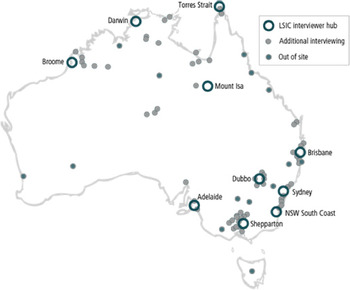
The LSIC ‘collects information about the lives of Aboriginal and Torres Strait Islander children, their families and communities’ (Walter et al., Reference Walter, Dodson, Barnes, Walter, Martin and Bodkin-Andrews2017, p. 15). It is an Australia-wide panel study that commenced in 2008, boasting an original sample of approximately 1670 Aboriginal and Torres Strait Islander children and their families across 11 sites throughout Australia. These sites range from urban city centres to extremely remote isolated communities (Walter et al., Reference Walter, Dodson, Barnes, Walter, Martin and Bodkin-Andrews2017, p. 16) (figure 1).
Longitudinal Study of Indigenous Children Data Collection Sites (Kneebone et al., Reference Kneebone, Christelow, Neuendorf and Skelton2012).

The LSIC was designed with two distinct cohorts of study children that are spaced approximately 3 years apart. These cohorts are known as the Baby Cohort (B Cohort) and the Kid Cohort (K Cohort). The children in the former cohort were between 6 and 24 months old when the study started in 2008, and those within the K Cohort were aged three and a half to five years of age. As of 2020, the study has 10 publicly available Waves of data (each Wave constituting an additional year of data collection), with future waves to be realised annually (see figure 2).
Longitudinal Study of Indigenous Children Cohorts (Kneebone et al., Reference Kneebone, Christelow, Neuendorf and Skelton2012).

The LSIC was designed with four overarching research questions in mind. These questions are formulated under the guidance of the dataset Steering Committee, they are:
• What do Indigenous children need to have the best start in life and to grow up strong?
• What helps Aboriginal and Torres Strait Islander children to stay on track or get them back on track to become healthier, more positive and stronger?
• How are Aboriginal and Torres Strait Islander children raised?
• What is the importance of family, extended family and community in the early years of life and when growing up? (Walter et al., Reference Walter, Dodson, Barnes, Walter, Martin and Bodkin-Andrews2017, p. 22).
To support these overarching research themes, the study collects data on an expansive range of topics including inter alia, physical and mental wellbeing, social and cognitive development, education, and family and community factors (Walter et al., Reference Walter, Dodson, Barnes, Walter, Martin and Bodkin-Andrews2017, p. 29). Accordingly, the LSIC is providing unequalled opportunities for current Indigenous and non-Indigenous researchers to contribute to improving outcomes for Indigenous children, their families and communities (Department of Social Services, 2016; Walter et al., Reference Walter, Dodson, Barnes, Walter, Martin and Bodkin-Andrews2017). Yet it must be acknowledged that it is not a perfect dataset; population statistics are often imbued with meaning derived from the dominant social norms, values and racial hierarchies of colonising nation-states.
Within this research, data from the K Cohort Wave 3 (5.5–7 years of age) to Wave 9 (11.5–13 years of age) are analysed. Analysis is undertaken regarding how teachers and parents believe the study child (hereinafter ‘SC’) will go in their education. All data analysis procedures are undertaken using the statistical software program SPSS (Version 24). Specifically, in this paper, the variable ‘How far do you think SC will go in their education’ in Waves 3 through 9 is analysed. This variable consists of five responses: [1] Leave school before finishing secondary school; [2] Complete secondary school; [3] Complete a trade or vocational training course; [4] Go to university and complete a degree; and [5] Obtain postgraduate qualifications at a university. This variable was then recoded into a dichotomous yes/no. This recoded variable is re-named: ‘Do you believe SC will finish their secondary education?’ With [0] No and [1] Yes being the options. The variable was recoded dichotomously through option [1] staying the same, and options [2] through [5] being combined. The same question is asked of the parents (P1 and P2) and teachers of the SC. The majority (87.7%) of P1s analysed are the biological mothers with the remainder being close female relatives. P2s analysed are all male, 93.3% are biological fathers; remainder are step-fathers or adoptive fathers. Teacher responses are analysed in Waves 3 through 9, whereas P1 and P2 responses are only analysed in Waves 5, 8 and 9 as this question was not asked in other Waves. The analysis specifically reports on the percentage of parents and teachers in the study who selected ‘Yes’ or ‘No’ in each Wave. Thereafter, one-way ANOVA analysis is undertaken to test for a statistically significant difference between group means; specifically testing whether there is a statistically significant difference between Wave 3 teacher expectations and Wave 9 teacher expectations.
Results
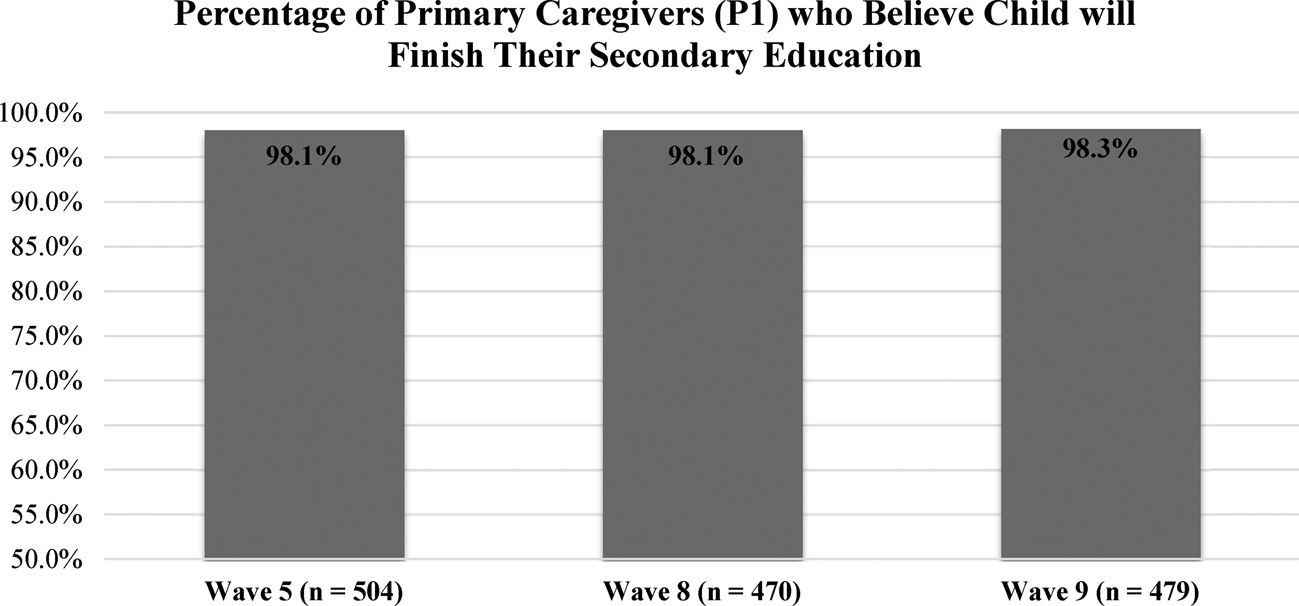
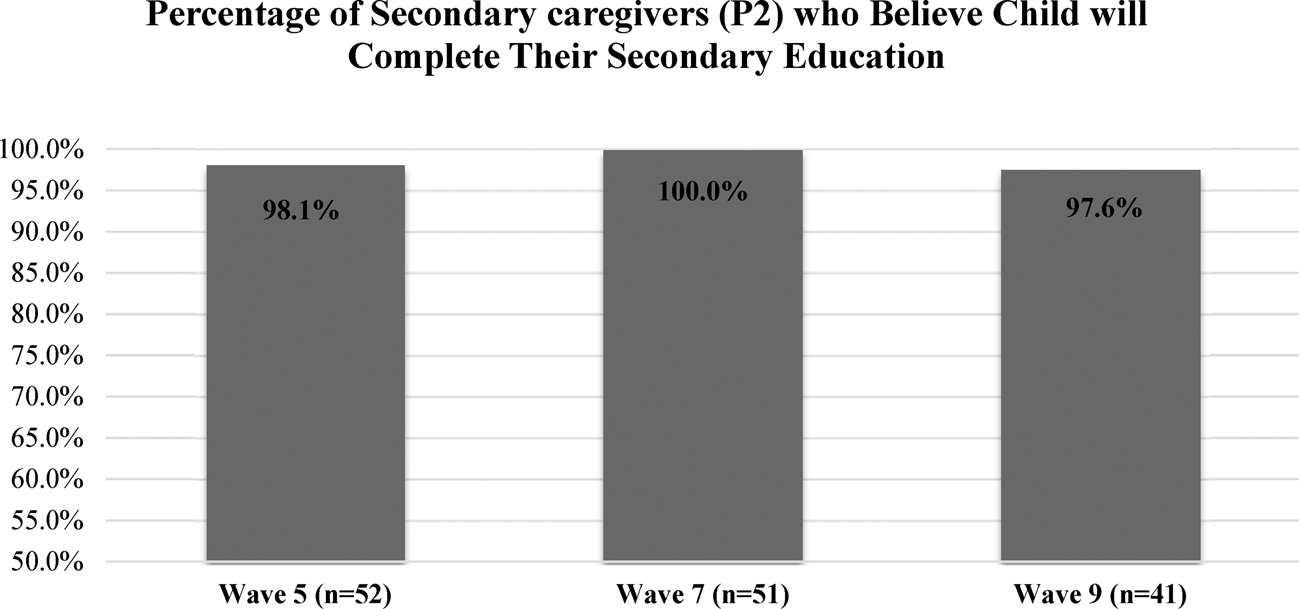
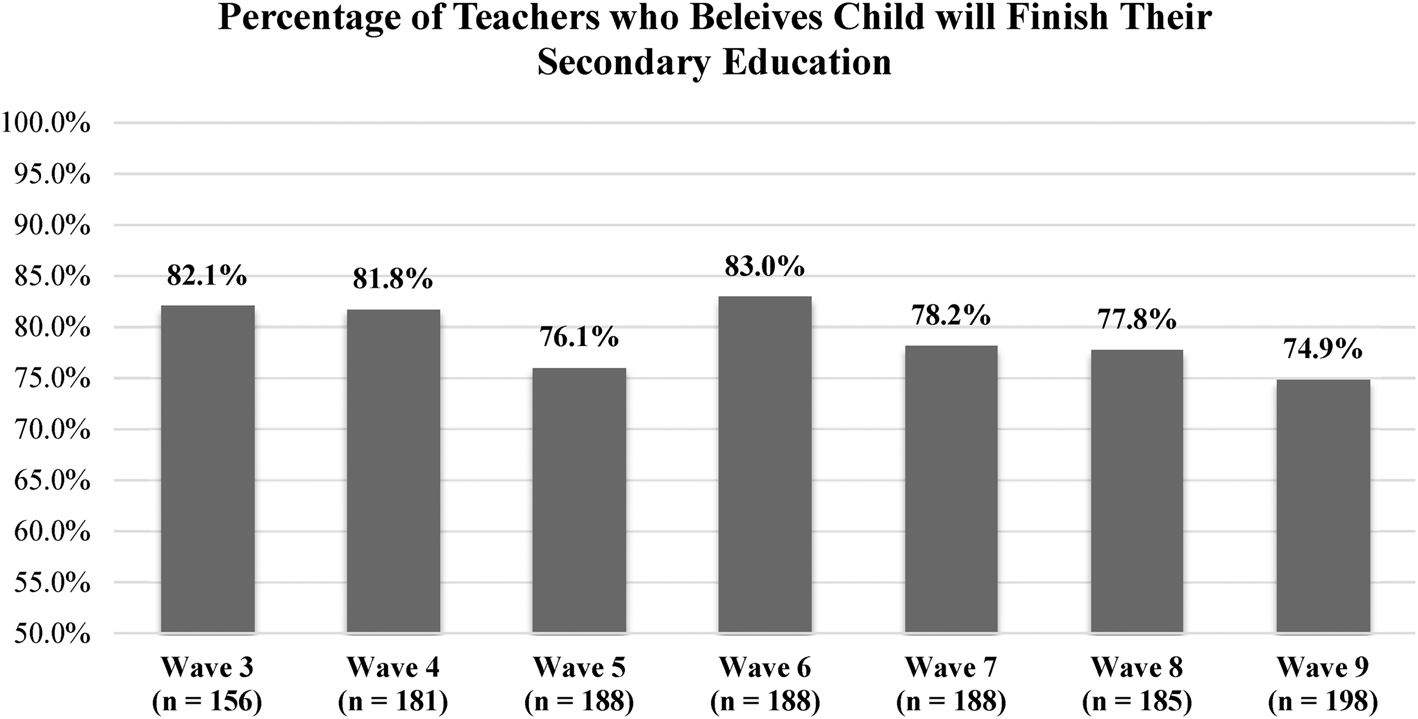
See figures 3–6

Primary caregiver (P1) expectations regarding their children completion secondary education.

Secondary caregiver (P2) expectations regarding their children completion secondary education.

Teacher expectations regarding whether Indigenous children will complete secondary education.

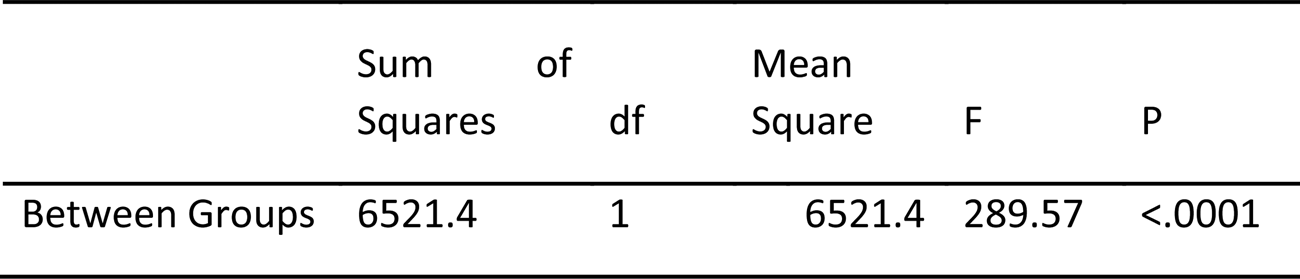
ANOVA of Wave 3 v Wave 9.

Summary of ANOVA (Wave 3 v Wave 9)
One-way ANOVA analysis indicates that there is a statistically significant difference [F (1) = 289.57, p ≤ 0.0001] between the group means of teacher expectations from Wave 3 compared to Wave 9. Put simply this indicates that in Wave 9, teacher's expectations of SC are significantly different (Lower) than teacher expectations from Wave 3.

Discussion
The aim of this paper was to understand the expectations of teachers and Indigenous primary caregivers regarding the secondary schooling completion rates of their Indigenous students/children, which has previously not been undertaken in Australia. Our results confirm and align with previous literature in finding that teachers have comparatively lowered expectations as children progress through their formal schooling years, whilst parents, conversely, maintain high-level expectations of their children completing their secondary education. The expectation completion rates of formal year 12 schooling between teachers and parents regarding Aboriginal and Torres Strait Islander children are, not surprisingly, mismatched.
The data indicate that teacher's expectations of Indigenous children completing secondary education decline as the Indigenous children progress through their formal schooling levels. This finding correlates with other North American studies which described that sampled teachers had similar shifts in expectations throughout child maturation with students of minority ethnic groups (Jacoby-Senghor et al., Reference Jacoby-Senghor, Sinclair and Shelton2016; Priest et al., Reference Priest, Slopen, Woolford, Philip, Singer, Kauffman and Williams2018). It is of concern not only by virtue of the existence of such lowered expectations of Indigenous students per se, but also because this is shown to progressively worsen over time. In recognising that as Indigenous children mature to an age where their self-concept and self-esteem are crystallised, and entrance into university becomes a consideration, it is imperative that they receive additional affirmation, instruction and support from their teachers. Given that lowered expectations from teachers likely correlates with less support, and subsequently students achieving less favourable results, intentions or possibilities for Indigenous youth to pursue higher education or employment requiring further training may be unduly hindered, impeded or jettisoned. This is of concern insofar as educational achievement has been identified as one of the primary means of Indigenous people moving out of poverty and intergenerational inequality into which they are often deeply embedded (Martin and Walter, Reference Martin, Walter, Walter, Martin and Bodkin-Andrews2017; Walter et al., Reference Walter, Dodson, Barnes, Walter, Martin and Bodkin-Andrews2017).
As expected, parents maintain remarkably heightened expectations of their children regarding formal secondary school completion. Across the three Waves analysed, parent's expectations of their children's ability to complete secondary education remain consistently high at over 98%. Further, much like the primary caregivers, secondary caregivers (mostly Indigenous fathers) also maintained extraordinarily heightened prospects of their children schooling completion. This is an important finding because parental belief of children is found to contribute regarding favourable educational accomplishment through the development of their self-concept, and serves as a mitigating factor against structural inequalities facing Indigenous children (Wentzel, Reference Wentzel1998; Rubie-Davies et al., Reference Rubie-Davies, Peterson, Irving, Widdowson and Dixon2010).
Our paper reaffirms the need for rectifying the lowered expectations that teachers have for Indigenous children, recognising that teachers are the single most important ‘in school’ influence on student achievement over peers and other personnel (Hattie, Reference Hattie2009). In recognising that teacher willingness is required to facilitate best outcomes in changes to beliefs and behaviours, we suggest that all teachers (and teacher aids) should be required to receive instruction in cultural competency and sensitivity training, which has support in Australia, as it is likely to produce improvements in the outcomes for Indigenous children (Harrison and Greenfield, Reference Harrison and Greenfield2011; Owens, Reference Owens2015). It is key that teachers be steered away from any prejudicial stereotypes they may have towards Indigenous people, and led to respect and have compassion for Indigenous communities, culture and children (Walter, Reference Walter and Green2014; Bodkin-Andrews and Carlson, Reference Bodkin-Andrews and Carlson2016).
Reflexivity towards attitudes and behaviours shown by teachers working with Indigenous children is a fundamental component of this process (Ryan, Reference Ryan2017). There is a deficit discourse that Indigenous students are lower achievers, which has the potential to unconsciously impact teacher expectations of Indigenous students (Jacoby-Senghor et al., Reference Jacoby-Senghor, Sinclair and Shelton2016). Teachers need to examine their own beliefs and behaviours to ascertain whether they have racial biases, and if present to what extent this is affecting their practice. The Australian Professional Standards for Teachers could incorporate the importance of holding high expectations for Indigenous students under Standard 1.4 (Strategies for teaching Aboriginal and Torres Strait Islander students) and/or 3.1 (Establish challenging learning goals). Furthermore, teacher cultural awareness programs could include an increase in unconscious bias training, alongside instruction outlining why maintaining high expectations of students (particularly those from minority groups) is needed to assist in ensuring the best results for students. More work is needed to further understand the multifaceted issue of lowered teacher expectations, and in turn uncover how such a negative trend can be reversed. As Priest et al. (Reference Priest, Slopen, Woolford, Philip, Singer, Kauffman and Williams2018) state: perceptions of even small differences between groups can result in differential treatment with deleterious consequences.
In light of the meta-analysis findings from De Boer et al. (Reference De Boer, Timmermans and Van Der Werf2018), one prominent strategy not mentioned is to improve teacher expectations through using ‘High Expectation Relationships’ (H-ER), to create high-quality relationships between students, teachers, families and the community. Students are more likely to feel supported and engaged in their education, as teachers are better able to understand and cater to their needs whilst maintaining heightened expectations (Stronger Smarter Institute, 2014). Chris Sarra suggests that this may be able to guard the classroom from racist and prejudicial practice (Stronger Smarter Institute, 2014). Sarra contends that when H-ER approaches are implemented within schools, students reportedly feel supported by their teachers and are more engaged in their education as a result. This may be because through using such strategies, teachers are positioned to better understand and cater for student individual needs, irrespective of race or disability, and focus on the development of high-quality relationships with students. Collectively, this may lead to a greater sense of inclusion within the schooling environment, further promoting student engagement (Stronger Smarter Institute, 2014, p. 14).
There are two overarching concepts of high expectation relationships used by the Stronger Smarter Institute (SSI), these are ‘fair’ and ‘firm’ (see also Tatar and Horenczyk, Reference Tatar and Horenczyk2000). The notion of fair consists of active enquiry, and listening to students to understand their worldview (Stronger Smarter Institute, 2014, p. 5). This aspect of the H-ER framework is characterised through the cultivation and enaction of empathy and compassion, deep listening, genuine interest and a non-judgemental approach (Spillman, Reference Spillman2013). The concept of firm consists of ‘critically reflective relating’ (Spillman, Reference Spillman2013). This means having courage and firmness to address times when the individual student or broader community (both internal and external to the school) is not performing their responsibilities appropriately (viz. with restraint, appropriate to the understanding ability of the child, free of malice or ill-intent). Within the school environment, this involves challenging the deficit biases that teachers may have (Stronger Smarter Institute, 2014, p.6), while also enabling parents to more readily engage in their children's education. This close interaction of teachers with students may assist the former in discarding any held racial biases as a result of relating to the student as an individual, rather than as a member of a class.
It must be acknowledged that the implementations of such interventions should abide by the recommendations of De Boer et al. (Reference De Boer, Timmermans and Van Der Werf2018). Namely, creating a broad array of support for teachers, by providing them with tangible information on expectations within their own context, as well as involving them in the design and implementations of such interventions (De Boer et al., Reference De Boer, Timmermans and Van Der Werf2018, p. 196). Further, we acknowledge that high expectations must be balanced against the competency of the student, i.e. being firm and fair.
We also recognise that tertiary education must lead the way in ameliorating biases of freshly-minted teachers, through the introduction of content and assessments which are embedded with Indigenous perspectives, and focus on confronting racist stereotypes (Zubrzycki et al., Reference Zubrzycki, Green, Jones, Stratton, Young and Bessarab2014; Bodkin-Andrews and Carlson, Reference Bodkin-Andrews and Carlson2016; Peters, Reference Peters2016). Education courses could incorporate Indigenous graduate attributes and further Indigenise to assist in this process (Page et al., Reference Page, Trudgett and Bodkin-Andrews2019). Put simply we are articulating that current teacher education programs could and should be improved to help alleviate prejudicial behaviours.
Limitations
It is important to acknowledge this study has limitations. One of the more prominent is the lowered number of teachers participating in LSIC. This may bias the results by producing better teacher expectations presented in the dataset than what is reality; which may be explained insofar as the teachers who decided to take the time to partake in the study are potentially more invested educators than those who did not. Further, this study is limited by the age of the children, i.e. the SC's high school years have not been analysed as the data were unavailable at this time. This should be followed up as subsequent Waves are released to observe any further expectational variation.
Another limitation is that quantitative measure of teachers' and caregivers' expectations of secondary school completion is incapable of fully reflecting the expectations caregivers and teachers have of Indigenous children in their everyday lives at school. It also cannot explain caregivers' and teachers' values, support and backgrounds or other influences that might affect school experience, which may be contributing to Indigenous students' educational achievement. More research is needed with regards to these important factors. Further research may also be required that investigates how teachers' attitudes, beliefs and perspectives from the different year groups impact on Indigenous students' outcomes. Nonetheless, the expectation measure of school completion remains an important consideration in evaluating teachers' expectations of Indigenous children.
Conclusion
This paper has aimed to understand the expectations that parents and teachers have regarding Aboriginal and Torres Strait Islander children and their secondary schooling completion rates. The results suggest that the expectations of parents remain constant over the course of the child's primary school years. This is an encouraging finding, as parental expectations play a pivotal role in their child's educational success. Conversely, the expectations held by teachers decrease as Indigenous children progress through their formal schooling years. This is problematic because teachers play a central role in the lives of Indigenous children growing up strong in their education, as well as assisting them to overcome the negative impacts of structural disadvantage.
To alleviate the lowered expectations that teachers have of Indigenous students, we suggest improvements to schooling systems and teacher training. The decolonisation and Indigenisation of the Australian schooling system requires further progression. Through providing a decolonised educational environment within schools favourable to Indigenous students and their worldviews, the Indigeneity of Aboriginal and Torres Strait Islander students is normalised, working to curtail othering and racism against their personhood. For teachers, decolonisation may lead to the abrogation of existing negative stereotypical assumptions as to Indigenous student educational prospects, thereby potentially improving teachers' expectations to become closer to those of Indigenous parents. We recognise that universities must take-on Indigenisation and de-colonisation efforts within their curricula in order to ensure such change within the primary and secondary educational sectors; teaching degrees and diplomas may need to incorporate more explicit instruction and assessment which addresses topics such as racial bias, cultural sensitivity and Indigenous pedagogy, to adequately shape the next generation of teachers (see Page et al., Reference Page, Trudgett and Bodkin-Andrews2019). For teachers already engaged in the workforce, undertaking professional development regarding unconscious bias may assist in maintaining heightened, but not patronising, expectations of Indigenous students. Australia is a wealthy nation and through facilitating positive learning environments, and reconfiguring pedagogy to assist First-Nations children achieve educational success is an endeavour that can be achieved.
Acknowledgements
This article is developed from research funded by the Australian Research Council through the ARC Discovery Indigenous Program (Project Number IN 160100024).
Huw Peacock is a proud palawa (Tasmanian Aboriginal) man. He currently works for the Pro Vice-Chancellor of Aboriginal Leadership at the University of Tasmania. He is involved with two research projects regarding Aboriginal and Torres Strait Islander education and health. Huw is also undertaking an HDR looking into the factors influencing Aboriginal and Torres Strait Islander children's sport and physical activity participation.
Jacob Prehn is a proud Worimi (Australian Aboriginal) man. Jacob works for the Office of the Pro Vice-Chancellor Aboriginal Research and Leadership at the University of Tasmania. He is undertaking an HDR on wellbeing of Aboriginal men. Jacob is the deputy-chair of the National Aboriginal and Torres Strait Islander Health Worker Association (NATSHIWA). He is also a qualified Social Worker and Aboriginal Health Worker.
Wendy Aitken is a Lecturer in Politics and International Relations at the University of Tasmania.
Michael A. Guerzoni (PhD University of Tasmania) is a palawa man, serving in the Office of the Pro-Vice Chancellor of Aboriginal Leadership at the University of Tasmania. Trained as a qualitative criminologist, his research investigates clerical attitudes, practices and cultures towards child sexual abuse and child protection within Anglicanism and Roman Catholicism.
Clair Andersen has Yanyuwa and Gungallida clan connections in the Gulf country of northern Australian, is skilled in Indigenous education and workforce development and has contributed extensively to improving policy and practice in these domains nationally. Her research interests are in improving education pathways for Aboriginal and Torres Strait Islander students, and the development of a culturally inclusive curriculum to enhance understanding and improve the delivery of health and education services to Indigenous Australians.