INTRODUCTION
Parasites with complex life-cycles have received a growing amount of interest because of the subtle interactions they develop with their intermediate hosts. Indeed, natural selection is thought to favour any parasite-induced alteration of host phenotype that results in increased trophic transmission to final hosts (the ‘manipulation hypothesis’, see Moore and Gotelli, Reference Moore, Gotelli, Barnard and Behnke1990). This is a well-developed characteristic in acanthocephalans which use invertebrates to reach their final, vertebrate hosts via the trophic pathway (Bethel and Holmes, Reference Bethel and Holmes1977; Moore, Reference Moore1984; Kennedy, Reference Kennedy2006). Parasite-induced behavioural alterations are varied and include reaction to light (Bauer et al. Reference Bauer, Trouvé, Grégoire, Bollache and Cézilly2000; Cézilly et al. Reference Cézilly, Grégoire and Bertin2000; Perrot-Minnot, Reference Perrot-Minnot2004), vertical distribution (Cézilly et al. Reference Cézilly, Grégoire and Bertin2000; Bauer et al. Reference Bauer, Haine, Perrot-Minnot and Rigaud2005; Médoc et al. Reference Médoc, Bollache and Beisel2006), drift behaviour (McCahon et al. Reference McCahon, Maund and Poulton1991; Maynard et al. Reference Maynard, Wellnitz, Zanini, Wright and Dezfuli1998), activity level (Dezfuli et al. Reference Dezfuli, Maynard and Wellnitz2003) and anti-predator behaviour (Baldauf et al. Reference Baldauf, Thünken, Frommen, Bakker, Heupel and Kullmann2007; Perrot-Minnot et al. Reference Perrot-Minnot, Kaldonski and Cézilly2007; Kaldonski et al. Reference Kaldonski, Perrot-Minnot and Cézilly2007). Even though the resulting trophic transmission has rarely been verified in the field, manipulation tends to make infected intermediate hosts more likely to be preyed upon by the parasite's definitive host (Lagrue et al. Reference Lagrue, Kaldonski, Perrot-Minnot, Motreuil and Bollache2007; Perrot-Minnot et al. Reference Perrot-Minnot, Kaldonski and Cézilly2007).
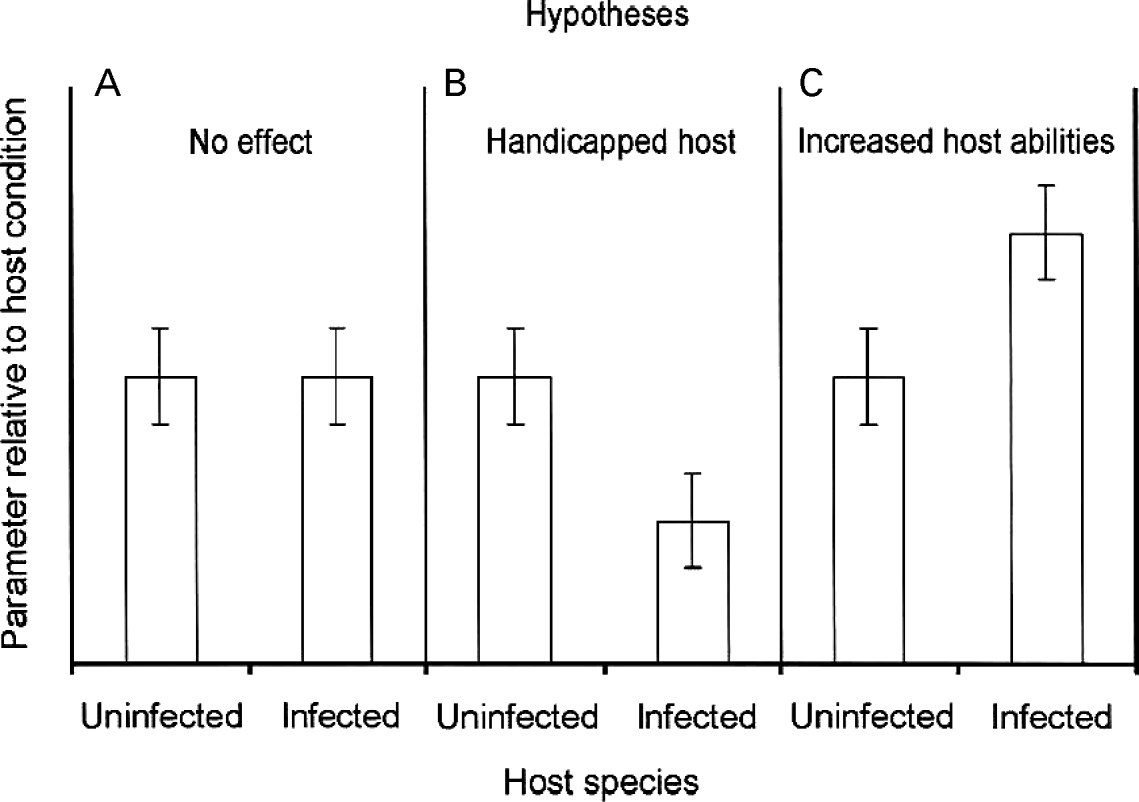
Basically, we considered 3 hypotheses about the potential effects of parasitism on host condition (Fig. 1). Firstly, the ‘no effect’ hypothesis (Fig. 1A) is very poorly documented because it has not generated wide support in the scientific community (Poulin, Reference Poulin2000), considering that it is difficult to imagine an infection without any negative consequences on host condition. Secondly, contrary to the previous hypothesis, the ‘handicapped host’ hypothesis, in which parasitism-induced effects handicap the infested animals (Fig. 1B), is frequently cited. Effects can include direct, pathological ones, for example when the parasite Pomphorhynchus laevis reduces growth rate and oxygen consumption in its Gammarus pulex host (Rumpus and Kennedy, Reference Rumpus and Kennedy1974). Alternatively, the effect could be more indirect as observed by Mouritsen and Poulin (Reference Mouritsen and Poulin2003) when infection by the trematode Curtuteria australis decreased the ability of its intermediate host, the New Zealand Austrovenus stutchburyi cockle, to burrow. As a result, this ‘handicapped’ mollusc becomes more conspicuous to both definitive avian hosts and non-host fishes. Finally, according to the ‘increased host abilities’ hypothesis (Fig. 1C), both the parasite and its intermediate host benefit from parasite-induced behavioural alterations. For parasites with complex life-cycles, this apparently paradoxical pattern could be favoured by natural selection if the increased abilities of the manipulated intermediate hosts prevent parasites from dying in unsuitable predators. A potential mechanism underlying the ‘increased host abilities’ hypothesis could be trade-offs in energy allocation within host-parasite systems. Thus, infected hosts might avoid unsuitable predatory hosts more effectively than uninfected ones if, for example, they allocate energy to locomotory instead of reproductive or foraging functions. An increased ability of infected intermediate hosts to evade predation attempts by non-host species does not prevent the parasite from manipulating its intermediate host in ways that increase encounter rates with appropriate final hosts, in particular when the non-host species is an arthropod and the final host is a waterbird.
Potential effects of parasitism on host condition as predicted by the ‘no effect’ (A), the ‘handicapped host’ (B) and the ‘increased host abilities’ (C) hypotheses.

Gammarus roeseli is a freshwater amphipod of Balkan-European origin (Karaman and Pinkster, Reference Karaman and Pinkster1997; Pöckl et al. Reference Pöckl, Webb and Sutcliffe2003) that was recorded for the first time in France (vicinity of Paris) in 1835 (Jazdzewski, Reference Jazdzewski1980). Now considered as naturalized in France, G. roeseli is the intermediate host for the acanthocephalan Polymorphus minutus. Following a physical stimulus, infected G. roeseli exhibit vertical displacement towards the water's surface which could enhance their chances of it being consumed by a bird, the parasite's definitive host (Bauer et al. Reference Bauer, Haine, Perrot-Minnot and Rigaud2005). Within a biological invasion context, this reverse geotactism renders parasitized specimens less vulnerable than uninfected G. roeseli to the new, benthic predator Dikerogammarus villosus (Médoc et al. Reference Médoc, Bollache and Beisel2006). D. villosus is a crustacean gammarid of Ponto-Caspian origin whose aggressive, predatory behaviour is well documented (Dick and Platvoet, Reference Dick and Platvoet2000; Dick et al. Reference Dick, Platvoet and Kelly2002; Bollache et al. Reference Bollache, Devin, Wattier, Chovet, Beisel, Moreteau and Rigaud2004). This amphipod has never been observed as an intermediate or a paratenic host of P. minutus (personal observations).
The Gammarus/Polymorphus host-parasite association allows us to investigate a counter-intuitive tactic that consists of increasing the ability of infected intermediate hosts to evade predation attempts by non-host species. This hypothesis has received little attention until now and has remained untested experimentally. Thanks to the development of a method to measure accurately the swimming speed of invertebrates, we studied a predator prey interaction regarding the escape speeds of preys. In this study, we investigated in detail the escape efficiency of G. roeseli in predator evasion faced with the benthic amphipod D. villosus. To test the ‘increased host abilities’ hypothesis, the locomotor performance of P. minutus-infected G. roeseli was assessed experimentally, under stressful conditions, by recording several parameters including time spent without displacement, average and maximum speeds. Next, to assess the infected host's reaction under predation pressure, we measured the escape speed, the distance covered by G. roeseli and the distance between the prey and the potential predator.
MATERIALS AND METHODS
Biological material
In spring and summer 2006, we used a pond net (500 μm mesh) to collect G. roeseli in the Nied River (Laquenexy, North-eastern France, 49°05′ N and 6°19′ E) and D. villosus in the Moselle River (Metz, North-eastern France, 49°07′ N and 6°10′ E). The yellow-orange cystacanth (the infective stage of P. minutus inside its intermediate host), visible through the host's translucent cuticle, distinguished infected G. roeseli from uninfected ones. All experiments were performed with males. G. roeseli males were identified during the precopula mate-guarding phase to avoid any confusion while D. villosus males (from 13 to 18 mm in length) were sexed using sexual dimorphism, with males exhibiting massive gnathopods (Devin et al. Reference Devin, Piscart, Beisel and Moreteau2004). To avoid effects of size or parasitic-load, we only selected G. roeseli males measuring 9±1 mm in length and harbouring 1 cystacanth. Animals were maintained separately in the laboratory in aerated, temperature-stabilized (12±1°C) water from the Nied River for 5 days before the experiments began. Alder-leaf discs (Ø=20 mm) were provided to satiation as the sole food resource.
Video recording device
The horizontal plan was filmed using a hermetic box (28 cm long×28 cm wide×37 cm high) with a source of diffuse light and a webcam (Philips ToUcam Pro II Pcvc840). This device is assumed to protect the organisms from any external disturbance during experiments. Tests were performed in a cylindrical glass receptacle lacking any places of refuge (Ø: 140 mm, height: 74 mm), placed inside the box, and filled with 250 ml of aerated, temperature-stabilized (12±1°C) Nied river water. The low water level (≈ 35 mm) encouraged amphipod displacement horizontally. Filming began once the amphipod (G. roeseli in the first experiment and D. villosus in the second) was carefully introduced into the glass receptacle, using a spoon. Each video capture was recorded for 3 min at a rate of 20 frames/s. After each experiment the G. roeseli were dissected to verify infection by P. minutus. The video shots were analysed using unpublished software developed in our laboratory. This software locates the moving subject in a given area and computes its XY coordinates into displacement metrics.
Experiment 1: Locomotor performance
A G. roeseli (uninfected or P. minutus-infected) was introduced into the device and a first 3-min video capture (control) was began immediately. Locomotor performance was assessed by exposing the invertebrate under test to high water velocity. Thus, at the end of the first video, we generated a circular water-flow (≈ 14·66 cm.s−1 at the periphery of the receptacle) inside the receptacle using a magnetic stirrer (Hanna Instruments 190 M). The rotation speed was too low to injure invertebrates (≈300 rot.min−1), but the resulting flow kept the amphipod moving. Three successive agitation periods (lasting 3, 6 and then 9 min) were each followed by a 3-min video capture. The magnetic agitator was removed during filming. This experiment was replicated 20 times with both uninfected and P. minutus-infected G. roeseli. The 3 and 6-min agitation periods only slightly affected the swimming performance of gammarids (results not shown), so in the Results section, we focused on the first (Control) and last (called ‘After Treatment’ hereafter) video shots. The entire sequences (3600 frames for 3 min) were analysed with our software. The time spent without locomotor activity and the average and maximum escape speeds in infected G. roeseli were compared to those of uninfected individuals, before and after the treatment.
Experiment 2: Escape behaviour
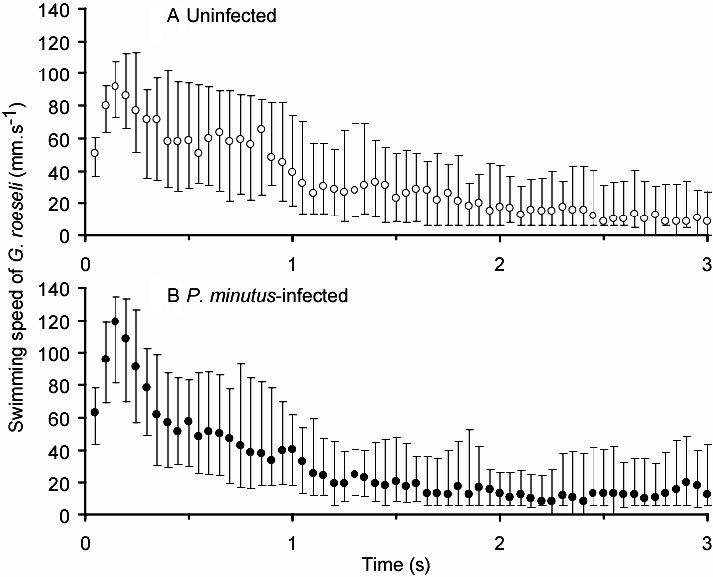
A single G. roeseli was placed into the glass receptacle using a spoon and acclimatized for 5 min. Then a D. villosus male was added and a 3-min video capture started. Twelve replicates were performed for both uninfected and P. minutus-infected gammarids. All D. villosus were used only once and we changed the water before each new video shot. The short-time experiments (3 min) prevented the prey from being consumed by D. villosus, but its aggressiveness caused an escape response in G. roeseli (pre-experimental inquiry). Predator encounters were numerous in each video shot and many of them were not aggressive. We therefore examined the 3 strongest escapes following an aggressive contact with D. villosus using our software and considered these data as independent. The strongest escapes were considered as the most representative of the host potentialities. Initially, we studied the escape pattern of G. roeseli regarding its swimming speed following an encounter with D. villosus. For both uninfected and P. minutus-infected individuals, the escape speed peaked during the first second after a contact, and then decreased with time (see Fig. 2). Consequently, during the video shot analyses, we focused on the first second following a physical contact with the benthic predator to highlight differences in the escape performance between the two prey types. The escape response of G. roeseli within the first second following a predator encounter was divided into 4 time-intervals (0–0·25 s, 0·30–0·50 s, 0·55–0·75 s and 0·80–1 s). The average escape speed was calculated for each time-interval while the distance covered by G. roeseli and its distance from D. villosus were calculated after 0·25, 0·5, 0·75 and 1 s (representing the end of the 4 time-intervals).
Pattern of escape speed of Gammarus roeseli during the first 3 sec after an aggressive encounter with the benthic predator Dikerogammarus villosus. Following the recording method, each dot represents a frame (20 frames/s). The swimming speeds (median and interquartile range) were obtained for each frame (see text for details) with uninfected (A) and Polymorphus minutus-infected (B) gammarids (N uninfected=N infected=36).

Statistical analysis
Speeds were calculated for each frame (20 frames/s), based on the distance covered by G. roeseli between 2 consecutive frames. The maximum speed was defined as the 95-percentile speed to reduce the variability induced by extreme values.
For Exp. 1, as data did not meet normality and homogeneity assumptions (following Shapiro-Wilk W-tests), we performed non-parametric statistics. The swimming activity of each individual being recorded before and after the agitation periods (paired samples), the treatment effect was assessed using Wilcoxon paired-sample tests. Then, Mann-Whitney U-tests were performed to evaluate differences between uninfected and P. minutus-infected gammarids (independent samples).
For Exp. 2, data that met normality and homogeneity assumptions (following Shapiro-Wilk W-tests) were tested for significance with parametric statistics (Student t-tests), or otherwise, with non-parametric statistics (Mann Whitney U-tests). We performed all tests with a 5% type I error risk, using STATISTICA Software 6.0 (StatSoft, France).
RESULTS
Experiment 1: Parasitism and locomotor activity
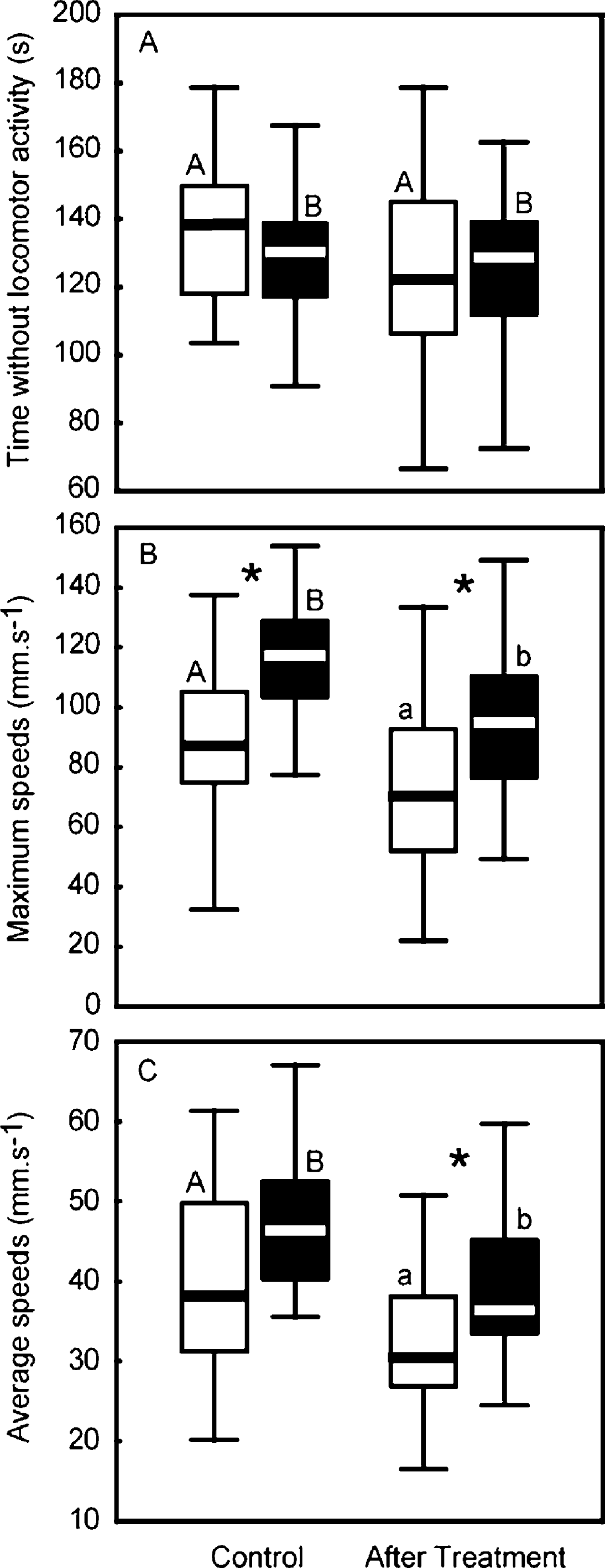
No significant differences were found in the stationary times between uninfected and infected amphipods (Mann Whitney U-test, control: U=170, N 1=N 2=20, P=0·43; after treatment: U=195, N 1=N 2=20, and P=0·90, Fig. 3A) and the treatment had no effect on this parameter (Wilcoxon paired-sample test, uninfected: T=79, N=20, P=0·332; infected: T=90, N=20, P=0·575). While the maximum speeds decreased significantly during experiments (uninfected: T=41, N=20, P=0·017; infected: T=39, N=20, P=0·014), values were 34·5% higher for infected compared to uninfected gammarids in controls (Mann Whitney U-test, U=93, N 1=N 2=20, P=0·003, Fig. 3B) and remained 35% higher after treatment (U=108, N 1=N 2=20, P=0·012). The average speeds also decreased significantly with treatment (Wilcoxon paired-sample test, uninfected: T=38, N=20, P=0·012; infected: T=6, N=20, P<0·001). Infected G. roeseli were slightly faster than uninfected ones in controls (Mann Whitney U-test, U=135, N 1=N 2=20, P=0·081, Fig. 3C) and this difference became significant (by 19·4%) after treatment (U=119, N 1=N 2=20, P=0·028).
Locomotor performance of Gammarus roeseli infected by Polymorphus minutus. The time spent without displacement (A), maximum (B) and average (C) speeds (median and interquartile range) were obtained for uninfected (white bars) and infected (black bars) amphipods before (Control) and after an experimental treatment including 3 disturbance sequences (N uninfected=N infected=20, see text for details). The asterisks indicate significant differences between uninfected and parasitized animals (Mann-Whitney U-test, P⩽0·05), whereas lower-case letters indicate significant differences in the measurements before and after treatment (Wilcoxon paired-sample test, P⩽0·05).

Experiment 2: The escape speeds of intermediate hosts
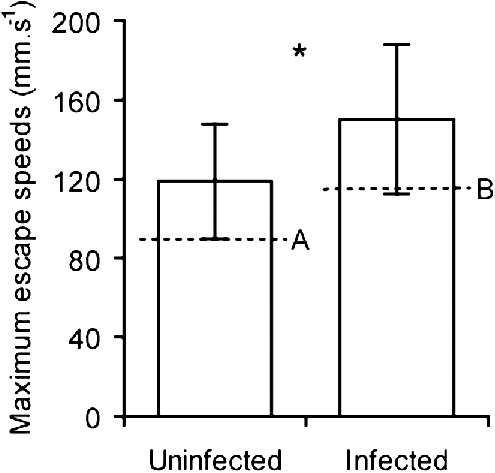
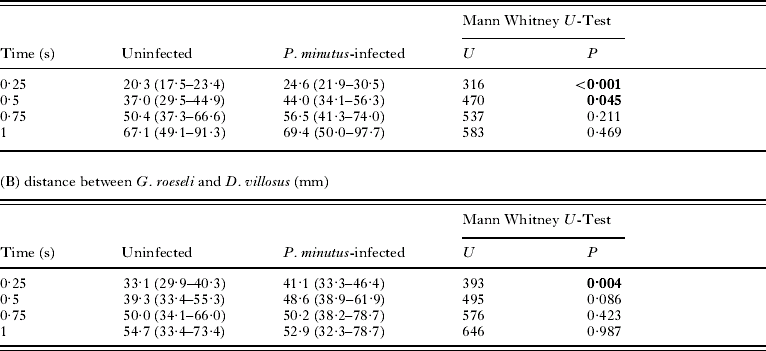
During the first quarter of a second, the median swimming speeds of infected animals were 21·5% higher (Mann Whitney U-test, U=316, N 1=N 2=36, P<0·001, Table 1), but after this short period no differences in speed were found between uninfected and infected amphipods. The highest speeds were reached at the beginning (0–0·25 s) of the escape response, with infected individuals reaching a maximal escape speed of 150 mm.s−1, a value 26% higher (Fig. 4) than that of uninfected individuals (U=357, N 1=N 2=36, P<0·001). G. roeseli covered a distance at least 21·2% longer when infected with P. minutus only at the beginning of the escape response (at t=0·25 s: U=316, N 1=N 2=36, P<0·001; at t=1 s: U=583, N 1=N 2=36, P=0·469, Table 2A). Hence, at the beginning of the escape movement, the distance between the potential predator and infected G. roeseli was significantly greater than with uninfected individuals (at t=0·25 s: 24·2%, Table 2B).
Escape speed of Gammarus roeseli interacting with a predatory species. The escape speeds (means±s.d.) were observed for uninfected and Polymorphus minutus-infected G. roeseli in the first second following contact with Dikerogammarus villosus. N uninfected=N infected=36 and the asterisk indicates a significant difference between uninfected and infected gammarids (Student t-test, P⩽0·05). The dotted lines refer to the maximum swimming speeds (mean values) of uninfected (A, N=20) and P. minutus-infected amphipods (B, N=20) measured without D. villosus, during the first experiment (control, see text for details).

Swimming speed (median and interquartile range) of uninfected and Polymorphus minutus-infected Gammarus roeseli following contact with the benthic predator, Dikerogammarus villosus
(Significant statistical effects (P⩽0·05, N uninfected=N infected=36) are shown in bold.)

Cumulative distance covered by uninfected and Polymorphus minutus-infected Gammarus roeseli following a contact with Dikerogammarus villosus (A), and distance between G. roeseli and this potential predator (B) (median and interquartile range)
(Significant statistical effects (P⩽0·05, N uninfected=N infected=36) are shown in bold.)
(A) distance covered by G. roeseli (mm)

DISCUSSION
This study assessed the effects of P. minutus infection on the locomotor/escape performance of its intermediate host, according to 3 hypotheses designated ‘no effect’, ‘handicapped host’ and ‘increased host abilities’. Acanthocephalan parasites encysted in the abdomen of their intermediate hosts have been found to compress the internal organs, which is usually considered as a handicap (Dezfuli and Giari, Reference Dezfuli and Giari1999). To support this idea, Pascoe et al. (Reference Pascoe, Kedwards, Blockwell and Taylor1995) found, in the study of another host-parasite association, that the feeding performance of Gammarus pulex was altered by its infection with the acanthocephalan parasite Pomphorhynchus laevis. In the presence of brine shrimp eggs, infected amphipods had significantly longer median-feeding times than uninfected ones, which was attributed to the potential physical obstruction caused by developing cystacanth inside the host (Pascoe et al. Reference Pascoe, Kedwards, Blockwell and Taylor1995).
For the first time, we measured the escape speed of a crustacean amphipod and the cost of infection by an acanthocephalan parasite on its swimming performance. Despite most previous findings pointing to behavioural or physiological alterations induced by parasites (reviewed by Kennedy, Reference Kennedy2006), our results appeared counter-intuitive by supporting the ‘increased host abilities’ hypothesis. While the time spent without displacement remained unchanged during tests, the average and maximum swimming speeds of G. roeseli in the absence of the predator were significantly higher when infected by P. minutus (at least 20%), both before and after the treatments. Furthermore, following an encounter with the benthic predator D. villosus, the highest escape speeds were observed in infected animals.
As the difference between escape and capture in a predator-prey encounter can be decided in a split-second interaction (Wisenden et al. Reference Wisenden, Cline and Sparkes1999), parasitized amphipods exhibiting a prompt escape might have much more time to seek shelter from attack than healthy individuals.
To support this idea, we found that the distance covered by infected gammarids, at the beginning of an escape (0–0·5 s), significantly exceeded those of uninfected individuals. Consequently, the distance between D. villosus and G. roeseli was greater when the latter was infected by P. minutus. Thus, under natural conditions, this ability might increase the probability for infected prey to be out of reach of a potential predator.
From the parasite's perspective, the increased escape response of infected G. roeseli interacting with D. villosus does not directly enhance parasite transmission to the definitive host, but might prevent cystacanths from dying in an inappropriate, non-host predator. Combined with a negative geotaxis (Bauer et al. Reference Bauer, Haine, Perrot-Minnot and Rigaud2005; Médoc et al. Reference Médoc, Bollache and Beisel2006) the escape response induced by P. minutus makes the infected intermediate hosts available for surface predators. However, the transmission of P. minutus to water birds remains to be verified experimentally (but see Bethel and Holmes, Reference Bethel and Holmes1977 with Gammarus lacustris infected by Polymorphus paradoxus).
The deleterious effects of P. minutus infection on the fitness of its crustacean hosts are well-documented, especially in Gammarus pulex. Alibert et al. (Reference Alibert, Bollache, Corberant, Guesdon and Cézilly2002) suggested a positive association between acanthocephalan infection and developmental instability in G. pulex. Ward (Reference Ward1986) reported total castration of infected females and an accompanying decrease in their pairing probability (Bollache et al. Reference Bollache, Rigaud and Cézilly2002). Finally, acanthocephalans do not interfere with spermatogenesis according to Charniaux-Cotton and Payen (Reference Charniaux-Cotton, Payen, Bliss and Manter1985) (reported in G. lacustris infected by Polymorphus parodoxus and P. marilis, see Zohar and Holmes, Reference Zohar and Holmes1998). However, the pairing success of G. pulex males infected with P. minutus is considerably reduced (Bollache et al. Reference Bollache, Gambade and Cézilly2001). G. roeseli used in this study is considered to be a recent host species compared to the more intensively studied G. pulex. Although both amphipod species show a negative geotaxis when parasitized with P. minutus, the effect is greater in the native host G. pulex than in G. roeseli (see Bauer et al. Reference Bauer, Haine, Perrot-Minnot and Rigaud2005). Without further investigation and considering only the deleterious effects of infection on a host's condition, such differences in the manipulation efficiency could be wrongfully interpreted as a less well-adapted strategy to newly-colonizing host species. In contrast, our results contribute additional elements to the P. minutus-induced effects underlying a potential adaptation which might favour parasite fitness with regard to non-host predator avoidance. The selective role of non-host predators on the parasite's transmission strategy was demonstrated in a mollusc/trematode host-parasite association (Levri, Reference Levri1998). The author found that infection with the trematode Microphallus sp. altered the daily foraging behaviour of the snail Potamopyrgus antipodarum in a time-specific manner, which minimizes its exposure to an inappropriate predator, the New Zealand fish (Gobiomorphus cotidianus).
In support of the ‘increased host abilities’ hypothesis, a recent study performed on the same G. roeseli population investigated the salinity tolerance of this host-parasite system (Piscart et al. Reference Piscart, Webb and Beisel2007). Infected amphipods were found to be much more resistant than uninfected individuals, and this pattern was not related to ATPase activity, the principal ion-exchange mechanism in aquatic crustaceans. Beyond the implication for animal dispersion, this pattern might increase parasite fitness by keeping the transmission effective under stressful conditions.
In conclusion, short time-scale measurements of G. roeseli swimming speed indicated that the first second following an encounter with a benthic predator was crucial in determining the outcome of the interaction. Infection with P. minutus significantly increased G. roeseli swimming activity over this critical time-frame, thus reducing the chance of parasite death in an unsuitable host species. However, although this would leave the infected gammarid available for predation by a suitable water bird definitive host, the impact of this increase in swimming ability on interactions with water bird predators remains to be investigated.
We wish to thank Philippe Rousselle (Université Paul Verlaine – Metz) warmly for the computer software used in the behavioural study of gammarids and Anna Matheny-Cartier for her linguistic corrections of an earlier version of the manuscript. We gratefully thank Dennis Webb (University of Rennes) for its suggestions on a revised manuscript. We are grateful to the two anonymous reviewers for their helpful comments and suggestions. This study was funded by the French Ministry of Ecology and Sustainable Development as part of the 2003–2005 Biological Invasions Program, and by a grant from the ‘Conseil Régional de la Région Lorraine’ to V.M.