INTRODUCTION
Children born very preterm (VP; <32 weeks’ gestation) demonstrate prominent executive functioning (EF) deficits compared with full-term (FT) born children (Burnett, Scratch, & Anderson, Reference Burnett, Scratch and Anderson2013). Executive functioning is an umbrella term for numerous interrelated, higher-order cognitive skills essential for complex reasoning, goal-directed activity, and adaptive behavior (Anderson, Reference Anderson2002; Lezak, Howieson, Bigler, & Tranel, Reference Lezak, Howieson, Bigler and Tranel2012). While difficulties in various EF domains, including complex attention, impulse control, working memory, verbal fluency, cognitive flexibility, and reasoning abilities, have been well documented throughout childhood in VP cohorts (Anderson et al., Reference Anderson, De Luca, Hutchinson, Spencer-Smith, Roberts and Doyle2011; Anderson & Doyle, Reference Anderson and Doyle2004; Böhm, Smedler, & Forssberg, Reference Böhm, Smedler and Forssberg2004; Luu, Ment, Allan, Schneider, & Vohr, Reference Luu, Ment, Allan, Schneider and Vohr2011; Taylor, Hack, & Klein, Reference Taylor, Hack and Klein1998), the nature of goal setting skills in VP children remains unclear due to limited research.
Goal setting can be considered a core component of EF (Anderson, Reference Anderson2008). It pertains to the ability to organize a series of steps or a plan toward goal completion, with deficits resulting in problem solving challenges due to poor planning, disorganization, strategy development difficulties, overreliance on previously learned strategies, as well as reasoning difficulties (Anderson, Reference Anderson2002). Goal setting skills are essential to the development of independent thinking and self-management, and are, therefore, especially important during late childhood (Burnett et al., Reference Burnett, Scratch and Anderson2013). Organization and planning competence, both components of goal setting, may assist children to succeed in new and increasingly complex environments (e.g., secondary school) and facilitate academic, social, and personal development (Luu et al., Reference Luu, Ment, Allan, Schneider and Vohr2011). Since goal setting skills become increasingly important for successfully and independently completing activities of daily living during late childhood and adolescence, deficits may become more overt during this developmental period. Understanding the nature of these abilities in VP children has implications to early detection and intervention, with a preference to detect deficits before they become entrenched.
Although limited, research suggests that VP children are at greater risk for goal setting difficulties than FT born children. Poorer planning and spatial organization abilities of VP cohorts have been reported during early childhood using performance based measures (Anderson & Doyle, Reference Anderson and Doyle2004; Harvey, O’Callaghan, & Mohay, Reference Harvey, O’Callaghan and Mohay1999; Marlow, Hennessy, Bracewell, & Wolke, Reference Marlow, Hennessy, Bracewell and Wolke2007) as well as parent report behavioral questionnaires (Anderson & Doyle, Reference Anderson and Doyle2004; Loe, Chatav, & Alduncin, Reference Loe, Chatav and Alduncin2015; Scott et al., Reference Scott, Taylor, Fristad, Klein, Espy, Minich and Hack2012). In late childhood, several studies have reported poorer VP spatial planning and strategy formulation (Aarnoudse-Moens, Duivenvoorden, Weisglas-Kuperus, van Goudoever, & Oosterlaan, Reference Aarnoudse-Moens, Duivenvoorden, Weisglas-Kuperus, van Goudoever and Oosterlaan2012; Curtis, Lindeke, Georgieff, & Nelson, Reference Curtis, Lindeke, Georgieff and Nelson2002; Taylor, Minich, Bangert, Filipek, & Hack, Reference Taylor, Minich, Bangert, Filipek and Hack2004), but others have found no goal setting deficits in VP groups (Mulder, Pitchford, & Marlow, Reference Mulder, Pitchford and Marlow2011).
To date, no study has undertaken a comprehensive assessment of goal setting in VP children, with current knowledge limited to studies that have used a single goal setting measure. Experimental measures with unclear ecological validity (i.e., CANTAB Stockings of Cambridge test; Cambridge Cognition, 2017) bring into question the generalizability of the findings to real life functioning (Burgess, Alderman, Evans, Emslie, & Wilson, Reference Burgess, Alderman, Evans, Emslie and Wilson1998). Another limitation of the research to date on goal setting in VP survivors is that most studies have focused on samples under 11 years of age, when these skills are still emerging and are of only modest functional importance (Anderson, Anderson, Northam, Jacobs, & Catroppa, Reference Anderson, Anderson, Northam, Jacobs and Catroppa2001).
Furthermore, risk factors of goal setting deficits in VP groups are unknown, yet important for classifying high-risk children who warrant close surveillance and possibly early intervention. In VP groups, neonatal medical complications (Curtis et al., Reference Curtis, Lindeke, Georgieff and Nelson2002; Duvall, Erickson, MacLean, & Lowe, Reference Duvall, Erickson, MacLean and Lowe2014; Orchinik et al., Reference Orchinik, Taylor, Espy, Minich, Klein, Sheffield and Hack2011), including brain injury and altered brain development (Clark & Woodward, Reference Clark and Woodward2010; Edgin et al., Reference Edgin, Inder, Anderson, Hood, Clark and Woodward2008; Woodward, Anderson, Austin, Howard, & Inder, Reference Woodward, Anderson, Austin, Howard and Inder2006; Woodward, Clark, Pritchard, Anderson, & Inder, Reference Woodward, Clark, Pritchard, Anderson and Inder2011; Young et al., Reference Young, Morgan, Powell, Moore, Whyte, Smith and Taylor2016) are known to be related to poorer outcome in other EF domains. Sex is another important consideration given the higher mortality and morbidity in preterm males (Costeloe, Hennessy, Gibson, Marlow, & Wilkinson, Reference Costeloe, Hennessy, Gibson, Marlow and Wilkinson2000), and their poorer performance on executive measures (Böhm et al., Reference Böhm, Smedler and Forssberg2004; Marlow et al., Reference Marlow, Hennessy, Bracewell and Wolke2007; Urben et al., Reference Urben, Van Hanswijck De Jonge, Barisnikov, Pizzo, Monnier, Lazeyras and Hüppi2017).
The current study sought to examine goal setting skills in a cohort of VP children at 13 years of age compared with FT controls. It was hypothesized that in comparison to their FT born peers, VP children would perform more poorly across goal setting measures, and within the VP group, moderate to severe brain injury, complicated neonatal course, and male sex would be associated with poorer goal setting performance.
METHODS
Participants and Procedure
Participants were part of the Victorian Infant Brain Study (VIBeS) cohort, a longitudinal study examining the development of children born VP (<30 weeks’ gestation) and/or very low birth weight (<1250 g). Two hundred and twenty-seven participants fitting eligibility criteria and without genetic or congenital abnormalities known to affect development were originally recruited between July 2001 and December 2003 at the Royal Women’s Hospital, Melbourne. Three infants subsequently died, leaving 224 survivors. Seventy-seven healthy control children born at term (≥37 to ≤41 weeks’ gestation) and of normal birth weight (≥2500 g) were also recruited, 46 from the Royal Women’s Hospital at birth and 31 from Maternal and Child Health Centers at 2 years of age. Neonatal brain MRI was performed on all VP survivors and the control children recruited at birth.
Children were followed up at 2, 5, 7, and 13 years of age, with age corrected for prematurity at all time points to avoid a known bias in cognitive test scores (Wilson-Ching, Pascoe, Doyle, & Anderson, Reference Wilson-Ching, Pascoe, Doyle and Anderson2014). This study was approved by the Human Research and Ethics committees of the Royal Women’s Hospital and the Royal Children’s Hospital, and informed written consent was obtained from the parents at all time points.
At the 13-year follow-up, 179 (80%) of the 224 eligible children in the VP cohort agreed to participate. Eleven participants did not consent, and 34 were lost to follow-up (uncontactable, n=10; declined/failed to attend, n=24). Goal setting measures could not be administered to 2 VP participants due to intellectual and physical impairment, resulting in n=177. Of the 77 eligible FT children, 61 (79%) participated, with 11 deciding not to consent and 5 lost to follow-up (uncontactable, n=4; overseas, n=1).
Goal Setting Measures at 13 Years of Age
From the Delis-Kaplan Executive Function Systems (D-KEFS; Delis, Kaplan, & Kramer, Reference Delis, Kaplan and Kramer2001) the Tower Test was administered to assess spatial planning, rule learning, inhibition of impulsive and perseverative responding, and the ability to establish and maintain instructional set. Performance was judged according to the total achievement score, which is based on the number of correct towers assembled within an item-specific time limit.
The Rey Complex Figure Test (RCFT) involves reproducing a complicated line drawing (Anderson, Anderson, & Garth, Reference Anderson, Anderson and Garth2001). Performance was judged according to (1) accuracy, and (2) organizational strategy. Copy accuracy was assessed using the 18-item accuracy criteria established by Osterreith (Reference Osterrieth1944). Organizational strategy was assessed using the RCFT-Organizational Strategy Score (RCFT-OSS; Anderson, Anderson, & Garth, Reference Anderson, Anderson and Garth2001), which classifies drawings into seven categories according into set criteria: 1=unrecognizable/substitution; 2=poor organization; 3=random organization; 4=piecemeal/fragmented organization; 5=part-configural organization; 6=conceptual organization; or 7=excellent organization. For the purposes of this analysis, performance was dichotomized into part-configural organization or better (levels 5 to 7) versus the rest (levels 1 to 4).
Two subtests from the Behavioural Assessment of the Dysexecutive System for Children (BADS-C; Emslie, Wilson, Burden, Nimmo-Smith, & Wilson, Reference Emslie, Wilson, Burden, Nimmo-Smith and Wilson2003) were selected, Zoo Map (ZM) and Six Part Test (6PT). Zoo Map is a test of planning that captures the ability to plan and execute a specific eight location sequence in accordance with several rules across 2 parts: ZM 1 unstructured, requiring independent planning; ZM 2 structured, with the sequence provided. Across both parts, points are accumulated and deductions are made for rule breaks. On ZM 2, points were additionally deducted when planning time exceeded 15 s, and/or total completion time exceeded 120 s. The Six Part Test (6PT) examines planning, task scheduling and performance monitoring skills by asking participants to complete 6 simple tasks in 5 min in accordance with several rules. Points are awarded for an effective strategy and pattern, and deducted when a participant returns to any part consecutively. The BADS-C is a novel, ecologically valid and complex measure of planning (Baron, Reference Baron2003). The BADS-C has been validated in children aged between 8 and 15 years of age (Baron, Reference Baron2003; Engel-Yeger, Josman, & Rosenblum, Reference Engel-Yeger, Josman and Rosenblum2009) and been found to be a useful measure in other clinical pediatric populations, including ADHD and autism (Shimoni, Engel-Yeger, & Tirosh, Reference Shimoni, Engel-Yeger and Tirosh2012; White, Burgess, & Hill, Reference White, Burgess and Hill2009).
Behavioral Questionnaire
The parent form of the Behavior Rating Inventory of Executive Function (BRIEF; Gioia, Isquith, Guy, & Kenworthy, Reference Gioia, Isquith, Guy and Kenworthy2000) was administered to the primary caregiver at the 13-year follow-up. This questionnaire assesses executive function behaviors in real-life settings. The Plan/organize (i.e., using strategies for attaining goals) and Organization of materials (i.e., keeping belongings tidy) scales were examined (Mean T score=50; SD=10) and reported in categorical ranges, with higher scores reflecting greater endorsement of difficulties (normal ≤ 59; at risk=60 to 64; clinically significant ≥ 65).
Neonatal Brain Abnormalities
At term-equivalent age [37 to 42 weeks’ gestational age (GA)], T1 and T2 images were acquired with a 1.5 Tesla General Electric MRI scanner (Signa LX Echospeed System; General Electric, Milwaukee, WI). Two VP infants who were scanned outside of the term-equivalent window (40 weeks’ gestation, ± 2 weeks) were excluded from imaging analysis. Unsedated infants were placed in a Vacuum Fixation beanbag to reduce motion. Using the rating system described by Kidokoro, Neil, and Inder (Reference Kidokoro, Neil and Inder2013), brain scans were assessed for pathology by an experienced neonatal neurologist. The scoring system has sub-scales for rating white matter, cortical gray matter, deep gray matter, and cerebellar abnormality, as well as a total abnormality scale that is the sum of the sub-scales. Higher scores reflect greater brain abnormalities. The total sub-scale score was classified into four groups, reflecting the following abnormality categories: none, mild, moderate, or severe (Kidokoro et al., Reference Kidokoro, Neil and Inder2013). For our analysis, we contrasted those with no and mild brain abnormalities with those with moderate to severe abnormality.
Social Risk
As part of the 13-year follow-up, parents completed a questionnaire to assess family social risk based on several indicators (i.e., family structure, language spoken at home, education of primary caregiver, occupation of the primary income earner, employment status of primary income earner, and maternal age at birth). In accordance with previous follow-up of this cohort, a social risk total score was calculated (Roberts et al., Reference Roberts, Howard, Spittle, Brown, Anderson and Doyle2008; Treyvaud et al., Reference Treyvaud, Ure, Doyle, Lee, Rogers, Kidokoro and Anderson2013) which was then used to categorize participants around the median into lower or higher risk groups.
Neonatal Medical Risk and Neurosensory Impairment
Data obtained during neonatal follow-up of the VP sample was used to assign children a neonatal medical risk classification. Children were classified as being of higher medical risk if they had one or more of the following risk factors: small for GA (defined as birth weight SD score > 2 standard deviations below mean weight for GA computed relative to the British growth reference data; Cole, Freeman, & Preece, Reference Cole, Freeman and Preece1998), bronchopulmonary dysplasia (BPD; defined as oxygen dependency at 36 weeks’ GA), administration of postnatal corticosteroids, proven necrotizing enterocolitis or sepsis, and cranial ultrasound brain injuries (grade 3/4 intraventricular hemorrhage or periventricular leukomalacia). Children with at least one of these medical complications were classified as higher medical risk (Anderson, Cheong, & Thompson, Reference Anderson, Cheong and Thompson2015), while the remainder were classified as lower medical risk (Anderson & Doyle, Reference Anderson and Doyle2008).
Neurosensory impairment was defined as the presence of cerebral palsy, deafness, or blindness, as diagnosed at the 7-year follow-up.
Statistical Analysis
Data were analyzed using Stata 14.2 (StataCorp, College Station, TX). Significantly skewed variables were log transformed to provide a better model fit before analysis.
Group differences in goal setting outcomes at 13 years of age between VP and term-born children were compared using both linear and logistic regression, with both unadjusted and adjusted models. The adjusted model included sex and social risk as potential confounders, and excluded children with significant neurosensory impairment or an IQ less than or equal to 70 (n=14), to ensure that group differences and/or associations were not due to a small number of significantly impaired VP children.
Additional regression analyses were conducted within the VP group. These models separately assessed the relationship between neonatal brain abnormalities (none/mild vs. moderate/severe), neonatal medical risk (high vs. low) and sex, and goal setting outcomes.
Models were fitted using Generalized Estimating Equations reported with robust standard errors to allow for clustering of multiple births within a family (i.e., twins/triplets). A critical value of less than or equal to .05 was used to evaluate statistical significance, but acknowledging the number of comparisons, findings are interpreted based on the pattern of the results (direction and magnitude of differences across measures). The Benjamini-Hochberg false discovery rate (FDR) correction procedure was applied to all p-values to address the issue of multiple comparisons (Benjamini & Yekutieli, Reference Benjamini and Yekutieli2001). Effect sizes were calculated to determine the magnitude of the group comparisons (Olejnik & Algina, Reference Olejnik and Algina2003), with 0.2 being considered a small effect, 0.5 a moderate effect and 0.8 a large effect (Cohen, Reference Cohen1973).
RESULTS
Sample Characteristics
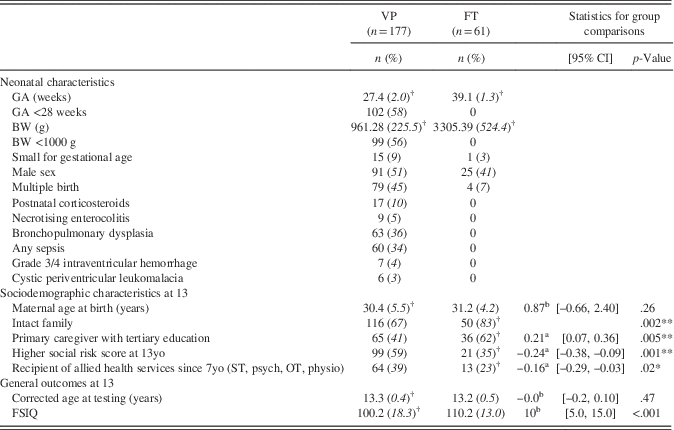
There were no differences between VP participants and non-participants, or FT participants and non-participants across the available neonatal variables (Table 1). As expected the VP and FT groups differed on antenatal and neonatal variables (i.e., birth weight, GA, BPD, sepsis, postnatal corticosteroids, brain injuries). Regarding sociodemographic characteristics, the VP group demonstrated higher social risk (fewer intact families and primary caregivers with a tertiary education), had a lower mean IQ, and were more likely to have received allied health intervention, compared with the FT group.
Sample characteristics

Note. Some sample sizes are less than the total sample due to missing data (social risk [VP=169, FT=60], recipient of allied health services since 7yo [VP=164, FT=57], primary caregiver with tertiary education [VP=160, FT=58], maternal age at birth [VP=176, FT=59], FSIQ [VP=2]). n=number; %=percentage; GA=gestational age; BW=birth weight; †=M (SD); ST=speech therapy; OT=occupational therapy; CI=confidence interval; FSIQ=full-scale intelligence quotient; VP=very preterm; FT=full term; yo=years old.
aProportional difference.
bMean difference. ∗ p<.05.
∗∗ p<.01.
Goal Setting
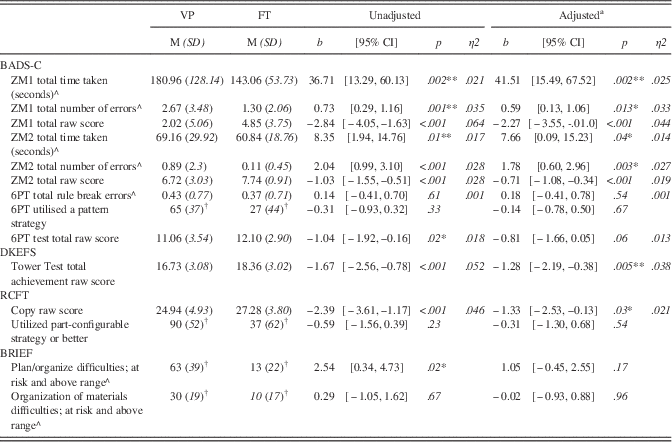
The VP group performed more poorly across all goal setting measures compared with the FT group, with group differences reaching significance on the majority of outcome measures, including poorer summary scores, slower completion times, and a greater number of errors (Table 2). Types of errors involved excessive planning/total completion time and rule breaks (i.e., deviating from a path, visiting inappropriate locations). On the BRIEF, parents of the VP group endorsed a greater proportion of planning and organizational difficulties, compared with parents of FT controls. Group differences largely persisted after adjustment for sex and social risk, and following FDR correction to address the multiple comparisons.
Goal setting group differences, unadjusted and adjusted models

Note. N ranges from 221 to 238 depending on the outcome; VP=very preterm; FT=full term; M=mean; SD=standard deviation; ^=higher scores reflects worse performance; †=n (%); BADS-C=Behavioral Assessment of the Dysexecutive System for Children; ZM 1=Zoo Map 1; ZM 2=Zoo Map 2; 6PT=6 Part Test; DKEFS=Delis-Kaplan Executive Function Systems; RCFT=Rey Complex Figure Test; BRIEF=Behavior Rating Inventory of Executive Function; b=coefficient for group from the regression model representing the difference in means between the VP and FT groups; CI=confidence interval.
a Adjusted for sex, social risk, and excludes participants with significant neurosensory impairment and/or IQ<=70.
∗ p<.05.
∗∗ p<.01.
Risk Factors and Goal Setting in VP Group
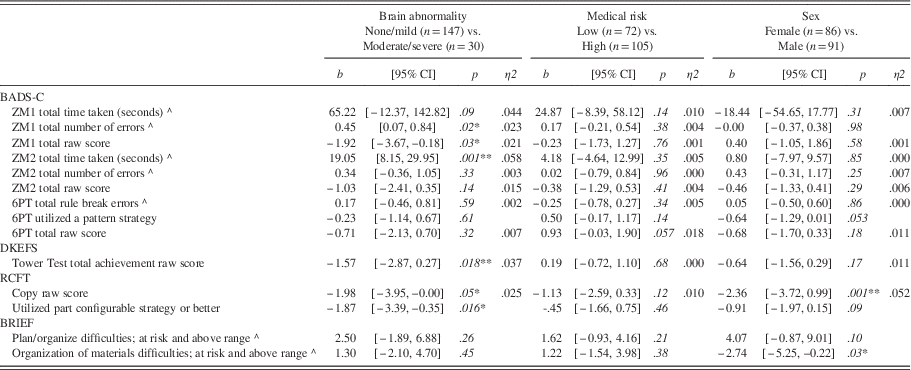
Within the VP group, children with moderate/severe neonatal brain abnormalities performed poorer on Zoo Map 1 (slower and more errors), Tower Test, and RCFT (accuracy and organizational strategy) (Table 3). Higher neonatal medical risk was not significantly associated with goal setting performances. While sex was not strongly associated with goal setting performance, males demonstrated poorer visuospatial organization, and parents of females reported a higher proportion of difficulties with “organization of materials.” There was also a trend for males to use less effective planning strategies (6PT, RCFT). Results were unchanged following the application of the FDR correction procedure.
Early predictors of goal setting outcomes within the very preterm group

Note. Outcome measure n ranges from 162 to 175 depending on the outcome; ^=higher scores reflects worse performance; BADS-C=Behavioral Assessment of the Dysexecutive System for Children; ZM 1=Zoo Map 1; ZM 2=Zoo Map 2; 6PT=6 Part Test; DKEFS=Delis-Kaplan Executive Function Systems; RCFT=Rey Complex Figure Test; BRIEF=Behavior Rating Inventory of Executive Function; b=coefficient for group from the regression model representing the increase in the dependent variable for every 1 unit increase in the independent variable; CI=confidence interval.
∗ p<.05.
∗∗ p<.01.
DISCUSSION
In the current study, VP 13-year-olds exhibited poorer goal setting than their FT born peers with a clear pattern of impairment and inefficiency across multiple measures, including parent report of everyday behavior. Brain abnormality on neonatal MRI at term equivalent age was significantly associated with adverse performance on some goal setting measures.
Our findings provide further support that the VP population underperforms on goal setting measures (Aarnoudse-Moens et al., Reference Aarnoudse-Moens, Duivenvoorden, Weisglas-Kuperus, van Goudoever and Oosterlaan2012; Anderson & Doyle, Reference Anderson and Doyle2004; Curtis et al., Reference Curtis, Lindeke, Georgieff and Nelson2002; Harvey et al., Reference Harvey, O’Callaghan and Mohay1999; Loe et al., Reference Loe, Chatav and Alduncin2015; Marlow et al., Reference Marlow, Hennessy, Bracewell and Wolke2007; Scott et al., Reference Scott, Taylor, Fristad, Klein, Espy, Minich and Hack2012; Taylor et al., Reference Taylor, Minich, Bangert, Filipek and Hack2004). However, our study adds to the existing literature in that we performed a detailed assessment of goal setting in later childhood, enabling examination of group differences on multiple measures. Regardless of the degree of structure inbuilt into the task, the VP group generally displayed slower completion times and higher error rates than full term controls, which may reflect slower information processing speed (Murray et al., Reference Murray, Scratch, Thompson, Inder, Doyle, Anderson and Anderson2014; Rose & Feldman, Reference Rose and Feldman1996) and/or poorer attention (i.e., shifting; Anderson et al., Reference Anderson, De Luca, Hutchinson, Spencer-Smith, Roberts and Doyle2011; Mulder et al., 2010; Shum, Neulinger, O’Callaghan, & Mohay, Reference Shum, Neulinger, O’Callaghan and Mohay2008).
Working memory difficulties in VP groups (Anderson & Doyle, Reference Anderson and Doyle2003; Böhm et al., Reference Böhm, Smedler and Forssberg2004; Omizzolo et al., Reference Omizzolo, Scratch, Stargatt, Kidokoro, Thompson, Lee and Anderson2013) are well recognized and may have contributed to difficulties maintaining an instructional set across goal setting tasks. Variables measuring strategy use failed to reach significance, despite the VP children performing more poorly across these tasks overall. Goal setting can be considered a top-down cognitive process. Strategic planning is required to achieve a goal, followed by the implementation of the plan which often involves several steps integrating and coordinating other cognitive domains (Friedman et al., Reference Friedman, Miyake, Corley, Young, DeFries and Hewitt2006; Miyake, Friedman, Emerson, Witzki, & Howerter, Reference Miyake, Friedman, Emerson, Witzki and Howerter2000).
Accordingly, deficits in other cognitive domains are likely to impede effective goal setting. For example, working memory is required to remember and execute each step, and active shifting of one’s attention is required between the planning and execution of the goal. An alternative explanation, however, might be that the variables assessing strategy use failed to reach significance due to their qualitative nature which lacks the sensitivity necessary to detect subtle differences in higher level reasoning.
Planning/organization difficulties in everyday settings (e.g., home and school) have been previously reported by parents of VP children (Anderson & Doyle, Reference Anderson and Doyle2004; Loe et al., Reference Loe, Chatav and Alduncin2015), as well as by teacher report (Scott et al., Reference Scott, Taylor, Fristad, Klein, Espy, Minich and Hack2012). Performance decrements on neuropsychological measures that align with parent and teacher reports provide reassurance that the findings are robust. Parent reported planning and organization difficulties of VP children are likely to reflect functional consequences, such as underestimating time needed to finish tasks, difficulties studying to achieve sound grades, or being overwhelmed by large tasks (e.g., school assignments; Gioia et al., Reference Gioia, Isquith, Guy and Kenworthy2000). As this is a cross-sectional analysis, we cannot comment on the trajectory of goal setting deficits in the VP population. The deficits documented are similar to that reported in preschool and early school-aged children born VP (Anderson & Doyle, Reference Anderson and Doyle2004; Harvey et al., Reference Harvey, O’Callaghan and Mohay1999; Loe et al., Reference Loe, Chatav and Alduncin2015; Marlow et al., Reference Marlow, Hennessy, Bracewell and Wolke2007; Scott et al., Reference Scott, Taylor, Fristad, Klein, Espy, Minich and Hack2012), and while this suggests an ongoing impairment, it is possible that developmental catch-up occurs later in adolescence and early adulthood.
The overall findings were largely robust, with the majority of group differences remaining unaltered when accounting for sex and social risk, factors known to be associated with cognitive outcomes (Anderson, Anderson, Northam, et al., Reference Anderson, Anderson, Northam, Jacobs and Catroppa2001). It was also demonstrated that goal setting deficits cannot solely be explained by low IQ or significant neurosensory impairment (i.e., cerebral palsy, blindness, deafness), consistent with previous studies examining executive outcomes of VP children during late childhood (Aarnoudse-Moens et al., Reference Aarnoudse-Moens, Duivenvoorden, Weisglas-Kuperus, van Goudoever and Oosterlaan2012; Anderson & Doyle, Reference Anderson and Doyle2004; Böhm et al., Reference Böhm, Smedler and Forssberg2004; Marlow et al., Reference Marlow, Hennessy, Bracewell and Wolke2007).
This is the first study that we are aware of that demonstrates an association between moderate to severe brain abnormalities on neonatal MRI and poorer goal setting performances in late childhood, in terms of overall accuracy as well as inefficiency. While this is a new finding, it adds to previous research documenting the capacity of brain abnormalities to predict other executive functioning difficulties during early childhood (Clark & Woodward, Reference Clark and Woodward2010; Edgin et al., Reference Edgin, Inder, Anderson, Hood, Clark and Woodward2008; Woodward et al., Reference Woodward, Anderson, Austin, Howard and Inder2006, Reference Woodward, Clark, Pritchard, Anderson and Inder2011; Young et al., Reference Young, Morgan, Powell, Moore, Whyte, Smith and Taylor2016). VP birth is associated with wide ranging structural and functional neural alterations that are likely to compromise numerous cognitive functions including goal setting.
For example, MRI studies with VP neonates have shown a high prevalence of structural brain abnormalities including diffuse white matter pathology (punctate to cystic lesions, loss of white matter volume, thinning of the corpus callosum, and delayed myelination), as well as delayed development of the cortex, subcortical gray matter and cerebellar structures (Inder, Wells, Mogridge, Spencer, & Volpe, Reference Inder, Wells, Mogridge, Spencer and Volpe2003; Maalouf et al., Reference Maalouf, Duggan, Rutherford, Counsell, Fletcher, Battin and Edwards1999). Quantitative MRI has demonstrated volumetric reductions in VP infants, children and adults in cortical, subcortical and cerebellar structures including the cerebellum, corpus callosum, basal ganglia, hippocampi, and midtemporal and parieto-occipital regions (Inder, Warfield, Wang, Hüppi, & Volpe, Reference Inder, Warfield, Wang, Hüppi and Volpe2005; Petersen et al., Reference Petersen, Vohr, Staib, Cannistraci, Dolberg, Schneider and Ment2000; Shah et al., Reference Shah, Anderson, Carlin, Pavlovic, Howard, Thompson and Inder2006).
Diffusion imaging reveals delayed microstructural development of many major white tracts in VP neonates and children including the central and frontal white matter, corpus callosum (Counsell et al., Reference Counsell, Allsop, Harrison, Larkman, Kennea, Kapellou and Rutherford2003; Kaur, Powell, He, Pierson, & Parikh, Reference Kaur, Powell, He, Pierson and Parikh2014; Thompson et al., Reference Thompson, Inder, Faggian, Johnston, Warfield, Anderson and Egan2011), while functional imaging studies suggest alterations to thalamo-cortical networks (Smyser et al., Reference Smyser, Inder, Shimony, Hill, Degnan, Snyder and Neil2010). However, the specific neural alterations associated with goal setting impairments are yet to be explored. While further research characterizing this relationship in more detail is required, the current study contributes to the literature by demonstrating a link between the severity of brain abnormalities and goal setting abilities, particularly during late childhood.
Contrary to expectations, there was minimal evidence for a relationship between goal setting skills and neonatal medical risk or sex in the VP group. These results aligned with the view that the predictive value of neonatal risk factors on neurodevelopmental outcome reduces with age, possibly as a result of the increasing influence of social and environmental factors (Doyle et al., Reference Doyle, Cheong, Burnett, Roberts, Lee and Anderson2015; Miceli et al., Reference Miceli, Goeke-Morey, Whitman, Kolberg, Miller-Loncar and White2000; Weisglas-Kuperus, Baerts, Smrkovsky, & Sauer, Reference Weisglas-Kuperus, Baerts, Smrkovsky and Sauer1993).
For such a long-term follow-up study, our retention for both the VP and FT groups was excellent. However, the study had unequal sample sizes, and despite substantial effort the VP and FT groups were not matched on sociodemographic factors. Accordingly, the analyses for social risk were adjusted, which in general made little difference to the overall findings. Further research is needed to examine the developmental trajectory of goal setting skills, which ideally would span from the preschool period through to early adulthood.
In addition, future research ought to examine the ramifications of VP goal setting impairments upon academic success and social skills during late childhood, given that impaired cognition is known to have a negative functional impact upon these domains (Alduncin, Huffman, Feldman, & Loe, Reference Alduncin, Huffman, Feldman and Loe2014; Johnson, Wolke, Hennessy, & Marlow, Reference Johnson, Wolke, Hennessy and Marlow2011). Also, understanding the neural correlates associated with these difficulties using concurrent neuroimaging may assist in understanding the underlying biological mechanisms and inform possible neurorecovery and neuroremediative strategies.
In summary, our findings extend current understanding of the extent and nature of goal setting impairments in VP children, and substantiate the capacity of neonatal brain abnormalities to predict later cognitive deficits, including executive functioning. Goal setting deficits are likely to have ramifications for academic success (Best, Miller, & Naglieri, Reference Best, Miller and Naglieri2011; Curtis et al., Reference Curtis, Lindeke, Georgieff and Nelson2002), and subsequent vocational prospects, and as such these findings have implications for educators and parents of VP children in terms of ongoing surveillance, early detection and remediation strategies.
Acknowledgments
We acknowledge the input of the entire VIBeS research team, and all the families who participated in this study. This study was funded by Australia’s National Health & Medical Research Council (Centre for Research Excellence 1060733 to L.W. Doyle, P.J. Anderson, and D.K. Thompson; Project Grant 1066555 to P.J. Anderson, L.W. Doyle, M. Spencer-Smith, D.K. Thompson; Senior Research Fellowship 1081288 to P.J. Anderson; Career Development Fellowship 1085754 to D.K. Thompson), Murdoch Children’s Research Institute, The Royal Children’s Hospital, The Royal Children’s Hospital Foundation, Department of Paediatrics, The University of Melbourne and the Victorian Government’s Operational Infrastructure Support Program. The authors have no conflict of interest to declare.