INTRODUCTION
Pythium aphanidermatum (Edson) Fitzp. is a soil-borne pathogen that affects a wide range of hosts and causes economic losses in several important crops (Ben-Yephet & Nelson Reference Ben-Yephet and Nelson1999). It infects mainly juvenile tissues, such as seedlings, and causes plant damping-off and root rot. It is an aggressive and devastating pathogen of greenhouse-grown crops (Jenana et al. Reference Jenana, Haouala, Triki, Godon, Hibar, Khedher and Henchi2009) that thrives in moist soil (Sun Reference Sun1991) by producing abundant zoospores and survival oospores in infected plant debris and/or infested soil. The treatment of soil or seeds with fungicides to control Pythium-induced plant diseases has been a common practice. Although many chemicals are very effective in controlling the pathogen, awareness of chemical residues in foods and the dangers of chemical treatments for the ecosystem, humans, animals and other living organisms has increased (Zakoks Reference Zakoks, Corey, Dall and Milne1993; Huang Reference Huang, Lo and Cho1997; Huang et al. Reference Huang, Hsieh, Sun, Huang and Acharya2003; Folman et al. Reference Folman, De Klein, Postma and Van Veen2004), so other methods of controlling the disease are being sought. Many researchers have tried to overcome this soil-borne disease by organic soil amendments (Kao & Ko Reference Kao and Ko1986; Paulitz & Baker Reference Paulitz and Baker1987; Bailey & Lazarovits Reference Bailey and Lazarovits2003). Other reports have shown that cucumber damping-off caused by P. aphanidermatum was suppressed by agricultural wastes, composts prepared from cattle manure, grape marc (i.e. the stems, seeds and pulps after the grapes have been processed for wine; Mandelbaum et al. Reference Mandelbaum, Hadar and Chen1988), liquorice roots (Hadar & Mandelbaum Reference Hadar and Mandelbaum1986), municipal biosolids (Lumsden et al. Reference Lumsden, Lewis and Millner1983) and sugarcane residues (Theodore & Toribio Reference Theodore and Toribio1995).
Synthetic container media for horticultural crops have been increasingly important for the greenhouse industry worldwide (Hoitink et al. Reference Hoitink, Inbar and Boehm1991; Huang Reference Huang, Lo and Cho1997). Although container media are generally pathogen-free, they can be contaminated by damping-off pathogens, such as Rhizoctonia solani, Pythium spp. and Fusarium oxysporum Schl. (Huang Reference Huang, Lo and Cho1997); however, the substrates of pots that contain compost may suppress soil-borne diseases of floriculture or vegetable crops (Trankner Reference Trankner, Tjamos, Papavizas and Cook1992; Huang Reference Huang, Lo and Cho1997). Spent mushroom compost is very abundant in Taiwan and Wang & Huang (Reference Wang and Huang2000) reported that a filtrate of water extract from spent forest mushroom compost (SFMC) reduced the production of zoospores by P. aphanidermatum. The container medium SSC-06, based on SFMC with carbonized rice hull (CRH), shrimp and crab shell meal, blood waste and lime was shown to suppress R. solani AG-4 by Huang & Huang (Reference Huang and Huang2000). Further, the culture filtrate of edible mushroom Clitocybe nuda (blewit mushroom) has been reported to inhibit certain plant pathogenic fungi and bacteria (Chen & Huang Reference Chen and Huang2009, Reference Chen and Huang2010).
Thus, the objectives of the present study were to: (i) develop a formulated container medium from spent blewit mushroom compost (SBMC) for the control of damping-off in cucumber caused by P. aphanidermatum, (ii) investigate the correlation between microbial populations and disease incidence in the formulated container medium, and (iii) isolate the beneficial micro-organisms from SBMC and evaluate the applicability of bio-formulation for plant disease control.
MATERIALS AND METHODS
Media preparation
The seven components used as container media were rice straw (RS), rice hull (RH), CRH, raw blewit mushroom growth medium (RGM), SBMC, field soil (FS) and the commercial growth medium BVB No. 4 peat moss (BVB; Bas Van Burren, Maasland, Netherlands). The RGM, a compost (pH 7·5) prepared for the growth of blewit mushrooms (C. nuda), consisted of 20% (w/w) chicken manure, 2% ammonium sulphate, 2% calcium carbonate, 5% gypsum, 3% calcium superphosphate, 1% soybean powder and 4% rice bran. The SBMC (pH 8·0) was SBMC used by C. nuda and contained the same components as RGM. Rice straw (pH 7·5) was prepared from dry RS that was chopped into pieces 2–3 cm long and soaked in water for 2 days. Field soil was that used for rice culture in Wufeng, Central Taiwan. The water content of these components or media was adjusted to 60–65% (w/w) for 7 days before use.
Among the seven media tested, SBMC suppressed P. aphanidermatum the most, but it inhibited the growth of cucumber seedlings. Therefore, SBMC and BVB were used as the basal substrates for formulation of a container medium that suppressed P. aphanidermatum isolate number PA01. Seven SBMC–BVB medium combinations were prepared by mixing SBMC with BVB No. 4 peat moss at ratios of 95 : 5, 90 : 10, 75 : 25, 50 : 50, 25 : 75, 10 : 90 or 5 : 95 (v/v), of which the 50 : 50 ratio was the best combination for growth of cucumber seedlings. Thus, the SBMC, BVB and 50 : 50 SBMC : BVB media were used with or without 0·3% (w/v) lime to evaluate the suppressive effect of lime on P. aphanidermatum PA01. The experiments had five replicates and were performed three times. The cucumber seedling assays were evaluated for the effects of container media on seedling growth and disease suppression (Wang & Huang Reference Wang and Huang2000). Finally, the 50 : 50 (v/v) of SBMC : BVB with 0·3% (w/v) lime was designated as spent blewit peat compost (SBPC) in the following tests.
In order to determine the effect of heat treating the composts on their ability to suppress Pythium damping-off, 2 l each of the SBPC, SBMC and BVB media were steamed in plastic bags at 100 °C for 30 min or autoclaved (121 °C) for 20 min. After being cooled overnight at room temperature (25 ± 2 °C), the heated media were used for the analysis of its efficacy on plant growth with P. aphanidermatum, and the experiments were conducted three times.
Preparation of inoculum
Pythium aphanidermatum (Edson) Fitzp. isolate PA01 was obtained from infected cucumber tissue at the National Chung Hsing University, Taichung, Taiwan. The isolate PA01 was cultured on 10% V-8 agar, consisting of 10% V8 juice (Campbell's Soup Company, USA), 0·02% calcium carbonate (CaCO3) and 2% agar (Difco, USA). After incubation at 20 °C under light (4000 lux) for 2 days, 15 culture discs (5 mm diameter) were cut from the margin and transferred to a 15-cm plate with 25 ml of sterile water. The culture was placed at 20 °C under continuous light (4000 lux) to induce vesicle formation and release zoospores. Approximately 1·5 × 104 zoospores per ml were harvested 12 h later.
Assays for plant growth
The zoospore suspension of P. aphanidermatum PA01 was mixed with media at a concentration of 16·7% (v/v) in a polyethylene bag (Wang & Huang Reference Wang and Huang2000). Pots (8 cm diameter) were filled with P. aphanidermatum PA01-inoculated container media, with pots containing non-inoculated medium as the control. For germination, the cucumber seeds (Cucumis sativus L. cv. Chun-Yan; Known-You Seed Co., Taiwan) were placed on two layers of moistened cheesecloth in a 15-cm glass plate and incubated at 28 °C for 24 h, then five germinated cucumber seeds were planted in each pot. The pots were kept in the greenhouse at 28 °C and watered daily for 14 days, at the end of which time the number of dead seedlings was recorded. The fresh weight and height of the healthy seedlings in each pot were measured. The experiments had four replicates and were conducted three times.
Micro-organisms in spent blewit peat compost medium
The SBPC medium (2 g) was steamed at 100 °C for 5, 10, 15, 20, 25 or 30 min then mixed with 200 ml of sterile water. The compost mixture (2 ml) was added to 20 ml of a selective medium for isolation of fungi, consisting of 0·1% SBPC mixture, 0·02% urea, 0·1% Tergitol NP-7 (Sigma-Aldrich, St. Louis, MO) and 1·5% agar. Tergitol NP-7 was used to restrict fungal colony size. After autoclaving, the medium was supplemented with 50 ppm chloramphenicol and 50 ppm streptomycin sulphate to prevent the growth of actinomycetes and other bacteria. The medium for the selective isolation of actinomycetes consisted of 0·1% SBPC mixture, 0·02% urea and 1·5% agar. After autoclaving, the pH of the medium was adjusted to pH 10·5 with 3 N potassium hydroxide (KOH) to suppress bacterial growth (Ho & Ko Reference Ho and Ko1980) and amended with 50 ppm nystatin to inhibit fungi growth. The medium for the selective isolation of bacteria consisted of 0·1% SBPC mixture, 0·02% urea and 1·5% agar. After autoclaving, the medium was supplemented with 50 ppm pentachloronitrobenzene (PCNB) to inhibit the growth of actinomycetes and 50 ppm nystatin to inhibit fungal growth (Ko et al. Reference Ko, Tsou, Lin and Chern2010).
Micro-organisms in spent blewit mushroom compost
A sample of SBMC was taken from a depth of 0–10 cm, sifted and moistened to about 65% water-holding capacity. The SBMC suspension was prepared by mixing 1·5 g SBMC with 100 ml of sterile distilled water in an Omni mixer chamber (Omni International, Kennesaw, GA , USA) at 5000 rpm for 30 s. To determine the dilution needed to obtain a SBMC suspension that was essentially free of the micro-organisms, the suspension was diluted to 10−4, 10−5 and 10−6 for fungi; 10−5, 10−6 and 10−7 for actinomycetes; and 10−6, 10−7 and 10−8 for bacteria. The diluted SBMC suspension (2 ml) was mixed with 20 ml of a molten selective medium at 45 °C in a Petri dish. The selective media were prepared as described above. Five plates were used for each treatment. After incubation at 24 °C for 7 days, micro-organisms with different colony morphologies were transferred individually to Potato dextrose agar (PDA, Becton and Dickinson Co., Maryland, USA) or nutrient agar (NA, Becton and Dickinson Co. Maryland, USA) media.
Micro-organisms in steamed spent blewit peat compost and steamed Bas Van Burren No. 4 peat moss
Each of the eight bacterial isolates and three actinomycetes isolates was individually cultured in 100 ml of NB in a 500-ml flask and incubated at 30 °C for 2 days on a shaker. The bacteria were harvested by centrifugation at 6000 g for 10 min and washed with 100 ml sterile distilled water, then re-suspended in sterile distilled water. The concentrations were determined with a spectrophotometer. The suspension of bacteria was adjusted to an optical density equivalent to 108 CFU/ml as OD660nm=0.3. The propagules of actinomycetes were collected by filtration through two layers of No. 1 filter paper. The biomass of propagules was 2·5 g and suspended in 100 ml sterile distilled water: 100 ml of the suspension was mixed with 800 ml of steamed SBPC or BVB in a plastic bag and incubated at 30 °C for 3 days. Nine fungal isolates from the SBMC medium were cultured on PDA plates at 24 °C for 14 days. For each fungal isolate, 1 mg of propagules scraped from the culture plates was mixed with steamed SBPC medium in a polyethylene bag and incubated at 28 °C for 10 days. Steamed SBPC and steamed BVB without micro-organism served as the control. After incubation, all treatments were inoculated with a 16·7% (v/v) zoospore solution (1·5 × 104/ml) of P. aphanidermatum and seeded with pre-germinated cucumber seeds as described above. The experiments had five replicates and were carried out three times.
DNA extraction and sequence analysis
Fungal isolates F7, F17, F20, F25, F29 and F34 were grown on PDA for 10–14 days, and bacterial isolates CB12, CB13, CB16, B34, B36 and actinomycetes isolate PCA3 were grown on NA plates for 3 and 5 days. The DNeasy plant kit (Qiagen, Germany) was used to extract DNA. Polymerase chain reaction (PCR) amplification of the fungal internal transcribed spacer (ITS) region was performed with primer pair ITS1 (5′-TCCGTAGGTGAACCTGCGG-3′) and ITS4 (5′-TCCTCCGCTTATTGATATGC-3′) (White et al. Reference White, Bruns, Lee, Taylor, Innis, Gelfand, Sninsky and White1990). The 16S rDNA gene of the above-mentioned bacteria and actinomycetes was amplified with primer pair 16s-F1 (5′-AGAGTTTGATCCTGGCTCAG-3′) and 16s-R1 (5′-GGTTACCTTGTTACGACTT-3′) (Weisburg et al. Reference Weisburg, Barns, Pelletier and Lane1991). The reaction was performed in a 50-μl volume containing 100 ng DNA, 1 pmole each of primers and 1 unit of RBC Taq DNA polymerase (RBC Bioscience Co., Taipei, Taiwan) with the buffer system recommended by the manufacturer. The 30 cycles of PCR consisted of denaturation at 94 °C for 30 s, annealing at 55 °C for 30 s and elongation at 72 °C for 1 min. The amplified products were cloned into the pCRII-TOPO vector (Invitrogen, Carlsbad, California, USA) based on the manufacturer's instructions. The target DNA was sequenced with the BigDye Terminator Cycle Sequencing Kit (Perkin-Elmer Applied Biosystem, California, USA) and an automatic DNA sequencer (ABI PRISM 377, Perkin-Elmer, California, USA) by Mission-Biotech Co., Ltd., Taiwan. The sequence data were compared by the BLAST algorithm of the National Center for Biotechnology Information.
Statistical analysis
Data were subjected to analysis of variance (ANOVA) using SAS Software (version 6.08, SAS Institute, Cary, NC). Statistical significance was assessed at P < 0·05 and Tukey's HSD Test was used to separate means.
RESULTS
Effect of different culture substrates on the growth of cucumber seedlings and Pythium damping-off
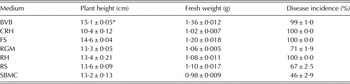
Among the seven culture substrates, BVB No. 4 peat moss was the best substrate for the growth of cucumber seedlings, which reached on average 15·1 cm in plant height and 1·4 g in fresh weight. However, it did not reduce the incidence of damping-off caused by P. aphanidermatum PA01 (Table 1). The RGM, RS, RH and SBMC substrates did not show significant differences in plant height, ranging from 13·2 to 13·6 cm; however, CRH was unfavourable for the growth of cucumber seedlings. The incidences of damping-off were not decreased in RH, FS and CRH; SBMC was the most effective substrate for the suppression of Pythium damping-off, but the cucumber seedlings did not grow as well as those in BVB. Although RGM was the basal substrate of SBMC, the disease incidence was decreased from 71% in RGM to 46% in SBMC (Table 1).
Effect of seven culture media on the growth and the disease incidence of Pythium damping-off in 14-day-old cucumber seedlings

* Significantly different at P < 0·05 according to Tukey's HSD test. Mean ± standard error (s.e.). d.f. = 6.
Effect of formulated container medium on the growth and Pythium damping-off of cucumber seedlings
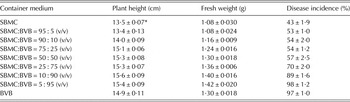
The formulated container medium contained two substrates: the SBMC medium, which strongly inhibited Pythium damping-off of cucumber seedlings, and BVB No. 4 peat moss, which was most effective for the growth of cucumber seedlings in the present study. Among seven different ratios of the two substrates, the current results revealed that the mixture of 50% (v/v) SBMC with 50% (v/v) BVB No. 4 peat moss was suitable for the growth of cucumber seedlings and also able to suppress the incidence of Pythium damping-off. The results showed that the incidence of Pythium damping-off increased significantly (P < 0·05) with increasing proportions of BVB No. 4 peat moss and decreased with increasing proportions of SBMC (Table 2). The disease incidence reduced from 98% in 5% of SBMC to 53% in 95% of SBMC. Therefore, the base of the formulated container medium consisted of SBMC medium mixed with BVB No. 4 peat moss at a ratio of 50 : 50 (v/v) was chosen for the following experiments.
Effect of spent blewit mushroom compost amended with different ratios of BVB No. 4 peat moss on growth of cucumber seedlings and disease incidence of Pythium damping-off caused by Pythium aphanidermatum
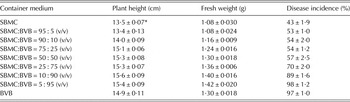
* Significantly different at P < 0·05 according to Tukey's HSD test. Mean ± standard error (s.e.). d.f. = 8.
Effect of formulated container media with or without lime on Pythium damping-off of cucumber seedlings
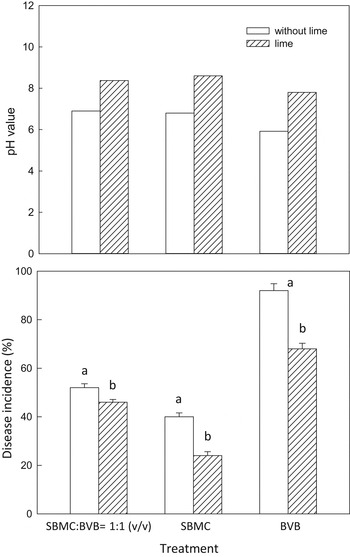
In all container media, the pH values were increased by the addition of lime. The pH value of the SBMC: BVB medium at 50 : 50 (v/v) was raised from 6·49 to 8·37 when amended with 0·3% (w/v) lime (Fig. 1). The SBMC, BVB and 50 : 50 (v/v) SBMC: BVB media amended with 0·3% lime showed slightly reduced incidences of Pythium damping-off compared to media without supplemental lime. The SBMC: BVB medium at 50 : 50 (v/v) amended with 0·3% (w/v) lime was selected as the major component for formulation of a container medium, SBPC, which suppressed P. aphanidermatum.
The pH value of three culture media with or without lime 0·3% (w/v) and their efficacy on disease incidence of Pythium damping-off in cucumber seedlings caused by Pythium aphanidermatum at 28 °C in the greenhouse. The three media are spent blewit mushroom compost (SBMC), BVB No.4 peat moss (BVB) and 50% (v/v) SBMC and 50% (v/v) BVB (SBMC : BVB = 1 : 1 (V/V)).

Effect of heat treatment of container media on disease incidence and microbial populations of spent blewit peat compost medium
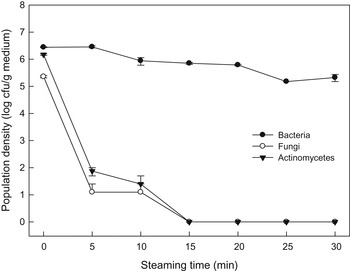
Steaming of the SBMC and SBPC media at 100 °C for 30 min did not increase the mortality of cucumber seedlings significantly (Table 3). However, the incidence of disease in cucumber seedlings in autoclaved SBMC and SBPC increased from 36 and 42% to 48 and 56%, respectively. The disease incidence of cucumber seedlings in BVB was high even after the heat treatment (Table 3). The colony-forming units (cfu) of bacterial populations in the SBPC medium ranged from 2·8 × 106 to 2·1 × 105 cfu/g dry medium after steaming treatment at 100 °C for 5–30 min (Fig. 2). However, the populations of fungi in the SBPC medium were reduced from 2·3 × 105 cfu/g dry medium to zero after steaming treatment at 100 °C for 15–30 min. Similar results were observed for actinomycetes. After steaming at 100 °C for 15–30 min, the populations of actinomycetes in the SBPC medium were decreased from 1·5 × 106 cfu/g dry medium to zero (Fig. 2).
Population densities of bacteria, fungi and actinomycetes in SBPC medium, consisting of 50% (v/v) spent blewit mushroom compost and 50% (v/v) BVB No.4 peat moss with 0·3% (w/v) lime after steaming at 100 °C for 0, 5, 10, 15, 20, 25, or 30 min.

Effect of autoclaved and steamed media on disease incidence of Pythium damping-off caused by Pythium aphanidermatum

* SBMC, spent blewit mushroom compost; BVB, BVB No. 4 peat moss; SBPC, 50% (v/v) SBMC, 50% (v/v) BVB and 0·3% (w/v) lime.
† Significantly different at P < 0·05 according to Tukey's HSD test. Mean ± standard error (s.e.). d.f. = 2.
Effects of steamed spent blewit peat compost mixed with micro-organisms on the growth and disease incidence of cucumber seedlings
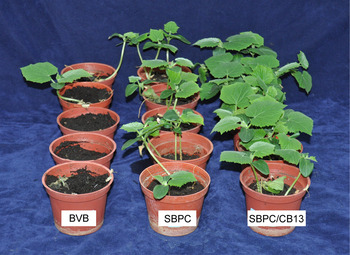
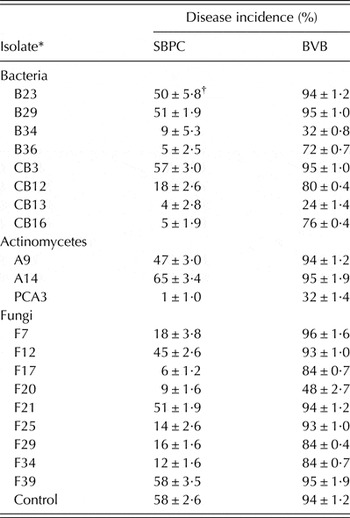
Twenty micro-organisms isolated from SBMC, including eight bacterial, three actinomycetes and nine fungal isolates, were inoculated into steamed SBPC to test the inhibition of Pythium damping-off. Among the eight bacterial isolates, B34, B36, CB13 and CB16 had the ability to reduce the disease incidence to <9% (Table 4). The bacterial isolate CB13 was the most effective in controlling Pythium damping-off (Fig. 3): disease incidence was reduced from 58% in steamed SBPC to 4% in that amended with CB13 (Table 4). A similar result was obtained for the actinomycete isolate PCA3; the incidence of cucumber damping-off was 1% when PCA3 was added to steamed SBPC (Table 4). The incidence of Pythium damping-off in steamed SBPC mixed with F17 and F20 was 6 and 9%, respectively (Table 4).
Effect of SBPC medium and Bacillus aryabhattai CB13 combination on disease incidence of Pythium damping-off of cucumber seedlings caused by Pythium aphanidermatum at 28 °C in the greenhouse. The SBPC medium consisted of 50% (v/v) spent blewit mushroom compost, 50% (v/v) BVB No.4 peat moss and 0·3% (w/v) lime, and was mixed with 108 CFU/ml of B. aryabhattai CB13 at 30 °C 3 days prior to use (colour online) .

Effects of steamed SBPC and BVB medium inoculated with 20 micro-organisms isolated from SBMC on disease incidence of Pythium damping-off in cucumber seedlings

* Each isolate of bacterium, actinomycete or fungus was inoculated with sterilized SBPC and BVB No.4 peat moss for 3 or 10 days before seeding with pre-germinated cucumber seeds in the greenhouse.
† Significantly different at P < 0·05 according to Tukey's HSD test. Means ± standard error (s.e.). d.f. = 19.
Steamed BVB medium was also inoculated with 20 micro-organisms and tested for suppression of Pythium damping-off of cucumber seedlings. Disease incidence was reduced from 94% in the steamed BVB control to 32 and 24% with the addition of bacterial isolates B34 and CB13, respectively (Table 4). The disease suppression of steamed SBPC inoculated with bacterial isolates was better than that of steamed BVB with the bacterial isolates. Therefore, an effective bio-formulation was prepared by inoculation of the antagonistic microbe CB13 into steamed SBPC medium.
Identification of antagonistic micro-organisms by DNA sequencing
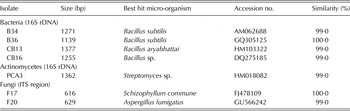
Four bacteria, one actinomycete and two fungi significantly reduced the incidence of damping-off when mixed with steamed SBPC medium. The sequences of 16S rDNA were used to identify the bacteria and actinomycete. The results showed that all of the bacteria belonged to the genus Bacillus and had sequence similarity that ranged from 99·0 to 100·0% (Table 5). Isolates B34 and B36 were identified as Bacillus subtilis, while CB13 was a member of Bacillus aryabhattai. Moreover, the 16S rDNA of PCA3 was the same as that of Streptomyces sp. (DQ275185) and had a sequence similarity of 99·0% (Table 5). Based on the sequence of the ITS region, fungal isolates F17 and F20 were identified as Schizophyllum commune and Aspergillus fumigatus (Table 5).
Identification of the antagonistic micro-organisms isolated from SBMC by 16S rDNA or ITS region sequences

DISCUSSION
Several bio-formulations were developed for biological control against soil-borne fungi, including R. solani and F. oxysporum f. sp. melonis (Huang & Huang Reference Huang and Huang2000; Suárez-Estrella et al. Reference Suárez-Estrella, Vargas-García, López, Capel and Moreno2007; Kakvan et al. Reference Kakvan, Heydari, Zamanizadeh, Rezaee and Naraghi2013). A container media made of agricultural wastes, SFMC, has been used for growing cabbage and cucumber seedlings in greenhouse nurseries (Huang & Huang Reference Huang and Huang2000; Wang & Huang Reference Wang and Huang2000). In the present study, BVB and SBMC were used as basic substrates for making SBPC. The SBMC was an effective substrate against P. aphanidermatum. The disease incidence ranged from 36 to 46% in different SBMC media in the present study (J. T. Chen, unpublished data). The commercial growth medium BVB has been used as a container medium for the growth of cucumber seedlings in greenhouse nurseries in Taiwan (Wang & Huang Reference Wang and Huang2000). However, it was ineffective for the suppression of Pythium damping-off of cucumber seedlings caused by P. aphanidermatum. Thus, SBPC consisting of 50% SBMC, 50% BVB and lime was developed as a potential medium for cucumber planting because it promoted seedling growth and suppressed Pythium damping-off. Several researchers have studied control of soil-borne pathogens by blending calcium with compost, which has been shown to reduce disease incidence significantly (Kao & Ko Reference Kao and Ko1986; Huang & Huang Reference Huang and Huang2000). A similar result was found in the present study, as the addition of lime to the formulated medium reduced the incidence of Pythium damping-off slightly. The amended lime is available for micro-organisms to grow and is suppressive to Pythium splendens in the cucumber rhizosphere (Kao & Ko Reference Kao and Ko1986).
In the present study, SBMC modified from RGM showed higher suppression of Pythium damping-off than RGM itself. This result suggested that substances produced by C. nuda had the ability to suppress Pythium damping-off. The inhibitory effects of culture filtrates of C. nuda on the growth of plant fungal and bacterial pathogens have been demonstrated in previous studies (Chen & Huang Reference Chen and Huang2009). The antimicrobial compounds of C. nuda against Phytophthora capsici have been identified as 2-methoxy-5-methyl-6-methoxymethyl-p-benzoquinone, indole-3-carbaldehyde and 6-Hydroxy-2H-pyran-3-carbaldehyde (Chen et al. Reference Chen, Su and Huang2012). The inhibitory effects of SBPC medium on P. aphanidermatum were also associated with microbial activity because the inhibitory effect was partially nullified by autoclaved treatment. A similar result was observed by Huang & Huang (Reference Huang and Huang2000). The suppression of R. solani was restored to the steamed SSC-06 medium by inoculation with Trichoderma harianum, which was isolated from SFMC (Huang & Huang Reference Huang and Huang2000).
The addition to compost of a biological agent as a bio-formulation is used widely for controlling plant diseases (Suárez-Estrella et al. Reference Suárez-Estrella, Vargas-García, López, Capel and Moreno2007, Reference Suárez-Estrella, Jurado, Vargas-García, López and Moreno2013; Blaya et al. Reference Blaya, López-Mondéjar, Lloret, Pascual and Ros2013; Kakvan et al. Reference Kakvan, Heydari, Zamanizadeh, Rezaee and Naraghi2013). Hadar & Papadopoulou (Reference Hadar and Papadopoulou2012) indicated that there were five possible mechanisms of suppression in such composts: (1) improving plant nutrition and resistance to disease; (2) competition for nutrients by beneficial micro-organisms; (3) production of antibiotics or other compounds against pathogens; (4) predation or parasitism of pathogens by micro-organisms; and (5) induced resistance of plants by compost microbes (Hadar & Papadopoulou Reference Hadar and Papadopoulou2012). The composts with microbial activity are able to fight plant pathogens (Mandelbaum et al. Reference Mandelbaum, Hadar and Chen1988; Theodore & Toribio Reference Theodore and Toribio1995; Hoitink et al. Reference Hoitink, Stone and Han1997; Tilston et al. Reference Tilston, Pitt and Groenhof2002). In the present study, antagonistic micro-organisms were isolated from the SBMC medium and were able to utilize SBMC for their growth. Their effects on reducing disease incidence and promoting plant growth in steamed SBPC were assayed as a bio-formulation. The results showed that the presence of antagonistic micro-organisms in steamed SBPC medium greatly enhanced the suppression of Pythium damping-off. The effective micro-organisms were identified as B. subtilis, Bacillus licheniformis, B. aryabhattai, Streptomyces sp., S. commune and A. fumigatus.
The genus Bacillus, containing the most common bio-control agents, can promote plant growth and induce systemic resistance of plants (Santoyo et al. Reference Santoyo, del Orozco-Mosqueda and Govindappa2012). Bacillus subtilis is an important microbe with activity against phytopathogens in compost, including P. aphanidermatum in tomato (Theodore & Toribio Reference Theodore and Toribio1995; Jenana et al. Reference Jenana, Haouala, Triki, Godon, Hibar, Khedher and Henchi2009), R. solani damping-off in tomato (Asaka & Shoda Reference Asaka and Shoda1996) and F. oxysporum f. sp. tracheiphilum in asparagus bean (Ha et al. Reference Ha, Huang and Huang2008). Bacillus licheniformis has also been used as a biological control agent (Lee et al. Reference Lee, Lee, Kim, Son, Song, Lee, Kim, Jung and Moon2006). In particular, the beneficial microbe B. aryabhattai isolate CB13 had a higher inhibition activity than B. subtilis. Bacillus aryabhattai was first found in the upper atmosphere at altitudes of 40·0–41·4 km (Shivaji et al. Reference Shivaji, Chaturvedi, Begum, Pindi, Manorama, Padmanaban, Shouche, Pawar, Vaishampayan, Dutt, Datta, Manchanda, Rao, Bhargava and Narlikar2009) and never reported as a bio-control agent. Thus, a novel bio-formulation was based on spent blewit compost inoculated with a potential bio-control agent B. aryabhattai. Further studies on the mechanisms of this new bio-formulation are needed.
This research was supported in part by the Ministry of Science and Technology, Taiwan under grant number NSC-102-2911-I-005-301, NSC103-2911-I-005-301 and the Ministry of Education, Taiwan under the ATU Plan.